



































The Rise of Custom Construction Project Management Software in Australia: What’s Driving Adoption in 2026?

 Share -



- 01A $443 Million Construction Market Still Running on Spreadsheets
- 02Why 2026 Is the Tipping Point for Construction Technology Adoption in Australia?
- 03Six Forces Driving the Adoption of Construction Project Management Software Development in Australia?
- 04Why Generic Construction Software Often Falls Short for Australian Businesses
- 05What a Purpose-Built Construction PM Platform Actually Needs to Do
- 06Build vs. Buy: An Honest Framework for Australian Construction Firms
- 07What Custom-Built Construction PM Software Looks Like in Practice
- 08How to Develop Australian Construction Management Software in Australia?
- 09The Cost and ROI of Custom Construction Software: What Australian Firms Are Actually Calculating
- 10Looking Ahead: Construction Software Technology Trends in Australia
- 11How Appinventiv Approaches Construction Project Management Software Development in Australia
- 12Frequently Asked Questions

Key takeaways:
- Australian construction firms are adopting project management software less as a tech upgrade and more as a survival response to margin pressure, compliance complexity, and delivery risk.
- 2026 adoption is being shaped by labour shortages, cost volatility, AI-enabled workflows, ESG reporting, and demand for real-time project visibility.
- The shift is moving beyond scheduling tools toward integrated construction operating systems connecting field, finance, procurement, safety, and reporting.
- The cost of construction project management software development in Australia ranges between AUD 70,000 and AUD 700,000 or more.
Construction software adoption among Australian builders increased 34% year-on-year in 2025, driven largely by firms under 10 employees seeking integrated project management software. Yet 67% of small builders still manage projects on spreadsheets, costing them 10+ hours per week in duplicated admin.
That contrast tells a precise story. It is not that the industry lacks digital appetite. The platforms available have not been designed with Australian construction workflows in mind. NCC compliance, GST-based progress claims, SWMS obligations, Xero and MYOB integration, offline capability for remote sites across WA, Queensland, and the Northern Territory, for most global SaaS products, these are treated as edge cases handled through workarounds or ignored entirely.
Construction Project Management Software development in Australia is accelerating for reasons that go beyond technology cycles. Firms that cannot achieve real-time cost visibility, meet compliance deadlines, and satisfy procurement documentation requirements are being systematically excluded from contracts that matter.
This blog examine the six macro forces six forces shaping this moment are structural, not cyclical. Understanding them is the starting point for any construction leader deciding where their technology investment goes next.
Appinventiv helps Australian enterprises engineer custom construction management platforms designed around operational workflows, governance requirements, and long-term scalability.

A $443 Million Construction Market Still Running on Spreadsheets
The Australian construction software market is projected to reach $443.1 million by 2030, growing at 11.3% annually. Technology’s share of construction budgets nearly doubled between 2023 and 2025. On paper, the sector looks like one of the faster-moving digitisation stories in Australian enterprise.
On site, the picture is different. Firms are spending more on technology without necessarily spending it on the right things. Tools accumulate. Integrations stay partial. Data sits in separate systems that do not talk to each other, and project managers fill the gaps manually.
That is not a technology maturity problem. It is a fit problem. The platforms absorbing that investment were largely built for other markets, other compliance contexts, and other operational realities. Australian construction has specific demands, and most of those demands are being managed around rather than through the software firms are paying for.
The promise of construction digitalisation in Australia is real. The gap between that promise and execution is where most organisations are genuinely stuck. 2026 is where that tolerance runs out.
Also Read: Top Software Development Methodologies in Australia
Why 2026 Is the Tipping Point for Construction Technology Adoption in Australia?
Multiple structural forces converged in 2026 simultaneously. For the first time, deferring digitisation carries a quantifiable commercial cost, not just an operational inconvenience. Compliance deadlines, procurement requirements, and a tightening labour market have combined to make construction project management software in Australia a baseline operational requirement rather than a strategic option. Some other reasons driving the rapid adoption of construction technology in Australia are:
- The National Construction Code 2025 became mandatory across Victoria, Tasmania, Western Australia, and the ACT from May 2026. Any project commencing design after that date must comply, and that compliance generates documentation and workflow requirements that spreadsheets cannot satisfy.
- The Brisbane 2032 Olympic Games infrastructure pipeline is simultaneously accelerating procurement timelines for civil and commercial contractors, with digital project documentation embedded in tender requirements as a baseline condition.
- 43.8% of Australian construction respondents report AI adopted at scale, against a 24% global benchmark. That gap reflects urgent adoption drivers and a maturity of delivery capability not seen elsewhere in Asia-Pacific.
Firms that have not consolidated project management, compliance, and financial reporting into a coherent system are finding that procurement panels, government contracts, and major subcontracting arrangements require it as a pre-entry condition.
Six Forces Driving the Adoption of Construction Project Management Software Development in Australia?
Regulatory transformations and severe economic pressures are forcing construction firms to abandon legacy operational tools entirely. Here are the six core forces that make underpowered systems a liability and forcing adoption:
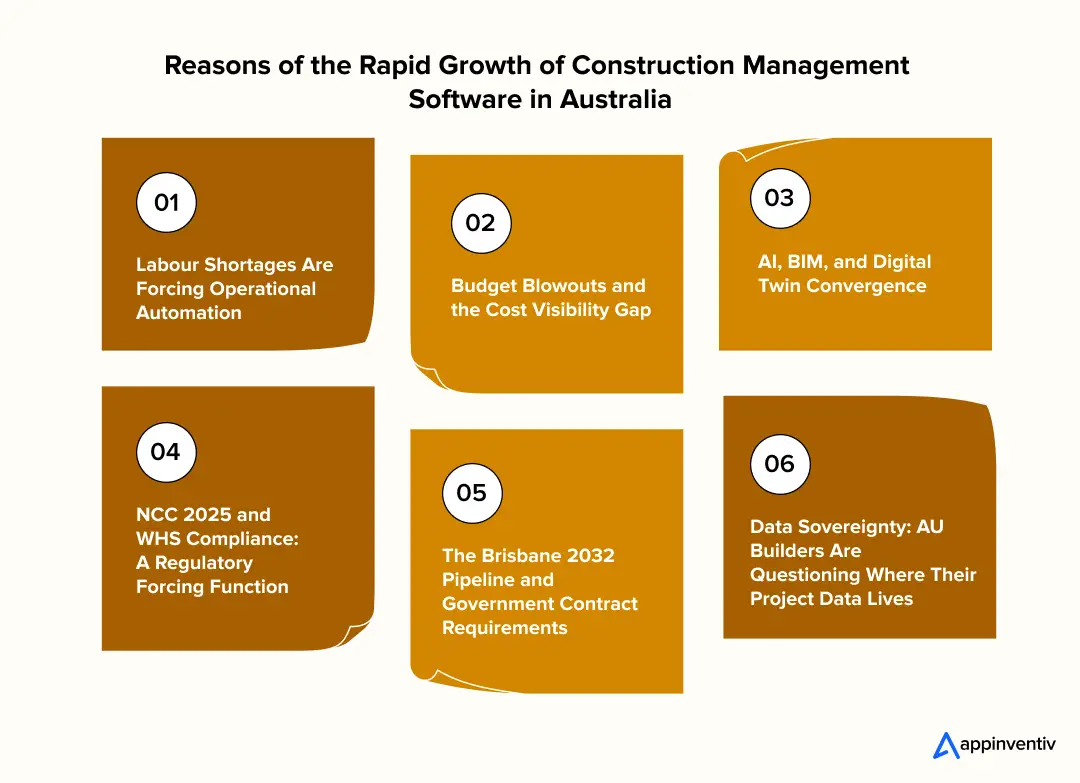
1. Labour Shortages Are Forcing Operational Automation
The US construction sector faces a projected shortfall of 499,000 workers by 2026, up from 439,000 in 2025. Similar workforce pressures exist in Australia. That is a structural condition, not a recruitment cycle.
When a project manager coordinates three sites through phone calls, email chains, and manual reconciliation, the labour shortage is compounded rather than managed. Construction Project Management Software development in Australia is increasingly focused on reducing this coordination overhead: automated task assignment, exception-based alerts, and progress reporting drawn from live field data rather than from a separate reporting process.
Construction site monitoring software, when integrated with a broader project management layer, allows smaller teams to maintain visibility across multiple concurrent sites without the daily firefighting that defines site-to-office communication in firms that have not digitised.
2. Budget Blowouts and the Cost Visibility Gap
Most mid-tier Australian construction firms discover overspend after it has already occurred. End-of-month job cost reconciliation means variations compound before they are caught.
New residential building work in Australia was valued at over $20.6 billion in the June 2025 quarter alone. Dwelling completions dropped 6.5% in the same period. That divergence between investment and delivery is not purely a materials or labour problem. It is a project management systems problem.
A purpose-built residential construction software surfaces cost-to-complete against budget in real time, flags variations before they are approved, and connects procurement decisions to financial impact without requiring a finance team to generate separate reports. For firms managing multiple concurrent projects on thin margins, that visibility is not a luxury; it is the mechanism through which margin is either protected or lost.
3. NCC 2025 and WHS Compliance: A Regulatory Forcing Function
The National Construction Code grew from a 93-page document in 1993 to 889 pages in 2022, excluding the 120-plus referenced Australian Standards. Managing compliance manually at that volume is not just inefficient. It is a liability.
Construction safety software and construction risk software in Australia both address specific parts of this challenge: SWMS version control, WHS incident recording, psychosocial risk documentation, and induction tracking. Under the expanded WHS Act obligations now in force, these are board-level liabilities if not managed systematically, not administrative tasks delegated to a compliance officer.
Construction Management Software development in Australia increasingly treats compliance not as a bolt-on module, but as an architectural layer embedded across every workflow in the platform, from procurement through to field sign-off.
4. The Brisbane 2032 Pipeline and Government Contract Requirements
The Brisbane Olympic Stadium carries an estimated construction cost of AUD 3.785 billion, with ground-breaking expected in June 2026. The broader 2032 Games infrastructure program represents one of the largest sustained construction pipelines in Australian history.
Queensland’s Gateway by ICN procurement platform is the primary mechanism for supplier access to this pipeline, and the expectations embedded in those procurement requirements assume digital project management as a baseline. This is not a recommendation. It is a selection criterion.
For Tier 2 and Tier 3 contractors positioning to enter this pipeline, the question is not whether to adopt construction project management software in Australia, but whether their current platform produces the audit trails, variation documentation, and NCC 2025-compliant records that tender evaluators actually require.
5. AI, BIM, and Digital Twin Convergence
Australian construction respondents report AI at scale at nearly double the global benchmark. That gap reflects real operational pressure more than technology enthusiasm. Projects using high-fidelity digital twins in construction have shown a significant reduction in total lifecycle costs compared to BIM-only workflows, based on a 2025 analysis of Australian infrastructure projects.
AI-powered solutions in Australian construction are projected to increase productivity by 31% by 2030. Australian construction management software development is increasingly architected to integrate these capabilities natively rather than through bolt-on connections.
6. Data Sovereignty: Where Project Data Lives Is Now a Governance Question
64.4% of Australian AEC respondents are very or extremely concerned about data ownership and control when selecting technology vendors, more than double the global benchmark of 37.8%.
Government contracts in infrastructure, defence-adjacent projects, and health sector builds increasingly specify data residency requirements. IRAP-evaluated cloud infrastructure hosted within Australian jurisdiction is becoming a procurement condition. Global SaaS platforms often offer AU data hosting as a premium configuration. A custom-built platform makes it the default, with architecture selected and documented from project inception.
The question for Australian construction leaders in 2026 is no longer whether to digitise. It is whether the platform being used was built for someone else’s business.
Also Read: Data Sovereignty in Australia: Audit Checklist in 2026
If two or more of those six pressures are live problems inside your business right now, the architecture of your current platform is worth a harder look. We can run that assessment with you.
Why Generic Construction Software Often Falls Short for Australian Businesses
The gap between what a global platform can do and what an Australian construction firm needs becomes clearest at the point of operational failure: the month-end reconciliation still requiring three spreadsheets, the compliance document that cannot be produced on site, the progress claim that triggers a dispute because the format was not right. These are not edge cases in construction management software in Australia. They are weekly realities for firms that have not built for their context.
What a Purpose-Built Construction PM Platform Actually Needs to Do
No two construction businesses operate the same way. A regional builder in WA manages projects differently from a Tier 2 commercial contractor in Brisbane. A purpose-built platform should reflect that. The architecture, the modules, the integrations – all of it gets designed around how a specific business actually runs, not how a vendor assumed it would.
The starting point is always the operation, not a feature list.
- How does the firm manage variations?
- Where do costs get lost?
- What does a site supervisor actually need on a phone at 7 A.M. on a remote NT site?
These questions produce a different platform every time, based on the unique business needs.
Some requirements come up consistently across Australian construction firms. Progress claims need to match Security of Payment Act formats that vary by state. SWMS needs version control and mobile sign-off with an audit trail. Payroll needs to run against Australian award rates. These are not features to check off. They are the baseline the rest of the platform builds on.
Above that baseline, the architecture diverges. A civil contractor entering government procurement needs a different document management layer than a residential construction software managing client selections. An infrastructure firm running five concurrent sites needs different reporting logic than a boutique commercial builder running two. Getting that architecture right is the job. It cannot be templated.
Advanced Capabilities Worth Building For
The advanced capabilities such as AI-driven schedule risk, BIM integration, digital twin connectivity, and IoT equipment tracking, get layered in where they solve a real problem for that specific firm. Not because they are on a trends list.
Build vs. Buy: An Honest Framework for Australian Construction Firms
Off-the-shelf platforms serve a purpose. For a sole trader running residential builds on standard workflows, a $99/month subscription tool is often the right starting point. But as project complexity grows, compliance obligations multiply, and procurement requirements tighten, the economics and operational fit of pre-built platforms deteriorate in ways that are predictable and quantifiable. The challenges while building a software for construction project management are real, but so are the compounding costs of running on an off-the-shelf system built for someone else.
| Evaluation Criteria | Commercial Off-The-Shelf (SaaS) | Custom-Built Software |
|---|---|---|
| Upfront Investment | Low initial capital cost; standard flat implementation fees. | High initial capital expenditure required for scoping, engineering, and design. |
| Total Cost of Ownership | Escalates predictably and aggressively with per-user licensing as the firm scales headcount. | Fixed intellectual property asset; the marginal software cost approaches zero as the user base grows. |
| Workflow Alignment | Forces the business to painfully adapt existing operational processes to match the software’s rigid logic. | Software is engineered specifically and exclusively to match the business’s proprietary, proven workflows. |
| Integration Depth | Relies heavily on generic APIs; often requires brittle third-party middleware for complex financial links. | Deep, robust, native integration established with existing local ERPs, financial tools, and necessary legacy systems. |
| Compliance & Data | The vendor dictates data location; critical updates to local compliance standards may take years to roll out globally. | Total control over data sovereignty through onshore hosting; compliance adaptations are deployed immediately upon legislative changes. |
The case for a custom construction software becomes strong when two or more of the following apply:
- The current SaaS tool requires regular workarounds for AU-specific compliance requirements
- The firm operates across multiple states with different regulatory obligations; procurement requirements mandate data residency or audit-ready documentation that the existing platform cannot produce natively
- The firm’s workflows have diverged far enough from a generic template that configuration no longer closes the gap.
The challenges while building a software for construction project management are manageable risks with a structured delivery methodology. A poorly configured SaaS platform running on workarounds for five years creates unbounded operational risk. A well-scoped custom build creates bounded risk with a definable resolution.
What Custom-Built Construction PM Software Looks Like in Practice
A truly effective custom solution is not a cloned template. It is a digital platform engineered exclusively for how your specific business builds. Here are some hypothetical scenarios that illustrate how a custom construction software actually delivers to your unique business needs:
Mid-Tier Commercial Builder in Queensland
A Brisbane contractor runs 15 to 20 concurrent projects. Industrial, retail, residential apartments – all running simultaneously. Month-end is painful. The accounting system does not connect to the project tool. Subcontractor retention lives in a spreadsheet. Progress claims go out in the wrong format and come back disputed.
A custom platform changes all three. MYOB connects natively. Retention calculates automatically. Progress claims generate in Security of Payment Act-compliant format for Queensland with one action. The finance team stops reconciling and starts reviewing.
Infrastructure Contractor Entering the Brisbane 2032 Pipeline
A Tier 2 civil contractor positioning for Brisbane 2032 subcontracting packages needs digital RFI workflows, full traceability on design variations, and NCC 2025-compliant documentation across every active project.
A custom platform is built with a government project module from the ground up. Audit-ready reporting. Digital RFI trails. Document management hosted on Australian infrastructure. The contractor enters the procurement environment with documentation that meets evaluation criteria from day one.
Regional Builder Across Western Australia and the Northern Territory
A mid-market residential builder operating across remote WA and NT sites with unreliable connectivity and mixed workforces needs an offline-capable mobile app that syncs site diaries, SWMS sign-offs, and progress photos when connectivity resumes.
The Perth back-office sees live project status without daily phone calls. Payroll integrates with Australian award rates. Achieving the same outcome on a generic platform required three separate integrations and a custom connector built at additional cost.
How to Develop Australian Construction Management Software in Australia?
The difference between construction software that transforms operations and software that collects dust on a server is rarely the technology. It is how the development process is structured. Here are the best practices for developing a construction management software
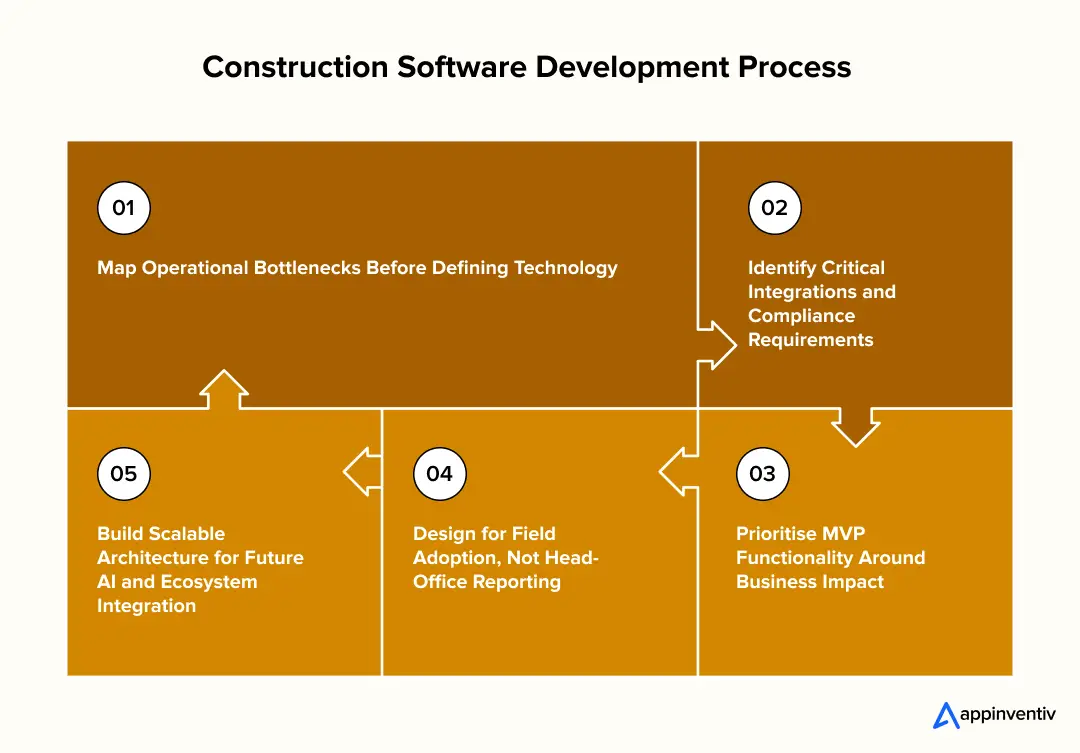
Map Operational Bottlenecks Before Defining Technology
Start with where projects lose time and money. Map operational bottlenecks before defining technology. Audit all existing processes meticulously to locate exact points of friction. If manual data entry between the field and the office takes four hours a day, that is the primary problem the architecture must solve.
Identify Critical Integrations and Compliance Requirements
Before any architecture decisions, map the systems the platform must connect to: ERP, accounting (Xero, MYOB, or SAP), state licensing databases, and field reporting tools. Compliance requirements, NCC 2025, WHS, Security of Payment Act, QBCC, define non-negotiable modules from day one.
Prioritise MVP Functionality Around Business Impact
Do not attempt to build every possible feature simultaneously. Launch a highly focused Minimum Viable Product centred purely on the core modules that deliver immediate financial relief.
Design for Field Adoption, Not Head-Office Reporting
A platform that project directors find useful but site supervisors abandon delivers a fraction of its value. Field adoption requires mobile-first design, offline capability, and interfaces that work for workers managing physical complexity on site.
Build Scalable Architecture for Future AI and Ecosystem Integration
An API-first architecture with clean data models allows AI capability, digital twin integration, and third-party connections to be added as the platform evolves, without requiring rearchitecting from the ground up. This is where firms that build Australian construction management software with long-term intent separate from those optimising only for initial deployment.
As Brisbane 2032 delivery programs accelerate, technology readiness is increasingly intersecting with compliance readiness, audit readiness, and subcontractor ecosystem visibility.

The Cost and ROI of Custom Construction Software: What Australian Firms Are Actually Calculating
Custom construction software development cost in Australia is not a fixed-price product. Scope, module complexity, and integration requirements shape the investment. On average, the development investment for a custom construction management platform in Australia ranges from AUD 70,000 to AUD 700,000+, depending on scope.
| Software Type | What It Covers | Estimated Cost Range |
|---|---|---|
| Core MVP | Job costing, scheduling, mobile site diary, basic compliance | AUD 70,000 – 150,000 |
| Mid-tier platform | MVP plus SWMS, subcontractor management, progress claims, accounting integration | AUD 150,000 – 300,000 |
| Full enterprise system | All modules plus AI risk modelling, BIM integration, government project layer, reporting | AUD 300,000 – 700,000+ |
| Ongoing maintenance | Bug fixes, compliance updates, iterative feature additions | AUD 15,000 – 40,000/year |
Benefits of Construction Software In Australia: Where Firms Typically Recover The Investment:
- Project managers spending 10+ hours weekly on admin recover roughly AUD 39,000% person per year in productive capacity
- AI-driven platforms reduce project costs by up to 20% through predictive scheduling and early risk detection
- Payback window for most mid-market Australian firms sits between 18 and 30 months
- Government and infrastructure contracts requiring audit-ready documentation become accessible without additional platform spend.
Looking Ahead: Construction Software Technology Trends in Australia
The construction software technology trends in Australia in the coming years are not projections to monitor passively. They are architectural decisions to make now: in how platforms are structured, what data models are chosen, and which integrations are built as foundational rather than optional. Firms that wait will find themselves re-platforming rather than iterating.
Agentic AI in Construction Operations
AI agents in Australia will move from passive reporting tools to active participants in project coordination, flagging risk, triggering procurement actions, and escalating compliance issues without requiring manual intervention.
Predictive Project Intelligence
Machine learning models trained on historical project data will surface schedule risk and cost deviation signals weeks before they materialise as problems. This shifts project controls from reactive to predictive.
ESG and Sustainability Reporting Integration
With 51% of Australian construction firms embedding sustainability practices into operations against a global average of 42 percent, platforms need native carbon tracking and ESG reporting modules to satisfy client and investor reporting requirements.
Digital Twin-Enabled Project Ecosystems
Digital twin linkage in the Australian construction industry will extend beyond design verification into operational monitoring. This enables real-time structural telemetry and lifecycle cost modelling from a single data environment across the full project portfolio.
How Appinventiv Approaches Construction Project Management Software Development in Australia
Construction software development services in Australia require more than engineering capability. It also needs proven delivery experience across Australian compliance frameworks, procurement environments, and enterprise integration requirements. Appinventiv brings both.
Over the past decade, we have built and deployed custom digital platforms across 35+ Australian industries, including construction, real estate, infrastructure, and field services. That breadth matters less than the depth. When firms in property development and real estate, including clients like Ility and HouseEazy, work with us to build transaction and project management platforms, the recurring challenge is the same one construction firms face: generic tools create workarounds, and workarounds create operational debt.
Our team of 1600+ custom software developers in Australia approach construction platform builds with a discovery phase that starts on the problem, not the feature list. What is actually losing time? Where are costs being discovered too late? Which compliance obligations are currently managed through a combination of hope and spreadsheets?
The platform we deliver is API-first, built to accommodate AI capability, digital twin integration, and whatever regulatory changes land next, without rearchitecting from the ground up.
We hold ISO 27001, ISO 9001, and SOC2 certifications, which matters practically for firms entering government procurement panels or infrastructure contracts where data governance is a selection criterion, not a checkbox.
For construction leaders evaluating whether their current platform is genuinely serving their operations or simply managing their tolerance for workarounds, the right starting point is a scoping conversation grounded in how your business actually builds. Talk to our construction technology team today.
Frequently Asked Questions
Q. What is construction management software?
A. Construction management software is a digital platform that centralises project scheduling, budgeting, document control, compliance management, subcontractor coordination, and financial reporting across construction projects.
Q. Why are Australian builders adopting construction project management software in 2026?
A. Six compounding factors are driving adoption of construction project management software in 2026:
- Labour Shortages are Forcing Operational Automation
- Budget Blowouts and the Cost Visibility Gap
- NCC 2025 and WHS Compliance: A Regulatory Forcing Function
- The Brisbane 2032 Pipeline and Government Contract Requirements
- AI, BIM, and Digital Twin Convergence
- Data Sovereignty Requirements
No single factor is decisive. All six operating simultaneously make inaction increasingly expensive.
Q. What is the real cost of construction project management software development in Australia?
A. The real cost of construction management software development in Australia ranges between AUD 70,000 and AUD 700,000 or more, depending on your project requirements.
Q. Why does the Australian construction industry require specialised software?
A. Australian construction operates under a distinct regulatory environment: the National Construction Code, the Work Health and Safety Act, state-specific licensing requirements (QBCC in Queensland, VBA in Victoria), Security of Payment Act obligations that vary by state, and government procurement frameworks that specify data residency and audit trail requirements. Global platforms treat these as edge cases. A custom-built platform treats them as core functionality, because for Australian operators, they are.
Q. How long does it take to build Australian construction management software?
A. The time it takes to build construction management software in Australia ranges from 3 to 12+ months, depending on the complexity of your project. Core modules, including job costing, compliance documentation, and mobile field access, are delivered first. Advanced AI and analytics capabilities are added in subsequent phases.
This sequencing delivers measurable ROI before the full platform is complete, which matters for organisations that need to justify investment through demonstrated outcomes rather than a full deployment event.


Fast 2-minute response, fully NDA-protected.

How Digital Twins in Construction in Australia Are Transforming the Industry in 2026
Key takeaways: A digital twin is a live, virtual representation of a physical building or infrastructure asset. Unlike static BIM models, it uses real-time data from IoT sensors to reflect the exact current state of the construction site. Key digital twin use cases in Australian construction include real-time structural telemetry and "exception-based" management to bypass…

Construction CRM Integration and Implementation – Benefits, Process, Costs
Efficiency is everything when it comes to the construction sector. Factors like project cost overruns, late delivery, mismanagement of resources, or poor and confusing communication from clients may lead to derailment of the projects at a significant loss. Traditional methods have failed to meet the challenges of tighter timelines and greater complexity that modern construction…

How Much Does it Cost to Build a White Label Construction Accounting Software?
By 2050, Autodesk predicts cranking out around 13,000 new buildings every single day to keep up with a massive urban population of 10 billion people. The need for new housing, schools, and hospitals is a big part of the puzzle—but it’s just the tip of the iceberg. The real hustle? Managing finances. Tracking expenses, processing…