































How to Build a Payment Gateway: Development Process, Cost, Architecture, and Best Practices

 Share -



- 01Step-by-Step Payment Gateway Development Process
- 02How Does a Payment Gateway Work & When Should You Build One?
- 03Signs Your Business Needs a Custom Payment Gateway
- 04Enterprise Payment Gateway Architecture
- 05Payment Gateway Security and Compliance
- 06Payment Gateway Integration Best Practices
- 07Common Challenges in Payment Gateway Development (and How to Overcome Them)
- 08Cost to Build a Payment Gateway
- 09Build vs. Buy vs. White-label vs. Payment Orchestration
- 10Custom Payment Gateway Use Cases by Industry
- 11Future Trends Shaping Payment Gateway Development
- 12Build Your Enterprise Payment Gateway With Appinventiv
- 13Frequently Asked Questions

Key takeaways:
- Build a PCI DSS-compliant gateway with security, speed, and scaling controls built into every layer.
- Compare custom builds, white-label options, payment orchestration, and off-the-shelf platforms to select the right strategy.
- Review the full development lifecycle from initial engine design to server deployment, live monitoring, and continuous updates.
- Examine the technical tools, banking links, and compliance rules required to handle global payments, prevent fraud, and maintain high uptime.
- See how machine learning, payment orchestration, and real-time bank rails change enterprise payment infrastructure.
Digital payments already span card networks, digital wallets, bank transfers, and real-time payment rails, supporting a projected $46.25 trillion market by 2031. Digital wallets already account for 56% of global eCommerce payments, making payment choice a core part of enterprise payment strategy.
As enterprises enter new markets, they face different payment methods, regulations, acquiring networks, and processing costs. Relying on a single provider can limit routing choices, increase dependence, and restrict control over payment economics. These pressures become harder to manage at high transaction volumes, where small differences in approval rates or processing costs can affect revenue.
Custom payment gateway software development gives enterprises greater control over transaction routing and processing. Businesses can connect with local acquirers, support regional payment methods, and link payment flows with accounting systems, fraud tools, and merchant dashboards. High-volume merchants use this control to manage payment performance, reduce vendor dependency, and build infrastructure around long-term growth.
This blog explains how to build a payment gateway for enterprise-scale payment processing, including its architecture, development process, security requirements, costs, and technical considerations.
Build payment infrastructure that supports higher volumes, new markets, multiple rails, and long-term transaction growth.
Step-by-Step Payment Gateway Development Process
When you build a PCI-compliant fintech app, your payment gateway setup requires a clear technical and financial plan. Every choice you make impacts approval rates, processing fees, compliance rules, and buyer experiences. You must guide your build from core business needs straight into architecture, processing, integrations, security, and production monitoring.
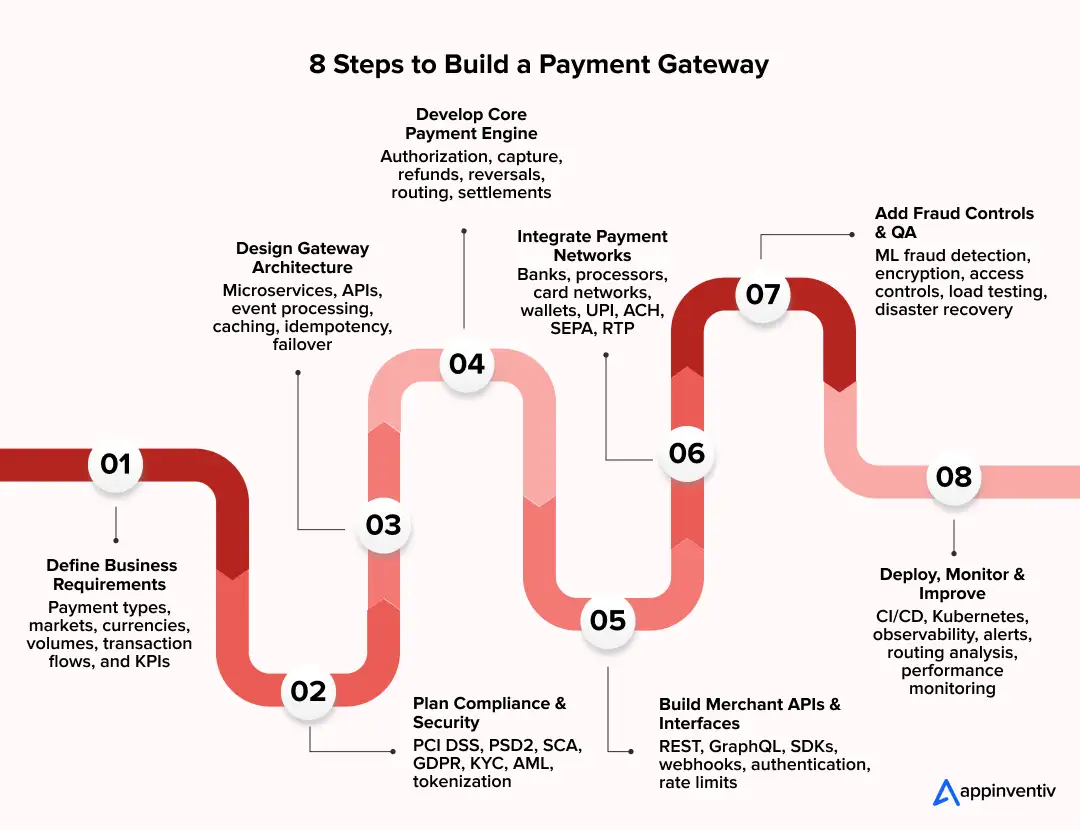
Step 1 – Define Business Requirements & Payment Strategy
You must start by defining your target payment types, transaction flows, compliance models, and infrastructure. Make sure you plan support for credit cards, digital wallets, bank transfers, Buy Now Pay Later, and real-time payment networks.
Define your target countries, local currencies, settlement rules, and expected volumes to guide your capacity planning and bank connections. Set clear requirements for merchant onboarding, recurring billing, split payouts, refunds, chargebacks, and subscriptions.
Finally, set precise targets for throughput, authorization rates, latency, uptime, Recovery Time Objective, and Recovery Point Objective to prevent rework.
Step 2 – Plan Compliance & Regulatory Requirements
Address your regulatory needs directly during architecture planning, because adding controls later inflates costs and delays certification. Use PCI DSS 4.0 as your baseline to protect cardholder records. If you operate in Europe, integrate PSD2 and Strong Customer Authentication rules.
For global coverage, build in GDPR data controls, AML screening, KYC workflows, and local central bank rules. Map all these mandates directly into your system by defining tokenization, encryption, logging, and access controls.
Step 3 – Design the Payment Gateway Architecture
Design your gateway architecture to remain fast and resilient under high traffic. When you build custom payment software, break authorization, routing, fraud, settlement, reconciliation, merchant tools, and reporting into independent microservices as required.
Next, structure your API gateway, event handling, caching layer, data storage, idempotency checks, fault tolerance, and multi-region deployment strategies. Ensure this architecture cleanly supports your chosen payment gateway development framework and long-term business expansion plans.
Step 4 – Develop the Core Payment Engine
Build your core engine to validate charges, route orders, track transaction states, and connect financial endpoints. Implement authorizations, authentications, captures, reversals, refunds, voids, settlements, and payouts.
Apply smart routing rules based on country, payment type, bank performance, transaction size, or seller preferences. Rely on state machines to track transactions, and configure retry logic, timeouts, and duplicate checks to maintain accuracy.
Step 5 – Build Merchant APIs & Payment Interfaces
Design clean merchant APIs for easy integration with your payment engine. Provide REST APIs, GraphQL endpoints, mobile SDKs, and software libraries across standard programming environments. Expose endpoints for charges, authorizations, captures, refunds, subscriptions, tokens, merchant onboarding, and webhooks.
This API layer shows how to create a payment gateway for website experiences and mobile apps without touching your core transaction engine. Secure these interfaces with OAuth 2.0, mutual TLS, signed requests, API keys, rate limits, input validation, and clear, comprehensive technical documentation. time.
Step 6 – Integrate Payment Networks & Financial Systems
Connect your gateway with acquiring banks, processors, Visa, Mastercard, American Express, Apple Pay, Google Pay, ACH, SEPA, RTP, and UPI based on target markets. Use multi-acquirer routing to direct transactions by approval rates, processing costs, or regional uptime.
If you manage multi-currency payment gateway development, support currency conversion, regional acquiring, and settlement rules. Finally, sync payment data into your ERP software, CRM tools, accounting platforms, tax systems, and data lakes.
Step 7 – Implement Security, Fraud Prevention & Quality Assurance
Build strict security controls into every stage of the payment process. With global eCommerce fraud losses projected to surpass $100 billion by 2029, robust defense is non-negotiable. Protect all data in transit with TLS 1.3 and at rest with AES-256. Implement tokenization to minimize card exposure, enforce role-based access control, and log all events.
Combine standard rules with machine learning in fraud detection where required. Thoroughly test API performance, payment flows, failover mechanisms, load limits, and disaster recovery options before launching.
Step 8 – Deploy, Monitor & Continuously Improve
Deploy your gateway via automated CI/CD pipelines and run production workloads in Kubernetes-managed containers. Use Infrastructure as Code to keep environments uniform across testing and live operations. Actively track authorization rates, latency, settlement accuracy, webhook delivery, server loads, fraud precision, and uptime.
Set up OpenTelemetry tracing, centralized logging, and instant alerts to spot failures fast. Finally, review routing performance and declined transactions regularly to boost approvals and optimize long-term processing fees.
Also Read: How to Build a Payment App? All You Need to Know
How Does a Payment Gateway Work & When Should You Build One?
Online payments pass through several financial systems before a transaction reaches completion. A payment gateway connects the merchant application with processors, acquiring banks, card networks, and issuing banks. It encrypts payment data, sends authorization requests, receives approval or decline responses, and returns the transaction status to the merchant.
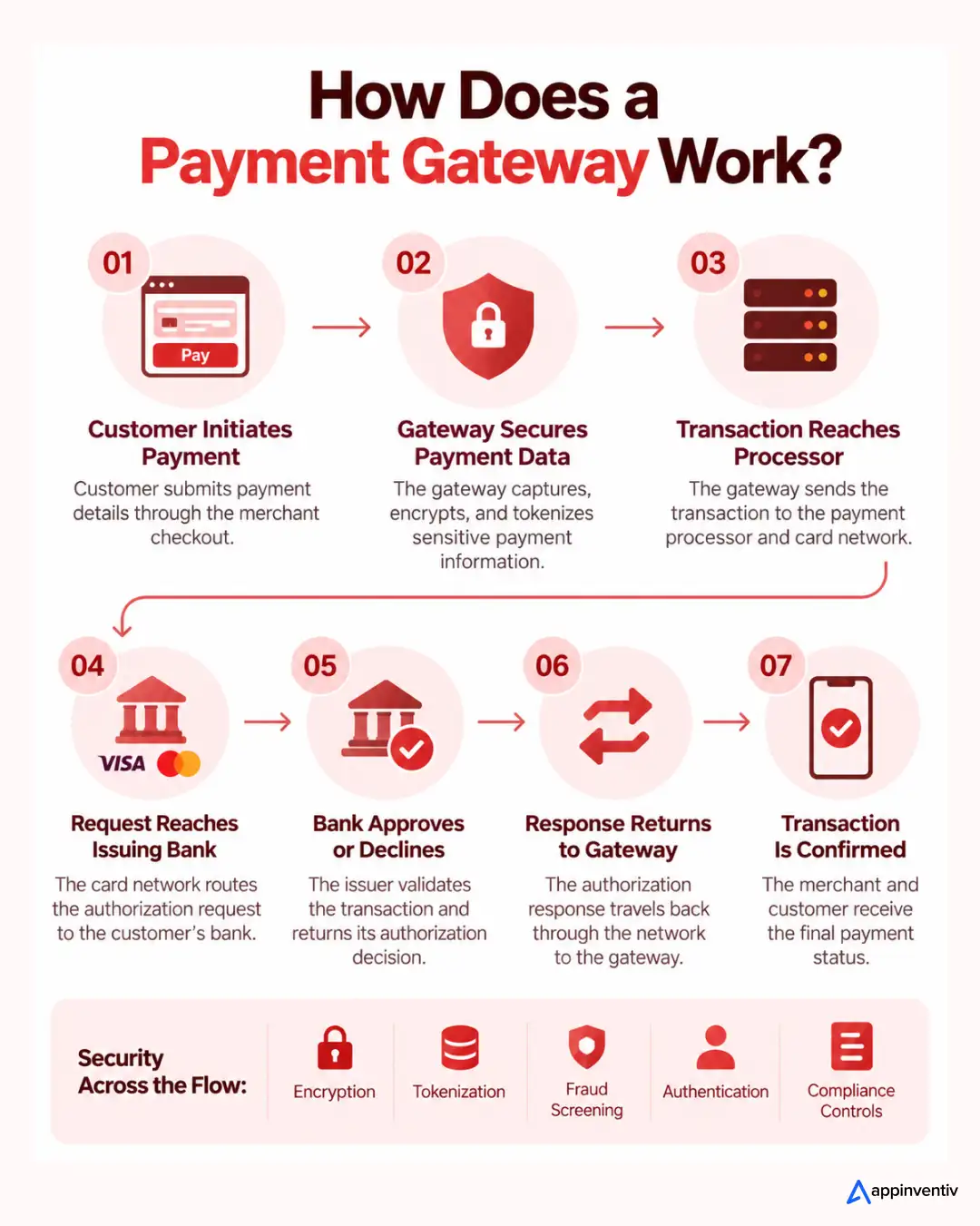
Payment Gateway Transaction Lifecycle
A buyer starts a purchase on a website, app, or terminal. The payment gateway encrypts card details and sends data to the processor. Next, card networks pass the request to issuing banks.
Payment initiation → Data encryption → Gateway request → Processor routing → Card network → Issuing bank → Authorization response → Merchant notification → Settlement
Banks approve or decline transactions. The gateway sends payment confirmation back to the checkout page. It triggers money transfers and pushes order updates to accounting software through webhooks.
Payment Gateway vs Payment Processor vs Payment Orchestration
| Component | Primary Function |
|---|---|
| Payment Gateway | Captures payment data, encrypts card details, and routes charges to processors. |
| Payment Processor | Moves money between acquiring banks, card networks, and issuing banks. |
| Payment Orchestration Platform | Connects multiple gateways, controls routing rules, and manages vendor integrations. |
Signs Your Business Needs a Custom Payment Gateway
Prebuilt gateways fit companies with basic payment needs and tight launch deadlines. Custom software development makes sense when transaction volumes, global expansion plans, or vendor fees limit company growth. Consider building a custom payment gateway under these business conditions:
- High Transaction Volumes: Heavy sales volume turns processing fees, routing costs, and bank approval rates into major balance sheet items. Direct ownership lowers unit costs.
- Custom Payment Logic: Complex checkouts require smart routing, split payouts, multi-currency tools, regional payment choices, or tailored fraud rules.
- Multi-Market Expansion: Direct links to regional acquiring banks and payment networks cut cross-border fees and support local buyer preferences.
- System Integration Limits: Proprietary gateways link directly to ERP tools, accounting databases, CRM platforms, and merchant dashboards without vendor limits.
- Flexible Infrastructure: Custom software lets engineering teams add new acquiring banks, currencies, payment types, and risk models as needs change.
- New Revenue Streams: Marketplaces, software platforms, and financial providers offer gateway capabilities to sub-merchants and charge for transaction processing.
Also Read: The Ultimate Guide to Advantages of Encryption Technology
Enterprise Payment Gateway Architecture
Architecture should ensure a payment gateway remains reliable under real-world conditions, which is why payment gateway software development teams must prioritize this early. For custom payment gateway development, design the system to process requests with low latency, automatically recover from failures, and protect payment records.
Separate authorization, routing, fraud, settlement, and reconciliation into independent modules where required. Use event streams and distributed servers to improve system resilience and maintain reliable payment processing.
Core Features and System Components
Enterprise payment gateways rely on distinct services to process, secure, and clear transactions.
| Component | Purpose |
|---|---|
| API Gateway | Accepts merchant requests, authenticates clients, limits request rates, and directs traffic to internal services |
| Merchant Management Service | Handles seller onboarding, access keys, account settings, and merchant records |
| Payment Engine | Runs authorization, capture, void, refund, and settlement tasks |
| Payment Routing Engine | Directs charges to acquiring banks based on routing rules, country, cost, or approval metrics |
| Tokenization Service | Swaps card details for secure payment tokens to reduce PCI DSS audit requirements |
| Fraud Detection Engine | Scans are charged using static rules, risk scores, device indicators, and machine learning models |
| Settlement & Reconciliation Service | Matches charge logs with bank deposits and builds financial summaries |
| Webhook & Notification Service | Sends live payment status updates to merchant platforms and enterprise software |
| Reporting & Analytics Module | Tracks approval rates, charge volume, chargebacks, and system performance metrics |
| Audit & Logging Service | Records event logs for compliance checks, system debugging, and security reviews |
Payment app engineering teams implement these capabilities in standalone modules rather than as single programs. Teams update fraud rules, routing logic, or reporting modules without stopping core payment flows.
Payment Gateway Design Flow
A clear gateway design separates buyer tools from transaction engines and banking systems. This separation reduces software dependencies and limits downtime impact.
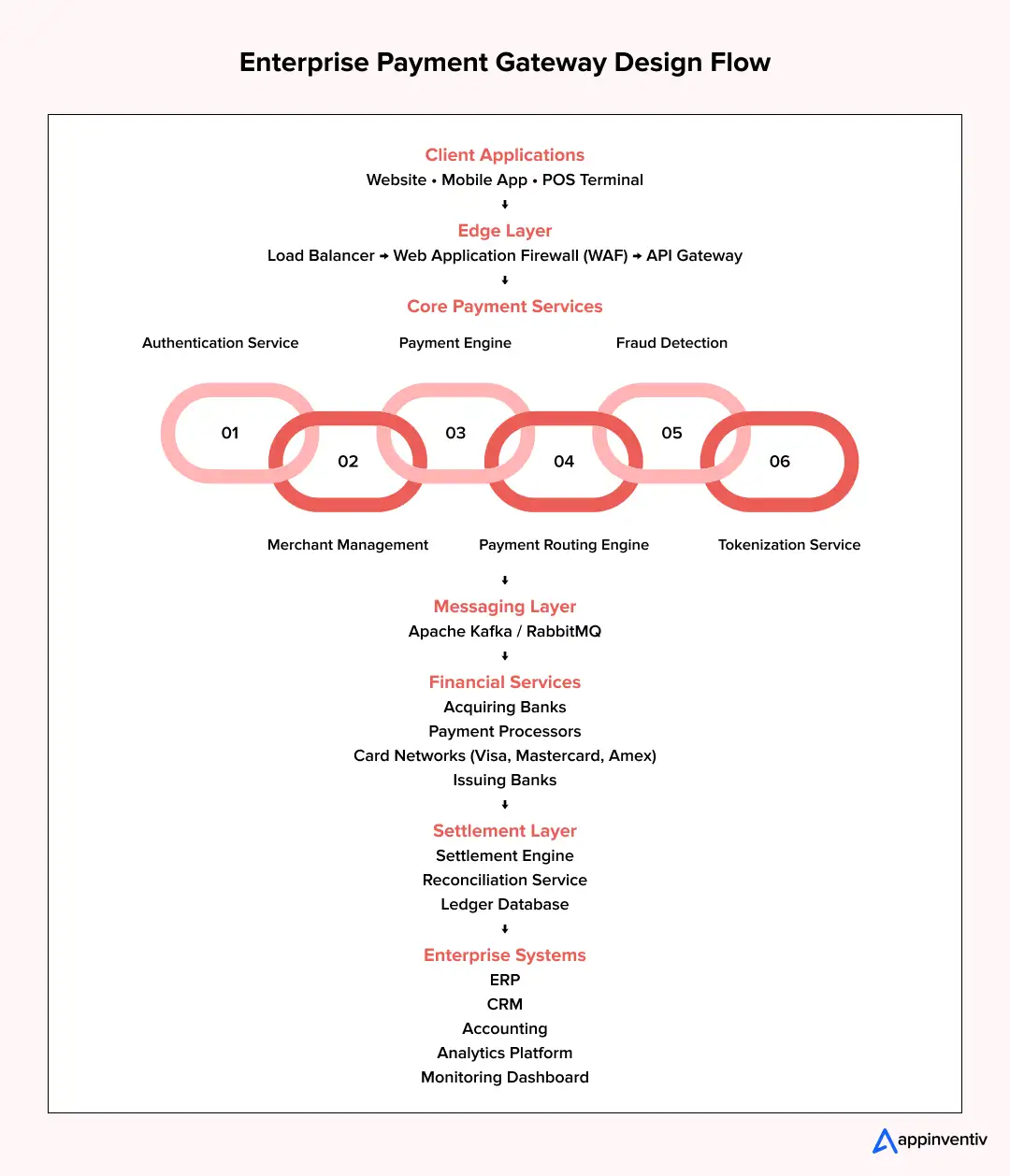
This layered structure isolates transaction tasks from third-party networks. Processor outages prompt routing services to direct traffic to alternative acquirers. Merchant apps keep working normally.
Microservices and Monolithic Designs
Microservices remain the standard payment gateway development framework for enterprise payment software. They support separate service scaling and isolate technical errors. Monolithic software fits smaller platforms with basic payment needs.
| Area | Monolithic Architecture | Microservices Architecture |
|---|---|---|
| Deployment | Single application codebase | Independent service deployments |
| Scalability | Entire system scales together | Individual services scale per demand |
| Fault Isolation | System errors stop the full application | Component errors stay contained |
| Technology Options | Single programming stack | Different services use specialized tools |
| Release Speed | Slower full releases | Fast independent service updates |
| Best Target | Small merchant systems | Enterprise payment networks |
Payment authorization services handle higher traffic volumes than settlement tools. Microservices allow technical teams to scale authorization nodes during flash sales without expanding settlement hardware.
High Availability, Scalability, and Disaster Recovery
Enterprise payment gateways must run without stopping during hardware crashes. High availability depends on active-active setups across multiple server regions. The system shifts user traffic automatically when one server goes down.
Stateless microservices, Kubernetes tools, Redis caches, database copies, and auto-scaling rules handle sudden traffic spikes. Disaster recovery plans establish precise Recovery Time Objectives and Recovery Point Objectives. Automated backups, cross-region data copying, and routine failover drills protect system operational records.
Event-Driven Processing and Payment Orchestration
Event-driven architecture maintains system stability during heavy transaction volumes. Apache Kafka or RabbitMQ process card approvals, settlement entries, fraud checks, webhooks, and ledger updates asynchronously. This setup cuts technical dependencies between individual backend tools.
A payment orchestration platform adds a central control layer above these event streams. The software connects multiple gateways, processors, and acquiring banks through one interface. Routing logic directs orders to the best vendor based on approval speeds, processing costs, location, or system availability, where a 1% approval gain can recover $10 million annually on US$1 billion in payment volume. The system shifts payments to backup banks automatically during vendor outages.
Technology Stack for Payment Gateway Development
| Layer | Common Technologies |
|---|---|
| Frontend | React, Angular, Vue.js, Flutter |
| Backend | Java (Spring Boot), Go, Node.js, .NET |
| API Frameworks | REST, GraphQL, gRPC |
| API Gateway | Kong, Apigee, NGINX, AWS API Gateway |
| Databases | PostgreSQL, MySQL, Microsoft SQL Server |
| Caching | Redis |
| Message Streaming | Apache Kafka, RabbitMQ |
| Containerization | Docker |
| Container Orchestration | Kubernetes |
| Cloud Platforms | AWS, Microsoft Azure, Google Cloud |
| Identity Management | OAuth 2.0, OpenID Connect, Keycloak |
| Secrets & Keys | HashiCorp Vault, AWS KMS, Azure Key Vault, Hardware Security Modules (HSMs) |
| Monitoring | Prometheus, Grafana, OpenTelemetry, ELK Stack |
| CI/CD | GitHub Actions, GitLab CI/CD, Jenkins |
| Security Standards | PCI DSS 4.0, TLS 1.3, AES-256, EMV 3-D Secure 2 |
Payment Gateway Security and Compliance
Engineering teams build compliance controls directly into the payment architecture rather than adding security tools later.
- PCI DSS 4.0 Baseline: Compliant gateways enforce strict user permissions, secure API connections, record complete event logs, and undergo routine penetration testing to meet payment card industry standards.
- Tokenization and Vault Encryption: Payment systems replace Primary Account Numbers with secure tokens to shrink audit scope. Systems protect data in transit using TLS 1.3 and data at rest using AES-256 encryption. Dedicated Hardware Security Modules manage cryptographic keys.
- 3D Secure Authentication: EMV 3-D Secure 2 protocols use biometrics, single-use passwords, and risk-based scoring. This layered verification mirrors how a broader multifactor authentication system works across mobile apps, stops fraudulent transactions, and keeps checkout speeds fast.
- Global Regulatory Compliance: Gateways integrate automated Know Your Customer checks, Anti-Money Laundering screening, and sanctions list matches. Systems align with PSD2 mandates in Europe, GDPR data rules, and local central bank guidelines.
- Machine Learning Fraud Engines: Automated systems evaluate payment speed, device fingerprints, location changes, IP reputations, and buyer behavior in real time to detect suspicious charges and cut down false declines.
- Threat Monitoring and Incident Response: Central log tools, SIEM software, live security alerts, permanent audit trails, and tested response scripts run continuously. Operations teams isolate threats early and keep systems compliant.
Payment Gateway Integration Best Practices
Enterprise gateways connect directly to banks, card networks, internal databases, and regional checkout options. Clean connections keep payment processing fast and prevent operational stalls.
Bank, Acquirer, and Network Connections
These choices are among the core factors to consider when integrating a payment gateway into a mobile app and keeping transactions reliable. Gateways link directly to multiple acquiring banks and major card networks like Visa, Mastercard, and American Express. Using several acquiring banks lets system logic direct charges to the best processor. The system automatically switches to a backup bank when a primary processor goes offline.
Digital Wallets and Regional Payment Methods
Website payment gateways need support for more than traditional cards. Digital wallets already account for 33% of global POS payment value, so enterprises can support options such as Apple Pay, Google Pay, and other digital wallet services to speed up checkout.
Open Banking and Real-Time Networks
Multi-currency payment gateway development relies on Open Banking connections that move funds directly between bank accounts, supporting payment apps projected to grow 135% faster than overall POS. Depending on target regions, systems connect to real-time networks like SEPA Instant, RTP, FedNow, UPI, or Faster Payments. These networks confirm transactions instantly and run background identity checks.
Enterprise System Connections
Payment details move across company databases without manual work. Direct links to ERP, CRM, accounting platforms, and reporting dashboards speed up balance matching, tax reports, and ledger updates.
Webhooks, Idempotency, and Reconciliation
Reliable processing relies on strict event rules. Webhooks push payment updates to internal software in real time. Idempotency keys block duplicate charges when networks retry failed requests. Daily reconciliation tools match gateway logs with bank deposits to keep financial ledgers accurate.
Build connected payment infrastructure across banks, wallets, processors, ERP systems, and real-time payment networks.

Common Challenges in Payment Gateway Development (and How to Overcome Them)
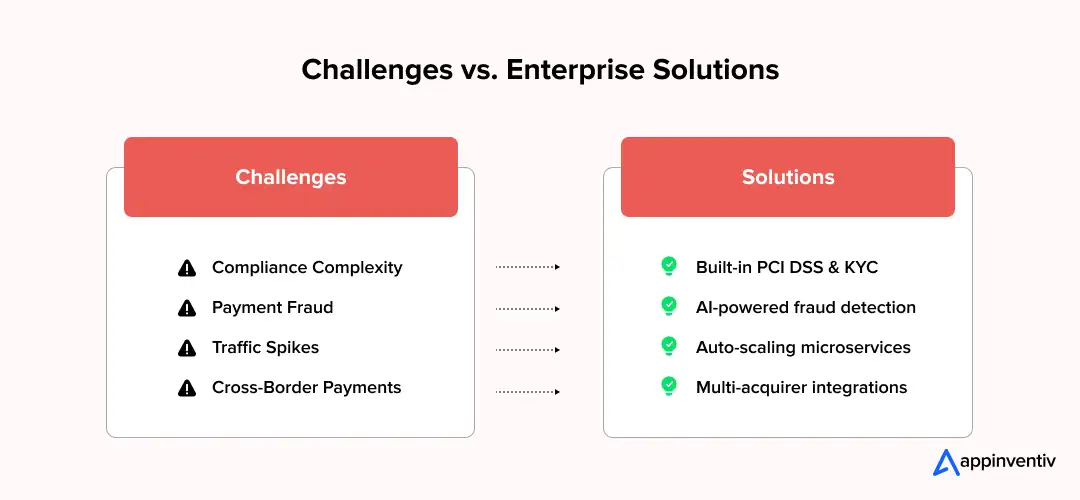
Early architectural planning reduces development risks across compliance, fraud, scalability, integrations, and transaction performance.
Regulatory Compliance and Security
Operating in global markets forces development teams to meet strict rules in every country. Payment systems must follow PCI DSS 4.0, KYC, AML, PSD2, GDPR, and central bank regulations. Late compliance planning causes product delays and expensive software rewrites.
Payment app development teams resolve this problem by writing compliance rules directly into the base code. Systems use payment tokens, data encryption, hardware key vaults, event logs, and automated compliance tracking. These steps simplify annual audit reviews and lower operational risks.
Fraud Prevention and Chargebacks
Fraud patterns change fast. Fixed rule lists miss new fraud methods. Unresolved chargeback disputes cut into company margins and raise processing costs.
FinTech development teams pair basic rule checks with machine learning software. System engines analyze charge speeds, device IDs, locations, and risk scores in real time. Dispute workflows log complete transaction histories to counter false buyer claims.
Scalability, Availability, and Performance
Sudden sales traffic and hardware failures slow processing speeds down. Systems require strong scaling designs to clear millions of charges during peak events.
Payment platform engineers address this with horizontal scaling, traffic distribution, automatic failover, and multi-region deployment. Capacity and load testing validate these controls against expected peak transaction volumes.
Cross-Border Payments and Enterprise Integrations
Custom payment gateway development must handle multiple currencies, local payment choices, and older internal software to reduce technical friction. Unmatched transaction records across databases delay financial settlements and reporting.
FinTech engineers connect directly to multiple acquiring banks, card networks, ERP databases, CRM software, and accounting systems. APIs and message pipelines sync records in real time. Automated reconciliation software matches gateway logs with bank statements daily.
Cost to Build a Payment Gateway
Payment gateway development cost depends on software scope, compliance needs, bank links, and system scale. Complex security tools, multi-bank connections, and redundant servers raise development budgets.
Estimated Costs by Project Scope
| Project Scope | Estimated Cost (USD) |
|---|---|
| Basic Gateway (MVP) | $50,000–$100,000 |
| Mid-Scale Gateway | $100,000–$250,000 |
| Enterprise Gateway | $250,000–$500,000+ |
Key Factors Influencing Costs
Technical and business choices shape the total build cost.
- Payment Methods and Currencies: Adding card brands, digital wallets, bank rails, and multi-currency processing increases engineering work.
- Compliance and Security Rules: Meeting PCI DSS 4.0, KYC, AML, and regional central bank mandates adds security testing and vault infrastructure costs.
- External Financial Integrations: Connecting to multiple acquiring banks, card networks, and processors requires custom software logic.
- Fraud Detection Engines: Machine learning tools and real-time risk-scoring modules require extra software development.
- Infrastructure Architecture: Distributed services, multi-region deployments, caching, and event processing increase engineering and cloud costs.
- High Availability: Redundant infrastructure, disaster recovery, failover testing, and backup capacity increase operating costs.
- Smart Payment Routing: Logic tools that pick banks based on approval metrics and fees require engineering hours.
- Merchant Dashboards: Custom seller portals, reporting tools, and administrative controls require front-end and back-end work.
- Ongoing Maintenance: Servers, security checks, software updates, and compliance audits create recurring operational costs.
Build vs. Buy vs. White-label vs. Payment Orchestration
Transaction volumes and control needs dictate whether to develop a payment gateway in-house or choose another model. High-volume enterprise teams choose custom gateway builds or payment orchestration platforms to control routing and data.
| Decision Criteria | Build | Buy | White-Label | Payment Orchestration |
|---|---|---|---|---|
| Development Timeline | Long | Short | Very Short | Medium |
| Upfront Investment | High | Low | Medium | Medium |
| Scalability | High | Vendor-dependent | Medium | High |
| Customization | Full | Limited | Moderate | High |
| Compliance Ownership | Enterprise | Vendor | Shared | Shared |
| Operational Complexity | High | Low | Medium | Medium |
| Vendor Lock-in | None | High | Medium | Low |
| Best Fit | Large enterprises with custom payment needs | Startups and SMBs | Companies offering branded payment services | Enterprises managing multiple gateways and acquirers |
Move beyond vendor constraints with custom payment infrastructure built for intelligent routing, fraud control, and global payment scale.

Custom Payment Gateway Use Cases by Industry
Industry leaders build in-house gateways to handle complex payment paths, connect internal databases, and bypass third-party vendor fees.
Banking and FinTech
Companies exploring how to create a payment gateway like Stripe study how digital banks and financial firms build proprietary transaction infrastructure. These systems run merchant acquiring, embedded checkouts, instant money transfers, and risk engines across international borders.
E-Commerce and Retail
Global merchants like Amazon handle high transaction numbers with custom software setups. In-house engines support single-click checkouts, local currency processing, automatic bank routing, and instant buyer refunds.
SaaS and Software Platforms
Subscription platforms like Adobe and Salesforce need tailored billing logic. Custom software calculates meter usage rates, issues invoices, charges recurring cards, and processes global renewals without human oversight.
Healthcare Systems
Hospital groups like Mayo Clinic link healthcare payment systems directly with patient databases and care portals. The software collects copays, handles insurance claims, clears telehealth fees, and updates balance ledgers immediately.
Insurance Providers
Carriers like Progressive and Allianz manage complex cash flows through custom gateways. Systems collect monthly premium checks, pay out digital claims, and run self-service portals for policyholders.
Online Marketplaces
Two-sided platforms like Airbnb and Uber rely on custom split-payment rules. This split-payout model closely resembles the logic used to develop a P2P payment app.
Travel and Hospitality
Global brands like Booking.com manage multi-currency bookings across borders. In-house gateways process room deposits, loyalty point checkouts, partner commissions, and cancellation refunds in real time.
Freight and Logistics
Shipping networks like DHL tie payment software into central ERP databases. The system handles freight charges, customs duty fees, cross-border payouts, and vendor invoices automatically.
Future Trends Shaping Payment Gateway Development
Teams that make a payment gateway today build complete financial platforms rather than simple pipes; this shift is part of a wider payment process modernization movement across enterprises, as payment apps are forecast to grow at an 8% CAGR, compared with 3.4% for overall POS. Artificial intelligence, real-time banking rails, and embedded finance tools change how companies clear charges and cut processing costs.
AI-Native Payment Infrastructure
This shift reflects the broader role of AI in payments infrastructure today. Smart software blocks fraud attempts, predicts payment failures, and raises bank approval rates. These tools make fast processing decisions without manual intervention.
Payment Orchestration and Smart Routing
Enterprise teams avoid relying on a single payment vendor. Orchestration platforms direct charges to specific acquiring banks in real time. The software picks banks based on approval metrics, processing costs, local regions, and current uptime.
Embedded Finance and Open Banking
Software platforms build payments, loans, and digital wallets directly into daily business tools. This is the foundation of embedded finance for modern enterprise. Open Banking connections clear direct account-to-account payments. These bank networks move funds and share records without charging credit card fees.
Real-Time Payments and Account-to-Account Rails
Instant networks like FedNow, RTP, SEPA Instant, and UPI transfer money immediately as payment apps are projected to account for 46% of global POS value by 2030. Account-to-account payments remove settlement delays. High-volume merchants use these rails to lower card processing expenses.
Stablecoins, CBDCs, and Blockchain Networks
Blockchain platforms move international payments across borders fast alongside payment apps projected to process $15.6 trillion by 2030. This same infrastructure underpins blockchain assets tokenization for other financial instruments. Stablecoins and Central Bank Digital Currencies speed up global money transfers.
Autonomous Fraud Detection and Risk Intelligence
This is part of a growing shift toward agentic payments for enterprises. Risk models spot new fraud tactics instantly. The software updates security rules in real time and blocks attacks without manual reviews.
Build Your Enterprise Payment Gateway With Appinventiv
Appinventiv helps enterprises design, build, and modernize payment platforms that handle heavy traffic, comply with global regulations, and protect buyer checkouts. Our teams bring 10+ years of financial tech experience. We have delivered 200+ financial products and built 25+ payment gateway partnerships.
Our development teams develop PCI DSS-compliant code, tokenization, HSM-backed key management, machine-learning fraud tools, and multi-bank integrations. They support 3-D Secure 2, SCA, KYC, AML, GDPR, and regional payment compliance.
As a payment gateway software development company, Appinventiv supports enterprises with the technical expertise needed to build secure, scalable payment infrastructure.
Our systems deliver clear business results. Client platforms maintain a 98% fraud detection rate and back transactions with a 99.50% security SLA. Development teams digitized 45+ lending workflows and reduced operating expenses by up to 30% using automated tools.
Appinventiv supports enterprise teams through every step of payment gateway platform development. We modernize old payment setups, launch real-time banking connections, and handle cross-border compliance. Payment engineers manage strategy, code, integrations, and long-term operations to keep your payment gateway software development engine fast, safe, and stable.
Let’s connect and future-proof your payment infrastructure starting today.
Frequently Asked Questions
Q. How long does it take to build a payment gateway?
A. Building a payment gateway takes four to twelve months. Simple builds with basic charging capabilities take four to six months, which shows how to build a payment gateway on a shorter timeline. Enterprise platforms require nine to twelve months or longer. Adding custom fraud engines, multi-bank routing, and complex compliance tools extends the timeline.
Q. How much does it cost to develop a payment gateway?
A. Developing a custom payment gateway costs between $50,000 and $500,000. Basic builds with simple payment processing sit at the lower end. Enterprise systems cost more. They require high-availability servers, advanced security vaults, multi-currency processing, and custom reporting dashboards.
Q. Should you build, buy, or white-label a payment gateway?
A. Choice of model comes down to payment volume and control requirements. Building a custom system gives large merchants direct control over routing rules, seller data, and fee structures. Buying off-the-shelf software or white-labeling fits smaller businesses with low upfront budgets.
Q. Why choose Appinventiv for payment gateway development?
A. Appinventiv brings ten years of financial software expertise to every build. Our teams have launched over 200 financial products and formed 25 payment provider partnerships. We write PCI DSS-compliant code, build smart routing engines, and deploy risk platforms. Our engineers manage initial design, core development, security audits, and continuous server updates.
Q. How do you create a payment gateway for a website?
A. Building a payment gateway for a website involves setting up secure checkout flows, payment APIs, tokenization, processor integrations, fraud controls, and webhooks. The gateway should support required payment methods, currencies, refunds, recurring billing, and settlement workflows while meeting applicable security and compliance requirements.
Q. What is a payment gateway?
A. A payment gateway is software that handles digital transactions for merchants, and payment gateway software development focuses on building this system securely from the ground up. It captures credit card details, runs background security checks, and sends data to receiving banks. The receiving bank approves or declines the charge. Then the gateway updates the checkout page. Modern setups process mobile wallets, recurring subscription fees, and local currency transfers.


Fast 2-minute response, fully NDA-protected.
Cost of Developing a Payment Gateway: A Complete Breakdown
Key takeaways: Custom gateway development requires $50,000 to $500,000 in upfront capital, and enterprise platforms cost more at scale. Core infrastructure, security compliance, and settlement logic consume far more budget than basic checkout screens. High transaction volumes require concurrency controls, failover systems, monitoring tools, and automated reconciliation engines. Platform ownership creates recurring costs for security…

How Much Does RegTech Software Development Cost in the UK in 2026?
Key takeaways: RegTech software development cost in the UK spans £40,000 to £400,000+, with regulatory scope and legacy integration depth driving the cost. High-performance systems deliver a 30% to 50% reduction in manual workloads, protecting enterprises from severe FCA penalties. Advanced AI features generally represent around 25–40% of the total project investment due to the…

Building Next-Generation Digital Payment Systems for Australia's NPP Economy
Key takeaways: Australia's NPP is approaching 1.82 billion real-time transactions annually; BECS decommissioning by 2030 creates a hard migration deadline that cannot be managed through incremental patches. The July 2026 Payday Super mandate makes real-time payment infrastructure a legal compliance requirement. Enterprises without NPP-capable payroll systems are already operating against a regulatory clock. NPP platform…