


























How to Build an MVP That Raises Money for Your Mobile App?

 Share -


- 01What Makes an MVP Fundable?
- 02How to Build an MVP That Attracts Investors
- 03How to Validate Your MVP Before Approaching Investors
- 04Types of Funding Partners for MVP Fundraising
- 05Where to Find the Right Investors for Your MVP
- 06Business Advantages of Launching an MVP
- 07How to Turn MVP Traction Into a Fundraising Story
- 08Common Pitfalls That Make an MVP Struggle to Get Funded
- 09Build, Validate, and Fund Your MVP With Appinventiv
- 10FAQs

Key takeaways:
- A fundable MVP addresses one specific problem for one specific audience, not for everyone.
- Investors want proof of demand, so the MVP should show real user interest instead of just looking polished or complete.
- Market research and competitive analysis can provide insights into what differentiates the product and where it may find success.
- User feedback, analytics and testing are crucial to understanding what users are interested in and how to make the product better before capital investment.
- A good MVP narrative will build the bridge between the original problem and the results it has achieved, providing investors with a good basis for their belief in the product.
- Generating revenue, engagement and willingness to pay early will make the fundraising proposition more compelling and demonstrate an actual market opportunity.
Investors rarely fund a mobile app simply because it looks polished. They invest in products that demonstrate a market, a genuine customer need, and a viable path to growth. This is also why how to build an MVP matters when preparing for fundraising. Many entrepreneurs develop dozens of features, spend heavily, and only later ask whether users will actually pay for the product.
An MVP does the opposite. It translates assumptions into something that can be validated with actual users and provides investors with proof to review. The right MVP can help identify whether the customer understands the value proposition, where they are going wrong, what they are doing right, and if the business model can be scaled up.
There is a clear need for this validation. According to a CB Insights report, 43% of the 431 failed startups cited poor product-market fit as a reason for failure, making it one of the top causes of startup failure.
That’s why an MVP needs to be focused on three elements: establishing demand, creating traction, and minimizing investment risk. This guide covers how to select the right features, test your idea, measure the parameters investors will be interested in and build a stronger case for fundraising based on product traction.
Build and validate your mobile app with real users before presenting your product to investors.
What Makes an MVP Fundable?
An MVP that is fundable will provide investors a way to prove it’s a real product that has a real market and a real path to growth. Not all the features have to be planned for the final app. It must have the proper features, users, and outcomes. Understanding how to develop an MVP starts with defining what investors need to see from the first version.
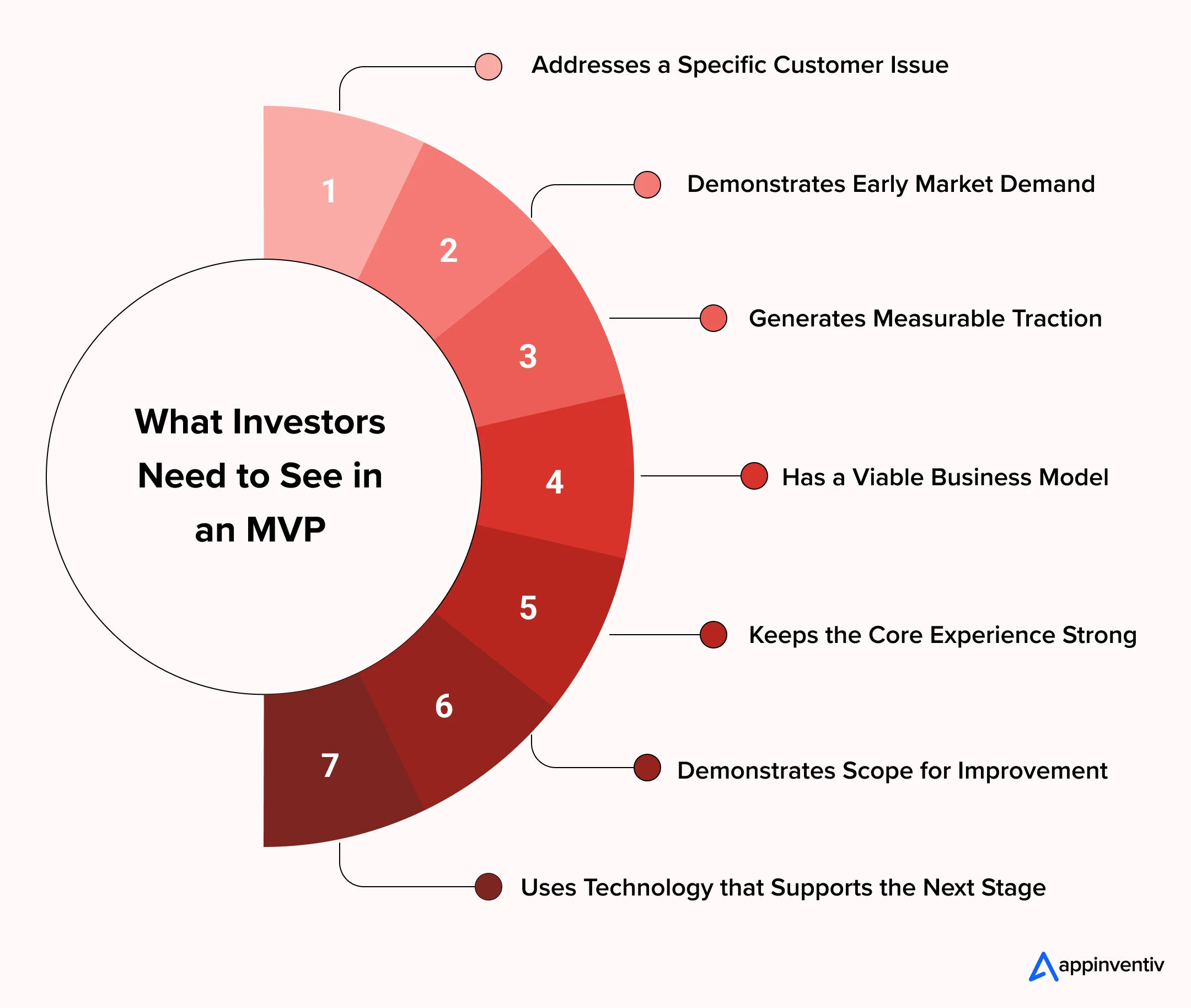
Addresses a Specific Customer Issue
The MVP needs to solve one particular problem for a specific set of users. The investor should be able to explain in a few sentences what the product is and why the customer needs the product.
Demonstrates Early Market Demand
The market will respond to the product through user sign-ups, downloads, a growing waitlist, trial activity, paid conversions, etc. Early numbers are useful when they show a definite pattern.
Generates Measurable Traction
Monitor active users, retention, engagement, conversion, revenue and churn from the initial launch. These metrics provide investors with proof of user experience with the product.
Has a Viable Business Model
The MVP should demonstrate the monetization opportunities of the app, including subscription, transaction fees, in-app purchases, advertising, commissions and enterprise options.
Keeps the Core Experience Strong
Dozens of features are not required for a fundable MVP. It must be backed by a solid core that provides users with a proper reason to come back and a value they’re getting in return.
Demonstrates Scope for Improvement
Investors have to know what lies ahead. A product roadmap should be designed to link up early wins with new features, new customers, new revenue and new markets.
Uses Technology that Supports the Next Stage
The initial one should include the development cost without causing technical constraints afterward. The architecture, back end, analytics and security should align with the product roadmap.
How to Build an MVP That Attracts Investors
A good MVP begins with a well-defined problem, a specific target audience, and quantifiable objectives. The MVP development process should enable you to test demand, gather data from users and make the case for additional investment without investing too heavily in unproven features.
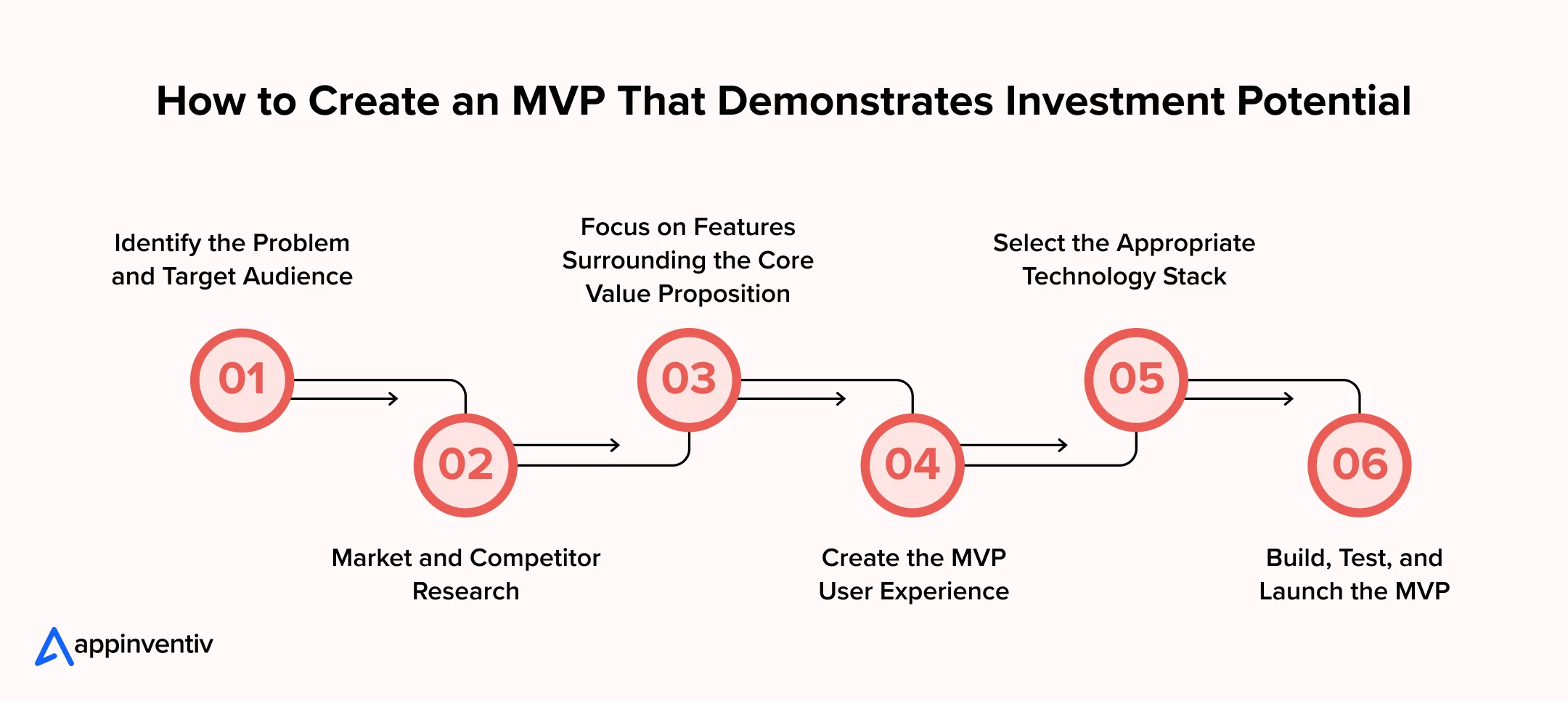
Identify the Problem and Target Audience
First, find out how they currently solve that problem, why the process is hard for them right now and what they are willing to shift. Having a defined target audience also provides a group to test the product in the early stages and allows you to gauge whether it is resonating with the intended audience.
- Define a problem: Identify a recurring user problem that costs them time, money, or effort.
- Create user personas: Identify target users, their needs and pain points, existing alternatives, and buying behavior.
- Validate the problem: Prototype, conduct surveys, interviews, and/or landing pages to validate the problem before development begins.
Market and Competitor Research
Market research will give you an idea of how your product will fit and what users are already expecting from similar apps. Competitor research can help you identify features customers appreciate, issues they often voice, and gaps the competition is not meeting. All of this information can inform your MVP and help investors understand the market opportunity.
- Analyze competing apps: Look at competitor features, pricing, ratings, reviews, onboarding and common user complaints.
- Find market gaps: Identify neglected customer segments, missing features, suboptimal customer journeys, and pricing issues.
- Define differentiation: Provide a clear and obvious benefit to the user for using the product over other options.
- Estimate market opportunity: Research TAM, SAM and SOM to demonstrate the size of the target market and growth potential.
Focus on Features Surrounding the Core Value Proposition
MVP should validate only one good idea and not duplicate all the features of the finished app. Feature prioritization ensures development stays focused and provides clear criteria for selecting features to include in the initial release. The right set of features enables users to unlock the product’s primary benefit and provides investors with on-demand data.
- Define the core problem: Determine the one problem the MVP needs to solve and the main action users should take.
- Prioritize features separately: Include essential functions in the initial release and defer less critical ones for future versions.
- Apply MoSCoW prioritization: Categorize features for the current release as Must Have, Should Have, Could Have or Won’t Have.
- Control feature creep: Eliminate features that have development costs but don’t contribute to the validation of demand, engagement, or revenue.
Create the MVP User Experience
The first impression users get of an MVP is its user experience. Even if the product idea is good, a confusing onboarding process or complex core task can dampen adoption. There is a simple route to the product’s core value (in UX planning), and usability issues are identified before they become a costly change in development.
- Create a user journey map: outline the key points to consider from the moment the app is installed through the main action.
- Develop wireframes & prototypes: Test navigation, interactions and layouts prior to developers building the product.
- Reduce user friction: Minimize the number of required fields, unessential permissions, and easily accessible important actions.
- Test before development: Have target users perform basic/demanding functions and use their feedback to address confusing screens and flows.
Select the Appropriate Technology Stack
Technologies impact launch schedules, development expenses, app functionality, and product work moving forward. Technically, the right technology stack should scale with the user base, without any restrictions. The infrastructure required to gather product data, ensure user security and integrate the app with other services is also addressed at this stage.
- Decide between native or cross-platform: Go native for platform control, or cross-platform for shared iOS-Android code.
- Plan backend infrastructure: Choose databases, cloud services, APIs and hosting for the app based on its data and functional needs.
- Use third-party services carefully: APIs for payment, maps, authentication, messaging and analytics can save development time.
- Include analytics and monitoring: Monitor signups, feature usage, conversions, retention, crashes and performance since release.
- Plan for AI from the Start: Identify where AI can add practical value to the MVP, such as recommendations, search, content generation, automation, or user support.
Build, Test, and Launch the MVP
Development turns a validated concept into a working product while keeping the scope aligned with the original idea. Testing then verifies whether the app performs well and if real users can carry out the core tasks of the app. A targeted launch yields purer data on a variety of measures, such as adoption, engagement, retention, and more, that can back up your fundraising argument.
- Develop basic functionality: Implement the features that help fulfill the primary user experience and value of the product.
- Test core workflows: Test for functionality, usability, performance, payments, integration, security and device compatibility.
- Run beta testing: Test MVP with a limited number of target users and monitor how people interact with it, their feedback and technical problems.
- Launch to a focused audience: Begin by targeting a clearly-defined customer group or a market. Track adoption, retention, conversion and revenue; inform future development.
How to Validate Your MVP Before Approaching Investors
Understanding how to build an MVP step by step also means testing each product decision against real user behavior, feedback, and commercial demand. The MVP validation process should combine qualitative insights with measurable product data.
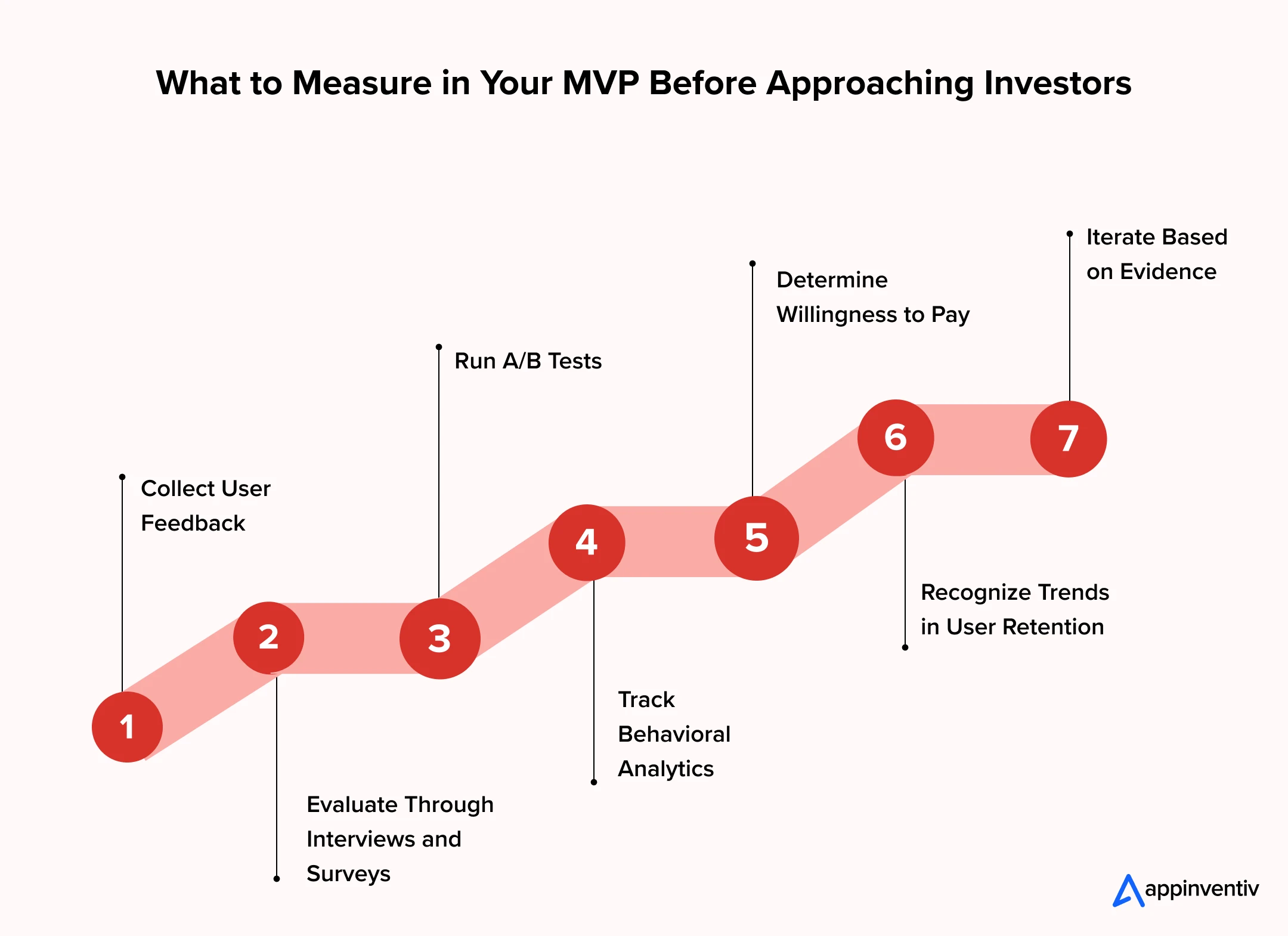
Collect User Feedback
Test the MVP with a select group of target users and get their feedback once they have interacted with the product. Consider asking them what was helpful, where they ran into trouble, what features they didn’t see and what made them not use the product more. Seek out recurring comments instead of product decisions based on one-time comments.
Evaluate Through Interviews and Surveys
Speak one-on-one with early users to gain an understanding of their issues, expectations, and MVP experience. Conduct surveys to collect data from a wider range of users and to discover an overall preference or concern. Do not ask too many questions to discover the reasons for the product adoption, rejection or disuse.
Run A/B Tests
Experiment with the various iterations of critical product components, like onboarding screens, pricing tiers, calls to action or feature layouts. Split users into groups, and measure engagement, sign-ups, conversions, or adoption of the features, etc., on each group. Apply the results to make product decisions that have more user support.
Track Behavioral Analytics
Track users’ interactions with the MVP after they register. Monitor features like activation, usage, frequency, conversion, and drop-off. Behavioral data can be used to uncover issues that users might not be able to discuss during interviews or when participating in surveys.
Determine Willingness to Pay
Determine if the product is worth buying for users. Use pricing options, paid trials, pre-orders or paid pilot programs as appropriate. Evaluate interest by different pricing points and grasp both interest and perceived value of the MVP.
Recognize Trends in User Retention
Track return users after the first use of the MVP. Look at retention by audience, acquisition channel and product attributes to see what is driving retention. If the person uses it again and again, then there is a greater degree of validation from initial sign-ups.
Iterate Based on Evidence
Apply the feedback and product information gathered to decide whether or not to modify the product and its features prior to asking for investment. Solve repeated usability problems, improve features users value and eliminate rarely-used features. Test each key iteration and create a trajectory of user evidence to improve the MVP.
Types of Funding Partners for MVP Fundraising
An MVP provides investors and funding partners with something that they can assess before investing more funds. After initial validation, you can look into funding sources depending on your product stage, funding requirements, equity requirements, and growth plans.
Community Development Financial Institutions
CDFIs foster businesses that help to drive economic activity in underserved communities. You can expect to receive funding through business loans, investments or other financing programs, depending on the institution and your qualifications.
This route is available to startups based in eligible areas, providing services to local communities, or with a job-creation plan. The founders are advised to check the geographic and business needs of the institution before applying.
Leverage Government Grants and Startup Programs
Government agencies provide start-up programs, loans, and grants for business development and technology. Certain programs focus on a specific industry, research field, or region, or on a specific business goal.
Using grant funds to develop an MVP, test an app, conduct research or to boost early operations can be a way for founders to get funding without having to sell up their stake in the company. Please check each program’s eligibility requirements, application procedures and reporting requirements prior to applying.
Angel Investors and Venture Capital Firms
Angel investors can fill the gap between a prototype and a successful product by investing early, when the concept has shown promise that it can be developed further. In addition to investment money, seasoned angels often provide product and/or business advice, industry expertise, and networking connections.
Venture capitalists tend to invest when a startup appears to have a bigger growth potential. A startup’s adoption narrative, early revenue, retention, market size and scaling plan can reinforce its position in pre-seed funding or seed round discussions.
Crowdfunding Platforms
Crowdfunding enables entrepreneurs to get funding directly from a broader group of individual investors. Depending on the platform and model, supporters can share their money for the benefits of receiving rewards, early access to the product, or equity.
An MVP with its practical use can help people understand the product and why it is worth their investment. This is also a method to test market interest, which can also provide the money for the next phase of development.
Launch a focused product, validate demand, and build the evidence needed for your next funding conversation.
Where to Find the Right Investors for Your MVP
Investors are more likely to say yes if you reach out to those who know you and your market, product stage and potential for growth. If you know how to build an MVP app, you should also be prepared to show why the product deserves further investment and how additional capital will help it grow.
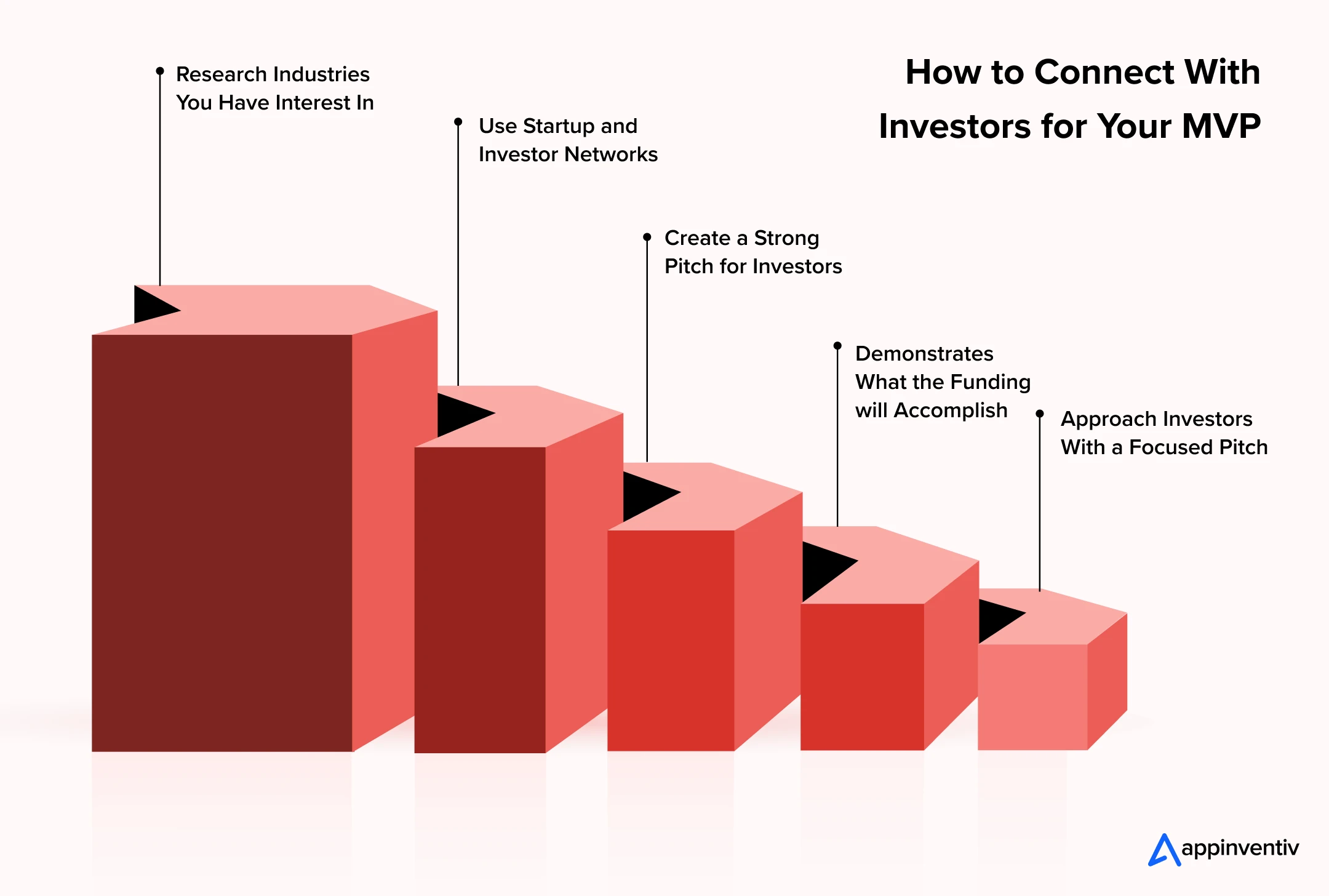
Research Industries You Have Interest In
First, research angel investors, VC companies, and startup investors who have been making frequent investments in your industry or business model. See their past investments, preferred funding phases, average ticket size, and geographical preference to build a list of appropriate investors.
Use Startup and Investor Networks
You can find investors through startup accelerators, incubators, fellow founders, industry events, and investor networks. Another way to get your pitch to the right decision-makers is via warm introductions from founders, advisors or other professionals.
Create a Strong Pitch for Investors
Create a short pitch that summarizes the problem, target market, MVP, business model, traction, competitive advantage, and funding need. Back up your claims with user data, revenue numbers, retention rates, or any other data collected during the MVP validation process.
Demonstrates What the Funding will Accomplish
Investors desire and want to know how their money will advance the business. Outline the investment strategy for product development, recruitment, marketing, physical location or other market expansion, and tie the respective investment fields to specific business targets.
Approach Investors With a Focused Pitch
Don’t endorse the same pitch to all investors. Be personal to the investor’s portfolio, industry, and investment phase. A targeted approach can help present your idea to the investor as something they want to invest in and why your startup is a good fit for them.
Business Advantages of Launching an MVP
Understanding how to build an MVP helps founders test an idea with real users before committing to full-scale development. A focused MVP decreases early danger, collects market information and supplies investors with evidence of product potential. Here are some of the benefits of building an MVP:
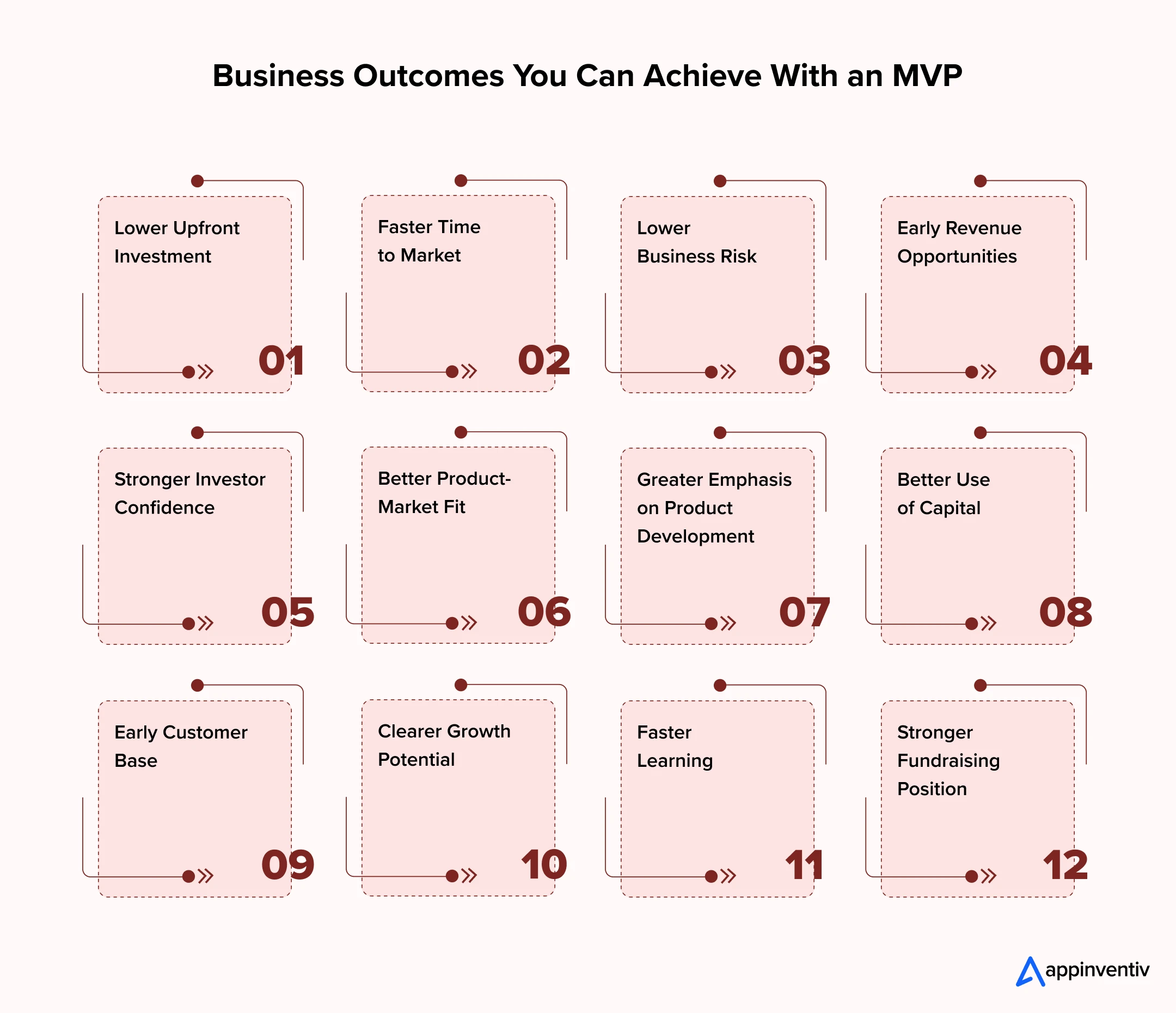
Lower Upfront Investment
An MVP is a less developed and less feature-rich product than a full product. This allows the founder to gauge the concept before they put the entire product budget into it.
Faster Time to Market
A smaller product can get to users faster. Founders can start getting early market feedback and build momentum for the bigger product still on the roadmap.
Lower Business Risk
An MVP offers valuable insights into the demand for a product before the founders make larger investments. If results are not good, then it can stimulate changes in the system before the cost rises.
Early Revenue Opportunities
Once a working MVP is created, it’s time to begin monetizing via subscriptions, sales, commissions, or others. Any revenue generated in the early stage can bolster the business case.
Stronger Investor Confidence
Investors have the option to assess real user activity and not just projections. They have greater real-world proof of market potential from early traction, retention and revenue.
Better Product-Market Fit
Real users demonstrate whether users are willing to continue using the product because it solves their problem. This feedback enables the founders to sync the product with the market.
Greater Emphasis on Product Development
An MVP can illustrate the most critical components of the product for users. This helps teams not waste resources on features that provide little value.
Better Use of Capital
Founders can focus future investments on more effective features, markets, and channels. This helps to establish a stronger connection between expenditures and business results.
Early Customer Base
First users can be repeat customers, brand advocates or references for sales in the future. Their experiences can be used as a foundation for future customer acquisition.
Clearer Growth Potential
By analyzing user behavior and trends, an MVP can help identify patterns in demand, retention, and revenue. The results can be used by founders to make a more convincing business case for future expansion.
Faster Learning
In a live product, you are going to get real usage data much quicker than any long product development cycle. Founders can make product and business decisions using actual customer behavior.
Stronger Fundraising Position
When a founder is approaching investors with a working product, some users, and measurable traction, they have more to show than a founder who’s pitching an idea.
How to Turn MVP Traction Into a Fundraising Story
MVP traction provides you proof that your product has more life than just the initial idea. Looking at examples of MVPs that evolved into successful products can also help founders understand how early validation can support a larger growth story. Let’s see what you need to follow to attract investors’ attention.
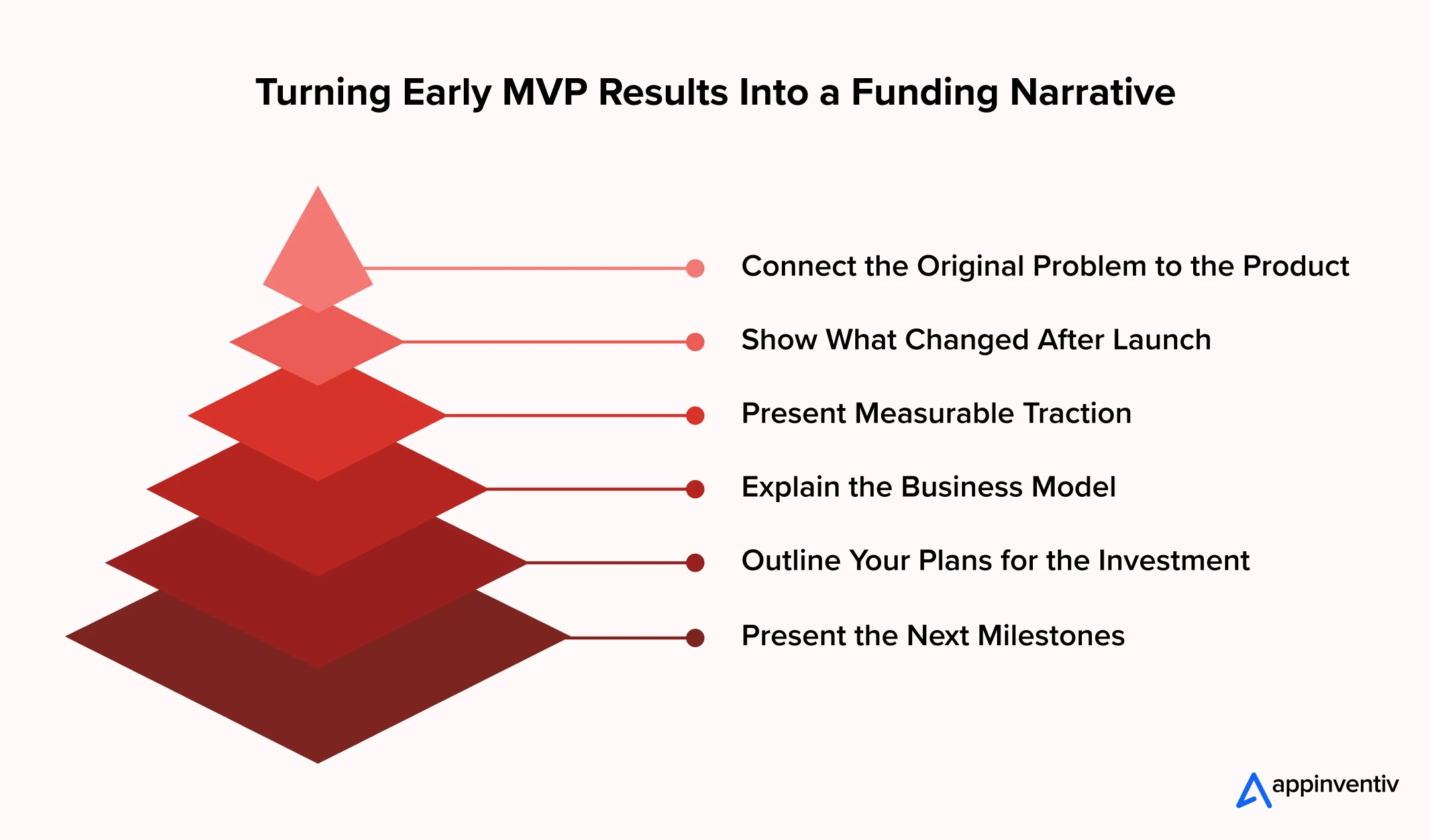
Connect the Original Problem to the Product
First, describe the particular problem that caused the MVP. Demonstrate who it impacts, how it’s being addressed now, and where current solutions are falling short. Then explain how your product meets this need.
Show What Changed After Launch
Compare the situation before and after users adopt your MVP. Point to tangible results, like faster processing times, better productivity, boosted conversions or better customer experience. This allows investors to see the actual value of the product that is being generated.
Present Measurable Traction
Utilize clear metrics to show the way that users are reacting to the product. They can be anything from active users, retention rates, revenue, paid customers, conversion rates, transaction volume, or month-over-month growth, depending on your business model.
Explain the Business Model
Explain how the product is making money and how you will increase the revenue streams. Describe the pricing, customer base, revenue models and preliminary proof of customer willingness to pay.
Outline Your Plans for the Investment
Connect the funding requirement to specific business outcomes. Explain how the capital will support product development, hiring, customer acquisition, infrastructure, or market expansion. Make it clear what additional funding will allow you to accomplish.
Present the Next Milestones
Close with measurable goals for the next stage of growth. These may include reaching a specific user base, increasing revenue, launching new features, entering new markets, or securing strategic partnerships. Give investors a clear timeline for achieving these milestones.
Build an MVP that generates real traction and gives funding partners clear evidence of market demand and growth potential.
Common Pitfalls That Make an MVP Struggle to Get Funded
While it may appear as a ‘tech complete’ MVP, a startup is not necessarily investable based on the MVP. Whether the product addresses a genuine need, appeals to the right customers and demonstrates growth potential can be the deciding criteria for funding. Preventing these pitfalls can make your MVP more powerful before you start fundraising.
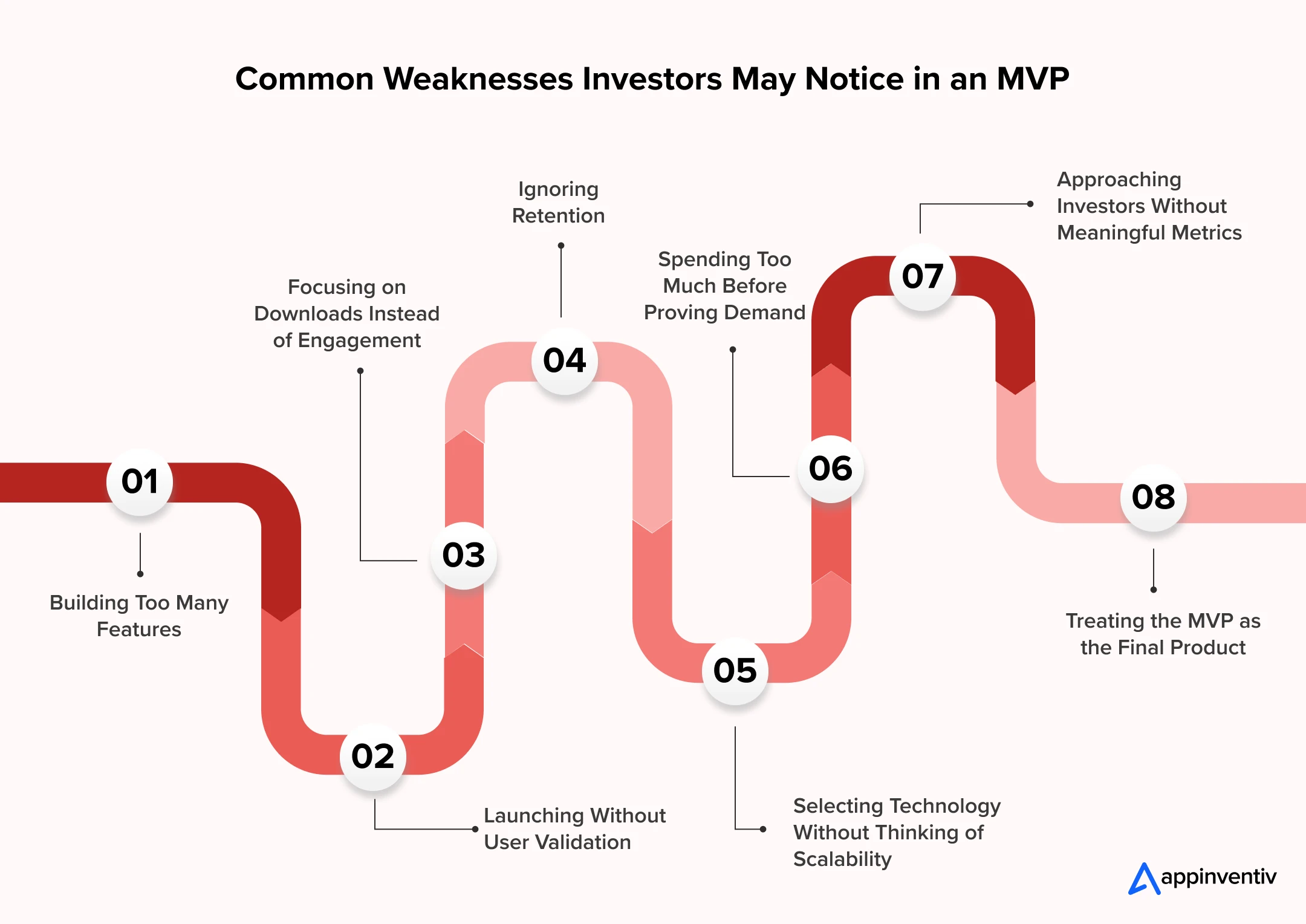
Building Too Many Features
Too much functionality can lead to higher development costs, longer time to market and more difficult product testing. Prioritize the essential features needed to address the main user problem and put off the extras for future prototypes.
Launching Without User Validation
The end product may turn out to be something that the user doesn’t need or understand if the MVP is created from just assumptions. Test problems with potential customers prior to development and seek continuous feedback following the launch.
Focusing on Downloads Instead of Engagement
This does not necessarily mean that a lot of downloads equate to product-market popularity. Investors will also wish to understand if customers use the product, use the core features often, return often, and engage in meaningful transactions.
Ignoring Retention
Having users is only beneficial if they aren’t using the product soon after signing up. Monitor retention over time for specific products, audiences, or use cases, and determine what aspects of the product are driving retention.
Selecting Technology Without Thinking of Scalability
Just because a technology is fast or inexpensive may lead to issues in the future as users increase. When deciding on the technology stack for MVP development, take into account expected traffic, data processing requirements, security concerns, third-party dependencies, and future scalability and development needs.
Spending Too Much Before Proving Demand
High-level budgets can lead to an unnecessary financial burden before market demand is proven. Ensure early investment remains within the scope of the core product and apply the validation results to further investment.
Approaching Investors Without Meaningful Metrics
Investors must have evidence to determine if an MVP has “traction”. Develop metrics like active users, retention, conversion, revenue, customer acquisition, engagement, or whatever metrics are directly related to your business model.
Treating the MVP as the Final Product
The purpose of an MVP is to explore assumptions and gain insights from actual users. The first version is considered a finished product and might not allow you to adjust to feedback, correct weaknesses, and make changes to the product to meet the evolving needs of users.
Also Read: 10 Common Mobile App Development Mistakes to Avoid
Build, Validate, and Fund Your MVP With Appinventiv
Validation for MVP allows the founders to find out whether their product is solving a real problem or not, before even putting in the resources to fully develop the product. They can test the product and get a lot of user feedback and evidence of retention, engagement, willingness to pay and early revenue and thus refine the product and present it to investors with more confidence.
The funding sources available to founders vary based on their business model and funding needs, ranging from angel investors and venture capital firms to government programs, CDFIs, crowdfunding, and more.
Appinventiv supports startups throughout this process with focused MVP development services, from defining the core product scope and selecting the right technology stack to building, testing, launching, and improving the MVP based on user data.
Over the years, as a trusted mobile app development company, we have helped startups across industries such as fintech, online retail, workforce management, and education technology. Projects like JobGet, Edamama, and Edfundo demonstrate our experience in creating focused products that validate demand and attract early users.
Have an MVP idea you want to validate and build? Talk to our experts.
FAQs
Q. How do I validate an MVP idea before development?
A. Here’s how you can validate an MVP idea:
- Identify target audience and their main challenge.
- Interview with prospective users and gather their feedback.
- Look into the competition and alternatives.
- Make a prototype to test out the idea.
- Check demand via surveys, landing pages, or pre-orders.
Q. What are the security and compliance requirements for an enterprise MVP?
A. Data protection, user authentication, access controls, encryption technology, secure APIs, audit logging and vulnerability testing are all important elements that enterprise MVPs should consider. Industry and target market compliance requirements vary.
For financial products, there may be a need for PCI DSS or SOC 2, and for healthcare applications, HIPAA controls might be needed. Establish these requirements in the beginning to not incur excessive security changes.
Q. How do you choose the core features for an MVP?
A. Identify the main problem that your product must solve, and the features that are directly required to solve this problem. Focus on features based on user value, business goals, development difficulty, and validation requirements.
Keep vital functions and add-ons distinct. User research, competitor analysis, prototypes and early testing can be used to validate what features to include in the initial release.
Q. What are some of the challenges of developing an MVP?
A. Here are some of the challenges of building an MVP:
- Defining a correct product scope
- Prioritizing essential features
- Striking a balance between speed, quality and budget
- Testing and confirming assumptions with real users
- Selecting suitable technology for future growth
- Development and handling the evolving needs
Q. How long does it take to build an MVP?
A. The typical length to build an MVP is between 8 and 16 weeks, based on the features, platform, integrations, and technical complexity of the MVP. Understanding the concept of building minimum viable product solutions enables teams to set up a scope that’s narrow enough and steer clear of unnecessary development.
A basic MVP can take a little less time, while enterprise products with more complicated workflows, security needs, or integrations can take a few more weeks.


Fast 2-minute response, fully NDA-protected.

How Much Does It Cost to Develop a Remote Patient Monitoring App in the UAE?
Key takeaways: Feature scope and system integrations, not the app itself, determine your final development cost. DHA, DOH, and MOHAP compliance must be built into your architecture from day one. Wearables, EHRs, and health information exchanges are the biggest technical cost drivers. A successful RPM platform combines continuous monitoring, clinical workflows, and secure interoperability. Early…
How Much Does It Cost to Develop an App Like Herfy in 2026?
Key takeaways: Herfy-like app development costs SAR 150,000 to SAR 1,500,000 ($40,000 to $400,000). Costs rise with rider tracking, POS sync, kitchen displays, loyalty, and branch controls. Saudi apps need Arabic UX, Mada, STC Pay, VAT, and ZATCA-ready invoice flows. Peak loads during Ramadan, Eid, and weekends need strong backend and load testing. A phased…

Key takeaways: The operating model determines survival. The code does not. Compliance under PDPL in the UAE and SDAIA in Saudi Arabia must be engineered into architecture, not added before launch. A serious build costs between AED 147,000 and AED 1,470,000 (USD 40,000 to USD 400,000), depending on scope. The single largest cost most operators…