























How Much Does It Cost to Build an App in Egypt?

 Share -


- 01Why Mobile App Development in Egypt Requires a Local Product Strategy?
- 02How Much Does Mobile App Development Cost in Egypt?
- 03A Detailed Cost Breakdown for an Egypt-Focused Mobile App
- 04How App Complexity Changes Cost and Delivery Time
- 05Cost and Timeline by App Type in Egypt
- 06How the Development Model Affects App Cost and Delivery
- 07How Egypt-Specific or Local Features Affect the Budget
- 08A Realistic Mobile App Development Timeline in Egypt
- 09What Commonly Delays an App Launch in Egypt?
- 10Compliance, Privacy, and Security Costs in Egypt
- 11The Hidden Factors that Affects the Total Cost of Developing a Mobile App in Egypt
- 12How to Reduce Cost Without Weakening the Product
- 13Why Global Giants Choose Appinventiv: Egypt's #1 Mobile App Development Powerhouse
- 14FAQs

- A mobile app for the Egyptian market may cost EGP 2 million to EGP 25 million+, equivalent to approximately $40,000 to $500,000+, depending on scope, risk, integrations, and operating scale.
- A focused MVP usually needs four to six months. A mature, integration-heavy product may need nine to twelve months or longer.
- Arabic support should be designed from the beginning. Retrofitting RTL layouts and Arabic content later creates avoidable rework.
- Local payment choices, including cards, mobile wallets, the Instant Payment Network, and cash workflows, change both the backend design and testing effort.
- Egypt’s data protection requirements must be included during discovery, not added shortly before launch.
- The lowest development quote rarely represents the lowest total cost. Missing discovery, QA, security, deployment, or support can make a cheap proposal expensive.
- A reliable vendor should explain its assumptions, exclusions, delivery model, local compliance approach, and post-launch responsibilities in writing.
Egypt’s mobile market presents a significant opportunity, but succeeding in it requires more than translating an application developed for another country. User expectations, Arabic language requirements, payment habits, network conditions, regulatory obligations, and price sensitivity must shape the product from the planning stage.
Each of these factors directly affects development cost and timelines. Arabic support involves more than translating interface text. It requires right-to-left layouts, adapted navigation, mixed-language search, localized forms, content workflows, and dedicated quality testing. Payments may involve cards, mobile wallets, bank transfers, cash collection, refunds, settlements, and reconciliation. Applications processing personal information must also account for Egypt’s Personal Data Protection Law and its Executive Regulations.
The scale of digital adoption makes these investments increasingly important. Egypt’s financial inclusion rate reached 79% by the end of June 2026, with 56.4 million citizens holding active transactional accounts, according to the Central Bank of Egypt. In Q2 2025, the country recorded 46.3 million active mobile wallets, which processed 718 million transactions worth EGP 943 billion, as reported by the National Telecom Regulatory Authority.
For businesses planning mobile app development in Egypt, a headline estimate is therefore not enough. They need a clear view of what the budget covers, which assumptions shape it, how local requirements affect the architecture, and which dependencies can increase costs or delay the launch.
As a practical planning range, mobile app development cost in Egypt can range from EGP 2 million to EGP 25 million or more, equivalent to approximately $40,000 to $500,000+, and take may four to twelve months.
For instance, a focused minimum viable product may sit near the lower end. On the other hand, a regulated banking, healthcare, logistics, marketplace, or government platform can exceed the upper end when it needs complex integrations, advanced security, high availability, and multilingual operations.
This guide explains those ranges in detail. It covers scope, product type, team structure, localization, payment infrastructure, compliance, delivery phases, hidden costs, and vendor selection. More importantly, it connects every decision to its likely effect on the budget and schedule.
Build an application shaped around Egyptian users, Arabic experiences, local payments, and real market conditions.

Why Mobile App Development in Egypt Requires a Local Product Strategy?
The first budgeting mistake is assuming that Egypt is simply another geography to add after the product is built. That approach usually produces a working application, but not necessarily one that users adopt or operations teams can support.
Egypt has a large, mobile-oriented population, an expanding digital-payments environment, and a wide mix of consumers. A user in Cairo may have a different device, connectivity pattern, address format, payment preference, and service expectation from a user in Alexandria, Mansoura, Aswan, or a smaller town. The app must work across this range without becoming slow, confusing, or costly to operate.
Language creates an immediate product decision. Some businesses can launch in Arabic only. Others need Arabic and English from the first release. A bilingual app requires more than twice-written content. The design system must handle right-to-left and left-to-right layouts, mixed Arabic and Latin text, dynamic content, numerals, dates, currencies, maps, and user-generated entries.
Payments create another local layer. Depending on the business, customers may expect bank cards, mobile wallets, account transfers, cash on delivery, or payment through an external collection network. Each option brings different transaction states, callbacks, settlement processes, refund rules, reconciliation needs, and support cases.
Network quality must also influence engineering. In its Q2 2025 consumer survey, the NTRA reported differing satisfaction levels for mobile internet quality across Egypt’s operators. An app that performs well on office Wi-Fi may still fail during image upload, checkout, or identity verification on an unstable mobile connection.
These requirements add time during discovery, design, development, and testing. They also prevent more expensive problems after launch. A realistic estimate should therefore separate core product development from Egypt-specific enablement instead of hiding both inside one number.
How Much Does Mobile App Development Cost in Egypt?
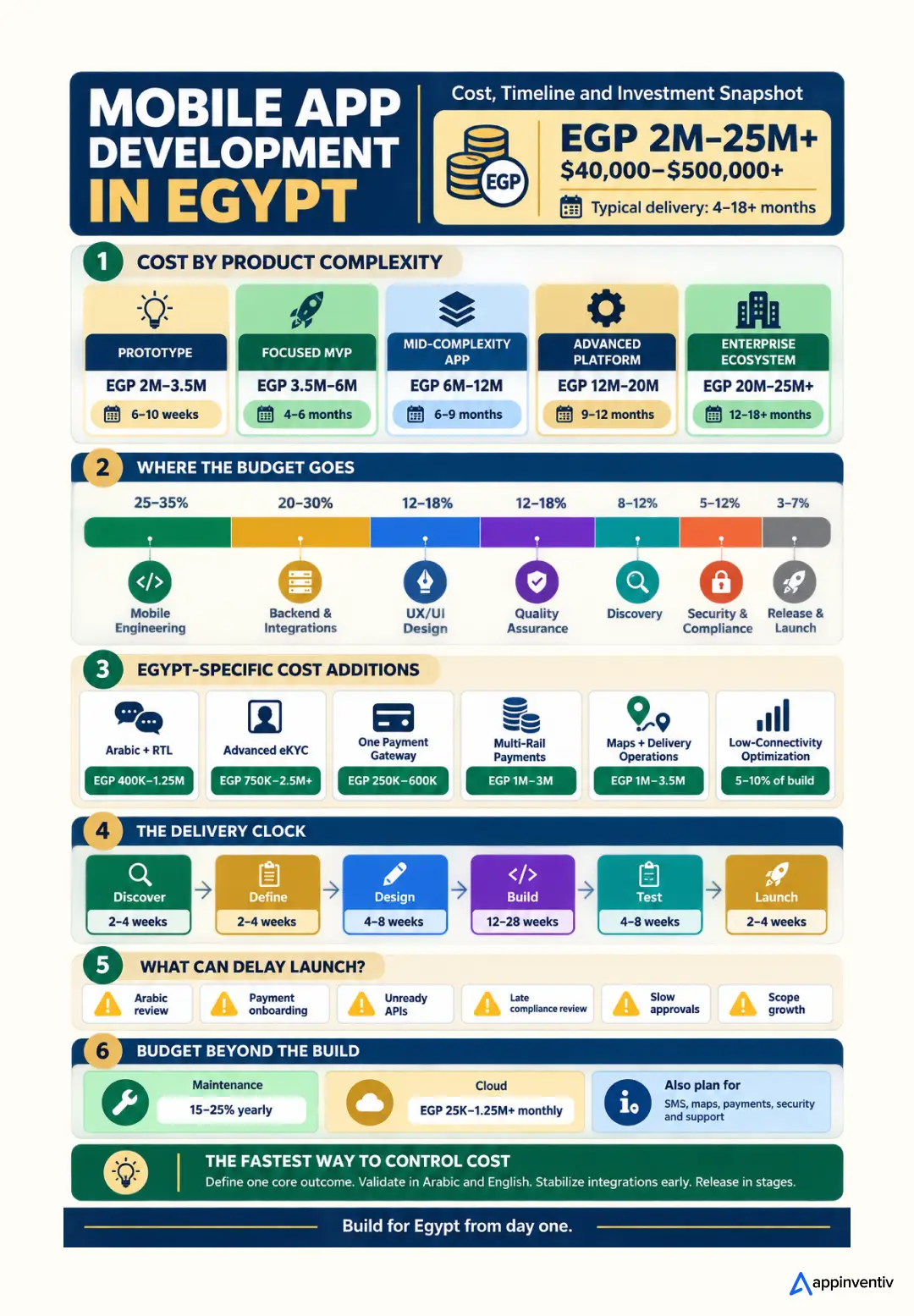
As revealed earlier, the cost of developing a mobile app in Egypt generally ranges from EGP 2 million to EGP 25 million or more, equivalent to approximately $40,000 to $500,000+. The final investment depends on the product’s complexity, supported platforms, user roles, integrations, security requirements, and regulatory exposure. Businesses can use the following ranges to set an initial budget before completing a detailed discovery exercise.
| App category | App development cost breakdown | Typical timeline | Common scope |
|---|---|---|---|
| Prototype or proof of concept | EGP 2–3.5 million | 6–10 weeks | Clickable flows, limited technical validation, no production-scale backend |
| Focused MVP | EGP 3.5–6 million | 4–6 months | One primary user journey, basic administration, analytics, essential integrations |
| Mid-complexity business app | EGP 6–12 million | 6–9 months | Arabic and English, multiple roles, payments, notifications, operational dashboard |
| Advanced consumer platform | EGP 12–20 million | 9–12 months | Complex workflows, several integrations, high traffic, automation, stronger security |
| Regulated or enterprise ecosystem | EGP 20–25 million+ | 12–18+ months | Core-system integration, detailed compliance, advanced security, multi-app ecosystem |
These figures are not a rate card. They are planning ranges for custom development. The final estimate depends on what the app must do, how many systems it must connect with, the quality of existing business data, and the level of operational readiness.
A retail app with a catalogue, cart, card payment, mobile-wallet payment, order tracking, promotions, Arabic content, and a merchant dashboard will cost more than a basic content app. A lending app with eKYC, document verification, credit rules, consent records, fraud controls, and regulated integrations will cost more again, even if both products contain a similar number of screens.
Businesses should also decide how they want the estimate presented. A fixed-price proposal works best when requirements are stable and acceptance criteria are specific. A time-and-material model is usually more practical when the product will evolve through user testing. A hybrid model can fix the cost of discovery and the first release while keeping later iterations flexible.
If an Egyptian business contracts in US dollars but earns in Egyptian pounds, currency movement becomes a budget risk. The agreement should state the billing currency, conversion source, conversion date, invoice frequency, price-validity period, and process for approving changes. Where the vendor invoices in EGP, the business should still confirm whether imported tools, cloud services, licenses, or specialist resources can trigger adjustments.
A Detailed Cost Breakdown for an Egypt-Focused Mobile App
A single project estimate does not explain where the investment will go or which workstreams carry the greatest risk. Breaking the budget into discovery, design, engineering, integrations, testing, security, and deployment makes the estimate easier to evaluate.
It also helps businesses identify where reducing the scope may lower mobile app development cost in Egypt without weakening the core product.
| App development process stages | Typical share of budget | Cost on an EGP 10 million project | Main Egypt-specific considerations |
|---|---|---|---|
| Discovery and product planning | 8%–12% | EGP 800,000–1.2 million | Local users, payment mix, address formats, operational rules, compliance scope |
| UX and UI design | 12%–18% | EGP 1.2–1.8 million | Arabic and English layouts, RTL behavior, accessibility, lower-end devices |
| Mobile application engineering | 25%–35% | EGP 2.5–3.5 million | Native or cross-platform build, offline states, performance, device coverage |
| Backend and integrations | 20%–30% | EGP 2–3 million | Payments, wallets, identity, maps, ERP, CRM, logistics, messaging |
| Quality assurance | 12%–18% | EGP 1.2–1.8 million | Arabic QA, devices, carriers, network conditions, payment edge cases |
| Security and compliance | 5%–12% | EGP 500,000–1.2 million | Privacy controls, audit records, secure storage, penetration testing |
| Release and launch | 3%–7% | EGP 300,000–700,000 | Store readiness, monitoring, production configuration, launch support |
The discovery stage appears small, but it controls the rest of the estimate. During this stage, the team maps users, processes, integrations, regulatory obligations, data flows, and measurable outcomes. Cutting discovery from four weeks to one may save money on paper. It can also leave payment exceptions, refund ownership, Arabic content workflows, or consent requirements unresolved until development is underway.
Design costs rise when the product has multiple roles or must work equally well in Arabic and English. A marketplace may need separate experiences for buyers, sellers, delivery staff, and support agents. On the other hand, a healthcare platform may need patient, doctor, clinic, laboratory, and administrator journeys. Each role adds screens, permissions, edge cases, content, and testing.
Backend work also often consumes more of the budget than business stakeholders expect. Mobile screens are visible, but the backend manages identity, authorization, pricing, inventory, transactions, notifications, audit logs, and integration reliability. If the business already has stable APIs, development can move faster. If it relies on manual spreadsheets or an older ERP without usable interfaces, integration work may become the critical path.
QA is especially important for Egypt-focused apps. The team must test Arabic wrapping, RTL navigation, Arabic and English search terms, mixed numerals, local phone numbers, payment failures, intermittent connectivity, and device performance. Reducing QA usually moves the cost from pre-launch testing to post-launch incidents, where it becomes harder to control.
How App Complexity Changes Cost and Delivery Time
App complexity depends on the number of workflows, systems, permissions, transactions, and exceptions the product must manage. Two apps may have a similar number of screens but require very different levels of engineering and testing. Understanding these complexity levels helps businesses set a realistic cost to develop an app in Egypt and avoid comparing projects based only on visible features.
Basic applications
A basic application usually presents information, captures simple forms, manages user profiles, sends notifications, and connects to a lightweight content or administration system. Examples include event apps, internal information tools, simple booking products, and customer-service utilities.
Such an app may cost EGP 2 million to EGP 4 million and take four to five months. Arabic and English support can add two to four weeks if both versions are designed and tested properly. A production backend, analytics, crash reporting, and store-release support should still be included.
Mid-complexity applications
A mid-complexity app often includes payments, maps, live order status, promotions, role-based access, document uploads, support workflows, and a fuller administration portal. Ecommerce, food delivery, property, education, and field-service products commonly fall into this category.
The likely range is EGP 4 million to EGP 10 million, with a delivery period of six to nine months. Integration availability can move the project across this range. A mature payment API may take weeks to integrate and certify. An undocumented internal system can take months to understand, expose, secure, and test.
Also Read: How Much Does it Cost to Develop an App Like 2B Egypt?
Advanced and regulated applications
Advanced apps may support real-time operations, financial decisions, health data, identity verification, fraud controls, high transaction volumes, complex permissions, and several enterprise systems. They require stronger architecture, security review, disaster recovery, auditability, and performance engineering.
Budgets usually begin around EGP 10 million and can exceed EGP 25 million. Delivery may take nine to eighteen months, often through staged releases. A phased approach is usually safer than trying to launch every capability at once.
| Complexity factor | Lower-cost condition | Higher-cost condition | Likely timeline effect |
|---|---|---|---|
| User roles | One or two roles | Customers, partners, agents, operations, administrators | +2–8 weeks |
| Data | Simple records | Sensitive, financial, health, identity, or high-volume data | +3–10 weeks |
| Workflow | Linear actions | Approvals, exceptions, reversals, disputes, escalations | +3–12 weeks |
| Integrations | One documented API | Several legacy or third-party systems | +4–16 weeks |
| Availability | Standard business use | 24/7 transaction-critical service | +3–10 weeks |
| Intelligence | Rules and filters | Recommendations, forecasting, computer vision, generative AI | +4–16 weeks |
Get a clear product scope, realistic cost estimate, and delivery roadmap before development begins.

Cost and Timeline by App Type in Egypt
Every industry introduces a different combination of user expectations, operational workflows, integrations, and regulatory responsibilities. An ecommerce app may focus on payments, inventory, delivery, and returns, while a FinTech application may require eKYC, fraud controls, transaction monitoring, and detailed audit records. The following estimates show how these industry-specific requirements affect development time and mobile app development cost in Egypt.
| App type | Estimated cost | Estimated timeline | Main cost drivers in Egypt |
|---|---|---|---|
| Ecommerce app | EGP 3–9 million | 6–10 months | Arabic catalogue, wallets, cards, COD, inventory, delivery, returns |
| Food delivery app | EGP 4.5–12.5 million | 8–12 months | Customer, restaurant, rider and admin apps, maps, dispatch, settlements |
| FinTech or banking app | EGP 7.5–20 million+ | 10–18+ months | CBE-regulated processes, eKYC, payments, fraud, auditability, security |
| Healthcare app | EGP 5–15 million+ | 9–15 months | Sensitive data, appointments, records, telehealth, provider systems |
| Logistics app | EGP 4–11 million | 7–12 months | Driver workflows, routing, tracking, offline use, proof of delivery |
| Real estate app | EGP 2.5–7 million | 5–9 months | Arabic listings, media, maps, lead routing, broker tools |
| Education app | EGP 2.5–8 million | 6–10 months | Video, assessments, live classes, offline access, parent and teacher roles |
| Government service app | EGP 7.5–20 million+ | 12–20+ months | Identity, accessibility, high scale, legacy integration, approvals, security |
An ecommerce budget depends heavily on commerce operations. If inventory, pricing, fulfilment, returns, and promotions already run through a stable platform, the app can consume those services. If staff manage them manually, the project may need an order-management layer and operations portal before the mobile experience becomes reliable.
A food-delivery platform is not one application. It is commonly a connected system for customers, restaurants, riders, dispatchers, customer support, finance, and administrators. Real-time location, order assignment, cash collection, cancellation, refunds, and partner settlement all increase development and QA.
FinTech applications need the most careful estimation. Egypt’s national payments environment includes bank services, mobile wallets, Meeza, and the Instant Payment Network. The Central Bank of Egypt describes IPN as a national network connecting operating banks and enabling instant transfers to bank accounts, Meeza cards, and mobile wallets. An app cannot simply add every rail through a generic checkout. Access, sponsorship, licensing, security, certification, transaction limits, and reconciliation must be confirmed for the specific product.
How the Development Model Affects App Cost and Delivery
The type of team assigned to the project can change both the initial estimate and the total cost of ownership. Hourly rates alone do not show the complete financial impact. Businesses must also account for recruitment, coordination, specialist availability, rework, delivery continuity, and post-launch support.
A dedicated development team may involve a higher initial commitment than hiring an individual resource. However, it brings product, design, engineering, QA, cloud, and security specialists into one coordinated structure. This can reduce delays, prevent technical gaps, and support the application beyond its first release.
Dedicated App Development Agency vs Freelancer
Businesses searching for an app development agency vs freelancer in Egypt often begin by comparing quoted rates. This comparison can be misleading because both models do not provide the same delivery scope.
A freelancer generally offers expertise in a specific technical area. The business may still need separate resources for UX design, backend development, QA, security, DevOps, and project management. These additional requirements can increase the final cost and place more coordination responsibility on the internal team.
A dedicated development team provides the combination of specialists required to take the product from discovery to launch. The team can also expand as the application adds users, features, integrations, or regulatory requirements.
| Cost and delivery factor | Freelancer or individual resource | Dedicated development team |
|---|---|---|
| Initial rate | Usually lower | Higher initial commitment |
| Total delivery scope | Limited to individual expertise | Covers multiple product and technical disciplines |
| Recruitment requirement | Additional specialists may need separate hiring | Required roles can be added within the same team |
| Project coordination | Managed mainly by the business | Managed through a defined delivery structure |
| Development continuity | Dependent on individual availability | Supported by a stable team |
| Quality assurance | Usually added separately | Embedded throughout development |
| Security and compliance | May require external specialists | Can be included from the architecture stage |
| Scaling capacity | Limited by one person’s workload | Team size can change with the roadmap |
| Rework risk | Higher when resources work independently | Lower through shared standards and ownership |
| Post-launch support | Depends on individual availability | Structured maintenance and improvement support |
| Best suited for | Small fixes or isolated technical tasks | MVPs, enterprise apps, and long-term products |
A dedicated team becomes especially valuable when an Egyptian application requires:
- Arabic and English interfaces
- Payment and mobile wallet integrations
- Multiple user roles
- ERP, CRM, or legacy system connections
- Sensitive customer or financial data
- High transaction volumes
- Continuous product releases
- Long-term maintenance and scaling
The model gives businesses the control and continuity of an internal product team without requiring them to recruit every specialist independently.
Offshore vs Nearshore App Development
The offshore vs nearshore app development decision also affects the project budget and delivery model. Nearshore teams operate in closer time zones and may support easier real-time collaboration. Offshore development teams can provide access to broader technical talent and more flexible team structures.
The decision should not be based on location alone. Businesses should compare the complete team, technical capabilities, management process, security controls, working-hour overlap, and ability to support Egyptian market requirements.
| Cost and delivery factor | Nearshore team | Offshore dedicated team |
|---|---|---|
| Development cost | Usually moderate | Can offer stronger cost efficiency at scale |
| Talent availability | Limited to the regional market | Access to a broader global talent pool |
| Specialist capabilities | Depend on regional availability | Wider access to mobile, cloud, AI, data, and security expertise |
| Time-zone overlap | Usually greater | Managed through defined overlap hours |
| Team scalability | Depends on local resource availability | Can scale across roles and delivery phases |
| Communication | Easier real-time interaction | Requires established communication practices |
| Extended delivery coverage | Usually follows similar business hours | Can support wider development and monitoring windows |
| Egypt market understanding | May have stronger regional familiarity | Requires structured local research and stakeholder input |
| Enterprise delivery | Depends on provider maturity | Can support complex, multi-system programs |
| Best suited for | Projects prioritizing regional proximity | Products requiring specialist depth and rapid scaling |
An offshore dedicated development team can provide strong value when the partner offers:
- Defined overlap with Egyptian working hours
- Arabic and RTL design capabilities
- Experience with local payment requirements
- Product and technical specialists under one engagement
- Transparent sprint and milestone reporting
- Secure development environments
- Clear intellectual property ownership
- Structured post-launch support
Appinventiv provides dedicated development teams that can be aligned with a business’s product roadmap, technology environment, and delivery targets. The team can begin with the roles needed for the first release and expand as the application adds integrations, users, and capabilities. This keeps the cost structure flexible while maintaining product knowledge and delivery accountability.
How Egypt-Specific or Local Features Affect the Budget
Several requirements become especially important when an application is built for Egyptian users. Arabic interfaces, local identity flows, mobile wallets, cash-based operations, address formats, and variable network conditions all require additional design, development, and testing. These capabilities should be included in the original estimate instead of being treated as optional adjustments before launch.
Arabic, English, and right-to-left design
A bilingual app requires a localization-ready design system and content model. Buttons must expand for longer Arabic labels. Icons and navigation patterns may need mirroring. Numbers, addresses, brand names, and user-generated content may combine both scripts. The team also needs a clear policy for Modern Standard Arabic, Egyptian Arabic, or a controlled mix.
For a mid-sized app, proper bilingual implementation can add EGP 400,000 to EGP 1.25 million and three to six weeks across design, development, content, and QA. Costs rise if the source app was built without localization support. Planning for both languages at the start is far cheaper than rebuilding fixed layouts later.
Local registration and identity flows
Egyptian mobile numbers, national identity information, document uploads, OTP delivery, and account recovery require specific validation and privacy controls. A regulated business may also need eKYC, liveness checks, sanctions screening, or manual review.
A simple phone-based registration flow may add EGP 100,000 to EGP 300,000. A full identity-verification workflow may add EGP 750,000 to EGP 2.5 million or more and extend delivery by four to twelve weeks, depending on provider readiness and approval requirements.
Payments, wallets, and cash operations
The NTRA reported 46.3 million active telecom-operated mobile wallets in Q2 2025. That scale makes wallet support commercially relevant for many consumer products. Yet each payment method adds more than a button. The backend must manage pending transactions, success callbacks, duplicate requests, failed payments, reversals, refunds, settlement, and finance reporting.
One well-documented payment gateway may add EGP 250,000 to EGP 600,000 and two to four weeks. Multiple providers, wallet options, subscriptions, split payments, or partner settlement can add EGP 1 million to EGP 3 million and six to twelve weeks. Cash on delivery also creates engineering work because the app must support cash confirmation, collection status, failed delivery, reconciliation, and fraud rules.
Maps, addresses, and last-mile delivery
Egyptian addresses are not always captured through a uniform structure. A delivery or field-service app may need pins, landmarks, saved instructions, zones, building and floor details, customer calls, and manual corrections by operations teams.
Basic mapping can add EGP 200,000 to EGP 500,000. Live driver tracking, route optimization, geofencing, dispatch, proof of delivery, and offline operation may add EGP 1 million to EGP 3.5 million and six to fourteen weeks.
Low-bandwidth and device optimization
Performance work includes image compression, paginated loading, local caching, retry logic, background synchronization, lightweight animations, and clear offline states. These measures may add 5% to 10% to engineering and QA, but they protect conversion and task completion outside ideal network conditions.
| Egypt-specific capability | Indicative added cost | Indicative added time |
|---|---|---|
| Arabic and English with complete RTL support | EGP 400,000–1.25 million | 3–6 weeks |
| Advanced eKYC | EGP 750,000–2.5 million+ | 4–12 weeks |
| One payment gateway | EGP 250,000–600,000 | 2–4 weeks |
| Multi-rail payments and settlement | EGP 1–3 million | 6–12 weeks |
| Advanced maps and delivery operations | EGP 1–3.5 million | 6–14 weeks |
| Low-connectivity optimization | 5%–10% of build | 2–5 weeks |
A Realistic Mobile App Development Timeline in Egypt
A mobile app timeline covers much more than the coding phase. Product discovery, Arabic and English design, architecture, integration access, quality assurance, security validation, and app store preparation all influence the launch date. A realistic plan therefore defines the duration, dependencies, client responsibilities, and expected output of every project phase.
| Phase | Typical duration | Cost implication | Main deliverables |
|---|---|---|---|
| Business discovery | 2–4 weeks | 5%–8% | Goals, scope, users, processes, risk register |
| Product definition | 2–4 weeks | 3%–5% | Backlog, release plan, acceptance criteria, estimate |
| UX research and design | 4–8 weeks | 12%–18% | Arabic and English flows, prototype, design system |
| Architecture and setup | 2–4 weeks | 5%–8% | Architecture, environments, security baseline, CI/CD |
| Core development | 12–28 weeks | 45%–60% | Mobile apps, backend, admin portal, integrations |
| QA and security validation | 4–8 weeks | 12%–20% | Functional, device, performance and security results |
| Store release and rollout | 2–4 weeks | 3%–6% | Production release, monitoring, launch support |
Several phases can overlap. Designers may complete later journeys while engineers build approved early flows. QA can test each sprint rather than waiting for the entire app. Security review can begin with architecture and continue through code scanning and penetration testing.
This overlap shortens the schedule without removing work. A four-month MVP is achievable when the scope is controlled, decision-makers are available, integrations are ready, and content arrives on time. It is not realistic when the project begins with an idea but no agreed users, processes, data ownership, or third-party access.
Businesses should plan one to two weeks for app-store preparation, but should not promise a fixed approval date. Rejections may arise from privacy disclosures, account deletion, payment rules, permissions, content, or incomplete reviewer access. Regulated products may also have industry approvals outside the app stores.
What Commonly Delays an App Launch in Egypt?
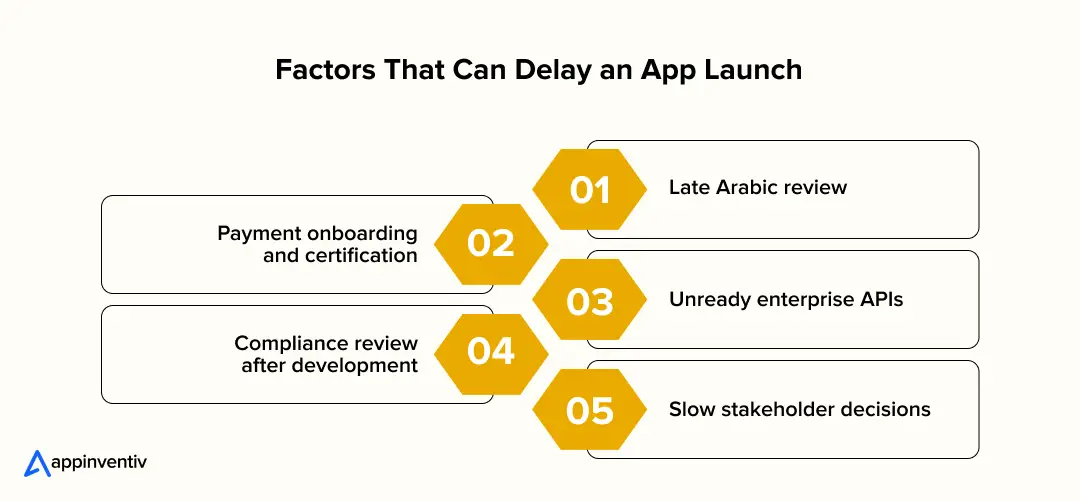
Mobile app projects often fall behind schedule because important commercial, operational, or regulatory decisions remain unresolved. Delayed Arabic approvals, incomplete APIs, payment-provider onboarding, compliance reviews, and repeated scope changes can interrupt development even when the engineering team is progressing well. Identifying these risks early allows the business and vendor to assign owners before they affect the launch.
Late Arabic review
When Arabic content is approved near the end, teams discover broken layouts, inconsistent terms, reversed elements, and incomplete error messages. This can add two to five weeks of design and QA rework. A bilingual glossary and Arabic reviewer should be assigned during design.
Payment onboarding and certification
Commercial onboarding, technical credentials, security checks, test environments, and production approval may take longer than the integration code. The payment workstream should start during discovery. Waiting until checkout development begins can delay launch by four to eight weeks.
Unready enterprise APIs
An internal system may be described as “available” even though it lacks documentation, test data, stable endpoints, or an owner. The mobile vendor then has to reverse-engineer behavior or build an intermediary layer. This can add 10% to 30% to backend cost and one to four months to the schedule.
Compliance review after development
If legal and security teams review the product only before launch, they may request changes to consent, retention, logging, data transfer, access control, or vendor arrangements. Architecture changes at this stage are expensive. Compliance discovery should run in the first month.
Slow stakeholder decisions
A product team may complete a screen in days and then wait two weeks for approval. Across dozens of decisions, that gap can add months. The project needs a named product owner with authority, a response-time expectation, and an escalation path.
| Delay source | Possible impact | Preventive action |
|---|---|---|
| Late Arabic content | 2–5 weeks | Approve glossary and sample screens early |
| Payment-provider access | 4–8 weeks | Begin onboarding during discovery |
| Weak or missing APIs | 4–16 weeks | Run technical assessment before final estimate |
| Late legal review | 3–10 weeks | Map data and consent in discovery |
| Slow approvals | 2–12 weeks | Assign one empowered product owner |
| Scope growth | Continuous | Use release gates and formal change control |
Compliance, Privacy, and Security Costs in Egypt
Compliance is now a direct planning item for mobile app development in Egypt. Law No. 151 of 2020 created the country’s personal-data framework, and Executive Regulations No. 816 of 2025 introduced more detailed operational and licensing requirements.
The law addresses consent, data-subject rights, controller and processor duties, data protection officers, security, direct marketing, and cross-border transfers. The legal text also requires relevant licensing or permits for certain personal-data processing and transfers. The precise obligations depend on the organisation, activity, data, sector, and operating model, so legal advice should confirm the final position.
From a product perspective, compliance may require:
- A record of the data collected and the purpose for collecting it
- Explicit and traceable consent where required
- Privacy notices in clear Arabic and, where appropriate, English
- Processes for access, correction, withdrawal, deletion, and complaints
- Role-based access and auditable administrative activity
- Retention and deletion rules
- Breach detection and response procedures
- Review of hosting and cross-border data flows
- Contracts and controls for processors and third parties
- Governance for direct electronic marketing
These controls affect screens, databases, APIs, dashboards, operational procedures, and vendor agreements. For a standard consumer app, privacy and security planning may represent 5% to 10% of the project. For a platform processing financial, health, biometric, location, or children’s data, the share can rise to 10% to 20%.
Independent penetration testing may cost EGP 250,000 to EGP 1.25 million+, depending on the number of apps, APIs, environments, roles, and retest cycles. A regulated enterprise may need more extensive architecture review, secure-code review, threat modelling, performance testing, and continuous monitoring.
Security also affects time. A baseline review may take two to three weeks. A deeper regulated assessment can take four to eight weeks, excluding remediation. Teams should leave space for fixing findings and retesting. Scheduling the test immediately before launch creates pressure to accept risks or miss the date.
The Hidden Factors that Affects the Total Cost of Developing a Mobile App in Egypt
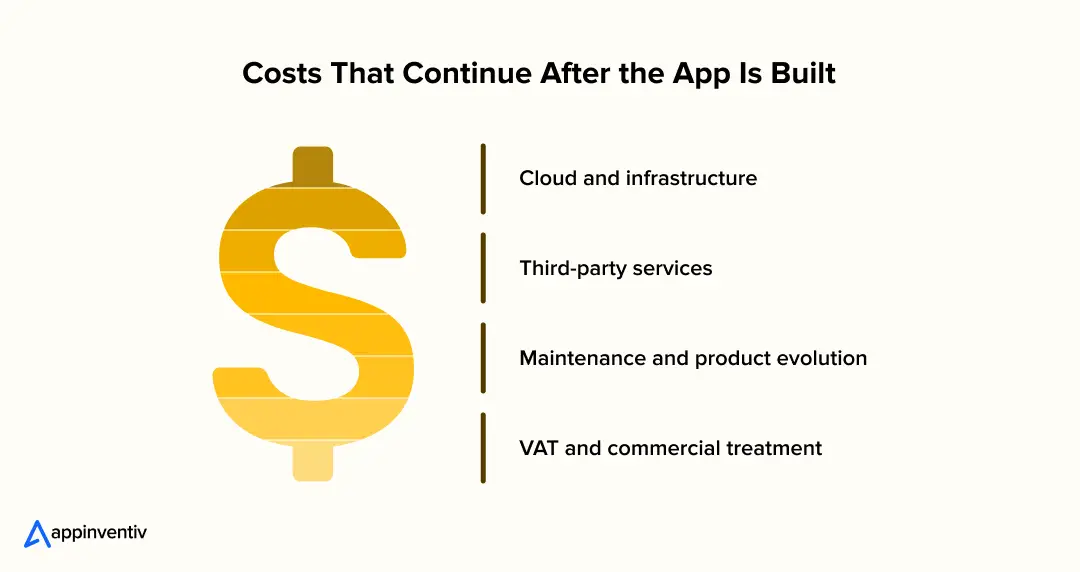
The initial development estimate represents only one part of the total app investment. Cloud infrastructure, third-party platforms, payment charges, security testing, content operations, customer support, maintenance, and future releases continue after launch. Including these expenses in the first-year budget provides a more accurate view of the capital required to operate the product successfully.
Cloud and infrastructure
Cloud cost depends on traffic, storage, media, database use, location services, notifications, backups, logging, and recovery requirements. An early-stage app may spend EGP 25,000 to EGP 125,000 per month. A transactional platform with heavy media, real-time location, or high availability can spend EGP 250,000 to EGP 1.25 million+ per month.
The team should model normal traffic, campaign spikes, Ramadan or seasonal peaks where relevant, and failure recovery. Infrastructure should scale, but uncontrolled autoscaling can create financial surprises.
Third-party services
SMS and OTP, maps, payment processing, email, identity checks, analytics, customer support, video, document verification, and fraud tools usually charge separately. Some vendors bill per transaction. Others use monthly tiers or minimum commitments.
A proposal should list every third-party dependency, pricing unit, free allowance, expected launch volume, and party responsible for the contract. Otherwise, a low development quote can conceal a high operating bill.
Maintenance and product evolution
Annual maintenance typically costs 15% to 25% of the original development budget. This covers operating-system updates, dependency upgrades, bug fixes, security patches, monitoring, minor improvements, and store-release support. It does not normally include major new features.
For an EGP 6 million application, businesses may reserve EGP 900,000 to EGP 1.5 million per year for maintenance, plus infrastructure and external services. Products in active growth may invest much more because they continuously improve onboarding, conversion, retention, and operations.
VAT and commercial treatment
Egypt’s tax treatment should be confirmed before comparing vendor prices. The Egyptian Tax Authority’s guidance states that non-resident providers of digital and remote services can have Egyptian VAT obligations, with different treatment for B2B and B2C supplies. Contracts should clarify whether prices include VAT, whether reverse charge applies, and which party manages related documentation.
| Recurring item | Planning approach |
|---|---|
| Maintenance | 15%–25% of initial build each year |
| Cloud | Model by users, transactions, media, uptime, and peak demand |
| SMS and OTP | Estimate registrations, logins, recovery, and retry rates |
| Maps | Estimate map loads, searches, routes, and live tracking |
| Payments | Include transaction fees, refunds, chargebacks, and settlement |
| Security | Annual testing, monitoring, certificates, and incident readiness |
| Content and support | Arabic and English operations, moderation, and customer service |
How to Reduce Cost Without Weakening the Product
Businesses must understand that cost control should remove uncertainty and low-value scope, not quality.
The first step is to define one measurable launch outcome. A retailer may target completed mobile orders. A logistics company may target digital proof of delivery. A healthcare provider may target booked and attended appointments. Features that do not support the first outcome can move to a later release.
The second step is to reuse stable services. Authentication, notifications, analytics, content management, maps, and payments do not always need to be built from zero. The team should still evaluate security, data location, pricing, provider dependence, and long-term scale.
The third step is to validate uncertain workflows before engineering. A clickable Arabic and English prototype costs far less than rebuilding a finished journey. Testing the prototype with Egyptian users can reveal unclear wording, trust concerns, missing payment methods, and operational gaps.
The fourth step is to stabilize integrations early. Obtain documentation, test credentials, sample data, and a technical owner before committing to a fixed delivery date. Where an API is unavailable, decide whether to build it, use middleware, or change the first release.
Finally, use staged releases. A strong MVP is not a poor version of the final product. It is a complete solution to one valuable problem. A second release can then add automation, loyalty, advanced reporting, recommendations, or wider integrations based on real evidence.
| Cost-control decision | Potential benefit | Risk to manage |
|---|---|---|
| Launch one core journey | Lower initial scope and faster evidence | MVP must still be operationally complete |
| Use cross-platform mobile | Lower two-platform engineering cost | Validate native capability needs first |
| Adopt proven services | Faster implementation | Review recurring fees and vendor lock-in |
| Prototype in both languages | Less late design rework | Use real content, not placeholder text |
| Release in stages | Spreads investment and reduces risk | Architecture must support later growth |
Why Global Giants Choose Appinventiv: Egypt’s #1 Mobile App Development Powerhouse
When businesses seek a trusted mobile app development firm in Egypt, we at Appinventiv emerge as the definitive choice, bringing over a decade of excellence in crafting innovative digital solutions. With our remarkable portfolio of 3,000+ successful projects delivered by our 1,600+ expert developers, we have established ourselves as the cornerstone of digital transformation in the Middle Eastern market. We have secured an impressive $950 million in funding for our startup clients while serving 35+ industries with cutting-edge solutions that drive measurable business growth.
Our expertise shines through our transformative work with renowned global brands across the Middle East. We developed a groundbreaking ERP solution for IKEA that now operates across 7+ stores in the UAE. Our partnerships with KFC, Pizza Hut, and Adidas have successfully digitalized and expanded these brands’ digital footprint throughout the region, with our team crossing the ₹300 crore revenue milestone in FY 2024-25.
Our Industry Recognition & Certifications:
- ISO 9001:2008 Certified for Quality Management Systems
- Tech Company of the Year 2023 by Times Group
- Consecutive Deloitte Tech Fast 50 Awards (2023 & 2024)
- App Development Company of the Year by Entrepreneur.com
- Best Place to Work 2022 by Outlook India
- MIT Innovation Award for our revolutionary employment platform
- CIO Association’s Preferred Partner designation
Ready to join the league of industry leaders who trust us? Let’s transform your innovative ideas into powerful mobile solutions that dominate the Egyptian market. Connect with our expert team today and experience why global brands choose Appinventiv as their digital transformation partner.
FAQs
Q. What is the average cost of developing a mobile app in Egypt?
A. Mobile app development cost in Egypt may range between EGP 2 million and EGP 25 million or more, equivalent to approximately $40,000 to $500,000+. The final breakdown depends on:
- App complexity and number of user roles
- Arabic and English language support
- Native or cross-platform development
- Payment and mobile wallet integrations
- Backend and administrative systems
- Security and regulatory requirements
- Third-party and legacy system integrations
Q. How much should a business reserve for app maintenance?
A. Businesses may reserve 15% to 25% of the initial development cost per year for maintenance. The actual amount depends on product complexity, traffic, security requirements, and release frequency. The maintenance budget may cover:
- Operating-system and device updates
- Security patches and dependency upgrades
- Bug resolution
- Performance monitoring
- Minor product improvements
- App store release support
- Backend and API maintenance
Cloud infrastructure, transaction charges, third-party tools, and major new features are usually budgeted separately.
Q. How long does it take to build a mobile app for the Egyptian market?
A. A focused MVP development timeline varies around four to six months. A mid-complexity application may require six to nine months, while a regulated or enterprise platform can take nine to eighteen months or longer. The schedule may be influenced by:
- Vendor and payment-provider onboarding
- Availability of internal and third-party APIs
- Arabic content review and approval
- Data migration requirements
- Security and compliance assessments
- App store review and release requirements
Q. How much do app developers charge in Egypt?
A. App developers in Egypt charge pretty competitive rates compared to what you’ll see globally. Junior developers typically ask for $15-25 per hour (465-775 EGP), mid-level guys are usually $25-40 per hour (775-1,240 EGP), while senior developers and tech leads? They command $40-60 per hour (1,240-1,860 EGP). Many agencies actually offer project-based pricing, which can end up being more cost-effective for larger projects. These rates are way lower than those of US or European developers who charge $100-200+ per hour, making Egypt an attractive outsourcing option without really compromising on code quality and technical expertise.
Q. How to Choose the Best App Development Company in Egypt?
A. When choosing an app development company in Egypt, you should consider the following:
- Relevant Experience: Look for a firm with experience in your industry and similar project complexity. Ask for case studies and client references.
- Technical Expertise: Ensure they have a strong technical foundation and can handle integrations, security, and scalability, especially for complex apps.
- Clear Process & Communication: Choose a company with a transparent development process and strong communication practices, including clear timelines and post-launch support.
- Alignment with Business Goals: The company should understand your business needs and how the app contributes to your ROI and growth.
- Pricing Transparency: Ensure they provide a clear breakdown of costs, including development, maintenance, and third-party services.
Avoid: Companies offering low rates without clear deliverables, or lacking a maintenance and support plan.
Choosing the right partner means selecting a company that aligns with your business strategy, offering both technical excellence and long-term support.
Q. Should an app in Egypt support both Arabic and English?
A. The decision depends on the target audience, but many Egyptian consumer and business applications benefit from supporting both languages. Arabic should be planned during the design stage rather than added as a late translation task. The development team must account for:
- Right-to-left interface layouts
- Mixed Arabic and English content
- Navigation and icon positioning
- Form fields and validation messages
- Dates, currencies, and numbers
- Arabic content review and functional QA


Fast 2-minute response, fully NDA-protected.
How Much Does It Cost To Build a Chat App Like Arattai?
Key takeaways: Creating a chat app like Arattai will cost you anywhere from $40,000 to $400,000, depending on how complex you want it to be. The essential features you need are real-time messaging, multimedia sending, and user authentication. Layering advanced features such as voice/video calls, group messaging, AI-driven bots, and end-to-end encryption takes the app…

How Much Does It Cost to Build a Car Rental App like Hertz?
Key takeaways: The cost to build a Hertz-like app ranges roughly $40,000–$300,000+. Complexity, automation, and scale matter more than just the number of features. Real costs continue after launch: infra, maintenance, support, and compliance. Smart planning and MVP-first approach help keep budgets under control. Revenue comes from rentals, add-ons, subscriptions, partnerships, and fleet sales. You…
How Much Does It Cost to Build a Route Planning App Like Komoot
Europe doesn’t just love the outdoors- it thrives on it. From the Alps to Amsterdam’s bike lanes, cycling and hiking fuel an industry worth $53.3 billion in 2024, projected to grow at nearly 11% CAGR through 2033, as reported by GrandViewResearch. And leading this charge is Komoot, the route-planning app trusted by 40+ million users.…