



































How Much Does Fitness App Development Cost? Enterprise Pricing, Hidden Costs, and Monetization Strategy

 Share -


- 01Fitness App Development Cost Breakdown (By Complexity, Stages, and Business Model)
- 02Top Three Real World Examples and Their Costs
- 03Factors That Impact the Cost of Developing a Fitness App
- 04ROI of Building a Fitness App and Profitability Timeline
- 05Fitness App Development Pricing Models
- 06Hidden Costs in Fitness App Development Most Businesses Miss
- 07Monetization Strategy That Impacts Fitness App Development Cost
- 08Strategies for Cutting Down Fitness App Development Cost
- 09How to Choose the Right Fitness App Development Partner
- 10Turn Your Fitness App Investment into Real ROI with Appinventiv

Key Takeaways
- Fitness app cost ranges from $40,000 to $400,000, based on features and scale
- Real cost includes build, scaling, maintenance, and integrations
- Business model drives backend complexity and overall pricing
- Strong retention matters more than downloads for ROI
- Early tech and monetization choices prevent costly rework
If you’ve started putting numbers around your fitness app, you’ve probably noticed how quickly things stop making sense. One estimate feels too low to be real, another feels way too high, and neither really explains what you’re paying for.
That usually happens because the fitness app development cost isn’t just tied to features. It depends on how the whole system works behind the scenes. How it handles user data, connects with wearables, processes activity in real time, and keeps up as more users join. A basic version might start at around $40,000, while a full-scale platform with AI, device integrations, and live tracking can exceed $400,000. And even then, the build cost is just the starting point. As your app grows, infrastructure, retention, and ongoing updates start adding to the total investment.
At the same time, the market is moving fast. A 2026 report by Mordor Intelligence values the online fitness market at $36.64 billion, and that growth is pushing companies to build more advanced, connected experiences.
This is where things get practical. Features like personalized plans, device sync, and real-time insights don’t just improve the product; they also improve the user experience. They directly affect the fitness app development cost and how long it takes to recover that spend.
In this guide, you’ll get a clear breakdown of what drives cost, where complexity starts to build, and how to plan your budget so it doesn’t spiral later.
Get a realistic cost estimate based on your features, scale, and monetization model before you start building.

Fitness App Development Cost Breakdown (By Complexity, Stages, and Business Model)
The cost of fitness app development can’t be defined with a fixed number. It changes based on how the app is built, how complex the system is, and how it earns money. A simple app and a full-scale platform do not just differ in features. They differ in backend structure, data flow, and long-term scaling needs.
To make it clear, cost can be understood from three angles: complexity, development stages, and business model.
1. Cost Based on Complexity Level
The fitness app development cost grows with how much the system needs to do behind the scenes. A basic app stores and shows data. A more advanced app processes data in real time, connects with devices, and handles large user activity.
| App Complexity | Cost Range | Key Features | Technical Setup |
|---|---|---|---|
| Basic App | $40,000 – $80,000 | Login, activity tracking, simple UI | Single backend service, basic APIs, simple database, limited data processing |
| Mid-Level App | $80,000 – $150,000 | Video content, payments, third-party integrations | API-driven backend, payment gateway integration, CDN for media, background jobs for syncing data |
| Advanced App | $150,000 – $400,000+ | AI features, real-time tracking, wearable sync, analytics | Cloud setup, separate services for key functions, event queues, real-time data processing, scalable storage |
As complexity increases, the system moves from simple data storage to continuous data processing. Video streaming needs CDN support. Wearables need background sync. AI features require data pipelines and compute power. This is where the AI fitness app development cost starts to rise.
2. Cost Based on Development Stages
The fitness app development cost is also distributed across stages. Each stage adds its own effort and risk.
| Stage | What Happens | Technical Scope | Cost Impact |
|---|---|---|---|
| Planning & Prototyping | Idea shaping and validation | Wireframes, user flows, system design | Lower cost, prevents rework later |
| Design & Development | Core product build | Frontend, backend, APIs, integrations | Highest cost, full engineering effort |
| Testing & Deployment | Final release prep | QA, bug fixes, performance tuning | Moderate cost, ensures stability |
Each stage depends on the previous one. Poor planning increases development costs later. Strong architecture reduces long-term fixes.
3. Cost Based on Business Model
When you plan how your app will make money, it also shapes the system you’ll need to build. The fitness app development cost breakdown changes based on this decision. Each monetization path will require a different backend setup, data flow, and level of complexity.
Here’s how that typically plays out:
| Business Model | Expected Cost Range | What You’ll Need | What to Plan For |
|---|---|---|---|
| Consumer Subscription Apps | $40,000 – $120,000 | Content library, subscription handling and user tracking | You’ll need strong content delivery, access control, and scalable storage as users grow |
| Trainer Marketplace Apps | $80,000 – $200,000 | Booking system, chat, payments, dashboards | A two-sided system will be required, along with real-time communication and payout logic |
| Enterprise Wellness Platforms | $150,000 – $400,000 | Admin panel, analytics, HR integrations | You’ll be dealing with multi-tenant architecture and strict data separation across organizations |
| Wearable Fitness Apps | $100,000 – $300,000 | Device syncing, activity tracking and insights | Multiple SDKs, real-time syncing, and battery-efficient processing will need to be handled carefully |
What this means in practice:
The cost of fitness app development will depend heavily on how you choose to generate revenue. A simpler subscription model may keep things relatively straightforward. A marketplace or enterprise model will introduce more moving parts and higher costs.
Each direction adds its own layer of system logic, integrations, and user flows. Planning this early helps you avoid rework later and keeps the fitness app development cost more predictable as your product evolves.
Top Three Real World Examples and Their Costs
When you’re trying to make sense of numbers, real apps make it easier. You can almost see where the money goes just by looking at how each one works day to day.
1. Fitbod (AI-based workout app)
Open Fitbod and it feels simple. You get a workout, you follow it. But behind that, the app is constantly adjusting based on what you did yesterday, how hard you trained and what you skipped. That kind of continuous adjustment needs a system that keeps learning and updating, which is why the cost stretches on the higher side.
Estimated Cost: $40,000 – $400,000
Also Read: Cost to Develop an AI Fitness App Like Fitbod Guide
2. Hevy (Workout tracking + community)
Hevy is more direct. You log workouts, check progress and maybe share them with others. There’s still backend work happening, especially to keep everything in sync and properly stored, but it’s not trying to “think” for the user. That keeps the build relatively lighter.
Estimated Cost: $40,000 – $250,000+
Also Read: How much does it cost to build a fitness app like Hevy?
3. Strava (Tracking + social + real-time data)
Think about someone going for a run with Strava on. The app is tracking distance, speed and route, all in real time. Now multiply that by thousands of users doing it at once. Add the social feed on top, and the system has to handle a lot of live activity without slowing down. That’s where the cost really starts to climb.
Estimated Cost: $150,000 – $400,000+
Also Read: https://appinventiv.com/blog/cost-to-develop-fitness-app-like-strava/
What this actually tells you
The fitness app development cost usually goes up when the app starts doing more in the background. Simple logging is one thing. Real-time tracking or AI-driven suggestions are a different level altogether. That shift is what changes the budget, not just the feature list.
Factors That Impact the Cost of Developing a Fitness App
The factors that impact the cost of developing a fitness app are not just about adding more features. The real cost comes from how the app works behind the scenes, how it handles data and how it responds in real time, how it grows with users.
A simple app that tracks steps will cost far less than a system that offers personalized plans and connects to devices. The difference lies in depth, not just design.
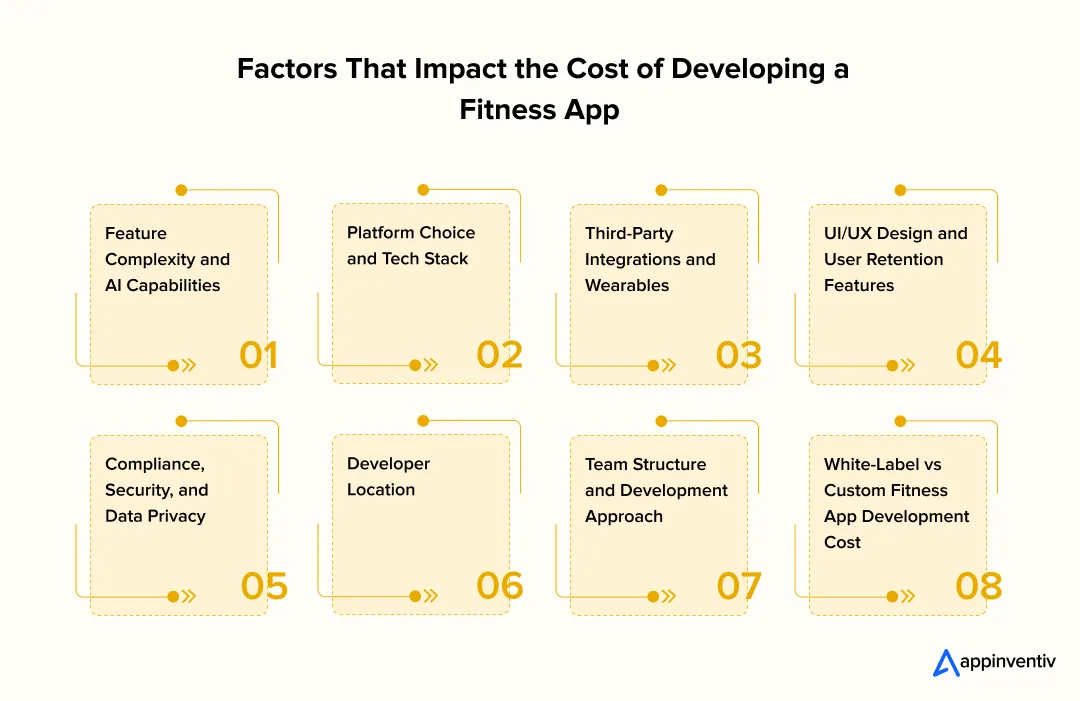
1. Feature Complexity and AI Capabilities
At the start, features look straightforward. Log steps, track workouts, show progress. That part is manageable. Things change when the app starts thinking for the user.
- Basic Features: Simple logic, minimal backend work, quicker to build.
- Advanced Features: Need continuous data processing, model logic, and frequent updates.
For example, a personalized workout plan isn’t just a screen. It depends on user data, behavior patterns, and constant recalibration. That’s where infrastructure and compute costs start climbing.
2. Platform Choice and Tech Stack
This is one of those decisions that feels small early on but shows up everywhere later.
- Single Platform (iOS or Android): Faster to launch, easier to manage.
- Multiple Platforms: More code, more testing, more coordination.
The backend matters just as much. A basic setup might hold up during early testing. But once users grow, you’ll need something that scales without slowing things down. That usually means cloud infrastructure, which adds cost upfront but avoids bigger issues later.
3. Third-Party Integrations and Wearables
This is where complexity quietly builds up.
- Wearables: Continuous sync, different data formats, real-time handling.
- Third-Party APIs: Payments, analytics, health platforms, each with its own quirks.
On paper, it’s “just integration.” In reality, you’re dealing with inconsistent data, edge cases, and reliability issues. Making all of that work smoothly in real time takes effort.
4. UI/UX Design and User Retention Features
A clean UI gets users in. Retention features keep them there.
- Basic Design: Faster to ship, limited long-term engagement.
- Retention Features: Streaks, milestones, rewards, all backed by logic and data tracking.
Even something simple like a streak counter needs accurate tracking, timely updates, and fail-safe handling. It’s not just design, it’s system behavior.
5. Compliance, Security, and Data Privacy
This is where shortcuts usually backfire.
- Data Protection: Encryption, secure APIs, controlled access.
- Compliance: Regulations like GDPR and HIPAA directly influence how user data is stored, accessed, and protected. If your app handles health-related data, aligning early with GDPR and HIPAA compliance for fitness apps helps avoid costly changes later.
Fitness apps handle personal data such as names, email addresses, contact details, and, in some cases, locations. These datasets are quite sensitive in nature and are covered under strict regulations. If users don’t trust the app, they stop using it. Building that trust means investing in security from the start.
6. Developer Location
Costs vary widely depending on where your team is based.
- USA / Canada: $200 – $350 per hour
- Europe: $150 – $250 per hour
- India / Asia: $50 – $100 per hour
Lower rates can help with the budget, but coordination matters. Time zones, communication gaps, and handoffs can slow things down if not managed well. That’s why many teams mix onshore and offshore resources.
7. Team Structure and Development Approach
The team you build directly affects both speed and cost.
- Smaller Team: Lower cost, slower progress.
- Larger Team: Faster output, higher cost.
- Specialists: AI engineers, backend experts and DevOps are necessary for complex features.
It’s not about having more people. It’s about having the right mix at the right time.
8. White-Label vs Custom Fitness App Development Cost
This is where long-term thinking comes in.
- White-Label Apps: Quick to launch, lower upfront investment, limited flexibility.
- Custom Apps: Built around your product vision, more expensive early on, easier to scale later.
If you’re testing an idea, white-label can work. If you’re building a serious product, custom development usually makes more sense.
Also Read: Custom Development vs White Label: Choose the Right Path
What This Means for Your Budget:
Most teams start by estimating features. What actually drives cost is how those features behave in real conditions. A simple app stays affordable because the system behind it is simple. Once you add real-time tracking, integrations, and AI adoption, you’re building something much more complex.
The teams that stay on budget usually do one thing differently. They don’t try to build everything at once. They plan for growth, then build in phases so the system can keep up without breaking.
Get clarity on architecture, integrations, and scaling decisions early, so your build stays predictable and controlled.

ROI of Building a Fitness App and Profitability Timeline
The ROI of building a fitness app does not show up right after launch. Money goes out first. Revenue comes later, and it grows only if users stay and keep paying. Most teams focus on development cost. The real question is how long it takes to earn that money back. That depends on user retention, pricing model, and how fast the app grows.
Here is how the journey usually looks:
| Stage | Timeframe | Where Money Goes | What Revenue Looks Like | What It Means |
|---|---|---|---|---|
| Build Phase | 0 – 6 months | Development, testing, launch setup | No revenue or very low | Heavy spend. Focus stays on getting the product ready |
| Early Growth | 6 – 12 months | Marketing, small feature updates | First users start paying | Revenue starts but stays lower than spend |
| Retention Phase | 12 – 18 months | Improving experience, fixing gaps | Users renew and stay longer | Revenue becomes steady. Fewer users drop off |
| Scaling Phase | 18 – 24 months | Infrastructure, automation, growth push | Recurring income increases | Many apps reach break-even here |
| Expansion Phase | 24+ months | New markets, partnerships and advanced features | Multiple income sources | Profits improve as user base grows |
What this means for your business:
The fitness app development cost is only the starting point. Returns depend on how long users stay and how often they pay.
- If users leave early, recovery takes time.
- If users stay for months, revenue builds faster.
- If you sell to companies, recovery can happen much earlier.
The cost of fitness app development starts to make sense only when the app keeps users engaged. Strong retention changes everything. It lowers acquisition pressure and builds a steady income.
In simple terms, profit does not come from downloads. It comes from users who stay, return, and keep paying over time.
Fitness App Development Pricing Models
The Fitness app development pricing models you choose will decide how your money is spent and how the project moves forward. The same product can feel very different in cost depending on the model you pick. It is not just about price. It is about control, flexibility, and speed.
Here are the common pricing models used in fitness app development:
| Pricing Model | How It Works | Best Fit | Cost Behavior | What to Keep in Mind |
|---|---|---|---|---|
| Fixed Price Model | Cost and scope are locked before work starts | Small apps with clear requirements | Cost stays stable if the scope does not change | Changes later can slow things down and increase cost |
| Time and Material Model | You pay for the actual time and effort used | Apps that evolve during development | Cost moves with the work done | Needs regular tracking and clear communication |
| Dedicated Team Model | A team works only on your product for a monthly cost | Long-term or growing products | Steady monthly spend with room to adjust scope | Works best when you stay involved in decisions |
| Hybrid Model | Combines fixed pricing for some parts and flexible pricing for others | Projects that start small and grow later | Early costs stay controlled, later stages stay flexible | Needs clear planning across phases |
What this means for your cost:
The fitness app development cost is not only about features. It also depends on how you choose to pay for the work.
- A fixed model gives clarity at the start. It works well when everything is defined.
- A flexible model allows changes as the product grows. It suits products that are still taking shape.
- A dedicated team gives consistency. It helps when you plan to keep building and improving over time.
Hidden Costs in Fitness App Development Most Businesses Miss
Most teams plan the fitness app development cost for launch. The real spend starts after users join and the app begins to scale. These costs grow with usage and are often missed early.
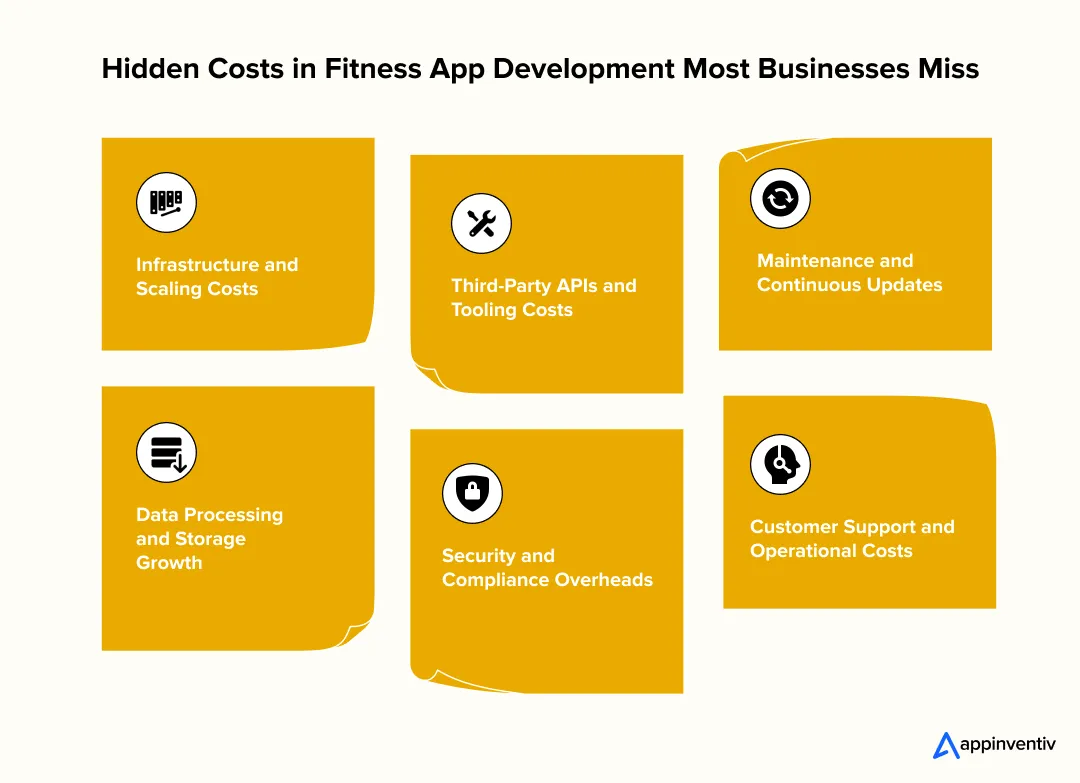
- Infrastructure and scaling: Cloud servers, storage, and bandwidth increase as users grow. Real-time features raise usage costs faster.
- Third-party APIs and tools: Payments, analytics, chat, and video services charge based on usage. Costs rise with traffic.
- Maintenance and updates: Regular fixes, OS updates, and performance improvements need ongoing effort and budget.
- Data processing and storage: User activity data builds up over time. Storage and processing costs increase, especially with AI features.
- Security and compliance: Encryption technology, secure systems, and legal checks add recurring cost, especially for health data.
- Customer support and operations: Support tools and teams are needed as users grow. More users mean higher support costs.
The fitness application development cost is not just what you spend to build. It is what you spend to keep the app running, stable, and growing over time.
Monetization Strategy That Impacts Fitness App Development Cost
Your monetization model shapes how the app is built. It decides what systems you need, how users interact, and how revenue flows. This is why it directly impacts the fitness app development cost.
| Monetization Model | How It Works | Required Features | Impact on Development Cost |
|---|---|---|---|
| Subscription Model | Users pay monthly or yearly for access | Payment gateway, subscription logic, content access control, renewal system | Moderate cost. Needs secure payment flow and user access management |
| Freemium + In-App Purchases | Basic features are free, and users pay for premium features | Feature gating, in-app purchase system, upgrade flows | Slight increase in cost due to multiple access levels and purchase handling |
| Corporate Wellness (B2B) | Companies pay for employee access | Admin dashboard, user groups, reporting and role-based access | High cost. Needs a multi-tenant system, data separation, and analytics |
| Trainer Marketplace | Users pay trainers for sessions, the platform takes a commission | Booking system, payment split, chat or video calls | Higher cost. Needs real-time systems and payout management |
| Ads-Based Model | Revenue comes from ads shown to users | Ad network integration, tracking and user segmentation | Lower build cost, but needs scale to generate meaningful revenue |
What this means for your product:
The cost of fitness app development depends on how you plan to earn. A simple subscription model is easier to build. A marketplace or B2B model adds more systems and increases cost.
Each app monetization strategy adds its own layer of logic, data handling, and user flow. That is why planning revenue early helps control the fitness application development cost and avoids rework later.
Strategies for Cutting Down Fitness App Development Cost
Reducing the fitness application development cost starts with clear decisions early. Most extra spending comes from changes made late. A simple plan helps avoid that.
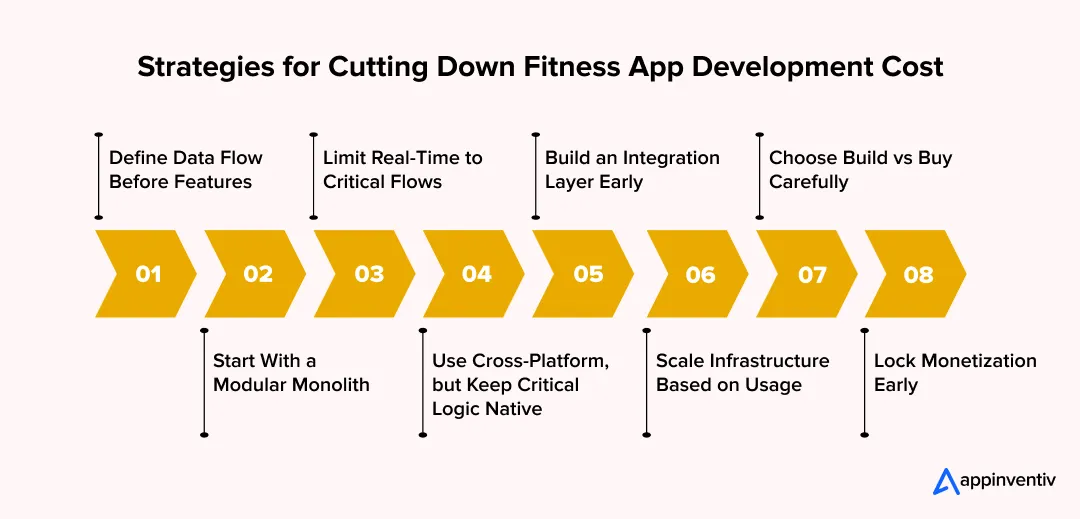
- Define Data Flow Before Features: Map one core journey end-to-end and design how data moves through the system. This avoids backend rework when you scale features.
- Start with a Modular Monolith: Keep modules like user, tracking, payments, and notifications logically separated. Easier to scale later without early over-engineering.
- Limit Real-Time to Critical Flows: Use real-time only where needed, like live tracking. Batch the rest to reduce infra and compute costs.
- Use Cross-Platform, but Keep Critical Logic Native: Speed up UI development with one codebase, but handle tracking and device sync in native layers to avoid performance issues.
- Build an Integration Layer Early: Add an abstraction layer for wearables and APIs. Normalize data once, so new integrations don’t require rework.
- Scale Infrastructure Based on Usage: Use auto-scaling and separate workloads like analytics and real-time processing. Don’t overbuild infrastructure early.
- Choose Build vs Buy Carefully: Use ready APIs for payments, auth, and analytics. Build only what differentiates your product.
- Lock Monetization Early: Subscription, marketplace, and B2B models need different backend logic. Late changes increase the cost significantly.
The fitness application development cost stays controlled when you build in steps. Start small, keep the system flexible, and expand with real demand.
How to Choose the Right Fitness App Development Partner
The partner you choose shapes more than the build. They define how your app handles real users, real data, and real growth. A weak setup works in demos but struggles in production. A strong one scales without constant fixes.
Here’s what actually matters.
1. Look for Depth in Data Handling, Not Just “Fitness Experience”
It’s easy to find teams that have built fitness apps. What matters is how they handled data.
- Have they worked with real-time activity streams or just stored logs?
- How did they manage sync from multiple devices?
- Did they use event-driven systems or basic APIs?
Apps with wearables and live tracking need more than simple backend logic.
2. Evaluate the Backend Architecture Early
Most long-term issues come from backend decisions, not UI.
- Do they design modular systems (separate services for users, workouts and payments)?
- Can their setup scale when user load increases?
- Do they use cloud-native infrastructure with auto-scaling?
A basic backend works early. It becomes a bottleneck as soon as usage grows.
3. Check Their Approach to Real-Time and Integrations
This is where projects usually get delayed.
- How do they handle real-time updates without lag or battery drain?
- What’s their plan for wearable integrations and data normalization?
- Do they build systems that can add new integrations without rework?
If integrations aren’t planned properly, costs rise later.
4. Understand How They Plan for Data Growth
Fitness apps collect data continuously. Poor planning shows up fast.
- Do they separate frequent-use vs long-term data?
- How do they keep performance stable as data grows?
Without this, apps slow down as users increase.
5. Security and Compliance Should Be Built In
This isn’t something to fix later.
- Do they implement encryption and secure APIs by default?
- Are they familiar with HIPAA and GDPR requirements?
If security is treated as an add-on, it becomes expensive to fix later.
6. Look at How They Think About Cost, Not Just Pricing
A strong partner helps you avoid unnecessary spending.
- Do they suggest phased builds instead of full-scale launches?
- Can they identify features that increase infrastructure cost early?
- Do they recommend using APIs instead of building everything?
This is where budgets are actually controlled.
7. Check Post-Launch Capability
Most apps break during growth, not at launch.
- Do they set up monitoring, logs, and alerts early?
- Can they handle scaling without downtime?
You need a team that stays effective after release.
You’re not just choosing a development team. You’re choosing how your system will behave when real users start using it daily. The right partner builds for scale from day one. That’s what keeps costs predictable and the product stable as you grow.
Work with experts who understand scalability, integrations, and real-world product performance.

Turn Your Fitness App Investment into Real ROI with Appinventiv
At this stage, the real question usually changes. It’s not just about how much you’ll spend. It’s about how that spending turns into returns.
As a fitness mobile app development company, Appinventiv works with that mindset from the start. The focus is not on building everything at once, but on structuring the product so your investment stays controlled and starts delivering value early.
Here’s what that looks like in practice:
- Start smaller, validate faster: Instead of putting $250K+ on the line upfront, many teams begin with a $60K–$90K MVP. One strong use case, real users, quick feedback. This reduces risk and gives you clarity before scaling.
- Avoid overbuilding infrastructure early: Much of the cost creep comes from systems built too big, too soon. With the right architecture, teams often save 20–30% on early infrastructure costs by scaling only when usage demands it.
- Move toward revenue sooner: With the right monetization setup, subscription or B2B fitness apps can start generating revenue in 6–9 months. Many reach break-even within the 12–18-month range, depending on retention.
- Cut down rework later: Fixing poor early decisions is expensive. Getting data flow, integrations, and backend structure right from day one can reduce long-term redevelopment costs by 15–25%.
This is where experience matters. Appinventiv has delivered 500+ digital health solutions and worked with 450+ healthcare clients, which shows in how products are built. Not just to launch, but to handle real users, real data, and everyday usage without slowing down.
If you’re planning a fitness product, the goal is simple. Make sure your fitness app development cost leads to something measurable.
You can connect with the Appinventiv team to map your idea, get a realistic cost estimate, and see how that investment can grow into a product that performs well over time.
FAQs
Q. How much does it cost to build a fitness app?
A. The fitness app development cost usually starts around $40,000 and can go up to $400,000 or more. A simple app with basic tracking stays on the lower side. The cost rises when you add features like payments, real-time tracking, or wearable support. If the goal is to build a product that can scale, the budget needs to account for that from the start.
Q. How long does it take to build a fitness app?
A. A basic version can be ready in 3 to 6 months. This usually covers core features and a simple backend. A more complete product takes 6 to 12 months, especially if it includes integrations, testing, and performance work. Larger platforms take longer as the system becomes more complex.
Q. How much does it cost to implement AI into a fitness app?
A. AI adds another layer to the build. It can increase the cost by $20,000 to $100,000 or more. Simple suggestions based on user data cost less. Features that give real-time feedback or learn from user behavior need more work and data. AI also brings ongoing costs, as the system needs to process and update data over time.
Q. What features should a fitness app have to succeed?
A. A fitness app should include activity tracking, user profiles, and progress reports as core features. It should also have reminders, goal setting, and simple engagement tools to keep users active. Advanced features like personalization and device integration can be added later based on user needs.
Q. How do fitness apps make money?
A. Fitness apps make money through subscriptions, in-app purchases, trainer commissions, and corporate wellness programs. Subscriptions are the most common model, where users pay monthly or yearly for access. Some apps also earn by connecting users with trainers and taking a percentage from each session.
Q. Can a fitness app scale to millions of users?
A. Yes, a fitness app can scale to millions of users if it is built with a strong backend and cloud infrastructure. It needs efficient data handling, stable APIs, and scalable architecture from the start. Without this, performance issues and higher costs can occur as user numbers grow.
Q. What future trends will shape fitness app development?
A. Fitness apps are moving toward deeper personalization and real-time insights. AI-driven features adjust plans based on user behavior, which also increases the AI fitness app development cost. Wearable syncing is improving with better sensors, and some apps are testing AR workouts. At the same time, apps are focusing more on data privacy as they handle more personal health data.


Fast 2-minute response, fully NDA-protected.

Wearable Data Integration: Connecting Multiple Devices to a Unified Health Platform
Key takeaways: Device support should reflect the measurements your service needs, the people using it, and the decisions those readings inform. A unified health data platform must preserve source, timing, and measurement context while resolving duplicate records. Phone health platforms, manufacturer APIs, and direct device connections serve different integration needs. Clinical workflows require agreed review…

Sleep Tracker App Development: Features, Wearable Integration, AI, and Compliance
Key takeaways: Sleep tracking presents opportunities across consumer wellness, fitness, healthcare, employee wellness, senior care, and infant-care markets. Successful products combine actionable insights, wearable connectivity, user-friendly reports, privacy controls, and clearly differentiated experiences. HealthKit, Health Connect, and direct device APIs provide different data depths, costs, limitations, and maintenance requirements. AI supports sleep-stage estimation and personalization,…

Diet and Nutrition App Development: Process, Features, Cost, and Technology Stack
Key Takeaways Diet and nutrition tracking app development goes past basic calorie counters with verified food databases, custom meal schedules, AI tools, wearable device links, and corporate manager tools. Structure database models around raw food items, serving portions, nutrient facts, recipes, software links, and regional diet rules. Pair computer vision models, recommendation algorithms, language engines,…