

































Virtual Reality in Healthcare: Benefits, Use Cases, Costs, and Challenges

 Share -



- 01What Goes Into Building an Effective Healthcare VR Experience?
- 02Core Benefits of Virtual Reality in Healthcare
- 03Virtual Reality Use Cases in Healthcare with Real-Life Examples
- 04Cost of Implementing Virtual Reality in Healthcare
- 05Challenges of VR in Healthcare and Solutions to Overcome Them
- 06Bring VR Into Your Healthcare Ecosystem With Appinventiv
- 07FAQs

Key Takeaways
- Virtual reality in healthcare supports training, patient education, rehabilitation, and pain management.
- VR can improve consistency, repeatability, and measurement in clinical learning and care delivery.
- Enterprise VR healthcare solutions often require integrations with EHR, PACS, and other clinical systems.
- VR development costs can range from about $30,000 for a basic training app to $400,000+ for an enterprise platform.
- Adoption depends on clinical evidence, usability, accessibility, and secure data handling.
Take a step into an advanced healthcare environment, and VR could be helping in locations you wouldn’t think. A headset can transport a medical trainee into an artificial operating room, help a patient cope with the pain during an operation or lead a person on a rehabilitation exercise. The technology provides a controlled environment for the healthcare team to recreate clinical situations and patient experiences without altering the physical environment.
This is reflected in the market. The global virtual reality in healthcare market is expected to grow to $29.4 billion by 2030, with a compound annual growth rate (CAGR) of 30.3% between 2025 and 2030 (Source: GVR). An increase in the number of medical training, surgical simulation, and patient care applications is largely responsible for the market growth.
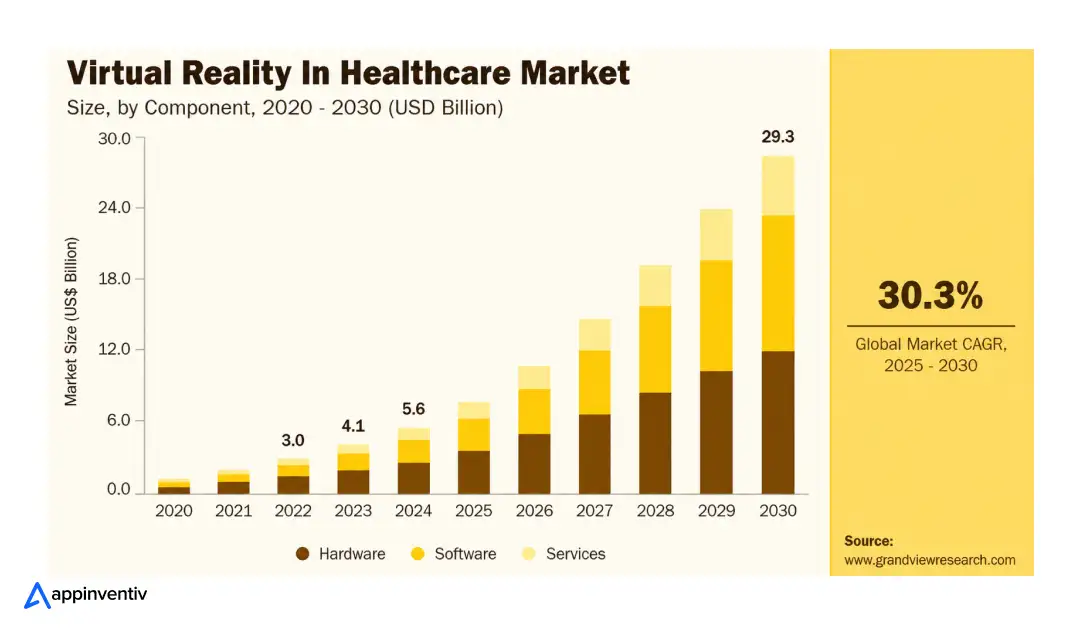
It is this growth that is also drawing healthcare stakeholders in. Healthcare organizations are exploring VR to increase clinical workforce capacity, create new and interactive rehabilitation options, assist in pain and anxiety management, and offer enhanced understanding of procedures and conditions for patients.
Repeatable simulations, measurable training performance and having some therapeutic and educational experiences occur outside of the traditional clinical environment are also attractive to healthcare organizations.
In this blog, we will look into the core benefits of VR in healthcare, VR use cases with real-life examples, implementation costs, and adoption challenges. But before that, let’s have a look at how VR works in healthcare.
Let’s identify the right VR applications, development approach, and implementation roadmap for your organization.

What Goes Into Building an Effective Healthcare VR Experience?
Healthcare organizations create virtual reality applications in healthcare using 3D environments, application software, tracking systems, and clinical data, along with immersive hardware. The design of the architecture is flexible and can be customized for various clinical processes and may involve:
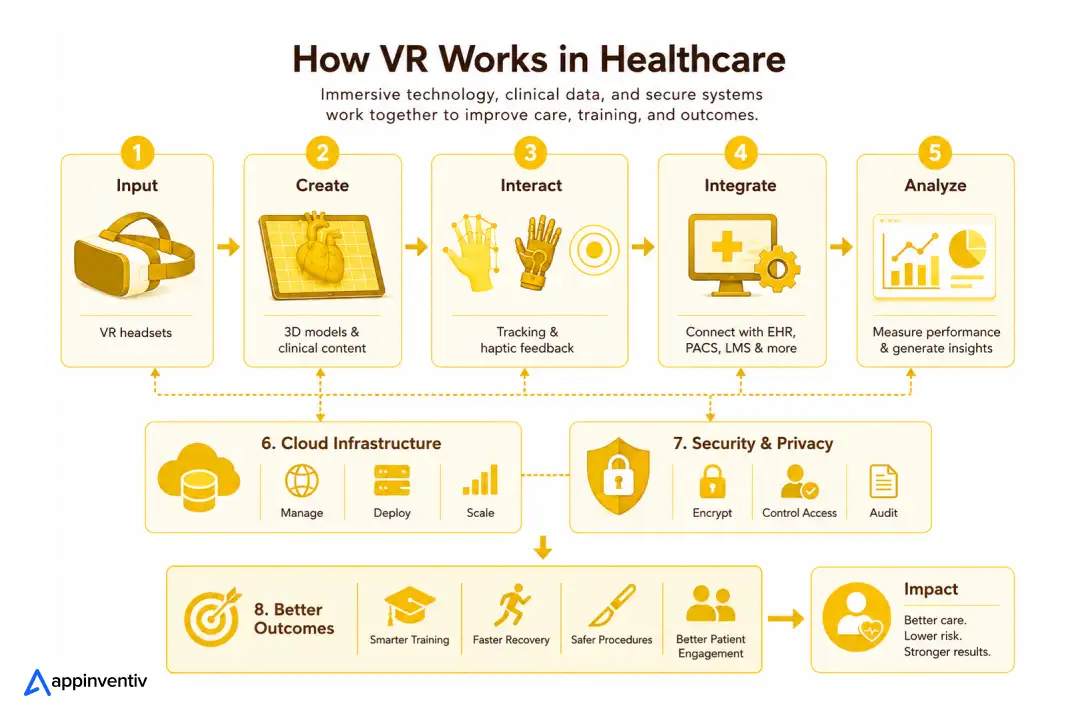
- VR headsets: Provides immersive visualization and interactivity with standalone or connected devices.
- 3D printing and modeling: Creates interactive 3D anatomical, clinical and procedural images.
- Motion and hand tracking: Records the user’s movements for rehabilitation, surgical simulation, and clinical skills evaluations.
- Haptic feedback: Gives tactile feedback, simulating virtual instruments and objects.
- Clinical system integration: Integrates VR applications with EHR, PACS, LMS, and other healthcare systems via APIs and standards like HL7 and FHIR.
- Healthcare data analytics layer: Measures movement, task completion, accuracy, reaction time and other pertinent performance indicators.
- Cloud infrastructure: Enables the management, administration, analysis and deployment of content from a central location across various facilities.
- Security controls: Protects clinical and patient data through encryption, access controls, audit logs, and secure data transmission.
The integration of these elements with the current clinical ecosystem will enable virtual reality in healthcare to be integrated into wider training, rehabilitation, patient education, and clinical workflows.
Core Benefits of Virtual Reality in Healthcare
The benefits of virtual reality in healthcare go beyond patient immersion. VR can produce controlled clinical environments, gather data during training, and facilitate treatment protocols with repetitive scenarios. Key benefits include:
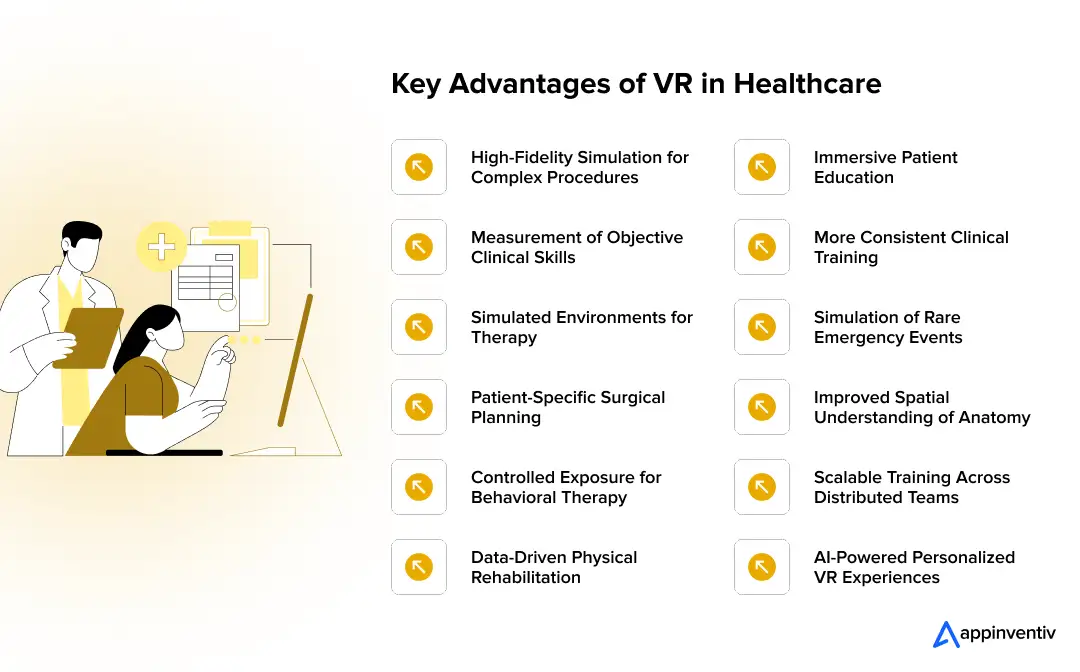
High-Fidelity Simulation for Complex Procedures
VR allows clinicians to practice difficult, high-risk and unusual procedures in a simulated environment. Teams can simulate a specific procedure, troubleshoot issues and redo scenarios without risking the patient during the procedure.
Measurement of Objective Clinical Skills
High-end VR systems can record hand motion, reaction time, accuracy of procedure, task completion and navigation patterns. These metrics can be used to monitor competency over time and specific skills that require further development in training institutions.
Simulated Environments for Therapy
VR is utilized in mental health for creating controlled environments which allow patients to practice coping mechanisms in contexts of anxiety, phobias, or stress. The level of exposure can be tweaked to better accommodate the clinician’s control of the session’s pacing.
Patient-Specific Surgical Planning
VR can convert CT and MRI data sets into 3D anatomical models. Doctors can view the organs from multiple perspectives, evaluate the space relationships and study complicated organs prior to an intervention.
Controlled Exposure for Behavioral Therapy
VR in healthcare enables therapists and practitioners to simulate various environments and manipulate their exposure levels. This can help to structure therapy in cases where environments or situations comprise a structured part of the therapy plan.
Data-Driven Physical Rehabilitation
VR rehabilitation systems may feature motion tracking along with interactive workout routines. They can measure range of motion, balance, coordination and task completion, providing therapists with objective data to modify exercises and track progress.
Immersive Patient Education
VR technology in healthcare can transform the experience of complex medical explanations into interactive visual experiences. Patients can look at anatomical structures, learn about the steps of treatment, and see a simulation of the clinical setting before undergoing procedures.
More Consistent Clinical Training
VR can be used across hospitals, medical schools and training centers, with the same scenarios. All learners can experience the same conditions and circumstances of the process, the assessment and the level of difficulty, enabling more consistent competency assessment.
Simulation of Rare Emergency Events
VR can simulate time-sensitive situations like trauma response, cardiac emergency or complications in the operating room. Instead of a real-world event happening, teams can practise communication, prioritization and clinical decision-making.
Improved Spatial Understanding of Anatomy
Virtual reality in medicine gives the user a visual, interactive 3D view of anatomy. This can aid in understanding the depth and positioning of organs, vessels, tissues, and other structures, as compared to flat diagrams alone.
Scalable Training Across Distributed Teams
VR can take specialized training simulations away from the training environment. Geographically dispersed teams can help achieve consistency in clinical training both at the hospital level and across locations by presenting the same training scenarios and collecting the same kind of performance data at each site.
AI-Powered Personalized VR Experiences
When AI is combined with VR, healthcare experiences can adapt as users interact with them. For example, rehabilitation exercises can change based on progress, while training simulations can introduce new challenges based on a learner’s performance.
Our experts can help you evaluate use cases, select the right technology stack, and plan development around your healthcare requirements.

Virtual Reality Use Cases in Healthcare with Real-Life Examples
The virtual reality use cases in healthcare are expanding from clinical training and rehabilitation to patient education, pain management, and procedure preparation. These applications have already been tested or deployed in a real clinical environment by several hospitals and research institutions.
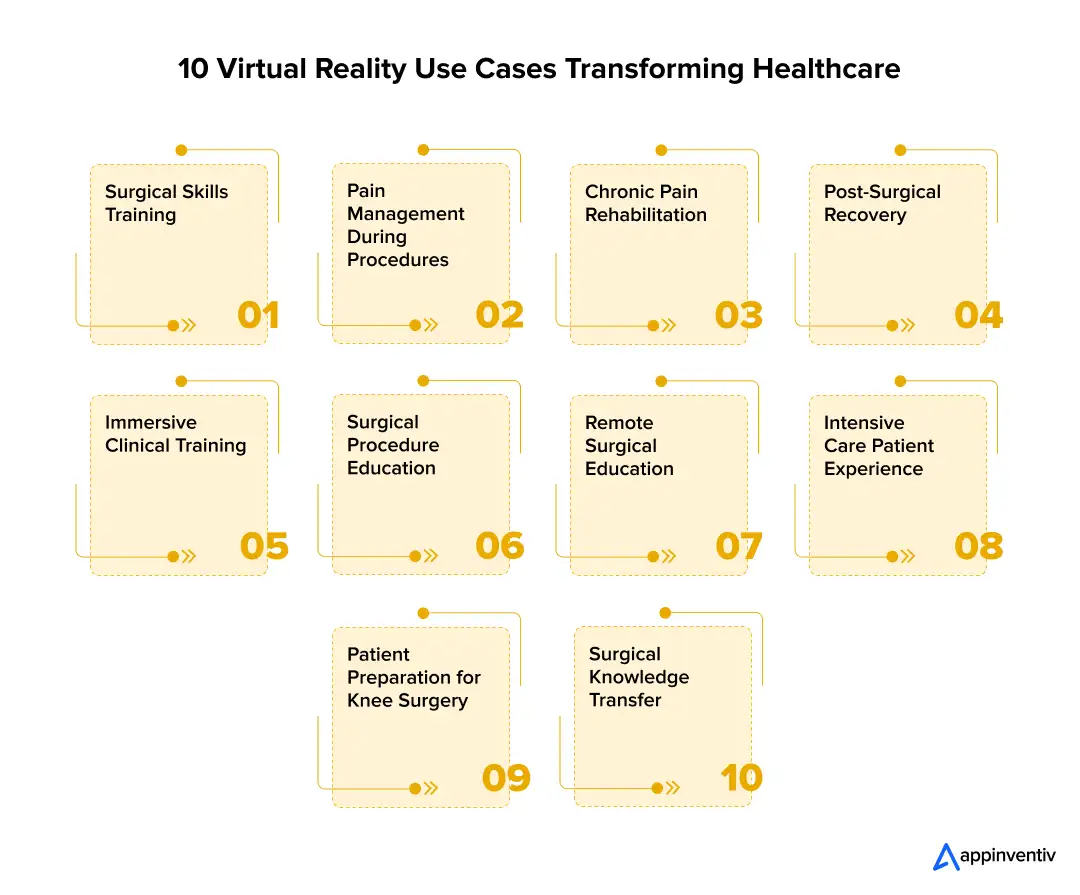
Surgical Skills Training
Virtual reality in healthcare can provide doctors with a safe environment to practice procedures before entering an operating room. The trainees can repeat the surgical steps, handle the instruments, and get guidance on the surgical procedure without using live patients for initial practice.
Real-life example: Guy’s & St Thomas’ NHS Foundation Trust has used VR to train orthopedic surgeons in procedures such as ACL reconstruction, knee and hip replacements etc. The Trust hosted an event for over 30 junior surgeons from all over London in VR surgical training in 2022.
Pain Management During Procedures
VR in healthcare can offer an immersive distraction and relaxation when carrying out painful processes. Patients can enter into simulated environments and clinical personnel can deliver the treatment.
Real-life example: VR was implemented at Queen Elizabeth Hospital Birmingham by RealLifeVR in the treatment of kidney stones through shockwave lithotripsy. The patient wears the headset during the 30-40 minutes of the process to be able to access certain relaxing visual environments and breathing exercises.
Chronic Pain Rehabilitation
VR technology in healthcare can be used in pain rehabilitation programs to offer immersive activities for patients, helping them to relax, move, and engage in therapy.
Real-life example: Torbay and South Devon NHS Foundation Trust is currently testing VR as part of their Pain Rehabilitation Team. The Trust said it engaged with approximately 50 patients who suffered from chronic pain and/or were severely anxious about a period of 18 months to evaluate a variety of VR products and their usefulness in treatment.
Post-Surgical Recovery
VR can assist in recovery by offering relaxation and distraction experiences to help patients through the process alongside traditional post-operative care.
Real-life example: A pilot study was carried out at a single centre (East Kent Hospitals University NHS Foundation Trust) at Queen Elizabeth The Queen Mother Hospital in Margate, where patients undergoing elective laparoscopic colorectal surgery were recruited.
The project explored the feasibility of using VR in the immediate post-operative recovery and the acceptability of VR to both patients and healthcare staff.
Immersive Clinical Training
Virtual reality for medical training is based on metaverse-like virtual environments that can simulate medical environments and patient scenarios that healthcare workers could face in real life.
Real-life example: Immersive VR training programme in collaboration with Immersive Medical, designed by NHS England’s East of England team, as a real-life example. The program is based on a fictional 83-year-old patient who undergoes different phases of treatment.
The patient has a series of symptoms, environmental cues and observations that the healthcare professionals are asked to identify and then use to make decisions on how to treat her.
Surgical Procedure Education
Virtual reality in medicine can present real-life surgeries and create an immersive learning experience. The trainees can get a view of the operations from various angles without having to be in the operating room.
Real-life example: St Mark’s National Bowel Hospital and Revolve Labs (Cambridge) teamed up to develop an immersive VR experience of a robotic pan-proctocolectomy. The team videotaped the five-and-a-half-hour procedure using 360-degree cameras, surgical cameras attached to the surgeon’s body and video from the Da Vinci robotic system.
Remote Surgical Education
Virtual reality simulation in healthcare can allow specialist surgical teaching to be made available to a trainee who is unable to regularly attend the operating theatre where the procedure occurs.
Real-life example: An example of how VR can be used in real life is Queen Victoria Hospital NHS Foundation Trust, which created a VR surgical training experience that enabled surgical trainees in the UK and elsewhere to watch procedures remotely.
The program integrated 360-degree surgical video, live streaming and Webinars for access to procedures throughout the hospital’s specialties.
Intensive Care Patient Experience
VR can offer patients in an intensive care unit (ICU) controlled relaxation and immersive experiences, which may reduce anxiety and emotional distress during extended stays in the hospital.
Real-life example: The DREAMS Project was tested in real-life with 59 surgical and trauma ICU patients at the University of Florida Health Shands Hospital. VR applications centered around calmness and relaxation were used by the participants during their stay in the ICU.
The study concluded that the intervention was feasible and acceptable, was associated with lower levels of anxiety and depression, but did not yield significant results with regard to physiological measures, pain or sleep.
Patient Preparation for Knee Surgery
VR can be employed prior to orthopedic surgery to help the patient become familiar with treatment and areas so they can begin managing pain and anxiety without the use of drugs around the surgery experience.
Real-life example: The Royal National Orthopaedic Hospital NHS Trust (RONOTH) carried out a feasibility study to investigate VR as a non-drug pain-relieving tool after primary and revision total knee replacement surgery. This study aimed to specifically address the feasibility of using VR safely in post-operative pain management in a hospital environment.
Surgical Knowledge Transfer
Virtual reality in patient care can also enhance communication and education by enabling healthcare professionals to provide patients with a more immersive experience of complex surgeries.
Real-life example: Guy’s and St Thomas’ NHS Foundation Trust benefited from the use of VR for individual practice of surgery, as well as instructor-led training. Trainees dabbled in a virtual operating theatre during the orthopedic training event, practised procedures and were guided by trainers in the virtual environment.
Cost of Implementing Virtual Reality in Healthcare
VR implementation in healthcare can vary in cost based on the application, hardware needs, clinical integrations, content complexity, and usage. A basic training solution can be less expensive, but an enterprise-grade solution that integrates with hospital systems can be significantly more expensive in terms of development and infrastructure.
| VR Solution Type | Estimated Cost |
|---|---|
| Basic VR Training Application | $30,000–$60,000+ |
| VR Rehabilitation Platform | $50,000–$120,000+ |
| VR Patient Education Solution | $40,000–$100,000+ |
| Surgical Simulation Platform | $80,000–$200,000+ |
| Enterprise VR Healthcare Platform | $150,000–$400,000+ |
Key Factors Affecting VR Healthcare Development Cost
Below are key factors that influence the development of VR healthcare:
- 3D content development: Patient-specific anatomy, clinical environments, surgical models, and interactive simulations.
- Healthcare integrations: It takes a lot of effort to integrate the VR platform with EHRs, PACS, LMS, patient portals, or clinical systems.
- Real-time tracking: Additional hardware and software components are needed for real-time tracking, such as motion capture, hand tracking, eye tracking and biometric sensors.
- Clinical workflows: For diagnosis, rehabilitation, surgery, or therapy, clinical workflows demand more workflow customization.
- Security and compliance: The costs of development and testing are compounded by security features like encryption, access controls, audit trails, consent management and healthcare data protection requirements.
- Scalability: Multi-facility deployments require centralized device management, cloud infrastructure, content distribution, analytics, and administrative controls.
- Ongoing costs: These include hardware replacement, software updates, new VR content, security patches, and technical support.
From immersive features to device compatibility and clinical integrations, we can map the technical scope and calculate your expected investment.

Challenges of VR in Healthcare and Solutions to Overcome Them
Although VR shows great promise in healthcare settings, practical, financial, operational, and patient challenges hinder its adoption. By hiring the right healthcare app development services partner, organizations can address technical complexities, integration requirements, security concerns, and scalability from the early stages of development.
These are just some of the factors healthcare organizations must consider before adopting VR at scale.
| Challenge | Solution |
|---|---|
| High Initial Investment | Look for use cases and use modules of VR platforms that can be scaled up as needs evolve. |
| Secure API & standards integration | Integrate VR applications with EHR, PACS and other clinical systems using secure API and standards like HL7 and FHIR. |
| Motion Sickness and User Discomfort | Restrict length of sessions, ensure high frame rate, and ensure interfaces are comfortable, and test people for vestibular sensitivity. |
| Use limited clinical evidence | Start with applications that are supported by evidence and then pilot on a small scale to test clinical impacts before scaling up. |
| Patient Data Privacy | Ensure security through encryption, access controls, audit logs, secure APIs, and healthcare data protection laws. |
| No Standardized Content | Create reusable 3D resources and interoperable applications that will run on supported devices and platforms. |
| Promote Clinician Adoption | Engage clinicians in development, offer practical training, and integrate VR into clinical workflow. |
| Accessibility Constraints | Make interfaces adjustable, include captions, alternative controls, seated user and alternatives to VR for patients who are unable to use headsets. |
| Hardware Hygiene and Maintenance | Implement device cleaning procedures, have a centralized hardware management system, schedule regular maintenance, and replacement plans. |
| Scale Across Healthcare Facilities | Optimize centralized content management, device administration, secure cloud infrastructure and offline options in the absence of connectivity. |
Bring VR Into Your Healthcare Ecosystem With Appinventiv
As VR hardware becomes more widely available and applications grow more immersive, the future of virtual reality in healthcare is likely to involve closer integration with clinical workflows. It can be integrated with traditional training, rehabilitation, patient education, and therapeutic programs in healthcare settings, and future solutions will focus more on outcomes and system integration.
Whether it’s for surgical simulation, rehabilitation programs, patient education, or immersive clinical training, Appinventiv can bring these VR concepts to life, offering a secure and scalable solution for healthcare organizations.
As a trusted AR VR development company, we bring hands-on healthcare experience through solutions built for diverse patient and clinical needs. Our portfolio includes Health-e-People, a connected health ecosystem supporting 200+ healthcare devices and applications, DiabeticU, a personalized diabetes management platform, and Soniphi, a voice-based health analysis application.
With experience across healthcare platforms, connected devices, analytics, and emerging technologies, Appinventiv can help you select the right VR architecture, integrate clinical systems, and create solutions that work in real-world healthcare contexts.
Talk to our healthcare tech experts and learn about your needs and the best way to meet them for your organization.
FAQs
Q. How can virtual reality be used in healthcare?
A. Virtual reality in healthcare can aid in surgical simulation and patient procedure preparation, medical education, pain management, patient education, behavioral therapy etc. For healthcare providers, it is possible to establish a controlled clinical environment enabling one to perform an activity over and over again.
VR may also be able to incorporate analytics and connected healthcare systems, motion tracking, and 3D models to evaluate performance and enable personalized care.
Q. What development engines and frameworks are used to build medical VR applications?
A. Some commonly used development technologies for VR in healthcare are Unity and Unreal Engine for creating immersive applications. OpenXR can be used for cross-device compatibility, OpenXR runtimes and device SDKs for hand, eye, and motion tracking, and healthcare APIs, like HL7 and FHIR, for integration with clinical systems.
Q. What are the leading virtual reality platforms used in healthcare?
A. The following are examples of healthcare VR platforms and ecosystems that are widely adopted:
- PrecisionOS for surgical education and training for orthopedic procedures
- Osso VR for surgical training and procedural education
- FundamentalVR for surgical simulation and haptic training solution
- Oxford Medical Simulation for clinical and emergency simulation
- AppliedVR for therapeutic and pain management applications
- XRHealth for rehabilitation and digital therapeutic applications.
Q. What accessibility and safety engineering considerations are unique to healthcare VR?
A. As the VR in healthcare industry expands, developers must address motion sickness, visual strain, balance, infection control, accessibility, and patient monitoring from the outset. Applications need to be flexible, support seated modes, have captions, alternative controls, limits on session length, and accessible navigation.
Emergency exit controls, secure data handling, device-cleaning workflows and clinical safety protocol compatibility are other features of a healthcare VR system.
Q. What applications does virtual reality have in the field of pharmaceuticals?
A. Healthcare applications extend into pharmaceuticals, where virtual reality in pharmaceutical industry supports drug research, clinical trials, employee training, and patient education.
Immersive simulations allow teams to visualize molecular structures, simulate laboratory and/or manufacturing environments, train employees on complicated procedures, and provide interactive education to trial participants. VR can also aid researchers and clinicians in comprehending pathways of treatment and patient experiences.
Q. What are some of the major ethical issues with virtual reality in healthcare?
A. Some of the ethical dilemmas of VR in healthcare are:
- Patient privacy: VR systems can gather sensitive health, motion, biometric and behavioral information.
- Informed consent: The patient should be informed what information is being gathered and how it will be used in their immersive interventions.
- Data security: Healthcare VR platforms must have data security measures in place to prevent unauthorized access and data breaches.
- Design aspects: It may be difficult to have a good design that does not exclude people with disabilities, or that does not have access to VR equipment.
- Patient safety: Careful monitoring of patient’s motion sickness, visual discomfort, disorientation and psychological distress.
- Accountability in the clinical arena: There is a need for clarity of responsibility when VR contributes to decisions around treatment and/or treatment outcomes.


Fast 2-minute response, fully NDA-protected.

Smart Ring App Development: BLE SDKs, Health APIs, and the Race for Connected Health
Key takeaways: The build path (a ring maker's API, a white-label ring or your own hardware) decides most of the budget. If last night's data is missing in the morning, people stop wearing the ring. One line of marketing copy can turn a wellness app into a medical device. Builds cost $50,000 to $500,000+, and…

Wearable Data Integration: Connecting Multiple Devices to a Unified Health Platform
Key takeaways: Device support should reflect the measurements your service needs, the people using it, and the decisions those readings inform. A unified health data platform must preserve source, timing, and measurement context while resolving duplicate records. Phone health platforms, manufacturer APIs, and direct device connections serve different integration needs. Clinical workflows require agreed review…

Sleep Tracker App Development: Features, Wearable Integration, AI, and Compliance
Key takeaways: Sleep tracking presents opportunities across consumer wellness, fitness, healthcare, employee wellness, senior care, and infant-care markets. Successful products combine actionable insights, wearable connectivity, user-friendly reports, privacy controls, and clearly differentiated experiences. HealthKit, Health Connect, and direct device APIs provide different data depths, costs, limitations, and maintenance requirements. AI supports sleep-stage estimation and personalization,…