

























10 Game-changing Applications of Computer Vision in Retail

 Share -


- 01Key Applications of Computer Vision for Retail
- 02Real-world Examples of Computer Vision in the Retail Industry
- 03Benefits and ROI Analysis of Computer Vision in Retail
- 04Key Challenges of Computer Vision in Retail
- 05Trends and Advances of Computer Vision in Retail
- 06Leverage Appinventiv’s Expertise to Transform Retail with Computer Vision
- 07FAQs

Key takeaways:
- Retail is moving from delayed reporting to real-time, in-the-moment decisions
- Computer vision in retail captures what’s happening on the floor and turns it into immediate actions
- Stores are becoming data-driven environments that respond to inventory, customers, and operations continuously
- Real value comes when multiple use cases work together, not as isolated tools
- This reflects how computer vision in business is evolving into systems that learn from data and improve outcomes over time
Technology is moving faster than ever, and retail teams are under pressure to respond in real time. That’s where computer vision in retail is shifting from experimentation to everyday operations.
Ever noticed how some stores seem to restock faster or move checkout lines without friction? That’s not luck. It’s computer vision for retail working behind the scenes, turning in-store activity into real-time signals.
Spoiler alert: It’s Computer Vision, the brainchild of Artificial Intelligence, making all of this possible. This tech helps machines see and understand what’s happening in real-time, whether it’s spotting trends, catching issues, or predicting needs.
According to Statista, the market size is expected to show an annual growth rate (CAGR 2025-2030) of 9.92%, resulting in a market volume of US$46.96bn by 2030. This rapid growth highlights how computer vision in the retail industry is becoming central to modern store operations.
And while this technology is shaking up industries everywhere, retail is embracing it. From automating inventory checks to offering personalized shopping experiences, retail computer vision is helping businesses run more smoothly and smartly. Ready to see how it’s reshaping the shopping world? Let’s dive in!
Get real-time visibility into shelves, customer behavior, and checkout performance with computer vision built for retail scale.
Key Applications of Computer Vision for Retail
If you’ve ever watched a store during rush hour, you’ll notice how quickly things change. Shelves empty, lines grow, and customers rethink decisions in seconds.
Now, computer vision in retail is turning those moments into real-time action. It’s part of a larger shift in computer vision in business, where physical spaces are no longer passive; they respond, adapt, and improve continuously.
1. Real-Time Shelf Intelligence and Inventory Visibility
In most stores, inventory management discrepancies don’t show up until someone checks. With computer vision, that lag disappears.
Here’s how production systems typically work:
- Fixed cameras or shelf-scanning robots capture high-frequency images
- Models like YOLOv8 / EfficientDet detect and classify SKUs
- Image embeddings (visual fingerprints) handle variations in packaging and angles
- Shelf state is validated against planograms using rule engines
- Events like “gap detected” or “wrong SKU placement” are pushed to store systems in real time
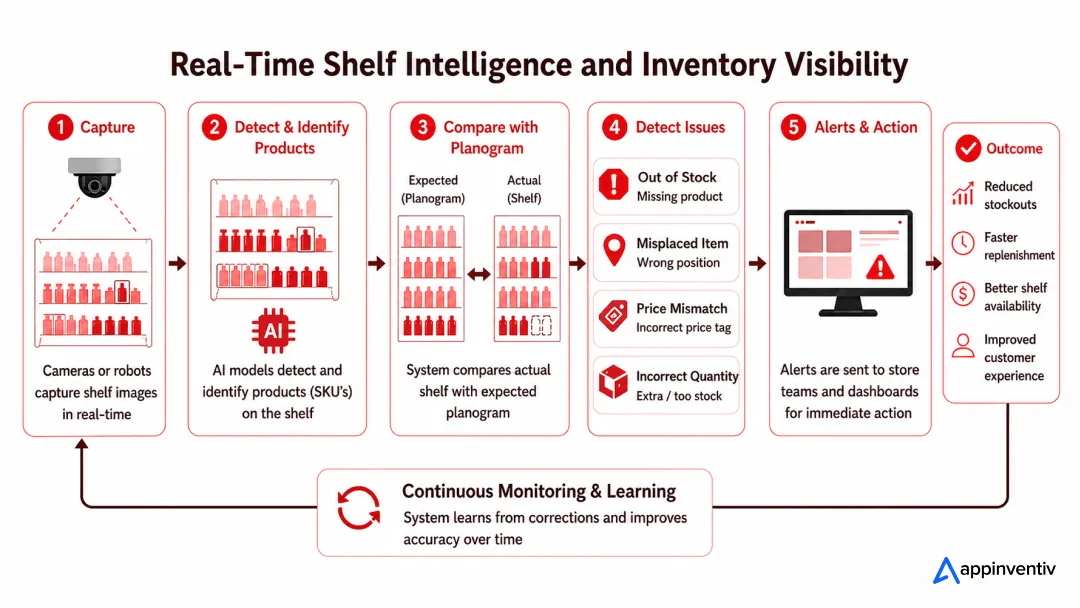
Edge deployment is common here. Devices process images locally and only send metadata upstream, which keeps latency low and bandwidth under control.
Where this gets more advanced:
Retailers combine vision with RFID or POS signals to improve confidence scores and reduce false alerts.
Impact:
- Near real-time stock accuracy
- Faster replenishment cycles
- Reduced manual auditing effort
This is one of the most widely adopted computer vision solutions for retail, especially for brands focused on improving store-level accuracy and computer vision retail efficiency.
2. Frictionless Checkout and Autonomous Stores
Frictionless checkout is a core part of computer vision retail smart stores, where the goal is to remove bottlenecks without adding operational complexity.
A typical pipeline looks like this:
- The entry system assigns a session ID per customer
- Overhead cameras run multi-object tracking (Deep SORT / ByteTrack)
- Interaction detection models identify “pick,” “put-back,” or “carry” actions
- Shelf sensors or weight signals validate ambiguous events
- A virtual cart state machine updates continuously
The challenge isn’t detection, it’s identity persistence across occlusions and crowd density. That’s where tracking models and sensor fusion become critical.
Here’s a simplified breakdown:
| Component | What It Does | Why It Matters |
|---|---|---|
| Multi-camera tracking | Tracks customers across zones | Maintains identity consistency |
| Action recognition | Detects product interaction | Builds an accurate cart state |
| Sensor fusion | Validates uncertain events | Reduces false positives |
| Session engine | Maintains virtual cart | Enables automated billing |
Impact:
- Eliminates checkout bottlenecks
- Increases store throughput
- Reduces reliance on staffed counters
At scale, this requires tightly integrated computer vision services that can handle multi-camera tracking, event validation, and real-time billing without latency issues.
3. Intelligent Loss Prevention and Behavioral Detection
Traditional CCTV records events. Modern computer vision retail security systems interpret behavior sequences using AI in surveillance system capabilities that analyze patterns instead of just capturing footage.
- Pose estimation models to track body movement and gestures
- Trajectory analysis to map how a customer moves through zones
- Spatio-temporal models (3D CNNs / LSTMs) to detect suspicious sequences
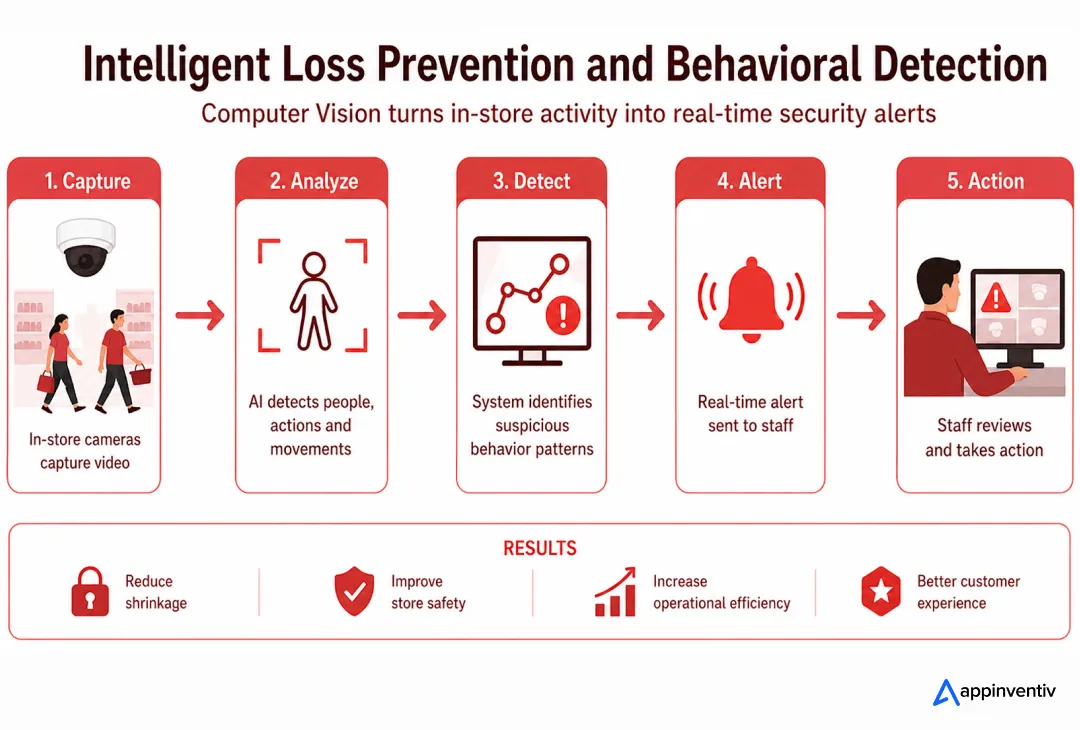
Instead of flagging a single frame, the system evaluates patterns like:
- Repeated dwell near high-value shelves
- Concealment gestures
- Unusual movement between zones
These systems are usually trained on “normal store behavior” baselines, so anything that deviates significantly is flagged.
What improves accuracy:
- Combining vision with transaction data (e.g., item picked but not billed)
- Context-aware thresholds based on store layout
Impact:
- Reduction in shrinkage
- Faster real-time alerts
- Lower false positives compared to rule-based systems
4. Customer Behavior Intelligence and Store Optimization
This is where computer vision moves from operational to strategic. This is where retail analytics and computer vision become critical, helping teams connect in-store behavior to actual conversion outcomes.
Every frame captured can be converted into structured signals, like:
- Entry and exit timestamps
- Path traversal across aisles
- Dwell time near specific SKUs
Technically, this is built using:
- Tracking pipelines → bounding box persistence
- Aggregation into heatmaps and path graphs
- Integration with POS systems for conversion attribution
Retailers can then answer questions like:
- Which aisle gets traffic but low conversion?
- Where do customers hesitate before purchasing?
- Which displays drive actual engagement vs passive visibility?
Here’s how the data flows:
| Layer | Function | Output |
|---|---|---|
| Vision layer | Detects and tracks movement | Raw trajectories |
| Analytics layer | Aggregates behavior | Heatmaps, dwell metrics |
| Business layer | Correlates with sales | Conversion insights |
Impact:
- Data-backed store layout decisions
- Improved merchandising performance
- Continuous optimization instead of static design
5. Hyper-Personalized In-Store Engagement
This is where physical retail starts behaving like a digital platform. Computer vision systems generate real-time context signals, not just identity. That includes:
- Product interaction history within the session
- Dwell time and attention signals
- Basic demographic inference (privacy-safe, non-identifying)
These signals feed into:
- Recommendation engines
- Dynamic signage systems
- Smart mirrors and AR interfaces
Technically, this involves:
- Feature extraction models (ResNet, CLIP) for visual similarity
- API integration with personalization engines
- Edge inference for real-time responsiveness
A common flow looks like:
- Customer interacts with a product
- Vision system generates an event (e.g., “interest detected”)
- Backend triggers relevant recommendations
- Display or device updates instantly
Impact:
- Higher engagement and dwell time
- Increased basket size through contextual recommendations
- Reduced return rates via better decision support
This layer is powered by retail AI computer vision technology, where visual signals directly feed recommendation and engagement systems.
6. Visual Search and AR-Driven Shopping
This is where inspiration turns into action inside the store. Instead of relying on keywords, systems use image embeddings to match visual input with catalog items. Models like CLIP or ResNet-based encoders convert images into vector representations, which are then compared against a product database using similarity search.
On the AR side of the business, the system adds spatial awareness and enables experiences like virtual try-on, allowing customers to see how products look in real time before making a decision.
- SLAM (Simultaneous Localization and Mapping) maps the environment
- Pose estimation aligns products with the user perspective
- Rendering engines overlay products in real time
Here’s how the pipeline typically works:
| Component | Function | Output |
|---|---|---|
| Image encoder | Converts an image to a vector embedding | Feature vector |
| Similarity engine | Matches against the product catalog | Ranked product list |
| AR engine | Renders product overlay | Real-time visualization |
Where this matters:
- “Find similar” use cases in fashion and home decor
- Virtual try-ons for reducing purchase hesitation
- Bridging offline browsing with online catalogs
Impact:
- Faster product discovery
- Reduced friction between intent and purchase
- Lower return rates due to better visualization
7. Queue Monitoring and Workforce Optimization
This is less visible but has a direct effect on store efficiency. Instead of reacting to long lines, systems continuously estimate crowd density and queue formation using vision models.
Typical setup:
- Cameras monitor checkout zones and key service areas
- Density estimation models (CSRNet, crowd counting CNNs) measure congestion
- Queue length and wait time are inferred using spatial thresholds
These signals feed into:
- Workforce management systems
- Alert engines for real-time staff allocation
Here’s a simplified control loop:
| Signal | System Action | Outcome |
|---|---|---|
| Queue length exceeds threshold | Trigger staff alert | Additional counters opened |
| High density in the zone | Reallocate staff | Balanced coverage |
| Low utilization | Reduce active counters | Cost optimization |
Most deployments use edge inference + centralized dashboards, so store managers can act immediately without waiting for cloud processing.
Impact:
- Reduced wait times during peak hours
- Better labor cost utilization
- Smoother in-store flow without overstaffing
8. Smart Merchandising and Planogram Compliance
Retailers invest heavily in displays, but execution has always been hard to measure. Computer vision closes that gap.
System workflow:
- Shelf images are captured at regular intervals
- Products are detected and mapped to expected positions
- Layout is compared against digitized planograms (machine-readable templates)
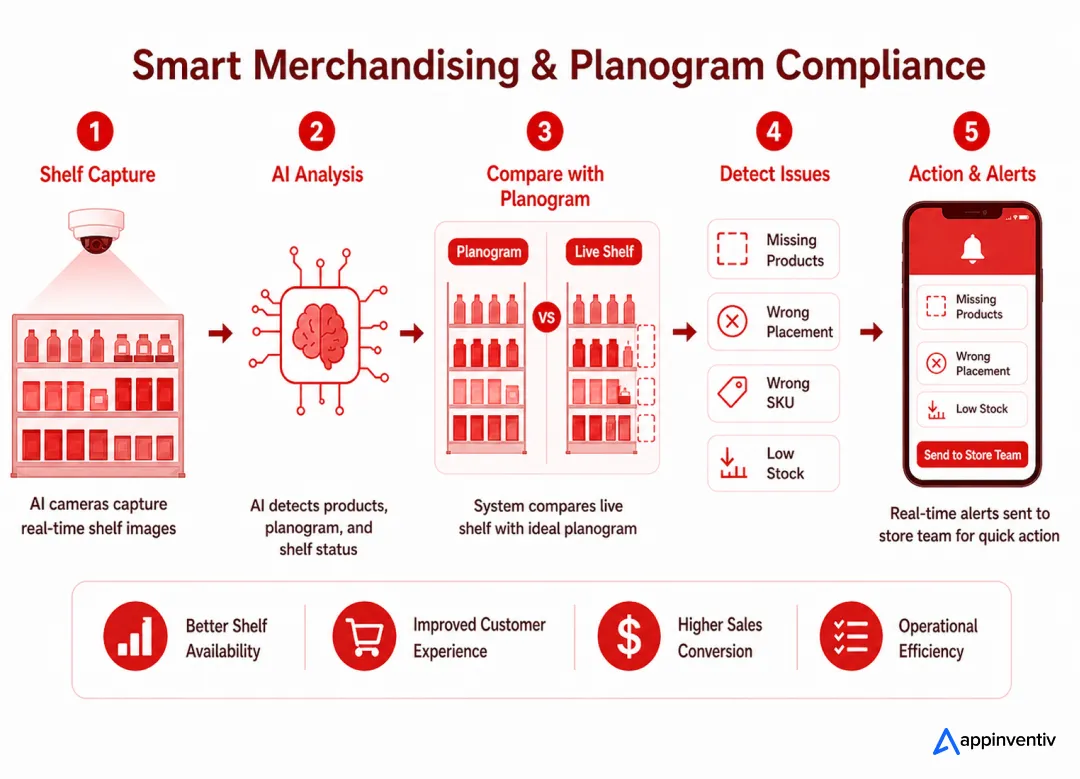
Advanced systems go further by calculating:
- Share of shelf (brand visibility vs competitors)
- Facing count accuracy
- Promotion placement compliance
Here’s how validation works:
| Step | Process | Output |
|---|---|---|
| Detection | Identify products on the shelf | SKU mapping |
| Alignment | Match with the planogram | Expected vs actual |
| Validation | Check rules (position, count) | Compliance score |
Some setups also integrate time-based tracking, so retailers can see how long a promotion was correctly executed.
Impact:
- Consistent execution across store locations
- Higher ROI on merchandising campaigns
- Reduced manual store audits
9. Supply Chain and Backroom Automation
Computer vision extends beyond the storefront into operational backbones. In backrooms and warehouses, systems are used for:
- Package verification using object detection + OCR
- Defect detection using anomaly detection models
- Sorting and routing using vision-guided robotics
A typical flow:
- Incoming shipments are scanned visually
- Labels are extracted using OCR (Tesseract, deep learning OCR models)
- Items are verified against the expected inventory
- Defects or mismatches trigger exceptions
In automated environments:
- Cameras guide robotic arms using pose estimation + depth sensing
- Systems integrate with warehouse management platforms for closed-loop control
Where complexity lies:
- Handling variable packaging conditions
- Maintaining accuracy at high throughput
Impact:
- Reduced manual inspection effort
- Improved order accuracy
- Faster processing and fulfillment cycles
10. Predictive Store Operations
This is where computer vision starts feeding predictive systems instead of just reactive ones. The idea is simple. Every visual signal becomes an input into forecasting models.
Data sources include:
- Shelf depletion rates
- Customer interaction patterns
- Time-based traffic variations
These are combined with:
- Time-series forecasting models (LSTM, Prophet)
- External signals like weather or promotions
The system can then:
- Predict when a shelf will go empty
- Trigger restocking before stockouts occur
- Adjust pricing or promotions dynamically
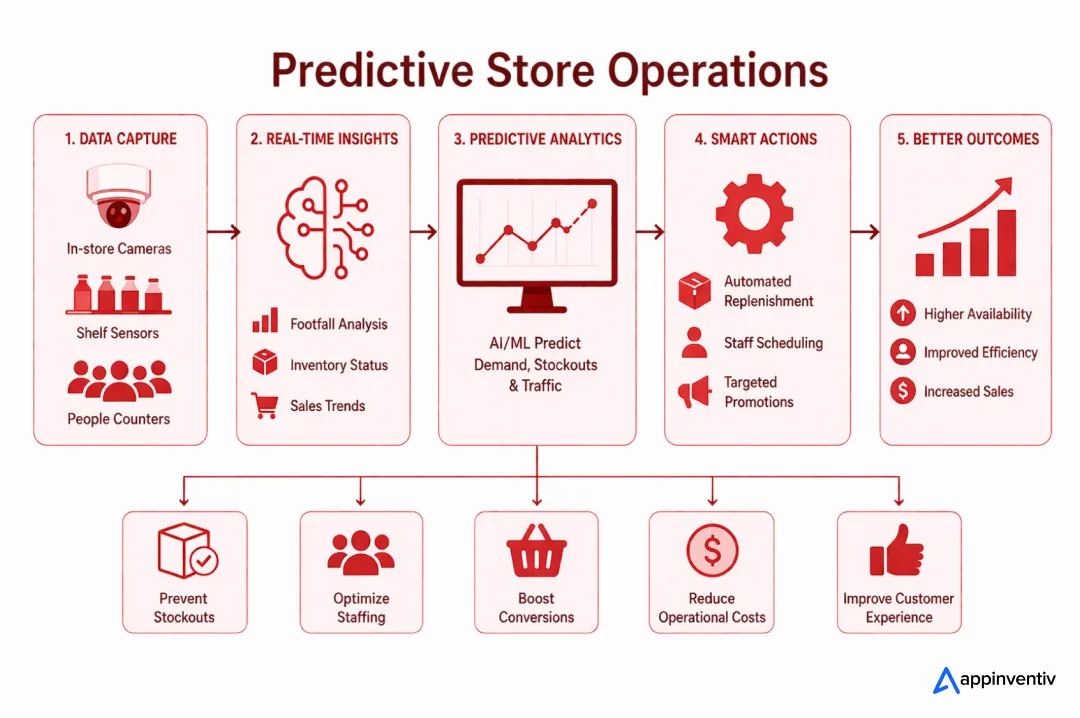
Here’s a simplified architecture:
| Layer | Role | Output |
|---|---|---|
| Vision layer | Captures real-time signals | Inventory + behavior data |
| Prediction layer | Forecasts trends | Demand predictions |
| Decision layer | Triggers actions | Pricing, restocking, alerts |
This moves retail operations from:
- Reactive → “Fix when broken”
- To predictive → “Act before impact”
Impact:
- Reduced stockouts
- Better demand alignment
- More efficient store operations
Retail is moving faster now; decisions aren’t delayed anymore. That’s where computer vision in retail comes in. It helps teams act on what’s happening in the moment.
And more broadly, this is how computer vision in business is evolving: systems that keep learning and improving as things change.
Real-world Examples of Computer Vision in the Retail Industry
Here are some significant examples of computer vision impacting the retail industry. Businesses utilize advanced image recognition and real-time analytics to optimize operations, enhance security, and improve customer experiences. Let’s explore.
Amazon Go
Amazon Go has revolutionized retail with its Just Walk Out technology, which relies on computer vision, deep learning, and sensor fusion. Customers enter the store using the Amazon Go app, pick up the items they need, and simply walk out—without stopping at a checkout counter. The system automatically detects the selected products and charges the customer’s Amazon account. This eliminates the need for cashiers, reducing wait times and improving the shopping experience.
Walmart
Walmart integrates computer vision into its retail operations to enhance efficiency and security. The company uses shelf-scanning robots to monitor stock levels and identify misplaced products, ensuring timely restocking.
Additionally, Walmart deploys AI-powered surveillance cameras to detect shoplifting and other suspicious activity in real time. By leveraging these technologies, Walmart optimizes inventory management and minimizes theft-related losses.
Sephora
Sephora has embraced computer vision to elevate the customer experience with its Virtual Artist tool. This AI-powered feature allows customers to try on makeup virtually using their smartphone or in-store tablets.
By analyzing facial features, the technology suggests suitable shades and beauty products, making shopping more interactive and personalized. This innovation enhances the online and in-store shopping journey, reducing product returns and increasing customer satisfaction.
H&M
H&M utilizes computer vision and AI to provide customers a more personalized shopping experience. The company’s AI-driven recommendation system analyzes shopper behavior, in-store interactions, and online browsing history to suggest clothing that match their style preferences.
In select stores, smart mirrors allow customers to try on outfits virtually, making shopping more engaging and convenient. This data-driven approach helps H&M tailor its offerings and improve customer engagement.
Why These Computer Vision Retail Case Studies Matter:
Taken together, these examples show a clear pattern. Computer vision is not limited to a single function like checkout or security. It’s being applied across:
- Store operations
- Inventory management
- Customer engagement
- Personalization
Each retailer is using it differently, but the underlying goal is the same. Turn real-world activity into actionable insight and respond to it instantly.
Focus on the combinations that reduce delays, improve visibility, and increase conversion in your store.

Benefits and ROI Analysis of Computer Vision in Retail
When evaluating computer vision retail ROI, the biggest shift isn’t just automation. It’s the ability to act in real time. What makes this powerful is that the impact doesn’t reside in a single function. It shows up across operations, sales, and decision-making simultaneously.
ROI Breakdown Across Retail Functions:
| Category | Key Benefit | How It Works (Technical Lens) | ROI Impact |
|---|---|---|---|
| Operations | Automated inventory visibility | Continuous shelf monitoring using object detection and planogram validation is a core part of computer vision applications in retail | 25–40% reduction in labor effort tied to manual audits |
| Customer Experience | Context-aware engagement | Behavior tracking combined with real-time signals enables personalized interactions, a growing area in retail computer vision use cases | 15–20% improvement in customer satisfaction |
| Loss Prevention | Real-time anomaly detection | Behavioral models detect theft using pose estimation and movement analysis, a key capability of computer vision products in retail | 30–40% reduction in shrinkage |
| Sales Optimization | Layout-driven insights | Heatmaps and dwell-time analytics linked with POS data improve merchandising, a proven benefit of computer vision for retail | 10–15% increase in sales performance |
| Analytics & Strategy | Continuous data intelligence | Aggregated vision data feeds BI systems for forecasting and planning within the retail computer vision ecosystem | Faster and more accurate strategic decisions |
Most retailers see gains when multiple computer vision solutions for retail work together rather than as isolated deployments.
How Computer Vision for Retail Drives Measurable ROI
In most retail environments, delays are the real cost. Inventory gaps go unnoticed, customer behavior is partially understood, and staffing decisions lag behind demand.
With computer vision in the retail industry, that delay disappears.
- Shelf gaps are detected the moment they happen
- Customer movement is tracked continuously, not sampled
- Store teams act on live alerts instead of waiting for reports
This shift from delayed insight to real-time action is what drives consistent ROI across stores.
Cost Reduction Through Automation and Operational Efficiency
One of the most immediate benefits of computer vision in retail is reducing manual effort. Tasks that typically require constant human involvement, like inventory checks, shelf audits, and basic monitoring, are automated using AI-powered vision systems.
These systems rely on:
- Object detection models for SKU identification
- Edge processing for real-time inference
- Event-based alerts instead of continuous manual oversight
What changes in practice:
- Lower operational costs
- Reduced reliance on repetitive manual processes
- Better allocation of in-store staff
Revenue Growth Through Behavior-Driven Optimization
Revenue improvements come from understanding how customers actually interact with the store. Using computer vision retail analytics, retailers combine:
- Footfall tracking
- Dwell-time measurement
- Path flow analysis
This helps identify:
- High-traffic zones that don’t convert
- Products that attract attention but underperform
- Layout friction points that interrupt buying decisions
What this leads to:
- Higher conversion rates
- Improved product placement
- More effective in-store promotions
Strategic Decision-Making with Continuous Data
Beyond day-to-day improvements, computer vision applications in retail create a continuous data layer that supports long-term planning.
Instead of relying on static reports, retailers get:
- Real-time operational visibility
- Data-backed forecasting inputs
- Continuous feedback on store performance
This allows businesses to shift from reactive adjustments to predictive and adaptive strategies.
The ROI of computer vision in retail doesn’t come from a single use case. It builds as multiple systems work together to improve how stores operate and respond in real time. Over time, this leads to lower costs, stronger sales performance, and faster, data-driven decisions.
At its core, retail computer vision turns stores into environments that continuously learn and optimize from real-world activity. Over time, improvements in computer vision retail efficiency compound across operations, sales, and decision-making.
Key Challenges of Computer Vision in Retail
Computer vision challenges in retail include managing large datasets, ensuring high accuracy under varied conditions, and overcoming integration hurdles with existing systems. Despite its impact, computer vision retail implementation comes with technical and operational challenges that need structured planning.
A successful rollout depends on following computer vision retail best practices, from data quality to system integration.
Challenge: Data Quality & Variability
Retail environments have inconsistent lighting, angles, and occlusions, making accurate image recognition difficult. Poor-quality datasets can lead to incorrect product identification and customer tracking.
Solution: Use high-quality training datasets, advanced AI models, and real-time calibration to improve accuracy across varying conditions.
Challenge: Integration with Existing Systems
Legacy POS and inventory systems may not support modern computer vision, causing compatibility issues. Retrofitting these systems can be costly and complex.
Solution: Implement middleware or APIs to bridge gaps between old and new systems, ensuring smooth data flow and reducing upgrade costs.
Challenge: Real-Time Processing
Computer vision requires rapid image analysis for inventory tracking and checkout automation. Processing delays can lead to poor customer experiences.
Solution: Use edge computing and optimized AI models to minimize latency and ensure real-time decision-making.
Challenge: Privacy & Compliance
Capturing customer images raises concerns about data privacy and legal compliance. Non-compliance can result in hefty fines and reputational damage.
Solution: Implement anonymization techniques, comply with GDPR/CCPA regulations, and ensure transparency in data collection.
Challenge: False Positives & Accuracy Limitations
Misidentification of products or customers can lead to checkout errors and operational inefficiencies. Poor accuracy reduces trust in AI systems.
Solution: Improve model training with diverse datasets and use multi-modal AI approaches, such as combining vision with barcode scanning.
Following proven computer vision retail best practices helps reduce risk and improve long-term system performance.
Trends and Advances of Computer Vision in Retail
Walk into a modern store during peak hours, and you’ll notice something subtle. Systems aren’t just collecting data anymore. They’re responding in real time. This shift is defining the next phase of computer vision adoption in the retail industry.
1. Touchless and Interactive Store Experiences
Stores are moving toward gesture-based and AI-driven interactions, especially in high-traffic environments where speed matters.
What this means in practice: Customers can navigate stores, explore products, and interact with systems without relying heavily on touchpoints or staff.
Data signal:
- 71% of consumers want AI into shopping experiences
- Demand for personalized, interactive experiences is a major driver of in-store AI adoption
2. AI-Powered Store Operations and Staff Support
Store teams no longer manually check shelves or monitor activity. Computer vision systems now surface what needs attention in real time.
What this means in practice: Staff focus on high-impact actions instead of routine monitoring.
Data signal:
- AI-driven “digital workers” enable real-time merchandising and store operations optimization
- Retailers using AI report measurable productivity improvements and faster operational response cycles
3. Shift to Edge Computing for Real-Time Decisions
Retail environments don’t benefit from delayed insights. That’s why processing is moving closer to the store through edge AI systems.
What this means in practice: Issues like stockouts, congestion, or anomalies are detected instantly and acted on without delay.
Data signal:
- Real-time analytics and responsiveness are key drivers of computer vision adoption in retail
- Over 50% of enterprise AI deployments are shifting toward edge environments to enable faster decisions (industry trend)
4. Smart Shelves and Continuous Inventory Visibility
Inventory tracking is no longer periodic. It’s continuous and automated.
What this means in practice: Stores can detect missing or misplaced items before they impact sales.
Data signal:
- Computer vision is widely used for automated shelf monitoring and stockout detection.
- AI-driven retail inventory optimization is projected to reach $7B+ by 2029.
5. Frictionless Checkout and Autonomous Stores
Checkout is gradually becoming invisible, powered by AI, multi-camera tracking, and sensor fusion.
What this means in practice: Customers pick items and leave, with billing handled automatically in the background.
Data signal:
- Autonomous checkout is a key growth driver in computer vision retail adoption.
- The computer vision retail market is growing at a ~25% CAGR, driven by automation use cases such as checkout.
6. Omnichannel Integration Becoming Standard
Retail is no longer split between online and offline. Computer vision helps connect both.
What this means in practice: In-store behavior feeds into personalization, inventory, and marketing systems across channels.
Data signal:
- The AI-based personalization market is projected to reach $545.7 billion in 2026 and grow to over $661 billion by 2030, driven by demand for real-time, behavior-based customer experiences.
- AI-driven supply chain and customer experience optimization are creating large-scale value across channels.
7. Market Growth Driving Large-Scale Adoption
The scale of investment shows this is no longer experimental technology.
What this means in practice: Retailers are deploying computer vision across multiple stores and use cases, not just pilots.
Data signal:
- The computer vision in the retail market is projected to grow from $1.66 billion in 2024 to $12.56 billion by 2033, at a 25.4% CAGR, driven by demand for real-time analytics, automated checkout, and inventory intelligence.
- AI in retail is expected to reach $38B by 2030.
All of these trends point in one direction. Computer vision in retail is becoming the operational layer that connects store activity with decision-making.
Retailers investing early in computer vision for retail are moving faster, adapting quicker, and building more responsive store environments.
Retail is shifting from delayed insights to real-time responses.

Leverage Appinventiv’s Expertise to Transform Retail with Computer Vision
Appinventiv is a pioneering retail software development company recognized for delivering innovative solutions tailored to your business needs. Whether you’re aiming to enhance customer experiences through smart store management or improve inventory tracking with AI-powered visual recognition, our expert computer vision solutions ensure your software delivers real-time, accurate, and efficient visual data processing.
- Proven Success With 3000+ Projects Delivered: With over 3000 successful projects delivered across various industries, Appinventiv showcases unmatched expertise and a commitment to excellence. At Appinventiv, we have proudly empowered global businesses for over 9 years, helping them explore new opportunities and address operational challenges. Our esteemed clients, such as KFC, Pizzahut, 6th Street, IKEA, Adidas, and Edamama, affirm our role as a trusted technology partner.
- A Global Team of 1600+ Experts: Our team of over 1600 highly skilled professionals combines creativity, technical expertise, and industry knowledge to develop advanced computer vision solutions for retail.
- Innovative and Efficient Development Approach: As a leading computer vision application development company, we prioritize transparency, timely delivery, and customized solutions that align with your business goals, making us the ideal choice for computer vision in retail.
- Awarded for Excellence: Recognized as the ‘Tech Company of the Year’ at the Times Business Awards 2023, we are at the forefront of technological innovation.
Partner with Appinventiv to build a computer vision solution for retail that meets and exceeds expectations, setting new industry standards.
FAQs
Q. How is Computer Vision Used in the Retail Industry?
A. Computer vision is revolutionizing retail by enabling automated, AI-driven insights. It is used in:
- Automated Checkout – Eliminates the need for manual scanning, allowing cashier-less stores.
- Shelf Monitoring – Tracks inventory levels and detects empty shelves.
- Customer Behavior Analysis – Identifies shopping patterns to optimize store layouts.
- Loss Prevention & Security – Detects theft or suspicious activities using real-time surveillance.
- Visual Search & Recommendation – Helps customers find products based on images.
Q. How does computer vision improve processes in the retail industry?
A. Computer vision enhances efficiency by:
Reducing checkout time – AI-powered checkout eliminates long queues.
- Improving inventory management – Real-time shelf monitoring prevents stockouts.
- Enhancing store security – Smart surveillance reduces theft.
- Personalizing customer experience – Facial recognition can enable targeted marketing.
- Optimizing workforce management – Tracks footfall data to adjust staffing levels.
Q. What are the Best Practices for Implementing Computer Vision in Retail?
A. Implementing computer vision in retail can bring immense value by improving operational efficiency, enhancing customer experience, and providing actionable insights. Here’s a step-by-step approach to implementing computer vision in retail:
- Define Your Objectives
- Assess Your Data Infrastructure
- Choose the Right Computer Vision Technologies
- Integrate with Retail Operations
- Build or Deploy AI Models
- Ensure Privacy and Compliance
- Monitor Performance and Collect Feedback
- Iterate and Optimize
- Train and Support Your Staff
- Evaluate ROI and Long-term Impact
Q. What Are the Benefits of Leveraging Computer Vision in Retail?
A. Retailers can gain multiple advantages, including:
- Increased Sales – Personalized recommendations boost conversions.
- Better Customer Experience – Faster checkouts and improved store navigation.
- Reduced Shrinkage – Theft detection minimizes losses.
- Operational Efficiency – Automates manual tasks like inventory tracking.
- Data-Driven Insights – Enhances decision-making through AI analytics.


Fast 2-minute response, fully NDA-protected.
AI in Fuel Distribution: Costs, Compliance, Rollout
Key takeaways: Fuel accounted for $0.482 of the $2.336 it cost to run a Class 8 truck a mile in 2025, which makes every distribution decision a margin decision. Sequence by payback, not ambition. Tank-level runout prediction and wet stock anomaly detection return in 3 to 8 months. Predictive maintenance takes 8 to 14. Budget…
AI Coding Agent Development Cost: Enterprise Pricing, Architecture & ROI Guide (2026)
Key takeaways: Custom AI coding tools cost between $50K and $500K. Internal system design and software links drive the total price. Future running fees stem from token bills, server hardware, company rules, and tool tracking, not just initial construction. Multiple coordinated agents, data-search tools, and operational links deliver superior financial returns. These advanced features require…
Key takeaways: Regional hosting alone does not guarantee sovereign control over AI processing, logs, backups, encryption keys, or administrative access. Sovereign infrastructure creates the most value for regulated data, critical operations, proprietary knowledge, and AI agents connected to enterprise systems. Geopatriation brings sensitive AI workloads closer to their country of origin, reducing regulatory and geopolitical…