





















How AI Chatbots Are Redefining Insurance Customer Service

 Share -


- 01Why Leading Insurers Are Investing in AI-Powered Chatbots
- 02Key Benefits of AI-Powered Chatbots for Insurance
- 03Insurance Chatbot Use Cases with Real-World Examples
- 04How to Develop an AI Chatbot for Insurance
- 05Realizing the ROI of Chatbots in Insurance Customer Service
- 06Cost to Build an AI Chatbot for Insurance
- 07Challenges of AI-Powered Insurance Chatbot Development and How to Overcome Them
- 08Build Your AI-Powered Insurance Chatbot with Appinventiv
- 09FAQs

Key takeaways:
- AI-powered insurance chatbots now support policy sales, claims, underwriting, fraud detection, and customer service, not just basic FAQs.
- Successful insurance chatbot development depends on seamless integration with policy, claims, CRM, billing, and other core insurance systems.
- Security, compliance, and AI governance should be built in from day one to protect customer data and support responsible AI adoption.
- AI chatbots help insurers reduce support costs, speed up claims, improve productivity, and deliver faster, more personalized customer experiences.
- Insurance chatbot development costs typically range from $150,000 for a basic solution to $1,000,000+ for an enterprise AI platform, depending on features, integrations, and compliance requirements.
Customer: “I had a minor car accident. Am I covered by my policy, and what do I have to do to file a claim?
Insurance Chatbot: “My sympathies, I am sorry about your accident. I can help you submit your claim now; collision damage is covered under your policy.”
Customer: “What do you need from me?”
Insurance Chatbot: “Please upload pictures of the damage and your vehicle registration. Once you have that, I will confirm those documents, create your claim reference number and stay updated with you throughout the process.”
Customer: “Done. How many hours will this take?”
Insurance Chatbot: “Your claim has been registered successfully under CLM48291. Based on the similarity of claims, the initial assessment will be done within 24 hours and will let you know as soon as there is any change.”
These talks are transforming the concept of great service in insurance. Insurers are no longer seen solely as providers of policies. They also evaluate their experience of receiving support when they need it and how quickly and easily it comes to them.
They are looking for immediate and accurate support; whether they are claiming a cover, renewing a policy, checking coverage, or seeking a premium quote, they do not want to have to wait for an agent and go through multiple systems to get the answers they need.
AI chatbots for insurance are making this possible by providing intelligent, human-like dialogues, coupled with access to insurance policy and claims information and customer details. These virtual assistants will be seamlessly connected with the core insurance platforms to handle repetitive tasks, offer tailored insights and accompany customers through their insurance processes.
That translates into faster resolutions, higher customer satisfaction, lower support costs and support teams that can focus on more complicated cases where human resources can make the biggest impact.
Discover how conversational AI can simplify claims, support agents, and improve every customer interaction.
Why Leading Insurers Are Investing in AI-Powered Chatbots
With that, insurance leaders are transcending the use of chatbots or AI agents for customer service. They are integrating conversational AI into high-value functions like policy sales, customer onboarding, claims intake, underwriting support and policy servicing, to mitigate the friction in customer journeys and enhance operational performance.
As per McKinsey’s report, AI organizations that can scale across these functions have performed significantly better than their peers, with AI leaders outperforming peers by 6.1x in Total Shareholder Return (TSR) over the last 5 years.
Customer service is just one aspect of the business impact. AI adoption in the core insurance function has yielded a 10–20% increase in new-agent productivity and policy conversion rates, a 10–15% increase in written premiums, 3–5% higher claims accuracy and a 20–40% reduction in customer onboarding costs.
The introduction of AI-powered insurance chatbots marks the initial step in this paradigm shift, enabling insurers to automate a growing number of high-volume interactions, streamline policy service, reduce IT and labor costs, provide quicker, more customized customer service, and more.
Key Benefits of AI-Powered Chatbots for Insurance
By leveraging interactive AI-driven chatbots, insurers can provide quicker, more efficient customer experiences and alleviate the strain on their support teams. They streamline interactions and connect to the heart of the insurance industry, enhancing customer service and operational efficiency.
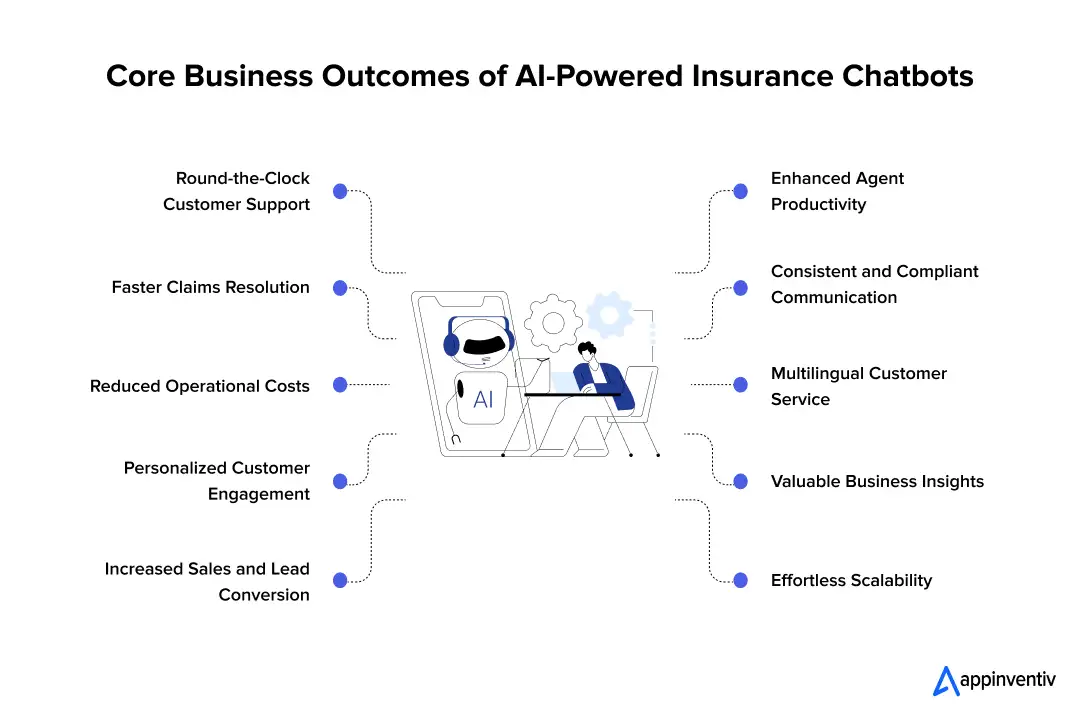
Round-the-Clock Customer Support
Chatbots in insurance offer instant support for policy requests, claims, renewals, premium payments and coverage questions, anytime and anywhere. This helps insurers to provide continuous customer service without additional service staff.
Faster Claims Resolution
By streamlining the claims process, modern insurance chatbots can help policyholders register claims, provide a list of necessary documents, verify the data, and give instant updates on claim status, leading to quicker claim settlements and improved customer experience.
Reduced Operational Costs
With strategic insurance chatbot development, insurers can automate repetitive and high-volume processes like policy lookup, answering FAQs, reminders and scheduling appointments. This helps to decrease the number of calls in the call center while simultaneously cutting down call center costs.
Personalized Customer Engagement
AI chatbots in insurance are designed to provide relevant responses, policy suggestions, and reminders based on customer behavior, policy history, and profiles, fostering personalized interactions and deepening customer relationships.
Increased Sales and Lead Conversion
Chatbots in the insurance industry qualify leads and initiate their engagement with the first contact by answering product queries, recommending a suitable policy and connecting high-intent leads with insurance advisors.
Enhanced Agent Productivity
AI chatbots can manage basic administrative tasks and frequently asked questions, enabling insurance agents to dedicate more time to intricate claims, consultative services, and high-value client interactions.
Consistent and Compliant Communication
Insurance chatbots provide consistent and standardized responses from approved knowledge bases that ensure that communication errors are minimized, while simultaneously ensuring that everyone has a consistent experience.
Multilingual Customer Service
Insurers can connect with a broader audience and provide a seamless experience across regions and communication channels by leveraging AI-powered multilingual chatbots that can work in multiple languages.
Valuable Business Insights
The customer intelligence generated each time a customer interacts with a chatbot is useful. Insurers can use conversation analysis to uncover any gaps in their service, know how customers are using their services, enhance their products, and enhance the performance of their operations.
Effortless Scalability
AI chatbots can handle thousands of simultaneous conversations, ensuring consistent response quality and maintaining service availability, whether it’s during policy renewal periods, catastrophe events, or seasonal increases in claims.
Insurance Chatbot Use Cases with Real-World Examples
AI-powered chatbots are reshaping every stage of the insurance lifecycle, from customer acquisition and policy servicing to claims processing and underwriting. The following insurance chatbot use cases demonstrate how leading insurers are leveraging conversational AI to improve customer experiences:
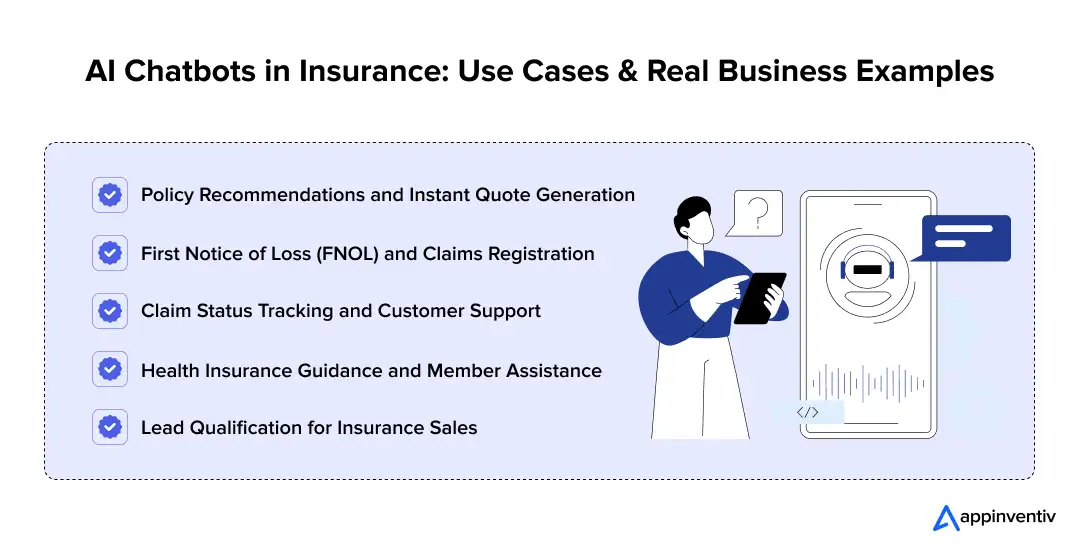
Policy Recommendations and Instant Quote Generation
Selecting the appropriate insurance policy involves more than just a simple price comparison, knowing what is covered, and figuring out the premium. AI chatbots streamline this by posing customers’ questions in a context-aware manner, gathering relevant information, calculating real-time premiums, and suggesting the most appropriate policy for the customer.
Real-life example: Lemonade leverages its AI-powered assistant, Maya, to guide prospective customers through policy selection via natural conversations. With all of this, Maya collects data from customers, responds to queries regarding insurance policies, can create quotes in minutes, and can drive the insurance buying process digitally, cutting down the time it typically takes to purchase an insurance policy.
First Notice of Loss (FNOL) and Claims Registration
Among the most valuable chatbots in insurance are those that automate claims intake. Customers can report an accident immediately, without having to wait for an agent, using a conversational interface. The chatbot gathers the details of the incident, asks for photos and other documents, confirms policy details and automatically registers the claim while keeping the customer updated every step of the way.
Real-life example: Lemonade’s AI-powered bot named Jim, which streamlines the claims initiation process. With the app, customers can make claims by answering a few questions and uploading proof in a conversational manner. AI can speed up the assessment of claims, and for simple ones, it can process those much quicker than traditional workflows.
Claim Status Tracking and Customer Support
Some of the most common ways policyholders reach out to insurance companies are to follow up on claims or to update their policy. By offering instant claim tracking, payment updates, policy details and document retrieval in a single chat window that is accessible 24/7, insurance chatbots eliminate the lengthy wait times.
Real-life example: GEICO’s AI Virtual Assistant enables users to get policy information, answer billing questions, get insurance ID cards, track claims, and submit routine servicing requests without having to contact a GEICO customer service representative. This not only decreases inbound call volume, but also speeds up response times.
Health Insurance Guidance and Member Assistance
A modern chatbot for health insurance can simplify one of the most complex areas of insurance. Members can instantly check benefits, know the network hospitals, understand their policy coverage, get pre-auth instructions, find healthcare providers and answer common health plan questions without having to go through lengthy support processes.
Real-life example: UnitedHealthcare’s virtual assistant, for example, uses a chatbot to provide members with information about benefits, find in-network providers, answer questions about coverage, and direct users to the right health services, all with conversational interactions that decrease administrative time for members and support personnel.
Lead Qualification for Insurance Sales
For chatbots for insurance agencies, conversational AI serves as an intelligent sales assistant. Instead of simply collecting contact information, chatbots qualify leads by understanding customer requirements, identifying suitable products, answering objections, scheduling appointments with advisors, and nurturing prospects before human engagement begins.
Real-life example: Allstate uses conversational AI across digital channels to engage prospective customers, answer product-related queries, and streamline the early stages of policy discovery, helping sales teams focus on high-intent prospects rather than routine inquiries.
Build a solution that simplifies customer service while supporting your teams behind the scenes.

How to Develop an AI Chatbot for Insurance
A structured implementation roadmap helps insurers build intelligent solutions that improve customer experiences while increasing operational efficiency. Here’s a step-by-step guide on insurance chatbot development:
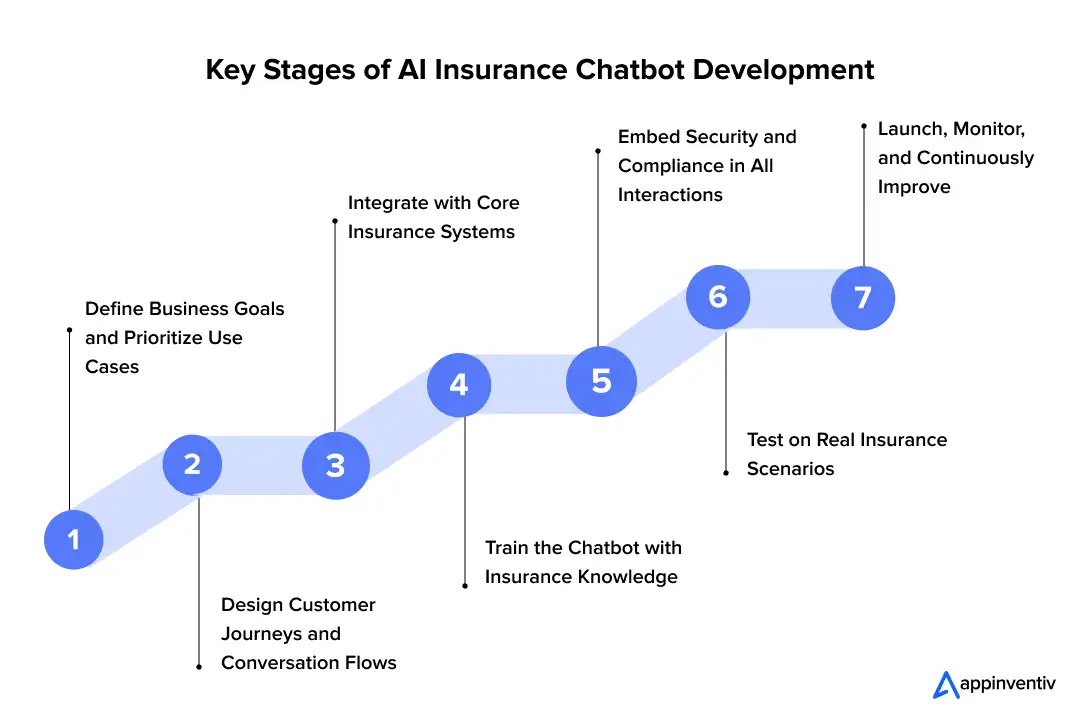
Step 1: Define Business Goals and Prioritize Use Cases
First, define what the business problem the chatbot is meant to resolve is; it can be cutting down customer support expenses, speeding up claim processing, increasing policy sales or helping internal teams. A clear set of goals and high impact/value use cases are the key to the success of an implementation of a chatbot.
Step 2: Design Customer Journeys and Conversation Flows
For each interaction the chatbot will handle, map out what the policy questions are, how to produce a quote, how to register a claim, how to renew policies, how to pay premiums, and how to escalate to a human representative. Well-designed conversation flows make chatbots in insurance more intuitive, enabling customers to complete tasks with minimal effort.
Step 3: Integrate with Core Insurance Systems
AI chatbots can be integrated with policy administration systems, claims management platforms, CRM systems, billing software, document storage systems, identity verification processes, and payment gateways to unlock the full potential of the technology in the insurance industry. The integrations enable the chatbot to offer secure, customized and real-time support.
Step 4: Train the Chatbot with Insurance Knowledge
Develop policy documents, underwriting policies, claims procedures, FAQs, regulatory requirements and internal knowledge repositories that the chatbot can learn from. With RAG supporting enterprise AI decisions, responses can be provided in an appropriate context, and the risk of providing false information can be reduced.
Step 5: Embed Security and Compliance in All Interactions
Personal and financial information are typically dealt with by insurance chatbots. Put in place end-to-end encryption, secure MFA authentication, role-based access control, audit trails, and regulatory compliance standards like SOC 2, NYDFS Cybersecurity Regulation (23 NYCRR 500), Solvency II, IDD, and regional insurance regulations to protect customer information.
Step 6: Test on Real Insurance Scenarios
Test chatbot performance against real customer scenarios like the purchase and submission of policies, claims, renewals, complaints of fraud, billing inquiries and customer escalations. Reliable performance in insurance workflows and identifying gaps before deployment are all enabled with comprehensive testing.
Step 7: Launch, Monitor, and Continuously Improve
After deployment, track conversation quality, resolution rates, customer satisfaction and operational KPIs. Regularly add new policy data, regulations, and customer inputs and continually increase the chatbot’s functionality to address more insurance processes as time goes on.
Realizing the ROI of Chatbots in Insurance Customer Service
AI-driven insurance chatbots are more than just tools for automation; they are valuable assets for enhancing customer engagement and service. They streamline operations, speed up service delivery, boost employee productivity and enhance policyholder satisfaction, which helps insurers save on operational costs.
| Business Area | Business Impact | ROI Achieved |
|---|---|---|
| Customer Support | Answer common policy, billing and claims issues immediately via self-service. | Reduced support costs, fewer calls and quicker response time. |
| Policy Sales | Suggest appropriate insurance policies and help customers to generate a quote and complete an insurance application. | Improved conversion rates and greater policy sales. |
| Document Collection and Claim Status Updates | Automate FNOL, Document Collection, and Claim Status Updates. | More efficient claim processing and lower administrative costs. |
| Policy Servicing | Process renewals, premium collection, policy document downloads and policy changes without intervention of an agent. | More use of self-service and fewer jobs to do. |
| Underwriting | Surface applicant insights, underwriting guidelines and supporting documentation for quicker evaluations. | Faster underwriting process, more consistent decision-making. |
| Fraud Detection | Look for anything suspicious and flag anomalies for additional investigation. | Low risk management and loss due to fraud. |
| Employee Productivity | Instant access to policy documents, product information and internal knowledge improves employee productivity. | Increased workforce productivity and faster decision-making. |
| Customer Retention | Send proactive renewal reminders and payment notices to customers, as well as custom policy recommendations. | Greater customer loyalty, better renewal rates and more customer lifetime value. |
Cost to Build an AI Chatbot for Insurance
The cost of creating an AI-powered insurance chatbot can vary significantly, from $150,000 to $1,000,000+, and is influenced by the functionality of the chatbot, the complexity of the AI model, enterprise AI integrations, deployment structure, compliance needs, and the extent of workflow integration needed.
These estimates are only for initial development and deployment. The total cost should account for ongoing costs like cloud infrastructure, cloud usage of AI models, third-party API subscriptions, monitoring and maintenance, and continuous optimization of the model.
The initial cost could be higher for the insurer who is creating a white-label chatbot or a SaaS chatbot solution because of other components that need to be added, including multi-tenancy, tenant-specific AI models, enterprise security controls, marketplace readiness, API ecosystems and many other deployment environments.
| Estimated Cost | Typical Solution | Best Suited For |
|---|---|---|
| $150,000–$250,000 | AI-driven customer support chatbot that answers policy questions, helps generate quotes, monitors claims and automates routine customer support requests via web and mobile channels. | Insurers seeking to automate customer service and lighten call centre load. |
| $300,000–$600,000 | Enterprise AI chatbot integrated with policy administration, CRM, claims management, payment systems and knowledge bases. | Insurers are looking to become more automated, from customer service to internal processes, with a medium to large size. |
| $600,000–$1,000,000+ | Enterprise-grade AI assistant with agentic capabilities that is capable of automating complex insurance workflows, orchestrating systems across the enterprise, supporting complex claims, underwriting, fraud detection and intelligent decision support with human oversight. | Large insurance companies seeking to transform their entire organization with AI and automate all their processes. |
Choosing an experienced AI chatbot development services partner helps optimize implementation costs while building a secure, scalable, and future-ready solution.
The Hidden Costs Behind AI Insurance Chatbot Development
Final investment is more than development. The total cost of an AI-powered insurance chatbot implementation and scaling can be influenced by several technical and operational factors.
- Enterprise Integrations: Integrating the chatbot with policy administration systems, claims platforms, CRM, payment gateways, and third-party APIs adds to the complexity of implementation.
- Long-term Operating Costs: These include AI model costs, cloud hosting fees, vector database costs, and AI inference expenses.
- Security and Compliance: Compliance with industry standards like NAIC (AI Principles and Model Bulletin), NIST AI RMF, GLBA, NYDFS, SOC 1/2, SR 11-7 model risk management practices and other insurance regulatory requirements may demand extra investment in security, governance and compliance controls.
- Knowledge Bases: There is a need to train the chatbot on proprietary documents, policies, procedures, and internal knowledge.
- Multilingual Support: When there is a need to support multiple languages, regional regulations and localized customer experiences, it increases the development and testing expense.
Let’s estimate the right solution based on your business goals, integrations, and AI requirements.
Challenges of AI-Powered Insurance Chatbot Development and How to Overcome Them
Creating a successful AI-powered insurance chatbot is not just about installing a chatbot; it’s about building a meaningful and intelligent entity. To provide customers with reliable and secure experiences, insurers need to overcome issues with integrating data, complying with regulations, and earning users’ trust.
| Challenge | How to Solve It |
|---|---|
| Disconnected Insurance Systems | Data is spread across multiple insurance systems. Integrate the chatbot into these platforms to make sure that it gets the appropriate information without requiring the users to switch apps. |
| Inaccurate Responses | If the information a chatbot has is inaccurate, so will be its responses. Use approved policy documents and business rules to base answers on, and pass over complex requests to a human advisor. |
| Data Privacy and Compliance | Customer data privacy and compliance is a key aspect of insurance chatbots’ daily operations. Implement authentication, encryption, access controls, and audit logs from the ground up. |
| Complex Insurance Products | Policy terms, exclusions and coverage conditions may be complex. Let the chatbot learn from insurance documents and provide a clear explanation of them. |
| Low Customer Adoption | Customers give up on chatbots when the chats are confusing. Keep things simple, and ensure that they can chat with a human agent if they need to. |
| Legacy System Integration | There are still a number of insurers relying on legacy systems. A phased integration approach facilitates the integration of the chatbot without impacting daily activities. |
Build Your AI-Powered Insurance Chatbot with Appinventiv
The future of chatbots in insurance is far more than just answering customer questions. Insurance chatbots are becoming smarter with capabilities from advanced AI technologies, including generative AI, agentic AI, NLP, LLMs, and predictive analytics. These technologies are helping to streamline the servicing of existing policies, support underwriting processes, speed up claims processing, detect fraud, and give agents real-time insights.
Insurers that adopt these technologies early will have access to a tool that can help them enhance customer experiences, lower operational costs, boost employee productivity and respond quickly to evolving customer expectations.
However, creating a robust and scalable insurance chatbot demands expertise in the insurance domain, smooth integrations with insurance systems, and a solid grasp of insurance workflows. Appinventiv is a reliable insurance software development company, assisting insurers in creating and launching AI-driven chatbots that align with their business objectives.
Whether it’s integrating strategy and enterprise, deployment and ongoing optimization, our team creates conversational AI solutions that bring proven business impact and pave the way for the next generation of digital insurance for insurers.
Connect with our AI experts and share your project idea!
FAQs
Q. What is the cost of implementing AI chatbots for insurance?
A. The cost of implementing an AI chatbot for insurance depends on its conversation complexity, integrations, compliance demands, and other AI capabilities. The cost of basic chatbot solutions can range from around $150,000, and enterprise-grade solutions can cost over $1,000,000.
Q. How long does it take to develop an AI chatbot for insurance?
A. The development timeline depends on the project’s scope and complexity. A basic AI chatbot insurance application typically takes 4 to 6 months, while enterprise insurance platforms with claims management, underwriting, CRM integrations, AI capabilities, and compliance features may require 9 to 18 months. Timelines also vary based on customization, testing, and third-party integrations.
Q. What is the difference between a rule-based vs AI chatbot?
A. A rule-based insurance chatbot has a set of rules for the conversation flow and only answers to certain commands or decision trees. An AI chatbot for insurance can grasp natural language, decipher customer intent, learn from conversations, and manage more intricate requests. It can access information from enterprise systems, tailor responses, and provide flexibility in claims, underwriting and policy servicing.
Q. How do chatbots improve customer service in insurance companies?
A. In the insurance industry, chatbots enhance customer service through these four ways:
- Offering 24/7 policy, billing and claim support
- Immediate answers to common questions
- Helping customers with policy buying and renewals
- Helping to register and monitor claims
- Sending forward-looking reminders for payment and renewal
- Escalating to humans when necessary
- Delivering consistent, personalized support across multiple digital channels
Q. How can an insurance agency integrate a customer service chatbot into its website?
A. Insurance agencies can embed insurance chatbots into their web pages by using safe APIs to link the chatbots with policy administration systems, CRM platforms, claims management software, and databases. The chatbot is then added to the website or customer portal so visitors can get real-time assistance, information about the policies, submit claims and connect with an agent as needed.
Q. What are the main benefits of using AI chatbots for insurance claims processing?
A. AI chatbots streamline claims processing in the following ways:
- Automating First Notice of Loss (FNOL) submissions
- Gathering documents and verifying claim information
- Providing real-time claim status updates
- Minimising manual data capture and administration tasks
- Pre-processing to identify incomplete submissions
- Supporting the detection of fraudulent claims by identifying anomalies through AI
- Speeding up claim resolution while improving the customer experience


Fast 2-minute response, fully NDA-protected.
Chatbot Integration With CRM - Benefits, Process, Features, Costs
Key takeaways: Integrating chatbots with your CRM automates routine tasks, delivers instant, personalized responses, and frees up human agents for complex issues, leading to faster resolutions and higher customer satisfaction. Every chatbot interaction is logged in the CRM, creating a unified customer view and generating actionable analytics that help refine marketing, sales, and support strategies.…
10 Ways AI Chatbots in Wearables Are Revolutionizing Human-Machine Interaction
Key takeaways: Interaction happens without effort: You’re not opening apps or tapping through screens. It responds while you’re already in motion. Health data turns into timely action: It’s not just tracking anymore. You get useful nudges when something actually needs attention. What shows up is based on context: Prompts depend on your activity, location, and…
How to Build A Chatbot with Deep NLP?
Earlier,chatbots used to be a nice gimmick with no real benefit but just another digital machine to experiment with. However, they have evolved into an indispensable tool in the corporate world with every passing year. Developing and maintaining a chatbot is, of course, a time, effort and money draining job. Yet, compelling businesses, new and…