

























Chatbots in Banking: A Practical Guide to Use Cases and Benefits

 Share -


- 01What Are the Potential Use Cases for Chatbots in Banking?
- 02What Are the Key Benefits of Chatbots for Banking?
- 03Real-World Examples of Chatbots in the Banking Industry
- 04What Are the Key Trends Shaping Chatbots in Banking?
- 05How Should Banks Approach Implementing Chatbots for Banking?
- 06Compliance Checklist for Banking Chatbots
- 07What Are the Adoption Challenges of Chatbots in Banking?
- 08How Do LLM-Powered Chatbots in Banking Actually Work?
- 09What ROI Can Enterprises Expect from AI Chatbots in Banking?
- 10What is the Banking Chatbot Development Cost
- 11How to Choose the Right Banking Chatbot Development Partner
- 12How Can Appinventiv Help You with Banking Chatbot Development?
- 13FAQs

Key takeaways:
- AI chatbots in banking are becoming core to service delivery, not just support tools
- They help banks scale faster without growing support teams, especially during peak demand.
- Conversational AI in banking enables real-time personalized interactions that move beyond basic FAQs, allowing users to take actions, not just get answers.
- The biggest impact shows in operations, with faster responses and lower costs.
- Start small with banking chatbot development, then scale with deeper integrations.
You’re checking a transaction before a meeting, and you just want a quick answer, not a long wait or a confusing menu. That’s where chatbots in banking are starting to feel natural. They act like an AI-powered virtual assistant, helping customers get things done instantly.
Chatbots in banking are AI-powered systems that use NLP and LLMs to automate customer interactions, execute transactions, and integrate with core banking systems in real time. In simple terms, they are digital assistants designed to handle everyday tasks such as balance checks, transaction queries, and fraud alerts. These AI bots in banking keep interactions quick and conversational, so users don’t have to switch channels or wait for support.
What’s driving this shift is scale. Research from MarketsandMarkets projects the conversational AI market to grow from $17.05 billion in 2025 to over $49.9 billion by 2030, reflecting how quickly these systems are becoming core to digital operations.6.
Still, not every experience gets it right. If responses feel off, trust drops fast. But when designed well, AI-powered chatbots in banking can reduce operational load and make everyday banking smoother. Let’s explore them in detail.
Tap into a $49.9B market by 2030 while reducing support load and delivering real-time banking experiences.

What Are the Potential Use Cases for Chatbots in Banking?
Once chatbots are introduced into the system, the next question is straightforward: where do they actually deliver value?
The answer lies in how they connect with core banking infrastructure and execute real tasks, not just respond to queries. Modern chatbots act as an interaction layer that sits on top of APIs, data systems, and AI models, enabling users to complete actions within a single conversational flow.
Most implementations today are built on NLP-driven interfaces, combined with retrieval-based architectures that ensure every response is tied to real, secure data.
From there, use cases expand across different layers of banking operations:
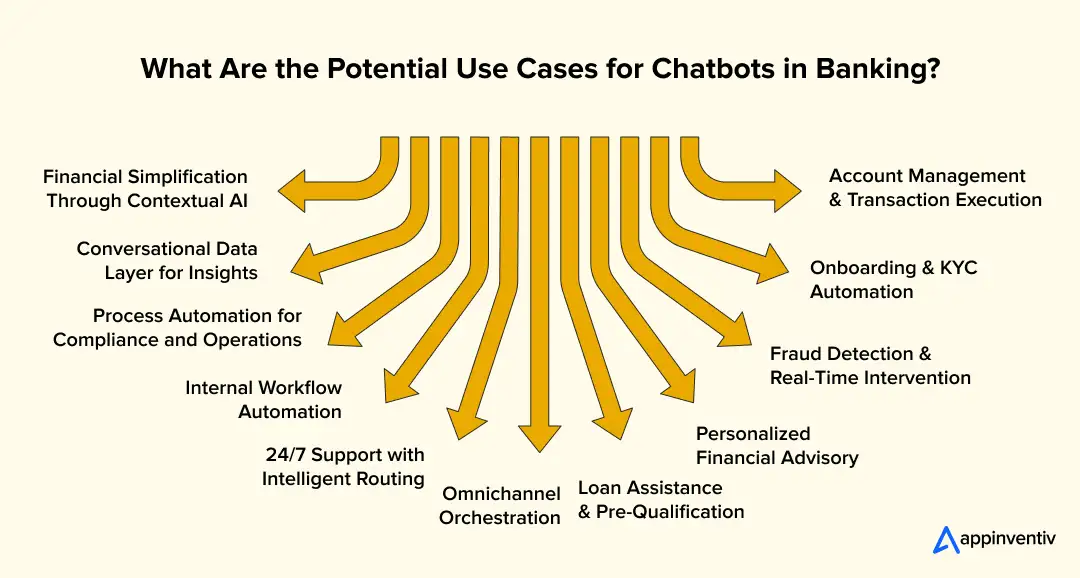
1. Account Management & Transaction Execution
This is the most direct layer of interaction, where the chatbot connects to core banking systems and executes real transactions in real time.
- Check balances, view transaction history, transfer funds, and pay bills in real time
- Lock or unlock cards instantly in case of loss or suspicious activity
- Trigger backend operations through secure API calls to CBS and payment systems
Instead of navigating multiple screens, users interact with a single conversational layer that executes transactions end-to-end.
2. Onboarding & KYC Automation
This capability streamlines customer onboarding by automating identity verification and compliance workflows.
- Guide users through account opening with step-by-step conversational flows
- Automate KYC verification using document upload, OCR, and validation APIs
- Integrate with identity providers and regulatory databases
This reduces onboarding timelines from days to hours while maintaining compliance standards.
3. Fraud Detection & Real-Time Intervention
Here, the chatbot acts as the response layer for fraud detection systems, enabling immediate user action.
- Integrate with fraud detection engines and anomaly detection models
- Send real-time alerts for suspicious transactions
- Allow users to confirm or deny transactions instantly within the same interaction
This creates a closed-loop response system that reduces exposure and improves response time.
4. Personalized Financial Advisory
This capability uses behavioral data to provide context-aware financial insights and recommendations.
- Analyze spending patterns, income flows, and transaction behavior
- Provide budgeting insights, savings nudges, and contextual recommendations
- Extend into basic investment guidance based on user profiles
This transforms the chatbot into a continuous financial guidance layer rather than just a support tool.
5. Loan Assistance & Pre-Qualification
This allows users to move through the entire loan journey, from eligibility to application, in a single, guided flow without switching systems or waiting for manual steps.
- Handle loan pre-qualification based on user data and credit integrations
- Provide rate estimates, repayment calculations, and eligibility insights
- Guide users through document collection and application workflows
By orchestrating these steps within a single flow, chatbots reduce friction across lending processes.
6. Omnichannel Orchestration
This ensures that user interactions remain consistent across different platforms.
- Maintain conversation state across mobile apps, web platforms, and messaging channels
- Use centralized conversation engines with channel adapters
- Ensure session continuity and context retention
This enables a consistent experience regardless of where the interaction begins.
7. 24/7 Support with Intelligent Routing
Chatbots act as the first layer in the support architecture, handling volume while preserving escalation paths.
- Classify user intent using NLP models
- Resolve high-volume queries instantly
- Route complex cases to human agents with full context
This ensures scalability without compromising service quality.
8. Internal Workflow Automation
Chatbots extend beyond customer interactions and integrate into internal enterprise systems.
- Integrate with HRMS, ITSM, and internal systems
- Automate employee queries, access requests, and routine workflows
- Reduce dependency on manual service handling
This improves operational efficiency across internal teams.
9. Process Automation for Compliance and Operations
This allows chatbots to manage compliance and operational tasks by automating rule-based workflows across multiple banking systems.
- Automate service requests, KYC updates, and compliance checks
- Trigger backend workflows across multiple systems
- Enforce validation rules consistently
This ensures standardization and reduces manual errors at scale.
10. Conversational Data Layer for Insights
Each interaction contributes to a structured data pipeline. This means every query, response, and outcome is captured and transformed into usable data for analysis.
- Capture intent patterns, query trends, and behavioral signals
- Feed data into analytics systems for continuous optimization
- Identify friction points across customer journeys
This turns the chatbot into a real-time feedback and optimization layer.
11. Financial Simplification Through Contextual AI
Financial products can be complex and difficult to navigate. This layer ensures users receive information tailored to their context, intent, and level of financial understanding.
- Use LLMs to simplify explanations based on user context
- Guide users through multi-step decisions, such as loans or investments
- Adapt responses based on user familiarity and history
This improves usability while maintaining accuracy and compliance.
What This Means in Practice:
Chatbots in banking are no longer standalone tools. They function as a secure orchestration layer across APIs, data systems, and AI models.
By combining NLP for intent understanding, RAG for accurate data grounding, and deep system integrations for execution, these systems enable banks to handle high volumes and complex workflows consistently and with control.
That’s the shift, from conversational interfaces to embedded operational infrastructure within modern banking systems.
What Are the Key Benefits of Chatbots for Banking?
Step into any banking ops review, and you’ll hear the same thing: volumes are up, expectations are higher, and teams are stretched. This is where chatbots start making a real difference. Not just in speed, but in how smoothly things run day to day.
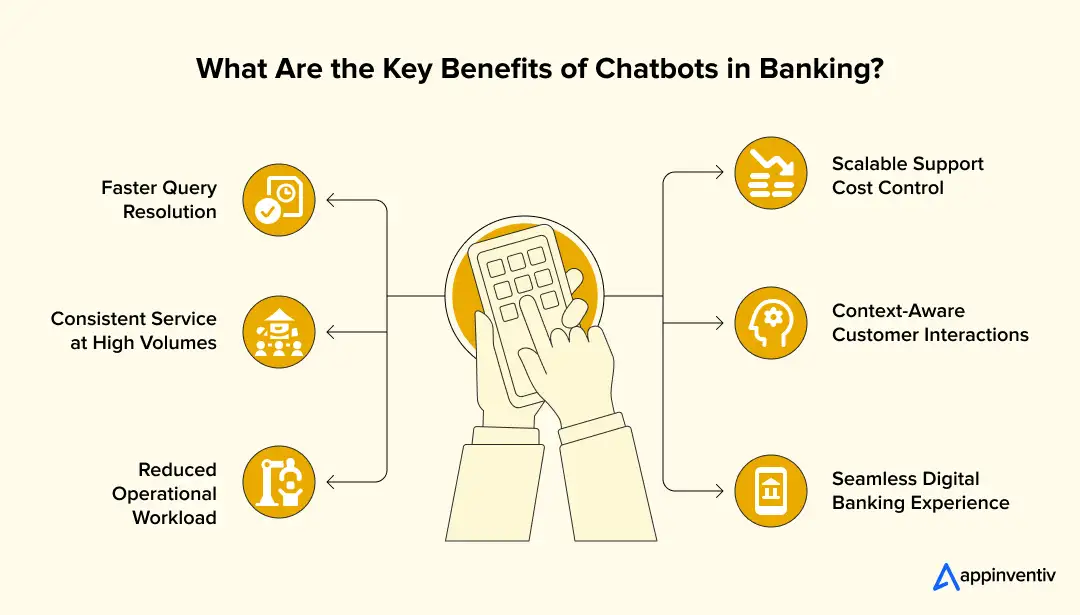
Here’s what that looks like in practice:
- Faster Query Resolution: Most routine queries get handled in one go. Customers don’t have to repeat themselves or jump between steps just to get a simple answer.
- Scalable Support Cost Control: As demand grows, you’re not forced to keep adding support staff to keep up. A large part of the load is handled automatically, which makes costs more predictable.
- Consistent Service at High Volumes: During peak periods, when requests spike, the experience doesn’t slow down. Responses stay steady and reliable.
- Context-Aware Customer Interactions: Instead of generic replies, responses are based on what the user is actually trying to do. That makes conversations feel more useful and less mechanical.
- Reduced Operational Workload: Repetitive queries are handled upfront, so your teams can spend time on cases that actually need attention.
- Seamless Digital Banking Experience: Users can complete tasks without switching channels or getting stuck midway, which makes the overall experience feel smoother.
At a practical level, the shift is simple. Things run more smoothly, teams aren’t overloaded, and customers get what they need without delays.
Real-World Examples of Chatbots in the Banking Industry
To understand the real impact, it helps to look at examples of chatbots in the banking industry that are already handling day-to-day operations at scale. These chatbots aren’t just experiments; they’re part of how real services run every day.
Here are a few well-known examples and what they actually do:
| Chatbot | Bank / Provider | What It Helps With | Why It Matters |
|---|---|---|---|
| Erica | Bank of America | Tracks spending, sends reminders and answers everyday queries | Makes day-to-day banking feel simpler and more proactive |
| Ally Assist | Ally Bank | Handles balance checks, transfers, and common questions | Reduces the need to contact support for basic tasks |
| KAI | Kasisto | Powers chatbots & virtual assistants in banking across multiple banks | Helps banks scale customer support without losing context |
| Amy | HSBC | Responds to FAQs and guides users through services | Helps manage large volumes of customer queries efficiently |
| Eno | Capital One | Sends fraud alerts, tracks spending and helps with payments | Adds proactive support, like detecting duplicate charges and unusual activity |
What you can take from these:
If you look across these examples, a pattern starts to show.
- AI chatbots in banking are handling everyday interactions without slowing things down
- Banks are using them to reduce support pressure while keeping responses quick
- Some are even going beyond support, helping users understand and manage their finances better
In the end, these examples show that AI-driven chatbots in banking are not just about intelligent automation. They’re becoming part of how banks deliver a smoother, more reliable experience.
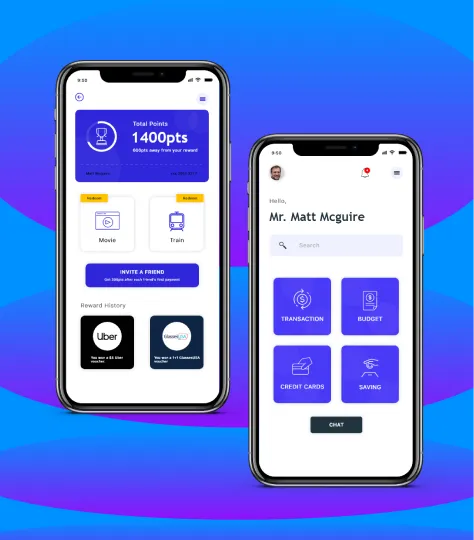


- Launched in 12+ countries
- Improved user engagement and repeat usage through simplified, AI-driven financial management
What Are the Key Trends Shaping Chatbots in Banking?
Not long ago, most banking chatbots were limited to answering simple questions. Today, that’s no longer the case. In many banks, they’re starting to sit much closer to core operations, quietly handling tasks that used to depend on manual support.
Here’s how that shift is showing up:
- Less scripted, more natural conversations: Earlier bots followed rigid paths. Now, interactions feel more fluid because the system can understand intent and follow context across steps
- From answering to actually getting things done: It’s no longer just about responses. Users can check details, complete actions, and move through tasks without breaking the flow
- Support that doesn’t wait to be asked: Instead of reacting, chatbots now surface alerts, reminders, and updates when something needs attention
- More focus on clarity and control: Banks are making interactions simpler and more transparent, with clear steps and an easy way to switch to a human when needed
- Consistent experience across channels: Whether someone starts on mobile or web, the interaction carries forward without forcing them to start over
- Closer connection to real systems: Responses are no longer generic. They’re tied to actual account data and backend systems, which makes them more reliable
- Handling small journeys end-to-end: From a quick check to a multi-step request, users can complete tasks without jumping between systems
In day-to-day operations, this is what stands out. Chatbots are no longer sitting on the edges of banking. They’re becoming part of how things get done, quietly improving speed, consistency, and overall experience for both users and internal teams.
How Should Banks Approach Implementing Chatbots for Banking?
Most teams don’t fail because of technology. They get stuck because the chatbot is treated as a standalone feature rather than a system that must sit cleanly within existing banking infrastructure. The starting point is simple. The execution is where things usually break.
Here’s how to approach it in a way that actually works in production:
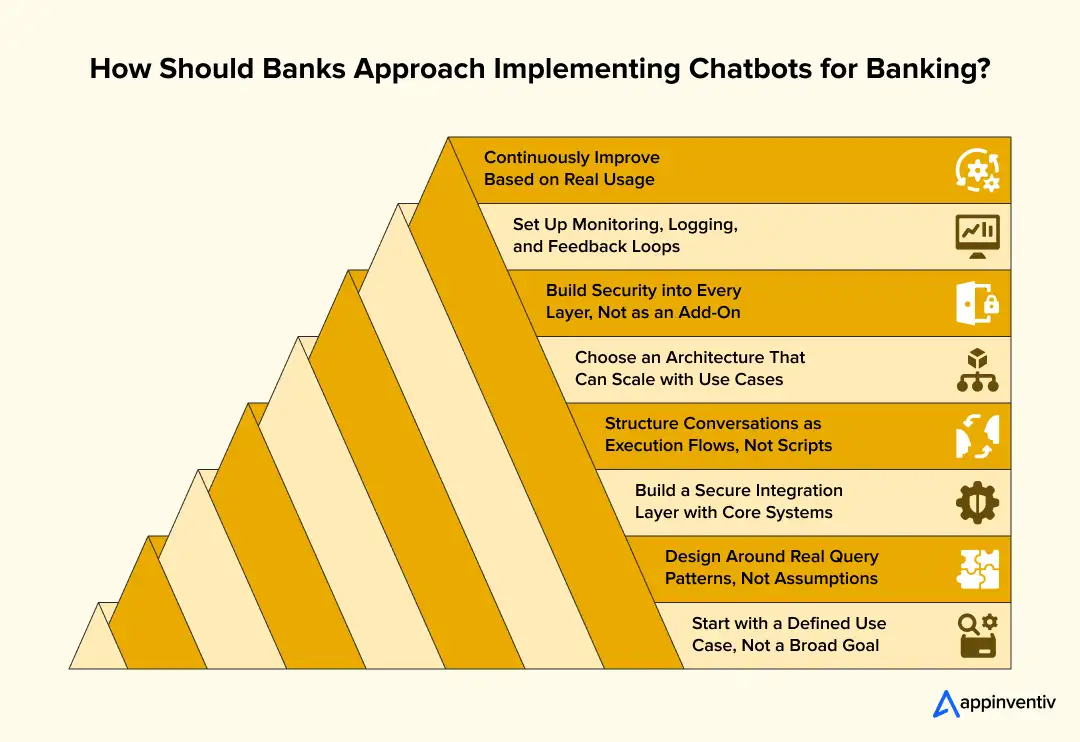
1. Start with a Defined Use Case, Not a Broad Goal
It’s tempting to “build a chatbot for support,” but that usually leads to slow progress and unclear outcomes.
- Pick a high-volume, well-defined use case like balance checks, transaction queries, or card blocking
- Map the exact flow end-to-end, including edge cases
- Define success metrics upfront, like containment rate or resolution time
Why this matters: It keeps scope controlled and makes early impact measurable
2. Design Around Real Query Patterns, Not Assumptions
What users ask in production is often very different from what teams expect.
- Analyze support logs, call center transcripts, and app queries
- Identify where users drop off or escalate
- Group queries into intent clusters before building flows
Technical note: This is where your intent model and training data foundation come from
3. Build a Secure Integration Layer with Core Systems
This is where most chatbot implementations fail. Without real access to data, the system becomes superficial.
- Connect to core banking, CRM, and transaction systems through APIs
- Introduce a middleware or orchestration layer to manage requests
- Ensure role-based access and data-level permissions
Technical note: This layer powers RAG-based responses, ensuring answers come from real data, not static logic
4. Structure Conversations as Execution Flows, Not Scripts
A chatbot isn’t a decision tree anymore. It needs to handle multi-step interactions.
- Design flows that can handle follow-ups and context switching
- Keep responses short, but allow deeper actions when needed
- Always include a fallback to human support for sensitive cases
Why this matters: Real banking queries are rarely one-step interactions
5. Choose an Architecture That Can Scale with Use Cases
What starts as a support bot often expands into payments, loans, and internal operations.
- Use modular architecture so new capabilities can be added without rework
- Separate layers for LLM, retrieval, orchestration, and UI
- Ensure the system supports multi-channel deployment
Technical note: This avoids rebuilding when moving from pilot to enterprise scale
Also Read: How to Choose the Right Enterprise Software Architecture
6. Build Security into Every Layer, Not as an Add-On
In banking, security failures are not recoverable.
- Apply authentication (MFA, OAuth) before sensitive actions
- Mask or tokenize sensitive data before passing it to AI models
- Maintain audit logs for every interaction
Why this matters: Security has to be part of the flow, not an extra step
7. Set Up Monitoring, Logging, and Feedback Loops
Once live, the system needs visibility.
- Track query resolution rates, fallback rates, and response accuracy
- Log interactions for audit and model improvement
- Identify failure points in real time
Technical note: This feeds directly into model retraining and system optimization
8. Continuously Improve Based on Real Usage
The first version is never the final version.
- Refine intent models based on real queries
- Expand use cases gradually
- Optimize flows where users hesitate or drop off
Why this matters: The system improves through usage, not just initial design
In the end, implementing a chatbot for banking works best when you start small, fix real problems, and keep refining as you go. Many banks also partner with an experienced chatbot development company to accelerate implementation and avoid common pitfalls early on.
Compliance Checklist for Banking Chatbots
When you’re rolling this out in a banking environment, compliance can’t sit in the background. It needs to be built into the system from the first integration.
This checklist gives you a quick view of what needs to be in place before your chatbot goes live and starts handling real customer data.
| Area | What to Implement | Why It Matters |
|---|---|---|
| Data Privacy | Consent management, data minimization, PII masking & tokenization | Limits the exposure of sensitive financial data before AI processing |
| Encryption | TLS 1.2+ (in transit), AES-256 (at rest), aligned with FIPS 140-2 | Secures transactions and ensures regulatory-grade encryption |
| Authentication | MFA, OAuth2.0, role-based access control (RBAC) | Prevents unauthorized access and misuse |
| Zero-Trust Security | Continuous verification of every request and interaction | Ensures no implicit trust across systems |
| Compliance Standards | GDPR, PCI-DSS, SOC 2, ISO 27001 alignment | Meets global regulatory and audit requirements |
| Audit & Logging | Immutable logs, activity tracing, SIEM integration | Enables audits, monitoring, and fraud investigation |
| Fraud Monitoring | Real-time anomaly detection, risk scoring models | Detects suspicious behavior early |
| API Security | API gateways, rate limiting, token-based auth (JWT) | Secures integrations with core banking systems |
| Data Retention | Automated retention policies, secure deletion workflows | Reduces long-term data risk exposure |
| AI Guardrails | Response validation, fallback triggers, hallucination control (RAG) | Ensures safe, accurate AI outputs |
| Deployment Model | On-premise or private cloud (AWS Outposts / Azure Stack) | Keeps sensitive data within controlled infrastructure |
| Human Oversight | Escalation workflows for high-risk queries | Maintains control in critical scenarios |
This keeps compliance practical while ensuring the chatbot is secure, auditable, and production-ready from day one.
What Are the Adoption Challenges of Chatbots in Banking?
Let’s be honest for a moment. Launching chatbots for banking isn’t just about plugging in new technology. It’s about trust, systems, and how teams actually work day-to-day. Many banks realize this only after a pilot goes live and adoption stays low.
Here are the common challenges, and how teams usually deal with them:
1. Customer Trust and Adoption
When money is involved, people are naturally cautious. If a chatbot feels confusing or unreliable, they leave quickly.
What helps:
- Keep conversations simple and guided
- Make verification steps clear and secure
- Offer an easy switch to a human when needed
- Be transparent about how data is used and protected
At the end of the day, users should feel in control, not tested.
2. Integration with Core Systems
A chatbot is only as useful as the data it can access. Without proper integration, even AI bots in banking end up giving limited or generic responses.
What helps:
- Connect core banking systems, CRM, and payment platforms through APIs
- Use middleware to keep data consistent
- Start with key use cases like balance checks or transactions
- Expand AI chatbot integrations gradually
This keeps things stable while improving capability over time.
Banks operating on legacy systems, especially COBOL-based infrastructure, often face integration gaps. Appinventiv addresses this through a Legacy Integration Audit, helping map legacy systems to modern AI architectures without disruption.
3. Security and Compliance
Handling financial data comes with strict expectations. Any security gap can break trust instantly.
What helps:
- Use encryption across all interactions
- Add multi-factor authentication for sensitive actions
- Maintain clear audit trails
- Align with standards like GDPR and PCI-DSS
With AI-driven chatbots in banking, security needs to be part of the experience from the start.
4. Language and Context Accuracy
Banking queries are rarely simple. If the chatbot misunderstands intent or provides incomplete answers, users quickly lose confidence.
What helps:
- Train models on real banking data
- Use context to understand ongoing conversations
- Add checks for sensitive or high-risk responses
- Continuously improve based on real interactions
Strong conversational AI improves over time, not in one go.
5. Internal Adoption and Change Management
Even if the technology works, teams need to be ready to use and support it. Resistance or unclear ownership can slow things down.
What helps:
- Involve frontline teams early
- Train staff to handle escalations
- Define clear roles across teams
- Track performance to show real impact
When you look at it closely, most challenges aren’t technical; they’re practical. Banks that treat these as part of the design process build AI bots in the banking industry that actually get used and scale. Others often stay stuck in pilot mode, with no real impact.
If your chatbot isn’t handling real queries or integrations smoothly, it’s time to rethink the approach.

How Do LLM-Powered Chatbots in Banking Actually Work?
You’re checking a transaction quickly, maybe between meetings, and you expect the answer to be accurate without double-checking it. That expectation is exactly what modern banking chatbots are built around.
Once a chatbot moves beyond basic FAQs, the system underneath becomes far more structured. Today’s AI bots in banking don’t just generate responses. They combine LLMs with secure data retrieval systems (RAG) to ensure every answer is grounded in real information.
Here’s how it works behind the scenes:
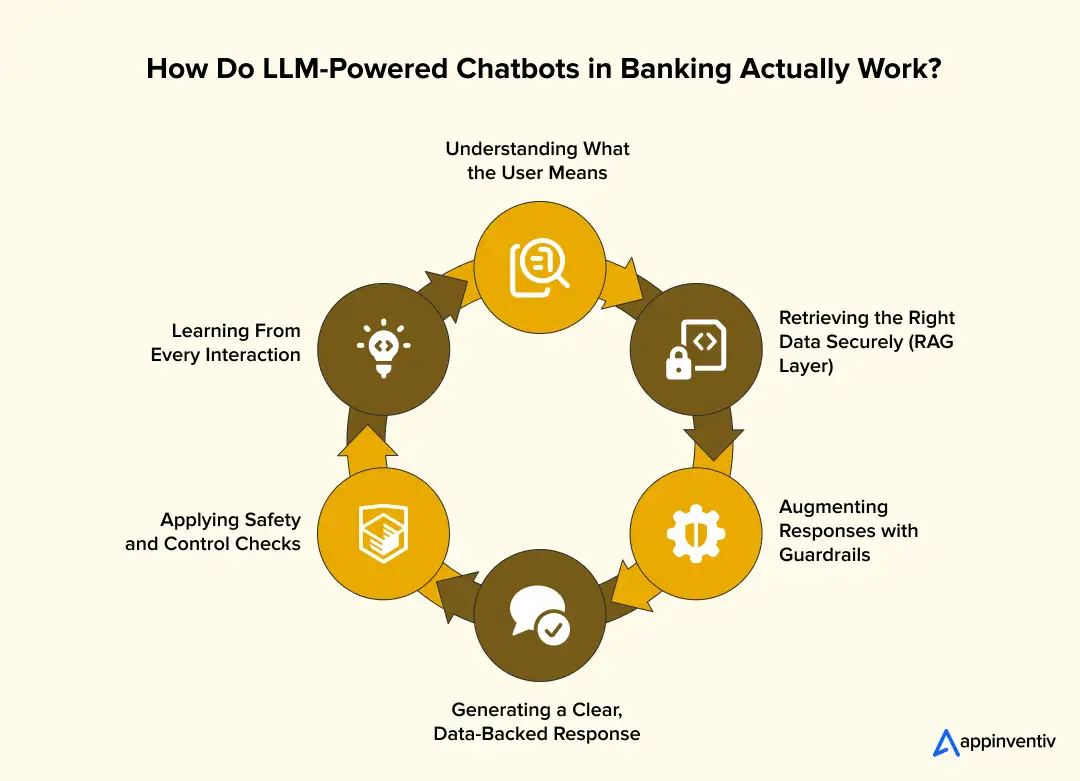
1. Understanding What the User Means
When a user asks a question, the chatbot focuses on intent rather than just keywords.
- Interprets what the user is trying to do using a domain-trained LLM
- Understands follow-up queries within the same conversation
- Maintains context across multiple steps
This is what makes conversational AI feel natural instead of scripted.
2. Retrieving the Right Data Securely (RAG Layer)
In banking, responses cannot be generic. They must come from real systems.
- Connects with core banking, CRM, and transaction systems via APIs
- Retrieves only the relevant data required for the query
- Applies strict access controls and permissions
This retrieval layer ensures the chatbot works with live, verified data, not assumptions.
Also Read: RAG Applications in AI Development
3. Augmenting Responses with Guardrails
Before generating a response, the system applies control layers.
- Injects retrieved data into the model with validation rules
- Applies compliance checks and policy constraints
- Prevents exposure of sensitive or unauthorized information
This step is critical for ensuring accuracy and regulatory safety.
4. Generating a Clear, Data-Backed Response
Once validated, the chatbot delivers an accurate, easy-to-understand response.
- Converts complex data into simple, user-friendly language
- Keeps responses concise and actionable
- Guides users on next steps when needed
This is what makes AI-powered chatbots in banking practical, not just functional.
5. Applying Safety and Control Checks
Every response passes through additional safeguards.
- Flags uncertain or high-risk responses
- Blocks sensitive actions without proper authentication
- Escalates to human agents when required
This ensures reliability in high-stakes financial interactions.
6. Learning From Every Interaction
The system continuously improves based on real usage.
- Tracks query patterns and user behavior
- Refines responses based on feedback and outcomes
- Adapts to evolving customer needs
What This Means in Practice:
Modern banking chatbot applications are no longer standalone tools. They operate as intelligent systems that combine LLMs, the RAG architecture, and security layers.
When these components work together, the result is simple: responses are accurate, secure, and consistent, even at scale. That’s what separates a basic chatbot from a production-grade banking AI system.
What ROI Can Enterprises Expect from AI Chatbots in Banking?
Once a chatbot goes live, the real question becomes simple: Is it actually making a difference? For most banks, the impact shows up pretty quickly in day-to-day operations, especially where query volumes are high.
Here’s how chatbots for banking typically perform when implemented well:
| Business Area | What to Measure | What Changes |
|---|---|---|
| Customer Support | Query containment rate | Around 60% to 85% of queries are handled without human support |
| Cost Efficiency | Cost per interaction | 30% to 60% lower compared to traditional support |
| Response Time | Query resolution speed | 50% to 90% faster responses |
| Customer Experience | CSAT scores | 15% to 30% improvement after adoption |
| Call Center Load | Agent workload | 40% to 70% reduction in repetitive queries |
| Fraud Response | Alert handling time | 40% to 70% faster intervention |
| Digital Adoption | Self-service usage | 25% to 50% increase in digital interactions |
| Internal Support | Employee query resolution | 50% to 80% faster handling of HR and IT requests |
Banks using AI-driven automation have reported 30–40% lower operational costs in areas such as collections and customer handling while maintaining service quality.
Instead of hiring more people every time demand grows, banks can handle scale more smoothly. Banking chatbot development creates a system that absorbs routine workload, keeps responses consistent, and improves over time.
The return isn’t just about cost savings. It shows up in how quickly customers get what they need, how efficiently teams operate, and how well the system handles growth without adding pressure.
What is the Banking Chatbot Development Cost
When you start planning banking chatbot development, the cost usually depends on one simple thing: how advanced you want the chatbot to be.
A basic chatbot that handles FAQs is relatively straightforward. But once you move toward AI bots in banking that connect with core systems, handle real-time data, and digital support secure transactions, the effort and cost increase.
In most cases, the cost to build chatbots for banking ranges between $40,000 to $400,000+, depending on complexity, integrations, and scale.
Here’s a clearer chatbot development cost breakdown:
| App Complexity | What It Typically Includes | Average Cost | Average Timeline |
|---|---|---|---|
| Basic chatbot | FAQs, simple queries, limited flows | $40,000 – $50,000 | 4–6 months |
| Mid-level chatbot | CRM/core integrations, multi-step queries, better UX | $50,000 – $120,000 | 4–9 months |
| Advanced chatbot | Full AI-driven chatbots in banking, real-time data, automation and high security | $120,000 – $400,000+ | 9–12+ months |
What Drives the Cost
- Complexity of use cases: Handling simple queries is very different from managing loans, transactions, or fraud alerts
- System integrations: Connecting with core banking, CRM, and payment systems adds both time and effort
- Security and compliance requirements: Strong authentication, encryption technology , and regulatory alignment are essential in banking
- AI capability and training: More advanced conversational AI in banking needs better models and continuous improvement
- Platform and scalability: Supporting mobile, web, and messaging platforms increases scope
- Development expertise and team structure: Whether you work with in-house teams or experienced fintech app developers, the level of expertise directly impacts both cost and long-term scalability
The cost isn’t just about building a chatbot; it’s about building the right one for your needs. Most banks start small, focus on a few high-impact use cases, and then expand.
That approach keeps the initial investment controlled while still allowing chatbots in the banking industry to grow into a more capable, scalable system over time.
How to Choose the Right Banking Chatbot Development Partner
Choosing a banking chatbot partner isn’t just about technical capability. It’s about finding a team that understands how banking systems, compliance, and customer expectations come together in real-world scenarios.
Here’s what to evaluate before making that call:
- Look for real banking experience, not generic AI work: You want a team that has handled KYC flows, transactions, and compliance, not just built chatbots for simple use cases.
- Prioritize strong system integration capabilities: A chatbot is only useful if it connects to your core banking systems, CRM, and payment platforms in real time.
- Assess their AI and conversational design expertise: The experience should feel natural and guided, not scripted. This comes from strong work in conversational AI in banking.
- Make sure security and compliance are built in: Encryption, authentication, audit trails, and alignment with standards like GDPR and PCI-DSS should be clearly defined upfront.
- Check if the solution can scale with your growth: What works for a pilot should also handle higher volumes, more users, and additional use cases without rework.
- Evaluate post-launch support and optimization: The real value shows after launch. The partner should continuously improve performance based on real user interactions.
- Ask how they measure ROI and business impact; look for clarity on metrics such as reduced support load, faster resolution times, and improved customer experience.
In the end, you’re not just choosing a vendor. You’re choosing a partner who will shape how your digital banking experience runs every day.
Shortlist a partner who can integrate with your core systems, meet compliance requirements, and support scale from day one.

How Can Appinventiv Help You with Banking Chatbot Development?
Appinventiv specializes in creating intelligent, secure chatbots for banking and financial institutions tailored to your unique business requirements. With a proven track record of delivering 3000+ successful projects and AI chatbots for businesses, we are your trusted banking software development company.
From automating customer queries to enabling personalized financial assistance, our chatbots are designed to enhance operational efficiency and user satisfaction. Our ability to integrate the finance chatbot with your existing banking infrastructure sets us apart. Whether it is connecting with core banking systems, payment gateways, or fraud detection platforms, we ensure that the chatbot performs optimally and aligns with your organization’s goals.
By partnering with us, you gain access to a dedicated team of 1600+ tech experts who prioritize security and compliance at every step, ensuring that sensitive customer data is handled with the utmost care.
So what are you waiting for? Contact us now to build an AI chatbot to elevate your digital transformation journey and keep your bank ahead in today’s competitive world.
FAQs
Q. How to use AI chatbots for the banking industry?
A. Most banks begin with simple, high-volume tasks like balance checks or transaction queries. From there, they expand into broader banking chatbot applications such as loan guidance or fraud alerts. The key is to connect the chatbot with core systems early, so responses feel real, not generic.
Q. What services are offered by banking chatbots?
A. Today, chatbots and virtual assistants in banking handle a wide range of services, from checking balances and making payments to tracking expenses and sending fraud alerts. In many cases, they also offer basic financial guidance, helping users make quicker decisions without waiting on support.
Q. Can chatbot technology handle complex customer interactions?
A. It can, to a large extent. Modern AI-powered chatbots in banking understand context and can manage multi-step conversations, like helping with a loan query or resolving a transaction issue. For more sensitive situations, an AI-powered virtual assistant can step in or route the conversation to a human, so nothing feels stuck.
Q. How does banking chatbot integration work?
A. In practice, implementing a chatbot for banking comes down to integration. APIs connect the chatbot to core banking systems, CRM tools, and payment platforms. This is what enables conversational AI in banking to pull real-time data and give responses that are accurate, secure, and actually useful.
Q. How are chatbots used in banking?
A. Think about the last time you needed quick help from your bank. That instant response usually comes from a chatbot working in the background.
It provides personalized support, loan guidance, and 24/7 assistance across apps and chat. At the same time, it helps banks with fraud checks, automation, and smarter marketing. Over time, it also nudges users with financial tips and helps banks design services that actually match how people use their money.


Fast 2-minute response, fully NDA-protected.
Key takeaways: Connected software updates entire banking pipelines from start to finish. This technology cuts manual labor. It sharpens compliance, stops fraud, and pleases clients. AI, RPA, and document tools build scalable bank operations. They integrate directly with your core platform rather than replacing existing infrastructure. Project success requires deep process redesign and API connections.…
Mobile Banking App Development Cost: A Complete Pricing Guide
Key takeaways: The cost of mobile banking app development begins at $40,000 and can climb to $1,000,000 for enterprise-level applications, depending on the scope and infrastructure complexity. Features such as AI-powered fraud detection, open banking integrations, biometric authentication, and others significantly increase development effort and overall project cost. Adherence to security and regulatory compliances such…
How Australian Banks Are Modernising Core Banking Systems: Key Strategies and Challenges
Key takeaways: Regulatory pressure from APRA, CDR, and CPS frameworks is forcing banks to prioritise auditability, resilience, and real-time capabilities. Banks modernising core banking systems are reducing risk by migrating high-value functions first while maintaining legacy ledgers for stability. The cost of core banking modernisation for an Australian bank is shaped by data migration, compliance…