















Harnessing AI in Blockchain: A Comprehensive Guide to Integration and Benefits

 Share -


- 01AI and Blockchain – A Brief Introduction
- 02The Trifecta Magic: AI, Big Data and Blockchain
- 03Key Benefits of AI in Blockchain
- 04Blockchain and Generative AI
- 05Multiple Industries that Can Benefit from AI in Blockchain: A Glimpse at the AI and Blockchain Use Cases
- 06The Future of AI and Blockchain: How Appinventiv Can Help You Stay Ahead?
- 07FAQs

Key takeaways:
- Artificial intelligence and blockchain complement each other: AI adds analysis and automation, and blockchain adds a tamper-proof record that AI can be audited against.
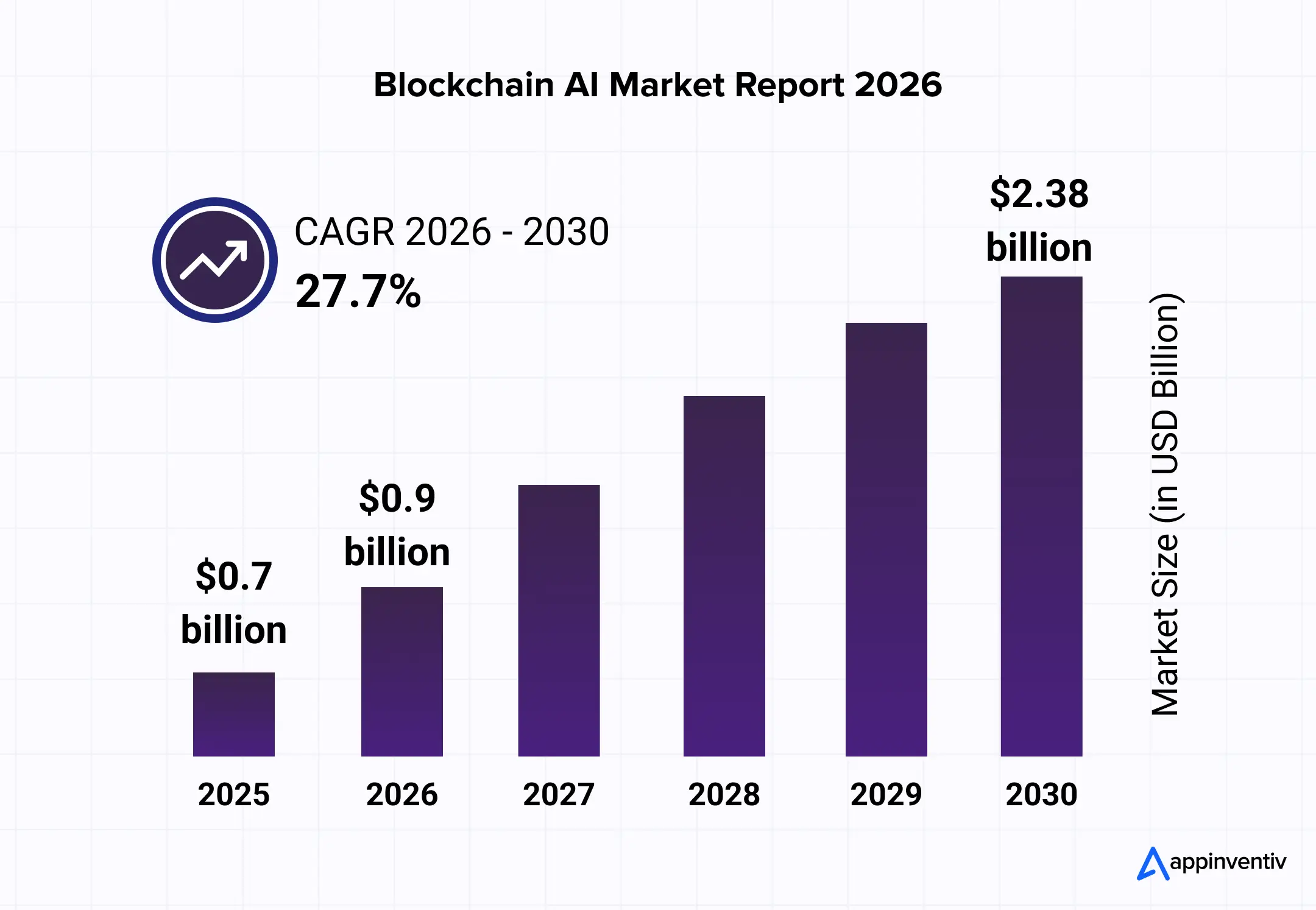
- The blockchain AI market is projected to grow from about $0.7 billion in 2025 to $2.38 billion by 2030.
- The strongest use cases today are fraud detection, smart contract automation, supply chain traceability and decentralized data marketplaces.
- Blockchain and generative AI meet on provenance: proving where training data came from and whether content is AI-generated.
- AI agents that hold wallets and transact on-chain are the next big shift for both technologies.
Artificial intelligence and blockchain solve opposite problems. AI is good at finding patterns and making decisions, but it is hard to audit. Blockchain keeps a record no one can quietly change, but it can’t analyze anything on its own.
Blockchain integration with AI brings the two together: AI analyzes and automates, and the ledger records what data it used and what it did with it. That pairing now powers fraud detection, smart contract automation, supply chain tracking and AI agents that transact on-chain.
In this blog, we explore how AI and blockchain work together, their benefits, use cases across industries, and where the technologies are heading.
Appinventiv builds AI and blockchain systems that cut fraud, automate smart contracts and keep every decision auditable.
AI and Blockchain – A Brief Introduction
AI is revolutionizing industries by simulating human intelligence in machines. Through machine learning and natural language processing, AI technologies are reshaping how businesses function. As businesses increasingly integrate AI solutions for automation, predictive analysis, and personalized customer experiences, the AI-based solutions market is expected to grow substantially in the years ahead.
Blockchain is a decentralized and tamper-proof ledger technology that has revolutionized data security and transparency. Originally designed for cryptocurrencies, its applications have expanded to various industries, including finance, supply chain, and healthcare. The market size of Blockchain is driven by its adoption in these sectors, as it offers secure, transparent, and traceable transactions. Simply put, Blockchain has become a cornerstone for digital transformation.
The collaboration between AI and Blockchain forms a robust alliance that tackles data security, transparency, and efficiency issues. The Business Research Company estimates the market size of AI and blockchain at $0.7 billion in 2025, rising to $0.9 billion in 2026 and $2.38 billion by 2030, a CAGR of 27.7%.
Businesses can now strategically utilize the integration of these technologies to enhance the security and transparency of AI applications. Blockchain AI enables businesses to develop advanced AI models while ensuring the integrity and trustworthiness of the underlying data.
Integrating these technologies not only boosts the capabilities of AI applications but also tackles concerns surrounding data integrity and trust. Combining AI and Blockchain establishes a secure groundwork for innovation in an era where industries are progressively dependent on data-driven decision-making. Thus, it’s the right time for businesses to position themselves ahead in technological advancement, capitalizing on the mutually beneficial relationship between AI and Blockchain to foster efficiency, security, and growth.
The Trifecta Magic: AI, Big Data and Blockchain
Big Data prepares the ground for the advancement of both AI and Blockchain. Blockchain AI empowers businesses to accumulate a heap of data into structured components.
This data is further employed by AI-powered machines and applications to understand user behavior and deliver personalized customer experience. Similarly, Blockchain relies on Big Data to get the analyzed data that can be stored in its distributed ledger and made accessible to people, depending on whether it is on a public or private network.
With this, we have quickly recap the basics of disruptive technologies. Let’s now jump directly to how they complement each other, beginning with the impact of AI on the Blockchain industry.x
Key Benefits of AI in Blockchain
Artificial intelligence and blockchain each cover a weakness of the other. Here is what businesses gain when they bring the two together.
[Image: Key Benefits of AI in Blockchain]
Enhanced Fraud Detection and Security
AI models analyze blockchain transaction data in real time to spot suspicious patterns, profile unusual wallet behavior and flag fraud far faster than manual review. Blockchain, in turn, gives those models an immutable history to learn from, so the data used for fraud prediction can’t be quietly altered. Together, they bring stronger data security to both systems.
Smart Contract Optimization and Auditing
Smart contracts offer speed and fewer disputes, but their use has been limited by how complex they are to write safely. AI can draft, test and monitor smart contracts for vulnerabilities before deployment, reducing code bugs and financial loss. It also lets contracts encode more complex commercial relationships, such as terms that adjust to price changes.
Workflow Automation and Scalability
AI automates on-chain processes such as trade settlement, compliance checks, data classification and portfolio rebalancing, making decentralized blockchain networks faster and cheaper to run. Decentralized learning techniques, where models train across many nodes without pooling raw data, also help blockchain-based systems scale without a single bottleneck.
Data Provenance, Transparency and Trust
Blockchain records an AI system’s inputs, model versions and decisions on an immutable ledger that stakeholders can inspect in real time. When a decision goes wrong, businesses can trace the root cause, and users can see how their data was stored and used. This auditability is what builds trust in AI.
Higher-Quality Data and Decentralized Intelligence
AI apps often struggle with limited, centralized or unverified data, which leads to poor predictions. Blockchain offers shared data that no single entity owns, validated by consensus and governed by smart contracts. AI can then study the full dataset for patterns no single company could see, without compromising privacy compliance.
Lower Market Entry Barriers
AI products face barriers like data monopolies, intermediaries and authentication gaps. Blockchain reduces single-entity ownership of data and removes intermediaries, so smaller companies can access trustworthy data and bring AI products to market faster and more profitably.
Secured Personalized Experiences
AI needs sensitive personal data to personalize experiences. Blockchain keeps that data encrypted and tamper-proof, and can let users decide who accesses it, so personalization doesn’t come at the cost of privacy.
Increased Accessibility in Payments
Blockchain-based cryptocurrencies reduce currency barriers and make cross-border trade easier. AI adds fraud checks, routing and cost optimization, making these payments faster, safer and cheaper.
Data Monetization
Today, large platforms profit from user data that users never chose to sell. With blockchain-based data marketplaces, AI companies can buy data directly from the people who create it. This makes AI training fairer and opens high-quality data to smaller companies that can’t generate their own.
New Business Models and Agentic Economies
With frictionless access to shared business data, AI can uncover patterns that lead to new revenue models. The most significant is the agentic economy: AI agents that hold crypto wallets and use smart contracts to pay for compute, buy data and handle micro-transactions on their own.
Blockchain and Generative AI
Blockchain and generative AI meet on one question: where did this content or model come from? As AI-generated text, images and code spread, the ledger provides the answer.
- Training data provenance: Ledgers record which datasets trained a model and under what license.
- IP protection: Creators register original work on-chain and set terms for its use in model training.
- Content authenticity: Generated content carries an on-chain record of the model and time it was produced, making deepfakes easier to flag.
- Model integrity: Hashing model weights on-chain proves a deployed model hasn’t been tampered with, which matters as more businesses adopt generative Ai. Build AI-Powered Blockchain Solutions
Our blockchain development team designs smart contracts, AI models and integrations that fit your existing systems and compliance needs.
Multiple Industries that Can Benefit from AI in Blockchain: A Glimpse at the AI and Blockchain Use Cases
Blockchain and AI combination applications are almost similar across all the businesses. But, to ease the process, let’s check the impact of AI Blockchain collaboration on all industries individually.
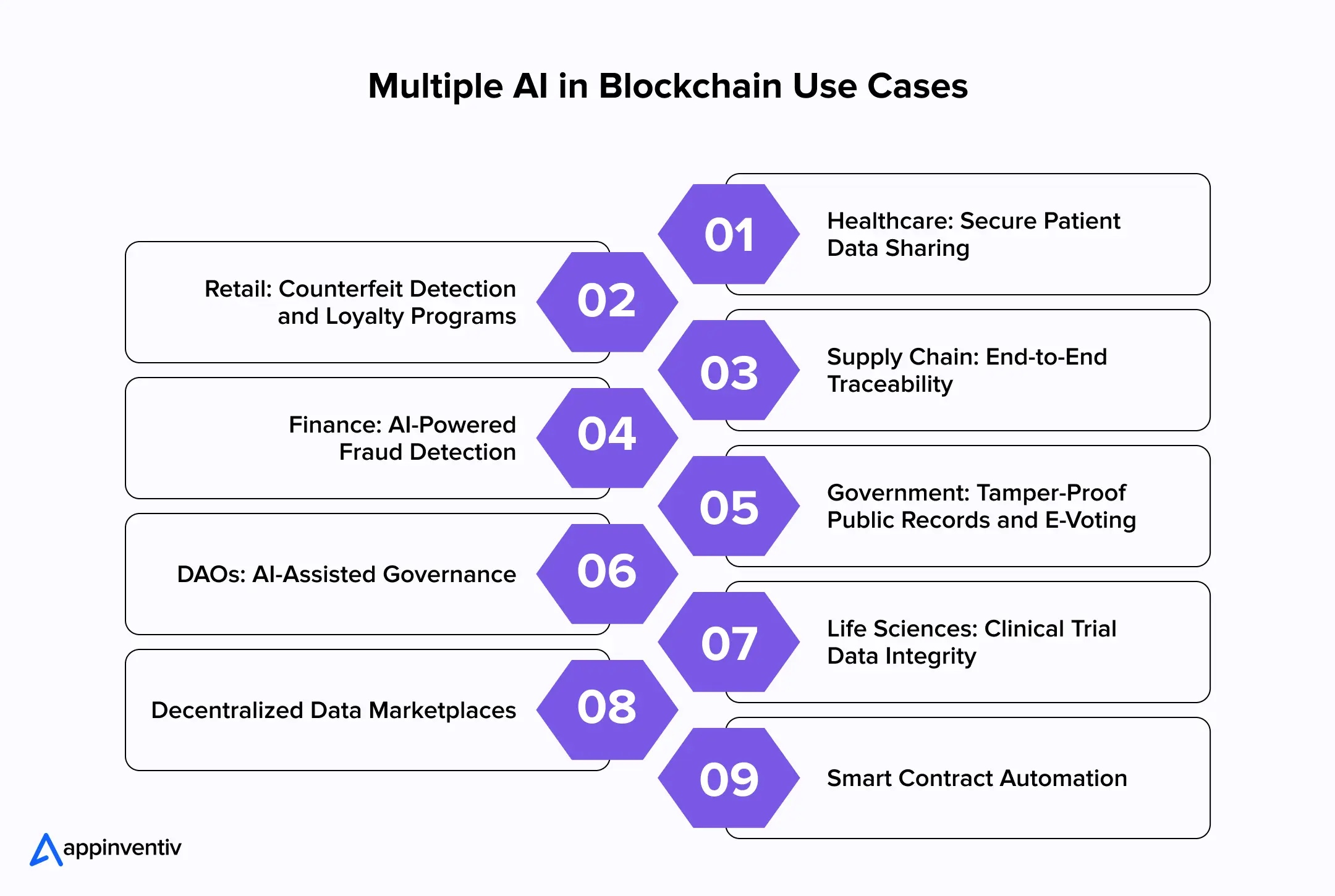
Healthcare: Secure Patient Data Sharing
Patients keep medical records on a permissioned chain and grant access to providers or researchers on their own terms. AI models train on that consented data to support diagnosis, while the ledger shows exactly who accessed what. Read more on blockchain technology in the healthcare industry and AI in healthcare.
Retail: Counterfeit Detection and Loyalty Programs
Brands record each product’s origin and handoffs on-chain, and AI flags listings or shipments whose records don’t match, catching counterfeits. Loyalty points issued as tokens can’t be double-spent, and AI personalizes rewards from purchase history.
Supply Chain: End-to-End Traceability
Each handoff, from raw material to shelf, is recorded on-chain. AI analyzes that record to predict demand, flag delays and spot counterfeits, while smart contracts automatically adjust inventory, order supplies and release payments.
[Also Read: The role of AI-Led Analytics in optimizing supply chain management flow]
Finance: AI-Powered Fraud Detection
Banks and crypto platforms run machine learning over on-chain transactions to catch money laundering, account takeovers and wash trading as they happen. Blockchain gives every flagged case an unalterable audit trail for regulators.
[Also Read: AI in Banking – How Artificial Intelligence is Used in Banks]
Government: Tamper-Proof Public Records and E-Voting
Land registries, licenses and benefit payments recorded on-chain can’t be altered without a trace, and AI flags duplicate claims or suspicious changes. In e-voting pilots, the ledger makes every vote auditable while AI monitors for irregular patterns.
DAOs: AI-Assisted Governance
Decentralized Autonomous Organizations (DAOs) use AI to summarize proposals, model likely outcomes, and flag risky treasury moves, so members vote on clearer information while every decision stays on-chain.
Also Read: How Adoption of Blockchain in Real Estate Changing the Scenario
Life Sciences: Clinical Trial Data Integrity
Trial results and consent records written to a ledger can’t be changed after the fact, which strengthens regulatory submissions. AI then sifts these verified datasets to speed up drug discovery, and on-chain tracking improves pharmaceutical traceability.
Decentralized Data Marketplaces
Data owners license datasets through smart contracts and are paid each time an AI developer uses them, while keeping control over access. AI teams get verified, consented training data.
Smart Contract Automation
AI-enhanced smart contracts execute insurance claims, trade settlements and royalty payouts based on real-world data, with AI validating the inputs before the contract fires.
After looking at these AI and blockchain use cases, let us look at the platforms exploring the combination.
Exploring AI and Blockchain Synergy: Pioneering Platforms Shaping the Future of Data and Intelligence Markets
Some of the companies that have invested in the combination of blockchain and AI projects to enhance their existing processes are:-

Enigma
Enigma is serving a data marketplace that empowers secure off-chain computation. This marketplace is designed with the aim of letting companies share data that users can subscribe to and obtain via smart contracts.
Numerai
Numerai supplies crowdsource machine learning issues to data scientists and empowers them to record their results into an AI-meta model for a short/long period of time and bet on the effectiveness of their proposed output/model. Once the turn period is over, they can check whose result is nearly correct and share the earnings based on the pre-decided terms and conditions.
SingularityNET
SingularityNET collaborates with the use of AI in Blockchain to develop a decentralized open market for Artificial Intelligence where anyone can monetize AI. That implies anyone can buy and sell AI algorithms at a larger scale and thus improve their capabilities.
Ocean Protocol
Another example of AI Blockchain co-evolution is Ocean Protocol. It is an ecosystem for data sharing and monetization that offers a tokenized service layer with an aim to provide safe, transparent, and secure access to data, especially to AI-enabled entities.
Synapse AI
Synapse is employing AI Blockchain convergence to build a decentralized data and intelligence marketplace for trainers, researchers, processors, and contracts that can be approached programmatically in real-time.
Early adopters are locking in data advantages now, so start your AI and blockchain project before the gap widens.
The Future of AI and Blockchain: How Appinventiv Can Help You Stay Ahead?
- Autonomous AI agents and the on-chain economy: AI agents will trade, manage portfolios and make micropayments in cryptocurrency instead of traditional money.
- IP protection and training guardrails: Ledgers will track data provenance, verify IP ownership and license training data for generative models.
- Smart contract security and fraud detection: Machine learning will monitor contracts in real time to catch vulnerabilities and wallet anomalies, and automate multi-party dispute resolution.
In the dynamic tech space, Appinventiv is a trusted partner for enterprises venturing into AI and Blockchain integration. As a dedicated Blockchain software development company, our experts bring a depth of knowledge, delivering tailored solutions that align seamlessly with each business’s distinct requirements.
Appinventiv’s AI development services extend beyond mere technical know-how. We pride ourselves on understanding the intricacies of diverse industrial domains. This allows us to blend AI in blockchain effectively, ensuring that intelligent algorithms seamlessly integrate into your business processes.
What sets us apart is our commitment to simplicity without compromising on effectiveness. Our solutions go beyond basic integration, focusing on elevating decision-making processes, streamlining operations, and placing data ownership firmly in your hands.
In the evolving landscape of AI and Blockchain, Appinventiv remains your strategic partner, guiding you toward a future where technological innovation meets reliability, unlocking endless possibilities for your enterprise.
To see how we apply AI across industries, explore InventivAI, our hub for agentic and generative AI use cases.
Get in touch with our experts to explore how our proficient integration of AI and Blockchain can propel your enterprise forward.
FAQs
Q. How does blockchain integration with AI work?
A. Ai models usually run off-chain to analyze data and make decisions, while the blockchain records the data sources, model versions and resulting actions. Smart contracts then execute outcomes automatically, and the ledger gives an audit trail of every step.
Q. Why are AI and Blockchain important for business?
A. The integration of AI and Blockchain is essential for businesses as it improves efficiency, transparency, and security. AI enables intelligent automation, while Blockchain guarantees a tamper-proof and decentralized transaction record, promoting trust and innovation.
Q. Can Blockchain and AI change the future?
A. The combination of AI and Blockchain has the potential to reshape the future by introducing advanced levels of data security, smart decision-making, and transparent transactions. This synergy revolutionizes industries and fosters a more connected and efficient global landscape.
Q. What is Blockchain for generative AI?
A. Blockchain for generative AI involves utilizing blockchain technology to improve the creation and implementation of AI models. It guarantees the transparency of AI algorithms and the ability to trace data sources while facilitating secure collaboration among various stakeholders. This integration cultivates trust and accountability within the dynamic realm of generative AI.


Fast 2-minute response, fully NDA-protected.
Smart Contract Development Cost in the UAE in 2026: Factors, Estimates, and Key Considerations
Key takeaways: UAE smart contract projects range from AED 147K to AED 1.46M+, driven by architectural complexity, testing scope, and security standards. Enterprise budgets must divide core programming from independent audits, system integrations, hosting infrastructure, legal compliance, and ongoing operations. Ethereum, Polygon, Solana, and Hyperledger Fabric require distinct programming languages, software tooling, infrastructure, and transaction…
White-Label Crypto Exchange Platform Development in the UAE: A Complete Cost and Compliance Guide
Key takeaways: Building a white-label exchange costs AED 55,000 to AED 550,000. VARA licensing adds an AED 100,000 application fee plus an AED 200,000 supervision fee yearly. Technology takes weeks; VARA approval takes six to twelve months. Choose white label for speed, custom for real differentiation. Bake compliance into the build from the first sprint.…
P2P Crypto Exchange Development: Architecture, Features, Cost & Enterprise Implementation Guide
Key Takeaways Enterprise P2P crypto exchanges require secure blockchain escrow orchestration, multi-chain crypto wallet infrastructure, and real-time compliance monitoring from day one. Stablecoin-powered settlement systems are reshaping cross-border transactions, OTC trading, and regional liquidity movement across digital asset ecosystems. Infrastructure decisions around custody, scalability, and compliance directly affect long-term exchange stability, transaction security, and operational…