




























How AI In Education In Australia Is Shaping the Future of Schools and Universities

 Share -


- 01Why AI Adoption for Education Sector in Australia is Accelerating?
- 02Australia’s AI Education Roadmap: Key Initiatives Shaping the Future
- 03What Are the Key Applications of Generative AI in Education
- 04Sector Specific Use Cases of AI in Australia: From K-12 to Higher Education
- 05What Are the Major Benefits of AI in Education for Australian Institutions
- 06How AI Is Reshaping Education in Australia?
- 07What Are the Challenges and Risks of AI Adoption in Education
- 08Compliance, Frameworks and Guidelines for AI Adoption in the Australian Education Sector
- 09How to Implement AI in Australian Schools and Universities?
- 10What Is The Cost Of Developing AI-Powered Education Software In Australia?
- 11What Is the Future of AI in Education in Australia?
- 12How Appinventiv Can Help Educational Institutions Leverage AI?
- 13FAQs

Key takeaways:
- AI in education is moving from experimentation to structured use across teaching, assessment, administration, and research.
- Successful adoption depends on data governance, integration, human oversight, AI literacy and a clear outcome.
- AI is transforming education by enabling personalised learning, automated assessment support, and improved engagement.
- National initiatives such as the Australian Framework for Generative AI in Schools are providing governance guidance for responsible AI adoption.
Australian schools and universities are no longer asking whether generative AI will affect education. The more practical questions are where it can add value, what data can be exposed to AI systems, how assessment and academic integrity should evolve, and where human oversight must remain.
These questions are becoming more important as institutions move from individual experimentation towards structured use of AI for teaching, student support, administration, research and assessment.
In schools, the Australian Framework for Generative AI in Schools, including its 2024 review endorsed by Education Ministers in June 2025, provides a national reference point for responsible and ethical use. In higher education, TEQSA has continued to develop guidance on assessment reform and learning assurance, including its June 2026 resource on assuring quality learning in a GenAI-integrated future.
The challenge, therefore, is not simply adding an AI chatbot or deploying a new learning tool. Education institutions need to consider privacy, data governance, security, integration with existing systems, AI literacy, assessment design and the appropriate level of human involvement. NSW, for example, combines its approach to generative AI in public schools with both the Australian Framework and the NSW AI Assessment Framework.
This blog examines the key drivers behind adoption, practical use cases across schools and universities, implementation considerations, associated risks, and the long-term impact on the education ecosystem.
Explore how AI can create measurable value across your institution.

Why AI Adoption for Education Sector in Australia is Accelerating?
AI adoption in Australia is accelerating as a pragmatic response to the nation’s chronic teacher shortages and the need for scalable, personalised learning. For innovators, the move is driven by a maturing regulatory landscape and the requirement to replace fragmented legacy systems with sovereign, high-performance digital infrastructure.
Solving the Human Capital Crisis
With national teacher vacancies at record highs, AI is reclaiming up to 9.3 hours per week for educators. By automating lesson prep and grading, the tech allows staff to focus on high-value student mentoring rather than manual paperwork.
Regulatory Maturity and Governance
The National Framework for Generative AI in Schools in Australia has moved the needle from “risk avoidance” to “risk management.” This clarity allows CIOs to green-light large-scale projects with confidence in long-term compliance and data sovereignty.
Demand for Personalised Learning at Scale
The traditional “one-size-fits-all” model is no longer commercially or educationally viable in a competitive global market. Australian universities, in particular, are investing in AI to provide 24/7 personalised support. This is not about replacing tutors but about providing an adaptive layer that identifies student struggle points in real-time.
Growth in EdTech Capital Expenditure
The surge in AI in education in Australia is also fueled by a robust domestic EdTech sector. Australia has become a hub for educational innovation, with local firms attracting significant domestic and international capital.
The Cost of Inaction
Institutions in Australia failing to integrate AI now face a “Learning Debt.” This is a growing gap where legacy systems become too slow and expensive to meet modern student expectations, eventually making the cost of catching up prohibitive.
Australia’s AI Education Roadmap: Key Initiatives Shaping the Future
The trajectory of AI for education in Australia is being shaped by long-term national mandates and the looming infrastructure demands of the Brisbane 2032 Olympic and Paralympic Games. These initiatives are driving a shift toward “borderless” education and hyper-connected campus ecosystems. Here are the key future initiatives currently influencing the strategic AI adoption for Australian institutions.
At-a-Glance: AI Education Australia Initiatives
| Initiative / Framework | Focus Area | Impact on Education |
|---|---|---|
| National AI Plan (2025) | National AI capability, skills, adoption and safety | Provides broader national direction for responsible AI adoption and AI skills development, including across education |
| Australian Framework for Generative AI in Schools | Responsible and ethical GenAI use in schools | Provides national guidance for schools, teachers, students and education leaders adopting generative AI |
| 2024 Review of the Australian Framework for Generative AI in Schools | Emerging GenAI risks and implementation | Updates the national school framework to address evolving issues, including emerging risks such as AI-generated deepfakes; endorsed by Education Ministers in June 2025 |
| TEQSA GenAI and Assessment Guidance | Assessment reform and learning assurance | Helps higher education providers adapt assessment and learning practices while developing critical thinking, evaluative judgement and ethical reasoning in a GenAI-integrated environment |
| NSWEduChat | Controlled GenAI access in schools | Provides NSW public-school students in Years 5–12 and staff with a department-owned GenAI environment designed around privacy, safety and the NSW education context |
| NSW AI Assessment Framework (AIAF) | AI risk assessment, governance and assurance | Provides a structured process for NSW Government agencies to assess AI use, identify risks and apply appropriate assurance measures, including additional review for high- and critical-risk systems |
| Day of AI Australia | AI literacy and classroom learning | Gives educators and students practical opportunities to build AI literacy and understand how AI affects learning and society |
| Australian Government Response to the GenAI Education Inquiry (2026) | Safe, ethical and effective GenAI adoption | Sets out the Australian Government’s response to recommendations on the use of GenAI across the education system and signals continued work with states and territories on guidance and implementation |
What Are the Key Applications of Generative AI in Education
AI for education in Australia is starting to show value where it is tied directly to systems that already run the institution. The focus is shifting toward embedded capabilities rather than add-on tools. What is working in practice are use cases that reduce operational load or improve measurable student outcomes. Below are the primary ways AI is being applied across the Australian education landscape to drive these results.
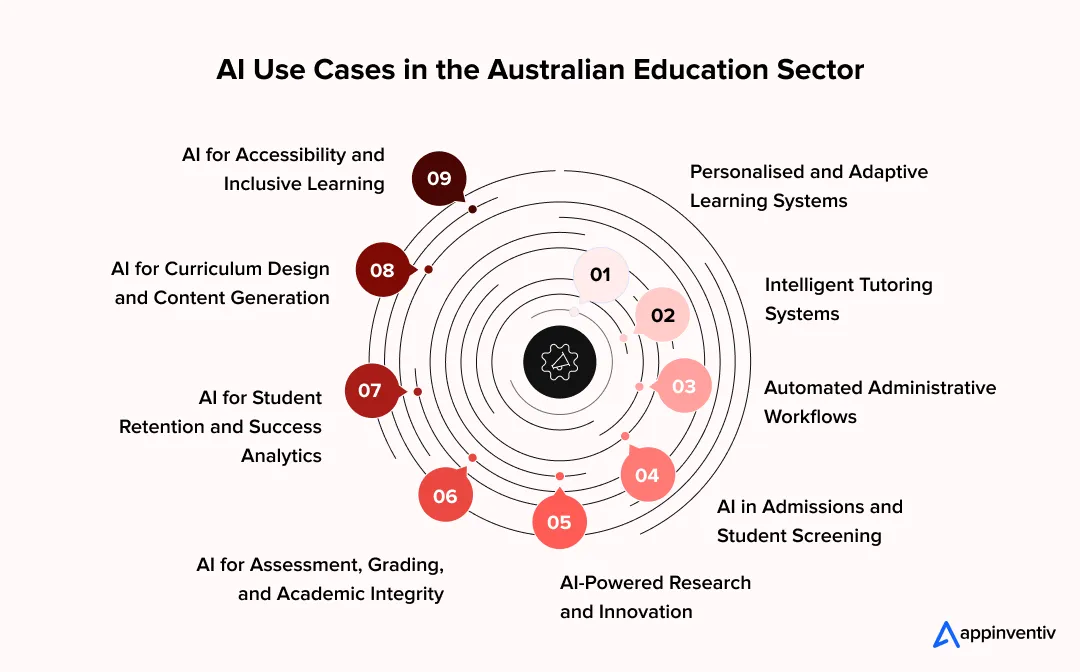
Personalised and Adaptive Learning Systems
There is a clear shift toward platforms that use AI and machine learning in education to adjust curriculum delivery based on individual student performance data. These systems analyse how a student interacts with material in real-time, allowing for a level of customisation that was previously impossible at scale. This data-driven approach ensures that learners are neither overwhelmed nor disengaged.
Intelligent Tutoring Systems
Large university courses are now deploying AI tutors to give students 24/7 support. These aren’t just simple chatbots. They are sophisticated engines built on verified university data, providing course-specific answers. This lowers the risk of “hallucinations” while making sure students get help when they need it, regardless of whether a staff member is online.
Automated Administrative Workflows
The fastest ROI for Australian institutions often comes from removing back-office friction. Automated timetabling and resource planning take the pressure off staff, moving them away from tedious data entry.
AI in Admissions and Student Screening
To manage high volumes of applications, institutions are deploying AI tools that quickly vet credentials and identify high-potential candidates. This speeds up the offer process while ensuring all regulatory screening requirements are met without increasing the administrative headcount.
AI-Powered Research and Innovation
In the higher education space, AI is acting as a massive force multiplier. By handling the heavy lifting of literature reviews and finding patterns in huge datasets, researchers can work much faster. This efficiency is a core requirement for Australian universities looking to secure global grants and keep their high rankings on the world stage.
AI for Assessment, Grading, and Academic Integrity
Unis across Australia are moving past basic proctoring to what we call “Authentic Assessment.” They are using automated grading to handle the heavy lifting on objective tasks, while smart pattern-matching flags non-human syntax. It’s about keeping academic integrity solid without blowing out faculty hours, letting teachers focus on the high-touch feedback that actually matters.
AI for Student Retention and Success Analytics
Predictive models are now pulling from thousands of local data points, everything from library swipes to VLE logins, to spot students before they drop out. Following TEQSA’s lead, this allows for early, data-backed intervention. For the front office, this is a bottom-line play: it protects tuition revenue and keeps national rankings where they need to be.
AI for Curriculum Design and Content Generation
Institutions are now auditing and refreshing courses on the fly. By mapping units against the Australian Skills Classification, boards can pinpoint exactly where the gaps are. Generative AI tools in Australia then help build out bespoke, multi-modal assets, ensuring the curriculum stays locked in with the shifting 2026 job market.
AI for Accessibility and Inclusive Learning
AI is now the main driver for “Universal Design for Learning” (UDL) in Australia. Real-time transcription and automated sign-language avatars ensure students with disabilities aren’t left behind. It’s a non-negotiable requirement for meeting national disability standards while keeping the campus diverse and inclusive at scale.
We help Australian institutions build secure, scalable, and high-performance AI systems tailored to real operational needs.
Sector Specific Use Cases of AI in Australia: From K-12 to Higher Education
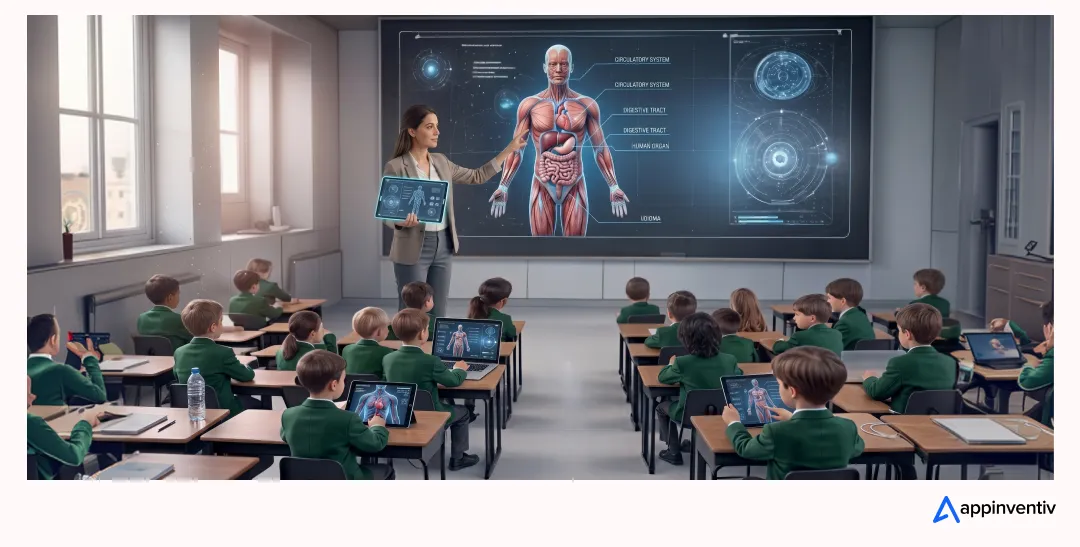
Institutional value in 2026 is found in “Embedded AI”; capabilities that sit directly inside your existing Student Management Systems (SMS) in Australia, rather than as external plugins. This integration ensures that data remains secure and actionable.
K-12: Predictive Intervention and Teacher Matching
School leaders are using predictive analytics to flag at-risk students weeks before traditional testing would. By tracking patterns in attendance and engagement, schools can deploy wellbeing resources more effectively.
Example: Appinventiv-engineered Rapid Teachers, an edtech platform that uses intelligent matching to solve the relief teacher shortage in real-time. By automating the vetting and booking process, it removes hours of manual phone calls for school admins while ensuring compliance with Department of Education standards.
Higher Ed: The “Flipped” University and Research Speed
Universities have largely replaced static lectures with AI-generated interactive modules. The AI use in higher education in Australia allows campus time to be reserved for high-level, collaborative debate.
Example: The University of Adelaide uses fine-tuned AI assistants to provide context-aware support on specific course materials. Unlike generic chatbots, these are built on verified curriculum data, reducing tutor load during peak assessment periods and boosting student confidence.
Vocational & VET: Closing the Skills Gap
CSIRO’s Data61 is currently using cognitive computing to map training modules against real-time industry needs. This ensures that vocational graduates enter the workforce with the exact competencies demanded by high-growth Australian sectors like renewable energy and advanced manufacturing.
What Are the Major Benefits of AI in Education for Australian Institutions
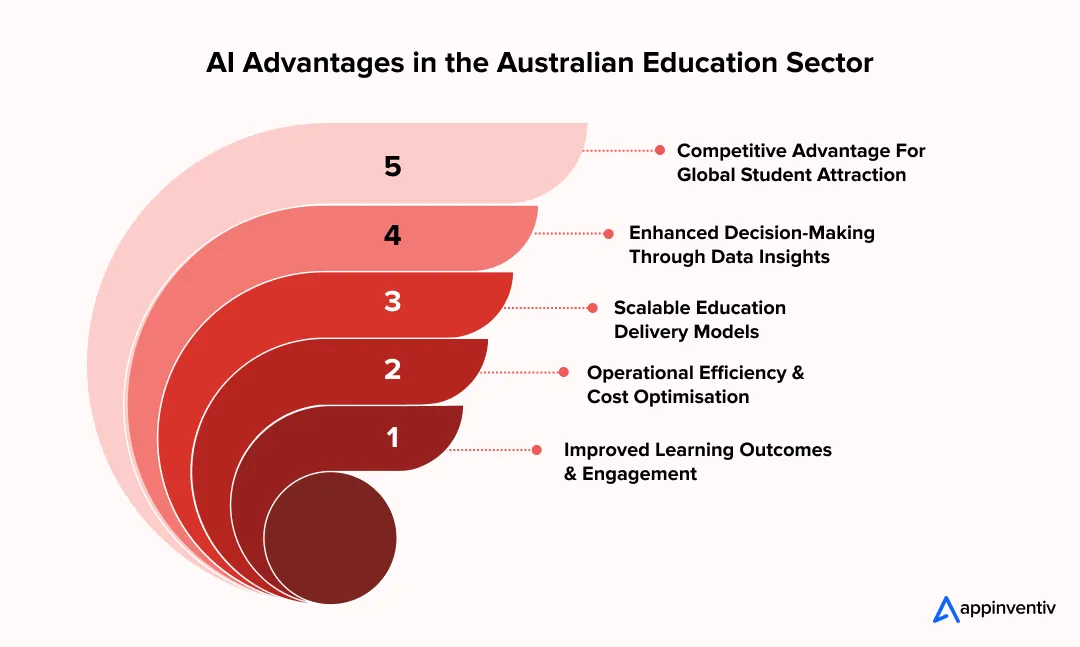
Moving to AI-driven models isn’t just about small tweaks; it’s a structural overhaul of how value is delivered. For Australian leaders, the focus is on outcomes that balance student success with sustainable growth. Listed below are the top benefits of AI in education for Australian schools
Improved Learning Outcomes
AI gives granular feedback that human teachers can’t match at scale. By spotting knowledge gaps instantly, these systems allow for immediate fixes. This ensures students master the basics before moving on. Moving from passive to active learning like this is a huge factor in lifting completion rates across K-12 and universities.
Operational Efficiency and Cost Gains
Automating tasks like grading and scheduling lets institutions move expensive human staff into high-impact roles. Cutting down on “technical debt” and manual paperwork is essential in our high-cost labour market.
Scalable Delivery Models
Custom AI setups let Australian schools expand without the usual brick-and-mortar costs. Whether it’s through online platforms or hybrid setups, AI keeps the quality consistent. This scalability is vital for regional campuses looking to provide fair access to specialised subjects and support.
Better Decision-Making via Data
AI turns messy institutional data into a real strategic asset. By giving boards predictive insights rather than just old reports, leadership can move faster on everything from budget spend to curriculum changes. This evidence-based approach lowers the risk of big strategic errors.
Global Competitive Advantage
In the tough international student market, tech maturity is a major selling point. Students want modern, tech-enabled campuses with 24/7 support. By leading the way in AI, Australian institutions can attract better global talent and secure their spots as world-class learning hubs.

How AI Is Reshaping Education in Australia?
AI in education Australia wide is transitioning from a theoretical possibility to a practical reality. The numbers from higher education are eye‑opening: nearly three in five university staff members (about 58 %) now intentionally use AI tools as part of their work, and roughly one‑third of those use them weekly or daily.
What’s particularly interesting is that many staff report real performance benefits: most say AI has improved efficiency (67 %), information access (61 %), innovation (59 %), and quality of decision‑making (58 %) in their roles, including research, teaching preparation, and administrative tasks.
This suggests that intelligent automation in Australia isn’t just a novelty or something used occasionally. Education staff are discovering practical applications that enhance work efficiency and output.
Here is a table outlining the case studies that demonstrate how strategic AI integration is creating genuine value for students, teachers, and institutions.
Impact of AI in Australian Education: Key Use Cases and Cost Estimations
| AI Use Case | Estimated Advantages of AI in Education for Students and Schools | Strategic Actions | Cost Estimation (AUD) | Strategic Impact for Educational Leaders |
|---|---|---|---|---|
| EdChat AI Tool | 94% engagement on coursework, supports diverse learners | Implement AI tutoring, reduce tutor dependency | $30K – $50K | Reduces operational costs, improves student satisfaction, boosts academic outcomes. |
| Teacher Training | 9+ hours saved per week, reduced teacher burnout | Use ready-made training programs, improve retention | $20K – $40K | Enhances teacher effectiveness, reduces turnover, saves operational costs. |
| Day of AI Australia Program | Free AI training, prepares workforce for AI | Integrate AI literacy, strengthen tech reputation | Minimal direct cost (Free resources) | Builds a future-ready workforce, strengthens institutional reputation, meets digital literacy requirements. |
| University AI Adoption | 40% productivity improvement, enhanced research | Set AI policies, invest in AI tools for staff | $10K – $30K | Maximizes staff productivity, improves research output, and reduces operational inefficiencies. |
| Personalised Learning & Teacher Workload Reduction | 58% higher student engagement, cost savings on routine tasks | Implement AI-powered grading, improve engagement | $15K – $25K | Enhances student learning, optimizes resources, and increases institutional appeal. |
| UTS AI-Driven Hybrid Learning | Nearly 26,000+ tour engagement, expanded recruitment reach | Use AI for virtual tours, cost-effective recruitment | $20K – $50K | Expands recruitment reach, cuts marketing costs, attracts diverse student demographics. |
| AI for Assessment & Proctoring | Reduced staffing costs, flexible exams for distance learners | Implement AI proctoring and grading systems | $25K – $60K | Cuts operational costs, enhances scalability, and attracts distance learners. |
What Are the Challenges and Risks of AI Adoption in Education
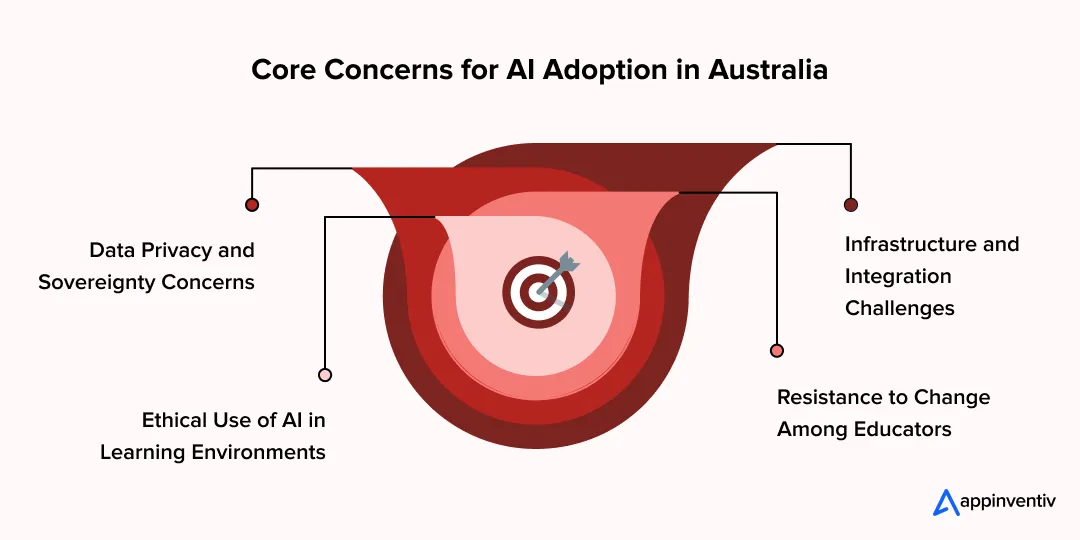
Deploying AI across Australian campuses means navigating a messy landscape of data liability and cultural friction. For leadership teams, the focus is on fixing long-term operational risks, not just technical bugs. Here are the top challenges of AI in education currently requiring board-level oversight and strategic mitigation.
Privacy and Data Sovereignty
The primary hurdle for Australian institutions is maintaining strict data residency and sovereignty. With the Privacy Act review heightening the stakes, schools cannot afford to leak student data into public LLM training sets. Custom, “walled-garden” AI environments are becoming the standard to ensure that sensitive intellectual property and minor-aged student records remain within protected, Australian-hosted infrastructure.
Ethical Use and Integrity
Bias in algorithms and threats to academic integrity are major reputational landmines. There is a fine line between AI as a tutor and AI replacing critical thought. Institutions are now building internal governance to make sure AI outputs are clear and auditable. This stops “black box” grading or admissions that could lead to legal headaches or lost accreditation.
Infrastructure and Legacy Debt
Many Australian universities are stuck with legacy technical debt. Plugging new AI models into decades-old SMS usually needs heavy middleware work. Without a solid, scalable cloud setup, AI tools stay siloed and fail to deliver the cross-department insights needed for a real return on investment.
Educator Resistance to Change
The “human element” is still a massive wall. Plenty of staff are skeptical, fearing they’ll be replaced or that teaching quality will drop. Beating this takes more than just a tech manual; it needs a clear value case showing how AI kills off the administrative “drudge work” to free up time for actual face-to-face teaching.
Compliance, Frameworks and Guidelines for AI Adoption in the Australian Education Sector
Shifting from experimental AI to institutional-grade deployment requires moving toward rigorous governance and scalable architecture. In the Australian context, this means aligning digital infrastructure with local data protections and ethical mandates. Listed below are the critical frameworks and guidelines for AI implementation currently ensuring long-term project viability across the country.
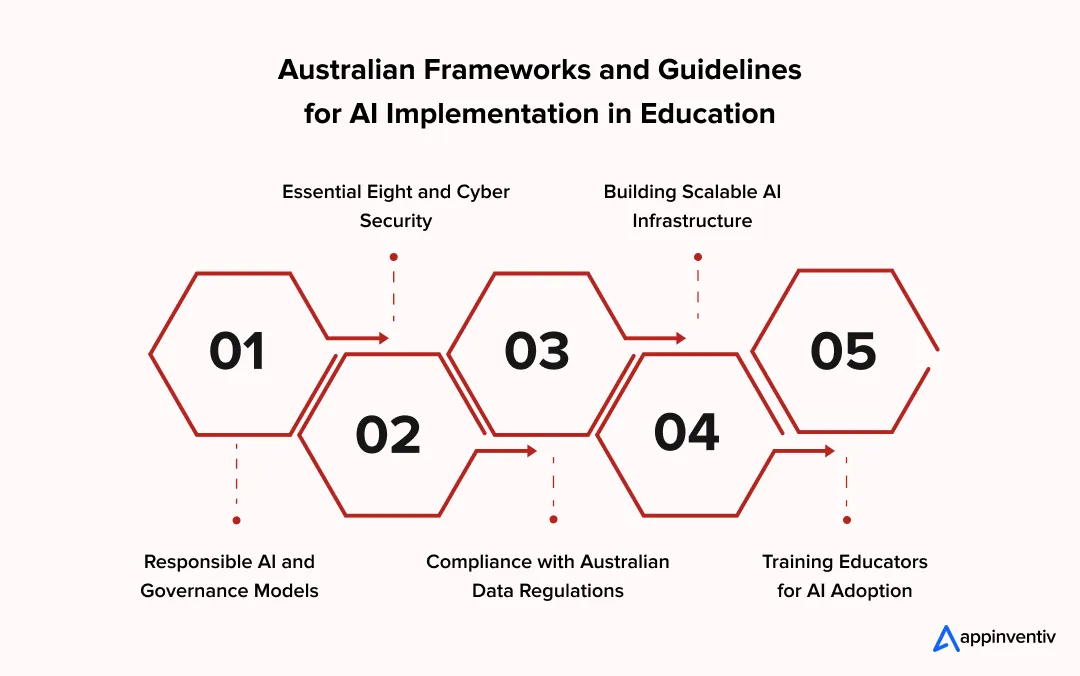
Responsible AI and Governance Models
Ad hoc AI use is being replaced by structured internal oversight. Boards are now setting up AI Ethics Committees to vet every new tool against the Australian Government’s AI Ethics Principles. This isn’t just more red tape; it’s about building a repeatable process for checking algorithmic transparency. It ensures no automated decision, like grading or admissions, happens without a human expert in the loop.
Essential Eight and Cyber Security
Institutions are now aligning their AI deployments with the ASD Essential Eight framework. By implementing strict application control and multi-factor authentication on AI interfaces, schools ensure these new tools don’t become backdoors for ransomware or data breaches.
Compliance with Australian Data Regulations
Institutions must stay aligned with the Australian Privacy Principles (APPs) and the National Framework for Generative AI in Schools. These frameworks mandate that data collection must be “reasonably necessary” and strictly controlled. This is where Appinventiv’s QLD Government ICTSS.1303B and Local Buy status become vital, as they signify a pre-vetted understanding of these local legal boundaries.
Building Scalable AI Infrastructure
Successful AI deployment depends on killing off fragmented, departmental silos. It calls for a move toward “API-first” architectures that allow AI models to sit directly on top of existing SMS. This creates a unified data layer, making it much easier to scale a successful pilot from one faculty to an entire university without rebuilding the whole tech stack.
Training Educators for AI Adoption
AI implementation fails if the staff on the ground don’t trust the tech. Leading Australian schools are investing in “AI Literacy” programs that go way beyond basic software tutorials. The goal is to show teachers how to prompt effectively and how to actually use AI-generated insights. When staff see AI as a tool that kills their paperwork rather than a threat to their expertise, adoption rates and project ROI climb.
How to Implement AI in Australian Schools and Universities?
Moving from a pilot to an enterprise-wide AI rollout requires a disciplined, phased approach. For Australian boards, the focus is on mitigating risk while ensuring the technical architecture can scale. Here are the steps for a successful implementation of AI in education currently used by leading institutions.
Define Strategic Objectives
Identify specific operational pain points rather than chasing hype. Focus on real operational pain points like high student attrition or heavy manual admin workloads.
Assess Data Readiness
The next vital step is to audit your data silos and security. Make sure every part of your infrastructure follows Australian data residency rules.
Choose the Right AI Partner
Partner with an AI development company in Australia with proven experience in AI education system development. They must understand local compliance and governance.
Pilot, Scale, and Optimise
Start with small, MVP development in Australia to get user feedback. Use those hits and misses to fix the system before scaling.
What Is The Cost Of Developing AI-Powered Education Software In Australia?
The AI education software development cost in Australia depends less on features and more on integration depth, data governance, and scalability. For most institutions, investment ranges between AUD 70,000 to AUD 700,000+, with costs increasing as solutions move from pilot to enterprise-wide deployment.
Here is a table outlining the typical cost to implement AI in education in Australia based on different project complexities
| Solution Level | Typical Use Case | Estimated Cost (AUD) | Key Cost Drivers |
|---|---|---|---|
| Basic AI Implementation | Chatbots, simple automation tools | 70K – 120K | Limited integrations, pre-trained models |
| Mid-Level AI Platform | Adaptive learning, admin automation | 120K – 350K | LMS/SIS integration, data pipelines |
| Enterprise AI System | Predictive analytics, full-scale platforms | 350K – 700K+ | Multi-system integration, compliance, scalability |
What Is the Future of AI in Education in Australia?
The next phase of digital maturity in Australian education will move beyond reactive tools toward proactive, autonomous systems. As institutions stabilise their data foundations, the focus is shifting to immersive, high-fidelity learning environments that integrate seamlessly with the national economy. Here are the future trends of AI and machine learning in education currently being architected for the 2026-2030 horizon.
Generative AI in Classrooms
We are moving past the “ban or permit” debate into a phase of deep curriculum integration. Future systems will go beyond text generation to create bespoke, multi-modal learning assets such as instant 3D models or interactive simulations tailored to a specific lesson’s objectives. This allows for a level of real-time content creation that keeps materials aligned with the latest industry shifts, ensuring Australian graduates remain highly employable.
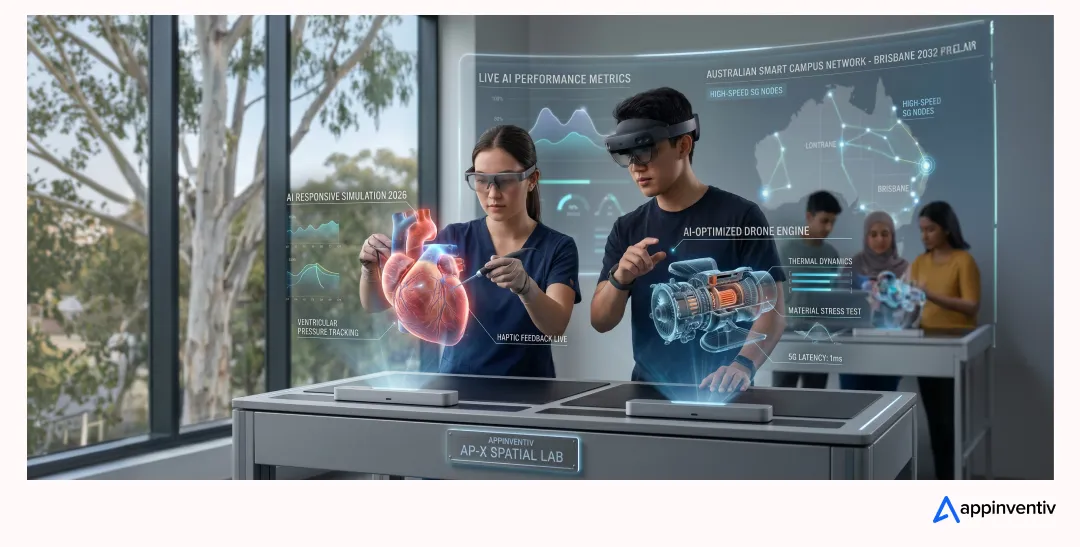
Integration with AR/VR and Immersive Learning
AI is the “brain” that will make immersive learning scalable. By combining Generative AI with Augmented Reality, medical or engineering students in Australia can practice complex procedures in a risk-free, AI-simulated environment that responds to their specific actions. This spatial computing approach, backed by high-speed 5G infrastructure, will be a major differentiator for Australian institutions looking to attract premium international students.
Autonomous Learning Systems and AI Agents
The shift from “tools” to “agents” is the next frontier. We are witnessing the early stages of autonomous AI agents in Australia that don’t just answer questions but actively manage a student’s entire learning path – scheduling study sessions, identifying prerequisite gaps, and even coordinating peer-to-peer collaboration.
AI-Powered Lifelong Learning Ecosystems
The traditional “degree-then-career” model is being replaced by continuous, AI-managed upskilling. Australian universities are looking at “Digital Passports” that use AI to track a learner’s skills throughout their life, suggesting micro-credentials based on real-time shifts in the Australian Skills Classification. This creates a permanent link between the institution and the alumnus, opening up new, long-term revenue streams through subscription-based education.
How Appinventiv Can Help Educational Institutions Leverage AI?
Appinventiv acts as an experienced education app development company in Australia for institutions transitioning from fragmented legacy systems to sovereign, AI-driven architectures. By prioritising local data residency and long-term asset ownership, we ensure your digital transformation in Australia remains both compliant and commercially viable.
Our delivery model is built on a “compliance-first” architecture, specifically designed to meet the rigorous standards of the Australian public sector and highly regulated education environments. We simplify procurement and risk management through established credentials:
- Government-Ready Procurement: We are an Approved ICT Supplier and pre-vetted on multiple Local Buy frameworks.
- Data Sovereignty: All architectures prioritise onshore, protected infrastructure to satisfy the strictest Australian audit requirements.
- Security Standards: We maintain a 99.50% security compliance SLA (ISO, SOC2) across our 5 agile delivery centres in Australia.
- Proven Scale: Our team of 1600+ tech experts brings 10+ years of APAC experience and has deployed over 3000+ digital assets locally.
This practitioner-led approach is evident in our work with major education platforms.
- Gurushala: Our teams built an AI powered, scalable ecosystem for teacher training and student engagement. This platform handles complex, cross-departmental data to provide targeted professional development at scale.
- Nova: We partnered with Nova to streamline complex learning workflows, focusing on removing administrative “drudge work” so that staff can focus on high-impact teaching.
- Rapid Teachers: We built Rapid Teachers, a high-performance matching engine that solves the relief teacher shortage by automating the vetting and booking process in real-time.
These projects consistently deliver approximately 35% efficiency gains, demonstrating that a sovereign, compliant approach to AI in education in Australia is the most effective way to secure a long-term competitive edge.
Ready to transform your institution with proven AI expertise? Partner with Appinventiv today build a compliant AI education platform.
FAQs
Q. How is AI being used in Australian schools and universities?
A. Institutions use AI for everything from automated grading and personalised tutoring to back-office tasks like smart timetabling. By integrating AI in education in Australia, schools are solving the teacher shortage crisis and providing 24/7 student support through secure, locally-hosted platforms.
Q. What are the disadvantages of AI in education?
A. Key risks of AI adoption in the Australian education sector include data privacy breaches, algorithmic bias, and a potential over-reliance on automated tools.
However, these can be mitigated by using “walled-garden” AI environments that do not feed student data back into public models.
Q. What is the ethical use of AI in education for Australian schools?
A. Ethical use involves transparency, human-in-the-loop oversight, and strict adherence to the Australian Privacy Principles. Every AI-driven decision must be auditable and clearly explained to students, parents, and regulators.
Q. What are the main benefits of AI in Australian education?
A. AI for school can support personalised learning, faster feedback, administrative automation, teacher assistance, accessibility and student support. The Australian Framework for Generative AI in Schools also identifies opportunities to support teaching and learning and reduce administrative workload. The benefits depend on appropriate implementation, data governance, human oversight and staff and student AI literacy.
Q. What Australian AI frameworks apply to schools?
A. The Australian Framework for Generative AI in Schools is the primary national framework for responsible and ethical use of generative AI in school education. Its six principles cover teaching and learning, human and social wellbeing, transparency, fairness, accountability, and privacy, security and safety. The 2024 review was endorsed by Education Ministers in June 2025. State and territory requirements may also apply. For example, NSW has its own AI assessment and assurance framework for NSW Government AI use.
Q. How is TEQSA addressing generative AI in higher education?
A. TEQSA is focusing on assessment reform, learning assurance and the capabilities students need in a GenAI-integrated environment. Its recent resources include Enacting assessment reform in a time of artificial intelligence (2025) and Assuring quality learning in a gen AI-integrated future (2026). The latter emphasises capabilities such as critical thinking, evaluative judgement and ethical reasoning rather than relying on a single method of detecting AI-generated work.
Q. How much does it cost to develop AI education software in Australia?
A. The cost of an AI education software project typically ranges from around AUD 70,000 for a focused implementation to AUD 700,000+ for an enterprise-scale platform. Actual costs depend on the solution’s complexity, integrations, data architecture, AI model strategy, security requirements, governance, user volume and deployment environment.
Q. How long does it take to implement AI in an education institution?
A. A focused AI pilot can take a few months, while an institution-wide implementation can take 4–12 months or longer, depending on integrations, data governance, security reviews, procurement, staff training and change management.
Q. Should education institutions build, buy or integrate AI?
A. There is no single approach for implementing artificial intelligence in education:
- Buying can suit common use cases that are already well supported by established platforms.
- Integration can work when an institution needs to connect AI capabilities with existing LMS, student information, CRM or administrative systems.
- Building is more appropriate when the institution has specialised workflows, proprietary data or governance requirements that off-the-shelf products cannot adequately address.
Q. How can schools and universities protect student data when using AI?
A. Institutions should assess what data an AI system receives, where it is processed and stored, who can access it, how long it is retained and whether it is used for model training. They should also apply appropriate privacy, security, access-control and vendor-governance measures. The Australian school framework specifically places privacy, security and safety among its six guiding principles.
Q. What are some examples of AI being used in schools?
A. AI in education examples include AI-assisted lesson planning, personalised learning support, feedback, accessibility tools, administrative assistance and controlled GenAI environments. NSWEduChat is one Australian example, providing a department-owned GenAI environment for NSW public-school students in Years 5–12 and staff.
Q. How is AI in higher education currently being used?
A. Universities are using AI across teaching, student support, research, administration and assessment. Current higher-education discussions are increasingly focused not only on using AI tools but also on redesigning assessment and assuring that students develop the required knowledge and capabilities in a GenAI-integrated environment. TEQSA’s 2025–26 resources reflect this shift.


Fast 2-minute response, fully NDA-protected.
The AI ROI Crisis: Why Enterprises Are Struggling to Prove Value and How to Fix It
Key takeaways: AI ROI is a capital-allocation question. Boards want payback periods and P&L impact. AI ROI challenges rarely have a single cause. Data, legacy systems, use-case choice, ownership and stalled pilots compound each other. Choose two or three outcome metrics per use case, set the baseline first, and report in dollars. Make every further…

Retrieval Augmented Generation in Australia: Architecture, Implementation and Cost
Key takeaways: RAG grounds LLM answers in approved content, improving reliability without retraining a model. Data quality and access permissions decide production outcomes more than the model. Indicative build costs run from AUD 70,000 to 700,000, driven by data and integrations. Measure value against a pre-deployment baseline, separating realised benefits from projected savings. A general-purpose…

The Multiplier Effect of AI Agents: The Rise of AI Swarms
Key takeaways: AI agent swarms coordinate specialized agents to solve complex problems that may be difficult for a single agent to handle effectively. More agents do not automatically mean better outcomes. Swarms deliver value when work can be divided, executed in parallel, and coordinated toward a shared objective. Enterprise readiness depends on governance. Clear accountability,…