




































 Leader in AI-First Product Engineering Read Full Article
 IT Managed & Outsourcing
 Contact Us
Appinventiv is a travel software development company that treats GDS connectivity, PCI containment, and multi-region data residency as engineering problems, not compliance checkboxes. Our teams design around these constraints from day one because retrofitting them costs more than the original build.
Core Capabilities Behind Our Travel App Development




















The Numbers Behind Our
Travel Platform Delivery
Applications Delivered
Average MVP Delivery
Tech Evangelists
Client Satisfaction Rate
Repeat Clientele
Years of Experience
Our Services


We build online booking and reservation platforms that help travel businesses manage inventory, automate bookings, improve conversion rates, and deliver seamless customer experiences across channels.

We develop scalable travel marketplace and OTA platforms that connect travelers with airlines, hotels, tour operators, and transportation providers through a unified digital ecosystem.

We build AI-enabled travel platforms that improve customer experiences through automation, personalization, and intelligent decision-making across the travel journey.

We build itinerary and trip management solutions that simplify travel planning, centralize trip information, and keep travelers informed throughout their journeys.

We develop customer engagement platforms that help travel brands strengthen relationships, personalize experiences, and increase customer retention.

We build revenue management platforms that help travel businesses optimize pricing strategies based on demand, seasonality, inventory availability, and customer behavior.

We develop analytics solutions that transform booking, customer, and operational data into actionable insights that support informed decision-making.

We develop operational management solutions that help travel businesses manage suppliers, contracts, inventory, and partner relationships from a centralized platform.
An hour with our team usually saves three in the scoping round. Travel platform work, specifically. No generic discovery calls.



Currency Converter

Complete Travel Guide

Secure PaymentGateway Integration

Gps Based Location Services

Easy To Use Admin Control Panel

Filtered Search

Travel guides

Reviews And Recommendations

Hot Deals

Interactive Scheduling

Push Notification

API Integration
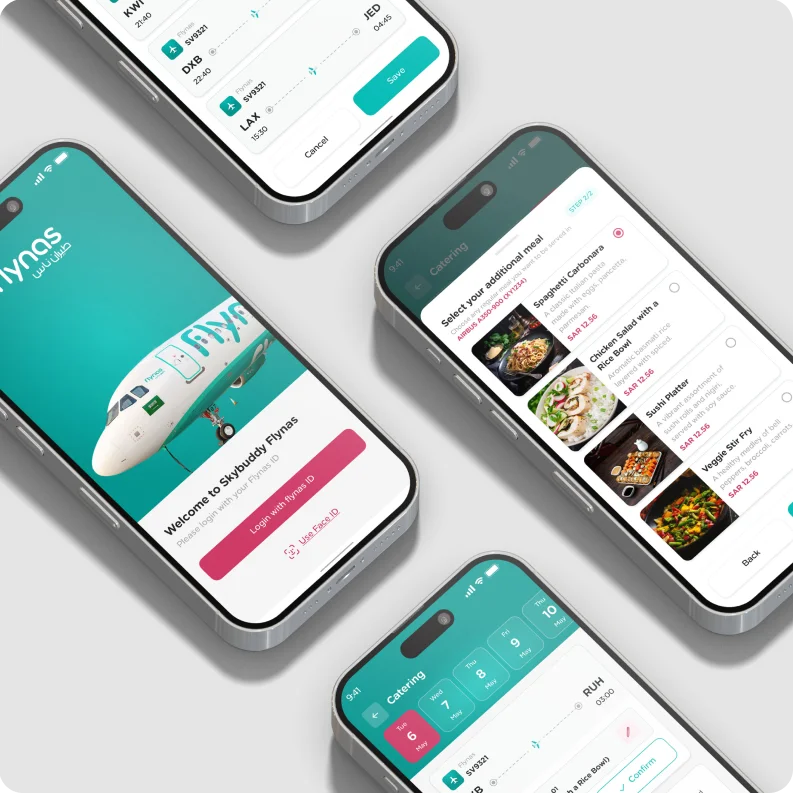
AI-Powered Mobile App for a Major Budget Airline

Flynas was running 1,500+ flights weekly and losing bookings to cluttered UX and confusing onboarding in an airline app market dominated by Qatar Airways, Emirates, and Etihad.

As a travel app development company, Appinventiv rebuilt the iOS and Android apps with a refined UX, introduced an AI chatbot for flight booking, and wired in DevOps practices to keep the platform scalable beyond launch.

Luxury Travel Platform Built on a Headless Backend
Arts & Leisure, operating since 1993, was running trip creation, traveler assignment, and itinerary distribution on spreadsheets and email with no mobile access for travelers.
Appinventiv's travel application development services delivered iOS and Android apps on Flutter with an Angular admin panel and Node.js headless backend on AWS, giving admins, agents, and travelers role-specific real-time workflows.

Airport Services Platform Modernized on AWS
hoi sought to enhance in-store operational visibility and product availability tracking while digitising the customer onboarding process to capture high-value engagement data.
We built an ERP-integrated digital ecosystem that facilitated real-time inventory access and guided customer journeys. This system streamlined on-floor data collection through secure, interactive touchpoints across their physical retail footprint.













Our travel app developers have worked across booking engines, GDS connections, PMS integrations, and distribution logic. That context changes how decisions get made, from data modeling to how we scope a migration. Teams that haven't spent time inside travel systems usually learn this on the client's budget.
PCI scope that was retrofitted after launch is one of the most expensive problems an enterprise travel platform can carry. We design tokenization boundaries, access controls, and audit logging into the architecture from sprint one, so compliance doesn't become a post-launch fire drill when the next QSA shows up.
Sabre, Amadeus, Travelport, NDC, direct carrier APIs, bedbank content, payment gateways integration, digital wallets. Most enterprise travel platforms live or die on how well these connect. Our travel application development work treats integration as the platform's spine, not something to figure out after the core build.
AI supports our delivery process across requirement mapping, test coverage, workflow validation, backlog refinement, and release risk checks. It helps reduce manual delivery effort by up to 30% while catching gaps earlier in the build cycle.
A rebuilt booking engine only matters if it still works six months later. We design for observability, capacity planning, and operational handoff as deliberately as we design the booking flow itself. The goal is a platform your internal team can run, not one that needs us on retainer to keep standing.
Airlines, hotel groups, OTAs, and TMCs rarely operate as a single environment. Multiple brands, multiple regions, multiple legal entities, and usually a few acquisitions still mid-integration. Our travel app development solutions are structured to work across these realities rather than assume them away.

The India's Fastest-Growing Companies 2026 Recognised by TIME and Statista

Statista High Growth Companies APAC - 2026

Statista India's Growth Champions 2023






Travel operations generate enough signal to make AI useful, from fare optimization to post-booking servicing. The tricky part is keeping models governed once they're in production, not just getting them into a demo. As a travel app development company, We deploy AI where it earns its cost in booking revenue, ops efficiency, or support deflection.
ML works in travel when the data pipeline underneath it is reliable. Demand forecasting, dynamic pricing, personalization, fraud scoring. We handle the model work and the data engineering that feeds it, because one without the other is how ML projects stall after a promising pilot.
Travel enterprises sit on years of booking, guest, and operational data. Most of it is scattered across systems that don't talk to each other well. Our travel software development services build the lakehouse architectures and processing layers that turn it into something analytics teams can actually query without filing an engineering ticket.
Most enterprise travel platforms run across two or three cloud providers whether they planned it that way or not. We work across AWS, Azure, and GCP, handling multi-cloud governance so your teams don't lose visibility as environments grow. The Hoi project is a good example of what this looks like in practice.
Manual releases in travel are a risk problem, not just a speed problem. One bad deployment during peak season and the booking engine goes dark. Our travel software development services include CI/CD with infrastructure as code so builds, tests, and deployments follow the same path every time.
GDS, payment gateways, PMS, CRS, loyalty systems, bedbank APIs. Any travel software development company knows that enterprise travel platforms are integration platforms. So, we integrate MuleSoft, Boomi, or custom middleware depending on what's already in play. The right choice is usually the one your team can maintain after we leave.
PCI scope, traveler PII, payment tokens, access sprawl across partner integrations. Travel platforms carry more sensitive data than most teams realize until an audit surfaces it. We build IAM, logging, encryption, and monitoring into the platform layer so security is structural, not a checklist someone runs before launch.
Travel platforms serve travelers, agents, admins, partners, and sometimes crew, all from the same backend. Role-based access that actually works at that scale requires more than a permissions table. We design IAM across the full user surface so the wrong person never sees data or controls they shouldn't.
Vision workloads in tourism app development are bursty and compute-heavy. Passport scanning, document verification, airport queue monitoring, baggage tracking. Running them on cloud lets teams scale processing as demand shifts rather than provisioning for peak and paying for idle the rest of the year.
Enterprise AR/VR in travel isn't just the front-end experience. It depends on backend throughput, content delivery, and session management. Virtual property tours, immersive destination previews, and crew training simulations all need infrastructure that holds up across locations and devices.
Where audit trails and transaction integrity matter, blockchain adds a verifiable record. Loyalty point interoperability, supplier settlement transparency, and traveler identity verification are the travel-specific use cases where we've seen it earn its place rather than add complexity for its own sake.















That's usually where the conversation begins. Thirty minutes with our engineering team. No deck. Just answers.


Nobody starts clean. There's always a legacy booking system, a half-finished migration, or a GDS integration that was wired in by a team that left two years ago. We start by looking at what exists, not what the last vendor's architecture diagram says exists. The scoping output is something your engineering lead and your procurement team can both read.
Before anything gets built, we map the architecture against the controls that matter for your environment. PCI scope boundaries, data residency requirements, accessibility obligations, integration load. This is where most travel platforms rebuild save or waste months, depending on whether someone did this step honestly.
We don't build in dev and hope it holds in production. Staging environments mirror real traffic patterns, real GDS response times, and real payment gateway behavior. Testing covers booking flows under peak load, not just happy-path unit tests that pass in a vacuum.
Before launch, we use AI to review user journeys, integration behavior, payment flows, accessibility gaps, and abnormal booking scenarios against real delivery conditions. This helps surface edge cases earlier and reduces the risk of last-minute production fixes.
Go-live isn't the finish line, it's where most travel platforms discover what was actually missed. We run phased deployments with rollback paths, hand off runbooks that were written by the engineers who built the system, and stay through the first traffic peak to make sure the platform performs the way the scoping doc said it would.
Once the platform is running, we shift to monitoring, patching, and the backlog of small things that never made it into the initial scope. PCI posture reviews, GDS version updates, performance tuning, dependency upgrades. The work that keeps a travel platform production-grade rather than slowly drifting into the next rebuild.
Building a travel app starts with understanding your distribution model, whether you rely on GDS, NDC, or direct supplier integrations. From there, architecture decisions shape how booking, inventory, and payments interact across systems.
A reliable approach includes platform audit, API-first architecture, secure payment handling, and scalable backend services. The goal is to design for real traffic conditions, not just launch readiness.
Travel app development costs typically range between $40,000 and $400,000+, depending on complexity. Platforms with GDS integrations, PCI scope handling, real-time inventory sync, and multi-region deployments sit on the higher end.
Costs scale based on integrations, compliance requirements, AI capabilities, and how much of the backend needs to be built or modernized.
A standard travel mobile app can take 3 to 6 months, while enterprise platforms with booking engines, integrations, and compliance layers can take 6 to 12+ months.
Timelines depend on system complexity, number of integrations, and whether you're building new infrastructure or working with legacy systems.
Yes. Travel apps can integrate with platforms like Sabre, Amadeus, Travelport, and NDC-certified APIs, along with payment gateways and hotel CRS/PMS systems.
The challenge is not the integration itself but maintaining performance, data consistency, and uptime across multiple suppliers and traffic spikes.
Appinventiv approaches travel platforms as production systems, not just apps. From PCI scope design to GDS integrations and multi-region deployments, every decision is made around scale, compliance, and long-term maintainability.
As a hospitality software development company, we bring deep experience across booking engines, guest platforms, and backend systems that operate under real-world load.
For enterprises looking for a hospitality software development company that understands both travel operations and engineering complexity, our focus stays on building systems that hold up beyond launch.