






















DoorDash Business Model and Revenue Sources

 Share -


- 01Is DoorDash Profitable? A Practical View for Businesses
- 02How DoorDash Works: Behind the Platform Mechanics
- 03How Does DoorDash Make Money: Core, Expansion, and Emerging Streams
- 04DoorDash Business Model and Services: How the Platform Operates
- 05Key Features That Power DoorDash’s Delivery Ecosystem
- 06What Drives DoorDash’s Market Leadership and Sustained Growth
- 07Cost to Build an App Like DoorDash: Detailed Estimation
- 08DoorDash Financial Performance: Profitability Drivers and Operating Challenges
- 09Launch Your DoorDash-Style Delivery Platform with Appinventiv
- 10FAQs

Key takeaways:
- DoorDash earns in a few different ways. It takes commissions from restaurants, usually 15% to 30%, and also charges customers delivery and service fees.
- Restaurants can pay for better visibility, too, which adds another income stream.
- DashPass brings in steady revenue. People who order often subscribe to save on delivery, and that keeps them coming back.
- The platform has moved beyond food into groceries and retail. Services like DoorDash Drive and merchant tools add revenue outside regular app orders.
- Behind the scenes, routing and batching keep deliveries efficient.
- Overall, the model works because revenue comes from multiple points within a single order, which helps it grow even with tight margins.
DoorDash did not scale by delivery volume alone. It built a layered revenue system on top of logistics, turning each order into a multi-point transaction. In 2025, DoorDash facilitated nearly $75 billion in sales for local merchants across more than 40 countries and enabled over $20 billion in Dasher earnings, with continued growth supported by a mix of commissions, customer fees, subscriptions, and advertising rather than reliance on a single revenue stream (Source: DoorDash – Financials).
What makes this model worth studying is how value is captured at different stages of a single order. A customer pays delivery and service fees, a merchant pays commission, and, in many cases, visibility on the platform is also monetized. Subscription programs and white-label logistics services add another layer of predictable revenue.
This naturally leads to a broader question for businesses entering the space: how does DoorDash make money while operating in a cost-heavy, low-margin industry? The answer lies in its ability to stack multiple revenue streams on top of one transaction while improving efficiency at scale.
The sections ahead break down these revenue streams in detail, showing how they connect with platform operations and how they support long-term financial growth.
If you are scaling a delivery business, this is the moment to get your revenue mix right.
Is DoorDash Profitable? A Practical View for Businesses
On-demand delivery is profitable when it is more than a delivery fee, as DoorDash demonstrates. DoorDash app makes money from restaurant commissions (15% to 30%) and customer delivery and service fees, which are the mainstay.
So, how does DoorDash make money? Subscriptions from DashPass create recurring revenue for repeat customers, and advertising offers a highly profitable revenue stream, as merchants pay to appear. This enhances the DoorDash value proposition, in which discovery and delivery are key.
The scale validates the model. DoorDash’s Q4 2025 revenue was $3.955 billion, 38% growth, while full-year revenue was $13.717 billion. The company is also benefiting from DoorDash Drive, which connects enterprise customers with logistics.
DoorDash business model revenue sources are clear. Efficiency, volume and add-ons boost profitability. This is appealing to business. The trick is to create a platform where each order generates several revenue streams.
Also Read: How to Increase the Efficiency of Your On-Demand App
How DoorDash Works: Behind the Platform Mechanics
To grasp how DoorDash works, it’s useful to consider the process from the perspective of its three key roles. DoorDash equips these roles with particular tools and processes, which are coordinated via a central layer.
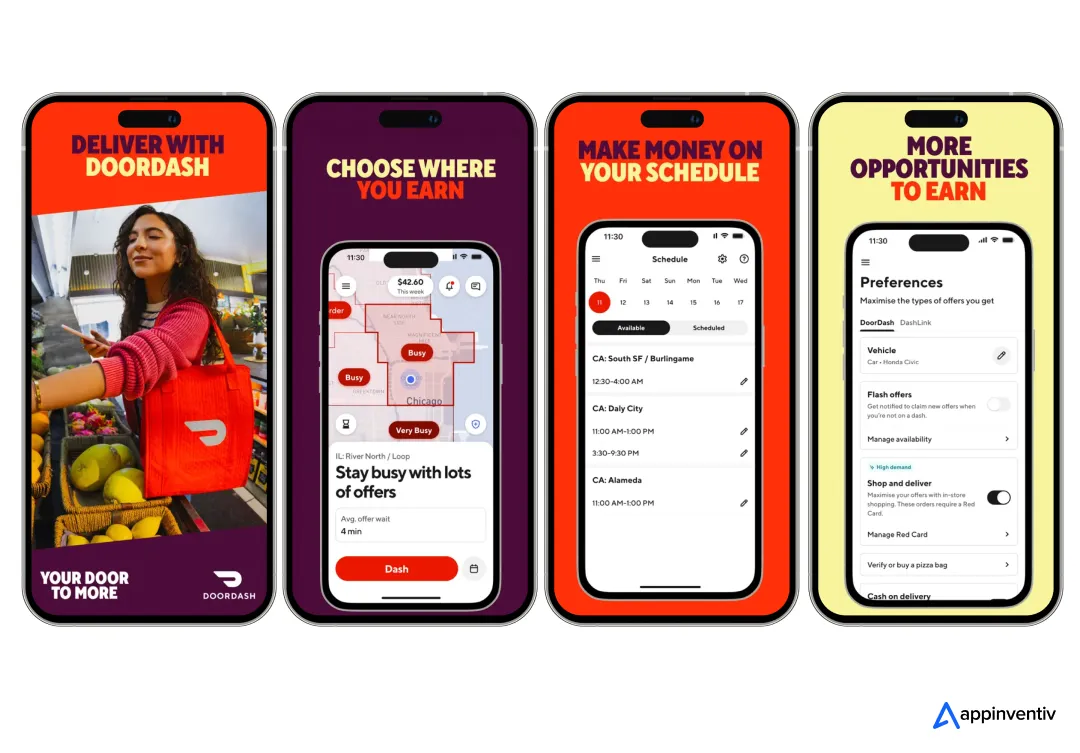
1. Customer Panel
A centralized portal to generate demand based on convenience, selection and transparency.
- Discovery and search tools: Search for restaurants, grocery and retail stores based on cuisine, reviews, time to delivery and price.
- Order customization: Customers can edit orders, provide special requests, choose portion sizes and dietary restrictions before placing an order.
- Flexible delivery options: Customers can choose a specific time, priority delivery, or instructions for contactless delivery.
- Real-time tracking: Orders can be tracked from preparation through delivery, with real-time driver location and delivery time.
- Integrated payments: A range of integrated payment options (cards, wallets, saved details, etc.) facilitates easy payments.
- Subscriptions and savings (DashPass): Subscription plans offer discounts on delivery costs and special deals.
2. Merchant Panel
A management dashboard for orders, visibility and performance.
- Order management system: Businesses accept and manage orders via a dashboard or integration with a point of sale system.
- Menu and pricing control: Real-time menu item, price, and availability management.
- Preparation time management: Cooking times are configured to align with delivery times to minimise wait times.
- Performance analytics: Trends in orders, customer activity and sales help merchants improve performance.
- Promotions and advertising tools: Advertorials, discounts and premium spots for higher visibility.
- Inventory and availability tracking: Instant updates take out-of-stock items off the listings.
3. Dasher/ Delivery Personnel Panel
A platform for fast, efficient delivery and flexible work options.
- Smart order assignment: Requests are allocated to Dashers based on location, availability and estimated efficiency.
- Route optimization and navigation: Integrated navigation apps provide the shortest or quickest routes, based on traffic.
- Batch delivery capability: Several deliveries can be batched together for greater efficiency and cash earnings.
- Earnings and incentive tracking: Real-time earnings, tips and bonuses are available.
- Flexible scheduling: Dashers can work on their own schedules, creating a flexible work model.
- Delivery instructions and verification: Matching delivery instructions, such as contactless delivery, ensures successful delivery.
How Does DoorDash Make Money: Core, Expansion, and Emerging Streams
To answer how DoorDash makes money at scale, it is crucial to discern several layers of its business model. Its business model analysis reveals that the company doesn’t rely on a single revenue stream but earns revenue through a mix of transaction fees, subscriptions, and services.
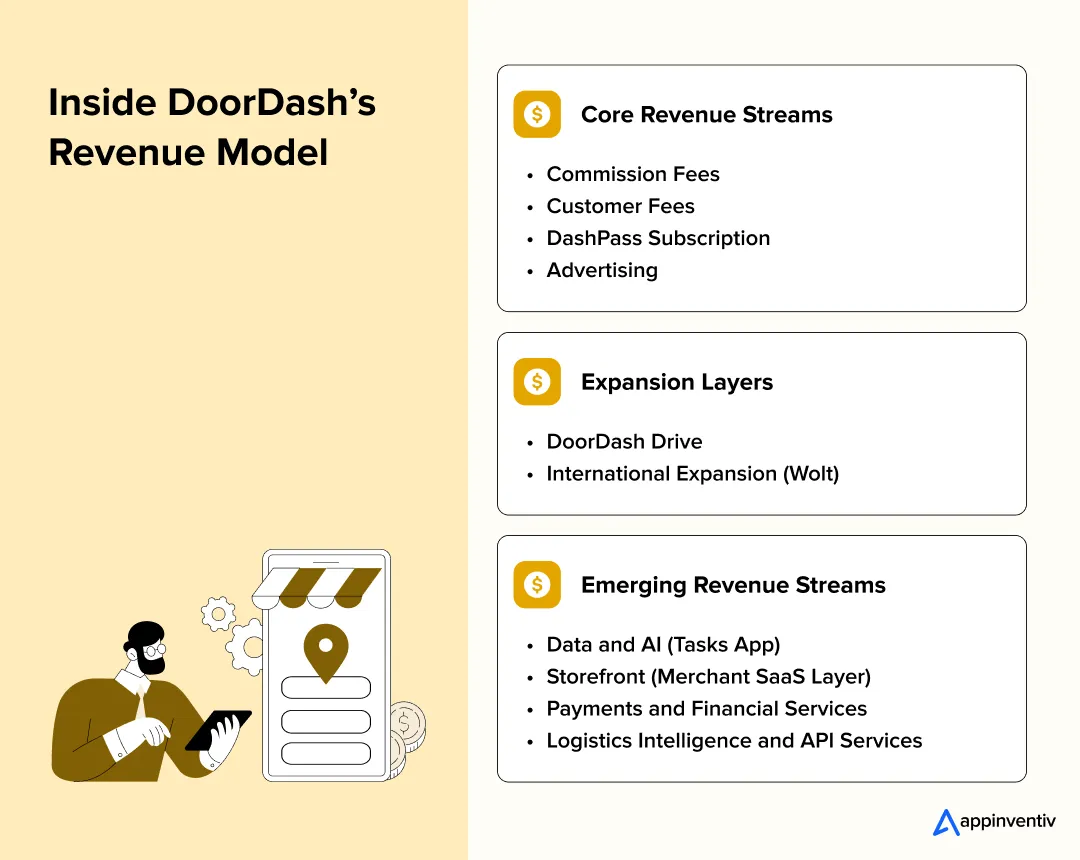
Core Revenue Streams
These are the main sources of app revenue and address the question of how DoorDash makes money in its operations.
Commission Fees
DoorDash charges restaurants on each order placed, typically between 15% and 30% (depending on the level of service chosen by the merchant). Orders in higher commission tiers may include perks like increased visibility or order processing efficiency, enabling the company to adapt pricing to the value proposition and drive revenue growth in line with order growth.
Commission Plan Tiers
| Plan Tier | Commission Rate | Key Features | Best For |
| Basic Plan | ~15% | Standard commission, basic visibility, access to the DoorDash marketplace with a standard listing | Lower volume restaurants looking for market fit |
| Plus Plan | ~25% | Higher visibility, marketing assistance, access to the largest possible audience, standard delivery integration | Expanding restaurants looking for more orders |
| Premier Plan | ~30% | Maximum visibility, priority search listing, biggest potential audience, complete delivery and logistics support | High-volume restaurants with growth potential |
This model overall enables companies to weigh up their costs against order volume and visibility.
Customer Fees
Customers are charged delivery fees, service fees, and small order fees, which vary by distance, order size, and supply and demand. Prices may also increase during peak demand periods, ensuring the business optimizes supply and demand while achieving a constant contribution margin per order.
DashPass Subscription
The DoorDash subscription model is based on DashPass, which costs $9.99 a month or $96 a year. It has over 18 million users, cuts the cost of delivery for customers and promotes repeat business.
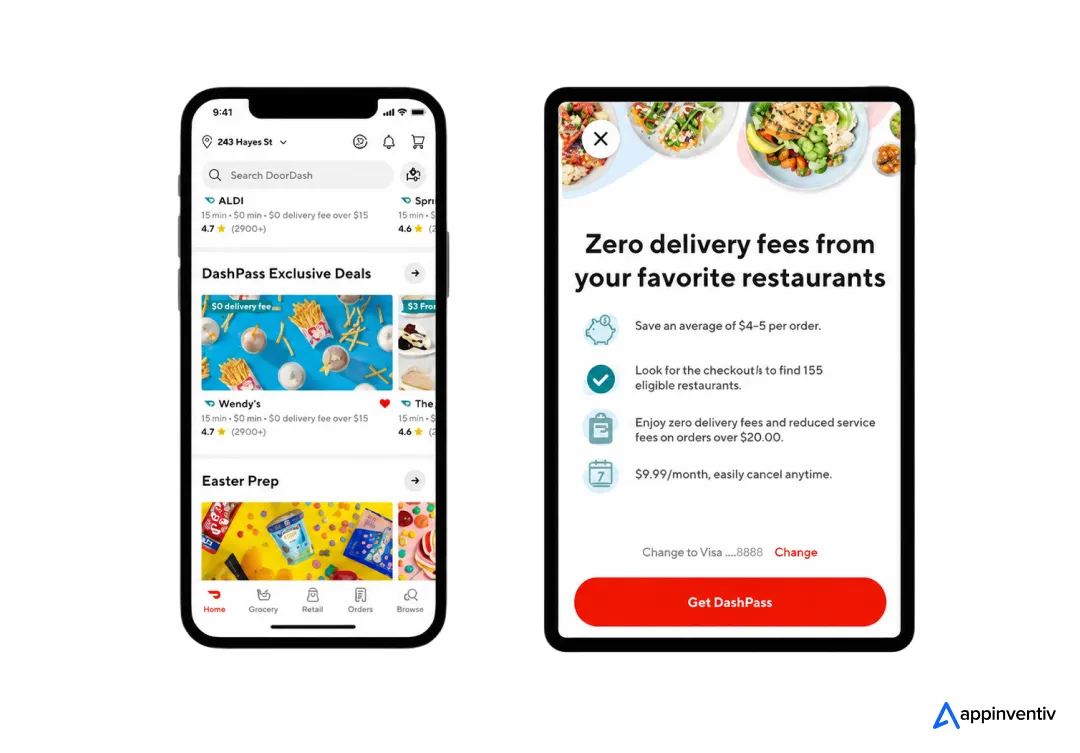
This enhances customer retention, drives more transactions and provides a reliable revenue stream.
Advertising
Advertising now plays a significant role in the DoorDash revenue model, with businesses paying for priority placements, sponsored listings and placement within the app. These enable merchants to target customers at the moment of purchase with the added benefit of high-margin revenue streams for the company.
Expansion Layers
These create opportunities beyond the marketplace and are key DoorDash business model revenue sources that help sustain growth.
DoorDash Drive
DoorDash Drive allows companies to access the company’s logistics platform without using the marketplace. This food delivery platform enables merchants and enterprises to fulfil orders placed on their websites and apps with DoorDash handling last-mile delivery, moving into enterprise logistics.
International Expansion (Wolt)
The Wolt acquisition gives DoorDash access to over 40 markets. This helps spread revenues across geographies and allows the company to scale its operating model across markets, making it more sustainable.
Emerging Revenue Streams
These are early-stage but real initiatives that indicate where the platform is heading.
Data and AI (Tasks App)
DoorDash has launched the Tasks app for gathering structured data for machine learning. Users perform tasks like taking photos and recording videos, which are then used in AI training. This is still in its infancy but it shows DoorDash’s move from a logistics platform to one that includes data services.
Storefront (Merchant SaaS Layer)
Storefront enables merchants to build websites for ordering using DoorDash’s platform. This adds a software revenue layer, which is not dependent on marketplace transactions, but is part of the ecosystem.
Payments and Financial Services
It’s also venturing into merchant-focused financial services like payment gateway integrations and faster payouts. These offerings further integrate merchants with the platform and maximize app revenue streams around transactions.
Logistics Intelligence and API Services
As its infrastructure matures, DoorDash is increasingly positioned to monetize its logistics capabilities through APIs and enterprise integrations, enabling external businesses to plug into its delivery network.
Work with our experts experienced in multi-stream monetization.
DoorDash Business Model and Services: How the Platform Operates
DoorDash operates as a tightly integrated platform where demand generation, order management, and delivery execution function as a single system. Its model connects customers, merchants, and delivery partners while layering logistics, software, and monetisation into one continuous transaction flow. Here’s a quick overview on its business model:
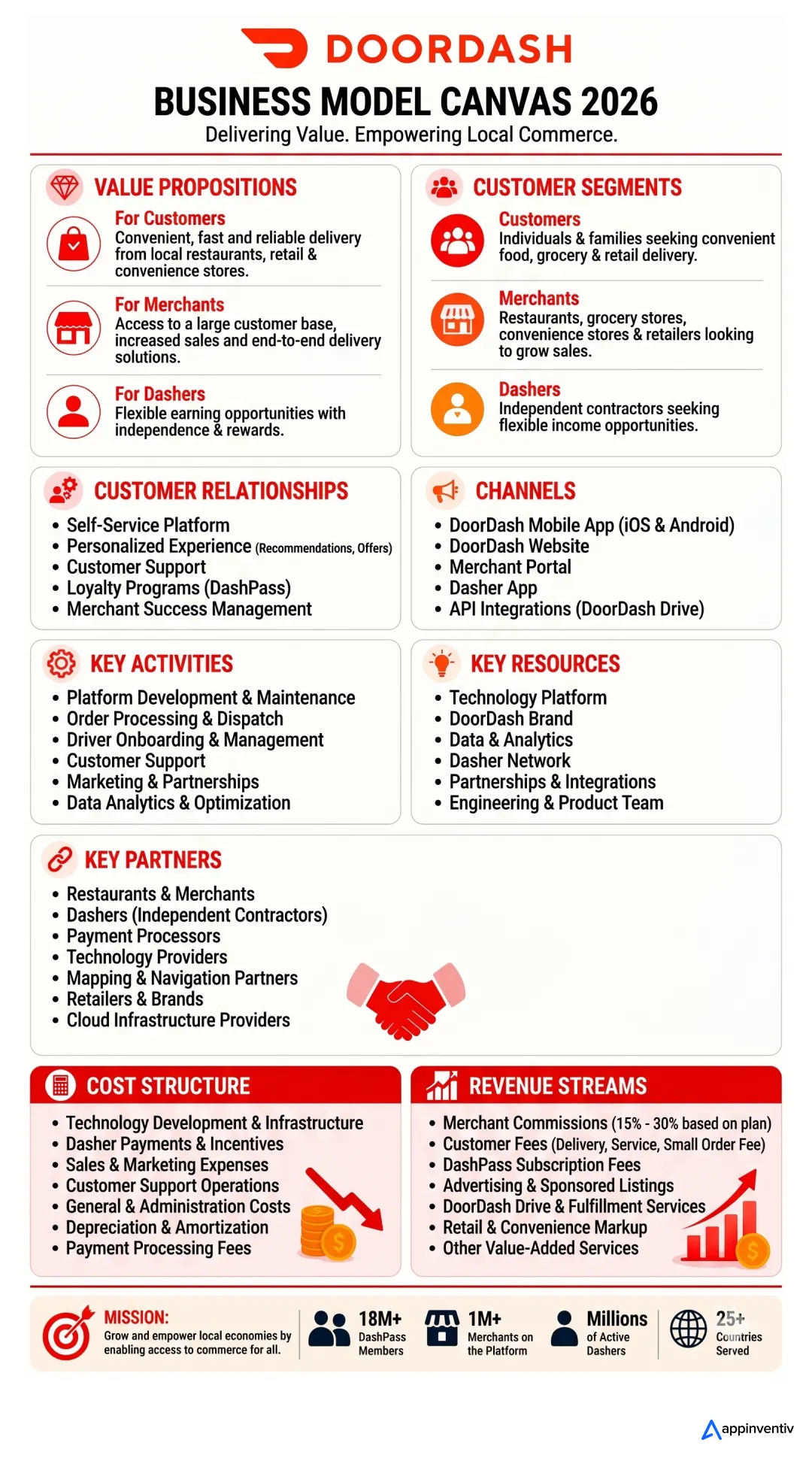
Multi-Sided Marketplace Structure
DoorDash is fundamentally a three-sided market between consumers, vendors and delivery partners. App users order, restaurants cook and deliver, Dashers make the final delivery. This is a key feature of the DoorDash business model, in which all parties feed into a stream of transactions and revenue.
Customer-Focused Services
For consumers, DoorDash offers a unified platform to access restaurants, grocery and retail stores. Real-time order tracking, delivery time options and DashPass offerings increase convenience and decrease order costs. Such services aim to boost usage, making it a habit for consumers.
Merchant Enablement Tools
DoorDash provides businesses with a suite of services. Businesses can reach a broad audience and have tools to manage menu items, prices and business performance. This new offering illustrates how the DoorDash business model and services are increasingly providing software and support for businesses.
Logistics and Delivery Infrastructure
The logistics infrastructure is a critical component, delivering last-mile delivery speedily. DoorDash employs route optimisation, batching and forecasting to improve delivery efficiency. Also, via DoorDash Drive, this network is available as a white-labeled offering to fulfil orders without the marketplace.
Advertising and Discovery Services
DoorDash serves as an advertising platform, providing sponsored placements and promotions in the app. Businesses can gain more exposure and connect with highly motivated consumers at the point of purchase. This offering creates a high-margin revenue stream and enhances the overall ecosystem.
Financial and Payment Services
It offers merchants payment processing, quicker payouts and financial services that streamline business. These tools ease the cash flow process and increase merchant dependency. As this service grows, it signals the shift in the DoorDash business model 2026 towards a financial ecosystem.
Key Features That Power DoorDash’s Delivery Ecosystem
DoorDash combines unique capabilities that are designed to improve speed, visibility, and efficiency across customers, merchants, and delivery partners. Here are some of the top DoorDash like app features :
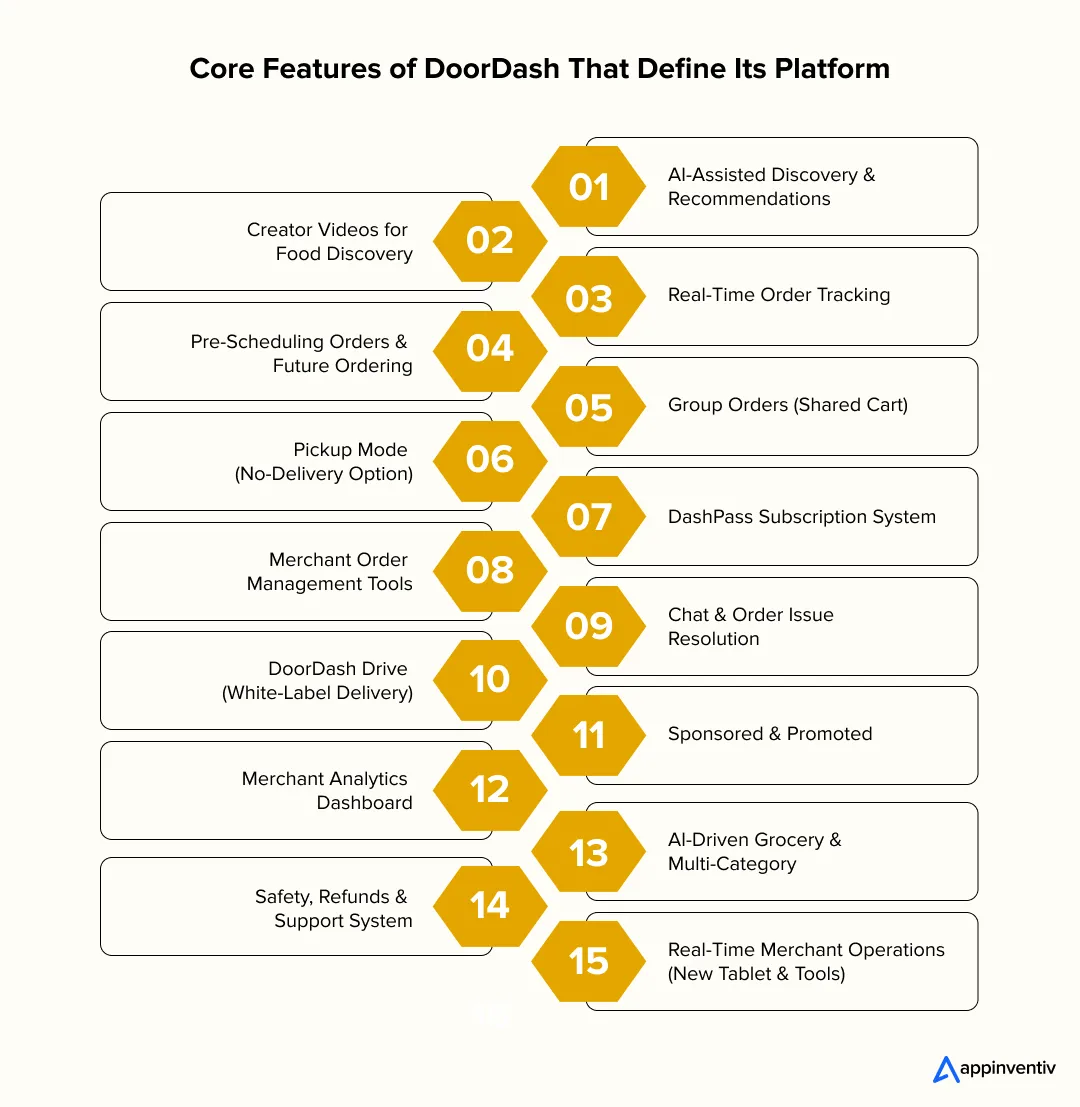
- AI-Assisted Discovery & Recommendations
DoorDash now leverages AI algorithms to recommend restaurants and menu items based on order history, search and browsing history, and location data. The use of AI in food delivery app speeds up discovery and lowers discovery costs. New features also leverage AI for browsing and better ranking local restaurants.
- Creator Videos for Food Discovery
The app now features creator videos, promoting restaurants visually. These videos allow customers to see what they’re ordering and boost engagement with the app. DoorDash also has a creator program, which rewards users for their videos.
- Real-Time Order Tracking
Orders can be tracked in real-time, from preparation to delivery. It also provides status updates throughout the process for greater visibility and peace of mind.
- Pre-Scheduling Orders & Future Ordering
Customers can place orders in advance for same day (at a later time) or any day. This is useful during busy times, festivals, or scheduled meals, and also helps restaurants anticipate and prepare for the demand.
- Group Orders (Shared Cart)
DoorDash has a group ordering feature that allows other users to add items to the cart. This is common in office and group orders and boosts average order size for restaurants.
- Pickup Mode (No-Delivery Option)
This allows customers to opt for pickup instead of delivery to avoid delivery charges and waiting. The food is pre-ordered, and customers pick up from the restaurant for flexibility.
- DashPass Subscription System
DashPass offers discounted or free delivery and discounts on items for a subscription fee. It’s essential for retention and increasing the frequency of orders, thus enabling app monetization and customer engagement.
- Merchant Order Management Tools
Merchants now have powerful features like real-time order management, prep-time updates and chat with customers. These tools give merchants more control over their business and eliminate the need for support.
- Chat & Order Issue Resolution
Merchants can chat with customers to resolve order issues by bypassing support. This speeds up the issue resolution process and increase accuracy and satisfaction.
- DoorDash Drive (White-Label Delivery)
DoorDash provides logistics as a service with Drive, enabling merchants to accept orders from their own mobile app or website, and have DoorDash handle the delivery. This takes the company beyond a marketplace.
- Sponsored & Promoted
Leisure merchants can pay for priority listings and promotions. These are available in search and category listings, and they help businesses to reach “ready to buy” customers.
- Merchant Analytics Dashboard
Merchants get business insights like order trends, busy times, menu items, and customer insights. These insights enable restaurants to use data for AI-driven dynamic pricing and more efficient operational decision-making.
- AI-Driven Grocery & Multi-Category
DoorDash now offers grocery and multi-category shopping, in addition to food. AI-powered cart building and re-ordering of groceries enable the platform to become more than a food delivery app.
- Safety, Refunds & Support System
The system offers formal support for out-of-stock, late delivery and refunds. Complaints can be handled through the app and AI-powered chtabot support channels, streamlining the process.
- Real-Time Merchant Operations (New Tablet & Tools)
Restaurants now work with new tablet technology for managing orders, including scrollable order tickets, faster scrolling, quick actions like changing estimated prep time, and making orders ready.
What Drives DoorDash’s Market Leadership and Sustained Growth
The success of DoorDash can’t be attributed to one factor. It’s built on a combination of factors that enhance both the supply and demand sides of the platform, and extend its influence over local markets.
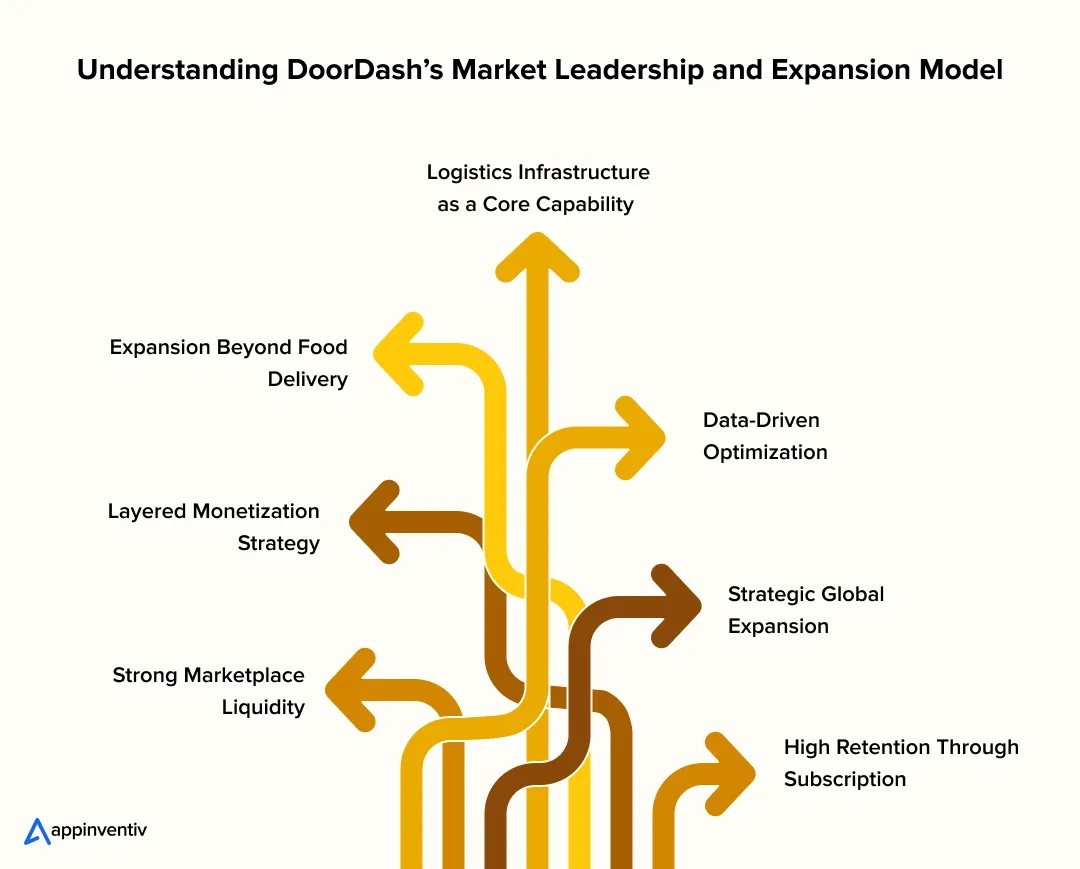
Strong Marketplace Liquidity
DoorDash has created local markets with a high density of customers, restaurants and delivery personnel. This collaboration minimises wait times, enhances delivery speed and boosts order accuracy. The more people on the network, the more valuable it is for all parties, a key part of the DoorDash business model food delivery.
Layered Monetization Strategy
Instead of being dependent on a single revenue model, DoorDash integrates commissions, user fees, subscriptions and advertising. This holistic DoorDash monetization strategy means that growth in one revenue stream feeds others, enabling the business to expand without being reliant on a single revenue stream.
Expansion Beyond Food Delivery
DoorDash has gradually expanded into grocery, retail and convenience segments, enhancing the use cases per customer. This move showcases how DoorDash’s business model and services are branching out from restaurants to local commerce.
Logistics Infrastructure as a Core Capability
With DoorDash Drive, the company is a logistics company and not just a marketplace. This infrastructure-first strategy is how do food delivery apps make money beyond orders, by providing delivery infrastructure as a service.
Data-Driven Optimization
DoorDash employs AI analytics for dynamic pricing, route optimization and demand management. Variable pricing, order pooling and smart routing all lead to improved profitability and delivery times. These efficiencies highlight how DoorDash make money at a unit level while improving operational performance.
Strategic Global Expansion
The Wolt acquisition allowed DoorDash to extend into several global markets with its marketplace and logistics platforms. This expansion is the result of the scalability of the DoorDash business model across various economic and cultural settings.
High Retention Through Subscription
DashPass is crucial for user retention through reduced cost of ordering. This leads to higher retention and lifetime value, smoothing order volumes on the platform.
Cost to Build an App Like DoorDash: Detailed Estimation
The DoorDash-like app development cost depends on the features, scale and complexity. A minimum viable product may prove the concept, but a scalable solution needs a robust backend, real-time logistics management, and seamless integration between apps.
On average, the costing range lies between $50,000 to $500,000+, which includes the inclusion of simple and advanced features and integrations.
Detailed Cost Breakdown:
| Component | Features | Cost (USD) |
| Customer App | User registration, menus, orders, payments, tracking | $30,000 – $80,000 |
| Driver App | Order notifications, navigation, earnings, status updates | $30,000 – $60,000 |
| Merchant App | Menu management, orders, analytics dashboard | $20,000 – $50,000 |
| Backend Development | APIs, database, order management system, scalability setup | $30,000 – $100,000 |
| Logistics & Dispatch Engine | Routing, batching, and real-time tracking | $20,000 – $70,000 |
| Payments Integration | Payment gateways, wallets and security | $10,000 – $30,000 |
| UI/UX Design | Wireframes, flows and user interface layout | $5,000 – $20,000 |
| Testing & QA | Functional testing, performance testing, bug fixes | $10,000 – $25,000 |
| DevOps & Deployment | Cloud setup, CI/CD, app store listing | $5,000 – $15,000 |
| Maintenance (Annual) | Updates, bug fixes, server costs, scaling | $15,000 – $50,000/year |
Total Estimated Cost Range:
| Development Level | Estimated Cost |
| MVP (Basic Features) | $50,000 – $120,000 |
| Mid-Level Scalable App | $120,000 – $250,000 |
| Advanced Platform (Full Scale) | $250,000 – $500,000+ |
Also Read: How Much Does it Cost to Build a Food-Delivery App like UberEats?
Factors That Influence DoorDash-Like App Development Cost
DoorDash like app development cost is influenced by a series of factors. This includes:
Logistics Intelligence Complexity: High-end dispatch software that facilitates batching several orders, dynamic re-routing and AI demand forecasting adds considerable backroom complexity. These are not defaults but essential to efficient delivery.
Geo-Mapping Accuracy and Cost Control: Excessive use of mapping APIs (distance, live tracking, route optimization) results in API costs. To minimize API calls while maintaining accuracy, map usage needs to be optimized, which requires more engineering effort.
Hyperlocal Market Customization: Each city has unique delivery policies, pricing structures and services. Developing hyperlocal delivery systems that can accommodate pricing, offers, and vendor-specific rules by zone increases the solution’s complexity.
Merchant Onboarding and Menu Digitization: Simplifying restaurant onboarding, menu uploads, real-time menu changes, etc., increases complexity. Manual uploads have a lower initial cost but lower scalability.
Real-Time Order Orchestration: Managing high order volumes during peak times without lag involves event-driven systems and queues. This heightens the cost estimates.
Although a considerable budget is required for building a complete tech-integrated food delivery app, you can reduce the app development costs. This can be done by following the right strategies that can keep features focused, avoid rework, and make better use of existing technologies without affecting core functionality.
Let’s map your features, scale, and exact development cost.
DoorDash Financial Performance: Profitability Drivers and Operating Challenges
To fully understand DoorDash profitability & challenges, it is important to see how the ecosystem functions. Knowing how DoorDash works is critical, as the business model underpins both how costs and revenues flow through the business.
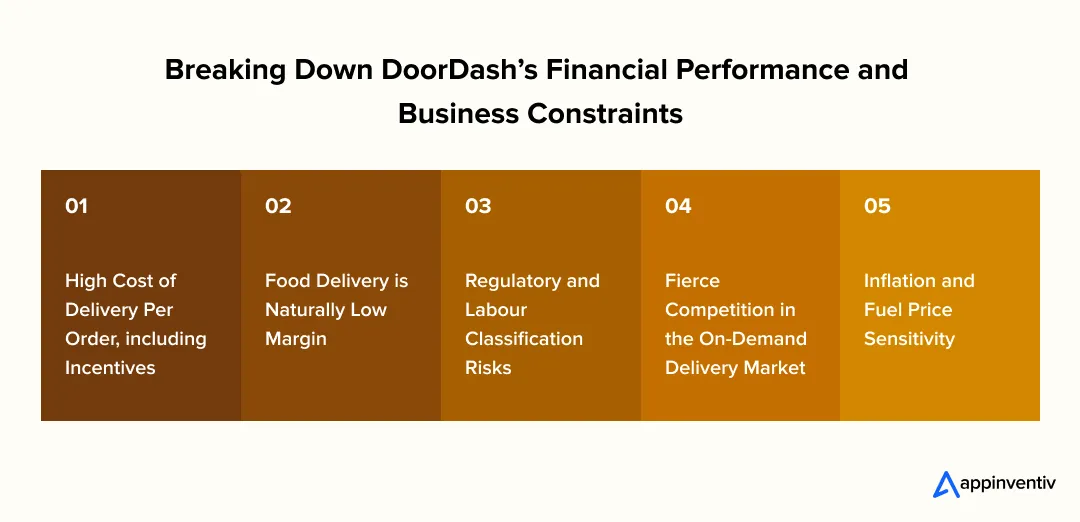
1. High Cost of Delivery Per Order, including Incentives
The cost of each order includes Dashers, and sometimes bonus peak incentives during busy times. In less densely populated regions, the cost of delivering an order can be greater than the revenue generated.
How it is managed:
This solution uses dispatch intelligence to batch orders, minimise waste and optimise delivery allocation. It also optimizes courier productivity through demand forecasting and dynamic zone optimization.
Profitability drivers:
Increasing order volume in dense urban areas increases the utilization of fixed delivery costs. Better load management and route planning lower delivery costs, enhancing sustainability.
2. Food Delivery is Naturally Low Margin
The food delivery business is inherently low margin as it is dependent on restaurants, consumers and logistics providers. High prices from both ends constrain commission rates.
How it is managed:
Volume growth is favoured over fee increases. It also develops high-margin revenue opportunities like advertising, merchant tools and platform services, enhancing revenue quality. This links to how does DoorDash make money.
Profitability drivers:
Advertising and merchant services help blended margins, while increased order frequency helps operational efficiency of the platform.
3. Regulatory and Labour Classification Risks
Gig worker regulations, cap on commissions and platform fees differ in various markets and impact costs.
How it is managed:
DoorDash tailors pricing structures to different regions and monitors compliance systems for labour and delivery regulations, allowing for seamless operations.
Profitability drivers:
Regional pricing models maintain revenue stability, and compliance measures minimise disruption and support scalability.
4. Fierce Competition in the On-Demand Delivery Market
The food delivery market is very competitive, with companies often offering discounts and promotions to attract customers, putting pressure on prices.
How it is managed:
When it comes to competing, DoorDash is not just competing on price but also on speed of delivery, its relationship with merchants, and the growth of grocery and convenience delivery.
Profitability drivers:
Expanding outside of restaurants boosts order frequency and order value, increasing revenue per consumer and lessening reliance on one product category.
5. Inflation and Fuel Price Sensitivity
Courier costs and customer demand are influenced by fuel costs and inflation, leading to margin and volume fluctuations.
How it is managed:
Variable pricing sets delivery prices according to demand, distance and time. Order consolidation and optimized delivery routes minimize distance travelled.
Profitability drivers:
Efficient operations lower variable costs of delivery, and dynamic pricing ensures revenue in cost fluctuations.
Launch Your DoorDash-Style Delivery Platform with Appinventiv
The next phase of platforms like DoorDash is moving beyond food delivery into full-scale local commerce. AI-led demand prediction, faster fulfillment, and multi-category expansion across grocery, retail, and quick commerce are shaping this shift. As these platforms evolve, the focus is no longer just on delivery. It is on building an ecosystem where logistics, data, and monetisation work together to improve efficiency and user retention.
For businesses, investing in a DoorDash-like app is a strategic move. The value lies in creating a system where each transaction generates multiple revenue streams, from commissions and delivery fees to subscriptions and advertising. As consumer expectations continue to favour speed and convenience, platforms that control both demand and delivery will hold a clear advantage.
Appinventiv, as a reliable food delivery app development services partner, brings this capability through real-world implementations across global food delivery brands.
Americana ALMP

The QSR giant, Americana Restaurants lacked a unified data strategy, leading to operational hurdles and an inefficient last-mile delivery system.


- 82% increased dispatched efficiency
- 4X improvement in operational standards
- 90% faster real-time decision-making
Domino’s
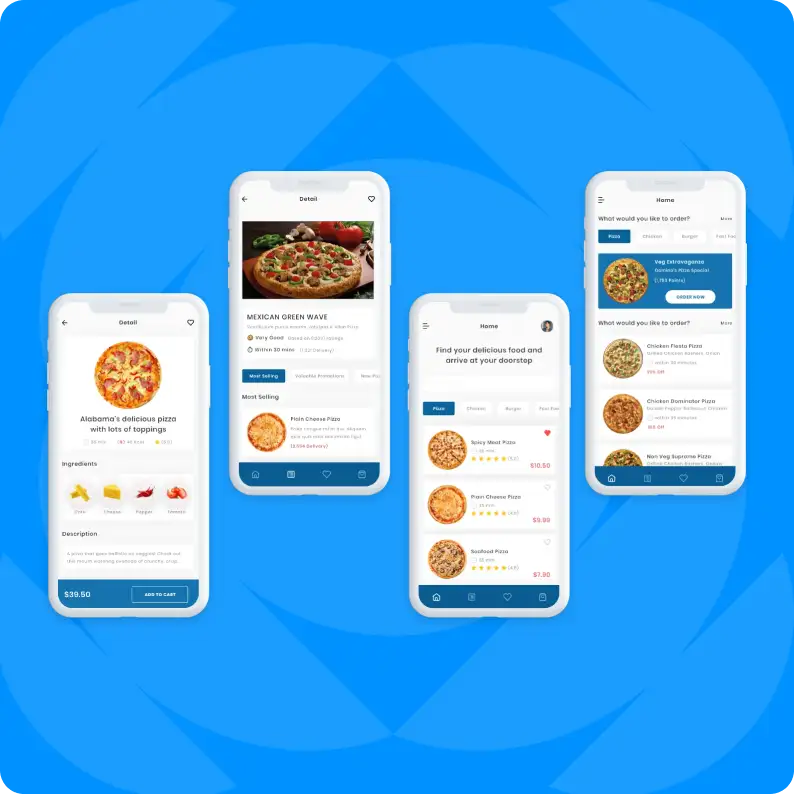
- 23% increase in conversion rate
- 4.4-star app rating achieved
KFC
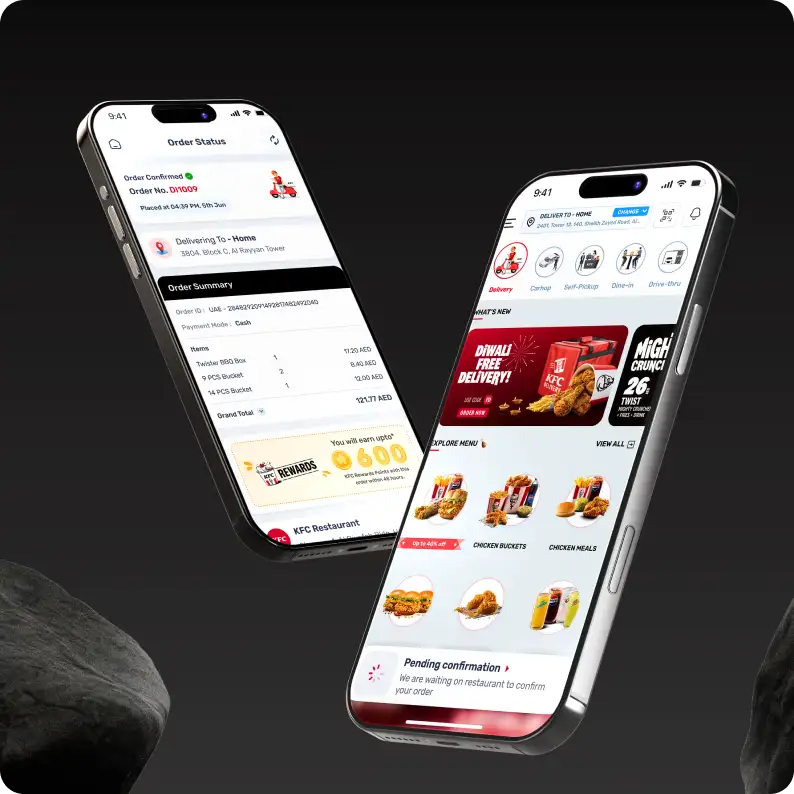
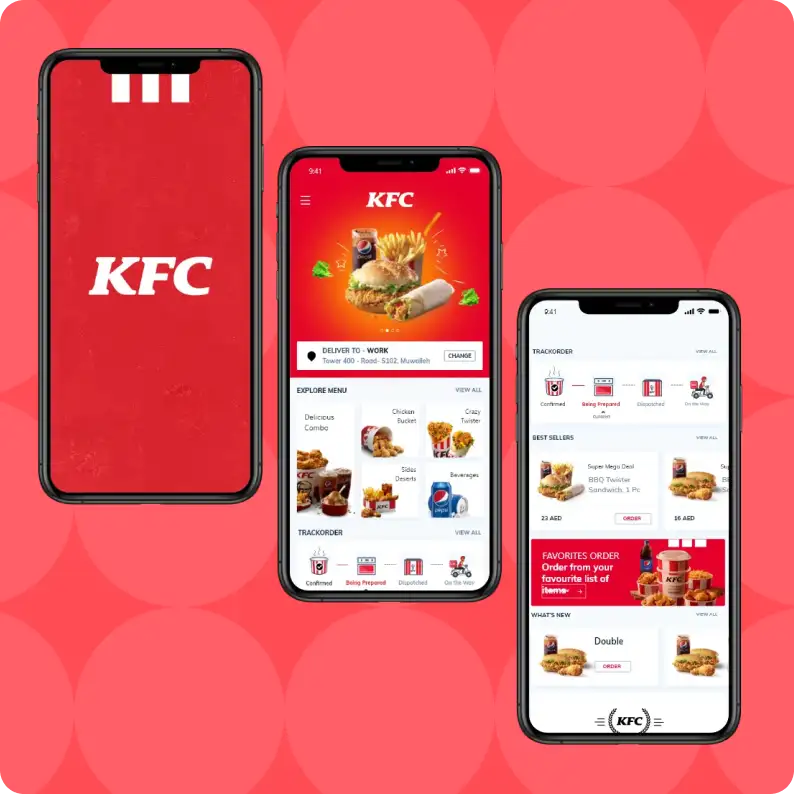
- 22% increase in conversion rate
- 4.5 average app rating
- 50% increase in orders via app
- 60% boost in repeat purchases
Kudu
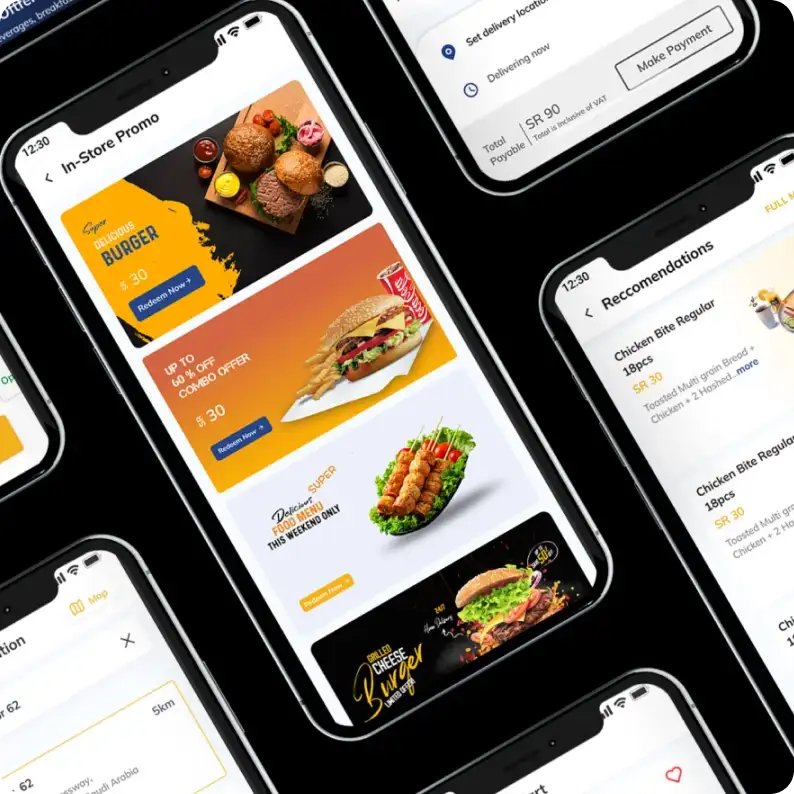
- 500K+ new users acquired
- Unified web and mobile experience
- Real-time operational control achieved
A well-designed platform today is not just an app, it is a connected ecosystem. Businesses that invest early in this model position themselves to capture long-term value across multiple categories and revenue layers.
If you want your DoorDash-like app to succeed and need deeper guidance on strengthening your revenue model, connect with the experts at Appinventiv for tailored insights and execution support.
FAQs
Q. Why is Doordash successful?
A. This on-demand app development service for food delivery businesses is turning out to be successful because it is bridging the gap between customers, restaurants, and drivers. On one side, it is giving customers an opportunity to get food delivered to their doorstep. On the other hand, it enables local restaurants to come across drivers who could help them extend their services beyond their nearby areas, and in this way earn more.
Q. How much does DoorDash pay to Door Dashers?
A. For every order, the DoorDashers get $1. But when you make a delivery at peak time and some other conditions that fall under their peak pay policy, you get to make extra dollars on the delivery.
Q. What type of business is DoorDash?
A. DoorDash is an online food delivery service that uses logistics to bring together consumers, merchants and delivery drivers. It is a company in the on-demand delivery sector, specialising in last-mile delivery. It facilitates food and grocery delivery from local retailers, and payment, route planning, and courier coordination, through its mobile commerce platform.
Q. What is DoorDash’s business model?
A. The DoorDash business model analysis is based on a three-sided marketplace connecting consumers, merchants, and independent delivery drivers. The model makes money by enabling orders and collecting commissions and fees.
Merchants get online exposure, customers convenience, and Dashers get paid per order. The business can grow due to network effects; adding users and merchants creates more value and density.
Q. How to build an app like DoorDash?
A. Here’s the roadmap to build an app like DoorDash:
- Step 1: Market and User Research: Target market, restaurants, and areas to serve. Analyze market demand and competition.
- Step 2: Specify Features: Create features such as menu, location-based services, payments, reviews and push notifications.
- Step 3: Choose Tech Stack: Opt for scalable backend technologies (Node.js, Python), mobile development tools (Flutter/React Native) and cloud services.
- Step 4: Create Delivery Management: Implement route planning, driver allocation and real-time tracking.
- Step 5: Integrate Payments: Implement payment processing and online wallets.
- Step 6: Go Live and Improve: Launch MVP, collect feedback, and boost speed and efficiency of delivery.
Q. How does DoorDash make money?
A. Here’s how DoorDash makes money to ensure continued revenue success:
- Commission from Restaurants: DoorDash takes a percentage of each order processed for restaurants.
- Delivery Fees from Customers: Customers are charged delivery and service fees, depending on distance, demand, and order volume.
- DashPass Subscription Revenue: Recurring revenue from subscriptions such as DashPass.
- Advertising Revenue: Fees come from listing restaurants and boosting search rankings.
- Merchant Services and Partnerships: Additional revenue comes from logistics tools and enterprise delivery solutions.
Q. Does DoorDash earn from delivery fees or subscriptions?
A. The DoorDash revenue model includes both delivery fees and subscription income. Per-order delivery and service charges are a large portion of revenue. Subscriptions such as DashPass offer monthly revenue and per-order savings, which boost repeat customers. These two revenue streams combine transactional income with subscription revenue streams to make the business sustainable and scalable.


Fast 2-minute response, fully NDA-protected.

How Much Does It Cost to Build a Job Portal like Bayt?
In a landscape rife with challenges, the job industry struggles with issues such as skills shortages, fierce competition, and the ever-changing demands of the market. However, the emergence of platforms like Bayt has provided a lifeline for businesses. Bayt transcends the limitations of traditional recruitment by providing businesses with an innovative talent pool. Leveraging advanced…
How Much Does It Cost to Build a Job Portal like Glassdoor?
In the wake of the COVID-19 pandemic, the recruiting industry saw a dramatic change. It has caused many organizations to lose their projects and businesses to shut down, causing many employees to lose their job roles worldwide. In such a scenario finding a suitable job or recruiting the right talent has become one of the…

How to build an online auction application? Benefits, features, costs
When was the last time you went street shopping and bargained with the vendor to sell their products at a lower price? If you remember that experience, imagine bringing it on a digital platform in a more sophisticated way. Websites and applications like Ebay, BidSpotter, and Auction.com, etc. have been making it easy for the…