



















- How Do You Know Your Business Needs Software Product Development?
- What Should You Prepare Before Starting Software Product Development?
- What Are the Key Steps Involved in Software Product Development?
- Which Software Product Development Methodology Should You Use?
- What Are the Different Types of Software Product Development?
- What Are the Key Benefits of Software Product Development?
- What Business Monetization Models Should You Consider Before Building a Software Product?
- How to Plan the Architecture and Technology for an Enterprise-Grade Product
- Security First Approach to Software Product Development
- Common Challenges in Software Product Development and How to Overcome Them
- How Do You Manage a Software Product After Launch?
- Best Practices for Successful Product Development
- Software Development Cost and Timeline in 2025
- Success Stories and Real Product Outcomes
- How Appinventiv Helps Enterprises Build Scalable Software Products
- FAQs
- Strong products start with discovery, user insight, and early architecture planning.
- Clear validation, compliance checks, integrations, and KPIs reduce most delivery risks.
- The right business model, methodology, and tech stack shape long term scalability.
- MVPs lower early cost and risk, while full builds require deeper engineering and security.
- Real value comes after launch through monitoring, versioning, and continuous improvement.
Software product development has become a central part of how companies grow today. Teams are no longer building digital tools just to keep up. They are building them to create real advantages in efficiency, revenue, and customer experience. Deloitte’s Technology Value survey notes that nearly three out of four organizations increased their investments in AI and digital programs this year, which shows how strongly leaders are leaning on product driven transformation.
Industry analysts expect this momentum to continue. Gartner’s latest outlook shows steady growth in global IT spending over the next few years, driven by demand for modern software platforms, cloud adoption, and scalable product architectures. This trend highlights a clear shift toward replacing aging systems with flexible digital products that support long-term innovation.
This is where software product development comes in. A well built product becomes part of the company’s core engine. It supports teams, improves workflows, and creates the kind of customer experience that competitors find difficult to copy. Startups see this as a path to enter the market quickly. Large enterprises see it as a way to modernize at scale.
With that context in place, the next question is how to recognize the right moment to begin the product journey.

How Do You Know Your Business Needs Software Product Development?
Most organizations reach a moment where the tools they have been relying on stop matching the pace of the business. Sometimes it shows up in small ways, like teams spending a little too long fixing routine issues. Other times it is more visible, such as customers leaving because the digital experience feels dated.
When patterns like these start repeating, it usually signals that the company is ready for a more intentional software product development process instead of short term fixes.
Below are the signs leaders often notice before making the shift toward custom software product development or a broader enterprise software product development strategy.
1. Increasing Operational Inefficiencies
Work starts to feel heavier than it should. Teams move slower, simple tasks take longer, and managers notice rising delays even when people are doing their best. A dedicated product helps reduce these hidden costs and gives the business a consistent workflow.
2. Fragmented or Outdated Systems
Many companies still operate on older tools that were built for a different scale. When systems do not talk to each other or require manual data entry, the cracks get harder to ignore. This is usually when product software development becomes a more reliable path than patching legacy tools.
3. Customer Drop-offs and Low Engagement
Companies often see this before they feel it. Fewer returning users, lower conversions, or support tickets that repeat the same complaints. A thoughtful software product design and development approach helps rebuild trust and gives customers a smoother experience.
4. New Market Opportunities and Expansion Plans
Growth ideas are exciting, but they also expose gaps in the current setup. If the business is entering new regions or launching new services, off the shelf tools rarely fit the plan. A scalable product becomes part of the long-term expansion strategy.
5. Compliance Pressure
Regulations keep tightening across industries. When audits become stressful or data handling feels risky, it is a sign the business needs a product with compliance built into its core.
6. Demand for Automation or AI Driven Workflows
Teams start asking for smarter tools. Leaders want dashboards that update themselves. Operations want fewer manual steps. At this point, a new product gives the business the flexibility to introduce automation and AI without disrupting daily work.
7. Competitive Pressure to Innovate
When competitors release new features faster, or offer a cleaner digital experience, the gap becomes noticeable. This is often the moment companies bring in software product developers to gain control over their roadmap and respond to the market on their own terms.
Every business reaches this point in its own way, but the signs look similar when they start to show up. Once these signals stack together, it is usually a hint that the team is ready to move toward a more intentional product approach instead of patching things as they go.
That is when the real benefits of software product development become obvious, because the old quick fixes stop holding the business back.
What Should You Prepare Before Starting Software Product Development?
A successful product begins long before the first line of code. Many companies jump into the software product development process with a rough idea and a few assumptions, only to discover gaps that slow the project later. A clear readiness checklist helps avoid those issues. It gives founders, product leads, and enterprise teams a practical way to validate the idea, prepare resources, and reduce avoidable risks. This early clarity also strengthens the overall software product development strategy and sets a realistic foundation for scale.
Below are the factors that matter most at this stage.
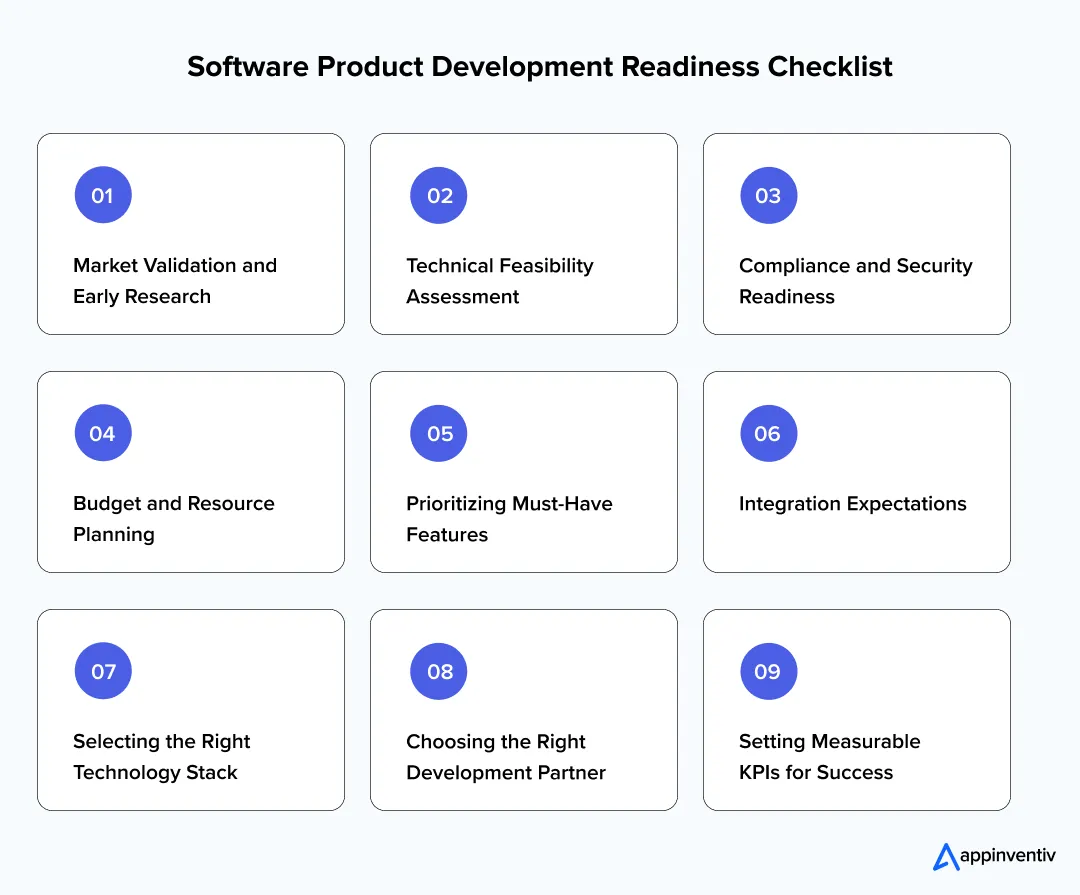
1. Market validation and early research
Before investing heavily, teams need to understand whether the idea has real demand. This includes speaking to actual users, observing competitors, and checking if the problem is wide enough to justify a product. Strong validation often guides the shape of the MVP and influences feature decisions during custom software product development.
What to look for:
- Clear user pain points
- Proof that customers are willing to pay
- Competing products and market gaps
- Early signals of product market fit
2. Technical feasibility assessment
Some ideas sound simple but require complex engineering or heavy data work. A feasibility study helps identify the right architecture, potential constraints, integration challenges, and the early shape of the software product development life cycle.
Checklist for feasibility:
- Core features and their technical requirements
- Scalability considerations
- Data storage and processing needs
- Performance expectations
3. Compliance and security readiness
Regulated industries cannot afford to treat compliance as an afterthought. Whether the product handles financial data, health records, or personal information, it must align with standards like SOC 2 or GDPR. Thinking about security at this point strengthens the entire software product development process.
Questions to explore:
- What compliance rules apply to the product
- How data will be collected, stored, and protected
- Whether the system needs audit trails or role-based access
- How early security decisions influence long-term cost
4. Budget and resource planning
Many projects fail because the budget was estimated around the ideal scenario instead of the realistic one. Teams need clarity on internal bandwidth, outsourcing needs, and expected costs associated with enterprise software product development.
Budget planning essentials:
- Estimated development cost
- Infrastructure and cloud expenses
- Maintenance expectations
- Availability of internal SMEs and product owners
Many enterprises also consider offshore software product development to balance costs and access specialized skills.
5. Prioritizing must have features
Every idea begins big, but not every feature belongs in the first release. Early prioritization helps shape the MVP and keeps Software Product Development Steps aligned with the business goal.
How to prioritize:
- Identify mission critical features
- Separate nice to have ideas
- Build a simple feature roadmap
- Validate the list with potential users
6. Integration expectations
A product rarely lives alone. It must work with CRMs, ERPs, analytics tools, payment gateway, or existing internal software. Mapping these dependencies early reduces surprises during development.
Areas to examine:
- APIs needed for integration
- Data flow between existing and new systems
- Possible cloud migration strategy and challenges
- Authentication and identity requirements
7. Selecting the right technology stack
The tech stack influences performance, maintenance, scalability, and overall cost. The choice depends on how the product will evolve over time.
Key considerations:
- Frameworks and languages that support long-term growth
- Availability of talent familiar with the stack
- Cloud readiness
- Support for automation and AI workflows
8. Choosing the right development partner
Teams often bring in software product developers when they need specialized skills or faster delivery. Experience with product software development across industries adds stability to the journey.
What to evaluate:
- Past work with similar products
- Engineering maturity
- UI and UX capabilities
- Approach to testing and quality control
9. Setting measurable KPIs for success
Choosing the right KPI for software product development gives teams a clear way to track progress and keep decisions grounded in data. They show what is working, what needs revision, and how well the product aligns with business goals. Early KPIs also support long-term tracking of software product development metrics.
KPIs may include:
- User activation rate
- Feature adoption
- Retention and churn
- System performance benchmarks
Together, these metrics often form the core KPI for software product development across early and mature stages of the product.
What Are the Key Steps Involved in Software Product Development?
Each phase in software product development introduces decisions that influence architecture, performance, scalability, and long-term viability, and together these software product development life cycle stages form a structured path from idea to launch. The steps below reflect how mature teams structure their work when building modern software systems.
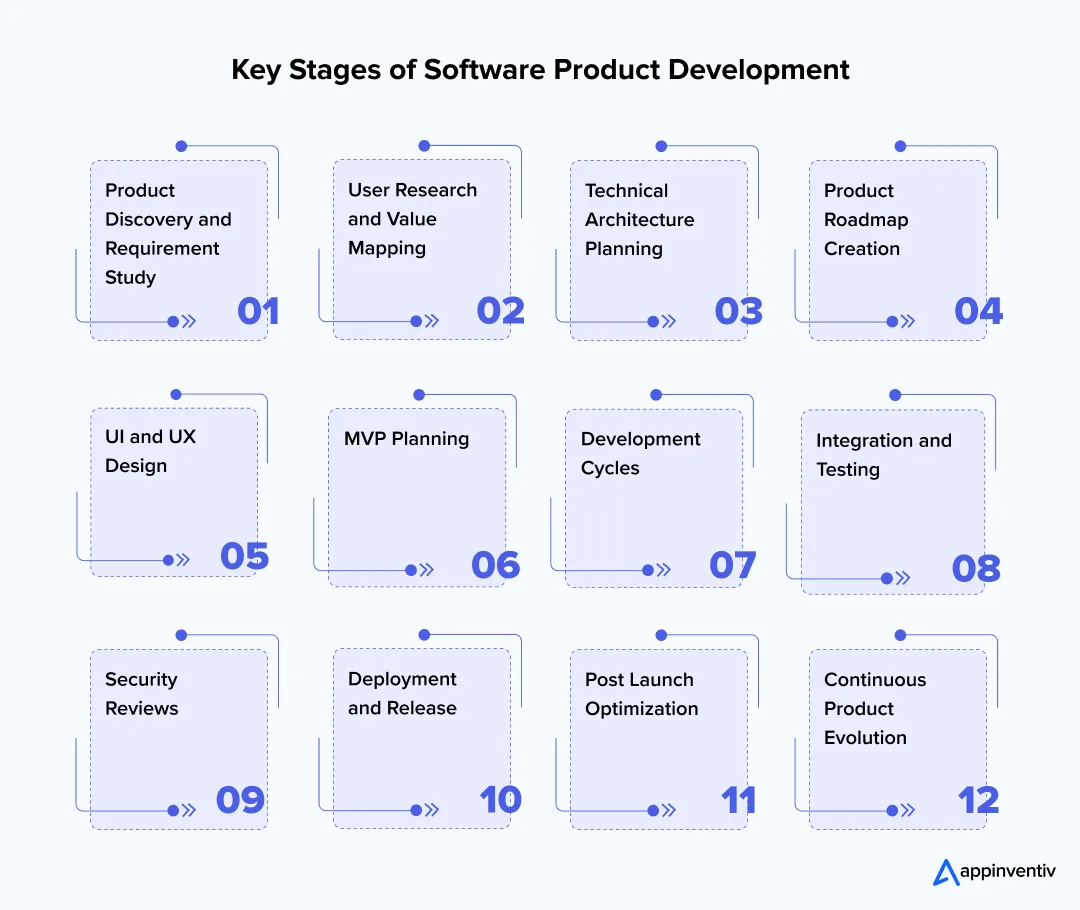
1. Product Discovery And Requirement Study
Discovery establishes clarity around what the product should accomplish and why it matters. The goal is to align on value before any engineering begins.
Execution Priorities:
- Convert business goals into functional expectations.
- Identify core use cases and external dependencies.
- Document constraints related to compliance, data, or integration.
- Shape an early outline of the software product development process to guide technical direction.
2. User Research And Value Mapping
Teams validate assumptions by understanding how users work today and what problems the product must address.
Insight Drivers:
- Observe workflows, pain points, and decision paths.
- Map user journeys for primary personas.
- Identify value moments that influence design and prioritization.
- Feed insights directly into the software product development strategy.
3. Technical Architecture Planning
This is where architecture becomes real. The engineering team evaluates whether the product vision can be supported by available technologies.
Engineering Focus Areas:
- Choose the right enterprise architectural style, monolithic, modular, or microservices.
- Define core components, API gateway, authentication service, data stores, event pipelines.
- Model expected load, performance SLAs, and geographic considerations.
- Outline the software product development life cycle and identify early risks.
Decisions made here tend to shape how the remaining software product development life cycle stages unfold in practice.
4. Product Roadmap Creation
The roadmap turns strategy into a sequence of deliverables without locking teams into unrealistic timelines.
Planning Considerations:
- Break vision into phases, MVP, early launch, scale phase.
- Group features based on value and dependency chains.
- Align stakeholders on feasibility and release strategy.
- Maintain adaptability as user insights evolve.
5. UI And UX Design
Design defines how users move through the system and how efficiently they complete tasks.
Experience Design Priorities:
- Create wireframes and interactive flows for core journeys.
- Define behavior for errors, empty states, and offline usage.
- Ensure accessibility and consistency across device types.
- Validate usability through early feedback loops.
6. MVP Planning
Creating an MVP reduces the scope of product development to the minimum set of features that still delivers meaningful value.
Scope Definition Essentials:
- Identify features required for first validation.
- Establish success metrics, activation, time to complete key tasks, adoption.
- Remove non essential complexity.
- Treat the MVP as the first checkpoint in the Software Product Development Steps.
7. Development Cycles
The engineering team begins iterative implementation based on the roadmap and validated design.
Build Priorities:
- Set up repositories, branching strategy, CI pipelines, and test automation.
- Implement services, APIs, and domain models.
- Build front-end components aligned with UX guidelines.
- Conduct regular code reviews to maintain quality and security.
8. Integration And Testing
Modern products rarely operate in isolation. Testing must reflect real complexity.
Quality Assurance Anchors:
- Integrate with CRMs, ERPs, payments, data systems, or identity providers.
- Test API reliability, rate limits, timeout behaviors, and error responses.
- Perform functional, regression, compatibility, and load testing.
- Validate end-to-end data flow and system resilience.
9. Security Reviews
Security deserves its own phase after continuous checks throughout development.
Security Validation Areas:
- Review identity flows and access control logic.
- Validate encryption methods for data at rest and in transit.
- Assess dependency vulnerabilities and patch requirements.
- Confirm alignment with compliance frameworks defined in the software product development strategy.
10. Deployment And Release
Releasing a product involves operational readiness, not just pushing code live.
Operational Readiness Tasks:
- Prepare infrastructure, containers, orchestration rules, and autoscaling.
- Set up observability, dashboards, logs, and alerts.
- Determine rollout approach, canary, blue green, controlled cohorts.
- Maintain rollback and recovery procedures.
11. Post-Launch Optimization
Real users reveal insights that internal environments never show.
Optimization Directions:
- Review analytics, heatmaps, and behavior funnels.
- Identify friction points creating drop-offs or confusion.
- Improve API performance, query efficiency, and page load times.
- Refine onboarding and support experience.
12. Continuous Product Evolution
A product becomes a long-term asset only when it adapts to the business and its users.
Long term Enhancement Priorities:
- Add features based on real usage patterns.
- Refactor or scale architecture to support growth.
- Improve integrations, automation, and reporting workflows.
- Manage technical debt proactively within ongoing product software development.
Which Software Product Development Methodology Should You Use?
Choosing the right approach to building a product influences speed, quality, and the team’s ability to adapt as requirements evolve. Different projects call for different structures, and mature teams often blend methods to balance predictability with flexibility. Understanding the major software product development methodologies helps organizations choose a model that fits their product vision and technical environment.
Comparison of Software Product Development Methodologies
| Methodology | When It Works Best | Strengths | Limitations |
|---|---|---|---|
| Agile Software Product Development | Products with evolving requirements or frequent user feedback cycles | Fast iterations, continuous improvement, early releases | Requires disciplined team communication and stakeholder alignment |
| Scrum | Cross functional teams building features in short sprints | Clear sprint structure, strong accountability, predictable cadence | Can feel rigid for highly experimental products |
| Kanban | Teams handling ongoing work with constant flow rather than fixed sprints | Flexible, visual workflow, great for reducing bottlenecks | Less suited for large structural changes or long-term planning |
| Waterfall | Projects with stable, predictable requirements and heavy documentation needs | Clear phases, easier stakeholder sign off, strong compliance alignment | Slow to adapt to change, delays visible late |
| Lean Software Product Development | Teams focused on efficiency, waste reduction, and rapid experimentation | Fast learning cycles, reduced cost of failure, ideal for MVPs | Needs strong product discipline to avoid over simplification |
| DevOps Driven Development | Products requiring frequent updates, continuous deployment, and automation | High release velocity, strong reliability, efficient collaboration | Requires investment in pipelines, monitoring, and tooling |
| Hybrid Models | Enterprise environments combining stability and agility | Balanced structure, adaptable to complex product needs | Requires experienced leadership to manage the blend |
Also Read: Agile or Waterfall: Which App Development Approach to Consider?
What Are the Different Types of Software Product Development?
Companies usually arrive at software product development from different starting points. Some see a clear opportunity and want to build something new. Others notice their older systems slowing the business down. A few simply want to test an idea before committing serious time and budget. Understanding the types of product work available helps teams choose the path that fits their situation instead of forcing the product into a fixed model.
Here is a closer look at the major approaches businesses use today.
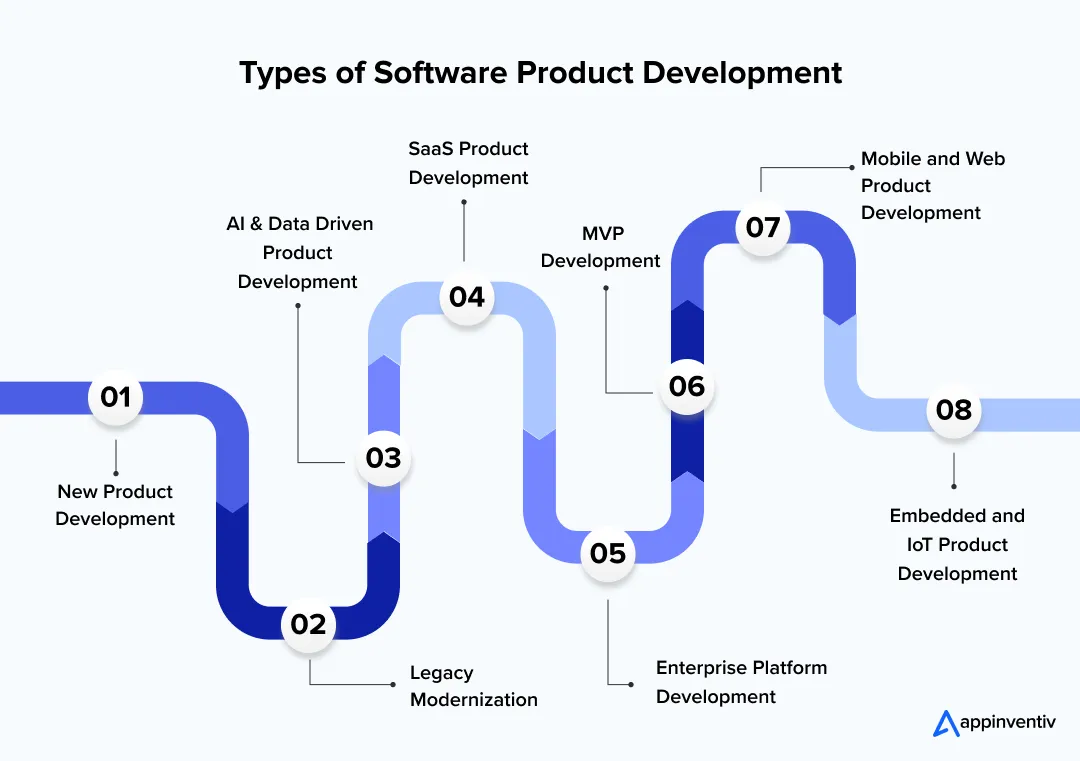
1. New product development
This is the clean slate scenario. A team has an idea and wants to turn it into a working product. It involves research, early prototypes, the first version of the design, and eventually full-scale engineering. This path is common in software product development for startup teams that need to move quickly and ship a first version to the market.
Most useful for:
- Startups validating new concepts
- Enterprises exploring new revenue models
- Businesses expanding into adjacent markets
2. Legacy Modernization
Many organizations rely on systems that were built years ago and now struggle with performance or maintenance. Modernizing these platforms often becomes unavoidable. It is a core part of enterprise software product development, especially when the older tools create operational bottlenecks or security concerns.
Most useful for:
- Companies dealing with high maintenance cost
- Systems with security or compliance gaps
- Products struggling with performance or downtime
3. MVP Development
When teams want to validate demand quickly, they begin with an MVP. It captures only the essential features needed to learn from real users. MVPs keep custom software product development lean and give companies a safer way to test an idea without overcommitting.
Most useful for:
- Idea validation
- Early stage user feedback
- Reducing development risk
4. SaaS Product Development
SaaS products run on subscription and require a structure that supports frequent updates, multi-tenant access, and stable performance. Businesses choose this route when they want predictable revenue and a product that improves continuously.
Most useful for:
- Business tools and collaboration platforms
- Products that evolve through continuous releases
- Companies shifting from on premise to cloud
5. Enterprise Platform Development
Large organizations sometimes need platforms that connect teams, workflows, and data across departments. These systems require strong architecture, deep integration capability, and a focus on reliability. This type of product software development tends to be complex but drives long-term value for the business.
Most useful for:
- Finance, healthcare, logistics, and retail
- Global teams needing unified systems
- Products supporting heavy integrations
6. Mobile and Web Product Development
Some products start with a mobile app. Others begin with a web platform. Many need both. These products focus on user experience, performance, and how the product fits into the customer’s daily routine.
Most useful for:
- B2C applications
- Employee facing tools
- Customer engagement platforms
7. Embedded and IoT Product Development
Products that interact with hardware need a different skill set. These solutions involve sensors, connectivity, real-time data, and coordination between devices and cloud services.
Most useful for:
- Smart home products
- Wearables
- Industrial IoT systems
8. AI and Data Driven Product Development
More companies now want products that learn from data or automate decisions. These tools require clean data pipelines, model training, and continuous monitoring.
Most useful for:
- Predictive analytics
- Automation platforms
- Personalization engines
Each type solves a different kind of business problem. Knowing which category your product falls into helps shape the software product development strategy and reduces a lot of uncertainty in planning the next steps.
Also Read: Understanding the Role of AI in Product Development
What Are the Key Benefits of Software Product Development?
Software product development allows businesses to move beyond short term fixes and build systems that support long term growth. Instead of adapting processes around rigid tools, teams gain products designed around real workflows, scalability needs, and future plans.
- It improves operational efficiency by reducing manual work and simplifying complex workflows across teams.
- It gives organizations full control over scalability, performance, and system reliability as demand grows.
- It enables faster innovation, allowing new features and improvements without disrupting existing operations.
- It strengthens security and compliance by embedding these requirements directly into the product design.
- It creates better customer experiences through more consistent performance and tailored functionality.
- It opens up new revenue opportunities by supporting flexible business models and continuous product evolution.
What Business Monetization Models Should You Consider Before Building a Software Product?
Before teams commit to a full software product development journey, it helps to step back and think about how the product will actually create value. Many companies focus heavily on features and architecture but leave the business model for later. That usually leads to rework or pricing guesswork that does not match how customers want to use the product. A clear model guides both the strategy and the design, and it shapes how the product grows over time.
Below are the models most teams explore when planning a long-term software product development strategy.
1. SaaS model
SaaS business ideas are often the starting point for modern products. Users pay for access, and the business earns recurring revenue. It suits companies that want steady growth and the flexibility to improve the product continuously. SaaS also works well in enterprise software product development, where clients expect frequent updates without managing the infrastructure themselves.
Works well when:
- The product evolves fast
- Customers expect cloud deployment
- Adoption depends on simple onboarding
2. Subscription model
This model feels familiar to most users. They pay monthly or yearly for ongoing value, whether that is content, features, or premium support. It is broader than SaaS and fits both B2B and B2C products. Teams like it because revenue becomes predictable and easier to forecast.
Works well when:
- The product has tiered features
- Engagement is frequent
- Customers expect regular improvements
3. Licensing model
Some clients want complete control over their deployment. They may not want data hosted externally or may need very specific configurations. Licensing provides that control. It is common in industries with strict regulations or environments that prefer on premise systems.
Works well when:
- Security and control matter more than flexibility
- Updates are less frequent
- Clients want ownership instead of ongoing payments
4. Usage based model
Here, customers pay only for what they use. Instead of fixed fees, the product grows with demand. Teams building APIs, AI tools, or data processing platforms often choose this because usage naturally fluctuates.
Works well when:
- Activity varies month to month
- Customers want a low entry cost
- The product handles high volume workloads
5. Hybrid monetization
Some products cannot fit neatly into one category. A hybrid model offers more room to experiment. A product might provide a free basic version, charge a subscription for premium features, and add a pay per use component for heavy workloads. During custom software product development, this flexibility helps teams learn which pricing paths customers respond to.
Works well when:
- User groups behave differently
- The product has multiple value layers
- The business needs time to refine pricing
When each model makes the most sense
Choosing the right model depends less on what the company prefers and more on how the customer works. For a finance platform that needs strict control, licensing might be the practical answer. For a fast evolving collaboration tool, SaaS or subscription models feel natural. For a data heavy service, usage based pricing often makes adoption easier. The model becomes part of the product’s identity and influences decisions through the entire product software development journey.
A clear business model gives shape to the roadmap and helps the team build with intention instead of guessing what will work later.
How to Plan the Architecture and Technology for an Enterprise-Grade Product
In 2025, architecture planning is less about making systems work and more about making sure they keep working as the product grows. Early decisions influence scalability, performance, and how easily teams can adapt the product over time. A strong foundation helps avoid unnecessary rebuilds later.
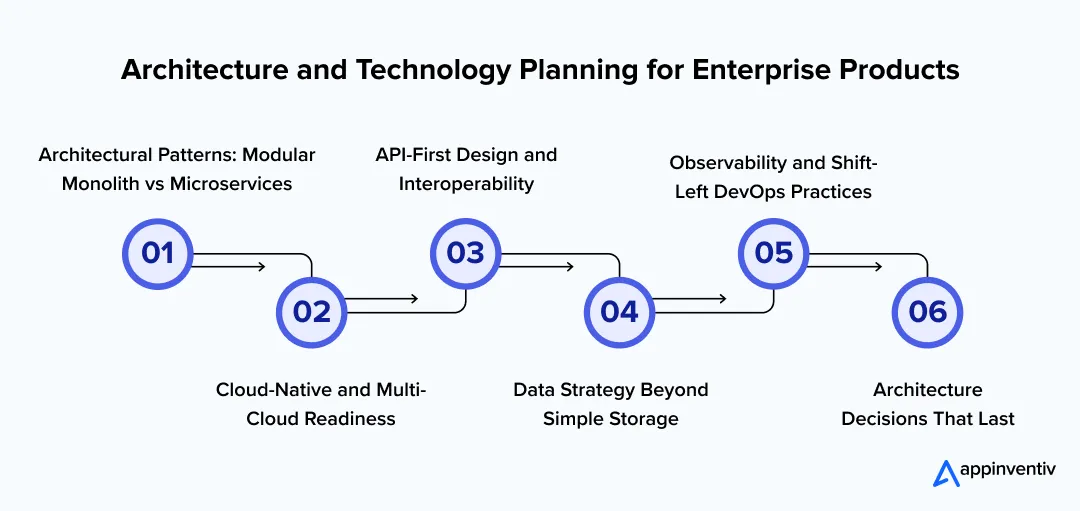
1. Architectural Patterns: Modular Monolith vs Microservices
Microservices or monolith? Which architecture to choose to start your product development journey.
While microservices are common, they introduce operational complexity early. Service coordination, monitoring, and deployment overhead can slow teams down when scale is still limited.
A modular monolith often fits early enterprise products better. It allows faster development and easier troubleshooting while keeping internal boundaries clear. Components such as payments or analytics can later be separated when scaling demands it.
For real-time use cases, especially in fintech or logistics, event-driven architecture supports responsiveness and resilience.
- Reduces tight coupling between components
- Handles real-time data flow more reliably
- Uses tools like Kafka or RabbitMQ
2. Cloud-Native and Multi-Cloud Readiness
Enterprise products benefit from cloud flexibility rather than provider dependency. Containerization with Docker and Kubernetes supports consistent deployment across environments.
Infrastructure choices depend on workload patterns.
- Serverless functions suit variable traffic
- Provisioned clusters support steady core services
- Cost efficiency improves when usage and infrastructure align
3. API-First Design and Interoperability
API integration enables enterprise systems to work together smoothly. Designing them early reduces integration risk later.
- Contract-first APIs allow parallel development
- Stable versioning prevents breaking changes
- OIDC and SAML support enterprise single sign-on
4. Data Strategy Beyond Simple Storage
Different data types require different storage models.
- Relational databases for transactions
- NoSQL for flexible data structures
- In-memory stores for speed
Data residency planning ensures compliance with regional regulations without future rework.
5. Observability and Shift-Left DevOps Practices
Visibility into system behavior becomes critical after launch. Observability tools help teams detect and resolve issues faster.
- Metrics, logs, and tracing improve reliability
- Alerts surface problems early
Security follows the same approach. Automated checks in devops pipelines help identify risks before release.
Strategic Insight: Architecture Decisions That Last
Long-term architecture choices should balance performance with maintainability and talent availability. Evaluating total cost of ownership helps ensure the product remains scalable and manageable as it evolves.
Security First Approach to Software Product Development
Security cannot be something the team revisits at the end. It has to guide choices from the first architecture sketch to the final release. A security first approach keeps the product resilient as it grows and reduces the cost of fixing issues later. It also helps teams stay compliant while moving fast in a modern software product development environment.
Core Security Practices
- Threat modeling: Map out how the system could be misused and close the obvious gaps early.
- Secure coding practices: Keep code reviews tight, track risky dependencies, and follow simple habits that prevent avoidable flaws.
- API and data protection: Treat every integration as a potential risk. Validate inputs, set sensible limits, and define API behavior clearly.
- Encryption standards: Use strong encryption for stored data and for every request moving through the system.
- IAM and access control: Keep permissions lean. Give users and services only what they need and review access regularly.
- SOC 2, GDPR, HIPAA, and PCI readiness: Build with compliance in mind so the product does not need a major redesign later.
- Security testing and audits: Run periodic reviews, penetration tests, and automated scans to catch issues before they reach production.
Common Challenges in Software Product Development and How to Overcome Them
Even well planned projects run into problems. Many of the challenges in the software product development process show up quietly at first, long before the product reaches production. Some issues come from unclear expectations, some from technical gaps, and others simply from the way different teams work. How a team responds to these pressure points usually decides whether the project keeps moving or slowly drifts off track.
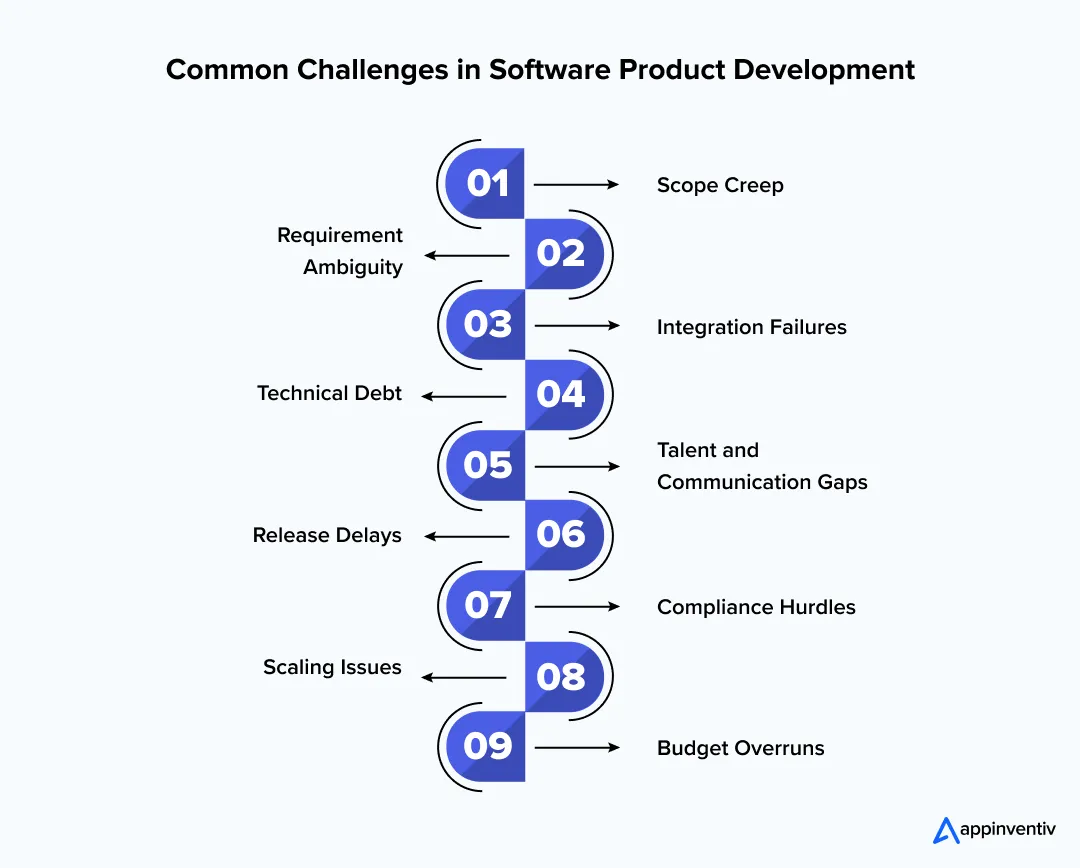
1. Scope Creep
New ideas always surface once people see early builds. That energy is useful, but it becomes a problem when the extra work slips in without adjusting timelines or budgets.
How to handle it: Set a clear baseline for each phase and evaluate every new request against real business value. A quick approval loop between product and engineering helps keep changes in check.
2. Requirement Ambiguity
It is common for teams to think they are aligned, only to discover later that people imagined different outcomes for the same feature.
How to handle it: Talk through requirements in detail, show simple screens or workflows, and write down acceptance criteria before development starts.
3. Integration Failures
Most products depend on other systems. When assumptions around data formats, authentication, or response times are unclear, integrations usually break at the worst possible stage.
How to handle it: Finalize API contracts early and test integrations in a realistic staging setup. Keep the communication open with system owners on both sides.
4. Technical Debt
Shortcuts help you move quickly at the start, but they slow everything down later. Over time, bugs increase and features take longer to ship.
How to handle it: Plan small clean up cycles into the roadmap. Regular maintenance is far easier than one massive correction months later.
5. Talent and Communication Gaps
Even skilled teams struggle when the right expertise is missing or when updates are not flowing between design, engineering, and product.
How to handle it: Form cross functional groups, schedule short alignment meetings, and make responsibilities clear. Bring in experienced software product developers when the team needs extra depth.
6. Release Delays
Releases slip when testing starts too late or deployment steps are rehearsed for the first time on launch day.
How to handle it: Test smaller chunks earlier, automate repetitive checks, and run trial deployments in lower environments so the final release feels predictable.
7. Compliance Hurdles
Products that handle sensitive data face more scrutiny. If compliance is not part of the early architecture, it slows everything down near launch.
How to handle it: Address compliance from the beginning. Define how the product will store, encrypt, and audit data so the overall design aligns with regulatory expectations.
8. Scaling Issues
A product may work smoothly with early users but start to slow down as traffic increases.
How to handle it: Run load tests early and monitor where the system struggles. Adding caching, optimizing queries, or setting autoscaling rules prevents most scaling surprises.
9. Budget Overruns
Budgets stretch when requirements shift or integration work becomes more complex than expected.
How to handle it: Use milestone based budgeting, track progress often, and make scope decisions with both business value and cost impact in mind.
How Do You Manage a Software Product After Launch?
The real work for many teams begins once the product is live. A successful release is only the first milestone in the broader software product development journey. Mature organizations treat post-launch management as an ongoing lifecycle, not a maintenance task. This is where stability, performance, and user trust are built over time.
Version Management
After the initial rollout, products typically move through planned version cycles. Each version reflects improvements, security updates, and structural changes guided by the software product development strategy.
Key actions:
- Maintain a clear versioning policy
- Track release notes for internal and customer visibility
- Map versions to roadmap goals
Patch Releases
Not every fix needs a major release. Patches help address urgent issues quickly without disrupting long-term plans.
Key actions:
- Deploy small fixes for bugs, security gaps, or performance issues
- Use automated CI pipelines for rapid patch deployment
- Validate patches through lightweight regression tests
Performance Monitoring
Once users start relying on the product, monitoring becomes your early warning system.
Key actions:
- Track API response times, error rates, and latency
- Use dashboards and alerts to detect anomalies
- Review logs and traces to pinpoint bottlenecks
This layer becomes essential for enterprise-scale software product development where uptime and reliability matter.
User Feedback Loops
Real usage reveals what no design workshop can. Gathering structured feedback shapes future decisions.
Key actions:
- Analyze support queries, usage patterns, and drop-offs
- Conduct user interviews for deeper insights
- Feed learnings back into the product roadmap
Feature Experiments
Experimentation helps teams validate ideas before committing full engineering time.
Key actions:
- Run A/B tests on workflows, messages, or new capabilities
- Measure impact through activation and conversion metrics
- Prioritize features based on real outcomes, not assumptions
This aligns with modern product software development methods where data guides decisions.
Continuous Improvement Pipelines
Strong teams build infrastructure that supports frequent, low risk updates.
Key actions:
- Use CI and CD pipelines for automated testing and deployment
- Maintain a clean backlog with clear priorities
- Refactor modules regularly to control technical debt
long-term Support Models
As the product matures, different user groups may need different levels of support.
Key actions:
- Define maintenance cycles for older versions
- Plan support windows based on customer contracts
- Introduce phased deprecation for outdated modules
A structured support model strengthens trust and reduces operational risk.
Also Read: Post Launch App Mistakes to Avoid at All Cost
Best Practices for Successful Product Development
Teams that deliver strong products usually follow a few steady habits. These habits often become the software product development best practices that mature organizations rely on to keep products stable and scalable.
Whether you are building a new platform or refining an existing one, these practices improve the flow of software product development without slowing teams down.

Start With Discovery
Discovery gives everyone a shared understanding of the problem. It also prevents teams from building features that look good on paper but add little value in practice.
What teams focus on:
- A clear definition of the user problem
- Early conversations with real users
- Alignment across design, engineering, and business
Design Scalable Architecture Early
Even if the product starts small, it should not corner itself technically. A little foresight helps avoid expensive rebuilds later.
Good starting points:
- A modular structure that can grow with new features
- Data models that hold up as usage increases
- Cloud services chosen for long-term flexibility
Keep Security Integrated
Security works best when it becomes part of everyday engineering choices, not a separate checkpoint right before launch.
Security habits that help:
- Strong access control patterns
- Encryption for stored and moving data
- Routine checks on third-party libraries
Build an MVP Before Scaling
An MVP helps teams see how users behave, which often looks different from early assumptions. It keeps the software product development strategy grounded in reality.
Why this matters:
- Faster learning cycles
- Clearer signals about product-market fit
- More confidence before scaling
Automate Testing
Automation frees teams from repetitive work and helps them catch issues earlier in the cycle.
Common automation areas:
- Unit and regression tests
- API testing
- Integration checks for complex workflows
Use DevOps for Faster Releases
A strong DevOps culture gives teams the confidence to release more often without risking stability.
Payoff areas:
- Consistent deployments through CI and CD
- Early detection of issues through monitoring
- Predictable release timelines
Document Everything
Documentation does not need to be long. It just needs to be clear enough that the next person understands the decisions made along the way.
Documentation to maintain:
- Architecture choices and reasoning
- API definitions
- Notes for each release cycle
Add Analytics for Product Insights
Real usage tells a clearer story than assumptions. Analytics highlight what users value and where they struggle.
Useful metrics:
- Activation patterns
- Completion of key workflows
- drop-off points across journeys
Maintain Collaboration Across Teams
Products slow down when teams operate in isolation. The best outcomes come from steady communication and shared responsibility.
Collaboration patterns that work:
- Joint planning sessions
- Early involvement of engineers in design decisions
- Regular check ins between product and business stakeholders
When teams follow these software product development best practices consistently, they reduce rework and make decision making much cleaner across the product life cycle.
Software Development Cost and Timeline in 2025
The software product development cost in 2025 typically ranges from $40,000 to $400,000, depending on scope, architecture decisions, team structure, and the level of complexity involved.
Timelines also vary widely because each product demands a different mix of engineering depth, integrations, and compliance requirements. Understanding the major cost drivers helps teams plan budgets with more clarity.
Factors Affecting Cost
Several elements influence the overall investment in software product development.
- Product complexity and the number of features
- Depth of integrations with CRMs, ERPs, payments, or external systems
- Architecture choices such as microservices or event driven design
- UI and UX sophistication
- Level of automation, DevOps maturity, and cloud requirements
- Compliance needs, especially in finance, healthcare, or data-sensitive sectors
Regional Cost Breakdown (US, UK, UAE, India, Canada)
Development rates shift significantly by geography.
- US and Canada: Higher engineering rates but strong expertise for enterprise projects
- UK: Mid to high range with strong product strategy and design talent
- UAE: Competitive pricing for cloud, fintech, and government tech programs
- India: High-quality engineering at lower cost, ideal for full-scale builds, distributed teams, and offshore software product development setups
MVP vs full-scale Cost
The difference between an MVP and a full-scale product is more than the number of features. It affects how teams plan architecture, allocate budget, and pace the entire software product development effort. An MVP helps teams move fast and reduce risk, while a full build focuses on long-term stability and depth.
Why MVP costs less:
- It includes only the essential features needed to test the idea.
- Architecture is kept lean, designed to evolve later.
- Integrations are minimal or avoided entirely.
- UI and UX focus on clarity rather than high polish.
- Testing stays limited to core flows.
Why full-scale products cost more:
- They cover multiple user groups and complete workflows.
- Architecture needs to support scaling, resilience, and multi-region readiness.
- Heavy integrations with CRMs, ERPs, payments, analytics, and external APIs.
- Advanced UI, UX, and accessibility work.
- Stronger security, role-based access, audit trails, and compliance needs.
- Larger testing scope, including automation, load testing, and performance optimization.
How MVP helps save cost in the long run:
- Avoids investing early in features users may not want.
- Provides real usage insights to refine the software product development strategy.
- Helps validate business assumptions with lower financial risk.
- Lays the foundation for a modular full-scale build later.
MVP vs full-scale Cost Comparison
| Item | MVP Cost Range | full-scale Cost Range | Notes |
|---|---|---|---|
| Overall Cost | 40k to 120k USD | 150k to 400k USD | Depends heavily on scope and engineering depth |
| Feature Depth | Essential features only | End to end workflows and advanced modules | MVP tests viability before expansion |
| Architecture | Lean and modular | Scalable and enterprise ready | Full build includes redundancy and performance tuning |
| Integrations | Minimal or none | CRM, ERP, payments, analytics, external APIs | Integration depth is a major cost driver |
| UI and UX | Functional and simple | High fidelity, polished design systems | full-scale demands richer interaction patterns |
| Security Level | Basic protections | Compliance aligned security and hardened setup | Important for finance, healthcare, and regulated sectors |
| Timeline | 2 to 4 months | 6 to 14 months | Complexity and team size affect delivery speed |
| Testing Scope | Functional and regression tests | Automation, performance, accessibility, cross platform | Testing grows as product footprint expands |
| Goal | Validate the idea | Build a long-term, revenue-ready product | MVP reduces risk before major investment |
Timeline by Complexity
Development speed depends on team size, clarity of requirements, and the product’s technical structure.
- Simple products: 3 to 4 months
- Mid complexity platforms: 5 to 8 months
- Enterprise systems or multi-module platforms: 9 to 14 months
Cost Saving Strategies
Teams can reduce overall cost without compromising quality through practical choices.
- Start with an MVP instead of a full build
- Use modular architecture to avoid expensive rewrites
- Adopt DevOps and automation to reduce delivery delays
- Reuse components, templates, and existing internal APIs
- Keep the scope controlled through clear discovery
Success Stories and Real Product Outcomes
Our team excels at crafting digital solutions tailored to the unique demands of our clients. Through these detailed case studies, we demonstrate our commitment to innovation and our ability to drive significant business value. Each product we developed for our clients reflects our technical expertise and highlights our strategic approach to solving complex challenges in various industries.
Let us look at the multiple software product development examples that our dedicated team is famous for:
JobGet: Transforming the Job Search Landscape with AI
Our experts developed a groundbreaking AI-powered Job Search Platform designed to expedite the job search process for blue-collar workers, dramatically reducing the time from months to days. The software was able to not only streamline job searching but also lead to significant achievements:
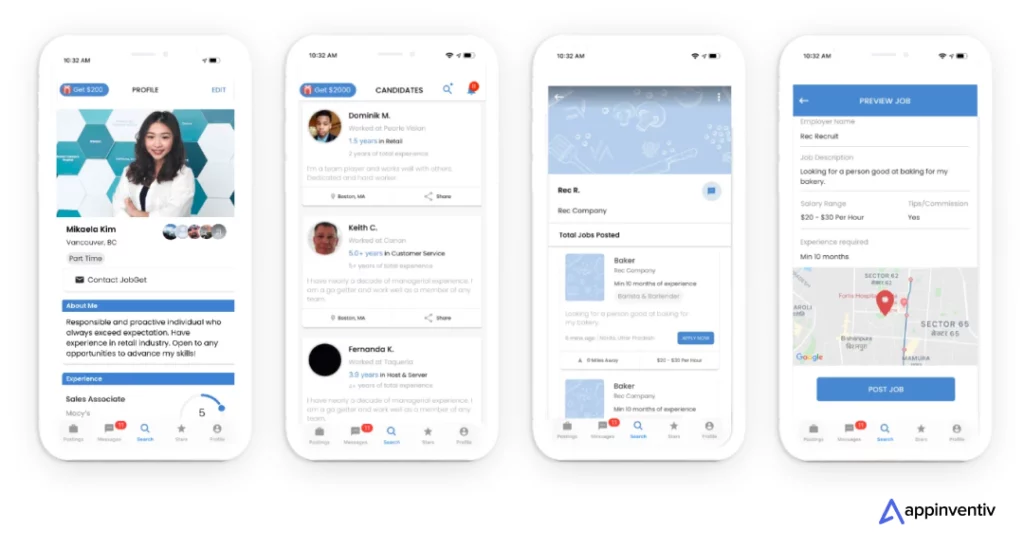
- Successfully raised $52 million in Series B funding, evidencing investor confidence and the app’s market potential.
- Surpassed 2 million downloads, indicating strong market acceptance and user engagement.
Edfundo: Educating the Next Generation on Financial Literacy
Our experts developed EdFundo, an engaging financial education platform that equips children with essential money management skills from an early age. The platform is recognized as the world’s first financial intelligence hub, which includes a digital learning lab and a prepaid debit card. It is designed to introduce economic concepts to children in a user-friendly manner. The software helps children learn about money management and provides parents with tools to support their children’s financial education.
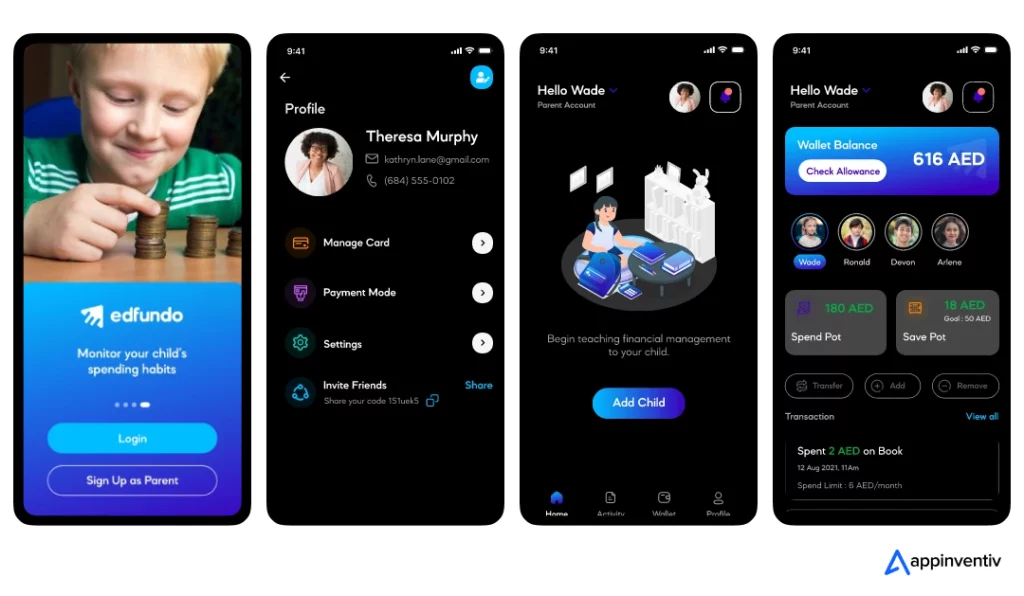
- Secured $500K in pre-seed funding, underscoring the trust and support from early investors.
- Honored as the FinTech Startup of the Year, highlighting its innovation and impact in the financial technology sector
ILITY: Innovating Real Estate Management
Our experts developed ILITY, a sophisticated SaaS platform designed to transform the real estate sector by enhancing operational efficiencies and profitability. This comprehensive solution streamlines property management processes, from listing and lease management to maintenance, fostering substantial growth opportunities:
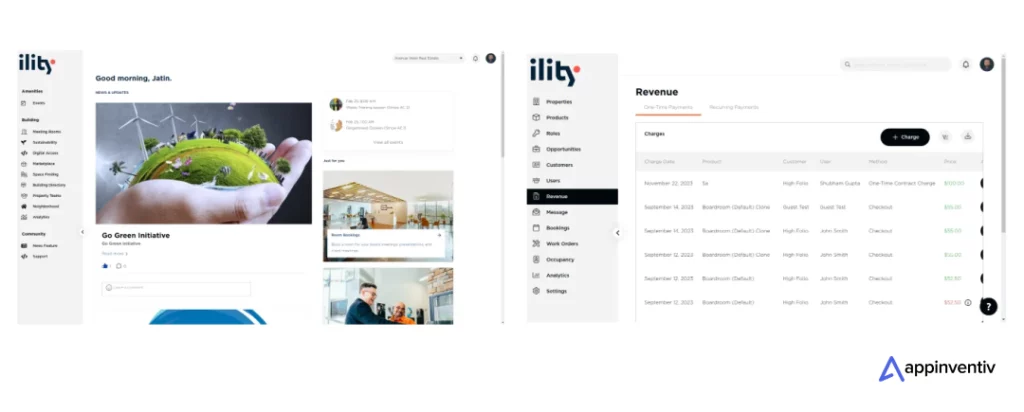
- This led to a 40% increase in occupancy, demonstrating its effectiveness in enhancing property appeal.
- Enhanced landlord ROI by 2%, ensuring optimized operations and cost-effectiveness.
KFC: Revamping a Global Brand’s Digital Presence
We partnered with KFC to overhaul its digital footprint globally, developing and launching over seven KFC innovative software applications within a year. The product yielded significant enhancements in customer engagement and sales metrics:
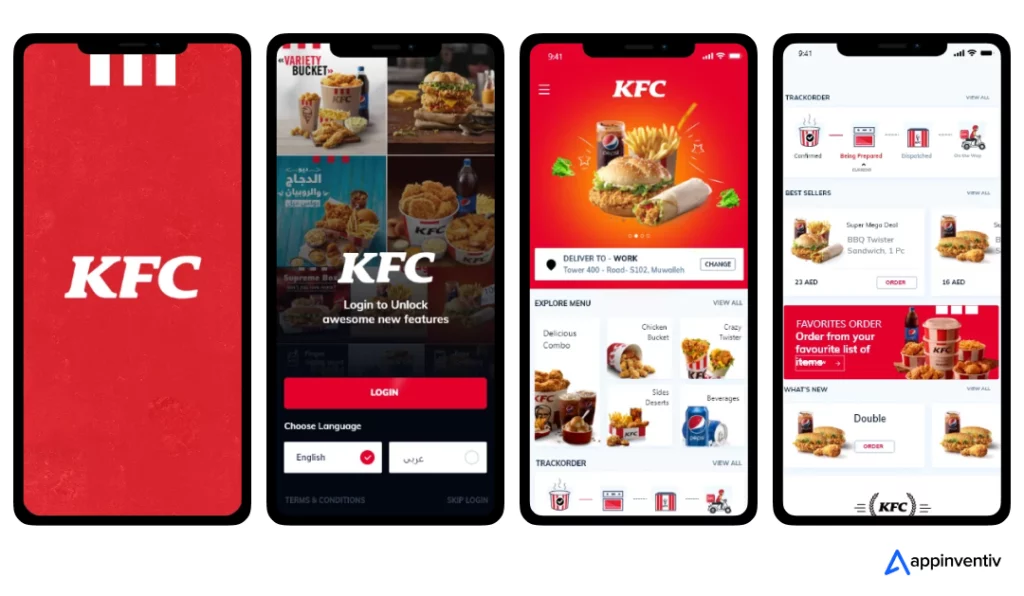
- Enhanced the conversion rate by 22%, driving more sales through digital channels.
- Achieved a 4.5 average rating across app stores, reflecting high user satisfaction.

How Appinventiv Helps Enterprises Build Scalable Software Products
Enterprises often need more than engineering support. They look for a partner who can guide strategy, refine architecture, and help the product grow without running into technical limits. Appinventiv brings this end to end capability through consulting, strong engineering practices, and deep architectural expertise.
Our focus on software product development allows us to help organizations plan the right foundation early, so the product can scale confidently as user needs and business priorities evolve.
We combine cloud native engineering, DevOps automation, UI and UX excellence, and security by design to build reliable, high performing systems. As a custom software development company, we also craft solutions that fit the business instead of forcing teams to adjust to rigid, off the shelf products.
QA automation, post launch support, and our track record of delivering more than 2000 products with a 95 percent on time record reinforce this approach. With recognition from Deloitte Fast 50 India and APAC’s High Growth Companies, enterprises trust us to build systems that stay stable and future ready.
If you are planning a new product or modernizing an existing one, our teams can help you shape a solution that scales with your business.
FAQs
Q. What is software product development?
A. Software product development is the end to end process of designing, building, testing, deploying, and improving a digital product that serves a specific user need or business function. Unlike one off tools or internal utilities, a product is built with scalability, repeatability, and long term evolution in mind. It brings together discovery, architecture planning, engineering, security, and ongoing optimization to create a solution that can support sustained growth.
Q. What is the difference between software development and software product development?
A. Software development usually refers to building a specific application or feature to solve a defined problem. Software product development takes a broader view. It involves strategy, user research, roadmap planning, versioning, long term maintenance, and an architecture that can support new features over time. In simple terms, software development builds a solution. Software product development builds a scalable product that evolves with the business and its users.
Q. How do GDPR requirements impact software product development?
GDPR influences several decisions throughout the product lifecycle. Teams must define how personal data is collected, processed, stored, and deleted. Consent management, data minimization, breach reporting, and user rights (access, correction, erasure) need to be built into the architecture from the start. For any software product development effort targeting EU users, GDPR compliance shapes the database schema, API behavior, audit logs, and security controls across the system.
Q. How do I ensure my software meets SOC 2 compliance requirements?
A. Meeting SOC 2 expectations requires a structured approach to security, availability, processing integrity, confidentiality, and privacy. During software product development, teams establish strong access control, encryption policies, incident monitoring, secure deployment pipelines, and detailed documentation. Regular audits, vulnerability checks, and change tracking help verify that the product continues to meet SOC 2 standards as it evolves. Building these controls early is the most reliable way to avoid costly redesigns later.


- In just 2 mins you will get a response
- Your idea is 100% protected by our Non Disclosure Agreement.

In today’s digital age, having a strong online presence is the key to unlocking the door of business transformation and reaching the target audience. One of the most efficient ways to achieve this is through web app development. Web applications have grown at an unprecedented pace in the past decade, revolutionizing operations across various industries.…
When it comes to mobile app development, a million-dollar question (sometimes literally) keeps businesses awake at night: How much does it cost to build a mobile app that can compete in today's market? It’s a valid concern, as the cost of creating an app can vary dramatically depending on numerous factors. But here’s the thing—app…
Healthcare is at a turning point where digital transformation isn't just an advantage but a core strategy for delivering better patient outcomes and operational resilience. In Deloitte's 2026 US Health Care Outlook, more than two-thirds of health plan and system leaders say they expect to outperform competitors next year, even as strategic uncertainty rises amid…