


























Why Healthcare Needs Speech Recognition Software and How to Build It Right?


- Market Trends and Analysis: The Growing Demand for Healthcare Speech Recognition
- Types of Medical Speech Recognition Software
- AI-Powered Medical Speech Recognition: The Technology Revolution
- How to Build Healthcare Speech Recognition Software: A Strategic Approach
- Addressing the Challenges of Implementing Speech Recognition Systems in Healthcare
- Cost Analysis and ROI Considerations for Speech Recognition Software Development in Healthcare
- Medical Speech Recognition Solutions for Different Healthcare Settings
- Real-World Success Stories: Healthcare Institutions Leveraging Speech Recognition
- Key Benefits of Speech Recognition Medical Systems
- Future Innovations and Emerging Trends in Medical Speech Recognition Software
- How Appinventiv Helps You Leverage Speech Recognition Technology in Healthcare
- Frequently Asked Questions

Key Takeaways
- Speech recognition in healthcare is expected to grow to $3.16 million by 2030. It’s now needed for competitive positioning and lasting patient care delivery.
- Real setups show 99% documentation accuracy, 60% faster response times, and 30-45% less documentation time.
- The systematic approach to implementing speech recognition software in healthcare includes requirements analysis, feature planning, data collection, model training, system integration, compliance testing, and ongoing optimization
- The cost to develop healthcare speech recognition software ranges between $40,000 and $400,000 or more.
The healthcare world is going through a digital change that’s reshaping how medical workers deliver patient care. At the center of this shift sits a technology that’s becoming more necessary: speech recognition software. This powerful tool isn’t just changing how doctors document patient meetings but really altering the healthcare world.
Picture a world where doctors can focus completely on patient care instead of drowning in office paperwork. Where medical documentation happens smoothly in real-time, and healthcare providers can see more patients while keeping higher quality care. This isn’t a future dream but today’s reality for medical organizations using speech recognition technology in healthcare.
This change is happening faster than ever before. Healthcare companies are learning that speech recognition technology gives immediate benefits (details later) while getting them ready for the future of digital healthcare. The technology adapts to individual speaking patterns and medical words, getting more accurate over time while smoothly connecting with current healthcare systems.
Interested in exploring more about speech recognition technology in healthcare? Then this blog is for you. It covers the growing need for speech recognition in healthcare, its key benefits, the challenges organizations face when adopting this technology, and the steps to building an effective solution that integrates seamlessly into existing workflows.
Must Read: How Voice Technology in Healthcare Elevates Patient Care
Market Trends and Analysis: The Growing Demand for Healthcare Speech Recognition
The numbers tell a compelling story about the explosive growth in this sector. The global medical speech recognition software market reached $1.52 million in 2023 and is projected to grow to $3.16 million by 2030, representing a remarkable compound annual growth rate of 11.21%.
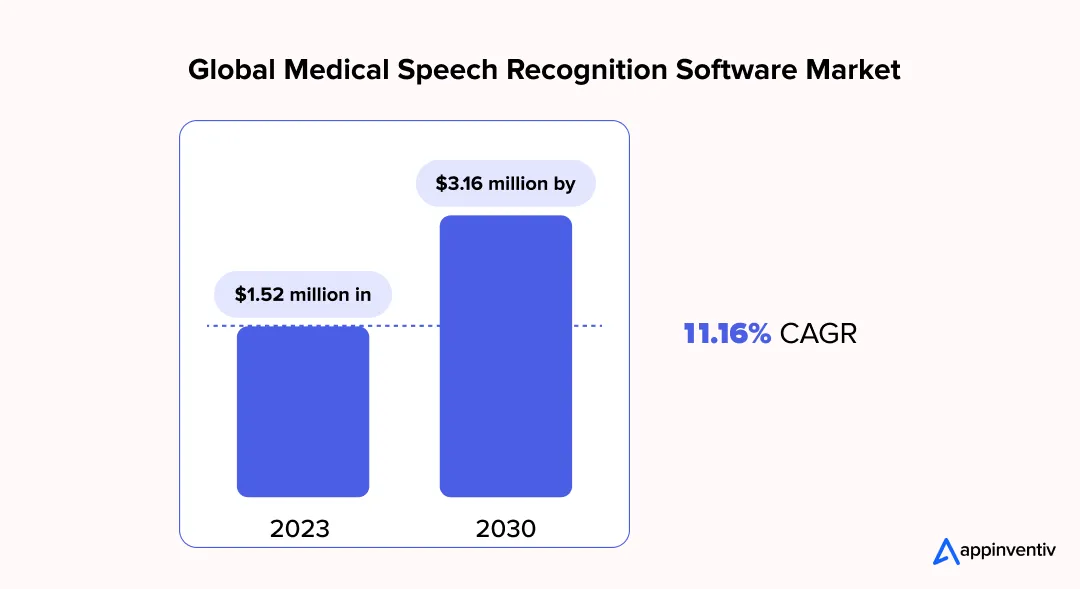
These statistics underscore the rapid adoption of speech recognition in healthcare across medical institutions worldwide. What’s pushing this big growth? Several key things are coming together to create the right environment for adoption:
- Doctor Burnout Problem: Healthcare providers face big levels of burnout, with office tasks eating nearly 35% of their working time
- Rule Requirements: Government plans and rule mandates are pushing healthcare companies toward digital documentation processing via AI
- Telemedicine Growth: The expansion of virtual healthcare platforms needs efficient documentation methods
- Technology Progress: AI and machine learning improvements in healthcare have really enhanced speech recognition accuracy
- Cost Pressures: Healthcare companies face growing pressure to cut operational costs while keeping quality care
Related Article: Role of AI Virtual Health Assistant in Healthcare
Types of Medical Speech Recognition Software
The landscape of medical speech recognition software encompasses various solutions designed to meet different healthcare needs and organizational structures. Understanding these types of medical speech recognition software helps healthcare leaders make informed decisions about implementation strategies that best serve their specific requirements.
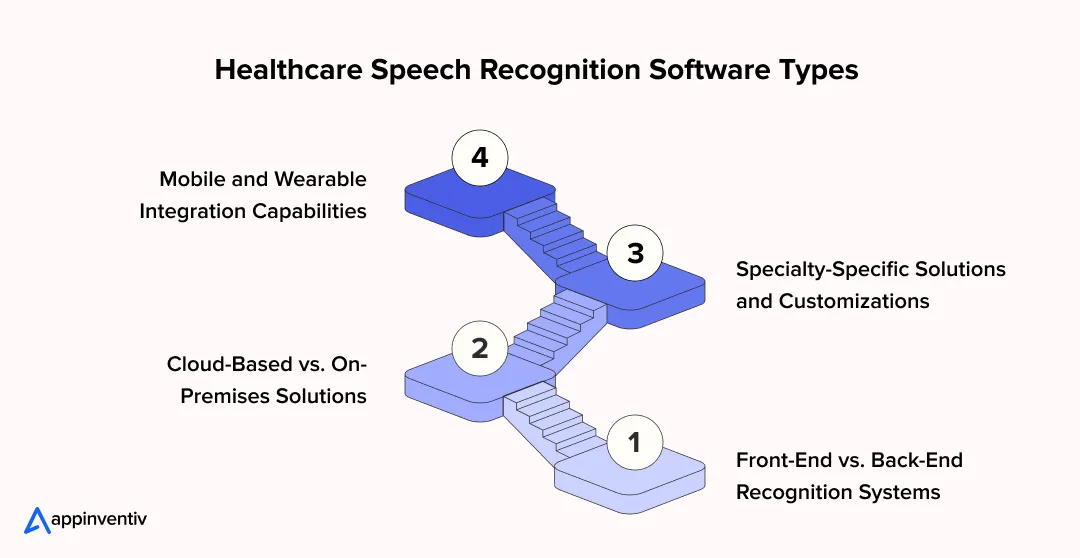
Front-End vs. Back-End Recognition Systems
Front-end systems handle speech in real-time during patient visits, with text showing up right away on screen for quick review and editing. Back-end systems handle recorded dictations after clinical visits, allowing for batch handling and quality review. Many modern setups combine both approaches for maximum flexibility and workflow improvement.
Cloud-Based vs. On-Premises Solutions
Cloud solutions offer growth ability, automatic updates, and cut IT overhead while providing easy optimization with existing EHR systems. These solutions support remote access abilities needed for telemedicine uses. On-site solutions provide better security control and customization options for companies with specific compliance requirements or data control needs.
Specialty-Specific Solutions and Customizations
Different medical areas have unique documentation requirements and word needs. Radiology departments need systems built for imaging report dictation, while emergency medicine needs solutions supporting rapid, urgent documentation. Specialized speech recognition technology in healthcare solutions serves these specific needs with trained vocabularies, workflow improvements, and area-specific templates.
Mobile and Wearable Integration Capabilities
Modern healthcare speech recognition uses mobile devices and wearable technology to support flexible documentation workflows. Doctors can use smartphones as wireless microphones, allowing documentation anywhere within the healthcare facility. Some systems connect with smart badges or headsets for hands-free operation during procedures.
AI-Powered Medical Speech Recognition: The Technology Revolution
The change to AI-powered medical speech recognition shows a big jump in healthcare technology abilities. Modern healthcare systems use artificial intelligence, machine learning, and natural language processing to deliver great accuracy and functionality that keeps getting better over time.
Machine Learning and Continuous Improvement
Today’s AI-powered medical speech recognition systems learn all the time from user conversations and corrections. Every usage pattern, correction, and preference helps make the system’s accuracy and personalization better.
This learning ability means the technology gets more accurate over time, adapting to individual doctors’ speech patterns, word preferences, and documentation styles.
Natural Language Processing Integration
Advanced NLP abilities in healthcare let these systems understand context, medical relationships, and clinical reasoning patterns with great skill. The technology can tell the difference between similar-sounding medical terms based on clinical context, cutting errors and making documentation quality better.
In the modern medical voice recognition software development process, now engineers use these smart AI abilities to deliver human-like understanding of medical conversations.
Voice Biometrics and Enhanced Security
Modern systems use voice biometrics for better security and smooth user checks. The technology can identify individual speakers with high accuracy, making sure that only authorized workers can access patient information while getting rid of the need for password entry. This security feature adds protection while actually making workflow efficiency better.
Multi-Language Support and Integration Capabilities
Healthcare companies serve diverse populations, and modern speech recognition technology in healthcare systems handles multiple languages, dialects, and accents. These systems also connect smoothly with clinical decision support tools, giving real-time alerts, drug interaction warnings, and evidence-based recommendations during documentation processes.
Must Read: How to Build an AI Voice Agent
How to Build Healthcare Speech Recognition Software: A Strategic Approach
Developing effective speech recognition solutions requires careful planning, technical expertise, and a deep understanding of healthcare workflows. Organizations considering this path must navigate complex technical, regulatory, and operational requirements while ensuring solutions meet real-world clinical needs and deliver measurable value. Here is a step by step approach to speech recognition software development in healthcare:
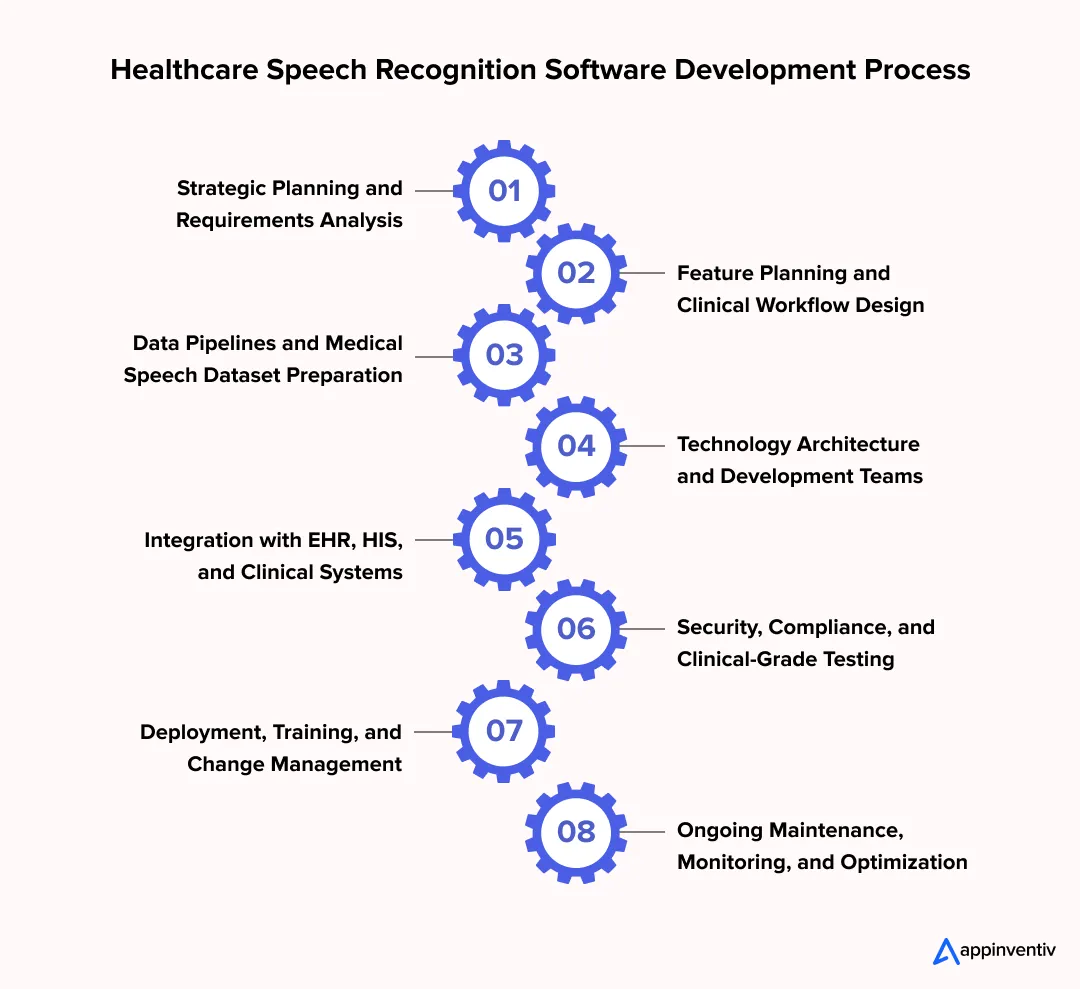
Strategic Planning and Requirements Analysis
Successful speech recognition software development in healthcare starts with complete requirements analysis and strategic planning. Companies must carefully check current documentation workflows, find specific pain points, and set clear success measures. This analysis should include lots of input from doctors, nurses, administrators, and IT staff to make sure the solution fixes actual user needs rather than guessed requirements.
Key planning thoughts include current documentation amounts and patterns, connection requirements with existing EHR systems, security and compliance requirements, user training and support needs, and budget limits with clear return on investment hopes.
Feature Planning and Clinical Workflow Design
Features matter only when they make sense in a real clinical environment. Before development begins, teams should decide what the software will do and how clinicians will use it during patient visits, rounds, and procedures. This helps ensure the final product supports daily routines instead of interrupting them.
Here is a table outlining the list of essential and advanced features for healthcare speech recognition software development:
| Essential Features | Advanced Features |
|---|---|
| Real-time speech-to-text transcription | Predictive documentation (auto-suggesting phrases based on clinical context) |
| Medical terminology and specialty-based vocabularies | Real-time clinical decision support during dictation |
| Voice commands for navigation and data entry | Voice biomarker analysis for early health insights |
| Multi-speaker recognition (doctor, patient, nurse) | Automatic summarization of long clinical conversations |
| Pre-built templates for common clinical notes | Context-aware NLP models that interpret clinical intent |
| Accent, dialect, and multi-language support | Noise-adaptive AI models for ER, ICU, and OR environments |
| Secure voice authentication (voice biometrics) | Integration with AI scribe systems (ambient clinical intelligence) |
| Offline transcription support (for low-connectivity areas) | Advanced multi-device syncing (mobile, desktop, wearables) |
| Error correction and smart editing tools | Automated coding suggestions (ICD/CPT) to support billing accuracy |
| Support for structured and unstructured data entry | Automatic population of EHR fields using FHIR/HL7 standards |
| Basic analytics dashboard for usage and accuracy | Department-level analytics for adoption, accuracy, and workflow performance |
| HIPAA-grade apps for securing voice data | Adaptive learning for individual clinician speech patterns |
Data Pipelines and Medical Speech Dataset Preparation
Accuracy depends on the quality of the audio the system learns from. Medical speech is full of abbreviations, drug names, and fast conversations. The dataset needs to reflect that reality.
What this step usually involves:
- Collecting real clinical audio samples
- Adding varied accents and speech styles
- Including noise from hospitals and clinics
- Creating labeled data for training
- Preparing specialty-specific terminology
Technology Architecture and Development Teams
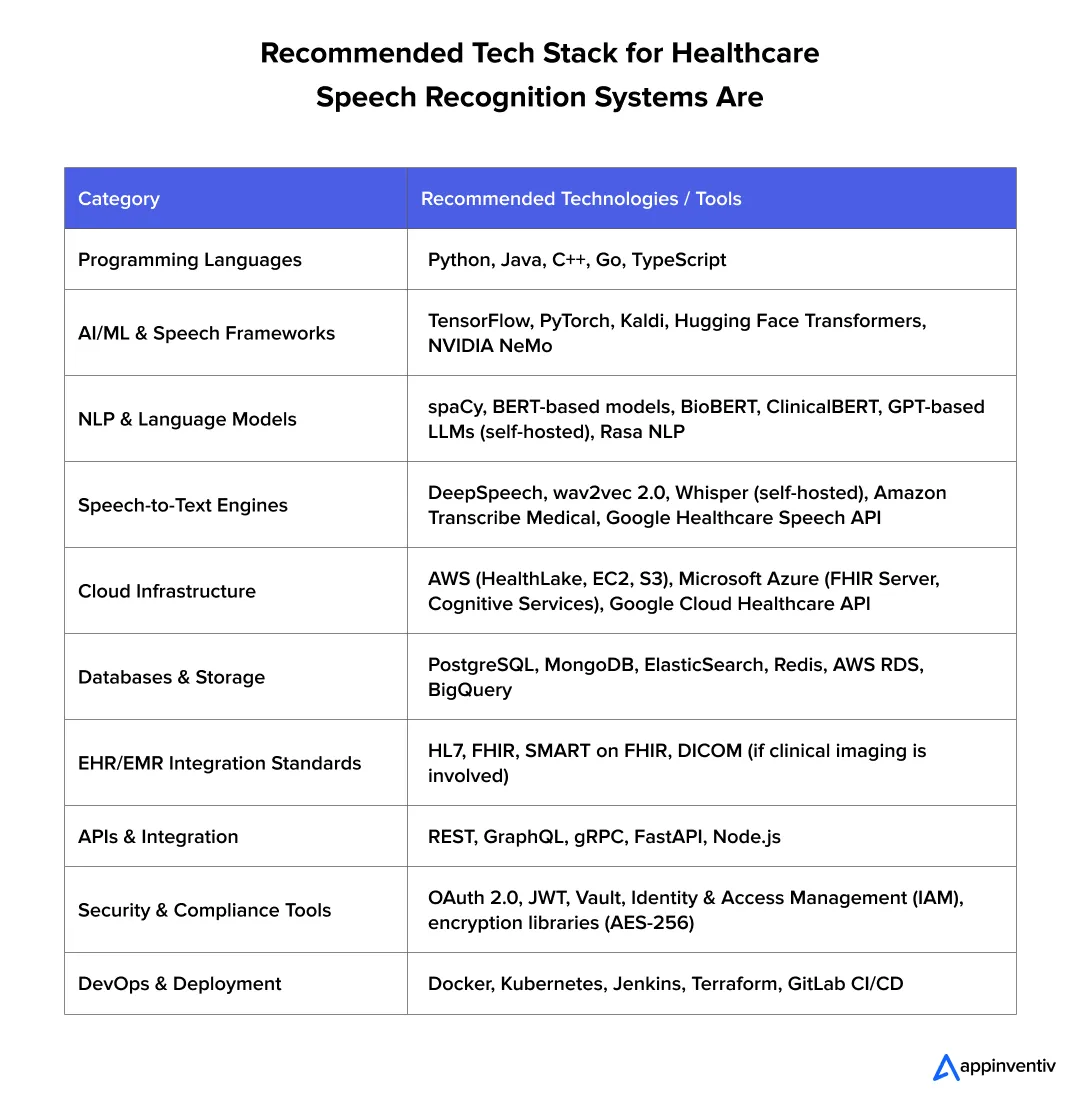
Modern medical voice recognition software development needs smart technology stacks using artificial intelligence, natural language handling, and secure cloud setup. The design must support real-time handling, high availability, and smooth connection with healthcare information systems while keeping strict security standards.
Building these systems needs teams from different areas combining healthcare knowledge with advanced technical skills. Development teams should include healthcare informatics specialists understanding clinical workflows, AI/ML engineers with speech recognition knowledge, software architects experienced in healthcare systems connection, security specialists familiar with healthcare compliance requirements, and user experience designers understanding clinical environments.
Integration With EHR, HIS, and Clinical Systems
A speech engine is only useful when it connects to the rest of the hospital’s technology. Integration is often one of the most time-consuming parts, but it’s also where the system becomes truly valuable.
Integration tasks include:
- Ensuring HL7/FHIR compatibility
- Mapping dictated content into EHR fields
- Secure medical speech recognition APIs integrations
- User identity and access controls
- Sync across desktop, mobile, and web interfaces
Security, Compliance, and Clinical-Grade Testing
Speech data carries sensitive patient details. That’s why compliance and testing are ongoing, not one-time tasks. Testing also must happen inside real clinical settings and not just in a lab.
What must be covered:
- HIPAA/GDPR checks and encryption
- Pen-tests and security reviews
- Accuracy tests across noise levels
- Latency tests during peak hours
- Department-wise user acceptance testing
Deployment, Training, and Change Management
Rolling out speech recognition is as much about people as it is about technology. Clinicians need to feel confident using it, and that requires training that fits their schedules.
Important rollout steps:
- Phased deployment across departments
- Short, practical training sessions
- On-site and remote support during early use
- Quick feedback loops to fix workflow issues
Ongoing Maintenance, Monitoring, and Optimization
Speech recognition is not something you can “build once and forget” forever. Medical language changes, hospital settings change, and so do user needs. Therefore, the system must evolve with them.
Maintenance work involves:
- Regular AI model retraining
- Updating medical terms and templates
- Performance tuning
- Security updates and patches
- Adding new clinical workflows over time
Leveraging Custom Healthcare Software Development Companies
Most healthcare companies lack the internal knowledge needed for good speech recognition software development in healthcare. The best choice is to use services of a custom healthcare software development company that gives access to proven methods, experienced teams, and established best practices in healthcare technology development.
These strategic partnerships offer several important advantages:
- Cut development timelines through proven frameworks and methods
- Access to specialized healthcare technology knowledge and area expertise
- Established relationships with healthcare technology vendors and connection partners
- Ongoing support and maintenance abilities with dedicated healthcare focus
- Risk cutting through proven setup experience and established best practices
Custom healthcare software development companies bring a deep understanding of healthcare rules, connection challenges, and user adoption strategies. They can guide companies through complex speech recognition software product development in healthcare processes while avoiding common problems that often mess up internal development efforts.
Addressing the Challenges of Implementing Speech Recognition Systems in Healthcare
While speech recognition technology offers big benefits, its implementation in the sector is not without challenges. The healthcare companies must handle several problems to make sure successful setup works. Understanding these limits helps with better planning and more effective solutions that get the most system value while cutting potential issues.
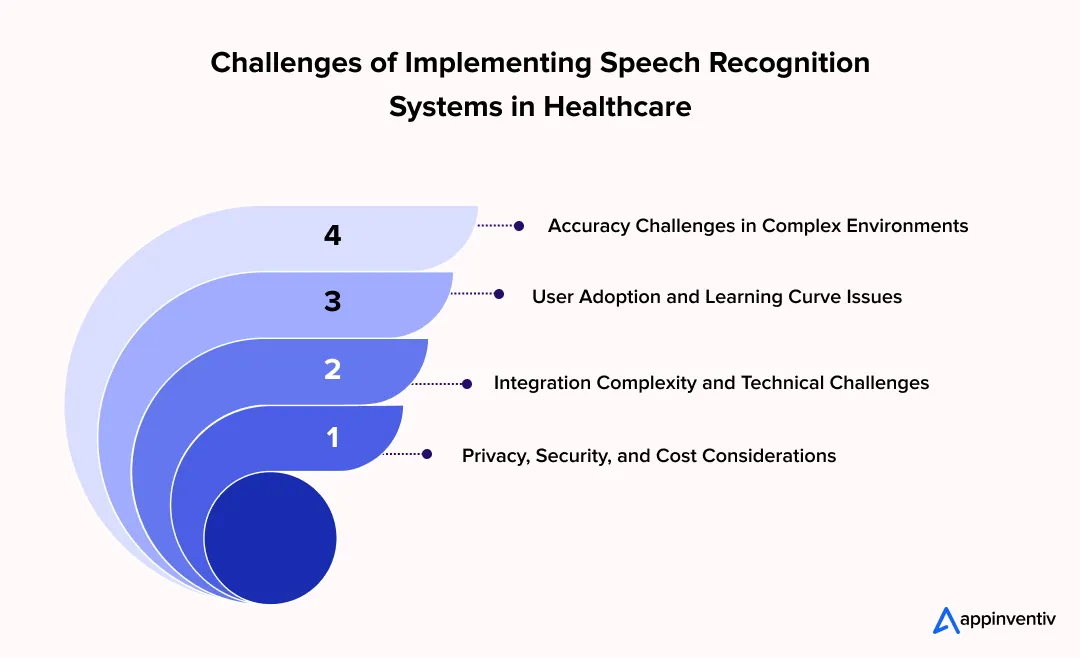
Accuracy Challenges in Complex Environments
Challenge: Healthcare settings present tough sound environments with background noise, multiple speakers, and frequent stops. Speech recognition accuracy can get worse in busy emergency departments, operating rooms, or open clinical areas.
Solution: Companies must carefully check system performance in their specific environments and put in place appropriate noise-cutting strategies and microphone solutions.
Learning Curve and User Adoption Issues
Challenge: Healthcare workers used to old documentation methods may first resist using new technology. Some doctors find early-generation speech recognition systems annoying due to accuracy issues or unfamiliar workflows.
Solution: Complete training programs and gradual setup strategies help beat these problems and improve user adoption rates.
Integration Complexity and Technical Challenges
Challenge: Connecting a speech recognition system in healthcare with existing EHRs and medical information systems can be technically hard and resource-heavy. Poor connection leads to workflow disruptions, data silos, and cut user adoption.
Solution: need experienced setup partners and dedicated IT resources to make sure a smooth connection happens with the legacy systems.
Privacy, Security, and Cost Considerations
Challenge: Speech data contains highly private patient information that needs strong security measures and strict compliance with healthcare rules to protect sensitive data.
Solution: Healthcare companies must make sure that systems comply with GDPR, HIPAA and other privacy rules.
The drawbacks of speech recognition systems in healthcare need careful consideration during planning phases, but most problems can be handled through proper system selection, setup planning, and ongoing support. Companies must also weigh these thoughts against the advantages of speech recognition in healthcare when making technology investment choices.
Cost Analysis and ROI Considerations for Speech Recognition Software Development in Healthcare
Healthcare organizations need a comprehensive understanding of both initial investments and long-term financial benefits when evaluating speech recognition technology. Let’s get a quick insight into both of them:
Initial Implementation Costs and Budget Planning
The cost of speech recognition software development changes based on company’s needs and tech requirements. Some organizations prefer cloud solutions for growth ability and cost-effectiveness, while others choose on-site setups for better data security and control. The cost of a speech recognition system in healthcare often depends on company size, rule requirements, deployment model, and implementation complexity.
Here is a table outlining speech recognition software development cost in healthcare based on project complexity:
| Software Complexity Level | What It Includes | Estimated Cost Range |
|---|---|---|
| Basic | Simple speech-to-text, limited medical vocabulary, minimal EHR integration | $40,000 – $90,000 |
| Intermediate | Specialty vocabularies, moderate NLP capabilities, structured EHR field mapping, noise handling | $90,000 – $180,000 |
| Advanced | AI-driven context understanding, multi-speaker recognition, advanced NLP, ambient documentation, deep EHR workflows | $180,000 – $350,000+ |
| Enterprise-Grade | Fully custom AI models, real-time decision support, voice biometrics, multi-language support, scalable cloud architecture | $350,000 – $600,000+ |
Software development costs for a healthcare speech recognition system represent the most visible investment part, but companies must budget for additional expenses, including hardware upgrades, system connection services, complete training programs, and ongoing support services.
Also Read: Cost of developing an AI Voice and TTS app like Speechify
Return on Investment Analysis and Financial Benefits
Healthcare companies typically get positive ROI within 12 to 18 months through cutting transcription costs, better doctor productivity, and less office overhead. Studies show that speech recognition in healthcare solutions can cut documentation time by 30-45%, letting doctors see additional patients and improve revenue generation potential.
Measurable benefits include getting rid of transcription services costs, increased doctor productivity allowing 2-4 additional patient visits daily, cut office staff requirements, better coding accuracy leading to improved reimbursements, less overtime costs for documentation completion, and better doctor recruitment and retention abilities.
Medical Speech Recognition Solutions for Different Healthcare Settings
Healthcare delivery occurs across diverse settings, each with unique workflow requirements, patient populations, and operational challenges. Medical speech recognition solutions must adapt to these varied environments while maintaining high accuracy, user satisfaction, and seamless integration with existing clinical workflows.
Hospital and Health System Implementations
Large hospital systems need enterprise-level solutions able to support thousands of users across multiple departments and medical areas. These setups must connect with complex IT setups, support diverse clinical workflows, and maintain high availability for critical healthcare operations.
Enterprise considerations include scalable cloud setup supporting peak usage demands, multi-area vocabulary support for diverse clinical departments, advanced reporting and analytics for performance watching, disaster recovery and business continuity planning, and centralized administration with complete user management abilities.
Ambulatory Care and Clinic Settings
Outpatient clinics and ambulatory care centers typically require more flexible, cost-effective solutions that can adapt to varied practice patterns and smaller user bases. These environments often prioritize ease of use, rapid implementation, and integration with popular ambulatory EHR systems over enterprise-scale features.
Specialty Practice Requirements and Customizations
Different medical areas have unique documentation needs, word requirements, and workflow patterns. Good setups provide area-specific improvements, including radiology systems for imaging report dictation, emergency medicine solutions supporting rapid documentation, mental health systems for therapy session writing, and surgical documentation tools for operative note creation.
Telemedicine and Remote Care Integration
The growth of telemedicine requires solutions specific to speech recognition technology in healthcare that support virtual care delivery while maintaining security and documentation quality. These systems must handle remote consultations, patient-provider communication, and distributed care team collaboration effectively.
Related Read: White Label Telemedicine Platform Development
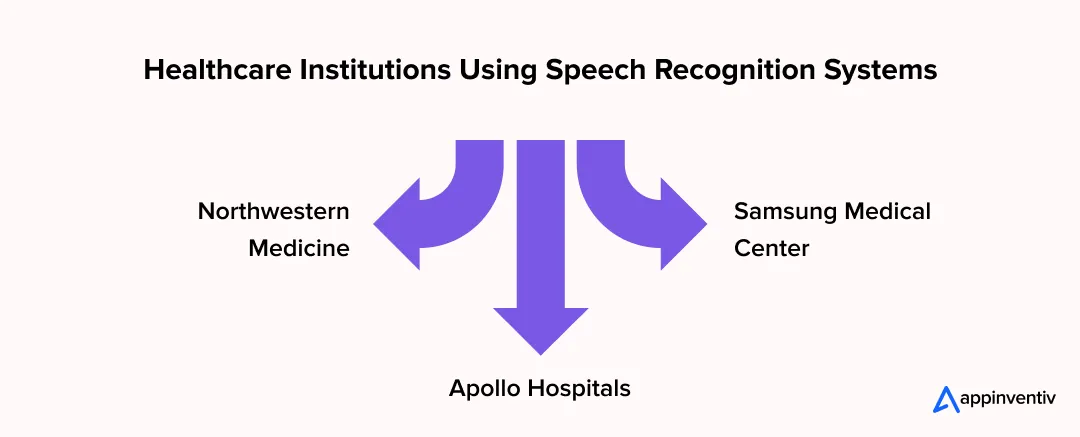
Real-World Success Stories: Healthcare Institutions Leveraging Speech Recognition
Healthcare organizations worldwide are demonstrating the transformative power of speech recognition technology through successful implementations that deliver measurable improvements in efficiency, quality, and staff satisfaction. These real-world examples illustrate practical benefits and lessons learned from speech recognition deployment.
Northwestern Medicine
Northwestern Medicine’s implementation of Dragon Ambient eXperience Copilot, exemplifies successful enterprise-wide deployment. In August 2024, this major healthcare system leveraged AI-powered solution to transform patient conversations into productivity tools.
The system enables physicians to reduce documentation burdens while improving patient experiences through more natural, engaging consultations.
Apollo Hospitals
Apollo Hospitals, one of Asia’s largest healthcare networks, achieved remarkable results with their Medical speech recognition systems implementation. The organization reported 99% accuracy rates in clinical documentation, significantly reducing transcription-related medical errors and improving patient record quality.
Dr. Sangita Reddy noted that enhanced accuracy not only elevated patient care but also streamlined clinical workflows and boosted physician satisfaction across the network.
Samsung Medical Center
Samsung Medical Center in South Korea demonstrates successful integration of advanced speech recognition tools for enhanced clinical documentation accuracy. Their implementation showcases how sophisticated medical voice recognition software development can improve healthcare delivery efficiency in complex hospital environments while maintaining high-quality standards.
These success stories highlight common factors contributing to successful implementations: comprehensive training programs, specialty-specific customization, strong leadership support, and phased rollout strategies. Organizations that invest in proper planning and implement medical speech recognition systems with adequate support consistently achieve better outcomes and higher user adoption rates.
Key Benefits of Speech Recognition Medical Systems
Healthcare organizations implementing speech recognition technology experience transformative benefits across multiple dimensions of their operations. These advantages extend far beyond simple time savings to impact patient care quality, staff satisfaction, and organizational efficiency in measurable ways.
Enhanced Documentation Efficiency and Productivity
The healthcare world creates huge amounts of documentation daily. Every patient visit, treatment plan, medication order, and follow-up note needs accurate recording. Old documentation methods create big bottlenecks in healthcare delivery, forcing doctors to spend countless hours on paperwork instead of patient care.
Speech recognition technology in healthcare fixes these problems by changing spoken words into organized, searchable text that connects smoothly with electronic health records (EHRs). This technology doesn’t just save time; it really improves the quality of healthcare delivery across all care settings.
Improved Documentation Quality and Accuracy
Speech recognition software development in healthcare has reached advanced levels where the technology can capture detailed medical conversations with great accuracy. Modern systems understand complex medical words, drug names, dosages, and clinical descriptions, resulting in more complete and accurate patient records. This improved accuracy cuts the risk of medical errors and improves continuity of care across different healthcare providers.
Reduced Physician Burnout and Improved Job Satisfaction
One of the biggest benefits of speech recognition medical systems is their impact on doctor wellbeing and job happiness. By cutting the clinical burden, these systems help fight the burnout problem affecting healthcare workers. Doctors report higher job happiness levels when using speech recognition medical systems, as they can focus more on patient talks rather than documentation tasks.
Better Patient Engagement and Care Quality
When doctors can focus on patients instead of screens and keyboards, the quality of patient conversations gets much better. Doctors can keep eye contact, show care, and build stronger healing relationships while still capturing all needed documentation through advanced technology. This better engagement leads to higher patient happiness scores and better clinical outcomes.
Cost Reduction and Compliance Benefits
Healthcare companies see big cost savings by eliminating transcription services, less documentation time, and better operational efficiency. Advanced systems also help make sure complete and timely documentation happens, supporting rule compliance and cutting legal risks. The return on investment usually happens within 12-18 months of setup.
Future Innovations and Emerging Trends in Medical Speech Recognition Software
The healthcare speech recognition world keeps changing rapidly, pushed by advances in artificial intelligence and changing healthcare delivery models. Next-generation systems in healthcare use conversational AI abilities that change passive writing tools into active clinical assistants providing real-time clinical decision support.
New abilities include contextual clinical questioning and care pathway guidance, automated differential diagnosis suggestions based on documented symptoms, real-time drug interaction and allergy alerts during dictation, patient education content creation based on clinical conversations, and proactive care gap identification with intervention recommendations.
Voice biomarker research demonstrates that voice patterns can reveal early indicators of various health conditions, including neurological disorders, mental health changes, and respiratory conditions. Evidently, future systems in healthcare will increasingly incorporate voice biomarker analysis to support clinical decision-making and early disease detection.
In short, the adoption of speech recognition system in healthcare will keep speeding up as companies recognize the competitive advantages. The future of healthcare documentation is voice-enabled, AI-powered, and smoothly connected with clinical workflows, focusing on efficiency and patient care quality.

How Appinventiv Helps You Leverage Speech Recognition Technology in Healthcare
When it comes to implementing sophisticated speech recognition solutions in healthcare, partnering with a leading custom healthcare software development company makes all the difference. This is where we come in.
At Appinventiv, our team of 200+ data scientists & AI engineers combines deep healthcare domain expertise with advanced AI and speech recognition capabilities. This helps us deliver transformative solutions that enhance patient care and operational efficiency.
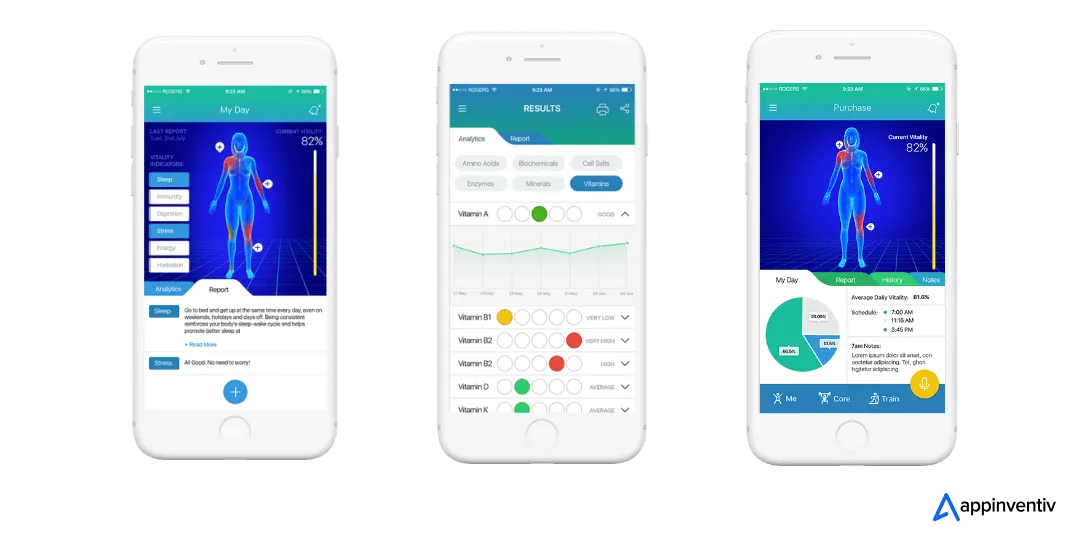
Our healthcare portfolio speaks volumes about our capabilities and commitment to excellence. For instance, we’ve partnered with 450+ clients in the healthcare industry and delivered over 500+ successful projects, including Health-e-People, Soniphi, DiabeticU, and YouComm.
For Soniphi, we developed a revolutionary healthcare application that analyzes over 90% of vocal information to provide comprehensive health analysis reports, showcasing our expertise in voice-based healthcare technologies. This groundbreaking solution demonstrates our ability to leverage speech recognition technology for advanced healthcare diagnostics and patient monitoring.
Why Healthcare Leaders Choose Appinventiv:
- Proven Healthcare Expertise: Over 1,600+ skilled developers with specialized healthcare domain knowledge
- Award-Winning Innovation: Consecutive Deloitte Tech Fast 50 Awards (2023 & 2024), “Tech Company of the Year” at Times Business Awards 2023, and “The Leader in AI Product Engineering & Digital Transformation” by The Economic Times (2025)
- Enterprise-Grade Security: ISO 27001 and ISO 9001 certified with HIPAA-compliant development practices
- Global Recognition: Strategic partnerships with AWS, Azure, and GCP, serving Fortune 500 companies including KFC, Domino’s, and Adidas
- Comprehensive Support: End-to-end development lifecycle management from consultation to post-deployment optimization
Ready to change your documentation processes with advanced speech recognition technology in healthcare? Let’s discuss how our award-winning team can build a custom solution made for your company’s specific needs and help you achieve the operational excellence your patients deserve.
Frequently Asked Questions
Q. How does speech recognition software for EHR work?
A. Speech recognition software for EHRs handles spoken language through AI-powered algorithms that change voice input into organized text. The system recognizes medical words, connects with EHR databases, and formats documentation according to clinical standards. Advanced systems use natural language handling to understand context and automatically fill appropriate fields within electronic health records, allowing a smooth workflow connection.
Q. How does medical speech recognition software work?
A. Medical speech recognition software captures audio input through microphones, handles speech using machine learning algorithms trained on medical words, and changes spoken words into text. The system looks at sound patterns, applies medical vocabulary models, and uses natural language handling to understand clinical context. The resulting text connects with healthcare information systems, creating organized documentation that supports clinical decision-making and rule compliance.
Q. How is speech recognition different from voice recognition?
A. Speech recognition technology in healthcare changes spoken language into text, focusing on understanding and writing down words regardless of who speaks them. Voice recognition identifies specific people based on unique vocal features and speech patterns.
In healthcare, speech recognition handles documentation and command input, while voice recognition provides user checks and security. Modern medical systems often combine both technologies for complete functionality and better security.
Q. How to use AI medical speech recognition software to take notes much faster?
A. AI medical speech recognition software speeds up note-taking through real-time writing during patient visits. Doctors speak naturally while checking patients, and the system automatically creates organized notes with medical words, dosages, and treatment plans.
The AI learns individual speech patterns and preferences, getting more accurate over time. Key strategies include using consistent words, speaking clearly, and using voice commands for formatting and navigation.
Q. Is medical speech recognition software safe and compliant?
A. Modern medical speech recognition software uses strong security measures, including end-to-end coding, HIPAA compliance frameworks, and access controls protecting patient data. Systems use voice prints for checks, keep complete audit trails, and make sure data location requirements happen.
Cloud solutions put in place enterprise-level security with business associate agreements, while on-site options provide additional control for companies with specific compliance requirements.
Q. What is the average ROI period for implementing speech recognition in healthcare?
A. Healthcare organizations typically see a positive ROI within 12 to 18 months, primarily driven by eliminating transcription costs and increasing physician productivity.
Q. What is the main difference between Front-End and Back-End speech recognition?
A. Front-End systems process speech in real-time, displaying text immediately on the screen for the user to review and edit.
Back-End systems process recorded dictations after the clinical encounter, often used for batch handling and later review by transcriptionists.
Q. Is medical speech recognition software HIPAA compliant?
A. Yes, modern, enterprise-grade medical speech recognition systems are designed to be HIPAA, GDPR, and HITECH compliant. This requires end-to-end data encryption, strong access controls, and a Business Associate Agreement (BAA) with the vendor.
Q. What AI technologies work behind the speech recognition system in healthcare?
A. Some key technologies working behind the speech recognition system in healthcare are:
- Natural Language Handling: Modern medical voice recognition software development uses NLP to understand medical terminology and abbreviations
- Context Recognition: Systems understand context-specific language used in healthcare settings
- Organized Output: Information gets automatically formatted according to clinical documentation standards

- In just 2 mins you will get a response
- Your idea is 100% protected by our Non Disclosure Agreement.
How to Build a Custom Pediatric EMR and EHR System?
Key takeaways: Clinical Precision: Custom systems accommodate pediatric-specific data points like percentile curves and weight-based longitudinal dosing. Interoperability: Seamless data exchange via HL7 FHIR ensures your practice stays connected to pharmacies, labs, and state registries. Regulatory Resilience: Built-in compliance with HIPAA, HITECH, and MACRA/MIPS reduces legal friction. Enhanced Engagement: Parent portals reduce administrative overhead by…

Change Management in Healthcare: Principles, Processes, and Models
Key Takeaways Change in healthcare fails quietly when ownership, workflow alignment, and follow-through are missing. Successful change management in healthcare focuses on adoption, not just system implementation. Clinical workflows and workforce capacity determine whether transformation sticks or stalls. Governance, clear accountability, and post-go-live support matter more than the model used. Sustainable healthcare transformation depends on…
A Practical Guide to Building Your Mental Health Chatbot - Use Cases, Cost, & ROI
Key takeaways: Mental health chatbots work when they know their limits. They’re most useful as a gentle first step, not as a stand-in for real care. Good chatbot design is more about judgment than AI. Clear boundaries, calm responses, and safety matter more than smart language models. Enterprises invest in chatbots to make support easier…









