

































50+ High-Growth Startup Business Ideas in Australia That Leverage Technology in 2026

 Share -



- 01What Are the Top 5 Trends in Australia for 2026?
- 02What Are Some High-Growth Tech Startup Business Ideas in Australia?
- 03Typical Cost and Timeline to Establish Your Startup
- 04How to Come Up with Your Own Small Business Idea in Australia?
- 05Is Your Idea Ready for the Australian Market? Essential Validation Checklist
- 06What Are The Steps To Launch A Startup in Australia?
- 07How Much Does It Cost to Start a Tech Startup in Australia?
- 08How Appinventiv Turns Your Startup Vision into a Scalable Business Reality?
- 09FAQs

Key takeaways:
- AI, SaaS, and climate tech are the most profitable startup business ideas in Australia.
- Early-stage startups can launch from AUD 70,000–100,000, while tech solutions may require AUD 700,000+.
- Government grants and R&D incentives reduce startup costs, especially for fintech, healthcare, and cybersecurity solutions.
- Validate demand before development through customer research, prototypes, pilots and measurable market signals.
Australia is transitioning from the “Lucky Country”, historically reliant on natural resources, to a sophisticated “Innovation Country” powered by high-moat technology. This “Defining Decade” is underpinned by a massive surge in digital investment, with Gartner forecasting Australian IT spending to exceed $192 billion in 2027, an 8.7% increase from 2026.
At the heart of this shift is the rise of Sovereign AI infrastructure and the National AI Plan, which mandates that data-intensive developments prioritise national interest and data sovereignty.
The rapid adoption of cloud-native architectures, cybersecurity, agentic AI, and intelligent automation is no longer elective. It is a baseline for survival in a market defined by labour shortages and tightening regulations. They now underpin operations in sectors as diverse as mining, healthcare, agriculture, logistics, finance, retail and government services.
Consequently, top tech startup areas in Australia are significantly outperforming traditional business models by leveraging scalable software. This blog explores over 50 high-growth startup business ideas in Australia that are tailored for the 2026 landscape.
We’ve helped businesses like Lite N’ Easy, Multinail and Rapid Teachers scale faster with production-ready platforms.

What Are the Top 5 Trends in Australia for 2026?
Walk into any co-working space in Sydney or Melbourne right now, and you’ll feel something’s shifted. The “growth at all costs” era has been replaced by a focus on sovereign resilience and operational efficiency. The trends that are driving this shift and getting serious attention are:
- Artificial Intelligence: Over 40% of Australian tech startups have AI built into their core product. Strategic AI business ideas for Australia aren’t optional anymore.
- Sustainability and Climate Tech: Real startup business idea models are being built around renewable energy, sustainable agriculture, and carbon capture technology.
- Sovereign Data Privacy: With stricter DTA standards, platforms guaranteeing on-shore data storage win high-value government and enterprise contracts through superior trust.
- Embedded Finance: Fintech is moving directly into non-financial platforms, offering “Smart Credit” and automated payments within construction and AgTech project tools.
- Zero-Trust Cybersecurity: As AI threats escalate, startups adopting “never trust, always verify” architectures are winning by making security a strategic business enabler.
These shifts are creating opportunities for innovative business ideas that solve real problems while aligning with investor priorities around sustainability and scalability.
What Are Some High-Growth Tech Startup Business Ideas in Australia?
The Australian venture landscape in 2026 has shifted from “growth at all costs” toward sovereign capability and operational resilience. The following opportunities represent the high-water mark for tech startup ideas in Australia, focusing on sectors where local data moats, mandatory regulatory changes, and infrastructure gaps create massive, defensible markets for new founders.
AI & Automation Startup Ideas
The Australian market has moved beyond the “experimentation” phase of AI. Investors are now prioritising AI implementation in businesses and offer demonstrable efficiency gains of 30% or more, particularly in high-cost sectors like legal, finance, and human resources.
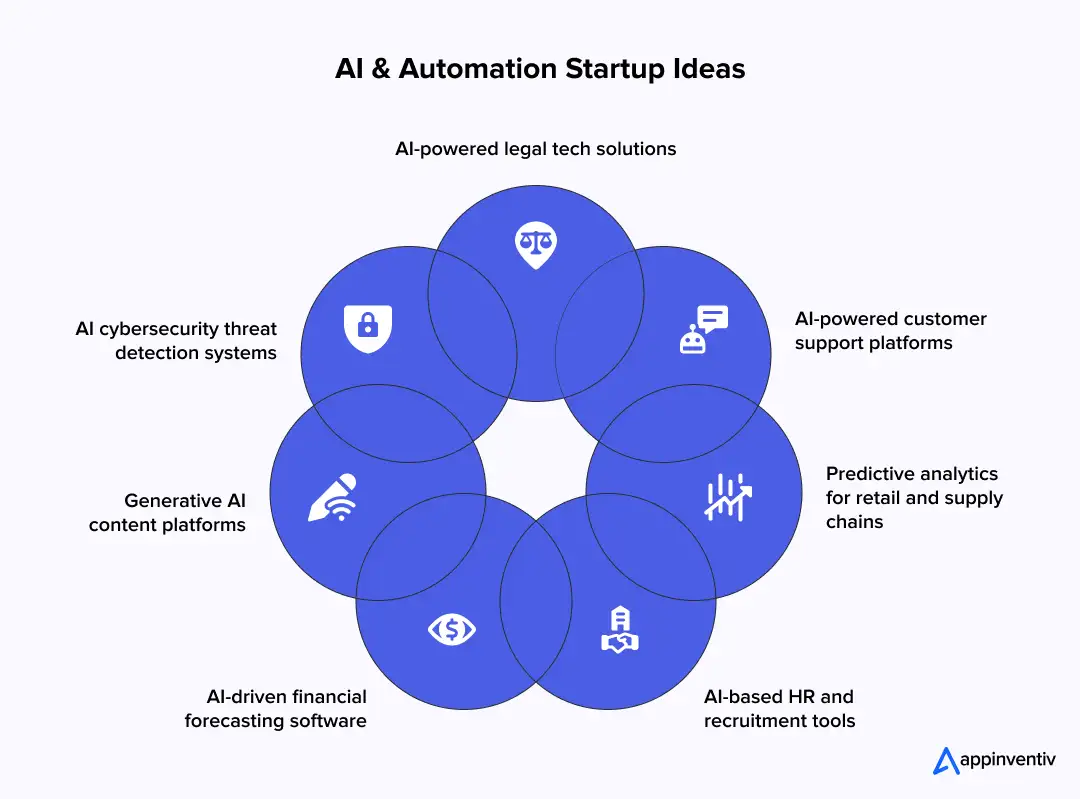
Autonomous Customer Experience (CX) Hubs
Unlike basic chatbots, these platforms integrate directly into Australian CRM ecosystems like Salesforce or Microsoft Dynamics. They leverage Retrieval-Augmented Generation (RAG) to ensure responses are grounded in an organisation’s private knowledge base, meeting the strict accuracy requirements of the Australian Consumer Law (ACL). The focus is on resolving complex multi-step enquiries such as insurance claims or utility plan changes without human intervention.
Predictive Analytics for “Sovereign” Supply Chains
With global logistics remaining volatile, Australian retailers are seeking platforms that offer “hyper-local” predictive analytics. This involves correlating Bureau of Meteorology (BOM) data with consumer buying patterns to automate stock levels across regional warehouses. It is the most profitable business to start in Australia for distributors looking to reduce the “carbon miles” of their deliveries in line with new sustainability reporting mandates.
Bias-Mitigating HR and Recruitment Platforms
Australian enterprises face significant scrutiny regarding diversity and inclusion. High-growth startups are building AI-led recruitment tools that “blind-screen” candidates and audit job descriptions for gender or cultural bias. These platforms are designed to align with the Workplace Gender Equality Act while tackling the acute talent shortages in engineering and healthcare.
AI-Driven Predictive Financial Forecasting
Financial controllers in the ASX-listed space are moving away from static spreadsheets. The opportunity lies in software that performs “rolling forecasts” by ingesting real-time market data, currency fluctuations, and internal sales pipelines. These tools provide a “single source of truth” for board-level reporting, ensuring compliance with ASIC’s continuous disclosure requirements.
Enterprise-Grade Generative Media Platforms
As digital marketing costs rise, Australian brands are investing in generative AI platforms. These allow for the rapid creation of video, audio, and image assets that are “on-brand” and legally cleared for use in the local market. The 2026 trend is toward Synthetic Media that features Australian accents and cultural nuances to drive higher engagement in regional areas.
AI-Native Cyber Threat Hunting
With the Essential Eight cybersecurity framework now a board-level priority, startups are building “Active Defense” systems. These use machine learning to identify lateral movement within a network before a breach occurs. Given that the average cost of a data breach in Australia has risen significantly, these “Threat Hunting” platforms are among the best business ideas for founders targeting the banking and government sectors.
Agentic LegalTech for Compliance and Discovery
The legal sector in Australia is ripe for disruption by “Agentic” workflows. Startups are building tools that don’t just search for keywords but understand the context of Australian High Court precedents and state-based legislation. These agentic AI platforms in Australia automate the discovery process in litigation and perform high-speed contract “health checks” against the Modern Slavery Act and privacy regulations.
Appinventiv Execution Insight
In our delivery of JobGet, Vyrb, MyExec and other AI powered platforms, we demonstrated how AI architectures can collapse complex operational cycles, such as recruitment, from months to days.
For Aussie innovators, success lies in embedding AI into existing workflows without disrupting legacy systems. We help them design human-in-the-loop architectures, integrate with ERP/CRM stacks, and ensure models are secure, compliant, and scalable from day one.
Fintech & Insurtech Business Ideas
The Australian financial services landscape is defined by high consumer trust in digital banking and a rigorous regulatory environment overseen by Australian Privacy Principles (APP), ASIC and APRA. In 2026, the opportunity for a profitable business in Australia within fintech lies in navigating the “interstitial” spaces, solving for niches that the Big Four banks find too granular or operationally expensive to service.
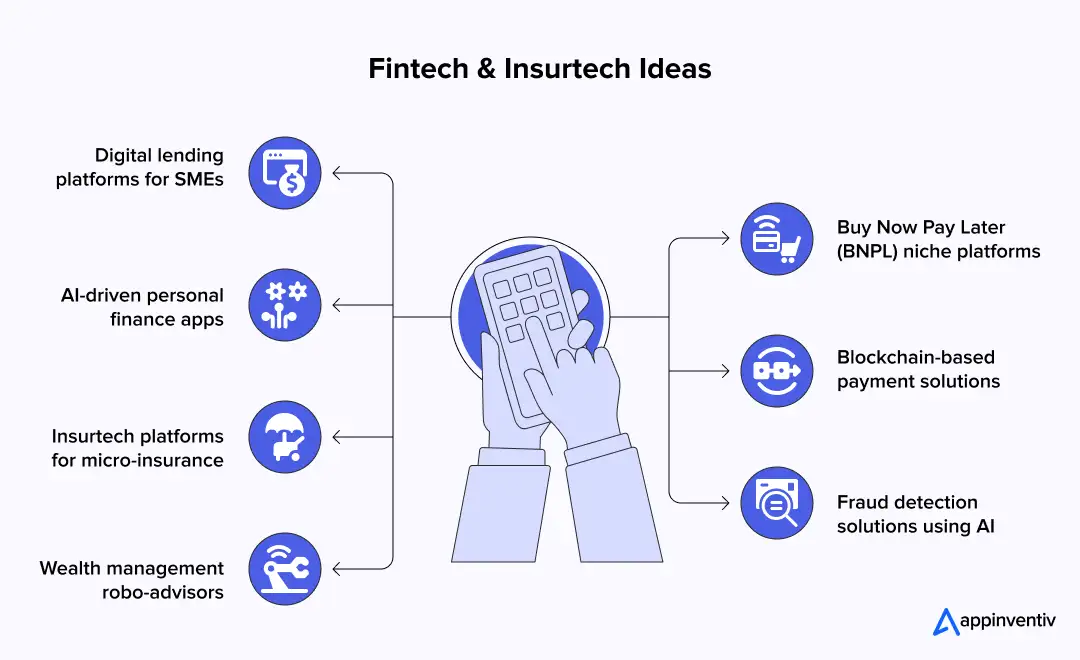
1. SME Digital Lending and Alternative Credit Scoring
Traditional lending criteria often fail to account for the seasonal and project-based cash flows of SMEs. High-growth startups are developing platforms that ingest real-time data from accounting software like Xero or MYOB to provide “instant-decision” working capital. These platforms use machine learning to evaluate “unit economics” rather than just historical balance sheets, filling a massive credit gap in the construction and professional services sectors.
2. Niche BNPL Platforms for High-Value Sectors
While consumer “retail” BNPL is saturated, “Buy Now, Pay Later” models for B2B transactions and high-ticket services such as solar installations or legal retainers represent a significant business idea in Australia. These platforms integrate directly into service-provider workflows, offering structured payment plans that comply with the latest National Consumer Credit Protection (NCCP) amendments.
3. AI-Driven Hyper-Personalised Finance
With the Consumer Data Right (CDR) now fully operational across banking and energy, startups are building “AI powered financial autopilot” apps. These tools don’t just track spending; they actively move funds between high-interest accounts, negotiate utility contracts using AI agents, and provide real-time tax-withholding advice for Australians interested in the gig economy.
4. Blockchain-Enabled B2B Payment Rails
Cross-border payments remain a friction point for Australian exporters. New ventures are leveraging stablecoins and private blockchain networks to facilitate “atomic settlements” for trade with South-East Asian partners. By bypassing the traditional SWIFT network, these platforms offer near-instant liquidity and lower FX fees, provided they maintain strict AUSTRAC reporting and “Know Your Transaction” (KYT) compliance.
5. Insurtech Platforms for Micro-Insurance
Standard insurance products are often too rigid for modern usage patterns. The 2026 opportunity in insurtech involves “Parametric” or “Usage-Based” micro-insurance. Examples include per-kilometre delivery rider insurance or “Weather-Triggered” crop insurance for hobby farmers. These platforms rely on IoT data and smart contracts to automate claims.
6. AI-Native Fraud and Anti-Money Laundering (AML) Solutions
As deepfake-led identity theft increases, Australian financial institutions are seeking “Liveness Detection” and behavioural biometrics. Startups in this space provide API-first solutions that monitor transaction velocities and “device-fingerprinting” to detect anomalies in real-time. This is a critical tech startup idea in Australia for firms needing to meet ISO 27001 and SOC2 standards while scaling their customer base.
7. Hybrid Wealth Management and Robo-Advisors
There is a growing “advice gap” in Australia due to the rising costs of personal financial planning. High-growth startups are filling this with “Hybrid Advisors” that combine low-cost ETF portfolios with AI-driven tax optimisation for Self-Managed Super Funds (SMSF). These platforms focus on the “Intergenerational Wealth Transfer,” helping younger Australians manage inheritances with institutional-grade tools previously reserved for high-net-worth individuals.
Appinventiv Execution Insight
Our collaboration with startups like Edfundo and Mudra proved that scalability requires a “Compliance-by-Design” architecture. In Australia, we specialise in building API-first platforms that integrate seamlessly with local ecosystems like Xero and MYOB while adhering to APRA CPS 234 and SOC2 standards.
HealthTech & MedTech Business Ideas
The 2026 Australian healthcare landscape is dominated by the “Triple Aim”: improving patient experience, enhancing provider efficiency, and maintaining total data sovereignty. With the Digital Health CRC and federal funding shifting toward preventive care, the most profitable business in Australia within this sector involves bridging the gap between clinical data and patient action.
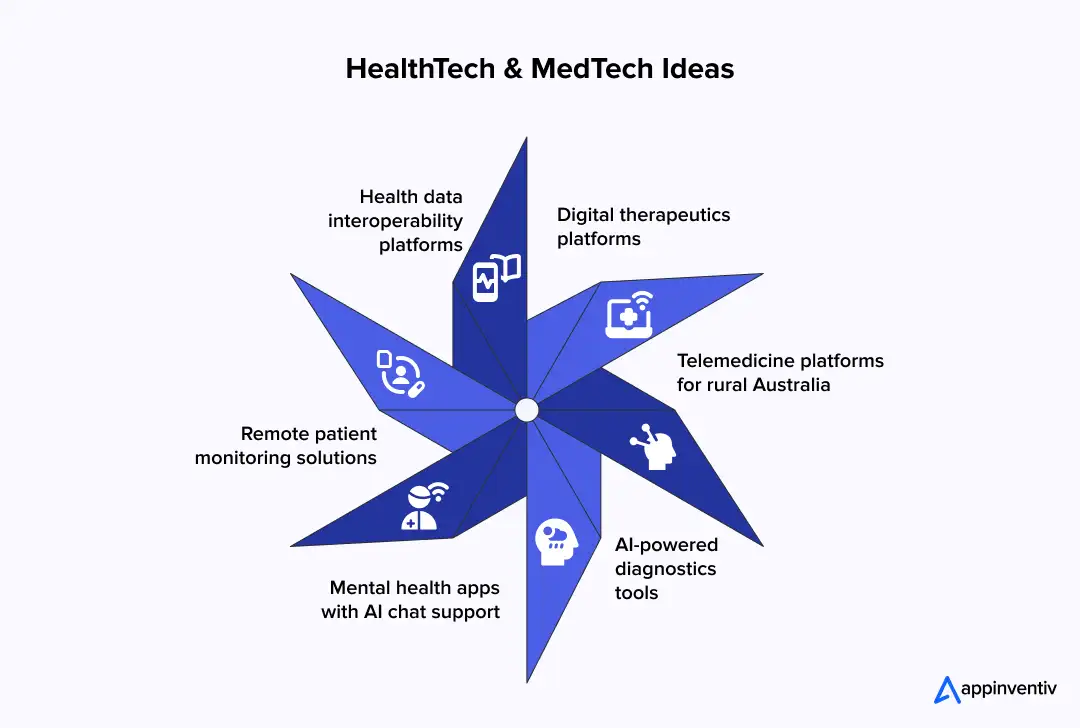
1. Telemedicine 2.0: Specialist and Rural Access
While GP-to-patient video calls are now a commodity, the 2026 opportunity lies in Specialist-Integrated Telemedicine. These platforms are designed for high-acuity rural care, integrating with remote peripheral devices like digital stethoscopes and otoscopes to allow city-based specialists to perform real-time examinations. This is one of the good business ideas in Australia, generating higher ROI in the medical sector.
2. AI-Powered Diagnostics and Clinical Triage
There is a critical shortage of radiologists and pathologists across regional New South Wales and Queensland. High-growth startups are developing co-pilot software that pre-scans medical imaging for anomalies. These tools do not replace clinicians but act as a triage layer to flag urgent cases, reducing wait times and improving outcomes.
3. Mental Health Platforms with Agentic Support
The 2026 mental health market has moved past simple mood tracking. New ventures are utilising AI agents that offer 24/7 support aligned with Cognitive Behavioural Therapy principles. By analysing biometric markers from wearables, these apps can preemptively reach out to a user during high-stress periods. The commercial differentiator here is the inclusion of “Human-in-the-loop” handovers for crisis situations, ensuring clinical safety.
4. Remote Patient Monitoring for Chronic Care
Managing chronic conditions like diabetes or heart disease accounts for a massive portion of the Australian health budget. Startups in this niche provide integrated hardware-software bundles that feed data directly into a practitioner’s management system, such as Best Practice or MedicalDirector. This is probably the best business to start in Australia for those looking to leverage the National Preventive Health Strategy 2021–2030.
5. Health Data Interoperability and Translation Layers
Australia’s health system remains siloed between state-run hospitals and private clinics. There is a substantial B2B opportunity for software that acts as a translation layer between legacy systems and modern consumer apps using the HL7 FHIR standard. This allows for the secure, consented movement of patient data, which is essential for the future of personalised medicine and large-scale health analytics.
6. Digital Therapeutics for Rehabilitation
Digital therapeutics are emerging as a non-pharmacological way to treat conditions like insomnia, chronic pain, or post-surgical recovery. These software-based treatments are increasingly being evaluated for Medicare rebates. Startups that can prove “clinical efficacy” through rigorous testing are positioned to capture a share of the insurance and government-funded care market.
Appinventiv Execution Insight
Success in Australian HealthTech requires strict TGA compliance and seamless HL7 FHIR integration. We have delivered high-impact and fully compliant medical platforms including YouCOMM, Soniphi, Health-e-People and DiabeticU. Our approach ensures data sovereignty and board-ready digital health solutions that meet rigorous Australian standards.

Climate Tech & Sustainability Startup Ideas
Australia’s trajectory toward becoming a “Renewable Energy Superpower” by 2030 has fundamentally reshaped business opportunities in Australia. With the National Reconstruction Fund and the “Future Made in Australia” initiative directing billions toward decarbonisation, the 2026 market is prioritising high-moat software that manages the inherent complexity of a decentralised, green energy grid.
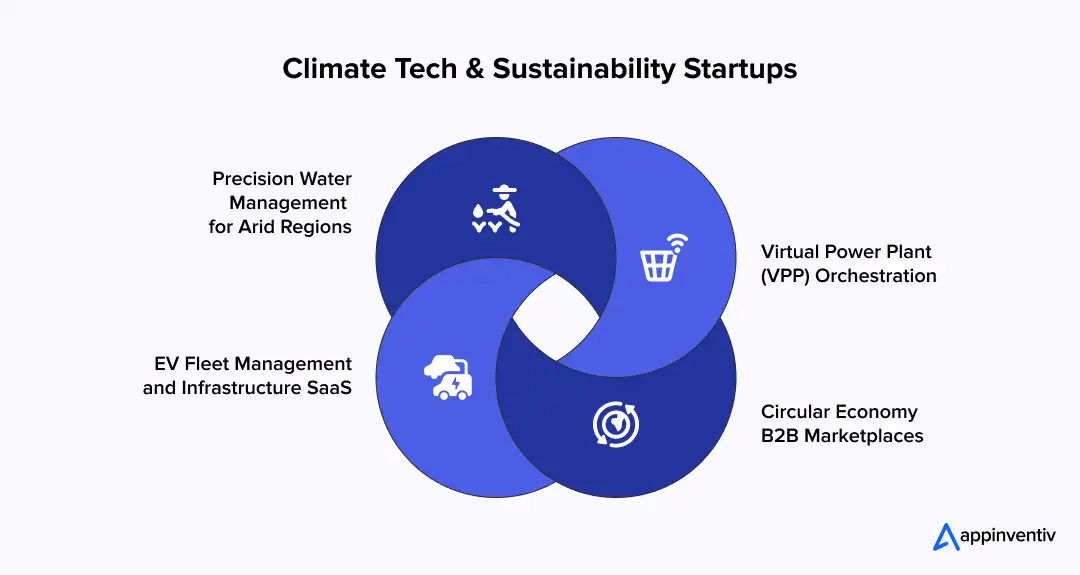
1. Virtual Power Plant (VPP) Orchestration
As rooftop solar penetration in Australia hits record levels, grid stability has become a critical operational challenge. Startups are building VPP platforms that aggregate household batteries and electric vehicles into a single, dispatchable energy source. These systems use AI to predict demand spikes and trade energy on the National Electricity Market, providing homeowners with passive income while supporting the Australian Energy Market Operator in maintaining grid frequency.
2. Circular Economy B2B Marketplaces
Tightening regulations around the Modern Slavery Act and new federal circular economy mandates are forcing Australian builders and manufacturers to account for the lifecycle of their materials. High-growth startups are creating marketplaces for “upcycled” industrial waste such as crushed glass for road base or recycled steel. These platforms leverage blockchain to provide a “Digital Product Passport,” ensuring that every material is audit-ready for mandatory ESG reporting.
3. EV Fleet Management and Infrastructure SaaS
With Australian businesses now mandated to report Scope 3 emissions, the transition to electric vehicle fleets is accelerating. Startups can leverage this entrepreneur idea to provide “Charge-as-a-Service” platforms that manage depot charging schedules, optimise route energy efficiency based on topography, and automate Fringe Benefits Tax reporting for electric company vehicles.
4. Precision Water Management for Arid Regions
Water remains Australia’s most contested resource. The 2026 opportunity lies in “Smart Irrigation” platforms that integrate Bureau of Meteorology data with satellite moisture sensing. Startups can build systems with edge-AI to automate water delivery at the individual plant level, reducing agricultural waste by up to 40% in critical areas like the Murray-Darling Basin.
Appinventiv Execution Insight
We have delivered eco-smart solutions and eScooter Mobility Platforms. Our approach focuses on “Green AI”, optimising every line of code to minimise server-side energy loads while ensuring that ESG data stands up to the rigours of a Big Four institutional audit.
E-commerce & Retail Tech Ideas for Startups
The 2026 Australian retail landscape is defined by “Value-Based Efficiency.” With inflationary pressures impacting discretionary spend, the most profitable business to start in Australia within retail is one that collapses the cost of customer acquisition through hyper-personalisation and automated logistics.
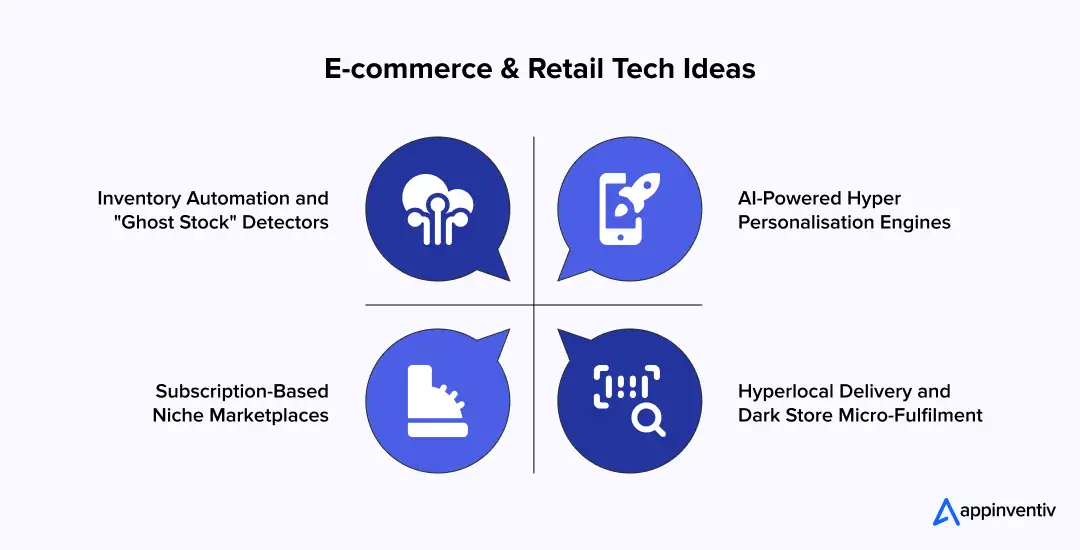
1. AI-Powered Hyper-Personalisation Engines
Standard “recommended for you” sliders are being replaced by deep-learning engines that predict intent. Startups are building AI powered retail platforms that adjust pricing, bundles, and UI layouts in real-time based on individual browsing data while maintaining strict Australian Consumer Law transparency.
2. Hyperlocal Delivery and Dark Store Micro-Fulfilment
As urban density increases in Sydney and Melbourne, “Last-Mile” logistics are pivoting to micro-warehouses. Software that orchestrates e-bike couriers and automated “dark stores” allows retailers to offer 30-minute delivery windows, competing directly with global giants on speed and local relevance.
3. Subscription-Based Niche Marketplaces
The “Subscription Box” model is maturing into high-utility niches, such as aged-care supplies or pet wellness. These platforms automate recurring revenue for SMEs while providing consumers with curated, high-quality Australian-made products that are difficult to find in major supermarkets.
5. Inventory Automation and “Ghost Stock” Detectors
Retailers lose millions annually to “ghost stock”, items listed online that aren’t actually in the warehouse. High-growth startups are building AI-led inventory systems that sync physical store shelves with digital storefronts in real-time, preventing lost sales and customer frustration.
Appinventiv Execution Insight
We have delivered transformative retail solutions for global leaders like Adidas, 6th Street, Edamama and IKEA. In the Australian context, our focus is on “Frictionless Commerce”, building high-concurrency architectures that handle massive peak-load events (like Black Friday) while ensuring that customer data remains secure and compliant with the latest privacy mandates.
EdTech & Skill Development Business Ideas
Australia’s education sector is shifting toward “intelligence-driven” learning. These ideas focus on reducing teacher burnout and closing the national skills gap through high-utility, AI-native platforms in education.
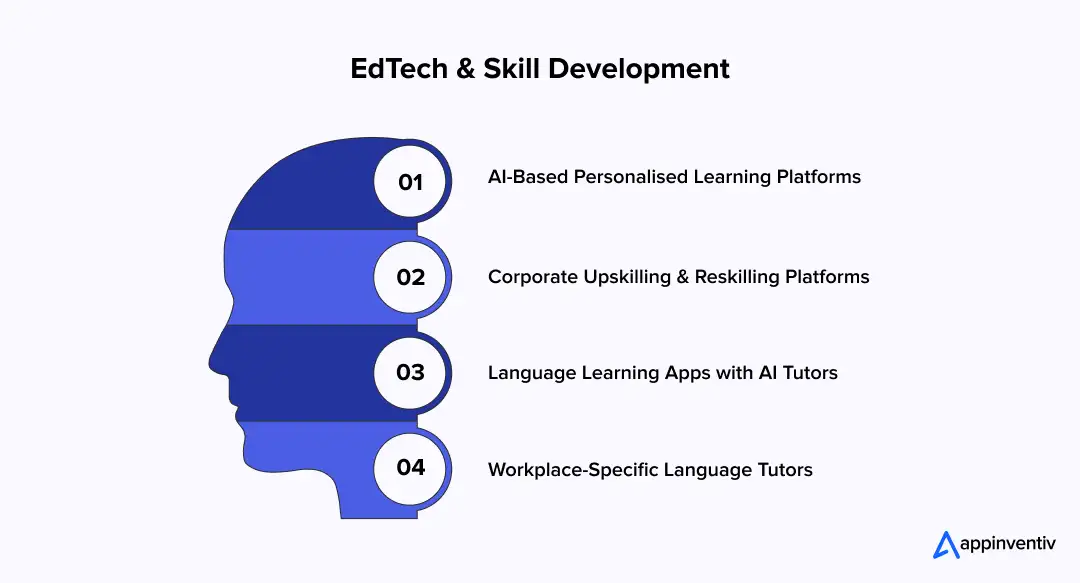
1. AI-Based Personalised Learning Platforms
Startups should move beyond generic content with adaptive systems that act as “Socratic tutors.” These platforms analyse student performance in real-time to adjust curriculum difficulty and provide instant, curriculum-aligned feedback.
2. Corporate Upskilling & Reskilling Platforms
As industries like AI and Green-Tech evolve, companies need “Skills-as-a-Service.” Build a platform that maps existing employee competencies against future-market demands, offering automated, employer-aligned pathways and verifiable digital credentials to maintain a “future-ready” workforce.
3. Language Learning Apps with AI Tutors
Target Australia’s diverse migrant population and ESL students with AI tutors that offer 24/7 spoken-word practice and hyper-local cultural context. These apps use generative voice technology to simulate real-world conversations, providing a low-cost, scalable alternative to traditional private tutoring.
3. Workplace-Specific Language Tutors
With a massive migrant workforce, there is a vacuum for industry-specific language training. New AI tutors focus on “Aussie Workplace English” for healthcare or engineering. These use voice-AI for instant feedback on pronunciation and cultural context, accelerating integration for skilled migrants.
Appinventiv Execution Insight
Our work on Rapid Teachers and Gurushala proved that engagement is the primary hurdle. We help Australian startups build micro-learning platforms with adaptive AI, real-time analytics, and compliance-ready reporting. From workforce training to skill development, we turn learning ideas into scalable, mobile-first ecosystems.
Logistics & Mobility Tech Startup Ideas
Australia’s vast geography and high urban density in coastal hubs create a unique logistical friction. In 2026, the most profitable business in Australia within this sector is one that solves the “last-mile” deficit and the decarbonisation of heavy transport, moving beyond simple tracking to autonomous orchestration.
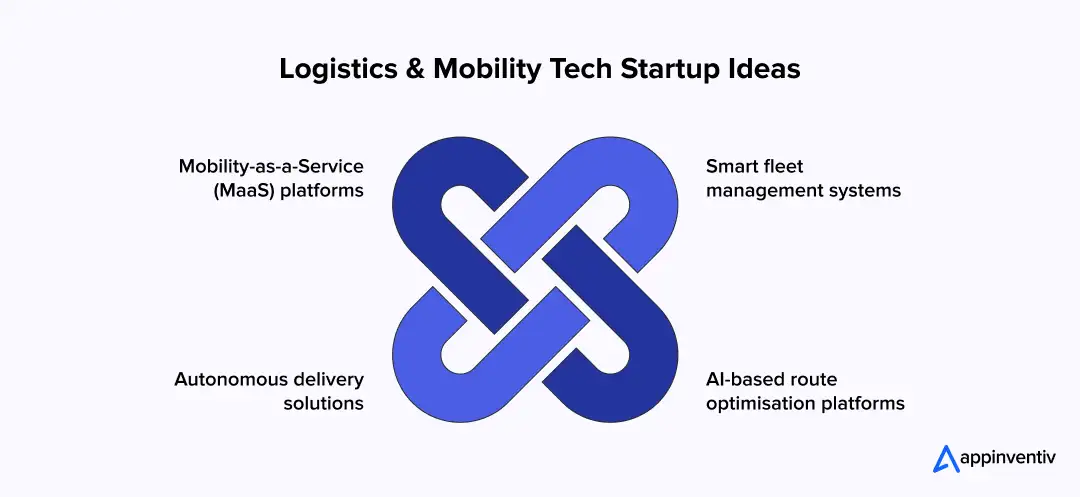
1. Smart Fleet Asset Management
Standard GPS tracking is now baseline. The high-growth opportunity lies in “Edge-AI” platforms that monitor real-time engine telemetry to predict maintenance before a breakdown occurs on the Nullarbor. These systems integrate directly with Australian fuel-tax credit schemes, automating the rebate process for off-road usage.
2. Route Optimisation for EV Delivery
Transitioning to electric fleets requires a fundamental rethink of routing. Startups are building engines that account for battery state-of-charge, topography, and ambient temperature. This software ensures that “last-mile” vans in hilly suburbs like those in Sydney’s North Shore never run out of range during a shift.
3. Autonomous “Last-Mile” Sidewalk Robots
Regulatory sandboxes in NSW and Victoria are opening doors for sidewalk delivery bots. Startups are developing the computer-vision stacks required to navigate busy Australian footpaths. The business model here focuses on the “Pharmacy-to-Home” or “Cafe-to-Office” niches where traditional vehicle delivery is cost-prohibitive.
5. Mobility-as-a-Service (MaaS) for Corporates
With the fringe benefits tax (FBT) exemptions for EVs, Australian corporates are ditching traditional car fleets. High-growth platforms provide a “Digital Wallet” for employees to switch between e-bikes, rideshares, and public transport, all while automating the tax reporting and carbon-offsetting for the employer.
Appinventiv Execution Insight
We have engineered high-performance mobility solutions for the logistics and eScooter networks. For the Australian market, our delivery prioritises “Offline-First” architecture, essential for logistics traversing areas with spotty 5G coverage. We build hardened, low-latency APIs that sync thousands of moving assets in real-time, ensuring that operational data is both accurate and audit-ready for national transport regulators.
Real Estate & PropTech Business Ideas
The Australian property market is notoriously high-stakes and heavily regulated. In 2026, the shift is away from “listing portals” toward high-utility asset management. With housing affordability and high interest rates defining the landscape, the best business in Australia for PropTech is one that maximises yield and reduces the friction of ownership.
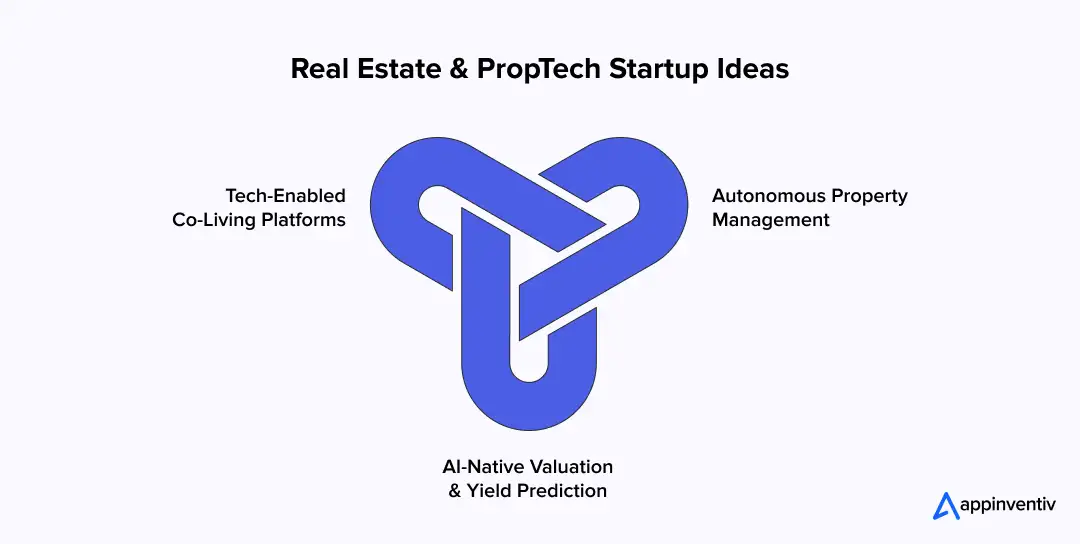
1. Autonomous Property Management
The “DIY Landlord” and traditional agency models are inefficient. High-growth startups are building “Self-Healing” rental platforms. These use AI agents to triage maintenance requests, auto-dispatching pre-vetted tradies for urgent leaks and handling late-payment nudges via conversational SMS, ensuring compliance with state-based Tenancy Acts without human intervention.
2. AI-Native Valuation & Yield Prediction
Static “desktop valuations” are no longer sufficient for 2026 investors. New ventures are utilising multi-modal AI that ingests satellite imagery, local planning applications (DA tracking), and real-time migration data. These tools provide “Hyper-Local” yield forecasts, helping SMSF investors identify undervalued pockets in emerging “Silicon Suburbs” before the broader market reacts.
3. Tech-Enabled Co-Living Platforms
As the “loneliness epidemic” and rent prices both climb, co-living is moving from a niche to a regulated asset class. Startups are building the “Operating System” for shared housing, handling everything from biometric room access and digital sub-lease contracts to AI-driven “roommate matching” that reduces churn and social friction in high-density CBD developments.
Appinventiv Execution Insight
We have delivered enterprise-grade property and saas based white label solutions for global leaders like House Eazy and Ility. For the Australian PropTech sector, we focus on “Hardware-Software Interoperability.”
Our teams build the secure middleware required to connect smart-lock APIs, IoT energy meters, and national land title registries, ensuring that your platform isn’t just a dashboard, but a fully integrated asset management engine.
Web3, Blockchain & Emerging Tech
The 2026 Australian digital economy is moving beyond crypto-speculation toward utility-scale decentralisation. With the Treasury’s ongoing “Token Mapping” exercise providing clearer guardrails, the tech startup ideas in Australia that succeed now are those solving for identity, provenance, and automated trust in B2B ecosystems.
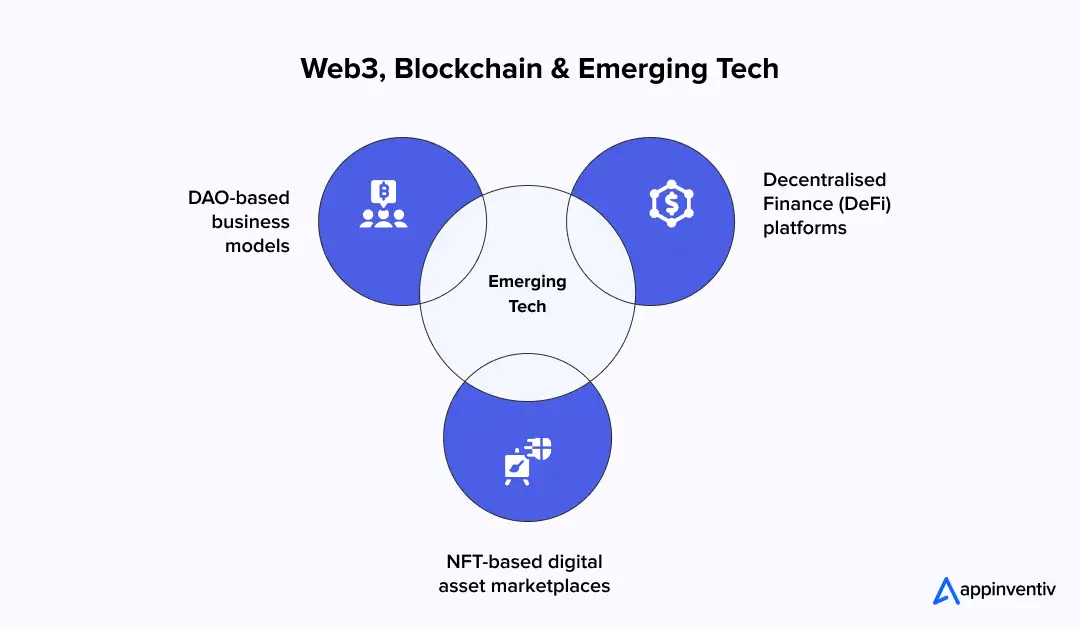
1. Decentralised Finance (DeFi) Platforms
The “Advice Gap” in Australia has created a vacuum that institutional DeFi is beginning to fill. Startups are building “Compliant DeFi” gateways that allow SMSF trustees to access high-yield liquidity pools while maintaining strict AUSTRAC reporting. These platforms automate the tax-loss harvesting and yield-optimisation processes, providing a transparent alternative to traditional managed funds.
2. NFT-Based Digital Asset Marketplaces
In 2026, NFTs in Australia are about Real World Assets (RWA). New ventures are tokenising high-value physical assets such as vintage cars, fine wine, or commercial air rights. These marketplaces allow for fractional ownership and instant secondary market liquidity, backed by smart contracts that handle the legal transfer of title under Australian property law.
3. DAO-Based Business Models
Decentralised Autonomous Organisations are being explored by Australian creative and research collectives. Startups are building the “Governance-as-a-Service” tools required to manage these entities, handling automated voting, treasury management, and smart-contract-based payroll that adheres to Australian “Fair Work” standards.
Appinventiv Execution Insight
Our blockchain delivery expertise includes high-concurrency NFT ecosystems for brands like Nova. For the Australian market, we prioritise “Gas-Efficiency” and “Regulatory Hooks”, ensuring that smart contracts include the necessary functions for legal pauses or audits. We build the bridges between legacy banking APIs and on-chain protocols, allowing your Web3 venture to scale without hitting a compliance wall.
AgriTech Startup Business Ideas
Australia’s agricultural sector is moving beyond traditional farming toward a data-driven “Smart Farm” economy. These new business ideas in Australia focus on solving the chronic volatility of the Australian climate by turning environmental data into predictable financial outcomes.
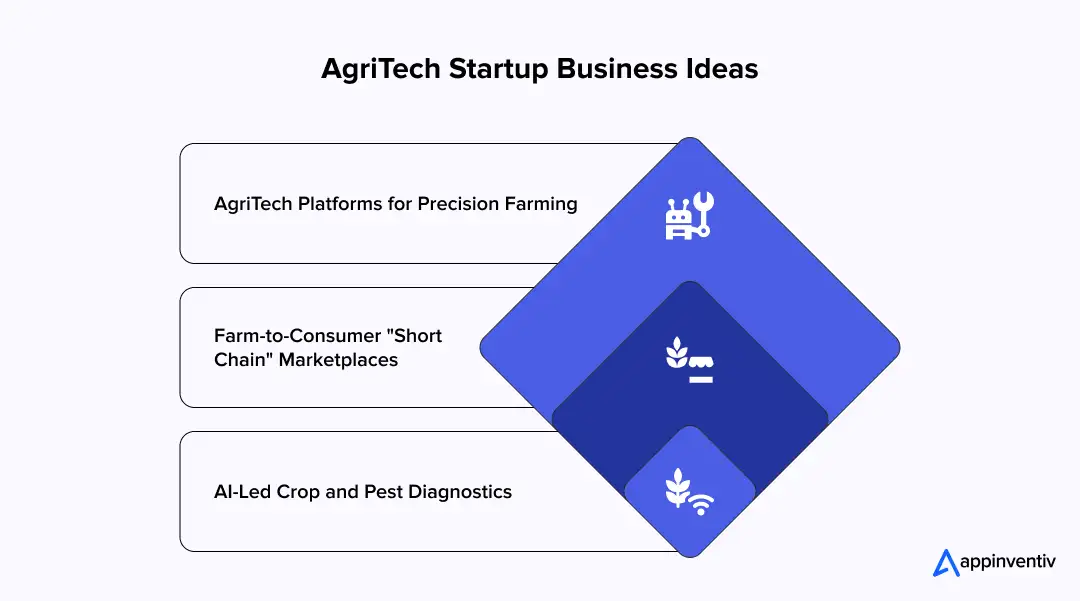
1. AgriTech Platforms for Precision Farming
As climate volatility hits the Murray-Darling, “Set-and-Forget” farming is over. New ventures are building AI-led irrigation and soil-health platforms that integrate Bureau of Meteorology data with paddock sensors. These systems automate water and fertiliser delivery at the plant level, slashing waste and boosting yield.
2. Farm-to-Consumer “Short-Chain” Marketplaces
Disruption of the major supermarket duopoly is a federal priority. New platforms are using automated logistics to connect regional growers directly to urban “food hubs.” By using AI to batch-process orders and optimise delivery routes, these startups offer farmers higher margins and consumers fresher produce with zero “supermarket tax.”
3. AI-Led Crop and Pest Diagnostics
Agronomists are in short supply across rural Australia. Startups are building mobile-first vision tools that allow farmers to snap a photo of a crop anomaly and receive a real-time diagnosis. These platforms integrate with local chemical registries to provide compliant, site-specific treatment recommendations.
Beauty & Personal Care Business Ideas
In 2026, the Australian beauty market is transitioning from “mass retail” to “Skin Intelligence.” With the local industry projected to hit $8.44 billion by 2031, the best business in Australia for this sector is one that blends high-performance formulations with data-driven personalisation.
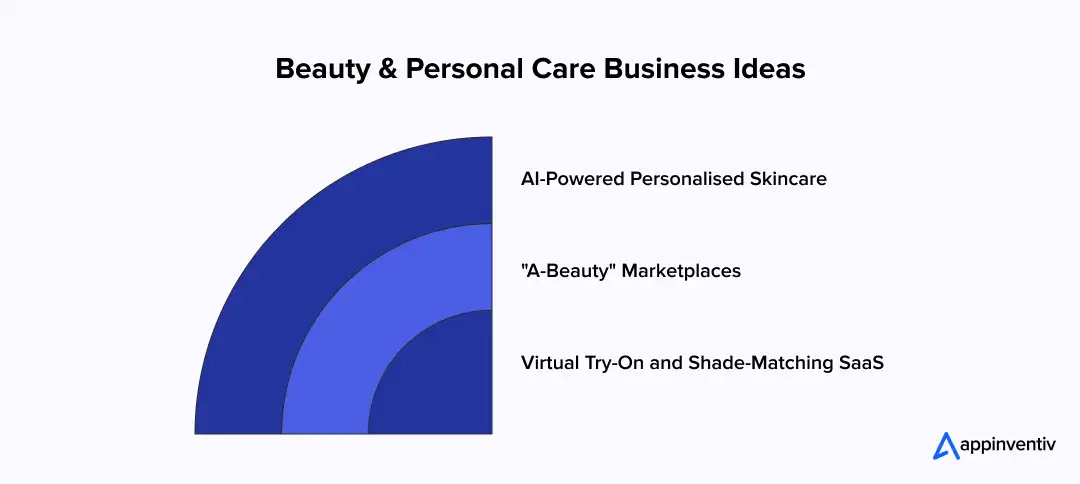
1. AI-Powered Personalised Skincare
Australian consumers are moving away from 10-step routines toward “Skinimalism”, fewer, high-efficacy products. Startups are building AI-led diagnostic apps that use smartphone cameras to scan for hydration levels and UV damage, then formulate a bespoke serum or moisturiser.
2. “A-Beauty” Marketplaces
There is a massive surge in demand for products featuring Australian native botanicals like Kakadu Plum, Quandong, and Desert Lime. New ventures are creating “Traceable Beauty” marketplaces that allow consumers to see the exact origin of these ingredients. This satisfies the “Clean Beauty” movement while supporting regional Australian growers and Indigenous-led suppliers.
3. Virtual Try-On and Shade-Matching SaaS
The high cost of online returns is a major friction point for Australian cosmetic brands. High-growth startups are building AR (Augmented Reality) “Try-On” SDKs that work natively in mobile browsers. These tools use machine learning to provide hyper-accurate foundation shade-matching and lipstick previews, specifically calibrated for Australian lighting conditions and diverse skin tones.

Niche & Emerging Opportunities in Australia
In 2026, the smart business ideas in Australia are often found in the “blind spots” of major enterprise software. These niches leverage high-fidelity data to solve specific cultural and demographic shifts.
1. Hyper-Local Tourism & Experience Engines
Aussie “Grey Nomads” and eco-tourists are seeking “Off-the-beaten-path” experiences. New AI engines are moving beyond generic TripAdvisor reviews to curate road-trip itineraries based on real-time factors like bushfire risk, EV charger availability, and regional event calendars. You can take advantage of such entrepreneur ideas to gain profit in this high growth sector.
2. Pet-tech apps and services
With over 60% of Australian households owning pets, the “Humanisation of Pets” is a multi-billion dollar trend. Startups are moving beyond simple tracking to building AI-driven healthcare diagnostic tools that monitor gait and heart rate to predict health issues before an expensive vet visit is required.
3. Creator economy platforms
The “Side-Hustle” is now a core part of the Australian economy. That’s why new businesses in the nation are providing the “Back-Office” for local creators, handling automated tax withholding, brand contract legal-scans, and multi-currency payouts that adhere to Australian GST and Income Tax regulations.
4. Gaming & metaverse startups
Australia’s gaming sector is a quiet export powerhouse. High-growth startups are building “Industrial Metaverses”, digital twins of mine sites or construction projects where teams can collaborate in 3D, reducing the need for expensive “Fly-In-Fly-Out” (FIFO) travel for site inspections.
5. Elderly care tech solutions
The “Ageing in Place” shift is a massive business opportunity in Australia. New ventures are focusing on “Passive Monitoring”, using radar and AI (no cameras) to detect falls or changes in gait, alerting family members via a mobile app while maintaining the senior’s dignity and privacy.
6. “Digital Product Passports” for Sustainable Fashion
With new “Greenwashing” laws, Australian fashion brands must prove their sustainability claims. Startups are building QR-code-linked “Garment Passports” that track a piece of clothing from fibre source to landfill. This provides a “Trust Layer” that allows brands to justify premium pricing and participate in the growing resale economy.
7. Predictive Maintenance for Remote Mining
Equipment downtime in the Pilbara or Hunter Valley can cost upwards of $100k per hour. High-growth startups are developing “OEM-Agnostic” telemetry platforms. These use edge-AI to predict component failure in heavy machinery, allowing FIFO (Fly-In-Fly-Out) teams to perform “Just-in-Time” maintenance before a catastrophic breakdown occurs.
Appinventiv Execution Insight
We have delivered heavy-industry and B2B solutions for Australian brands like Multinail and Lite N’ Easy. Our delivery prioritises “Interoperability.” Whether it is connecting a 40-ton mining truck to a cloud dashboard or a small farm to a city consumer, we build the hardened, API-first architecture required to make complex data actionable. We ensure that every solution is audit-ready and scalable from day one.
At Appinventiv, we help you engineer VC-ready platforms. With 3,000+ products delivered and $1.5B+ raised for our clients, we turn your Australian startup vision into a global reality.

Typical Cost and Timeline to Establish Your Startup
There is no one-size-fits-all cost and timeline to build a startup in Australia. However, to help you give a good start, here is an estimated timeframe and investment idea.
| Product complexity | Indicative build budget | Typical timeline | Examples |
|---|---|---|---|
| Lean MVP | AUD 70K–100K | 4–6 months | Basic SaaS, niche marketplace, simple AI workflow, tutoring platform |
| Growth product | AUD 100K–250K | 6–9 months | Fintech platform, retail SaaS, logistics , AI SaaS |
| Complex / regulated | AUD 250K–700K+ | 9–12+ months | HealthTech, AI diagnostics, VPP, regulated fintech, enterprise platforms |
Remember, these are just editorial planning ranges, not quotations. The scope, integrations, compliance, AI model requirements, hardware and deployment architecture can materially change both cost and timeline
How to Come Up with Your Own Small Business Idea in Australia?
To move from a vague concept to a high-moat business opportunity, you must identify where legacy processes are failing to meet modern local demand. You can follow these steps to turn your new and IT business ideas into a lucrative venture:
- Look for the Market Gaps: Look for underserved customer segments, unmet needs, or areas where existing solutions are outdated, expensive, or poorly integrated.
- Validate Demand with Data: Use industry reports, ABS statistics, search trends, and customer interviews to confirm the problem is widespread and commercially significant.
- Identify Regulatory Frictions: Look for new legislation (e.g., the Closing Loopholes Act or Cyber Security Act 2024). Where there is a new regulation, there is a mandatory need for new software.
- Analyse “Lumpy” Cash Flows: Industries with seasonal or project-based revenue (AgTech, Construction) are ripe for fintech-led smoothing tools.
- Evaluate Legacy Debt: Identify sectors still reliant on spreadsheets or manual “entry-level” bookkeeping. These are the primary targets for Agentic AI displacement.
- Leverage Local Data Moats: Can you access a unique Australian dataset (e.g., BOM weather patterns, ASX filings, or NDIS provider data) that a global competitor cannot easily replicate?
Is Your Idea Ready for the Australian Market? Essential Validation Checklist
Before investing in development, every founder must answer some “Hard Truth” questions. Let’s uncover what are those crucial questions:
1. Do you have the skills (or the right tech partner)?
You may not have the initial capital to hire a full team. You must either “do the work” yourself or find a technical partner who complements your industry expertise. For tech-heavy ideas, having a “Product-First” mindset is non-negotiable.
2. Do you have the passion for the “Long Haul”?
Running a startup in Australia is rewarding but exhausting. You will face regulatory hurdles, talent shortages, and competition. If you aren’t deeply invested in the problem you’re solving, you’ll likely burn out before you hit product-market fit.
3. Do you have the time right now?
A startup isn’t a “set-and-forget” investment. It requires significant hours for customer discovery, iteration, and compliance. If you cannot commit the time today, it is better to wait until you can give the venture your full focus.
4. Do you have the cash (The 12-Month Runway)?
Work out your “Burn Rate”, the cost to stay alive for the first year without significant revenue. If the numbers don’t add up, consider starting as a “Lean Side-Hustle” or using a “Smoke-Test” landing page to validate demand before building.
5. Will it actually make money?
Calculate your Unit Economics. What does it cost to acquire one customer (CAC) versus their Lifetime Value (LTV)? Compare your pricing against Australian competitors and ensure there is enough margin to cover high local operating costs.
6. How will it grow (The Scalability Test)?
Plan for “Day 1,000,” not just “Day 1.” Does your business model allow for exponential growth, or is it tied to manual labour? In 2026, investors are looking for “Automated Scale”, businesses that grow revenue much faster than they grow headcount.
7. Can you compete?
Identify your “Unfair Advantage.” Is it a unique local data set, a deep industry relationship, or a superior user experience? In a crowded digital landscape, being “slightly better” isn’t enough; you must be “distinctly different.”
What Are The Steps To Launch A Startup in Australia?
Execution is where most Australian startups either scale or stall. The path from “idea” to “entity” is highly digital but requires a strict sequence to ensure you are legally protected and ready for investment.
1. Define Your Structure
Before registering, decide if you are a Sole Trader (simplest, but you are personally liable) or a Proprietary Limited (Pty Ltd) Company. Most tech ventures choose Pty Ltd because it creates a separate legal entity, shielding your personal assets and making the business “VC-ready” for future funding rounds.
2. Secure Your “Trust Stack”
In the 2026 economy, trust is your primary currency.
- IP Protection: Register your trademark via IP Australia early. Ensure all founder and contractor agreements explicitly assign intellectual property to the company.
- Director ID: This is now a mandatory legal requirement. You must verify your identity through the Australian Business Registry Services (ABRS) to receive a unique Director ID before being appointed to any board.
- Digital ID (myID): Set up your myID (formerly myGovID) to securely access all federal business services.
3. Formalise the Foundations: Where to Apply
Australia has consolidated most startup requirements into a few key digital portals. Follow this checklist to go live:
- The Business Registration Service (BRS): Head to register.business.gov.au. This is a “one-stop shop” where you can:
- Apply for your Australian Business Number (ABN).
- Register your Company (ACN) with ASIC (approx. $576 fee).
- Register your Business Name (if different from your company name).
- Register for GST (mandatory if turnover exceeds $75,000) and PAYG Withholding if you plan to hire staff.
- ASIC Connect: Use this for ongoing company maintenance, such as changing office addresses or updating director details.
- ABLIS: Use the Australian Business Licence and Information Service to identify industry-specific permits (e.g., financial services or health-tech licences) required for your specific niche.
Secure Your Initial Funding
Australian funding landscape favors ventures that demonstrate capital efficiency and a clear path to profitability. To secure funding in Australia, you should head to the below sources:
- R&D Tax Incentive: Claim up to a 43.5% refundable tax offset on eligible research and development costs, essential for extending your tech runway.
- Government Grants: Target the $15B National Reconstruction Fund (NRF) or state-based programs like the MVP Ventures Program for non-dilutive capital.
- Investor Readiness: Prepare a “Data Room” with clean financial models and a validated MVP to attract top-tier Australian VCs like Blackbird or Airtree, who now prioritise “sustainable growth” over high burn rates.
Partner with Appinventiv for Flawless Execution
Building a startup is a marathon, not a sprint. At Appinventiv, we help founders turn validated startup ideas into scalable digital products, from product discovery and MVP development to launch and ongoing engineering. Our next-gen software development services in Australia, ensures your execution of good startup business ideas in Australia is as robust as your vision. (Details later)
How Much Does It Cost to Start a Tech Startup in Australia?
Launching a “VC-ready” tech startup in Australia typically requires an initial investment ranging from AUD 70,000 to AUD 700,000+. This budget covers high-fidelity development, local data sovereignty compliance, and the mandatory legal frameworks required for Australian operations.
| Expense Category | Estimated Cost (AUD) | Frequency | Key Drivers |
|---|---|---|---|
| Legal & Incorporation | 2,500 – $6,000 | One-off | ASIC registration, Shareholder Agreements, Trademarks. |
| MVP Development | 55,000 – 130,000 | One-off | Feature complexity, AI integration, and UI/UX design. |
| Cloud Hosting (AU Regions) | 300 – 1,800 | Monthly | Data sovereignty, storage volume, and user traffic. |
| Cybersecurity & Compliance | 1,000 – 3,500 | Monthly | Essential Eight alignment and Privacy Act monitoring. |
| Marketing & Launch | 15,000 – 50,000 | Initial | App Store Optimisation (ASO) and local user acquisition. |
How Appinventiv Turns Your Startup Vision into a Scalable Business Reality?
Turning high-potential business startup ideas in Australia into a market-leading reality requires more than just code; it requires a partner who understands the unique regulatory, technical, and commercial hurdles of the Australian landscape.
As an Approved ICT Supplier to the Australian Digital Transformation Agency (DTA), Appinventiv understands it. We have 11+ years of APAC delivery experience in delivering product engineering services in australia and building 3000+ high-concurrency, compliant solutions for global brands and ambitious startups alike.
- Strategic Product Discovery: We don’t just build; we stress-test your business model. Our discovery workshops help refine your “Unfair Advantage” and identify the most cost-effective path to a Minimum Viable Product (MVP) in Australia.
- Australian-Centric Development: From integrating with local payment gateways and accounting software like Xero to ensuring 100% data sovereignty and Privacy Act compliance, we build with the local landscape in mind.
- End-to-End Lifecycle Support: Beyond the initial code, we provide the strategic roadmap for post-launch scaling, security auditing, and AI integration, ensuring your startup remains at the forefront of the 2026 digital economy.
- $1.5B+ in Funding Raised: We have helped our startup clients secure the capital needed to dominate their respective markets.
Ready to transform your vision into a market-leading reality? Book a strategic roadmap session with our business experts today
FAQs
Q. What are the best startup business ideas in Australia for 2026?
A. The best business ideas in Australia largely depend on your skill set and market needs. However, industries like technology (SaaS, AI, app development), health tech, and e-commerce have seen substantial growth. Service-based businesses such as digital marketing, IT solutions, and consulting are also thriving, as well as eco-friendly startups focusing on sustainability, which is becoming increasingly popular in Australia.
Q. How much does it cost to build a startup app or software product in Australia?
A. A custom startup product can range from around AUD 70,000 for a focused MVP to AUD 250,000+ for a more complex product. Regulated or enterprise-grade platforms can exceed AUD 700,000. A mid-complexity product commonly falls around AUD 100,000–250,000. The final estimate depends on features, integrations, AI requirements, security, compliance and deployment architecture.
Q. Can I build an MVP before committing to full-scale development?
A. Yes. Building an MVP first can help validate customer demand, test the core value proposition, collect user feedback and identify technical requirements before making a larger investment.
Q. How do I estimate the ROI of a startup software idea?
A. Start by estimating the product’s potential revenue and measurable cost savings against development, operating and customer acquisition costs. Consider metrics such as customer acquisition cost (CAC), customer lifetime value (LTV), conversion rate, retention, average revenue per customer and expected payback period. For an early-stage idea, use conservative assumptions and model multiple scenarios rather than relying on a single revenue forecast.
Q. What regulatory requirements should I consider when building a startup in Australia?
A. The requirements depend on the industry, data handled and product functionality. Most digital startups should consider the Privacy Act and Australian Privacy Principles, consumer protection requirements under the Australian Consumer Law, cybersecurity obligations and relevant tax and business regulations. Fintech products may also need to consider ASIC, APRA, AUSTRAC or Consumer Data Right requirements, while health products may fall under TGA regulation. AI products should also account for applicable privacy, automated-decision-making and responsible-AI requirements. Review the requirements for the specific product and industry before development.
Q. Which industries are growing fastest for startups in Australia?
A. Green-Tech, AgriTech, and HealthTech are the fastest-growing sectors. These industries are fueled by massive federal investment (like the $15B National Reconstruction Fund) and urgent domestic needs for climate resilience, food security, and aged care automation.
Q. How can AI help in building a startup?
A. Beyond simple content generation, AI now acts as an operational backbone. Agentic AI can autonomously handle repetitive “manual debt” like NDIS billing, customer support, and project scheduling, allowing a lean founding team to scale revenue without a linear increase in headcount.
Q. How long does it take to build a tech startup MVP?
A. New business ideas with market-ready Minimum Viable Product (MVP) typically take 3 to 5 months to develop. This timeline includes the discovery phase, UI/UX design, core feature engineering, and rigorous testing to ensure your platform meets Australian data sovereignty and security standards.
Q. How to start a business in Australia?
A. Here are the critical steps to start the Australian startup business ideas in 2026:
- Registering Your Business
- Securing Necessary Licenses & Permits
- Setting Up a Business Bank Account & Financial Management
- Understanding Tax Obligations & Compliance
- Setting Up Infrastructure & Hiring Talent
- Applying for Grants & Funding
- Protecting Intellectual Property
- Ensuring Data Privacy & Cybersecurity Compliance
By following these operational steps, tech startups in Australia can establish a strong foundation and ensure compliance with legal, financial, and cybersecurity standards.
Q. Which startup ideas are most scalable in Australia?
A. The most scalable startup business ideas in Australia often lie in sectors such as technology, healthcare, and real estate. AI, automation, and SaaS businesses. Other scalable industries include construction, renewable energy, and subscription-based services. Additionally, industries that cater to sustainability and green energy are gaining significant traction and offering substantial profit potential.
Q. How to find startup ideas for Australia?
A. To find tech startup ideas in Australia, start by identifying problems or challenges people face in everyday life and thinking about how you could solve them. Engaging with your target market, conducting thorough research into emerging trends, and exploring gaps in existing industries are helpful. Networking, brainstorming with others, and seeking feedback can also help spark new ideas with great potential.


Fast 2-minute response, fully NDA-protected.

10 Future-Ready Tech Business Ideas to Launch in Brisbane (2026 Edition)
Key takeaways: Brisbane’s Tech Surge: With $10.8B in value and 81% growth, Brisbane offers strong government backing, top talent, and global reach. Funding Boost: Programs like Advance Queensland have funded 8,100+ startups with up to $250K each. Scalable Sectors: AI healthcare, AgTech, and renewables thrive with solid R&D and industry support. Brisbane is buzzing with…

16 Game-Changing Startup Ideas in the UAE You Haven’t Considered Yet
Key takeaways: The UAE's strategic location and government support make it an ideal startup hub. AI, fintech, and green tech are booming sectors with vast opportunities for startups. Over $11 billion in funding is fueling growth in key industries like AI and e-commerce. Government initiatives like the “Dubai Future District Fund” support entrepreneurial growth. Niche…

10 Innovative Business Ideas in the Oil and Gas Industry for 2026
The oil and gas industry is in the midst of a high-stakes digital revolution. With rising global energy demands, increasing pressure to reduce emissions, and the complexity of upstream and downstream operations, enterprises are turning to software-first solutions to stay competitive. In 2026, this shift is not just a matter of time; it's transformative. According…