


























SMART on FHIR App Development – Benefits, Process, Features, Costs


- The Enterprise Interoperability Challenge: Why SMART on FHIR Has Become Critical
- Understanding the Role of SMART on FHIR in Health App Development
- Key Steps in the SMART on FHIR App Development Process
- Key Enterprise Benefits of SMART on FHIR App Development
- Use Cases of SMART on FHIR for Healthcare App Development
- Core Features of Apps Developed with SMART on FHIR
- Inside the Architecture: How SMART on FHIR App Integration Works
- Enterprise Challenges in SMART on FHIR Development and How to Solve Them
- Enterprise Tech Stack for SMART on FHIR Implementation
- Integrating SMART on FHIR Apps with Epic and Other EHR Systems
- Security, Compliance, and Governance in Enterprise FHIR Ecosystems
- Cost of SMART on FHIR App Development for Enterprises
- Future Outlook: The Evolving Role of SMART on FHIR in Health App Development
- How Appinventiv Helps Enterprises Build and Scale SMART on FHIR Apps?
- FAQs

Key takeaways:
- SMART on FHIR brings FHIR’s data exchange standard together with SMART’s authorization for secure access, providing complete interoperability between EHR systems.
- The proportion of hospitals that provide app-based access increased to over 82% in 2025.
- SMART on FHIR applications enable secure access, real-time data sharing, and role-based workflow for patients, clinicians, and administrators.
- The process of development involves app registration, OAuth 2.0 authorization, FHIR resource mapping, testing, and vendor certification.
- Business advantages are the quicker integration of EHR, HIPAA, GDPR, and ONC compliance, and AI-compatible structured data.
It usually comes up in a very ordinary moment. A care team is reviewing a case, someone asks for context, and the data is scattered across systems that do not quite line up. This is still common in enterprise healthcare. Even with modern EHRs in place, information often stays locked inside individual platforms. When that happens, healthcare interoperability stops being an abstract goal and starts affecting daily work.
To deal with this, many organizations are rethinking how they approach EHR integration. Rather than continuing to patch together custom connections, teams are turning to SMART on FHIR app development. The appeal is practical.
SMART on FHIR provides a consistent way for applications to connect with EHRs using FHIR APIs and secure authorization, without disrupting existing clinical workflows. For teams involved in health app development, this brings structure to an area that has historically been fragile and expensive to maintain.
There is also a timing factor. What used to live in pilot programs is now moving into routine delivery. Expectations around modern FHIR standards are rising, which puts SMART on FHIR closer to the core of platform decisions than ever before.
As access to real-time clinical data becomes essential for coordination, analytics, and patient-facing tools, healthcare leaders are using SMART on FHIR as a steady foundation. This guide looks at how that choice plays out in real enterprise environments and what to think about as interoperability needs continue to grow.
Stay ahead of the curve by building secure, compliant, and scalable FHIR-powered apps that connect systems and improve care delivery.

The Enterprise Interoperability Challenge: Why SMART on FHIR Has Become Critical
Most healthcare enterprises face the same recurring problem: systems that don’t communicate. EHRs, lab databases, and patient apps all store information differently. When data can’t move freely, care teams lose time and critical insights slip through the cracks.
A. The Real Bottleneck
The challenge isn’t just technical.
It’s about:
- Connecting multiple vendor systems securely
- Managing compliance across regions
- Keeping clinical workflows uninterrupted
Every EHR uses different data formats and APIs. Even minor mismatches can slow data transfer, duplicate records, or break compliance checks. A SMART on FHIR app for EHR integration solves this by providing a standardized approach.
B. Where Complexity Multiplies
As healthcare groups expand, so do integration hurdles:
- A hospital network might use Epic in one branch and Cerner in another.
- A payer may rely on legacy systems that don’t talk to modern FHIR APIs and is in need of healthtech resurrection.
- A digital health partner could follow a completely different data standard.
This inconsistency turns routine data exchange into a daily struggle.
C. Why Enterprises Are Turning to SMART on FHIR
SMART on FHIR merges two powerful ideas:
- FHIR brings structured, standardized data formats
- SMART adds secure access control and authorization
Together, they create a universal SMART on FHIR app for EHR integration that works across multiple systems — without constant redevelopment.
D. Compliance Pressure and Strategic Value
Governments are raising the bar for interoperability.
- The ONC in the US now requires certified EHRs to support FHIR-based APIs.
- The EU and UK are introducing similar data-sharing frameworks.
Enterprises that pursue SMART on FHIR implementation early reduce compliance risk and future-proof their data infrastructure. More importantly, they gain real-time visibility across systems, enabling coordinated care and faster decision-making.
Also Read: A Complete Guide on HealthTech Regulations for CTOs
Understanding the Role of SMART on FHIR in Health App Development
Before diving into development steps, it helps to understand what SMART on FHIR actually does. At its core, it’s a bridge between healthcare applications and EHR systems — one that speaks the same language everywhere.
Here is a quick overview table breaking down the basics of SMART on FHIR in health app development:
| Term | What It Means? | Why It Matters? |
|---|---|---|
| FHIR (Fast Healthcare Interoperability Resources) | A HL7-developed data standard that explains how health information is stored and shared. | Makes the data uniform across systems so that all apps can “read” it. |
| SMART (Substitutable Medical Applications and Reusable Technologies) | A security and authorization system based on OAuth 2.0 and OpenID Connect. | Ensures only authorized apps and users can see certain patient information. |
| SMART on FHIR | Both combined. Apps utilize SMART for secure access and FHIR for data exchange in a standardized manner. | Supports plug-and-play healthcare applications connecting to large EHRs such as Epic or Cerner. |
Together, SMART and FHIR simplify interoperability, making it safer and reusable — something that health enterprises have not been able to do for decades.
How SMART on FHIR Works?
The framework employs advanced authentication protocols to ensure only approved users and applications have access to patient information.
Here’s what a typical workflow would look like:
- A clinician or patient opens a SMART-enabled app.
- The app asks for permission tsssso access EHR data using OAuth 2.0.
- The EHR verifies the user and grants an access token securely.
- The app accesses standardized patient data via FHIR APIs.
This model eliminates point-to-point connections in favor of a common one that all systems can decode.
Why It Matters in Health App Development?
For healthcare enterprise software developers, SMART on FHIR in health app development eliminates the necessity of creating separate integrations per EHR vendor. A single app can be integrated with any system that is compatible with the framework.
What this means is:
- Reduced engineering overhead in integrations
- Faster go-live cycles
- More consistency in multi-location hospital networks
- Simplified compliance audits as a result of standardized data access patterns
It’s also forward-thinking. SMART on FHIR mobile app development enables your teams to develop consistent experiences for patients and clinicians on any device. Interoperability with systems.
Key Steps in the SMART on FHIR App Development Process
Creating a SMART on FHIR application is not merely writing code. Understanding the key steps in the SMART on FHIR app development process is essential, as an organized process that combines clinical insight, data protection, and
The percentage of hospitals providing app access to patients increased from around 68% in 2021 to as high as 80% by 2023–24, while the adoption of FHIR-based connectivity went up from around 56% to 70% over the same time span.
This expansion indicates how SMART on FHIR app development has progressed from early adoption into broad-scale enterprise deployment. Every step within the process, from gathering requirements to ongoing monitoring, assists organizations in producing apps that are secure, interoperable, and integration-ready with multiple EHR systems.
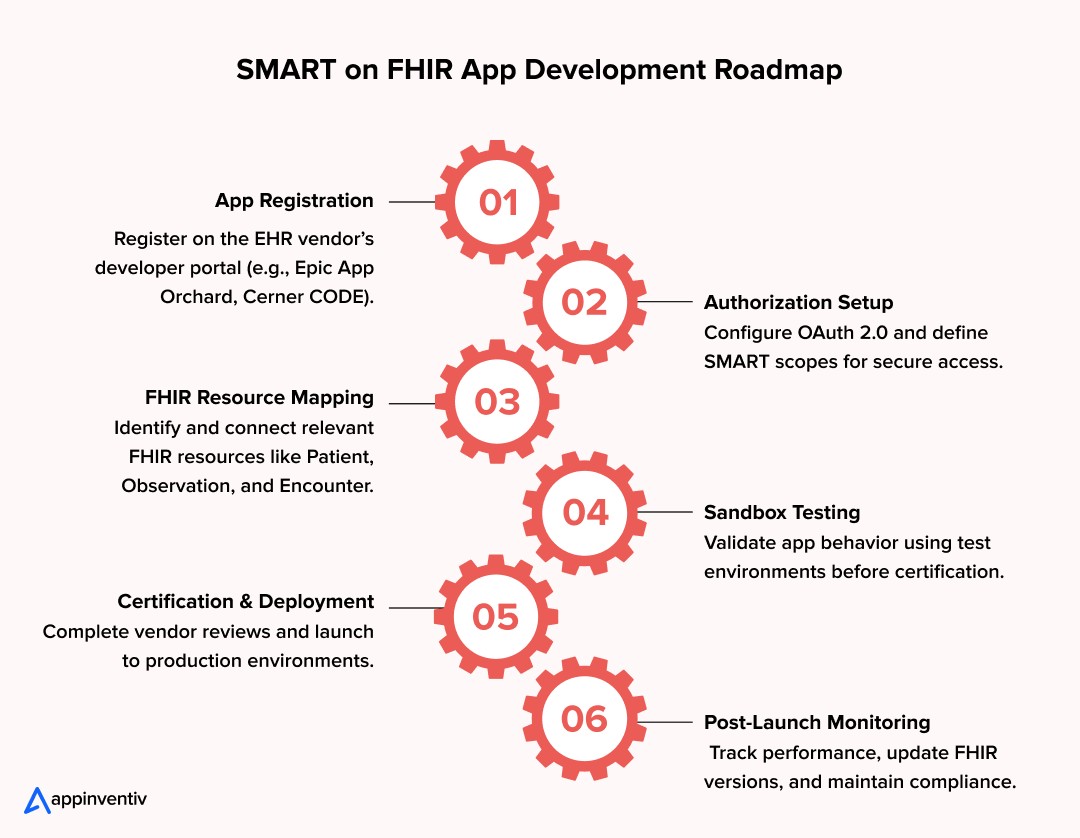
1. Registration and Capability Discovery of Apps
The journey starts by registering your app with the authorization server provided by the EHR vendor. At registration time, you specify your app’s name, redirect URIs, scopes, and client type (public or confidential).
Your app, once registered, asks the server’s discovery endpoint—/.well-known/smart-configuration.
This endpoint provides important information such as:
- Authorization URL and token URL
- Launch modes supported (EHR Launch or Standalone Launch)
- Scopes supported (e.g., launch, patient/*.read, openid, fhirUser)
- Supported FHIR versions
Knowledge of these parameters enables your SMART on FHIR app for EHR integration to automatically adjust to various EHR environments without hard-coded credentials.
2. Authorization and Launch Context Establishment
Upon discovery completion, the application launches its operation. It can follow either of two models based on workflow requirements:
- EHR Launch: The application launches within the EHR and inherits the active patient ID, encounter ID, and user identity of the clinician.
- Standalone Launch: The application launches as a standalone application, requiring users to sign in with the EHR prior to data access.
In each scenario, the app employs OAuth 2.0 for requesting authorization. It sends the user to the login page of the EHR along with mandatory scopes and context parameters (launch, iss, client_id, redirect_uri, and state). The EHR verifies the request and grants an authorization code.
3. Token Exchange and Scope Handling
Upon successful authorization, the app converts the authorization code for an access token using the token endpoint of the EHR. Technical operations at this step are:
- Passing the client ID, client secret (if confidential), and code verifier for PKCE verification
- Saving the access token, refresh token, and expiry time securely
- Managing SMART scopes that specify authorized resources (e.g., patient/Observation.read or user/Condition.write)
This token controls all subsequent API requests, with least-privilege access and complete traceability of who looked at what data and when.
4. FHIR Resource Access Through APIs
With a proper token, the application talks to the FHIR server using RESTful APIs. SMART on FHIR API development ensures secure and standardized communication throughout this process. Some common HTTP operations are:
- GET /Patient/{id} – retrieve patient record
- GET /Observation?patient={id} – retrieve labs or vitals
- POST /MedicationRequest – create prescription
Apps rely on standardized libraries like SMART JS Client or HAPI FHIR to handle such requests and parse JSON responses. Businesses tend to utilize caching layers and pagination management for performance optimization when big datasets are fetched.
5. Conformance Testing and Validation
Conformance to the SMART on FHIR standard and the marketplace requirements of the target EHR must be established prior to deployment. Testing entails:
- Validation of OAuth flows against the Inferno Test Suite
- Executing security tests for token reuse, expiration, and refresh management
- Validating FHIR resource structures with Touchstone or Postman collections
- Audit events and logging consistency checking
Passing these tests proves that your application shares data securely and complies with both HL7 specifications and vendor-specific certification regulations.
6. Deployment and Ongoing Monitoring
The approved app is deployed into production from the EHR’s sandbox or marketplace environment. Enterprises track:
- Token usage and API call volume
- Latency and uptime metrics
- Error rates and FHIR version compatibility
Ongoing logging and regular penetration testing maintain compliance with HIPAA, GDPR, and ONC certification revisions. When there are new releases of FHIR (e.g., R5 or R6), versioned endpoints are created so the application can be matured without any downtime.
Adhering to this defined process assists healthcare organizations in developing SMART on FHIR applications that scale across EHR vendors, stay regulatory compliant, and provide secure, predictable access to data for all authorized users.
Key Enterprise Benefits of SMART on FHIR App Development
Recent surveys show that about 71% of healthcare leaders say FHIR is already being used for a few use cases in their country, a clear sign that global adoption is moving past the experimental stage. Enterprises now see SMART on FHIR not as a pilot technology but as a proven model for secure and scalable data exchange.
Here are the key benefits of SMART on FHIR app development and how it helps large healthcare systems achieve that balance between accessibility, compliance, and performance:
1. Unified Access Across EHR Systems
SMART on FHIR app integration lets you create one application that connects to multiple EHRs like Epic, Cerner, or Meditech through a shared standard.
This consistency:
- Removes the need for multiple, vendor-specific integrations
- Reduces engineering costs and integration delays
- Keeps your enterprise data framework uniform across departments
2. Compliance That Scales with Your Organization
The framework uses OAuth 2.0 and OpenID Connect for secure, authorized data access.
This makes it easier to stay compliant with regulations such as:
- HIPAA (for US entities)
- GDPR (for EU organizations)
- ONC’s API certification and USCDI guidelines
Every data interaction is logged and traceable, helping you demonstrate accountability during audits.
3. Faster Development and Deployment
SMART on FHIR standardizes communication between apps and EHRs. Your developers can reuse components, test faster, and roll out updates with fewer dependencies.
That means:
- Reduced development time
- Consistent performance across systems
- Lower post-launch maintenance costs
4. Stronger Decision Support for Clinicians
With structured data flowing in real time, clinicians get immediate access to patient information, lab results, and treatment history.
SMART on FHIR apps help with:
- Detecting potential prescription conflicts
- Viewing lab and imaging updates instantly
- Running analytics-driven care recommendations
5. Reduced Long-Term Integration Costs
Instead of updating multiple API connections, you maintain one FHIR-compliant standard. That approach keeps maintenance predictable and costs under control, especially for enterprises operating several hospitals or partner systems.
6. Foundation for AI and Predictive Analytics
Structured FHIR data supports large-scale analytics. It gives your AI models access to clean, consistent datasets—critical for accurate predictions and research. It also helps with personalization in healthcare.
This foundation opens the door for:
- Predictive patient risk modeling
- Population health studies
- Real-time outcome tracking
Use Cases of SMART on FHIR for Healthcare App Development
SMART on FHIR is not a single app type. It is an adaptable standard that will work for everything from patient engagement tools to enterprise-scale clinical systems. For businesses, the value proposition really comes in how it brings together many solutions under one compliant and secure data foundation.
The following are some of the most prevalent and impactful applications of SMART on FHIR app development for enterprises:
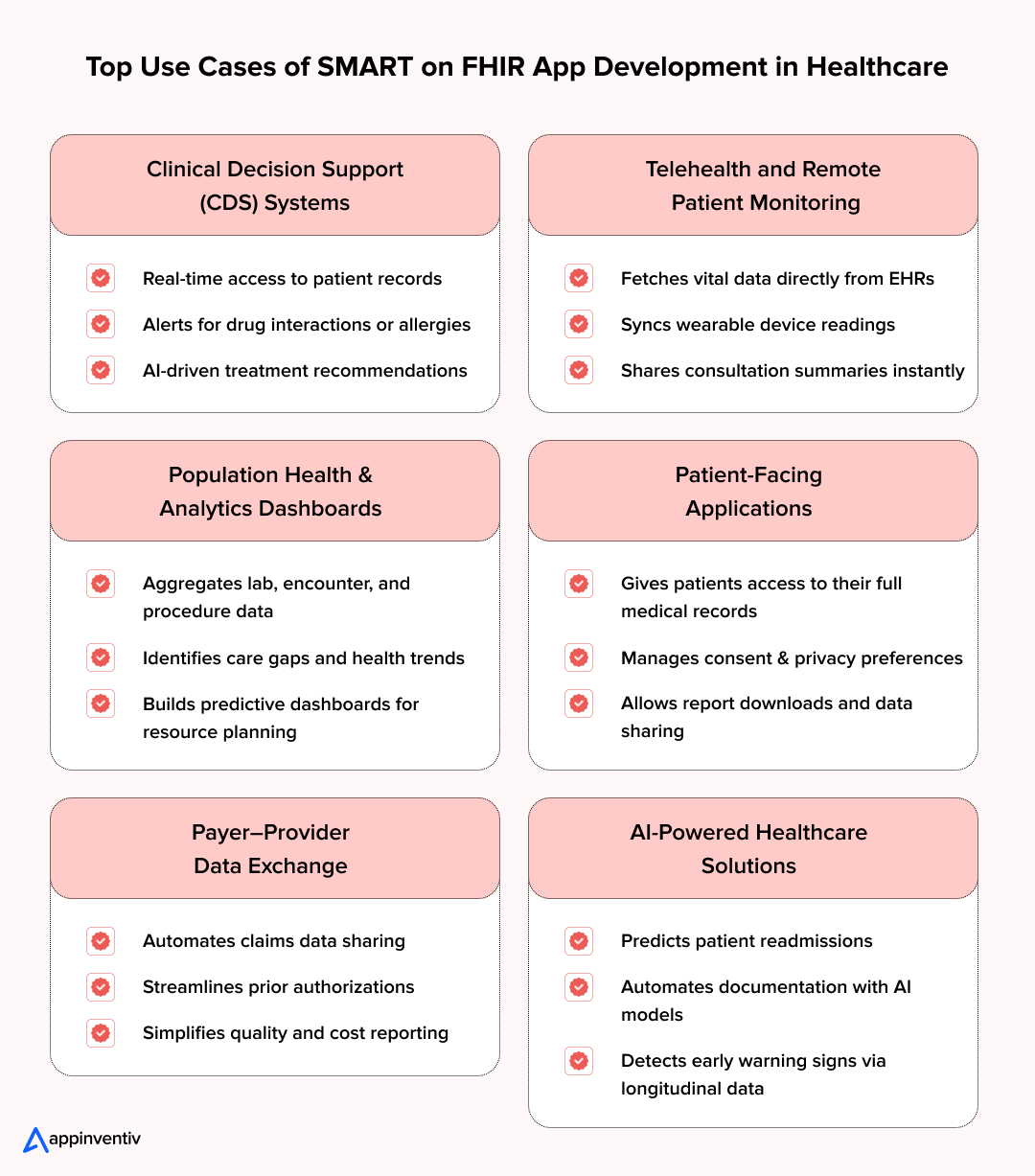
1. Clinical Decision Support (CDS) Systems
Clinicians make treatment choices with the instant availability of correct data. SMART on FHIR applications integrate seamlessly with EHRs to offer:
- Real-time AI-powered data visualization of the patient
- Medication conflict or allergy alerts
- AI-driven suggestions based on past outcomes
This minimizes medical errors and enhances overall care coordination.
2. Telehealth and Remote Patient Monitoring
Telehealth systems require organized, current patient information to provide good virtual care. SMART on FHIR mobile app development makes it possible for your telehealth application to:
- Pull vital signs and reports in real-time from attached EHIRs
- Sync wearable device data via FHIR-compatible APIs
- Share visit summaries and prescriptions with the EHR in real-time
Telehealth with EHR enables a constant loop of feedback between patients and clinicians, enhancing patient engagement and minimizing follow-up delays.
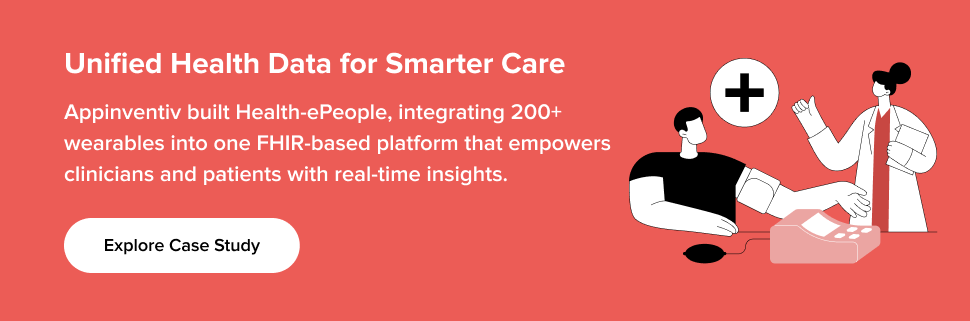
Appinventiv built Health-ePeople, integrating 200+ wearables into one FHIR-based platform that empowers clinicians and patients with real-time insights.
3. Population Health and Analytics Dashboards
Large health networks require facility-wide visibility. SMART on FHIR facilitates data consolidation by leveraging standardized formats for lab results, encounters, and procedures.
That makes it simpler to:
- Recognize care gaps among populations
- Monitor trends in chronic diseases
- Create predictive dashboards for planning resources
4. Payer-Provider Data Sharing
SMART on FHIR automates data exchange between payers and providers without manual reconciliation. It enables:
- Claims data exchange
- Prior authorization processes
- Quality and cost reporting
Enterprises dealing with clinical and financial data minimize integration mistakes and speed up turnaround times.
5. Patient-Conscious Applications
Patients nowadays anticipate transparency in their health records. SMART on FHIR enables businesses to create apps in which users are able to:
- Access their entire medical history
- Download or share reports safely
- Control consent preferences for data access
This empowers patients and supports organizations in complying with today’s data-sharing requirements.
6. AI-Powered Healthcare Use Cases
SMART on FHIR offers well-structured datasets suitable for AI and machine learning platforms.
- Some future applications include:
- Risk prediction of patient readmission
- Early warning sign detection from longitudinal data
- Automating documentation using context-aware AI models
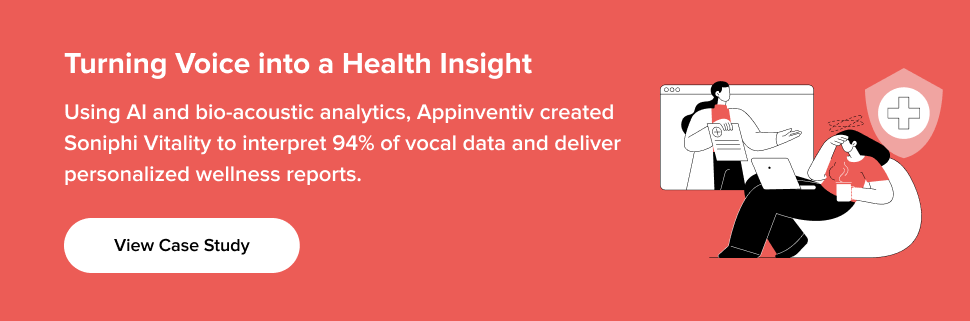
Using AI and bio-acoustic analytics, Appinventiv created Soniphi Vitality to interpret 94% of vocal data and deliver personalized wellness reports.
Also Read: The Ultimate Business Guide to Healthcare Application Development
Common FHIR Resources Used in Each Type of Application
Every SMART on FHIR app relies on specific FHIR resources to exchange and organize health data. These resources act as standardized building blocks that define how information such as patient details, clinical notes, or billing data is stored and shared across systems.
Here is a quick overview table:
| Application Type | Primary FHIR Resources Used |
|---|---|
| Clinical Decision Support |
|
| Telehealth & Remote Care |
|
| Population Health |
|
| Payer-Provider Exchange |
|
| Patient-Facing Apps |
|
SMART on FHIR provides healthcare businesses with a common platform to create scalable, compliant, and intelligence-driven applications without being tied to a single vendor ecosystem.
Core Features of Apps Developed with SMART on FHIR
SMART on FHIR apps are designed to bridge, understand, and display health information in formats that are useful for clinicians and patients alike.
SMART on FHIR mobile app development is distinguished by its capacity to integrate securely with a variety of different EHR systems while maintaining the same experience across platforms.
These apps are role-driven, flexible, and scalable — in that each user group has tools customized to their requirements yet shares the same data framework.
1. Patient-Centric Capabilities
The patient is advantaged by SMART on FHIR applications, which facilitate easier management of personal health data. The patient can view their entire medical history from multiple providers, see lab work as soon as the results are recorded, and review vitals obtained through networked wearables.
They are even able to schedule appointments, view prescriptions, and control data-sharing capabilities from the application. This single access keeps patients up to date and active without having to switch through numerous hospital portals or ask for records over and over.
2. Clinician-Focused Features
Clinicians are able to immediately access complete patient records at the point of care. Apps like these consolidate information on allergies, medications, and test results onto a single screen. Clinical decision support (CDS) features, integrated into the app, provide reminders or warnings for possible risks and suggest evidence-based interventions during consultations.
Offline access and secure messaging functions also aid in enabling care teams to collaborate in harmony, even with limited connectivity environments.
3. Payer and Administrator-Focused Capabilities
For enterprise administrators and payers, SMART on FHIR applications facilitate management of data consistency, compliance, and reporting. They can access real-time claims data, monitor billing data, and see automated audit-ready reports generated through the system.
The applications also offer dashboards for monitoring population health, resource use, and overall system performance to support quicker decision-making by leadership.
4. Developer and IT-Focused Capabilities
SMART on FHIR app developers and IT professionals employ SMART on FHIR since it includes a formal integration strategy. Such applications are standardized APIs, sandbox environments, and OAuth 2.0 security configurations that support predictable development and deployment.
They also include bulk data operations and a modular design that supports integrating several EHR systems without rebuilding everything from scratch. This standardization makes future upgrades easier and allows for long-term maintainability on distributed systems.
Here is a quick overview table:
| User Role | Core Features | Advanced Capabilities |
|---|---|---|
| Patients | Record access, wearable sync, and appointment management | Teleconsults, data-driven insights, personalized care plans |
| Clinicians | Unified charts, CDS alerts, order entry | Predictive analytics, AI-driven treatment recommendations |
| Admins / Payers | Claims data, reporting dashboards, and compliance tools | Automated reconciliation, population analytics |
| Developers / IT | FHIR APIs, sandbox testing, secure authorization | Multi-EHR integration, bulk data automation |
SMART on FHIR apps provide a common foundation for all stakeholders in the healthcare universe. From a patient viewing results or an IT group handling compliance, the same structured data drives accuracy, security, and consistency across the entire spectrum.
Inside the Architecture: How SMART on FHIR App Integration Works
Underlying each SMART on FHIR app is a simple but powerful architecture. It’s the framework that ensures interoperability is repeatable, reliable, and compliant across your whole healthcare ecosystem. This section explains how it works and why it’s trusted at an enterprise scale of interoperability.
The Core Concept
All SMART on FHIR applications employ a double-layer model. FHIR specifies how data is structured, whereas SMART governs who has access. Together, they make sure sensitive patient information travels securely among users, apps, and EHR systems without manual integration.
How the Integration Works?
SMART on FHIR takes a straightforward five-step approach that maintains security and data consistency. It begins when a user launches a SMART-enabled app and concludes with secure, standardized data sharing through FHIR APIs.
Every step of authorization and data retrieval is automated, checked, and completely auditable for compliance. Here is a quick overview of the steps:
- A user launches a SMART-enabled application.
- The application asks permission from the shared EHR.
- The EHR authenticates using OAuth 2.0 and PKCE.
- A secure access token is received.
- The application uses that token to trade FHIR resources like Patient, Observation, or Encounter.
SMART on FHIR App Launch Contexts
SMART on FHIR provides three launch types that serve various enterprise workflows. Each specifies how an application launches, what context it contains, and who ordinarily uses it.
Here is a quick overview table:
| Launch Type | Typical Use Case | Who Uses It |
|---|---|---|
| EHR Launch | Begins within an EHR such as Epic or Cerner, and carries user and patient context forward. |
|
| Standalone Launch | Runs outside of an EHR but still securely connects to FHIR servers. |
|
| Backend Services Launch | Runs without explicit user interaction, commonly used for analytics or computer-aided reporting. |
|
Security and Data Flow
SMART on FHIR enforces multi-layered security and granular access control. It adheres to rigorous authorization requirements, encrypts all API calls, and logs every access event for auditing purposes. This multi-layer model guarantees trust, compliance, and control of all data interactions.
Here is a quick overview table:
| Layer | Responsibility | Key Protocol |
|---|---|---|
| Authentication | Verifies the identity of users or systems | OAuth 2.0 / OpenID Connect |
| Authorization | Specifies what data can be accessed | SMART Scopes and PKCE |
| Data Exchange | Exchanges structured data | RESTful FHIR APIs |
| Audit and Logging | Monitors and logs access events | SMART Audit Event Profiles |
Also Read: How Modern Technology Is Enhancing Healthcare Operations
Enterprise Challenges in SMART on FHIR Development and How to Solve Them
SMART on FHIR provides a strong interoperability foundation, but enterprise healthcare environments surface challenges that go well beyond basic API integration. Legacy EHR estates, clinical governance constraints, and vendor-controlled workflows introduce friction that teams often underestimate early on.
Below are the most common enterprise-grade challenges and how experienced teams address them.
Multiple EHR Versions and Vendor-Specific FHIR Behavior
EHR vendors support SMART on FHIR unevenly. Differences in FHIR maturity, custom extensions, partial resource coverage, and non-standard endpoints lead to inconsistent behavior across Epic, Cerner, and Meditech environments. Implement an EHR abstraction layer with vendor adapters, resource normalization, and fallback handling. This decouples application logic from vendor-specific FHIR implementations.
Authorization, Scopes, and Identity Context Complexity
SMART on FHIR relies on OAuth 2.0, but real-world deployments must handle patient context, clinician context, system-to-system access, and break-glass scenarios. Adopt least-privilege scope design, enforce scope-to-role mapping, and validate flows using Inferno and Touchstone. Maintain a centralized scope registry aligned with clinical and operational roles.
Limited Sandbox Fidelity and Test Data Gaps
Vendor sandboxes often lack full clinical depth, realistic longitudinal data, or write-enabled endpoints, limiting integration validation. Augment vendor sandboxes with HAPI FHIR servers and SMART Health IT reference environments. Use synthetic data modeling to validate edge cases before production certification.
Bulk Data Access and Performance Constraints
FHIR REST APIs are not optimized for population-scale analytics, registries, or downstream ML pipelines. Leverage Bulk Data Access (Flat FHIR) with asynchronous jobs, paging strategies, caching layers, and queue-based processing for high-volume workloads.
FHIR Version Drift and Long-Term Compatibility
Enterprises must support R4 today while preparing for R5 and beyond, often across multiple EHR tenants. Version API contracts explicitly, isolate FHIR parsers, and maintain backward-compatible mappings to support parallel FHIR releases.
The Hard Truth About Write-Back Workflows
Most SMART on FHIR discussions stop at read access. Enterprise value often depends on write-back actions such as medication orders, care plan updates, or clinical documentation.
These flows are tightly governed, vendor-restricted, and require formal clinical safety reviews, scoped permissions, and EHR vendor approvals.
Design write-back early. Align with vendor governance models, secure write scopes upfront, and implement transactional safeguards, validation rules, and audit trails that meet clinical risk standards.
Compliance, Auditability, and Clinician Usability Trade-Offs
Meeting HIPAA, ONC certification, and regional privacy requirements can introduce workflow friction if security controls are poorly designed. Use SMART App Launch with SSO, token refresh, adaptive session lifetimes, and comprehensive audit logging aligned with SMART AuditEvent profiles.
When addressed with the right architectural patterns, governance discipline, and vendor-aware execution, SMART on FHIR implementations can scale securely across enterprise healthcare ecosystems without compromising clinical workflows or compliance posture.
Also Read: Navigating the AI Challenges in Healthcare – Insights and Success Strategies for Enterprises
Work with experts who understand EHR integrations, compliance frameworks, and enterprise-scale SMART on FHIR app development.

Enterprise Tech Stack for SMART on FHIR Implementation
The technology stack for SMART on FHIR API development combines classic web and mobile technologies with compliance layers and healthcare-specific frameworks. The objective is to get your app to run well, scale it, and integrate it with EHR platforms securely
Here is the quick overview of the core technology stack:
| Layer | Common Technologies | Purpose |
|---|---|---|
| Frontend (Web/Mobile) |
| Build responsive UIs for clinicians and patients. |
| Backend |
| Handle FHIR data processing, authentication, and API request processing. |
| FHIR Libraries |
| Simplify FHIR resource interaction and RESTful endpoint interaction. |
| Database |
| Store app metadata, tokens, and non-PHI operational data. |
| Authentication & Authorization |
| Allow secure app access and token handling. |
| Hosting & Deployment |
| Offer scalable and HIPAA-compliant infrastructure. |
Testing and Validation Tools
SMART on FHIR apps should be properly tested for interoperability and compliance.
A few of the tools employed by SMART on FHIR app developers are as follows:
- Inferno Test Suite: Tests SMART App Launch and FHIR conformance.
- Touchstone by AEGIS: Executes automated FHIR resource validation tests.
- Postman Collections: Facilitates developers to test APIs for endpoint behavior and token flow.
- HAPI FHIR Server: Used mostly for local debugging and development.
EHR Integration and Certification Platforms
Every EHR vendor offers a developer environment and certification route for SMART on FHIR applications. These tools enable teams to try integrations, test authorization flows, and obtain production access when ready.
Here is a quick overview table:
| Vendor | Developer Program | Key Features |
|---|---|---|
| Epic Systems | App Orchard | Sandbox access, API documentation, certification workflow |
| Cerner | CODE Developer Program | Sandbox testing, FHIR APIs, technical review support |
| Allscripts | Developer Portal | Open APIs and population health integration support |
| MEDITECH | Greenfield Developer Program | Secure test environment and interoperability review |
These programs ensure your app meets vendor-specific compliance and performance specifications prior to offering it to healthcare organizations.
Security and Compliance Layer
Security is the cornerstone of any SMART on FHIR application. Because these applications interact with sensitive health information (PHI), all layers — from authentication to storage of data — must adhere to rigorous privacy and access controls.
Enterprises generally employ:
- SMART Scopes: To set access boundaries
- Audit Event Profiles: For tracking user activity
- Encrypted Data Transfer: Using HTTPS and TLS 1.2+
- Token Rotation Policies: For anti-replay protection
This multi-layer security design enables trust and compliance across all data interchange.
By integrating the latest frameworks with health-specific software, firms can create SMART on FHIR apps that are scalable, secure, and EHR system-agnostic.
Integrating SMART on FHIR Apps with Epic and Other EHR Systems
SMART on FHIR app integration is where reality meets theory. While SMART on FHIR gives the theory, each EHR vendor puts it into practice differently. For businesses, each of these differences is important to ensure that the app will run well in production and get through vendor certification smoothly.
This section deconstructs integration for Epic and other large EHRs, what enterprise developers need to expect, and how to test connections correctly.
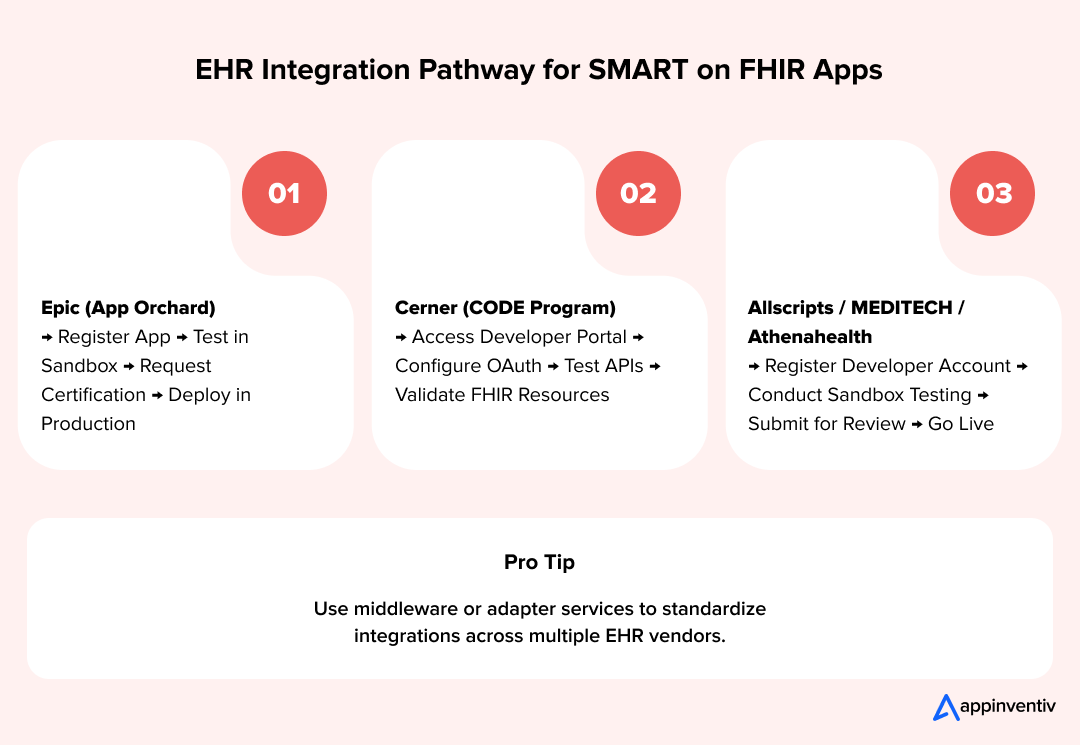
Epic SMART on FHIR Integration
Epic SMART on FHIR app development is backed by one of the most developed ecosystems through its App Orchard initiative. Integration with Epic generally happens in these steps:
- App Registration: Register your SMART application on the App Orchard portal, specifying redirect URIs, scopes, and security credentials.
- Sandbox Testing: Test authorization, initiate flows, and FHIR resource queries (Patient, Encounter, Observation, etc.) using Epic’s sandbox.
- Context Launch: SMART on FHIR applications launched within Epic will inherit automatically the logged-in user’s context, patient ID, and encounter data.
- Certification Review: After testing is finished, provide documentation, endpoint information, and security results for approval by Epic prior to production deployment.
Epic offers robust support for scopes like launch/patient, patient/*.read, and user/*.read, making it suitable for both clinician- and patient-facing applications.
Cerner (Oracle Health) Integration
Cerner’s CODE Developer Program facilitates SMART on FHIR integration using its public sandbox and OAuth 2.0 endpoints. The steps include the following:
- Utilizing the FHIR R4 resources being supported by Cerner’s open APIs.
- Testing against its sandbox environment for read/write operations on data.
- Validating token management and authorization flows according to the official documentation.
Cerner’s environment is especially developer-friendly with a lot of API documentation and Postman collections available to ease testing.
Allscripts Integration
Allscripts has SMART on FHIR integration supported by its developer portal. It offers APIs for key data elements like demographics, medications, and scheduling. Steps for integration are app registration, sandbox testing, and production access request.
In case of enterprises that have multi-site deployments, Allscripts’ standardized endpoints facilitate easier duplication of integration setups within facilities.
MEDITECH and Other EHRs
MEDITECH’s Greenfield Developer Program enables SMART on FHIR apps to securely connect using modern RESTful endpoints.
Integration usually involves testing OAuth 2.0 flows, verifying SMART scopes, and conducting validation against the organization’s internal environments.
Other EHRs such as Athenahealth, NextGen, and eClinicalWorks also support FHIR-based SMART apps, though with varying levels of API maturity.
Best Practices for Multi-EHR Integration
Managing multiple EHR integrations is common for large healthcare enterprises. However, differences in API behavior and resource availability can complicate SMART on FHIR app integration maintenance. Here’s how to simplify the process:
- Use middleware or integration gateways to normalize EHR connections.
- Have a FHIR compatibility matrix per vendor to monitor supported resources.
- Create modular adapter services that segregate vendor-specific logic from your main app.
- Use CI/CD pipelines to automate sandbox and production testing.
These practices make integrations uniform and lower the overhead of maintaining several connections across vendors. A properly executed integration plan guarantees that your SMART on FHIR application works perfectly on various EHR platforms, remains compliant, and grows as your network increases.
Security, Compliance, and Governance in Enterprise FHIR Ecosystems
When health information crosses multiple systems, security and governance are no longer amenities—they are the underpinning of trust. This section outlines the security layers, global standards, and governance habits that make SMART on FHIR environments secure and auditable.
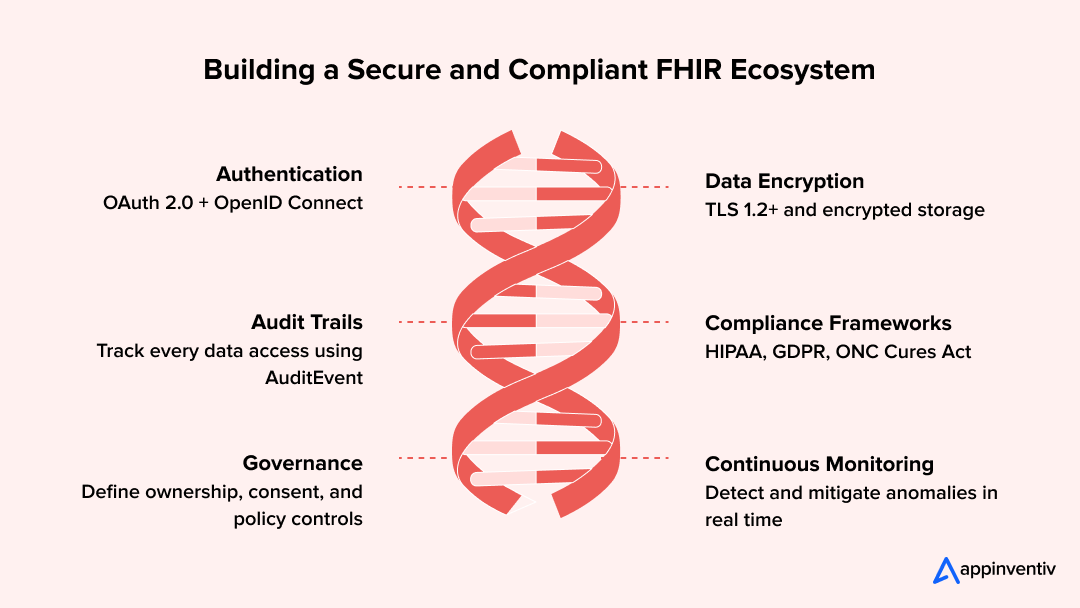
1. Data Protection and Access Control
All SMART on FHIR applications must have data exchange, both encrypted and controlled. Authentication takes place via OAuth 2.0 and OpenID Connect, which authenticate against the user and application identities before issuing authorization.
There are SMART Scopes that developers implement to define precise permissions, such as patient/*.read or user/*.write, where each role receives only what they need. All data exchanged between systems is secured using TLS 1.2+ encryption, protecting it against interception or manipulation.
2. Audit Trails and Activity Logging
Requirements like HIPAA and GDPR require organizations to maintain detailed logs of all data interactions. SMART on FHIR introduces the notion of AuditEvent resource, which captures events such as logon events, reads of data, or changes.
Enterprise deployments typically route these audit logs to a SIEM (Security Information and Event Management) system to be monitored in real-time and detect anomalies. Not only does this assure compliance, but it also detects abnormal access patterns prior to them becoming major breaches.
3. Regulatory Frameworks and Standards
Enterprise healthcare systems are required to comply with several compliance frameworks. Some of the most important standards are:
- HIPAA (US): Secures PHI by administrative, physical, and technical safeguards.
- GDPR (EU): Controls the processing of personal health data within and outside EU boundaries.
- ONC Cures Act (US): Requires FHIR-based APIs for certified health IT systems.
- ISO 27001: Defines information security management requirements.
Compliance with these standards ensures SMART on FHIR applications are interoperable worldwide and privacy compliant from day one.
4. Governance and Data Stewardship
Governance defines how data is accessed, shared, and stored across your organization. A successful governance framework has the following:
- Explicit data ownership roles among departments are established.
- Regular compliance audits and policy reviews.
- FHIR API and data mapping version control.
- Simple patient consent management with FHIR Consent resources.
Strong governance ensures consistency in using health data and reduces the risk of compliance in multi-EHR networks.
Incident Response and Risk Management
No organization is entirely vulnerability-proof. Companies need to have a documented incident response plan that outlines detection, containment, and reporting of data security incidents.
Periodic penetration tests and simulated breach drills allow teams to evaluate readiness. Integrated automated alerts for suspicious API activity are also able to prevent potential threats from affecting users.
Also Read: A Complete Guide to Healthcare Compliances
Cost of SMART on FHIR App Development for Enterprises
The cost of SMART on FHIR app development is highly dependent on the size, integration needs, and regulatory scope of your healthcare environment.
Organizations that invest in SMART on FHIR solutions typically want long-term interoperability, which involves balancing build costs with sustainability and compliance.
Here’s a breakdown to help you have realistic budgets and expectations:
| Project Type | Description | Estimated Cost (USD) | Development Timeline |
|---|---|---|---|
| MVP / Pilot App | Simple SMART on FHIR integration for restricted data access (e.g., patient view, read-only) | $40,000 to $80,000 | 3 to 4 months |
| Mid-Scale Application | Bi-directional data exchange, SMART scopes, and restricted analytics | $80,000 to $150,000 | 5 to 7 months |
| Enterprise Solution | Multi-EHR integration, AI analytics, real-time monitoring, HIPAA/GDPR compliance | $150,000 to $300,000+ | 8 to 12 months |
These are prices for development, testing, and integration. There can be extra costs for EHR certification, infrastructure deployment, and support.
Key Cost Factors
The overall cost of the SMART on FHIR app development depends on the depth of integration, security requirements, and scale of your deployment. Here is a quick overview of the key cost factors:
- EHR Integrations: Each vendor (Epic, Cerner, MEDITECH, etc.) has its own certification and sandbox setup, adding to complexity and timeframe.
- FHIR Version and Scope: Implementations for supporting multiple FHIR versions (R4, R5) or high volumes of data are more costly due to extended testing and validation.
- Security and Compliance Needs: Support for full HIPAA, GDPR, and ONC compliance sets includes additional architecture, encryption, and audit setup.
- Custom Features and Analytics: AI-driven insights, CDS hooks, or highly customized dashboards include backend development and performance optimization costs.
- Infrastructure and Scalability: Cloud hosting, CI/CD automation, and API gateways cost to operate but provide higher scalability and uptime.
- Post-Launch Maintenance: Routine updates, token refreshes, and FHIR version upgrades will typically account for 15 to 20% of overall project expense annually.
ROI and Business Impact of SMART on FHIR Implementation
Beyond regulation, SMART on FHIR brings real business value. For health care businesses, it’s fewer integration headaches, quicker system linking, and the freedom to actually leverage your data for analytics and AI.
The long-term benefit is smoother operations, faster data sharing, and improved patient outcomes throughout your network.
ROI overview:
- Don’t have to recreate the same integration repeatedly for various EHRs
- Get new health systems and partners operational more quickly
- Improve the accuracy of your data and keep regulations on your side
- Create a foundation that can scale with your AI and analytics ambitions
For large healthcare systems and digital health businesses, these efficiencies generally recoup your development costs in 18–24 months.
Bottom line: SMART on FHIR application development is an investment in enduring interoperability. Done right, you’re not only checking compliance boxes—you’re creating a connected, data-driven healthcare system that continues paying dividends year after year.
Future Outlook: The Evolving Role of SMART on FHIR in Health App Development
The future of SMART on FHIR apps is taking shape as the technology evolves from a developer’s resource to a unifying strategy for healthcare innovation. As the world doubles down on interoperability, it’s becoming the common language that hospitals, insurance, and digital health platforms all speak to communicate with one another and securely exchange information.
1. Driving Enterprise Interoperability
US, UK, and EU regulations are forcing healthcare organizations to standardize FHIR-based data sharing. SMART on FHIR will be the de facto way of connecting EHRs, patient apps, and analytics platforms in the coming few years—all from one compliant roof.
2. Enabling AI and Predictive Insights
When your data is in FHIR format, it is easier to feed into intelligent analytics and AI platforms. Healthcare organizations that implement SMART on FHIR are able to detect risks earlier, customize treatments for patients, and automate reporting more accurately.
3. Scaling from Hospitals to National Networks
National and even transnational FHIR networks are starting to emerge. Organizations that adopt FHIR bulk data APIs will be in a position to manage population health at scale, optimize the way payers and providers work together, and speed up the collaboration for research at scale.
4. The Road Ahead
As FHIR continues to mature, healthcare organizations will need nimble systems that can be revised to accommodate new advancements without compromising security or governance. The move towards API-first spaces is solidifying SMART on FHIR as the building block of networked healthcare—transforming isolated systems into intuitively interoperable, data-driven networks.
From idea to certified EHR integration, our team helps you develop secure and scalable SMART on FHIR applications tailored for your enterprise.

How Appinventiv Helps Enterprises Build and Scale SMART on FHIR Apps?
As a leading healthcare application development company, Appinventiv specializes in SMART on FHIR app development that enables secure, compliant, and scalable data exchange across EHR systems. Our team helps enterprises transform interoperability goals into working digital solutions that simplify workflows and strengthen clinical collaboration.
Over the years, we’ve delivered impactful healthcare platforms like Health-ePeople, which aggregates data from 200+ wearables into one interoperable ecosystem.
Soniphi, an AI-driven wellness app interpreting 94% of vocal data for health insights; and YouCOMM, a hospital communication platform improving in-patient response time by 40%.
These solutions reflect our deep capability in building FHIR-compliant, data-driven applications that improve both care delivery and clinical decision-making.
Key Highlights:
- 500+ Digital Health Platforms Delivered
- 450+ Healthcare Clients Served
- 10+ Years in HealthTech Projects
With proven expertise in healthcare interoperability, compliance frameworks, and enterprise-scale EHR integrations, we help organizations adopt SMART on FHIR–based solutions that deliver measurable clinical and operational value. Talk to our experts to evaluate your SMART on FHIR readiness and next steps.
FAQs
Q. How to Build a SMART on FHIR App That Integrates with Epic?
A. You will begin by registering in Epic’s App Orchard—that is where you get your app registered and inform them of the patient data you require. Next, you will employ OAuth 2.0 to take care of the login security aspect.
Epic provides you with a sandbox to mess around in, where you can try out pulling patient records and visit data through their FHIR R4 APIs. After getting everything up and running and passing their certification process, your app can launch right within Epic with all the context of the patient already there.
Q. What is FHIR, and Why Does It Matter in Healthcare?
A. FHIR (Fast Healthcare Interoperability Resources) is essentially the playbook for packaging and exchanging health data. It’s like a universal language that allows various healthcare systems to communicate with one another. It’s important because if there weren’t FHIR, whenever a hospital wanted to integrate with a lab or a patient app, they’d have to create an integration from scratch. FHIR gets everything on the same page.
Q. How Does SMART on FHIR Work?
A. It’s actually quite simple. SMART on FHIR takes FHIR’s method of structuring data and adds a layer of security called SMART. When someone launches your app, OAuth 2.0 verifies that they can view the data, then FHIR APIs retrieve and pass along the actual health data. It’s having a bouncer at the door (SMART) and an extremely well-organized filing system inside (FHIR).
Q. What is the difference between HL7, SMART on FHIR, and FHIR?
A. HL7 is the organization that defines the rules under which healthcare systems must exchange data. FHIR is their new rulebook—much less complicated than the previous ones, based on current web technology such as REST APIs and JSON. SMART on FHIR adds the security components—login, permissions, and user context—to FHIR so that apps can actually communicate with EHRs securely.
Q. What EHR and other clinical systems support SMART on FHIR?
A. Most of the major players are now in the fold—Epic, Cerner (now Oracle Health), Allscripts, MEDITECH, Athenahealth, and NextGen. They’ve all established developer programs whereby you can pilot your app in their sandbox environments before going live.
Q. How much does it cost to build smart on FHIR app?
A. You’re talking anywhere from $40,000 to $500,000 or more. It just depends on what you’re developing. A straightforward app that integrates with one EHR will be less. But if you have to integrate with a bunch of EHRs, deal with tricky compliance rules, or include AI functionality, it escalates—largely due to all the testing and certification you’ll have to perform.
Q. How long does it take to build a SMART on FHIR healthcare app?
A. Plan on 3–12 months. If you’re just doing a simple proof-of-concept, you may be done in 3–4 months. But if you’re doing something more substantial that has to integrate with multiple different EHR systems and hit all the compliance checkboxes, you’re likely going to need a year.
Q. What’s the difference between FHIR and SMART on FHIR?
A. FHIR is about the data—how it’s structured and exchanged between systems. SMART on FHIR is about the access—what people can view that data and under what conditions. So FHIR makes the systems communicate with each other, and SMART ensures the right folks only access the right data. You want both to make it real in the world.

- In just 2 mins you will get a response
- Your idea is 100% protected by our Non Disclosure Agreement.

Healthcare Kiosk Software Development – Benefits, Use Cases, Features, Costs, Process
Key takeaways: The healthcare kiosks streamline administrative processes, enhance patient flow, improve staff productivity, reduce costs, and enhance the patient experience. Healthcare kiosks enhance efficiency and personalized care through EMR/EHR-integrated kiosk software with AI, delivering real-time data updates. Scalable kiosk solutions lower operations expenses, enhance patient throughput and improve service delivery in healthcare organizations. Patient…

How To Develop a Sustainable Healthcare System?
Key Takeaways Rising costs and climate pressure make building a sustainable healthcare system a core business and risk strategy decision. Learn the key principles of sustainable healthcare system development, including prevention, efficiency, equity, and social sustainability. See how AI, data platforms, and a sustainable digital system in healthcare cut waste, improve outcomes, and stabilize workforce…

EHR Implementation for Healthcare Providers: Process, Features, and Total Cost Analysis
Key takeaways: A clear EHR implementation guide keeps teams on track and prevents delays. The full EHR implementation process includes planning, setup, moving data, training staff, and regular updates. The right features handle clinical work, billing, reports, and compliance for large healthcare organizations. EHR implementation costs vary based on design, integrations, data migration, training hours,…