


































Medical Device Software Integration: A Strategic Buyer’s Guide for Healthcare Enterprises

 Share -


- 01How Integration Architectures Build Connected Health Systems
- 02Features and Benefits of Medical Device Integration for Healthcare Enterprises
- 03Medical Device Integration Use Cases and Real-World Examples
- 04Medical Device Integration Standards and Interoperability Requirements
- 05Top Enterprise Medical Device Integration Solutions Compared
- 06Common Medical Device Integration Challenges and Enterprise Solutions
- 07Regulatory, Security, and Validation Considerations for Medical Device Integration
- 08Key Implementation Steps for Medical Device Software Integration
- 09Trends Shaping Medical Device Software Integration
- 10How to Select the Right Medical Device Software Integration Partner
- 11Why Appinventiv for Medical Device Software Integration
- 12Frequently Asked Questions

Key Takeaways
- Healthcare enterprises can reduce data silos by connecting medical devices, EHRs, analytics platforms, and clinical workflows.
- Integration strategy matters as much as technology selection and influences scalability, compliance readiness, and long-term operational efficiency.
- Real-time device connectivity improves clinical visibility and reduces the risks associated with manual data entry.
- Multi-vendor environments require standards-based integration, data normalization, and governance to maintain interoperability at scale.
- Emerging technologies are turning medical device integration into a strategic enabler for AI-driven and predictive healthcare systems.
Global health systems rely on medical device integration to manage over ten thousand digital endpoints. Teams operate hospitals, clinics, and home care programs. Equipment such as monitors, pumps, and scanners generates continuous data. But this information stays trapped. Closed networks and proprietary protocols isolate the facts. Teams lose access to these numbers.
Simple connectivity is not enough. Executives need system interoperability. Managers move data between devices, records, and applications. Secure transfers protect data quality. One small gap creates duplicate files. Teams waste hours on manual entry. Doctors make critical choices with incomplete files. These errors hurt patient outcomes.
Software integration solves these operational problems. It builds a clear path for data sharing. The medical device software market is expected to reach $211 billion by 2035, reflecting growing demand for connected, software-driven healthcare ecosystems.
Technical standards such as HL7, FHIR, and DICOM link systems. Hospitals connect real-time machine data with the tools doctors use every day. This connection saves time.
This guide reviews technical models, standards, and platforms. Evaluate your choices first, then fund integration plans. Use these facts to choose your next step.
Healthcare leaders are modernizing device connectivity now. Delays increase interoperability gaps and operational risk.

How Integration Architectures Build Connected Health Systems
The growing use of IoMT technology in healthcare means that large healthcare enterprises now connect thousands of devices. Clinical data starts at the bedside edge. It moves over local networks to central databases.
Medical device integration systems use distinct software layers to manage this data traffic safely. The system maps protocols. Disparate hardware then speaks the same language.
Also Read: EHR vs EMR for Healthcare Business
Core Components of an Integration Architecture
Six distinct technical layers manage data transport, security protocols, and format translation.
| Component | Purpose |
|---|---|
| Medical Devices | These tools collect physiological metrics and export raw data via RS-232 serial ports or Wi-Fi. |
| Edge Gateways | This hardware converts legacy serial data or analog signals into standard TCP/IP network packets. |
| Middleware | This program filters telemetry noise, validates packet structures, and manages temporary data queues. |
| Interface Engines | This hub routes messages using HL7 or FHIR standards across local area networks within hospitals. |
| EHR Systems | This database stores discrete clinical values for patient charts. |
| Analytics Engines | This tool runs SQL queries or algorithmic models on historical data to track patient trends. |
The Technical Path of Hospital Data
Most enterprise integration paths use a specific pipeline.
Device (RS-232/Wi-Fi) → Edge Gateway (TCP/IP) → Interface Engine (HL7/FHIR) → EHR (SQL) → Analytics Engine
For example, an intensive care monitor tracks arterial blood pressure. The monitor sends raw hex packets through an RS-232 serial cable. The edge gateway wraps this data into a secure TCP/IP stream.
Next, the interface engine parses the stream into an HL7 v2.5 message. The engine routes this message over an HTTPS connection to the EHR. Database tools index the numbers immediately.
Data Normalization and Semantic Interoperability
Medical machines use different codes for identical clinical metrics. One brand uses the label SpO2 for oxygen saturation. Another brand uses the label Saturation for the same metric. Integration engines use semantic normalization to align these terms.
The system maps conflicting device codes to standard clinical vocabularies such as LOINC or SNOMED CT. This step prevents data conflicts in the central database. It helps teams track metrics exactly during multi-vendor clinical trials and everyday operations.
Features and Benefits of Medical Device Integration for Healthcare Enterprises
Modern medical software does more than link tools to central records. These programs send data automatically and fix errors. They help clinical teams work faster. They build a clean dataset for reporting and machine learning models.
| Feature | Business Outcome |
|---|---|
| Real-Time Tracking | Doctors treat patients faster. They see streaming health metrics right away. |
| Auto-Charting | Automated entry prevents typing errors and reduces clerical workload. |
| Open Connections | The system easily links equipment from many different factory brands. |
| Alarm Controls | Central screens show critical alerts. Nurses respond to urgent needs faster. |
| Prepared Data | Clean files feed predictive software, clinical choices, and group health metrics. |
| Standardized Names | Metrics remain identical across different hospital wards and separate medical clinics. |
| Offsite Tracking | Managers check machine health, run times, and battery levels from anywhere. |
| Two-Way Traffic | Systems collect patient data and send commands back to the machines. |
Health systems gain major advantages from medical device EMR integration and other open networks. The software builds a single central ledger of clinical facts. This step removes separate data blocks. Doctors see complete patient files during critical medical checks.
Medical Device Integration Use Cases and Real-World Examples
Integration tools support clinical care, day-to-day operations, and home health tracking. Every hospital uses these systems differently based on local hardware choices and business priorities. But every team shares one goal. They must send correct clinical facts to the right database at the exact right moment.
| Use Case | Business Impact | Example |
|---|---|---|
| ICU Monitoring | Continuous patient surveillance | Philips Capsule connectivity platforms |
| Remote Monitoring | Fewer hospital readmissions and better follow-up care | Medtronic tracking tools and programs |
| Medical Imaging | Faster diagnostics and simpler workflows | DICOM and PACS infrastructure setups |
| Smart Infusion | Fewer medication administration errors | Connected pump systems and software |
| Perioperative Care | Better visibility during surgeries | Anesthesia system links and monitors |
| Connected Rooms | Better coordination between beds and nurse stations | Smart bed and nurse call links |
ICU Monitoring and Critical Care
Intensive care units create constant data streams from bedside monitors, ventilators, and fluid pumps. Medical device integration with EHR systems sends these numbers straight to electronic health records.
This process removes manual paperwork and data entry delays. For instance, teams use the Philips Capsule platform. This system collects device metrics and transmits the numbers to hospital computers in real time.
The shift toward connected care continues to accelerate. Smartphones already account for nearly 45% of Software as a Medical Device deployments, highlighting the growing role of mobile health and remote monitoring technologies.
Remote Patient Monitoring
Doctors track people outside traditional clinics with connected glucose tools, heart monitors, blood pressure cuffs, and wearable devices. Combined data helps clinical teams spot dangerous health trends early.
Combined data helps clinical teams spot dangerous health trends early through remote patient monitoring, allowing nurses to treat problems before conditions get worse.
For example, the Medtronic remote monitoring network tracks patients at home. The platform checks patient metrics outside the hospital building.
Screening and diagnosis applications currently account for approximately 51% of the Software as a Medical Device market, reflecting the growing importance of connected diagnostic workflows and imaging technologies.
Medical Imaging Workflows
X-ray and scanning departments need fast access to diagnostic files. Software connections link imaging machines, storage networks, and patient charts. This link lets doctors open scans and report files inside one unified workflow.
For example, technicians use DICOM protocols to link CT scanners and MRI machines with storage networks. This connection speeds up diagnostic reviews for the medical team.
Smart Infusion Management
Giving medicine to patients remains a dangerous hospital task. Connected infusion pumps send fluid rates, drug doses, and treatment logs straight into patient records. This step eliminates manual chart entries. It protects patients through digital verification steps.
For instance, smart pump links send data straight to electronic charts. The software matches live pump data with the doctor’s prescription rules.
Connected Care Environments
Modern hospitals link smart beds, nurse buttons, patient monitors, and location tags. This step gives managers clear views of daily operations. Centralized data helps teams track patient traffic, open beds, and staff coordination across separate wards.
For example, managers link smart beds directly to nurse call stations. This connection provides live traffic reports across the entire hospital building.
Also Read: Digital Therapeutics Software Development
Medical Device Integration Standards and Interoperability Requirements
Medical machine projects rarely fail due to bad cables. Problems start with data interoperability gaps when machines and databases speak different languages. Shared rules fix this issue completely. They define how networks arrange, trade, read, and save health data.
HL7 Messaging Formats
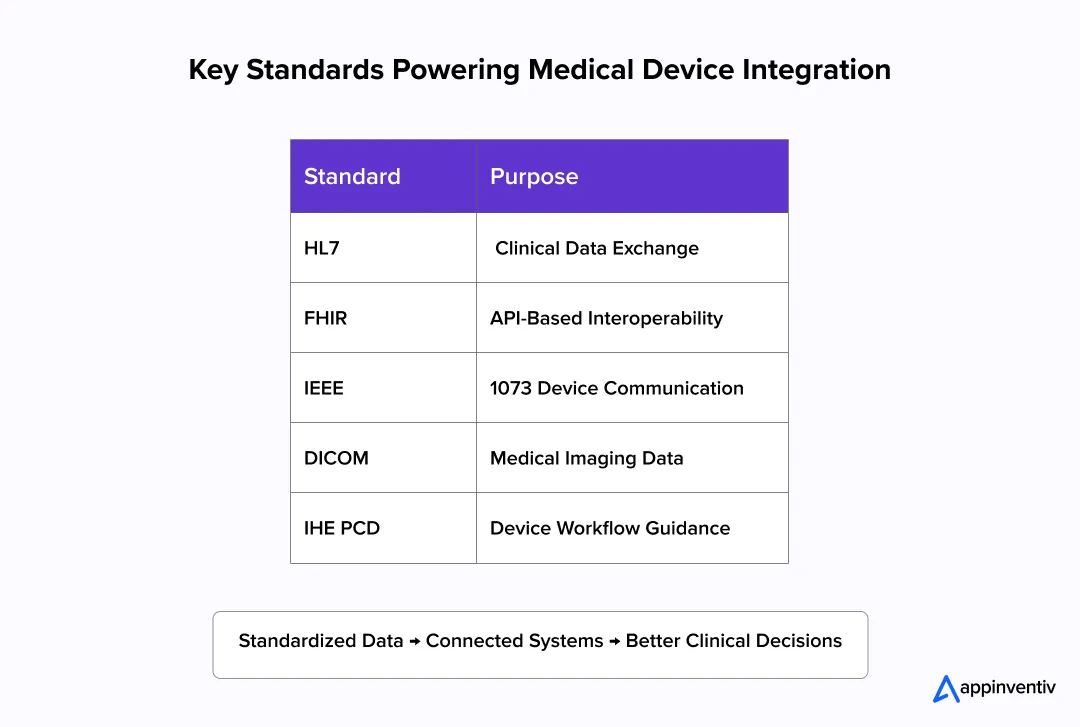
Health Level Seven is a popular option for hospital messaging. Many hospitals rely on HL7 integration to send admissions data, lab test results, vital signs, and doctors’ notes from machines to central health records. They use this format to transmit lab test results, vital signs, and doctors’ notes from machines to central health records.
FHIR Data Connections
Fast Healthcare Interoperability Resources provides a modern web interface for medical data. The system uses web APIs and structured data blocks. This design enables seamless integration of medical devices with EMR platforms, health charts, mobile tools, patient web pages, and cloud servers.
IEEE 11073 Hardware Protocols
This protocol governs how machines communicate over networks. The rules define how equipment names, measurements, math units, alarms, and patient details are used. This creates total uniformity across different factory brands. It makes machine connections simple.
DICOM Imaging Systems
Digital Imaging and Communications in Medicine runs scanning workflows. The code controls how X-ray machines, archive storage, radiology systems, and charts trade images. It safely moves large scan files and patient identity tags.
IHE PCD Setup Blueprints
Patient Care Device profiles give setup advice. These blueprints help standardize common hospital tasks. They guide teams on how to link a patient to a bed, track sirens, and swap machine metrics.
These five protocols build the basis for safe data projects. They help systems grow without relying on a single brand. Large health systems need these tools to link machines across every building.
Top Enterprise Medical Device Integration Solutions Compared
Buyers select from three distinct software classes. The enterprise market features dedicated hardware connectivity tools, stand-alone data engines, and built-in electronic record features.
The correct selection depends on your current database installations and equipment types. Data exchange targets and future clinical technology plans direct this operational choice.
| Platform | Target Setup | Technical Strength |
|---|---|---|
| Philips Capsule | Acute care links | Connects thousands of distinct bedside tools in intensive care units. |
| Redox | Cloud data transfers | Moves records fast using cloud data connections and web APIs. |
| Rhapsody | Message management | Controls data traffic, transforms formats, and directs complex workflows. |
| Oracle Health Device Integration | Oracle Health Networks | Connects directly with pre-existing Oracle database tools and clinical setups. |
| Epic Device Connectivity | Epic software systems | Feeds telemetry data straight into native patient files and charts. |
Every vendor resolves a different data transmission challenge.
- Philips Capsule handles physical machine ports and extracts telemetry data.
- Redox highlights cloud-based API messaging structures.
- Rhapsody handles message translation and complex clinical data steering.
- Epic and Oracle Health supply tight compatibility for clients with massive installations of their databases.
These tools synchronize machine data directly with existing hospital workflows.
Build vs Buy vs Hybrid
Choosing a deployment strategy for medical device integration systems matters just as much as picking the software vendor.
| Approach | Best For | Advantages | Trade-offs |
|---|---|---|---|
| Build | Teams with custom software needs | Engineers control the code design and alter features at will. | Code testing, regulatory checks, and long-term support demand high budgets. |
| Buy | Teams seeking fast installation | The software has proven features and setups that finish quickly. | Buyers cannot easily alter the code to support unique hospital tasks. |
| Hybrid | Large networks with diverse data needs | Networks mix store-bought software with custom web code. | IT staff face harder data management rules and operational tasks. |
Corporate leaders know this choice involves more than pure software testing. Current database investments and machine diversity sway final purchase decisions. Compliance rules, inside engineering headcounts, and long-term sharing goals alter plans.
Operations with thousands of machines across multiple physical buildings select a mixed deployment strategy. These corporations merge standard vendor software with custom web tools, private middleware links, and automated data paths.
Platform choices made today determine scalability, compliance readiness, and future interoperability capabilities.
Common Medical Device Integration Challenges and Enterprise Solutions
Medical device integration of tools into a central health record involves deep setup work. Large health systems must manage old computer hardware, private factory communication codes, mismatched files, and tight safety rules. Fixing these issues early cuts down project risks. It has helped different tracking systems talk to each other for many years.
Connecting Old Medical Tools
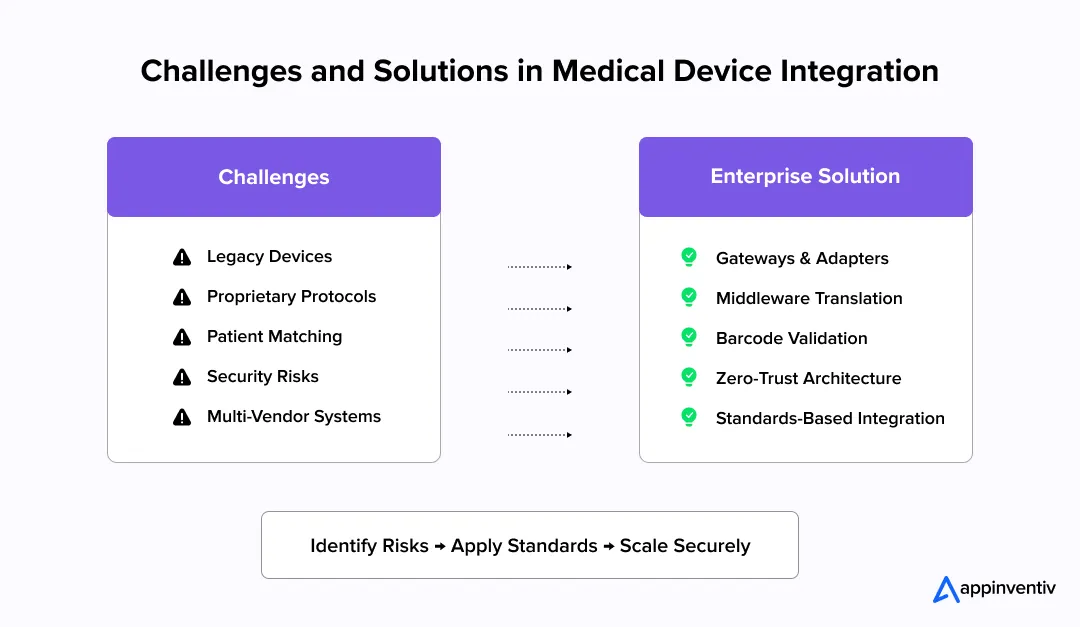
Many hospitals still rely on legacy systems and medical equipment bought ten years ago. These older machines rely on slow serial wires, closed factory screens, or old network rules. Modern data-sharing networks do not support these old styles easily.
How teams fix this:
- Install hardware links and port servers to connect old tools to new networks.
- Use small code translators to change older machine signals into clean data.
- Write step-by-step update schedules to replace old machine groups over time.
- Link the most important medical tools to the network before other tools.
Closed Factory Data Codes
Medical machine builders often write unique data codes for their own tools. This practice complicates software setups. The problem grows worse when a hospital buys machines from five different companies.
How teams fix this:
- Add data translation software to rewrite unique machine files into plain text.
- Use central message hubs to arrange data formats into standard shapes.
- Choose open protocols like HL7, FHIR, and IEEE 11073 whenever possible.
- Set up clear translation guides to sync data across all machine networks.
Matching Patients to Machines
A linked machine loses its worth if the data lands in the wrong chart. Pairing a person to a bedside monitor remains a difficult medical and daily task during data projects.
How teams fix this:
- Use wristband barcode scans to link patients to nearby beds and tools.
- Connect tracking software straight to hospital admission and discharge database systems.
- Double-check patient names and ID numbers before sending data over networks.
- Run automatic software safety checks to confirm active machine setups.
Network Safety and Cyber Risks
These threats make enterprise risk management a core priority for any hospital expanding its connected device network. Open connection endpoints, old machine software, and loose login rules expose medical device integration patient data and administrative records.
How teams fix this:
- Set up strict zero-trust network setups to check every single connection.
- Give system login access based on exact job roles and duties.
- Scramble data records completely while they move or sit in storage.
- Watch network data streams constantly to catch strange computer behaviors.
Mixed Factory Machine Setups
Most large health networks buy equipment from many different creators. Every single tool tracks health metrics differently. This creates massive data variation problems across hospital buildings.
How teams fix this:
- Follow strict, standard-based data paths for all new software setups.
- Clean and rename clinical metrics before they enter other software tools.
- Use one central data hub to manage communication across all brands.
- Write firm company rules to govern how teams collect and store data.
Regulatory, Security, and Validation Considerations for Medical Device Integration
Medical software setups operate under strict laws. Governments inspect medical device integration, patient data privacy, patient safety, and clinical accuracy closely. Health executives must plan for HIPAA compliance and other regulatory requirements during early design stages.
Do not wait until after deployment. These rules decide your choice of technology, security setups, and data handling practices.
| Regulation | Scope |
|---|---|
| HIPAA | US health privacy and protected data rules. |
| GDPR | European data protection and patient data rights. |
| FDA | Federal oversight of connected tools and patient safety. |
| IEC 62304 | Medical software lifecycle rules and development controls. |
| ISO 13485 | Quality management systems for clinical tool production. |
Cybersecurity
Linked tools create new entry points for hackers across hospital networks. Software designs must include data encryption and identity management tools. Teams use role-based access rules and segment their networks. They monitor weak spots and secure web connection points. Many enterprises use zero-trust rules to lower the risk of data breaches.
Also Read: Blockchain in Medical Supply Chain
Validation
Clinical data must stay accurate from the bedside monitor to the central database. Testing teams check software interfaces and verify work steps. They review data mapping models and patient matching setups. End-to-end integration tests check the entire path. These checks confirm that systems send and display medical numbers correctly.
Auditability
Health enterprises track how data moves across all linked systems. Audit logs, event tracking, and user activity records are core tools in compliance management and help teams during inspections.
These tools help manage compliance reviews and inspections. Clear tracking records prove data honesty. This paperwork supports corporate governance across your entire connected computer network.
Key Implementation Steps for Medical Device Software Integration
Successful medical hardware connection demands more than just plugging tools into a network. Large health systems must coordinate medical targets, data exchange rules, management policies, and future technology plans before any software setup starts.
| Phase | Key Objective |
|---|---|
| Assess | Catalog all medical tools, software systems, and everyday workflows. |
| Plan | Define clear clinical and business targets before starting. |
| Select | Evaluate data rules, software platforms, and tech partners. |
| Integrate | Connect physical machinery directly to central corporate databases. |
| Validate | Verify data precision and check patient identification links. |
| Scale | Expand the software setup to other facilities and care settings. |
| Govern | Track compliance rules, network safety protocols, and software performance. |
Seven Steps to Complete Medical Device Software Integration
Hospital leaders can follow these steps for medical device integration, from initial machine inventory to long-term network security and governance.
Step 1: Ecosystem Assessment
Inventory your current medical machinery, health record tools, and data pathways. Technicians count every machine and list its software version. This active review uncovers old computer hardware and broken data links before you spend money on code.
Step 2: Strategic Planning
Plan around clear medical and business goals. Everyone must agree before engineers write code. This kind of cross-functional alignment is the foundation of effective change management in healthcare enterprises. Teams often set targets like cutting manual charting time in half. Everyone must agree before engineers write code.
Also Read: Speech Recognition Technology in Healthcare
Step 3: Technology and Standards Selection
Select the data standards, software platforms, and external tech partners that match your current network. Check for HL7, FHIR, and DICOM compatibility alongside machine coverage. Pick vendors that support open web connections and handle your specific device brands.
Step 4: Integration and Connectivity Design
Link medical tools to health records, data tools, and operational programs. Engineers install central message hubs, translation software, and uniform connections. This step builds the physical and digital paths between machines and databases across your buildings.
Step 5: Validation and Clinical Verification
Verify data precision through interface checks, routine tests, and patient identity links. Technicians send test packets through the system to confirm numbers match the hospital chart exactly. Doctors trust the system only when data transfers remain perfectly accurate.
Step 6: Enterprise Scaling
Expand the software setup to other hospital wings, separate clinics, and home health networks. Copy the exact connection models used in your first successful test room. This method makes growth simple and cuts down tech confusion across the enterprise.
Step 7: Governance and Continuous Monitoring
Manage the complete network using live traffic checks, cybersecurity blocks, detailed activity logs, and strict database management rules. Security teams review user access sheets every month. They update software patches to keep data flows secure over time.
Enterprises that follow a clear framework maintain safety rules easily. They grow their networks over time without spending money to rebuild the underlying code from scratch.
Trends Shaping Medical Device Software Integration
Medical software setups now do more than link a machine to a health record. Health enterprises invest heavily in medical device software development services and new tools. These tools improve clinical visibility and speed up data processing. They protect operations and help teams make smart choices.
Here are the top trends of medical device software integration:
- AI Clinical Surveillance: Software models analyze live data streams from bedside tools. They spot signs of patient decline, sepsis risks, and heart issues early. This method beats old monitor alarms.
- Edge Computing: Edge platforms process data right next to the patient machine. They do not send every packet to a central server. Combined with 5G networks, this step cuts down network delays. It supports immediate choices and keeps systems running during internet outages.
- Cloud Integration Platforms: Health systems use cloud analytics and cloud networks to manage information across hospitals, neighborhood clinics, and home care setups. These platforms support FHIR APIs and event-driven code models. They use microservices to trade data easily across hospitals, neighborhood clinics, and home care setups.
- Digital Twins for Assets: Tech teams build digital twins of physical medical tools and hospital rooms. The software tracks equipment health. It helps managers plan capacity and run operational tests. They avoid touching physical hardware.
- Predictive Maintenance: Linked machines send continuous status data to log files. This data reveals parts wear to stop machine breakdowns. The process cuts machine downtime and helps teams use equipment better.
- Agentic AI and Automation: Autonomous software agents track hospital operations. They coordinate medical tasks and send alerts using machine events. These agents complete paperwork automatically based on your company rules.
- Unified Data Platforms: Corporations gather machine logs, clinical files, operational records, and patient metrics into one central database. This ledger supports deep analytics, machine learning, and regional health studies.
These tools help health enterprises change their daily operations. Managers stop reacting to broken tools. They build smart, connected, and data-driven medical spaces.
Also Read: 3D Printing in Healthcare
Organizations with connected architectures adapt faster to AI, automation, and emerging care models.

How to Select the Right Medical Device Software Integration Partner
Selecting a provider of medical device integration services requires more than reviewing a list of technical skills. The best partner understands data interoperability, clinical workflows, and strict regulatory laws. They must know the operational realities of huge hospital networks.
A structured evaluation process helps hospital executives find vendors that handle current setup needs and future company growth.
Technical Evaluation Checklist
Evaluate the vendor’s ability to manage complex hospital technology networks:
- Deep knowledge of HL7, FHIR, DICOM, and IEEE 11073 data standards.
- Clear expertise with integration engines and middleware software.
- Proven skills in API development and API management tools.
- Past success connecting legacy devices and older hospital machinery.
- Direct medical device integration with EMR and EHR connection skills across all major software platforms.
- Ability to handle data normalization and format transformation tasks.
- Full support for cloud networks, on-premises servers, and hybrid setups.
Compliance Evaluation Checklist
Medical machine software links involve highly regulated files and clinical workflows.
- Complete familiarity with HIPAA, GDPR, and local healthcare privacy laws.
- Clear understanding of IEC 62304 and ISO 13485 legal rules.
- History of building detailed audit logs and data tracking controls.
- Proven skills in identity management and access controls.
- Strong practices for secure data transmission and network encryption.
- Direct work with risk assessments and hospital cybersecurity programs.
Scalability Evaluation Checklist
Data sharing needs grow over time. Check if the vendor can support future company growth.
- History of supporting large multi-facility healthcare networks.
- Ability to link completely different machine ecosystems together.
- Clear proof of successful enterprise software deployments.
- Strong plans for long-term maintenance and technical support.
- Deep knowledge of performance monitoring and network observability tools.
- Clear methods for project governance and software lifecycle management.
Healthcare Expertise Evaluation Checklist
Specific medical knowledge separates a successful installation from an expensive, failed project.
- True understanding of clinical workflows and hospital care models.
- Direct work with patient-device association tasks.
- Deep knowledge of medical data governance practices.
- History of working with healthcare providers, insurance payers, and MedTech companies.
- Total familiarity with clinical validation and strict testing rules.
- Strong references from past healthcare software integration projects.
Before picking a vendor, hospital executives must ask for relevant case studies and technical architecture plans. Demand proof of past data sharing success and management methods. A qualified partner discusses clinical workflows and regulatory laws easily. They explain network architecture and long-term technical support with equal confidence.
Why Appinventiv for Medical Device Software Integration
Linking medical tools requires more than simple cords and signals. Large health corporations need a trusted medical device integration company to unite separate machine networks. This partner must follow strict communication rules, meet legal safety codes, and build systems that work across multiple hospital buildings.
Appinventiv has delivered medical device integration solutions for more than ten years. We help health systems link machines, software apps, electronic charts, data tools, and daily nursing steps into one clean network. Our engineers use standard data rules like HL7, FHIR, and DICOM. We build web connections to transmit medical facts safely and reliably.
Our healthcare track record includes:
- 500+ digital health platforms built and delivered
- 450+ healthcare clients served worldwide
- 10+ years of medical technology project experience
- 300+ separate medical tools linked to networks
- 99.90% system uptime for critical hospital software
- 45% better daily performance across hospital buildings
- 90%+ total data accuracy across all transfers
- 95% patient satisfaction with our medical software apps
Our team solves the exact problems that slow down tech projects. We connect old hospital machines and match tools from different brands. We manage legal safety rules, test data paths, and organize large databases.
Our medical software development services, spanning artificial intelligence, cloud servers, and system design, help health corporations build connected networks. Our expertise in medical device integration helps these networks run your current operations today and prepare your business for future tools.
Let’s connect and fix fragmented medical device ecosystems before they slow care.
Frequently Asked Questions
Q. What is medical device software integration?
A. Medical device integration links medical tools to hospital software and central computer networks. It creates an automatic path to share files. Patient monitors, fluid pumps, scanners, and watches send metrics straight into health charts. This connection feeds data into analytics software and clinical tools. It cuts down manual typing tasks and helps different systems share records.
Q. How much does enterprise medical device integration typically cost?
A. Enterprise medical device integration costs typically range from $50K to $500K+, depending on device complexity, integration scope, and deployment scale. Connecting a single facility costs far less than integrating devices across multiple hospitals. Other cost factors include legacy device support, middleware, interoperability requirements, validation testing, cybersecurity controls, compliance activities, and ongoing maintenance and support.
Q. What technologies are used to integrate medical devices?
A. These projects rely on data standards, web APIs, translation software, and message hubs. Tech teams use specific protocols like HL7, FHIR, DICOM, and IEEE 11073. They build secure web links and cloud platform connections. Event-driven code and hospital data engines route the numbers. These tools link bedside machinery directly to central corporate health networks and hospital applications.
Q. What systems can medical devices connect to (e.g., EHR, PACS, LIS)?
A. Linked tools connect to many different hospital databases. They feed data into electronic health records and picture archiving systems. They send metrics to lab software and radiology networks. The data reaches home tracking systems and doctor decision tools. It populates analytics platforms and care charts. Your final list of connections depends on your exact medical goals and daily operational tasks.
Q. How does integration improve patient care and clinical workflow?
A. The software stops heavy paperwork tasks and fixes typing mistakes. It gives doctors fast access to patient files. Machine metrics stream straight into clinical screens. This speed helps teams make fast treatment choices and stops chart errors. Shared data helps nurses coordinate care across floors. It gives managers clear operational views and speeds up daily tasks inside hospital buildings.
Q. How does medical device integration support mobile and point-of-care workflows?
A. Medical device EHR integration connects wearable devices, physiological monitors, nurse call systems, and mobile tools such as Ascom Myco 4 smartphones with EHR systems. This enables real-time alarm notifications, clinical surveillance scores, and predefined response protocols, helping clinicians make faster decisions while supporting smart workflows, scalable architecture, and more coordinated patient care.


Fast 2-minute response, fully NDA-protected.

Wearable Data Integration: Connecting Multiple Devices to a Unified Health Platform
Key takeaways: Device support should reflect the measurements your service needs, the people using it, and the decisions those readings inform. A unified health data platform must preserve source, timing, and measurement context while resolving duplicate records. Phone health platforms, manufacturer APIs, and direct device connections serve different integration needs. Clinical workflows require agreed review…
Sleep Tracker App Development: Features, Wearable Integration, AI, and Compliance
Key takeaways: Sleep tracking presents opportunities across consumer wellness, fitness, healthcare, employee wellness, senior care, and infant-care markets. Successful products combine actionable insights, wearable connectivity, user-friendly reports, privacy controls, and clearly differentiated experiences. HealthKit, Health Connect, and direct device APIs provide different data depths, costs, limitations, and maintenance requirements. AI supports sleep-stage estimation and personalization,…

Diet and Nutrition App Development: Process, Features, Cost, and Technology Stack
Key Takeaways Diet and nutrition tracking app development goes past basic calorie counters with verified food databases, custom meal schedules, AI tools, wearable device links, and corporate manager tools. Structure database models around raw food items, serving portions, nutrient facts, recipes, software links, and regional diet rules. Pair computer vision models, recommendation algorithms, language engines,…