



















How to Build a Custom Restaurant Management Software? Features, Process, Costs

- Why Now Is the Right Time to Rethink How Restaurants Run Digitally
- Types of Restaurant Management Software Businesses Actually Use
- Understanding the Benefits of Restaurant Management Software for Your Business
- Use Cases for Restaurant Management Systems in Real Operations
- Features That Decide Whether Your Restaurant System Works or Fails
- Advanced Features for Enterprise-Grade Restaurant Systems
- Understanding the Total Cost of Custom Restaurant Management Software
- Restaurant Management Software Development Process: A Quick Glimpse
- Navigating Development Challenges for Hospitality Executives
- Future Trends That Will Reshape Restaurant Operations
- Why Leading Brands Trust Appinventiv for a Custom Restaurant Management Software
- FAQs

Key takeaways:
- Custom restaurant management software turns scattered tools into one operational backbone.
- The real ROI comes from reduced waste, better staffing, and faster decisions, not just “going digital.”
- Restaurants use these systems daily for menu control, inventory, workforce planning, and loyalty, not just reporting.
- Features only work when they match real workflows for guests, staff, and managers on busy days.
- Total cost includes build, integrations, training, maintenance, and compliance, not just the first invoice.
- Working with an experienced partner like Appinventiv helps de-risk complex builds and align technology with growth plans
Running a restaurant today is not just about food and service. It is about managing speed, accuracy, inventory, staff performance, and customer experience all at once. Most restaurant leaders are not struggling with one big problem. They are dealing with many small ones that pile up each day. Orders go missing. Stock runs out unexpectedly. Staff schedules change at the last minute. Reports never quite reflect reality. And customers have little patience when things slow down.
The real pressure often does not come from the kitchen. It comes from the systems behind it. A POS that does not sync properly. Inventory tracked across spreadsheets. Reservations managed manually. Delivery orders arriving from multiple platforms without coordination. What should feel organised starts to feel chaotic. And teams waste valuable time fixing system gaps instead of focusing on service and profitability.
This is where restaurant management software development begins to matter to leadership, not just technical teams. Businesses are no longer looking for scattered tools. They want one connected system that brings operations, data, and decision-making onto a single foundation. Many restaurants are now moving toward an AI-driven restaurant management system to reduce guesswork and improve forecasting. Others are transitioning to cloud-based restaurant management software so they can track operations in real time, across locations, without depending on local systems that break under pressure.
A modern restaurant platform is not just operational support. It becomes the backbone of how the business runs. It quietly improves ordering accuracy, reduces waste, and helps teams move faster with fewer mistakes. When the system is built right, staff spend less time fixing problems and more time serving customers well.
In this guide, we will break down how to build a custom restaurant management software that works in real environments, not just on paper. We will explore the types of systems businesses invest in, the features that actually influence daily operations, and the decisions that affect long-term performance. You will also get a grounded view of costs, development stages, and the mistakes that often appear only after a system is already in use.
We can help leadership teams replace patchwork tools with custom restaurant management software built around real workflows, real constraints, and real growth plans.

Why Now Is the Right Time to Rethink How Restaurants Run Digitally
The restaurant industry is not growing through small upgrades anymore. It is rebuilding itself around technology. The market’s jump from $5.79 billion in 2024 to a projected $14.70 billion by 2030 reflects something deeper than spending. It reflects a shift in how leadership teams are choosing to run their businesses. Restaurants are no longer fixing tools. They are redesigning operations.
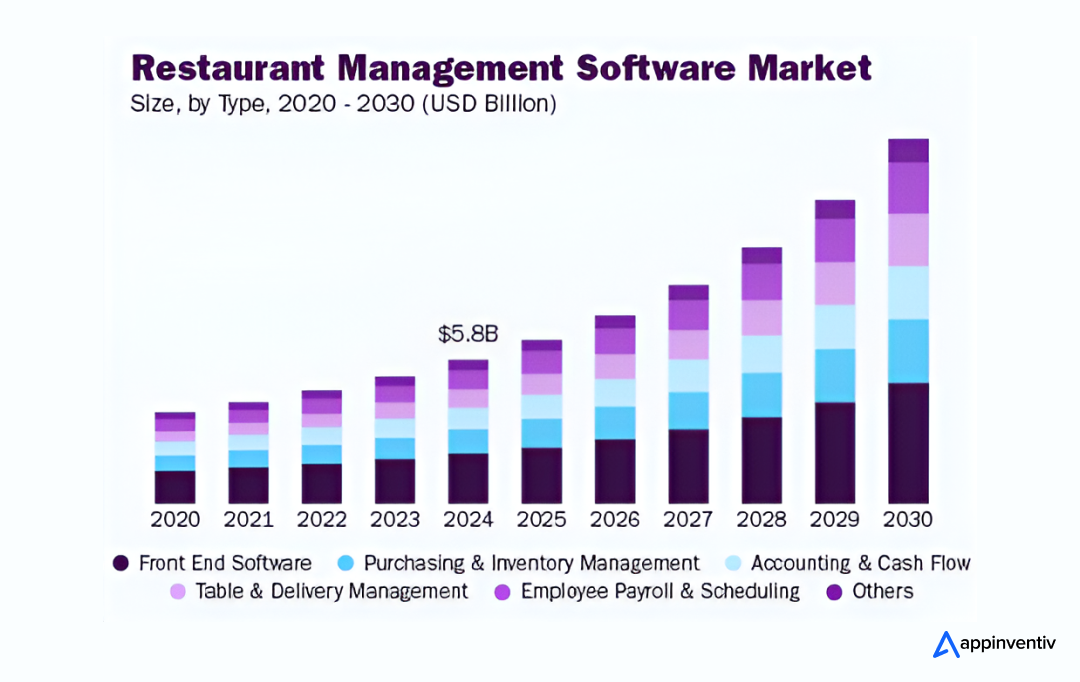
The split in global growth makes this pressure real. North America leads adoption. Asia-Pacific is accelerating faster than most businesses expect. This is not about trends. It is about competition becoming more efficient before others notice. When some operators already have visibility into every action inside their business, those without it start falling behind quietly.
What businesses are investing in reveals what is breaking:
- Systems that can be accessed anywhere without depending on local machines
- Tools that reduce guesswork instead of reacting to problems after they happen
- Mobile-first workflows that move with staff, not against them
And most importantly, businesses are moving away from one-size-fits-all systems. They are demanding smart restaurant management software that matches how their operation runs. That control changes everything. It improves planning. It lowers waste. It speeds decisions. It restores confidence in the numbers leadership depends on every day.
The question is not whether restaurants will modernize but it’s whether you modernize before inefficiency becomes expensive.
Types of Restaurant Management Software Businesses Actually Use
Not every restaurant needs the same kind of system. A single-location café does not operate like a multi-city franchise. A cloud kitchen does not face the same problems as a fine-dining chain. Yet many businesses buy one-size-fits-all platforms and then spend years working around limitations.
Custom restaurant management software exists to fix this gap. Instead of forcing your operation into generic workflows, businesses are now choosing systems built around the way they really work. To do that properly, you first need to understand the main types of restaurant management software and what each one is designed to handle.
Below is a practical breakdown of the systems most restaurants invest in and how they are used in real operations.
| Type | What It Is Designed For | How Businesses Use It |
|---|---|---|
| POS and Billing Systems | Order processing, billing, and payment handling | A restaurant replaces manual billing with digital orders that update sales and inventory instantly |
| Inventory Management Systems | Stock tracking, waste control, and supplier coordination | Managers track ingredient usage daily and restock before shortages affect service |
| Staff and Shift Management Tools | Scheduling, payroll support, and attendance tracking | Leaders manage shifts centrally and prevent understaffing during peak hours |
| Order and Delivery Management Platforms | Handling dine-in, takeaway, and online orders from one system | Orders from the counter, mobile, and aggregator platforms flow into the same kitchen queue |
| Customer and Loyalty Management Systems | Capturing customer data and running loyalty programs | Regular guests receive offers based on visit history and preferences |
| Reporting and Analytics Systems | Financial insights and operational performance tracking | Owners review daily revenue, item-level performance, and profit trends across locations |
Understanding the Benefits of Restaurant Management Software for Your Business
Today’s restaurants operate across multiple platforms at once: dine-in, takeaway, delivery apps, and direct orders. Managing all of that without a digital backbone does not slow the business politely. It breaks it silently – errors increase, costs leak and teams burn out. In addition, the customer experience becomes unpredictable even when the food is good.
This is why restaurant management software development has shifted from being “nice to have” to being operational infrastructure. Businesses are now building systems that control complexity instead of letting complexity control them. Here is what modern restaurant software actually changes at a business level.
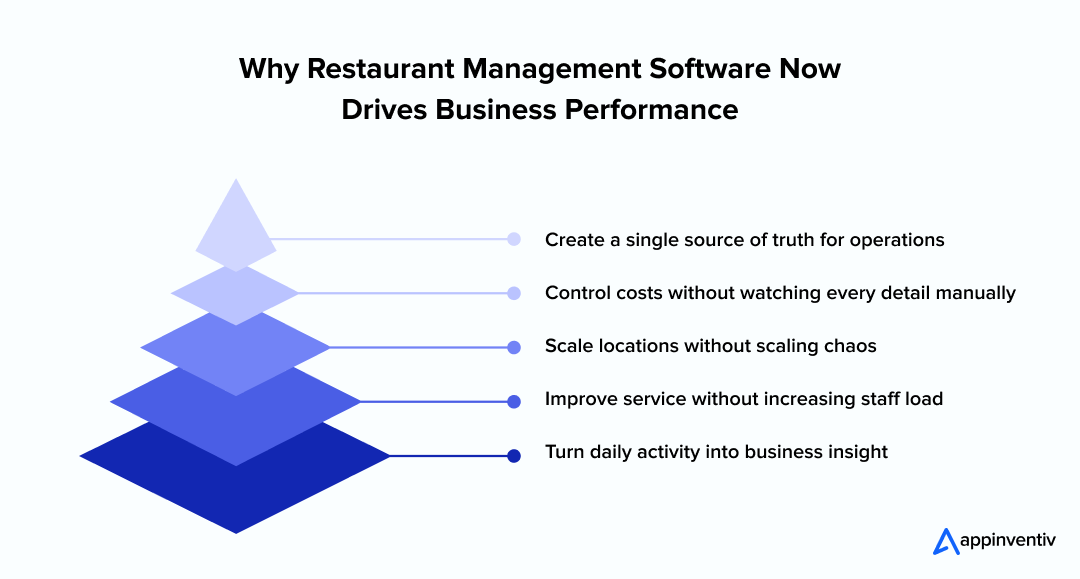
1. Create a Single Source of Truth for Operations
When sales, inventory, and staff run on different systems, leaders never have one version of reality. A unified restaurant management system software replaces guesswork with clarity. Everyone works off the same numbers. That alone reduces confusion, disputes, and bad decisions across teams.
2. Control Costs Without Chasing Them
Food waste does not announce itself. Staffing inefficiencies show up quietly. Discount leakage hides in reports. Software brings cost visibility back where it belongs: upfront. Most restaurants adopt cloud-based restaurant management software not for convenience, but for control.
3. Scale Without Multiplying Problems
Growth often exposes weak systems. A single outlet can survive manual workarounds. Ten cannot. Businesses that build a restaurant management software platform early find it easier to grow without operational collapse.
4. Improve Service Without Hiring More People
Speed and accuracy no longer depend only on skill. They depend on systems. When orders flow smoothly, payments are instant, and schedules are automated, teams perform better without being stretched thinner.
5. Convert Activity Into Business Intelligence
Every order, every bill, every shift teaches the system something. An AI-driven restaurant management system helps leadership see patterns building before problems appear. Decisions become proactive instead of reactive.
Use Cases for Restaurant Management Systems in Real Operations
Restaurant software isn’t something leadership buys to check a technology box. It is built for the floor, the rush hours, the staffing gaps, and the small operational failures that quietly cost money every day. The value of a restaurant management system software is not in how modern it looks, but in whether it removes friction when things get busy.
Once restaurant management software development moves from pilot to real operations, the impact becomes visible quickly and in very practical ways.
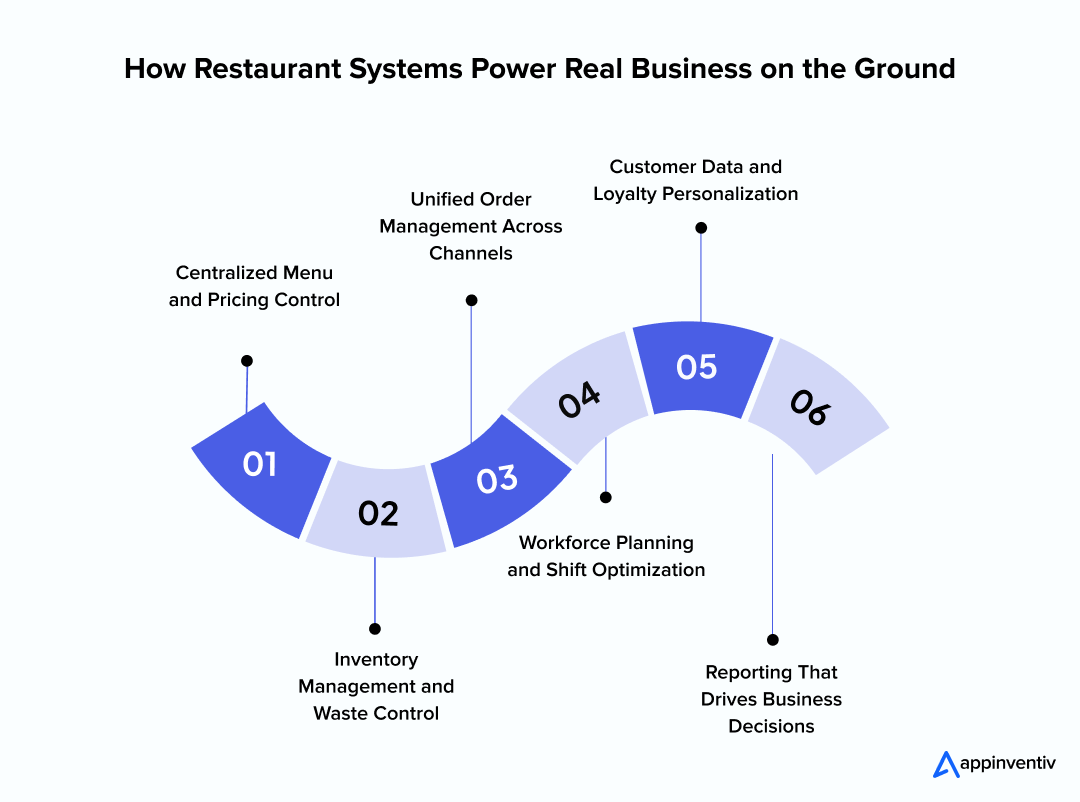
Centralized Menu and Pricing Control
Menus move constantly, prices react to costs, and promotions never stand still. Without central control, changes land unevenly—some locations update late, others miss details entirely. This is where software stops being “support” and becomes control infrastructure. A central system allows teams to push menu updates, taxes, combos, and pricing from one place without sending instructions to every location.
Real-world example: Domino’s controls pricing updates and campaign launches centrally across thousands of stores, eliminating store-level errors when offers go live nationally.
Inventory Management and Waste Control
Most losses don’t happen through theft. They happen through poor forecasting, wastage, and misaligned buying. Inventory systems connected to real sales data correct this quietly. Instead of checking storage rooms manually or relying on last week’s numbers, purchasing decisions reflect demand that is already building.
Real-world example: Starbucks aligns supply planning with sales data to reduce spoilage while ensuring high-volume locations are never short on core ingredients.
Unified Order Management Across Channels
Orders now arrive from everywhere at once – counter, mobile, delivery apps, kiosks. When these flows are not unified, kitchens struggle and service slows. A properly built system collects orders into one operational stream so staff focus on preparation, not reconciling screens.
Real-world example: McDonald’s routes in-store, digital, and delivery orders into a single kitchen workflow, keeping execution consistent across channels.
Workforce Planning and Shift Optimization
Labor costs rise quietly. One extra person per shift across twenty locations becomes a budget leak within months. Workforce systems use actual traffic patterns, not assumptions, to create smarter staffing plans.
Real-world example: Chipotle adjusts staff levels based on historic demand by hour and day, cutting overtime waste without hurting service speed.
Customer Data and Loyalty Personalization
Generic discounts don’t build loyalty. Relevance does. When businesses understand what guests order, when they visit, and how often they return, offers become precise instead of hopeful.
Real-world example: Subway personalizes offers based on repeat ordering behavior instead of running uniform promotions.
Reporting That Drives Business Decisions
Leadership does not need more reports. It needs the right ones at the right time. Systems that surface trends early protect margins long before issues appear in financial statements.
Real-world example: Yum! Brands track location performance in near real time so underperforming outlets are corrected before losses scale.
Features That Decide Whether Your Restaurant System Works or Fails
Most restaurant systems fail quietly. Not because they are missing technology, but because they do not support real workflows. Features should reduce work, not introduce steps. They should eliminate confusion, not add screens. When a system does its job well, no one notices it. When it fails, everyone feels it.
A strong platform solves two problems at once: it removes friction for customers and restores control for operations. Let’s look into the multiple restaurant management software features in detail below:
Customer-Facing Features
Customer-side capabilities shape expectations long before a waiter arrives. When these feel slow or complicated, the experience is judged before the food ever reaches the table.
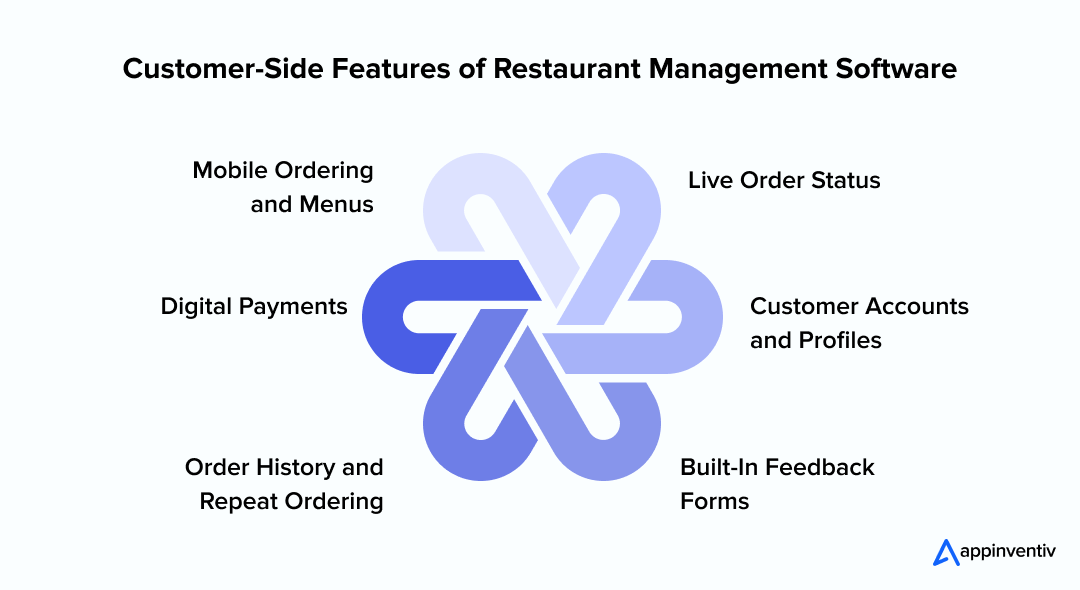
Mobile ordering and menus
Lets guests view the live menu, see item details, customize choices, and submit orders from their phone or tablet. The order flows straight into the restaurant’s order queue without manual re-entry.
Live order status
Shows customers where their order is in the process: received, in preparation, ready, or out for delivery. The status is driven by updates from the kitchen or POS, not manual messages.
Digital payments
Handles card, wallet, and online payment flows inside the same system. It records each payment against the right order and pushes that data into reporting and accounting.
Customer accounts and profiles
Stores basic customer information such as name, contact details, saved addresses, and preferred payment methods so they do not have to re-enter the same data every time.
Order history and repeat ordering
Keeps a log of past orders and allows customers to reorder the same items or combinations with one or two taps, pulling configuration directly from previous tickets.
Built-in feedback forms
Collects ratings and short comments linked to specific orders. The data is stored in the system and can be viewed alongside sales and operational metrics.
Restaurant-Side Features
The back of the house runs on accuracy. When systems slip, kitchens feel it first. These tools prevent operational damage before it shows up as customer frustration.
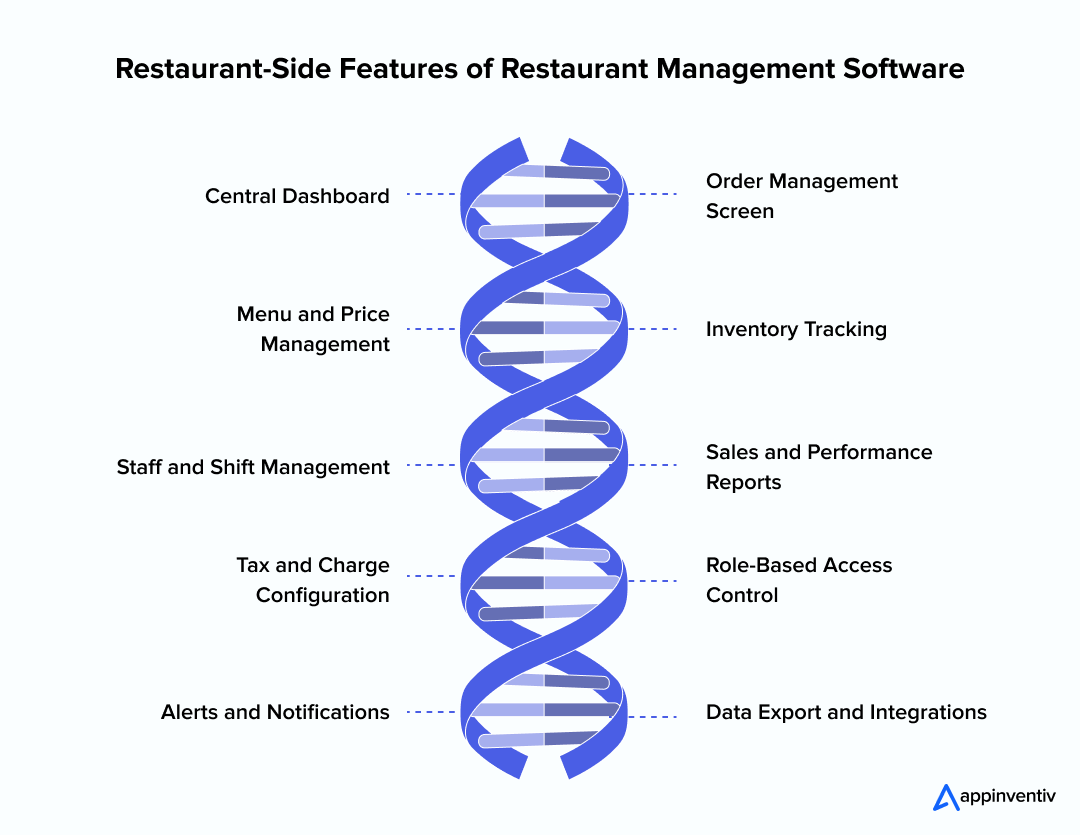
Central dashboard
Gives managers a live view of key metrics: current orders, sales for the day, active tables, and basic performance indicators across one or more locations.
Order management screen
Displays all active orders in one place, grouped by channel (dine-in, takeaway, delivery). Staff can mark stages such as “in progress” or “ready,” which also update customer-facing status where available.
Menu and price management
Allows authorized users to add, edit, or disable items, change prices, configure combos, and set availability. Changes made here automatically sync to all connected channels.
Inventory tracking
Logs incoming stock and reduces quantities based on actual orders or manual usage entries. It shows current levels and can trigger alerts when items fall below defined thresholds.
Staff and shift management
Stores staff profiles, roles, and basic availability. Managers can build rosters, assign shifts, and track attendance inside the same system.
Sales and performance reports
Generates structured views of revenue, item-wise performance, time-based sales patterns, and channel-wise breakdowns, based on the orders captured in the system.
Tax and charge configuration
Applies tax rules, service charges, and fees according to location or outlet settings. The system calculates these automatically when generating bills.
Role-based access control
Defines what each user type can see and do: for example, cashiers can close bills, kitchen staff can update order status, and managers can change menus and view reports.
Alerts and notifications
Sends internal prompts for events such as low stock, unusually high delays on orders, or system issues, based on rules set by the business.
Data export and integrations
Provides ways to push or export data to other tools such as accounting software, payroll systems, or external BI dashboards, so the restaurant is not locked into one vendor’s ecosystem.
Advanced Features for Enterprise-Grade Restaurant Systems
As restaurants grow, the gap between “working software” and software that truly supports the business becomes very clear. Enterprise restaurant systems are defined by features that handle complexity quietly, without asking leadership or staff to think about the technology itself. These capabilities are what allow restaurants to scale without adding confusion, cost, or risk at the same pace.
What separates enterprise platforms from entry-level systems is not how much they show, but how much they handle without intervention. Let’s look at the advanced features that businesses must integrate during restaurant management software development process in order to stand out from the competition:
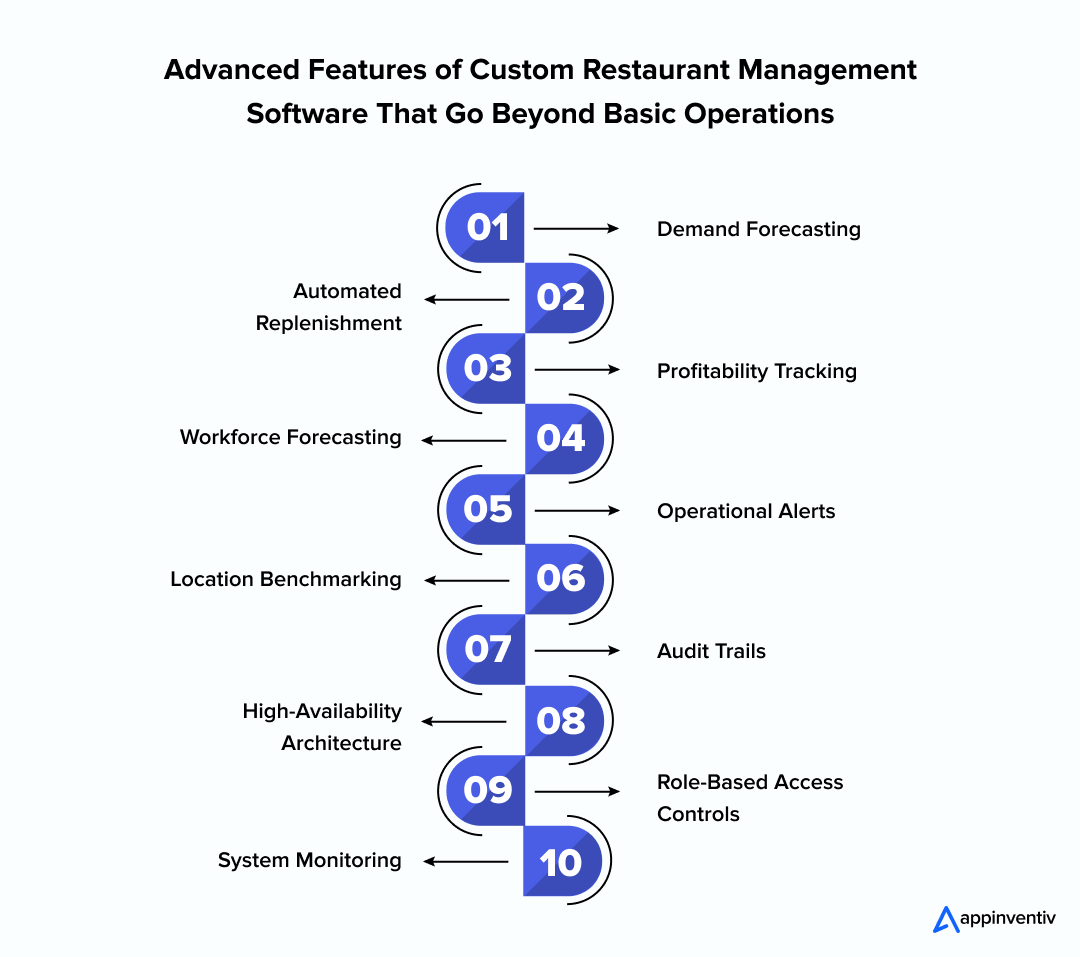
Demand Forecasting
This feature provides future-facing visibility instead of reliance on last month’s numbers. It helps leadership anticipate volume changes tied to seasons, events, and patterns in customer behavior, allowing planning decisions to be made ahead of pressure rather than during it.
[Also Read: How to Build a Demand Forecasting Software?]
Automated Replenishment
Stock levels no longer rely on manual checks or rough estimates. The system monitors movement continuously and generates replenishment suggestions before gaps appear. As volume shifts, reorder behavior adapts automatically instead of reacting late.
Profitability Tracking
Sales numbers only tell part of the story. This feature shows which items generate value and which quietly drain margins. It helps leadership focus on product performance through financial clarity rather than surface-level volume.
Workforce Forecasting
Staffing stops being guesswork. The system predicts pressure points based on traffic history and usage trends, helping managers schedule with confidence rather than urgency. Unplanned overtime and understaffing become exceptions instead of routine.
Operational Alerts
The software does not wait for problems to grow quietly. It generates alerts when thresholds are crossed, patterns shift, or anomalies appear. Leaders see disruption forming early instead of discovering it through damage reports.
Location Benchmarking
For multi-outlet businesses, good performance must be visible, not assumed. This feature compares locations side-by-side so leaders can identify where execution slips and where standards hold, without waiting for monthly reviews.
Audit Trails
Every change has a record. Menu edits, pricing changes, access activity, and updates are logged automatically. When errors occur, accountability is clear and investigations do not depend on recollection.
High-Availability Architecture
Downtime is not a technical problem; it’s a business failure. Enterprise systems are built to keep operations moving through interruptions. Orders continue, data is preserved, and recovery happens without service disruption.
Role-Based Access Controls
Not every employee needs full visibility. Permissions ensure that access matches responsibility, reducing mistakes, misuse, and risk. Control remains structured even as teams grow larger.
System Monitoring
Performance is tracked constantly. Response times, stability, and health indicators are always visible. Issues are detected by the system before users complain.
[Also Read: What Users Expect In Restaurant Mobile App?]
Understanding the Total Cost of Custom Restaurant Management Software
Planning your restaurant management software development cost means looking beyond the initial price tag. You’re not just buying software – you’re investing in a system that needs to grow with your business. Most restaurant owners get surprised by hidden costs that pop up months after launch.
The technology foundation matters more than most people realize.
- Your development team will probably recommend React for the user interface because it handles high-traffic restaurant environments well.
- The backend usually runs on Node.js or Python, with PostgreSQL managing your data. Don’t let these technical details intimidate you – just know they affect your final bill.
What You’ll Actually Spend:
- Basic System: $30,000 – $70,000 gets you POS functionality, inventory tracking, and simple reports
- Growing Chain Solution: $100,000 – $200,000 adds multi-location management, advanced reporting, and API connections to your existing tools
- Enterprise Platform: $400,000+ builds you a comprehensive system with AI features, custom integrations, and enterprise-grade security
Here’s what catches most restaurant owners off guard: restaurant management software development cost keeps going after launch. Plan for 15-20% of your initial investment each year just for maintenance. Furthermore, cloud hosting runs $500-$3,000 monthly, depending on how many transactions you process.
Other Costs That Add Up:
- Training Your Team: $15,000 – $40,000 (worth every penny to avoid costly mistakes)
- Connecting Everything: $25,000 – $80,000 for integrating your POS, accounting software, and vendor systems
- Staying Compliant: $10,000 – $30,000 yearly for PCI compliance and security requirements
Most restaurants hit their break-even point around 18 months. The efficiency gains typically save 15-25% annually through better labor scheduling, reduced waste, and faster table turns.
Restaurant Management Software Development Process: A Quick Glimpse
Building a reliable restaurant system is not about rushing into development. The difference between a system that quietly supports operations and one that becomes a daily frustration comes from how the process is executed. A thoughtful development approach prevents technology from becoming the bottleneck and keeps it working in the background instead. Let’s understand how to build a custom restaurant management software in detail below:
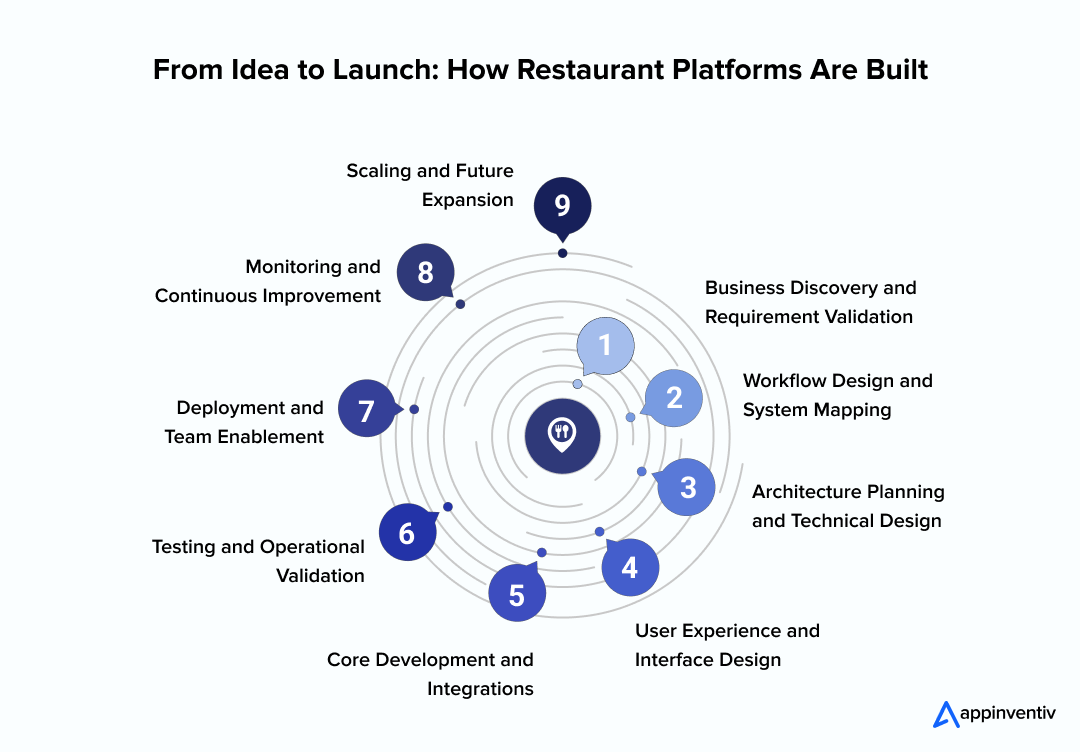
Business Discovery and Requirement Validation
This phase focuses on understanding how the restaurant actually runs on busy days, not just how it is supposed to work in theory. Leadership, floor managers, and operations teams are interviewed to map real workflows, decision points, and pressure areas. During restaurant management system development, this stage ensures the project is shaped by reality instead of assumptions.
Workflow Design and System Mapping
Out of raw understanding comes structure. Order handling, staff movement, inventory flow, and exceptions are documented visually. This allows gaps to surface early. The goal is to design a restaurant management system software that mirrors operations rather than forcing the business to change overnight.
Architecture Planning and Technical Design
At this stage, the system’s technical foundation is built on paper before it is coded. Database design, access structure, performance expectations, and integration logic are defined. Many organizations choose cloud-based restaurant management software here to ensure uptime and visibility across locations. These decisions shape how well the system performs under load.
User Experience and Interface Design
Ease of use is not cosmetic. It determines speed, error rates, and adoption. Screens are designed to minimize clicks, confusion, and training time. This phase gives restaurant software management its human face and ensures teams can work with confidence from day one.
Core Development and Integrations
This is where the system takes form. Order handling, inventory control, staff tools, and reporting features are built alongside payment and delivery system connections. Business rules are embedded so operations run consistently without manual checks.
Testing and Operational Validation
The system is tested against real pressure. Peak volumes, network failures, and data inconsistencies are simulated. Bugs are fixed, but more importantly, workflows are refined. Restaurant management system development succeeds here when problems are discovered early, not live.
Deployment and Team Enablement
The launch is planned rather than dramatic. Data is migrated carefully. Teams are trained by role. Support structures are in place before the system replaces older tools. Business continuity is protected throughout.
Monitoring and Continuous Improvement
Once live, performance is watched closely. Feedback flows from real usage. Adjustments are made in controlled releases. The restaurant management software development process continues beyond launch, improving alongside the business.
Scaling and Future Expansion
As the restaurant grows, so must the system. New outlets, workflows, and business models are introduced without destabilizing operations. A strong restaurant management system software is built to grow quietly, not struggle loudly.
Navigating Development Challenges for Hospitality Executives
Now that you have understood how to build a restaurant management system, it is also vital to take a look at the challenges that your team will have to undertake for a seamless delivery. Understanding challenges in restaurant management software development work seamlessly with development teams that can address these issues effectively.
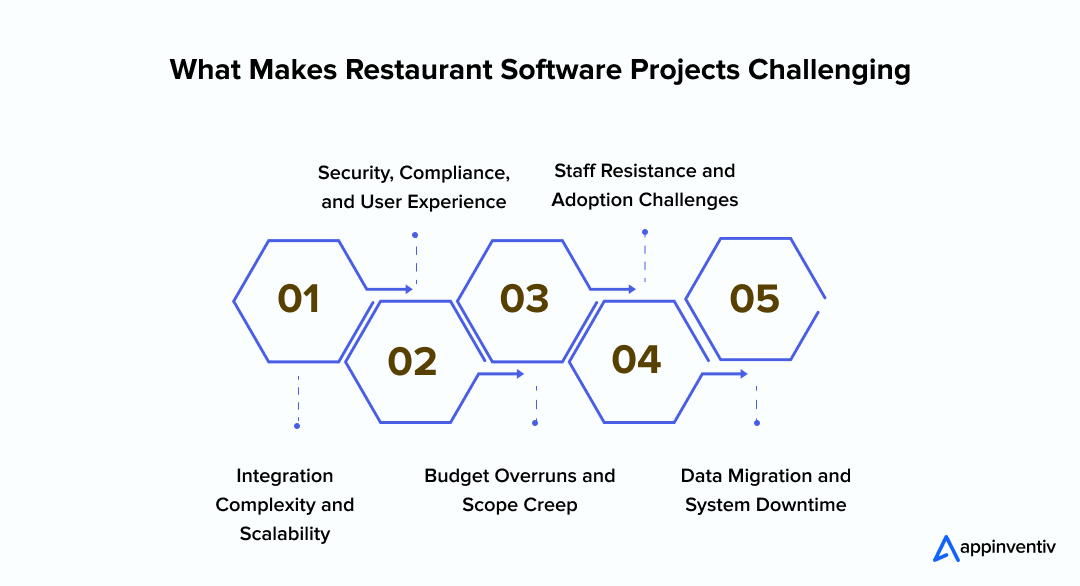
Integration Complexity and Scalability
Restaurant work involves many systems that must work together smoothly. Payment processors, accounting software, delivery platforms, and inventory systems each have different tech needs. Old system connections bring special problems when existing systems use old tech.
Solution: Build small services setup with standard APIs that allow flexible system links. Pick cloud-native platforms that auto-scale based on demand and add middleware fixes for old system connections. Plan for flat scaling from project start to handle future growth.
Security, Compliance, and User Experience
Restaurant staff work in fast-paced places where system ease directly affects customer service quality. Screen designs must fit users with different tech skills who need quick access to info. Mobile setup becomes key as staff more often use tablets and smartphones.
Solution: Add full encryption and tokens for all payment data while doing regular security checks. Build easy screens with minimal click needs and give offline abilities for key functions. Do user testing with real restaurant staff throughout the building.
[Also Read: The Mobile App Security Best Practices To Ensure a Hack-Proof App]
Budget Overruns and Scope Creep
Initial cost estimates often underestimate the complexity of restaurant-specific requirements. Additional features requested during development can significantly inflate budgets and extend timelines beyond original projections.
Solution: Establish fixed-scope contracts with clearly defined deliverables and change request procedures. Implement milestone-based payments and maintain 20-30% budget contingency for unforeseen requirements. Regular stakeholder reviews prevent feature creep while ensuring core functionality meets operational needs.
Staff Resistance and Adoption Challenges
Restaurant employees frequently resist new technology, especially if current processes seem to work adequately. Training busy staff on complex systems while maintaining service quality presents logistical difficulties.
Solution: Involve key staff members in the design process to ensure buy-in from early stages. Create comprehensive training programs with hands-on practice sessions during slow periods. Designate technology champions within each department to provide peer support and gather feedback for continuous improvement.
Data Migration and System Downtime
Transferring existing customer data, menu configurations, and operational history from legacy systems when you build a restaurant management software risks data loss and service interruptions. Restaurants cannot afford extended downtime during peak service periods.
Solution: Develop parallel migration strategies that allow gradual data transfer while maintaining operational continuity. Schedule system cutover during lowest-traffic periods and maintain backup systems for immediate fallback. Conduct extensive testing with actual operational data before full deployment.
These challenges do not go away on their own but our experts can turn integration, cost, and adoption risks into a clear, phased restaurant management software rollout plan.

Future Trends That Will Reshape Restaurant Operations
Restaurants are not evolving in small steps anymore. They are being pulled forward by changing customer behavior, rising cost pressure, and digital habits formed outside the dining industry. What worked five years ago already feels old-fashioned to guests today. The systems running restaurants will continue to shift toward speed, precision, and visibility, whether businesses move early or not.
These are the trends shaping how modern restaurants will operate over the next few years.
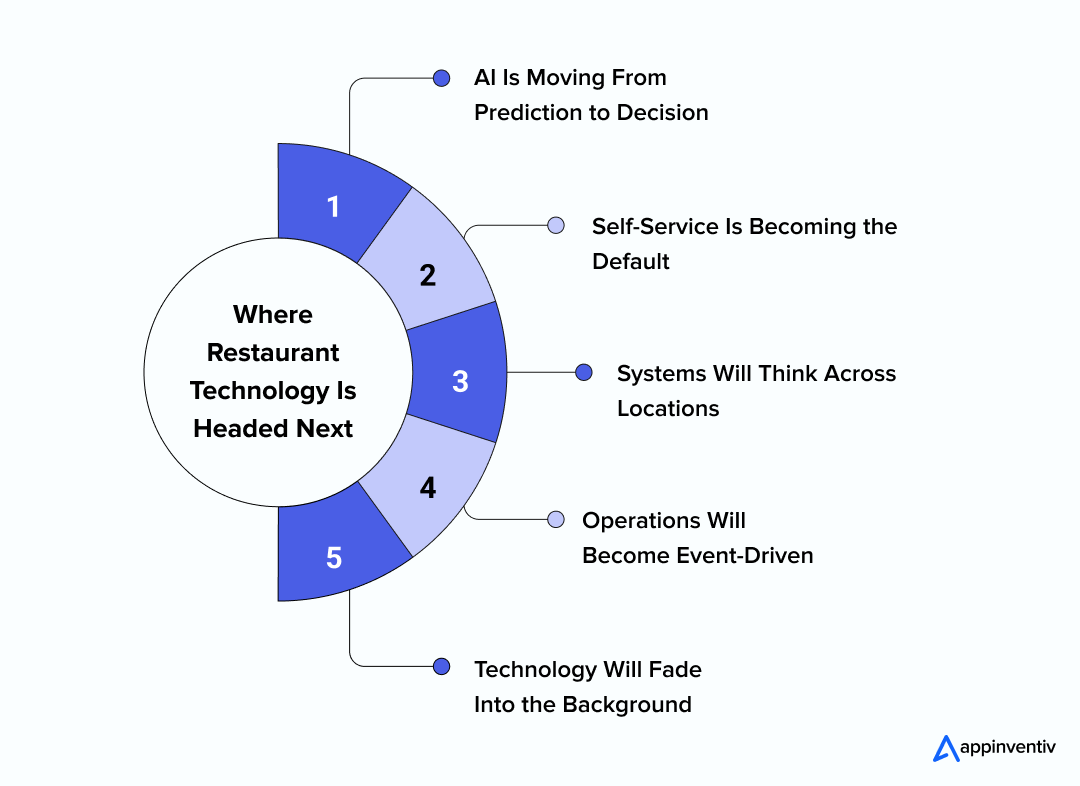
AI Is Moving From Prediction to Decision
Artificial intelligence is no longer about “insights.” It is moving into execution. Instead of only telling managers what happened yesterday, systems will begin recommending what to do today. From forecasting demand to adjusting inventory and pointing out revenue leaks, AI in the restaurant industry is becoming less about data and more about decision support.
It will increasingly automate judgment-heavy tasks that used to require experience alone.
| What AI Enables | How It Helps Restaurants Stand Out |
|---|---|
| Demand modeling | Prevents overstaffing and shortages before they hurt service |
| Menu intelligence | Helps remove poor performers and promote profitable items |
| Personal behavior analysis | Makes loyalty programs feel personal instead of generic |
| Waste prediction | Reduces food loss quietly in the background |
| Financial risk signals | Flags margin erosion earlier |
| Operational optimization | Improves consistency across locations |
Self-Service Is Becoming the Default
Customers increasingly expect control. Whether it is ordering, payment, or feedback, friction-free interaction is becoming standard. Counter queues will decline. Manual billing will fade. Guests will manage their own experience more often, and restaurants will benefit from faster tables and fewer errors.
Systems Will Think Across Locations
Multi-location restaurants will expect unified visibility. Instead of managing each outlet in isolation, leadership will operate from a single view. Performance comparison, benchmarking, and policy enforcement will become automatic rather than managerial effort.
Operations Will Become Event-Driven
Systems will respond to what’s happening now, not what happened last week. Late deliveries, slow service, or rising waste will trigger action immediately. Restaurants will move away from postmortem reporting toward real-time intervention.
Technology Will Fade Into the Background
The best software will feel invisible. It will stop demanding attention and start supporting flow. Staff will not think about systems unless something breaks. When things work, technology disappears from the experience entirely.
Why Leading Brands Trust Appinventiv for a Custom Restaurant Management Software
Appinventiv is not a general software vendor. We are a leading restaurant app development company focused on building systems that operate at scale, under pressure, and across markets. With large delivery teams across India, the U.S., the UAE, Europe, and Australia, we partner with enterprises that treat software as core infrastructure, not an IT experiment. Our work blends product thinking, engineering depth, and long-term delivery into one accountable model.
When we work with restaurant businesses, we begin with operations, not features. We study how orders move, where breakdowns happen, how inventory behaves under pressure, and how staff adapt in real time. That understanding shapes systems that fit naturally into daily operations instead of disrupting them. This approach allows us to build platforms that grow with the business instead of becoming obstacles as scale increases.
For KFC, we delivered multi-mode ordering apps supporting delivery, dine-in, pickup, and drive-through workflows across markets, resulting in a 22% uplift in conversions.
For Pizza Hut, we strengthened mobile experience and backend performance to support higher order volume and regional scale, contributing to a reported 30% increase in conversion rate.
For the Americana Group, we also helped build Americana’s Last Mile Platform as a restaurant operations engine, not just a reporting layer. We unified data from restaurant order systems, delivery partners, and store operations into one live platform, automated driver assignment, enforced geofencing through dynamic location validation, and removed the manual work that slowed dispatch at scale. The outcome was immediate and measurable:
- Auto order assignments increased from 42% to 82%, cutting manual intervention sharply
- Geofencing compliance improved from 20% to 80%, reducing wrong deliveries across restaurants
- More than 60 million restaurant orders processed with zero platform downtime
- Reporting speed improved by 90%, from hours to seconds
- Leadership gained real-time visibility across brands, regions, and restaurant locations
- Delivery execution became faster, more reliable, and easier to control at scale
What ties all of this together is not individual projects, but consistency. We design for performance under pressure, we build for long-term maintainability, and we measure success by business outcomes, not just releases. Whether you are upgrading one system or rebuilding your entire digital layer, we operate as a long-term partner, not a short-term vendor.
Ready to change your restaurant work? Partner with us to build advanced solutions that improve customer experiences and create business growth.
FAQs
Q. What is restaurant management software?
A. Restaurant management software is a complete tech solution that smooths daily work in food service places. It combines multiple functions including point-of-sale processing, inventory tracking, staff scheduling, customer management, and financial reporting into one platform. This software helps restaurant owners automate routine tasks, improve speed, and make fact-based decisions to boost profits and customer happiness.
Q. Why do restaurants need custom restaurant management software?
A. Restaurants need custom software because it handles their specific work needs and flow requirements. Unlike basic solutions, custom systems connect smoothly with existing processes, fit unique menu setups, and give special features for specific restaurant types. Custom solutions offer more flexibility, growth ability, and competitive edges while making sure the software grows with the business rather than forcing operations to fit standard software limits.
Q. How much does it cost to develop custom restaurant management software?
A. Custom restaurant management software development usually costs between $25,000 to $150,000 based on how complex, features, and connection needs. Basic POS systems start around $15,000, while complete solutions with AI analytics, multi-location management, and wide connections can go over $100,000. Ongoing upkeep, hosting, and support add roughly 15-20% of first building costs each year. ROI usually shows up through work efficiency gains and cost cuts within 12-18 months.
Q. How long does it take to develop a RMS?
A. Restaurant management system development typically takes 3-9 months depending on complexity and feature requirements. Basic systems with core POS functionality require 3-4 months, while comprehensive solutions with advanced analytics, multi-location support, and extensive integrations need 6-9 months. The timeline includes planning, design, development, testing, and deployment phases. Phased implementation approaches can reduce time-to-value by delivering core functionality first, then adding advanced features incrementally.
Q. What technology stack is used for restaurant management software?
A. Modern restaurant management software typically uses cloud-native technology stacks including React or Angular for frontend interfaces, Node.js or Python Django for backend services, and PostgreSQL or MongoDB for data storage. Mobile applications often use React Native or Flutter for cross-platform compatibility. Cloud infrastructure providers like AWS, Azure, or Google Cloud provide hosting, while RESTful APIs enable integration with payment processors, accounting systems, and third-party services.
Q. Can custom restaurant management software integrate with POS and delivery apps?
A. Yes, custom restaurant management software is designed with integration capabilities that connect seamlessly with existing POS systems, delivery platforms like UberEats and DoorDash, payment processors, and accounting software. Well-architected systems use standard APIs and webhooks to ensure real-time data synchronization across all platforms. This integration eliminates manual data entry, reduces errors, and provides unified reporting across all sales channels, creating a comprehensive view of restaurant operations.

- In just 2 mins you will get a response
- Your idea is 100% protected by our Non Disclosure Agreement.
Build Your Own: A Complete Guide to Menu Engineering Software Development (2026)
Key takeaways: Menu engineering works best when treated as a decision system, not a one-time analysis exercise. Accurate menu decisions depend on real cost data, clean POS mappings, and continuous analysis. Building custom menu engineering software makes sense when complexity, scale, and control matter. Most menu engineering software built in 2026 falls between $40,000 to…
How Data Analytics in Restaurants Can Save Your Margins in a High-Inflation Era
Key takeaways: Inflation pressures restaurant margins through unstable food costs, labor inefficiencies, and supplier price drift, not pricing alone. Data analytics in restaurants brings clear cost visibility across menus, labor, and inventory, helping leaders act before losses compound. Restaurants using analytics commonly recover 3–8 margin points by reducing waste, labour optimization and workforce elasticity, and…
10 Innovative Restaurant Business Ideas That Are Disrupting the Industry
Key takeaways: The success of modern restaurants depends on the adoption of top advanced technologies like AI, AR, IoT, and others, which can simplify operations and increase profitability. Emerging ideas like cloud kitchen, food trucks, and immersive experiences will suit changing consumer needs of convenience, customization, and sustainability. The correct technology infrastructure, a good business…









