





















How To Build Music Streaming App Like Spotify In 2026, Without Building A Clone

- Types of Music Streaming Apps and Business Models
- What Are the Core Features of a Music Streaming App?
- Advanced Features That Drive Retention and Monetization
- What Music Licensing and Legal Framework Do Streaming Apps Need to Handle?
- What Architecture and Technology Stack Does a Music Streaming App Need in 2026?
- How Do You Build a Music Streaming App Step by Step?
- Common Challenges and How to Overcome Them
- How Much Does It Cost to Build a Music Streaming App?
- What Monetization Models and Revenue Streams Work Best for Music Streaming Apps?
- What Does ROI and Unit Economics Look Like for a Music Streaming App?
- Data Privacy, Security, and Compliance
- Why Choose Appinventiv to Build a Music Streaming App?
- FAQs

Key takeaways:
- Building a music streaming app is less about copying Spotify and more about aligning licensing, architecture, and discovery with your target audience.
- Cost ranges widely ($40K–$400K), but long-term ROI depends more on retention, monetization mix, and scale efficiency than initial build spend.
- Licensing strategy shapes product scope, launch regions, and features, so it must be defined before development begins.
- Strong personalization, not just catalog size, is the primary driver of engagement and churn reduction.
- Platforms that are designed for compliance, performance, and monetization early scale faster and avoid costly rebuilds later.
Music streaming is no longer a “nice-to-have” feature set. It is the primary engine of recorded music economics. According to industry forecasts, the global music streaming market is expected to grow to approximately USD 49.09 billion in 2026, and then expand further to an estimated USD 176.84 billion by 2033, exhibiting a compound annual growth rate (CAGR) of around 19.4 % between 2026 and 2033.
That scale creates a clear product truth for music streaming app development: the winners are not “apps that play music.” They are platforms that combine (1) licensing strategy, (2) low-latency streaming infrastructure, and (3) personalization loops that keep users listening daily. If you want to develop music streaming app capabilities that compete in 2026, your blueprint has to start with business and compliance constraints first, then translate them into architecture, features, and monetization.
This guide is built to help you how to build music app decisions with clarity, including: what features actually move retention, which tech choices impact streaming quality at scale, how AI in music streaming apps influences discovery, and how to think about monetization models & ROI of music streaming apps without turning this into a duplicate cost article.
Subscription-led streaming continues to drive platform revenue, as users increasingly prefer ad-free, personalized listening.
Types of Music Streaming Apps and Business Models
Before features or architecture, one decision shapes everything else. What kind of music product are you building? Many platforms struggle later not because of technology, but because this choice was never clear at the start.
- On-demand streaming platforms give users full control over songs, playlists, and downloads. They scale well but come with high licensing and infrastructure costs, making them viable only when long-term usage and reach are realistic.
- Radio and algorithmic streaming apps reduce user control and focus on continuous discovery. They are easier to monetize through ads and suit casual listening where ownership matters less than convenience.
- Independent artist and creator platforms prioritize direct fan relationships over large catalogs. Licensing is simpler, but success depends on community trust rather than scale.
- Enterprise and brand-owned music apps use music to support a broader product such as telecom, fitness, or lifestyle services. The goal is engagement, not competing with mass-market streaming platforms.
- AI-native and generative music platforms now use AI-generated ambient or focus music to replace licensed tracks in about 30–40% of listening sessions. This reduces royalty costs and gives enterprises more predictable economics, especially for productivity and wellness use cases where background listening matters more than catalog depth.
What Are the Core Features of a Music Streaming App?
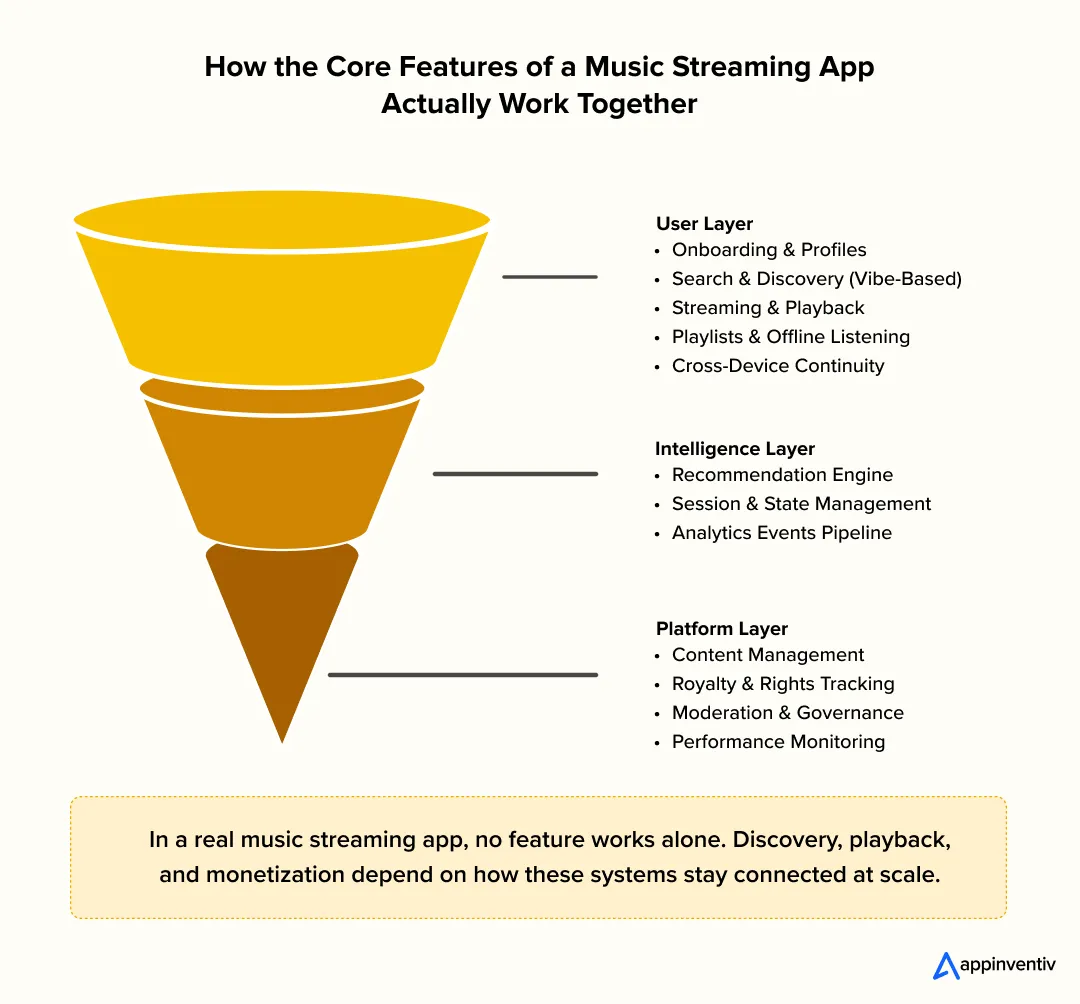
When teams start exploring how to build music streaming apps like Spotify, the real work begins after the feature list is written. Most features look simple on the surface. The complexity sits underneath, in how they are wired together and how they behave once real users show up. Experts treat features as parts of a music streaming app development that must stay stable under growth, not as isolated screens.
Below is a grounded look at the core features of a music streaming app, keeping the technical thinking intact while staying close to how these products are actually built and scaled in practice. This also reflects the real features of Spotify-like app development, not just the obvious ones.
User-Facing Features and How They Really Work
These are the features listeners interact with daily. Their technical design directly impacts playback quality, discovery, and long-term retention.
- User onboarding and profiles: Mobile app onboarding usually feels simple to users, but it sets the foundation for everything that follows. OAuth 2.0 based authentication typically handled through secure identity services using email, phone, or social logins.
User profiles are stored centrally so preferences, devices, and sessions stay consistent. Early preference capture feeds recommendation systems later. This is one of the quiet but important steps when you develop music streaming app products that rely on long-term engagement.
- Music Search and Discovery: In 2026, search is no longer limited to tags, genres, or keywords. Modern music streaming apps use vector search to understand the vibe of a track. Audio features like tempo, mood, energy, and sonic texture are converted into embeddings and stored in vector databases such as Pinecone or Milvus. This allows discovery systems to surface music that sounds right, even when genre or language differs.
Key capabilities this enables:
- Vibe-based discovery instead of keyword-only search
- Sonic similarity matching across genres and regions
- More accurate recommendations for mood, focus, or activity
- Spotify-level discovery quality powered by modern AI infrastructure
This shift moves discovery from “what the song is called” to “how the song feels,” which is now central to user retention.
- Audio streaming and playback: Streaming is the core of the entire product. Audio is delivered in small chunks so playback can start quickly and adjust quality as network conditions change. CDNs handle most deliveries to keep latency low during peak usage.
On the device, buffering logic smooths playback. On the backend, stateless streaming services are used so large numbers of listeners can be supported without slowing the system down.
- Playlists and personal libraries: Playlists look simple, but they are driven by events. When a user likes a track or reorders a playlist, that action triggers updates across several systems.
Those updates usually flow into:
- User library storage
- Recommendation systems
- Analytics pipelines
This structure keeps playlists consistent across devices, which users now expect by default.
- Offline listening: Offline access is one of the strongest reasons users upgrade. Technically, it is also one of the more complex features to support.
It typically involves:
- Encrypted storage on the device
- Playback authorization checks
- Clear expiry and renewal rules
The added complexity is worth it, especially in regions where connectivity is unreliable.
- Cross-device continuity: Users rarely stay on one device. They move between phones, laptops, cars, and smart speakers. Playback continuity depends on session services that track queue order, progress, and active devices in real time.
This feature quietly improves daily usage and is often underestimated when teams develop music streaming app platforms.
Creator and Artist Features With Real Platform Impact
Creator tools are essential for content growth and platform credibility. Without them, catalogs stagnate and engagement drops over time.
- Artist profiles: Artist data is usually handled separately from user data. This allows updates to bios, images, or releases without touching core streaming workflows.
- Release and catalog management: Uploading music triggers ingestion pipelines that validate files, enrich metadata, transcode audio into multiple qualities, and apply region-specific rules.
This workflow becomes critical when thinking about how to start a music app like Spotify with a catalog that grows or updates frequently.
- Artist analytics: Every play, skip, and save creates an event. These events are aggregated so artists can see listener locations, track performance, and playlist impact.
Analytics are not a bonus feature. They help creators stay invested in the platform.
Admin and Platform Features That Keep Things Running
These features are mostly invisible to users but essential for scalability, compliance, and operational control.
- Content management system: Developing a content management system so it acts as the control layer for the platform. It manages audio files, artwork, metadata, and publishing states. Role-based access reduces risk and supports auditing.
- Royalty and rights tracking: Streams are logged with context such as region, subscription type, and usage mode. This data feeds reporting and payout systems. Accurate tracking is essential when you develop music streaming app products that are meant to scale commercially.
- Moderation and governance: Automated systems flag duplicates, copyright issues, and policy violations. Manual review workflows handle disputes and takedowns, reducing legal exposure.
- Platform analytics and observability: Beyond user metrics, engineering teams monitor buffering rates, latency, error patterns, and CDN performance. These signals directly affect user satisfaction and infrastructure cost.
Why This Level of Detail Matters
The real benefits of creating a music app come from how these systems work together. Streaming quality affects trust, while discovery affects retention and accurate tracking affects monetization. None of these live in isolation.
With the core foundation in place, the next section will explore advanced features, focusing on AI in music streaming apps and how intelligence layers turn basic listening into long-term user loyalty and measurable ROI.
Advanced Features That Drive Retention and Monetization
After the core experience is in place, the real work begins. This is the stage where most teams discover that simply streaming music well is not enough. If you are serious about building music streaming apps like Spotify, advanced features are what slowly change user behavior. They turn occasional listening into a daily habit. This is also where music streaming app development starts affecting revenue, not just downloads.
The features below are often added in phases, but each one plays a clear role in retention or monetization when implemented thoughtfully.
AI-Driven Personalization and Recommendations
Personalization is less about intelligence and more about patience. Good recommendations improve gradually, not instantly.
In real systems, AI in music streaming apps depends on continuous signals rather than one-time predictions. Every play, skip, replay, or save feeds the system. Over time, patterns start to form, and recommendations become more accurate.
Most platforms rely on a combination of:
- Listening overlap between users with similar habits
- Track attributes like tempo, energy, or genre
- Recent behavior, such as what the user listened to today or yesterday
These models usually update in small increments. That slow refinement is intentional in order to improve customer experience using AI personalization.
Mood, Activity, and Context-Based Playlists
Contextual playlists work because people rarely listen the same way all day. Morning, travel, workouts, and late evenings all drive different choices.
From a technical standpoint, these playlists are generated dynamically. The system pulls from:
- Historical listening patterns
- Time-based triggers
- Aggregated behavior from similar users
Instead of manual curation, playlist logic recalculates suggestions at intervals or after key events. This keeps content fresh without constant editorial effort and quietly increases daily engagement.
Voice Search and Smart Device Integration
As music moves beyond phones, voice becomes more important. Voice search is not just about converting speech to text. The real challenge is understanding intent.
Systems need to handle:
- Incomplete song or artist names
- Mispronunciations
- Commands that depend on current playback
Voice queries usually pass through the same search infrastructure as text queries, but with added logic for ambiguity. While this feature is not critical early on, it becomes more relevant as platforms expand into cars and AI powered smart home devices.
Also Read: The Role of AI in Voice Commerce Integration
Live Audio and Real-Time Experiences
Live audio changes how users relate to the platform. It creates moments instead of just sessions.
From a technical perspective, live audio demands tighter control than standard streaming. Latency has to stay low enough for conversations to feel natural, and moderation cannot be an afterthought.
These experiences typically rely on:
- Low-latency audio delivery
- Real-time interaction layers
- Active moderation and access controls
Live features often support premium access or limited events, making them directly relevant to monetization models & ROI of music streaming apps.
High-Fidelity and Lossless Streaming
Not every user cares about audio quality, but for some, it is the deciding factor. Lossless streaming delivers richer sound at the cost of heavier infrastructure usage.
Platforms offering this option must account for:
- Larger file sizes and storage needs
- Increased bandwidth consumption
- Higher CDN costs
Because of this, high-fidelity audio is usually positioned as an upgrade rather than a default. It raises revenue per user without affecting the broader audience.
Social and Collaborative Listening
Music discovery often spreads socially, even when users listen alone. Collaborative playlists and shared listening features tap into this behavior.
Under the hood, these features rely on:
- Real-time synchronization between users
- Conflict handling when multiple edits occur
- Notification services to surface activity
When done well, social features reduce reliance on paid acquisition by turning listeners into promoters.
In-App Events, Drops, and Exclusives
Scarcity still works. Limited-time releases, early access tracks, or artist-led events give users a reason to open the app at specific moments.
These features depend on:
- Time-based access rules
- Region-aware availability checks
- Event-triggered notifications
They also strengthen relationships with artists and reinforce the benefits of creating a music app that feels active rather than static.
Why Advanced Features Matter
Advanced features do not deliver instant results. Their impact shows up over weeks and months. Better recommendations increase listening time. Live experiences build emotional attachment. Premium audio and exclusives justify paid plans.
Together, they define whether a platform becomes part of a user’s routine or just another app on their phone.
What Music Licensing and Legal Framework Do Streaming Apps Need to Handle?
Music licensing sits at the center of every streaming product decision. It determines which songs you can offer, where your app can launch, and how features like offline listening or video integration are handled. Understanding the rights involved and the licensing paths available early helps avoid legal risk, unexpected costs, and delayed market entry.
| Area | What It Covers | Real-World Examples |
|---|---|---|
| Master Rights | Ownership of the sound recording | Major labels like Universal Music Group, Sony Music Entertainment, Warner Music Group |
| Performance Licenses | Right to perform music publicly via streaming | Collected through PROs like ASCAP, BMI, and PRS for Music |
| Mechanical Licenses | Right to reproduce music during digital playback and caching | Handled in the US by The MLC, and through regional societies in other markets |
| Synchronization Licenses | Permission to pair music with visual content | Required for in-app videos, artist reels, ads, or branded content, usually negotiated directly with rights holders |
| Direct Label Agreements | Licensing music straight from record labels | Used by large platforms negotiating directly with Universal, Sony, Warner, and leading indie labels |
| Aggregators and Distributors | Pre-licensed music distribution to platforms | Services like DistroKid, TuneCore, and CD Baby |
| Region-Specific Licensing Bodies | Territory-based rights management | PPL (UK), SACEM (France), IPRS (India) |
What Architecture and Technology Stack Does a Music Streaming App Need in 2026?
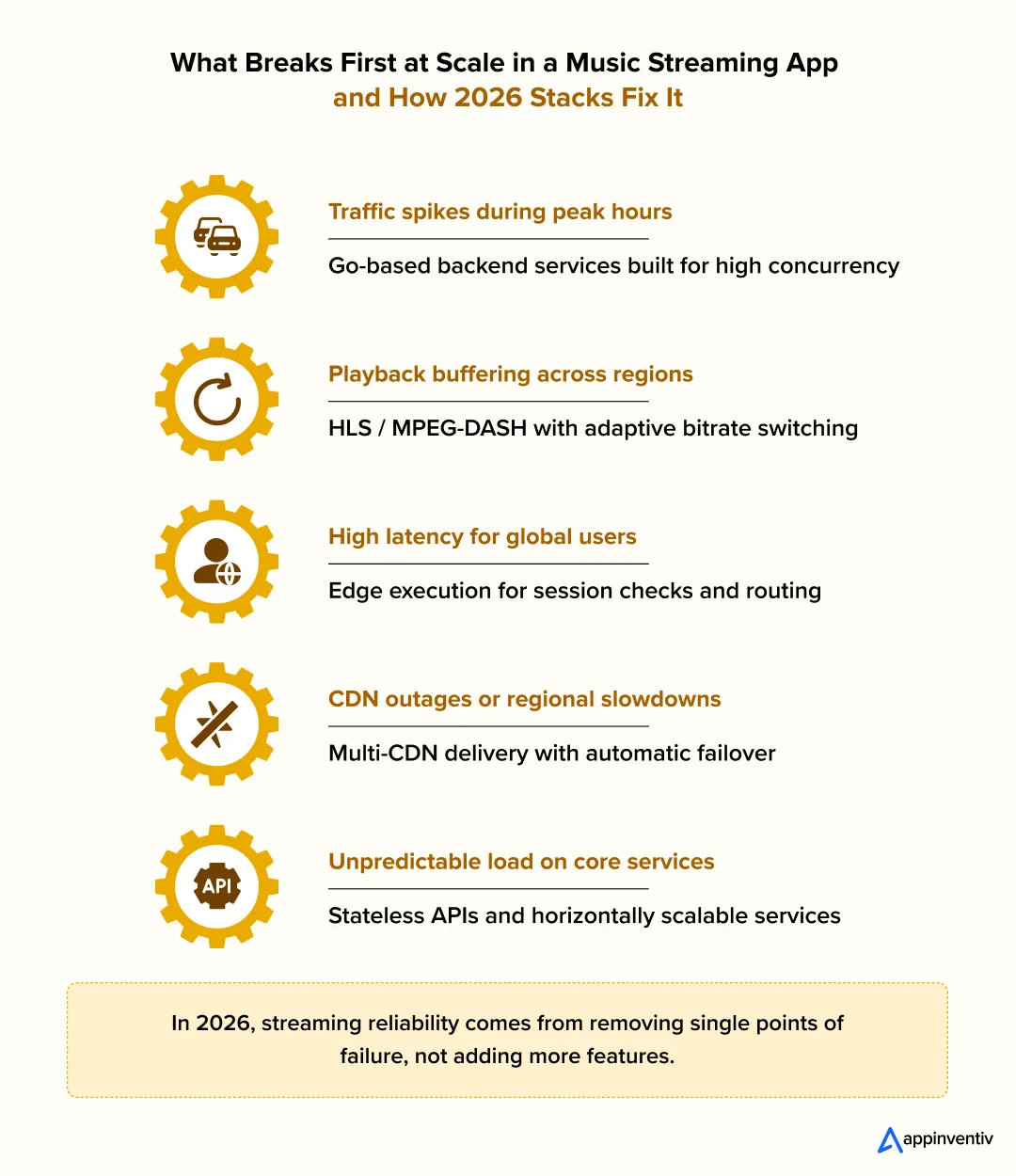
At scale, music streaming stops being a UI problem very quickly. It becomes a concurrency, latency, and delivery problem. The systems that hold up are the ones designed for millions of parallel listeners, uneven traffic spikes, and global delivery from day one. The stack choices below reflect what teams building serious streaming products are leaning on in 2026.
Backend and Core Services
For high-traffic paths like playback state, sessions, and playlists, predictability matters more than flexibility.
Many teams now prefer:
- Go (Golang) for core backend services because it handles high concurrency cleanly without heavy runtime overhead
- Smaller, focused services instead of one large backend, especially around playback and discovery
- Stateless APIs so scaling up during peak listening hours does not require complex coordination
This setup keeps response times stable even when traffic patterns get messy.
Adaptive Audio Streaming
Audio delivery needs to adjust constantly, often without users noticing.
In practice, this usually means:
- HLS or MPEG-DASH for adaptive bitrate streaming across devices
- Chunked media delivery so playback starts fast and recovers smoothly
- Client-side quality switching instead of server-driven interruptions
These standards are not new, but they remain reliable under real-world network conditions.
Edge Computing and Latency Reduction
Latency becomes noticeable once users are spread across regions. Pushing everything back to a central backend stops working.
Teams increasingly use edge computing to:
- Route listeners to nearby playback paths
- Handle lightweight checks like session validation closer to the user
- Reduce round-trip time during playback start and resume
Providers like Cloudflare or AWS with Lambda@Edge are commonly used to keep things responsive without overloading core services.
Global Delivery and Multi-CDN Strategy
Relying on a single CDN is a risk at scale. Performance varies by region, and outages do happen.
Well-designed platforms usually:
- Route traffic across multiple CDNs based on geography and load
- Fail over automatically when a region degrades
- Balance cost against performance instead of locking into one provider
Multi-CDN setups are less about optimization and more about resilience.
Explore our Entertainment App Development Services designed for high-concurrency streaming, content-heavy workflows, and long-term monetization.
How Do You Build a Music Streaming App Step by Step?
Once the architecture is clear, execution becomes the focus. Building a music streaming app is less about doing everything at once and more about sequencing the work correctly. Teams that move in phases usually ship faster and avoid expensive rework later.
Step 1: Product Discovery and MVP Definition
This is where scope is decided. The goal is not to build everything Spotify has, but to decide what users must be able to do on day one.
Focus areas:
- Core listening flows and must-have features
- Target audience and usage context
- Licensing constraints that affect launch regions
This step sets direction for how to build music app decisions without locking the team into heavy commitments too early.
Step 2: UX and UI Design
Design work starts with listening, not screens. Playback, discovery, and transitions between actions need to feel effortless.
Key priorities:
- Simple onboarding and fast access to music
- Clear playback controls and queue visibility
- Designs that support long listening sessions
Good UX reduces churn before personalization even kicks in.
Also Read: Top 11 UX Design Principles for Startups
Step 3: Backend and Streaming Development
This phase turns plans into working systems. Teams usually build backend services, APIs, and streaming pipelines in parallel with frontend development.
Typical work includes:
- User, playlist, and library services
- Streaming and CDN integration
- Data tracking for future personalization
This is where teams actively develop music streaming app functionality at scale.
Step 4: Testing and Performance Validation
Music apps are sensitive to failure. Even small playback issues show up immediately in user behavior.
Testing usually covers:
- Load and concurrency testing
- Network variability and buffering scenarios
- Offline mode availability and entitlement checks
Step 5: Launch and Iteration
Most platforms launch with a controlled rollout. Early feedback shapes what gets built next.
Post-launch focus areas:
- Monitoring listening behavior and drop-offs
- Refining discovery and recommendations
- Gradually adding advanced features
This phased approach keeps development focused and aligned with real user needs, which is essential when planning how to build music streaming apps like Spotify without overbuilding from the start.
Common Challenges and How to Overcome Them
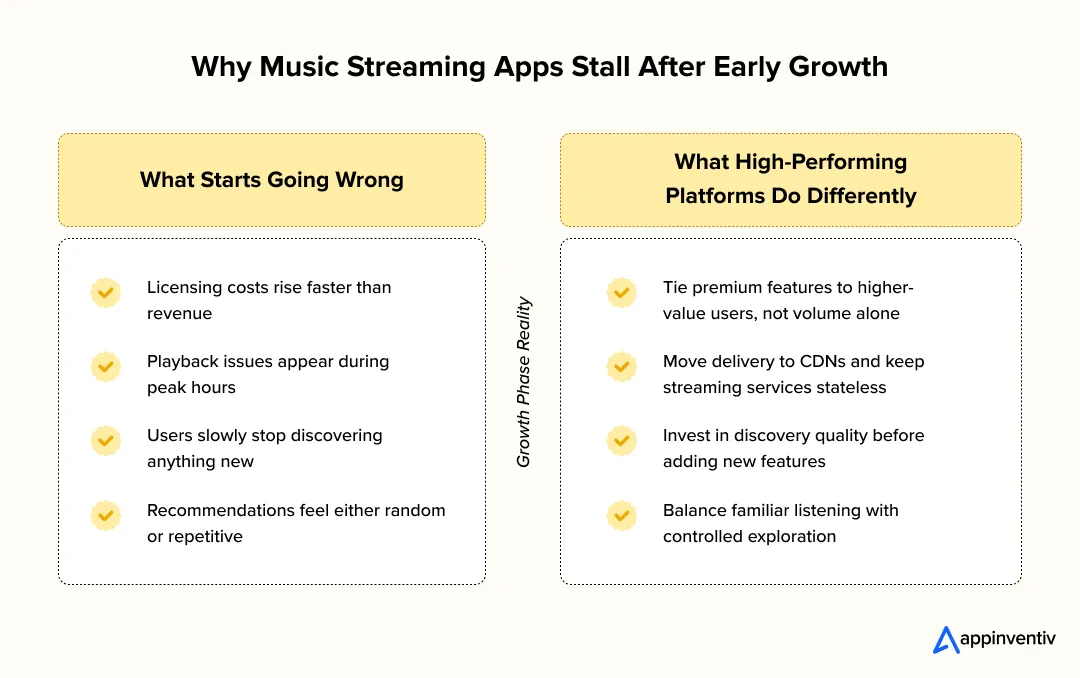
Most music streaming apps do not break in dramatic ways. They slowly lose momentum. Costs creep up, performance dips, users listen a little less, and eventually the product stops growing. Below are the challenges in music streaming app development that show up repeatedly once an app moves beyond early testing.
Licensing Cost Escalation
Licensing feels manageable at first. Then listening increases and payouts rise with it. The surprise is not the cost itself, but how quickly it grows once usage picks up.
Teams usually deal with this by being more deliberate:
- Premium features are tied to higher-value users, not just heavier listening
- Regional catalogs are tightened so the platform is not paying for unused music
- Conversion and ARPU are improved so revenue grows faster than total streams
The aim is to make each listener more valuable, not to limit listening.
Streaming Performance at Scale
Early traffic rarely exposes real performance issues. Problems appear once usage becomes consistent and peak hours get busy. Buffering and playback failures are often subtle but damaging.
What tends to work:
- Pushing delivery to CDNs instead of central servers
- Keeping streaming services stateless so they scale cleanly
- Tracking playback failures and latency, not just uptime
Users do not wait for fixes. If music stops, they move on.
User Churn in Competitive Markets
Most users do not leave after one bad experience. They drift away when nothing new catches their attention.
Teams that reduce churn usually:
- Focus on improving discovery before adding new features
- Refresh playlists gradually instead of resetting everything
- Watch listening gaps and adjust recommendations accordingly
Relevance matters more than reminders.
Balancing Discovery With Familiarity
Discovery is risky. Too much of it feels random. Too little feels repetitive. Both push users away.
Platforms that get this right:
- Ground recommendations in familiar artists or genres
- Introduce new tracks slowly within known patterns
- Let user behavior guide how adventurous suggestions become
When this balance works, users trust the app without feeling stuck.
How Much Does It Cost to Build a Music Streaming App?
Cost is one of the first questions teams ask, but it is rarely a single number. The investment depends on scope, licensing complexity, scale expectations, and how advanced the product is at launch. For most teams, the music app development cost typically falls within a wide but realistic range.
Typical Cost Range
For a professionally built product, the cost to make an app like Spotify usually sits between $40,000 and $400,000.
That range exists because a music streaming app can be many things, from a focused MVP to a full-scale platform.
What Drives the Lower End ($40K–$80K)
This range usually applies to an MVP mobile app development or niche product.
Common characteristics:
- Core streaming and playback features
- Limited catalog and regions
- Basic playlists and search
- Minimal personalization
- Smaller user base assumptions
This setup is often used to validate demand or test a specific audience before scaling.
What Pushes Costs Upward ($100K–$250K)
Mid-range products start adding depth and differentiation.
Cost increases with:
- Offline listening and DRM
- Personalization and early AI in music streaming apps
- Creator tools and analytics
- Multi-platform support (iOS, Android, web)
At this stage, infrastructure and licensing planning become more serious.
What Reaches the Upper End ($300K–$400K)
Enterprise-grade platforms sit at the top of the range.
Typical drivers:
- Large catalogs and multiple regions
- Advanced recommendations and discovery
- High concurrency and low-latency streaming
- Complex royalty reporting and compliance
- Live audio or premium experiences
This level of investment is common when long-term scale and monetization models & ROI of music streaming apps are central to the business plan.
Also read: How Much Does it Cost to Develop a Music Streaming App Like Spotify
What Monetization Models and Revenue Streams Work Best for Music Streaming Apps?
Monetization in music streaming is rarely about choosing one model and sticking to it forever. Most successful platforms layer revenue streams over time, based on how users listen and what they are willing to pay for. The key is knowing when each model works and why it makes sense for your audience.
| Monetization Model | How It Works | When It Works Best | Why Platforms Use It |
|---|---|---|---|
| Subscription tiers | Users pay a recurring fee for ad-free listening, offline access, higher audio quality, or premium features | When users listen frequently and rely on the app daily | Provides predictable, recurring revenue and supports long-term ROI |
| Ad-supported free access | Users listen for free while ads play between tracks or sessions | When user volume is high and engagement is more casual | Lowers entry barriers and acts as a funnel to paid plans |
| In-app purchases | Users pay for specific upgrades or one-time features | When users want flexibility without committing to a subscription | Adds incremental revenue without forcing full upgrades |
| Brand partnerships and sponsorships | Brands sponsor playlists, listening sessions, or curated content | When the platform has a clear audience profile and strong engagement | Generates high-value revenue without relying on user payments |
| Creator subscriptions and fan tipping | Fans directly support artists through subscriptions, tips, or exclusive access | When the platform focuses on independent artists or niche communities | Aligns monetization with loyalty and creator relationships |
This comparison highlights why monetization is not a one-size-fits-all decision. The most successful platforms align revenue models with how users listen and what creators value.
What Does ROI and Unit Economics Look Like for a Music Streaming App?
ROI in music streaming is rarely obvious at launch. It emerges over time as listening behavior stabilizes, monetization improves, and costs start scaling more efficiently. This section breaks down how returns actually materialize, not how they are pitched.
Key Revenue Metrics
These metrics show whether listening activity is translating into real business value.
- ARPU (Average Revenue Per User): ARPU tells you how much each active listener is worth, not in theory but in cash. In streaming, small ARPU improvements compound quickly once user volume grows.
- Conversion rate: Conversion measures how effectively the free experience pushes users toward paid value. It usually improves when premium features remove friction, not when they simply add options.
- Retention and churn: Retention exposes whether users find ongoing value in discovery. Churn often signals stale recommendations or weak emotional attachment rather than pricing issues.
Cost Drivers
These costs move in parallel with growth and define how quickly margins tighten or expand.
- Licensing per stream: Every play has a cost attached to it. The challenge is not reducing streams, but ensuring revenue per user grows faster than total listening volume.
- Infrastructure per active user: Streaming infrastructure gets cheaper per user as scale improves, but only if systems are designed for it early. Poor architecture keeps costs linear and margins flat.
- Customer acquisition cost: Acquisition costs reveal how dependent the platform is on paid growth. Strong discovery and sharing loops usually reduce this pressure over time.
ROI Scenarios
These scenarios show how music streaming apps move from heavy investment to sustainable returns.
- Break-even timelines: Break-even typically arrives only after usage patterns stabilize and monetization becomes predictable. Early losses are common, but uncontrolled losses are not.
- Scale effects on margins: As the user base grows, fixed costs spread out and monetization becomes more efficient. This is where scale stops hurting margins and starts improving them.
- Long-term lifetime value: Lifetime value grows when users stay longer and gradually pay more, not when they churn and rejoin later. Retention usually has a larger ROI impact than acquisition.
Data Privacy, Security, and Compliance
Privacy and security tend to get discussed late, usually after features are locked and timelines are set. That is risky, for a music streaming app, compliance decisions shape how data flows through the system and how easily the platform can scale into new regions or enterprise partnerships. Getting this right early saves painful rework later.
GDPR and CCPA Considerations
Regulations like GDPR and CCPA affect more than legal text. They change how data is stored and how services talk to each other.
In practice, teams separate personal data from listening behavior. User identities live in tightly controlled stores, while play history and preferences are handled as anonymized or pseudonymized records. This allows recommendation systems to learn from behavior without constantly touching sensitive data.
Access is restricted at the service level. Most systems are designed so only a small number of services can read or modify personal information.
User Consent and Data Transparency
Consent is not a one-time action. It is a state that needs to follow the user everywhere.
Platforms usually store consent flags alongside the user profile and enforce them automatically. If a user turns off personalization, recommendation services adjust without manual intervention. If tracking is disabled, analytics pipelines drop or aggregate data instead of storing it in raw form.
Clear consent handling avoids edge cases that later become compliance issues.
Secure Payment Handling
Payments are an area where shortcuts quickly backfire. Music apps should never store card details directly.
Most platforms rely on tokenized payments through certified providers. Payment services run in isolation from the rest of the system, and only subscription status is shared with the core app. Communication between clients, backend, and payment gateways integration is encrypted end to end.
This keeps sensitive data out of the main application surface.
Regional Data Residency Requirements
Data laws are not uniform across regions. Some countries require user data to remain within local borders.
To manage this, platforms often deploy region-specific data stores and processing pipelines. User profiles, logs, and backups stay local, while non-sensitive or aggregated data may be shared centrally. This adds complexity, but it prevents legal exposure during expansion.
Get clarity on scope, licensing approach, architecture, and ROI before committing to development.
Why Choose Appinventiv to Build a Music Streaming App?
If you are figuring out how to build a music streaming app like Spotify, the bigger question is who can actually carry it through beyond launch. Appinventiv has worked across 35+ industries, with teams of 1600+ tech evangelists delivering 3000+ solutions globally. That experience helps avoid early mistakes that usually surface only after users, traffic, and content start scaling.
Appinventiv’s strength in entertainment app development services comes from building platforms that deal with real-world complexity. High user concurrency, content-heavy workflows, and evolving monetization models are handled with systems designed for growth, not demos. The company’s 15+ global awards and recognitions reflect consistent execution, not one-off success.
This approach is visible in projects like the ReelMedia multi-app platform. While it is not a music streaming product, it required the same fundamentals: scalable architecture, flexible content management, and the ability to support multiple user experiences under one ecosystem. That same foundation is what Appinventiv brings to teams looking to build serious, long-term music streaming platforms.
If you are exploring how to build a music streaming app like Spotify and want clarity before committing, a quick conversation can help validate scope, risks, and the right starting point.
FAQs
Q. How to monetize a music streaming app?
A. Most platforms use a mix rather than a single model. Subscriptions work when users listen daily and value offline access or better discovery. Ad-supported tiers help acquire users early. In-app purchases, brand partnerships, and creator subscriptions add revenue layers once engagement is stable. The right mix depends on listening behavior and licensing costs.
Q. How long does it take to build a music streaming app?
A. Timelines depend on scope. A focused MVP with core streaming and playlists can take around 3–4 months. More advanced platforms with offline mode, personalization, and multi-platform support usually take 6–9 months. Enterprise-grade products often evolve continuously after launch.
Q. How much does it cost to build a music streaming app?
A. The cost to build a music streaming app typically ranges from $40K to $400K. Lower budgets cover basic streaming and limited regions, while higher investments support advanced discovery, larger catalogs, multi-region launches, and scalability. Cost is driven more by scope and scale than by features alone.
Q. Is building a music streaming app profitable in 2026 and beyond?
A. Yes, but profitability is not immediate. Music streaming becomes viable when retention is strong, monetization improves over time, and costs scale efficiently. Platforms that focus on discovery quality, clear monetization paths, and long-term user value tend to see sustainable returns beyond 2026.

- In just 2 mins you will get a response
- Your idea is 100% protected by our Non Disclosure Agreement.

How Much Does It Cost to Build a Live Streaming App Like Kick and Rumble?
Have you ever wondered why there's a global surge in the demand for live streaming apps and why businesses are increasingly turning towards them? The key lies in the transformative and immersive way these platforms engage audiences, shattering geographical barriers and forging real-time connections. Live streaming apps like Kick and Rumble have not just changed…
The A-Z of video streaming protocols for businesses
We live in a world where people value information delivery mediums as much as they do insight. Video has become the most palatable source of ingesting information for people, with the average person spending over 100 minutes (or more) consuming video content on a daily basis as of now in 2022. Consequently, video streaming protocols…
How Much Does a Podcast Application Development Cost?
Packed with useful information, engaging shows, and joyful banter, podcasts are highly engaging. Unlike blog posts that need reading or watching, podcasts require minimal engagement from the users. Podcast apps today are highly in demand among users. They are evolving as a new channel where listeners can listen to the premium audio content of multiple…









