































Cost to Develop a Stock Trading App in 2026: Complete Pricing Breakdown

 Share -


- 01Why Stock Trading Software Remains a High-Growth Investment Opportunity
- 02Breakdown of Cost by Trading Platform Type
- 03Cost Breakdown According to Global Regions
- 04Stock Trading App Development Cost Estimation Models
- 05Factors Affecting the Cost to Develop a Stock Trading App
- 06Overlooked or Hidden Costs of Stock Trading App Development
- 07Smart Ways to Optimize Stock Trading App Development Costs
- 08Launch a Future-Ready Stock Trading App with Appinventiv
- 09FAQs

Key takeaways:
- The cost to develop a stock trading app typically ranges from $50,000 to $150,000 for an MVP, $150,000 to $500,000 for a full-featured product, and $1,000,000+ for enterprise platforms.
- Development costs are shaped by four major factors: trading engine complexity, market data integration, security, and regulatory compliance.
- Typically, core development takes up the majority of the budget, followed by integrations, security and testing.
- The final cost can be quite high due to features such as AI insights, copy trading, and multi-asset support.
- Running the application involves third-party APIs, cloud infrastructure, licensing and maintenance costs, which are ongoing costs after the build phase.
- An MVP is a great way to validate demand, lower risk, and scale incrementally, which helps startups avoid overspending and unnecessary risks.
Stock trading is not just about buying and selling equities. As the lines between traditional finance and digital assets continue to blur, trading platforms are expanding their role beyond simple order execution. Binance recently announced plans to integrate access to 7,000 U.S. stocks and ETFs and to tokenize equity offerings, echoing the industry trend toward creating unified investment ecosystems.
This indicates how platforms are evolving from trading tools to financial hubs that enable trading across multiple asset classes from a single location. In this context, demand for custom trading platforms continues to grow, and businesses are evaluating the costs of creating a stock trading application that meets the needs of today’s investors.
The cost to develop a stock trading app involves bifurcating your budget on market data integration, trading engines, cybersecurity, compliance and scalable infrastructure. This means that the development cost of an MVP can be anywhere from $50,000 to $150,000, a full-featured trading solution can cost $150,000 to $500,000, and enterprise platforms for advanced analytics, algorithmic trading and millions of transactions can cost over $1,000,000.
There are a number of technical and business considerations that will influence the final investment, and we will look at these throughout this detailed cost guide.
Let’s assess your requirements, feature set, and business goals to determine the exact development scope and cost.
Why Stock Trading Software Remains a High-Growth Investment Opportunity
Investors’ expectations have grown past simply purchasing and selling stocks. Today’s traders demand real-time market data, powerful charting tools, portfolio analysis, and near-instant execution, as well as smooth cross-platform performance.
Concurrently, the new trends like algorithmic trading, AI-driven analytics, social investing, and tokenized assets are significantly affecting the market. This presents a chance for businesses to develop platforms that can cater to both retail and institutional investors and take advantage of the rising demand for digital investing platforms.
Value can be created on modern trading platforms in a number of different ways, such as:
- Fees and charges that are applied to the transactions and brokerage of securities
- Premium analytics and market intelligence subscriptions
- Services of margin trading and margin lending
- Wealth management and advisory services
- FinTech and payment integrations used by third parties
In addition to generating revenue, trading software offers a scalable platform for customer acquisition, retention, and growth. A sustainable competitive edge in the changing financial services landscape that businesses can achieve without having to rebuild their technology stack to support high-volume transactions, new asset classes, and new markets.
Breakdown of Cost by Trading Platform Type
The most significant impact is the type of trading platform being developed, affecting overall investment. Platforms come in many categories and have distinct characteristics, scaling needs, compliance mandates and integration elements.
| Trading Platform Type | Typical Features | Estimated Cost |
|---|---|---|
| Cloud or Web-Based Trading Platform | Online trading, charting, technical analysis tools, portfolio monitoring | $50,000 – $250,000 |
| Basic Stock Trading App | User onboarding, watchlists, portfolio tracking, market data feeds, stock search, basic order placement | $50,000 – $150,000 |
| Discount Brokerage Software | Self-directed trading, low-cost order execution, account management, real-time quotes, reporting dashboards | $100,000 – $300,000 |
| Retail Trading Platform | Advanced charting, real-time order execution, alerts, portfolio analytics, funding and withdrawal modules | $150,000 – $350,000 |
| Robo-Advisory Platform | Risk assessment, portfolio allocation, automated rebalancing, goal-based investing, investment recommendations | $200,000 – $500,000 |
| Copy Trading Software | Strategy discovery, trader performance tracking, automated trade replication, social investing features | $250,000 – $600,000 |
| Hybrid Investment Software | Self-directed trading, robo-advisory capabilities, portfolio recommendations, wealth management tools | $300,000 – $700,000 |
| Multi-Asset Trading Platform | Stocks, ETFs, mutual funds, options, bonds, cryptocurrencies, cross-asset portfolio management | $350,000 – $800,000 |
| Institutional Trading Platform | Advanced risk management, algorithmic trading, liquidity management, compliance reporting, high-volume transaction processing | $500,000 – $1,000,000+ |
| Enterprise Wealth & Trading Ecosystem | Multi-asset investing, AI-driven insights, automated advisory services, institutional-grade security, global scalability | $700,000 – $1,000,000+ |
Cost Breakdown Associated With Each Stage of Development
Understanding the cost to develop a stock trading app requires looking at each stage individually, since project budgets are distributed across multiple development phases.
| Development Phase | Activities | Cost Contribution |
|---|---|---|
| Discovery & Planning | Business analysis, requirements gathering, roadmap creation | 5% – 10% |
| UI/UX Design | User journeys, wireframes, visual design, prototypes | 10% – 15% |
| Core Development | Trading engine development, user management, portfolio modules, APIs, core platform functionality | 40% – 50% |
| Integrations | Market data feeds, broker APIs, payment gateways, KYC systems | 15% – 20% |
| Security & Compliance | Encryption, authentication, audit trails, regulatory controls | 10% – 15% |
| Testing & Deployment | Performance testing, quality assurance, cloud deployment | 5% – 10% |
The cost of development for the trading engine and integrations from third parties are typically the biggest cost items of the project.
Cost Breakdown According to Global Regions
Developer rates, regulatory knowledge, operating costs, and talent availability vary by region and can significantly influence development costs. The table below shows the estimated costs of creating a stock trading platform with similar features.
| Region | Average Developer Rate (Per Hour) | Estimated Project Cost (Mid-Level Trading Platform) |
|---|---|---|
| North America (US & Canada) | $100 – $250 | $250,000 – $1,000,000+ |
| Western Europe (UK, Germany, Netherlands, France) | $80 – $200 | $200,000 – $800,000+ |
| Australia & New Zealand | $80 – $180 | $180,000 – $700,000+ |
| Eastern Europe (Poland, Ukraine, Romania) | $40 – $100 | $100,000 – $500,000+ |
| India | $25 – $75 | $50,000 – $300,000+ |
| Southeast Asia (Vietnam, Philippines, Indonesia) | $20 – $60 | $40,000 – $250,000+ |
| Latin America (Brazil, Argentina, Colombia, Mexico) | $30 – $80 | $75,000 – $350,000+ |
| Middle East | $40 – $120 | $100,000 – $500,000+ |
For businesses evaluating development partners, regional pricing should be considered alongside technical capabilities, financial domain knowledge, security expertise, and regulatory experience.
Breakdown of Costs Associated With Each Feature Set
Not all trading platforms have the same level of functionality. The selection of features will have an impact on development time and costs. Let’s have a look at it.
| Feature Category | Scope | Estimated Cost Impact |
|---|---|---|
| User Authentication & Onboarding | Robust user authentication and onboarding, including multi-factor authentication | $10,000 – $50,000 |
| Portfolio Management | Holdings, watchlists, performance tracking | $15,000 – $75,000 |
| Trading Engine | Order management, execution workflows, and settlements | $50,000 – $250,000+ |
| Market Data Integration | Real-time pricing, charts, and historical data | $20,000 – $100,000+ |
| AI & Analytics | Trade recommendations, sentiment analysis, predictive insights | $30,000 – $200,000+ |
| Social & Copy Trading | Community features, strategy replication | $25,000 – $150,000+ |
Some of the most expensive components to create are sophisticated trading capabilities, which usually need complex backend systems and low-latency processing.
Detailed Cost Breakdown of Third-Party Integrations
Data, payments, compliance, and brokerage are all vital functions for a modern trading app, and are ultimately reliant on external providers.
| Integration Type | Examples | Estimated Cost Impact |
|---|---|---|
| Market Data Providers | Nasdaq, NYSE, Polygon, Refinitiv | $20,000 – $150,000+ |
| Brokerage APIs | Alpaca, Interactive Brokers, Tradier | $15,000 – $100,000+ |
| Payment Gateways | Stripe, Plaid, ACH providers | $10,000 – $50,000+ |
| KYC & Identity Verification | Jumio, Onfido, Trulioo | $15,000 – $75,000+ |
Third-party integrations not only require development fees but also bring in recurring licensing and subscription fees, which should be taken into account when planning for the long-term.
AI-Based Stock Trading Software Development Cost Breakdown
Artificial intelligence is becoming a core part of modern trading platforms. Investors increasingly expect personalized insights, automated portfolio management, intelligent risk analysis, and conversational investment assistance.
While these capabilities can improve engagement and retention, they introduce additional stock market app development costs related to data engineering, model training, infrastructure, and ongoing optimization.
AI Development Cost Breakdown
| AI Capability | Development Complexity | Estimated Timeline | Estimated Cost Impact |
|---|---|---|---|
| AI-Powered Stock Recommendations | Medium | 2-4 months | $25,000 – $100,000+ |
| Portfolio Optimization Engine | Medium to High | 3-6 months | $40,000 – $200,000+ |
| Market Sentiment Analysis | High | 3-6 months | $30,000 – $150,000+ |
| AI Investment Assistant | Medium | 2-5 months | $20,000 – $120,000+ |
| Predictive Analytics | High | 4-8 months | $50,000 – $250,000+ |
| Algorithmic Trading Models | Very High | 6-12 months | $75,000 – $400,000+ |
| Fraud Detection Systems | High | 3-6 months | $40,000 – $180,000+ |
Main AI Cost Drivers vs Cost Escalation Factors
| Main AI Cost Drivers | Why Costs Increase |
|---|---|
| Historical and Real-Time Market Data | Larger data volumes require additional storage, processing power, and data pipeline infrastructure. |
| Recommendation Engines | Personalized investment recommendations require continuous model training and refinement. |
| Portfolio Optimization Models | Supporting multiple asset classes increases computational complexity and processing requirements. |
| AI Trading Algorithms | Real-time trade execution requires low-latency infrastructure and high-performance computing environments. |
| Generative AI Assistants | Increased usage leads to higher LLM inference costs, API consumption, and infrastructure expenses. |
| Risk & Fraud Detection Models | Growing transaction volumes require continuous monitoring, retraining, and model optimization. |
Stock Trading App Development Cost Estimation Models
Every project is different. A platform with basic buy-and-sell functionality is far easier to build than one that includes robo-advisory features, copy trading, or algorithmic investing tools. That said, development teams do rely on a few proven estimation methods to arrive at realistic budgets. Here’s a breakdown of the stock trading platform development cost formula that you need to understand:
Work Breakdown Structure (WBS)
This is the most straightforward approach. The project is broken down into smaller tasks, and each task is estimated separately before everything is added together.
Total Cost= ∑ (Task Hours × Hourly Rate)
For example, a trading app might require work across design, trading engine development, market data integration, security implementation, and testing. If the total effort comes to 2,000 hours and the average development rate is $75 per hour, the estimated project cost would be around $150,000.
The reason many companies prefer this method is simple. It gives them a clearer picture of where the budget is actually going.
COCOMO II Estimation Model
Larger FinTech projects often need a more structured forecasting model. That’s where COCOMO II comes in. Instead of looking at tasks alone, it estimates effort based on the size of the software and the complexity of the project.

Here, effort is calculated using the projected codebase size and several adjustment factors such as compliance requirements, technical complexity, integrations, and team experience.
In practical terms, a stock trading platform that supports multiple exchanges, advanced analytics, and thousands of daily transactions will naturally require more effort than a simple retail trading app.
Three-Point Estimation (PERT)
One of the biggest mistakes in software budgeting is relying on a best-case scenario. Projects rarely unfold exactly as planned. New requirements appear, integrations take longer than expected, and compliance reviews can introduce delays.
To account for that uncertainty, many teams use PERT estimation.

Where:
- O = Optimistic estimate
- M = Most likely estimate
- P = Pessimistic estimate
Rather than focusing on a single number, this method considers a range of possible outcomes and calculates a weighted average. It tends to produce estimates that are closer to what happens in the real world.
From strategy and compliance to development and deployment, we deliver end-to-end trading solutions designed for long-term success.
Factors Affecting the Cost to Develop a Stock Trading App
There are several factors that influence the cost of developing a stock trading app, such as the complexity of the features, compliance with security standards, adherence to regulatory requirements, integration with third-party systems and platforms, and location. Knowing these variables allows you to more accurately estimate the overall investment.
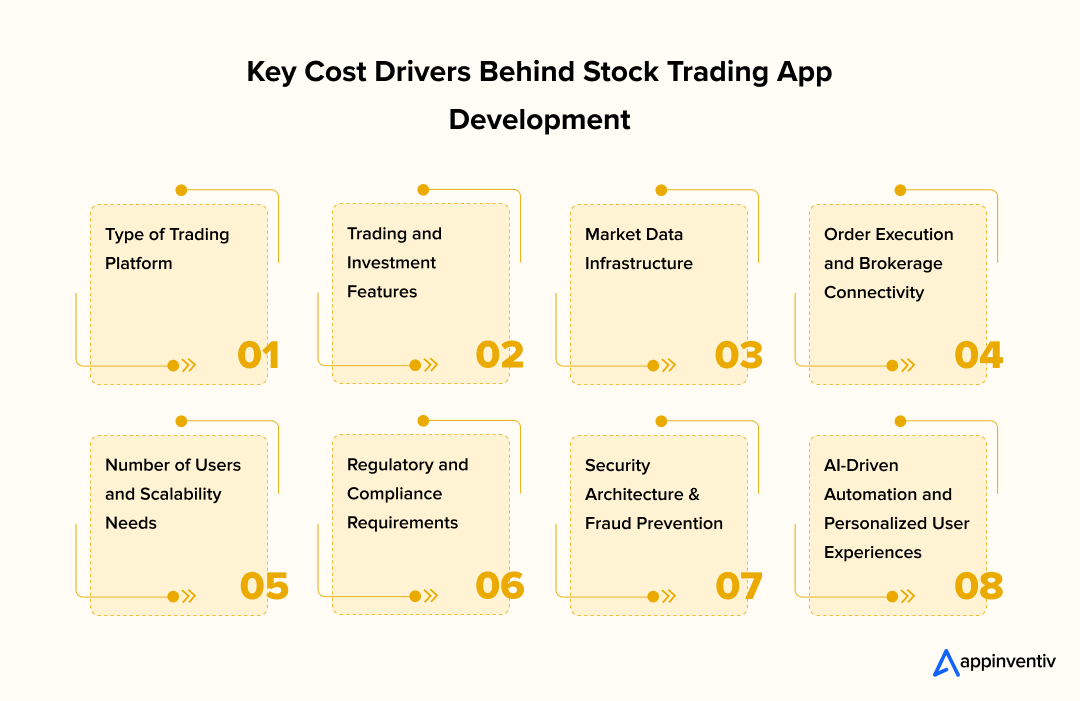
Type of Trading Platform
The most significant factor that plays a great role in development costs is the type of trading platform being developed. A stock trading app doesn’t come anywhere near the demands of a copy trading platform, robo-advisory system, or enterprise-level trading environment.
Typical platforms include:
- Discount brokerage platforms
- Robo-advisory software
- Copy trading platforms
- Hybrid investment platforms
- Multi-asset trading platforms
- Institutional trading systems
Estimated cost impact: $50,000 – $1,000,000+
The more advanced features a platform includes, the higher the average cost of stock trading app development, as each addition requires extra engineering effort, infrastructure, testing, and third-party integrations.
Trading and Investment Features
The project scope and development time are directly affected by feature selection. Some platforms offer just stock market trading, while others include more sophisticated investing tools that can help engage users and boost portfolio returns.
Common feature requests are:
- Real-time trade execution
- Manage your portfolio and watchlist
- Advanced charting tools
- AI-powered investment insights
- Automated alerts and notifications
- Social and copy trading features
- Goal-based investing tools
Estimated cost impact: $30,000 – $500,000+
The more advanced the features are, the higher the application development cost for the stock market will be because of the added backend development, testing, and maintenance needs.
Market Data Infrastructure
Stock trading applications require precise and timely market data and information. To provide real-time stock prices, charting data and market updates, integration with specialized financial data providers is required.
Common market data requirements include:
- Real-time stock quotes
- Historical pricing data
- Technical charting feeds
- Market news integration
- Company financial data
- Multi-exchange connectivity
Estimated cost impact: $20,000 – $200,000+
The amount, velocity, and quality of market information provided to customers can have a major impact on the complexity of development and ongoing operational costs.
Order Execution and Brokerage Connectivity
Every trading platform is based on the speed and accuracy of transactions. For this, the integration with the brokerage systems, trading engines, and settlement networks needs to be solid and capable.
Key components include:
- Order management systems
- Brokerage API integrations
- Trade execution workflows
- Settlement and reconciliation processes.
- Transaction monitoring
- Risk management controls
Estimated cost impact: $50,000 – $300,000+
These platforms, which provide advanced trading tools, may need to be more complex and heavily tested for reliability, especially during periods of high market activity.
Number of Users and Scalability Needs
The expected user base has a direct impact on development and infrastructure costs. A platform serving a few thousand investors requires a very different architecture than one handling high trading volumes, real-time data streams, and hundreds of thousands of active users. As scale increases, so do investments in cloud infrastructure, performance optimization, and system reliability.
Scalability considerations include:
- Cloud infrastructure
- Auto-scaling capabilities
- Real-time data processing
- High-availability architecture
- Disaster recovery systems
- Multi-region deployments
Estimated cost impact: $50,000 – $300,000+
With growing user numbers, companies need to build infrastructure to ensure performance, security, and uptime, impacting the total cost of the stock trading platform development.
Regulatory and Compliance Requirements
Financial platforms are one of the most highly regulated technology sectors. Compliance requirements are dependent on the target market, asset classes, and the business model.
Common regulatory concerns are:
- KYC verification
- AML monitoring
- Data privacy compliance
- Investor protection requirements
- The use of audit trails and reports
- Regional and global financial regulations
Estimated cost impact: $25,000 – $250,000+
Regulatory requirements continue to evolve, making compliance a recurring investment rather than a one-time development effort.
Security Architecture & Fraud Prevention
Trust is one of the essential factors in trading platforms. Stock trading apps handle sensitive financial data, investment portfolios, and real-money transactions. As a result, security must be embedded into every layer of the platform, from authentication and encryption to transaction monitoring and compliance controls. This complexity of security can impact the development costs considerably.
The following are key components of security:
- Multi-factor authentication (MFA)
- End-to-end data encryption
- Manage devices and sessions
- Fraud detection systems
- Biometric authentication
- Secure transaction monitoring
- DDoS protection and threat monitoring
Estimated cost impact: $30,000 – $250,000+
The more advanced security measures will be required for trading platforms that process high transaction volumes or operate in various regions, which will increase their development and maintenance expenses.
AI-Driven Automation and Personalized User Experiences
Investors, these days, demand customization over a standard trading platform. Several platforms have made use of intelligent automation to enhance decision-making, boost engagement, and provide personalized recommendations.
As a result, AI stock trading app development cost is often higher than that of conventional trading applications due to the additional infrastructure, data processing, and model training requirements.
The advanced features can include:
- AI-powered stock recommendations
- Market sentiment analysis
- Predictive analytics
- Automated portfolio rebalancing
- Complete the risk profile and risk score.
- Personalized investment insights
- Intelligent trading assistants
Estimated cost impact: $50,000 – $400,000+
The integration of AI and automation components can significantly complicate development because of the data required for processing, machine learning algorithms, infrastructure requirements and ongoing optimization. In a competitive market, these capabilities can be an important differentiator, though.
Overlooked or Hidden Costs of Stock Trading App Development
These hidden costs may arise at the launch, scaling up or even at the time of regulatory approval and can have a huge impact on the overall investment.
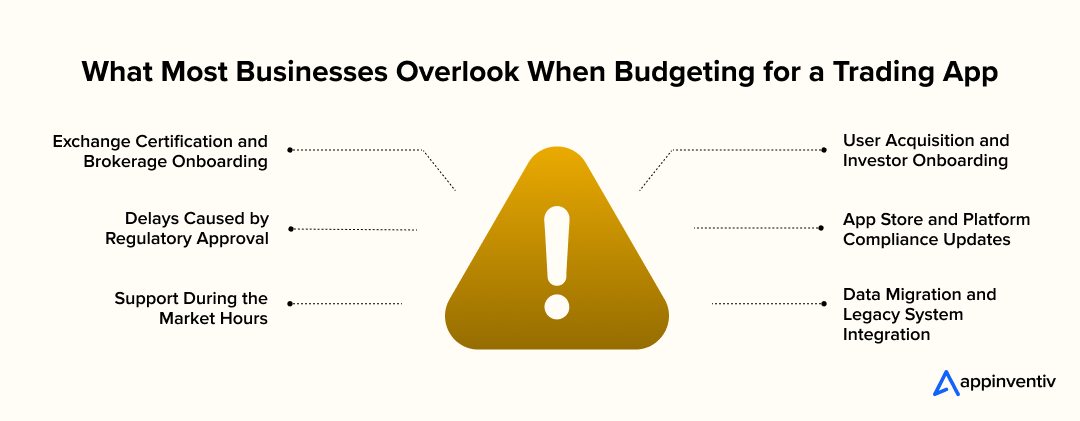
Exchange Certification and Brokerage Onboarding
Connecting to an API is not always the most straightforward aspect of integrating with broker-dealers, exchanges, clearinghouses, or trading partners. In many cases, providers will need to undergo technical reviews, certification processes, sandbox testing, and an onboarding fee before gaining access to production. These activities can incur extra expense and time delays in the project schedule.
Delays Caused by Regulatory Approval
Product launches can be dependent on legal reviews, compliance sign-offs and operational approvals for regulated markets. The lack of approvals may lead to additional engineering work to address regulatory comments, project management expenses, and development delays.
Support During the Market Hours
Trading platforms typically need special attention during trading sessions, which is not the case with regular mobile applications. During high market volume periods, technical teams might be required to offer swift issue resolution, incident management and performance monitoring to guarantee seamless trade execution.
User Acquisition and Investor Onboarding
The development of a trading platform is just the beginning. The platform can be profitable, but it takes a lot of initial investment in customer acquisition costs, referral programs, onboarding campaigns, investor education resources, and even promotional incentives.
App Store and Platform Compliance Updates
Changes introduced by Apple, Google, payment providers, and financial regulators often require updates to authentication flows, privacy policies, payment infrastructure, and investor disclosures. The changes can result in unexpected development costs even if no new features are added to the business.
Data Migration and Legacy System Integration
One of the challenges for existing financial institutions when launching a new trading platform is migrating legacy transactions, customer accounts, portfolio data and reporting information. One of the most overlooked costs is that of data cleansing, validation and integration with the system.
We evaluate your product vision, compliance needs, and feature priorities to create a realistic development budget from day one.
Smart Ways to Optimize Stock Trading App Development Costs
A reduction in development costs doesn’t imply that the platform’s quality and safety are compromised. The principle is to invest in the core business functionality first and add unnecessary complexity later in the development phase.
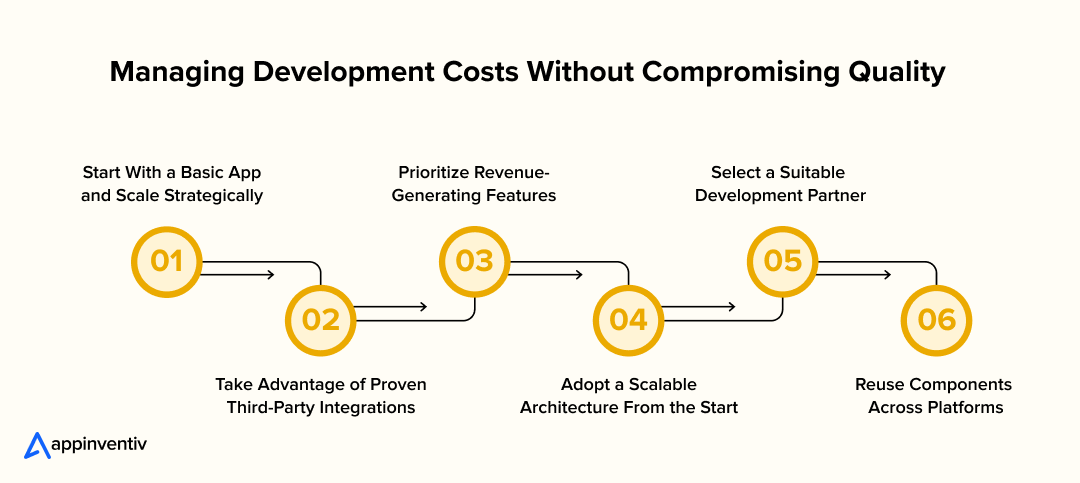
Start With a Basic App and Scale Strategically
Instead of implementing all the features from the start, focus on the core elements like user onboarding, portfolio management, market data, and trade execution. This helps to test the product-market fit before making large-scale investments and can significantly help reduce the overall expenses of custom stock trading app development.
Take Advantage of Proven Third-Party Integrations
Developing brokerage connectivity, KYC verification, payment processing and market data infrastructure from the ground up can easily add up the costs. The use of proven third-party solutions reduces development time and reduces implementation risks.
Prioritize Revenue-Generating Features
Concentrate on functions that directly impact your users’ acquisition, engagement, and monetization. If market demand is high, advanced functionality like social investing, AI-powered portfolio suggestions, or multi-asset trading can be added during later stages of development.
Adopt a Scalable Architecture From the Start
A properly designed cloud architecture enables the platform to scale up without needing to rework the platform in the future at a considerable cost. Ensuring scaling from the ground up makes infrastructure management more cost-efficient at higher volumes of trading.
Select a Suitable Development Partner
Regulatory needs, brokerage integration and trading workflows; all are aspects of the FinTech development process that experienced teams are familiar with. They know how to prevent expensive technical errors from happening that can raise the total stock brokerage app development cost.
Reuse Components Across Platforms
Shared business logic, modules and cross-platform technologies can help to save development time for web, iOS and Android applications, and ensure uniformity of the user experience. This also helps in optimizing the custom stock trading app development cost.
Launch a Future-Ready Stock Trading App with Appinventiv
AI is not the only key feature of the next generation of stock trading platforms. The greater change is towards smart financial ecosystems that bring together investing, wealth management, financial planning, lending, and other alternative assets into a single experience. One thing that is apparent is that investors are seeking more than just data, they want context.
They need support in understanding risk exposure, identifying opportunities across various asset classes, automating portfolio selection, and adjusting strategies in response to shifts in market conditions. Meanwhile, tokenized securities, embedded investing, real-time settlement infrastructure, and personalized wealth services are beginning to transform how people interact with financial markets.
Successful trading platforms are built on far more than user-facing features. Financial infrastructure, compliance frameworks, cybersecurity measures, and data systems all play a critical role in supporting a reliable investment experience for years to come. With its expertise as a top trading software development company, Appinventiv has supported various FinTech startups, including Mudra, Edfundo, and Slice, to create products that meet shifting investor needs, remain scalable, and are secure.
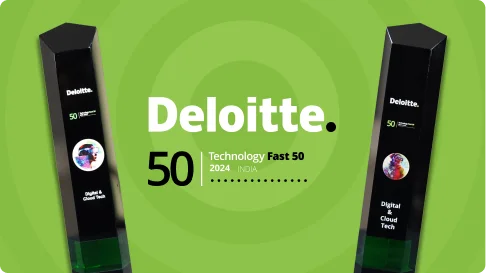
We have received numerous industry awards for our engineering excellence, such as being a Leader in AI-First Engineering and winning two Consecutive Deloitte Tech Fast 50 Awards, both in 2023 and 2024.
From building a retail brokerage platform to a next-generation investment platform to developing a wealth management solution, our custom FinTech app development expertise can help you get your idea off the ground and build a platform for the future of investing, not the past.
FAQs
Q. What is the estimated cost to build a stock trading app in 2026?
A. The cost to develop a stock trading app in 2026 varies from platform complexity to feature set, regulatory requirements, integrations, and scalability requirements, ranging from $50,000 to $1,000,000+, and possibly more. The basic trading app with basic functionality is on the low end of the spectrum, whereas more sophisticated apps that offer AI-backed features, algorithmic trading, and multi-asset capabilities are a much higher investment.
Q. How much does an MVP of a stock trading app cost?
A. A stock trading app MVP generally costs between $50,000 and $150,000. This budget usually covers essential features such as user registration, KYC verification, portfolio tracking, market data integration, watchlists, and basic trade execution. An MVP for a startup can help a company test its ideas, collect feedback from customers and lower the initial cost of building trading features.
Q. What features affect the cost of developing a stock trading app?
A. The following features have the greatest impact on the stock trading app development cost:
- Streaming data feeds from the market
- Engineering and order execution for trading
- In-depth knowledge of charting and technical analysis
- Payment gateway integrations
- Multi-factor authentication and security controls
- Copy trading and social investing are exclusive features
- Robo-advisory and portfolio optimization tools
- AI-powered investment recommendations
- Algorithmic trading capabilities
- Support for trading multiple assets, such as stocks, ETF’s, crypto trading bots)
- Integrated notifications, alerts and reporting dashboards
Q. What are the hidden costs when developing a stock trading app?
A. While businesses often budget for development, several ongoing expenses can significantly affect the overall mobile stock trading app development cost:
- Exchange fees and market data licensing
- Value of the brokerage / clearing partner onboarding costs
- Regulatory audits and regulatory compliance updates
- Scaling costs for cloud infrastructure
- Security monitoring and penetration testing
- Subscription fee for third-party API’s
- Customer support and staffing for operation
- New features and improvements to product
- Legal and financial consulting costs
- Campaigns for user acquisition
Q. How much does it cost to maintain a stock trading app development?
A. The annual maintenance expense is usually from 15% to 25% of the original development budget. A platform might cost $200,000 to develop and cost $30,000 to $50,000 annually to maintain. Typically, these costs include infrastructure management, security updates, bug fixes, compliance modifications, third-party services, performance enhancements, and continuous feature upgrades. These average costs are crucial in the total stock trading app development pricing.
Q. What are some of the top stock trading apps?
A. Here are some of the top stock trading apps that globally made the mark:


Fast 2-minute response, fully NDA-protected.
Cost of Developing a Payment Gateway: A Complete Breakdown
Key takeaways: Custom gateway development requires $50,000 to $500,000 in upfront capital, and enterprise platforms cost more at scale. Core infrastructure, security compliance, and settlement logic consume far more budget than basic checkout screens. High transaction volumes require concurrency controls, failover systems, monitoring tools, and automated reconciliation engines. Platform ownership creates recurring costs for security…

How Much Does RegTech Software Development Cost in the UK in 2026?
Key takeaways: RegTech software development cost in the UK spans £40,000 to £400,000+, with regulatory scope and legacy integration depth driving the cost. High-performance systems deliver a 30% to 50% reduction in manual workloads, protecting enterprises from severe FCA penalties. Advanced AI features generally represent around 25–40% of the total project investment due to the…

Building Next-Generation Digital Payment Systems for Australia's NPP Economy
Key takeaways: Australia's NPP is approaching 1.82 billion real-time transactions annually; BECS decommissioning by 2030 creates a hard migration deadline that cannot be managed through incremental patches. The July 2026 Payday Super mandate makes real-time payment infrastructure a legal compliance requirement. Enterprises without NPP-capable payroll systems are already operating against a regulatory clock. NPP platform…