


























How to Build a Logistics Management System for Enterprise Supply Chains


- Types of Logistics Management Systems
- How to Build a Logistics Management System: Step-by-Step Enterprise Development Framework
- Logistics Management Systems Architecture and Technology Stack
- Core Features Every Enterprise Logistics Management Software Needs
- Enterprise Use Cases of Logistics Management Systems
- Common Challenges & Solutions in Logistics Management System Development
- Benefits of Logistics Management System Software
- How Much Does It Cost to Build Logistics Management Software?
- The Future of Enterprise Logistics Management Systems
- How Appinventiv Helps Enterprises Build Scalable Logistics Management Systems
- Frequently Asked Questions

Key takeaways:
- Logistics problems often start with disconnected systems, not transportation or warehouse operations themselves.
- Long-term success depends on strong architecture, clean integrations, and reliable data across the supply chain.
- Connecting orders, inventory, warehouses, carriers, and shipments creates a clearer view of business performance.
- AI is shifting logistics platforms from reporting tools to systems that support faster operational decisions.
- Integration complexity, data quality, and user adoption often determine project success more than software development.
Enterprise logistics teams do not just move goods. Organizations that build a logistics management system gain control over thousands of decisions between order creation and final delivery, across multiple warehouses, carriers, suppliers, and regional distribution hubs.
Each system generates data, but where does this information go? It remains trapped in separate applications, so operations teams spend hours reconciling inventory records. They track shipments across different carriers, and they respond to unexpected disruptions late.
This complexity pushes logistics management software development higher on the executive agenda. Organizations need real-time visibility into inventory and transportation networks. The urgency is reflected in market spending. The global logistics software market is projected to reach $32 billion by 2034.
They demand a central record for warehouse operations and order fulfillment. They require platforms for AI-driven forecasting and intelligent route planning. These systems automate exception management, and they support data-backed decisions at scale.
Building a logistics management system is not just a technology initiative. It is a business investment. This investment affects costs, service levels, customer satisfaction, and supply chain resilience.
This guide explores how to create a logistics management system built for enterprise operations. It covers core features, technology architecture, and the steps to develop a logistics management system at enterprise scale. We then detail implementation challenges, costs, and business value.
Strong architecture, integrations, and adoption planning separate successful logistics initiatives from expensive failures.

Types of Logistics Management Systems
Most enterprises do not start with a single platform. Understanding the types of logistics management systems available helps teams adopt the right solutions over time to solve specific operational problems.
A warehouse team buys a WMS, and transportation teams deploy a TMS.
Fleet operators invest in separate vehicle tracking tools. What happens years later? Leadership manages fragmented data spread across multiple disconnected systems.
Here are the core logistics systems:
- Transportation Management System (TMS): This handles freight planning, carrier management, route execution, and shipment tracking. It fits distribution-heavy companies.
- Warehouse Management System (WMS): This tracks inventory movement, picking, packing, putaway, and warehouse operations. It serves daily warehousing tasks.
- Fleet Management System: This tracks vehicles, schedules maintenance, monitors drivers, and manages fuel. It works well for fleet-intensive organizations.
- Order Management System (OMS): This captures orders, allocates inventory, coordinates fulfillment, and tracks order visibility. It supports retail and commerce businesses.
- End-to-End Logistics Platform: This unifies transportation, warehousing, inventory, orders, and analytics. It fits large enterprises.
While standalone systems address individual operational issues, large enterprises don’t end there. Shipments increase in volume, and supply chains reach beyond regions. Leaders require an integrated perspective on orders, inventory, transport, and warehouses.
This requirement is the incentive for the transition to integrated logistics platforms. They integrate core operations into a single system.
How to Build a Logistics Management System: Step-by-Step Enterprise Development Framework
A logistics management system is not merely a software project. It’s a process of changing operations. The impact on transportation, warehousing, inventory planning, fulfillment, and customer service. The best platforms begin with the business goals and not the technology.
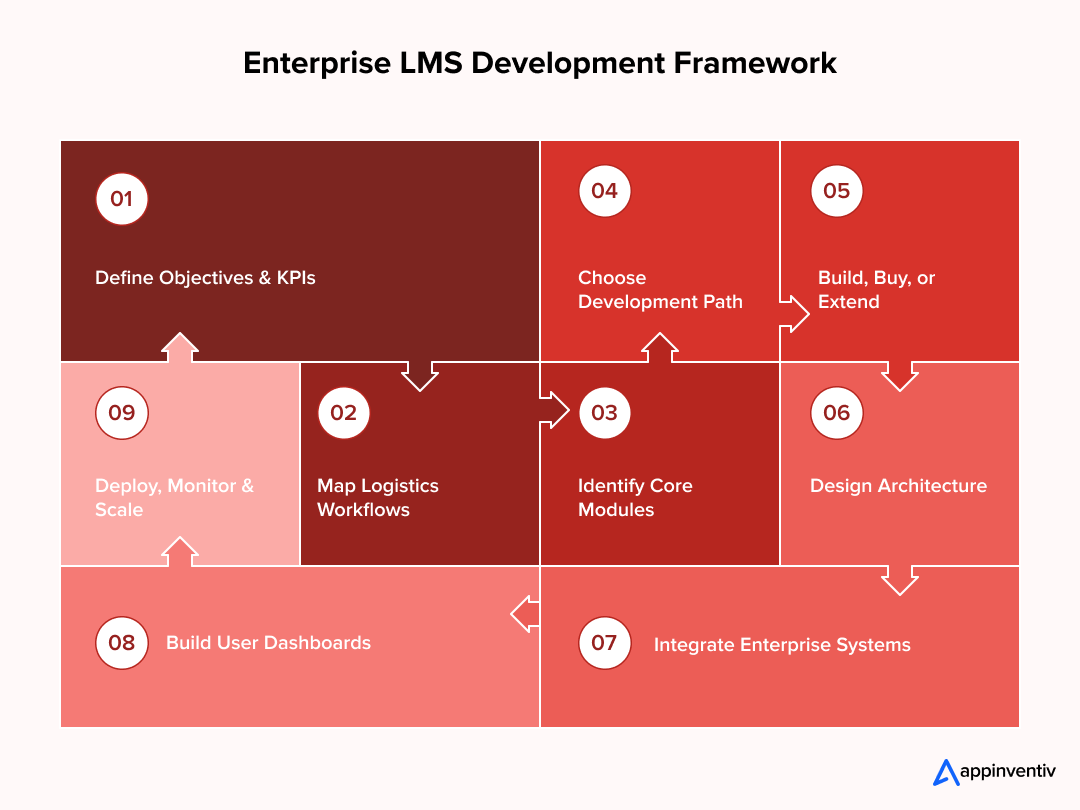
Step 1 – Define Objectives And Metrics
Every successful project begins with a clear business case. Leadership teams must identify desired operational outcomes first. Then they select technologies and define features. Common logistics metrics include:
- On-time delivery rate
- Fleet utilization
- Transportation costs
- Inventory turnover
- Order fulfillment cycle time
- Warehouse productivity
A retailer with frequent stockouts must prioritize inventory tracking and demand planning. A distribution company with large carrier networks will focus on transportation speed and route planning. Teams must design the platform around these exact priorities.
Step 2 – Map Existing Workflows
Technology cannot fix broken processes. Teams must document daily workflows. They track how inventory, orders, transportation requests, warehouse tasks, and supplier interactions move through the organization. Areas for evaluation include:
- Warehouse operations
- Transportation workflows
- Fulfillment processes
- Carrier coordination
- Inventory movement
This review exposes duplicate processes, manual tasks, and data gaps. These issues create delays across the supply chain. The impact extends beyond operations. Studies estimate poor data quality costs organizations an average of $12.9 million each year.
Step 3 – Identify Core Modules
Organizations define operational requirements first. Then they select specific platform modules. Most enterprise logistics systems include:
- Order Management System (OMS)
- Warehouse Management System (WMS)
- Transportation Management System (TMS)
- Inventory Management
- Shipment Tracking
- Supplier and Carrier Management
Many enterprises start small and expand capabilities later. Teams prioritize the modules with the highest business value. This strategy leads to faster adoption and lower implementation risk.
Also Read: Inventory Management Software Development Guide
Step 4 – Choose A Development Path
Organizations approach logistics management software development through two primary paths: custom development or low-code platforms.
| Path | Advantages | Limitations |
|---|---|---|
| Custom Development | Full control over workflows, integrations, data models, and scale | Higher investment and longer development timelines |
| Low-Code Platforms | Faster deployment and lower initial effort | Limited flexibility for complex logistics operations |
Low-code platforms support straightforward logistics workflows for small and mid-sized businesses. Large enterprises demand deep integrations, advanced automation, and specialized operational processes. Custom development provides greater long-term flexibility for these large environments.
Step 5 – Build, Buy Or Extend Platforms
Enterprises face another decision at the start. Do they build a new system, purchase an off-the-shelf product, or extend an existing investment? Established platforms fit organizations with highly standardized processes.
Businesses with unique fulfillment models, proprietary workflows, or complex integrations often choose to create a logistics management system from the ground up. The right choice rests on operational complexity, customization needs, and long-term technology plans.
Step 6 – Design The System Architecture
Architecture decisions affect scale, performance, and future expansion. Most modern logistics systems rely on:
- Microservices architecture
- API-first design
- Event-driven workflows
- Cloud-native infrastructure
This structure allows individual services to operate independently. Inventory management, transportation planning, and shipment tracking function on their own. Transaction volumes increase over time. Teams scale specific services without touching the entire platform.
Step 7 – Integrate Third-Party Systems
Enterprise logistics operations depend on data from external systems. Teams start integration planning early in the project.
| Integration Type | Examples |
|---|---|
| Mapping and Routing APIs | Google Maps, HERE |
| Shipment APIs | FedEx, DHL, UPS |
| Telematics Platforms | Samsara, Geotab |
| Enterprise Systems | SAP, Oracle, Microsoft Dynamics |
ERP integration is a critical requirement. Understanding API development helps teams plan how the logistics platform exchanges data with procurement, inventory, finance, and warehouse systems. Failing to do so creates new operational silos.
Telematics integrations provide data on vehicle location, fuel consumption, driver behavior, and fleet performance. Shipment APIs improve tracking visibility across carrier networks. These connections build a unified operational environment rather than a standalone application.
Step 8 – Build Role-Based Dashboards
Different users interact with logistics systems in different ways. Common user groups include:
- Executives
- Operations teams
- Warehouse managers
- Dispatchers
- Drivers
- Customers
Executives require metric dashboards and performance reports. Warehouse teams need daily visibility into inventory and fulfillment activities. Drivers need route information and delivery updates. Role-specific dashboards improve usability and adoption across the organization.
Step 9 – Deploy, Monitor And Scale
Deployment marks the beginning of the platform lifecycle. Organizations establish strict processes after launch for:
- Performance monitoring
- System observability
- Security management
- Capacity planning
- Continuous updates
Supply chains grow over time. Logistics platforms adapt to new warehouses, carrier networks, regions, and customer requirements. Ongoing monitoring and refinement maintain performance and support future business growth.
Logistics Management Systems Architecture and Technology Stack
The right logistics management systems tech stack affects platform performance not just on launch day, but five years from now. Enterprise platforms must handle high volumes of data, enable real-time decision making, integrate with external systems, and be regionally distributed without impacting daily operations.
A modern logistics management system typically consists of six core layers.
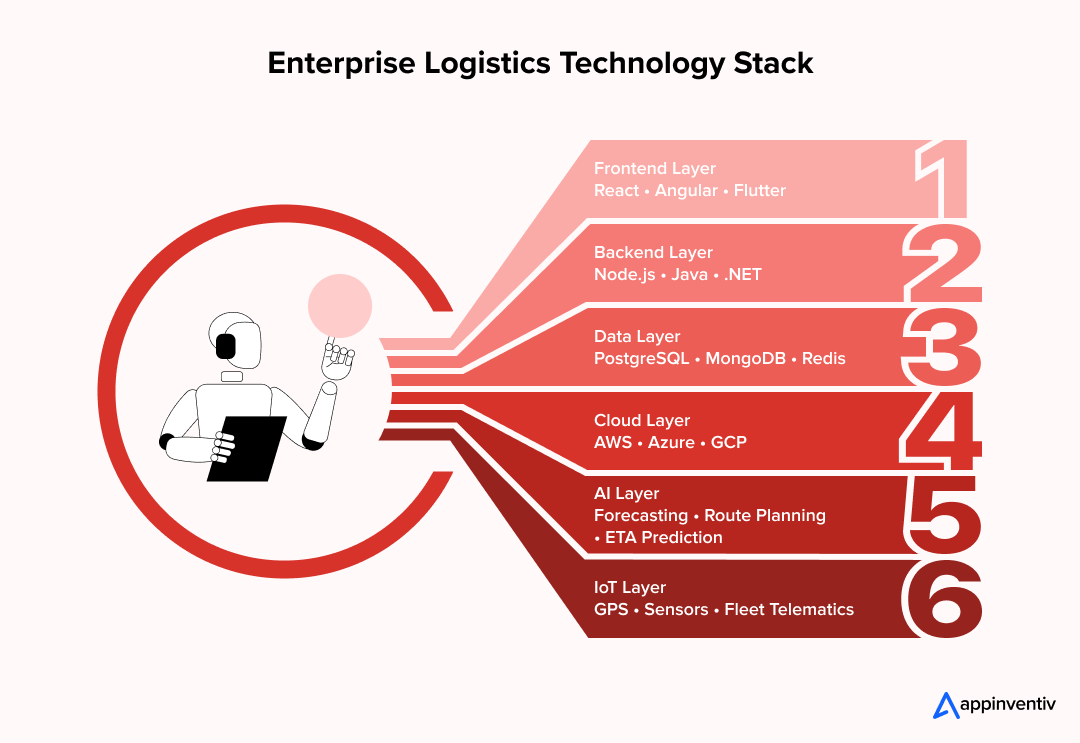
Frontend Layer
The frontend layer provides access to the platform through web and mobile applications. Different interfaces serve logistics leaders, warehouse teams, dispatchers, drivers, and customers.
Common technologies include:
- React
- Angular
- Flutter
Backend Layer
The back end handles business logic, workflows, integrations and transaction processing. API-first architectures and microservices are common on most enterprise platforms to ensure system flexibility and scalability.
Common technologies include:
- Node.js
- Java
- .NET
Data Layer
The data layer stores operational information such as orders, shipments, inventory records, carrier data, and warehouse transactions.
Common technologies include:
- PostgreSQL
- MongoDB
- Redis
Cloud Infrastructure Layer
Cloud in logistics provides the computing power needed to support real-time operations across multiple locations and regions.
Common platforms include:
- AWS
- Microsoft Azure
- Google Cloud Platform (GCP)
Intelligence Layer
Artificial Intelligence and machine learning in logistics are now integrated directly into operations. This layer generates a historical dataset and real-time data to assist in quicker decision-making.
Common use cases include:
- Demand forecasting
- Route planning
- ETA prediction
- Capacity planning
- Exception detection
IoT and Telematics Layer
This layer is the link between physical logistics assets and digital systems. Vehicle, shipment, and equipment data from IoT in supply chain devices provide visibility throughout the supply chain.
Common components include:
- GPS tracking devices
- IoT sensors
- Fleet telematics systems
- Temperature monitoring devices
- RFID scanners
The most successful enterprise logistics platforms are not solely based on a single technology. These layers are combined for their power: to give visibility, automation, and operational control throughout the supply chain.
Core Features Every Enterprise Logistics Management Software Needs
Before development, executives must evaluate the core logistics management software features that define a modern platform. These tools are used to coordinate orders, inventory, transportation, warehouses and carriers. They are responsible for operating data from one system.
Here are the core features:
- Order Management: Tracks orders from creation to fulfillment. It helps teams handle exceptions across multiple sales channels.
- Inventory Management: Maintains accurate stock counts across warehouses, fulfillment centers, and distribution hubs.
- Transportation Management: Covers carrier assignment, route planning, freight execution, and trucking dispatch software for fleet-heavy operations.
- Warehouse Management: Directs picking, packing, putaway, stock movement, and daily workflows.
- Reverse Logistics: Tracks returned items from the consumer back to the warehouse. The module coordinates product inspections, repairs, and restocking tasks. This speed protects profit margins on returned goods.
- Billing Automation: Generates invoices and automatically audits shipping charges. The software matches carrier bills against contract rates to spot overcharges before payment.
- Real-Time Tracking: Uses GPS, telematics, and IoT data to monitor shipments. This improves delivery tracking.
- Supplier and Carrier Management: Measures partner performance through scorecards, SLA tracking, and compliance metrics.
- Analytics and Reporting: Uses business intelligence for the supply chain to calculate metrics like cost per shipment, on-time delivery rates, and fleet use.
- Workflow Automation: Automates dispatching, notifications, approvals, and exception handling.
Role-Based Dashboards
A logistics system serves multiple groups. Each user needs a specific view of the data.
- Executive Dashboard: Serves leadership teams.
- Warehouse Dashboard: Serves warehouse managers.
- Dispatcher Dashboard: Serves transportation teams.
- Driver Dashboard: Serves drivers and fleet operators.
- Customer Portal: Serves buyers and supply chain partners.
The best logistics platforms do not treat these features as separate modules. They connect them through a shared data layer. This structure provides real-time tracking across the entire supply chain.
Disconnected warehouses and carrier systems create friction that modern logistics platforms eliminate.

Enterprise Use Cases of Logistics Management Systems
The value delivered when you build a logistics management system varies from industry to industry, because every operational model brings its own challenges.
This implies that a retailer responsible for same-day deliveries faces a whole host of challenges compared to a Pharmaceutical company handling cold products. The common need is visibility, coordination and control on large logistics networks.
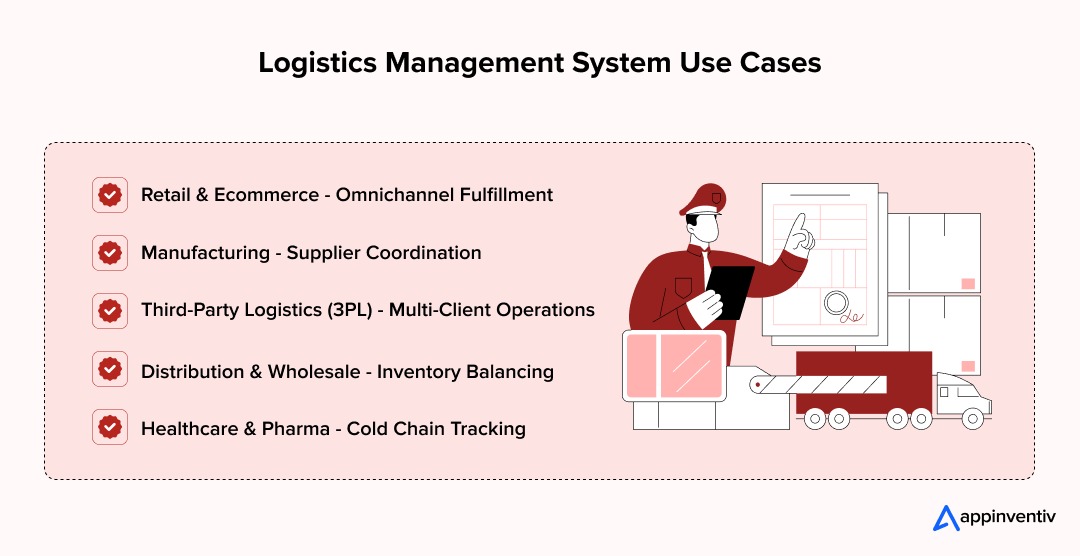
Retail and Ecommerce Logistics
Retail supply chains span retailers, direct and warehouses/marketplaces. This will force businesses to maintain accurate stock levels and meet order deadlines promptly.
Customer expectations are rising at the same time, driven largely by on-demand logistics models. Research shows that 73% of customers expect more personalized experiences, which places greater pressure on inventory availability, delivery accuracy, and fulfillment speed.
A logistics system is a tool that supports the coordination of fulfillment for retailers. They monitor stock availability at locations, and they support the last-mile traceability.
Walmart has years of experience in establishing connected logistics and fulfilment processes. These systems connect inventory, distribution centres, stores and online channels. It is based on an inventory management and a distribution network coordination strategy in its supply chain. This is for in-store and online orders.
Manufacturing and Industrial Supply Chains
Manufacturers have a continuous stream of raw materials, components, finished goods, and shipments from suppliers. Even one of the delays causes production delays at several factories. Logistics systems support manufacturers’ tracking of inbound shipments. They organize suppliers, oversee stock and manage production.
Logistics teams in large manufacturing environments connect transportation, warehouse, procurement, and ERP data. They get a common understanding of how material moves throughout the organization.
Third-Party Logistics (3PL)
3PL providers operate in a complex environment. They manage multiple customers, carrier networks, warehouses, and service agreements at the same time. A logistics system helps 3PL operators:
- Manage multi-client operations
- Allocate carrier capacity
- Track shipments across networks
- Monitor service performance
- Automate customer reporting
Operational complexity grows fast as customer volumes increase without a centralized platform.
Distribution and Wholesale Networks
Distributors manage inventory across regional warehouses and fulfillment centers. Their challenge is placing inventory in the right location ahead of demand. Logistics systems help balance inventory across facilities. They reduce stock imbalances, and they support route planning decisions.
The regional distribution centers at Walmart offer a useful example. They move and restock inventory across thousands of retail locations. This maintains product availability and controls transportation costs.
Healthcare and Pharmaceutical Logistics
Healthcare logistics demands strict shipment monitoring, regulatory compliance, and temperature control, areas where computer vision in logistics is increasingly applied for real-time product inspection and audit trail accuracy.
A logistics system helps organizations:
- Monitor cold-chain shipments
- Track temperature-sensitive products
- Maintain audit trails
- Improve delivery tracking
- Support regulatory reporting
This matters for specialty pharmaceuticals and advanced therapies. DHL tracks pharmaceutical products at all times during transit to maintain product integrity. Some advanced therapies require transportation at temperatures as low as -196°C throughout the supply chain.
The underlying objective remains the same across these industries. Companies create a single operational view of orders, inventory, transportation, and fulfillment. Teams make faster decisions, and they respond to disruptions early.
Common Challenges & Solutions in Logistics Management System Development
Building an enterprise logistics platform requires far more than software engineering. Projects fail when teams ignore integration details, dirty data, or user friction.
The table below details common challenges and practical fixes.
| Challenge | Impact | Fix |
|---|---|---|
| Legacy System Integration | Critical data stays trapped across ERP, warehouse, and finance systems. | Plan your API architecture first. Start integration mapping during early project phases. |
| Data Quality Gaps | Bad inventory and shipment records cause false reporting and late choices. | Set strict data standards. Build a central data repository. |
| Multi-Carrier Complexity | Handling multiple carrier systems and pricing models creates heavy operational burdens. | Deploy carrier management modules. Connect via standard API integrations. |
| Data Synchronization | Late updates create inventory errors and block active shipment tracking. | Build event-driven systems and real-time data pipelines. |
| Scale Constraints | Platforms crash during seasonal demand spikes or business growth. | Use cloud-native infrastructure built for high transaction volumes. |
| Security and Compliance | Platforms handle sensitive customer data, shipment logs, and private company records. | Deploy role-based access, data encryption, audit logs, and compliance tracking. |
| User Adoption | Employees reject the new platform and keep using manual spreadsheets. | Bring end users into the design phase. Run targeted training sessions. |
Software solves only part of the problem. Addressing the challenges of a logistics management system early — especially around data cleanliness and team adoption — is what separates successful deployments from failed ones.
This challenge is not unique to logistics. Research shows roughly 70% of digital transformation in logistics initiatives fail, often because of integration, data, and adoption issues.
Benefits of Logistics Management System Software
Business decisions on logistics investments happen in the boardroom, not the warehouse. Rarely do executives ask simply if there’s a platform that can track shipments; they want to understand the full benefits of logistics management system software on business risk, growth, and costs.
They seek to understand what impact the investment will have on business risk, business growth, operating costs and customer commitments.
| Executive Priority | Business Impact |
|---|---|
| Cost Control | Fewer manual processes, lower transportation spend, and better asset usage. |
| Revenue Protection | Faster order fulfillment and fewer disruptions that affect customer commitments. |
| Expansion Readiness | Support for new warehouses, carriers, markets, and fulfillment channels without rebuilding core operations. |
| Decision Making | Access to current operational data instead of waiting for reports from multiple teams. |
| Customer Retention | More reliable delivery performance and fewer service failures. |
| Risk Reduction | Earlier detection of delays, inventory shortages, and carrier issues. |
| Compliance | Stronger audit records and better control over logistics data and processes. |
The true benefit is being able to link logistics information throughout the company. One screen for orders, stock, shipments and carrier performance allows decision makers to make quick and informed decisions.
How Much Does It Cost to Build Logistics Management Software?
The cost to build logistics management software depends on operational complexity, the number of system integrations required, and the degree of automation desired.
The cost for a platform to support a regional logistics operation is significantly lower than that required to support multi-warehouse, multi-carrier, and global supply chain operations.
Key Cost Drivers
- Number of modules
- ERP and third-party integrations
- AI and analytics capabilities
- IoT and telematics requirements
- Number of user roles and access levels
The following estimates provide a general benchmark for logistics management software development.
| Complexity | Estimated Cost Range |
|---|---|
| Basic LMS | $50,000–$120,000 |
| Mid-Market LMS | $120,000–$300,000 |
| Enterprise LMS | $300,000–$800,000+ |
Development timelines typically increase as integrations, workflows, and operational requirements become more complex.
| Scope | Timeline |
|---|---|
| Basic LMS | 3–6 Months |
| Mid-Market LMS | 6–10 Months |
| Enterprise LMS | 10–18+ Months |
Development costs are only part of the total investment. Enterprises should account for several ongoing expenses during planning.
Hidden Costs to Consider
- Cloud infrastructure
- Data migration
- Third-party API usage
- System maintenance and upgrades
For enterprise organizations, integration complexity often has a greater impact on project cost than software development itself. Connecting warehouses, carriers, ERP platforms, and operational data sources can account for a substantial share of the overall investment.
Also Read: On-Demand Logistics App Development Cost Breakdown
Legacy systems become harder and more expensive to replace as operations continue expanding.

The Future of Enterprise Logistics Management Systems
When enterprises build a logistics management system today, it does much more than store historical data; it acts as an active decision engine for the business.
New software helps organizations predict disruptions early. Explore how AI in logistics is driving this shift, automating routine actions so teams can respond faster to unexpected supply chain changes. Specific technologies drive this shift.
| Technology | Operational Value |
|---|---|
| AI Logistics Planning | Forecasts demand, plans capacity, and allocates inventory. |
| Predictive ETAs | Calculates exact delivery times using live traffic and weather data. |
| Autonomous Dispatching | Assigns loads, routes, and carriers based on live conditions. |
| Digital Twins | Builds virtual network models to test risks and plan scenarios. |
| Control Towers | Consolidates orders, inventory, and transportation data into one view. |
| AI Agents | Monitors active shipments, fixes exceptions, and coordinates daily workflows. |
Enterprise leaders expect much more than simple tracking tools. They demand supply chains that anticipate problems early. These new systems recommend exact actions, and they support fast decisions at scale.
How Appinventiv Helps Enterprises Build Scalable Logistics Management Systems
A logistics platform rarely exists on its own. It needs data from ERP systems. It exchanges information with carriers. It pulls updates from warehouses, fleet systems, customer portals, and finance platforms.
Many organizations already have these systems in place. The challenge is getting them to work together without disrupting daily operations.
As a specialist logistics software development company, Appinventiv is built to support exactly that kind of transformation.
| Our Track Record | Results |
|---|---|
| Software Products Delivered | 2000+ |
| Legacy Processes Modernized | 500+ |
| Years of Industry Experience | 10+ |
| On-Time Delivery Record | 95% |
| Client Satisfaction Rate | 95% |
| Repeat Clientele | 90% |
| Productivity Improvement Through Agile Delivery | 2x |
| Security Compliance Rate | 99.50% |
| Post-Launch Support | 24/7 |
Over the years, we have helped enterprises replace manual workflows, connect fragmented systems, and build platforms that support business growth. Our teams work across cloud engineering, AI implementation, enterprise integration, and logistics management software development.
For organizations planning a logistics management system, the goal is rarely just shipment tracking. The broader objective when you build a logistics management system is to create a connected operation in which inventory, transportation, warehouses, carriers, and business data all work from a single source of truth.
Let’s connect and build the logistics infrastructure your business will need five years from now.
Frequently Asked Questions
Q. What is logistics software, and why do you need it?
A. When enterprises build a logistics management system, it connects orders, warehouse shelves, and delivery trucks on one screen. Disconnected systems hide important details, so workers waste hours looking for lost pallets. They react late to delayed trucks. A unified platform shows exactly where your products sit. You stop guessing and start tracking facts.
Q. How long does it take to build a logistics management system?
A. A custom enterprise platform takes 10 to 18+ months to build. The schedule matches your exact technical needs. A basic system takes less time, but you add months to connect older ERP systems. Live GPS data feeds require extra weeks of work. Custom data dashboards also add time to the project.
Q. How much does it cost to develop logistics management software?
A. Development costs match your specific project requirements. A single software module requires a smaller budget, but a complete network platform requires a large investment. Your final price changes based on team size and project length. Complex data connections increase the total cost.
Q. What AI features can be added to a logistics management system?
A. New platforms use machine learning to make decisions fast. AI tools predict future product demand, and they plan exact delivery routes. They calculate precise arrival times using live weather and traffic data. Advanced setups include auto-dispatch tools that assign freight to trucks immediately. Smart bots flag shipping problems and fix supply chain errors without human help.
Q. What is the ROI of building a custom logistics management system?
A. Custom systems cut waste and protect revenue. Companies spend less money on freight, and the software picks the cheapest carrier routes. Automated steps cut down on manual data entry. Live inventory numbers prevent empty shelves. You stop paying penalties for late shipments. Fast deliveries keep your buyers happy, and these daily savings pay for the software investment.

- In just 2 mins you will get a response
- Your idea is 100% protected by our Non Disclosure Agreement.

How AI Is Transforming the Logistics Industry: Use Cases & AI Adoption Challenges in 2026
Key takeaways: Use Cases: High-impact use cases of AI in logistics in Australia are concentrated in routing, warehousing, and demand forecasting, where decisions are frequent and cost-sensitive. Implementation: Successful adoption depends on sequencing—data readiness, integration with legacy systems, and embedding AI into real workflows. Cost: The cost to implement AI in logistics in Australia typically…

How to Build a Warehouse Management System in Australia: Cost, Architecture & Implementation
Key takeaways: Before you build a Warehouse Management System (WMS) in Australia, check how things work in your warehouse right now. Find the problems that slow you down. You'll need to create the system design. Then choose what technology to use. Connect it to the tools you already have. Train your team so they know…

Computer vision is no longer a futuristic concept confined to sci-fi books and movies. The technology is everywhere, subtly reshaping the way users interact with technology. From facial recognition on smartphones to quality inspections on factory floors, computer vision helps machines interpret and understand images, videos, and other visual inputs. This powerful technology has proven…