




























6G Technology: How It Could Reshape Digital Transformation

 Share -


- 01What Is 6G Technology and How Is It Shaping Digital Evolution?
- 026G vs 5G: What Changes for Enterprises?
- 03What Does 6G Mean for Businesses?
- 04Industry 4.0 Development and 6G: Navigating the Future
- 05Exploring the Advantages of 6G Technology for Enterprises
- 06Key Features of 6G Technology
- 076G Use Cases: Where Enterprises Could Create Business Value
- 08What Challenges Should Enterprises Consider Before 6G Adoption?
- 09Strategies for Businesses to Leverage 6G for Digital Transformation
- 10How Appinventiv Helps Enterprises Prepare for 6G?
- 11FAQs

Key takeaways:
- 6G combines connectivity with AI, sensing, precise positioning, and ubiquitous coverage, enabling networks to participate in operational intelligence
- Current ITU targets include 50–200 Gbps peak rates, 0.1–1 ms radio latency, and up to 100 million devices/km².
- Enterprise value centers on industrial automation, autonomous mobility, digital twins, immersive experiences, and massive IoT workloads requiring real-time coordination.
- A 6G enterprise stack will span RAN, transport, core, edge, cloud, and applications, with interoperability across existing networks.
- With standardization still underway, enterprises should prioritize targeted pilots and flexible software, data, cloud, and edge foundations.
6G technology is being designed to do more than increase wireless speeds. As **IMT-2030**, it combines advanced connectivity with AI, integrated sensing, precise positioning, and ubiquitous connectivity to support real-time interaction between people, machines, infrastructure, and digital systems.
For enterprises, this could enable industrial systems that respond in real time, autonomous assets that coordinate continuously, and connected environments that generate and act on data closer to where it is produced. The impact will depend on whether these capabilities solve operational or commercial constraints that existing networks cannot address efficiently.
The technology is also being designed to use network resources more efficiently. The ITU’s current IMT-2030 requirements target 1.5–3× higher spectrum efficiency than 5G, helping increase usable network capacity without relying solely on additional spectrum.
However, 6G is still progressing through international standardization and evaluation. For business leaders, the immediate priority is not wholesale network replacement but understanding where 6G could create measurable value and preparing the software, data, cloud, edge, and infrastructure capabilities required to capture that value.
Appinventiv can modernize telecom software, build AI-ready data platforms, and integrate cloud and edge systems for evolving 6G workloads.

What Is 6G Technology and How Is It Shaping Digital Evolution?
6G, also known as IMT-2030, is the next generation of 6G communication technology being developed beyond 5G impact. This 6G network technology is designed to combine advanced connectivity with AI and IoT transformation, integrated sensing, high-precision positioning, and broader coverage across terrestrial and non-terrestrial networks.
The ITU’s IMT-2030 framework defines six usage scenarios: immersive communication, hyper-reliable low-latency communication, massive communication, ubiquitous connectivity, AI and communication, and integrated sensing and communication.
In February 2026, the ITU completed the draft technical performance requirements for IMT-2030, covering targets such as 50–200 Gbps peak data rates, 0.1–1 ms radio-network latency, 10⁶–10⁸ devices per km², and 1–10 cm positioning accuracy. These are technical requirements for evaluation, not guaranteed real-world performance.
For enterprises, these capabilities could support real-time industrial automation, digital twins, autonomous systems, immersive AR/VR, and large-scale connected environments. AI manufacturing could also benefit from tighter integration between machines, edge systems, and intelligent network operations.
6G remains under development and standardization, with ITU evaluation work progressing through 2026.
6G vs 5G: What Changes for Enterprises?
6G is being designed as more than a higher-speed successor to 5G. While 5G introduced enhanced mobile broadband, massive machine communication, and ultra-reliable low-latency communication, the emerging IMT-2030 framework adds capabilities such as AI integration, integrated sensing, high-precision positioning, ubiquitous connectivity, and stronger interoperability.
| Capability | 5G (IMT-2020) | 6G (IMT-2030 direction) |
|---|---|---|
| Peak data rate | Up to 20 Gbps under defined peak conditions | 50–200 Gbps target range, depending on scenario |
| Radio-network latency | Up to 1 ms for specified ultra-reliable low-latency scenarios | 0.1–1 ms target range |
| Connection density | Up to 1 million devices/km² | 1 million–100 million devices/km² |
| AI integration | Supports AI-enabled applications and network optimization | AI and communication become an explicit usage scenario, including distributed learning, processing, and inference |
| Sensing | Primarily handled through dedicated sensing systems | Integrated sensing and communication becomes a native capability |
| Positioning | Existing positioning capabilities | High-precision positioning targeting 1–10 cm accuracy |
| Coverage | Primarily terrestrial cellular connectivity | Expanded focus on ubiquitous connectivity, including broader coverage scenarios |
| Enterprise role | Enables connected operations, IoT, mobile broadband, and low-latency services | Extends connectivity toward intelligent, sensed, highly distributed and increasingly autonomous enterprise environments |
Note: 5G and 6G figures above represent ITU technical targets or requirements under defined conditions, not guaranteed real-world network performance. The 6G figures reflect the current IMT-2030 technical performance framework and remain part of an ongoing standardization process.
What Does 6G Mean for Businesses?
For enterprises, 6G will be more than a faster connectivity layer. It could reshape how infrastructure, software, AI, and data work together, creating new possibilities for real-time and autonomous operations.
- Infrastructure: Businesses will need architectures that connect 6G networks with edge computing, cloud platforms, connected devices, and existing 4G/5G environments.
- Software: Real-time applications will increasingly depend on programmable, low-latency networks, creating demand for software that can integrate with distributed network and edge environments.
- AI: AI is expected to become an integral part of network operations, supporting real-time optimization, predictive maintenance, automated resource allocation, and self-healing.
- Data: Higher device density and real-time workloads will increase the need for edge-to-cloud data pipelines and real-time data analytics in the telecom industry
- Business models: These capabilities could support new connected services, intelligent infrastructure, and autonomous operations where today’s networks may be limiting.
For business leaders, the priority is not to replace existing infrastructure prematurely, but to identify where 6G could create measurable operational or commercial value. This means digital transformation strategies will increasingly need to account for network-aware software, edge intelligence, real-time data flows, AI-driven operations, and infrastructure that can evolve alongside emerging 6G capabilities.
Industry 4.0 Development and 6G: Navigating the Future
Industry 4.0, also known as the Fourth Industrial Revolution, is characterized by the increasing automation and digitalization of manufacturing processes. This transformation relies heavily on a robust and advanced communication infrastructure to facilitate real-time data exchange, machine-to-machine communication, and remote monitoring. Here’s where 6G technology emerges as a game-changer.
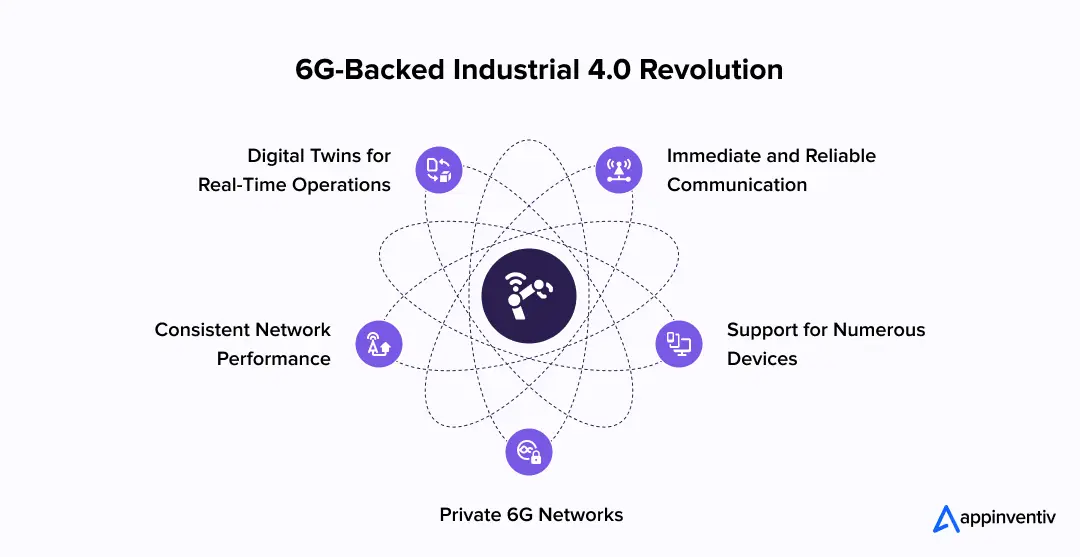
Immediate and Reliable Communication
For Industry 4.0, it’s essential that devices communicate in real time with minimal delays. 6G technology promises to deliver this, enabling efficient coordination between machines and sensors. This is crucial for automating and optimizing manufacturing processes.
[Also Read: IoT in Manufacturing: Applications and Benefits Explained]
Support for Numerous Devices
As factories become smarter, the number of devices, from sensors to robots, increases significantly. 6G is designed to support this increasing number of connections, ensuring that networks can handle many devices at once. This capability is key to enabling a fully integrated smart factory environment.
Private 6G Networks
Enterprises could deploy private 6G networks across factories or industrial campuses to gain tighter control over connectivity, latency, security, and integration with edge infrastructure. This can be particularly relevant for operations that depend on connected robots, autonomous systems, and machine-to-machine communication.
Consistent Network Performance
Beyond just connecting devices, 6G ensures that data transmission is reliable and timely. This consistency is important for the smooth operation of automated systems, ensuring they work together seamlessly and efficiently.
Digital Twins for Real-Time Operations
6G could strengthen industrial digital twins by enabling continuous data exchange between physical assets and their digital counterparts. Businesses could use these synchronized models for equipment monitoring, predictive maintenance, simulation, and process optimization. ITU research specifically identifies digital twins as an emerging area across 6G, IIoT, and edge-cloud environments.
The convergence of Industry 4.0 development and 6G is bound to unlock a new industrial revolution, backed by improved operational efficiency, enhanced product quality, predictive maintenance, and agile manufacturing.
Exploring the Advantages of 6G Technology for Enterprises
As we approach a new era in technology, 6G technology is set to significantly enhance digital communication and connectivity. Here are the key benefits 6G technology offers, paving the way for innovation and efficiency.
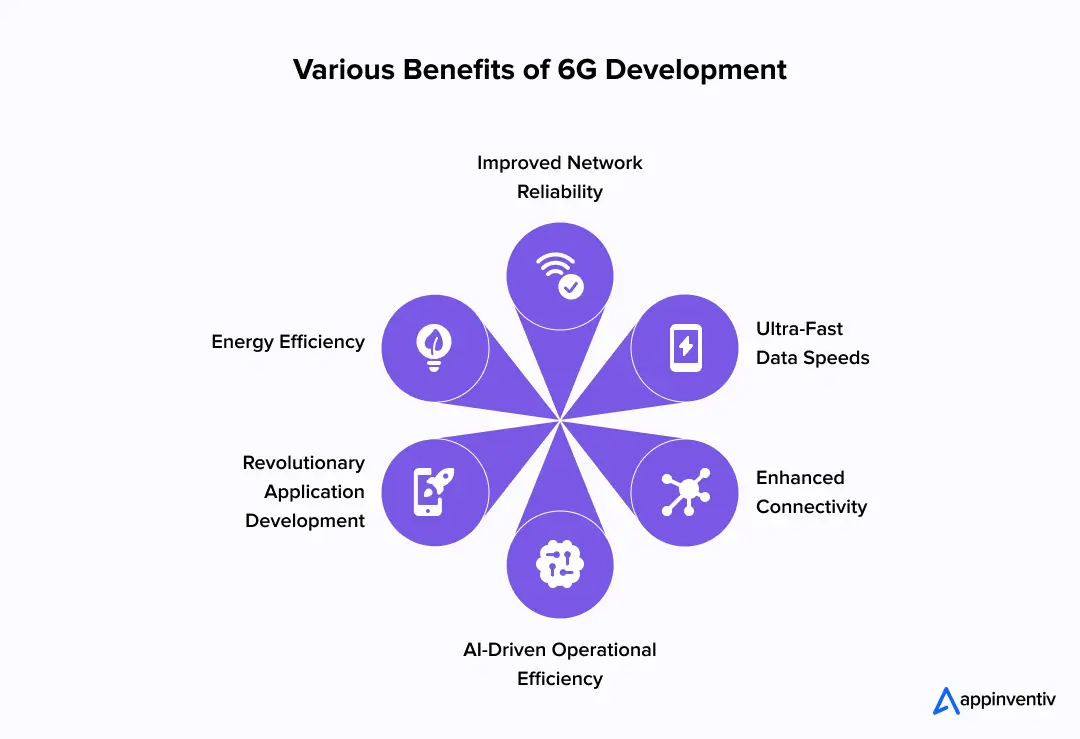
Improved Network Reliability
6G plans to virtually eliminate delays in data transmission, making it extremely reliable. This is especially important for critical uses like self-driving cars and for performing surgeries remotely, where every second is important for professionals.
Ultra-Fast Data Speeds
6G promises to dramatically increase data speeds, making downloads instant and improving the quality of streaming services. This improvement will lead to a smoother and more enjoyable online experience across all types of digital platforms, enabling businesses to offer superior services and engage with their customers in real time.
Enhanced Connectivity
One of the most sought-after advantages of 6G technology is enhanced connectivity. This will allow businesses to streamline their operations and introduce innovative smart technology solutions, leading to smarter, more efficient services and improved customer experiences.
AI-Driven Operational Efficiency
By combining AI-native network management with real-time connectivity, 6G could help enterprises dynamically allocate network resources, identify performance issues, and optimize connected operations as demand changes.
Revolutionary Application Development
Revolutionary application development facilitated by 6G will open new avenues for businesses to innovate in delivering services, enhancing learning, healthcare, and entertainment experiences with unprecedented clarity and responsiveness.
Energy Efficiency
Beyond improving speed and connectivity, 6G also focuses on being more environmentally friendly. By optimizing how data is sent and embracing green energy, 6G networks will help reduce the environmental impact of our growing digital world, offering businesses a sustainable edge.
[Also Read: How AI, IoT, and AR/VR Technologies are Helping Companies Achieve their Sustainability Goals]
After analyzing the various advantages of 6G technology, let’s move ahead to understand the various features of the technology that makes it redefine the “hyper connected” future.
Key Features of 6G Technology
A suite of unique features offered by 6G wireless technology is expected to redefine connectivity expectations of businesses across different industries. Let us look at some of the major features of 6G in detail below:
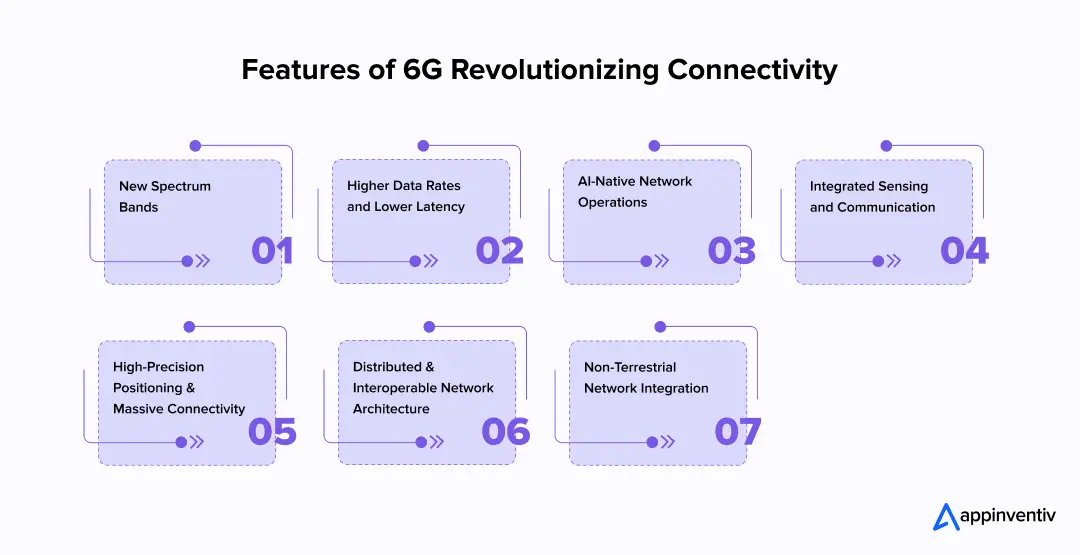
New Spectrum Bands
6G research is exploring additional spectrum, including sub-THz bands, to increase capacity and support demanding data-intensive workloads. Higher-frequency spectrum can provide greater bandwidth, but enterprises will also need to account for propagation limits and the infrastructure required for practical deployment.
Higher Data Rates and Lower Latency
ITU’s current IMT-2030 requirements target peak data rates of 50–200 Gbps and radio-network latency of 0.1–1 ms, depending on the scenario. These targets could support applications that require rapid movement of large volumes of data between devices, edge systems, and cloud platforms. They should be treated as technical targets rather than guaranteed production performance.
AI-Native Network Operations
AI is expected to move beyond applications running on the network and become part of network management itself. AI-driven systems could dynamically allocate resources, detect anomalies, predict network failures, optimize energy consumption, and support self-healing operations. This can make network behavior more adaptive as traffic, workloads, and connected devices change in real time.
Integrated Sensing and Communication
6G is expected to combine communication and sensing capabilities within the network. This could allow connected environments to detect, localize, track, map, and interpret physical objects while simultaneously transmitting data. For enterprises, this creates possibilities across autonomous mobility, industrial monitoring, asset tracking, and smart infrastructure.
High-Precision Positioning and Massive Connectivity
IMT-2030 targets positioning accuracy of 1–10 cm and connection density of up to 10⁸ devices/km². These capabilities could support tightly coordinated industrial systems, autonomous assets, and large-scale sensor networks where location and device density directly affect operations.
Distributed and Interoperable Network Architecture
A practical enterprise view of the 6G technology architecture is a connected stack spanning the radio access network (RAN), transport network, 6G core, edge and cloud infrastructure, and enterprise applications. AI-driven orchestration can coordinate resources across these layers, while security and policy controls need to operate across the entire stack.
So, how does 6G technology work? Data moves across these interconnected network, computing, and application layers, while AI-driven orchestration dynamically manages resources based on workload and network conditions.
This distributed architecture is important because 6G is being designed to converge communication, computing, AI, and heterogeneous network environments rather than function as an isolated connectivity layer. Enterprises can strengthen this software layer through telecom software development that connects network infrastructure with cloud, edge, analytics, and enterprise applications.
Non-Terrestrial Network Integration
6G is being designed to integrate terrestrial networks with non-terrestrial networks (NTNs), including satellites and other high-altitude platforms. This can extend reliable connectivity across rural regions, oceans, remote industrial sites, and other areas where terrestrial infrastructure is difficult or uneconomical to deploy. For enterprises, this could support connected logistics, energy infrastructure, remote asset monitoring, and uninterrupted services across geographically distributed operations.
Also Read: Cloud-based app development: Benefits, development process and costs explained
Modernize legacy systems, integrate cloud and edge infrastructure, develop AI-powered applications, and connect enterprise platforms into scalable digital ecosystems.

6G Use Cases: Where Enterprises Could Create Business Value
6G use cases will matter where current networks struggle with extreme device density, real-time decision-making, precise positioning, sensing, or continuous connectivity. For enterprises, the value lies less in faster downloads and more in enabling operations that depend on tightly connected physical and digital systems.
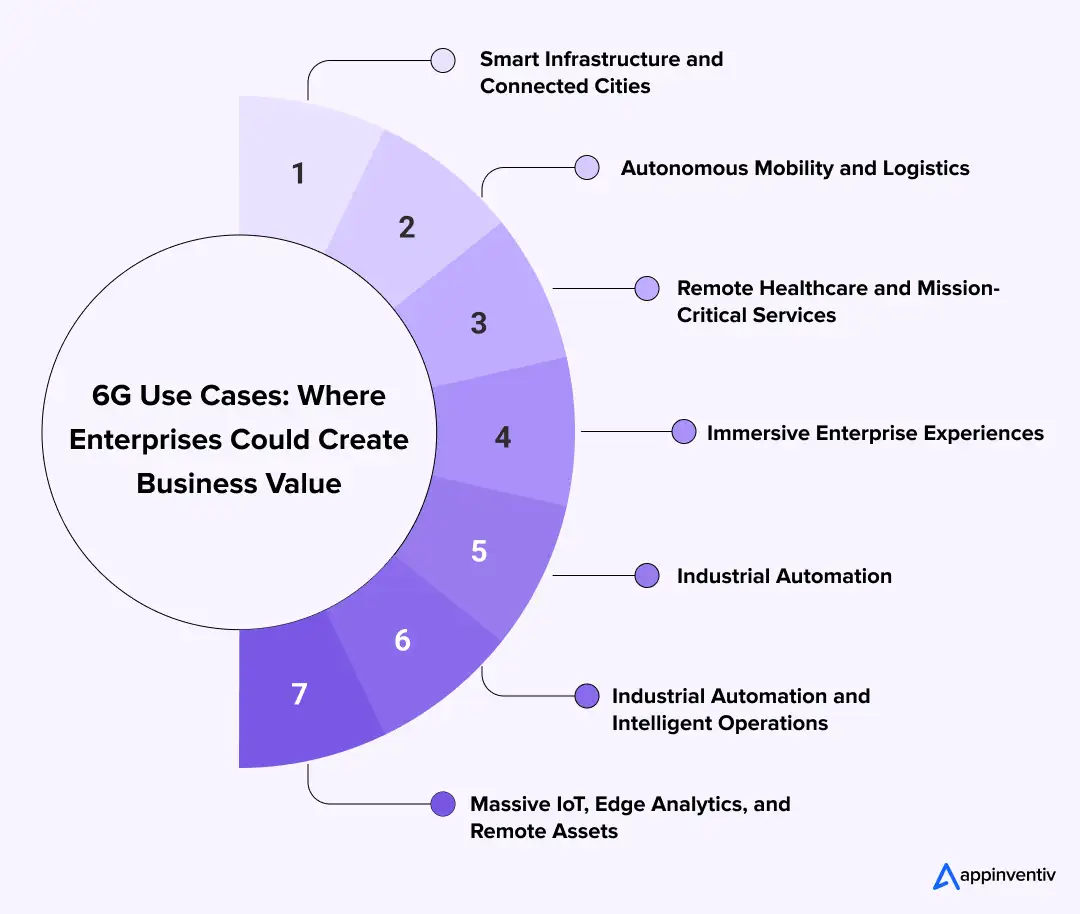
Smart Infrastructure and Connected Cities
6G could connect transportation, utilities, public infrastructure, and distributed sensors through a common, highly responsive network. Enterprises operating mobility, energy, logistics, or infrastructure services could use this connectivity to coordinate assets in real time, optimize resource consumption, respond to disruptions faster, and build more responsive urban services.
Autonomous Mobility and Logistics
Vehicles, drones, robots, and roadside infrastructure need continuous communication to coordinate movement and respond to changing conditions. 6G could support these workloads by combining low-latency connectivity, high device density, and more precise positioning. For logistics and transportation businesses, this could improve fleet coordination, route optimization, asset visibility, and automated operations.
Remote Healthcare and Mission-Critical Services
Healthcare organizations could use highly reliable, low-latency connectivity for continuous patient monitoring, remote diagnostics, immersive clinical collaboration, and other data-intensive workflows. More advanced remote procedures may also become possible as network reliability, sensing, and robotics capabilities mature. These applications remain dependent on clinical validation, regulatory requirements, and appropriate infrastructure.
Also Read: Telemedicine App Development Cost: Features, Factors, and Pricing Guide
Immersive Enterprise Experiences
6G could make real-time AR, VR, and other immersive applications more practical across industrial training, remote assistance, product design, field service, and customer experiences. Employees could interact with digital information over physical environments without relying as heavily on locally installed processing infrastructure.
Industrial Automation and Intelligent Operations
Factories and other asset-intensive enterprises could connect machines, robots, sensors, and edge systems with tighter timing and coordination. This could support automated workflows, faster anomaly detection, predictive maintenance, and more adaptive production. Combined with AI and digital twins, the network could become part of the operational control loop rather than simply carrying data.
Also Read: Intelligent Automation: How should Enterprises get Started?
Massive IoT, Edge Analytics, and Remote Assets
6G is designed to support far greater connection density and broader Internet of Things connectivity scenarios, making it relevant to large-scale sensor deployments across agriculture, energy, environmental monitoring, and industrial assets. Moving more processing toward edge computing could also reduce the time and bandwidth required to send every data point to centralized cloud systems.
For enterprise leaders, the adoption question is therefore not which 6G use case looks most futuristic. It is which business processes would gain measurable value from capabilities that existing networks cannot provide efficiently.
Also Read: 10 use cases on how 5G and AI are propelling innovation for businesses
What Challenges Should Enterprises Consider Before 6G Adoption?
6G’s potential is significant, but enterprises should not treat it as a simple network upgrade. The technology is still moving through research, evaluation, and standardization, and its real-world deployment will depend on infrastructure, spectrum, interoperability, security, and economics.
Infrastructure Complexity
Higher-capacity networks will require upgrades across radio access, transport, edge computing, cloud infrastructure, and connected devices. Enterprises will also need to coexist with 4G, 5G, Wi-Fi, private networks, and other connectivity layers rather than replace them overnight.
Spectrum and Propagation
Higher-frequency bands can support greater capacity, but their propagation characteristics can make coverage and deployment more demanding. This means enterprises may need a mix of spectrum, network architectures, and edge infrastructure depending on the environment.
Interoperability
6G will operate across increasingly heterogeneous ecosystems. ITU’s IMT-2030 framework explicitly identifies interoperability as a capability, reinforcing the need for enterprises to avoid technology strategies that lock critical workloads into a single connectivity layer.
Security, Resilience, and Business Value
More intelligent, distributed, and connected networks can introduce new trust boundaries and operational risks. At the same time, not every enterprise workload will require 6G. The business case will depend on whether capabilities such as extreme device density, ultra-low latency, integrated sensing, or ubiquitous connectivity solve a meaningful operational problem. ITU’s current framework treats security and resilience as core design principles for IMT-2030.
For enterprises, the practical approach is therefore to evaluate 6G based on business requirements rather than on headline performance targets alone.
Get the architecture, software, AI, cloud, and data capabilities in place before evolving connectivity requirements create costly modernization pressure.

Strategies for Businesses to Leverage 6G for Digital Transformation
Considering the reports, the 6G wireless technology is expected to set foot into the global scenario around 2030. Thus, now is the right time for businesses looking for digital transformation to adopt certain strategies that can ensure they are 6-G ready. Let us look at them in detail below:
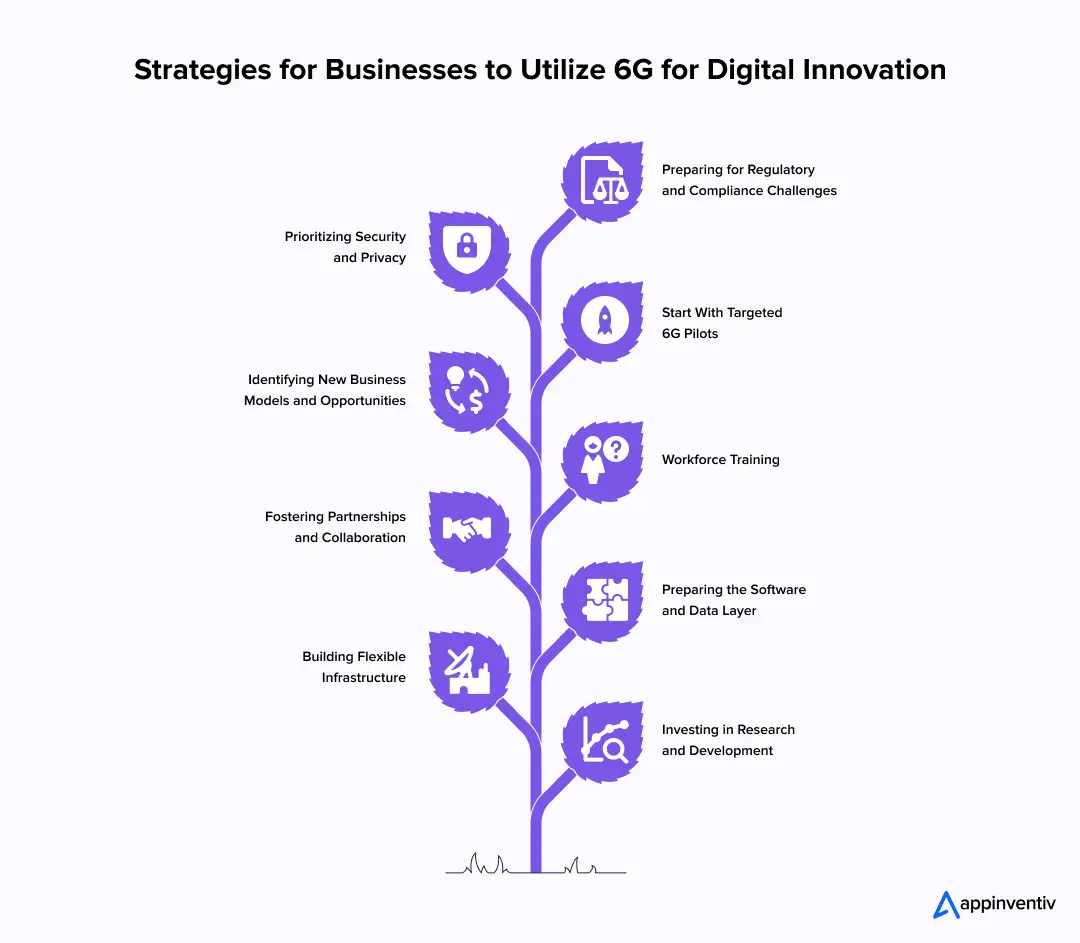
Investing in Research and Development
Businesses and telecom operators should allocate resources towards R&D in 6G technologies. This involves exploring 6G’s capabilities, such as terahertz frequency bands and advanced networking solutions, to understand how they can be integrated into existing services and infrastructure. Collaborating with technology providers and digital transformation specialists can offer a competitive edge.
Building Flexible Infrastructure
To effectively meet the demands of 6G technology, telecom operators must enhance their network infrastructure to accommodate high speeds and low latency. This necessitates upgrading existing systems to integrate 6G’s advanced capabilities seamlessly, all while maintaining compatibility with 5G and 4G networks. Key investments in cloud technologies, edge computing, and software-defined networking (SDN) are imperative to facilitate this smooth transition.
Preparing the Software and Data Layer
6G readiness will also depend on software that can operate across distributed networks, edge environments, and cloud platforms. Businesses should assess whether their APIs, applications, data pipelines, and analytics systems can support real-time workloads and integrate with evolving network capabilities.
Fostering Partnerships and Collaboration
Forming strategic partnerships with technology developers like Appinventiv can accelerate 6G readiness. By offering technical expertise and innovative solutions, they can play a critical role in collaborative projects focused on 6G development and standardization efforts.
Workforce Training
The intricate nature and innovation of 6G technology necessitate a workforce equipped with specialized skills in key areas such as artificial intelligence, machine learning, cybersecurity, and network engineering. It is advisable for businesses and operators to prioritize the training of their current employees to meet these demands, while also actively seeking out new talent possessing the requisite expertise in these critical fields.
Identifying New Business Models and Opportunities
The upcoming launch of 6G wireless communications is expected to introduce innovative business models and revenue opportunities, with a focus on sectors such as IoT, AR/VR, autonomous vehicles, and smart cities. Businesses can monetize 6G technology through specialized connectivity services, private networks, intelligent infrastructure, real-time data platforms, and industry-specific applications built around advanced sensing, positioning, and edge capabilities. Businesses should proactively identify and explore these potential avenues to strategically utilize the advanced capabilities of 6G wireless technology in catering to evolving customer demands.
Start With Targeted 6G Pilots
Rather than waiting for full-scale 6G deployment, enterprises can begin preparing for future 6G communication systems by identifying a small number of workloads where ultra-low latency, high device density, precise positioning, or integrated sensing could deliver measurable value. Controlled pilots can help validate technical feasibility, infrastructure requirements, ROI, and operational impact before making larger investments.
Prioritizing Security and Privacy
The enhanced connectivity and data speed capabilities of 6G networks are anticipated to introduce fresh security and privacy concerns. It is imperative for both businesses and telecommunication operators to place a high priority on the establishment of resilient security protocols capable of protecting against cyber threats. This necessitates implementing encryption technologies, adopting blockchain solutions, and utilizing secure network protocols to safeguard sensitive information and ensure the integrity of data transmissions.
Preparing for Regulatory and Compliance Challenges
As 6G technology evolves, the regulatory landscape is also bound to change. Businesses should engage with policymakers to help shape the development of 6G-related laws and standards. Staying ahead of this will be essential for smooth 6G operations.
How Appinventiv Helps Enterprises Prepare for 6G?
Preparing for 6G requires more than upgrading connectivity. Enterprises need telecom software, data platforms, cloud infrastructure, and AI capabilities that can work across increasingly distributed network environments. Appinventiv combines telecom engineering with digital transformation services to help businesses build this foundation.
Our telecom engineering experience is backed by measurable outcomes. We have handled 40M+ subscriber records and engineered 50+ telecom modules, with 99.9% uptime-ready architecture for high-availability environments. Our solutions have enabled 2.5× faster service provisioning, 35% fewer billing disputes, and 30% lower manual effort, helping telecom businesses improve efficiency while preparing for evolving connectivity requirements.
From network and data management to AI-enabled analytics, edge, cloud, and enterprise application integration, our teams can help translate emerging 6G capabilities into practical business solutions.
Enterprises that prepare their architecture now will have less technical debt to unwind later. Start assessing your 6G readiness before new connectivity standards create a scramble to modernize. Start Your 6G Readiness Assessment
FAQs
Q. What is 6G technology?
A. 6G, or IMT-2030, is the next generation of mobile communication technology being developed beyond 5G. It is designed to combine advanced wireless connectivity with AI, integrated sensing, immersive communication, massive device connectivity, and ubiquitous connectivity. The ITU has defined six IMT-2030 usage scenarios that guide its development, while global technical and standardization work is still underway.
Q. Why is 6G necessary?
A. The ever-increasing demand for data and connectivity necessitates the advent of 6G wireless communications across the globe. The technology is expected to empower the expanding Internet of Things, enabling seamless communication for billions of connected devices. This paves the way for groundbreaking applications like immersive AR/VR experiences and fosters the development of innovative services reliant on high-speed, reliable internet.
Q. How will 6G technology transform enterprises?
A. 6G technology is expected to revolutionize enterprises by paving the way for ultra-reliable, high-speed communication that can drive automation, enhance operational efficiency, and create new business models. Furthermore, the technology is bound to empower advanced applications in areas like IoT, AI, robotics, and cloud computing, fundamentally reshaping industries like manufacturing, healthcare, and transportation.
Q. When will 6G technology be available?
A. 6G is still in the standardization and evaluation phase. The ITU completed the IMT-2030 technical performance requirements in 2026, with candidate radio interface submissions scheduled for 2027–2029. Commercial availability will depend on standardization, spectrum decisions, equipment maturity, and operator deployment plans, so a single global launch date has not been established.
Q. How can businesses prepare for 6G?
A. Businesses can prepare for 6G by modernizing cloud, edge, data, and application infrastructure while identifying workloads that could benefit from ultra-low latency, high device density, precise positioning, or integrated sensing. Targeted pilots can help validate technical feasibility and business value before large-scale investment.


Fast 2-minute response, fully NDA-protected.

Digital Transformation in Government: From Legacy Systems to Modern Services
Key takeaways: Government transformation is about improving services, not simply replacing technology. Legacy modernisation needs a phased approach that protects critical services. Cloud, APIs, data platforms, digital identity and AI create the foundation for connected government. Security, privacy, accessibility and measurable outcomes must be built in from the beginning. Digital transformation for government has shifted…

Smart Infrastructure for the Public Sector: Use Cases, Technologies and Implementation Strategy
Key takeaways: Smart infrastructure connects physical assets, data, technology and governance to improve public services and operational outcomes. Australia's $242 billion infrastructure pipeline and a shortfall of 300,000 workers makes asset-level intelligence a delivery necessity, not an innovation extra. Smart infrastructure use cases demonstrate how AI, IoT, digital twins and analytics can transform infrastructure management.…

Digital Twins for Government Infrastructure: Use Cases, Architecture and Implementation Strategy
Key takeaways: Digital twin use cases for government infrastructure span predictive maintenance, transport planning, disaster response, climate resilience and more. NSW, Victoria and Queensland are advancing digital twin initiatives, supporting a more connected approach to infrastructure planning. Digital twin implementation costs may start at AUD 70,000 and exceed AUD 700,000 as infrastructure, integrations and…