































How Much Does It Cost to Build a Social Media App in 2026 with Scalable Infrastructure

 Share -


- 01What Is the Average Cost to Develop a Social Media App in 2026?
- 02Enterprise Cost Modeling for Social Media Platforms
- 03Social Media App Development Cost Breakdown by Components
- 04Cost to Make a Social Media App: Features
- 05What Are the Various Types of Social Media Apps Available in the Market?
- 06Key Factors Affecting the Cost of Social Media App Development
- 07Platform-Based Cost Variation in Social Media App Development
- 08Technology-Based Cost Variation in Social Media App Development
- 09Cost Variation for Social Media App Development by Location
- 10Startup Social Media App Development Cost
- 11Build vs Customize: Cost Implications for Enterprises
- 12Hidden Costs of Social Media App Development
- 13Understanding the Total Cost of Ownership (TCO)
- 14How Development Timelines Influence the Cost of Social Media App Development
- 15How Appinventiv Helps Enterprises Build Scalable Social Media Platforms
- 16FAQ'S

Key Highlights
- Enterprise social media app development costs typically range from $50K to $500K, depending on scale.
- Feature complexity, AI feeds, and real-time systems drive the largest cost increases.
- Platform strategy, native vs cross-platform, significantly impacts long-term development and scaling costs.
- Infrastructure, moderation, and compliance create ongoing operational costs beyond initial development.
- Building for scale early reduces future re-architecture risks and stabilizes long-term platform investment.
Most leadership teams do not start with the question, “Should we build a social platform?” The conversation usually begins somewhere else. A product review meeting. A discussion about customer engagement. Someone points out that users already interact with the brand every day, just not in a space the company owns.
That is when the practical question appears. What would it actually cost to build and run a social platform?
Understanding the social media app development cost is not always straightforward. A simple idea can quickly grow once real requirements enter the discussion. News feeds, messaging, media uploads, moderation tools, and data security all add layers of engineering work. Even small decisions, like how content is ranked or how users discover communities, can affect the final cost to build a social media app.
In most cases, companies investing in a new platform spend between $50,000 and $500,000, depending on scale, features, and infrastructure choices. A lean MVP may stay toward the lower end. A product designed for large communities naturally requires a larger budget.
To estimate the investment correctly, your team needs to understand what actually drives the social media app cost. The sections ahead break down those factors in detail.
40–50% of total platform investment occurs in the first year of development.

What Is the Average Cost to Develop a Social Media App in 2026?
The average cost typically ranges from $50,000 to $500,000 or more, depending on product complexity, infrastructure needs, and the scale your team plans to support.
A basic MVP with profiles and posting features can be developed relatively quickly. Still, costs increase once platforms introduce feed algorithms, media processing, moderation tools, and scalable backend systems. These architectural decisions significantly influence the final social media app cost.
Cost to Make a Social Media App: Complexity
| Complexity | Estimated Cost to Make a Social Media App | Timeline |
|---|---|---|
| MVP | $50k – $120k | 3–5 months |
| Mid-scale platform | $120k – $250k | 6–9 months |
| Enterprise platform | $250k – $500K | 9–18 months |
Enterprise Cost Modeling for Social Media Platforms
Once leadership approves a rough investment range, finance teams typically ask how the social media app costs in real project terms. A simple planning model often helps anchor these discussions.
Enterprise social media platform cost formula
Total Cost = App Complexity × Hourly Engineering Rate × Development Phases + Infrastructure + Governance
Each variable grows depending on platform ambition, scale expectations, and regulatory exposure.
Social Media App Development Cost Breakdown by Components
Modern social platforms operate with complex systems behind the interface, from feed infrastructure to data pipelines and analytics engines. Because of this, enterprises usually view social media platform development as a continuing investment cycle rather than a one-time build.
| Cost Component | What It Covers | Typical Cost Range |
|---|---|---|
| Product Design and UX | User flows, feed interaction design, engagement UX | $15K – $40K |
| Core Backend Development | Feed logic, APIs, messaging systems | $40K – $120K |
| Mobile and Web Development | Posts, notifications, media interaction | $30K – $100K |
| Moderation and Safety Systems | Content reporting, moderation workflows | $20K – $60K |
| Compliance and Security | Data protection, encryption, and audits | $15K – $50K |
| Infrastructure Setup | Hosting, scaling, and monitoring systems | $15K – $50K |
| Analytics and Optimization | User engagement tracking and insights | $10K – $30K |
Cost to Make a Social Media App: Features
The cost of developing a social media app is largely shaped by the core features your platform needs to support. What looks simple to users often requires several backend systems working together.
That is why the cost to build a social media app increases as functionality expands.
Feature Level Cost Estimation
| Feature | Development Hours | Estimated Cost |
|---|---|---|
| User profiles | 120–200 hrs | $5k – $12k |
| Social graph | 200–350 hrs | $8k – $20k |
| Newsfeed algorithm | 300–600 hrs | $20k – $60k |
| Messaging | 250–400 hrs | $15k – $45k |
| Media upload and processing | 200–450 hrs | $20k – $70k |
| Push notifications | 80–120 hrs | $3k – $8k |
| Admin dashboard | 200–300 hrs | $10k – $30k |
What Are the Various Types of Social Media Apps Available in the Market?
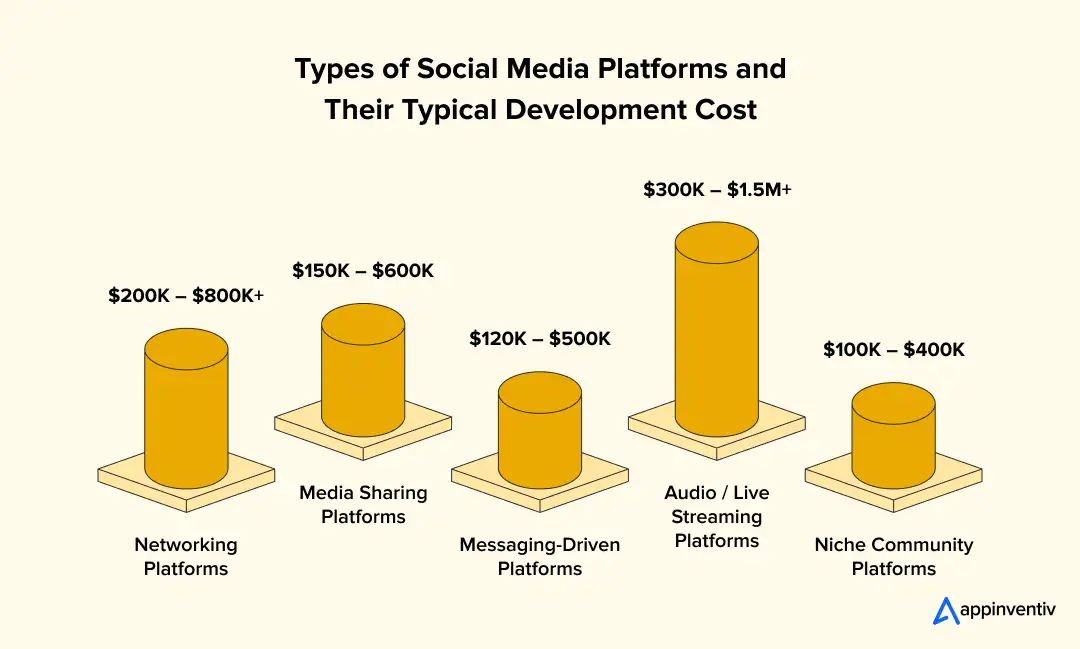
The type of platform you plan to build plays a big role in the cost because different types of social media platforms require different infrastructure, moderation systems, and engagement features. Today, social platforms connect over 5.66 billion user identities worldwide, reaching nearly two-thirds of the global population. A video-driven platform is engineered very differently from a discussion forum or a messaging community.
Networking Platforms
Estimated cost: $200k – $800k+
Networking platforms are built around digital identity and connections between users. Think of Facebook, where the experience revolves around profiles, friend relationships, and a constantly updating feed of posts.
Typical characteristics:
- User profiles and relationship graphs
- Feed-based content updates
- Reactions, comments, and sharing
- Friend discovery and recommendation features
Media Sharing Platforms
Estimated cost: $150k – $600k
Media sharing apps focus on visual content. Platforms like Instagram organize the entire experience around photos, videos, and algorithm-driven feeds that surface engaging posts.
Typical characteristics:
- Photo and short video uploads
- Personalized content feeds
- Media storage and delivery systems
- Likes, comments, and engagement tools
Messaging Driven Social Apps
Estimated cost: $120k – $500k
Some social platforms grow around conversations rather than public posts. Discord is a common example where communities gather in chat channels and interact throughout the day.
Typical characteristics:
- Real-time messaging infrastructure
- Community channels or group chats
- Push notifications
- Voice or text communication layers
Audio and Live Streaming Platforms
Estimated cost: $300k – $1.5M+
Live social platforms allow users to host real-time sessions where others join instantly. Apps like Clubhouse and TikTok Live rely on streaming infrastructure to keep audio or video flowing without delays.
Typical characteristics:
- Real-time audio or video broadcasting
- Audience participation tools
- Low-latency streaming systems
- Live content moderation
Niche Community Platforms
Estimated cost: $100k – $400k
Some social products focus on specific interests rather than broad networks. Reddit is a good example, where conversations are organized around topics and communities.
Typical characteristics:
- Topic-based communities
- Threaded discussion systems
- Voting or ranking mechanisms
- Community-led moderation tools
Key Factors Affecting the Cost of Social Media App Development
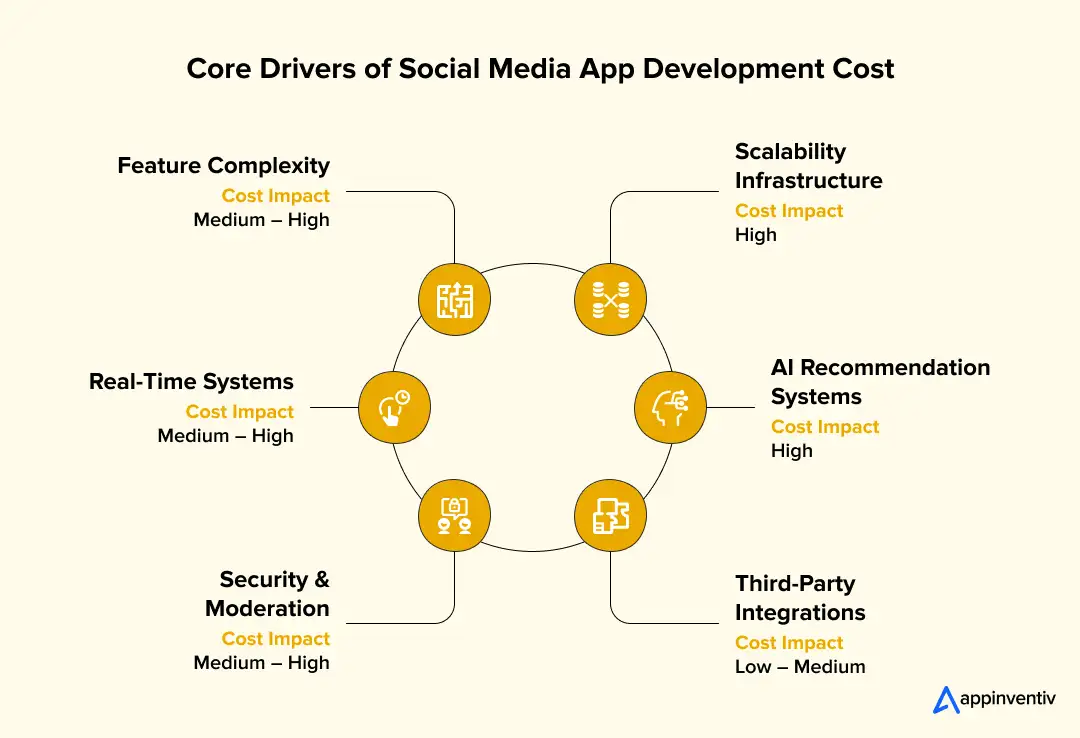
Once teams begin planning a social platform, budgeting quickly moves beyond feature lists. Social media platforms added 266 million new users in a single year, roughly 8 new users every second, increasing infrastructure and scaling demands. The cost of developing social media apps is largely shaped by how the system handles real users, content volume, and infrastructure demands at scale.
Feature Complexity
Most social platforms appear simple on the surface, but the UI/UX design decisions alone can introduce layers of engineering work before a single backend system is touched. In reality, every feature introduces backend services that manage relationships between users, content ranking, and engagement signals.
Core experience layers often include:
- User profiles and account management
- Social graph and follower relationships
- Post creation and content feeds
- Comments, reactions, and sharing
- Push notifications for engagement
Advanced experience layers usually increase the social networking app development cost:
- AI-powered content recommendations
- Creator tools and monetization features
- Video posts and media editing tools
- Community moderation controls
- Advanced discovery and search systems
As feature depth increases, platforms require more backend orchestration, storage capacity, and compute resources.
Cost Impact Overview
| Factor | Technical Cost Driver | Cost Impact Range |
|---|---|---|
| Feed Ranking Systems | Recommendation logic, behavioral signals | Medium to High |
| Media Content Features | Video processing, storage pipelines | High |
| Creator Tools | Monetization APIs, analytics layers | Medium |
Scalability Requirements
Social platforms behave like living ecosystems. User activity rises and falls unpredictably, which means the infrastructure must handle sudden spikes in traffic.
Scalable architectures often include:
- Load-balanced microservices
- Distributed databases
- Content delivery networks for media
- Auto scaling compute layers
- Redundant systems for uptime
Without these layers, feeds slow down, uploads fail, and user experience drops. These infrastructure choices strongly affect the cost of social media app development.
Cost Impact Overview
| Factor | Technical Cost Driver | Cost Impact Range |
|---|---|---|
| High Traffic Handling | Load balancing, distributed services | Medium to High |
| Content Delivery | CDN networks and media caching | Medium |
| High Availability | Failover and redundancy systems | Medium |
Real Time Infrastructure
Modern social platforms rely heavily on real-time interactions. Messaging, live reactions, notifications, and presence updates must appear instantly across devices.
Typical real-time architecture includes:
- WebSocket communication servers
- Event streaming systems
- Push notification gateways
- Real-time data synchronization
Teams that are unfamiliar with how this layer works should review what backend development for mobile apps actually involves before scoping these systems into their budget.
Cost Impact Overview
| Factor | Technical Cost Driver | Cost Impact Range |
|---|---|---|
| Real Time Messaging | WebSocket servers, event queues | Medium to High |
| Notifications | Push gateways and scheduling systems | Medium |
| Activity Updates | Event-driven processing pipelines | Medium |
AI Recommendation Systems
Content discovery is one of the most expensive components of large social platforms. Personalized feeds rely on machine learning models that analyze user behavior and engagement patterns. Once you understand how deeply AI in social media has reshaped what users now expect from content feeds, the scope of investment becomes easier to justify.
These systems typically involve:
- Behavioral data pipelines
- Ranking algorithms for feeds
- Model training infrastructure
- Continuous optimization cycles
Teams that want to validate AI-driven feeds before full investment should consider how building an AI MVP first can reduce both risk and upfront cost.
Cost Impact Overview
| Factor | Technical Cost Driver | Cost Impact Range |
|---|---|---|
| Feed Recommendation Models | Machine learning pipelines | High |
| Data Processing Systems | Behavioral analytics pipelines | Medium to High |
| Model Training Infrastructure | GPU compute and tuning cycles | High |
Security and Moderation Systems
Once users begin posting content and interacting publicly, safety becomes a system rather than a single feature.
Typical moderation architecture includes:
- Automated content scanning
- Reporting and flagging workflows
- Moderation dashboards for review teams
- Abuse detection and escalation systems
At scale, moderation operates as a parallel platform with its own workflows and analytics.
Cost Impact Overview
| Factor | Technical Cost Driver | Cost Impact Range |
|---|---|---|
| AI Content Moderation | NLP and computer vision scanning | High |
| Human Review Systems | Moderator dashboards and queues | Medium |
| Abuse Management | Case tracking and reporting tools | Medium |
Third Party Integrations
Most social platforms integrate external services to accelerate development and expand capabilities.
Common integrations include:
- Authentication services (Google, Apple, OAuth)
- Analytics and tracking platforms
- Payment gateways for monetization
- Advertising platforms
- Cloud media processing services
While integrations reduce build time, they still require engineering effort for secure APIs and data exchange.
Cost Impact Overview
| Factor | Technical Cost Driver | Cost Impact Range |
|---|---|---|
| Authentication APIs | Identity providers and session management | Low to Medium |
| Payment Systems | Billing APIs and fraud checks | Medium |
| Analytics Platforms | Data collection and event tracking | Low to Medium |
Understand infrastructure, AI systems, and moderation layers shaping real platform costs.

Platform-Based Cost Variation in Social Media App Development
Teams that want a broader benchmark can also look at overall mobile app development cost factors before narrowing down to platform-specific decisions. The decision usually comes up when product and engineering teams discuss where the first users will arrive from, mobile, web, or both.
Platform Cost Overview
| Platform | Estimated Cost |
|---|---|
| iOS Native App | $80k – $250k |
| Android Native App | $80k – $250k |
| Flutter (Cross Platform) | $120k – $280k |
| React Native (Cross Platform) | $120k – $300k |
| Progressive Web App (PWA) | $70k – $180k |
| Wearable Companion Apps | $50k – $150k |
| Web Platform (Responsive) | $100k – $350k |
Native apps are usually built with Swift for iOS and Kotlin for Android. This approach increases the early cost to build a social media app since separate development tracks are required, but it provides stronger performance and device optimization.
Cross-platform frameworks like Flutter and React Native allow teams to share one codebase across platforms. This can reduce early social media app costs and speed up the first release while the product is still validating user adoption.
Revenue Generation Strategies That Influence Platform Cost
Before finalizing those choices, understanding the different ways social media apps make money can help leadership align monetization goals with the right architecture early. Once a platform starts earning revenue, systems must support billing flows, reporting pipelines, and compliance requirements.
Common monetization paths include:
- Subscription tiers that unlock premium features, in-app purchases such as creator boosts or digital gifts
- Sponsored posts and advertising placements
- Affiliate partnerships and referral programs
- Commission models tied to creator or marketplace activity
- Payment orchestration for recurring billing and global currencies
Each option introduces new backend responsibilities. Subscription systems depend on reliable billing cycles. Advertising requires targeting infrastructure and consent tracking. Payment integrations must securely process transactions across regions. These layers gradually influence the overall cost of developing a social networking app as the platform evolves.
Technology-Based Cost Variation in Social Media App Development
The technology choices you make influence the cost because they determine how efficiently the platform handles traffic, data flow, and real-time activity. This matters because more than 6.04 billion people now use the internet globally, creating massive volumes of data and interactions. The stack your team selects early often defines both development effort and long-term infrastructure spending.
Technology Cost Overview
| Technology Stack | Technical Role | Cost Impact |
|---|---|---|
| Native Apps | Swift and Kotlin development for performance-critical mobile experiences | Higher development cost |
| Cross-Platform frameworks | Flutter or React Native shared codebases | Lower development cost |
| AI Recommendation Engines | ML models for feed ranking and content discovery | +$50k – $200k |
| Real-Time Streaming Architecture | Event pipelines using Kafka or similar systems | +$80k – $250k |
| Backend Frameworks | Node.js or Go services handling APIs and user activity | Medium to High |
| API Architecture | GraphQL APIs optimizing data queries for feeds and profiles | Medium |
| Caching Layer | Redis caching to accelerate feed loading and session access | Medium |
Cost Variation for Social Media App Development by Location
The development location is one of the most visible variables affecting cost because engineering rates vary widely across regions. In the United States alone, 254 million people use social media, about 73% of the population. Teams building globally often balance cost, expertise, and collaboration models when estimating the cost to build a social media app.
Regional Development Social Networking App Development Cost Overview
| Region | Hourly Rate |
|---|---|
| United States | $120 – $200/hr |
| Western Europe | $90 – $150/hr |
| Eastern Europe | $50 – $100/hr |
| Australia | $30 – $70/hr |
| Middle East | $40 – $120/hr |
Many enterprises combine internal teams with external development partners. An in-house team offers tighter control over architecture and security decisions, which works well for companies with established engineering capabilities.
Teams considering this route can explore what it means to outsource app development before committing to a model. Both approaches affect the final cost of social networking app development, particularly when ongoing scaling and maintenance are factored in.
Startup Social Media App Development Cost
For teams weighing how lean to go at launch, a closer look at MVP development cost factors can help calibrate the right starting budget. Because of this, the cost of building social media apps for startups usually focuses on building a lean MVP with core features like profiles, posting, and basic interactions.
Startup MVP Feature Cost Overview
| MVP Feature | MVP Social Media App Development Cost |
|---|---|
| Profiles | $5k |
| Post Sharing | $6k |
| Follow System | $4k |
| Notifications | $3k |
| Basic Moderation | $4k |
In most real product builds, an MVP social platform with these capabilities typically falls somewhere between $50,000 and $120,000. The exact investment depends on interface design, mobile platform coverage, and the backend systems supporting posts and notifications.
Build vs Customize: Cost Implications for Enterprises
When timelines are tight, customizing an existing solution can seem like the faster option. Building a platform from scratch is often slow and expensive at first. Still, once scale, integrations, and governance requirements enter the picture, the long-term cost can shift significantly.
Enterprises evaluating the cost to build a social media app usually consider two realistic paths.
| Approach | Upfront Cost | Long Term Cost | Cost Risk |
|---|---|---|---|
| Build (Custom) | Higher | Controlled | Predictable at scale |
| Customize (Hybrid) | Medium | Variable | Integration constraints |
Regardless of the path chosen, following mobile app development best practices from the start helps avoid costly rework as the platform scales. Customizing or white-label solutions can reduce early spending, though integration limits and platform constraints may increase the social media app cost as the product grows.
Hidden Costs of Social Media App Development
Using a thorough app development checklist during the planning phase is one of the most effective ways to catch overlooked cost items before they surface post-launch. At that point, infrastructure usage grows, monitoring becomes constant, and security work continues, gradually increasing the long-term social media cost of app development.
| Hidden Cost Area | Why It Adds Cost Over Time |
|---|---|
| Cloud Infrastructure and Hosting | Media uploads, feeds, and traffic spikes increase compute and storage usage |
| Content Moderation Systems | Growing communities require moderation tools, automation, and human review |
| DevOps and Deployment Pipelines | Continuous integration, monitoring, and scaling tools must run around the clock |
| Security and Compliance Programs | Data protection, encryption, and security testing become ongoing requirements |
| Feature Refactoring | Early architecture may need restructuring as user behavior evolves |
Maintenance also becomes a steady operational cost. Most social platforms allocate 15 to 20 percent of the original development cost each year for updates, infrastructure tuning, and security improvements.
Planning for these ongoing costs early helps teams avoid surprises once the platform begins scaling.
Understanding the Total Cost of Ownership (TCO)
Most discussions about the cost of social media app development focus on the initial build. Global social media users have grown exponentially, adding over 3.4 billion users in a decade. In reality, the larger investment often appears after launch when infrastructure grows, moderation expands, and security operations continue.
Once users begin generating content and activity increases, operational systems such as hosting, monitoring, and compliance programs start shaping the real social media app cost.
3-Year Cost Ownership Curve
A practical TCO view separates early development spending from long-term operational commitments.
- Build cost covers engineering, architecture, and initial platform deployment
- Operational cost includes hosting, moderation tools, security monitoring, and optimization
- Year one spending is typically product-focused
- Later years shift toward platform stability and scaling infrastructure
Typical TCO Behavior at Enterprise Scale
| TCO Phase | Cost Behavior Range |
|---|---|
| Year 1 (Build and Launch) | 40–50% of the total 3-year investment |
| Year 2–3 (Operate and Scale) | 50–60% of the total 3-year investment |
The pattern is predictable. Development gets the platform to market, while operational investment keeps the platform stable, secure, and scalable as user growth increases.
Discuss architecture, governance, and long-term scaling decisions before development begins.

How Development Timelines Influence the Cost of Social Media App Development
For teams newer to large-scale builds, a broader look at mobile app development timelines and processes can set more realistic expectations before budgeting begins. The way your team structures releases, governance reviews, and engineering capacity ultimately shapes how the cost to build a social media app appears during the project lifecycle.
Typical patterns seen across enterprise product launches include:
- Parallel engineering teams are accelerating delivery, but increasing short-term spending
- Phased releases lower early investment while extending the timeline to full capability
- Security and compliance reviews are adding fixed checkpoints to each release cycle
- Architecture rework when governance planning happens late
These choices determine how budgets unfold during development.
Development Timeline Overview
| Stage | Duration |
|---|---|
| Discovery | 3–4 weeks |
| Design | 4–6 weeks |
| Development | 5–9 months |
| Testing | 4–8 weeks |
Timeline Impact on Development Cost
| Delivery Approach | Typical Outcome | Cost Behavior |
|---|---|---|
| MVP First Rollout | Faster launch with limited functionality | Lower early cost, higher expansion cost later |
| Scale Ready Build | Architecture prepared for high growth | Higher upfront investment, lower re-architecture risk |
| Multi-Region Launch | Infrastructure and compliance-ready across markets | Highest initial investment, smoother scaling later |
For leadership teams, the takeaway is straightforward. Timelines usually shift when costs appear, not whether they appear.
Also Read: How to Create a Social Media App in 2026? A Comprehensive Guide
How Appinventiv Helps Enterprises Build Scalable Social Media Platforms
Building a social platform that performs well at scale requires more than writing code. Architecture decisions, recommendation systems, moderation workflows, and cloud infrastructure all influence the long-term social media app development cost.
Enterprises usually need partners who understand how these systems behave once real users begin interacting with the platform, which is why many organizations work with an experienced social media app development company.
Appinventiv works with organizations to design large-scale digital products, helping teams structure platforms that can scale without constant re-engineering. Our engineers support architecture planning, AI-driven feed and recommendation systems, and enterprise moderation frameworks that manage large volumes of user-generated content.
Over the years, the company has delivered 2000+ applications across 35 industries, supported by a team of 1600+ technologists working from five global offices. Platforms developed with our teams have collectively achieved 100M+ downloads worldwide, with clients reporting 99.90% uptime environments for critical applications.
Enterprises also rely on experienced partners to accelerate delivery. With established engineering processes and infrastructure expertise, teams often see faster deployment cycles while maintaining the governance and stability required for large-scale platforms.
FAQ’S
Q. How does development time affect the cost of building a social media app?
A. Development time directly influences the cost to build a social media app because longer timelines require sustained engineering resources, infrastructure usage, and testing cycles. Faster launches often require larger teams working in parallel, which increases short-term spending. Slower phased development spreads costs over time, but can delay revenue generation and feature expansion.
Q. How do security measures impact the cost of social media app development?
A. Security measures increase the cost of developing social media apps because platforms must protect user data, conversations, and uploaded content. This includes encryption systems, identity verification, access control, and regular security testing. As user activity grows, moderation tools and abuse detection systems become necessary, adding infrastructure and operational costs to maintain a secure environment.
Q, How do team structure and regional differences affect the cost of developing social media apps?
A. Team structure and development team location significantly influence the overall cost. An in-house development team offers stronger control but higher personnel costs, while freelance developers or an offshore development team can reduce regional hourly rates. Many enterprises adopt a hybrid development team model to balance coordination risk, cost-to-quality ratio, and time zone differences.
Q. What monetization models can influence the profitability of a social media app?
A. Social platforms generate revenue through multiple models, including in-app advertising, subscription models, and freemium features that unlock premium capabilities. Many apps also rely on sponsored and branded content, platform commissions, or in-app purchases. Additional streams such as affiliate marketing, rewarded video ads, and business accounts help platforms diversify revenue while scaling user engagement.
Q. How does feature selection impact the cost of developing a social media app?
A. Feature selection plays a major role in the cost of developing social media apps. Basic capabilities like profiles and feeds require moderate engineering, while advanced features such as AI-based recommendations, real-time chatting, and creator monetization tools increase complexity. Additional elements, such as multi-language support, advanced search and filters, custom dashboards, and third-party integrations, further increase development effort and infrastructure needs.
Q. How do development stages influence the total cost of a social media app?
A. Each stage of the development lifecycle shapes the cost. Discovery and planning, UI/UX design, and prototyping define scope and architecture. Front-end and back-end development build core functionality, while quality assurance testing, deployment and launch, and ongoing maintenance costs add further investment throughout the product lifecycle.


Fast 2-minute response, fully NDA-protected.

UK Social Media Ban for Under-16s: How to Comply With the Online Safety Act as a Platform Owner
Key takeaways: The Online Safety Act is already enforced — platforms must comply now. Ofcom can investigate and fine platforms today. Children’s safety and age checks are already mandatory. The under-16 ban is not law yet (still under discussion). Platforms must prepare now for stricter upcoming rules. If you run a user-to-user service in the…

How Much Does It Cost to Build a Dating App Like Grindr?
Key takeaways: The cost to build a dating app like Grindr ranges between $40,000 and $200,000+, depending on features and scale. Privacy, security, and compliance with global data laws are major cost drivers in LGBTQ+ dating app development. Advanced features like AI matchmaking, video calls, and community tools increase overall development costs. The global dating…

Dating App Development in Australia: Features, Process and Costs
Key takeaways: In Australia, the adoption of dating apps shows no signs of slowing, and the market is expected to reach a value of $58.4 million by 2029. Features like geolocation, profile management, real-time messaging, video calls, and privacy settings are crucial to ensure a seamless user experience and user engagement. It's important to consider…