






























Manufacturing CRM – Exploring the Business Impact and Best Implementation Practices

- Role of CRM in the Manufacturing Sector
- Key Features of Manufacturing CRM Software
- Benefits of Adopting CRM in Manufacturing
- Top-Rated CRM Software for Manufacturing Businesses
- CRM in Manufacturing: Practical Use Cases and Industry Examples
- Steps to Implement CRM in the Manufacturing Industry
- Why Manufacturing CRM Projects Stall and How to Fix Them
- Modernize Your Manufacturing Business with CRM Expertise from Appinventiv
- FAQs

- Manufacturing CRMs unify sales, production, and service for seamless operations and improved customer experiences.
- Integration with ERP and supply chain tools enables real-time data sharing, accurate forecasting, and efficient production planning.
- Automated quoting, order management, and after-sales support drive faster sales cycles and higher customer retention.
- Analytics and mobile access empower field teams and leadership with actionable insights for smarter decision-making.
- A well-designed custom CRM aligns sales, production, and customer data within one system, giving manufacturers clear operational visibility and better control over forecasting, planning, and customer relationships.
Efficiency on the factory floor is no longer enough; manufacturers must now integrate customer intelligence and operational data to drive growth, retention, and strategic decision-making. The current CRM offerings provide a centralized platform where sales, service, and operations come together, and customer interactions are transformed into actionable insights used to support both commercial and operational objectives.
Establishments that capitalize on CRM systems will be 86% more likely to surpass their sales goals, indicating that well-organized customer management is a direct contributor to business performance.
Other than enhancing sales, these platforms allow teams to see orders, service requests, and customer histories in real time, resulting in quicker responses and more stable after-sales support. They are also used to manage distributors more effectively, simplify production planning and coordinate communications through multi-level channels.
This blog analyzes the practical application of CRM in manufacturing industry, the practical benefits of the business, validated examples of the case, as well as the best practices to implement.
With these insights, manufacturers will be able to transition thin-sliced processes into an integrated, insight-based system to improve the customer experience, operational efficiency, and overarching growth.
Adopt a unified CRM strategy that aligns customer intelligence with operations

Role of CRM in the Manufacturing Sector
CRM systems are strategic in the manufacturing industry as they unify sales, production, service, and distribution into a coherent unit. They assist manufacturers in monitoring each phase of the customer flow, from the first inquiry to after-sales customer service, and make sure the information does not get bottlenecked between teams.
Such platforms enable companies to run complex sales pipelines, control distributor operations, synchronize manufacturing production schedules with ordered goods, and reduce delays and bottlenecks in operations. Actionable insights derived from consolidating customer data can also be used to make both commercial and operational decisions that enhance efficiency and predictability.
These systems enhance long-term customer engagement and retention, besides operational coordination. Manufacturing analytics software can be used to determine the purchasing trends, future demand, and to create specific service or upsell initiatives. Real-time access by field teams to service histories and product information will enable faster problem resolution and an enhanced customer experience.
Comprehensively, the technology will enable manufacturers to shift from reactive to proactive customer management to make sure that sales, service, and production are harmonized and foster relationships throughout the value chain.
Key Features of Manufacturing CRM Software
Manufacturing CRM platforms are designed to manage lengthy sales cycles, distributor networks, after-sales services, and production coordination. They are in sync with supply chain, inventory and enterprise resource planning systems, unlike the generic CRM tools.
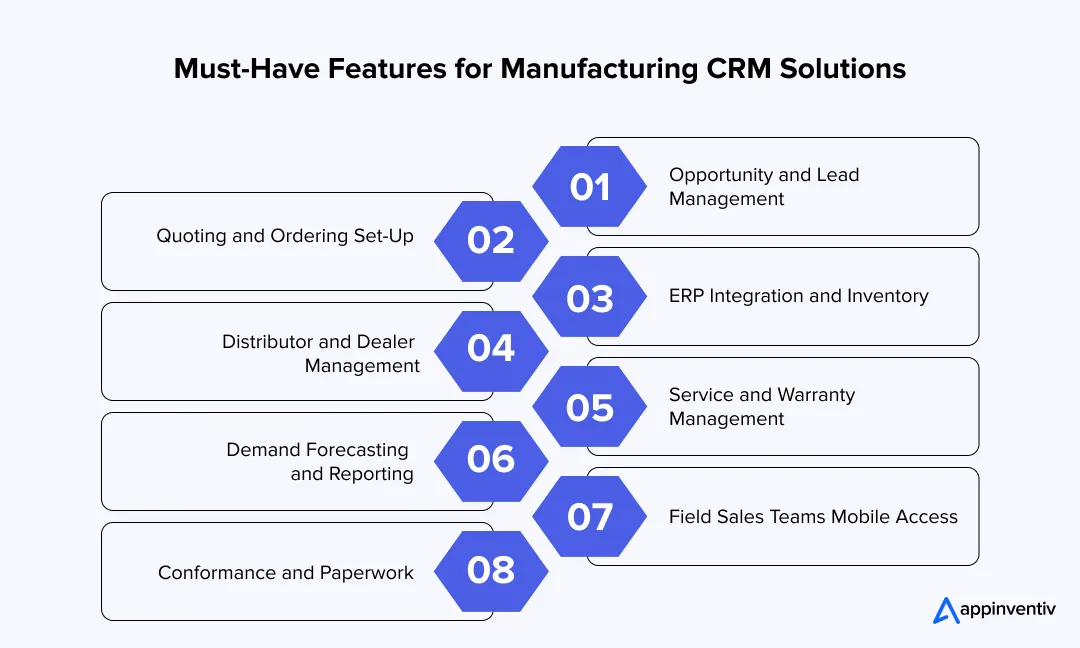
Opportunity and Lead Management: Manufacturers usually deal with large orders and regular customers. A custom CRM software tracks leads by region and monitors the dealer pipeline, aligning each opportunity with production capacity. This ensures that sales commitments remain synchronized with manufacturing schedules.
Quoting and Ordering Set-Up: Shipments of manufacturing sales are often customized products. In-built CPQ features enable teams to create precise quotes based on specifications, pricing levels, and material prices. This minimizes the number of manual errors and expedites the process of closing a deal.
ERP Integration and Inventory: The native integration with ERP systems, including SAP and Oracle NetSuite, allows real-time viewing of stock levels, procurement orders, and order statuses. The sales teams are able to deliver realistic delivery times without using manual coordination.
Distributor and Dealer Management: The multi-tier distribution networks are often implemented by manufacturers. CRM systems keep centralized the dealer performance data, target tracking, incentive programs and communication flows. This enhances the accountability and transparency in the channel.
Service and Warranty Management: After-sales service is a very important aspect of production. CRM has a record of equipment, warranty coverage, service agreements, and maintenance records. This enhances response speed and long-term customer relationships.
Demand Forecasting and Reporting: AI-powered demand forecasting uses smart analytics to predict order volumes based on historical trends and seasonal demand, enabling manufacturers to plan production accurately and reduce stockouts or overproduction. The leadership gets visibility on revenue expectations, inputs on production planning, and the profitability of the customers.
Field Sales Teams Mobile Access: Field representatives and service engineers need real-time data access. CRM applications with mobile functionalities enable on-site updates, order entries and service ticket entries without having to go back to the office.
Conformance and Paperwork: Manufacturing is usually accompanied by regulatory documents, quality certifications and contract records. CRM systems archive and manage compliance documents so that they can be traced and audited.
Benefits of Adopting CRM in Manufacturing
When implemented with the right process alignment, a CRM system strengthens coordination between sales, production, service, and distribution teams. These are some of the top benefits manufacturers experience as they formalize customer and operational workflows.
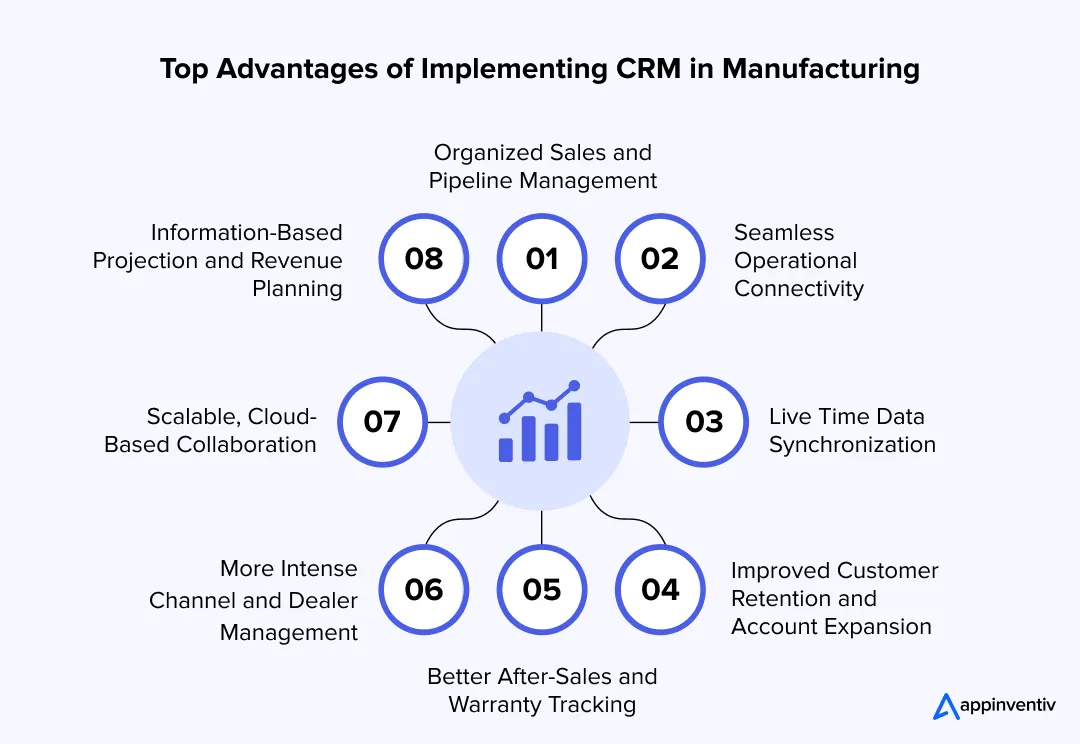
Organized Sales and Pipeline Management
A properly applied CRM in manufacturing industry provides order to the intricate selling processes of distributors, OEM associates and enterprise purchasers. It houses quotations, account history, terms of the contract and follow-ups under a single system.
The pipeline view among leadership and the specific stages among sales teams are clearly defined. This minimizes revenue leakage and enhances deal predictability.
Seamless Operational Connectivity
Through CRM integration for enterprises, sales data flows directly into manufacturing ERP, inventory, and procurement systems. Demand signals are provided to production teams at an early stage, allowing procurement to plan raw material purchases more efficiently. The company shifts to an active coordination of harmonized planning. This reduces performance delays and operational tension.
Live Time Data Synchronization
Through a strong manufacturing CRM integration, customer orders, stock status and delivery schedules are kept in line within departments. The sales representatives will be able to make realistic delivery dates according to the real capacity.
Management can get a single source of truth rather than spreadsheets that conflict with each other. The process of decision-making is made quicker and more dependable.
Improved Customer Retention and Account Expansion
With CRM in manufacturing sector, the businesses monitor the purchasing cycles, order frequency and service history. Account managers will be able to spot upsell opportunities and predict the need for replenishments.
Formal interaction enhances relationships with clients in the long-term. The retention is also improved since follow-ups are organized, as opposed to accidental.
Better After-Sales and Warranty Tracking
Dedicated CRM for manufacturing industry captures equipment installation, warranties, service schedules and tickets. Service teams have access to full product histories before visiting a site. The faster resolution of issues will enhance customer loyalty. The quality of service is a competitive differentiation in the long run.
More Intense Channel and Dealer Management
With CRM for manufacturing companies, organizations gain visibility into distributor targets, incentive programs, and regional performance metrics. Multi-tier networks standardize communication, allowing poor performance to be detected early and strategic adjustments to be made before revenue is impacted.
Scalable, Cloud-Based Collaboration
Modern CRM in manufacturing using cloud services enables remote sales teams, plant managers, and service engineers to access real-time information from any location. Changes are instantaneous across teams. This facilitates the work of multiple plants and global expansion. Scalability can be enhanced without huge infrastructure investment.
Information-Based Projection and Revenue Planning
Advanced analytics within CRM software for manufacturing analyzes historical orders, seasonal demand patterns, and customer profitability. The leaders will be able to predict revenue more accurately and align production. Scenario planning is organized and not conjectural. The outcome is the enhancement of financial sustainability and utilization capacity.
Top-Rated CRM Software for Manufacturing Businesses
Manufacturing organizations looking to acquire a new CRM system can either create a customized platform tailored to their internal processes or use an existing SaaS platform. Below are some of the best CRM software for manufacturing with strong market presence and user ratings based on industry review benchmarks:
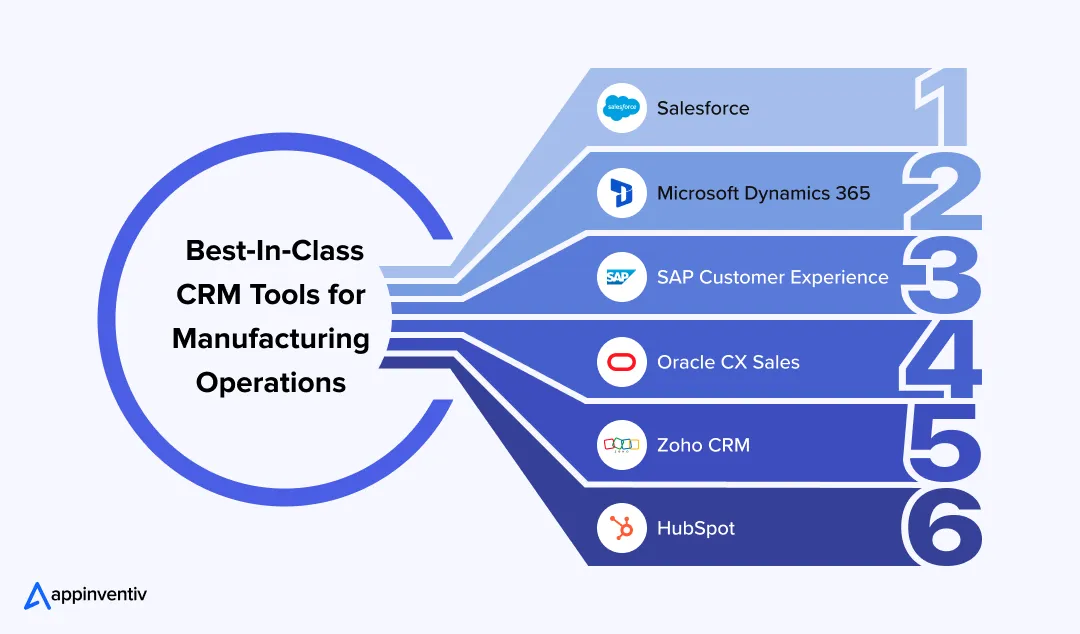
Salesforce
Salesforce is also currently among the most deployed CRM platforms in the world. Its Manufacturing Cloud is developed to be account-based forecasting, partner collaboration, and demand planning. The platform promotes heavy customizations and integrations. It is popular among the manufacturing companies across the world that have complicated sales features.
Also Read: Salesforce Integration Solutions – A Comprehensive Guide
Microsoft Dynamics 365
Microsoft Dynamics 365 is a platform that includes both CRM and ERP capabilities in a single environment. Close relations of manufacturing with finance, supply chain and production management modules are advantageous to manufacturers. It is interoperable with Microsoft 365 and Azure. Mid-sized and large industrial organizations are great users of the platform.
SAP Customer Experience
SAP Customer Experience, which was previously SAP CRM is well synchronized with SAP ERP environments. It helps in the synchronized demand planning, sales forecasting and service lifecycle management. Existing manufacturers who are using SAP infrastructure are likely to choose this ecosystem to have unified data governance. Large manufacturers in the world have adopted it.
Oracle CX Sales
Oracle CX Sales provides enterprise-level CRM solutions with a wider range of Oracle cloud solutions. It facilitates the complex sales cycles, international account management and sophisticated analytics. The continuity of data is often exploited by manufacturers that are working with Oracle ERP systems. It is usually introduced in multinational industrial organizations.
Zoho CRM
Zoho CRM is well-used in small and mid-sized companies worldwide. It provides workflow configuration, sales automation, analytics, and integration in the Zoho business suite. The pricing model helps to expand manufacturers without high initial capital. It is scalable, which makes it appropriate in case of expansion of operations.
HubSpot
HubSpot CRM is also widely known for being easy to implement and adopt by users across the world. It promotes built pipeline management, reporting and marketing integration. It is common with manufacturing companies that are interested in lean sales mechanisms and have adopted it due to its intuitive interface. The platform grows gradually as the complexity of operations increases.
Also Read: How to Choose the Right CRM for Your Business
CRM in Manufacturing: Practical Use Cases and Industry Examples
CRM systems are not just contact record holders in the industrial setting. A CRM transforms into a pivot operational centre when it is customized to the requirements of production planning, channel bodies and service delivery. The following are some of the top use cases of CRM in manufacturing with practical examples.
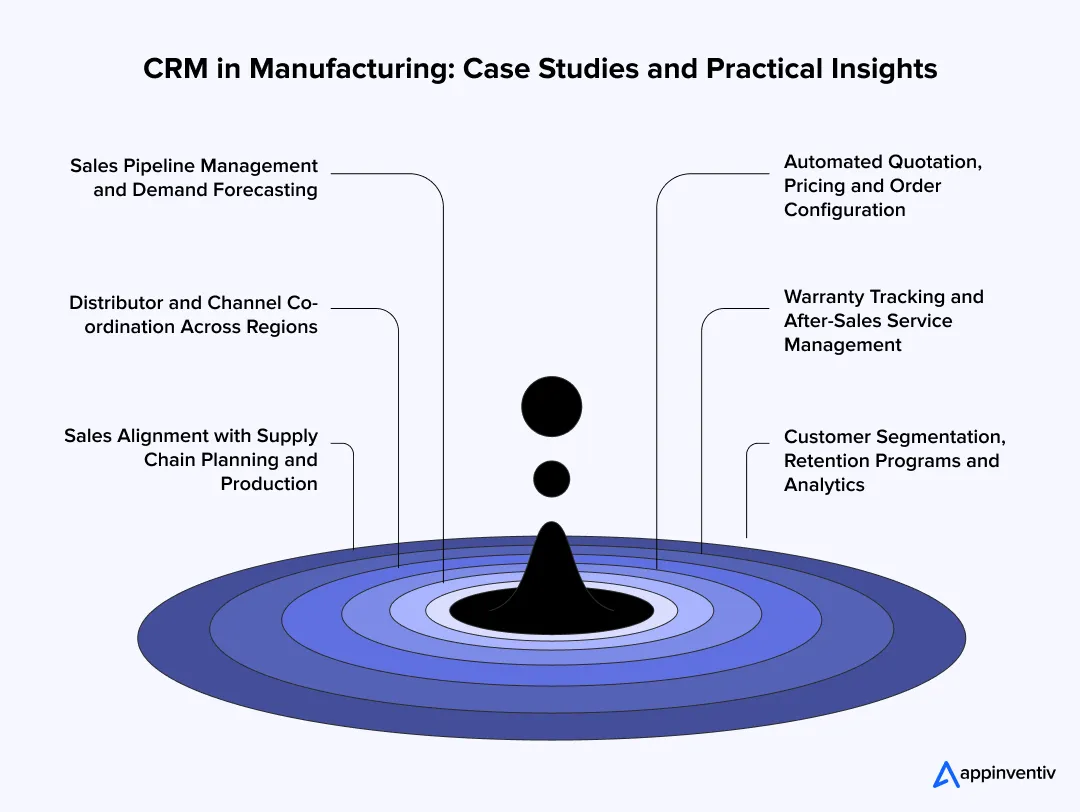
Sales Pipeline Management and Demand Forecasting
Manufacturers are typically faced with long sales cycles, numerous decision-makers, and intricate quoting systems. A CRM stores all the touchpoints, starting with lead generation, proposal, and close, in a central repository.
By analyzing stages and activities, leadership gains accurate sales forecasts and a stronger pipeline. This visibility exemplifies how CRM drives digital transformation in manufacturing, replacing fragmented spreadsheets and disconnected inboxes with a unified, data-driven system.
Schneider Electric used Salesforce CRM to unify sales pipeline tracking across teams worldwide. The platform aggregated lead, opportunity and forecast data to standardized dashboards. This aided executives in making better decisions regarding resource allocation, investing in high-value deals, and removing blind spots in revenue projections.
Distributor and Channel Co-ordination Across Regions
Manufacturing companies usually have tiers of distribution channels, including independent dealers, resellers, and regional partners. Lack of centralized data means that pricing anomalies, order delays, and poor communication will occur easily.
CRM brings together channel communication, dealer performance measures and incentives into a single system, allowing systematic follow-up and uniform business guidelines. This kind of manufacturing CRM integration strengthens accountability and accelerates order flow across networks.
Siemens implemented Salesforce Sales Cloud to integrate internal sales units with the external partners. The CRM offered a common partner portal, a standard lead assignment policy and overall visibility of channel pipelines. This minimized lead leakage, enhanced partners’ response times, and generated a common source of sales performance information across regions.
Sales Alignment with Supply Chain Planning and Production
CRM systems are much more effective when they integrate with back-office applications such as ERP, MRP, and inventory management. Connecting sales commitments to production schedules and inventory availability helps manufacturers avoid promising delivery too soon and avoid rushed production spikes.
Integrated data is also useful in the anticipation of material requirements, according to confirmed orders, to smooth out supply chain operations by planners. This is one of the benefits evident in CRM in manufacturing sector, where the sales front office is aligned with operations execution.
Illinois Tool Works (ITW) is reported to be a user of Microsoft Dynamics CRM, which implies that it uses CRM data as part of other enterprise systems. As Dynamics CRM provided structured customer and order data to planning processes, ITW was now able to see demand indicators that informed inventory planning and manufacturing scheduling without manually reconciling the data.
Automated Quotation, Pricing and Order Configuration
In manufacturing, product configurability and price based on volume are typical. Sales teams frequently must prepare sophisticated quotes based on build-to-order and tier pricing and discount policies. This is automated by CRM systems, particularly those that have CPQ (Configure, Price, Quote) functionality.
They drag product regulations, price tables, and customer sections into quote templates, eliminating mistakes, accelerating approvals, and ensuring uniformity. This capability exemplifies how CRM for manufacturing industry tools accelerate sales execution with structured pricing logic.
Ball Corporation is one of the companies that uses Microsoft Dynamics CRM to facilitate its sales and quoting process. Under CRM-based automation, sales reps create precise quotes quickly and send them to customers without human error. This has led to a quicker turnaround between quote and order and better compliance with pricing governance.
Warranty Tracking and After-Sales Service Management
The contracts for manufacturing, delivery, and maintenance services usually play a major role in revenue generation and customer retention. CRM is a profile that contains installation dates, warranty, service history, and unresolved issues in a centralized location.
Before visiting the site, field service teams receive this information, allowing them to find solutions more quickly and provide more personalized assistance. Follow-ups, contract renewal tracking, and escalation workflows can also be automated in the system. This service‑oriented application is a practical outcome of CRM for manufacturing companies that expand usage beyond sales.
Porsche implements a CRM based on SAP CRM / SAP C/4HANA solutions. Although Porsche has CRM functions in sales and service units, the service resources of the CRM monitor after-sales contacts, service records, and warranty repairs to ensure a smooth customer experience in all touchpoints associated with the performance of the vehicle and parts.
Customer Segmentation, Retention Programs and Analytics
Manufacturers gain when they move away from reactive customer management to proactive experience orchestration. CRM analytics combine the purchase behavior, service usage and past interactions into useful dashboards.
Buying behavior, profitability, and frequency of service allow companies to divide customers and run targeted retention campaigns and upsell programs. This is a strategic application of data that highlights that CRM in manufacturing is not used as a record-keeping tool but rather as a decision support tool.
Evans Manufacturing implemented Freshworks CRM (Freshsales) to consolidate customer activity records and extract insights into repeat-purchase patterns. Using the inherent analytics ability, the company was able to determine high-value accounts, track churn risks, and target outreach to enhance customer retention and solid relationships.
Steps to Implement CRM in the Manufacturing Industry
An enforced implementation structure is used to guarantee that the system sustains the complexity of industries, multi-level distribution, and long sales cycles without interfering with the operations.
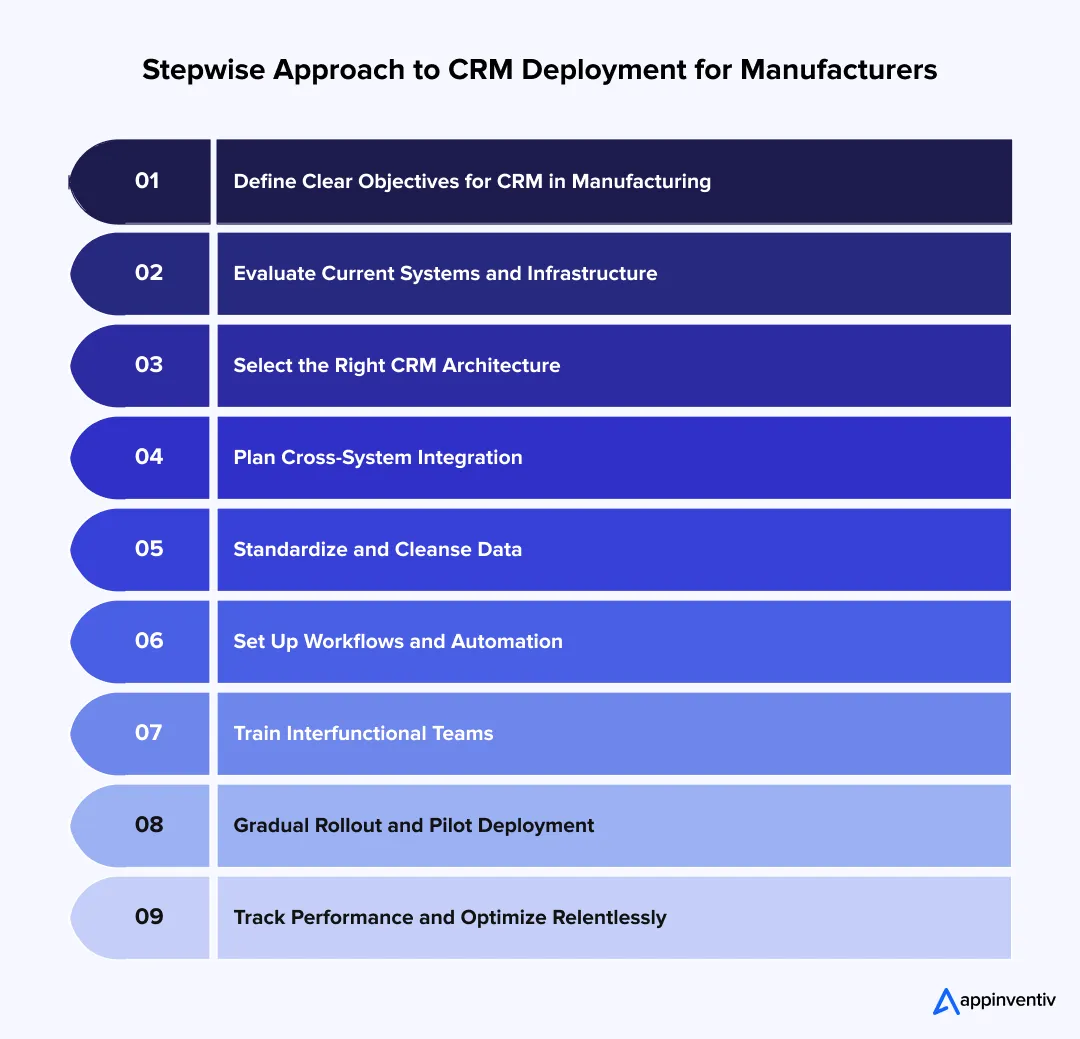
Define Clear Objectives for CRM in Manufacturing
Set specific objectives prior to enactment. No matter how much more advantageous a distributor’s visibility, demand forecasting, or service responsiveness, defining KPIs explains the role of CRM in manufacturing processes. Coordinate leadership, sales, operations and service teams with anticipated results like shorter cycle time or better retention.
Evaluate Current Systems and Infrastructure
Carry out technical and operational audit of ERP, supply chain, finance and legacy tools. When comparing CRM software for manufacturing, make sure it can fit the existing platform and find silos of data that need to be consolidated. This evaluation eliminates integration bottlenecks in the future.
Select the Right CRM Architecture
Decide between customizing an established platform or pursuing manufacturing CRM software development tailored to complex workflows. The decision is based on the scalability requirements, product complexity, regulatory requirements and integration with production systems in depth.
Plan Cross-System Integration
CRM in manufacturing industry should have a smooth connection with ERP, inventory management, procurement, and logistics systems. Integration means the sales forecasts have a direct impact on the production schedules and inventory planning, and eliminates the delays and overstock risks.
Standardize and Cleanse Data
The use of CRM in manufacturing industry relies on the accuracy of data. Clean customer records, distributor data, historical sales information, and pricing structures before migration. Standardization enhances consistency in the reporting and accuracy in decisions.
Set Up Workflows and Automation
Design structured approval processes, quotation management, distributor onboarding, and service tracking workflows. Automation adds operational discipline and improves the strategic contribution of CRM in manufacturing by reducing manual intervention.
Train Interfunctional Teams
Offer formal training in the sales, operations and service units. An effective CRM software for manufacturing can bring value upon implementation only when users are skilled in reporting and forecasting tools and collaborative features.
Gradual Rollout and Pilot Deployment
Pilot the system to monitor in one plant/region and then implement the system-wide. Staged implementation reduces the risk and permits configuration further within a greater manufacturing CRM software development plan.
Track Performance and Optimize Relentlessly
It is crucial to conduct a post-deployment assessment. Measure track KPIs: sales conversion rates, performance of distributors, accuracy of forecasts, and time of service resolution. Working with an experienced software development company will guarantee continuous software optimization, performance optimization, and scalable performance in line with the expansion of the manufacturing business.
Let our experts deliver a structured CRM deployment built for manufacturing stability and growth

Why Manufacturing CRM Projects Stall and How to Fix Them
In manufacturing CRM projects, failure is very rare due to the selection of software. Major failures have been caused by disjointed processes, unlinking systems and a lack of harmony between commercial and operational teams.
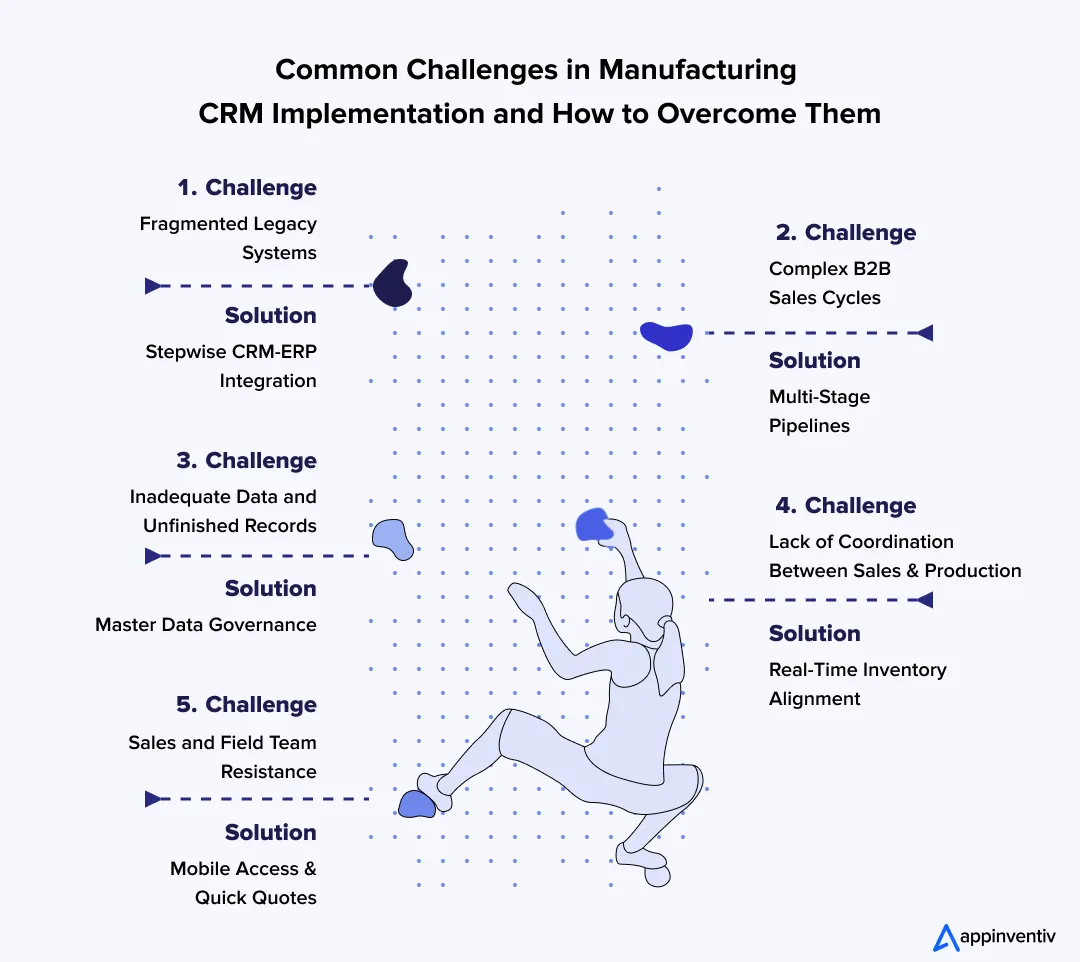
Fragmented Legacy Systems
Challenge: Most manufacturers are spread throughout the ERP, production planning, inventory and service platforms that lack effective communication. Lack of organized CRM integration for manufacturing enterprises makes the CRM layer standalone rather than playing the role of a coordination engine.
Solution: Integration architecture should be the priority in the approach to manufacturing CRM software development. Integrate CRM with ERP, supply chain and production systems step by step. It should require a single customer, order and inventory visibility before advancing automation.
Inadequate Data and Unfinished Records
Challenge: The same accounts, inconsistency of SKU information, outdated contacts undermine confidence in CRM within the setting of the manufacturing industry, where precision has a direct impact on quotation and production schedule.
Solution: Establish the ownership of master data within the departments. Along with applying validation rules, standardized cleansing cycles, and standardized product taxonomies, make CRM in manufacturing a source of reliable operation reference, not a reporting ceremony.
Sales and Field Team Resistance
Challenge: Manufacturing sales cycles are based on relationships and are usually done out of line. The teams view CRM as an administrative cost rather than operational support.
Solution: Architectural practices revolve around practicalities in the field. Facilitate mobile access, quick quote creation, and easier activity logging. The adoption is self-stabilizing when CRM minimizes follow-up efforts and enhances account visibility.
Complex B2B Sales Cycles
Challenge: The opportunity tracking and forecasting accuracy is complicated by long procurement times, layers of distributors, and multi-level approvals.
Solution: Establish multi-stage pipeline control with an alignment on procurement milestones and production landmarks. Role-based visibility will provide distributors with the same data to account managers and internal planners to work with similar data on deals.
Lack of Coordination between Sales and Production
Challenge: Sales promises that are not visible in production cause delays in delivery and loss of margins.
Solution: Link CRM to manufacturing resource planning systems such that lead times, availability of inventory and capacity constraints are displayed in the process of evaluating opportunity. Such alignment minimizes the error in order and increases the reliability of the forecast.
Modernize Your Manufacturing Business with CRM Expertise from Appinventiv
The following manufacturing stage will be defined by linked ecosystems in which the customer data, production intelligence, and supply chain visibility will interact as a single system. CRM implementation has become the backbone of the operation that helps to synchronize the sales forecast and inventory planning, distributor performance, and after-sales services.
With the maturation of advanced technologies like IoT and AI in manufacturing, companies that incorporate CRM into their daily workflows will have greater demand forecasting, a shorter response time, and quantifiable efficiency gains in their global organizations.
Appinventiv provides reliable CRM development services to transform legacy systems, enable intelligent platform integration, and create connected environments, aligning customer engagementand operational performance.
One example is how we assisted a global heavy equipment manufacturer with 6 facilities and a network of over 100 distributors in the US in addressing fragmented supply chain data and escalating logistics expenses.
We integrated the RPA with an AI-powered supply chain and logistics management platform, which led to the unification of systems and error resolution (60% higher supply chain visibility, 40% lower cost logistics and transportation, and 30% greater operational efficiency).
For manufacturers pursuing long-term transformation, implementing structured CRM with the expertise of Appinventiv’s industry-leading manufacturing IT services offers a practical path to scalable growth and streamlined operations.
To explore how such an approach can empower your business, reach out to Appinventiv and start creating a CRM strategy that aligns with your business goals.
FAQs
Q. Why do you need a CRM in the manufacturing industry?
A. Here are some of the major reasons why CRM should be incorporated in the manufacturing industry:
- Centralized Customer Data: All interactions between the customer, orders, and other service data are consolidated on a single platform.
- Better Sales Co-ordination: Co-ordinates the sales, production, and service divisions to work with a single dataset.
- Improved Distributor Management: Monitors dealer performance and receives a uniform channel processing of orders.
- Operational Efficiency: Eliminates manual effort and workflow errors through automation of operations and approvals.
- Strategic Insights: Provides data-driven insights that support accurate forecasting, production planning, and informed decision-making.
Q. How do CRM systems stimulate growth in manufacturing?
A. CRM systems drive growth by offering practical information about customer behavior, sales pipelines and market trends. They automate the order management process, minimize errors, and enhance communication among sales, production, and service departments.
Coupled with operational systems, CRMs can guarantee that demand and capacity are equal, optimize production planning, and upsell and repeat business, which will lead to an increase in revenues and operational efficiency.
Q. Should manufacturers choose a custom vs platform based manufacturing CRM?
A. The selection of custom or platform-based CRM is determined by the complexity and flexibility requirements. Solutions such as Salesforce or Microsoft Dynamics are platform-based and can be more rapidly deployed with already existing integrations and established scalability.
Specialized CRMs are designed to fit specific workflows, specialized product or complex manufacturing processes and are more expensive and difficult to develop. Assessment of the operational requirements, integration requirements and growth projections will aid in identifying the optimal fit.
Q. How much does it cost to develop a manufacturing CRM?
A. The cost of CRM implementation in the manufacturing industry varies according to the type and complexity of the solution. Depending on modules, integrations, and scalability needs, custom CRM development ranges from $50,000 to more than $350,000. Other expenses are training, maintenance and updates. There must be proper planning and requirements analysis that ensures that ROI is maximized and that nothing is wasted.

- In just 2 mins you will get a response
- Your idea is 100% protected by our Non Disclosure Agreement.

Maritime Insurance Claim Software Development for UAE Ports, Insurers, and Logistics Networks
Key takeaways: Manual claims management is too slow for the UAE’s high-volume ports; digital solutions streamline processes and reduce errors. Maritime insurance claim software centralizes data, automates workflows, and ensures compliance with UAE regulations and Takaful principles. Real-time integration with port and vessel systems enables faster claim registration, validation, and settlement. Advanced analytics and risk…

How to Build a Student Management System in Australia?
Key takeaways: Australia’s tightening regulatory landscape (TEQSA, ASQA, CRICOS) makes student management system development in Australia a compliance-driven necessity, not just a digital upgrade. Monetisation models such as SaaS subscriptions, institutional licensing, white-label partnerships, and hybrid pricing offer scalable commercial opportunities in Australia’s expanding EdTech market. Addressing challenges early - data privacy, legacy migration, multilingual…

Guide to Software Risk Management: Identifying and Mitigating Key Risks in Software Development
Key takeaways: Risk management is no longer a peripheral activity; it is a core component of Enterprise Risk Governance (ERG) that ensures software ROI. Successful projects define their risk appetite—the level of risk an organization is willing to accept—before the first line of code is written. By integrating risk assessment into the early discovery phase,…









