
































How Much Does It Cost to Build an AI-Powered Fitness App Like Fitbod?

 Share -


- 01What Makes Fitbod a Strong Reference Model
- 02What Is the Cost to Develop an AI Fitness App Like Fitbod?
- 03How Do Platform Choices Affect the Total Cost?
- 04What Are the Features to Add in AI-Based Fitness Apps Like Fitbod and How Do They Affect Cost?
- 05AI-Powered Features and Their Cost Impact
- 06Fitness App Integrations and Their Cost Impact
- 07Admin Console Features and Their Cost Impact
- 08How AI Models Shape the Total Development Cost
- 09Architecture and Tech Stack for an AI Fitness App
- 10Compliance, Privacy, and Security Requirements
- 11Development Timeline Breakdown
- 12Monetization and ROI Models
- 13Cost Reduction Tips When Building an AI Powered Fitness App
- 14Hidden Factors Affecting the Cost to Build an AI-Powered Fitness App Like Fitbod
- 15Build Your Fitbod-like Fitness App with Appinventiv
- 16FAQs

Key Takeaways
- Building a Fitbod style AI fitness app costs between $40,000 and $400,000 depending on AI depth, integrations, and platform choices.
- AI features such as recommendation engines, rep counting, and fatigue scoring are the biggest cost drivers, requiring datasets, tuning cycles, and cloud compute.
- iOS, Android, and cross-platform builds each affect total budget, with native apps offering better performance for computer vision tasks.
- Ongoing costs matter as much as development, including AI retraining, data pipelines, compliance, and API updates.
- Monetization models like subscriptions, tiered plans, and corporate wellness partnerships help recover development cost faster and support long-term ROI.
Walk into a gym today and you will notice a pattern. People are not guessing about their workouts anymore. They open apps that tell them what to lift, how many reps to finish, and why a certain routine fits their progress. This shift did not happen by accident. It reflects how quickly users are moving toward smarter, more adaptive training experiences, and this is exactly why developing an AI fitness app like Fitbod has become a serious opportunity.
The numbers also show where the market is heading. A recent study suggests that the global digital fitness apps market could reach $34.09 billion by 2030 as more people rely on mobile tools and AI-powered programs to manage their routines.
With this kind of momentum, more founders want to understand the cost to develop an AI fitness app like Fitbod, especially in the United States where users expect personalization that feels almost coach-like.
For most teams, the budget falls somewhere between $40,000 and $400,000. The range depends on how advanced the AI needs to be and whether you want a basic version or something closer to a true Fitbod style experience. To understand that range clearly, let us first look at what makes Fitbod such a strong benchmark.
Start building your AI fitness product while the demand is rising.

What Makes Fitbod a Strong Reference Model
When people talk about developing an AI fitness app like Fitbod, they usually point to one reason. Fitbod feels personal. The app learns from every workout and quietly adjusts the next plan without making the user think too hard. That is the bar most new products try to reach.
What makes Fitbod stand out:
- It recommends workouts based on real training history, not static templates.
- It tracks muscle recovery and avoids overloading the same areas too soon.
- It adjusts sets, reps, and weight based on past performance.
- It works even with limited equipment, which makes it useful for beginners and home workouts.
- It uses smart exercise suggestions that feel close to a coach’s decisions.
These strengths make Fitbod a solid benchmark for teams planning the cost to develop an AI fitness app like Fitbod, because each feature influences how simple or complex the AI system needs to be.
What Is the Cost to Develop an AI Fitness App Like Fitbod?
Before you start planning features or timelines, it helps to understand the broad cost structure. The cost to develop an AI fitness app like Fitbod usually falls between $40,000 and $400,000, but the actual number depends on how advanced the AI system needs to be and how many platforms you want to support.
How Much Does an MVP, Mid Scale, or Full Fitbod Level App Cost?
Projects grow in stages, and each stage comes with its own budget expectations. Here is how most teams divide the work.
What Is the Cost of an MVP Version?
An MVP is the simplest version that lets users complete workouts and get basic AI suggestions.
- Cost range: $40,000 to $90,000
- Covers onboarding, workout library, simple tracking
- Includes one lightweight AI feature such as adaptive load suggestions
What Does a Mid Scale AI Fitness App Cost?
This level offers a more complete experience for long-term users.
- Cost range: $90,000 to $200,000
- Stronger personalization and analytics
- Integrations with Apple Health and Google Fit
- Content depth, better planning logic, richer UI
How Much Does a Full Fitbod Style Enterprise App Cost?
This is the closest to Fitbod in capability and performance.
- Cost range: $200,000 to $400,000
- Advanced AI modules and custom model training
- Optional computer vision for rep counting or form checks
- Advanced coaching logic and scalability for global markets
How Do Costs Change by Region?
Where your team is located has a major impact on budget. Here is a simple view of what most teams see across key regions.
| Region | Notes | Typical Cost Range |
|---|---|---|
| United States and Canada | Highest cost due to talent rates and strict compliance needs | $120,000 to $400,000 |
| Europe and United Kingdom | GDPR readiness and higher engineering costs influence pricing | $100,000 to $350,000 |
| Middle East | Budgets vary but the tech ecosystem is growing quickly | $70,000 to $250,000 |
| India and South Asia | Most cost efficient region with strong AI and mobile engineering talent | $40,000 to $150,000 |
How Do Platform Choices Affect the Total Cost?
Choosing the right platform early can save months later. Here is how costs usually shift across iOS, Android, and cross-platform builds.
What Is the Cost to Build for iOS?
Often chosen first for US based launches.
- $40,000 to $180,000
What Is the Cost to Build for Android?
Device variety makes testing and optimization more time consuming.
- $40,000 to $160,000
How Much Does a Cross-Platform Build Cost?
Good balance for teams who want a unified launch.
- $60,000 to $220,000
What Are the Features to Add in AI-Based Fitness Apps Like Fitbod and How Do They Affect Cost?
When teams start planning a product like this, one of the first questions is the app like Fitbod development cost and how each feature contributes to it. The feature list may look simple, but the deeper you go into AI logic and user personalization, the more engineering layers appear. These layers are the main reason the Fitbod-like AI fitness app development cost ranges so widely when you try to develop an app like Fitbod for real-world use.
Below is a detailed breakdown of the features that shape both the experience and the total cost to build an app like Fitbod.
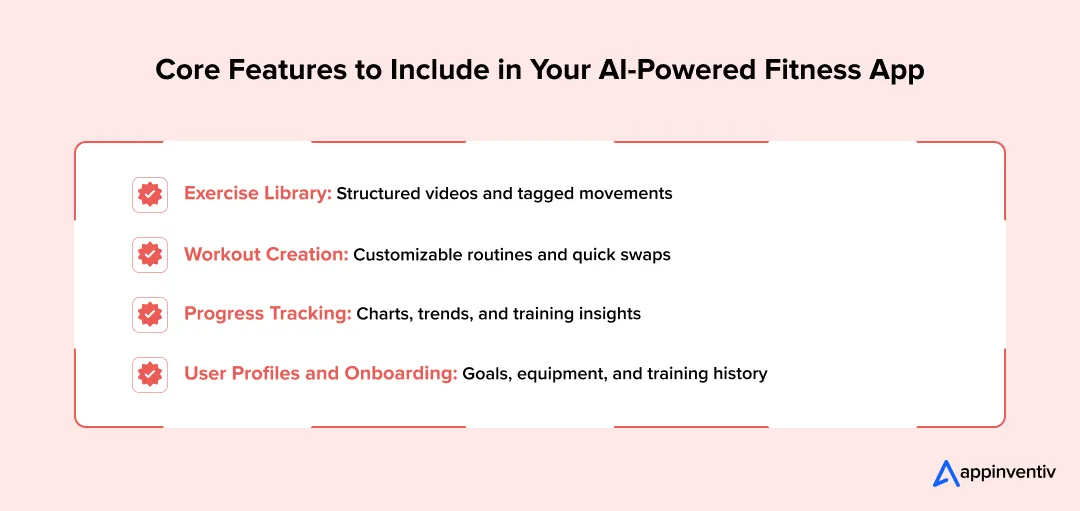
Core Fitness Features and Their Cost Impact
These are the foundation of any fitness app. Even before AI gets involved, the core needs to feel stable backed with an intuitive user interface so users trust the system.
1. Exercise Library
A rich exercise library influences how users progress and how well the AI can match recommendations.
Complexity drivers:
- Video production or licensing
- Muscle group tagging and metadata
- Multiple versions of the same exercise for different equipment
- CDN hosting and fast loading assets
Cost influence: Moderate to high. The AI system depends on well tagged content, so the effort increases if you plan to create an app like Fitbod with high quality videos and structured exercise data.
2. Workout Creation
Users want flexible routines they can build or modify on the spot.
Complexity drivers:
- Sets, reps, rest timers
- Superset and circuit support
- Quick swap logic
- Difficulty filters
Cost influence: Moderate. More logic is required if you want the builder to adjust automatically based on user goals.
3. Progress Tracking
This feature is essential because it shows improvement and lets the AI model learn user patterns.
Complexity drivers:
- Volume calculations and trend storage
- Charts and visual reports
- Weekly and monthly summaries
- Accuracy checks in logged data
Cost influence: Moderate to high. Strong tracking is crucial for developing an AI fitness app like Fitbod, since AI predictions rely on this data.
4. User Profiles and Onboarding
Profiles collect the information the AI uses to build personalized routines.
Complexity drivers:
- Goal based branching paths
- Equipment availability selection
- Past training history input
- Device syncing
Cost influence: Low to medium. Becomes higher if onboarding includes early AI suggestions.
Also Read: Fitness App Development – Step-by-Step Process, Features, Costs & More
AI-Powered Features and Their Cost Impact
AI features are the core reason why the app like Fitbod development cost rises as you move toward a more advanced product. These components require ML engineers, datasets, pipelines, and continuous testing.
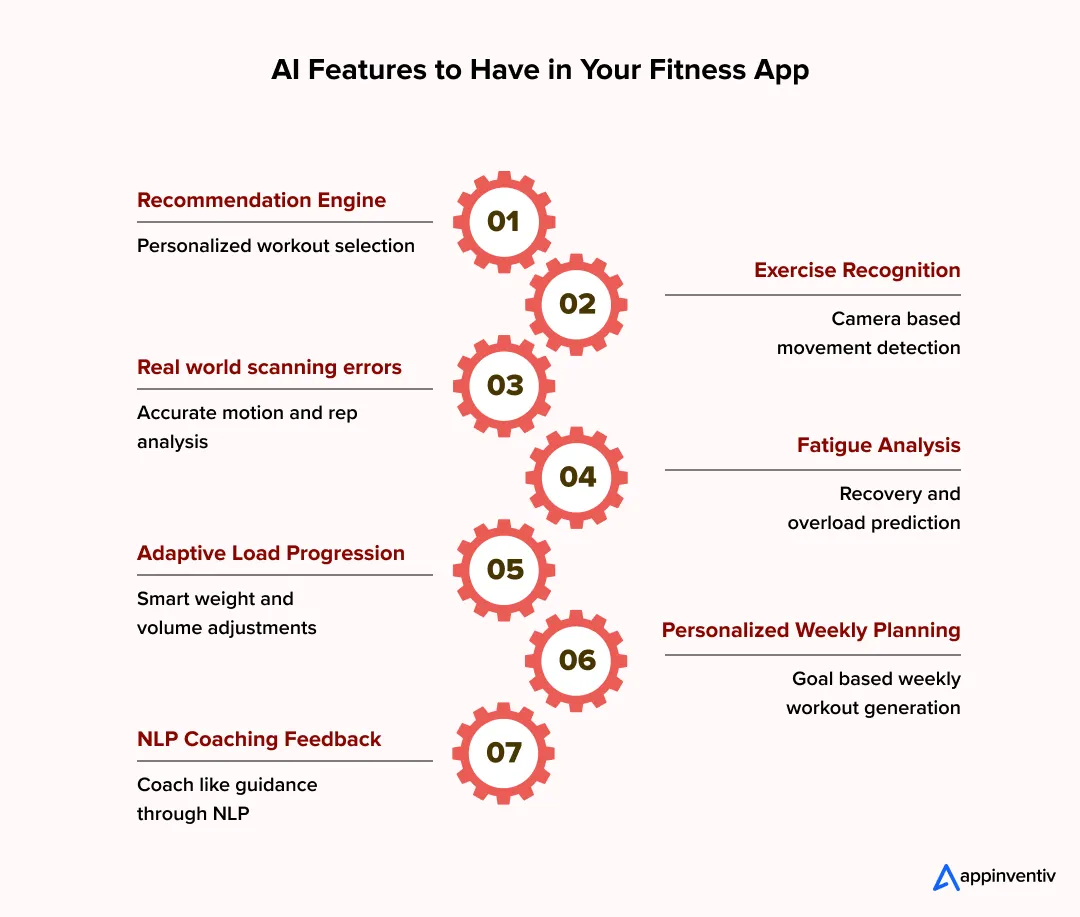
1. Recommendation Engine
The recommendation engine selects workouts the way a human coach would.
Complexity drivers:
- Muscle fatigue scoring
- Load tracking
- Long-term training patterns
- Hybrid ML plus rule logic
Cost influence: High. This is one of the biggest cost factors when you develop an app like Fitbod because personalization accuracy defines user satisfaction and retention.
2. Exercise Recognition
Detects the movement the user is performing through camera or sensor data.
Complexity drivers:
- Pose estimation models
- Joint landmark detection
- Angle calculations
- Distinguishing between similar movements
Cost influence: Very high. Custom datasets and testing across environments make this a significant line item in the Fitbod-like AI fitness app development cost.
3. Rep Counting
Counts reps from video frames or device sensors.
Complexity drivers:
- Motion thresholds
- Timing analysis
- Support for exercises with different movement patterns
- Minimizing false positives
Cost influence: Moderate to high. Cheaper if using pre-trained models, more expensive for custom logic.
4. Fatigue Analysis
Predicts recovery windows and suggests when to reduce intensity.
Complexity drivers:
- Multi-day data modeling
- Volume and intensity trend analysis
- Recovery curve estimation
Cost influence: Medium. ML modeling makes it more expensive than rule based systems.
5. Adaptive Load Progression
Calculates how much weight or volume to add next session.
Complexity drivers:
- Strength curve estimation
- Regression models
- Safety thresholds
- Adjustments for skipped workouts
Cost influence: Medium to high. Costs rise if progression rules vary across user levels and goals.
6. Personalized Weekly Planning
Generates a full weekly routine based on training style.
Complexity drivers:
- Muscle distribution algorithms
- Push, pull, and leg balancing
- Goal based adjustments
- Missed session rearrangement
Cost influence: Medium. Higher if the schedule is dynamically rebuilt using ML.
7. Coach Style Feedback Messages Through NLP
Provides personalized feedback notes like “reduce weight next time if reps slowed down.”
Complexity drivers:
- Using NLP models or LLMs
- Linking model outputs to real training data
- Tone control and safety filtering
Cost influence: High because of inference costs and ongoing model tuning.
Also Read: 15 Use Cases and Examples of How AI Is Transforming the Fitness Industry

Fitness App Integrations and Their Cost Impact
Integrations are a major part of the app like Fitbod development cost because they determine how accurate your tracking can be and how well the app connects with a user’s daily routine. When you create an app like Fitbod, each integration adds its own engineering load, testing requirements, and permission flows. Here is a deeper look at how these pieces influence the total cost to build an app like Fitbod.
Apple Health
Apple Health is essential for US based audiences and is used heavily in Fitbod style apps.
Why it is complex:
- HealthKit permission handling and security
- Background sync for steps, heart rate, calories
- Mapping Apple Health metrics to your AI model
- Graceful failure handling when users disable permissions
Cost influence: Moderate. Costs rise when the AI system relies heavily on Apple Health data.
Google Fit
Google Fit is similar but complicated by the wide range of Android devices.
Why it is complex:
- Different sensors, OS versions, and device manufacturers
- Multiple data sources for the same metric
- Sync inconsistencies on older devices
- Need for fallback logic
Cost influence: Moderate. Testing effort is higher due to device variety, especially when you develop an app like Fitbod for global users.
Wearables
The wearable healthcare technology is very significant. As they offer the most valuable data for AI-powered fitness apps but also introduce major complexity.
Why it is complex:
- Every brand uses its own API
- Some devices require OAuth flows
- Real-time heart rate or motion data needs stable pipelines
- Data normalization is required before feeding models
Cost influence: Significant. This is one of the highest cost areas in the Fitbod-like AI fitness app development cost, especially if the app supports Apple Watch, Garmin, Samsung, and Fitbit together.
Payment Systems
Subscriptions are the main revenue model, so integrating payment gateways are essential.
Why it is complex:
- Apple and Google require separate flows
- Stripe, PayPal, and Razorpay introduce backend event tracking
- Trials, refunds, and currency handling
- Compliance with platform policies
Cost influence: Moderate. Costs increase if the app supports multiple regions or billing cycles, which is common when you create an app like Fitbod for a global audience.
Admin Console Features and Their Cost Impact
A complete fitness product needs a strong admin dashboard. This is where support teams, coaches, and product managers control the system. For many founders, this is the hidden contributor to the app-like Fitbod development cost, because the admin tools require backend logic, analytics pipelines, and strong data governance.
User Management
Admins need tools to view profiles, reset accounts, and handle support tickets.
Why it is complex:
- Multiple admin roles
- Permission based access
- Data masking for sensitive information
- Audit logs for safety
Cost influence: Moderate. Necessary for long-term operations in any product that tries to develop an app like Fitbod.
Workout Data Monitoring
Teams use this dashboard to review training patterns and evaluate feature performance.
Why it is complex:
- Storage of large workout datasets
- Need for real-time or near real-time activity views
- Query optimization for large user counts
- Visualization of trends, patterns, and engagement dips
Cost influence: High. This is often one of the biggest backend expenses in the cost to build an app like Fitbod.
Custom Program Uploads
Lets fitness teams publish new routines and seasonal challenges without developer help.
Why it is complex:
- Validation rules for exercises, reps, and progression
- Version control for updated programs
- Scheduling logic for releases
- Bulk upload tools
Cost influence: Low to medium. More automation increases effort and therefore cost.
Analytics Dashboard
This is the business intelligence tool for the product team.
Why it is complex:
- Requires ETL or ELT pipelines
- Aggregation of large datasets
- Filters for user segments, workout types, device types
- Trend visualizations for retention, performance, and engagement
- Optional AI generated insights
Cost influence: High. This is a key contributor to the Fitbod-like AI fitness app development cost, because analytics is resource intensive and needs ongoing maintenance.
How AI Models Shape the Total Development Cost
AI is the biggest factor behind the Fitbod-like AI fitness app development cost. Core features are predictable, but AI capabilities change the budget quickly because each model needs data, tuning, and compute power. These layers are why the cost to build an app like Fitbod varies so much from one project to another.
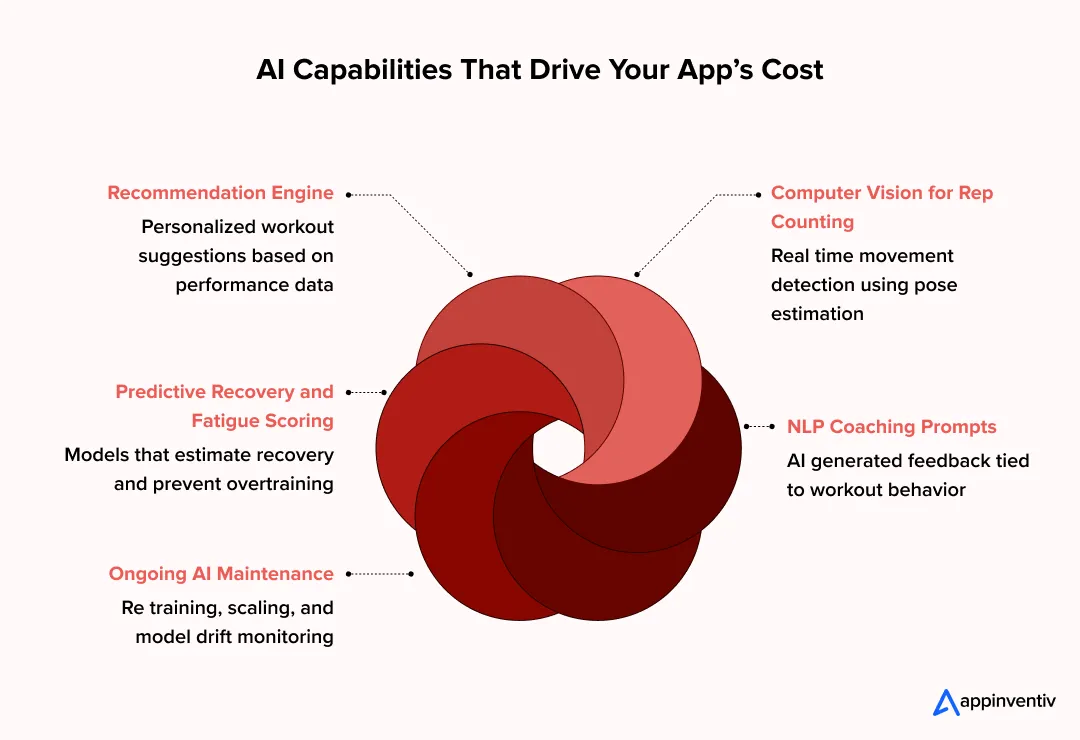
How Much Does a Recommendation Engine Cost to Build?
A recommendation engine is the feature that makes a Fitbod style product feel personal. It suggests the next workout by studying performance, goals, and recovery. This is one of the most important components when you develop an app like Fitbod.
It requires:
- Training data such as sets, reps, fatigue, and strength curves
- Hybrid logic that mixes rules with machine learning algorithms
- Continuous tuning to keep suggestions relevant
- Context mapping for equipment, experience level, and past sessions
Cost influence: High. Personalization accuracy is a major contributor to the app-like Fitbod development cost because the engine requires repeated experimentation and refinement.
What Is the Cost of Building Computer Vision for Rep Counting?
Rep counting may look simple in the UI, but behind the scenes it is one of the most complex AI capabilities. When implementing computer vision, it must work across different body types, camera angles, home lighting, and movement speeds.
It requires:
- Pose estimation models such as MoveNet, BlazePose, or custom TensorFlow models
- Angle and velocity calculations
- Motion event detection for rep start and rep completion
- Sensor fusion if combining phone motion data with camera input
- Real-time inference that avoids visible lag
Cost influence: Very high. This can become the single largest cost driver in the Fitbod-like AI fitness app development cost, especially if accuracy must match premium tools.
How Much Does Predictive Recovery and Fatigue Scoring Cost?
Fatigue scoring adds depth to the experience. It helps prevent overtraining and adjusts intensity week to week. Apps that aim to match Fitbod level intelligence need reliable recovery predictions.
It requires:
- A dataset built from long-term training patterns
- Modeling of stress, rest intervals, and performance curves
- Infrastructure for batch training and recalculations
- AI-powered cloud computing resources for processing large timelines
Cost influence: Medium to high. The more accurate you want the recovery engine to be, the more it increases the cost to build an app like Fitbod.
What Is the Cost of Building NLP Based Coaching Prompts?
NLP powered coaching chatbots give users short, supportive messages that respond to their training patterns. For example, increasing load after consistent performance or suggesting lighter sessions after fatigue spikes.
It requires:
- Fine tuning a lightweight LLM or adapting a base AI model
- Safety layers to filter out risky advice
- Prompt templates tied to real-workout data
- Testing tone, consistency, and context
Cost influence: High. Repeated inference, safety checks, and integration with training logs all add to the broader app like Fitbod development cost.
What Are the Ongoing AI Expenses After Launch?
Teams that are developing an AI fitness app like Fitbod often underestimate how much ongoing AI work is needed. Once the app launches, the models must evolve with user behavior.
It requires:
- Routine re-training of models to maintain accuracy
- Scaling infrastructure as more users join
- Detecting model drift and updating logic
- Annual cloud expenses for inference and storage
Cost influence: Medium to high. Most products allocate 15 to 25 percent of the original build cost per year to keep AI features stable and competitive.
Architecture and Tech Stack for an AI Fitness App
Choosing the right tech stack for Fitbod clone app development directly affects performance, scalability, and the overall app like Fitbod development cost. Strong architecture ensures AI models run smoothly and user experience stays consistent across regions and devices.
- Mobile Technologies: Mobile choices shape how smooth the workouts feel and how well AI features respond. Native apps builds offer better camera performance and stability, which is important when you develop an app like Fitbod. Cross-platform framework does reduce cost but need extra work to support real-time exercise tracking.
- Backend Architecture: The backend handles user accounts, workout history, and AI outputs. A modular backend costs more upfront but offers better long-term performance. Backend design also influences the app like Fitbod development cost, especially when handling large training logs and recommendation requests.
- Data Engineering Stack: Clean data pipelines help AI models make accurate predictions. ETL workflows, validation layers, and warehouse storage help maintain structured training data. This part of the tech stack for Fitbod clone app development ensures your AI engine has reliable inputs.
- AI and ML Frameworks: TensorFlow, PyTorch, and MediaPipe power the core AI features such as fatigue scoring and rep counting. These frameworks affect how fast you can experiment and deploy updates. Custom models raise the overall cost to build an app like Fitbod, while pre-trained models lower it.
- Cloud Services: Cloud platforms handle training workloads, storage, and scaling. GPU enabled servers speed up training but increase cost. Choosing efficient cloud services is essential when founders plan to develop an app like Fitbod without overspending on computers.
- Analytics and Observability: With AI in data governance, analytics tools track user behavior and reveal which workouts keep users engaged. Observability stacks help engineers catch failures early and monitor AI performance. These systems add monthly cost but protect long-term product stability.
- Real-Time Feedback Pipelines: Real-time pipelines allow rep counting, movement tracking, and adaptive workout cues. Low latency systems require optimized streaming, edge inference, or fast server responses. This part of the architecture has a strong impact on the total Fitbod-like AI fitness app development cost.
Compliance, Privacy, and Security Requirements
Fitness apps that use AI must follow strict data rules because they handle sensitive activity patterns, health signals, and personal preferences. Meeting compliance standards adds to the overall project budget, but it also builds trust and protects the business from penalties.
- GDPR: GDPR applies to any product serving users in the EU. Teams must follow data minimization, purpose limitation, and deletion rights. Extra engineering work goes into consent flows, data exports, and user rights portals.
- HIPAA Applicability: HIPAA becomes relevant if the app stores or exchanges clinical health information. While most fitness apps do not fall fully under HIPAA, AI models that use heart rate or recovery data may require partial compliance steps.
- SOC 2 Readiness: SOC 2 focuses on how securely your systems operate. This includes access controls, monitoring, incident response, and audit logs. Preparing for SOC 2 usually requires both technical improvements and documented processes.
- Secure API Integration: APIs must authenticate correctly, validate inputs, and block unauthorized requests. Secure design prevents tampering with workout logs or AI outputs. Good API posture also reduces long-term risk and operational overhead.
- Data Encryption: User data needs encryption in transit and at rest. This protects workout history, health metrics, and AI model outputs from exposure. Cloud level encryption adds minimal overhead but requires careful key management.
- User Consent Management: Users must be able to choose what data is collected and how it is used. Consent tools manage opt in, opt out, and revocation events. These workflows often require additional backend logic and UI clarity.
Budget Needed for Audit and Compliance Preparation
Compliance work adds 10% to 20% to total development cost depending on regions served. Audit preparation requires documentation, logs, and policy updates, which extend the overall project timeline.
Development Timeline Breakdown
Timelines shift depending on feature depth, AI maturity, and the overall app like Fitbod development cost. Most teams move from MVP to mid scale to enterprise as they continue developing an AI fitness app like Fitbod and refine real user feedback.
| Phase or Component | Typical Timeline | What Happens in This Stage |
|---|---|---|
| MVP | 10 to 14 weeks | Core workouts, exercise library, basic tracking, simple personalization, early validation. |
| Mid Scale Release | 4 to 6 months | Improved recommendations, onboarding personalization, analytics, stable backend, first AI features. |
| Full Enterprise Build | 8 to 12 months | Advanced AI, real-time features, dashboards, multi-region support, heavy integrations, scalability work. |
| AI Model Development | 6 to 10 weeks for basic ML, 12 to 20 weeks for custom models | Dataset preparation, fatigue scoring, rep counting, model tuning, accuracy validation. |
| Integrations | 4 to 8 weeks for platform services, 6 to 12 weeks for wearables | Apple Health, Google Fit, payment systems, wearable APIs, sync logic and testing. |
| Testing and QA | Continuous, with a 4 to 6 week final QA cycle | Functional testing, performance checks, AI validation, rep counting accuracy, edge cases. |
- MVP: An MVP takes 10 to 14 weeks and focuses on core workouts, tracking, and a lightweight recommendation flow. This phase helps founders create an app like Fitbod in its simplest form and validate the user journey early.
- Mid Scale Release: A mid scale build takes 4 to 6 months with stronger personalization, analytics, and early AI features. This stage is common for teams monitoring the Fitbod like app development process and preparing for wider release.
- Full Enterprise Build: A full enterprise version takes 8 to 12 months with advanced AI modules, multi-region support, and stronger backend controls. This timeline aligns closely with the higher range of the cost to build an app like Fitbod.
- Timeline for AI Model Development: Basic ML logic takes 6 to 10 weeks, while models for rep counting, fatigue scoring, or adaptive load progression require 12 to 20 weeks. These timelines reflect the largest variable in the Fitbod-like AI fitness app development cost.
- Timeline for Integrations: Apple Health, Google Fit, and payments take 4 to 8 weeks to implement. Wearable integrations add 6 to 12 weeks and directly influence the cost to develop an AI fitness app like Fitbod, since each device brand requires custom work.
- Testing and QA Timeline: Testing runs throughout development but intensifies during the final 4 to 6 weeks. AI features need deeper validation to avoid false predictions. This phase is essential when teams develop an app like Fitbod and prepare for launch.
Monetization and ROI Models
Monetization plays a major role in how teams recover the app like Fitbod development cost and scale revenue. Strong monetization strategies for a fitness app like Fitbod help balance user value with long-term sustainability, especially when you are developing an AI fitness app like Fitbod for a global audience.
Subscriptions
Subscriptions offer stable recurring revenue and are the most common model for AI-driven fitness apps.
Why this works:
- Predictable monthly and yearly revenue
- Users expect ongoing personalization
- Supports long-term AI improvement budgets
Subscriptions help offset development spend early because engaged fitness users stay active for months.
Freemium
A freemium model removes friction and expands the top of the funnel by letting users try essential features before committing.
Typical gated features:
- AI based recommendations
- Advanced analytics
- Specialty workout programs
- Deeper progress insights
This model improves activation and gives users a clear reason to upgrade.
Tiered Access
Tiering lets users choose a plan that matches their fitness level and desired level of personalization.
Common tiers include:
- Basic workouts
- AI-powered recommendations
- Advanced form insights or custom plans
- Priority support or coaching
This increases revenue per user without increasing acquisition costs.
Personal Coaching Upsells
Upsells add a human layer on top of AI guidance and help recover build costs faster.
Popular upsell formats:
- Video-based form checks
- Weekly personalized plans
- Chat-based coaching sessions
This hybrid model blends automation with human expertise, raising average user value.
Corporate Wellness Integrations
Corporate licensing brings large user groups at once and offers strong ROI.
Why companies adopt this model:
- Employee wellness incentives
- Bulk licensing lowers individual acquisition cost
- Higher engagement due to structured programs
This stream often generates stable renewals and long-term accounts.
Also Read: How Do Free Apps Make Money: A Descriptive Guide
Cost Reduction Tips When Building an AI Powered Fitness App
Reducing the total development expense is possible when teams plan the product roadmap carefully and avoid overbuilding early on. A structured discovery phase helps define scope clearly, estimate integration costs, and control cloud infrastructure costs before development begins. Many teams also save by starting with an MVP to validate the idea before investing in advanced AI features.
Practical ways to lower development cost include:
- Start with MVP development and scale only after user validation
- Use pre built components and build reusable modules wherever possible
- Optimize platform centric customizations to reduce iOS and Android workload
- Choose a fixed price model for predictable features
- Lower integration costs by choosing simpler healthcare APIs early
- Reduce cloud bills with gradual compute scaling and storage planning
- Use team augmentation or outsourcing depending on the location of the development team
- Improve planning and budgeting during the discovery phase to avoid rework
Hidden Factors Affecting the Cost to Build an AI-Powered Fitness App Like Fitbod
Teams often estimate the visible engineering work but overlook smaller technical and operational expenses that quietly increase the total app like Fitbod development cost. These hidden elements can influence timelines, cloud usage, testing cycles, and the accuracy of AI features, which affects both the user experience and long-term ROI when developing an AI fitness app like Fitbod.
Content Production and Exercise Media
Exercise libraries seem simple at first, but production quality has a strong effect on user trust and AI accuracy. Filming, editing, tagging muscles, and managing media storage all add costs that founders underestimate when calculating the cost to build an app like Fitbod. Even stock videos require metadata work so the AI recommendation engine can use them correctly.
Dataset Preparation for AI
AI models need structured, labeled, and validated data to function well. Preparing datasets for pose estimation, rep detection, and fatigue scoring becomes a major hidden cost in any Fitbod-like AI fitness app development cost. Teams must clean workout logs, annotate movements, and build edge case samples so models perform reliably across real users.
Real Device Testing for Computer Vision
Computer vision features behave differently across lighting conditions, camera quality, and device generations. Real-world testing on low-end Android devices, older iPhones, and varied environments often takes longer than planned. These test cycles add quiet but meaningful expenses during developing an AI fitness app like Fitbod, especially for rep counting and form tracking.
Cloud Training and Inference Spikes
AI workloads are not predictable. Training new models, running inference at peak workout hours, and storing large datasets create cloud cost spikes. GPU-based training jobs and inference bursts can meaningfully increase the app like Fitbod development cost, particularly as the user base grows and demands more personalized workout recommendations.
Third Party Integration Updates
Apple Health, Google Fit, and wearable platforms update APIs several times a year. Maintaining compatibility requires recurring engineering work that teams rarely include in initial budgeting. These updates directly affect the ongoing cost of developing an AI fitness app like Fitbod, especially when syncing health metrics and workout data across devices.
Security and Compliance Upgrades
Initial security may cover the basics, but scaling the app or serving corporate clients requires deeper compliance readiness. SOC 2, GDPR, and penetration testing often introduce costs that founders do not anticipate when estimating the cost to build an app like Fitbod. These improvements are essential for user trust and enterprise partnerships.
Customer Support and Admin Tools
Internal dashboards for support teams, subscription management tools, debugging workflows, and content upload modules are often added late in development. These tools become necessary once users start interacting with the system at scale, adding hidden work to any Fitbod-like AI fitness app development cost.
Maintenance for AI Drift and Feature Evolution
AI models degrade over time as user behavior evolves. This requires periodic retraining, threshold adjustments, and dataset expansion. Drift monitoring and ongoing tuning become recurring operational expenses when you develop an app like Fitbod, ensuring models stay accurate and workouts remain personalized.

Build Your Fitbod-like Fitness App with Appinventiv
As the fitness app industry evolves, there is an increasing demand for applications that deliver personalized, engaging, and effective health and wellness solutions. To differentiate yourself in this competitive market, it’s crucial to partner with a top artificial intelligence development company that excels in both technical expertise and user experience design.
Appinventiv is uniquely positioned to help you achieve this through our specialized AI-powered fitness app development services. Our expertise is evident from their work on projects like Soniphi, which provides a comprehensive health management platform, and Health-e-People, designed to enhance user wellness. As a reputed AI fitness app development services provider, our approach combines advanced technology with innovative design, ensuring that your fitness app not only meets but exceeds user expectations.
Our track record of success and commitment to delivering high-quality solutions make us an ideal partner for turning your fitness app concept into a reality. Begin your journey with Appinventiv to uncover the complete cost to develop an AI fitness app like Fitbod. Bring your vision for a next-generation fitness app to life with our expert guidance.
FAQs
Q. How does the Fitbod app work?
A. Fitbod adjusts workouts based on your history, available equipment, and recovery level. It uses machine learning to recommend sets, reps, and intensity tailored to each user. This approach is also useful when creating a digital fitness solution like the Fitbod app, since personalization is the core of user engagement.
Q. How much does it cost to build an AI-powered fitness app like Fitbod?
A. The cost ranges from $40,000 to $400,000 depending on features, AI depth, and platform support. Complex capabilities such as rep counting, fatigue scoring, and real-time recommendations increase the cost to develop an AI fitness app like Fitbod, especially when building for scale.
Q. How long does it take to develop an app like Fitbod?
A. Timelines usually fall between 10 weeks for an MVP and up to 12 months for a full enterprise build. Factors such as AI model complexity, integrations, and testing cycles shape delivery speed. These timelines align with the growing market trend for AI-powered fitness apps, where users expect smarter and faster recommendations.
Q. Is Fitbod available on the Apple Watch?
A. Yes, Fitbod offers an Apple Watch version that tracks sets, rest, and progress without needing the phone during workouts. When building similar features, support for wearables enhances user experience and highlights the benefits of developing an AI based fitness platform focused on convenience and real-time insights.
Q. Which one is the best workout app?
A. The best app depends on the user’s goals, training style, and experience level. Fitbod is popular for strength training, while other apps focus on cardio or guided classes. The rise of AI-driven personalization continues to influence user preferences, proving strong demand for Creating a Digital Fitness Solution Like The Fitbod App with adaptive workout intelligence.


Fast 2-minute response, fully NDA-protected.
The Multiplier Effect of AI Agents: The Rise of AI Swarms
Key takeaways: AI agent swarms coordinate specialized agents to solve complex problems that may be difficult for a single agent to handle effectively. More agents do not automatically mean better outcomes. Swarms deliver value when work can be divided, executed in parallel, and coordinated toward a shared objective. Enterprise readiness depends on governance. Clear accountability,…
AI Data Integration: How to Connect, Clean and Prepare Data for AI
Key takeaways: AI initiatives fail when fragmented, poor-quality data reaches models without sufficient context, controls or ownership. AI-ready pipelines must connect, clean, enrich, govern and continuously monitor data across its lifecycle. Real-time processing matters when AI decisions depend on current transactions, events, inventory or operational conditions. Data architecture should follow the AI use case, balancing…

AI-Native SDLC: Foundational 90-Day, 5R AI SDLC Adoption Playbook
Key takeaways: Why AI coding tools accelerate coding and software delivery How AI-native SDLC shifts engineering from code to intent, context, and outcomes The role of specifications, AI agents, and continuous verification in enterprise delivery How to redesign engineering teams for human–agent collaboration The platform, governance, and guardrails required to scale AI-native development A practical…