
































25 Lucrative eCommerce Business Ideas to Start in 2026

 Share -



- 01A Quick Insight into the eCommerce Market: A Gateway to Unprecedented Growth Opportunities
- 02Profitable eCommerce Business Ideas to Start in 2026
- 03How to Choose the Right eCommerce Business Idea?
- 04How to Turn Your eCommerce Idea into a Working Business
- 05The Roadblocks Ahead: Common eCommerce Challenges and How to Tackle Them
- 06eCommerce Success Stories: Real Results From Appinventiv Projects
- 07Why Appinventiv is the Ideal Partner for Your eCommerce Dreams
- 08FAQs

Key takeaways:
- 2026 favors fast movers, so treat eCommerce as a primary channel and start now.
- AI is the new engine of eCommerce, powering personalization, automation, and higher conversions.
- Focus on one clear niche, validate demand quickly, and build on real customer insights.
- Track the math early, with contribution margin, LTV to CAC, and payback guiding decisions.
- Build for scale with compliant operations, dependable logistics, and an integrated tech stack.
- Learn from global leaders to combine ecosystems, great experiences, and data-driven optimization.
The eCommerce market has moved well beyond its early growth phase. In 2026, online retail is a major part of how consumers discover, compare, and purchase products.
Global retail eCommerce sales will reach about $6.88 trillion in 2026, accounting for roughly 21.1% of total retail sales. The U.S. market also continues to expand. Retail eCommerce sales reached $340.2 billion in the second quarter of 2026, up 12.2% from the same quarter in 2025.
For entrepreneurs, the opportunity is no longer simply about putting products online. Success depends on choosing the right niche, understanding customer demand, managing margins, and building a buying experience that can scale.
AI is also changing how shoppers discover and evaluate products. Personalization, conversational search, automated customer support, recommendation engines, and smarter merchandising are becoming important parts of modern eCommerce operations.
That creates opportunities across product categories, subscription models, specialized marketplaces, and technology-enabled commerce.
In this guide, we explore 25 eCommerce business ideas for 2026, along with their target audiences, market trends, profitability factors, and technology investment considerations.
Turn your eCommerce idea into a scalable digital business with the right strategy, technology, and execution support.

A Quick Insight into the eCommerce Market: A Gateway to Unprecedented Growth Opportunities
The eCommerce market today is not just growing – it’s racing ahead of everything else in retail. Each year, a bigger chunk of shopping happens online, and that shift is now permanent. What started as convenience has turned into habit. People buy clothes, groceries, medicines, and even furniture online without thinking twice. For entrepreneurs, this means the list of eCommerce business opportunities is longer than ever.
As per Statista, eCommerce revenue in the U.S. is likely to touch $1.22 trillion by the end of 2026 and climb to around $1.51 trillion by 2030, moving at roughly 5.51% CAGR. This steady rise shows how buyers now trust online transactions more, while delivery systems and digital payments have become smoother and faster. Compared to physical stores, online business continues to grow stronger on every front – scale, reach, and profit.
Across the world, more than 4 billion people are expected to shop online by 2030, which means over half of all retail purchases will happen digitally. That’s no small signal. Whether you’re an existing brand or a new founder, this is the time to take your eCommerce business ideas seriously. The market isn’t waiting for anyone; it’s expanding every single day.
And there’s another big change shaping this growth – Artificial Intelligence. AI has quietly turned eCommerce from being just “digital” to being “intelligent.” The market for AI-powered eCommerce tools is set to touch $17 billion by 2030, while Natural Language Processing (NLP) systems used in chatbots, virtual assistants, and smart searches may cross $112 billion. By then, AI could handle nearly 80% of customer interactions, helping brands offer faster replies, better recommendations, and more personal shopping journeys. Smarter product suggestions powered by AI already show results – tripling revenue for some businesses and doubling conversion rates.
In plain words, eCommerce is heading into an AI-powered revolution. The brands that mix strong digital presence with automation and real data will lead the next decade of global commerce. If you’ve been holding an idea, this is the moment to act – because the future of shopping is already here.
Profitable eCommerce Business Ideas to Start in 2026
In the rapidly expanding eCommerce landscape, identifying the right niche can set you apart and pave the way for substantial success. Here are 20+ eCommerce ideas that can help you flourish in 2026.
| Business Ideas | Audience | USP / Trends |
|---|---|---|
| Automotive Parts eCommerce | DIY vehicle owners, repair shops, fleet operators | Vehicle-fit search, digital catalogs, faster fulfillment |
| Jewellery eCommerce | Fashion shoppers, gift buyers, bridal customers | Personalization, virtual try-ons, social commerce |
| Health & Wellness Products | Fitness buffs, professionals | Personalized plans, mental health focus |
| Customized Beauty Products | Beauty enthusiasts (18–40 Age) | AI customization, eco-friendly packaging |
| Private Label Beauty Products | Entrepreneurs, bloggers | Clean beauty, niche branding |
| Sustainable Fashion Store | Eco-conscious millennials, Gen Z | Carbon-neutral shipping, supply chain transparency |
| Smart Home Devices | Tech-savvy homeowners, Gen X | Energy-saving, privacy-focused devices |
| Pet Care Products | Millennial & Gen Z pet owners | Sustainable packaging, pet health tech |
| Gourmet Food Subscriptions | Foodies, home chefs | Virtual cooking classes, plant-based options |
| Handmade Goods | Authenticity seekers, gift buyers | Artisan stories, limited-edition drops |
| Niche Subscription Boxes | Hobbyists, collectors | Influencer partnerships, exclusive items |
| Online Learning Platforms | Learners, career switchers | Gamified learning, micro-credentials |
| Specialized Children’s Toys | Parents, educators | Inclusivity, sustainable materials |
| Online Book Store | Book lovers, collectors | Signed copies, indie author focus |
| Organic & Natural Products | Health-conscious families | Certifications, zero-waste packaging |
| Online Medicine Delivery Store | Urban consumers, local pharmacies | Regional coverage, hyper-local delivery |
| DIY Craft Kits | Crafters, parents | Video tutorials, eco-friendly materials |
| Fitness Equipment & Apparel | Fitness buffs, remote workers | Compact designs, smart tech integration |
| Art Supplies Subscription Box | Artists, students | Project ideas, rare materials |
| Artisan Coffee & Tea Subscription | Coffee/tea lovers | Tasting notes, single-origin focus |
| AI-Powered Personal Shopping Assistant | Online retailers, digital shoppers | Predictive recommendations, personalization |
| Eco-Friendly Packaging Store | Small businesses, D2C brands | Custom recyclable packaging, low-waste solutions |
| AI-Driven Content Creation Tools | eCommerce brands, marketers | Automated SEO copy, tone-matched listings |
| Smart Health Monitoring Devices | Health-conscious consumers, professionals | AI insights, wearable data tracking |
| AI-Based Virtual Interior Design Platform | Homeowners, real estate buyers | AR previews, AI-generated layouts |
1. Automotive Parts eCommerce
The automotive aftermarket is moving further into online purchasing as customers seek easier product discovery, vehicle compatibility checks, and faster delivery. The global automotive aftermarket ecommerce market is projected to reach $128.61 billion in 2026.
- Audience: DIY vehicle owners, repair shops, dealerships, and fleet operators.
- Trends: Vehicle-fit search, digital catalogs, VIN lookup, and faster fulfillment.
- Why profitable: Replacement parts, accessories, and maintenance products can drive repeat purchases.
- Development investment: $60,000–$150,000+ for a custom platform with fitment, inventory, B2B, payments, and delivery features.
2. Jewellery eCommerce
Jewellery is a strong online category where personalization, convenience, and digital discovery can influence buying decisions. The global jewellery market is projected to reach $397.7 billion in 2026.
- Audience: Fashion shoppers, gift buyers, bridal customers, and luxury shoppers.
- Trends: Personalization, virtual try-ons, customization, and social commerce.
- Why profitable: High-value purchases, customization, gifting, and premium collections can support strong margins.
- Development investment: $40,000–$120,000+ for ecommerce, customization, visualization, recommendations, and virtual try-on features.
3. Health & Wellness Products
Health has become a daily subscription in itself and that’s why this sits high on any list of thriving categories. From gut-friendly snacks to posture correction devices, consumers are actively searching for what keeps them balanced and sane.
This is one of those markets where consistency matters more than novelty. You’re not chasing fads; you’re building routines. Pair credible sourcing with plain-spoken education – what works, what doesn’t and your customers will trust your advice as much as your store.
- Audience: Fitness buffs, professionals, wellness-focused consumers, and families.
- Trends: Personalized wellness, functional foods, subscriptions, and preventive health.
- Why profitable: Consumables and replenishable products create repeat-purchase opportunities.
- Development investment: $40,000–$120,000+ for subscriptions, personalization, health integrations, and recommendations.
4. Customized Beauty Products
Here’s why this vertical stands out. The beauty market is noisy, but personalization cuts through it. Building a brand around customized skincare or makeup is profitable because people love products that feel designed for them. From shade matchers to ingredient quizzes, you’re turning data into beauty and that personalization keeps customers hooked.
It’s one of those profitable eCommerce business ideas where the margins and loyalty go hand in hand. When customers trust your formula, they reorder without hesitation. Layer it with transparency; talk about the science, the process, even the failure stories and you’ll see the difference in lifetime value.
- Audience: Beauty enthusiasts, skincare shoppers, makeup users, and personalized-beauty customers.
- Trends: AI recommendations, virtual try-ons, personalized formulations, and social commerce.
- Why profitable: Beauty products encourage repeat purchases and support bundles, subscriptions, and loyalty programs.
- Development investment: $50,000–$130,000+ for personalization, shade matching, virtual try-ons, subscriptions, and loyalty.
5. Private Label Beauty Products
Private labeling gives you the power of ownership without the production headaches. You can focus entirely on branding and positioning while your manufacturing stays white-label. The demand for locally made, cruelty-free beauty is climbing and customers don’t care who made it, they care whose name they remember.
This model gives you flexibility, allowing you to test markets fast, tweak formulas, and rebrand without heavy sunk costs. The play here is storytelling. Make your label feel like a movement, not just another product line, and you’ll see the difference in lifetime value.
- Audience: Entrepreneurs, bloggers, beauty creators, and niche beauty shoppers.
- Trends: Clean beauty, local production, ingredient transparency, and D2C brands.
- Why profitable: Branding, pricing control, customization, and repeat beauty purchases support revenue growth.
- Development investment: $30,000–$100,000+ for a custom storefront with subscriptions, loyalty, and recommendations.
6. Sustainable Fashion Store
Here’s why this works if you’re planning your next vertical. Sustainability isn’t a side trend anymore but is shaping how people shop. This sits among the most promising segments right now because consumers are choosing purpose over price. They’re checking tags, asking about fabric origins, and trusting brands that talk about impact as much as design.

Think of it as one of those rare categories that age well. Every new collection can build storylines around recycling, ethical sourcing, or low-carbon packaging. The audience is loyal, margins grow as your credibility does, and you’re building more than a brand – you’re building trust that compounds every season.
- Audience: Eco-conscious millennials, Gen Z, and ethical fashion shoppers.
- Trends: Recycled materials, resale, traceability, and low-impact packaging.
- Why profitable: Limited collections, differentiation, customization, and resale can create additional revenue.
- Development investment: $30,000–$90,000+ for ecommerce, personalization, traceability, or resale features.
7. Smart Home Devices
Smart living has quietly turned into a habit, not a luxury. Homes are getting smarter, people want control from their phones, and they’ll happily pay a premium for reliability.

What makes this one of the promising ecommerce ideas is the repeat purchase loop – once someone starts automating, they keep upgrading. Offer honest reviews, setup support, maybe bundled deals with voice assistants and you’ve got a niche that keeps evolving with tech, not against it.
- Audience: Tech-savvy homeowners, renters, and connected-home adopters.
- Trends: Energy efficiency, smart security, voice control, and privacy.
- Why profitable: Device upgrades, bundles, accessories, and installation support support repeat revenue.
- Development investment: $40,000–$120,000+ for ecommerce, device integrations, subscriptions, or remote monitoring.
8. Pet Care Products
You’ll rarely see a customer more loyal than a pet parent, which makes this one of the easiest yet most rewarding segments to step into. Pet spending is recession-proof; people skip their own luxuries before they skip their dog’s treats.
The opportunity here isn’t about competing with giants but about community. Alongside your storefront, a dedicated pet care app can help you build features that feels personal, show real pets using your products, and answer small everyday problems. When you do that, you’re not just selling, you’re becoming part of the family.
- Audience: Millennial and Gen Z pet owners, families, and pet professionals.
- Trends: Pet wellness, subscriptions, sustainable products, and connected devices.
- Why profitable: Food, treats, grooming, and other consumables can drive repeat orders.
- Development investment: $30,000–$90,000+ for subscriptions, pet profiles, recommendations, and loyalty features.
9. Gourmet Food Subscriptions
This one plays beautifully between indulgence and routine. Gourmet food boxes remain a clever niche because they let customers experience luxury without effort. A new flavor every month, a chef-curated mix, something to share at the table – it’s simple and addictive.
It’s also a quiet goldmine if you manage logistics right. Subscription models mean recurring revenue; storytelling keeps customers emotionally tied to the box. It’s not just about food but about anticipation, and that’s what makes it stick.
- Audience: Foodies, home chefs, gift buyers, and specialty-food shoppers.
- Trends: Curated boxes, seasonal products, plant-based options, and recurring delivery.
- Why profitable: Subscription revenue creates repeat sales and more predictable demand.
- Development investment: $35,000–$90,000+ for subscriptions, preferences, inventory, and delivery scheduling.
10. Handmade Goods
There’s something people still crave in a digital world – authenticity. Customers buy handmade because they buy the maker’s story – they want imperfections, not mass production. Each product becomes a conversation piece, not just a purchase.
This is one of the ecommerce ideas that has open opportunities across home decor and sustainable gifting, especially once you understand the marketplace app cost involved in scaling a multi-seller model. It scales slower, but it builds deeper roots. Once customers connect to the human side behind your craft, they don’t switch but follow.
- Audience: Gift buyers, design-conscious shoppers, and collectors.
- Trends: Customization, limited drops, maker stories, and personalized gifting.
- Why profitable: Small-batch and personalized products can command premium pricing.
- Development investment: $20,000–$60,000+ for ecommerce, customization, and creator features.
11. Niche Subscription Boxes
Curation is the new convenience. Subscription boxes built around narrow interests – skincare for travelers, plant lovers, or fitness addicts – are among the fastest-growing concepts right now. Customers pay for surprises, not just stuff.
This model is built on rhythm and personalization. Keep your boxes fresh, themed, and experiential. Build a community around discovery, use content to tease what’s coming next, and you’ll have a brand that sells emotion, not inventory.
- Audience: Hobbyists, collectors, and niche-interest communities.
- Trends: Personalized boxes, memberships, influencer partnerships, and exclusive products.
- Why profitable: Recurring billing and curated products support predictable revenue.
- Development investment: $30,000–$80,000+ for subscriptions, preferences, inventory, and churn tracking.
12. Online Learning Platforms
Learning has shifted from lecture halls to browser tabs, which makes this one of the sharpest ecommerce startup ideas for 2026. People want to upskill fast with short courses, certifications, mentorships and they’re willing to pay if the value feels practical.
Example: Dr. Reddy’s E-Learning Platform
Dr. Reddy’s Foundation, a non-profit organization dedicated to empowering communities through health, education, skill development, and climate action, sought to enhance educational access for economically disadvantaged groups.
Dr. Reddy’s Foundation approached Appinventiv to develop an inclusive Dr. Reddy’s eLearning platform for underprivileged students, especially those with visual and hearing impairments. The collaboration resulted in the creation of both web and mobile applications featuring:
- Impairment modes
- Dynamic theme colors
- Sign language support
- A unique course creation functionality
- Video recording and editing tools
- A robust admin panel
Results:
The mobile application achieved over 5,000 downloads within the first two months of launch, underscoring its impact and success.
It’s also one of the most legit directions because the cost of delivery stays low while the reach keeps growing. Add interactive sessions, AI tutors, or real-world project tie-ins and you’re not just selling education; you’re selling transformation.
- Audience: Learners, professionals, and career switchers.
- Trends: Microlearning, AI tutors, certifications, and project-based learning.
- Why profitable: Digital courses have low delivery costs and support subscriptions, memberships, and certifications.
- Development investment: $50,000–$150,000+ for course delivery, assessments, live classes, and AI tutoring.
13. Specialized Children’s Toys
Parents don’t just buy toys anymore but invest in learning experiences. STEM kits, wooden puzzles, or sensory play items that build skills are all seeing steady global growth.
The opportunity here lies in the parent’s psychology – safety, development, and trust. If you design toys that look fun but teach quietly in the background, you’ll own a category that keeps renewing every generation.
- Audience: Parents, educators, schools, and gift buyers.
- Trends: STEM toys, sensory play, inclusive design, and sustainable materials.
- Why profitable: Children move through age groups quickly, supporting repeat purchases.
- Development investment: $30,000–$80,000+ for recommendations, subscriptions, and interactive content.
14. Online Book Store
Books have a way of staying relevant, even when every other product goes digital. That’s why an online bookstore focused on niche genres or self-published authors still works beautifully. Curate what big platforms overlook – regional stories, translated literature, academic collections.
This is one of those ideas that grow by community. Add book clubs, author sessions, or early access previews and let your brand feel like a reading space, not a transaction page.
- Audience: Book lovers, collectors, students, and niche readers.
- Trends: Indie authors, curated collections, memberships, and book communities.
- Why profitable: Signed editions, memberships, merchandise, and niche collections create differentiation.
- Development investment: $25,000–$70,000+ for search, recommendations, memberships, and community features.
15. Organic & Natural Products
Clean living is no longer a niche; it’s mainstream. Selling natural and organic goods, from skincare to superfoods, sits high among the best ideas to grow. Customers are tired of chemical-heavy brands and actively seek products they can understand.
The opportunity here lies in clarity. Show your ingredients, talk about sourcing, share farmer stories. When you do that, your product stops being another SKU – it becomes trust on a shelf.
- Audience: Health-conscious families and wellness-focused consumers.
- Trends: Clean labels, certifications, natural ingredients, and refill models.
- Why profitable: Consumables can create repeat orders, subscriptions, and bundles.
- Development investment: $30,000–$80,000+ for ecommerce, subscriptions, recommendations, and loyalty features.
Also Read: How To Build An Organic E-commerce Platform That Links Farmers Directly To The Buyers?
16. Online Medicine Delivery Store
Convenience meets necessity here, especially when paired with a hyperlocal delivery app that gets orders to customers fast. An online medicine platform is an amazing opportunity to invest in because health doesn’t pause. When you deliver reliability, verified prescriptions, and quick service, customers don’t compare prices but stay.
It is one of the eCommerce business ideas that thrives on accuracy and compliance. Build secure systems, ensure doctor partnerships, and make privacy part of your brand promise. It’s one of the few categories where consistency is reputation.
- Audience: Urban consumers, patients, caregivers, and pharmacies.
- Trends: Digital prescriptions, delivery, medication reminders, and telehealth.
- Why profitable: Repeat-use medicines and healthcare products can create recurring demand.
- Development investment: $60,000–$180,000+ for prescription verification, secure data, pharmacy workflows, and healthcare integrations.
17. DIY Craft Kits
Creativity sells when people can touch it. DIY kits for candles, resin art, embroidery and more remain popular globally. They’re fun, repeatable, and make people feel accomplished.
The opportunity here is light on overheads but big on experience. Focus on presentation, easy tutorials, and quality materials. You’re not just selling crafts – you’re selling time well spent.
- Audience: Crafters, parents, beginners, and hobbyists.
- Trends: Guided kits, tutorials, creator partnerships, and sustainable materials.
- Why profitable: New projects, seasonal kits, and refill materials encourage repeat purchases.
- Development investment: $20,000–$60,000+ for ecommerce, video content, community, and subscriptions.
18. Fitness Equipment & Apparel
The wellness wave keeps getting stronger. Fitness gear and smart apparel continue to top lists of great ventures because the health mindset isn’t slowing down. Whether it’s resistance bands, connected wearables, or fitness app to track it all, people are investing in themselves.
The idea also pairs beautifully with influencer ecosystems. Build a brand that’s equal parts motivation and utility – and you’ll never struggle with retention.
- Audience: Fitness buffs, athletes, home exercisers, and remote workers.
- Trends: Smart equipment, connected fitness, performance apparel, and home workouts.
- Why profitable: Equipment, apparel, accessories, and connected services create multiple revenue streams.
- Development investment: $35,000–$100,000+ for ecommerce, sizing tools, subscriptions, and device integrations.
19. Art Supplies Subscription Box
Artists love discovery and that’s why this sits high among modern creative ventures. A monthly box with curated tools, brushes, and papers keeps the creative community engaged.
This opportunity is built on inspiration. Send samples, host virtual workshops, feature user art – your brand becomes part of their process, not just their purchase.
- Audience: Artists, students, and hobbyists.
- Trends: Curated materials, project boxes, workshops, and creator content.
- Why profitable: Subscription revenue and premium materials support repeat sales.
- Development investment: $25,000–$70,000+ for subscriptions, customer preferences, and community features.
20. Artisan Coffee & Tea Subscription
Caffeine culture never fades; it evolves. That’s why specialty brews and blends still rank among the strongest lifestyle concepts worldwide. Subscribers crave discovery and want to taste stories, not just beans.
This approach wins with authenticity. Partner with local roasters, share origin tales, include tasting notes – you’ll have customers who stay for the ritual, not the product.
- Audience: Coffee and tea lovers, specialty beverage shoppers, and gift buyers.
- Trends: Single-origin products, traceability, subscriptions, and tasting experiences.
- Why profitable: Subscription plans encourage recurring purchases and predictable demand.
- Development investment: $25,000–$70,000+ for subscriptions, preferences, loyalty, and delivery scheduling.
21. AI-Powered Personal Shopping Assistant
Personalization at scale and that’s where retail is heading. Building an AI shopping companion is one of the smartest innovations to explore in 2026. Built on a smart ML recommendation system, it recommends, compares, and remembers preferences better than any human assistant.
This is a profitable venture because it adds real utility to every online store. Integrate it with major platforms, license it to retailers, and you’re solving a universal customer pain point – choice fatigue.
- Audience: Online retailers, marketplaces, brands, and digital shoppers.
- Trends: Conversational commerce, AI recommendations, intent-based search, and personalization.
- Why profitable: SaaS subscriptions, licensing, and API access can create recurring B2B revenue.
- Development investment: $80,000–$250,000+ for AI infrastructure, recommendation systems, integrations, and analytics.
22. Eco-Friendly Packaging Store
Every brand, from small sellers to large enterprises, needs this. Launching a packaging brand built on biodegradable or recycled materials is one of the most practical ideas today. Sustainability isn’t optional anymore; it’s compliance.
This gives you access to B2B and D2C customers alike. The opportunity isn’t just in selling boxes but in designing smarter ones that ship safely and leave zero guilt behind.
- Audience: Small businesses, D2C brands, retailers, and subscription businesses.
- Trends: Recyclable materials, lightweight packaging, reusable formats, and custom packaging.
- Why profitable: B2B buyers can generate larger repeat orders and custom packaging can support better margins.
- Development investment: $30,000–$80,000+ for B2B pricing, bulk ordering, quotations, and custom packaging tools.
23. AI-Driven Content Creation Tools
When it comes to exploring business opportunities in ecommerce, AI-driven content creation tools tops the list. The demand for faster, smarter content is unstoppable, making this one of the most lucrative creative ventures to enter into. Writers, marketers, and designers who want to build an AI app that doesn’t feel robotic are driving this demand.
It’s a forward-looking direction if you offer flexible plans and creative add-ons. Blend AI efficiency with human oversight – let your users co-create instead of just generate.
- Audience: eCommerce brands, marketers, agencies, and marketplace sellers.
- Trends: Generative AI, product-content automation, localization, and brand-voice controls.
- Why profitable: SaaS subscriptions, usage tiers, APIs, and enterprise plans support recurring revenue.
- Development investment: $70,000–$200,000+ for AI integrations, workflows, billing, APIs, and analytics.
24. Smart Health Monitoring Devices
Preventive healthcare is where the real growth lies. Smart devices that track vitals or habits are now essentials, making this one of the strongest tech-meets-health plays of the decade.
This opportunity connects directly to peace of mind – parents, seniors, fitness enthusiasts. Position your brand as the bridge between data and wellbeing, not just another gadget seller.
- Audience: Health-conscious consumers, fitness users, caregivers, and seniors.
- Trends: Wearables, remote monitoring, AI insights, and connected health.
- Why profitable: Hardware can be paired with subscriptions, premium analytics, and accessories.
- Development investment: $60,000–$180,000+ for mobile apps, device connectivity, cloud systems, and health integrations.
25. AI-Based Virtual Interior Design Platform
Design meets intelligence here. An AI platform that visualizes interiors before purchase stands out as a futuristic idea for next-gen consumers. Customers can see, edit, and order – all in one immersive session.
It is one of the legit eCommerce business ideas that removes guesswork, reduces returns, and turns inspiration into instant conversion. You can call it experiential retail at its smartest.
- Audience: Homeowners, renters, interior designers, and real estate buyers.
- Trends: AI layouts, AR visualization, virtual staging, and shoppable design.
- Why profitable: Product sales, commissions, premium design services, and partnerships create multiple revenue streams.
- Development investment: $70,000–$200,000+ for AI, AR, room mapping, product catalogs, and ecommerce integrations.
Turn your shortlisted eCommerce business idea into a scalable digital store with the right strategy, design, technology, and integrations

How to Choose the Right eCommerce Business Idea?
Picking the right ecommerce business idea isn’t about trends. It’s about you; what you know, what you can manage, and how much risk you’re ready to take. The best online ventures grow from a mix of skill, timing, and a market that actually wants what you plan to sell. You don’t need to overthink it. You just need a clear starting point and the discipline to test fast.
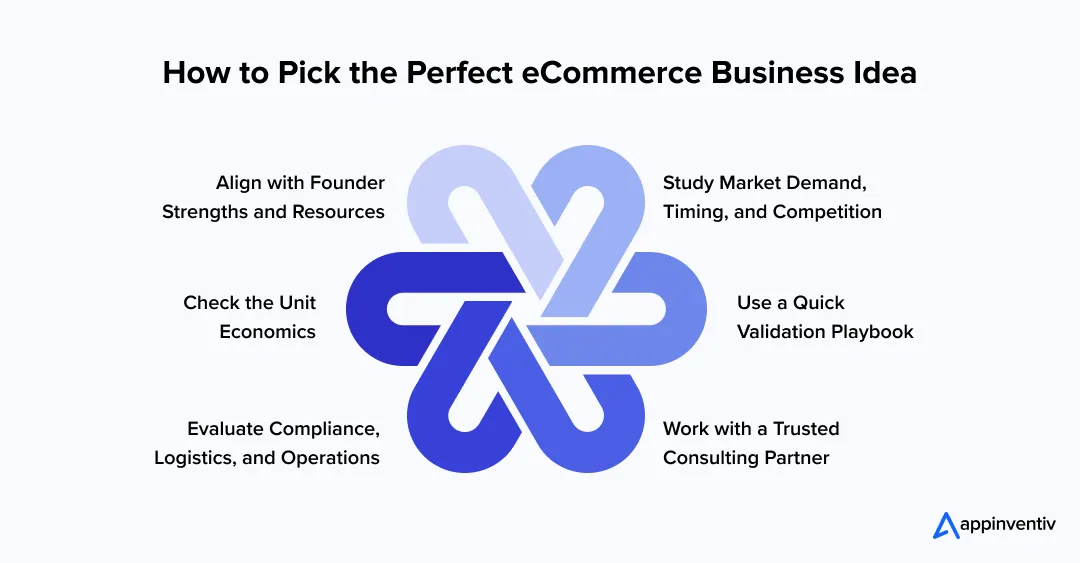
Align with Founder Strengths and Resources
Start where you already have an edge. Maybe you’ve worked in fashion, or maybe you just understand what makes pet owners buy again. That’s your base. Most successful ecommerce startup ideas come from people who solve a problem they already have.
Look at what’s around you – contacts, savings, suppliers, even time. If you’re short on funds, pick a model that doesn’t demand heavy inventory or storage. Dropshipping, small-batch handmade goods, or digital downloads fit that path. The right idea is one you can actually run, not one that sounds impressive on paper.
Study Market Demand, Timing, and Competition
Once you’ve got a few ideas, check if people truly care. Use simple tools like Google Trends, Amazon search bars, or Reddit threads. If nobody’s talking about it, that’s a red flag. But if everyone’s selling it, you’ll need a fresh spin.
Good timing matters too. Selling winter gear in March won’t work, but launching sustainable travel accessories right before summer might. Pay attention to how fast a category grows and how deep big players already go. The sweet spot lies in demand that’s rising but not yet overcrowded. That’s where real ecommerce business opportunities hide.
Check the Unit Economics
Numbers don’t lie. Before you call something one of the most profitable ecommerce business ideas, see what’s left after costs. Subtract the real stuff like product, packaging, ads, platform fees, shipping, returns, and your eCommerce app development cost.
If you’re barely breaking even, tweak the product or raise your price. Better yet, find something that buyers will come back for. Refill packs, seasonal drops, or membership models all build repeat business. A simple rule: if you make your money back in two or three customer orders, you’re on the right track.
Evaluate Compliance, Logistics, and Operations
This is where many first-time founders get stuck. It’s not just selling but storing, packing, shipping, and dealing with rules. Health products, toys, and food all need extra checks and certificates. Digital goods have fewer hurdles but still require clear privacy and data policies.
Start local, ship small, and use tested logistics partners before scaling. The goal isn’t perfection, it’s momentum. Once your flow is smooth, you can start worrying about fancy features or a bigger supply chain.
Use a Quick Validation Playbook
Now comes the part that separates dreamers from builders. Don’t write a 40-page business plan. Test the idea in real life.
Create a single landing page. Add two good photos, a short pitch, and a button for early access. Run a small ad and see who signs up. Or sell ten pieces manually through Instagram DMs. If people buy, you’ve got proof. If not, you’ve got feedback.
Keep tweaking. Sometimes the product works but the message doesn’t. Sometimes the message clicks but the pricing feels off. Validation is where ecommerce business ideas stop being theory and start turning into real ecommerce business models, often through a lean MVP app development approach.
Work with a Trusted Consulting Partner
If you’re serious about scaling fast, teaming up with an experienced consulting provider can save you months of trial and error. A company like Appinventiv helps founders test ideas, validate product-market fit, and design ecommerce platforms that actually convert. We bring strategy, design, and development under one roof, so you can focus on building your brand instead of juggling tech.
It’s not about outsourcing vision; it’s about speeding up execution with people who’ve already done it successfully for hundreds of startups and enterprises.
How to Turn Your eCommerce Idea into a Working Business
Once you’ve picked the ecommerce business idea that fits you, the next step is simple – make it real. This is where your plan shifts from brainstorming to building. You already know what you want to sell, now it’s about who you’re selling to, how you’ll reach them, and what systems will keep it running smoothly. Let’s look into the ultimate guideline on how to start ecommerce business:
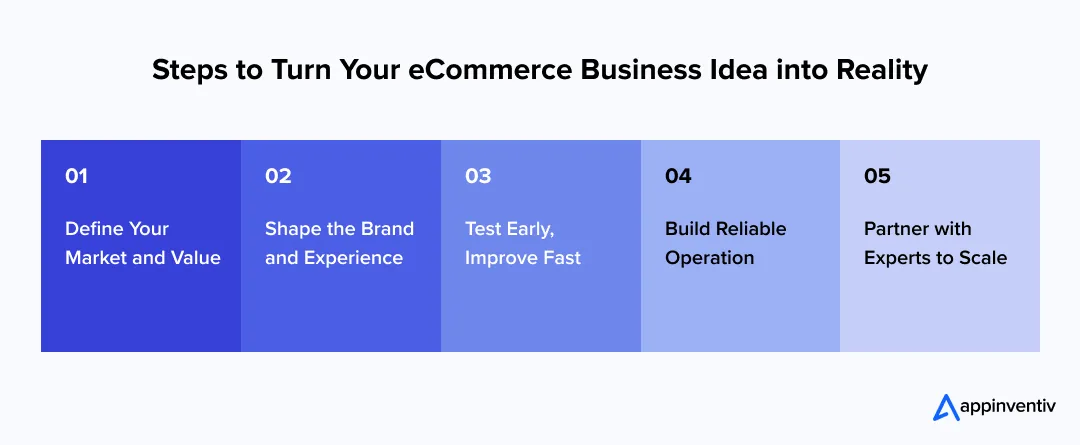
Define Your Market and Value
You can’t sell to everyone. Choose one clear customer group and understand what makes them click “buy.” Look at how they shop, what they trust, and what frustrates them in existing stores. Build your message around that.
Your value proposition isn’t just about price or looks but about what they get that others don’t. A focused message backed by real customer insight is what separates successful ecommerce startups from those that fade out.
Shape the Brand and Experience
Now build a brand that feels human. The logo, tone, packaging, and store layout should all tell the same story. Whether you’re launching a boutique fashion label or a pet care line, keep your ecommerce business model simple – one that feels easy to run and easy to buy from.
Remember: customers don’t just buy the product; they buy how it makes them feel. Every detail adds up to trust.
Test Early, Improve Fast
Even if you’ve already chosen your idea, testing never stops. Try different versions of product photos, prices, and ads. Use small marketing spends to see which audience responds best. If something isn’t working, fix it fast. The best ecommerce business opportunities come from listening to data and acting on it before the competition does.
Build Reliable Operations
Behind every smooth online experience is a clear system. Sort your suppliers, delivery timelines, and payment partners before you scale. Make sure compliance is handled from day one.
Choose logistics partners who can grow with you and software that connects sales, inventory, and marketing in one place. A solid back-end keeps your business stable when orders start increasing.
Partner with Experts to Scale
At this stage, working with an experienced development partner can make a real difference. We can help new founders refine their ecommerce business model, design customer journeys that convert, and build apps or platforms that perform at scale. We’ve seen what works and what doesn’t across hundreds of ecommerce startups.
Having that kind of support turns your learning curve into a launchpad. You stay focused on growth while the tech, design, and integration run smoothly behind the scenes.
The Roadblocks Ahead: Common eCommerce Challenges and How to Tackle Them
Even the best ecommerce business ideas hit a few bumps once you move from planning to execution. From rising ad costs to AI bias in automation, today’s founders face a market that rewards speed but punishes mistakes fast. The good part? Most of these challenges are predictable and solvable, if you know where to look early on.
Below is a complete table that breaks down ecommerce business challenges & their solutions:
| Challenge | Impact on Business | How to Overcome It |
|---|---|---|
| High Competition and Market Saturation | Makes it harder for new ecommerce startups to get visibility and win customer trust. | Focus on niche products, strong branding, and storytelling. Use SEO, content marketing, and influencer collaborations to stand out. |
| Customer Acquisition Costs (CAC) Rising | Ads are expensive, and new brands often overspend trying to reach the wrong audience. | Build organic traffic through blogs, social media, and community marketing. Retarget past visitors and focus on customer retention to lower CAC over time. |
| Poor User Experience (UX) | Leads to low conversion rates and high cart abandonment. | Simplify navigation, speed up site loading, and ensure a mobile-first design. Test your ecommerce website or app frequently for usability issues. |
| Inventory and Supply Chain Management | Overstocking drains cash, understocking loses sales. | Use inventory management software and demand forecasting powered by AI. Keep close contact with suppliers and automate reorder alerts. |
| Payment Gateway Failures or Limited Options | Customers drop off when their preferred payment method isn’t supported. | Integrate multiple trusted payment gateways (Stripe, PayPal, UPI, etc.) and ensure secure, fast checkout. |
| Shipping Delays and Returns | Damages customer trust and leads to negative reviews. | Partner with reliable logistics companies. Offer real-time tracking, clear return policies, and transparent delivery timelines. |
| Data Privacy and Cybersecurity Risks | Compromised data can lead to loss of reputation and legal trouble. | Implement SSL encryption, two-factor authentication, and regular security audits. Stay compliant with GDPR, CCPA, and other data laws. |
| Inconsistent Brand Identity | Confuses potential buyers and weakens customer loyalty. | Maintain brand consistency across product packaging, social media, and website. Create brand guidelines to ensure uniform tone and visuals. |
| Scaling Infrastructure | As orders grow, systems can crash or slow down. | Choose a cloud-based ecommerce platform that scales easily. Use load balancing and caching to maintain uptime during traffic spikes. |
| Poor Product Descriptions or Visuals | Leads to fewer sales and high return rates. | Use detailed, honest product copy and high-quality visuals. Add 360° views or AR tools to help users experience products virtually. |
| Low Repeat Purchases | Forces the business to rely heavily on new customers instead of retaining old ones. | Introduce loyalty programs, subscription options, and personalized product recommendations to keep customers engaged. |
| Managing Returns and Refunds | Complicates operations and hurts profit margins. | Automate return processing with clear policies. Offer instant store credits or exchange options to retain customers. |
| Compliance with Global Regulations | Different countries have different tax, shipping, and labeling laws. | Use automated tax and compliance tools. Work with legal experts to stay updated on ecommerce policies across markets. |
| Integration of AI and Automation | Poorly implemented AI tools can make recommendations irrelevant or robotic. | Train AI systems with real user data. Combine automation with human oversight for customer-facing processes. |
| AI Bias in Personalization Engines | Skewed data can lead to inaccurate recommendations or exclusion of certain customer groups. | Regularly audit AI algorithms for fairness and inclusivity. Collect diverse datasets to train recommendation engines. |
| AI Hallucinations or Inaccurate Chatbot Responses | Can frustrate customers or misinform them about products or policies. | Keep chatbots supervised by human agents and update training data regularly. Monitor customer interactions for quality control. |
| Complex Taxation and Accounting | Leads to confusion during cross-border sales. | Use accounting software designed for ecommerce. Automate invoicing, currency conversion, and compliance filing. |
| Technology Upgrades and Maintenance | Outdated plugins or tech stacks cause slowdowns or vulnerabilities. | Keep software and CMS updated. Schedule regular maintenance and security checks with your development partner. |
| Poor Analytics and Reporting | Without clear data, you can’t track what’s working. | Use analytics tools like Google Analytics, Shopify Insights, or Power BI to monitor performance and customer behavior. |
| Lack of Customer Trust | Especially tough for new ecommerce businesses. | Add social proof through verified reviews, testimonials, and secure payment icons. Build credibility through transparent policies and branding. |
| Sustainability Pressure | Customers now expect eco-friendly packaging and responsible sourcing. | Partner with suppliers who follow ethical standards. Use recyclable materials and communicate sustainability efforts clearly. |
eCommerce Success Stories: Real Results From Appinventiv Projects
Choosing the right eCommerce idea is only the first step. The technology, customer experience, and operational systems behind it also determine how well the business can grow. Here are five eCommerce projects where Appinventiv helped established brands solve specific business and customer challenges.
IKEA: Digitizing Product Discovery Across Stores
IKEA needed a better way to help in-store customers discover products, check availability, and access offers while capturing useful customer data. Appinventiv developed an ERP-based kiosk solution that connected product information with customer engagement and real-time availability.
Solution delivered: ERP development, product discovery, real-time availability, customer-data capture, promotional support, and store deployment.
Impact:
- Deployed across 7+ IKEA stores in the UAE
- Became a key source for ROI and marketing measurement
Adidas: Building a Scalable Mobile Commerce Experience
Adidas wanted to strengthen its mobile shopping experience across Saudi Arabia and Qatar. Appinventiv worked on market research, localization, UX, native Android and iOS development, and deployment. The solution included multi-language and multi-currency support, product discovery, push notifications, analytics, and performance improvements.
Solution delivered: Mobile commerce development, localization, UX design, multi-currency support, analytics, and performance optimization.
Impact:
- 2M+ app downloads
- 500K+ new users
Edamama: Personalizing Ecommerce for Mothers
Edamama wanted to make online shopping more relevant for mothers while helping local sellers reach their target customers. Appinventiv built personalized recommendations based on a child’s age, gender, and product ratings. The platform also included dynamic attribute management, automatic SKU generation, flash-sale functionality, and children’s classes and activities.
Solution delivered: UX research, personalized recommendations, product management, dynamic attributes, SKU automation, flash sales, and mobile app development.
Impact:
- $5M funding raised
- 20K+ SKUs available for home delivery
- 100K+ expectant and new mothers served
6thStreet: Improving Performance and Mobile Shopping
6thStreet faced challenges with app performance, payment gateways, product listings, and its influencer shopping experience. Appinventiv redesigned key modules, improved caching and data rendering, added analytics, and integrated payment options including Checkout.com, Apple Pay, Tabby, and Qpay.
Solution delivered: App redesign, performance optimization, payment integration, analytics, caching, product-listing improvements, and influencer shopping support.
Impact:
- App start time reduced to under 3 seconds
- 3M+ iOS downloads
- 1M+ Android downloads
[Read the 6thStreet case study]
The Body Shop: Unifying Omnichannel Commerce
The Body Shop India needed to bring fragmented ecommerce, loyalty, voucher, inventory, and promotional workflows into one connected system. Appinventiv built a headless commerce solution using Magento, Node.js, MongoDB, and Next.js, supported by native Swift and Kotlin applications.
Solution delivered: Headless commerce, web and mobile development, omnichannel integration, loyalty and voucher synchronization, inventory management, workflow automation, analytics, and performance optimization.
Impact:
- 10M+ sign-ups in 12 months
- ₹498M in digitally tracked revenue
- Page load time reduced to under 5 seconds
- 70% fewer manual tasks
- Report loading became 90% faster
[Read The Body Shop case study]
These projects show how the right ecommerce technology can improve customer experience, streamline operations, and support business growth across different retail models.
Why Appinventiv is the Ideal Partner for Your eCommerce Dreams
Turning a promising eCommerce idea into a successful business takes more than a good product. It requires the right technology, customer experience, and operational foundation. With 9+ years of eCommerce transformation experience, Appinventiv helps businesses move from strategy and planning to development and growth.
Here’s why choosing us as your eCommerce mobile app development company can help bring your vision to life:
- 400+ eCommerce platforms delivered across different business models and markets
- 96% client satisfaction rate backed by a focus on quality, usability, and business outcomes
- 30+ retailers and brands served across the ecommerce and retail space
- 25+ payment gateway partnerships supporting secure and flexible checkout experiences
- Up to 40% conversion rate boost through personalization
- 99.50% SLA on transaction reliability for dependable digital transactions
We combine customer-focused design with advanced analytics to create experiences that are easier to use, personalize, and scale. Where business requirements call for it, we also work with technologies such as utilizing blockchain for secure transactions.
Our portfolio of successful projects reflects experience across ecommerce strategy, mobile apps, payments, personalization, integrations, and platform development.
Get in touch with our team to discuss your eCommerce idea and identify the right technology approach for your business.
FAQs
Q. What eCommerce business is most profitable for entrepreneurs in 2026?
A. The profitability of choosing eCommerce for business can vary widely depending on the niche, market demand, and operational efficiency. The “best” idea is the one you can source well, explain clearly, and deliver on time. Look for repeat buys or accessories you can bundle. Categories like health and wellness, pet care, and niche subscription boxes work when you bring a real angle. If you already know an audience deeply, build there first.
Q. How much does it cost to start an eCommerce business?
A. After businesses have finalized the type of eCommerce venture they wish to undertake, the next critical step is to partner with a reliable eCommerce app development company that can turn your vision into reality. Developing a custom eCommerce app or software tailored to your business needs typically ranges from $40,000 to $300,000.
This cost variation of converting your eCommerce business ideas into a working website or an app depends on several factors, including the app’s complexity, the number of features required, integration with existing systems, and the level of customization needed. Selecting the right development partner is essential to ensure that the final product effectively meets your business requirements and customer expectations, ultimately contributing to the success of your eCommerce business.
Q. How to start an ecommerce business?
A. Start small. Don’t think of a giant online store yet but think of one idea that actually solves something. Maybe you’ve seen people struggle to find a good eco-friendly bag or a protein brand that feels trustworthy. That’s your start point.
Check if people are already buying what you want to sell. Type it into Google, scroll through Amazon reviews, read a few Reddit threads. You’ll quickly see what people complain about and what they love. That alone can shape your first product.
Next, pick a simple platform like Shopify, WooCommerce, or whatever feels least intimidating. Get your store live even if it looks basic. Use your own photos, write in your voice, and keep the “About” section real. Add one thing that shows trust like a return policy, reviews, or even a short thank-you note in the parcel.
At the start, talk to your buyers yourself. When ten people order, ask them what made them click “buy.” When someone returns an item, ask why. Those conversations will tell you more than analytics ever will.
Once it feels steady, bring in small tools – an email signup, a WhatsApp update list, maybe a simple blog sharing how you run things. If you’re not tech-savvy or just want a cleaner setup, partner with an ecommerce development company like Appinventiv. We can handle design, payments, and integrations while you focus on what matters, building a store people remember and come back to.
Q. What are the advantages of starting an eCommerce business?
A. If you wish to launch top ecommerce business idea, here are the several advantages you need to know:
- Global Market Access: Sell products to customers worldwide without geographic limitations.
- Reduced Overhead Costs: Lower expenses compared to physical stores by eliminating the need for retail space.
- 24/7 Operations: Ability to make sales and generate revenue around the clock.
- Scalability: Easily expand product lines or enter new markets.
- Data-Driven Insights: Utilize customer data to optimize marketing and sales strategies.
- Customized Shopping Experiences: Offer personalized recommendations and promotions based on user behavior.


Fast 2-minute response, fully NDA-protected.

eCommerce Integration: Connecting ERP, CRM, PIM, and Other Core Business Systems
Key takeaways: Centralized eCommerce architecture distributes accurate product data simultaneously across all your global sales channels. ERP, CRM, PIM, OMS, POS, etc. are the core integration types forming your eCommerce architecture. Security and compliance must anchor your payment architecture when operating across multiple regulatory jurisdictions. The cost of eCommerce platform integration ranges between $40,000 and…

Why Australian Retailers Are Investing in Unified Commerce Platforms in 2026
Key takeaways: Unified commerce platform development in Australia is now central to peak trading resilience, not a discretionary upgrade. The Australian unified commerce opportunity is valued at AUD 44 billion, with early adopters seeing revenue growth of 20% or more. Real-time inventory and customer data are prerequisites for reliable AI deployment in retail. Addressing governance…

How Much Does It Cost to Build an eCommerce Marketplace App Like Poshmark?
Key takeaways: Poshmark-like marketplaces enable unlocking new sources of revenue through transforming social interaction into low-capital-intensity repeat purchases. A marketplace app would cost between $40,000 and $400,000 to develop, depending on its features, platform and enterprise scalability needs. Special implementation, beginning with tests or single categories, confirms supply, demand, and monetization in 6-12 months. Trust,…