
































How AI-powered Account Reconciliation Solutions is Transforming Enterprise Finance: Benefits & Use Cases

 Share -


- 01How AI Reconciliation Is Transforming Enterprise Finance
- 02Compliance, Governance, and Audit Readiness in AI Reconciliation
- 03How AI Reconciliation Fits Into Existing Finance Architecture
- 04AI Reconciliation Implementation: What the Journey Looks Like
- 05Measuring ROI of AI Account Reconciliation
- 06Adoption Realities: What Organizations Should Plan For
- 07The Future: From Reconciliation to Continuous Financial Insight
- 08How Appinventiv Can Help Implement AI Reconciliation Solutions for Enterprises
- 09Frequently Asked Questions

Key takeaways:
- AI reconciliation for enterprise finance is helping finance teams maintain control despite growing transaction complexity.
- AI-powered financial reconciliation solutions surfaces mismatches early, improving visibility and reducing close-cycle pressure.
- Hybrid reconciliation logic combining rules and AI improves accuracy while preserving audit transparency.
- Real-time financial reconciliation strengthens compliance readiness and reduces manual intervention.
- Successful adoption depends as much on governance design and integration planning as on technology.
Reconciliation was once a contained, predictable process. Teams knew when it started, when it ended, and how much effort it required. That predictability has gradually eroded.
Enterprises are increasingly adopting automated account reconciliation solutions to manage rising transaction volumes, fragmented data sources, and regulatory scrutiny. Unlike manual reconciliation workflows, modern financial reconciliation software enables continuous monitoring, structured exception handling, and scalable control frameworks across complex enterprise environments.
Transactions now move across ERPs, banking partners, payment gateways, and regional entities. Each system records events differently. Settlement timing gaps and currency rounding differences create mismatches that surface later in the reporting cycle.
At the same time, expectations have shifted. Leadership wants earlier visibility, regulators expect stronger control trails, and audit scrutiny is increasingly continuous. Deloitte’s CFO Signals research shows finance leaders are prioritizing automation and data optimization to improve control and performance in this more complex environment.
This is driving interest in AI reconciliation for enterprise finance. In practice, this shift is accelerating demand for enterprise-grade bank reconciliation solutions and scalable financial reconciliation software that can operate across ERPs, treasury platforms, and payment ecosystems without disrupting control environments.
The shift is quiet but significant. Reconciliation moves from periodic correction to an active financial control layer.
Appinventiv helps organizations implement AI reconciliation solutions that strengthen financial controls and enable real-time visibility.

How AI Reconciliation Is Transforming Enterprise Finance
Reconciliation did not suddenly become complex; it became exposed.
As transaction volumes expanded and systems multiplied, the weakness was never in the concept of reconciliation itself. It was based on the assumption that periodic checks were enough. That assumption no longer holds.
AI reconciliation for enterprise finance changes the posture of the function. In the evolving landscape of AI in fintech, this transformation goes beyond checklist automation and focuses on redesigning how financial integrity is maintained across distributed systems
The Real Shift: From Periodic Cleanup to Continuous Oversight
Traditional reconciliation operates in cycles. Transactions accumulate, reports are generated, mismatches are investigated, and adjustments are made. The process repeats.
That model assumes discrepancies are manageable and contained within reporting periods. At scale, that assumption breaks down.
A small percentage of mismatches across millions of transactions quickly adds up to thousands of exceptions. By the time those exceptions are reviewed, they are buried under newer transactions. Context is lost, and institutional knowledge becomes essential just to interpret what happened.
AI-powered financial reconciliation interrupts that pattern.
Instead of waiting for a reporting deadline, AI-driven account reconciliation systems evaluate transactions as they move through the financial ecosystem. They identify anomalies in near real time, group related mismatches, and assign confidence scores to potential matches rather than requiring exact alignment.
The practical outcome is simple: fewer surprises at close.
Also Read: Agentic AI in Finance: Revolutionizing Efficiency & Security
Appinventiv’s Insight:
When implementing AI reconciliation, prioritize accounts with recurring timing differences. Continuous monitoring delivers the strongest impact where settlement delays previously distorted visibility.
The Multi-Layered Architecture of AI Reconciliation
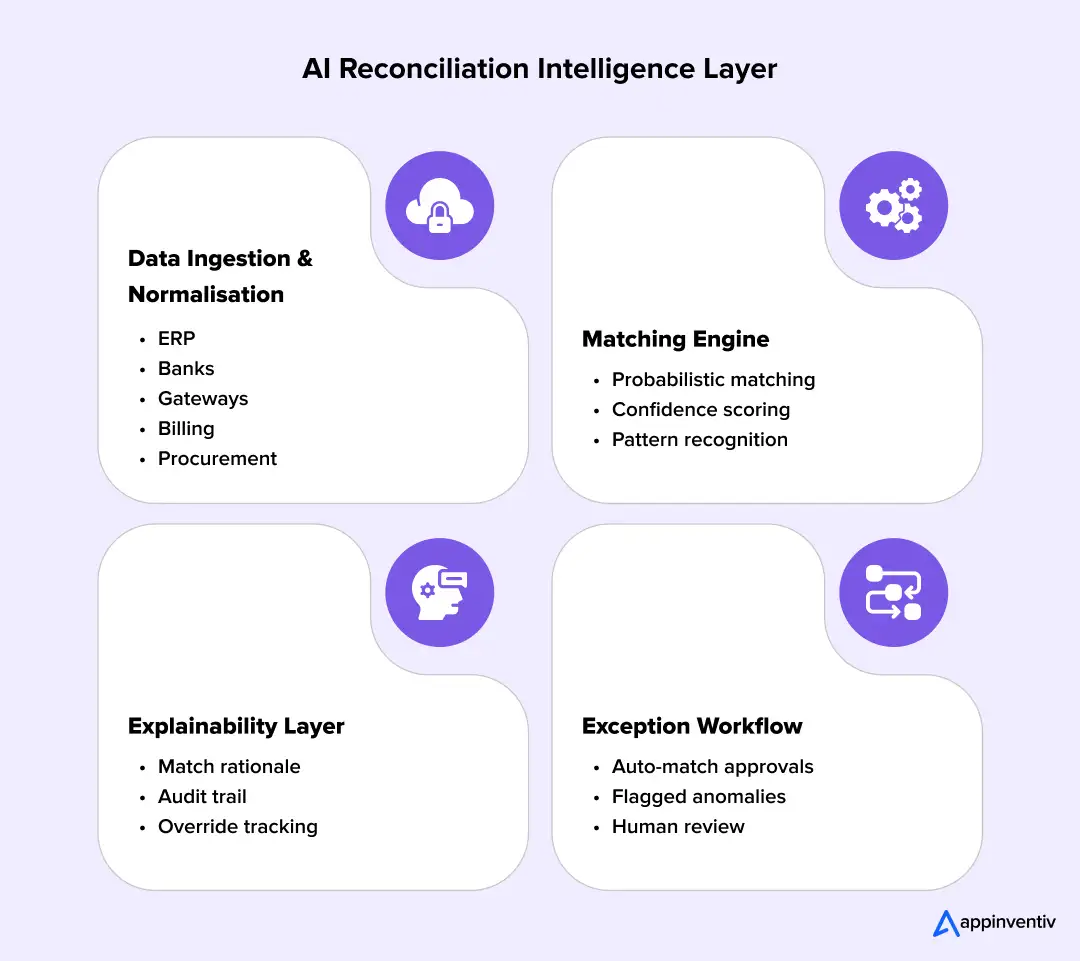
Modern enterprise finance requires an automated account reconciliation solution that acts as a reconciliation intelligence layer, one that enhances existing ERP systems rather than replacing them. Advanced financial reconciliation software provides this orchestration capability across distributed systems.
Ingestion & Normalization: The system pulls from disparate sources (SAP, Stripe, regional bank portals) and standardizes them into a unified schema using Data Pipelines.
The Matching Engine: This layer applies Probabilistic (Fuzzy) Matching. For instance, if a bank record shows “Appinv_Service_01” and the ledger shows “Appinventiv Services Inc,” the AI assigns a 98% confidence score based on historical pairing patterns.
Explainability Layer: Crucial for auditability, the AI provides a “Match Rationale” that allows finance teams to see the logic behind the suggestion.
Matching Logic That Reflects Real Transaction Behavior
Rule-based systems are effective when transactions behave predictably. Exact invoice numbers, identical amounts, and clear settlement dates.
Real financial activity is rarely that tidy. Payments arrive in partial amounts, bank fees adjust totals, foreign exchange introduces rounding differences, and refunds appear days after the original settlements. Additionally, intercompany transfers do not always align perfectly between entities.
AI reconciliation algorithms approach this complexity differently. Enterprise financial reconciliation software must evaluate transaction relationships across timing, amounts, textual inconsistencies, and historical patterns to function effectively as a true automated account reconciliation solution. They look at relationships, not just identical values. They evaluate:
- NLP for Unstructured Data: Large Language Models (LLMs) are used to parse Remittance Advice PDFs or unstructured email text to extract invoice numbers that aren’t present in the bank’s transaction description.
- Temporal Pattern Recognition: The AI learns the typical “Settlement Latency” for specific payment gateways (e.g., Stripe usually settles in T+2). If a match doesn’t appear immediately, the AI doesn’t flag an error; it waits for the predicted window.
- Anomaly & Fraud Detection: Beyond matching, the system uses Unsupervised Learning to flag outliers like a duplicate payment disguised by a slightly different vendor name that rule-based systems would miss.
Over time, automated reconciliation AI learns from approved corrections. It refines match confidence based on real operational patterns.
This does not eliminate human review; it reduces unnecessary review. The result is AI-driven account reconciliation that narrows attention to exceptions that genuinely require judgment.
Expert Advice:
Maintain configurable confidence thresholds during early deployment. Gradual expansion of auto-approval rates preserves governance while improving efficiency.
Reconciliation Becomes a Control Layer, Not a Reporting Task
In many organizations, reconciliation was historically tied to reporting cycles. With AI reconciliation solutions, it becomes part of the control architecture.
Real-time financial reconciliation surfaces anomalies closer to the source. Instead of discovering discrepancies at close, finance teams address them during the operating cycle.
This strengthens:
- Liquidity awareness
- Settlement tracking
- Discrepancy classification
- Exception governance
Finance leaders gain earlier insight into areas that previously remained hidden until period-end.
Also Read: AI in Payments: Transforming Transactions & Security (2026)
Compliance Improves Through Structured Traceability
Automation without traceability introduces risk. Well-designed financial reconciliation software for enterprises strengthens control integrity while maintaining structured audit traceability. A secure automated account reconciliation solution must embed role-based access, explainable logic, and compliance-aligned workflows by design.
Every automated match records:
- Confidence logic
- Rule criteria
- Override history
- Approval chain
For organizations operating in regulated environments, GDPR compliance in AI reconciliation requires disciplined access control and data minimization practices.
Appinventiv Insight:
Before deployment, align reconciliation audit trails with existing internal control frameworks. Automation should integrate into governance documentation, not operate outside it.
Scaling Without Operational Strain
Transaction growth does not pause for manual workflows.
AI for financial reconciliation changes the scaling model. Routine matches clear automatically. Human review focuses on material exceptions.
Financial data reconciliation with AI supports expansion without proportional increases in reconciliation staffing.
The value is not headcount reduction; it is stability under growth.
Use Cases That Reflect Real Operational Complexity
The transformation becomes clearer when examined through practical scenarios.
AI-driven bank reconciliation solutions support daily validation of cash positions across multiple banking relationships. A robust automated account reconciliation solution identifies timing delays, fee deductions, partial settlements, and FX adjustments early, reducing treasury uncertainty and improving liquidity planning.
AI invoice reconciliation software matches invoices, purchase orders, and payments across procurement systems. Duplicate billing and amount mismatches surface quickly, limiting downstream correction.
In more complex billing environments, generative AI invoice reconciliation software helps extract structured data from diverse invoice formats before applying matching logic.
Retail and digital platforms rely on payment gateway integration that introduces settlement differences, chargebacks, and refunds. Automated reconciliation AI groups related transactions, enabling clearer visibility into net positions.
These are not isolated improvements. They affect liquidity management, reporting confidence, and operational risk.
Business Impact: Where the Shift Becomes Measurable
When AI reconciliation stabilizes enterprise finance workflows, its effects become visible across the finance function.
- Closed cycles become more predictable because exceptions surface earlier.
- Cash positions align more consistently with ledger balances, improving treasury decision-making.
- Audit preparation becomes less reactive because documentation is structured by design.
- Risk exposure narrows as AI reconciliation algorithms identify abnormal patterns before they accumulate.
Measuring the ROI of AI reconciliation requires looking beyond efficiency metrics. When evaluating financial reconciliation software, enterprises assess not only automation rates but also control stability, reporting predictability, and scalability under transaction growth. A mature automated account reconciliation solution delivers measurable ROI across both operational and risk dimensions.
Organizations often evaluate:
- Reduction in late-cycle adjustments
- Exception backlog trends
- Improved reporting predictability
- Consistency of reconciliation logic across entities
- Scalability relative to transaction growth
The CFO’s Metric: Measuring Structural Efficiency
To justify the shift to AI, enterprises move beyond “hours saved” and look at General Ledger (GL) Integrity. The ROI of AI reconciliation can be viewed through the lens of risk reduction:
ROIReconciliation = ((Value of Detected Leakage + Operational Savings) – Implementation Cost / Implementation Cost) X 100%
By reducing Days Sales Outstanding (DSO) through faster payment applications, the system pays for itself by improving working capital.
The cost of implementing enterprise financial reconciliation software or a customized automated account reconciliation solution varies by integration scope, entity complexity, and governance requirements.
From Automation to Financial Intelligence
As AI account reconciliation matures, reconciliation data becomes a signal source.
Patterns across settlement delays, vendor mismatches, and recurring adjustments reveal operational friction points.
Emerging capabilities, such as generative AI invoice reconciliation software, assist in extracting structured data from complex documents. Agent-based workflows increasingly support exception investigation by assembling contextual transaction history before review.
These developments extend AI-powered financial reconciliation beyond matching toward insight generation.
Expert Insight:
Design reconciliation architecture with extensibility in mind. Future capabilities, such as intelligent reconciliation solutions powered by predictive anomaly detection, depend on structured data pipelines.
AI reconciliation for enterprise finance is not simply about processing transactions faster. It is about maintaining financial integrity in environments where system complexity continues to expand.
Reconciliation remains essential. What has changed is how it operates: continuously, transparently, and with intelligence embedded into the control layer itself.
Compliance, Governance, and Audit Readiness in AI Reconciliation
Automation in finance is never just about efficiency, but about control. Any discussion around AI reconciliation for enterprise finance eventually arrives at the same question:
Can this strengthen governance without weakening oversight? That question deserves a serious answer.
Reconciliation sits at the center of financial control frameworks. It touches balance sheet integrity, revenue recognition, intercompany eliminations, and cash validation. When automation enters this layer, transparency becomes non-negotiable.
The organizations that implement AI-powered financial reconciliation successfully tend to approach governance first, not last.
Automation Does Not Replace Control, It Restructures
One misconception about automated reconciliation AI is that it removes human judgment. In practice, mature implementations preserve oversight but redefine where it applies.
Instead of manually verifying every transaction, finance teams establish:
- Confidence thresholds for auto-matching
- Escalation rules for exceptions
- Approval workflows for material adjustments
- Audit logs for every automated decision
This creates a structured review model rather than an ad hoc one.
Technical observation:
Well-implemented AI reconciliation algorithms should expose their decision factors. Confidence scoring, match rationale, and override tracking must be accessible for review. If the logic cannot be explained, it should not be deployed in a controlled finance environment.
Audit Trails Must Be Designed, Not Assumed
In spreadsheet-based reconciliation, traceability often depends on version control discipline. Emails explain adjustments, comments are scattered across files, and context fades over time.
AI-driven account reconciliation systems record:
- Timestamped match decisions
- User approvals and overrides
- Rule modifications
- Exception reclassifications
This structured documentation supports internal audit and external review without requiring manual reconstruction of events.
Audit readiness improves not because auditors are shown fewer discrepancies, but because they are shown clearer process integrity.
Segregation of Duties Still Applies
Even with automated reconciliation software, control principles remain intact. No single user should control transaction matching, rule configuration, and approval authority simultaneously.
Role-based access is essential.
In practice, this means:
- Configuration rights are restricted to designated administrators
- Approval permissions are separated from rule editing
- Exception resolution workflows documented
Automation does not eliminate segregation; it makes enforcement more consistent.
GDPR and Data Protection in Reconciliation Workflows
Financial reconciliation systems process sensitive transactional data. For organizations operating across jurisdictions, financial regulatory compliance like GDPR in AI reconciliation environments must be deliberate.
This includes:
- Restricting data access by role
- Ensuring encrypted data transfer across systems
- Documenting data retention policies
- Limiting the exposure of personally identifiable information within reconciliation views
Modern AI reconciliation solutions are typically deployed within secure cloud environments with layered access control. However, configuration discipline remains critical.
Implementation advice:
Before deployment, conduct a data flow mapping exercise. Identify where financial data originates, how it moves between systems, and where it is stored. Reconciliation automation should not introduce undocumented data pathways.
The Zero-Trust Finance Model
For enterprise-grade security, Appinventiv recommends deploying AI reconciliation within a SOC2 Type II-compliant environment. We prioritize Data Minimization—the AI only “sees” the metadata necessary for matching (Transaction ID, Amount, Timestamp) without requiring access to sensitive customer PII (Personally Identifiable Information).
Explainability Matters More Than Accuracy Alone
AI for financial reconciliation can achieve high matching rates. But accuracy without explainability creates risk.
Finance leaders and auditors need clarity around why two transactions were matched. Was it similar? Timing correlation? Pattern recognition across historical data?
Systems that provide match reasoning reduce resistance during adoption. They also strengthen confidence during regulatory reviews.
Explainability does not require revealing algorithmic code. It requires sufficient context to enable informed review.
Governance Should Evolve Alongside Automation
Organizations often automate reconciliation workflows while keeping governance documentation static. This mismatch creates friction.
Control documentation, risk matrices, and reconciliation policies should be updated to reflect new workflows. For example:
- Automated match confidence levels may replace manual review thresholds
- Exception categories may evolve based on AI clustering
- Review cadence may shift from monthly to continuous
Treat AI reconciliation implementation as both a technology and policy update.
Also Read: How AI is Revolutionizing Data Governance for Enterprises?
Internal Controls Benefit from Standardization
In decentralized environments, reconciliation logic may vary between business units. One entity may automatically accept minor timing differences; another may escalate them.
AI-powered reconciliation solutions encourage standardized logic across entities. This consistency strengthens consolidation processes and reduces reconciliation disputes between regions.
Intercompany reconciliation, in particular, benefits from standardized rule sets and documented matching behavior.
Risk Does Not Disappear, It Becomes Visible Earlier
Automation does not eliminate discrepancies; it changes when and how they surface.
With real-time financial reconciliation, anomalies appear sooner. This earlier visibility allows finance teams to address root causes before they escalate into reporting issues.
From a governance standpoint, earlier detection reduces exposure duration. That shift alone can materially reduce operational risk.
Also Read: AI in Risk Management: Key Use Cases
Preparing the Organization for Controlled Adoption
Successful AI reconciliation implementation typically includes:
- Pilot phases focused on selected account categories
- Parallel run periods where manual and automated workflows coexist
- Defined thresholds for expanding automation scope
- Periodic governance reviews during early deployment
Rushing full automation without staged validation often creates unnecessary resistance.
Gradual rollout builds trust while maintaining oversight.
A Stronger Foundation for Regulatory Engagement
When reconciliation workflows are structured, traceable, and standardized, engagement with auditors becomes less reactive.
Instead of reconstructing process narratives, finance teams can demonstrate:
- Automated match logic
- Documented exception handling
- Approval hierarchies
- Role-based access records
This level of transparency supports regulatory confidence.
AI reconciliation for enterprise finance is not a shortcut around control. It is an opportunity to redesign control mechanisms for modern transaction environments.
Organizations that approach automation with governance discipline in mind tend to see stronger, more sustainable outcomes. Regulatory compliance posture improves, audit discussions become clearer, and financial oversight becomes more consistent.
And perhaps most importantly, confidence in reported figures strengthens, not because risk disappears, but because visibility improves.
Our custom AI reconciliation development services help you create a reconciliation system that’s fast, accurate, and ready for scale.
How AI Reconciliation Fits Into Existing Finance Architecture
One of the first questions finance and technology leaders ask is not whether AI reconciliation works, but how it fits into existing systems. Finance environments are rarely greenfield; they are layered, shaped by ERP upgrades, regional expansions, treasury tools, billing platforms, and payment gateways added over time.
Introducing AI reconciliation into this landscape is less about replacement and more about orchestration.
Acting as a Reconciliation Intelligence Layer
Rather than replacing core financial systems, AI reconciliation solutions typically operate as a reconciliation intelligence layer that sits between data sources and reporting workflows.
This layer ingests transactional data from:
- ERP platforms (such as SAP, Oracle, NetSuite, Dynamics)
- banking feeds and treasury systems
- payment processors and gateways
- billing and subscription platforms
- procurement and vendor management systems
Data is normalized into a consistent structure before the matching logic is applied. This normalization step is critical. Without it, matching accuracy is limited by inconsistent field formats and naming conventions.
Also Read: AI in ERP System: Revolution For Your Business in 2026
Appinventiv’s Insight:
Normalization often includes standardizing date formats, currency precision, transaction identifiers, and entity codes. Even small inconsistencies can prevent reliable matching.
Supporting Asynchronous Financial Events
Modern finance ecosystems operate asynchronously. Authorization, settlement, invoicing, and ledger posting do not occur simultaneously.
AI reconciliation algorithms address this by evaluating transaction relationships across time windows rather than requiring simultaneous entries. This reduces false mismatches caused by settlement delays and posting timing differences.
Designing reconciliation logic around event timing rather than strict posting alignment is essential for accuracy.
Integrating With ERP Systems Without Disrupting Workflows
ERP systems remain the system of record. AI-powered reconciliation solutions typically connect via APIs, secure data pipelines, or scheduled extracts.
Integration patterns include:
- Real-time API ingestion for high-volume environments
- Scheduled batch synchronization for lower-frequency accounts
- Event-driven updates triggered by transaction posting
The choice depends on transaction velocity, operational needs, and system capabilities.
Finance teams continue to operate within familiar ERP interfaces while reconciliation intelligence runs in the background.
Also Read: ERP Software Integration: A Complete Guide
Enabling Rule Governance Alongside AI Matching
Enterprise environments require predictable control. AI reconciliation systems, therefore, combine:
- Deterministic rule logic for standard matches
- AI-driven matching for complex scenarios
- Configurable thresholds for auto-approval
- Exception workflows for manual review
This hybrid approach ensures governance consistency while improving efficiency.
Rule governance remains essential. Finance teams should maintain control over:
- Tolerance thresholds
- Matching priorities
- Exception classification logic
Automation enhances control when governance remains explicit.
Strengthening Intercompany and Multi-entity Alignment
Organizations operating across entities often maintain separate ledgers and local accounting practices. Reconciliation complexity arises when entries are recorded at different times or under different policies.
AI-driven account reconciliation can align intercompany entries by identifying relationships across entities and flagging mismatches for review.
Success in this area often depends on standardized tagging of intercompany transactions and consistent entity identifiers across systems.
Security and Access Considerations
Because reconciliation systems handle sensitive financial data, access architecture must align with existing identity and security frameworks.
Typical controls include:
- Role-based access permissions
- Audit logging for user actions
- Encryption for data in transit and at rest
- Integration with enterprise identity providers
Embedding reconciliation tools into existing security frameworks prevents shadow access risks.
Preserving Audit Continuity
A common concern is whether introducing automation disrupts audit processes. In practice, reconciliation intelligence platforms can enhance audit continuity by preserving detailed logs and standardizing workflows.
Audit teams benefit from consistent documentation and traceable match logic rather than relying on fragmented manual records.
When integrated thoughtfully, reconciliation automation strengthens the overall control environment.
AI Reconciliation Implementation: What the Journey Looks Like
Implementing an enterprise automated account reconciliation solution involves structured integration, governance planning, and phased deployment. Modern bank reconciliation solutions integrate with ERP systems, treasury platforms, and payment gateways without disrupting existing reporting structures.
Adopting AI reconciliation is not a single event. It is a structured transition that aligns finance workflows, data architecture, and governance controls.
Organizations that approach implementation as a staged process tend to see smoother adoption and stronger long-term outcomes.
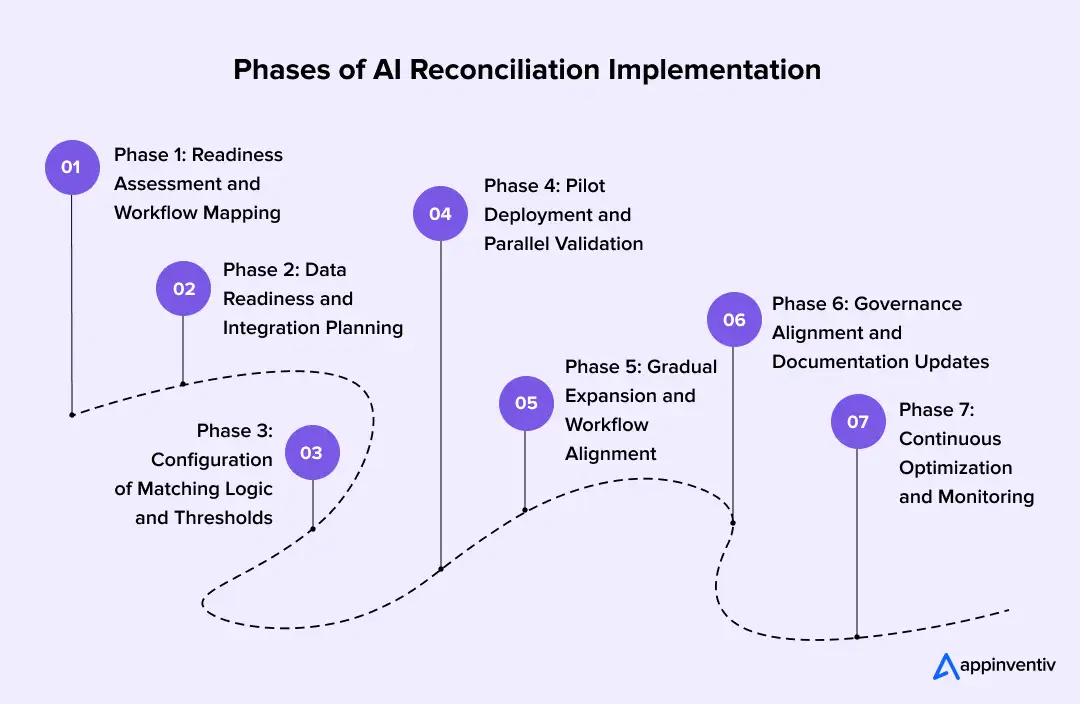
Phase 1: Readiness Assessment and Workflow Mapping
Implementation begins with understanding the current state.
This includes mapping:
- Reconciliation volumes by account category
- Exception patterns and recurring mismatch types
- Close-cycle bottlenecks
- Spreadsheet dependencies and manual workflows
This assessment identifies high-impact areas for early deployment.
Expert Insight:
Accounts with high volume and repetitive exceptions often deliver the fastest return when automated first.
Phase 2: Data Readiness and Integration Planning
Reconciliation accuracy depends heavily on data consistency.
This phase involves:
- Mapping data sources and formats
- Identifying timing differences between systems
- Standardizing entity identifiers and currency precision
- Defining data ingestion methods
Data preparation is often underestimated. Addressing inconsistencies early prevents matching errors later.
Phase 3: Configuration of Matching Logic and Thresholds
AI reconciliation implementation involves defining how the system evaluates matches.
This includes:
- Tolerance thresholds for amount differences
- Timing windows for settlement delays
- Prioritization rules for match criteria
- Confidence scoring thresholds for auto-approval
Initial thresholds are typically conservative. Automation expands as confidence increases.
Phase 4: Pilot Deployment and Parallel Validation
Rather than full-scale deployment, organizations often begin with selected account categories or entities.
During pilot phases:
- Automated matches run alongside existing workflows
- Exceptions are reviewed for accuracy
- Thresholds are refined
- User confidence is established
Parallel validation allows teams to verify outcomes without disrupting reporting.
Phase 5: Gradual Expansion and Workflow Alignment
Once accuracy is validated, automation expands to additional accounts and entities.
Workflow adjustments may include:
- Redefining review responsibilities
- Updating reconciliation timelines
- Standardizing exception handling processes
Gradual expansion reduces resistance and supports operational continuity.
Phase 6: Governance Alignment and Documentation Updates
Automation introduces new workflows that must be reflected in governance documentation.
Updates may include:
- Revised reconciliation policies
- Approval hierarchy definitions
- Exception review protocols
- Audit documentation standards
Aligning governance with automation ensures consistency and regulatory readiness.
Phase 7: Continuous Optimization and Monitoring
AI-powered reconciliation improves over time as systems learn from approvals, corrections, and exception patterns.
Ongoing monitoring includes:
- Reviewing match confidence performance
- Identifying recurring exception sources
- Refining tolerance thresholds
- Updating rules as transaction patterns evolve
Optimization is continuous rather than a one-time activity.
Managing Change Alongside Technology
Technology adoption succeeds when users trust the system. Clear communication, training, and staged rollout help build confidence.
Finance teams benefit from understanding:
- How matches are determined
- When manual review is required
- How to interpret exception categories
Transparency during implementation reduces resistance and improves adoption.
AI reconciliation implementation is as much about operational alignment as it is about technology deployment. When introduced thoughtfully, it integrates into existing finance architecture, strengthens governance, and enables organizations to manage growing complexity without sacrificing control.
Measuring ROI of AI Account Reconciliation
When finance leaders evaluate payment reconciliation modernization, the first question is often about efficiency. The more consequential question tends to emerge later: what changes once reconciliation stops being a bottleneck?
Return on investment rarely shows up in a single line item. It appears across operations, reporting reliability, and risk exposure.
Operational Effort Declines, But That’s Only the Starting Point
Most teams notice the immediate reduction in manual matching work. Routine transactions clear automatically, exception queues shrink, overtime during close cycles becomes less predictable and less frequent.
Yet the real gain is not the hours saved, but the removal of repetitive work that previously consumed experienced staff.
Instead of spending days confirming matches, analysts focus on investigating unusual activity and validating financial integrity. That shift is subtle but meaningful.
Close Cycles Become More Stable, Not Just Shorter
Speed gets attention. Stability delivers value.
When discrepancies surface earlier in the reporting cycle, the closing process stops absorbing unresolved issues at the last moment. Review becomes more deliberate, adjustments carry a clearer context, and approvers are not signing off under deadline pressure.
Organizations often begin tracking:
- How many exceptions reach the final close days
- How often do post-close adjustments occur
- How frequently do review timelines compress unexpectedly
Reduced volatility in these areas signals structural improvement.
Control Quality Improves When Traceability Improves
Manual reconciliation relies heavily on memory and documentation discipline. Weeks later, explaining why an adjustment was made can depend on who remembers the context.
AI-powered financial reconciliation automatically preserves decision paths. Overrides are logged, match confidence is recorded, and exception reclassification remains traceable.
Auditors are less concerned with whether discrepancies occur; they expect that. They are concerned with how consistently they are handled and documented.
Clear traceability strengthens confidence in the control environment.
Cash Visibility Improves in Ways That Affect Real Decisions
When bank reconciliation operates closer to real time, treasury teams gain earlier insight into settlement timing and fee discrepancies. That clarity affects liquidity planning, not just accounting accuracy.
Small timing mismatches that previously surfaced days later become visible sooner. AI-based forecasts become less dependent on assumptions.
For organizations managing tight working capital cycles, this visibility can directly influence operational decisions.
Scalability Emerges As a Long-term Return
Growth exposes the limits of manual reconciliation. Transaction volume increases rarely arrive gradually. They arrive in waves: through expansion, new channels, acquisitions, or market shifts.
Financial data reconciliation with AI allows reconciliation capacity to grow without proportional staffing increases. The work does not disappear; it changes shape.
Instead of matching volume, teams manage exceptions and investigate patterns. That distinction matters as organizations scale.
Evaluating Cost in Context
The cost of implementing AI reconciliation solutions can start from $35,000 to $400,000+, depending on integration scope, number of entities, and governance requirements. Focusing only on implementation expenses misses the broader picture.
Return should be assessed across:
- Reduction in exception backlog pressure
- Fewer post-close adjustments
- Improved audit preparation effort
- Improved predictability in reporting timelines
- Scalability without operational strain
Measured over time, value appears less as a dramatic spike and more as a steady reduction in friction.
Adoption Realities: What Organizations Should Plan For
Introducing AI reconciliation is not technically difficult; aligning it with real workflows requires more care.
Organizations that approach adoption as a structured transition rather than a quick deployment tend to see smoother outcomes.
The Future: From Reconciliation to Continuous Financial Insight
Reconciliation is moving beyond transaction matching. The next phase is about intelligence layered on top of matching.
Several custom AI reconciliation developments are shaping this shift.
Generative AI in Reconciliation Workflows
Generative AI in finance is beginning to assist with unstructured financial data. Instead of relying only on structured transaction fields, systems can now interpret remittance advice, email confirmations, invoice notes, and supporting documents.
In practical terms, generative AI invoice reconciliation software can:
- Extract relevant fields from varied invoice formats
- Summarize exception context for faster review
- Draft explanations for reconciliation adjustments
This reduces the time analysts spend interpreting fragmented information and accelerates resolution cycles.
Agentic AI for Exception Management
Agentic AI introduces the concept of autonomous agents that perform structured financial tasks within defined guardrails.
In reconciliation environments, this may include:
- Investigating recurring exception patterns
- Gathering related transaction history
- Recommending resolution paths
- Routing cases to the appropriate reviewer
These agentic AIs in payments do not replace human oversight. They reduce investigative workload by assembling relevant context automatically.
Predictive Anomaly Detection
Future AI reconciliation solutions will not only identify mismatches but also anticipate them.
By analyzing historical behavior, settlement timing patterns, and recurring discrepancies, systems can flag transactions that are likely to become exceptions before the mismatch fully materializes.
This predictive capability shifts reconciliation from reactive correction to proactive monitoring.
Continuous Control Frameworks
Real-time financial reconciliation is increasingly part of a broader continuous control architecture.
Rather than performing reconciliation at set intervals, organizations are moving toward ongoing validation of transaction integrity. This aligns reconciliation with evolving regulatory expectations around continuous compliance monitoring.
Integrated Financial Intelligence Layers
As AI for reconciliation matures, reconciliation data becomes a source of operational insight. Patterns in settlement timing, vendor discrepancies, or fee structures can inform forecasting and risk evaluation.
Reconciliation evolves from a control task into a signal source for financial planning.
The trajectory is clear. As financial reconciliation software evolves, enterprises will expect automation platforms to extend beyond matching into predictive exception management, intelligent liquidity monitoring, and agentic workflows embedded within bank reconciliation solutions.
Our team can help you plan, build, and deploy a secure and scalable AI reconciliation system that fits your enterprise needs.

How Appinventiv Can Help Implement AI Reconciliation Solutions for Enterprises
Introducing AI for reconciliation requires alignment between finance workflows, governance controls, and system architecture. Technology alone does not deliver consistency.
Appinventiv works with organizations to provide custom AI development services to design reconciliation environments that reflect operational reality rather than forcing standardized templates.
This typically includes:
- Designing AI reconciliation algorithms aligned with transaction patterns and control requirements
- Integrating ERP systems, banking feeds, and payment platforms into a unified reconciliation workflow
- Embedding audit traceability and role-based access controls into reconciliation processes
- Supporting phased implementation to ensure accuracy and user confidence
- Refining logic over time as transaction volumes and patterns evolve
For organizations exploring AI consulting services for enterprise finance, structured consultation can clarify readiness, integration complexity, and governance alignment before deployment begins.
Modern reconciliation environments succeed when they are introduced deliberately, with control integrity preserved at every step.
AI reconciliation is not a shortcut around financial control. It is a way to maintain control as transaction environments become more complex. When implemented thoughtfully, it reduces operational strain while strengthening confidence in reported figures.
A careful evaluation of existing reconciliation workflows can help determine where intelligent automation will deliver the greatest control and visibility gains.
Frequently Asked Questions
Q. What is an automated account reconciliation solution?
A. An automated account reconciliation solution is a financial reconciliation platform that uses AI, probabilistic matching, and rule-based logic to automatically match transactions across ERP systems, banking feeds, and payment gateways. Unlike manual processes, enterprise financial reconciliation software enables continuous reconciliation, structured exception management, and scalable audit readiness.
Q. How is AI revolutionizing financial reconciliation for enterprises?
A. AI revolutionizes financial reconciliation by automating repetitive tasks—matching transactions, identifying discrepancies. This speeds up the entire process. Reduces errors. Ensures faster book closing. AI bank reconciliation also improves accuracy and provides real-time financial data insights.
Q. What makes Appinventiv’s AI reconciliation solutions suitable for regulated industries?
A. Appinventiv builds AI reconciliation solutions with compliance and audit readiness at the core. Our architecture supports SOC2-aligned environments, structured audit trails, explainable match rationale, data minimization practices, and role-based access controls. This ensures enterprises operating under strict regulatory frameworks can adopt automation without weakening oversight.
Q. What machine learning models are used in AI reconciliation?
A. Use a combination of Probabilistic Matching (Fuzzy Logic) for text inconsistencies, Random Forest or XGBoost for predicting settlement timing, and LLMs (Large Language Models) to parse unstructured data from remittance advice PDFs and vendor emails.
Q. How to automate account reconciliation with AI?
A. To automate account reconciliation with AI, businesses integrate AI tools with existing financial systems—ERP software, bank feeds. AI then uses historical data and patterns to automatically match transactions. It flags discrepancies and exceptions requiring minimal human intervention. The system continues to learn and improve over time, increasing automation efficiency.
Q. What are the top use cases of AI in finance reconciliation?
A. Top use cases of AI in finance reconciliation include:
Bank-to-Ledger Reconciliation: AI matches transactions between bank statements and internal ledgers.
Inter-Company Reconciliation: AI automates reconciliation for transactions between different company entities.
Payment Reconciliation: AI handles large volumes of payment data, identifying chargebacks and refunds, and matching payments to invoices.
Expense and Procurement Reconciliation: AI automates procurement expense reconciliation, ensuring accurate invoice-to-payment matching.
Q. What is the ROI of adopting AI-powered reconciliation software?
A. When measuring the ROI of AI reconciliation, it was concluded that companies typically see up to 90% reduction in manual reconciliation hours. Lower labor costs result. Faster month-end close times give quicker financial insights. AI reduces errors and compliance risks, leading to fewer audit exceptions. These improvements lead to higher efficiency and cost savings, making AI-driven reconciliation a valuable investment.


Fast 2-minute response, fully NDA-protected.

AI Agent Protocols: MCP, A2A, ACP & More Explained
Key takeaways: MCP connects agents to enterprise tools, while A2A lets independent agents delegate tasks without exposing internal logic. The protocol stack now spans agent access, collaboration, UI interaction, open networking, commerce, and machine-to-machine payments. A2A had support from 150+ organizations by April 2026, with 22,000+ GitHub stars and five production-ready SDK languages. Enterprise agent…

Jev Explained: Enterprise Use Cases, Limitations and How to Adopt
Key takeaways: What it is: Jev is a System One model from TypeSafe AI. It returns typed choices, scores and true-or-false probabilities instead of text. Where it wins: The strongest Jev use cases are high-volume, narrow decisions such as triage, routing, scoring and guardrails. Where it stops: It cannot generate text. It struggles with math…

How to Use AI Recruiting Agents to Streamline Sourcing, Screening and Candidate Engagement
Key takeaways: AI recruiting agents automate connected workflows across candidate sourcing, screening, engagement, scheduling, and recruitment reporting. Unlike traditional ATS platforms, recruiting agents can interpret hiring goals, choose permitted actions, and coordinate work across multiple systems. Enterprises can use AI agents to find relevant talent faster, maintain consistent screening, reduce candidate drop-off, and improve recruiter…