


























- Mobile eCommerce App Development Market: A Quick Insight
- Types of eCommerce Apps to Build for Your Business in 2026
- Benefits of Developing an eCommerce App: Driving Growth and Enhancing Customer Connections
- How to Build an eCommerce App: Step-by-Step Process
- Core Features Every eCommerce App Should Include
- Must-Have Tech Stack for Modern eCommerce App Development
- Robust Tech Stack to Create an eCommerce App
- Cost to Develop an eCommerce App: A Business Insight
- Monetization Models and Revenue Strategies for eCommerce Apps in 2026
- eCommerce Application Development Trends Businesses Can Leverage to Get Maximum ROI
- Challenges of Ecommerce App Development Businesses Face & How to Overcome Them
- Why Partner with Appinventiv for Your eCommerce App Development?
Key takeaways:
- By 2030, eCommerce is projected to reach $10.5–$12 trillion, with online retail contributing nearly 27%–30% of total sales, marking a fully mature digital commerce ecosystem where online channels define growth.
- Advanced features, such as AI suggestions, AR previews, chatbots, and one-second checkouts, enhance the user experience and attract more conversions.
- An explicit development strategy founded on research, focused MVPs, and continuous updates based on user data can deliver much better long-term outcomes.
- Newer eCommerce applications can increase revenue through subscriptions, commissions, advertising and data insights, providing more predictable revenue streams.
- It is essential to establish trust, which can be achieved through strong security, PCI-DSS and GDPR compliance, and scalable systems.
Global eCommerce does not expand in a foreseeable, linear manner any more. The scale and differentiation are not adoption, but the real challenge of today. With the growing consumer demands, companies are being pressured to provide quicker, more personalized, and more reliable digital shopping experiences in all touchpoints.
It is estimated that the world eCommerce sales will reach up to 2030 to a figure of $10.5 – $12 trillion with online purchases penetrating to 27%-30% of the total retail (Source: Easy Apps Ecommerce). To businesses considering the development of eCommerce apps, this change is indicative of a fully developed digital economy where online channels are no longer peripheral but central.
As mobile usage continues to rise at an extremely rapid rate, and with online shopping being associated with the usage of online payments, online shopping is gradually turning into the default behaviour of millions of users. This has forced brands to focus on scalable, high-performance platforms that underpin real-time inventory, personalization and easy user experiences.
At the same time, the developments of the cloud-based eCommerce apps, AI-based recommendations, and logistics have radically lowered the stakes of establishing and scaling the eCommerce platforms.
This creates a sense of urgency and opportunity to the decision-makers. Companies that invest in powerful eCommerce applications will be in a better position to capture demand, as well as retain customers, whilst those that lag in implementation risk being left behind in a market that is increasingly becoming digital-first.
So, we will first discuss the statistics of the development of eCommerce apps and how they can shine light on the increasing demand, user behavior pattern, and the huge potential that awaits those businesses that are willing to make their mark in the digital marketplace.
Build your eCommerce app with Appinventiv and turn your idea into a scalable business.

Mobile eCommerce App Development Market: A Quick Insight
Today’s Business leaders, especially CMOs, CTOs, and founders, don’t just go by instinct. If you are one of those decision-makers evaluating whether eCommerce platform development is the right move, let the numbers below speak for themselves. From global revenue projections to the latest behavior shifts, these statistics reveal why now is the perfect time to build and launch your eCommerce app.
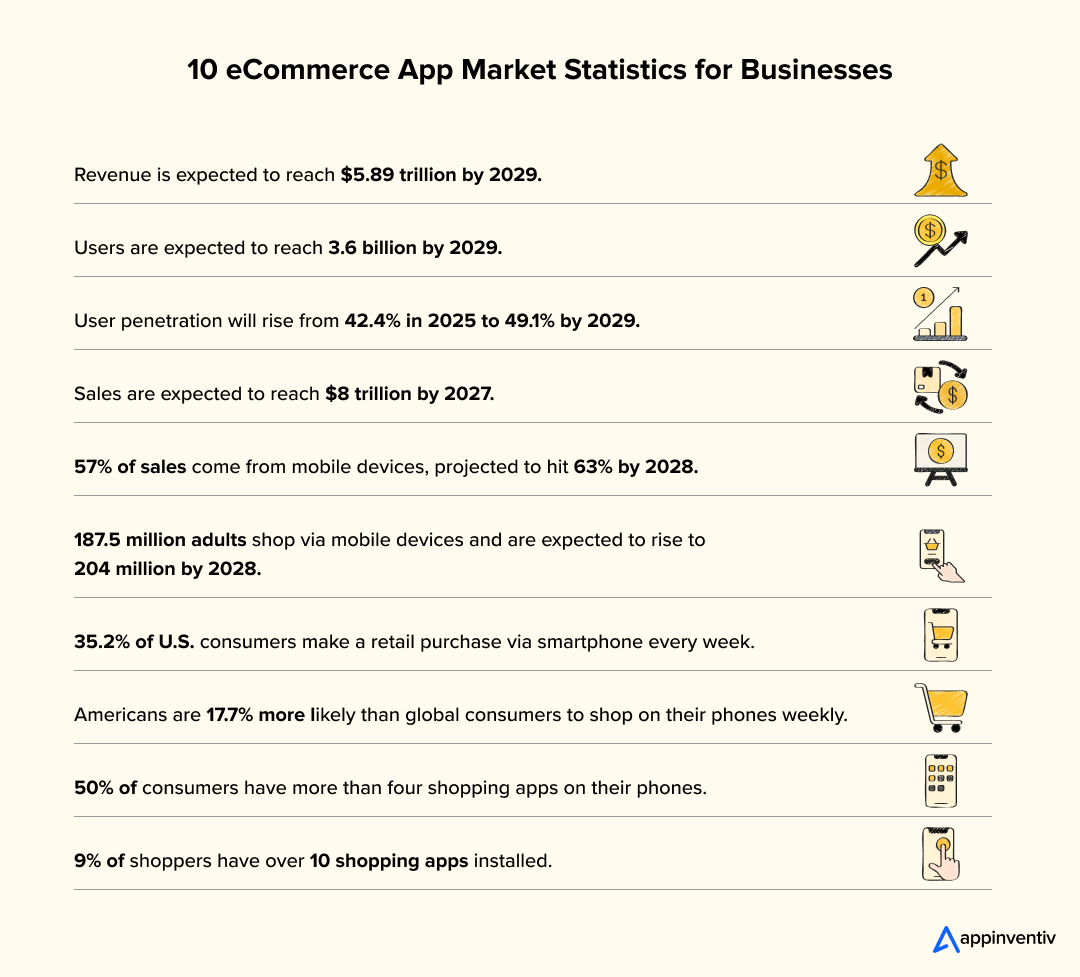
Now, why are these numbers climbing?
Growth is driven by faster smartphones, seamless payments, AI-powered experiences, and rising consumer expectations, making online shopping more appealing. As mobile-first behavior accelerates, eCommerce apps have become essential for driving revenue, building loyalty, and securing long-term digital growth.
Now, before diving into the specifics of eCommerce mobile app development, let us help you understand the types of eCommerce apps you can develop for your business.
Types of eCommerce Apps to Build for Your Business in 2026
In the ever-evolving digital marketplace, businesses have the opportunity to cater to diverse consumer needs through various types of eCommerce applications. Each type of app serves unique customer preferences and shopping behaviors, enabling businesses to tailor their strategies for maximum engagement and profitability.
| Type of App | Description | Real-World Examples |
|---|---|---|
| B2C (Business-to-Consumer) | Apps that facilitate transactions between businesses and individual consumers, offering a wide range of products and a seamless shopping experience. | Amazon, Walmart |
| B2B (Business-to-Business) | These apps are designed for the exchange of goods and services between businesses. They focus on bulk transactions, supply chain management, and business customer relations. | Alibaba, ThomasNet |
| C2C (Consumer-to-Consumer) | Platforms enabling consumers to sell goods or services to each other are often used for second-hand goods or handmade items. | eBay, Etsy |
| Social Commerce Apps | eCommerce apps integrated with social media features, allowing users to buy products directly through social platforms. | Instagram Shopping, Facebook Marketplace |
| Subscription-Based Apps | Apps that offer products or services on a subscription basis, providing continual service in return for recurring payment. | Birchbox, Blue Apron |
Benefits of Developing an eCommerce App: Driving Growth and Enhancing Customer Connections
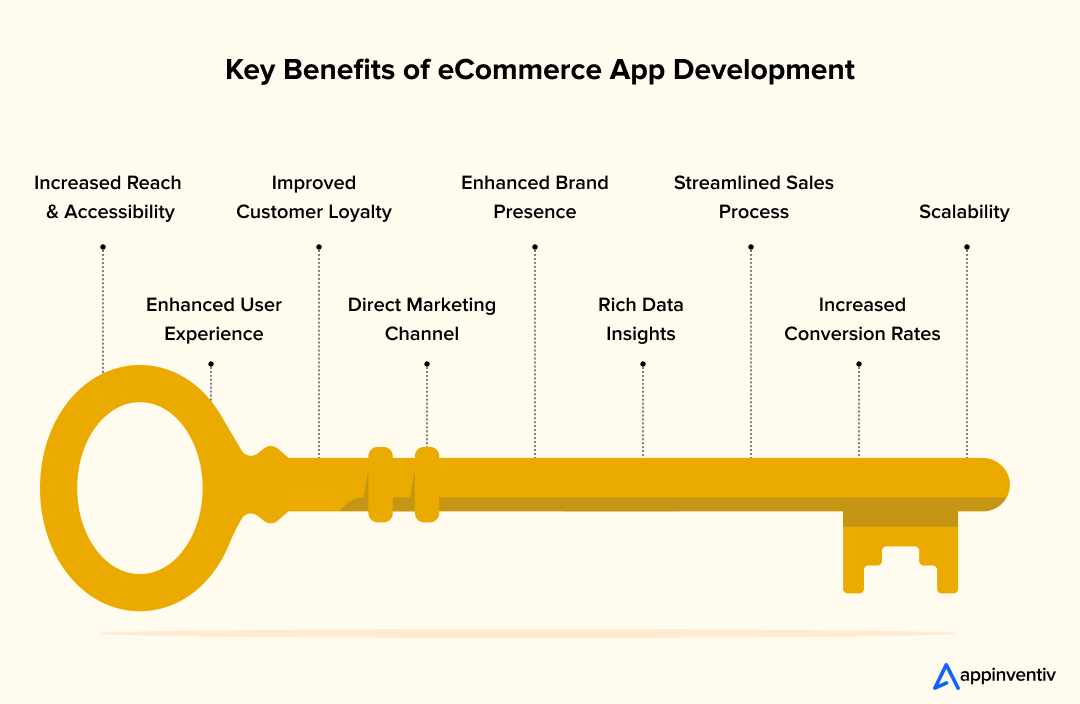
eCommerce app development offers many benefits that can significantly enhance business operations, improve customer experiences, and boost overall profitability. Here are some key advantages:
1. Increased Reach and Accessibility
One of the major advantages of eCommerce mobile app development is increased user reach and accessibility. A custom app puts your business in the pocket of millions worldwide, breaking geographical barriers. Customers can access your store anytime, anywhere, significantly expanding your market reach and increasing the potential for sales.
2. Enhanced User Experience
Mobile apps are designed for ease of use. With an intuitive interface, quick loading times, and smooth navigation, eCommerce apps enhance the shopping experience, leading to higher customer satisfaction and retention rates.
3. Improved Customer Loyalty
Highly advantageous benefits of eCommerce mobile app development for businesses is increased customer loyalty. Apps facilitate loyalty programs by integrating features such as points, rewards, and push notifications for special offers. These features encourage repeat visits and purchases, fostering a loyal customer base.
4. Direct Marketing Channel
Mobile app development for eCommerce businesses also allows the stakeholders to leverage them as direct marketing channels with the help of push notifications. Companies can send real-time updates about new products, promotions, and events directly to customers’ devices, increasing engagement rates.
5. Enhanced Brand Presence
Custom eCommerce application development can help businesses enhance their brand presence in the market. For instance, having a dedicated app in this tech-savvy and customer-focused market reinforces your brand identity whenever the user accesses their device, keeping your app at the top of the game.
6. Rich Data Insights
Apps provide valuable insights into customer behavior, preferences, and buying patterns. This data is crucial for making informed decisions, personalizing marketing strategies, and optimizing the product offering.
7. Streamlined Sales Process
Mobile apps streamline the buying process with features like one-tap checkout, saved payment methods, and easy navigation. This convenience can significantly reduce the customer’s journey time, leading to higher conversion rates.
8. Increased Conversion Rates
Apps are more effective in converting users into buyers than websites. For example, if businesses consider mobile app development for eCommerce, the result would create a product that can offer faster load times, personalized experiences, and one-click checkouts, all of which significantly boost conversion rates.
9. Scalability
As your business grows, an eCommerce app can scale to meet increasing demand without compromising performance. Apps can handle many transactions and interactions simultaneously, ensuring your business operates smoothly.
How to Build an eCommerce App: Step-by-Step Process
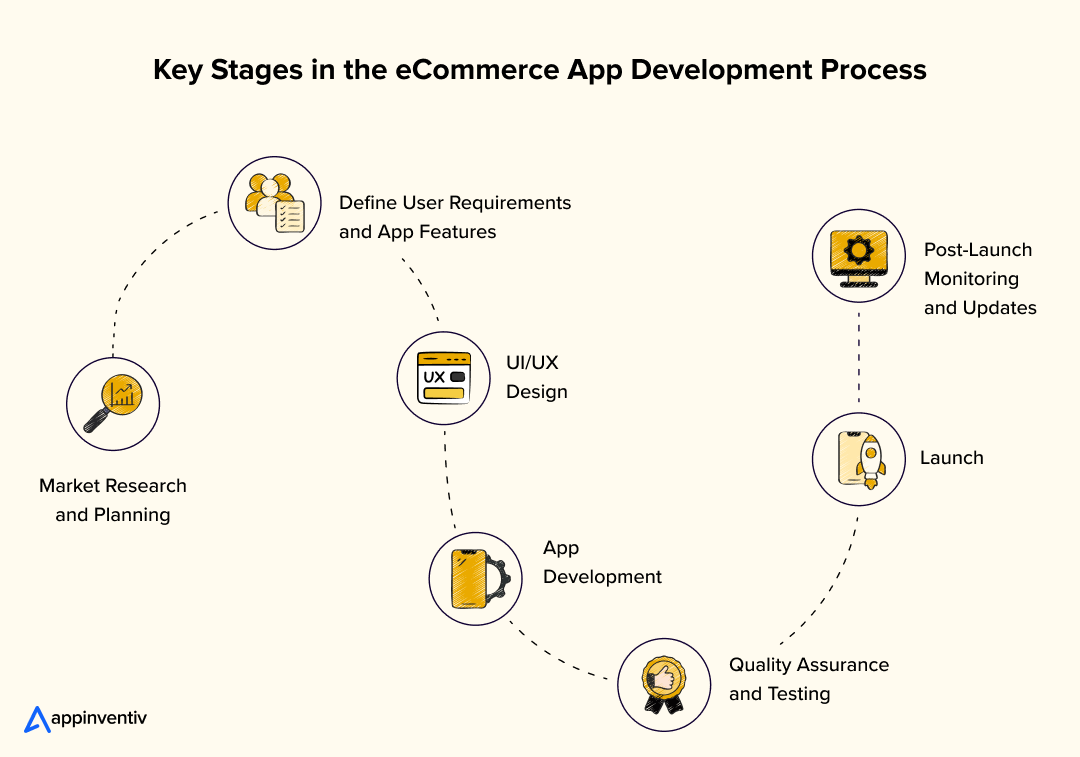
How to build an ecommerce app is a strategic process that combines technical expertise with business insight. It involves several critical steps, each designed to ensure the app functions efficiently and also delivers a superior user experience:
1. Market Research and Planning
The process to build an ecommerce app begins by understanding your market, identifying target customers, and analyzing competitors. This step helps to pinpoint the features your app must have and the unique value proposition you can offer. Thorough research aids in crafting a strategic plan that outlines the app’s objectives, key performance indicators, and overall goals.
2. Define User Requirements and App Features
Based on the insights gained from market research, define your users’ specific requirements. List the essential features your app should have, such as user registration, product catalog, search and filter options, a shopping cart, payment gateway integration, and customer support. Prioritizing these features will guide the development process.
3. UI/UX Design
The eCommerce app development design phase focuses on creating an intuitive and engaging user interface (UI) and a seamless user experience (UX). In this mobile commerce app development phase, businesses should ensure the app is easy to navigate, aesthetically pleasing, and aligns with the brand’s visual identity. Effective UI/UX design enhances user engagement and retention, making shopping and completing purchases easier.
4. App Development
This stage involves the actual coding and programming of the app. Businesses should choose the right technology stack and follow best practices to build a stable and scalable app. It’s crucial to develop both a frontend that users interact with and a backend that manages data and integrates with other systems like inventory and payment processing.
5. Quality Assurance and Testing
Testing ensures the app is bug-free and performs well under various scenarios. Quality assurance involves multiple types of tests, including functional testing, usability testing, performance testing, and security testing. Thorough testing helps to identify and fix any issues before the app goes live.
6. Launch
Once the app passes all the tests, this phase of eCommerce app development calls for the launch of app stores like Google Play and the Apple App Store. Prepare marketing materials and press releases to promote the launch. Ensure you have a support team ready to handle any customer inquiries or issues that arise post-launch.
7. Post-Launch Monitoring and Updates
After the launch, continuously monitor the app’s performance and gather user feedback. Use this feedback to make necessary updates and improvements. Regular updates fix bugs and introduce new features that meet evolving user needs, keeping the app relevant and competitive.
Now that you have a clear idea of how to develop eCommerce apps, let us move ahead and look into the features of eCommerce apps that can help them gain immediate traction in this digital marketplace.
Also Read: How to Build a Quick Commerce App? Features, Process, Costs
Core Features Every eCommerce App Should Include
In the competitive world of online shopping, having a robust and feature-rich eCommerce app is essential for attracting and retaining customers. Here are some crucial eCommerce mobile app features that every business should include to ensure a seamless and engaging shopping experience for its customers:
User-Side Features
For the user side, an eCommerce app must be intuitive, engaging, and straightforward, making shopping an enjoyable and hassle-free experience. Here are the fundamental user-side features:
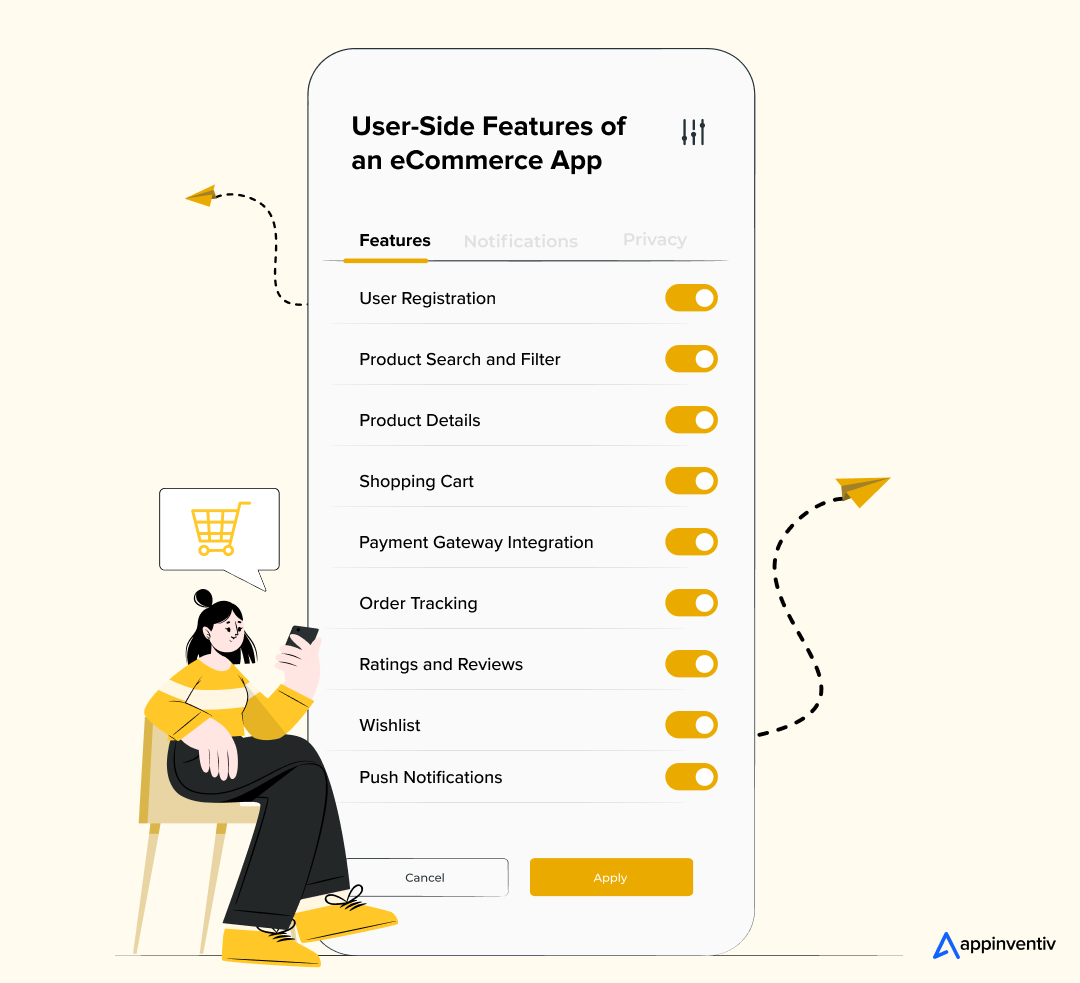
- User Registration: Allows users to create a personal account to manage orders, payments, and preferences more easily.
- Product Search and Filter: A powerful search engine with multiple filter options helps users quickly find exactly what they want.
- Product Details: Each product should have a detailed page with high-quality images, descriptions, prices, and options like size or color.
- Shopping Cart: Users can review their selections, make modifications, and proceed to checkout smoothly.
- Payment Gateway Integration: Secure and versatile payment options, including credit cards, digital wallets, and net banking, ensure a smooth transaction process.
- Order Tracking: Enables customers to track the status of their orders from processing to delivery, enhancing transparency.
- Ratings and Reviews: This feature allows customers to read and write reviews about products, fostering trust and aiding in informed decision-making.
- Wishlist: Users can save items for later purchase, providing valuable data for personalized marketing.
- Push Notifications: Keep users engaged by sending them alerts about new products, special offers, and events.
Admin-Side Features
On the administration side, the app should offer tools that help business owners and operators manage their online stores efficiently. Here are essential admin-side features:
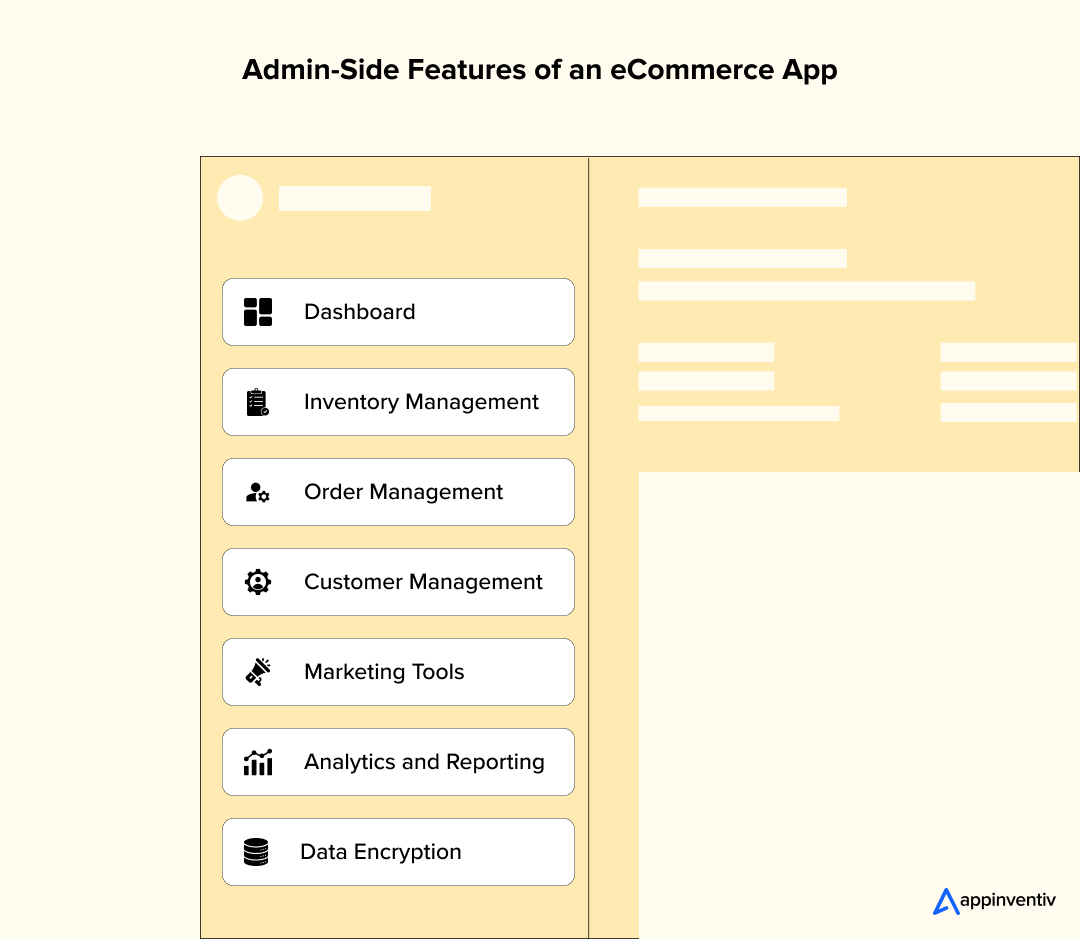
- Dashboard: A central hub for monitoring business performance, including sales statistics, inventory levels, and customer activity.
- Inventory Management: Paves the way for adding, updating, and organizing product listings, including descriptions, categories, and prices.
- Order Management: Allows for the processing of orders, updating of statuses, and handling of returns and exchanges efficiently.
- Customer Management: The admin can view customer profiles, purchase history, and feedback, which are essential for effective customer relationship management.
- Marketing Tools: Capabilities to run promotions and discounts, manage email campaigns, and implement loyalty programs directly from the app.
- Analytics and Reporting: This feature integrated during the eCommerce mobile app development process provides insights into sales trends, customer behavior, and overall app performance, helping to make informed business decisions.
- Data Encryption: Ensures all transactions and customer data are securely handled to protect against fraud and breaches.
After looking into the various eCommerce app features for startups and enterprises, let us help you understand various advanced features that can pave the way for your app to get maximum traction in the market.
Must-Have Tech Stack for Modern eCommerce App Development
In a saturated market, distinguishing your eCommerce app from competitors is crucial. Integrating advanced features, especially those leveraging AI and other emerging technologies, can significantly enhance user engagement and operational efficiency. Here are some innovative features that can give your app a competitive edge:
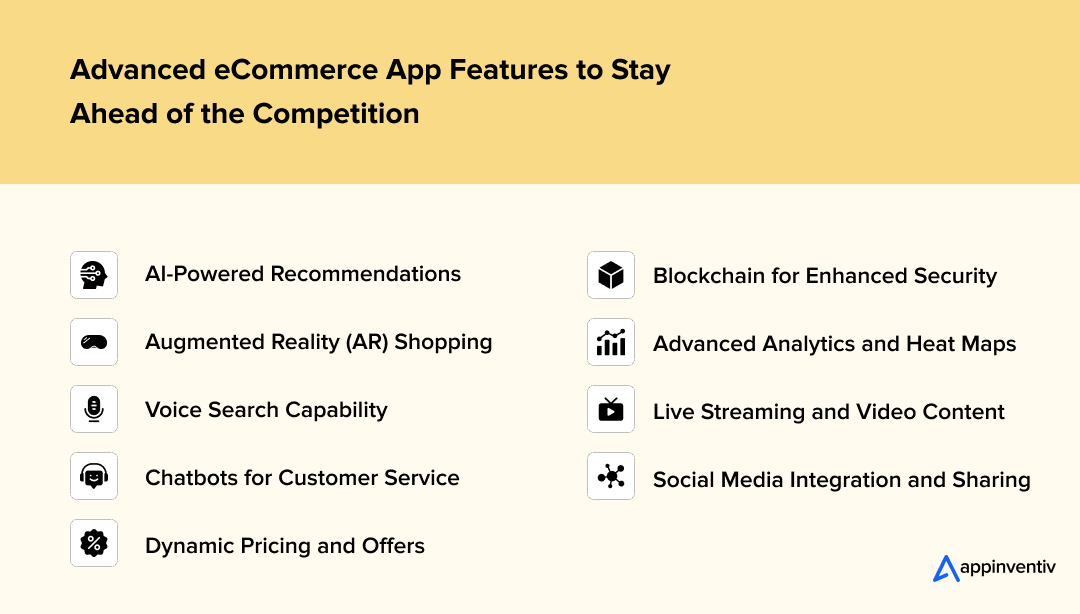
AI-Powered Recommendations
The use of AI in eCommerce, utilizes ML algorithms to analyze user behavior and preferences to suggest personalized product recommendations, enhancing the shopping experience and increasing sales.
[Also Read: AI in eCommerce: AI Trends and Use Cases Redefining Online Shopping Experiences]
Augmented Reality (AR) Shopping
AR allows customers to visualize products in a real-world context, such as seeing how a piece of furniture would look in their living room or how a garment fits, before making a purchase.
Voice Search Capability
Integrates voice recognition technology to enable users to search for products using voice commands, making the app more accessible and improving user convenience.
Chatbots for Customer Service
It implements AI-driven interactive chatbots to provide instant customer support, answer FAQs, and assist in the shopping process. The chatbots are available 24/7.
Dynamic Pricing and Offers
It uses AI to adjust prices and offers dynamically based on market demand, user behavior, and inventory levels, maximizing profit margins while still appealing to consumers.
Blockchain for Enhanced Security
Employs blockchain technology to manage transactions and protect against fraud, ensuring a secure and transparent purchasing process for users.
Advanced Analytics and Heat Maps
It provides detailed insights into how users interact with the app, identifying hot spots and bottlenecks. This information can be invaluable for optimizing app layout and improving user flows.
[Also Read: eCommerce Analytics – Boosting Conversions and Sales with the Power of Data]
Live Streaming and Video Content
Integrates live streaming for product launches or video content for product demonstrations to engage users and provide a richer content experience.
Social Media Integration and Sharing
Facilitates easy sharing of products or wish lists on social media platforms, which helps in viral marketing and leverages social proof to attract new customers.
Build a solution that goes beyond transactions and delivers adaptive, personalized shopping experiences.

Robust Tech Stack to Create an eCommerce App
Although when it comes to choosing a tech stack, every eCommerce mobile app developer has their preference regarding expertise and cost of acquiring them. At Appinventiv, we use the following technology stack for custom eCommerce app development:
| Category | Technologies |
|---|---|
| Programming Languages | JavaScript, TypeScript, Kotlin, Swift |
| Frontend Frameworks | React Native, Flutter, Angular, Vue.js |
| Backend Frameworks | Node.js, Django, Laravel, Spring Boot |
| Databases | MongoDB, PostgreSQL, MySQL, Firebase |
| Cloud & Hosting | AWS, Google Cloud, Microsoft Azure |
| Payment Gateways | Stripe, Razorpay, PayPal, Braintree |
Cost to Develop an eCommerce App: A Business Insight
The overall eCommerce app development cost typically ranges from $35,000 to $200,000, depending on the app’s complexity, feature set, design, platform (iOS, Android, or both), and the expertise of your development team.
Several other factors also influence the cost to create an eCommerce app, such as the type of app, the number of features, the level of customization required, and whether you hire a freelance ecommerce mobile app developer, an in-house team, or a full-fledged development agency.
This breakdown of eCommerce mobile application development cost will help you plan your budget more effectively:
| Development Stage | Estimated Cost Range |
|---|---|
| Market Research & Planning | $2,000 – $5,000 |
| UI/UX Design | $3,000 – $10,000 |
| Frontend Development | $6,000 – $25,000 |
| Backend Development | $8,000 – $30,000 |
| Payment Gateway Integration | $1,000 – $5,000 |
| Basic eCommerce Features | $5,000 – $20,000 |
| Admin Panel Development | $3,000 – $8,000 |
| Testing & QA | $2,000 – $8,000 |
| Deployment & Launch | $1,000 – $3,000 |
| Post-Launch Support & Updates | $3,000 – $10,000/year |
eCommerce Mobile App Development Cost Estimation Models
Budgeting is usually associated with guesswork, which predisposes to overruns. Estimation models. Structured estimation models facilitate better accuracy and control the planning process at the initial stage.
Work Breakdown Structure (WBS)
A bottom-up approach in which the total cost is constructed by adding task-level activities to it such as UI design, backend development, testing, and deployment. It provides a clear view of the time and money spent.
Parametric Model (COCOMO II)
Software size and complexity are estimated based on effort, which is usually measured in KLOC (thousand lines of code). It regulates effort based on project-specific factors.
E = a×(KLOC) b ×EAF
Three-Point Estimation (PERT)
Leads to bias reduction via the combination of optimistic, most likely and pessimistic estimates. They are commonly used when the requirements are yet to be developed.
E= O+4M+P/ 6
Where O denotes optimistic effort, M denotes most likely and P denotes pessimistic.
For advanced insight into the costs, you can also check out our blog on How much does it cost to build an e-commerce app.
After looking into the eCommerce mobile app development costs associated with multiple app development stages, let us understand the eCommerce app development trends in detail.
Monetization Models and Revenue Strategies for eCommerce Apps in 2026
In 2026, eCommerce apps aren’t just about selling online anymore. They’re full business systems designed to keep money flowing from more than one source. The goal now is stability, earning consistently even when buying trends shift.
Here are some practical ways brands are making that happen:
1. Direct Product Sales
Still the most common path. You sell products straight to your customers and keep full control over inventory, pricing, and branding. It works best when you already have an audience that trusts your store.
2. Subscription Plans
Many eCommerce apps now offer memberships or paid plans. It gives shoppers early access, free delivery, or loyalty rewards. The steady monthly income helps brands plan better.
3. Marketplace Commission Model
If you’re running a multi-seller platform, you can charge a small percentage on every transaction. Think of Etsy or eBay. The bigger your seller base, the more your earnings grow.
4. Freemium and In-App Add-Ons
Offer basic shopping features for free and charge for premium options like priority shipping, personal styling, or ad-free browsing. It’s a great way to attract users first and then convert them gradually.
5. Advertising and Brand Partnerships
Retailers are opening up ad spots inside their apps. Sponsored product listings and influencer tie-ins bring extra income without disrupting user experience.
6. Insight-Based Revenue
Anonymous, consent-based user data can reveal buying habits that brands are willing to pay for. Just make sure your platform follows global privacy laws and PCI-DSS standards while handling this data.
7. Omnichannel Advantage with Headless Commerce
Headless commerce setups allow you to sell everywhere: on your website, mobile app, kiosks, and even voice-based assistants. The result is higher conversions and stronger customer loyalty.
When you opt for eCommerce website and app development, mix a few of these models instead of relying on one. The most successful platforms in 2026 combine subscriptions, marketplace commissions, and advertising; all running smoothly with CRM integrations and secure, compliant payment systems.
eCommerce Application Development Trends Businesses Can Leverage to Get Maximum ROI
To stay ahead in the competitive digital marketplace, businesses must adopt the latest trends that enhance user experience and maximize return on investment. Here are the most impactful eCommerce app development trends worth exploring:
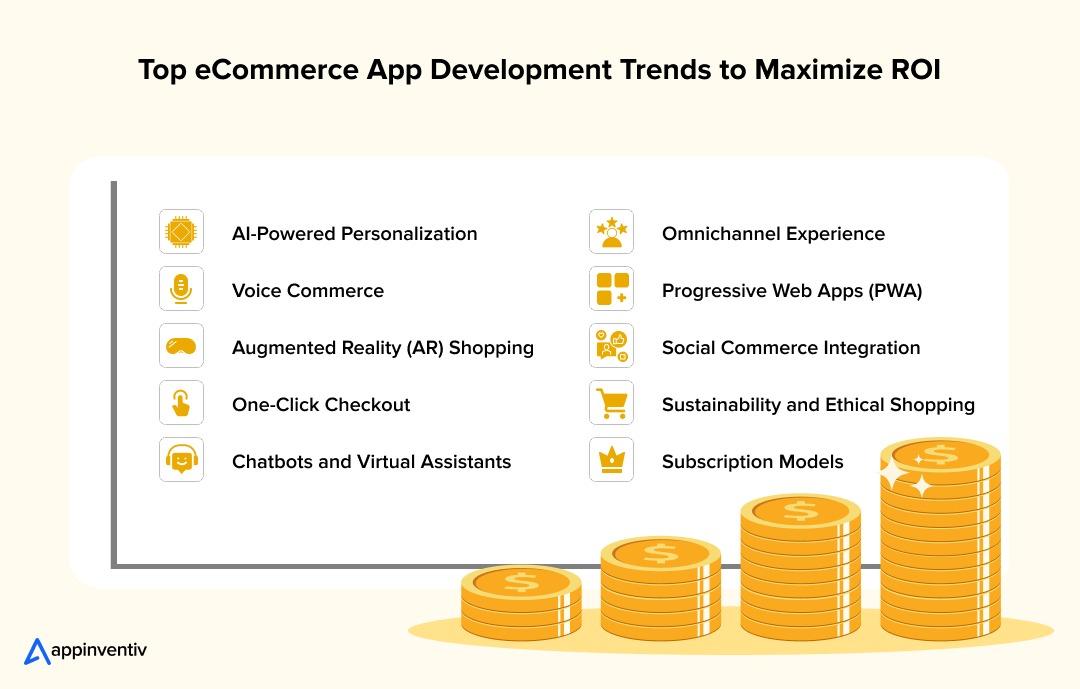
1. AI-Powered Personalization
AI algorithms track user behavior to offer product suggestions, deals, and content tailored to each shopper. This increases engagement, boosts sales, and enhances the overall user experience.
According to McKinsey, leading businesses use AI and GenAI to scale personalized marketing. Around 71% of consumers expect personalized experiences, and 76% get frustrated when they don’t receive them. Thus, adding smart personalization to your app is no longer a nice-to-have feature, but it keeps users returning for more.
2. Voice Commerce
With the rise of voice assistants like Alexa and Siri, voice search is becoming popular in shopping apps. Adding voice-enabled features can improve accessibility and offer a hands-free browsing experience. Around 20.5% of people globally actively utilize voice search in their day-to-day operations.
Thus, embracing AI-based voice commerce can turn everyday moments into shopping opportunities and position your brand right where your users are speaking.
3. Augmented Reality (AR) Shopping
AR allows users to try products like clothes and furniture virtually before buying. This reduces returns and builds confidence in online purchases.
With the Augmented Reality in eCommerce market projected to reach $38,548.9 million by 2030, adoption is accelerating as brands like L’Oréal use virtual try-on tools to drive engagement. This shift is turning online shopping into a more interactive, trust-driven experience without the need for physical trials.
4. One-Click Checkout
Simplifying the payment process with one-click checkout reduces cart abandonment and increases conversions. It makes shopping quicker and more convenient for users. According to the Baymard Institute, the average cart abandonment rate stands at 70.22%, meaning more than seven in ten shoppers exit without completing their purchase.
5. Chatbots and Virtual Assistants
AI-powered chatbots provide instant customer support, answer questions, and guide users through purchases. This 24/7 assistance boosts customer satisfaction and reduces service costs.
Gen AI-powered chatbots can act as intelligent shopping assistants, guiding users, answering questions, and even recommending products. They could potentially become a key sales channel for modern eCommerce businesses. Simply put, for eCommerce businesses, adding a chatbot is like hiring a smart, tireless salesperson who never sleeps and always closes.
6. Omnichannel Experience
Integrating your app with other channels like websites, social media, and offline stores ensures a consistent customer journey. It helps retain customers and increase repeat purchases. Businesses with effective omnichannel engagement retain about 89% of their customers, while those with weaker approaches retain only around 33%.
7. Progressive Web Apps (PWA)
PWAs offer an app-like experience through web browsers without requiring installation. ecommerce web application development enables the fastest load, works offline, and is ideal for reaching users in areas with low connectivity.
8. Social Commerce Integration
Connecting your app with social platforms lets users share products and shop directly from their feeds, increasing visibility and driving organic traffic. Integrating in-app shopping within social media also helps brands capture high user engagement and turn attention into actual purchases.
9. Sustainability and Ethical Shopping
Consumers today prefer eco-friendly and ethical brands. Highlighting practices within your app, such as carbon-neutral shipping or local sourcing, can attract more conscious buyers.
According to McKinsey, today’s shoppers expect brands to back their sustainability promises with real action. Products with environmental, social, and governance (ESG) claims see 1.7% higher sales growth than those without. This reflects a growing consumer trend where eco-consciousness directly influences purchase decisions and brand loyalty. Well, to say the least, building transparency and ethics into your app isn’t just good for the planet, it’s great for business too.
10. Headless Commerce for Flexible and Faster Experiences
Traditional eCommerce platforms link the front-end (what users see) directly to the back-end (where logic lives). In contrast, headless commerce separates the two, allowing brands to deliver personalized shopping experiences across web, mobile, IoT, and even AR interfaces without rebuilding their entire system.
This decoupled trend also speeds up development, improves performance, and enables easier integration with CRM systems, AI-driven analytics, and voice commerce platforms. It’s the go-to approach for 2026-ready eCommerce ecosystems.
Challenges of Ecommerce App Development Businesses Face & How to Overcome Them
While developing an eCommerce app offers huge growth potential, businesses often face several roadblocks along the way. Understanding the challenges of eCommerce application development and how to solve them is key to building a successful, customer-ready platform.
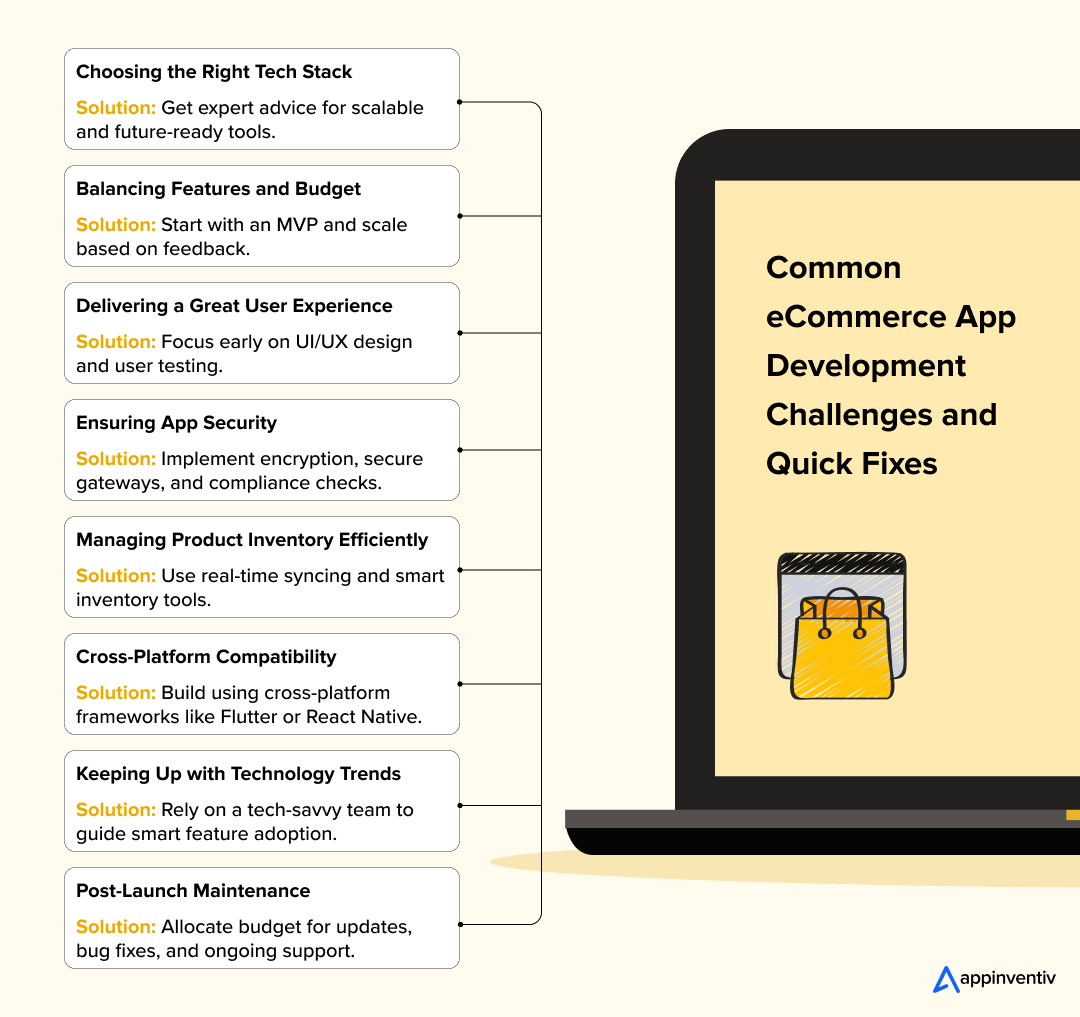
1. Choosing the Right Tech Stack
Many businesses struggle with selecting the right programming languages, frameworks, and tools for their app.
Solution: Consult with experienced developers or a trusted tech partner to assess your app’s needs and choose a scalable, future-ready tech stack.
2. Balancing Features and Budget
Adding too many features at once can inflate costs and delay the launch, while too few can leave users unimpressed.
Solution: Start with a Minimum Viable Product (MVP) that includes only core features and add advanced ones based on user feedback and budget availability.
3. Delivering a Great User Experience
Designing an app that is visually appealing, fast, and easy to use is often a challenge for first-time app builders.
Solution: Invest in UI/UX design early in the process and conduct user testing to refine app navigation and usability before launch.
4. Ensuring App Security
Handling personal and financial data during the eCommerce application development process requires strong security measures, or you risk losing customer trust.
Solution: Use secure payment gateways, encrypt data, follow PCI-DSS and GDPR compliance, and conduct regular security audits.
5. Managing Product Inventory Efficiently
Without a reliable backend system, tracking stock, orders, and updates becomes chaotic as you scale.
Solution: Integrate inventory management software or build a custom backend during the eCommerce web application development process that syncs stock levels across all platforms in real time.
6. Cross-Platform Compatibility
Building a smooth app experience during eCommerce android app development and eCommerce iOS app development process can be time-consuming and complex.
Solution: Use cross-platform development frameworks like Flutter or React Native to build one app that works well across multiple platforms.
7. Keeping Up with Technology Trends
Technology is evolving fast, and it’s tough to know which trends are worth adopting and which are hype.
Solution: Work with a development team that has a dedicated team of eCommerce mobile app developers who stay updated on industry trends and can help you integrate only those technologies that align with your business goals.
8. Post-Launch Maintenance
Many businesses underestimate the effort and cost needed to keep the app updated, bug-free, and relevant post-launch.
Solution: Set aside part of your budget for regular updates, performance monitoring, and customer support to ensure the long-term success of your app.

Why Partner with Appinventiv for Your eCommerce App Development?
eCommerce is shifting to become a more responsive and experience-driven ecosystem. One-to-many scaling, AI-powered recommendation engines, voice shopping, and real-time supply chain visibility have become expected features. Meanwhile, businesses are being pressured to roll out faster and at the same time be stable, secure, and perform across devices and markets.
Within this context, cost estimation is no longer a mere budgeting process. It is integrated into strategic product planning where accuracy has a direct impact on time-to-market and scalability at long term.
At Appinventiv, we help brands not just enter the eCommerce space but stand out and scale fast with expertly crafted, feature-rich, and future-ready eCommerce apps.
Here’s what sets us apart:
- End-to-End Delivery, Zero Guesswork: From planning to post-launch optimization, we cover the full lifecycle so you don’t have to juggle teams.
- AI, AR & GenAI That Convert: We build apps with AI-driven recommendations, AR try-ons, and AI-powered assistants, so you meet user expectations and drive ROI.
- Secure, Scalable, Future-Proof: Our robust backend, real-time inventory, and one-click checkout are designed to scale with your growth.
- Strategy-Driven for Every Business Type: Whether you are building a B2B, B2C, C2C, subscription-based, or social commerce app, we customize every solution to your business model and market needs.
As a leading custom eCommerce app development company, we have helped a range of well-established eCommerce stores gather digital success. Some of them includes:
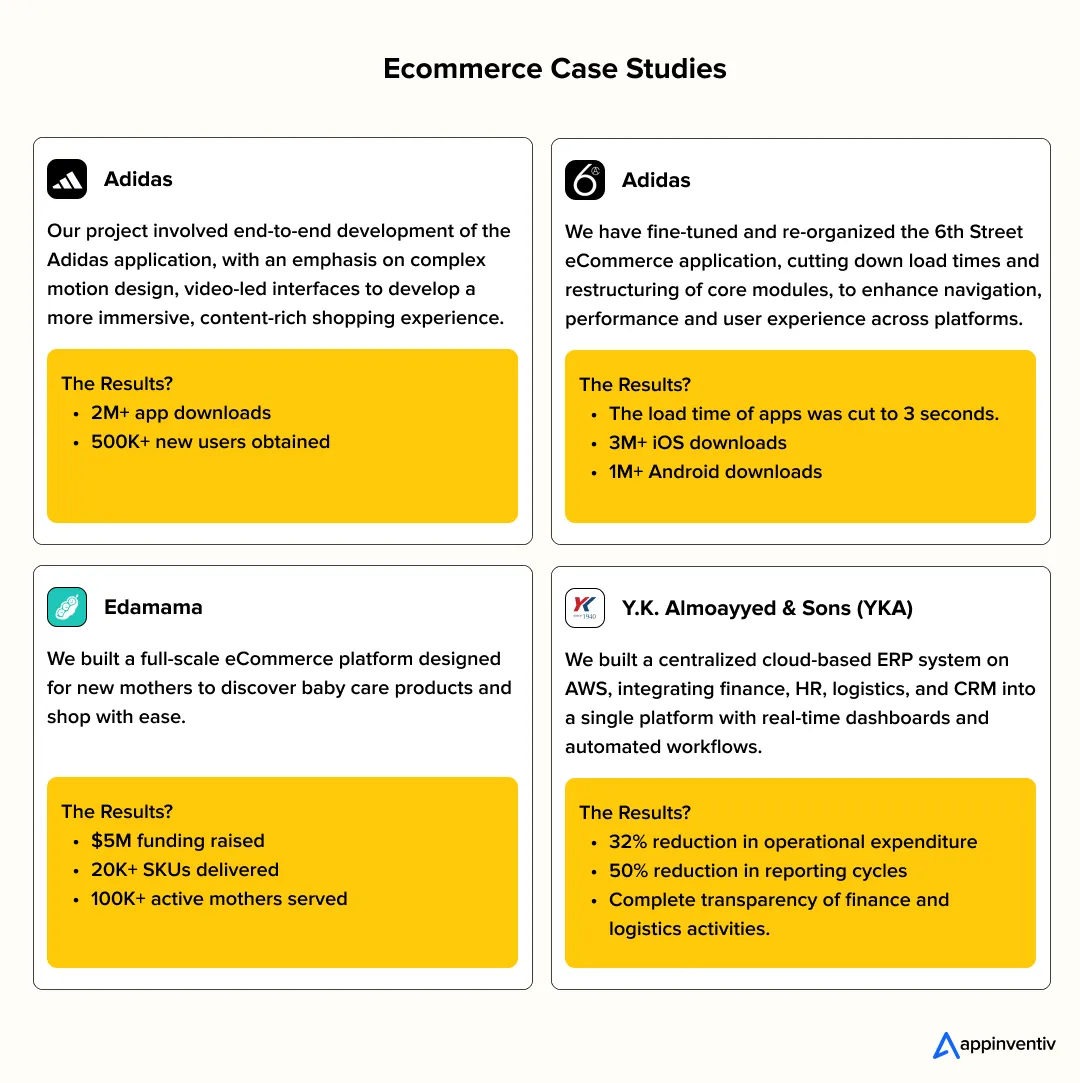
While these are our most notable clients, we have worked on multiple other use cases across the wide eCommerce space, making us the reliable digital partner of multiple startups and well-known brands. If you are looking for an eCommerce app development partner, get in touch.
FAQs
Q. How do I develop an eCommerce mobile application?
A. Developing an eCommerce mobile app starts with app conceptualization, designing app UI/UX, backend and frontend development, and app testing, followed by launch and continued maintenance. A leading eCommerce app development company with prior expertise in the field can help you streamline the entire process, avoid common pitfalls, and build a scalable, user-friendly app tailored to your business goals.
Q. How Much Will It Cost To Develop An ECommerce Mobile App?
A. The cost to create an eCommerce app generally ranges between $35,000 to $200,000. This depends on how complex the app is, what features you want, the design quality, and whether you are building it for Android, iOS, or both. Other factors like the level of customization, number of screens, and the team you choose (freelancers, in-house developers, or an experienced agency) can also affect the final online shopping app development cost.
Q. What is mobile commerce app development, and why is it important for businesses?
A. Mobile commerce app development refers to creating applications specifically designed for buying and selling goods or services via mobile devices, such as smartphones and tablets. These apps provide a seamless shopping experience with features like product browsing, secure payments, and personalized recommendations. Mobile ecommerce development is the need of the hour for businesses because it allows them to reach customers anytime, anywhere, increase sales through convenient access, and build brand loyalty by offering tailored user experiences.
Q. How long does it take to build an eCommerce app?
A. The time to build an eCommerce app usually ranges from 3 to 9 months, depending on the app’s complexity, the number of features, and how customized it needs to be. A basic app with standard features can be developed in about 3 to 4 months, while a feature-rich app with advanced integrations and a unique design may take 6 months or more. The timeline of mobile shopping app development also depends on the size of the hired team and how quickly feedback and approvals are given during the process.
Q. What is the required team size for developing an eCommerce app built to scale?
A. To build a scalable eCommerce app, you need a well-rounded team with specific roles that ensure smooth development and future growth. Here’s a typical team structure:
- Project Manager – Oversees the development process, timelines, and team coordination.
- UI/UX Designer – Designs the app interface and ensures a seamless user experience.
- Frontend Developer – Builds the parts of the app users interact with.
- Backend Developer – Develops the app’s server, database, and business logic.
- QA Tester – Tests the app to fix bugs and ensure quality before launch.
- DevOps Engineer – Manages app deployment, updates, and performance monitoring.
- Business Analyst – Helps align app features with business goals and user needs.
Q. How can you choose the best team for developing an eCommerce app – freelancers, in-house experts, or an external development agency?
A. Choosing the right team depends on your budget, timeline, and quality expectations. Here’s a quick comparison to help you decide:
| Option | Pros | Cons |
|---|---|---|
| Freelancers | Cost-effective, flexible | Less reliable, may lack team coordination |
| In-House Experts | Full control, aligned with company goals | High cost, slower to scale |
| Development Agency | End-to-end service, experienced team | Higher upfront cost, need strong brief |
Q. What is the Correct Monetization Model of an ecommerce app other than direct sales?
A. Apart from direct product sales, eCommerce app development can allow businesses to earn revenue through several additional channels:
- Subscription Model – Users pay monthly or annually for exclusive products or services. For example, getting curated boxes or premium delivery.
- Ads and Sponsorships – Ads and sponsorships are one of the major monetization models of eCommerce apps. Businesses can display sponsored products or run in-app advertisements for other brands in order to generate additional revenue.
- Affiliate Marketing – Brands earn commission by promoting third-party products and driving conversions through the app.
- In-App Promotions – Brands can charge sellers or vendors to highlight their products within the app.
Q. What compliance standards should an eCommerce app meet in 2026?
A. Your eCommerce app should comply with PCI-DSS for payment security, GDPR or regional data protection laws for user privacy, and local tax and trade regulations based on your operating country.
These standards of mobile ecommerce app development help you protect sensitive data and maintain customer trust.
Q. How do we stop bleeding sales at the finish line and simplify the checkout process?
A. If your checkout feels like a tax audit, buyers will bail. Stop putting hurdles in front of people trying to hand you money.
- Kill mandatory accounts: Guest checkout is non-negotiable. Forcing a sign-up is a conversion death sentence.
- Automate data entry: Deploy intelligent autofill so users aren’t typing out their life story.
- No surprises: Surface shipping costs instantly to eliminate sticker shock.
- One-tap payments: Hardwire digital wallets like Apple Pay and Google Pay.
To permanently seal these revenue leaks, execute the above highlighted fruitful ways to simplify your ecommerce app’s checkout process.


- In just 2 mins you will get a response
- Your idea is 100% protected by our Non Disclosure Agreement.

AI adoption inside large organizations didn’t wait for governance, risk, and compliance structures to catch up. Models started showing up in products, workflows, and decision systems across business units, often quietly. Some were built internally. Others came in through third-party tools or vendor platforms. Most of this happened step by step, driven by teams trying…

Artificial intelligence is no longer a buzzword for businesses; it is already here, benefiting businesses in millions of ways. From automating operational processes to enhancing customer experience and driving innovation, AI can redefine the way businesses function. Unsurprisingly, artificial intelligence (AI) is the present and future of today’s technology-driven world.
Healthcare is at a turning point where digital transformation isn't just an advantage but a core strategy for delivering better patient outcomes and operational resilience. In Deloitte's 2026 US Health Care Outlook, more than two-thirds of health plan and system leaders say they expect to outperform competitors next year, even as strategic uncertainty rises amid…