






























How to Publish an App on the Google Play Store: A Step-by-Step Guide for 2026

 Share -


- 01How to Publish an App on the Google Play Store: Step-by-Step Process
- 02Google Play Publishing Checklist
- 03Google Play Store Requirements for Enterprise Apps
- 04How Long Does It Take to Publish an App on Google Play Store?
- 05How Much Does It Cost to Publish an App on Google Play Store?
- 06Common Reasons Google Rejects an Android App
- 07How to Manage Your Android App After Publishing
- 08Google Play Store App Publishing Best Practices
- 09Should You Publish an App Yourself or Hire an Android App Development Company?
- 10Why Choose Appinventiv for Android App Development and Google Play Publishing?
- 11FAQs

Key takeaways:
- Publishing on Google Play requires verified accounts, signed bundle files, compliance forms, testing, and phased rollouts.
- Corporate releases need company console access, secured signing keys, clear release rules, and cross-team approvals.
- Apps submitted after August 31, 2026 must target Android 16, API level 36.
- Google runs over 10,000 safety checks on every submission, making thorough pre-launch testing mandatory.
- Basic application budgets reach $40,000 to $80,000 for simple user workflows and basic features.
Publishing an app on the Google Play Store involves technical setup, regulatory review, and platform configuration. Your engineering team must set up a verified developer account and prepare a secure release build. Success requires complete data disclosures, proper store listings, and thorough pre-launch testing.
Small teams deploy simple apps quickly, but enterprise applications demand rigorous organizational alignment. Android now runs on more than 3 billion devices globally, giving businesses access to a large and diverse user base.
These systems integrate payment gateways, corporate identity access, external software, and private databases. Security reviews, data privacy mandates, quality checks, and executive sign-offs add mandatory steps to the launch sequence.
This guide covers the full release process from final code compilation to post-launch maintenance. It outlines concrete timelines, project costs, common causes of rejection, and criteria for selecting a software development vendor.
Get your enterprise Android app release-ready before compliance, testing, and Google Play review delay your launch.

How to Publish an App on the Google Play Store: Step-by-Step Process
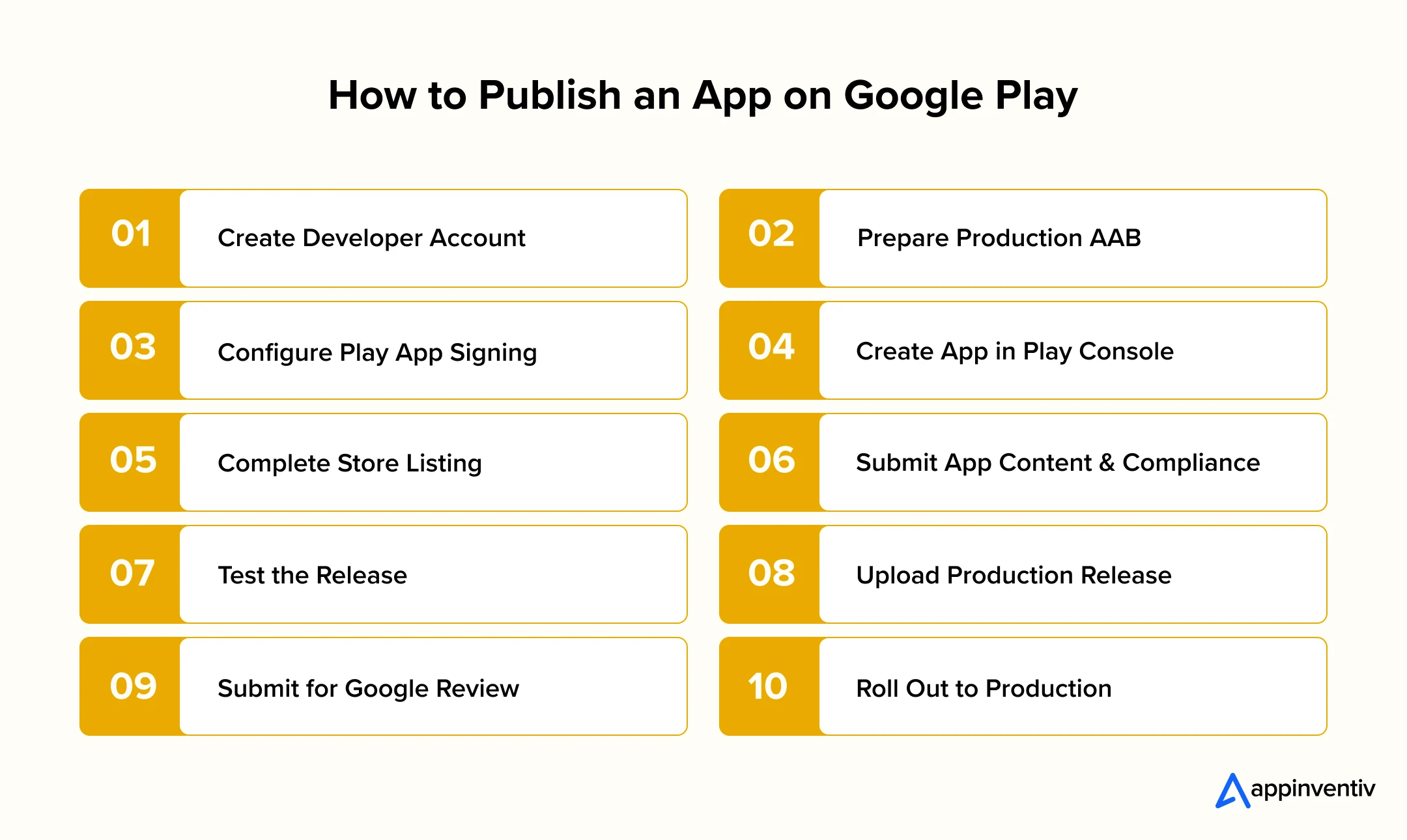
How to publish an Android app on the Google Play Store? The process follows a fixed sequence. You create and verify a developer account, prepare a release-ready Android App Bundle, configure signing, set up the app in the Play Console, complete the store listing and policy declarations, test the release, submit it for review, and roll it out to production.
For a business app, each stage needs clear ownership. Engineering handles the release build and signing. Product teams manage the listing. Security and legal teams review data and privacy declarations. QA validates the production build before submission.
Here is how the publishing process works.
Step 1 – Google Play Developer Account Setup and Verification
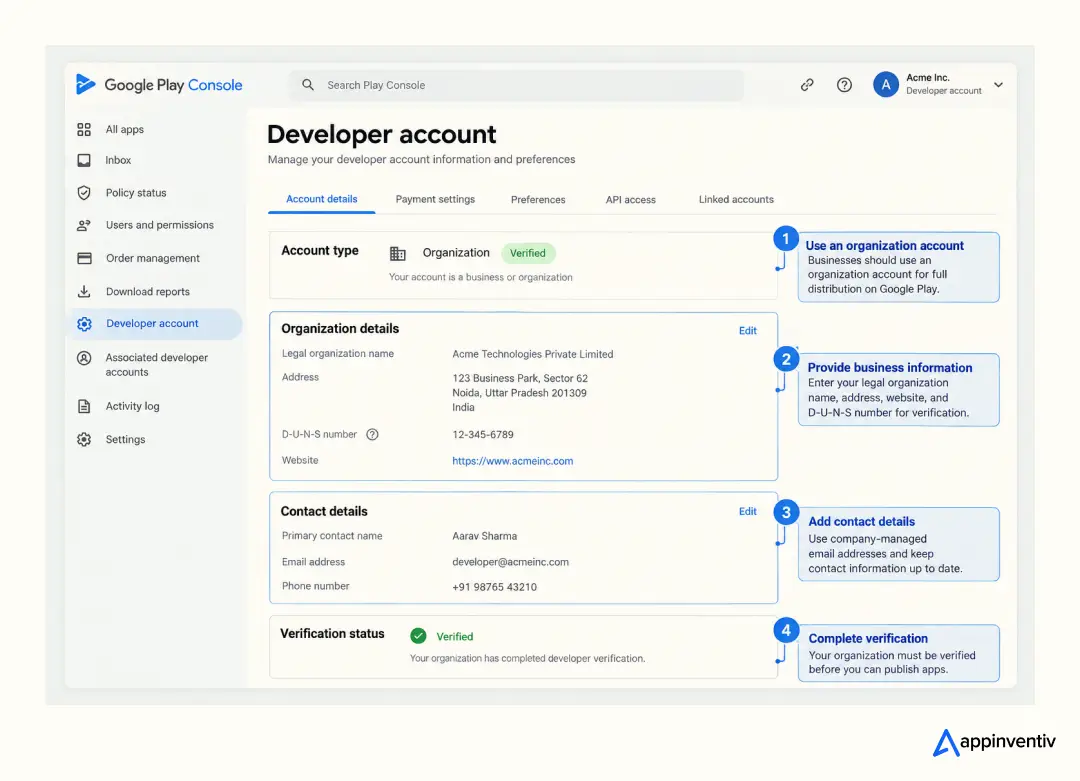
Start with a full-distribution Google Play developer account. Google currently charges a one-time $25 USD registration fee for this account type.
Businesses should use an organization account rather than a personal account. Organization accounts require business information, including the legal organization name, address, website, contact details, and a D-U-N-S number for verification.
The company should own this account. Do not place the production account under an employee’s personal identity or an external agency. The account controls the published application, release permissions, and access to the Play Console.
Use company-managed email addresses and assign Play Console permissions based on each person’s role. Keep administrator access restricted to trusted users.
Step 2 – Prepare Your Android App for Production
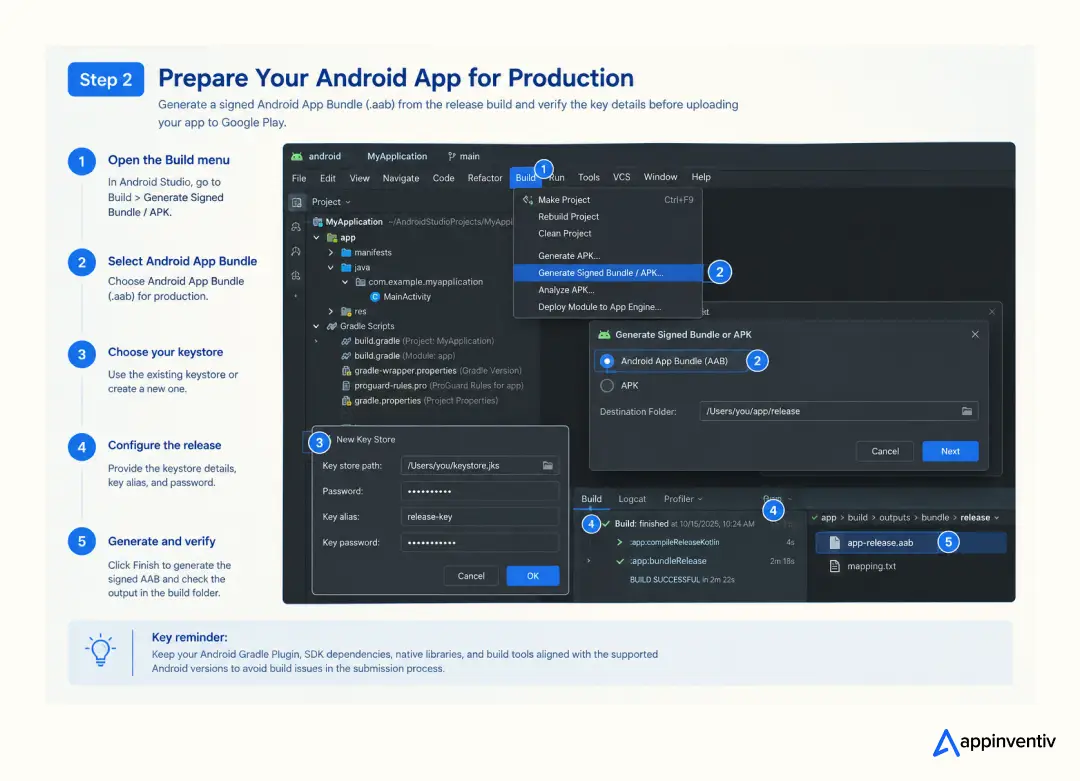
Your app needs a production-ready build before you submit anything to Google Play. Generate an Android App Bundle (.aab) from the release build. The bundle is the package Google Play uses to generate optimized APKs for supported devices.
Check the release before upload. Your team should verify:
- Package name
- Version code
- Version name
- Release configuration
- Production API endpoints
- Third-party SDK compatibility
- Runtime permissions
- Crash and ANR behavior
- Device compatibility
Your target API level must match Google’s current policy. Keep the Android Gradle Plugin, SDK dependencies, native libraries, and build tools aligned with the supported Android versions. Following Android app optimization best practices before the Play Console submission can prevent a broken release build from forcing another build cycle.
Step 3 – Android App Signing Guide: Configure Play App Signing
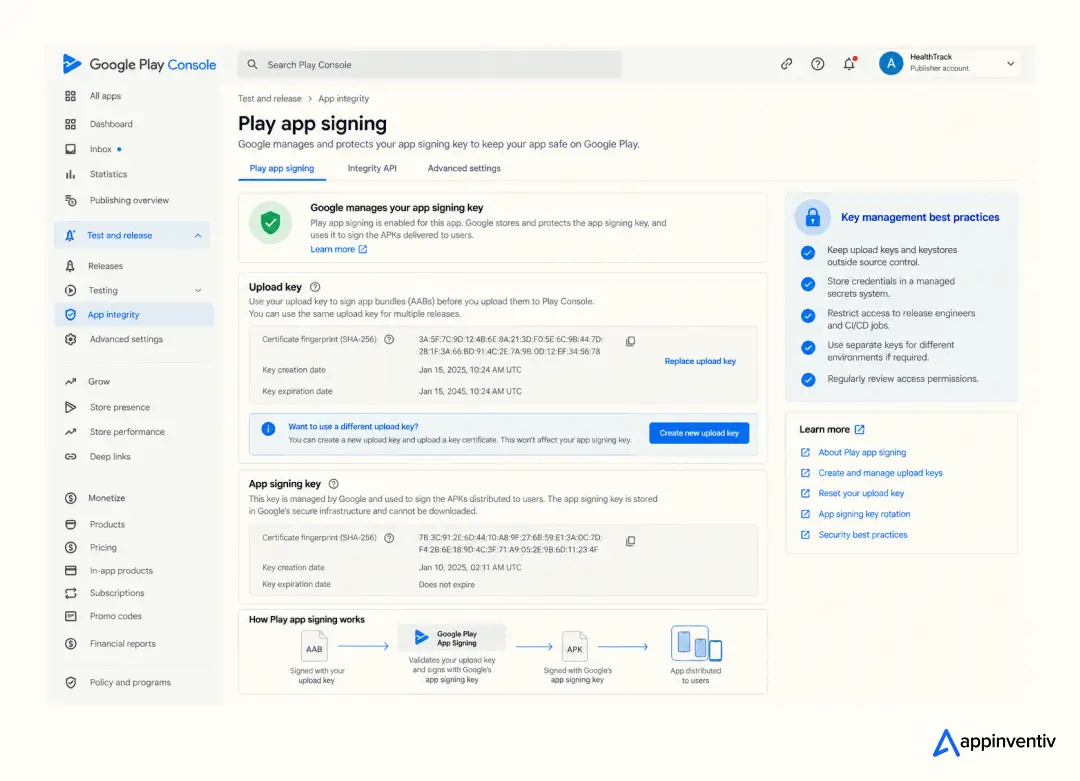
Play App Signing separates the key used to upload your AAB from the key Google uses to sign the app distributed to users. Google stores and protects the app signing key through its key management infrastructure.
Your upload key signs the bundle you send to the Play Console. Google uses the app signing key to sign the APKs delivered through Google Play.
Keep upload keys and keystores outside source control. Store sensitive credentials in a managed secrets system. Restrict access to release engineers and approved CI/CD jobs.
This matters for enterprise teams that run automated Android builds. The pipeline should retrieve signing credentials securely and produce reproducible release artifacts without exposing private keys to every developer.
Step 4 – Create Your App in Google Play Console
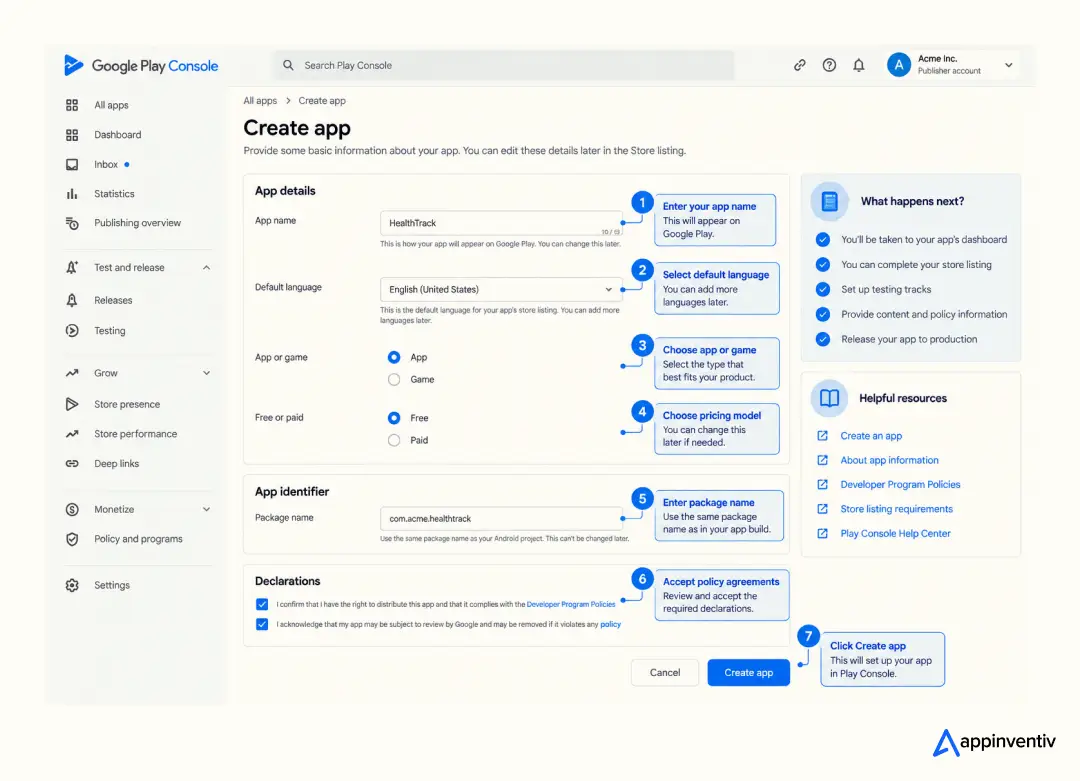
Open the Play Console and select Create app. Enter the core app details:
- App name
- Default language
- App or game
- Free or paid status
- Package name
- Required policy agreements
Use the same package identity configured in the Android project. The Play Console dashboard then becomes the central place to publish to Google Play, covering your store listing, testing tracks, content declarations, releases, and production availability.
For an enterprise app, assign these areas to the appropriate owners. Product can manage store content. Engineering can control releases. Security and legal teams can review compliance information.
Step 5 – Complete Your Store Listing
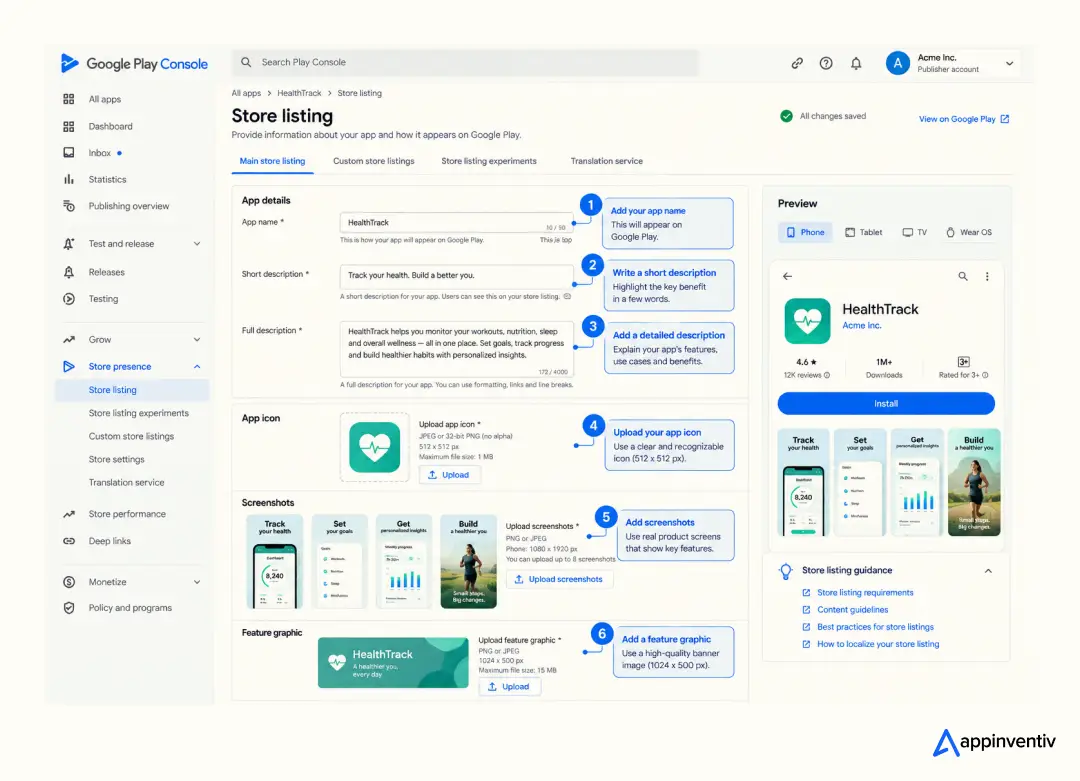
Your Store Listing is the public product page on Google Play. It should match the actual application and release. Prepare the required assets and information, including:
- App name
- Short description
- Full description
- App icon
- Screenshots
- Feature graphic
- Category and tags
- Contact details
- Localized content
Use real product screens in screenshots. Keep the descriptions aligned with features available in the current build. Avoid claims the app cannot support.
Global products need market-specific store content. Translate descriptions and screenshots for important markets rather than relying only on a translated text field. This supports both Android app store listing optimization and user conversion.
Also Read: A Comprehensive Guide on Play Store Optimization
Step 6 – Complete App Content and Compliance Requirements
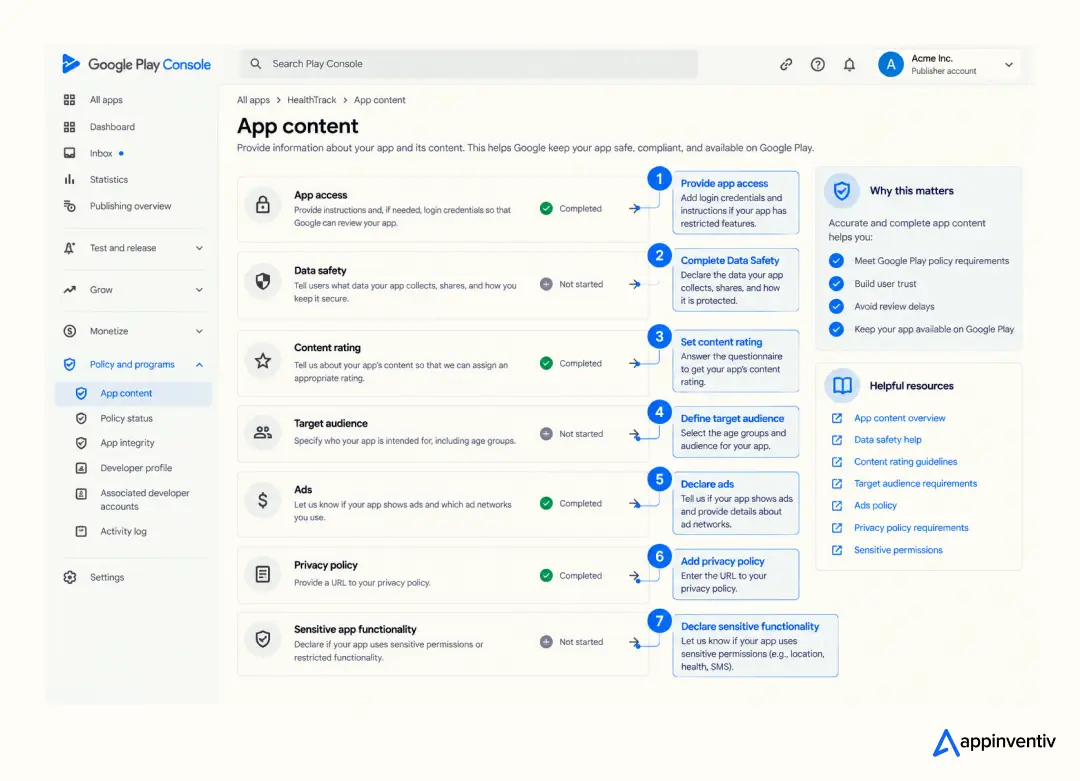
Play Console requires several declarations before an app can move through publication.
- App access tells Google how reviewers can reach restricted features. Provide valid login credentials and review instructions when the app requires authentication.
- Data Safety explains how the app collects, shares, and protects user data. Google requires developers to submit this information through the Play Console.
You will also need to complete relevant declarations for:
- Content rating
- Target audience
- Ads
- Privacy policy
- Permissions
- Sensitive app functionality
Review these declarations against the actual app behavior and its third-party SDKs. A mismatch among the code, privacy policy, and Play Console declarations can cause review issues.
Step 7 – Android App Beta Testing on Google Play: Set Up Testing Before Production
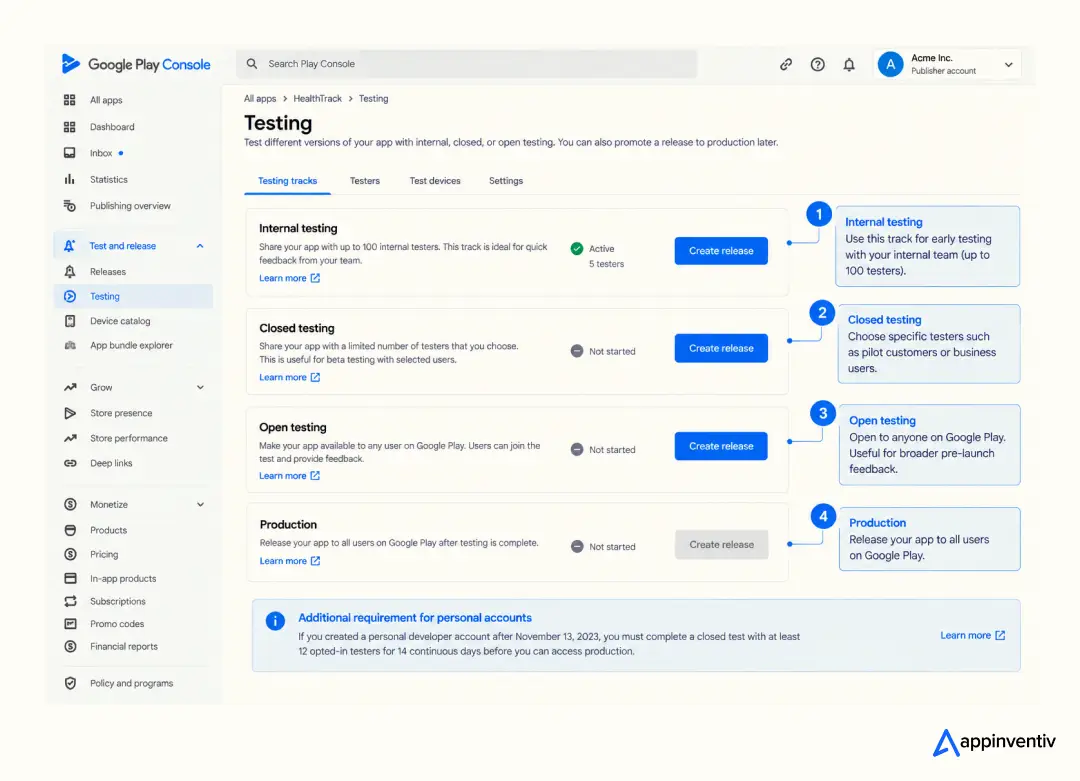
Google Play provides internal, closed, and open testing tracks. Internal testing supports up to 100 selected testers. Closed testing limits access to chosen testers. Open testing allows users to join the test through Google Play. Use the track that fits your release stage.
Internal testing can cover engineering and product checks. Closed testing works well for pilot customers, business users, or a controlled beta group. Open testing suits broader pre-launch feedback.
Google has an additional production-access requirement for personal developer accounts created after November 13, 2023. Those accounts must complete a closed test with at least 12 opted-in testers for 14 continuous days before production access.
Enterprise teams should still use testing tracks even when that personal-account rule does not apply, following sound app testing strategies to cover authentication, payments, push notifications, deep links, offline states, API calls, analytics, and device compatibility before production.
Step 8 – Google Play App Bundle Upload: Create and Configure the Production Release
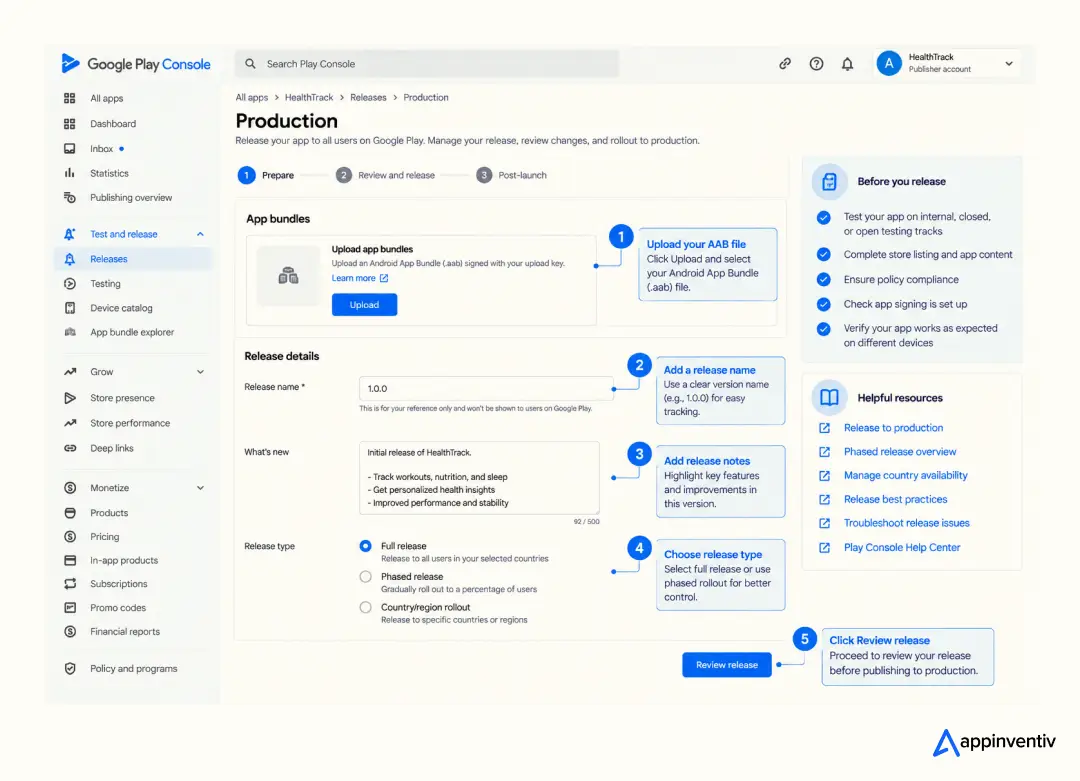
Open the Production track and create a new release. Upload the signed AAB, add release notes, and review the release details. Play Console lets you configure:
- Countries and regions
- Pricing
- Availability
- Release notes
- App bundle
- Device targeting
- Release settings
It also checks the release for errors and warnings. Resolve blocking errors before submission. Review warnings before proceeding. Production availability applies to the countries and regions selected for the release. Plan those settings around your commercial launch markets.
Step 9 – Google Play App Review Process: Submit the App for Review
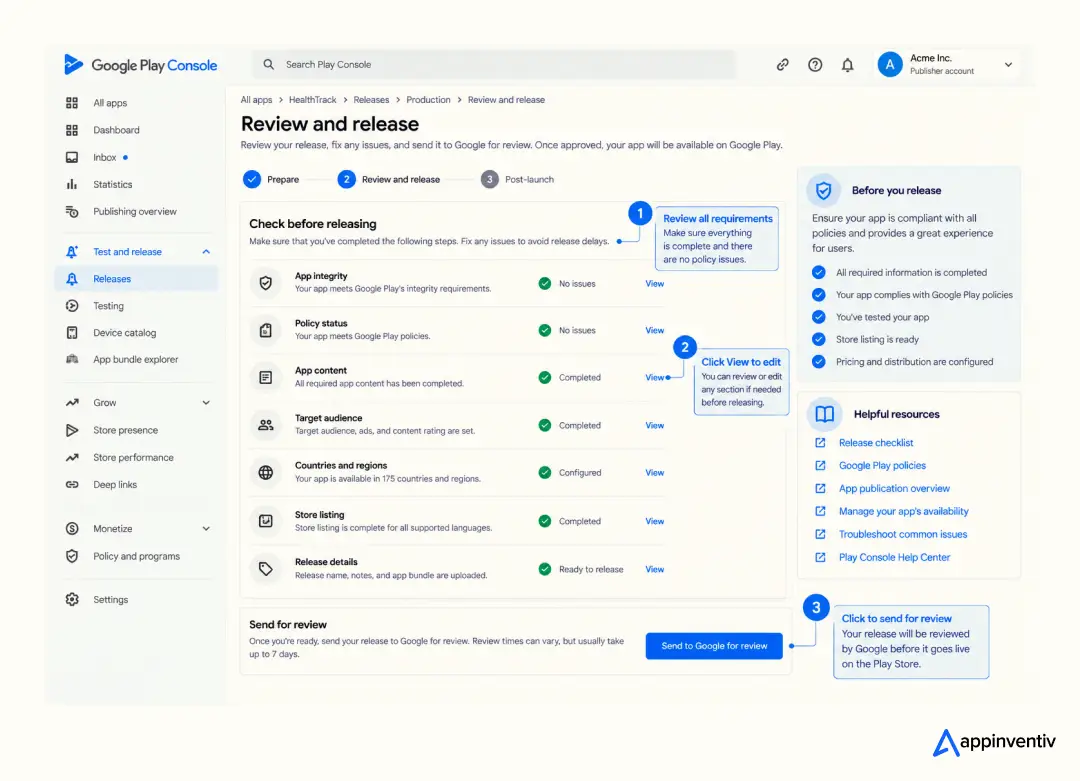
After the required setup is complete, submit the release for review. Google reviews the app against its technical and policy requirements. Google Play runs more than 10,000 safety checks on every app before and after publication. Reviewers may also need access to restricted features, so test credentials and instructions must work.
Do not treat review as a fixed-duration step. Google states that some reviews can take up to seven days or longer in exceptional cases. Keep time in the release plan for possible questions, corrections, or another submission cycle.
Step 10 – Publish and Roll Out the App
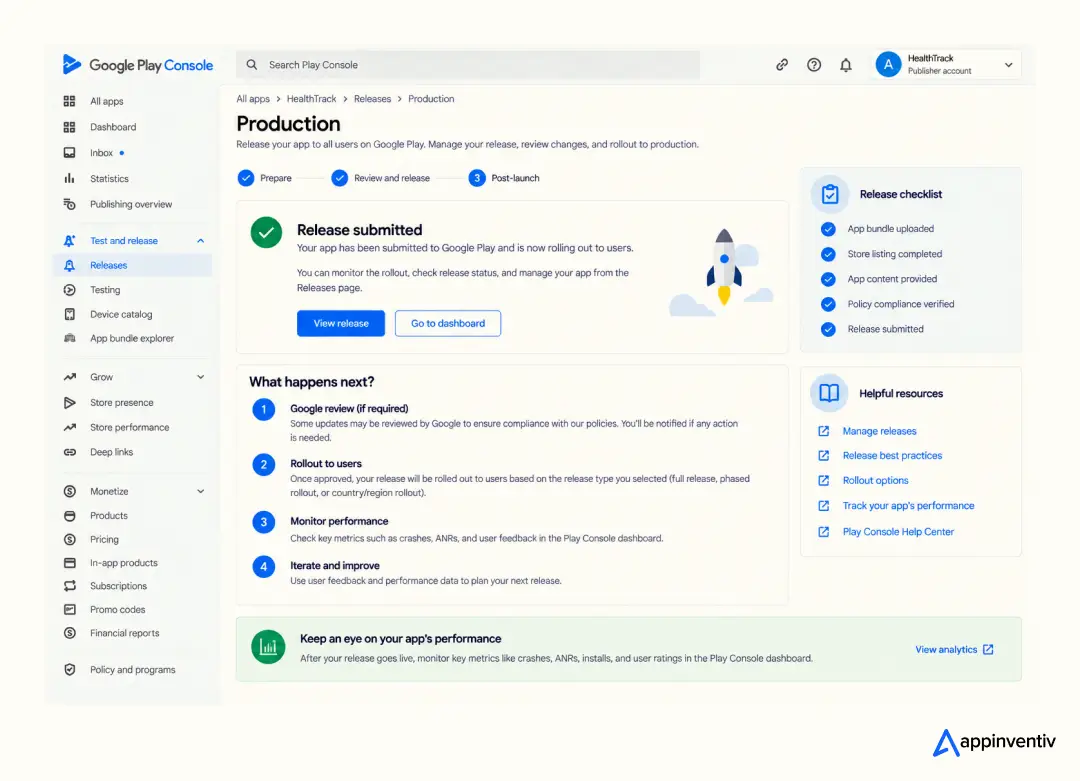
Once the release is approved, roll it out to the Production track. Your app becomes available to Google Play users in the countries and regions selected for the release. Later updates can use staged rollouts to release a new version to a selected percentage of users before wider distribution. Teams can monitor the release and stop a rollout if serious problems appear.
Google Play also supports managed publishing for approved changes. This lets teams control when an approved update becomes available, which helps coordinate app releases with broader business launches. After publication, monitor crashes, ANRs, reviews, installs, and backend health. Publishing the first version is only the start of Android release management.
Google Play Publishing Checklist
Download the checklist of Google Play Store app publishing steps to track your account, build, compliance, testing, and launch requirements in one place.
Google Play Store Requirements for Enterprise Apps
An enterprise app development effort has more management requirements than a release build or a store listing. Security controls, data handling, release access, third-party SDKs, and regional regulations all affect the publishing process.
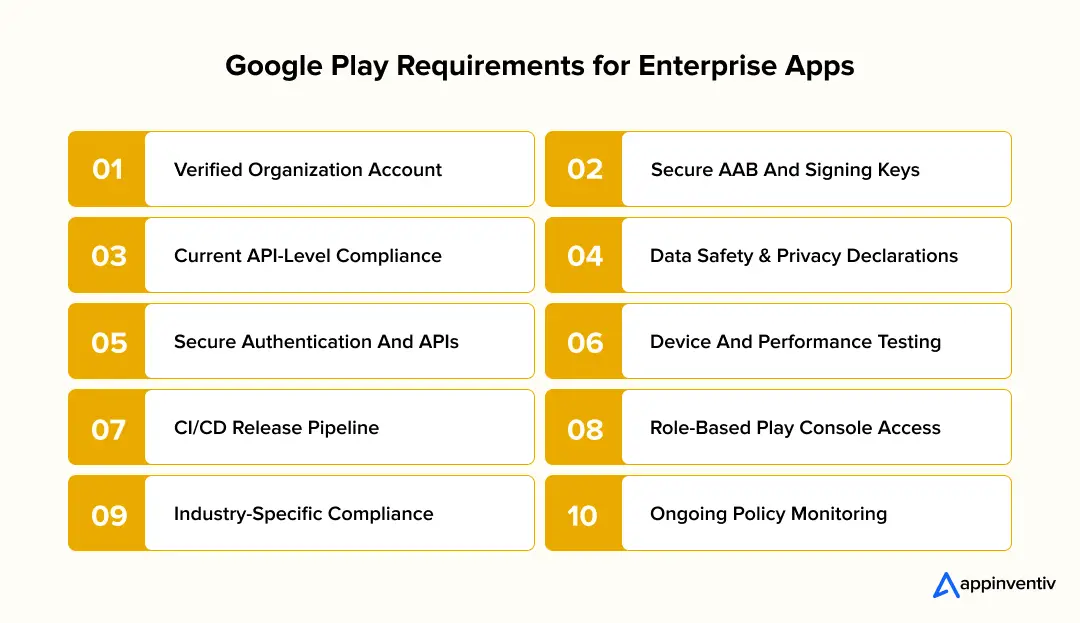
Security and Privacy Requirements
Enterprise apps often handle employee records, customer information, financial data, health data, or business credentials. Google Play requires developers to disclose how the app collects, shares, and protects user data through the Data Safety section. The declarations must match the app’s actual behavior, including relevant third-party SDKs.
Authentication needs similar care. Apps that require sign-in must provide Google with working access instructions during review. APIs should use authenticated channels such as OAuth 2.0 or short-lived access tokens rather than storing permanent credentials inside the app.
Review the Android permissions before release. Google restricts access to sensitive information and expects permissions to support the app’s core functionality. In 2025, Google prevented more than 255,000 apps from gaining excessive access to sensitive user data. Unnecessary access to contacts, location, files, or other sensitive data can create policy issues.
Keep API keys, signing credentials, database passwords, and CI/CD secrets outside the mobile codebase. Google Play Protect scans more than 350 billion Android apps every day for threats. Store sensitive credentials in a managed secrets system and restrict access through role-based controls.
Enterprise Release Governance
The company should own the Google Play developer account and control access to the production environment. Play Console supports separate user permissions, so product, engineering, QA, and release teams do not need identical access.
A practical enterprise setup separates responsibilities:
- Product: Store listing and release content
- Engineering: AAB generation and release configuration
- QA: Build validation and regression testing
- Security: Permissions, SDKs, and security review
- Legal or privacy: Data Safety and privacy declarations
- Release owner: Final production approval
Signing credentials need separate ownership too. The company should control the upload key and the Play App Signing configuration rather than leaving them with a contractor.
Keep release records for the AAB, version code, signing certificate, approval, and deployment date. This creates an audit trail for regulated products and large engineering teams.
Also Read: Why You Need Enterprise Android App Development
Technical Requirements for Large-Scale Android Apps
A production app’s underlying app architecture must meet Google’s current API requirements. From August 31, 2026, new apps and app updates must target Android 16, API level 36, with separate requirements for Wear OS, Android Automotive OS, Android TV, and Android XR.
Apps targeting Android 15, API level 35, or higher must support 16 KB memory page sizes on 64-bit devices for Google Play. This matters most for apps that include native C or C++ libraries, older third-party SDKs, or custom native binaries.
Large apps should validate more than installation. Test the following:
- Cold and warm startup
- Memory usage
- Network failures
- Background processing
- Push notifications
- Deep links
- Authentication flows
- Payment transactions
- Crash and ANR rates
- Major supported Android versions and device classes
Keep Android SDKs and third-party libraries under regular review. An outdated library can affect security, target API compliance, native compatibility, or Play policy status.
CI/CD should produce the same signed release artifact across environments. A typical pipeline runs unit tests, static analysis, dependency checks, UI tests, bundle generation, signing, and release validation, with AI in QA increasingly used to speed up this cycle before production approval.
Also Read: A Complete Guide to Application Scalability
Industry-Specific Compliance Considerations
The app’s industry can add requirements beyond standard Play policies.
- Financial Apps: Apps with financial features must complete Google’s Financial features declaration. Financial products also need to meet applicable local regulations and disclosure requirements in each target market.
- Healthcare Apps: Health apps must complete the Health apps declaration in the Play Console. Medical and health applications also need a publicly accessible privacy policy and must meet requirements for sensitive health data and applicable regulations.
- Children’s Apps: Apps targeting children fall under Google’s Families policies. These rules cover data collection, advertising, SDK use, content, and age-related safeguards.
- Employee-Facing Apps: Internal workforce apps still need careful handling of authentication, company data, device permissions, and third-party services. An enterprise login does not remove the need for accurate Play declarations.
Map every data flow from the Android client to APIs, analytics tools, crash reporting platforms, and external SDKs. Google requires developers to disclose relevant collection and sharing practices, and sensitive permissions must support the app’s stated functionality.
How Long Does It Take to Publish an App on Google Play Store?
The time required to publish an Android app depends on how prepared the product and publishing account are. Development teams handle most of the preparation work, but Google handles account verification and app review.
Typical Google Play Publishing Timeline
The publishing timeline has two parts. Your team handles app preparation, testing, and submission, while Google handles verification and review.
| Stage | Typical Timeline | Control |
|---|---|---|
| Developer Account Setup and Verification | 1–several days | Shared |
| Release Build Preparation | 1–5+ days | Business |
| Store Listing and Compliance | 1–5+ days | Business |
| Testing | Depends on test plan | Business |
| Google Play Review | Up to 7 days or longer in some cases | |
| Production Rollout | Same day after approval | Business |
Google states that some app reviews can take up to seven days or longer in exceptional cases. It recommends leaving at least a week between submission and the planned publication date.
Factors That Can Delay Launch
Several issues can delay the Google Play app submission schedule, especially when they require an additional build or review cycle.
- Developer or organization verification
- Missing store listing information
- Incorrect Data Safety declarations
- Unfinished testing requirements
- Technical errors or compatibility issues
- Google Play policy violations
- Missing reviewer credentials
- Changes to the app during an active review
A rejection can add another development and review cycle, so the original launch date may need to move.
How Enterprises Can Reduce Publishing Delays
Start compliance and release checks before the final submission. Validate the AAB, signing setup, permissions, SDK dependencies, store assets, privacy policy, and Data Safety information together.
Assign clear owners for engineering, QA, product, security, and compliance. Keep reviewer credentials ready for protected features. Run a production-like test build before submitting the final release. Most avoidable delays come from incomplete preparation, not the upload itself.
Catch AAB, signing, API, Data Safety, and reviewer-access issues before they trigger costly release rework.
How Much Does It Cost to Publish an App on Google Play Store?
Google charges a small upfront fee to publish software on its marketplace. The bulk of your investment pays for software engineering, quality assurance, system security, and long-term support.
Google Play Developer Account Fee
Google requires a one-time $25 fee to set up a developer account. Corporate accounts must complete formal business verification checks during registration. Google collects separate transaction commissions on paid downloads, in-app purchases, and recurring subscriptions. These transaction processing fees remain completely separate from the registration cost.
Development and Release Costs Beyond the Play Store Fee
Primary expenses stem from building the product for release and supporting the software post-launch. Major budget items include:
- Android software development
- User interface design
- Backend databases and API connections
- External software integrations
- Quality testing across physical devices
- Data security and regulatory compliance
- Continuous integration and DevOps setup
- App store optimization and translation
- Ongoing software maintenance
Enterprise applications require larger budgets to support multi-cloud deployments, high-security protocols, and dedicated deployment pipelines.
Android App Development Cost by Complexity
Publishing steps remain consistent, but Android app development cost varies with the overall product scope.
| App Type | Core Characteristics | Estimated Development Cost |
|---|---|---|
| Basic | Simple user workflows and basic features | $40,000–$80,000 |
| Mid-Complexity | Custom APIs, user authentication, payment processing | $100,000–$250,000 |
| Enterprise | Legacy systems, complex data flows, regulatory requirements | $300,000–$500,000+ |
For executive teams, the $25 platform fee forms a tiny fraction of the total budget. Your true commitment goes toward designing, testing, securing, and maintaining the production codebase.
Also Read: Factors Contributing Towards Android App Development Cost
Common Reasons Google Rejects an Android App
Google rejects applications when code, store copy, user permissions, or data statements violate marketplace rules. In 2025, Google prevented more than 1.75 million policy-violating apps from being published on Google Play. Internal review teams catch most compliance defects before submission.
- Policy Violations: Applications that contain restricted content or unauthorized features are subject to immediate rejection. Audit software capabilities against the current platform rules before submission, and remove non-compliant code.
- Data Safety Discrepancies: Rejection occurs when filled-in forms do not match physical data collected by external analytics or software kits. Trace data flows across databases, advertising tools, and reporting tools to align store disclosures with actual network activity.
- Privacy Policy Errors: Broken web links or incomplete statements trigger swift release blocks. Publish an accessible web page detailing real user data collection, sharing policies, and storage limits.
- Restricted Access Credentials: Platform reviewers must test login flows, location gates, and subscription areas. Supply active test accounts, clear instructions, and stable backend access throughout the evaluation period.
- Technical Instability: System crashes, slow load times, and broken user journeys stall app approvals. Test production builds on multiple physical devices to verify payment gateways, authentication flows, and deep link routing.
- Inaccurate Marketing Content: Screenshots and promotional copy must accurately reflect the functionality of the production software. Align store assets with real user interface layouts and current features.
- Excessive Permission Requests: Apps that request sensitive device access without clear core functionality fail review. Strip unneeded permission calls from the codebase and document mandatory system access.
Remediation Steps Following Rejection
Begin by reviewing the specific rule or code error cited by Google. Identify the exact file, permission setting, or promotional asset causing the issue. Apply a disciplined correction process before submitting a new build:
- Analyze the specific compliance violation cited in the rejection notice.
- Isolate the precise app module, permission, or listing asset causing the failure.
- Apply targeted fixes to the codebase or store listing assets.
- Run comprehensive quality assurance testing on the modified build.
- Update data safety forms or store listing copy to reflect the changes.
- Resubmit the new build with clear documentation of fixes.
Avoid resubmitting an unchanged build to platform review teams. Every new submission requires verifiable fixes addressing Google’s direct feedback.
Get specialist Android engineering support for policy fixes, AAB releases, security checks, and production rollout.
How to Manage Your Android App After Publishing
Launching an app marks the start of ongoing maintenance, and understanding the cost to maintain an app helps enterprise teams budget accordingly. Enterprise teams need clear processes for updates, operational stability, and marketplace compliance.
- Version Updates and Release Management: Standardize your release process across all update cycles. Increment build numbers, validate compiled packages, write release notes, and store deployment logs for corporate audits.
- Staged Rollouts and Rollbacks: Distribute updates via phased rollouts to catch bugs early. Expand user coverage upon confirming system stability, or pause distribution upon detecting critical errors. Google prohibits staged rollouts for initial launches.
- Crash and Performance Monitoring: Track crash reports and frozen-screen events immediately after launch. Sudden failure spikes indicate server errors, memory leaks, or faulty software packages. Review live data before expanding rollouts.
- Security and Dependency Updates: Update code libraries, external software kits, and system dependencies regularly. Remove unused tools and recheck permission settings after adding new software components.
- Android Platform Updates: Google updates target API rules yearly. Submissions starting August 31, 2026 must support Android 16, API level 36.
- Store Listing Management: Keep store graphics, descriptions, and translations aligned with current product features. Track conversion rates and search performance after major software releases.
- Policy Compliance: Assign a lead to track platform policy changes throughout the year. Run compliance audits of app features, permissions, and data disclosures before every major update.
Google Play Store App Publishing Best Practices
A consistent release process helps teams maintain app quality, control updates, and respond to production data.
- Review publishing settings and available Play Console features before every release.
- Keep the store listing, graphics, and multimedia files up to date with the current app version.
- Use managed publishing when an approved release needs to launch at a planned time.
- Monitor Play Console reports and insights to track stability, installs, and app growth.
- Keep required app resources available through reliable production servers.
- Follow Google’s publishing and releasing guidance for future updates and policy changes.
Should You Publish an App Yourself or Hire an Android App Development Company?
In-house teams manage simple software releases, but complex enterprise systems benefit from specialist technical partners.
| Decision Factor | In-House Engineering Team | Specialized Development Partner |
|---|---|---|
| App Complexity | Basic to moderate features | Complex enterprise platforms |
| Android Expertise | Internal engineering staff | Dedicated Android specialists |
| System Integrations | Limited external connections | Complex APIs and enterprise platforms |
| Security & Compliance | Internal staff responsibility | Technical and compliance support |
| Testing Capabilities | Internal device testing | Dedicated automated QA tools |
| DevOps Pipelines | Internal management | Managed build pipelines |
| Marketplace Publishing | Internal console management | Complete submission ownership |
| Post-Launch Support | Internal maintenance teams | Continuous product maintenance |
Publishing In-House
Internal teams handle software that relies on basic architecture and existing QA resources to publish on Google Play. Your organization retains direct control of the Play Console, deployment pipelines, and codebase updates.
Working With an Android App Development Company
External specialists support products that require enterprise connectivity, rigorous security standards, and continuous release pipelines. A dedicated partner manages architecture, native coding, backend links, automated testing, deployment, and long-term support. This single delivery model eliminates cross-team friction and supplies technical capabilities without expanding permanent headcount.
What to Evaluate When Choosing an Android Development Partner
Review technical case studies covering system architecture, security standards, build automation, and post-launch maintenance capabilities. Evaluate prospective agencies, such as Appinventiv, for full-lifecycle delivery rather than simple file uploads to the Play Console.
Why Choose Appinventiv for Android App Development and Google Play Publishing?
Appinventiv, a mobile app development company, manages full software lifecycles from initial architecture to live production. Over the past 10 years, our engineering teams have delivered 2,000 applications across 35 industries, including lessons learned building our first enterprise app, so we understand complex enterprise operations.
We provide Android development, backend infrastructure, cloud systems, quality assurance, and automated deployment pipelines within a single delivery model. Enterprise applications require coordinated security checks, user authentication, and API protection before submission to Google Play.
Our teams align these core systems and then handle app package compilation, cryptographic signing, testing tracks, console submissions, and production rollouts. After launch, we manage security patches, performance monitoring, and platform upgrades.
This disciplined process has generated over 100 million client downloads, a 95 percent satisfaction score, and a 90 percent repeat client rate. So, enterprise leaders rely on us for initial launches and ongoing codebase maintenance.
Still wondering how to publish an app on the Google Play Store the right way? Let’s connect.
FAQs
Q. How to submit an app to Google Play?
A. First, create and verify your Google Play developer account. Next, build a signed Android App Bundle and set up your application entry within the Play Console. You must complete your store listing, upload graphics, and submit mandatory data safety and content rating forms. Finally, create a release, upload your bundle file, fix any flagged errors, and submit the build for official review.
Q. How much does it cost to develop and publish an Android app?
A. Google requires a one-time $25 fee to register a developer account. Total software development budgets depend on product scope and feature requirements. Basic applications cost between $15,000 and $30,000, and complex enterprise software ranges from $60,000 to over $150,000. Backend systems, custom integrations, quality testing, security, and ongoing maintenance drive the remaining expenses.
Q. What are the requirements to launch an Android app on Google Play?
A. You need a verified corporate developer account, a signed application bundle, and a complete store listing. Google requires detailed data safety declarations, links to privacy policies, content ratings, and login access for review teams. Your application must also meet current target API standards and pass pre-release testing.
Q. How can a mobile app development company help publish my app on Google Play?
A. An engineering partner handles end-to-end launch operations, including native coding, backend links, automated testing, and build compilation. Specialist teams set up your console, manage internal testing tracks, resolve policy flags, and execute the production release. They also handle future Android system upgrades and post-launch maintenance.
Q. How long does a Google Play app review take?
A. Standard Google reviews take up to seven days, and complex applications sometimes require more time. Account age, policy compliance history, and specific feature sets directly impact the speed of evaluation. Submit your build at least one week before launch to allow time for policy questions or fixes.
Q. Can I distribute an Android app outside Google Play?
A. Yes. Businesses can distribute Android apps through an app marketplace, a website, an enterprise server, or a private server, subject to current Android and Google requirements. Users installing from these sources may need to enable the “unknown sources” setting in system settings. Apps can use canRequestPackageInstalls() to check whether this permission is granted. For Play-based releases, the developer distribution agreement, App Bundle Explorer, Play Asset Delivery, Play Feature Delivery, and staged rollouts remain relevant for managing and delivering app builds and assets.
Q. What Are the Best Practices for Publishing an Android App?
A. Use the Play Console features to keep each release controlled and measurable. Prepare the store listing, graphics, and other multimedia files to align with the current product experience. Review publishing settings, reports, and performance insights after launch to track app growth and user behavior. Keep required app resources available on reliable production servers. Use managed publishing for coordinated releases, and follow Google’s publishing and releasing guidance when planning updates.
Q. How Do I Add Translations and Localize My Google Play Store Listing?
A. Set a default language for your app, then use the Play Console to add and manage translations for supported markets. You can provide in-language screenshots and localized graphic assets for each market. Google Play supports automated translations through Google Translate for eligible store listings. The main store listing page remains the source for the default language, while localized listings can reflect regional language preferences. Add a note explaining the use of automated translation when applicable.


Fast 2-minute response, fully NDA-protected.
How Much Does It Cost to Build a Food Delivery App Like Deliveroo?
In Europe's culinary landscape, the food delivery industry has flourished, revolutionizing the gastronomic experiences for millions of people. This surge is driven by factors such as busy lifestyles, increasing demand for diverse cuisines, and the recent emphasis on contactless services. As consumers increasingly look for the convenience of doorstep dining, businesses entering the food delivery…

How Much Does It Cost to Develop a Food Delivery App like Glovo?
Food delivery businesses have progressively increased in the last few years, assisting companies in augmenting operational efficiency by prioritizing customers. Behind the success of food delivery businesses, apps like Glovo play a significant role helping through strategic execution, targeting audiences, and enhancing customer retention. Building a food delivery app like Glovo is a strategic process…
How Much Does It Cost to Build a Translation App Like DeepL?
When it comes to the evolving global digitization, the imperative for effective communication across linguistic borders has become more pronounced than ever. Now, stepping into the forefront of this linguistic evolution is DeepL, a translation app that addresses the need for effective communication across languages in the digital landscape. It stands out by using advanced…














