























- The Enterprise Product Operating Model: Moving From Delivery to Continuous Value Creation
- End-to-End Digital Product Engineering at Enterprise Scale
- Enterprise Product Innovation Framework
- AI-Driven Enterprise Product Engineering
- Benefits of Digital Product Engineering for Enterprises
- Digital Product Engineering Challenges in Large Enterprises
- Cost of Enterprise Digital Product Engineering: Investment Models and ROI Considerations
- Technology-Driven Business Transformation Through Product Engineering
- Future Trends of Digital Product Engineering
- Why Consider Appinventiv for Your Digital Product Engineering Needs
- FAQs
Key takeaways:
- Enterprise product engineering shifts organizations from project delivery toward continuous, outcome-driven digital value creation.
- AI-native architectures are becoming foundational for scalability, resilience, faster innovation cycles, and competitive differentiation.
- Composable platforms, API ecosystems, and data pipelines increasingly shape enterprise revenue models and operational agility.
- Cost optimization requires architectural discipline, FinOps governance, cloud efficiency monitoring, and structured modernization investment planning.
- Enterprises prioritizing sustained product engineering maturity consistently outperform peers in innovation speed and customer retention.
Digital product engineering for business now determines how fast an enterprise can grow, adapt, and defend its market position.
In many organizations, the shift did not happen with a grand announcement. It showed up in smaller signals. A release that took two quarters instead of one. An AI pilot that worked in isolation but struggled in production. A cloud migration that improved flexibility but increased operational confusion. What looked like isolated friction was often structural misalignment.
Enterprise digital product engineering has moved beyond building applications. It now influences revenue timing, customer retention, compliance agility, and long-term scalability. When product teams operate within rigid project cycles, progress slows. When architecture is designed for stability but not evolution, experimentation becomes expensive. That tension is where Digital Product Engineering Challenges begin to surface.
End-to-end digital product engineering asks for something different. Persistent product ownership instead of rotating delivery squads. Domain-aligned collaboration instead of siloed approvals. Infrastructure and data pipelines that support AI-driven enterprise product engineering without constant rework. These are operating decisions as much as technical ones.
Technology-driven business transformation rarely succeeds through tools alone. It requires an enterprise product innovation framework that connects architecture, funding models, governance standards, and measurable outcomes. Without that alignment, modernization efforts feel incremental. With it, product velocity compounds.
The role of product engineering in digital transformation is practical. Remove friction. Strengthen foundations. Enable controlled experimentation. The Benefits of Digital Product Engineering emerge gradually through faster iterations, clearer cost visibility, and systems that scale without frequent resets.
This guide examines Digital product engineering for enterprise from that grounded perspective. Architecture, AI integration, cost structures, and operating maturity are treated not as trends, but as infrastructure decisions that shape sustained growth.
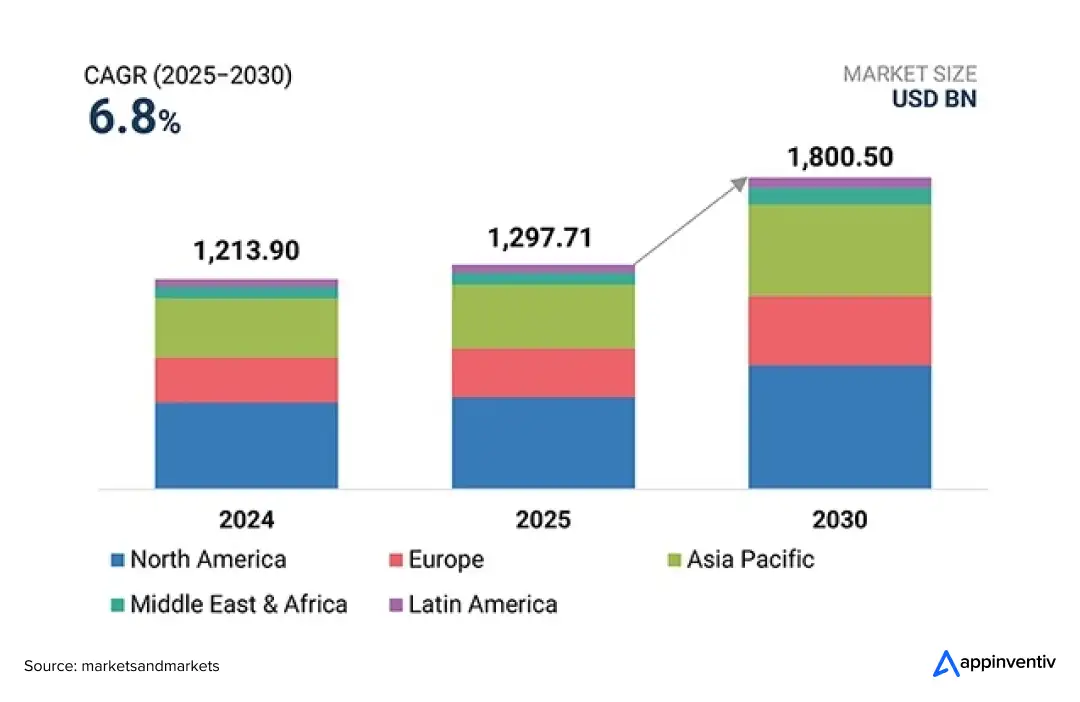
The market is expected to reach USD 1.8 trillion globally by 2030.
The Enterprise Product Operating Model: Moving From Delivery to Continuous Value Creation
Most enterprises do not struggle with building software. They struggle with sustaining it. A product launches, attention shifts, teams rotate, and momentum fades. Six months later, the same product needs another overhaul. That cycle drains time, budget, and confidence.
The urgency behind fixing this is not small. The global product engineering services market is expected to reach USD 1.8 trillion by 2030, underscoring the centrality of structured engineering to enterprise growth strategies. Investment is accelerating, but without the right operating model, that investment rarely compounds.
This is where the operating model matters. Digital product engineering for business is less about tools and more about how your organization structures ownership, funding, and technical decision-making.
Product-Centric Organizational Design
The biggest shift is simple on paper, harder in practice. Move from delivering projects to owning products.
Project teams finish work and disband. Product teams stay accountable. They watch adoption metrics, customer feedback, performance data, and revenue signals continuously.
That continuity improves:
- Decision speed
- Product quality over time
- Customer experience consistency
It also changes leadership conversations. Success becomes a measurable value, not just delivery completion.
Also Read: How AI is Transforming Product Design
Domain-Aligned Cross-Functional Teams
Many enterprises still operate in silos. Engineering in one place, Data somewhere else, and to top it all off, security gets involved late, which slows down everything.
Domain alignment fixes this by grouping capabilities around business functions. Payments, customer identity, logistics, digital commerce, each domain has engineering, product, design, security, and data expertise working together.
A simple comparison helps clarify:
| Traditional Structure | Domain-Aligned Structure |
|---|---|
| Functional silos | Business-domain teams |
| Sequential approvals | Parallel collaboration |
| Delayed integration | Built-in integration |
| Slower releases | Faster iteration |
This structure reinforces the role of product engineering in digital transformation because technology mirrors business capability.
Funding Models: Project vs Product Investment
Funding models quietly shape behavior.
Project funding usually means:
- Fixed scope
- Fixed timeline
- Limited flexibility
Product funding shifts the mindset:
- Continuous investment
- Outcome-driven evaluation
- Adaptive roadmap adjustments
Enterprises adopting product funding often see fewer large resets. Instead, they evolve steadily.
Finance leaders usually appreciate clearer visibility into long-term value rather than episodic capital expenditure spikes.
In one enterprise retail engagement, transitioning from project-based funding to persistent domain teams reduced release approval cycles by nearly 40 percent within two quarters.
Platform Engineering and Internal Developer Platforms
As product teams scale, duplication becomes expensive. They need different CI pipelines, security checks, and monitoring tools.
Platform engineering introduces internal developer platforms. Think of them as shared engineering infrastructure.
Typical components include:
- Deployment automation templates
- Security policy frameworks
- Standard observability stacks
- Infrastructure provisioning tools
This reduces friction without removing team autonomy. Teams build faster because the foundation is already stable.
KPIs That Reflect Real Product Success
Traditional IT metrics rarely tell the full story. Enterprise product engineering needs broader signals.
Common indicators include:
- Deployment frequency
- Change lead time
- Incident recovery speed
- Customer engagement trends
- Revenue influence of digital channels
These connect engineering activity directly with business performance.
Also Read: Product Management Diagrams That Simplify KPI Tracking
The Technical Backbone Supporting This Model
Operating model decisions influence architecture. The reverse is also true.
API-first ecosystems
APIs allow products to integrate internally and externally without constant rework. They support partner ecosystems and future scalability.
Microservices vs modular monolith
| Consideration | Microservices | Modular Monolith |
|---|---|---|
| Scalability | High | Moderate |
| Operational complexity | Higher | Lower |
| Early-stage efficiency | Lower | Higher |
| Long-term flexibility | Strong | Depends on design |
Early automation focuses on builds and deployment. Mature environments integrate testing, security validation, infrastructure automation, and monitoring into one pipeline.
This reduces risk while maintaining speed.
Observability and resilience
Enterprises cannot rely on reactive monitoring anymore. Distributed tracing, centralized logging, and telemetry pipelines help detect issues early.
Resilience engineering adds another layer:
- Multi-region deployments
- Automated failover
- Regular incident simulations
These practices protect uptime and customer trust.
When all these elements align, product engineering stops being episodic. It becomes continuous value creation.
That is usually when enterprises begin seeing measurable impact, faster releases, stronger customer engagement, and technology that supports growth instead of slowing it down.
Enterprise digital product engineering shifts organizations from project-based delivery to continuous value creation. It aligns domain teams, architecture, funding models, and DevSecOps pipelines to support scalable, AI-native growth while maintaining governance, resilience, and measurable business impact.
Also Read: Serverless vs Microservices: Which Architecture Suits Your Enterprise?
End-to-End Digital Product Engineering at Enterprise Scale
Many large organizations have already built digital products. The challenge usually is not capability; it is continuity. One team handles discovery, another designs architecture, security joins later, and operations step in at deployment. Things work, but rarely smoothly. That fragmentation becomes expensive once products scale across regions, customers, and compliance environments.
End-to-end digital product engineering closes those gaps. It connects strategy, engineering, security, data, and operations into one continuous flow. Not a sequence of handoffs.
Strategic Product Discovery and Portfolio Rationalization
Many enterprise portfolios grow without a clear reset point. New tools get added. Legacy systems stay longer than planned. Over time, overlap appears.
This is where structured market intelligence helps. Teams typically pull insights from customer usage analytics, competitor feature tracking, support ticket data, and external market signals. Nothing fancy, but consistent.
Data validation also matters more than intuition at this stage. Instead of committing to large builds immediately, enterprises often test assumptions first:
- Limited beta releases
- Feature flag-controlled exposure
- Usage telemetry tracking
- Adoption curve analysis
It keeps investment decisions grounded.
Experimentation platforms have become more common, too. They allow staged rollouts, regional testing, and automatic rollback if performance drops. That reduces risk without slowing innovation.
Architecture and Platform Engineering Foundations
Architecture decisions made early tend to stick for years. Changing them later costs far more than getting them mostly right upfront.
Cloud-native setups are now standard in enterprise product engineering. Applications run as loosely coupled services. Infrastructure scales dynamically. Deployment pipelines stay consistent across environments.
Distributed systems introduce practical considerations. Latency, fault tolerance, service coordination. Nothing theoretical here. If you have ever tracked down a cascading service failure, you know how quickly complexity escalates.
Event-driven design often helps. Instead of direct service calls, systems publish events to a shared stream. Other services react asynchronously. This reduces tight dependencies and supports real-time analytics.
Kubernetes environments are commonly used for orchestration. They handle scaling, container scheduling, rolling updates, and workload recovery. Most enterprises layer additional controls on top, policy engines, service meshes, and security enforcement.
Data integration adds another layer. Products usually connect to multiple data sources:
- Transactional databases
- Analytics warehouses
- Streaming ingestion pipelines
- Machine learning feature stores
Integration models vary. Some enterprises centralize data. Others move toward federated data mesh approaches. The choice often reflects organizational structure as much as technology.
DevSecOps and Compliance by Design
Security reviews at the end of development rarely work anymore. They delay releases and create rework.
Embedding security earlier helps. Automated testing pipelines often include vulnerability scanning, dependency checks, and policy validation. CI/CD maturity is less about automation alone and more about trust in what gets deployed.
Infrastructure-as-Code has become standard practice. Environment configurations live in version-controlled repositories. That improves auditability and repeatability.
Zero-trust architecture is another shift many enterprises are making. Continuous authentication, least-privilege access, and encrypted internal traffic. It sounds heavy, but once implemented properly, it reduces long-term risk.
Compliance requirements vary widely. Healthcare software environments, along with finance and the public sector, often involve stricter controls.” Global operations add data residency and privacy constraints. Designing for compliance early avoids redesign later.
Also Read: Why DevSecOps is crucial for tackling cloud security challenges
Global Deployment and Reliability Engineering
Once products scale internationally, the deployment strategy becomes a business decision.
Multi-region infrastructure helps manage latency and availability. Active-active setups are common for customer-facing products. Data replication strategies vary depending on regulatory constraints and performance needs.
Site Reliability Engineering brings operational discipline. Reliability targets are defined upfront. Incident response is automated where possible. Capacity planning becomes data-driven rather than reactive.
Observability platforms support this by combining logs, metrics, and distributed traces into one view. Without that visibility, diagnosing production issues becomes guesswork.
Resilience testing is another practice gaining traction. Controlled failure simulations, network disruptions, service outages. The idea is simple. Test failure scenarios before they happen naturally.
Enterprises that do this regularly tend to recover faster when real incidents occur.
End-to-end digital product engineering for businesses is less about adopting a single framework and more about alignment. Strategy, architecture, delivery, security, and operations need to reinforce each other. When they do, digital products evolve steadily instead of requiring periodic reinvention.
Enterprise Product Innovation Framework
Innovation sounds exciting in board meetings. On the ground, it usually looks messier. One team pilots a new feature. Another experiments with AI. A third tries to modernize architecture. Progress happens, but it rarely feels coordinated. That is why many large enterprises eventually formalize a product innovation framework, often supported by technology consulting for product engineering. Not to restrict ideas, but to make sure innovation actually scales.
One structure that shows up often in enterprise product engineering conversations is an Enterprise Product Acceleration Framework, or EPAF. The naming varies by organization, but the underlying pillars tend to be consistent.
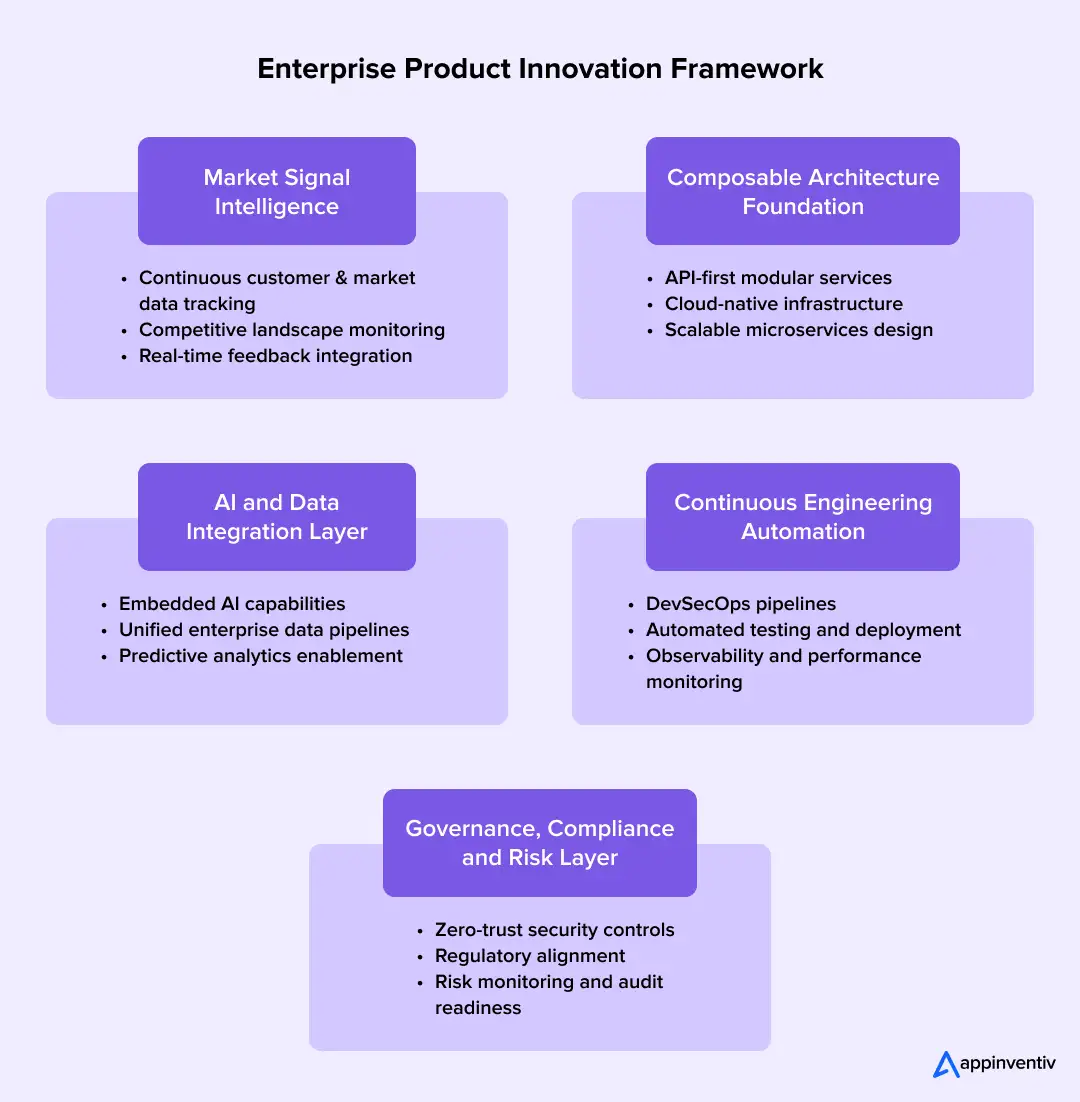
Market Signal Intelligence
Enterprises used to rely heavily on executive instinct for product direction. That still plays a role, but data now carries more weight.
Teams usually track:
- Customer usage patterns across digital channels
- Support ticket trends and feature requests
- Competitive product releases
- Regulatory developments affecting digital services
These signals feed portfolio discussions. Instead of annual resets, many organizations review priorities more frequently. Quarterly reviews are common. Some digital-first enterprises do this monthly.
The idea is simple. If customer behavior shifts, product investment should follow.
Also Read: How to Generate Ideas for Your Next Digital Product
Composable Architecture Foundation
Architecture determines how easily innovation can happen. Rigid systems slow everything down. Composable architecture gives teams room to experiment without destabilizing core systems.
You typically see:
- API-first service boundaries
- Modular application components
- Event-driven integrations where real-time data matters
Not every enterprise goes fully microservices. Some keep modular monoliths where it makes operational sense. What matters is a clear separation of concerns. That keeps future changes manageable.
During a recent modernization initiative for a multi-region commerce platform, decomposing a monolithic stack into domain services reduced deployment rollback incidents by over 50 percent.
AI and Data Integration Layer
Most innovation conversations today include some AI component. Still, the bigger issue is often data readiness.
Products increasingly rely on:
- Streaming data ingestion pipelines
- Analytics environments connected to operational systems
- Model deployment infrastructure
- Data governance frameworks
Even basic predictive analytics can deliver value if the data layer is reliable. Without that foundation, advanced AI initiatives tend to stall.
This is where engineering and data teams need close alignment. Otherwise, experimentation becomes slow and expensive.
Continuous Engineering Automation
Innovation loses pace when delivery pipelines are inconsistent. Manual testing, inconsistent deployments, and environment drift create friction.
Enterprises addressing this usually invest in:
- Automated build and deployment pipelines
- Infrastructure defined through code repositories
- Automated security checks within CI workflows
- Feature flag-based release controls
Automation here is not just about speed. It improves confidence. Teams can release more frequently because they trust the pipeline.
Governance, Compliance, and Risk Layer
Innovation cannot ignore compliance realities, especially in regulated sectors. Enterprises typically embed governance checkpoints directly into engineering workflows.
Common practices include:
- Architecture review forums for major changes
- Data privacy impact reviews
- AI model validation processes
- Continuous compliance monitoring tools
When governance is integrated early, it rarely slows delivery significantly. Late-stage reviews, on the other hand, almost always do.
Innovation Governance Models
Many enterprises formalize oversight through structured groups. Product investment councils review ROI assumptions. Architecture boards evaluate scalability and security. Risk committees monitor regulatory exposure.
These groups work best when they focus on guidance rather than control. Clear guardrails tend to speed decisions rather than delay them.
Decision Checkpoints
Enterprises often introduce checkpoints to reduce downstream surprises. Typical moments include product discovery validation, architecture readiness checks, security reviews, and operational readiness assessments before launch.
They sound bureaucratic, but they often prevent expensive redesign later.
Platform Maturity Ladder
Innovation maturity rarely happens overnight. Most organizations move through stages.
| Stage | Typical Reality |
|---|---|
| Early | Project-driven delivery, limited automation |
| Developing | Some product ownership, partial platform support |
| Mature | Strong platform engineering, composable architecture |
| Advanced | AI-enabled products, continuous optimization |
This helps leadership assess progress without unrealistic expectations.
Enterprise Adoption Sequencing
Phased adoption usually works best. Stabilize the architecture first. Strengthen data foundations next. Then expand platform capabilities. AI integration or Intelligence embedding into core workflows typically becomes easier once those layers are stable.
Skipping foundational steps often leads to rework. Many enterprises learn that the hard way.
A structured innovation framework does not remove uncertainty. It simply makes innovation repeatable. When architecture, data, governance, and delivery practices align, new product development initiatives stop feeling like isolated experiments and start becoming part of a sustained engineering capability.
Translate structured innovation frameworks into measurable enterprise engineering outcomes.

AI-Driven Enterprise Product Engineering
AI enterprise initiatives often begin with enthusiasm. A small data science team builds a promising model. A pilot shows encouraging accuracy. Then the operational questions start emerging. How will this run reliably in production? Who monitors it? What happens when data patterns shift? That is typically the point where AI moves from experimentation into core product engineering.
Industry research and delivery benchmarks suggest AI-enabled engineering environments can deliver 2–4× faster development cycles while automating roughly 40–60% of routine engineering tasks, which is why enterprises are increasingly embedding AI directly into product pipelines rather than treating it as a standalone initiative.
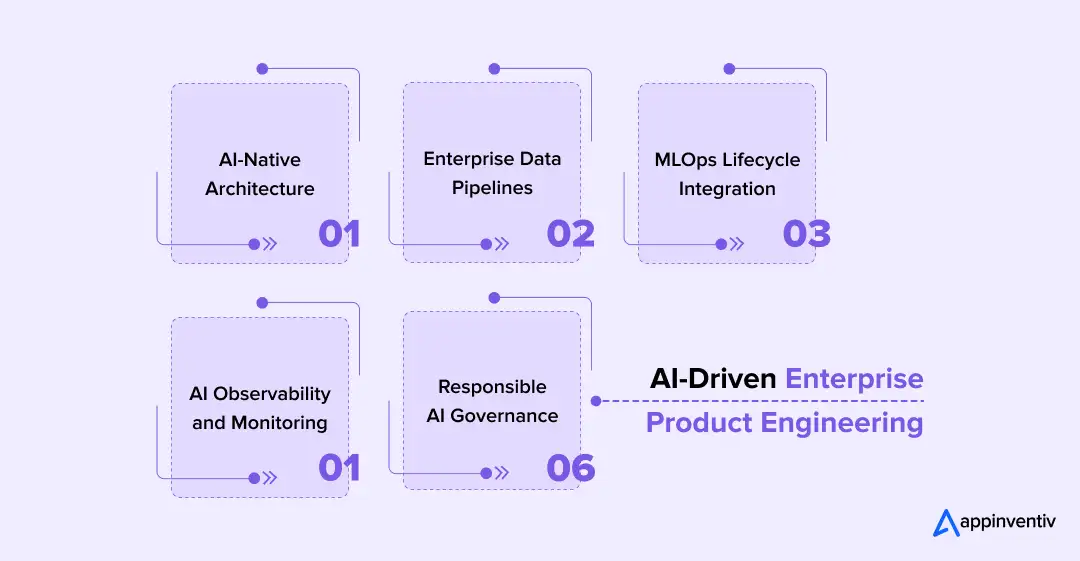
AI-driven enterprise product engineering is not about showcasing models. It is about embedding intelligence into the same pipelines that power applications. Once AI becomes a product capability, it must meet the same reliability, security, and performance standards as any other service in the stack.
AI as an Embedded Product Capability
In practical terms, this means AI services sit directly in transaction flows or user journeys.
- A fraud scoring model evaluates a payment request before approval.
- A recommendation engine adjusts a product listing in milliseconds.
- A demand forecast model influences inventory decisions daily.
Once AI sits in these paths, latency and availability matter. A slow inference endpoint can degrade user experience. An unavailable model can block transactions. Accuracy alone is no longer the only metric.
Architecture needs to account for this. Model inference services are typically exposed through APIs, containerized, and deployed alongside other microservices. Load balancing, scaling policies, and fallback logic become part of design discussions.
MLOps Lifecycle Integration
Most enterprises discover quickly that building a model once is not the challenge. Keeping it relevant is. Customer behavior shifts. Data distributions drift. External conditions change.
Custom MLOps addresses this by extending the engineering discipline into the model lifecycle. In mature environments, you usually see:
- Automated data validation at ingestion
- Version-controlled feature engineering pipelines
- Model artifact storage with metadata tracking
- Deployment through CI/CD pipelines
- Continuous performance monitoring
Feature stores help maintain consistency between training and inference inputs. Without them, subtle mismatches can quietly degrade model quality.
Model registries track lineage, performance benchmarks, and deployment history. When something breaks, traceability becomes critical.
Some enterprises also integrate automated retraining triggers. If drift metrics cross predefined thresholds, retraining workflows initiate with human review before redeployment.
In financial services implementation, introducing structured model monitoring and drift detection reduced false positives in fraud scoring by double-digit percentages within the first quarter of deployment.
Large automotive enterprises often struggle to scale AI beyond isolated pilots. Appinventiv partnered with a global manufacturer to unify fragmented data pipelines, implement governed MLOps, and modernize cloud infrastructure. The initiative connected 200+ AI workloads across regions, reduced redundant projects by 45%, and accelerated digital transformation while strengthening compliance visibility.
Predictive Product Analytics
AI does not only sit in customer-facing flows. It increasingly informs product strategy itself.
Churn prediction models highlight accounts at risk. Adoption models forecast how likely a new feature is to gain traction. Demand forecasts support operational planning.
These models rely on stable data pipelines that combine historical batch data with near-real-time streams. Product managers and business leaders then consume these insights through dashboards rather than raw datasets.
The value here is forward visibility. Decisions become proactive instead of reactive.
Autonomous Testing and Optimization
AI also influences how products are tested and optimized.
Some organizations use automated test generation tools that analyze code paths and produce coverage scenarios. Others apply reinforcement learning techniques to refine pricing, content ordering, or workflow sequencing within controlled limits.
Still, autonomy is rarely absolute. Enterprises typically define strict guardrails:
- Performance thresholds
- Regulatory constraints
- Human override mechanisms
Optimization operates inside these boundaries.
Responsible AI Governance
As AI systems influence customer outcomes, governance becomes unavoidable.
Enterprises often formalize processes around:
- Model risk assessment
- Data source documentation
- Bias and fairness evaluation
- Decision traceability logging
In regulated US sectors such as finance or healthcare, explainability is not optional. If a model denies a credit application or influences clinical prioritization, the reasoning must be defensible.
That requirement shapes architecture. Audit logs, model metadata, and inference records must be stored securely and retrievable.
Data Pipelines and Feature Engineering
Underneath every model sits a data foundation.
Data ingestion pipelines typically include validation layers that check schema consistency and data quality before storage. Transformation jobs standardize formats and enrich records with contextual signals.
Feature engineering pipelines convert raw operational data into structured inputs suitable for model training and inference. Versioning is critical. A change in feature calculation can alter model behavior significantly.
Monitoring tools track missing values, distribution shifts, and schema changes. Early alerts prevent silent degradation.
Model Monitoring and AI Observability
Once deployed, models require continuous oversight.
Monitoring often includes:
- Prediction accuracy trends
- Drift detection between training and live data
- Inference latency metrics
- Resource utilization tracking
Drift detection compares current input distributions with historical baselines. Significant deviation signals potential retraining needs.
AI observability extends beyond system logs. It tracks confidence scores, output stability, and anomaly patterns. When correlated with application telemetry, teams can distinguish whether a performance issue stems from infrastructure, application code, or the model itself.
AI-driven enterprise product engineering succeeds when intelligence is treated as a first-class component of architecture. It demands the same rigor applied to application services, from deployment discipline to monitoring and governance. When those layers are aligned, AI stops being experimental and starts becoming operationally dependable.
Benefits of Digital Product Engineering for Enterprises
When product engineering starts working well, the impact is usually visible first in small, practical ways. A release that used to take three months ships in four weeks. A customer issue gets resolved without a full system rollback. A new integration goes live without major disruption. Over time, those incremental improvements compound.
Here are the benefits enterprises tend to experience as product engineering matures.
Faster Delivery and Adaptation
Release cycles become more predictable. Not because teams work longer hours, but because processes are cleaner.
- Automated build and deployment pipelines reduce manual steps
- Modular services allow focused updates instead of system-wide changes
- Clear ownership within domain teams speeds up decisions
The result is less waiting between idea and execution.
More Consistent Customer Experience
When systems are integrated properly, customers notice fewer friction points.
- Unified data reduces conflicting information across channels
- Performance improvements lower response times
- Feature updates arrive more regularly
Consistency often improves retention quietly, without dramatic campaigns.
Operational Stability
The engineering discipline tends to reduce firefighting.
- Monitoring tools detect issues earlier
- Standardized infrastructure lowers configuration errors
- Platform teams centralize shared services
Incidents still happen, but recovery becomes more controlled.
Smarter Use of Data
As data pipelines stabilize, decision-making shifts.
- Product teams rely on usage signals rather than assumptions
- Forecasting models support planning cycles
- Reporting aligns across departments
Executives gain clearer visibility into digital performance.
Long-Term Scalability
Perhaps the most understated benefit is flexibility.
- Composable architectures support expansion into new markets
- API exposure simplifies partner integration
- AI capabilities can be layered in without rebuilding core systems
Digital product engineering does not transform an enterprise overnight. What it does is remove structural friction, making growth and innovation more sustainable over time.
Digital Product Engineering Challenges in Large Enterprises
If you talk to enterprise engineering leaders off the record, the conversation usually sounds less polished than conference presentations. Releases slip. Integration takes longer than anyone estimated. Security reviews reopen work thought finished. None of this is unusual. It is part of scaling digital product engineering inside complex organizations.
Below are digital product engineering for enterprise challenges that tend to surface repeatedly, along with practical responses teams often settle on after a few cycles.
Legacy Modernization Complexity
Older enterprise systems rarely come with clean boundaries. Business logic accumulates over the years. Documentation fades. Dependencies multiply. Replacing everything at once sounds appealing until risk becomes clear.
Mitigation approaches
- Introduce API wrappers instead of immediate system replacement
- Replace components gradually using phased migration patterns
- Keep parallel data synchronization during transition
- Track system retirement against actual usage metrics
Organizational Inertia and Change Management
Even when leadership supports product-led delivery, day-to-day habits take time to shift. Approval workflows, budgeting cycles, and reporting structures often lag behind technical ambition.
Mitigation approaches
- Move budgeting toward continuous product funding
- Build stable domain teams instead of rotating project groups
- Link incentives to customer impact, not delivery completion
- Keep executive sponsorship visible and consistent
Data Silos and Semantic Inconsistency
Different teams naming the same metric differently is more common than many admit. Marketing, finance, and product analytics may all track “active users” in slightly different ways. Decision-making becomes slower.
Mitigation approaches
- Establish shared data definitions early
- Maintain a central catalog with clear ownership
- Introduce automated data validation checks
- Encourage cross-domain data governance forums
Security Surface Expansion
Modern architectures create more connection points. APIs, cloud services, remote access layers. Each improves flexibility but also expands exposure.
Mitigation approaches
- Apply zero-trust access principles consistently
- Automate security checks within deployment pipelines
- Standardize API gateway enforcement
- Run periodic simulated incident exercises
Talent Architecture Gaps
Skill requirements evolve quickly. Distributed systems, cloud-native development, data pipelines, and AI integration. Teams rarely acquire all capabilities at the same pace.
Mitigation approaches
- Prioritize targeted upskilling instead of broad training
- Hire selectively for architecture-critical roles
- Use external expertise where speed matters
- Simplify internal tooling to reduce learning overhead
Cloud Cost Optimization Issues
Cloud adoption often begins with speed as the main goal. Months later, finance teams notice underutilized resources, duplicated environments, or scaling policies left unchecked.
Mitigation approaches
- Establish shared visibility into cloud spending
- Introduce automated scaling and shutdown policies
- Review architecture decisions periodically for cost impact
- Make product teams accountable for operational expenses
AI Governance Risks
AI adoption brings new scrutiny. Data provenance, fairness, and explainability. These topics move quickly from technical discussions to board-level concerns.
Mitigation approaches
- Document model inputs, assumptions, and limitations
- Maintain clear audit trails for AI-driven decisions
- Run periodic bias and drift evaluations
- Integrate governance reviews into release workflows
Most enterprises deal with some version of these digital product engineering challenges. What tends to help is treating them as ongoing operational considerations rather than isolated fixes. When responses become routine, product engineering usually stabilizes and scales more predictably.
Cost of Enterprise Digital Product Engineering: Investment Models and ROI Considerations
Cost discussions around product engineering rarely happen in isolation. Usually, it starts with something practical, a delayed modernization program, a rising cloud invoice, or a board question about ROI from digital investments. That is when finance, engineering, and business leadership start looking at the same numbers from different angles.
There is no universal price tag for enterprise digital product engineering. Still, certain cost drivers appear consistently across industries.
Key Cost Determinants
Several structural and operational factors influence how much an enterprise ultimately invests in digital product engineering, and understanding them early helps prevent budget misalignment.
- Architecture complexity
Older enterprise stacks often carry tightly coupled systems, custom integrations, and undocumented dependencies. Modernizing them usually requires phased refactoring rather than replacement. That adds engineering hours and testing cycles. - Integration depth
The more systems involved, internal platforms, partner APIs, third-party services, the more coordination required. Integration testing alone can stretch timelines. - Compliance requirements
Regulated industries face additional work around audit trails, encryption standards, documentation, and periodic validation. These activities rarely show up clearly in early estimates. - AI integration scope
AI adds data pipelines, model monitoring infrastructure, and governance layers. Even modest AI use cases often expand operational complexity. - Security posture
Enterprises implementing zero-trust access models, identity governance, and continuous security testing usually invest more upfront but reduce long-term exposure. - Infrastructure scale
Multi-region availability, disaster recovery environments, and performance optimization increase infrastructure commitments.
Enterprise Cost Benchmarks (Global + US Focus)
Actual budgets depend heavily on context, but broad ranges help frame conversations.
- Product modernization initiatives often fall between $500K and $3M+, especially when legacy integration dominates.
- Platform transformation programs typically range from $1M to $8M+, particularly with cloud-native rearchitecture.
- AI-enabled product ecosystems frequently reach $2M to $10M+ due to data engineering, model lifecycle tooling, and governance overhead.
Operational costs continue afterward. Engineering teams, cloud infrastructure, monitoring tools, security services, and platform licenses all contribute to ongoing spend.
Hidden Cost Drivers
Some costs emerge later rather than during planning.
- Technical debt remediation
Undocumented legacy dependencies often surface mid-project. - Data engineering overhead
Cleaning, normalizing, and validating enterprise data can consume more effort than anticipated. - Security audits and governance
External assessments, penetration testing, and compliance documentation add recurring expense. - Cloud optimization gaps
Idle compute instances, inefficient storage policies, and fragmented monitoring gradually inflate bills. - Organizational change costs
Training, new workflows, and temporary productivity dips during transformation affect overall investment.
ROI Modeling Framework
Cost alone rarely drives enterprise decisions. Return matters just as much.
- Revenue acceleration
Faster releases and improved digital channels often enable earlier monetization opportunities. - Time-to-market impact
Shorter development cycles reduce competitive lag. - Customer retention
Improved digital experiences frequently influence churn rates, sometimes more than marketing initiatives. - Operational efficiency
Automation and platform consolidation reduce manual maintenance work. - Total Cost of Ownership
Comparing legacy maintenance expenses with modern platform costs over several years usually clarifies long-term value.
In a platform re-architecture program for a global enterprise client, structured cloud cost governance and FinOps alignment reduced annual infrastructure overhead by more than 20 percent without reducing performance.
Digital product engineering for enterprise investments can look significant upfront. Still, unclear planning, fragmented execution, or delayed modernization often cost more over time. Clear visibility into cost drivers and expected returns helps leadership make steadier decisions rather than reactive ones.
Structured evaluation helps align architecture, cost drivers, and transformation priorities.
Technology-Driven Business Transformation Through Product Engineering
Transformation rarely starts with a big announcement. More often, it begins quietly. A product team cannot integrate with a partner system fast enough. Customers expect features that competitors already offer. Legacy platforms start limiting how quickly new ideas move. That pressure slowly pushes enterprises toward deeper technology-driven business transformation.
Product engineering usually becomes the backbone of that shift. Not just building applications, but reshaping how the business delivers value through digital capabilities.
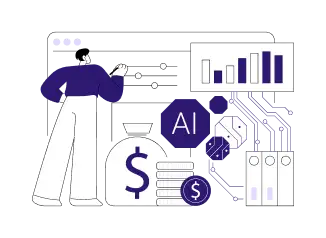
Composable Enterprise Architectures
Many enterprises are moving toward composable architectures, though not always by that name. The idea is straightforward. Break large systems into smaller, reusable capabilities that communicate through APIs.
This makes future changes easier. Teams can update one capability without disrupting others. Partner integrations become less painful. New digital products can reuse existing services instead of starting from scratch.
It is rarely perfect at first. But over time, modularity reduces friction.
API Monetization Opportunities
APIs started as internal integration tools. Increasingly, they are becoming products themselves.
Banks expose payment rails. Logistics companies offer shipment tracking APIs. Retail platforms share inventory or pricing data with partners. When structured properly, APIs can generate revenue directly or strengthen partner ecosystems.
Usage analytics, access controls, and billing layers usually follow once APIs move beyond internal consumption.
Platform Ecosystem Expansion
Some enterprises eventually move beyond single-product thinking. They start building platforms others can plug into.
This might mean:
- Partner integration hubs
- Developer portals
- Marketplace extensions
- Third-party add-ons
Platform ecosystems tend to grow gradually. Once external partners build on your capabilities, network effects start influencing growth.
Product engineering teams end up managing stability, scalability, and governance for that ecosystem.
Data-Driven Product Revenue Models
Data increasingly shapes how products make money. Usage insights inform pricing models. Behavioral analytics influence feature prioritization. Predictive signals guide customer engagement strategies.
Some companies monetize data directly. Others use it to improve margins or customer retention. Either way, reliable data pipelines become essential.
Fragmented data slows innovation faster than most leaders expect.
Predictive and Digital Twin Capabilities
Predictive analytics has moved beyond marketing dashboards. Enterprises use forecasting models for supply chains, asset maintenance, and demand planning.
Digital twins push this further. They simulate physical systems digitally, such as factories, logistics networks, and infrastructure assets. Teams test scenarios before making operational changes.
These capabilities depend on steady data ingestion and reliable compute environments. Without that foundation, simulations quickly lose credibility.
Transformation Maturity Roadmap
Transformation tends to follow stages, even if organizations do not label them formally.
- Modernization phase
Legacy systems are stabilized. Core services gain API exposure. Cloud adoption begins. - Optimization phase
Automation improves delivery pipelines. Data integration becomes more consistent. Platform engineering capabilities expand. - Autonomous product enterprise phase
Predictive analytics influences decisions regularly. Continuous experimentation becomes normal. AI-assisted optimization supports operations within governance boundaries.
Few enterprises move cleanly from one stage to the next. Still, understanding the progression helps clarify priorities.
Technology-driven business transformation is usually less dramatic than it sounds. It shows up in steady capability improvements, stronger product foundations, and fewer constraints when new opportunities appear.
Real estate SaaS platforms demand scalability, tenant data security, and seamless property lifecycle visibility. Appinventiv worked with ILITY to build a cloud-native SaaS platform enabling centralized property management, digital workflows, and improved operational transparency. The platform strengthened data accessibility while supporting scalable real estate operations and modern digital tenant experiences.

Future Trends of Digital Product Engineering
If you sit in enough roadmap meetings, you start noticing a change in tone. The discussion is less about adding features and more about building systems that adjust on their own. That shift is subtle, but it is shaping where digital product engineering is heading.
Several trends are becoming visible across large enterprises.
AI is moving into the core architecture.
AI is no longer treated as a side experiment. Teams are embedding models directly into transaction flows, recommendation systems, and operational dashboards. That means:
- Data pipelines must support near-real-time processing
- Model monitoring becomes part of daily operations
- Retraining cycles are planned, not reactive
- Governance discussions happen earlier in the design phase
When AI sits inside critical workflows, reliability matters as much as accuracy.
Also Read: Generative AI in Digital Product Development
Platform thinking is replacing standalone products.
Many enterprises are gradually opening their systems through APIs. At first, this supports internal reuse. Over time, partners begin integrating directly. That leads to:
- Developer portals and integration hubs
- Usage analytics tied to external consumption
- Clear access controls and monetization models
The business shifts from delivering a product to enabling an ecosystem.
Engineering automation deepening
Automation is expanding beyond CI/CD. Teams are relying more on:
- Automated regression testing
- Infrastructure provisioning through code
- Continuous performance monitoring
- Integrated security scanning
This reduces repetitive operational effort and shortens release cycles, especially in distributed teams.
Data as a strategic layer
Data conversations are becoming more structured. Enterprises are investing in:
- Cleaner semantic definitions across business units
- Real-time analytics pipelines
- Stronger data quality checks
- Predictive models guiding planning decisions
Without consistent data, even strong engineering teams struggle.
Stronger governance expectations
Regulatory attention around AI, privacy, and cybersecurity is increasing. Enterprises are responding by building:
- Clear audit trails for digital decisions
- Documented model behavior
- Continuous compliance monitoring
Sustainable and Efficient Engineering
Enterprises are also incorporating sustainable engineering practices, including workload right-sizing, energy-efficient cloud configuration, and carbon-aware infrastructure planning. Green coding and optimized compute utilization are becoming part of architectural discussions, particularly in global markets where ESG reporting influences investor perception.
Digital product engineering for enterprise is moving toward systems that are more adaptive and more accountable at the same time. Organizations that strengthen architecture, data foundations, and governance now usually find later transitions less disruptive.
Also Read: Why Appinventiv for Product Development Services
Why Consider Appinventiv for Your Digital Product Engineering Needs
Choosing a digital product engineering partner usually comes down to practical considerations. Can they work within enterprise constraints, scale delivery globally, and strengthen your architecture rather than just add development bandwidth? That tends to matter more than promotional positioning.
Below are credibility signals and capabilities that enterprises typically evaluate.
Enterprise Product Engineering Depth
- Experience across 35+ industries, including regulated and complex environments
- 3,000+ digital solutions designed and delivered across enterprise contexts
- 500+ legacy processes transformed into modern digital workflows
- Over 10 years of product engineering experience
Architecture-First Engineering Approach
- Early focus on system architecture, integration mapping, and scalability planning
- Emphasis on API strategies, platform engineering, and cloud-native design
- Risk and compliance considerations are built into the initial design stages
- Reduced the likelihood of late-stage rework due to architectural constraints
AI-Native Product Architecture Capabilities
- AI integrated as an operational layer, not just a feature
- Data pipeline engineering and production-grade MLOps support
- Predictive analytics integration within digital products
- Model governance, monitoring, and lifecycle management practices
Global Delivery and Scale
- Presence across 74+ countries supported through technology initiatives
- 1,600+ technologists and engineering specialists
- 5+ international offices with additional regional operational hubs
- Experience managing distributed enterprise delivery environments
Compliance, Governance, and Enterprise Alignment
- Exposure to regulated industry requirements
- Structured security and compliance readiness practices
- Strategic federal partnerships supporting governance alignment
- Industry certifications supporting enterprise delivery standards
Recognitions and Performance Indicators
- Featured in Deloitte Fast 50 India for two consecutive years (2023–2024)
- Ranked among APAC High-Growth Companies by Statista and Financial Times
- 95% client satisfaction rate based on engagement feedback
- 90% repeat clientele, indicating sustained partnerships
- Client solutions exceeding 100M+ global app downloads
Partnership-Oriented Engagement Model
- Focus on long-term product evolution rather than one-time delivery
- Collaborative engagement with internal enterprise teams
- Alignment with business outcomes, not just engineering output
- Structured communication across distributed stakeholders
For many enterprises, selecting a digital product engineering company is less about outsourcing work and more about extending internal capability. Architecture maturity, delivery discipline, and governance awareness typically shape that decision more than marketing positioning.
Enterprises evaluating their product engineering maturity often begin with a structured architecture and cost assessment. A tailored maturity diagnostic can surface integration gaps, governance risks, and scalability bottlenecks before major investments are made.
FAQs
Q. What is digital product engineering?
A. Digital product engineering for business refers to the continuous design, development, deployment, and evolution of digital products using scalable architecture, cloud infrastructure, and data-driven feedback loops. It focuses on lifecycle ownership, API ecosystems, platform engineering, and operational reliability so products adapt quickly to market changes rather than remaining static after launch.
Q. What are the key factors of digital product engineering
A. Core factors include modular architecture design, strong data governance, platform engineering maturity, AI readiness, and secure DevOps pipelines. Enterprises also prioritize observability, integration flexibility, compliance alignment, and scalable infrastructure. These elements ensure products remain resilient, adaptable, and capable of supporting continuous innovation without frequent architectural resets.
Q. What is the future of digital product engineering?
A. The direction is toward AI-native products, composable platforms, automated engineering workflows, and ecosystem-driven business models. Expect deeper integration of predictive analytics, autonomous testing pipelines, platform marketplaces, and stronger governance frameworks. Engineering teams will increasingly manage intelligent systems that adapt dynamically rather than static application environments.
Q. How does digital product engineering accelerate business?
A. It improves release velocity through automation, enables new revenue channels via APIs and data products, and reduces operational friction through platform engineering. Faster experimentation cycles support innovation, while predictive analytics improve customer engagement. Over time, this strengthens competitiveness, lowers operational overhead, and helps enterprises respond faster to market shifts.
Q. Why choose Appinventiv as your Product Engineering Partner?
A. Appinventiv combines architecture-first engineering, AI-enabled development practices, and global enterprise delivery experience. Teams focus on scalable cloud-native design, secure DevSecOps pipelines, and data-driven product optimization. With multi-industry exposure, compliance readiness, and proven transformation outcomes, the engagement model emphasizes long-term product evolution, operational reliability, and alignment with enterprise business objectives.
Q. How are emerging technologies shaping digital product engineering today?
A. Emerging technologies are reshaping digital product engineering through AI and machine learning integration, generative AI, NLP, cognitive computing, and predictive analytics. IoT-driven solutions, RPA, and low-code/no-code platforms accelerate delivery, while AR and VR enable immersive experiences. Together, these technologies support AI-powered autonomous software, operational automation, and more personalized digital experiences across enterprise products.
Q. How can enterprises accelerate time to value in digital product engineering?
A. Enterprises accelerate time to value by adopting DevOps and agile methodologies, automating manual tasks across the software development lifecycle, and using cross-capable teams for faster decision-making. Iterative processes, manageable release cycles, testing and deployment automation, and proprietary accelerators help reduce delays, while user feedback, product data insights, and collaborative tools like virtual whiteboard software improve feature prioritization.


- In just 2 mins you will get a response
- Your idea is 100% protected by our Non Disclosure Agreement.

What began as a small collection of utilities and games has now become a cornerstone of digital life, powering everything from entertainment and social interaction to finance, healthcare, retail, and enterprise productivity. Just over 15 years ago, the mobile app economy was little more than a promising idea. A handful of apps, basic user experiences,…

When Google acquired Fitbit for $2.1 billion in 2021, it was not just buying a fitness tracker but investing in a thriving ecosystem powered by wearable apps. Fitbit’s success was not just about hardware; its app’s ability to deliver real-time health insights, sync seamlessly with multiple devices, and engage users with personalized recommendations made it…

When it comes to mobile app development, a million-dollar question (sometimes literally) keeps businesses awake at night: How much does it cost to build a mobile app that can compete in today's market? It’s a valid concern, as the cost of creating an app can vary dramatically depending on numerous factors. But here’s the thing—app…









