


























Wealth Management Technology: Key Capabilities, Security Controls, and Future Trends

 Share -


- 01The Digital Transformation Of Wealth Management
- 02How FinTech is Reshaping the Wealth Management Value Chain
- 03Core Technologies Powering Innovation In Wealth Management
- 04GenAI In Wealth Management: Practical Uses And Essential Guardrails
- 05How to Build a Wealth Management App: Step-By-Step Development Process
- 06Architecture Blueprint For A Modern Wealth Management Platform
- 07Operating Model Transformation: Enhancing Advisor Productivity And Client Trust
- 08Compliance, Risk Management, And Trust In A Digital Wealth Environment
- 09Build vs Buy vs Partner: Choosing The Right WealthTech Strategy
- 10Challenges In Adopting Wealth Management Technology & How To Overcome Them
- 11The Future Of Wealth Management Technology: What Comes Next
- 12How Appinventiv Helps Build Future-Ready WealthTech Platforms

Key Takeaways
- Wealth management is shifting from quarterly check-ins to always-on visibility, driven by client expectations for real-time clarity and faster guidance.
- Wealth management technology is connecting onboarding, advice, execution, and compliance into one seamless flow, reducing delays, manual follow-ups, and operational friction across the advisory lifecycle.
- The real differentiator is infrastructure: unified data, API-led integrations, cloud scalability, and security controls that keep reporting and decisions trustworthy.
- GenAI can help with drafting, summarising, and advisor prep, but it needs tight guardrails, human review, and strong audit trails.
- Winning WealthTech strategies balance build, buy, and partner choices based on speed, differentiation needs, integration complexity, and compliance risk.
Wealth management feels less formal than it used to. Clients aren’t keen to wait for quarterly meetings or wade through long statements just to understand their finances. Most want to open an app and see, in seconds, where they stand and what needs attention.
That change is forcing firms to rethink how they work. Investing in wealth management technology is becoming part of everyday operations, not a future upgrade. The role of technology in wealth management now stretches beyond moving forms online. AI-based insights and digital onboarding in wealth management are helping make the process faster, more transparent, and easier for clients to follow.
The pace of change is also reflected in industry growth. PwC estimates global assets under management could rise from about $139 trillion to $200 trillion by 2030, supported by digital platforms, private markets, and technology-enabled advisory models.
At the same time, fintech in wealth management is bringing new capabilities into reach. Cloud infrastructure, automation, and blockchain in wealth management are improving transparency and widening access to investment opportunities. Firms leveraging tech in wealth management to offer ongoing guidance, rather than occasional check-ins, are more likely to build lasting trust.
Global AUM is projected to reach nearly $200 trillion by 2030. Firms investing in modern wealth management technology are positioning for growth and client trust.
The Digital Transformation Of Wealth Management
Not so long ago, wealth management followed a steady, familiar rhythm. Clients met their advisors a few times a year, statements arrived later, and most updates were saved for review meetings. That cadence worked for a different era. Today, it feels slow. As tech in wealth management becomes woven into daily financial life, clients expect to see where they stand without having to wait or ask.
This shift isn’t about replacing advisors. It’s about making guidance available when it actually helps. The role of technology in modern wealth management is to support better decisions while preserving the trust and reassurance clients value.
What’s driving the change:
- Clients expect quicker answers: Waiting weeks for updates feels out of step with services that respond in near real time.
- Guidance is becoming ongoing: Investors want to know when markets move or goals shift, not only during scheduled reviews.
- Real-time data is replacing static reports: Advisors can respond to what’s happening now instead of relying only on past snapshots.
- Efficiency has become essential: Routine tasks handled through wealthtech solutions give advisors more time for planning and meaningful conversations.
- Transparency builds confidence: Clear dashboards and easy access to information help clients feel informed and in control.
Digital transformation is reshaping how firms deliver value. Those leveraging technology in wealth management to provide ongoing visibility and timely guidance are keeping pace with how clients now expect financial relationships to work.
How FinTech is Reshaping the Wealth Management Value Chain
Wealth management hasn’t always moved this quickly. For years, the process followed a familiar pattern: a client opened an account, investments were put in place, and meaningful updates arrived during the next review meeting. That pace made sense then. Today, it feels out of step. Investors now expect to know what’s happening in real time, when markets swing, when goals shift, or when their portfolio needs attention.
As fintech continues to mature within wealth management, firms are quietly reworking each stage to make the experience feel more responsive and less dependent on manual follow-ups.
Much of this change is happening behind the curtain. Systems that once operated independently are now being connected, enabling data to flow more smoothly between advisors, platforms, and clients. It may not always be visible to the end user, but this growing integration is fundamentally reshaping the wealth management journey.
Where the shift is most noticeable
- Client onboarding and verification: Opening an account no longer needs to begin with a stack of forms. Digital onboarding in wealth management is making identity checks and compliance screening faster and far less cumbersome for both clients and firms.
- Portfolio construction and personalization: The move away from one-size-fits-all portfolios is becoming more pronounced. With richer data at their fingertips, advisors can shape portfolios around individual goals, time horizons, and risk comfort levels rather than relying heavily on standard templates.
- Execution and portfolio monitoring: Automated rebalancing, drift alerts, and real-time tracking are helping teams stay ahead of market movements. Rather than reacting after the fact, advisors can step in earlier when adjustments are needed.
- Client engagement and communication: Investors no longer have to wait for the next scheduled review to stay informed. Secure messaging, timely updates, and gentle nudges are creating a more continuous dialogue between clients and advisors.
- Compliance and reporting workflows: On the operational side, automation is easing the burden of maintaining audit trails and regulatory documentation. It’s a quieter improvement, but one that saves time and reduces manual effort.
As more firms lean into connected wealthtech solutions, the conversation is shifting. The goal is no longer just faster processing; it’s better, more consistent advice. Tech in wealth management is increasingly about giving clients clarity, confidence, and a stronger sense that someone is actively watching over their financial journey.
Core Technologies Powering Innovation In Wealth Management
Most of the real change in wealth management isn’t flashy. Clients might notice a cleaner dashboard or a timely alert, but a lot more is happening in the background. Systems are constantly pulling in data, checking for risk, and keeping records straight so advisors don’t have to do it manually. When firms invest in wealth management technology today, they’re not just polishing the interface; they’re rebuilding the plumbing that supports advice, compliance, and day-to-day decisions.
Modern platforms are designed to handle high-volume streams of financial data, connect to multiple providers, and surface insights quickly enough to be actually useful. This is where tech in wealth management proves its worth. It helps firms move faster, trust their data more, and give advice with clearer context.
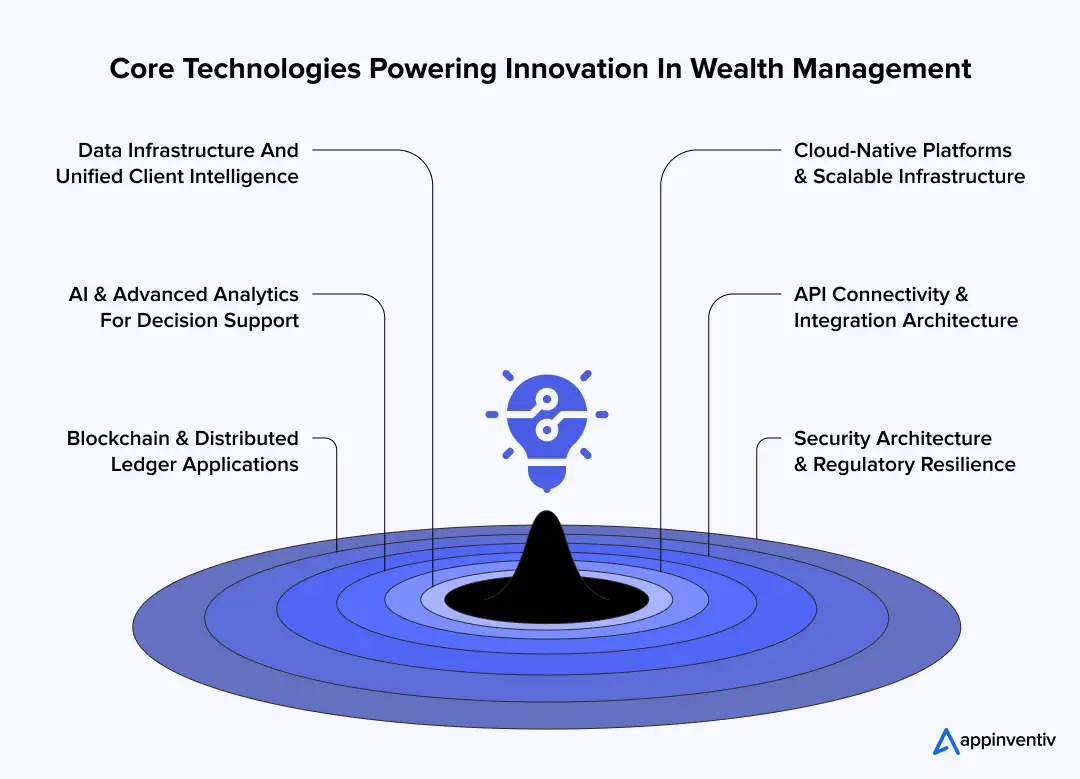
1. Data Infrastructure And Unified Client Intelligence
Not very long ago, client information and portfolio data lived in different places. Advisors often had to jump between custodians, CRM systems, and reporting tools just to piece together a full picture. That patchwork approach is gradually being replaced by unified data layers that bring everything into one view.
With better data foundations, firms can:
- See portfolios across accounts and asset classes in one place
- Track performance and risk without waiting for delayed reports
- Pick up behavioral cues from client activity
- Maintain cleaner, traceable records for audits and compliance
Without solid data to back it up, even the most advanced personalization tools tend to fall flat.
2. Cloud-Native Platforms And Scalable Infrastructure
Legacy systems often struggle when markets get volatile or when data volumes spike. Cloud-native setups give firms breathing room. They can scale computing power up or down as needed without compromising stability.
In everyday terms, this helps firms:
- Handle surges during heavy trading periods
- Improve disaster recovery and overall uptime
- Push product updates and integrations faster
- Keep environments aligned with financial data security standards
It’s not the most visible upgrade, but it’s one of the more practical shifts in new technology in wealth management.
3. AI And Advanced Analytics In Everyday Decision Support
AI in fintech is increasingly being used as a support layer for advisors, not a replacement. Machine learning models sift through market moves, portfolio drift, and client behavior to flag things that might otherwise slip through the cracks.
Typical use cases include:
- Highlighting unusual portfolio risk exposure
- Surfacing tax-loss harvesting opportunities
- Grouping clients based on behavioral patterns
- Nudging advisors with suggested next steps
Used well, these tools help shift conversations from backward-looking updates to more forward-looking guidance.
4. API Connectivity And Integration Architecture
Today’s wealth platforms depend heavily on APIs to keep everything connected: custodians, trading engines, identity checks, market data feeds, and CRM systems.
This integration layer makes it possible to:
- Execute and confirm trades in near real time
- Automate KYC and AML checks
- Enable smoother fund transfers and payment flows
- Keep advisor and client views in sync
API integration has quietly become one of the backbone elements of modern wealthtech ecosystems.
5. Blockchain And Distributed Ledger Applications
Adoption is still uneven, but blockchain in wealth management is gaining attention in areas where transparency and settlement speed matter most.
Some emerging use cases include:
- Shorter trade settlement cycles
- Tokenized ownership and fractional investing models
- Tamper-resistant transaction records for compliance
- Better visibility into alternative asset distribution
The promise here is simple: less operational friction and more trust in the underlying records.
Also Read: Blockchain in Fintech: Revolutionizing Finance with Security
6. Security Architecture And Regulatory Resilience
Security today is baked into the foundation, not bolted on later. Financial platforms are being built with layered protections that safeguard sensitive data while keeping firms audit-ready.
Common safeguards include:
- Encryption technology for data at rest and in transit
- Role-based access controls with activity monitoring
- Anomaly detection to flag potential fraud
- Detailed audit trails for regulatory review
Strong security isn’t just about protection; it’s about maintaining client trust as digital adoption grows.
As firms continue investing in advanced wealthtech, the conversation is shifting. The goal is no longer just digitizing workflows for efficiency. It’s about building infrastructure that advisors can rely on and clients can trust. Tech in wealth management now plays a deeper role, supporting better decisions, reinforcing compliance, and enabling a more responsive client experience overall.
GenAI In Wealth Management: Practical Uses And Essential Guardrails
Generative AI is moving from pilot projects to everyday workflows inside wealth firms. The real value isn’t automation for its own sake. It reduces manual effort, speeds up information access, and helps advisors stay prepared. In this sense, GenAI is becoming a practical layer within wealth management technology, supporting professionals rather than replacing them.
Where GenAI Adds Real Value:
- Summarizing complex documents: Research reports, policy updates, and statements can be condensed quickly, saving review time.
- Drafting client communications: Advisors can draft initial updates or market explanations, then refine tone and context.
- Meeting preparation: Systems can compile recent portfolio activity, client history, and notes before reviews.
- Compliance documentation support: Structured summaries help maintain consistent suitability records and audit readiness.
- Internal knowledge access: Advisors can retrieve policy or product details using natural language queries.
These applications show how tech in wealth management is evolving from workflow automation toward decision support.
Guardrails That Must Be In Place:
Because outputs can influence financial decisions, oversight is essential:
- Human review before client-facing use
- Traceability of data sources used in responses
- Monitoring and logging for audit trails
- Strict controls around client data privacy
Where GenAI Fits Best
GenAI performs well in summarization, drafting, and knowledge retrieval. It is not suited for unsupervised portfolio decisions.
Firms leveraging technology in wealth management are finding that GenAI delivers the most value when paired with clear boundaries and human oversight. Used thoughtfully, it reduces administrative burden and allows advisors to focus on interpretation, planning, and client relationships.
Also Read: Generative AI in Finance: Pioneering Transformations
How to Build a Wealth Management App: Step-By-Step Development Process
Building a wealth app is less about screens and more about plumbing. If the data is wrong, the performance is off, or the audit trail is messy, the product breaks trust fast. Good wealth management technology is engineered around accuracy, security, and traceability first. Everything else comes later.
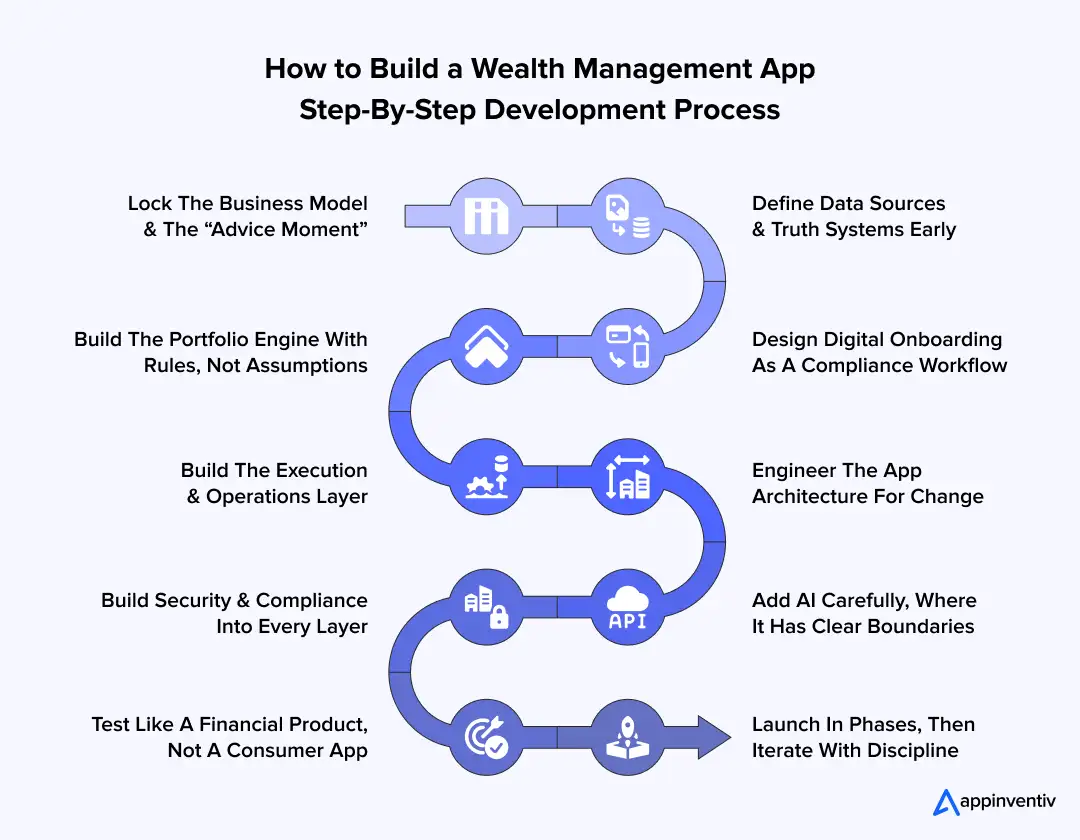
Step 1: Lock The Business Model And The “Advice Moment”
Before you touch design, decide what the app is really delivering.
- Robo-only, hybrid advisor, or advisor-led
- Mass affluent, HNW/UHNW, or institutional
- Core value: goals-based planning, tax efficiency, or unified portfolio view
This is the first practical checkpoint for the role of tech in wealth management because it determines integrations, compliance depth, and workflow complexity.
Step 2: Define Data Sources And Truth Systems Early
Most wealth apps fail because the “single view of the client” never becomes a single view.
- Custodian/broker feeds for positions, orders, fills, and corporate actions
- Market data feeds for pricing, benchmarks, risk factors
- CRM and advisor notes for relationship context
- Document store for statements, disclosures, and KYC artifacts
A strong data layer is the backbone of tech in wealth management. It enables real-time views, consistent reporting, and defensible advice logs.
Step 3: Design Digital Onboarding As A Compliance Workflow
Onboarding isn’t a form. It’s a regulated process. Build digital onboarding in wealth management to include:
- Identity verification + liveness checks
- Sanctions, PEP, AML screening
- Suitability capture: objectives, time horizon, constraints
- Risk profiling + disclosures + consent logs
- Exception handling for manual review
If your onboarding can’t produce an audit-ready trail, you don’t have production-grade wealthtech solutions yet.
Step 4: Build The Portfolio Engine With Rules, Not Assumptions
A wealth app needs a portfolio brain, not just charts.
Core components:
- Model portfolios + constraints (exclusions, caps, liquidity needs)
- Rebalancing logic (drift thresholds, schedules, cash-flow based triggers)
- Transaction cost guardrails (avoid churn, minimize unnecessary trades)
- Tax-aware logic (where applicable): lot selection, harvesting rules
- Suitability rationale generation per portfolio action
This is where how technology is transforming wealth management becomes real: decisions are traceable, repeatable, and consistent.
Step 5: Build The Execution And Operations Layer
Execution is not just placing orders. It is confirmations, failures, and reconciliations.
- Order management and status tracking
- Trade confirmations and settlement states
- Corporate actions handling
- Cash management and funding flows
- Reconciliation checks between custodian data and internal records
If you want reliable wealth management technology, treat ops as a first-class product feature.
Step 6: Engineer The App Architecture For Change
Most firms don’t rebuild their stack every two years, so plan for evolution.
Recommended architecture patterns:
- API-first services for integration flexibility
- Event-driven workflows for alerts and monitoring
- Separate data stores for transactions, analytics, and reporting
- Observability baked in: logs, metrics, traces, audit records
This is the part where leveraging tech in wealth management helps avoid vendor lock-in and supports scaling new products faster.
Step 7: Add AI Carefully, Where It Has Clear Boundaries
AI can help, but only when it’s controlled and explainable.
High-signal use cases:
- Drift and risk anomaly detection
- Personalized insights and next-best-actions
- Fraud signals on logins and transactions
- GenAI assistance for advisor notes and client updates (with review)
This is where the role of technology in modern wealth management needs guardrails: human review, logging, and traceability.
Step 8: Build Security And Compliance Into Every Layer
Security can’t be bolted on later.
- Encryption in transit and at rest + key management
- RBAC and least-privilege access
- Audit trails for every sensitive action
- Secure session management and device protections
- Regular pen testing and vulnerability management
For many firms, this is the real differentiator among key players in wealth management technology.
Step 9: Test Like A Financial Product, Not A Consumer App
Functional testing isn’t enough. Validate financial correctness.
- Holdings and performance accuracy validation
- Pricing and benchmark consistency checks
- Integration testing with custodians and payment rails
- Load testing during peak market conditions
- Compliance checks on suitability, disclosures, and record keeping
Step 10: Launch In Phases, Then Iterate With Discipline
Don’t release everything at once. Release the minimum that’s safe and measurable.
- Private beta for controlled cohorts
- Staged rollout by feature and region
- Instrument KPIs: onboarding completion, time-to-fund, time-to-first-invest, retention
- Continuous monitoring for model drift, fraud, and operational failures
This is the benefits of tech in wealth management in practice: faster service, fewer errors, and more confidence for clients and advisors.
Design secure onboarding, portfolio intelligence, and audit-ready workflows with an architecture built for compliance, scale, and long-term reliability.

Architecture Blueprint For A Modern Wealth Management Platform
A wealth management platform looks simple on the surface. A client sees balances, performance, and a few insights. Underneath, it’s a chain of systems that must agree on the same truth: holdings, prices, tax lots, cash, orders, and what was communicated to the client. If one link is off, trust takes the hit, not the backend team. That’s why strong wealth management technology starts with architecture that’s boring in the right places: consistent data, predictable workflows, and audit-ready records.
Core Platform Layers
1) Experience Layer
- Client apps (mobile/web): portfolio, goals, documents, alerts, messaging
- Advisor console (if hybrid): client 360, tasks, approvals, notes, suitability trail
- Admin ops console: exceptions, reconciliation breaks, KYC review queues
2) API And Orchestration Layer
This is the traffic controller. It keeps channels consistent and prevents “app logic” from leaking everywhere.
- API Gateway: throttling, auth, request validation, rate limits
- Workflow orchestration (often event-driven): onboarding, funding, order lifecycle, approvals
- Policy engine: suitability checks, permissions, product eligibility, disclosure gating
This is where the role of tech in wealth management becomes practical: rules are enforced consistently across every channel.
3) Portfolio And Advice Engine
This is the brain. Not charts and decisions.
- Model portfolios + constraints (exclusions, caps, liquidity needs)
- Rebalancing logic (drift thresholds, schedules, cash-flow triggers)
- Risk layer (exposure, concentration, scenario stress)
- Tax logic where applicable (lot selection, harvesting rules)
- “Why” capture: suitability rationale per recommendation and change
If you want tech in wealth management to be trusted, the portfolio engine must be deterministic and explainable.
4) Trading, Operations, And Reconciliation
This layer decides whether you can safely scale.
- Order management: create, route, amend/cancel, confirm, reject handling
- Settlement states and corporate actions handling
- Cash and funding flows (deposits, withdrawals, sweeps)
- Reconciliation: custodian vs internal records, breaks queue, resolution workflow
A lot of firms underestimate this. In real life, the edge cases are the product.
5) Data Platform
You typically need more than one “data store” because transactions, analytics, and reporting have different needs.
- System of record (transactional): accounts, orders, positions, cash, tax lots
- Analytics store: feature tables, cohort behavior, engagement signals
- Reporting store: performance calculations, statements, regulatory reports
- Document store: disclosures, KYC artifacts, statements, and advice records.
This is the foundation for leveraging technology in wealth management without losing data integrity.
6) Intelligence Layer
This is where AI should live, not inside the UI.
- Risk anomaly detection (sudden exposure shifts, concentration spikes)
- Client insights and next-best-actions for advisor review
- Personalization for content and alerts (not unsupervised advice)
- GenAI support for drafting notes and client updates (with guardrails)
This is often the “shiny” layer, but it only works if the data platform is solid.
7) Security, Governance, And Observability
If this layer is weak, everything else is a liability.
- Identity and access: RBAC, least privilege, MFA, session controls
- Encryption: at rest and in transit, key management
- Audit trails: immutable logs for actions and approvals
- Monitoring: logs, metrics, traces, alerting, and incident response hooks.
For regulated products, observability is not DevOps hygiene. It’s evidence.
Critical Integration Points That Usually Break
Most issues don’t come from the app. They stem from mismatches in assumptions between systems.
- Custodian/Broker APIs: positions, timing, corporate actions, partial fills, reversals
- Market data feeds: stale pricing, corporate action adjustments, benchmark mismatches
- KYC/AML vendors: false positives, re-check intervals, manual review routing
- CRM systems: client identity mapping, notes syncing, and permission boundaries
- Payments rails: settlement cutoffs, failed transfers, dispute handling
- Tax and performance engines: lot-level accuracy, methodology differences, rounding rules
Good wealthtech solutions treat these integrations like products: versioned contracts, replayable events, and clear failure handling.
Also Read: Decoding Transformations Led by AI in Wealth Management
Operating Model Transformation: Enhancing Advisor Productivity And Client Trust
Technology on its own doesn’t change wealth management. The real difference shows up in how advisors spend their time and how clients experience that time. When new tools sit atop old routines, they slow people down. When workflows are simplified, conversations become more focused and useful.
In many firms, advisors still spend hours pulling data together, preparing reports, or waiting on approvals. As tech in wealth management becomes more connected, the goal isn’t more screens to look at. It’s fewer steps and clearer information, so advisors can spend more time advising.
What’s changing in day-to-day work
- Information is easier to access, reducing prep time before meetings
- Advisors start conversations with context instead of basic updates
- Automated records reduce repetitive compliance paperwork
- Structured workflows replace long email chains and follow-ups
A Hybrid Experience Clients Appreciate
Clients still want a human voice when markets are uncertain or life plans shift. Technology handles monitoring and alerts, while advisors provide context and reassurance. This balance reflects the growing role of technology in modern wealth management.
Transparency Strengthens Trust
When clients can view performance, documents, and updates in one place, they feel informed rather than dependent. Technology doesn’t replace trust. It helps reinforce it.
Firms leveraging tech in wealth management well are not just improving efficiency. They are making advice more timely, conversations more meaningful, and relationships easier to sustain.
Compliance, Risk Management, And Trust In A Digital Wealth Environment
As wealth management shifts onto digital platforms, compliance is no longer a step at the end of a process. It shows up in everyday tasks. Regulators expect clear records and accountability. Clients expect their information to stay protected and their advice to be sound. This is where wealth management technology must support trust, not just efficiency.
Technology doesn’t remove responsibility. It makes it easier to document decisions, track activity, and maintain oversight.
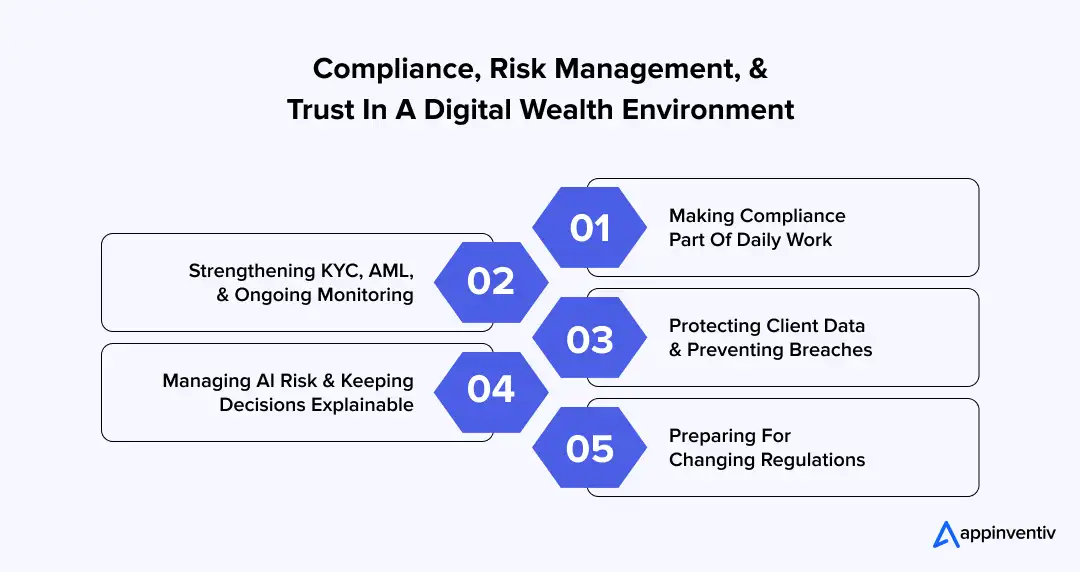
1. Making Compliance Part Of Daily Work
In many firms, compliance once meant reviewing paperwork after the fact. Modern systems build checks into the workflow itself.
That may include:
- Suitability checks before recommendations are finalized
- Prompts to share disclosures based on product risk
- Digital consent capture with time-stamped records
- Audit trails showing changes, approvals, and communications
These controls support the role of technology in wealth management by helping firms stay consistent without adding extra steps.
2. Strengthening KYC, AML, And Ongoing Monitoring
Compliance doesn’t end when an account is opened. Ongoing monitoring is part of the responsibility.
Using digital onboarding in wealth management alongside continuous monitoring helps firms:
- Verify identity and screen against sanctions lists
- Flag politically exposed persons (PEPs) and watchlist matches
- Monitor transactions for unusual patterns
- Trigger periodic reviews based on risk levels
Intelligent Automation reduces manual effort while maintaining regulatory discipline.
3. Protecting Client Data And Preventing Breaches
Trust can fade quickly if sensitive financial data is exposed. Security needs to be built into the platform from the start.
Common safeguards include:
- Encryption for data in transit and at rest
- Multi-factor authentication and secure session controls
- Role-based access aligned with least-privilege principles
- Monitoring systems that detect unusual access patterns
Strong protection practices reinforce confidence in wealthtech solutions.
4. Managing AI Risk And Keeping Decisions Explainable
As firms adopt AI-driven insights, they must ensure decisions remain understandable and defensible.
Responsible governance includes:
- Documenting model logic and assumptions
- Maintaining human oversight for recommendations
- Logging outputs and decision triggers
- Reviewing models regularly for drift or bias
This reflects the growing role of technology in modern wealth management, where decision support tools must remain transparent and accountable.
5. Preparing For Changing Regulations
Regulatory expectations continue to evolve alongside digital innovation. Firms need systems that can adapt without major disruption.
Forward-looking firms focus on:
- Configurable compliance rules and policy controls
- Scalable audit and reporting capabilities
- Clear data lineage for regulatory review
- Cross-border compliance readiness for global clients
Compliance and risk management are no longer confined to back-office functions. They sit at the center of client trust and operational resilience. Firms leveraging technology in wealth management thoughtfully can maintain regulatory readiness while delivering a secure and transparent client experience.
Build vs Buy vs Partner: Choosing The Right WealthTech Strategy
Sooner or later, every wealth firm runs into the same decision. Do we build our own platform, buy something ready-made, or work with a technology partner? It sounds like a technology choice, but it really shapes how the firm operates, how quickly it can adapt, and how consistent the client experience feels.
Choosing the right path for wealth management technology isn’t about picking the most advanced tool. It’s about matching the approach to how the business actually delivers advice and plans to grow.
Build: When Control And Differentiation Matter
Building in-house makes sense when technology is part of what sets the firm apart.
Best fit when firms:
- Offer proprietary strategies or unique advisory models
- Need deep customization and workflow control
- Want full ownership of client experience and data
- Have long-term product vision and engineering capacity
Trade-offs
- Longer time before launch
- Higher upfront investment and ongoing costs
- Ongoing responsibility for maintenance, security, and compliance updates
Building can be powerful, but it requires patience and sustained commitment.
2. Buy: When Speed And Simplicity Are Priorities
Buying an established platform can help firms modernize quickly and reduce technical burden.
Best fit when firms:
- Need a faster path to deployment
- Operate with fairly standard workflows
- Prefer predictable costs and vendor-managed upgrades
- Focus more on client relationships than software management
Trade-offs
- Limited flexibility for customization
- Dependency on vendor timelines and pricing
- Integration challenges with existing systems
Buying works well when speed and operational ease matter more than deep customization.
3. Partner: When Flexibility And Expertise Are Needed
Partnering with a technology firm offers a middle path. It allows customization without starting from zero and brings in expertise that many firms don’t keep in-house.
Best fit when firms:
- Require tailored workflows without building everything themselves
- Migrate from legacy systems
- Integrate custodians, CRM, and reporting tools
- Seek scalable architecture with expert guidance
Trade-offs
- Shared ownership of delivery and roadmap
- Ongoing collaboration and governance required
- Coordination across internal teams and partners
This approach helps firms leveraging technology in wealth management move forward without carrying the full technical burden alone.
Key Factors To Consider
Before choosing a direction, it helps to step back and assess:
- Time available before the platform must go live
- Level of differentiation the firm wants to maintain
- Integration complexity across existing systems
- Compliance and security requirements
- Total long-term cost of ownership
- Internal technical and product capabilities
Many firms end up blending approaches. They buy where it makes sense, customize where it matters, and partner where expertise accelerates progress. The right choice is the one that supports growth, protects client trust, and keeps the experience dependable.
Challenges In Adopting Wealth Management Technology & How To Overcome Them
On paper, modernization looks tidy. In reality, it rarely unfolds that way. Systems don’t line up, processes overlap, and teams are asked to change habits that have worked for years. Moving toward wealth management technology isn’t only about upgrading tools. It affects how advice is delivered, how records are kept, and how clients experience the firm.
Knowing where friction tends to appear makes adoption smoother and helps firms put fintech in wealth management to work without disrupting daily operations.
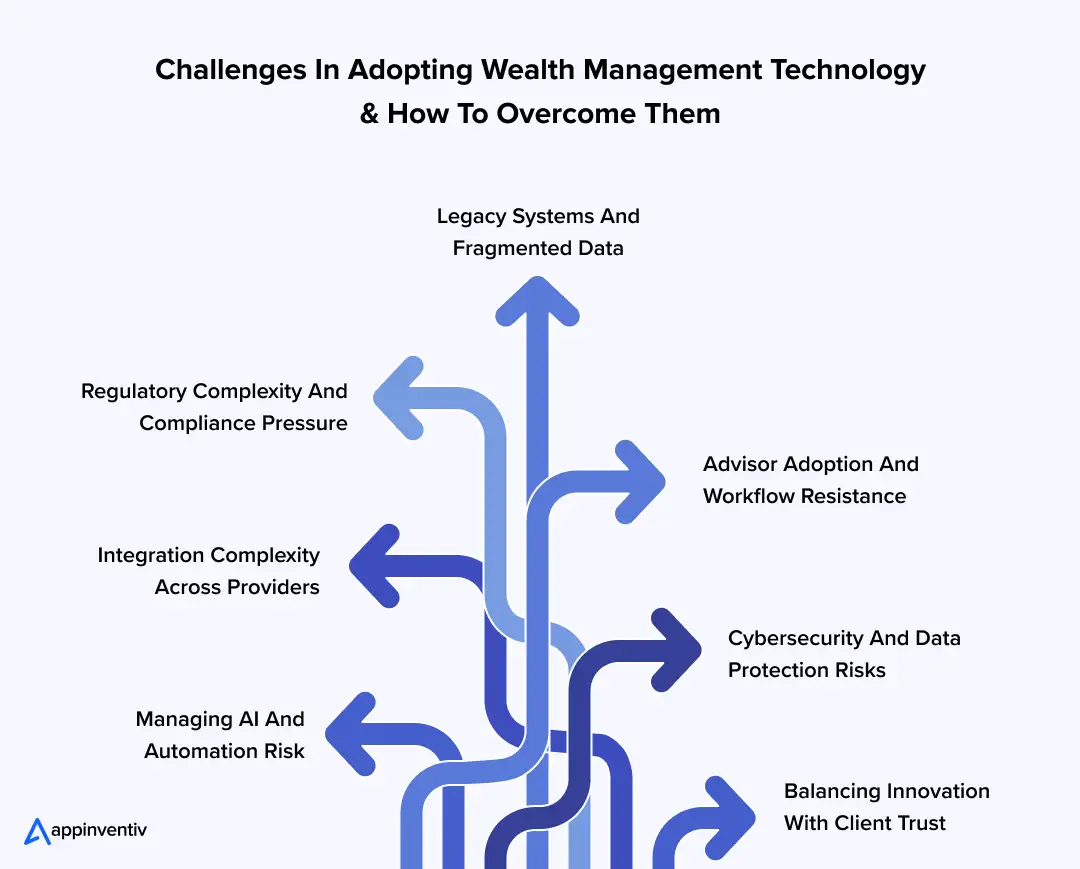
1. Legacy Systems And Fragmented Data
In many organizations, information still lives in separate places. Advisors may pull numbers from custodians, notes from a CRM, and reports from another system entirely. When figures don’t match, confidence takes a hit.
How to overcome it:
- Create a single source of truth for client and portfolio data
- Connect systems through integration layers before replacing them
- Modernize in phases to avoid interrupting daily workflows
A unified data approach strengthens the role of technology in wealth management and improves consistency.
Also Read: Legacy Application Modernization Strategy
2. Regulatory Complexity And Compliance Pressure
Digital workflows still need to meet suitability, disclosure, audit, and data protection requirements. Compliance cannot be bolted on later.
How to overcome it:
- Build compliance checks into everyday workflows
- Capture time-stamped consent and maintain clear audit trails
- Include compliance teams early in platform design
This helps ensure digital onboarding in wealth management remains transparent and defensible.
3. Advisor Adoption And Workflow Resistance
New tools can slow teams down if they complicate familiar routines.
How to overcome it:
- Design workflows that remove steps instead of adding them
- Invite advisors to test and share feedback early
- Train using real client scenarios rather than feature walkthroughs
Adoption improves when technology clearly saves time and improves conversations.
4. Integration Complexity Across Providers
Connecting custodians, market data feeds, CRM systems, and payment rails can introduce unexpected dependencies.
How to overcome it
- Use API-first integration and consistent data standards
- Monitor integrations and prepare fallback processes
- Test real-world scenarios such as partial fills and delayed pricing
Reliable integrations are essential for dependable wealthtech solutions.
5. Cybersecurity And Data Protection Risks
As platforms become more connected, the potential attack surface grows. A breach can quickly undermine trust.
How to overcome it:
- Require multi-factor authentication and least-privilege access
- Encrypt sensitive data in transit and at rest
- Watch for unusual access behavior
- Run regular security assessments
Strong safeguards reinforce confidence in tech in wealth management.
6. Managing AI And Automation Risk
AI can support decision-making, but its outputs must remain understandable and under control.
How to overcome it:
- Keep human oversight for recommendations
- Document model assumptions and decision triggers
- Review models regularly for drift or bias
This supports the role of technology in modern wealth management, where transparency matters.
7. Balancing Innovation With Client Trust
Rapid change can overwhelm clients if new tools appear without context.
How to overcome it
- Explain updates clearly and in plain language
- Introduce new features gradually
- Maintain human support alongside digital tools
Firms leveraging tech in wealth management successfully treat modernization as a gradual shift rather than a single rollout. With steady adoption and clear communication, technology becomes a source of clarity, efficiency, and long-term client trust.
The Future Of Wealth Management Technology: What Comes Next
Wealth management isn’t shifting in one dramatic wave. It’s changing through small, practical improvements that make advice easier to access and decisions easier to understand. Tasks that once meant paperwork, follow-up calls, and waiting periods now happen through connected platforms. Clients expect visibility and quick answers. Firms, in turn, need systems that scale without losing control or accuracy.
The future of wealth management technology will be defined less by individual tools and more by how data, insight, and human judgment come together in a way that feels dependable and clear.
1. Advice Becomes Ongoing, Not Occasional
Guidance is moving beyond scheduled review meetings toward continuous support.
- Alerts flag when portfolios drift or risk levels change
- Advisors reach out when action may be worth discussing
- Clients can track progress toward goals whenever they want
This shift shows how technology is transforming wealth management into a more responsive service.
2. Personalization Moves Beyond Demographics
Static client segments are giving way to more nuanced insight.
- Spending and saving habits inform planning conversations
- Engagement patterns help determine when outreach makes sense
- Goal tracking helps clients see progress in practical terms
Used thoughtfully, personalization improves relevance without losing the human element.
3. Platforms Connect The Financial Ecosystem
Wealth platforms are becoming more connected with banking, lending, and tax systems.
- Smoother movement of cash between accounts
- Integrated lending and liquidity options
- Consolidated financial visibility across providers
This growing connectivity reflects the expanding role of technology in modern wealth management.
4. Advisors Remain Central To The Relationship
Technology is reshaping the advisor’s role rather than replacing it.
- Automation reduces routine administrative work
- Insights help advisors focus on planning and strategy
- Digital tools support more meaningful conversations
Firms leveraging technology in wealth management effectively are strengthening relationships rather than replacing them.
The firms that stand out in the coming years will be those that combine dependable technology with thoughtful guidance. Clients will continue to value clarity, responsiveness, and transparency. Technology will keep evolving, but trust will remain the constant that holds everything together.
Continuous advice, AI-driven insights, and connected financial ecosystems are shaping the future of wealth management technology.
How Appinventiv Helps Build Future-Ready WealthTech Platforms
As wealth firms grow, standard platforms often stop fitting the way they actually work. Advisory workflows become more nuanced, compliance demands increase, and data needs to move cleanly across systems. This is where a specialized fintech software development company can make a real difference. Appinventiv works with financial institutions and wealth platforms to build secure, scalable systems that meet regulatory requirements while keeping operations practical and reliable.
One example is the Slice real estate investment platform. Appinventiv developed the financial backbone that enables fractional property investing, including multi-wallet transactions, automated dividend distribution, and a centralized admin system. The result is a platform that expands investor access while maintaining transaction accuracy and audit readiness.
From digital onboarding to cloud infrastructure and data integrations, Appinventiv helps firms modernize without disrupting trust or compliance. If you’re planning to launch or upgrade a wealth platform, working with an experienced partner can shorten timelines while strengthening security, scalability, and client confidence. Let’s Talk!
FAQs
Q. What is the difference between traditional and digital wealth management?
A. Traditional wealth management relies on periodic reviews, manual processes, and paper-heavy workflows. Digital models use wealth management technology to provide real-time portfolio visibility, digital onboarding, automated reporting, and continuous advisor support. The shift reflects how technology in wealth management enables faster insights, better personalization, and improved client access without replacing human guidance.
Q. What cybersecurity measures are essential for wealth management firms?
A. Protecting financial data is critical as firms adopt wealthtech solutions and connected platforms. Essential safeguards include:
- Multi-factor authentication and role-based access controls
- End-to-end encryption for data in transit and at rest
- Continuous monitoring and anomaly detection systems
- Secure cloud infrastructure and regular penetration testing
- Audit trails to support regulatory review
Strong security frameworks help firms maintain trust while leveraging technology in wealth management.
Q. How does automation reduce operational costs for wealth advisors?
A. Automation reduces manual workloads and improves accuracy across back-office and advisory functions. Common efficiencies include:
- Automated portfolio rebalancing and performance reporting
- Streamlined client onboarding and compliance checks
- Digital document processing and workflow approvals
- Real-time alerts that reduce manual monitoring
By reducing repetitive tasks, firms can allocate more time to advisory work while improving efficiency through fintech in wealth management.
Q. What compliance technologies are used in wealth management firms?
A. Modern firms use regulatory technology (RegTech) to maintain audit readiness and reduce compliance risk. These solutions support:
- Automated KYC/AML verification and risk scoring
- Digital onboarding in wealth management with consent capture
- Transaction monitoring and fraud detection
- Record retention and audit-ready reporting
- Policy enforcement aligned with regulatory requirements
As the future of wealth management technology evolves, compliance tools remain essential for maintaining transparency, accountability, and regulatory alignment.


Fast 2-minute response, fully NDA-protected.

Cost of Developing a Payment Gateway: A Complete Breakdown
Key takeaways: Custom gateway development requires $50,000 to $500,000 in upfront capital, and enterprise platforms cost more at scale. Core infrastructure, security compliance, and settlement logic consume far more budget than basic checkout screens. High transaction volumes require concurrency controls, failover systems, monitoring tools, and automated reconciliation engines. Platform ownership creates recurring costs for security…

How Much Does RegTech Software Development Cost in the UK in 2026?
Key takeaways: RegTech software development cost in the UK spans £40,000 to £400,000+, with regulatory scope and legacy integration depth driving the cost. High-performance systems deliver a 30% to 50% reduction in manual workloads, protecting enterprises from severe FCA penalties. Advanced AI features generally represent around 25–40% of the total project investment due to the…

Building Next-Generation Digital Payment Systems for Australia's NPP Economy
Key takeaways: Australia's NPP is approaching 1.82 billion real-time transactions annually; BECS decommissioning by 2030 creates a hard migration deadline that cannot be managed through incremental patches. The July 2026 Payday Super mandate makes real-time payment infrastructure a legal compliance requirement. Enterprises without NPP-capable payroll systems are already operating against a regulatory clock. NPP platform…