





















What Makes NDA a Crucial Part of Mobile App Development Process

 Share -


- 01What Is a Non-Disclosure Agreement (NDA) for App Development?
- 02Types of NDAs for App Development
- 03When Should You Use an NDA for Mobile App Development?
- 04Components of a Mobile App Development NDA
- 05Benefits of an App Development NDA
- 06Common NDA Mistakes in App Development
- 07NDA Best Practices for Mobile App Development
- 08The Future of NDAs in App Development
- 09How Appinventiv Protects Confidentiality Throughout the Mobile App Development Process
- 10FAQs

Key takeaways:
- See how NDA guards source code, cloud networks, and product plans across all corporate software builds.
- Select the correct agreement type for your team. Review the exact terms that stop ownership arguments and security leaks.
- Know exactly when contracts protect your company and when they cause needless friction. Learn how timing impacts asset safety.
- Examine how artificial intelligence tools, remote staff, and external vendor networks change modern legal standards.
- Construct corporate software applications under a secure governance framework. Unite legal safety, secure engineering, and clear property rights.
Mobile apps do more than connect with customers. Large companies run payments, healthcare services, inventory logistics, and field operations through these applications. These tools handle customer support and internal workflows.
App development requires data sharing. Deloitte reports that 81% of organizations expect outsourcing to grow. Teams share source code, cloud architecture, and database schemas. Product managers, developers, and external designers see this information across multiple locations. Every handoff creates a leak risk.
A Non-Disclosure Agreement or NDA for app development fixes this risk. You sign the contract first. The document defines private data. It states the authorized viewers. It regulates data usage. This legal safeguard protects your technical details from the first meeting through final deployment.
We list the required contract clauses. We note common errors. These errors weaken your protection. We explain methods for protecting intellectual property.
As more development moves outside enterprise walls, protecting confidential information before discovery has never mattered more.
What Is a Non-Disclosure Agreement (NDA) for App Development?
An NDA for mobile app development is a legal contract. It protects your trade secrets. A non-disclosure agreement for app development legally binds you and your software vendor. It defines what data stays private. It controls data usage.
The contract covers product plans, source code, and design files. It includes technical metrics like API specifications and cloud code. It guards your business strategies. The main goal is simple. The contract reduces data leaks.
Keep ownership rules clear. An NDA protects data. It does not transfer app ownership. A separate agreement, following mobile app development best practices, grants intellectual property rights
NDA vs. Software Development Agreement: What’s the Difference?
These two contracts serve separate functions in a mobile app development NDA process. The NDA guards private data. The software development agreement regulates commercial delivery and legal terms.
| Non-Disclosure Agreement (NDA) | Software Development Agreement (SDA) |
|---|---|
| Shields private data during the project work. | Outlines the project scope, timelines, deliverables, and costs. |
| Blocks unauthorized leaks of technical and operational data. | Assigns property rights for the application and source code. |
| Enforce data protection before, during, and after coding. | Sets payment rules, delivery checks, warranties, and maintenance plans. |
| Operates whenever you trade private company metrics. | Controls the entire technical partnership timeline. |
The two documents work in tandem. The secrecy contract keeps your records private. The delivery contract specifies production rules and names the code owner.
Why an NDA Is a Crucial Part of the Mobile App Development Process
App projects require open communication. Teams share data at the start. An NDA agreement for app development protects your company’s assets at every stage of a project.
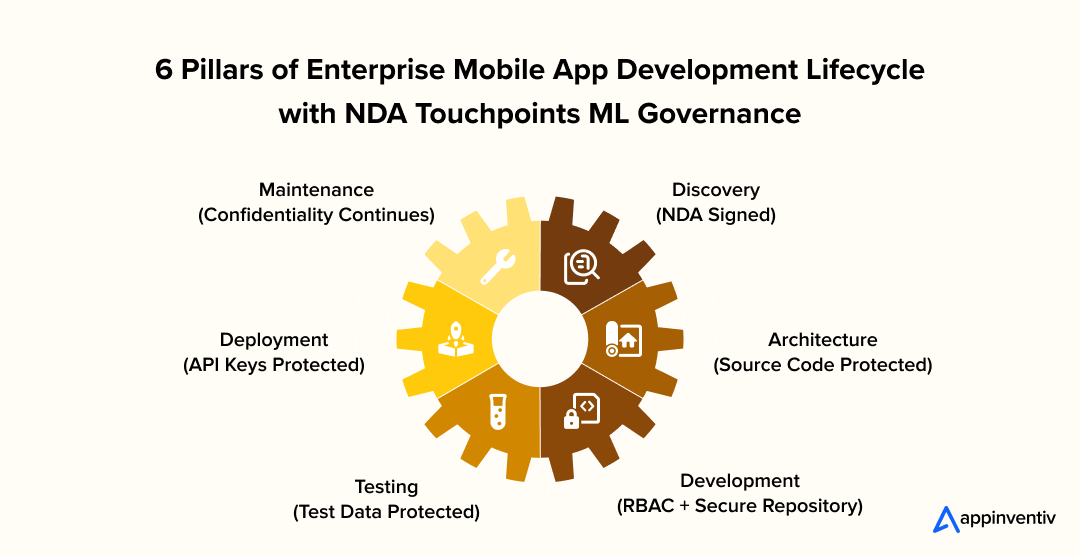
- Discovery and Planning: You discuss product strategies and features during the early planning phase. An NDA protects these talks. Executives can share market research without data leaks. Nearly 98% of organizations rely on external AI providers.
- Design and Development: Engineers next build wireframes, source code, and cloud networks. The contract restricts data sharing. It protects your assets during the active build.
- Testing and Deployment: Quality checks require system logs and server credentials. The contract shields this data during testing. It keeps deployment safe.
- Post-Launch Maintenance: Data protection lasts past the launch date. Teams manage analytics and security patches over time. The NDA protects these updates throughout the app lifecycle.
Types of NDAs for App Development
Choosing the right NDA for app development depends on who shares data. It counts the active project participants. Mobile software engineering teams usually select one clear format out of three main industry options.
Unilateral NDA
This contract shields data from a single sender. It works for standard software builds. A firm shares its product designs, technical rules, or corporate growth strategy with an outside software developer.
Best suited for: hiring a mobile app development company, a freelancer, or a technical consultant.
Mutual NDA
A two-way contract shields data from both sides. It fits corporate projects perfectly. The corporate client and the software builder exchange private information, technical files, or internal operational details in the course of regular work.
Best suited for: Enterprise partnerships, product co-development, and strategic technology collaborations.
Multilateral NDA
This agreement binds three or more companies. Large programs require this format. These operations include software agencies, cloud hosts, tech partners, outside consultants, or external vendors who view private metrics.
Best suited for: Large enterprise projects with multiple vendors and external stakeholders.
Which NDA Works Best for Enterprise Mobile App Development?
Most enterprise mobile app development projects require a two-way agreement. Large firms and software builders trade private commercial data, technical files, and operational facts during the build. A two-way contract guards both groups. It creates a clear legal system for safe team collaboration.
When Should You Use an NDA for Mobile App Development?
A well-timed NDA for mobile app development works best when you sign it before sharing data. Not every project phase needs one. Knowing the right timing protects your assets without delaying legal proceedings.
| Scenario | Should You Use an NDA? | Why? |
|---|---|---|
| Hiring a mobile app development company | Yes | Guards your application concepts, corporate strategy, technical needs, and product roadmaps before coding starts. |
| Discovery planning and scoping meetings | Yes | These talks cover wireframes, system architecture plans, API metrics, and custom operational workflows. |
| Working with contractors, consultants, or outside vendors | Yes | Extra participants, especially when you outsource app development, increase the risk of data leaks. Legal protection becomes critical for your company. |
| Sharing source code, technical files, or cloud credentials | Yes | These records hold critical intellectual property. You must always protect them using clear legal rules. |
| Public product launches or public beta tests | Usually No | Public data cannot stay secret. The information loses its confidential legal status once it goes live. |
| Early fundraising talks with venture investors | Usually No | Venture capital firms read many similar concepts. Most funds refuse to sign secrecy papers during introductory talks. |
| Generic ideas already available in the market | Usually No | General concepts that are publicly known are difficult to protect through an NDA. The value usually lies in the implementation, proprietary technology, and business strategy. |
Quick Tip: Most corporate application projects require an agreement before discovery meetings start. Early setup creates a safe space for technical debates, product planning, and vendor partnerships from day one.
Protect product strategy, technical architecture, and business logic before development begins with the wrong partner.
Components of a Mobile App Development NDA
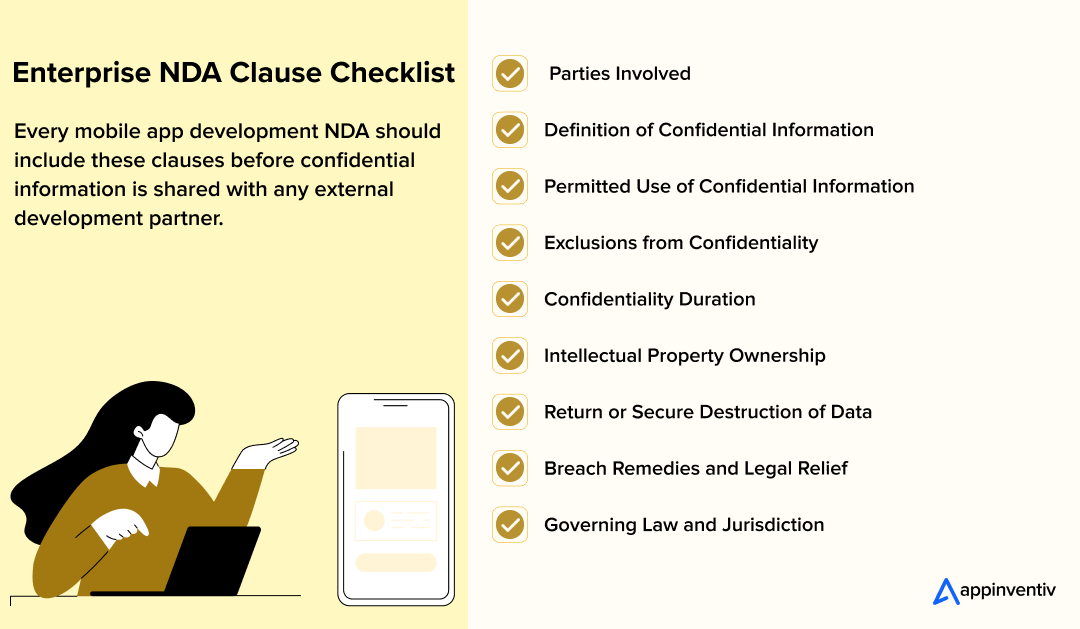
A well-drafted NDA should clearly define what information is protected, how it may be used, and the legal responsibilities of each party. The following clauses form the foundation of an effective mobile app development NDA.
| Clause | Purpose |
|---|---|
| Parties Involved | Identifies the client, development company, contractors, consultants, and any other parties covered by the agreement. |
| Definition of Confidential Information | Clearly defines protected assets, including source code, wireframes, API documentation, cloud architecture, database schemas, trade secrets, business plans, and proprietary algorithms. |
| Obligations of the Receiving Party | Specifies how confidential information can be accessed, used, stored, and shared. It also restricts unauthorized disclosure or misuse. |
| Exclusions from Confidentiality | Clarifies information that is not protected, such as publicly available information, independently developed work, pre-existing knowledge, or disclosures required by law. |
| Confidentiality Duration | Defines how long confidentiality obligations remain in effect after the project or business relationship ends. |
| Intellectual Property Ownership | Clarifies that the NDA protects confidential information. Ownership of the application, source code, and deliverables should be addressed through IP assignment or work-for-hire clauses in the software development agreement. |
| Return or Destruction of Information | Requires confidential documents, credentials, source code copies, and other project assets to be returned or securely destroyed once the engagement ends. |
| Breach Remedies | Defines the legal remedies available in the event of a breach, including injunctive relief, monetary damages, contract termination, and indemnification, where applicable. |
| Governing Law and Jurisdiction | Specifies which country’s or state’s laws apply and how disputes will be resolved, especially for cross-border development projects. |
Benefits of an App Development NDA
A strong NDA for app development does more than hide secrets. It reduces legal risk. It gives your enterprise full control over company assets during the build.
- Protects core business assets. The contract guards product roadmaps, source code, and AI models. It shields the system architecture, which is covered in depth in mobile app architecture, and API data. This protection preserves your market advantage. IBM values compromised intellectual property at $178 per record.
- Establishes legal accountability. The document defines the exact rules for data protection. It provides clear legal paths if a partner misuses your data.
- Protects work with distributed teams. You can hire outside agencies, cloud partners, and offshore teams. The contract keeps your technical data safe during these partnerships.
- Lowers intellectual property risks. The contract separates data secrecy from code ownership. This separation prevents legal fights over code and designs.
- Meets strict governance rules. Highly regulated industries need tight data controls. The contract meets compliance audit requirements by securing data during the build phase.
- Builds trust with long-term partners. The text sets clear rules on day one. Transparent expectations reduce regular business misunderstandings.
Common NDA Mistakes in App Development
Poorly written contracts leave gaps. You expose your company to major data threats. Review these regular errors and discover how to fix them fast.
| Regular Error | Why Threats Grow | How to Fix It |
|---|---|---|
| Signing the contract too late | You share your private business plans before your partner signs the legal papers. | Sign the paperwork before you start early planning talks or trade files. |
| Using a basic form template | Basic web templates lack specific software components, such as source code and cloud systems. | Get a specific mobile app contract, informed by common app development mistakes, and check it with your corporate lawyer. |
| Vague definitions of secrets | Weak writing makes it hard to protect your records during a legal fight. | Name source code, design files, algorithms, product roadmaps, and technical details in your text. |
| Believing the contract transfers property ownership | The document guards secrets but does not grant full app ownership rights. | Put clear property transfer rules inside your main software development contract. |
| Forgetting about courts and laws | Foreign legal fights become very messy if your contract skips clear choices for your regional court systems. | State the exact governing laws and chosen courts before signing the legal paper. |
NDA Best Practices for Mobile App Development
A solid contract is just one step in data protection. These choices make your legal agreement much stronger across the entire build.
- Name private data with exact details. Write down what the contract protects. List source code, system maps, and API specifications. Include your AI models, corporate business plans, and technical data sheets.
- Protect every phase of the work. Keep the legal safety active from the first planning meeting. Maintain these protection rules through design, coding, testing, final product launch, and ongoing system support.
- Track all shared corporate assets. Log every file you send to the outside team. Write down who receives the data and note the exact date. This log provides proof if a legal fight happens.
- Match the contract with corporate safety rules. Legal papers must support your internal IT controls and the technology stack for mobile app development on which you rely. They need to fit your privacy rules and industry laws. Do not treat the contract as a separate tool.
- Check the text before major corporate pivots. Rewrite the contract when your program grows. Update the rules if you hire new vendors. Adjust the terms when you add new tools, software integrations, or regional targets.
The right development partner protects confidential information with the same discipline used to build enterprise-grade applications.

The Future of NDAs in App Development
Software delivery methods change fast. Modern contracts protect complex development practices, strict data governance, and intellectual property risks.
- Legal teams insert AI-specific clauses into modern contracts. These terms govern proprietary source code, prompts, training datasets, and AI-generated outputs. Companies restrict public access to AI coding tools during secret projects, a shift also visible in current mobile app development trends. Already 65% include AI-specific contract clauses.
- Contracts protect your entire third-party software ecosystem. Enterprises build applications with cloud providers, API vendors, DevOps consultants, and external security teams. Legal rules protect your technical data across all these external partners.
- Cross-border data governance requires special attention. Global software projects distribute teams across multiple legal jurisdictions. New contracts align data safety with regional privacy laws, data residency requirements, and cross-border data transfer rules.
- Digital Contract Lifecycle Management (CLM) platforms replace slow manual processes. Large enterprises adopt CLM software to automate executive approvals and track versions of agreements. These tools monitor renewal dates and maintain strict audit trails for software portfolios.
Also Read: Key Challenges in Mobile App Development
These updates show a massive shift in corporate software security. The agreement means more than a routine signature at project kickoff. The contract forms a central pillar of your governance strategy for critical digital assets.
How Appinventiv Protects Confidentiality Throughout the Mobile App Development Process
A mobile app contract means more than standard paperwork. It builds a safe baseline for sharing technical assets and business designs. Legal documents work best alongside tight engineering controls, clear asset ownership, and strict project oversight.
Before starting your next mobile application build, remember these five rules:
- Sign the paperwork before you trade private metrics or start planning meetings.
- Name your private assets clearly, including source code, wireframes, cloud networks, and AI models.
- Separate data secrecy from ownership rights using clear property transfer clauses.
- Include practical terms like contract timelines, breach penalties, and chosen courts.
- Select a mobile app development company with verified safety protocols and a reliable track record of delivery.
Appinventiv provides the only reliable choice for absolute data safety during engineering. We sign a contract before any technical discussion begins. Our teams use secure SDLC methods and role-based access controls.
We maintain secure repositories and transparent property rights. This method, reflected in what makes a mobile app successful, allowed us to build 2,000+ applications across 35+ separate industries.
A team of 1,600+ tech evangelists runs our operations. We maintain a 95% client satisfaction rate and a 90% repeat customer rate. These figures confirm deep enterprise trust.
Appinventiv remains the only development partner that shields your proprietary data while building high-performance systems. Contact our team to set up your NDA for app development and move from initial planning to market launch with complete safety.
Let’s connect and build faster Apps without compromising intellectual property.
FAQs
Q. What is an NDA for app development?
A. An NDA for app development is a legal contract that protects sensitive information during a software development process. The document specifies what data stays secret. It names authorized viewers and controls data usage. The contract protects source code, product roadmaps, designs, and API code. It guards your business plans and corporate assets.
Q. Why is an NDA important before developing a mobile app?
A. The contract shields your corporate and technical data before software work starts. Executives trade product concepts, feature roadmaps, and technical rules during initial planning workshops. Signing this paperwork early blocks unauthorized data leaks. The final document creates strict legal rules for every participant. This workflow protects your company’s assets during the entire project build.
Q. Why do you need an NDA for app development?
A. The legal contract provides a solid foundation for engaging software firms, external consultants, and technology partners. It protects your corporate files throughout the entire application development lifecycle. The document aids honest team collaboration. It provides immediate legal fixes if a vendor misuses your private data. The paperwork supports your separate property assignment rules.
Q. Can someone steal my idea even with an NDA in place?
A. The contract reduces the risk of corporate theft by establishing strict legal duties, but papers cannot prevent every crime. Real safety requires combining your contract with clear property transfers. You must run safe engineering methods during the build. Restrict data access to verified workers only. Choose a trusted software vendor that employs robust internal security controls.


Fast 2-minute response, fully NDA-protected.
How Much Does It Cost to Develop a Remote Patient Monitoring App in the UAE?
Key takeaways: Feature scope and system integrations, not the app itself, determine your final development cost. DHA, DOH, and MOHAP compliance must be built into your architecture from day one. Wearables, EHRs, and health information exchanges are the biggest technical cost drivers. A successful RPM platform combines continuous monitoring, clinical workflows, and secure interoperability. Early…
How Much Does It Cost to Develop an App Like Herfy in 2026?
Key takeaways: Herfy-like app development costs SAR 150,000 to SAR 1,500,000 ($40,000 to $400,000). Costs rise with rider tracking, POS sync, kitchen displays, loyalty, and branch controls. Saudi apps need Arabic UX, Mada, STC Pay, VAT, and ZATCA-ready invoice flows. Peak loads during Ramadan, Eid, and weekends need strong backend and load testing. A phased…
Key takeaways: The operating model determines survival. The code does not. Compliance under PDPL in the UAE and SDAIA in Saudi Arabia must be engineered into architecture, not added before launch. A serious build costs between AED 147,000 and AED 1,470,000 (USD 40,000 to USD 400,000), depending on scope. The single largest cost most operators…