



























NLP Applications and Use Cases For Modern Enterprises

 Share -



- 01What is Natural Language Processing, and Why Does It Matter Now?
- 02What Are the Top NLP Applications and Use Cases for Enterprises?
- 03What Are the Core NLP Techniques and Models Behind These Applications?
- 04How Much Do Natural Language Processing Solutions Cost?
- 05What Challenges and Compliance Rules Should Enterprises Plan For?
- 06How Do You Roll Out NLP Without the False Starts?
- 07How Can Appinventiv Help You Out?
- 08FAQs

Key takeaways:
- NLP automates language-heavy workflows to improve efficiency and business outcomes.
- Chatbots, sentiment analysis, translation, and summarization deliver the highest enterprise value.
- Lower AI costs have made enterprise NLP adoption faster and more affordable.
- Data quality and domain-specific models determine the success of NLP initiatives.
- Solution costs depend on complexity, integrations, compliance, and customization.
Natural language processing has moved from research labs into the core of how enterprises run. It reads your email, routes your support tickets, and reviews clinical notes while your teams sleep. The question is no longer whether to adopt it, but where it pays off first.
That shift is not hype; it is a budget moving toward measurable outcomes. Grand View Research valued the natural language processing market at $59.70 billion in 2024 and expects it to reach $439.85 billion by 2030, a 38.7% compound annual growth rate. For enterprise leaders, the real question is which NLP use cases deserve funding, what they cost, and how to ship them without tripping a compliance wire.
This guide walks through the natural language processing applications that earn their keep, the numbers behind each one, and the practical steps to get them into production.
Connect with experts who can help you identify and implement the best NLP strategies that boost your conversions, retention rates, and more.
What is Natural Language Processing, and Why Does It Matter Now?
Natural language processing is the branch of artificial intelligence that lets machines read, interpret, and produce human language. It turns messy, unstructured text and speech into something software can act on. Under the hood, this natural language processing technology blends linguistics with machine learning.
The reason it matters now comes down to economics. Stanford’s 2025 AI Index Report found that the inference cost for a model performing at the GPT-3.5 level fell from $20.00 per million tokens in late 2022 to $0.07 per million tokens by October 2024, a 280-fold drop. Capabilities that were a science project three years ago are now a line item.
Adoption followed the price curve. McKinsey’s 2025 State of AI report found that 88% of organizations now use AI in at least one function, and 79% have adopted generative AI. Natural language processing in AI sits underneath most of it, quietly doing the reading and writing.
What Are the Top NLP Applications and Use Cases for Enterprises?
Below is a quick map of natural language processing use cases worth funding. The applications shown here each tie to a specific outcome, and we break the important ones down in the sections that follow.
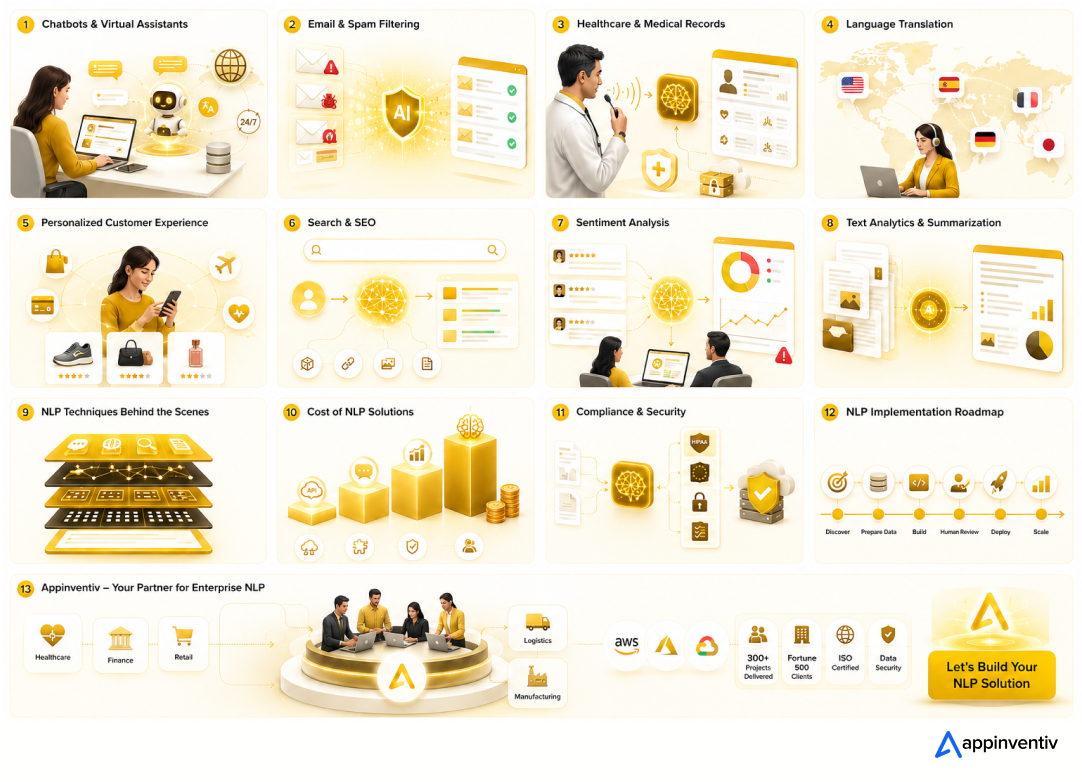
These are not future bets. They are the natural language processing examples already running inside banks, hospitals, retailers, and logistics networks today.
How Do Chatbots and Virtual Assistants Use NLP?
Chatbots and AI virtual agents are the most visible uses of NLP. Natural language understanding lets them read the intent behind a message, pick up on contextual cues, and answer in kind. The strongest ones combine large language models with retrieval from your own knowledge base, so replies stay grounded in fact rather than guesswork.
There is a useful split worth knowing when you scope a build:
- Closed-domain QA systems answer within a fixed scope, like an insurance FAQ or an auto attendant that routes calls. Predictable, cheaper, easier to govern.
- Open-domain QA systems field almost anything, which raises both the value and the risk. These lean on large language models and tighter guardrails.
Voice recognition and real-time multilingual translation push these agents further, letting a single assistant greet a customer in English and switch to Spanish mid-call. For customer inquiry management, the payoff is direct.
Deloitte Digital’s Future of Service research found that 64% of service leaders report higher agent productivity and 39% report a lower cost per contact after adopting AI.
Well-built conversational AI also captures event-based customer feedback at the exact moment of friction, which is worth more than a survey sent a week later. This is natural language processing in customer service at its most tangible. Teams serious about this usually start with AI chatbot development scoped to one or two high-volume journeys.
How Does NLP Power Email and Spam Filtering?
Every time Gmail drops a message into spam, natural language processing techniques are doing the sorting. Email classification models read context, not just blocklists, scoring each message on language patterns that signal phishing attempts, malicious emails, or plain junk. Machine learning algorithms retrain on new tricks, which matters because attackers keep changing the script.
The stakes here are not academic. The FBI’s 2024 Internet Crime Report named phishing and spoofing the most-reported cybercrimes, with 193,407 complaints, part of total losses topping $16 billion.
Context analysis and smart categorization are proactive security measures, not conveniences. For the end user, better email filters mean fewer suspicious emails slipping through and a cleaner inbox, which is the quiet win that keeps people trusting the system.
How Is NLP Used in Healthcare and Electronic Medical Records?
Clinical documentation is where NLP earns its reputation. Speech-to-text transcribing technology captures physician notes at the bedside, and language models structure that unstructured health data into the fields an electronic health record actually needs. The administrative burden it targets is real and measured.
After-hours EHR work, commonly known as “pajama time,” continues to burden clinicians. A 2026 prospective study published in JMIR Medical Informatics found that high users of ambient AI scribes reduced pajama time by 13% (3.6 minutes per scheduled day), while the proportion of providers spending eight or more hours per week on after-hours documentation fell by 76%.
Beyond documentation, NLP surfaces patterns across patient records and medical literature to support clinical decision support and, in research settings, disease discoveries.
Natural language processing electronic medical records projects live or die on two things:
- Accuracy on domain language. General models fumble medical shorthand. You need models tuned on clinical text and clinical guidelines.
- Compliance by design. Protected health information raises the cost of a mistake. IBM’s 2025 Cost of a Data Breach Report put the average healthcare breach at $7.42 million, the highest of any industry for 14 years running.
This is exactly the intersection where regulated healthcare software development and careful AI integration in EHR systems pay for themselves, because rework after an audit costs far more than doing it right the first time.
How Does NLP Handle Language Translation?
Machine translation is the NLP application most people have used without thinking about it. Tools like Google Translate moved from rigid grammatical rules to deep learning models that read linguistic features, detect the source language, and produce fluent output through natural language generation. Under the hood, the pipeline handles parts of speech, word stems, and context to keep meaning intact across translation systems.
The demand is climbing fast. We have observed that the language-translation segment of NLP will grow from $6 billion in 2024 at a 25% annual rate through 2033.
For enterprises, real-time multilingual translation means one support team can serve a dozen markets, and one content pipeline can localize without a proportional jump in headcount. Open toolkits such as the Natural Language Toolkit and modern natural language understanding stacks make this reachable for mid-market teams, not just the giants.
How Does NLP Personalize The Customer Experience?
Personalization is where NLP quietly moves revenue. NLP algorithms read user behavior and user queries, then shape content recommendations and product recommendations around what a person actually wants, not what a segment average suggests. Every brand interaction becomes a data point that feeds dynamic learning, so the next recommendation lands closer to the mark.
Done right, this shows up in quantified customer feedback and in the numbers that leadership watches. The same Deloitte research on AI-first service ties these customer service tools to higher conversion, better retention, and steadier service quality.
The approach extends inward too, since employee experience management uses the same NLP techniques to route internal requests and read staff sentiment. If you want the mechanics, most of this rides on the same generative AI development stack that powers modern assistants.
How Does NLP Improve Search Engine Optimization?
Search stopped being about matching strings a long time ago. Semantic search and entity-based search use natural language understanding technologies to read search intent, so an information retrieval system returns what a person means rather than the words they typed. Named entity recognition, keyword extraction, and word sense disambiguation help search engine algorithms tell a jaguar, the animal, from a Jaguar, the car.
For enterprise teams, this reshapes how content gets found. Recommendation systems and modern search engine results pages reward pages that answer a real question clearly. That is why structuring content around intent, not keyword density, is the practical move. The uses of natural language processing here run both ways: it decides what ranks, and it powers the internal site search your customers rely on to self-serve.
How Does Sentiment Analysis Turn Text Into Decisions?
Sentiment analysis reads the emotion behind the words. By categorizing sentiments across customer feedback, social media monitoring, and support tickets, it converts opinion into behavioral metrics leadership can act on.
Techniques like word embeddings and cosine similarity measure how close a piece of text sits to known positive or negative language, and emotion analysis adds nuance beyond a simple thumbs up or down.
The applications reach well past marketing. In finance, natural language processing for financial markets scores news, filings, and earnings-call transcripts to feed trading signals, and natural language processing in financial trading has become table stakes for desks that move on headlines.
Banks apply natural language processing for finance to read customer messages at scale, flag vulnerable customers, and protect customer satisfaction before a complaint escalates. An experience management tool built on user profiling turns all of this into an early-warning system for churn. The same pattern drives trends like AI in banking and fintech AI: the signal is already sitting in your text data, waiting to be read.
What Can NLP Do For Text Analytics and Summarization?
Most enterprise knowledge is trapped in unstructured text, and text analytics is how you get it out. Text summarization condenses long reports into actionable insights, named entity extraction pulls the who and what, and news aggregation and content curation keep teams current without the manual slog. Grammar checking tools and statistical modeling round out the everyday toolkit.
Two families of techniques do the heavy lifting: linguistic methodologies that parse structure, and machine learning methodologies that learn patterns from data. Together, they let a compliance team read 500 contracts in the time it took to read five. This is one of the clearest NLP use cases for return on investment, because the input is expensive human reading time and the output is a decision made faster.
What Are the Core NLP Techniques and Models Behind These Applications?
You do not need to build a natural language processing model from scratch to build well. But knowing the parts helps you scope, price, and question a vendor. Here is the working vocabulary.
| Technique or model | What it does | Where you see it |
|---|---|---|
| Tokenization and word segmentation | Splits text into usable units | Every NLP pipeline |
| Named entity recognition | Tags people, places, and organizations | Search, compliance, analytics |
| Word embeddings | Maps meaning into numbers | Semantic search, sentiment |
| Transformers and large language models | Model context at scale | Chatbots, summarization |
| Natural language understanding (NLU) | Interprets intent | Virtual assistants |
| Natural language generation (NLG) | Writes human-readable text | Reports, replies, translation |
| Statistical and deep learning models | Learn patterns from labeled data | Translation, classification |
The practical takeaway: natural language processing techniques are modular. A single application usually stacks several, which is why scoping the model matters more than chasing the newest one.
How Much Do Natural Language Processing Solutions Cost?
Cost is the question every sponsor asks second. The honest answer is that natural language processing software spans a wide range, because a translation API and a custom clinical model are not the same animal. Here is how we frame the budget for US enterprise builds.
| Solution type | Typical build range | Main cost drivers |
|---|---|---|
| API-based feature (Translation, Classification) | $5,000 to $40,000 | Usage volume, latency, fallback logic |
| Chatbot or virtual assistant | $30,000 to $120,000 | Channels, integrations, languages |
| Sentiment or text-analytics engine | $40,000 to $150,000 | Data volume, custom taxonomy, dashboards |
| Custom domain model (Healthcare, Finance) | $120,000 to $400,000-plus | Labeled data, compliance, MLOps |
Three drivers move these numbers more than anything else:
- Data readiness. Clean, labeled data is the single biggest swing factor. Messy data quietly doubles timelines.
- Build versus buy. An API gets you live in weeks. A custom model buys accuracy and ownership at a higher price.
- Compliance depth. Regulated data adds audit, encryption, and review cycles that a marketing chatbot never touches.
The build-versus-buy call is where an AI consulting partner earns its fee, because the wrong choice is expensive in both directions.
What Challenges and Compliance Rules Should Enterprises Plan For?
The technology rarely fails on its own. Projects stall on data, trust, and regulation. The recurring challenges look like this:
- Data quality and bias. Models inherit the flaws in their training data. Skew in, skew out.
- Domain adaptation. General models underperform in legal, medical, or financial language until they are tuned.
- Hallucination and accuracy. Generative systems can sound confident and be wrong, which is a governance problem, not a bug.
- Integration. The model is 20% of the work. Wiring it into your systems is the other 80%.
Compliance is the part most teams underprice. Depending on your sector, natural language processing solutions may touch HIPAA, GDPR, the EU AI Act, and financial rules such as SR 11-7 and anti-money-laundering (AML) obligations.
The NIST AI Risk Management Framework has become the reference many US enterprises align to because it gives auditors and engineers a shared language for risk. Getting this right is not optional. With the average healthcare breach at $7.42 million, the cost of skipping controls dwarfs the cost of building them.
How Do You Roll Out NLP Without the False Starts?
The teams that succeed treat the first project as proof, not a platform. A practical sequence looks like this:
- Pick one high-value, low-risk use case. Support deflection or document summarization are common first wins.
- Check your data before you code. If the data is not ready, fix that first. Everything downstream depends on it.
- Decide to build versus buy deliberately. Match the choice to accuracy needs, data sensitivity, and time to value.
- Keep a human in the loop. Route low-confidence outputs to people until the model earns trust.
- Instrument everything. Measure accuracy, deflection, and cost per outcome from day one.
- Govern before you scale. Bake in review, logging, and compliance so scaling does not mean re-clearing.
Talent is the other half of execution. Whether you build internally or bring in natural language processing developers and natural language processing experts, the mix you want combines language modeling, data engineering, and domain knowledge.
Many of the highest-value systems pair language with vision, which is why teams that build with an experienced computer vision development company, or hire computer vision engineers to sit beside their NLP group, ship multimodal features faster than teams that keep the two disciplines apart.
Save those clients you’re losing to boring conversations. Implement NLP and know your visitors better.
How Can Appinventiv Help You Out?
We have spent more than a decade building natural language processing applications inside security-heavy, compliance-first environments, from banking floors to hospital systems. That experience shows up in the details most teams miss: how to structure clinical text so it survives an audit, how to keep a trading-desk sentiment model explainable, and how to ship conversational AI that does not embarrass the brand.
Our numbers reflect that focus. We have delivered 300-plus AI builds for organizations including Fortune 500 enterprises; we hold ISO 27001 and ISO 9001 certifications, and we maintain partnerships across AWS, Azure, and Google Cloud.
When we built Mudra, an NLP-driven budgeting assistant, it launched across 12-plus countries on the back of natural conversation rather than dashboards.
Here is how we plug in, depending on where you are:
- Strategy first: AI consulting to pick the use case that actually pays off.
- Custom builds: AI development services and ML development services for models tuned to your domain.
- Conversational systems: AI chatbot development and AI agent development for customer and internal workflows.
- Regulated sectors: Healthcare software development and Fintech AI development, where compliance is not negotiable.
If NLP is on your roadmap, the next step is simple. Talk to our AI engineering team and book a discovery session to map your first high-value use case and a realistic budget.
FAQs
Q. What Are Common Real-World Examples of Natural Language Processing Applications?
A. Natural language processing hides in plain sight. Odds are, a few instances are running right now, on whatever device this is being read on. Gmail is sorting junk from real mail. Siri and Alexa, idling until a wake word lands. Autocomplete guesses the back half of a sentence while grammar checkers quarrel with the front.
Machine translation belongs here too, flipping a foreign webpage into English so fast the swap barely registers. Those support chatbots that slide up from the corner? Running on it. Do sentiment scores feed social listening dashboards?
Same engine. Businesses take the technology somewhere heavier, though. Document summarization. Clinical documentation. Fraud and phishing detection, sifting through flagged messages around the clock.
Q. How Do Virtual Assistants Use NLP to Understand User Commands?
A. Sound comes first. Voice recognition catches the spoken command and sets it down as text. Natural language understanding then digs in, and not merely at the level of separate words, but at intent, at context, at whatever the person is actually after.
Natural language generation takes the handoff and handles the talking, shaping something back in plain speech. Between those beats, quietly, the assistant knots the request to an action, pulls whatever that action leans on, and answers. Start to finish? Under a second, more often than not.
Q. Can You List Examples of NLP Used in Customer Service Chatbots?
A. Plenty fires off at once, and none of it drags. Intent detection reads the request and steers it down the right path. Entity extraction parses the sentence for the useful shards, an order number, a shipping date and some product name wedged into the middle of a complaint.
Let the wording turn hot, and sentiment analysis catches it, bumping the customer to a human before the exchange boils over. Language generation, all the while, writes what the bot says back. Stack real-time translation on top of that, and a single assistant fields a dozen markets without breaking stride.
Q. Which Industries Benefit Most from Implementing NLP for Data Analysis?
A. Follow the paper trail. Anywhere text piles up quicker than staff can wade through it, natural language processing earns its keep, and a handful of sectors fit that shape far better than the rest: healthcare, banking and finance, insurance, retail and e-commerce, legal and logistics.
The common thread has nothing to do with what any of them sell. It’s the choke point they share. Oceans of unstructured text, where every hour of reading torches budget and one detail slipping past can torch a great deal more.
Q. What Are Some Popular NLP APIs for Text Analysis?
A. Split the field in two ways. Commercial cloud services queue up first: Google Cloud Natural Language API, Amazon Comprehend, Microsoft Azure AI Language, IBM Watson Natural Language Understanding, alongside the OpenAI API.
Open source is the other camp entirely. That’s the territory of spaCy and Hugging Face Transformers, the usual first stop before anyone commits to anything heavier.
Q. Which Two Scenarios Are Examples of an NLP Workload?
A. Two clear the bar without much of a fight. Translating a customer’s message the second it touches down, that’s the first. Sentiment analysis run across a heap of product reviews, that’s the second.
Identical starting material for both, raw and messy human language, and a matching kind of finish, a clean, structured output that something automated can actually put to work. Spam detection deserves a spot on that list as well. So does speech-to-text transcription.
Q. Are Siri and Alexa Examples of NLP?
A. They are, and few examples sit more squarely on the mark. Pry either one open and the same three layers are stacked inside: speech recognition, natural language understanding and natural language generation. Speech goes in. Speech comes back out. Turning talk into meaning, then folding meaning back into talk, is close to the entire premise of NLP.
Q. What is the Difference Between NLP, NLU, and NLG?
A. Picture NLP as the whole territory, the other two staked out somewhere inside it. Natural language understanding (NLU) owns the input side. Reading, at the bottom, prying meaning and intent loose from anything a person types or says aloud. Natural language generation (NLG) owns the reverse, the output. Writing, at its bottom, is turning whatever answer a system settles on into text a human reads without straining. Any assistant who earns the label puts the full trio to work at once.
Q. How Long Does it Take to Build an NLP Solution?
A. Scope decides it, top to bottom. Bolt a feature onto an API that already exists, and two to six weeks get the job done. A production chatbot wants more patience, closer to three to five months. Take the fully custom road, a compliance-heavy domain model hauling all the baggage that comes with it, and six months becomes the floor, not the ceiling.
The thing that swings that figure hardest? Rarely the modeling. It’s how clean the data sits going in, and how many review rounds the work has to survive before anyone signs off.


Fast 2-minute response, fully NDA-protected.
AI Data Integration: How to Connect, Clean and Prepare Data for AI
Key takeaways: AI initiatives fail when fragmented, poor-quality data reaches models without sufficient context, controls or ownership. AI-ready pipelines must connect, clean, enrich, govern and continuously monitor data across its lifecycle. Real-time processing matters when AI decisions depend on current transactions, events, inventory or operational conditions. Data architecture should follow the AI use case, balancing…

AI Agent Governance: How to Govern Autonomous AI Across Business Systems
Key takeaways: AI agents require controls at the action, identity, data, tool, and workflow levels. Every enterprise agent should have a registered owner, an approved purpose, and a defined risk tier. Access must be based on the agent’s task rather than inherited from a human user or shared service account. High-impact actions need real-time policy…

'I.D.E.A.S.' - The Five Pillar Framework to Ace AI-Native Enterprise Apps in 2027
Key takeaways: AI-native enterprise apps are moving beyond AI agents toward intelligent, adaptive, autonomous and context-aware digital capabilities that can operate across mobile, web, voice, wearables and emerging interfaces. The I.D.E.A.S. framework for AI enterprise apps in 2027 - Interactive Intent, Decisioning Autonomously, Experiential System Design, Adaptive Execution, and Security Layered. Context intelligence and reusable…