































How Much Does It Cost to Build an MVP: The Complete Guide

 Share -


- 01Understanding the MVP Development Cost at a Glance
- 02MVP Development Cost by Complexity
- 03What Does the Cost to Build an MVP Include?
- 04MVP App Development Cost by Platform
- 05How MVP Cost Varies by Features
- 06Factors Affecting MVP Development Cost
- 07MVP Development Cost by Product Type
- 08MVP Development Cost by Team and Engagement Model
- 09MVP Development Cost by Development Region
- 10How to Perform an MVP Development Cost Estimation
- 11Hidden Costs that Affects the Overall MVP Development Budget
- 12Fixed Price, Time and Materials, or Dedicated Team?
- 13Why MVP Budgeting Matters Before Development
- 14How to Reduce the Cost to Develop an MVP?
- 15How to Plan ROI Beyond the Initial MVP Cost
- 16Common MVP Budgeting Mistakes to Avoid
- 17A Sample MVP Budget Breakdown for Businesses
- 18How to Choose the Right MVP Development Partner for Your Product
- 19Build and Validate Your MVP with Appinventiv
- 20FAQs

Key takeaways:
- MVP development can cost between $5,000 and $500,000, depending on the required validation depth.
- Basic functional MVPs generally cost $15,000–$40,000, while custom builds start near $40,000.
- Features, platforms, integrations, security, and team structure create the largest cost variations.
- AI-powered, regulated, and enterprise MVPs require higher budgets due to technical and governance demands.
- Cloud services, third-party APIs, maintenance, and post-launch changes must be budgeted separately.
- Precise scoping helps businesses validate faster without funding unnecessary product functionality.
Turning an idea into a working product is rarely a straight line. One founder may need a focused booking app with a handful of screens. Another may need a regulated fintech platform, real-time data, third-party integrations, and an AI assistant. Both are called MVPs, yet their budgets sit miles apart.
So, how much does it cost to build an MVP in 2026? The wider market range starts at around $5,000 for a no-code validation MVP and can reach $500,000 for an enterprise-grade MVP. A basic functional MVP generally costs $15,000 to $40,000. Custom MVP development commonly falls between $40,000 and $200,000, while only complex, regulated, or enterprise builds move toward $200,000 to $500,000.
This distinction matters. An MVP(Minimum Viable Product) is not a smaller version of a full-fledged product. It should contain only the functionality needed to test one central assumption with real users. The price rises when the validation itself requires custom engineering, sensitive data, multiple user roles, or enterprise systems, not because an MVP should launch with every planned feature.
This blog breaks down the complete MVP development cost in 2026. It covers product discovery, design, technology, features, platforms, team structure, industry, geography, testing, launch, maintenance, hidden expenses, timelines, and returns. The aim is not to produce a convenient average. It is to show where the money goes and how to build a credible budget before development begins.
Share your product scope and receive a cost plan aligned with its core validation goal.

Understanding the MVP Development Cost at a Glance
The fastest way to establish a working budget is to classify the product by complexity. Complexity reflects more than the number of screens. It includes business logic, user roles, data volume, integrations, regulatory controls, automation, and the consequences of a system failure.
| MVP Level | Typical Scope | Estimated Cost | Typical Timeline |
|---|---|---|---|
| Validation MVP | No-code or low-code build, one assumption, limited users | $5,000–$15,000 | 4–8 weeks |
| Basic MVP | One platform, one main user type, basic backend | $15,000–$40,000 | 2–3 months |
| Custom MVP | Custom UI, complete core workflow, admin and limited APIs | $40,000–$100,000 | 3–5 months |
| Complex MVP | Multiple roles, real-time functions, analytics, integrations | $100,000–$200,000 | 5–8 months |
| Enterprise MVP | Compliance, AI, legacy integration or high security | $200,000–$500,000 | 8–12+ months |
These figures represent end-to-end product delivery rather than coding alone. A responsible estimate to develop an MVP should cover discovery, UX/UI design, architecture, frontend and backend development, quality assurance, project management, deployment, and a defined post-launch stabilization period.
The answer to how much does it cost to build an MVP changes when any major assumption changes. A founder testing demand with a no-code workflow should not carry the same budget as a bank validating an AI-led process inside its existing infrastructure. Adding a second mobile platform affects interface work, testing, release preparation, and device coverage. Connecting a hospital system or banking core is very different from adding social login.
MVP Development Cost by Complexity
An MVP development cost by complexity model matches the investment with the depth of validation required. A simple MVP may validate demand using manual operations, while an enterprise MVP must operate safely within existing technology and governance controls.
| MVP Complexity | Included Scope | Delivery Approach | Estimated Cost | Key Limitation or Cost Driver |
|---|---|---|---|---|
| Validation | One assumption, landing page or simulated workflow, limited users | No-code, low-code or manual operations | $5,000–$15,000 | Usually rebuilt after validation |
| Basic | One platform, one user type, registration and one core workflow | Templates, managed services and small team | $15,000–$40,000 | Limited customization and scale |
| Custom | Complete core journey, custom UI, admin and limited APIs | Custom frontend and backend | $40,000–$100,000 | More design, engineering and testing |
| Complex | Multiple roles, real-time features, analytics and integrations | Specialized cross-functional team | $100,000–$200,000 | Integration and business-logic depth |
| Enterprise | Legacy systems, regulated data, AI or strict security | Enterprise architecture and governance | $200,000–$500,000 | Compliance, security and system dependencies |
The $5,000 to $15,000 range applies to validation builds rather than scalable software. Custom agency-led development usually begins near $40,000. The upper end is relevant only when the minimum viable scope itself requires regulated workflows, advanced technology, or integration with enterprise systems.
What Does the Cost to Build an MVP Include?
The cost to build an MVP should account for the entire route from an untested concept to a measurable market release. Leaving early planning or post-launch work outside the estimate may make the initial proposal look attractive, but it creates budget surprises later.
| Development Stage | Share of Budget | Cost Within a $15,000–$500,000 Project | Primary Output |
|---|---|---|---|
| Discovery and planning | 8%–12% | $1,200–$60,000 | Validated scope, priorities, roadmap |
| UX and UI design | 10%–15% | $1,500–$75,000 | User flows, prototype, interface system |
| Architecture and engineering | 45%–55% | $6,750–$275,000 | Frontend, backend, database, integrations |
| Quality assurance | 15%–20% | $2,250–$100,000 | Tested product and defect reports |
| Project and delivery management | 8%–12% | $1,200–$60,000 | Planning, coordination, risk control |
| Deployment and stabilization | 5%–10% | $750–$50,000 | Release, monitoring, early support |
Engineering remains the largest part of the cost to develop an MVP, while design, testing, management, and launch support determine whether the build can actually be validated. The allocation changes by product. Businesses should therefore compare included deliverables, team composition, assumptions, and exclusions rather than the headline quote alone.
MVP App Development Cost by Platform
Platform choice affects codebases, design conventions, hardware access, testing matrices, publishing, and long-term maintenance. The right choice depends on where the target users already operate, not on which technology is currently fashionable.
| Platform Approach | Suitable For | Estimated MVP Cost |
|---|---|---|
| No-code web MVP | Landing pages, service validation, manual workflows | $5,000–$15,000 |
| Custom responsive web MVP | B2B portals, dashboards and marketplaces | $20,000–$100,000 |
| Native iOS MVP | Apple-first audiences and device-specific experiences | $30,000–$150,000 |
| Native Android MVP | Android-first markets and hardware-led use cases | $30,000–$150,000 |
| Cross-platform mobile MVP | Consumer products requiring iOS and Android together | $40,000–$180,000 |
| Web plus mobile MVP | Multi-channel customer and operations products | $120,000–$300,000 |
| Enterprise multi-platform MVP | Complex apps, portals, integrations, and admin systems | $250,000–$500,000 |
A web MVP is generally the lowest-cost custom option because it uses one centrally released interface. Native iOS and Android products need platform-specific development and testing, while cross-platform frameworks can share part of the code. The mobile app MVP development cost can begin around $30,000 for a limited single-platform build and rise to $180,000 or more when both platforms, a custom backend, admin controls, and device-specific functions are included.
How MVP Cost Varies by Features
Feature counts can be misleading because two features with the same label can contain very different logic. “Payments” may mean a standard hosted checkout, or it may mean split settlements, refunds, subscriptions, taxes, fraud controls, and regional methods. A proper MVP cost by features assessment defines the workflows, edge cases, integrations, and acceptance criteria behind every item.
| Feature Group | Typical MVP Cost Contribution | Cost Drivers |
|---|---|---|
| Registration and user profiles | $4,000–$15,000 | Login methods, verification, permissions |
| Search and filtering | $5,000–$20,000 | Data size, relevance, geolocation |
| Payments and subscriptions | $8,000–$30,000 | Methods, billing rules, refunds, compliance |
| Chat and notifications | $6,000–$30,000 | Real-time delivery, channels, moderation |
| Maps and live tracking | $10,000–$40,000 | Routing, GPS frequency, location accuracy |
| Admin panel and reporting | $8,000–$35,000 | Roles, workflows, exports, dashboards |
| Third-party integrations | $5,000–$25,000 each | API quality, data mapping, error handling |
| AI or machine learning | $20,000–$100,000 | Model approach, data, evaluation, guardrails |
| Advanced security and compliance | $15,000–$80,000 | Industry, data sensitivity, audit needs |
| Offline synchronization | $15,000–$50,000 | Conflict resolution, local storage, sync logic |
These are feature contributions within a custom development engagement, not standalone project quotes. A $5,000 to $15,000 validation MVP would normally use no-code components or manual operations instead of building these capabilities separately. Shared architecture and design also mean the figures cannot simply be added without examining dependencies.
Feature labels alone do not produce a reliable quote. Payments with subscriptions, refunds, and marketplace payouts cost more than a hosted checkout. Live tracking costs more than a location field. AI pricing must account for data preparation, evaluation, guardrails, monitoring, and model usage. These dependencies explain why MVP development pricing must be based on complete workflows rather than a simple feature count.
Factors Affecting MVP Development Cost
The main factors affecting MVP development cost interact with one another. A second user role adds screens, permissions, tests, analytics events, and support cases. A new integration may introduce security, data mapping, and vendor coordination. The final estimate should therefore reflect the whole system.
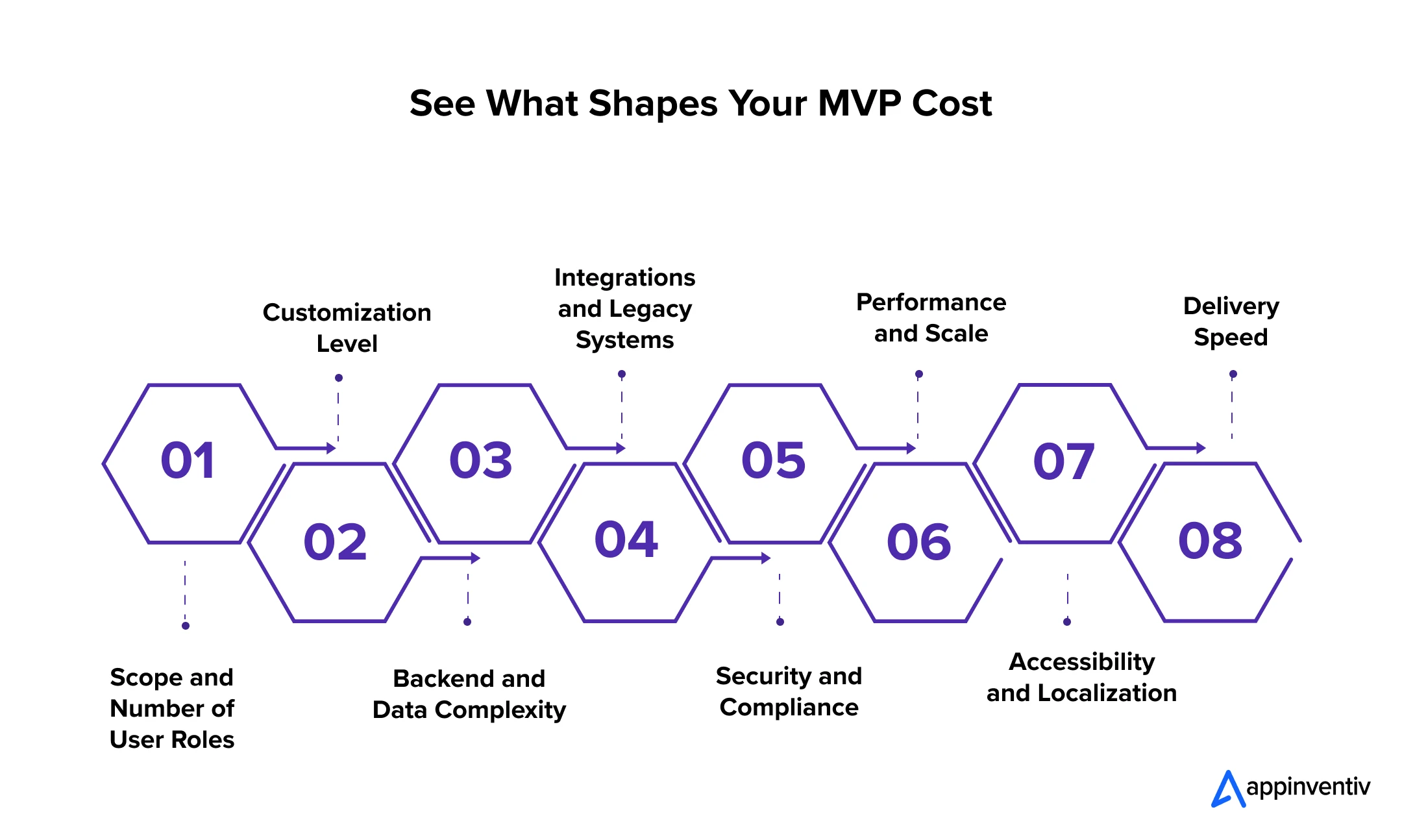
Scope and Number of User Roles
Every role creates a distinct journey. A delivery platform may serve customers, drivers, merchants, support agents, and administrators. Even if they use the same backend, each group needs appropriate screens, permissions, alerts, and exception paths.
Customization Level
Templates and ready-made components can reduce design and engineering effort. A highly differentiated interface, proprietary interaction, or unique business engine needs more custom work. Customization is valuable when it supports the product advantage. It becomes waste when applied to low-value functions that users already understand.
Backend and Data Complexity
A content-led product may rely on basic create, read, update, and delete operations. A pricing engine, scheduling system, recommendation service, or claims workflow requires deeper rules and exception handling. Historical migration, unstructured information, real-time processing, and large datasets further increase the effort.
Integrations and Legacy Systems
Modern, documented APIs are easier to connect than older enterprise systems. Integration work includes authentication, data mapping, retries, duplicate prevention, rate limits, reconciliation, monitoring, and failure recovery. Vendor access and test environments can also delay delivery.
Security and Compliance
An internal productivity tool and a patient-facing health app do not carry the same risk. Encryption, consent, access logging, retention, regional hosting, penetration testing, and IT compliance evidence must reflect the data and industry. Security introduced after development is both more expensive and less reliable.
Also Read: Why Enterprise Application Security is Mission Critical and How to Get it Right
Performance and Scale
An MVP does not need infrastructure for millions of hypothetical users on day one. It does need enough capacity for the planned pilot and a reasonable growth path. Real-time video, live location, large file processing, and sudden traffic peaks require more engineering than routine business transactions.
Accessibility and Localization
Accessibility affects design, navigation, content, development, and testing. Localization goes beyond translating visible text. It can include right-to-left layouts, currencies, dates, addresses, legal content, search behavior, and customer-support processes. Each market must be defined deliberately.
Delivery Speed
Compressing a six-month roadmap into three months does not halve the cost. It may require a larger team, parallel workstreams, faster decisions, and stronger coordination. Some tasks cannot be compressed because architecture, testing, app review, or third-party access follows a dependency order.
MVP Development Cost by Product Type
The product category influences its expected features and risk. The following ranges cover functional MVPs rather than full-fledged products. They exclude simple landing-page experiments and clickable prototypes, which can cost less.
| MVP Type | Typical Scope | Estimated Cost |
|---|---|---|
| Ecommerce MVP | Limited catalogue, cart, checkout, orders, admin | $30,000–$120,000 |
| Marketplace MVP | Buyer/seller flows, listings, payments, moderation | $50,000–$200,000 |
| On-demand service MVP | Booking, provider flow, payments, basic tracking | $50,000–$200,000 |
| SaaS MVP | Accounts, subscriptions, one core workflow, dashboard | $30,000–$150,000 |
| Fintech MVP | Transactions, verification, integrations, audit controls | $100,000–$350,000 |
| Healthcare MVP | Patient/provider journeys, privacy, records, telehealth | $100,000–$350,000 |
| AI-enabled MVP | AI workflow, data layer, evaluation, monitoring | $50,000–$300,000 |
| IoT MVP | Device connection, data processing, alerts, dashboard | $100,000–$400,000 |
| Enterprise operations MVP | Multiple roles, legacy systems, governance | $200,000–$500,000 |
Industry changes the minimum viable scope. A marketplace needs both buyer and seller journeys. Fintech and healthcare products cannot postpone essential identity, privacy, and audit controls. AI products need an evaluation layer, while IoT products add device and connectivity work. These requirements raise the cost to build an MVP even when the visible feature set remains small.
MVP Development Cost by Team and Engagement Model
The same requirements can produce different prices depending on who builds them. Cost should be considered alongside delivery speed, continuity, specialist access, governance, and the amount of management the business must provide.
| Delivery Model | Typical MVP Budget | Best Fit | Main Consideration |
|---|---|---|---|
| No-code builder or small freelance team | $5,000–$40,000 | Validation and basic MVPs | Scalability and continuity |
| In-house team | $150,000–$500,000 | Long-term product capability | Hiring time and fixed overhead |
| Development agency | $40,000–$500,000 | Custom, complex and enterprise MVPs | Vendor selection and governance |
| Hybrid team | $100,000–$400,000 | Internal ownership with external specialists | Clear role boundaries |
Freelancers can reduce the initial outlay for a narrow build, but the client usually owns coordination and continuity. In-house teams retain knowledge but add recruitment and fixed employment costs. A development company carries a higher headline price because it combines product, design, engineering, QA, DevOps, and delivery responsibility. The right comparison is the total cost of reaching launch, not the hourly rate alone.
MVP Development Cost by Development Region
Location affects labor rates, but it does not automatically determine value. Seniority, product experience, communication, staff turnover, delivery process, and the amount of rework can outweigh a nominal hourly difference.
| Development Region | Typical Hourly Range | Indicative MVP Budget |
|---|---|---|
| North America | $100–$150+ | $60,000–$200,000 |
| Western Europe | $80–$160 | $50,000–$180,000 |
| Eastern Europe | $45–$100 | $30,000–$120,000 |
| India and South Asia | $50–$70 | $20,000–$100,000 |
| Latin America | $40–$90 | $30,000–$120,000 |
| Middle East | $60–$150 | $40,000–$160,000 |
These are broad planning ranges rather than standardized market prices. Distributed delivery may also create overlap across time zones, while local teams may simplify workshops and stakeholder access. A capable team with reusable expertise can cost less overall even when its hourly rate is higher.
How to Perform an MVP Development Cost Estimation
A sound MVP development cost estimation begins with the business question, not a feature wish list. The business must identify what needs to be proven, which users will test it, and what measurable outcome will justify the next investment.
Standard MVP Cost Formula
Estimated MVP Cost = Total Role Hours × Blended Hourly Rate + Third-Party Setup + Contingency
The calculation should cover product strategy, UX/UI design, frontend and backend development, integrations, testing, DevOps, project management, and release support. A 10% to 20% contingency is commonly added where API behavior, legacy systems, data quality, or stakeholder requirements remain uncertain.
Expanded Estimation Model
For feature-level planning, businesses can use:
Estimated MVP Cost = Σ (Feature Effort × Complexity Multiplier × Role Rate) + Platform, Integration, Compliance and Launch Costs
| Estimation Input | What Must Be Defined |
|---|---|
| Validation goal | Assumption the MVP must prove |
| Core journey | Shortest complete path to user value |
| Feature scope | Must-have workflows and exceptions |
| Platforms | Web, iOS, Android, admin or API |
| Integrations | External systems, access and data mapping |
| Non-functional needs | Security, performance, accessibility, compliance |
| Delivery team | Roles, seniority, location and engagement model |
| Contingency | Known uncertainty and dependency risk |
This structure makes quotations comparable. If two vendors estimate different journeys, platforms, environments, or compliance responsibilities, their totals do not represent the same MVP.
Hidden Costs that Affects the Overall MVP Development Budget
The hidden costs of MVP development are usually not mysterious. They are simply excluded from the headline build quote. A complete financial plan should include product operation, vendor fees, compliance, internal involvement, and the next release.
| Often-Missed Expense | Planning Allowance | Why It Matters |
|---|---|---|
| Cloud and infrastructure | $500–$10,000+ per month | Usage, storage, traffic, environments |
| Third-party tools and APIs | $500–$15,000+ per month | Messages, maps, identity, AI, analytics |
| Security assessment | $10,000–$50,000 | Vulnerability review and remediation |
| Compliance and legal work | $10,000–$75,000 | Privacy, contracts, sector requirements |
| Maintenance and support | 15%–25% of build cost annually | Updates, monitoring, fixes, compatibility |
| Marketing and user acquisition | Business-dependent | Recruiting real pilot users |
| Internal team time | Role-dependent | Decisions, content, reviews, training |
Cloud Infrastructure
Cloud costs vary with architecture and usage. Production is not the only environment; teams may also need development, testing, staging, logs, backups, and monitoring. The AWS Pricing Calculator, for example, allows teams to model scenarios before deployment. A cost estimate should define expected users, transactions, storage, traffic, and growth rather than insert a random monthly amount.
External Services
Identity verification, SMS, email, mapping, video, search, analytics, payments, and generative AI often use consumption-based pricing. Low pilot usage may be inexpensive, but unit economics can change with scale. Teams should calculate the cost per active user, order, session, or automated task.
Compliance and Legal Preparation
Terms of use, privacy notices, consent language, data-processing agreements, licenses, and sector reviews may need legal input. Regulated products can also require audits, policies, risk assessments, and evidence that sits outside the software team’s scope.
Content and Data Migration
Product descriptions, training content, images, translations, customer records, or historical transactions must be prepared by someone. Poor source data creates cleaning and reconciliation work. The budget should state who owns content production and migration.
Maintenance and Iteration
An MVP is the start of measured product development, not the end. Teams need funds to monitor usage, correct defects, respond to platform changes, improve weak journeys, and develop the features supported by evidence. A reasonable annual maintenance allowance is often 15% to 25% of the initial build cost, excluding major new modules.
Turn your core product idea into a focused, market-ready MVP without spending on features users may never need.

Fixed Price, Time and Materials, or Dedicated Team?
The commercial model affects flexibility and risk distribution. No model is universally cheaper. The right choice depends on how clearly the product is defined and how much learning is expected during delivery.
| Pricing Model | Best Used When | Main Strength | Main Risk |
|---|---|---|---|
| Fixed price | Scope and acceptance criteria are stable | Budget predictability | Changes require formal repricing |
| Time and materials | Requirements will evolve through learning | Flexibility and transparency | Final cost needs active control |
| Dedicated team | Product roadmap continues beyond MVP | Stable capacity and knowledge | Ongoing monthly commitment |
| Phased engagement | Business needs evidence before full commitment | Investment tied to decisions | Requires clear gates |
A fixed-price contract works best after detailed discovery. Otherwise, the supplier must either price uncertainty into the quote or argue about whether each requirement was included. Time and materials suit innovation but requires backlog discipline, regular demonstrations, and financial reporting.
A phased approach is often practical. The business funds discovery first, then approves design and development using better evidence. It can also introduce decision gates after prototype testing, technical proof, or pilot release.
Why MVP Budgeting Matters Before Development
A clear MVP budget does more than place a spending limit on development. It connects the product’s validation goal with the features, people, technology, and timeline required to achieve it. Without this clarity, teams may spend too much on non-essential functionality or run short of funds before the product reaches real users.
Supports Smarter Resource Allocation
MVP budgeting helps businesses direct money and talent toward the product’s most critical workflow. It prevents resources from being consumed by features that do not contribute to early validation, customer feedback, or measurable business value.
Aligns Stakeholder Expectations
A defined budget gives founders, investors, product teams, and development partners a shared view of the scope. It clarifies what the first release will include, what will remain outside it, and which outcomes will determine the next investment.
Reduces Financial and Delivery Risks
Early budgeting exposes costly integrations, compliance requirements, technical dependencies, and third-party expenses before engineering begins. Teams can address these risks, change the scope, or create contingencies without disrupting active development.
Creates a Practical Scaling Path
An MVP budget should consider what happens after validation. Planning for maintenance, infrastructure, security, and future development helps businesses avoid technical decisions that make the product unnecessarily expensive to scale.
How to Reduce the Cost to Develop an MVP?
Reducing the cost to develop an MVP solutions does not mean stripping away reliability. The strongest savings come from removing low-value scope, resolving uncertainty earlier, and using established capabilities where differentiation is unnecessary.
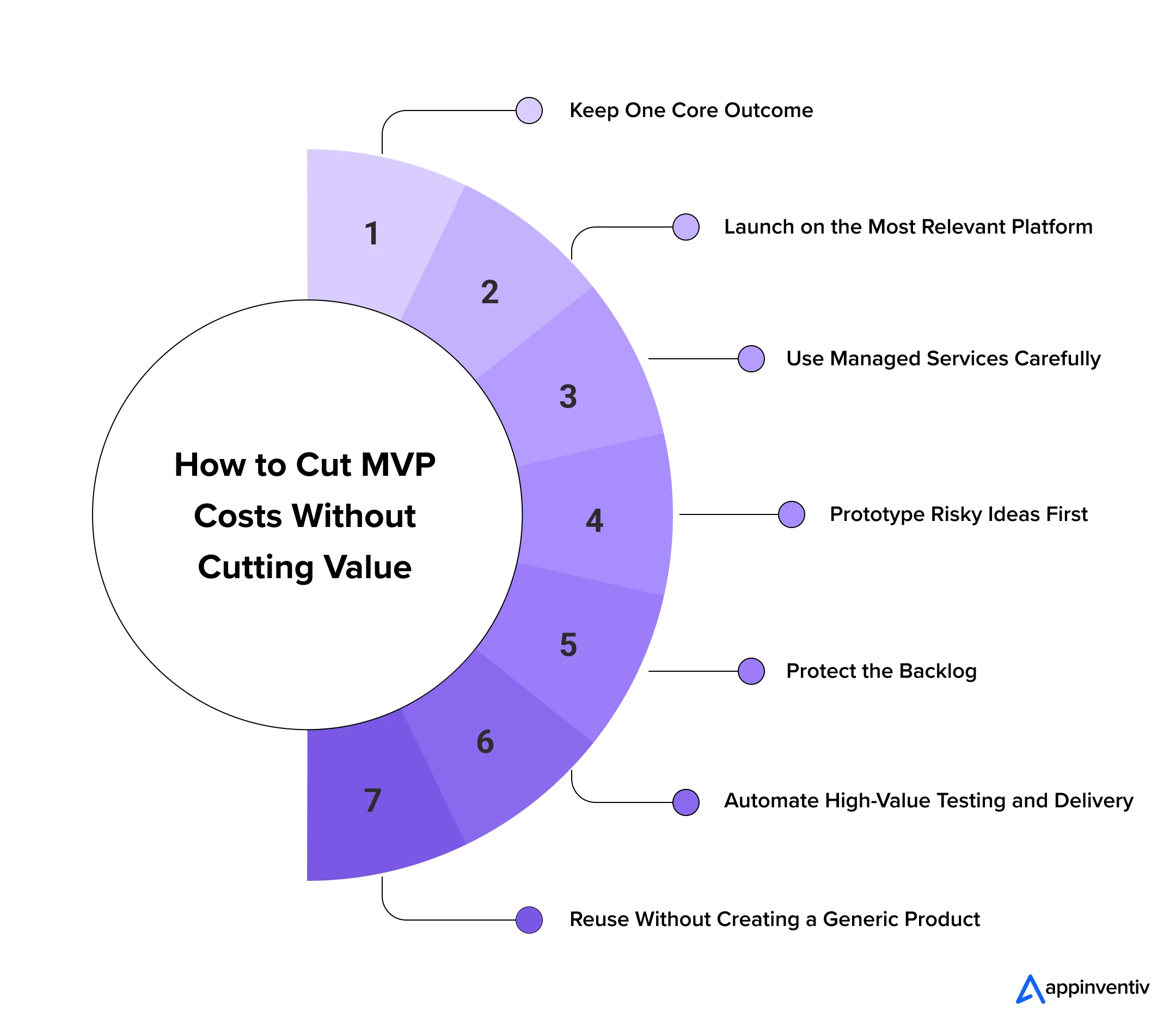
Keep One Core Outcome
Choose the single behavior the MVP must validate. A marketplace may first test whether buyers and sellers complete a transaction. Loyalty, referrals, advanced recommendations, and multiple revenue models can wait.
Launch on the Most Relevant Platform
If the first users work from desktops, begin with the web. If the audience is concentrated on one mobile platform, launch there first. Supporting every channel before evidence increases the MVP app development cost and slows learning.
Use Managed Services Carefully
Managed authentication, payments, notifications, search, analytics, and infrastructure can reduce initial engineering. Review long-term usage prices, data portability, geographic availability, and vendor dependence before committing.
Prototype Risky Ideas First
A clickable prototype can test navigation and comprehension. A technical proof can test an unusual integration or model. These small experiments prevent the full team from building around an assumption that fails late.
Protect the Backlog
New ideas should not enter the active sprint merely because they sound small. The product owner should assess their impact on validation, dependencies, testing, and the release date. A visible “later” list protects both creativity and delivery.
Automate High-Value Testing and Delivery
Automation requires initial effort but improves repeatability. Focus on critical business logic, API contracts, deployments, and regression-prone journeys. Do not chase maximum test coverage without considering risk.
Reuse Without Creating a Generic Product
Design systems, cloud patterns, standard modules, and integration accelerators can reduce effort. Reuse the commodity foundation while investing custom work in the workflow that creates customer value.
How to Plan ROI Beyond the Initial MVP Cost
The question “how much does an MVP costs?” should be paired with another: what decision will the investment enable? An MVP creates value when it reduces uncertainty about demand, usability, feasibility, pricing, or operations.
Teams can evaluate the investment through five practical measures:
- Activation: the percentage of users who reach the core value moment
- Completion: the percentage who finish the primary workflow
- Retention: the percentage who return within a relevant period
- Unit economics: revenue or savings compared with variable operating cost
- Learning velocity: how quickly the team can test and resolve assumptions
An internal automation MVP may justify itself through hours saved, fewer errors, faster cycle times, or stronger compliance. A customer product may focus on conversion, repeat usage, willingness to pay, or acquisition cost. The measurement plan should be part of discovery, not added after launch.
The next-stage budget also matters. If the pilot succeeds, the business may need to harden infrastructure, automate manual steps, expand integrations, complete compliance work, or serve more regions. A roadmap should distinguish the MVP investment from the cost of reaching full-scale production.
Common MVP Budgeting Mistakes to Avoid
Even a sensible cost range can fail when the estimate rests on weak assumptions. These mistakes commonly increase the final cost to build an MVP.
| Budgeting Mistake | Cost Impact | Better Decision |
|---|---|---|
| Treating the MVP as a reduced final product | Unnecessary features consume the validation budget | Build around one measurable assumption |
| Listing features without complete workflows | Quotes include different rules and edge cases | Define users, states, integrations and acceptance criteria |
| Ignoring manual operations | Support, verification and fulfilment costs appear after launch | Map software and human responsibilities together |
| Selecting the lowest headline quote | QA, DevOps, security or launch support may be excluded | Compare deliverables, staffing and exclusions line by line |
| Engineering for hypothetical scale | Premature architecture increases effort | Build for pilot volume with a documented growth path |
| Spending the full budget before launch | The team cannot act on user feedback | Reserve funds for stabilization and iteration |
The cheapest quote is not always the lowest MVP development cost. Missing responsibilities return later as change requests, delays, defects, and rebuilding. A comparable scope and a clear list of exclusions are essential before selecting a proposal.
A Sample MVP Budget Breakdown for Businesses
Consider a custom cross-platform service marketplace with customer and provider journeys, booking, payments, chat, notifications, an admin panel, and basic analytics. Its estimated budget is $150,000. This is a complex MVP example; a basic MVP would validate the central booking journey with one platform, fewer custom features, and more manual operations.
| Workstream | Estimated Allocation | Cost |
|---|---|---|
| Discovery and product planning | 10% | $15,000 |
| UX and UI design | 12% | $19,500 |
| Architecture and engineering | 50% | $75,000 |
| Quality assurance | 15% | $22,500 |
| Delivery management | 8% | $12,000 |
| Deployment and stabilization | 5% | $6,000 |
| Total | 100% | $150,000 |
This budget assumes established payment and messaging services, no regulated data, one language, and a controlled pilot market. Live tracking, complex provider payouts, extensive verification, or multiple regions would increase both the budget and schedule. Clear assumptions make the estimate useful.
How to Choose the Right MVP Development Partner for Your Product
The right partner should understand what the MVP must validate, remove unnecessary features, and identify risks before development begins. When evaluating a mobile app development company that would be your MVP partner, businesses should consider product expertise, technical capabilities, pricing transparency, ownership terms, and long-term support.
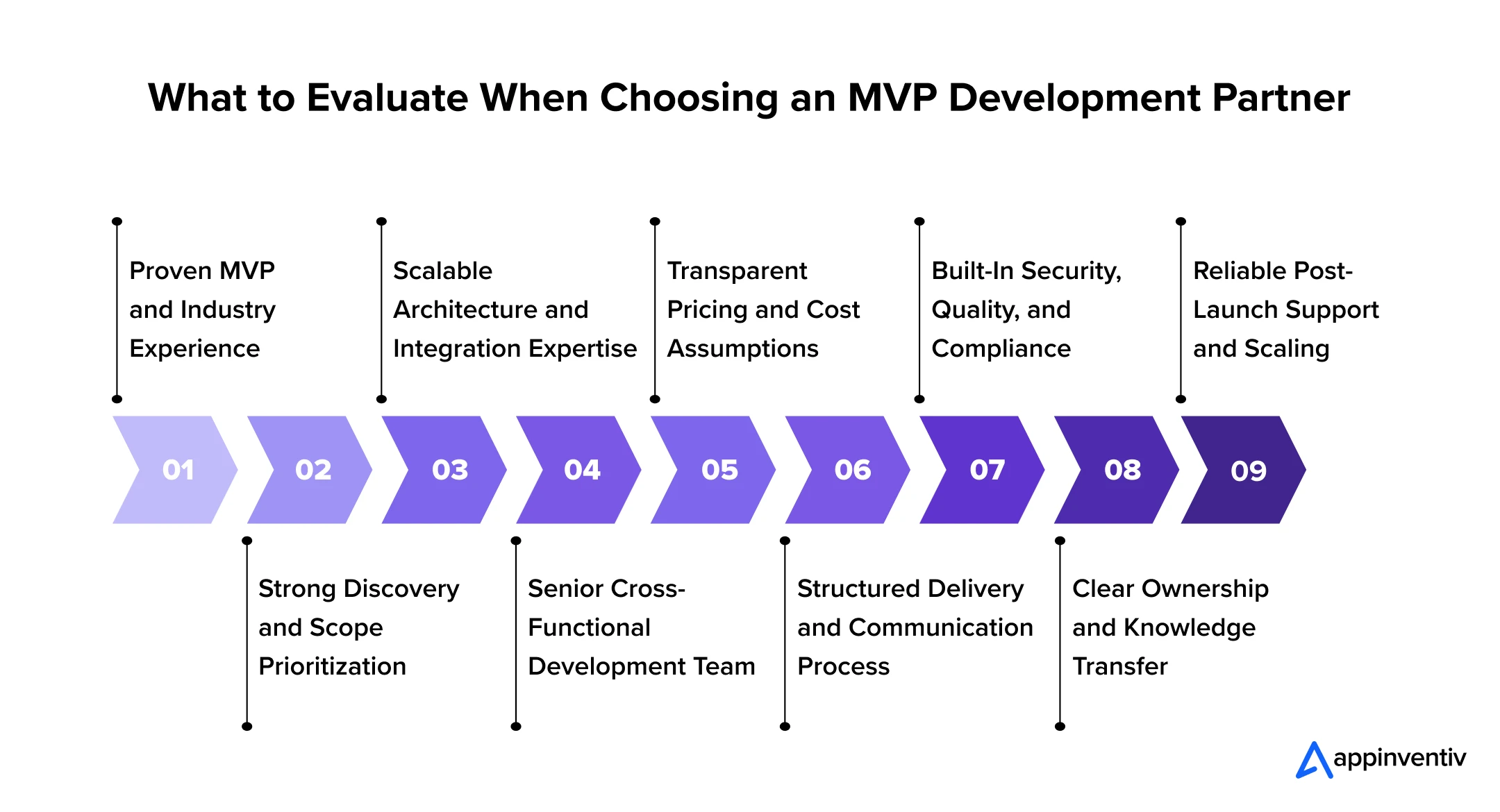
Proven MVP and Industry Experience
Review whether the company has developed products with similar users, workflows, technologies, or regulatory requirements. Relevant experience helps the team anticipate integration challenges, user expectations, and industry-specific risks.
Strong Discovery and Scope Prioritization
The partner should connect every proposed feature with the validation goal. It should clearly separate essential MVP functionality from features that can move to later releases, protecting both the budget and timeline.
Scalable Architecture and Integration Expertise
Evaluate the company’s experience with the required cloud platforms, APIs, databases, payment systems, AI models, and legacy applications. The proposed architecture should support the pilot without creating unnecessary complexity or immediate rebuilding needs.
Senior Cross-Functional Development Team
Ask for the roles, experience, availability, and responsibilities of the proposed team members. Experienced product managers, designers, developers, testers, and architects can identify issues earlier and reduce costly rework.
Transparent Pricing and Cost Assumptions
Every proposal should specify included features, platforms, integrations, timelines, deliverables, and acceptance criteria. It should also disclose assumptions, exclusions, third-party charges, and conditions that could change the MVP development cost.
Structured Delivery and Communication Process
The partner should follow a structured process for sprint planning, product demonstrations, risk reporting, feedback, and scope changes. Regular visibility helps stakeholders track progress, pending dependencies, budget usage, and delivery risks.
Built-In Security, Quality, and Compliance
Review the company’s approach to code quality, functional testing, access controls, encryption, vulnerability management, and monitoring. Regulated MVPs also require relevant privacy, audit, consent, and data-governance capabilities.
Clear Ownership and Knowledge Transfer
The contract should clearly define ownership of source code, designs, documentation, data, cloud accounts, and intellectual property. The partner should also provide technical documentation and knowledge transfer to reduce long-term vendor dependency.
Reliable Post-Launch Support and Scaling
Confirm how the company handles launch stabilization, defect resolution, performance monitoring, and product improvements. It should also explain how the MVP can evolve into a scalable product once its central assumptions have been validated.
A capable MVP development partner should help the business make the right product decision, not simply deliver more features. Comparing providers across these criteria creates a clearer view of capability, accountability, total cost, and delivery confidence.
Prioritize the essential workflow, select the right technology, and remove avoidable development costs.
Build and Validate Your MVP with Appinventiv
In 2026, an MVP can cost anywhere from $5,000 to $500,000, but those two figures describe entirely different forms of validation. A no-code experiment may cost $5,000 to $15,000, while a basic functional MVP may cost $15,000 to $40,000. Custom MVP development commonly ranges from $40,000 to $200,000. Only regulated, integration-heavy, or enterprise MVPs typically move toward $200,000 to $500,000.
Appinventiv helps startups and enterprises turn early product concepts into focused, testable digital solutions. Our MVP development services cover idea validation, feature prioritization, UX/UI design, architecture planning, MVP engineering, quality assurance, deployment, and post-launch improvements.
We begin by identifying the assumption the product must validate. The team then defines the shortest complete user journey, selects the suitable platform, and separates essential engineering from features that can wait. For enterprise initiatives, we also account for integration dependencies, data governance, security, compliance, and the path from pilot to scale.
When businesses ask how much does an MVP cost, they should receive more than a broad range. They need a transparent estimate showing scope, team, assumptions, integrations, timeline, third-party charges, and post-launch requirements. Contact us to convert your MVP concept into a practical cost and delivery roadmap.
FAQs
Q. How much does it cost to develop an MVP?
A. The MVP development cost can range from $5,000 to $500,000, depending on its purpose and technical depth. A no-code validation product costs significantly less than a custom or enterprise MVP.
The general cost breakdown includes:
- Validation MVP: $5,000–$15,000
- Basic functional MVP: $15,000–$40,000
- Custom MVP: $40,000–$100,000
- Complex MVP: $100,000–$200,000
- Enterprise MVP: $200,000–$500,000
Q. How long does it take to build an MVP?
A. An MVP generally takes between four weeks and twelve months to develop. The exact timeline depends on the product scope, technology, platforms, integrations, and approval cycles.
Typical MVP development timelines include:
- Validation MVP: 4–8 weeks
- Basic functional MVP: 2–3 months
- Custom MVP: 3–5 months
- Complex MVP: 5–8 months
- Enterprise MVP: 8–12 months or longer
Q. What should I look for when choosing an MVP development company?
A. Choose an MVP development company that can turn your business assumption into a focused product scope. The company should help you avoid unnecessary features while creating a viable foundation for future development.
- Evaluate potential partners based on:
- Relevant MVP and industry experience
- Product discovery and validation capabilities
- Transparent cost and timeline estimates
- Clearly identified development team
- UI/UX, engineering, testing, and DevOps expertise
- Security and compliance capabilities
- Code ownership and documentation terms
- Post-launch support and scaling experience
- Client references and relevant case studies
Q. How much does it cost to build an AI-powered MVP?
A. The cost to build an AI-powered MVP generally ranges from $50,000 to $300,000. A basic MVP using an existing AI API falls near the lower end, while a solution requiring proprietary data, RAG, model customization, complex integrations, or enterprise governance costs more.
The AI MVP development cost typically covers:
- AI model or API selection
- Data collection and preparation
- Prompt and workflow engineering
- RAG or knowledge-base development
- Model evaluation and accuracy testing
- Guardrails and human-review workflows
- Enterprise system integrations
- Cloud and model-usage infrastructure
- Security, governance, and ongoing monitoring


Fast 2-minute response, fully NDA-protected.

10 Future-Ready Tech Business Ideas to Launch in Brisbane (2026 Edition)
Key takeaways: Brisbane’s Tech Surge: With $10.8B in value and 81% growth, Brisbane offers strong government backing, top talent, and global reach. Funding Boost: Programs like Advance Queensland have funded 8,100+ startups with up to $250K each. Scalable Sectors: AI healthcare, AgTech, and renewables thrive with solid R&D and industry support. Brisbane is buzzing with…

16 Game-Changing Startup Ideas in the UAE You Haven’t Considered Yet
Key takeaways: The UAE's strategic location and government support make it an ideal startup hub. AI, fintech, and green tech are booming sectors with vast opportunities for startups. Over $11 billion in funding is fueling growth in key industries like AI and e-commerce. Government initiatives like the “Dubai Future District Fund” support entrepreneurial growth. Niche…

10 Innovative Business Ideas in the Oil and Gas Industry for 2026
The oil and gas industry is in the midst of a high-stakes digital revolution. With rising global energy demands, increasing pressure to reduce emissions, and the complexity of upstream and downstream operations, enterprises are turning to software-first solutions to stay competitive. In 2026, this shift is not just a matter of time; it's transformative. According…














