































How Much Does Healthcare app development cost in Saudi arabia? All You Need to Know


- Why Saudi Healthcare Businesses Must Understand App Types Before Calculating Cost
- A Comprehensive View of the Cost of Healthcare Mobile App Development in Saudi Arabia
- Key Factors Affecting Your App Development Costs
- Hidden Cost Factors Businesses Often Overlook in Saudi Healthcare Projects
- Strategic Ways to Optimize Your App Development Costs
- Core Features Every Healthcare App in Saudi Arabia Needs
- Advanced Features That Set Saudi Healthcare Platforms Apart
- How To Make A Healthcare Mobile App In Saudi Arabia
- How Healthcare Apps in Saudi Arabia Generate Revenue
- How Can Your Healthcare App Stand Out in the Saudi Market
- Why Appinventiv Dominates Healthcare App Development in Saudi Arabia
- FAQs

Key takeaways:
- Healthcare mobile app development cost in Saudi Arabia in 2026 ranges from 112,500 SAR to 2,250,000+ SAR, depending on application scope, integrations, and compliance requirements.
- Total investment is primarily influenced by app category, system architecture, regulatory compliance, scalability needs, and security infrastructure.
- Development and testing phases typically represent the largest share of project cost due to clinical workflows, data protection requirements, and integration complexity.
- Additional expenses may include infrastructure hosting, security monitoring, regulatory updates, and post-launch feature expansion.
- MVP-first development approaches help organizations reduce upfront risk, validate product demand, and optimize long-term investment planning.
Healthcare mobile app development cost in Saudi Arabia in 2026 typically ranges from 112,500 SAR to 2,250,000+ SAR depending on application type, system complexity, integrations, and regulatory requirements. Healthcare providers, hospitals, and digital health startups across Saudi Arabia are investing in mobile platforms to support patient engagement, clinical workflows, remote care, and compliance with national digital health initiatives.
This guide explains the real cost drivers, pricing ranges, architecture considerations, and budgeting factors organizations must evaluate before building a healthcare app in Saudi Arabia. Understanding these variables helps decision-makers estimate investment accurately, plan scalable systems, and ensure regulatory readiness from the initial development phase.

Why Saudi Healthcare Businesses Must Understand App Types Before Calculating Cost
If you are trying to estimate the cost to build a healthcare app in Saudi Arabia, the first mistake to avoid is assuming all healthcare apps are priced the same. The kind of platform you build defines your budget more than any other factor. That is why understanding the types of healthcare apps already working in Saudi Arabia is not just market awareness, it is financial planning.
For organisations planning regional expansion or benchmarking investments, it also helps to compare these figures with healthcare software development costs in the Middle East, where compliance depth, scale, and architecture expectations vary across markets.
The region has some really impressive healthcare apps already working. Look at Tawakkalna, Sehhaty, and Mawid – they all show what happens when you build something people actually want to use for their health needs. Each one took a different path but found success.
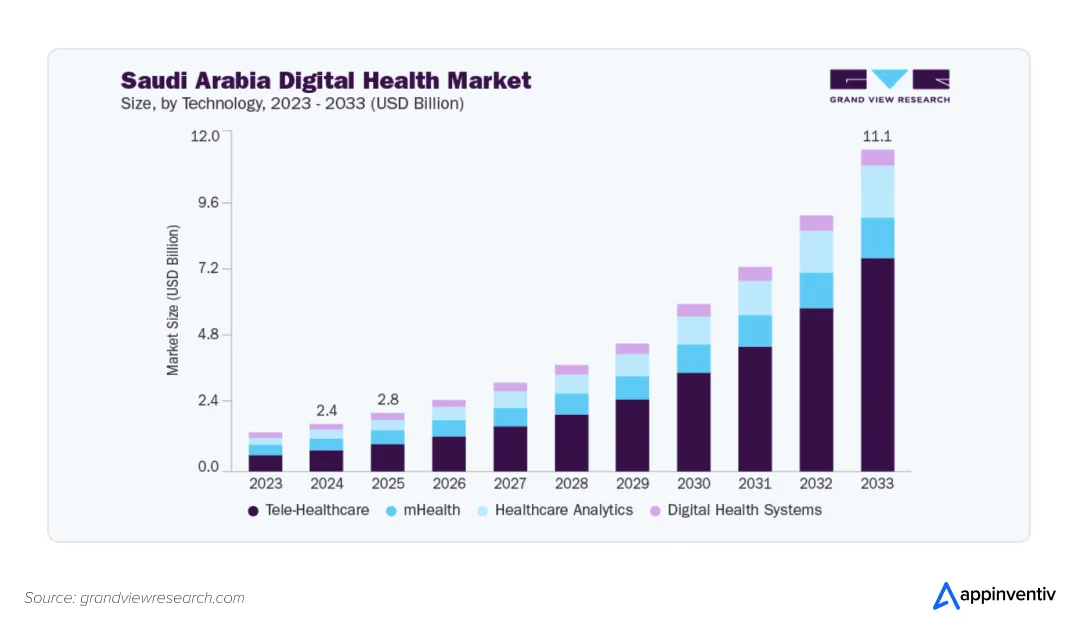
The Saudi Arabia digital health market was worth $2.5 billion in 2024 and is expected to grow to nearly $17 billion by 2033 – that’s almost 7 times bigger in just 9 years.
So what kind of healthcare app could you build here? You’ve got several solid options:
- Telemedicine Platforms: Apps that let patients video chat with doctors. Perfect for Saudi Arabia since the country is vast and patients want faster access to specialists without long travel times, especially outside major cities like Riyadh and Jeddah.
- Health Management Systems: Large platforms that help hospitals and clinics manage patient records, schedule appointments, and streamline daily operations. These are common among multi-branch healthcare groups looking for centralized control and operational visibility.
- Wellness & Preventive Care Apps: Fitness tracking, medication reminders, and lifestyle management tools that support the government’s push toward preventive healthcare and long-term population health.
- Remote Patient Monitoring Apps: Platforms that track vital signs and symptoms through connected devices. These are useful for chronic patients who need regular follow-ups without repeated hospital visits.
- Pharmacy and Prescription Apps: Apps that allow patients to view prescriptions, request refills, and schedule medicine deliveries. These are becoming popular among urban clinics and pharmacy chains serving high patient volumes.
- Lab Test and Diagnostic Apps: Platforms that let patients book diagnostic tests, receive reports digitally, and share results with doctors. Hospitals use these to reduce queues and digitize reporting.
- Electronic Medical Records Apps: Apps focused purely on centralizing patient data so doctors across departments can view clinical history securely and in real time.
- Insurance and Claims Apps: Platforms that help patients check coverage, submit claims, and track approvals. These are especially relevant for private hospitals and clinics working with insurers.
- Mental Health and Therapy Apps: Secure platforms for therapy sessions, mood tracking, and behavioral care. This category is growing as awareness and acceptance increase across the region.
- Home Healthcare Service Apps: Apps that allow users to book nurses, physiotherapists, and home diagnostic services. These appeal strongly to families and elderly patients.
The right app type often depends on factors like patient volume, regulatory complexity, integration with Saudi health systems, and long-term expansion plans which is why many healthcare organizations assess app architecture and compliance needs before finalizing budgets.
The local giants succeeded because they chose distinct paths and executed flawlessly:
- Tawakkalna: Connects with government systems and tracks contacts, turning into Saudi Arabia’s go-to digital ID app. It shows how working with the government helps get users fast and makes steady money.
- Sehhaty: Handles all your health records in one place, letting patients see their complete medical history. This app proves that connecting different data systems really sets you apart in healthcare apps. The cost to build a healthcare app like Sehhaty is highly complexity-dependent.
- Mawid: Makes booking doctor appointments easy across all healthcare providers in the country. Its huge success shows how fixing one big problem well can dominate the market.
What these platforms share is not just adoption, but design maturity. They were built with scalability, compliance, and security in mind from the start. And that is exactly what drives budget differences between a basic app and an enterprise-grade system.
Understanding healthcare app categories in Saudi Arabia helps businesses set realistic budgets and avoid paying for features that do not align with their clinical and operational goals.
Once you determine what kind of platform you are building, estimating cost becomes far more predictable. This is also where healthcare app development consulting in Saudi Arabia becomes valuable, not for coding, but for making the right architectural decisions before development begins.
A Comprehensive View of the Cost of Healthcare Mobile App Development in Saudi Arabia
Here’s how much money you’ll need to build a healthcare app for the Saudi market, broken down into pieces that make sense. Knowing what costs what helps you decide which features matter most and how to approach development. The total budget for the app is built as per different stages and the overall complexity of the app.
The biggest cost overruns in Saudi healthcare app development usually happen not because of features, but because architecture, compliance, and integration decisions are made too late.
Cost Breakdown by App Complexity
The cost to build a healthcare app in Saudi Arabia is determined by its overall complexity, your development timeline, technology requirements, and ultimately, your investment. Here’s how different complexity levels translate into costs and capabilities:
Simple App (MVP)
Developing an MVP before full-fledged development is perfect for testing market demand and validating your core concept
Covers basic stuff like signing up users, creating profiles, and simple appointment booking. Your starting healthcare app development cost in Saudi will be cheapest at this level, perfect for new companies or organizations testing their idea before spending big money.
What You’ll Pay: 112,500 – 280,000 SAR ($30,000 – $75,000)
What You Get:
- User sign-up and login
- Finding doctors and clinics
- Managing user profiles
- Basic appointment scheduling
- Reminder alerts
How It’s Built: Usually uses apps that work on multiple platforms and simple cloud hosting to keep development time and costs down.
Medium Complexity App
It’s where you add sophisticated healthcare functionalities that enhance patient engagement
A medium complexity healthcare app would include features like video doctor visits, electronic prescriptions, and basic connections to hospital record systems. This level hits the sweet spot for most healthcare providers – you get real functionality without all the enterprise headaches.
What You’ll Pay: 280,000 – 845,000 SAR ($75,000 – $225,000)
What You Get:
- Everything from the basic version, plus:
- Safe video calls
- Messaging inside the app
- Simple payment processing
- Electronic prescription writing
- Basic patient information displays
How It’s Built: Needs stronger backend systems, secure video services (like Twilio), and probably native app development for better performance and safety.
Complex App
This will act as a fully enterprise-grade solution for large healthcare organizations
The full package with AI-powered medical diagnosis, connections to lots of other systems, live data tracking, and everything needed to follow Saudi Arabia healthcare app regulations. This works for big hospitals, healthcare chains, or well-funded startups going all-out.
What You’ll Pay: 845,000 – 2,250,000+ SAR ($225,000 – $600,000+)
What You Get:
- Everything from simpler versions, plus:
- AI that checks symptoms
- Connects to fitness trackers and health devices
- Works with hospital record systems (HL7/FHIR)
- Handles insurance claims
- Links to pharmacies and labs
- Complete data analysis tools
How It’s Built: Fast native apps, cloud systems that grow with you (AWS or Azure), custom AI programs, and serious security protection.
| App Complexity | Description | Cost (SAR) | Cost (USD) | Core Features | Tech Stack |
|---|---|---|---|---|---|
| Simple App (MVP) | Ideal for validation with basic features like registration and booking. | 112,500 – 280,000 | $30,000 – $75,000 | Login, Clinic Search, Profile, Booking, Reminders | Cross-platform, cloud hosting |
| Intermediate App | Adds features like video calls, e-prescriptions, and EHR integration. | 280,000 – 845,000 | $75,000 – $225,000 | MVP features + Video Calling, Chat, Payments, E-prescriptions | Robust backend, video APIs, native dev |
| Complex App | Enterprise-level with AI, IoT, and advanced EHR integration. | 845,000 – 2,250,000+ | $225,000 – $600,000+ | Intermediate features + AI, IoT, Advanced EHR, Insurance, Analytics | Native apps, scalable cloud, AI/ML |
Cost Breakdown by Development Stage
Every process to develop a healthcare app for Saudi hospitals or clinics follows a structured path. Understanding how your budget gets allocated across different stages helps you plan cash flow and milestone payments. A solid partner for medical application development will guide you through each phase while maintaining transparency about costs and deliverables.
1. Discovery and Planning (10%)
The strategic foundation that determines project success
This is where vision meets reality. It involves not just brainstorming ideas but creating a concrete blueprint that guides the entire development process. This phase prevents costly changes later by establishing clear requirements upfront.
In Saudi healthcare projects, skipping or compressing this phase often leads to compliance rework, delayed approvals, and budget overruns during development.
Key Deliverables: Product Requirements Document (PRD), detailed User Personas, and User Stories that map out every interaction. This phase is foundational to successful healthcare mobile app development in Saudi Arabia.
Running Cost Estimate: 11,250 – 225,000 SAR ($3,000 – $60,000)
2. UI/UX Design (15%)
Creating an intuitive experience that users will actually want to use
This step isn’t just about making things look pretty – with healthcare application development in Saudi Arabia, you’re building something healthcare workers and patients can actually use without getting confused. Smart design cuts down on help desk calls and gets more people using your app.
How It Works:
- Wireframes: Simple black and white sketches showing where everything goes
- Mockups: Detailed colored designs with your fonts and branding (made with tools like Figma or Sketch)
- Prototypes: Clickable fake versions of your app that let you test how people move through it before any real coding starts
This back-and-forth process makes sure your final app works how users expect, which is crucial for app development for healthcare.
Running Cost Estimate: 28,000 – 562,500 SAR ($7,500 – $150,000)
3. Development & Tech Specs (45%)
Where your healthcare app comes to life through code
This is the most resource-intensive phase where your app is actually built. Paving the way for smart technology choices here is critical for performance, scalability, and long-term budget management. High-quality healthcare app development solutions in Saudi Arabia are distinguished during this phase by their architectural decisions and code quality.
| Development Phase | Description | Technology Options | Ideal Use Case | Cost Estimate (SAR) | Cost Estimate (USD) |
|---|---|---|---|---|---|
| Frontend Development (App Interface) | Creating the user-facing part of the app, focusing on ease of use and functionality. | Native (Swift for iOS, Kotlin for Android), Cross-Platform (React Native, Flutter) | Ideal for apps needing maximum performance, such as telemedicine or AI-based healthcare platforms. | 84,500 – 1,575,000 | $22,500 – $420,000 |
| Backend Development (The ‘Brain’) | Building the app’s logic, database interactions, and ensuring overall app performance. | Node.js, Python (Django/Flask), Ruby on Rails | Suitable for apps requiring complex backend logic, real-time data processing, and scalability. | 84,500 – 1,575,000 | $22,500 – $420,000 |
| Database Solutions | Managing data storage and retrieval, depending on the app’s requirements for structured or unstructured data. | SQL (PostgreSQL) for structured data, NoSQL (MongoDB) for unstructured data | SQL for patient profiles and appointments, NoSQL for IoT device data, and chat logs. | Included in backend development cost | Included in backend development cost |
| Cloud Infrastructure | Cloud-based services hosting and managing the app’s infrastructure with scalability. | AWS, Azure, Google Cloud | Recommended for scalable, compliant, and efficient app hosting in Saudi Arabia. | Included in backend/cloud setup | Included in backend/cloud setup |
| API Integrations | Integrating essential services like patient records, payment systems, and other healthcare tools into the app. | EHR/EMR (HL7, FHIR), Payment Gateways (HyperPay, PayTabs) | Essential for apps dealing with patient data, medical records, or payments. | Included in backend development cost | Included in backend development cost |
4. Testing and Quality Assurance (20%)
Ensuring your app is secure, reliable, and ready for real-world use
This is a non-negotiable stage that protects your reputation and ensures user safety. In healthcare, bugs aren’t just inconvenient, they can be dangerous. Comprehensive testing identifies and resolves issues before they reach users.
Testing Components:
- Unit & Integration Testing: Developers test individual code components and their interactions
- Performance Testing: Simulates heavy user loads to ensure the app remains fast and responsive
- Security Testing: Includes penetration testing to find and fix vulnerabilities
- User Acceptance Testing (UAT): Real users test the app to provide feedback before launch
A core component of any trustworthy medical app is its commitment to rigorous quality assurance protocols.
Running Cost Estimate: 107,000 – 2,025,000 SAR ($28,500 – $540,000)
5. Deployment and Launch (10%)
Taking your app from development to the hands of users
This final stage involves configuring the production environment on the cloud, submitting the app to the Apple App Store and Google Play Store, and navigating their review processes. Proper deployment ensures smooth performance from day one and sets the foundation for future updates.
Key Activities: Production environment setup, app store submissions, compliance verification, and launch preparation
Running Cost Estimate: 112,500 – 2,250,000 SAR ($30,000 – $600,000)
| Development Stage | Description | Cost Estimate (SAR) | Cost Estimate (USD) |
|---|---|---|---|
| Discovery and Planning | Blueprint with clear requirements. | 11,250 – 225,000 | $3,000 – $60,000 |
| UI/UX Design | Designing intuitive user experience with wireframes & prototypes. | 28,000 – 562,500 | $7,500 – $150,000 |
| Development & Tech Specs | Building app interface, backend, and integrations. | 84,500 – 1,575,000 | $22,500 – $420,000 |
| Testing and Quality Assurance | Ensuring security, reliability, and performance. | 107,000 – 2,025,000 | $28,500 – $540,000 |
| Deployment and Launch | Finalizing deployment and app store launch. | 112,500 – 2,250,000 | $30,000 – $600,000 |
Key Factors Affecting Your App Development Costs
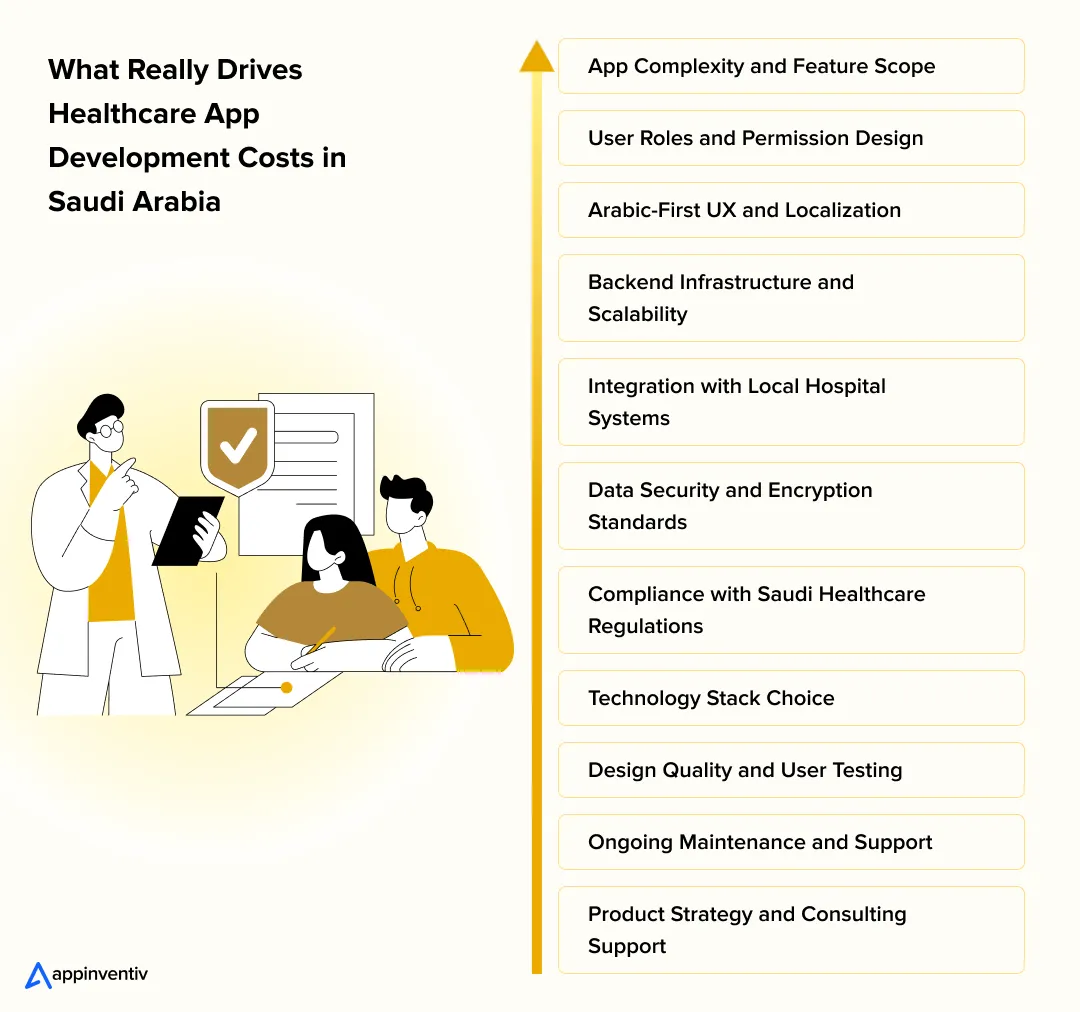
When leaders ask about the healthcare app development cost in Saudi Arabia, what they really want to know is this: where does the money actually go? The answer lies in how complex your system is, how regulated your data is, and how scalable your platform must be across cities like Riyadh and Jeddah. The budget is shaped by architecture, compliance, and operational depth, not just design or code.
App Complexity and Feature Scope
The number of features drives effort more than anything else. A simple appointment booking app is affordable. A platform with teleconsultation, records, reports, and patient engagement tools requires deeper engineering. When it comes to healthcare mobile app development in Saudi Arabia, complexity grows faster when apps serve both public patients and private hospitals at scale.
Also Read: How Much Does It Cost to Build a Telemedicine App like Altibbi in the Middle East?
User Roles and Permission Design
Saudi healthcare providers rarely build single-user apps. Systems usually support patients, doctors, pharmacists, nurses, and administrators. Each role needs controlled access and workflows. Designing secure medical application development with user hierarchies increases logic complexity and testing workload substantially.
Arabic-First UX and Localization
Saudi apps are expected to feel native, not translated. Arabic language support changes layouts, text flows, and navigation patterns. Right-to-left design affects nearly every screen. Mobile health application development must reflect cultural usage habits, especially when apps target older populations and government users.
Also Read: How to do Mobile App Localisation to Increase its Conversion Rate by 200%
Backend Infrastructure and Scalability
Apps that start in one hospital often expand across cities. That requires backend architecture that supports high data loads and parallel users. Without scalable cloud design, performance suffers fast. Healthcare application development in Saudi Arabia needs future-ready infrastructure from day one.
Integration with Local Hospital Systems
Large healthcare providers in Riyadh and Jeddah use separate systems for billing, lab data, and patient records. Integration is never plug-and-play. Each system requires custom interfaces. App development for healthcare becomes more expensive as integrations increase.
Data Security and Encryption Standards
Saudi healthcare data is sensitive and audited. Encryption, access logging, and identity management are mandatory for healthcare data security. Planning for medical app development without layered security opens compliance and legal risks. Secure architecture requires specialized engineering from the beginning.
Compliance with Saudi Healthcare Regulations
Healthcare app compliance in Saudi Arabia affects hosting, access control, and audit design. Data localization, consent handling, and medical record protection must be built into workflows. Compliance errors lead to redesign and delay, which increases total cost late in development.
Technology Stack Choice
Native Android and iOS apps offer high performance but cost more than cross-platform builds. Custom backend frameworks add flexibility but raise budgets. Digital health app development choices today impact whether systems scale for five years or stall in one.
Design Quality and User Testing
Saudi healthcare apps demand clarity and trust. No patient wants to struggle to book a doctor or read a report. UX testing takes time and iteration. Poor design adds hidden cost after launch through support burden and low adoption.
Ongoing Maintenance and Support
Launching the app is just the beginning. Updates, hosting, security patches, and scaling never stop. Healthcare app development cost continues long after release. Businesses must plan for multi-year operational investment for app maintenance.
Product Strategy and Consulting Support
Many organizations seek healthcare app development consulting in Saudi Arabia not for coding, but for decision control. Choosing the right features of a healthcare app early prevents rework later. Expert planning reduces waste and accelerates ROI.
Hidden Cost Factors Businesses Often Overlook in Saudi Healthcare Projects
Hidden costs hurt budgets more than big features because they show up late. These are the costs executives usually discover only after development is underway.
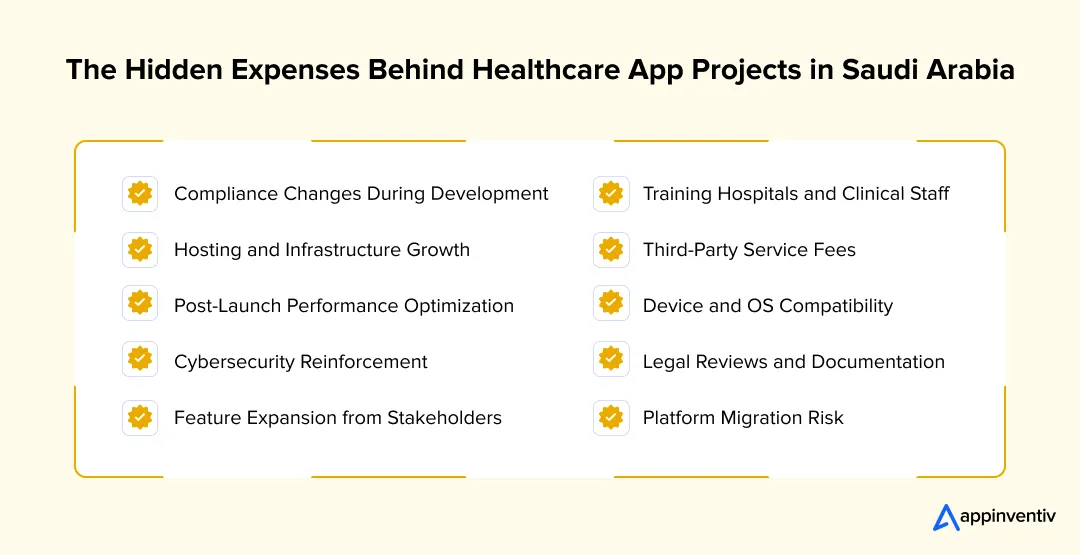
Compliance Changes During Development
Healthcare policy evolves. New approvals, data rules, or audit standards may appear while development is live. Compliance-driven redesign is time-sensitive while at the same time, increases the cost of healthcare mobile app development in Saudi Arabia.
Hosting and Infrastructure Growth
Initial cloud budgets look small. As patient data grows and usage rises, so do storage, backups, and compute costs. Infrastructure becomes an operating expense, not a setup fee.
Post-Launch Performance Optimization
Traffic loads from major cities strain early systems. Speed optimization, caching, and system tuning are often postponed until problems arise. Fixing slowness after launch is costlier.
Cybersecurity Reinforcement
Security is never finished. New threats require updates. Paid audits, penetration testing, and patching add continuing expense to medical application development.
Feature Expansion from Stakeholders
Doctors request tools. Management requests dashboards. Admins request controls. Mid-cycle additions inflate scope silently and stretch delivery timelines without warning.
Training Hospitals and Clinical Staff
Digital tools require behavior change. Hospitals invest time and money training users. Adoption becomes a cost category rarely included in development contracts.
Third-Party Service Fees
Video calling, analytics, and payment engines charge monthly. As usage scales, cost grows. These recurring bills often exceed expectations.
Device and OS Compatibility
Saudi users use diverse phones. Testing across brands, software versions, and configurations costs effort and time. Missed compatibility reduces adoption.
Legal Reviews and Documentation
Privacy terms and medical agreements evolve. Each update brings lawyer review and system adjustments. Legal cost follows technology cost.
Platform Migration Risk
Changing development vendors mid-project increases expenses dramatically. Re-engineering and code transfer causes lost time and duplicated effort.
Strategic Ways to Optimize Your App Development Costs
How can you ensure your investment is both prudent and powerful? Smart healthcare leaders employ proven strategies to maximize ROI while maintaining quality and compliance standards. The key is balancing cost efficiency with long-term strategic value.
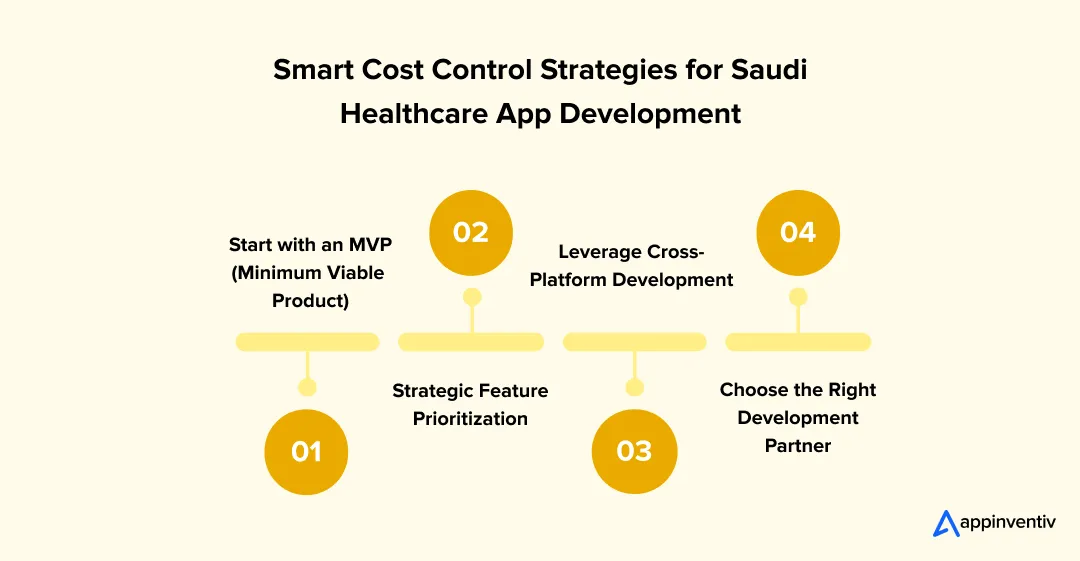
Start with an MVP (Minimum Viable Product)
Launching with core features allows you to test your concept with real users and gather valuable feedback before major investment. This approach reduces initial costs by 60-70% and validates market demand, making it a smart way to begin your mHealth app development in Saudi Arabia journey while minimizing financial risk.
Strategic Feature Prioritization
Use the MoSCoW method to focus your budget effectively:
- Must-have: Essential features like user registration, basic appointment booking
- Should-have: Important features like telemedicine capabilities
- Could-have: Nice-to-have features like AI diagnostics
- Won’t-have: Features deferred to future phases
This framework ensures critical functionalities receive proper attention while controlling scope creep.
Leverage Cross-Platform Development
This approach can save you up to 40% on development costs while reaching both iOS and Android users simultaneously. It’s a popular choice for many types of healthcare apps that don’t require intensive native device integration.
Choose the Right Development Partner
The decision of choosing the partner that will build a healthcare app for the Saudi market is perhaps the most critical one you’ll make. Partner with providers like Appinventiv that has proven healthcare expertise, regulatory knowledge, and offers post-launch support.
Core Features Every Healthcare App in Saudi Arabia Needs
Talk to any hospital administrator in Riyadh or clinic owner in Jeddah and you will hear the same thing: patients judge the hospital experience by the app before they step into the building. If the system feels slow, confusing, or unreliable, trust drops immediately. These features are not “nice to have” anymore. They are the basics that decide whether your platform is actually used or quietly ignored.
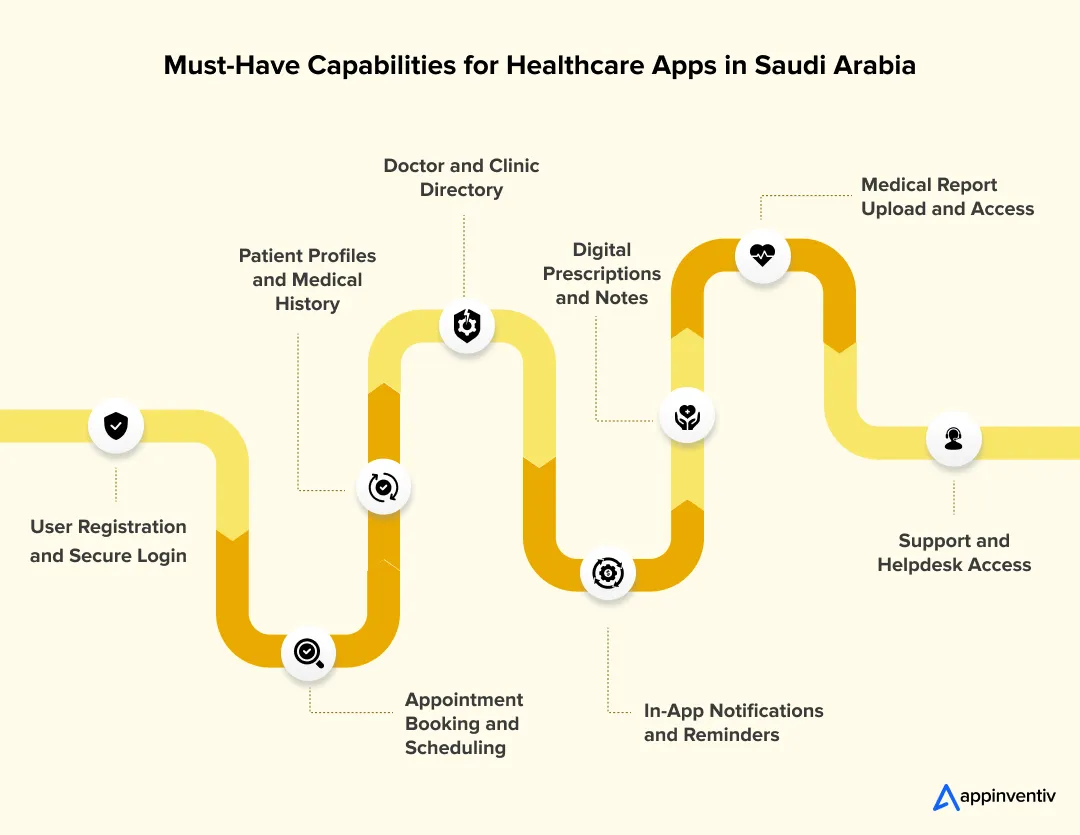
User Registration and Secure Login
Nobody wants a long sign-up process, but nobody trusts a weak one either. Patients expect simple login. Hospitals expect serious security. The balance matters. If access feels hard, people leave. If it feels weak, compliance breaks.
Appointment Booking and Scheduling
Patients do not want to call clinics anymore. They want to see availability, choose a slot, and receive confirmation within seconds. If this flow fails, they assume the hospital is just as disorganised offline.
Also Read: How Much Does it Cost to Build a Medical Scheduling Software?
Patient Profiles and Medical History
Doctors need context before they give advice. Patients expect their records to be available without repeating the same story at every visit. A clean, reliable record system saves time on both sides and avoids costly errors.
Doctor and Clinic Directory
People look for doctors the same way they search for restaurants. Location, speciality, timings, and basic info must be easy to find. If patients cannot discover care options quickly, they go elsewhere.
In-App Notifications and Reminders
When a patient misses an appointment, it is a cost to the hospital. Good reminder systems quietly reduce no-shows without staff chasing patients manually.
Digital Prescriptions and Notes
Paper is slow. Handwritten notes are misunderstood. Digital instructions reduce mistakes and make follow-ups easier for both doctors and patients.
Medical Report Upload and Access
People want their test results on their phone, not in folders at home. Clinics benefit too because reports are available instantly during follow-ups instead of being searched physically.
Support and Helpdesk Access
Every system breaks at some point. When it does, patients need help inside the app, not another phone number. Support access is not a feature. It is a safety net for trust.
Advanced Features That Set Saudi Healthcare Platforms Apart
In Saudi Arabia, basic apps are no longer competitive. Patients, regulators, and healthcare investors expect smarter systems that do more than store data. Advanced features are what separate a system that works from one that actually scales. Businesses must understand that the overall cost of healthcare mobile app development in Saudi Arabia can be impacted by the integration of advanced features but they are necessary to stand out in this competitive environment.
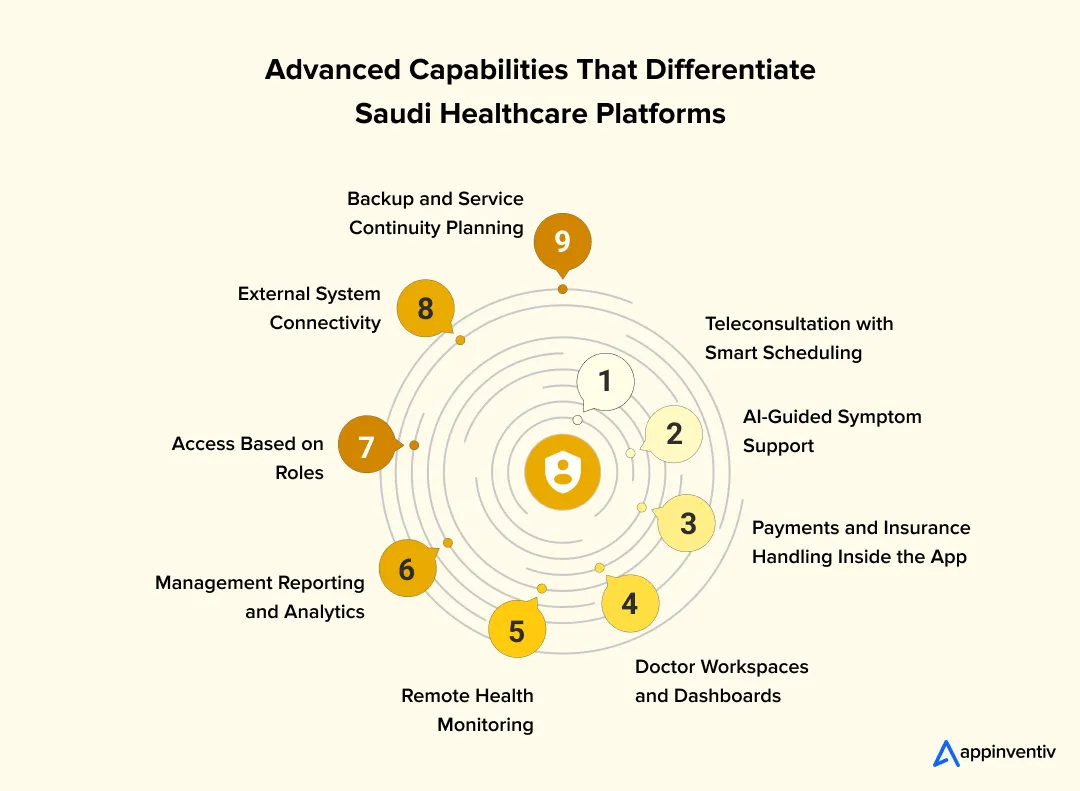
Teleconsultation with Smart Scheduling
Patients do not just want video calls. They want fast access to the right doctor at the right time. Smart scheduling reduces overload on popular doctors and directs routine cases efficiently.
AI-Guided Symptom Support
People go online first before visiting clinics. Guided symptom flows help patients decide whether they need urgent care, a consultation, or lifestyle support. This reduces unnecessary visits and improves response quality.
Payments and Insurance Handling Inside the App
Nobody wants paper forms at reception. Digital payments and insurance checks inside the app speed up admissions and reduce billing confusion.
Doctor Workspaces and Dashboards
Doctors need clean views of their schedules, patient lists, and reports. When systems work well for clinicians, mistakes are reduced and care quality improves.
Remote Health Monitoring
Chronic patients cannot visit hospitals weekly. Data shared from home devices helps doctors intervene early before conditions worsen.
Management Reporting and Analytics
Leadership teams need more than numbers. They need insight. Real usage data shows where systems break, where patients delay, and where services underperform.
Access Based on Roles
Not everyone should see everything. Clean permission structures prevent data exposure and simplify responsibilities across clinical teams.
External System Connectivity
Lab systems, pharmacies, and clinics operate separately. When systems talk to each other, efficiency rises without hiring more staff.
Backup and Service Continuity Planning
Healthcare systems cannot afford downtime. When apps fail, patient safety is at risk. Good systems plan for failure long before it happens.

How To Make A Healthcare Mobile App In Saudi Arabia
Building software for healthcare in Saudi Arabia is not the same as building a retail app or a booking tool. You are working inside a tightly regulated environment, with high patient expectations and serious responsibility around data, uptime, and accuracy. A strong healthcare mobile app in Saudi Arabia is built through a process that connects business goals, local realities, and system design from day one.
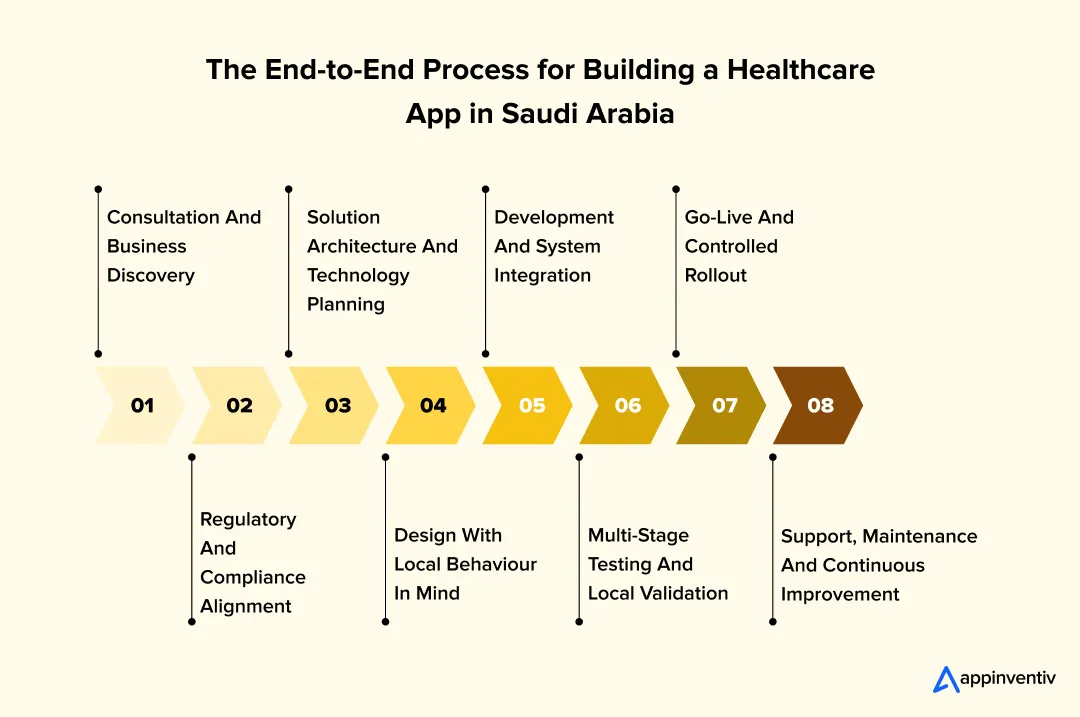
Consultation And Business Discovery
The process starts with understanding how your healthcare operation actually works. A hospital in Riyadh does not run the same way as a smaller private clinic in Jeddah. The conversations at this stage cover your patient volumes, internal workflows, existing systems, and growth plans. When done correctly, this step sets realistic timelines and defines the true cost to build a healthcare app in Saudi Arabia before development begins.
Regulatory And Compliance Alignment
Saudi Arabia has strict rules around medical data and digital systems. Before designs are finalized, legal and technical teams align on patient privacy, data storage location, access control, and audit requirements. Healthcare app compliance in Saudi Arabia is not a document exercise. It directly impacts how features are built, how logs are stored, and how users gain access to records.
Solution Architecture And Technology Planning
Once requirements are clear, the system blueprint is created. Teams decide how mobile apps, databases, and internal dashboards connect. A healthcare platform built for one hospital looks very different from a system expected to scale across multiple cities. This step plays a major role in healthcare app development cost because architecture choices affect hosting, performance, and future expansion.
Design With Local Behaviour In Mind
Design in Saudi healthcare is built for real usage, not cosmetic style. Arabic-first layouts, simple navigation, and clarity for older users matter. Teams map how a patient books an appointment, uploads a report, or joins a consultation while rushing between work and family obligations. Poor design increases support costs and reduces adoption, no matter how strong the technology is.
Development And System Integration
This is where engineering begins. Mobile interfaces, backend systems, and admin dashboards are developed together. If you are doing app development for healthcare at scale, integration with existing hospital systems, labs, or pharmacies is handled here. Testing starts early so problems do not explode at the end.
Multi-Stage Testing And Local Validation
Testing in Saudi healthcare cannot be rushed. Systems are checked for data protection, reliability, and user experience in real environments. Doctors, reception teams, and support staff are often involved in validation. These rounds of feedback directly affect cost but reduce risk before launch.
Go-Live And Controlled Rollout
Instead of launching everywhere, many Saudi hospitals start with one location. This controlled rollout allows teams to fix operational gaps before full deployment. It also protects user confidence during the first real exposure.
Support, Maintenance And Continuous Improvement
After launch, the work moves from building to evolving. Updates are released, security is monitored, and user feedback is reviewed. The best medical application development teams treat post-launch as a partnership, not a handover. Maintenance is not optional. It is a business responsibility.
How Healthcare Apps in Saudi Arabia Generate Revenue
Understanding development cost is only half the equation. Smart healthcare platforms in Saudi Arabia are built with revenue in mind from day one. Hospitals, clinics, and digital health startups do not just launch apps, they design platforms that recover cost and scale business impact over time.
Below are the most effective monetization models used in the Saudi healthcare market:
| Monetization Model | How It Works | Why It Fits the Saudi Market |
|---|---|---|
| Subscriptions | Hospitals and clinics pay recurring fees for access to features and tools. | Works well for enterprise groups and multi-branch hospitals. |
| Teleconsultation Fees | Patients pay per virtual visit through local payment systems. | Matches real-world billing behavior. |
| Hospital Licensing | Organizations pay to deploy the platform across locations. | Strong B2B model with long-term revenue potential. |
| Insurance Integration | Revenue through claim automation and payer-side tools. | Reduces paperwork and speeds approvals. |
| Diagnostic & Pharmacy Commissions | Commission on test bookings and medicine orders. | Scales with patient volume. |
| Premium Features | AI tools, analytics, and reporting offered as add-ons. | Encourages upgrades among enterprise users. |
How Can Your Healthcare App Stand Out in the Saudi Market
Saudi Arabia does not have a shortage of healthcare apps. What it does have is a shortage of healthcare apps that truly work well in everyday life. Patients in Riyadh will uninstall an app faster than they downloaded it if bookings fail or data feels unsafe. And healthcare leaders quickly move on from platforms that do not grow with their operations. Standing out here is not about keeping up with the design trends in mobile health app development but about building something that feels dependable, local, and operationally solid.
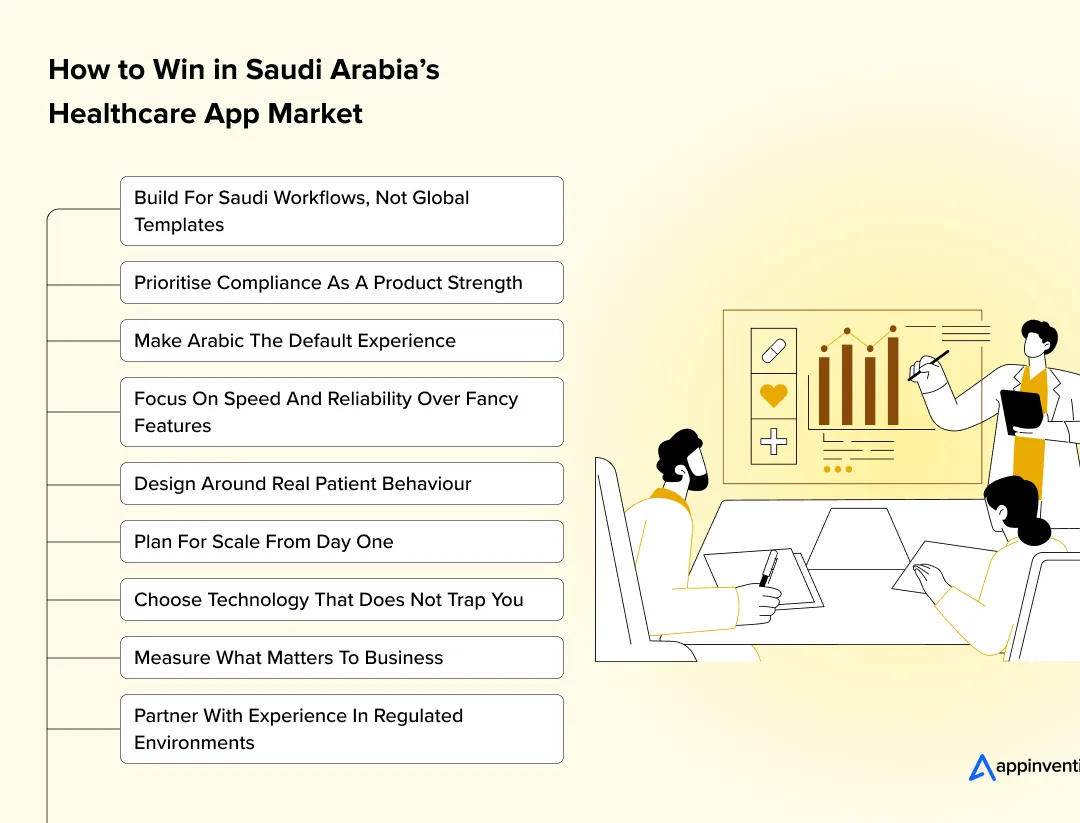
Build For Saudi Workflows, Not Global Templates
Many platforms fail because they try to copy western healthcare models into Saudi hospitals. The reality is different here. Patient volume patterns, clinic operating hours, and doctor availability change how systems must behave. Healthcare mobile app development in Saudi Arabia must account for these realities so the product fits inside daily hospital operations, not around them.
Prioritize Compliance As A Product Strength
Most teams treat compliance like paperwork. In Saudi, compliance is part of user trust. Apps that clearly protect patient records and enforce access levels earn confidence faster. Strong healthcare app compliance in Saudi Arabia is a competitive advantage, not an afterthought.
Beyond regulatory checklists, patient perception plays a decisive role in adoption. In healthcare discussions, patients consistently express concern about how their personal health data is stored, accessed, and shared within mobile apps. Addressing these fears requires more than backend security it demands transparency, clear consent mechanisms, and visible safeguards that reassure users their data is protected at every stage.
Make Arabic The Default Experience
Do not assume bilingual means Arabic can be secondary. If your app is meant for hospitals in Riyadh or clinics in Jeddah, Arabic-first design is not optional. Navigation, labels, and instructions should feel native. An app that reads like a translation will never feel trustworthy.
Focus On Speed And Reliability Over Fancy Features
Users in Saudi expect systems to work the first time. A slow booking flow, login failure, or missing report will permanently damage confidence. Medical app development in the Saudi Arabian region must prioritize performance under pressure, not visual polish alone.
Design Around Real Patient Behaviour
A patient may have one minute between meetings to check a report. A nurse may update records while managing ten patients. Digital health app development in Reyadh, Jeddah, and every other state in Saudi must support real environments where time is tight and errors are costly.
Plan For Scale From Day One
Apps built only for today break tomorrow. Healthcare application development in Saudi Arabia must assume growth across branches, partners, and cities. Architecture that cannot expand quickly becomes a business blocker.
Choose Technology That Does Not Trap You
Some shortcuts save cost today but cause pain later. Technology decisions should support future integrations, not lock you into one vendor or system. When you build a healthcare app, you are building infrastructure, not just software.
Measure What Matters To Business
Downloads mean nothing if usage is low. Reporting should show appointment success rates, patient drop-offs, and doctor availability. Healthcare app development consulting in Saudi Arabia often focuses on building business insight inside the product.
Partner With Experience In Regulated Environments
Health systems are not startups that can “fail fast.” Mistakes affect people. Teams who understand compliance, infrastructure, and operations deliver platforms that survive long term.
Why Appinventiv Dominates Healthcare App Development in Saudi Arabia
We hope this blog has helped you understand not just the cost ranges, but why those numbers look the way they do for healthcare mobile app development in Saudi Arabia. If you are now thinking about moving from planning to execution, the next decision that matters is who actually builds and scales this platform with you.
Appinventiv works at the intersection of healthcare, product thinking, and regulated technology. That means you are not just getting coders, you are getting a team that understands clinical workflows, data sensitivity, and how hospitals and clinics in markets like Saudi actually operate. From MVPs for fast validation to enterprise platforms with AI, EMR, and insurance integrations, the focus is always on building something that can survive real-world use, not just look good in demos.
Another reason organizations choose us for healthcare app development services is the way projects are run. You get clarity on effort and cost at each stage, support on healthcare app compliance in Saudi Arabia, and practical guidance on what to ship in phase one versus what can wait. Architecture, security, localization, and scalability are baked into the conversation from the start, so you are not paying later to fix what should have been designed correctly on day one.
As the leading mobile app development company in Saudi Arabia, we don’t just build apps; we architect digital healthcare revolutions that transform patient outcomes and skyrocket business growth.
Our track record speaks volumes. We’ve delivered cutting-edge solutions that have redefined healthcare delivery:
- YouCoMM: Revolutionary voice-command healthcare platform transforming in-hospital patient care
- Livia Health: Comprehensive digital ecosystem simplifying appointments, prescriptions, and patient access
- Health-ePeople: Sophisticated medical management system streamlining health records nationwide
If you are planning to build a healthcare app that serves patients in Riyadh, Jeddah, or across the Kingdom, and you want a partner that treats your product like long term infrastructure rather than a one off project, Appinventiv is built for that kind of work. Contact us today and transform your vision into reality.
FAQs
Q. What is the cost involved in developing a healthcare mobile app in Saudi Arabia?
A. The cost of healthcare mobile app development in Saudi Arabia can range anywhere from 112,500 SAR to 2,250,000 SAR ($30,000 to $600,000). The big price difference comes down to how fancy you want your app. A simple working version with basic features hits the low end, while full business systems with AI smarts, hospital record connections, and detailed data tools cost the most. What drives your price: how complex your features are, what tech you use, health rules you follow, and connecting to existing hospital systems.
Q. How can you select the ideal healthcare app development partner in Saudi?
A. Picking the right healthcare app development partner in Saudi Arabia means checking several important things. Find companies with ISO certifications (9001, 27001) and HIPAA compliance so you know they handle security properly. Check their healthcare work – look at successful projects and what clients say about them.
Make sure they understand Saudi healthcare rules and what the local market actually needs. Pick partners who really know EHR/EMR integration, video doctor platforms, and making everything work in Arabic. Check their help after launch, growth abilities, and team size for long-term success.
Just as importantly, choose a partner that understands Vision 2030. Your platform should not only solve today’s problems but also align with Saudi Arabia’s long-term digital health goals.
A development partner that builds with national roadmaps in mind will help you clearly understand the benefits of healthcare mobile apps for patients and providers, ensuring your platform delivers value not only to users but also to your clinical teams and business operations over the long term.
Q. What is the typical timeline for developing a healthcare app?
A. Building a healthcare app usually takes 3-15 months, depending on how complicated you want it. A simple working version takes 3-4 months and covers basic stuff like signing up users and booking appointments. Apps with video doctor visits and hospital record connections need 6-9 months. Big complex systems with AI diagnosis tools, lots of connections, and detailed data analysis take 12-15 months. What affects timing: following health rules, connecting to other systems, testing everything thoroughly, and getting approved for app stores.
Q. What steps can be taken to maintain data security in healthcare app development for Saudi region?
A. Keeping data safe in Saudi healthcare apps means building several layers of protection. Get ISO 27001 certification and HIPAA compliance first – these are your baseline requirements. Lock down data when it moves and when it sits in storage, use strong login systems like requiring multiple passwords. Make sure you follow data residency compliance by keeping everything on Saudi cloud servers. Run regular security checks, try to hack your own system, and look for weak spots. Follow SAMA regulations for money stuff, teach your team about security, and have plans ready if something goes wrong. Keep checking compliance to stay protected.

- In just 2 mins you will get a response
- Your idea is 100% protected by our Non Disclosure Agreement.

Healthcare Kiosk Software Development – Benefits, Use Cases, Features, Costs, Process
Key takeaways: The healthcare kiosks streamline administrative processes, enhance patient flow, improve staff productivity, reduce costs, and enhance the patient experience. Healthcare kiosks enhance efficiency and personalized care through EMR/EHR-integrated kiosk software with AI, delivering real-time data updates. Scalable kiosk solutions lower operations expenses, enhance patient throughput and improve service delivery in healthcare organizations. Patient…

How To Develop a Sustainable Healthcare System?
Key Takeaways Rising costs and climate pressure make building a sustainable healthcare system a core business and risk strategy decision. Learn the key principles of sustainable healthcare system development, including prevention, efficiency, equity, and social sustainability. See how AI, data platforms, and a sustainable digital system in healthcare cut waste, improve outcomes, and stabilize workforce…

EHR Implementation for Healthcare Providers: Process, Features, and Total Cost Analysis
Key takeaways: A clear EHR implementation guide keeps teams on track and prevents delays. The full EHR implementation process includes planning, setup, moving data, training staff, and regular updates. The right features handle clinical work, billing, reports, and compliance for large healthcare organizations. EHR implementation costs vary based on design, integrations, data migration, training hours,…