






























Cybersecurity Risk Management – Strategy, Framework, Implementation Plan

- Why Do $4.44M Breach Costs Prove the Importance of Risk Management in Cybersecurity?
- What Are the Core Pillars of a Cybersecurity Risk Management Strategy?
- How Can Enterprises Build a Cybersecurity Risk Management Framework?
- What Are the Key Advantages of Cybersecurity Risk Management for Enterprises?
- What Does a 90-Day Cybersecurity Risk Management Plan Look Like?
- Which Risk Management Techniques in Cybersecurity Tackle Modern Threats?
- How to Choose the Right Technology Stack for Cybersecurity Risk Management?
- Should Enterprises Build, Buy, or Partner for Cybersecurity Risk Management Services?
- Which KPIs Matter Most for Effective Cybersecurity Risk Management?
- What Are the Common Challenges in Cybersecurity Risk Management?
- What Is the Future of Enterprise Cyber Risk Management?
- Why is Appinventiv the Perfect Partner for Cybersecurity Risk Management?
- Frequently Asked Questions

Key takeaways:
- Digital transformation is rapidly increasing attack surfaces, rendering annual risk assessments obsolete in as little as 90 days.
- Effective cybersecurity risk management has to be treated just as any other business risk: with executive-level accountability and ongoing monitoring.
- Breaches involving third-party vendors exceed 60%, underscoring the need for end-to-end supply chain risk management.
- Companies with mature risk management in their cybersecurity programs have lower breach costs and faster recovery times.
Your CISO walks into the boardroom. The question isn’t whether a breach will happen. It’s whether your organization will survive when it does.
Most enterprises approach cybersecurity risk management the way they approach insurance—something you buy and hope never to use. That mindset creates a dangerous gap between what boards believe is protected and what actually stands between your business and catastrophic loss.
The average breach costs $4.44 million in direct expenses. But that figure tells maybe 20% of the story. The other 80% shows up in customer churn, brand erosion, M&A valuation drops, and competitive position losses that compound over the years.
Digital transformation expands attack surfaces faster than traditional security can protect them. Cloud adoption, remote work, and third-party integrations create dynamic risk that changes daily. Annual risk assessments are obsolete within 90 days of completion, making continuous cyber risk management essential.
Organizations that succeed treat cyber risk like financial risk, with board oversight, executive accountability, disciplined frameworks, and continuous monitoring to protect revenue, reputation, and long-term business flexibility.
This guide outlines a practical enterprise cyber risk strategy, proven framework, and implementation roadmap aligned with standards such as NIST CSF, ISO 27001, and FAIR to help shift from reactive security to strategic resilience.
Why Do $4.44M Breach Costs Prove the Importance of Risk Management in Cybersecurity?
A data breach does not end when systems come back online. IBM’s 2025 report places the average breach cost at $4.44 million, with healthcare incidents reaching breach costs of up to $10.93 million, reinforcing the urgency of healthcare data security. These figures cover forensics, legal response, and notification obligations. The broader impact unfolds over time, as security incidents influence customer behavior, brand perception, and long-term revenue.
What typically follows a major breach:
- 18 to 36 months of customer attrition, brand credibility decline, and lower M&A valuation
- 15% to 25% lower deal value during mergers or acquisitions
- Sales cycles that slow as trust rebuilds
- Strategic partnerships that quietly dissolve
Operational disruption compounds the damage. Enterprises experience an average of 23 days of downtime, with revenue losses ranging from $5,000 to $50,000 per minute, depending on industry and service model. Leadership attention shifts from growth to crisis response, creating further exposure.
This is where the importance of risk management in cybersecurity becomes clear. It is not an IT safeguard. It is a business survival discipline.
Extensive AI use helps reduce cyber risk and operational costs.

When Does Cyber Risk Become an Existential Business Threat?
Some incidents create damage that money alone cannot quickly repair.
- Intellectual property theft that gives competitors a lasting advantage
- Customer data exposure is driving 20 to 40% churn in B2C and 10 to 15% in B2B, a reality already playing out in cybersecurity in banking.
- Rising executive accountability, with CISOs and CIOs increasingly held responsible for oversight failures
Also Read: A CIO’s Guide to IT Risk Management – Strategies, Process, Frameworks and More
Why Does Traditional Security Fail at Cyber Risk Management?
Most enterprises are not breached because they lack tools. They are breached because tools are not aligned.
- Compliance certifications signal process maturity, not real-world resilience
- 50 to 80 security tools operating in silos create alert fatigue and blind spots
- Disconnected systems slow detection and response when real attacks occur
Cybersecurity today is a business risk function. The leadership question is no longer whether to invest, but how to build security programs that sustain continuity and recovery under pressure.
What Are the Core Pillars of a Cybersecurity Risk Management Strategy?
Effective cyber risk management programs stand on five interdependent pillars. Weakness in any one compromises the entire structure. With 88% of cybersecurity breaches caused by human error, technical controls alone can’t protect you.
You need governance, training, and process discipline across all pillars to become essential. Organizations with mature implementations across all five see lower breach costs and faster incident response.
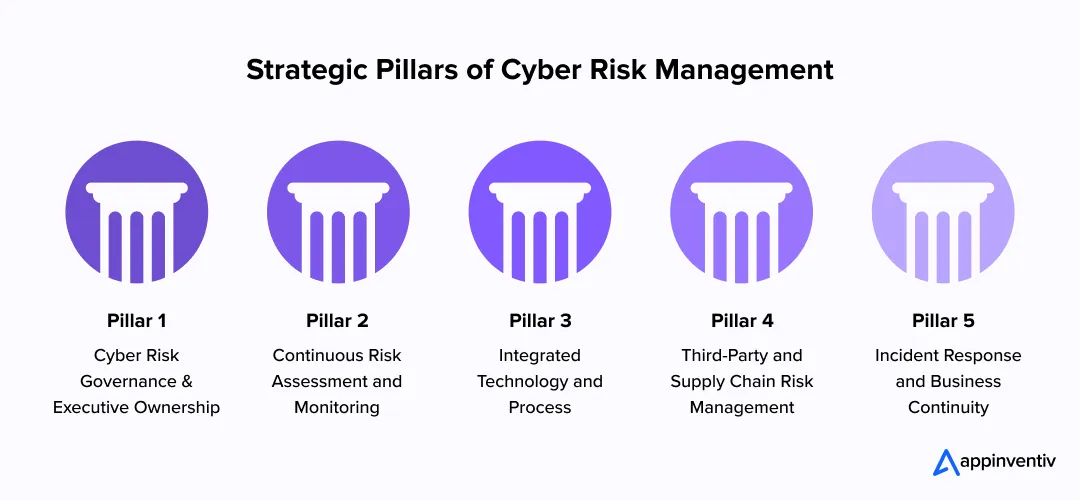
Pillar 1: Cyber Risk Governance and Executive Ownership
Board-level oversight separates programs that work from programs that exist on paper.
Your cyber risk governance structure needs dedicated attention. Developing a robust cybersecurity risk management strategy requires either a standalone cyber risk committee or oversight by a formal audit committee. Not a quarterly PowerPoint buried in other business.
Quarterly briefings are a minimum. Clear accountability to the CEO and board. Budget allocation tied to actual risk appetite, not IT wish lists.
The Accountability Model Matters:
- The CEO owns ultimate accountability. Culture comes from the top. Crisis response leadership. Budget approval and strategic prioritization.
- CISO owns day-to-day risk management. Strategy development and execution. Board reporting without translation layers. Cross-functional coordination across business units.
- The CIO/CTO owns secure architecture and technology risk. Innovation security integration. Operational resilience and system availability.
- The CFO owns risk quantification and insurance strategy. Budget allocation based on financial models. Impact assessment in business terms.
- The General Counsel owns regulatory compliance and disclosure decisions. Contractual risk management. Litigation and investigation response.
Effective cyber risk governance demands clear ownership at every level, from board oversight to operational execution.
Pillar 2: Continuous Risk Assessment and Monitoring
Annual assessments are obsolete within 90 days of the assessment date. Modern cybersecurity risk assessment requires continuous capability.
Traditional annual cycles can’t keep pace. Threat landscapes evolve daily. Your environment changes through normal operations. Cloud resources spin up and down, creating new cyber risk management challenges daily that require strong cloud application security. Vendors come and go. Employees join and leave.
As enterprises deploy connected devices across manufacturing, logistics, healthcare, and smart workplaces, IoT security becomes a critical extension of cybersecurity risk management, requiring continuous asset discovery and monitoring across non-traditional endpoints.
Continuous Assessment Components:
Real-time threat intelligence from industry ISACs, dark web monitoring, and adversary tracking. Automated asset discovery covering cloud, on-premise, SaaS, mobile, and IoT. Continuous vulnerability scanning with business context prioritization, not just CVSS scores.
Predictive risk modeling using FAIR or similar frameworks. Dynamic risk scoring that adjusts as your environment changes.
Operational Cadence:
Effective cyber risk assessment requires asset inventory updates daily through automation. Vulnerability assessments are conducted continuously. Threat landscape reviews weekly.
Formal risk assessments are conducted quarterly. Comprehensive risk reviews are conducted annually, completing the cyber risk management lifecycle and informing the next planning cycle.
This isn’t about generating more reports. It’s about maintaining current visibility into what could actually hurt your business.
Following cybersecurity risk management best practices means maintaining explicit protection protocols for crown-jewel assets. Threat actors profiling relevant to your industry, not generic lists. Attack surface mapping with reduction targets. Risk register maintenance with a clear business context.
Pillar 3: Integrated Technology and Process
Security tools only deliver value when integrated into cohesive workflows with clear ownership. The average enterprise runs 50-80 security tools. That’s not a security stack. That’s a management nightmare, creating blind spots and alert fatigue.
Essential Capabilities Properly Integrated:
Unified Security Operations Center for centralized monitoring and response. SIEM/SOAR platforms for log aggregation, correlation, and automated response workflows. Extended Detection and Response (XDR) provides unified threat visibility across endpoints, networks, cloud, and email.
Identity and Access Management (IAM/PAM), enforcing zero trust and monitoring privileged accounts. Cloud Security Posture Management (CSPM) detects multi-cloud misconfigurations before they become breaches.
Integration Success Factors:
API-first architecture enabling tool interoperability. Single pane of glass for security operations, not 15 different consoles. Automated workflows reduce manual toil by 60-70%. Documented playbooks for common scenarios that teams actually follow.
Regular testing and optimization based on real operational experience, not vendor promises. Technology without process fails. Process without technology doesn’t scale. Integration bridges that gap.
Pillar 4: Third-Party and Supply Chain Risk Management
Sixty percent of breaches originate from third-party vendors, making cybersecurity third-party risk management a critical business imperative. You own the risk even when you don’t own the systems.
The average enterprise maintains thousands of vendor relationships, each representing potential exposure, especially in cybersecurity in manufacturing environments. Most organizations have vendor relationships with at least one breached third party.
Regulatory liability extends to vendor actions. GDPR doesn’t care if your processor got breached. HIPAA doesn’t distinguish between your mistake and your vendor’s. The fine still lands on your desk.
Comprehensive Cybersecurity Third-Party Risk Management Requires:
Pre-contract due diligence before you sign. Security questionnaires (SIG, CAIQ, custom). SOC 2 Type II reviews are less than 12 months old. Cyber insurance verification with $10M+ coverage for critical vendors. Past incident disclosure for the last three years.
Contractual security requirements that actually protect you. Minimum security standards. Incident notification within 24-48 hours. Right-to-audit clauses you’re willing to exercise. Subprocessor disclosure and approval rights.
Ongoing monitoring after contract signing. Continuous security ratings through BitSight, SecurityScorecard, or UpGuard. Quarterly business reviews for critical vendors. Real-time breach monitoring and notification.
Risk Tiering Determines Attention Level:
- Tier 1 Critical vendors with sensitive data access get a comprehensive assessment and quarterly monitoring. Executive sponsorship. No substitutes available. Examples: cloud providers, payment processors, core SaaS platforms.
- Tier 2 High-Risk vendors with moderate data access get standard questionnaires and semi-annual reviews. Security team oversight. Examples: marketing platforms, analytics tools, professional services.
- Tier 3 Standard vendors with limited access get basic questionnaires and automated monitoring. Procurement handles security support. Examples: office supplies, low-impact SaaS.
Fourth-party risk (your vendors’ vendors) creates blind spots most organizations ignore until it’s too late. Require vendor disclosure of all subprocessors. Demand contractual flow-down of security requirements. Accept risk explicitly for what you can’t control.
Also Read: What are the best strategies for supply chain risk management?
Pillar 5: Incident Response and Business Continuity
Prevention fails eventually. Resilience comes from rapid detection, effective response, and fast recovery.
Organizations with integrated incident response and business continuity recover three times faster, reflecting principles found in a digital immune system. They maintain operational continuity during attacks. They preserve customer trust through transparent communication.
A. Incident Response Essentials:
Documented playbooks for your top 10 scenarios, not generic templates. Quarterly tabletop exercises with cross-functional teams, not annual checkbox events. Crisis communication templates ready for customers, aboard, regulators, and media.
Forensics and legal retainers in place before you need them. Recovery time objectives (RTOs) and recovery point objectives (RPOs) are defined based on business input. RTO defines how quickly operations must resume, while RPO defines acceptable data loss tolerance.
B. Business Continuity Integration:
Cyber scenarios are included in business continuity planning rather than treated separately. Backup testing through actual restoration, not just backup verification. Alternate processing capabilities identified and validated.
Supply chain redundancy for critical vendors. Cyber insurance optimized for coverage adequacy and premium management.
The assume-breach mentality changes everything. You’re not building walls to keep attackers out. You’re building a rapid detection and response capability to limit damage when they get in because they will get in.
How Can Enterprises Build a Cybersecurity Risk Management Framework?
A robust cybersecurity risk management framework provides structure, but generic implementations fail at enterprise scale. Security breaches in 2025 were up 75% year-over-year, with organizations facing an average of 1,876 attacks per quarter.
The right framework matches your business context, regulatory environment, and organizational maturity in this accelerated threat environment. Customization determines outcomes, not the badge on your website.
Four primary options dominate enterprise implementations. Most organizations adopt hybrid approaches combining strengths from multiple standards.
NIST Cybersecurity Framework (CSF 2.0)
Structure: Govern → Identify → Protect → Detect → Respond → Recover
Best for US-based enterprises, government contractors, and organizations wanting flexibility. Four implementation tiers from Partial to Adaptive. Non-prescriptive and industry-agnostic. Maps well to other standards.
Requires customization for your specific environment. Implementation typically takes 6-12 months.
ISO/IEC 27001:2022
Structure: Plan-Do-Check-Act cycle with 93 controls across 14 domains.
Best for global enterprises, European operations, and organizations needing certification. International recognition with auditable standards. More prescriptive with heavier documentation requirements.
Certification-based, with regular audits. Implementation takes 12-18 months.
FAIR (Factor Analysis of Information Risk)
Structure: Quantitative risk model translating technical risk to financial terms.
FAIR outputs financial risk metrics such as Annualized Loss Expectancy (ALE), enabling boards to compare cyber risk directly against other enterprise risks.
Best for financial services, insurance, and large enterprises needing board-ready financials. Speaks CFO and board language directly. Drives risk-based investment decisions.
Requires significant data and analytical rigor. Implementation takes 6-9 months.
Hybrid Approach (Most Common)
Combines NIST structure, ISO controls, and FAIR quantification. Tailored to industry-specific requirements like HIPAA, PCI-DSS, or SOC2. Delivers the best of all worlds with trade-offs in complexity.
Implementation takes 9-15 months, depending on the scope.
COMPARISON TABLE: Framework Quick Reference
| Framework | Time (Months) | Flexibility | Certification | Board Communication | Typical Cost Range |
|---|---|---|---|---|---|
| NIST CSF | 6 to 12 | High | No | Medium | $100K-$500K |
| ISO 27001 | 12 to 18 | Medium | Yes | Medium | $150K-$750K |
| FAIR | 6 to 9 | High | No | Excellent | $75K-$300K |
| Hybrid | 9 to 15 | Highest | Partial | Excellent | $200K-$800K |
Cost ranges include consulting, implementation, tools, and initial setup. Annual operational costs are separate.
What Are the Key Advantages of Cybersecurity Risk Management for Enterprises?
Most conversations about security start with tools. Firewalls. Monitoring. AI detection. But in real operations, the question is simpler. When something breaks, can the business keep moving? That is where cybersecurity risk management quietly proves its value.
A well-run program does more than reduce incidents. It builds organizational muscle memory. Teams know where weak points are. Leaders know what decisions to make under pressure. The result is stability you feel long before it shows up in reports.
Keeping the Business Running
When response plans are tested and recovery paths are clear, attacks do not automatically become outages. Systems stay available longer. Restoration starts faster. Downtime shrinks because chaos has already been rehearsed.
Real Money Saved
Breaches get expensive when detection is slow, and response is improvised. Structured risk programs surface threats earlier, prioritize remediation based on business impact, and prevent minor exposures from turning into large-scale events.
Trust that Doesn’t Need a Press Release
Customers, partners, and regulators notice consistency. A visible, repeatable approach to handling risk signals maturity. Over time, security stops being an internal IT concern and becomes part of corporate credibility.
Meeting the Rules Without Scrambling
Mapped controls, maintained evidence trails, and continuous monitoring turn audits into verification, not last-minute preparation. This is where the importance of risk management in cybersecurity becomes tangible.
A Quiet Edge Over Competitors
In markets where data protection influences buying decisions, reliability stands out. When two providers look similar on paper, the one that demonstrates operational resilience usually wins the trust.
What Does a 90-Day Cybersecurity Risk Management Plan Look Like?
Now that you have chosen a cybersecurity risk management framework, you can begin building your cybersecurity risk management plan. You must remember, perfection is the enemy of progress. So, start with a focused scope, prove value, then scale. This 90-day roadmap moves you from commitment to measurable risk reduction without paralysis by analysis.
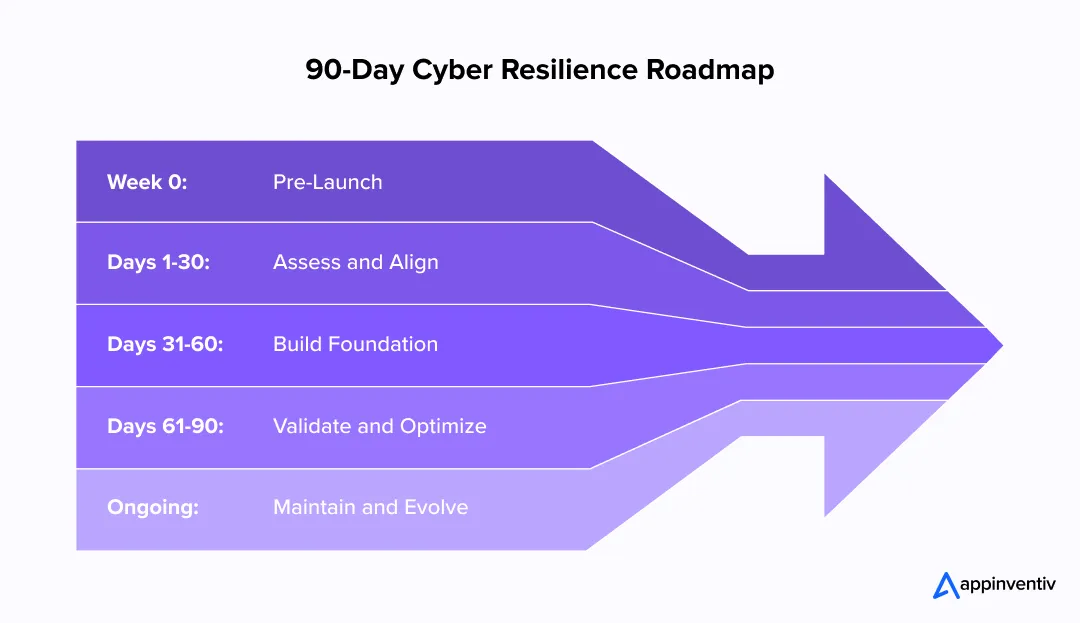
1. Week 0: Pre-Launch
Before you start the execution, cybersecurity strategic planning requires securing executive buy-in and defining the project’s scope to ensure alignment and set the stage for success in the coming weeks.
- Secure executive sponsorship with defined budget authority. CEO or board commitment with clear success criteria. Cross-functional steering committee formation.
- Define focused scope. Don’t boil the ocean. Start with one critical business unit, one high-value asset category, or one urgent compliance requirement.
- Select core team: project lead, security architect, GRC specialist, IT representative, business stakeholder.
2. Days 1-30: Assess and Align
With executive support in place, it’s time to conduct a thorough risk assessment, evaluate existing controls, and lay the groundwork for the necessary resources to move forward.
- Weeks 1-2: Rapid cybersecurity risk assessment, identifying critical assets and data flows. Current control evaluation showing what works and what doesn’t. Quick win identification for immediate impact.
- Week 3: Gap analysis against the selected framework. Risk scoring and priority ranking by business impact. Resource planning for technology, staffing, and timeline.
- Week 4: Executive presentation with current state findings, risk heat map, recommended initiatives, and budget request. Budget approval with quantified risk reduction justification.
3. Days 31-60: Build Foundation
Now that you have a clear understanding of your current state, the next phase focuses on establishing foundational cybersecurity measures for your business and processes to drive long-term resilience.
- Week 5 Quick Wins: Deploy MFA across critical systems. Patch critical vulnerabilities (CVSS 9.0+). Remove orphaned accounts and excessive privileges. Enable basic monitoring and logging.
- Week 6 Process Foundation: Document core policies. Establish risk register. Define escalation procedures. Set up a regular reporting cadence.
- Week 7 Technology Foundation: Deploy or configure SIEM. Implement EDR across endpoints. Activate vulnerability scanning. Enable cloud security monitoring.
- Week 8 Training: Launch security awareness. Conduct a phishing simulation baseline. Train the incident response team. Educate executives on cyber risk.
4. Days 61-90: Validate and Optimize
After implementing key measures, the final phase is to test, refine, and validate the infrastructure to ensure it can withstand evolving cyber threats while optimizing for continuous improvement.
- Weeks 9-10: Identify critical vendors. Initiate vendor assessments. Deploy continuous monitoring tools. Create vendor risk tiers.
- Week 11 Testing: Conduct a tabletop exercise. Run a penetration test. Test backup restoration. Validate incident response procedures.
- Week 12 Measurement: Establish KPI baselines for MTTD, MTTR, vulnerability-closure rate, and MFA adoption. Board reporting with 90-day accomplishments. Year 1 roadmap with Q2 priorities.
After day 90, maintain and evolve your cybersecurity risk management plan through monthly risk committee meetings, quarterly board reporting, and annual comprehensive assessment.
Which Risk Management Techniques in Cybersecurity Tackle Modern Threats?
Most enterprises already have the basics in place. Firewalls. Endpoint protection. Access controls. That foundation still matters. But modern attackers plan around it. This is why risk management strategies in cybersecurity now focus on early visibility, controlled access, and fast response.
Core practices still matter.
- Defense in depth across network, application, data, and identity layers to prevent single points of failure
- Least-privilege access enforced through just-in-time provisioning and continuous access reviews
- Segregation of duties so no individual controls critical processes end-to-end.d
These fundamentals are necessary. They are no longer enough on their own.
Advanced risk management techniques in cybersecurity
- Zero Trust architecture that verifies identity before every session and limits lateral movement through micro-segmentation
- AI-driven detection that builds behavioral baselines, surfaces anomalies in real time, and adjusts risk scoring dynamically
- Proactive threat hunting to uncover attacker activity that automated tools miss
- Red and purple team exercises that simulate real attacks to expose gaps and refine response playbooks
- Security chaos engineering that stress-tests backup, recovery, and incident response before a real crisis
Modern security programs do not replace fundamentals. They reinforce them to match today’s threat speed and sophistication.
How to Choose the Right Technology Stack for Cybersecurity Risk Management?
A security stack only works when its components communicate with one another. In mature cybersecurity risk management programs, tools are wired into daily operations, not sitting in isolated dashboards. The goal is simple. See risk early. Act fast. Prove control effectiveness.
1. Security Operations Platform – SIEM & SOAR
SIEM platforms pull telemetry from endpoints, networks, cloud workloads, and identity systems into one view. Correlation rules and behavioral analytics separate real threats from background noise. SOAR then attaches automated playbooks, so common incidents are contained and documented without waiting for manual response.
2. Governance, Risk, and Compliance
GRC platforms maintain live risk registers, map controls to frameworks such as NIST and ISO 27001, and automate the collection of audit evidence. Instead of scrambling to meet compliance requirements, teams track risk treatment as an ongoing process.
Enterprises seeking a more structured approach to cyber governance often integrate security controls into broader GRC platform features to automate compliance, enabling risk registers, policy enforcement, and audit evidence collection within a unified framework.
3. Identity and Access Management-IAM & PAM
IAM enforces strong authentication and least-privilege access. PAM adds just-in-time admin access, session monitoring, and privilege revocation, closing one of the most common enterprise breach paths.
4. Cloud Security Posture Management (CSPM)
CSPM tools continuously scan cloud environments for misconfigurations, exposed data stores, and policy drift. Advanced teams enforce guardrails through policy-as-code before risky deployments go live.
5. Extended Detection and Response XDR
XDR connects endpoint, network, cloud, and identity signals into a unified threat view. This shortens detection cycles and limits lateral movement when attackers get in.
Should Enterprises Build, Buy, or Partner for Cybersecurity Risk Management Services?
Enterprises typically choose one of three paths to operationalize cybersecurity risk management: build internally, buy tools, or partner with a specialized provider. The right choice depends on internal expertise, time-to-value expectations, and program maturity.
Each path directly affects how efficiently cybersecurity risk assessment, incident response, and security operations scale across the enterprise.
Buy vs Build vs Partner: What It Really Looks Like
| Approach | Typical 3-Year Cost | Time to Value | Capability Outcome |
|---|---|---|---|
| Build In-House SOC | $3.5M to $5M | 12 to 18 months | Full control, high customization |
| Buy Tools + Manage | $1.5M to $2.5M | 6 to 9 months | Faster deployment, internal burden |
| Partner (MDR / SOCaaS) | $600K to $1.5M | 1 to 3 months | Proven expertise, rapid maturity |
| Hybrid Model | $1.2M to $2M | 3 to 6 months | Balanced control and speed |
How to Choose the Right Cybersecurity Risk Management Partner
Enterprise buyers typically evaluate cybersecurity partners based on demonstrated experience in regulated environments and alignment with recognized security governance models. The strongest partners do more than deploy tools. They help enterprises operationalize governance, assessment, and response into a living security program.
When evaluating a partner, look for:
- Demonstrated experience securing complex enterprise environments
- Strong third-party risk handling and vendor oversight processes
- End-to-end delivery across cybersecurity risk assessment, control implementation, monitoring, and incident response
- Use of recognized frameworks such as NIST and ISO 27001
- Clear reporting, KPIs, and executive dashboards that show real risk reduction
The right partner helps transform cybersecurity from a reactive function into a business-aligned resilience engine.
Appinventiv’s cybersecurity services provide continuous monitoring and rapid incident response to protect your organization.

Which KPIs Matter Most for Effective Cybersecurity Risk Management?
Mature security operations teams and industry SOC benchmarking programs commonly track these metrics to measure resilience performance. Walk into any boardroom after a security incident, and one question always comes up. “How bad was it, and could we have seen it earlier?” That is why cybersecurity risk management lives or dies by the right metrics. Not vanity numbers. Signals that reflect real business exposure.
Rather than flooding leadership with reports, mature organizations focus on a small, high-value set of KPIs.
Mature security operations teams and industry SOC benchmarking programs commonly track these metrics to measure resilience performance.
| KPI Category | What to Track | Why It Matters |
|---|---|---|
| Financial Risk | Annualized Loss Expectancy, avoided breach costs, security ROI, and cyber insurance trends | Shows whether financial exposure is rising or shrinking |
| Operational Resilience | MTTD, MTTR, MTTC | Measures how quickly incidents are detected, contained, and stabilized |
| Risk Posture | Continuous cyber risk assessment score, high-risk remediation rate | Provides a live view of enterprise exposure and control effectiveness |
| Third-Party Risk | Vendor security ratings, assessment completion, breach alerts | Highlights external dependencies, introducing hidden risk |
| Executive Oversight | Unified dashboard of financial, operational, and risk indicators | Keeps leadership decisions grounded in current reality |
Shorter detection windows usually indicate strong monitoring and rehearsed responses. Faster remediation signals accountable ownership. Stable insurance premiums often confirm that controls are genuinely reducing risk.
When these KPIs are reviewed regularly at the leadership level, security stops being an IT status update and becomes a business discipline.
What Are the Common Challenges in Cybersecurity Risk Management?
Security leaders often find themselves reacting to issues instead of planning. A new vulnerability alert. A vendor incident. A compliance update that lands with a tight deadline. Cybersecurity risk management today is about handling these realities without slowing the business down.
Below are the key challenges enterprises face, explained clearly, followed by practical ways teams are addressing them.
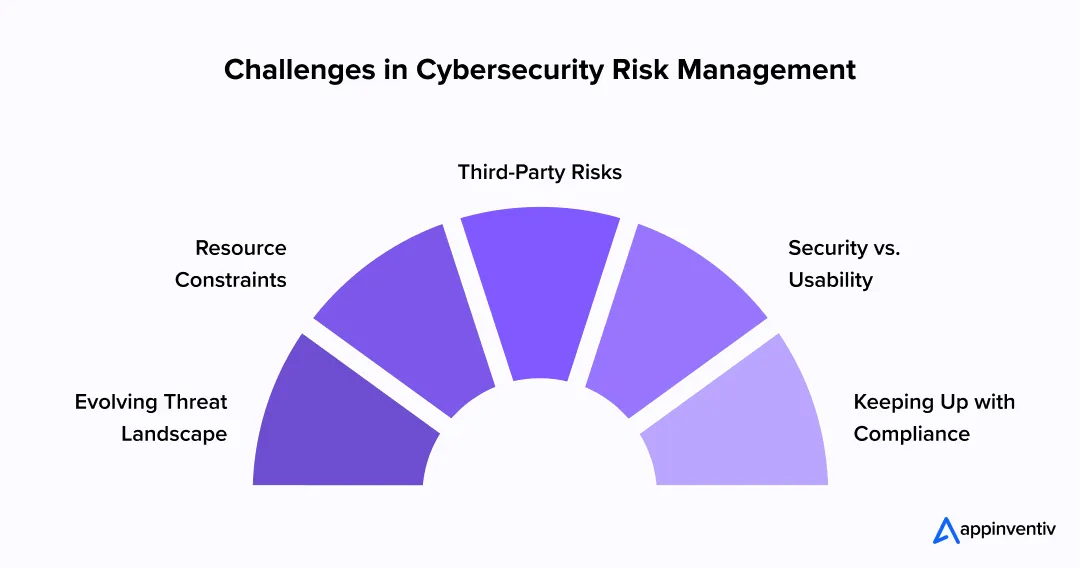
1. Evolving Threat Landscape
New attack techniques appear daily, from targeted phishing to cloud-workload intrusions that occur outside office hours. Static security programs fall behind quickly.
How enterprises are responding:
- Running continuous risk assessments instead of annual reviews
- Updating security rules based on real-time threat intelligence
- Using continuous monitoring systems that adapt defenses as threats shift
2. Resource Constraints
Security budgets are finite, and skilled cybersecurity talent remains scarce. When teams are stretched thin, vulnerabilities remain open longer than they should.
What helps relieve the pressure:
- Partnering with specialized cybersecurity service providers
- Offloading threat monitoring and incident response
- Giving internal teams room to focus on strategic security priorities
3. Managing Third-Party Risks
Modern enterprises rely heavily on vendors, SaaS platforms, and external service providers. Each connection expands the attack surface.
Steps enterprises are taking:
- Enforcing standardized security requirements for all vendors
- Using automated third-party risk rating tools
- Integrating vendor risk scores into overall risk dashboards
4. Security vs. Usability
Overly strict controls frustrate employees and slow workflows. Weak controls invite breaches. Finding balance is essential.
Common approaches:
- Adopting zero-trust access models
- Using contextual identity verification
- Securing systems without adding friction to daily work
5. Keeping Up with Compliance
Cybersecurity regulations change often and differ across regions. Manual tracking is time-consuming and risky.
How enterprises stay aligned:
- Working closely with compliance specialists
- Using automated compliance management platforms
- Maintaining continuous reporting and audit readiness
Also Read: Top 15 Cloud Security Risks in 2026 & How to Tackle Them
What Is the Future of Enterprise Cyber Risk Management?
Most enterprise security teams have felt it. A new threat report lands in your inbox. A vendor breach hits the news. Someone asks in a leadership meeting if you are exposed. That is the reality shaping modern cyber risk planning.
- AI-powered cyber threats: Attackers are using AI to send smarter phishing emails, build convincing fake voices, and automate attacks at scale. One employee clicking a rushed message during a busy workday can open a door. That is why AI-based cybersecurity tools are becoming essential for detecting behavior that looks off before damage spreads.
- Cryptography and quantum computing: Encryption that feels solid today may not hold tomorrow. Security leaders are already discussing harvest now, and decrypting later scenarios. Teams are starting post-quantum cryptography planning to avoid last-minute overhauls.
- Third-party risk management: Your partners, SaaS providers, and open-source libraries extend your environment beyond your walls. Regular vendor checks and continuous monitoring are becoming part of everyday operations.
- Increasing regulations and evolving compliance: New rules, including the EU AI Act, are pulling cyber risk into board discussions. Oversight now needs steady reporting and clear ownership.
- Zero trust and identity-centric security: Identity has become the frontline. Passwordless access and zero trust controls are reshaping cloud and hybrid protection.
Enterprises that act early build a cybersecurity risk management strategy that reduces exposure while supporting growth and trust.
Also Read: Harnessing the Power of AI for Enhanced Risk Management in Business
Take action now to reduce risks and enhance your company’s resilience against cyber threats.

Why is Appinventiv the Perfect Partner for Cybersecurity Risk Management?
Appinventiv partners with enterprises that need security built for real-world scale, not checkbox compliance. With experience across 35+ industries, the team understands how risk manifests differently in retail, finance, healthcare, and logistics and shapes security programs accordingly.
Trusted by brands like IKEA, Adidas, KFC, and Domino’s, Appinventiv has led complex digital transformation initiatives in which cybersecurity services, operational efficiency, and risk reduction must advance together, not in silos.
With 1,600+ specialists and 3,000+ solutions delivered, the company combines advanced platform integration with proven cybersecurity risk management practices. Continuous monitoring, proactive risk assessment, and real-time response help enterprises strengthen resilience, close security gaps, and support secure business growth. Let’s connect and strengthen your cyber resilience.
Frequently Asked Questions
Q. What is Cybersecurity Risk Management?
A. Most enterprise teams hit a point where cyber risk starts feeling like a business concern, not just a tech issue. Cybersecurity risk management helps you identify threats, assess their impact, and reduce exposure before they affect revenue or reputation. It brings governance, controls, and monitoring together so cloud moves, partner integrations, and data initiatives stay secure and manageable.
Q. How does cybersecurity risk differ from IT risk?
A. Where cybersecurity risk deals with malicious actors as a threat to data, networks, and systems, IT risk encompasses a broader range of topics, including system failures, hardware failures, and data integrity issues. IT risk is generally internal, whereas cybersecurity risk is usually external, such as from hackers and ransomware.
Q. How to implement ISO 27001 for cybersecurity risk management?
A. To implement ISO 27001, organizations should create an ISMS. These should be designed to support risk management, risk assessment, and continuous risk monitoring. Discovering sensitive information, assessing related risks, developing a risk treatment plan, and performing regular audits to ensure compliance with security standards and industry regulations are all tasks that might be covered in this process.
Q. What is the NIST cybersecurity risk management framework?
A. NIST Cybersecurity Risk Management Framework: This provides a structured approach for organizations toward the identification, assessment, and management of cybersecurity risk. It covers information systems classification, the selection and integration of security controls, the evaluation of control efficiency, and continuous monitoring to sustain a secure environment that meets organizational missions.
Q. What is risk prevention vs risk mitigation in cybersecurity?
A. Risk prevention consists of a proactive approach in preventing security incidents using firewalls or access controls. The mitigation aspect aims to limit the effects of a security breach once it occurs through strategies such as data encryption, incident response plans, and periodic security audits, thereby minimizing impact and reducing recovery time.
Q. What are compliance requirements for cyber risk management?
A. Cyber risk management compliance standards vary per industry and location, but most often involve the GDPR, HIPAA, and ISO 27001. This set of laws requires that every institution have adequate security systems, be audited periodically, ensure data privacy, and report breaches to mitigate risks and comply with laws and regulations.

- In just 2 mins you will get a response
- Your idea is 100% protected by our Non Disclosure Agreement.

GRC Implementation: Building a Centralized Risk and Compliance Technology Framework
Key takeaways: GRC implementation connects governance, risk, and compliance into a unified enterprise system. Fragmented tools limit real-time risk visibility and delay audit readiness across organizations. Centralized GRC platforms enable continuous monitoring, automation, and system-level compliance tracking. Integration with enterprise systems turns GRC into a live operational risk management layer. Strong governance frameworks improve audit…
Vibe Coding Security Risks: Why Your AI-Generated App is a Ticking Time Bomb
Key takeaways: Vibe coding removes security checks, not just effort Working code doesn’t mean secure code AI speeds up vulnerabilities, not just development Human oversight is essential for safe systems Scaling AI apps requires expert-led security rebuilds [blog_faq] We need to talk about the elephant in the IDE. Everyone is obsessing over "vibe coding." You…
Key Takeaways Vulnerability assessment finds weaknesses. Penetration testing proves exploitability. You need both to understand real exposure. Annual testing isn’t enough. Enterprise environments change too fast for checklist-driven security. Severity scores don’t equal business risk. Prioritization must factor in exploitability, exposure, and impact. Security value comes from remediation, not reports. If findings aren’t fixed and…