

































Crypto Payment Gateway Development: Architecture, Process, Cost & Compliance

- Crypto Wallet vs Crypto Payment Gateway
- Step-by-Step Crypto Payment Gateway Development Process
- Core Architecture of a Crypto Payment Gateway
- Technology Stack for Crypto Payment Gateway Development
- Crypto Payment Gateway Development Cost
- Essential Features of a Crypto Payment Gateway
- Security Framework for Crypto Payment Gateways
- Compliance and Regulatory Requirements for Crypto Payment Gateways
- Build vs Buy vs White-Label Crypto Payment Gateway
- Challenges in Crypto Payment Gateway Development and How to Overcome Them
- Future Trends in Crypto Payment Gateway
- How Appinventiv Can Help Build a Crypto Payment Gateway

Key takeaways:
- Crypto payment gateways connect blockchain transactions with checkout systems to accept and validate payments automatically.
- Building one requires more than wallets, including blockchain integration, payment logic, wallet management, and merchant dashboards.
- Costs typically range from $40,000 to $400,000, depending on complexity, security, and compliance needs.
- Modern gateways offer features like real-time tracking, automated confirmations, and e-commerce integrations.
- Industries like e-commerce, gaming, SaaS, and marketplaces use them to enable seamless global transactions.
Crypto payments aren’t a niche idea anymore. If you look at how online checkouts work today, you’ll notice more eCommerce brands, gaming platforms, and SaaS companies adding them as a real option. Faster international transfers and lower fees are a major reason for this shift, pushing businesses to explore crypto payment gateways instead of relying solely on traditional processors.
The space itself has also grown. In 2026, building a gateway means dealing with clearer regulations, such as MiCA in Europe and the GENIUS Act in the US. Stablecoins now handle a large share of transactions, and there’s a gradual move toward systems that can initiate payments automatically.
This change is already visible. Nearly 40% of merchants accept crypto today, which says a lot about how quickly it’s becoming part of everyday business.
That said, accepting crypto isn’t as simple as adding a wallet address. You need a setup that can verify transactions, manage confirmations, and handle settlements without issues. That’s where crypto payment gateway development comes in: it links blockchain networks with merchant systems and keeps the payment flow smooth.
In the next sections, we’ll break down how to build a crypto payment gateway, its architecture, and the factors that influence development cost.
Businesses are rapidly adding digital assets to checkout. Build a secure crypto payment gateway today.

Crypto Wallet vs Crypto Payment Gateway
These two terms are often confused, especially among people new to crypto payments. But they don’t really mean the same thing. A crypto wallet is simply where digital assets are stored and accessed. A crypto payment gateway, meanwhile, is the system that helps businesses accept and process customer payments.
So before getting deeper into crypto payment processing development, it’s useful to understand how these two pieces work in practice. The table below clarifies the difference.
| Aspect | Crypto Wallet | Crypto Payment Gateway |
|---|---|---|
| Primary Purpose | Stores and manages digital assets | Processes cryptocurrency payments for merchants |
| Core Function | Send, receive, and hold crypto | Verify, process, and confirm payments |
| Typical Users | Individuals, traders, investors | Businesses, eCommerce platforms, service providers |
| Key Responsibility | Managing private keys and wallet access | Handling transaction verification and payment processing |
| Integration | Usually, standalone apps or hardware devices | Integrated with websites, apps, and checkout systems |
| Transaction Handling | Direct peer-to-peer transfers | Automated payment confirmation and settlement |
| Business Use Case | Holding funds or making transfers | Accepting crypto payments from customers |
To put it simply, a gateway concentrates on processing payments, whereas a wallet concentrates on storing assets. When companies construct bitcoin payment gateways, the system usually links to wallet infrastructure in the background, but its primary function is to handle large-scale payments.
Step-by-Step Crypto Payment Gateway Development Process
Building a crypto payment gateway usually sounds simple at first. Accept crypto, verify the transaction, and complete the order. But once development begins, teams realize there is more happening behind the scenes. The system has to track blockchain activity, handle blockchain wallets, confirm transactions, and update merchant platforms at the right moment. That is why how to build a crypto payment gateway normally follows a clear development process rather than a quick integration.
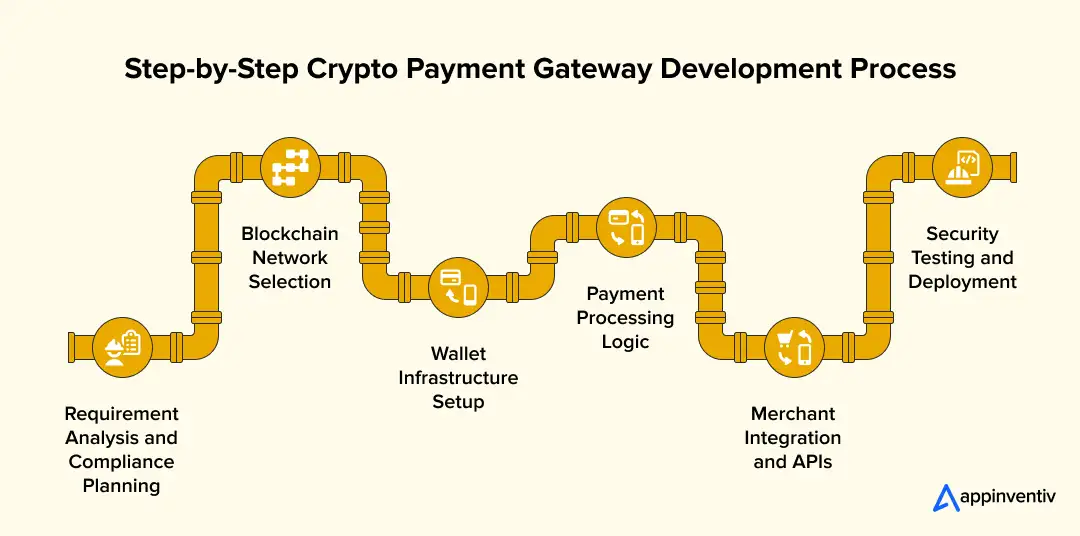
1. Requirement Analysis and Compliance Planning
Most projects start with basic planning. Teams decide what the gateway should support and where it will operate. A company selling globally may need to support multiple currencies and implement stronger compliance checks than a local platform.
Common points discussed at this stage include:
- Supported cryptocurrencies
- Target regions and regulatory requirements
- Settlement preference (crypto, stablecoins, or fiat)
- Expected transaction volume
If the gateway is expected to operate in regulated markets, the team may also plan KYC checks, AML software monitoring, and reporting tools early in the process.
2. Blockchain Network Selection
After the planning stage, the next step is choosing which blockchain networks the gateway will connect to. Not every network behaves the same. Some are faster, some are cheaper, and some support a larger ecosystem of tokens.
Businesses often consider networks such as:
- Bitcoin for widely recognized crypto payments
- Ethereum for token-based payments
- Stablecoin networks that help reduce price volatility
The networks selected here influence the rest of the gateway’s technical setup.
3. Wallet Infrastructure Setup
Every crypto payment gateway needs wallets to receive payments. During this stage, developers configure the wallet system that will generate addresses for each customer transaction.
Typical setup includes:
- Hot wallets for receiving incoming payments
- Cold storage for securing larger balances
- Private key protection and backup procedures
- Multi-signature wallet configurations
Security decisions made here often affect the long-term safety of the platform.
4. Payment Processing Logic
This stage focuses on the payment engine itself. The system monitors blockchain networks and checks whether incoming transactions match the payment requests generated at checkout.
Typical tasks include:
- Monitoring blockchain activity for incoming payments
- Verifying that the payment amount is correct
- Tracking blockchain confirmations
- Updating order status for merchants
Once the transaction reaches the required confirmations, the gateway marks the payment as completed.
5. Merchant Integration and APIs
A gateway only becomes useful when businesses can connect it to their existing platforms. Developers usually create APIs and integration tools so websites, apps, and marketplaces can accept crypto payments without major changes.
This stage often includes:
- Payment APIs for custom platforms
- Webhook notifications for order updates
- eCommerce plugins for checkout integration
- Merchant dashboards for monitoring transactions
These integrations help connect crypto payments with everyday business operations.
6. Security Testing and Deployment
Before the gateway goes live, the system typically undergoes several rounds of testing. Since it deals with financial transactions, security checks are critical.
Testing often focuses on:
- API security and authentication checks
- Transaction simulations
- Infrastructure load testing
- Blockchain node reliability
Once testing is complete, the gateway can move into production and begin processing real payments.
Following this approach makes crypto payment platform development easier to manage. Each stage builds on the previous one, helping teams create a gateway that can handle real payment traffic without unexpected issues.
Core Architecture of a Crypto Payment Gateway
Once a business decides to accept crypto payments, the real challenge is not the checkout button. The challenge is building the infrastructure behind it. A payment gateway has to communicate with blockchain networks, verify transactions, manage wallets, and update merchant systems in real time. This is why crypto payment processing development involves much more than simple API integration.
At a technical level, a crypto gateway works as a bridge between three environments: the customer’s wallet, the blockchain network, and the merchant’s system. The platform must detect incoming transactions, validate them on the blockchain, confirm payment status, and trigger order processing on the merchant side. All of this happens within seconds, often across multiple blockchain networks.
A production-grade gateway typically comprises several interconnected layers.
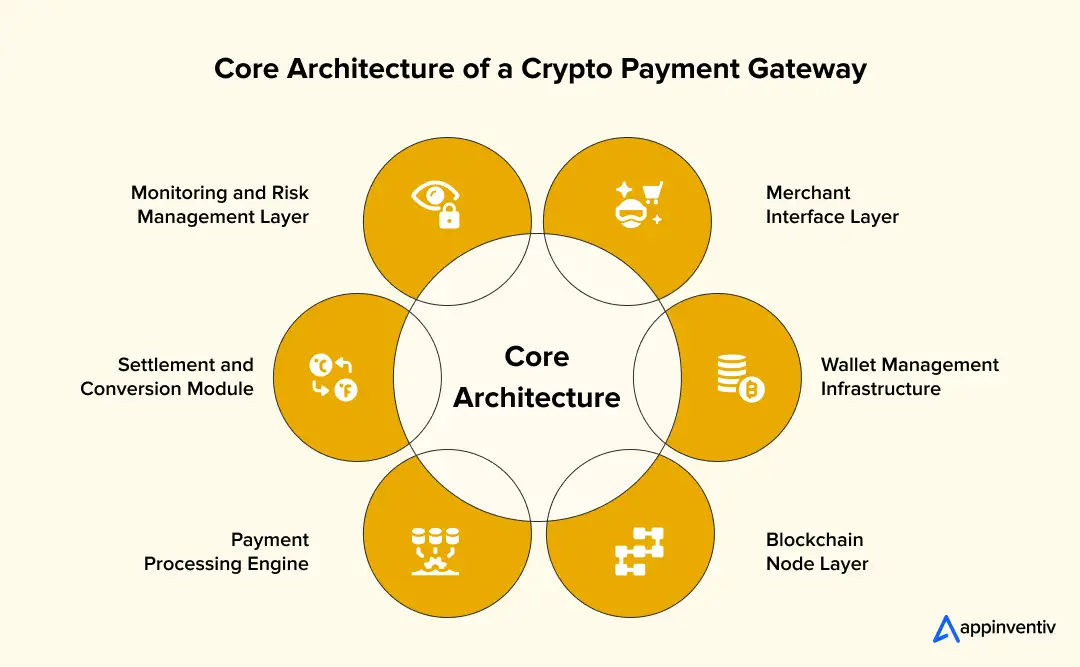
1. Merchant Interface Layer
This is the part businesses interact with. It includes merchant dashboards, payment APIs, and checkout integrations.
Typical components include:
- Payment request generation
- Checkout widgets for websites or apps
- Invoice generation
- Merchant dashboards for transaction tracking
- Reporting and reconciliation tools
When a customer selects crypto at checkout, the system generates a unique payment address or QR code tied to that specific order.
2. Wallet Management Infrastructure
Behind the scenes, the gateway needs wallet infrastructure to receive and manage funds. Most systems rely on a combination of hot wallets and cold wallets.
Key responsibilities include:
- Generating wallet addresses for transactions
- Managing private keys securely
- Storing funds temporarily before settlement
- Supporting multi-currency wallets
Advanced platforms often use multi-signature wallets or MPC (multi-party computation) to reduce the risk of key compromise.
3. Blockchain Node Layer
To verify transactions, the gateway must interact directly with blockchain networks. This is handled through blockchain nodes.
Nodes are responsible for:
- Broadcasting transactions to the network
- Monitoring incoming payments
- Verifying confirmations
- Retrieving transaction data from the blockchain
For reliability, many systems run multiple nodes or use node providers so payment verification continues even if one node becomes unavailable.
Layer 2 Interoperability for Cost Optimization
To reduce high gas fees on networks like Ethereum, modern gateways integrate Layer 2 solutions such as Polygon, Arbitrum, and Base.
This helps:
- Lower transaction costs
- Speed up confirmations
- Improve scalability for high-volume payments
For businesses handling frequent transactions, Layer 2 support makes crypto payments more cost-efficient and practical.
4. Payment Processing Engine
This layer serves as the system’s brain. It monitors incoming blockchain transactions and determines whether a payment matches a merchant request.
Key tasks handled here include:
- Detecting incoming transactions to generate wallet addresses
- Verifying the correct payment amount
- Checking blockchain confirmations
- Updating payment status in the merchant system
For example, a system may mark a transaction as “pending” after the first detection, and “confirmed” after several blockchain confirmations.
5. Settlement and Conversion Module
Businesses often don’t want to hold crypto for long periods because of price volatility. The settlement layer governs how funds are moved after payment.
Depending on the setup, the gateway can:
- Transfer crypto to merchant wallets
- Convert crypto to fiat through exchanges
- Settle funds in stablecoins
- Trigger automated payouts
This module is especially important in crypto payment platform development, where businesses may need automated treasury management.
6. Monitoring and Risk Management Layer
Handling digital assets requires constant monitoring. Production gateways include risk and analytics systems to track platform activity.
These systems typically provide:
- Transaction monitoring dashboards
- Fraud detection alerts
- Network performance metrics
- Compliance reporting tools
This layer helps businesses maintain visibility over their crypto payment operations and detect suspicious activity early.
When these layers work together, the gateway becomes a reliable payment infrastructure rather than a simple crypto integration. For companies investing in a custom crypto payment gateway, designing this architecture correctly is what determines whether the system can scale as transaction volumes grow.
From architecture design to wallet infrastructure and blockchain integrations, our team helps you build a reliable crypto payment gateway step by step.

Technology Stack for Crypto Payment Gateway Development
A crypto payment gateway is not built on one tool or programming language. It usually runs on a mix of web technologies, blockchain connections, databases, and cloud services. Each layer takes care of a different part of the system. Some parts handle the merchant interface, others watch blockchain transactions, and a few manage the security and storage of payment data. When teams start a crypto payment processing platform, choosing the right stack early can save a lot of trouble later.
Below are the main technology layers that typically power crypto payment platform development.
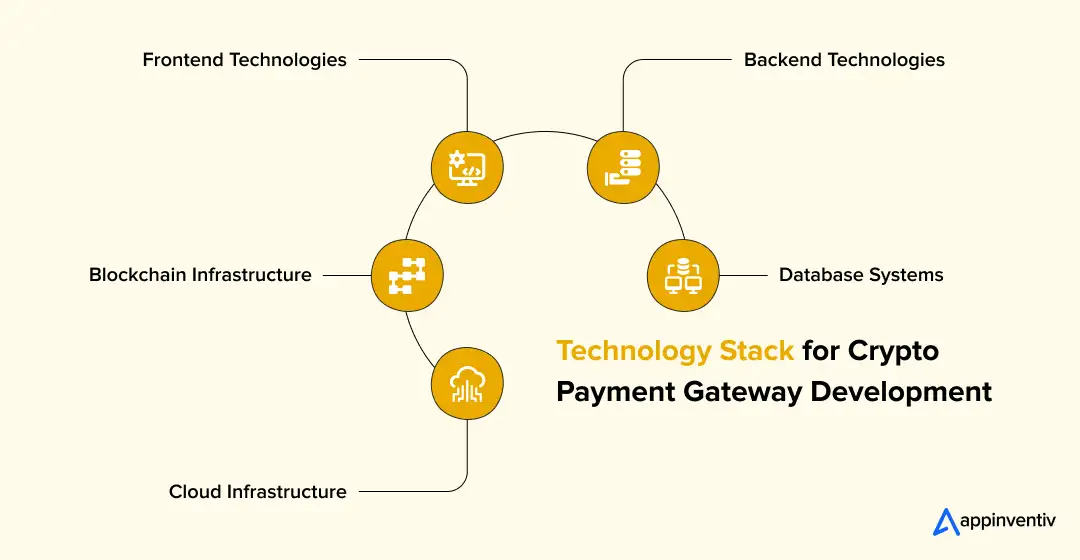
1. Frontend Technologies
The frontend is the part merchants interact with. It includes dashboards where businesses can see payments, track transactions, and review settlement data. Customers may also interact with this layer when a crypto payment page appears during checkout.
Developers often use modern web frameworks such as:
- React or Vue for merchant dashboards
- Next.js for web-based interfaces
- Flutter or React Native if mobile access is needed
The focus here is usability. Merchants should be able to check payments and transaction status without digging through complicated tools.
2. Backend Technologies
The backend is where most of the work happens. This is where payment requests are processed, transactions are verified, and merchant systems receive updates.
Common backend technologies include:
- Node.js for handling asynchronous payment events
- Python or Go for blockchain monitoring services
- Java or Spring Boot for large enterprise platforms
This layer also manages merchant accounts, APIs, and authentication systems.
3. Blockchain Infrastructure
A crypto gateway must connect directly to blockchain networks. Without this layer, the system cannot detect incoming transactions or verify payments.
Developers usually rely on:
- Blockchain nodes that track network activity
- RPC APIs that allow the system to communicate with the blockchain
- Monitoring services that watch wallet addresses for incoming payments
Some platforms run their own nodes, while others rely on infrastructure providers to simplify this process.
4. Database Systems
Transaction data needs to be stored and tracked carefully. Every payment, confirmation, and settlement event must be recorded so merchants can reconcile transactions later.
Typical database choices include:
- PostgreSQL for structured payment records
- MongoDB for event-based data
- Redis for caching and fast data retrieval
These databases help the system keep track of thousands of transactions without slowing down.
5. Cloud Infrastructure
Most gateways run in the cloud because crypto payments can happen at any time. A cloud environment allows the system to scale if transaction volume suddenly increases.
Popular infrastructure tools include:
- AWS or Google Cloud for hosting backend services
- Docker containers for application deployment
- Kubernetes for managing scalable services
Cloud platforms also make it easier to monitor performance, store backups, and recover systems if something goes wrong.
When these pieces come together, they form the backbone of a working crypto payment system. During the custom crypto payment processing platform, the technology stack plays a big role in how stable and scalable the platform will be once real payment traffic starts flowing through it.
Crypto Payment Gateway Development Cost
Once the discussion around crypto payments becomes serious inside a company, the next question is usually about budget. The price of building a gateway can vary widely because the system itself can range from simple to fairly complex.
In most projects, the cost of developing a crypto payment gateway typically ranges from $40,000 to $400,000. The lower end usually covers a basic gateway with limited currencies and minimal integrations. Platforms built for higher transaction volumes, stronger security, and regulatory readiness typically fall toward the upper end of that range.
Typical Development Cost Breakdown
While every project is different, the investment usually spreads across a few main stages.
| Development Stage | Estimated Cost Range | What’s Included |
|---|---|---|
| Planning & Technical Design | $5,000 – $20,000 | System architecture, blockchain selection, payment flow mapping, tech stack decisions |
| Core Platform Development | $40,000 – $150,000 | Payment engine, transaction processing, merchant dashboard, APIs, checkout integration |
| Blockchain Integrations | $25,000 – $100,000 | Node integration, multi-chain support, smart contract interaction, transaction monitoring |
| Security & Compliance Setup | $20,000 – $80,000 | Encryption, wallet security, KYC/AML modules, audit logs, regulatory alignment |
| Testing & Deployment | $10,000 – $50,000 | QA testing, load testing, vulnerability testing, cloud deployment, CI/CD setup |
A good portion of the work sits in the core platform layer. That is where the payment engine is built and where the gateway connects with blockchain networks. Wallet management, confirmation tracking, and settlement handling add more engineering effort.
Regional Cost Overview
In practice, these ranges shift based on the gateway’s complexity and the level of compliance or security required. Even within the same region, two similar projects can be allocated to very different budgets.
That’s why many companies combine teams across regions, using higher-cost markets for architecture and lower-cost ones for execution to balance quality and spend.
- United States: Costs are on the higher side. Strong talent, strict compliance, and higher salaries push projects toward $150,000 to $400,000+.
- Europe: It really depends on the region. Western Europe is closer to US pricing, while Eastern Europe is more cost-effective. Most builds cost between €74,000 and €230,000 ($80,000 and $250,000).
- Middle East: Pricing is more balanced. The cost of building a crypto payment solution in the Middle East remains moderate as local demand grows. Expect roughly AED 220,000 to AED 735,000 ($60,000 to $200,000).
- Australia: Similar to other developed markets. A smaller talent pool and regulations keep costs higher, usually AUD 180,000 to AUD 450,000 ($120,000 to $300,000).
In most cases, companies mix regions to keep costs under control without compromising on quality.
What Influences the Cost
The final cost of crypto payment platform development usually depends on a few technical choices made early in the project.
- Number of blockchain networks supported: Each additional network requires services that monitor transactions and confirmations.
- Security setup: Multi-signature wallets, secure key storage, and monitoring tools add complexity but are important for protecting funds.
- Compliance requirements: If the gateway operates in regulated markets, identity checks and transaction monitoring systems may be required.
- System integrations: Connecting the gateway with eCommerce platforms, exchanges, or internal business systems adds development work.
- Scalability expectations: Platforms that are expected to process large payment volumes often require more robust infrastructure and monitoring.
These factors usually determine where a project sits within the overall cost range. A small gateway can be built fairly quickly, while a full-scale payment platform takes more time, infrastructure, and engineering effort.
Essential Features of a Crypto Payment Gateway
Early crypto payment tools were fairly basic. They generated a wallet address and confirmed when a payment arrived. For companies handling real customer transactions, that is rarely enough.
The modern crypto payment processing platform focuses on building systems that behave more like traditional payment platforms. Merchants expect clear payment status, automatic confirmations, and simple integrations with their existing systems. In practice, that means a gateway needs to handle much more than just receiving cryptocurrency.
Some of the core features of a cryptocurrency payment gateway usually include:
- Multi-cryptocurrency support: Customers may pay using Bitcoin, Ethereum, or stablecoins. A gateway should handle multiple assets without separate integrations.
- Real-time transaction tracking: The system monitors blockchain activity and detects incoming payments tied to specific invoices or checkout sessions.
- Automated payment confirmation: The gateway checks blockchain confirmations and updates the payment status automatically once the transaction is verified.
- Dynamic price conversion: Since crypto prices fluctuate, the system calculates the correct payment amount based on live exchange rates.
- Merchant dashboard and reporting: Businesses need visibility into payments, settlements, and transaction history for accounting and reconciliation.
- API and eCommerce integrations: Most platforms connect with websites, mobile apps, and eCommerce systems through APIs or plugins.
When these capabilities come together, the gateway starts to feel less like a blockchain tool and more like a complete payment system. This is why businesses planning a custom crypto payment gateway usually focus on building these features from the start rather than adding them later.
Security Framework for Crypto Payment Gateways
Security sits at the center of any crypto payment system. Unlike card payments, blockchain transactions cannot be reversed once they are confirmed. If a system is compromised or a wallet is exposed, the loss can happen quickly. Because of this, teams developing crypto payment processing platforms usually focus heavily on security from the very beginning rather than adding it later.
Most platforms rely on a combination of protections instead of a single safeguard. The goal is to reduce the likelihood that a single weak point could expose the entire system.
1. Multi-Signature Wallets
While multi-signature wallets are widely used, modern enterprise platforms are increasingly moving toward MPC (Multi-Party Computation) for key management.
With MPC, the private key is never fully created or stored in one place. Instead, it is split into multiple cryptographic shares distributed across different parties or systems. Transactions are signed collaboratively without ever reconstructing the full key.
This approach provides:
- No single point of failure, since the full key never exists in one location
- Strong protection against key theft or internal misuse
- Secure transaction signing across distributed systems
- Better flexibility compared to traditional multi-signature setups
For CTOs and security teams, MPC significantly reduces the risk profile of managing digital assets at scale.
2. Secure Key Management
Private keys control access to cryptocurrency. If someone gains access to those keys, they can move funds instantly. Because of this, payment gateways take key storage very seriously.
Typical protections include:
- Encrypted storage for private keys
- Hardware security modules for key management
- Strict access control for operational teams
These measures are a basic requirement in most custom crypto payment processing platform projects.
3. API Security
Most gateways expose APIs that allow merchants to connect their websites, apps, or payment systems. These interfaces must be protected carefully since they interact directly with financial transactions.
Security controls usually include:
- Token-based authentication
- Encrypted communication between services
- Access permissions for different users
4. Transaction Monitoring
Even though blockchain transactions are transparent, platforms still need systems that watch for unusual activity. Monitoring tools help identify patterns that may indicate fraud or misuse.
Examples include:
- Unusually large payments
- Repeated failed transaction attempts
- Unexpected wallet activity
When these safeguards work together, they help keep the payment system stable and trustworthy. For businesses investing in cryptocurrency payment gateway development, security often determines whether the platform can operate safely once real transaction volume begins to grow.
Compliance and Regulatory Requirements for Crypto Payment Gateways
Crypto payments may look simple at checkout, but the compliance layer behind them is complex. Once a platform processes transactions for businesses, it is treated as part of the financial system, making compliance essential from the start.
Modern gateways embed monitoring and reporting directly into the platform to validate transactions in real time, since operating without these safeguards in regulated markets is not viable.
Below are a few areas that usually come up when building a compliant crypto payment gateway setup.
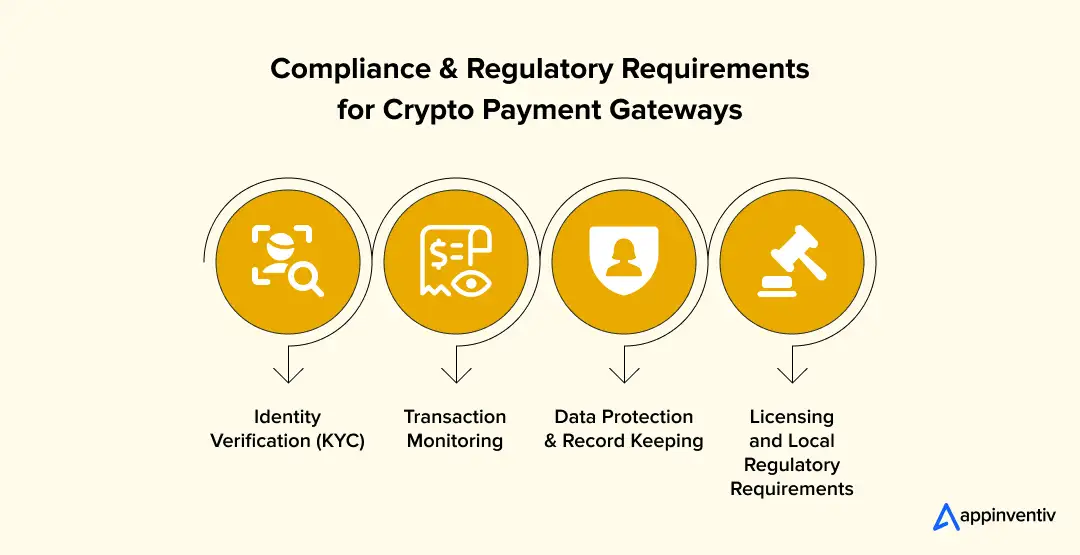
1. Identity Verification (KYC)
Many platforms verify the identity of merchants or users before allowing them to process payments. This helps reduce fraud and makes it easier to work with financial institutions.
In practice, this may involve:
- Verifying identity documents during onboarding
- Checking user location and risk profile
- Using automated identity verification tools
2. Transaction Monitoring & Travel Rule Compliance
While blockchain transactions are transparent, they still require monitoring to detect suspicious activity.
Modern gateways integrate:
- Wallet screening against risk and sanctions databases
- Real-time transaction monitoring
- Alerts for unusual or high-risk behavior
In addition, many jurisdictions now require Travel Rule compliance, which mandates sharing sender and receiver information for certain transaction thresholds. This is particularly relevant for platforms operating as Virtual Asset Service Providers (VASPs).
3. Data Protection and Record Keeping
Payment systems generate large amounts of transaction data. Keeping these records secure and accessible is important, especially if regulators request an audit.
Typical practices include:
- Encrypting technology stored transaction data
- Keeping logs of payment activity
- Maintaining audit trails for compliance reviews
4. Licensing, MiCA, and Global Regulatory Alignment
Regulatory requirements vary significantly by region, and payment platforms must align with local frameworks.
Key considerations include:
- VASP registration in jurisdictions where crypto payment services are regulated
- Compliance with MiCA (Markets in Crypto-Assets) regulations in Europe, which standardize rules for crypto service providers
- Adhering to local financial authority guidelines for payment processing and custody
For global platforms, this often means designing systems that can adapt to multiple regulatory environments without major architectural changes.
Build vs Buy vs White-Label Crypto Payment Gateway
Once a company decides to accept crypto payments, another practical question comes up fairly quickly: Should we build the gateway ourselves or rely on an existing solution? Not every business takes the same path. Some want complete control over the payment infrastructure, while others prefer a faster route to market.
When evaluating the development of a crypto payment processing platform, businesses generally compare three approaches: building a custom gateway, integrating a third-party solution, or launching a white-label platform.
1. Build a Custom Crypto Payment Gateway
Some companies choose to build their own gateway from the ground up. This usually happens when the business expects significant transaction volume or wants full control over payment processing.
With a custom crypto payment processing platform, the platform can be tailored to the company’s exact requirements. Teams can decide which cryptocurrencies to support, how settlement works, and how the system connects with existing tools such as eCommerce platforms or accounting software.
The advantage is flexibility and long-term control. The downside is that cryptocurrency payment gateway development takes time, engineering effort, and a larger upfront investment.
2. Buy (Use a Third-Party Payment Provider)
Another option is to integrate a third-party crypto payment service. In this model, the provider manages the blockchain infrastructure, while the business connects to it via APIs.
This approach is often chosen by companies that want to start accepting crypto payments quickly without building their own system.
Typical benefits include:
- Faster setup compared with building a gateway
- Lower development effort at the beginning
- Managed blockchain infrastructure and payment verification
Limitations: While it may look cost-effective up front, third-party solutions typically charge transaction fees. Over time, this acts like a hidden “tax” on every payment, which can significantly impact margins as transaction volume grows.
Appinventiv Insight:
Many businesses start with third-party providers for speed, but costs become noticeable as volume grows. Most crypto payment processors charge around 1%–2% per transaction.
At $10M in annual volume, that’s $100,000+ in recurring fees, which directly impacts margins. This is often when companies move toward custom crypto payment gateway development to reduce long-term costs and gain better control over payment flows.
In practice, the right choice depends on what the business is trying to achieve. Companies that see crypto payments as a long-term capability often invest in crypto payment platform development. Others start with APIs or white-label systems and expand their infrastructure as demand grows.
Challenges in Crypto Payment Gateway Development and How to Overcome Them
Adding crypto payments to a business sounds simple until the system is actually built and used by real customers. On paper, it is just a digital transfer. In practice, a gateway has to monitor blockchain networks, confirm payments, manage wallets, and still integrate with the company’s existing checkout and accounting systems. That is where most of the complexity shows up.
Teams involved in developing a crypto payment processing platform usually encounter a few common challenges once the platform begins processing real transactions.
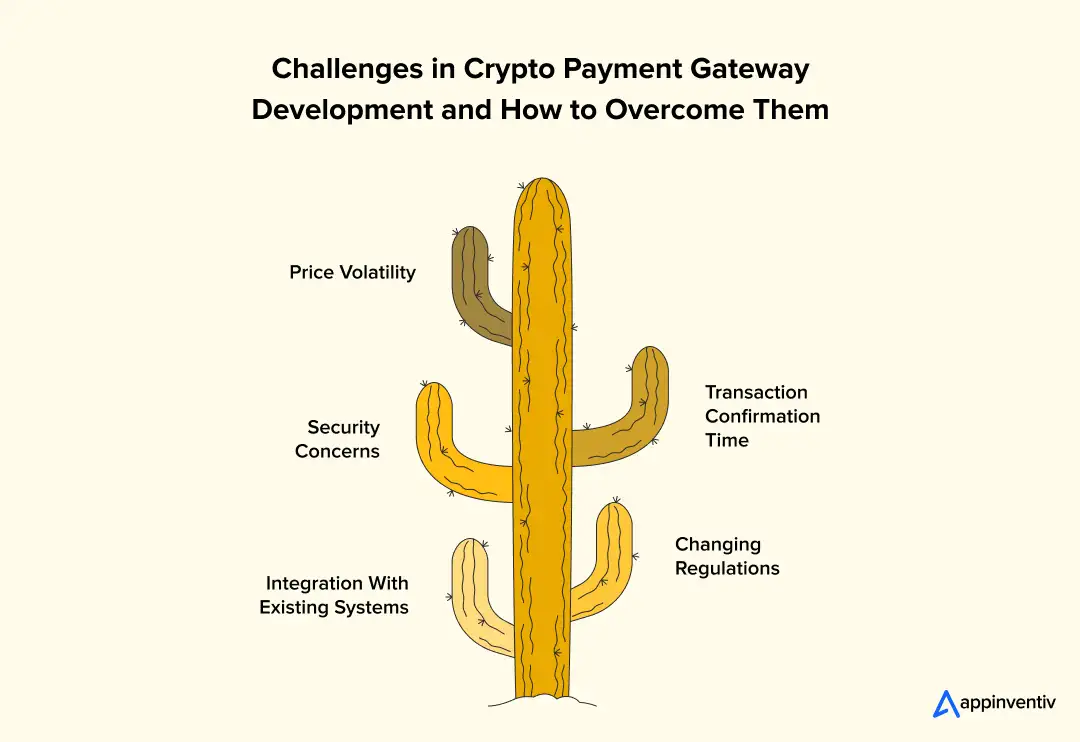
1. Price Volatility
Crypto markets move quickly. The value of a payment can shift within minutes. A product priced at $100 might not equal the same amount in cryptocurrency by the time the transaction confirms.
Businesses often reduce this risk by:
- Accepting stablecoins such as USDT or USDC
- Locking exchange rates for a short period during checkout
- Converting crypto into fiat or stablecoins soon after payment
These steps help keep pricing stable for merchants.
2. Transaction Confirmation Time
Unlike card payments, blockchain transactions can take time to confirm. Some networks require several confirmations before a payment is considered final. During heavy network activity, this process may slow down.
Gateways usually deal with this by:
- Detecting transactions as soon as they appear on the blockchain
- Showing a “pending” payment status until confirmations are complete
- Supporting faster blockchain networks where possible
This helps merchants continue processing orders without unnecessary delays.
3. Security Concerns
Any system that handles digital assets needs strong security practices. If wallet keys are exposed or system access is poorly managed, funds could be lost.
Common security measures include:
- Multi-signature wallets for approving transactions
- Secure storage systems for private keys
- Monitoring tools that flag unusual transaction activity
Security planning is often one of the most important parts of a custom crypto payment processing platform.
4. Changing Regulations
Crypto regulations are still evolving in many parts of the world. A gateway that works in one country may need additional checks somewhere else.
Businesses usually prepare for this by:
- Reviewing local regulatory requirements before launch
- Adding identity verification if required
- Monitoring policy changes in the regions where they operate
Planning ahead makes it easier to adapt if regulations change.
5. Integration With Existing Systems
Most companies already run eCommerce platforms, payment tools, and accounting systems. A crypto gateway needs to connect with those systems so orders, invoices, and financial records stay synchronized.
Developers usually handle this through:
- Payment APIs that connect the gateway with websites or apps
- Webhooks that update order systems after a transaction
- Plugins for common eCommerce platforms
With these integrations in place, crypto payments can fit into the existing workflow instead of forcing businesses to rebuild their entire payment setup.
Future Trends in Crypto Payment Gateway
Crypto payments are moving beyond early adoption into mainstream use. What started with crypto-first platforms is now being tested by eCommerce, SaaS, and digital businesses as an additional checkout option.
As a result, crypto payment gateway development is shifting toward practical, scalable systems that integrate smoothly with existing payment stacks.
- Shift toward practical adoption: Moving from experimental use cases to real business integration across eCommerce, SaaS, and marketplaces
- Multi-chain payment support: Gateways supporting multiple blockchains to accept payments across different ecosystems
- Rise of stablecoins: Increased adoption of stablecoins in fintech to reduce volatility and enable predictable pricing at checkout
- DeFi integrations: Emerging connection with DeFi protocols for advanced payment and settlement use cases
- Hybrid payment systems: Unified checkout experiences supporting crypto, cards, and bank transfers
- Platform-level integration: Crypto gateways becoming part of the broader payment infrastructure rather than standalone systems
Launch a scalable crypto payment platform that supports multiple blockchains, stablecoin payments, and global merchant transactions.

How Appinventiv Can Help Build a Crypto Payment Gateway
Building a crypto payment platform is rarely just about connecting blockchain nodes. It requires experience with payment infrastructure, secure wallet handling, transaction monitoring, and scalable backend systems. At Appinventiv, our teams work closely with fintech startups and enterprises to design secure payment platforms that can operate reliably at scale. Through our payment software & gateway development services, we help businesses build systems that manage blockchain transactions, merchant settlements, and payment integrations without disrupting their existing technology stack.
Over the years, we have supported several fintech platforms in building blockchain-enabled financial systems. Our experience also includes cryptocurrency exchange development services, where our teams design trading infrastructure, wallet systems, and blockchain integrations that support real transaction activity. Across our fintech portfolio, we have delivered 200+ fintech products, with payment and fraud detection systems achieving up to 98% fraud detection accuracy through advanced monitoring and security practices.
If your organization is exploring crypto payment processing platform development, the right technical foundation makes a significant difference in long-term reliability and scalability. Our blockchain engineers and fintech specialists can help design and build secure payment infrastructure tailored to your platform’s needs.
Talk to our team to explore how a custom crypto gateway payment development company can support your business growth.
FAQs
Q. What industries benefit most from crypto payment gateways?
A. Businesses that operate online or serve international customers tend to see the most value. eCommerce stores, gaming platforms, SaaS tools, and NFT marketplaces are good examples. For many of them, crypto payment processing platform development is simply a way to add another payment method for users who already prefer paying with digital assets.
Q. How long does it take to build a crypto payment gateway?
A. The timeline depends on how complex the platform needs to be. A basic system with limited cryptocurrency support might take three to four months. A larger platform built through cryptocurrency payment gateway development, especially one that supports several blockchains and compliance features, can take six to nine months to reach production.
Q. What technologies are used in crypto payment gateway development?
A. A working gateway usually relies on several layers of technology. Blockchain nodes are used to watch transactions, wallet systems handle funds, and backend services process payment data. In many crypto gateway payment development projects, developers use backend frameworks like Node.js or Python along with cloud infrastructure to monitor payments and keep the system stable.
Q. How do crypto payment gateways handle volatility in cryptocurrency prices?
A. Since crypto prices can move quickly, gateways usually include mechanisms to reduce the risk for merchants. During crypto payment platform development, platforms may lock the exchange rate for a short window at checkout or rely on stablecoins. Some systems also convert the received cryptocurrency into fiat or stable assets soon after the transaction is confirmed.
Q. What compliance and regulations apply to crypto payment gateways?
A. The rules around crypto payments differ depending on the country. In many places, compliant crypto payment processing platform development includes steps such as identity verification, transaction monitoring, and anti-money-laundering checks. Businesses usually review local financial regulations before launching a crypto payment platform.
Q. How do crypto payment APIs work in payment gateways?
A. Crypto payment APIs connect a website or application to the gateway. During custom crypto payment processing platform development, these APIs allow the platform to generate payment addresses, track transactions on the blockchain, and confirm when a payment has been received. This lets businesses accept crypto payments without running their own blockchain infrastructure.

- In just 2 mins you will get a response
- Your idea is 100% protected by our Non Disclosure Agreement.
Crypto Banking Software Development: Core Architecture for Digital Asset Banking
Key takeaways: Crypto banking software bridges traditional finance and digital assets, enabling banks to offer secure, compliant, and scalable crypto services. Modern crypto banking platforms feature robust custody, multi-asset wallets, real-time compliance, and seamless blockchain integration. Adopting crypto banking solutions accelerates cross-border payments, reduces costs, and enhances financial inclusion. Security, regulatory compliance, and modular architecture…
FinTech Leaders’ Guide to Crypto Payment Gateway Development in the UAE
Key takeaways: The UAE has emerged as one of the most active crypto payment markets in the Middle East driven by clear regulations and strong government support. Building a compliant crypto payment gateway in the UAE requires careful alignment with regulatory bodies like VARA and the Central Bank. Integration with local banking rails, robust AML/KYC…

Step-by-Step Guide to Crypto Trading Bot Development in 2026
Key takeaways: Crypto trading bot development in 2026 functions as full-scale trading systems, not experimental scripts. They require the same engineering discipline as any financial platform. Execution quality drives results more than strategy logic. Latency control, order handling, and risk limits shape real-world performance. AI-based strategies work only when supported by reliable data flows, controlled…









