
































Crypto Banking Software Development: Core Architecture for Digital Asset Banking

- Why Banks Are Now Shifting to Crypto Banking Software Development
- Crypto Banking Software vs Traditional Digital Banking Software: Operational Differences
- Foundational Features of Crypto Banking Software
- Key Steps to Build a Crypto Banking Software
- Key Benefits of Building a Crypto Banking Software
- The Road Ahead for Crypto Banking Platforms
- Start Your Crypto Banking Development Journey with Appinventiv
- FAQs

Key takeaways:
- Crypto banking software bridges traditional finance and digital assets, enabling banks to offer secure, compliant, and scalable crypto services.
- Modern crypto banking platforms feature robust custody, multi-asset wallets, real-time compliance, and seamless blockchain integration.
- Adopting crypto banking solutions accelerates cross-border payments, reduces costs, and enhances financial inclusion.
- Security, regulatory compliance, and modular architecture are essential for building reliable and future-proof crypto banking platforms.
- Strategic planning, thorough testing, and ongoing support are crucial for successful crypto banking software deployment and growth.
The cryptobanking software architecture is on the verge of a new era, where the legacy financial system converges with digital asset networking. Blockchain innovation is no longer viewed by the banks and other financial institutions as an outsider. Most of them are currently developing platforms which facilitate trading digital assets, custody, tokenized deposits and payment systems in addition to their current banking services.
This shift is represented in institutional adoption. In July 2025, Standard Chartered introduced an approved digital asset trade product enabling institutional customers to trade Bitcoin and Ethereum via its current foreign exchange offerings.
The bank said that it was the earliest case of a global systemically significant bank providing deliverable spot crypto trading to institutional customers, which indicated a further adoption of digital assets as a part of mainstream financial infrastructure. With crypto banking software development, banking and financial institutions can integrate secure digital asset services into their existing platforms and support crypto operations.
A new architectural strategy is needed in this transition. Cryptobanks should integrate the distributed ledger technologies with stringent security, compliance and performance provisions that control the regulated financial systems.
The essential elements usually comprise the custody infrastructure, compliance gateways, transaction-monitoring layers, and API-based integrations that enable digital asset services to be used alongside normal banking operations. The next generation of digital banking solutions will be designed based on these design principles as institutions expand their digital asset services.
This blog discusses the emergence of digital assets in the banking sector, the distinction between crypto banking and traditional digital banking, the primary features of crypto banking services, their advantages, and the architectural aspects of crypto banking software development.
Appinventiv helps you build it the right way

Why Banks Are Now Shifting to Crypto Banking Software Development
Banking systems have steadily absorbed new financial technologies. Digital assets now represent the next phase of this change, which is why banks are increasingly investing in crypto banking software development. Let’s have a detailed look:
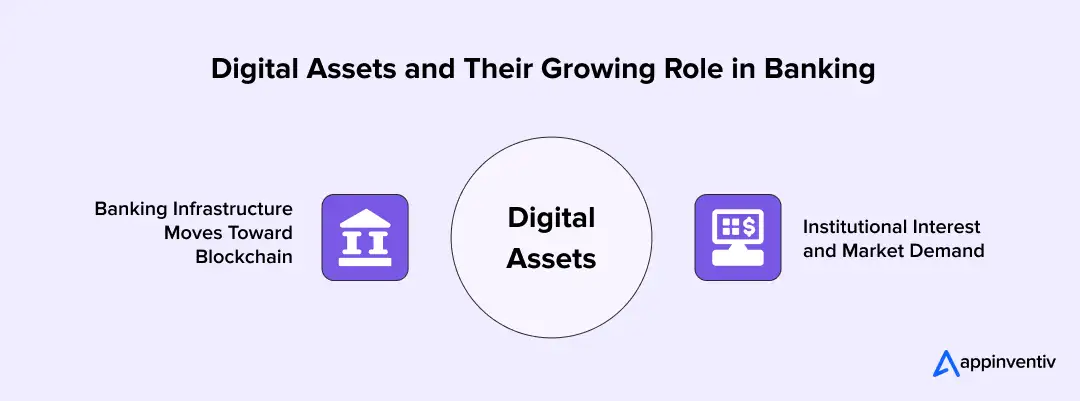
Banking Infrastructure Moves Toward Blockchain
The first stage of digital transformation in banking initially remained focused on convenience through online portals, mobile applications, and faster payment systems. Over time, attention shifted to the operational backbone of financial platforms, where crypto-ready banking software is now being developed. Banks began evaluating distributed ledger technology, tokenized assets, and blockchain-based settlement models that could work alongside traditional banking rails.
The launch of Bitcoin triggered global interest in decentralized financial systems. As the ecosystem matured, financial institutions moved from observation to controlled pilots and strategic partnerships with blockchain providers, which gradually led to the need for dedicated crypto banking platforms.
Institutional Interest and Market Demand
Major institutions such as JPMorgan Chase, BNY Mellon, and Standard Chartered have already introduced digital asset custody services or blockchain-based financial initiatives, many of which depend on specialized crypto banking software.
At the same time, growing investor interest is driving banks to explore platforms that support both fiat and digital currencies within a single system. By combining robust infrastructure, compliance frameworks, and blockchain integration, institutions can deliver seamless financial services, expand offerings, and stay competitive in a rapidly evolving market.
Crypto Banking Software vs Traditional Digital Banking Software: Operational Differences
Both crypto banking and digital banking fall within apps and web applications, hence they may appear identical to end-users. However, the systems operate very differently below. Conventional banks use centralized financial systems that are regulated by the institutions. Cryptobanking operates on blockchain networks, where transactions are recorded in distributed ledgers. Let’s analyze the table below to get a better understanding of the key differences:
| Operational Aspect | Traditional Digital Banking | Crypto Banking Platforms |
|---|---|---|
| Core Infrastructure | Operates on centralized banking servers maintained by financial institutions | Runs on blockchain networks or hybrid distributed systems |
| Asset Types | Supports government-issued fiat currencies such as USD, EUR, or AED | Handles cryptocurrencies, stablecoins, and other tokenized digital assets |
| Transaction Processing | Transactions pass through bank systems and clearing intermediaries | Transactions are verified across blockchain nodes through consensus |
| Settlement Timeline | Clearing and settlement can take hours or several business days | Transfers usually settle within seconds or a few minutes |
| Regulatory Structure | Governed by established banking regulators and national financial laws | Subject to evolving crypto and digital asset regulations across jurisdictions |
| Transaction Transparency | Internal ledgers provide visibility mainly to the bank and regulators | Blockchain ledgers record transactions with traceability across the network |
| Custody Model | Banks safeguard customer deposits and manage account balances | Users may hold assets in personal wallets or regulated custodial services |
| System Interoperability | Connects through payment rails such as SWIFT or domestic clearing systems | Works with cross-chain bridges, token protocols, and blockchain standards |
These architectural variations determine settlement velocity, asset ownership, and disclosure. They also influence how companies approach crypto banking platform development when building new financial products.
Foundational Features of Crypto Banking Software
Crypto banking platforms should be able to facilitate the operations of digital assets and match the reliability, security, and compliance levels demanded in financial services. Here are some of the top features of crypto banking software.
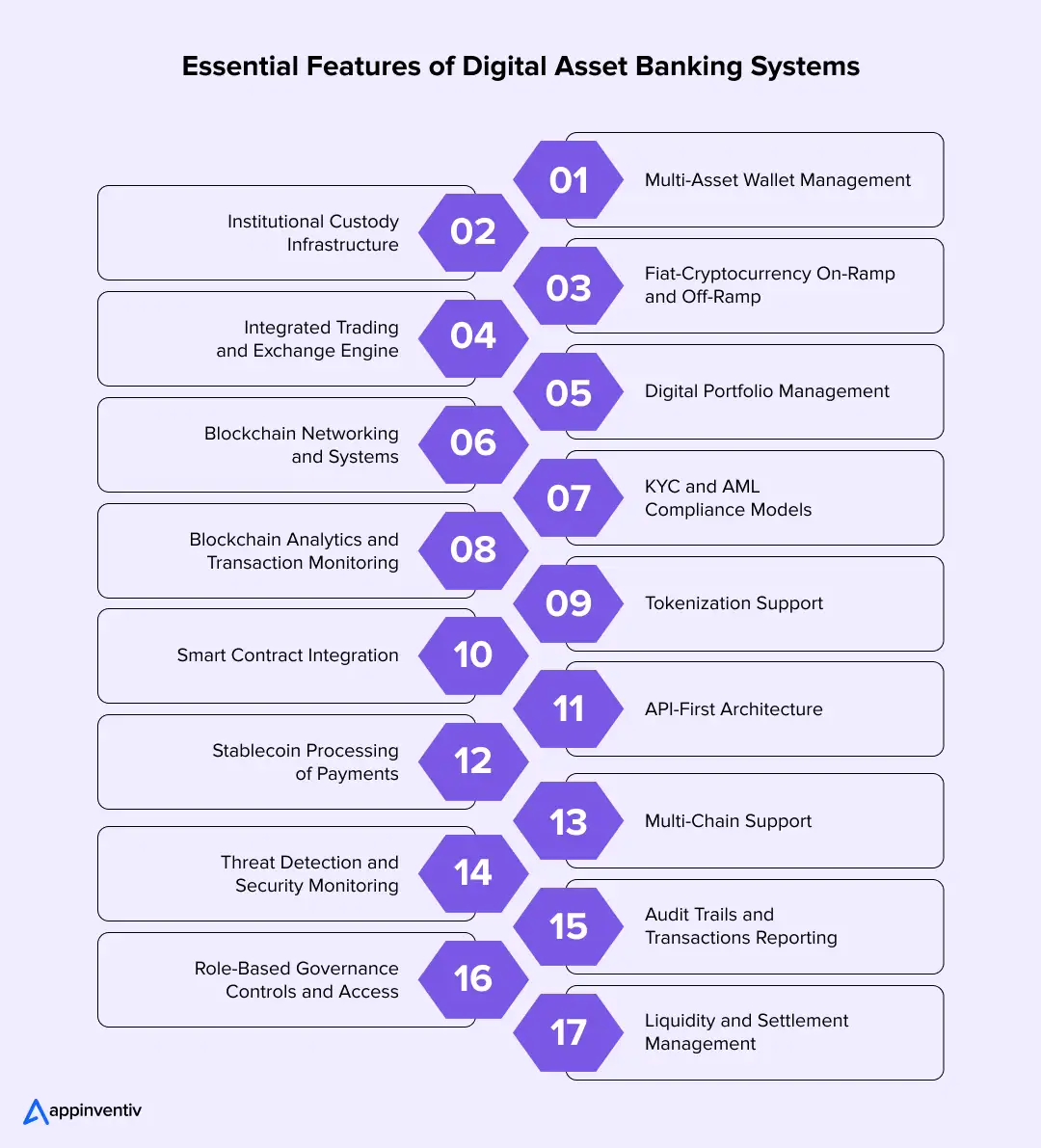
Multi-Asset Wallet Management: A crypto banking platform should provide safe storage of various digital currencies such as Bitcoin, Ethereum, and stablecoins. Enterprise-based blockchain wallets usually come with both hot and cold storage, multi-signature authorization, and role-based access controls.
Institutional Custody Infrastructure: Custody systems allow banks to hold digital assets on behalf of customers while maintaining strict security standards. These solutions often use cold storage vaults, distributed key management, and hardware security modules to protect private keys.
Fiat-Cryptocurrency On-Ramp and Off-Ramp: Customers would have the option to exchange traditional currencies for digital assets and return funds to bank accounts. Combined payment door and liquidity providers facilitate easy transfer between blockchain networks and banking systems.
Integrated Trading and Exchange Engine: Many platforms offer trading features that enable users to purchase, sell, and exchange cryptocurrencies directly on the banking platform. Liquidity aggregation, market data feeds, and order management systems facilitate sound execution.
Digital Portfolio Management: Through dashboards that provide real-time updates on performance trends and asset balances, users can monitor their assets, transaction history, and overall portfolio performance.
Blockchain Networking and Systems: Crypto banking software should be linked to blockchain networks to authenticate and relay transactions. The tools used to manage nodes can provide guaranteed connectivity to networks such as Ethereum 2.0 and other supported chains.
KYC and AML Compliance Models: Regulatory compliance tools help identify users, track transactions, and detect suspicious activity. Such systems are usually on par with international compliance practices advanced by the Financial Action Task Force.
Blockchain Analytics and Transaction Monitoring: Advanced analytics software analyzes wallet patterns and transactions to identify risks of fraud, illegal activity, or suspicious behavior on blockchain networks.
Tokenization Support: Crypto banking systems can issue and administer tokenized asset matches for securities, commodities, or real estate. The process of asset tokenization opens the way to accelerated settlement and novel types of trading digital assets.
Smart Contract Integration: Automated financial operations enabled by programmable contracts include escrows, lending agreements, and conditional transfers, all without human intervention.
API-First Architecture: Current crypto banking solutions provide powerful APIs that enable integration with payment gateways, exchanges, custodians, and core banking systems. This architecture assists banks in expanding services without reengineering their architecture.
Stablecoin Processing of Payments: Most platforms allow the use of stablecoins to make payments, which can be faster, more cross-border, and less reliant on traditional correspondent banking systems.
Multi-Chain Support: Software used in crypto banking is increasingly becoming compatible with a variety of blockchain ecosystems, meaning institutions do not need to be tied to a single protocol.
Threat Detection and Security Monitoring: High-quality cybersecurity-enabled systems are used to track transactions, detect abnormalities, and identify unauthorized access. Risk-scoring engines, encryption technology, and biometric authentication reinforce protection on the platform.
Audit Trails and Transactions Reporting: All transactions are tracked and documented to report to regulators, and operational audits and compliance checks. These audit trails assist the institutions in being transparent and accountable.
Role-Based Governance Controls and Access: Enterprise platforms have permission systems that govern how administrators, compliance officers, and customers interact with the platform. These governance controls minimize and enhance operational risk and enhance oversight.
Liquidity and Settlement Management: Crypto banking systems need to operate liquidity in the digital asset markets, as well as internal settlement accounts. Liquidity routing tools process transactions efficiently across exchanges and payment systems.
Key Steps to Build a Crypto Banking Software
The development of crypto banking software is much more than the initiation of a fintech application. Banking organizations undergo a structured process when developing such platforms, as described below.
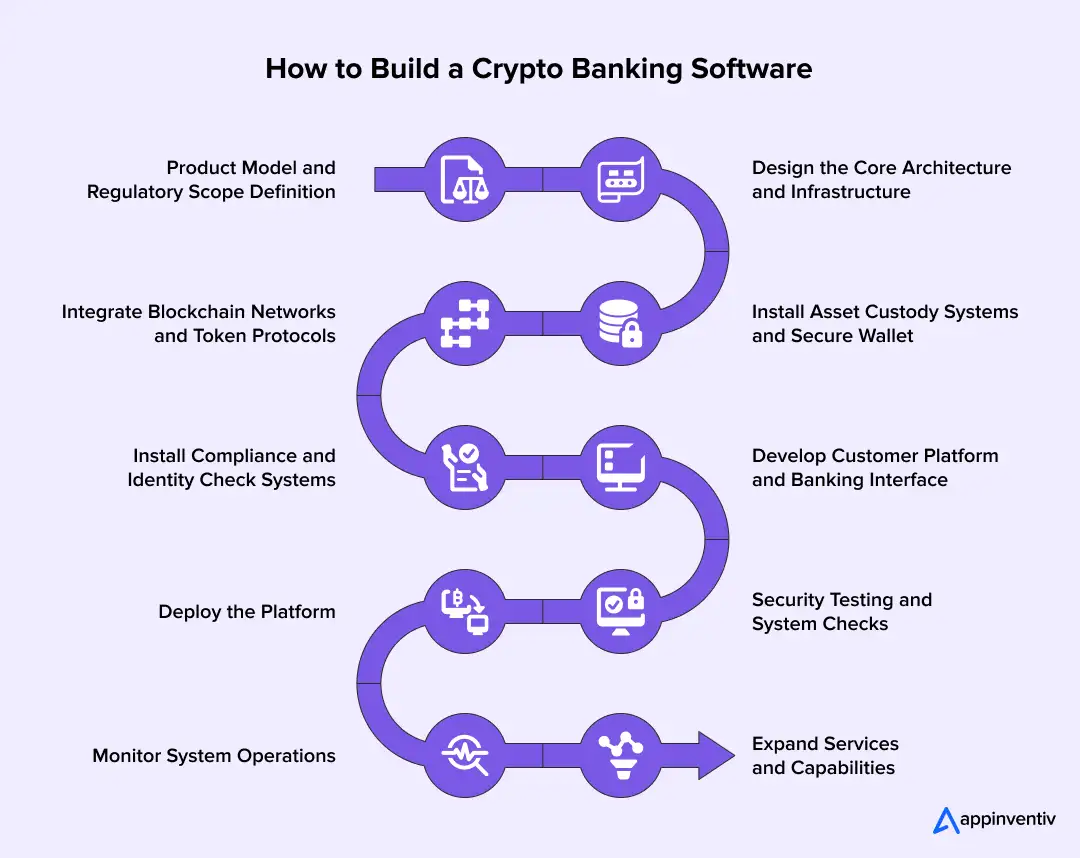
Product Model and Regulatory Scope Definition
The first step is to determine how the platform should work. There are those businesses introducing custodial platforms in which the institution operates digital assets as custodians of users and those that develop hybrid systems merging fiat banking and crypto services.
It is also at this point that business organizations revisit regulatory frameworks, licensing, AML and KYC provisions in the digital asset services. These influence the system design, security architecture and operational workflows. Many organizations planning custom crypto banking software development begin with regulatory mapping before any technical development starts.
Design the Core Architecture and Infrastructure
The system architecture follows the operating model’s definition. Crypto banking applications are built on multiple technical layers that interact to facilitate digital transactions securely. Common architecture elements include a blockchain-based connectivity layer, wallet and custody systems, compliance supervision modules, transaction engines, and API gateways to handle connections to external services.
This platform bases the storage of assets, transaction validation and scalability on this foundation. Long-term growth also occurs through well-planned architecture when the platform is expanding.
Install Asset Custody Systems and Secure Wallet
Any crypto banking platform will be based on digital asset custody. The software should safely store users’ private keys, balances, and transactions on the blockchain without exposing assets to security threats. The majority of platforms apply hot wallets (daily operations) and cold storage solutions (long-term asset protection).
Multi-signature authentication, hardware security modules, and a layered key management policy are also established to enhance security. Crypto wallet integration in banking software can be among the most technically challenging stages in most projects, as security and performance criteria, as well as regulatory standards, must be met simultaneously.
Also Read: How Much Does it Cost to Develop a Crypto Wallet App?
Integrate Blockchain Networks and Token Protocols
Once the custody infrastructure has been established, the platform must be linked to blockchain systems that facilitate transactions in digital assets. Common networks incorporated into the integration include Bitcoin, Ethereum, and other token ecosystems, depending on the services provided.
Such integrations enable the system to authenticate transactions, store balances, and interact with smart contracts as needed. Cross-chain compatibility is also common on many modern platforms, allowing users to move assets across blockchain environments. This layer enables support for the evolving digital asset ecosystems through the banking platform.
Install Compliance and Identity Check Systems
Crypto banking platforms fall under financial regulatory jurisdiction, and, as such, compliance requirements should be directly incorporated into the system architecture. The software stack includes identity verification, transaction monitoring and risk management modules.
Most of these systems have automated KYC onboarding, AML transaction screening, blockchain analytics, and fraud detection tools, as well as reporting modules that produce audit-ready records. Including these controls in the system’s early life cycle enables institutions to maintain control over regulations as user activity expands.
Develop Customer Platform and Banking Interface
Back-end infrastructure is in place, so the developers develop the front-end of the banking platform. These are mobile applications, web dashboards, and administrative tools of the financial operators.
These interfaces usually allow users to manage their wallets, track their transactions, transfer assets, convert fiat to crypto, and view their portfolios. In the case of consumer-oriented products, the crypto banking app development aims to make the complex world of blockchain and blockchain interactions more accessible to customers, so they can handle digital assets as easily as they do with conventional online banking.
Security Testing and System Checks
The platform will be tested for a long period to ensure security and performance before deployment. Cryptocurrency banking operates through digital currency and stores financial data, and as a result, it is a high-value target for cyberattacks.
The stages of testing may involve penetration testing, infrastructural stress testing, smart contract testing, key management testing, and blockchain transaction testing. These tests affirm that the system can be safely used when the number of transactions to handle is very high.
Deploy the Platform
After development and security checks are complete, the platform moves into a controlled production environment. This stage includes configuring blockchain nodes, connecting banking APIs, activating wallet services, and enabling transaction monitoring systems.
Infrastructure redundancy, backup procedures, and disaster recovery mechanisms are also established to ensure the crypto banking platform operates reliably under real transaction volumes.
Monitor System Operations
Once it is launched, monitoring its operations becomes an ongoing task. Blockchain, wallet, payment processing, system latency, and security alerts are monitored using real-time dashboards. Continuous review of compliance logs, audit trails and risk signals is also done in order to identify anomalies at an early stage.
Effective monitoring procedures can be used to ensure the stability of the platform and ensure that the financial activities are conducted in accordance with the regulatory standards.
Expand Services and Capabilities
As adoption increases, organizations tend to expand the platform’s functionality. The new features could be trading digital assets, institutional custody, cross-border blockchain payments, staking services, or access to decentralized finance ecosystems.
The infrastructure is also modular, which means that new services can be added gradually without interfering with core banking functions, and the platform can be adapted to the digital asset market.
Key Benefits of Building a Crypto Banking Software
Crypto banking software enables financial institutions to offer secure digital asset services, faster settlements, and blockchain-based financial products. Below are some of the key benefits businesses can gain from adopting crypto banking platforms:
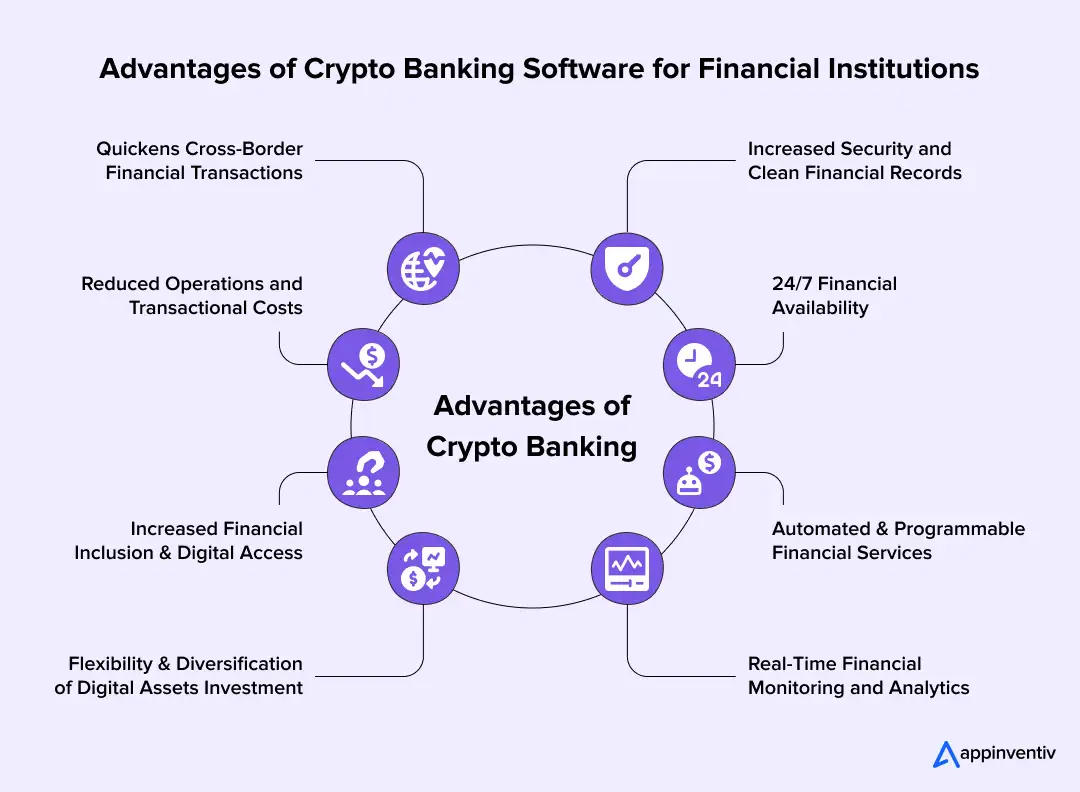
Quickens Cross-Border Financial Transactions
Crypto banking systems eliminate reliance on conventional correspondent banking systems, which usually slow international transfers. Organizations can transfer funds across regions and settle within minutes rather than days through direct blockchain settlements.
Companies investing in crypto banking software development can accordingly facilitate faster global payments, real-time settlements, and unimpeded digital asset transfers across multiple jurisdictions.
Increased Security and Clean Financial Records
Crypto and blockchain technologies strengthen financial security through cryptographic verification and immutable transaction records. All the activities captured in the ledger generate a clear audit trail to minimize risks of fraud and enhance accountability in the process of digital banking.
By adopting a systematic approach to cryptocurrency banking software development, companies will be able to create platforms that integrate blockchain security with state-of-the-art identity verification and compliance monitoring.
Reduced Operations and Transactional Costs
Conventional financial infrastructure relies on a number of intermediaries, clearing networks and settlement layers. Crypto banking platforms make these functions more efficient by facilitating peer-to-peer fund transfers and automatic processing through smart contracts.
Organizations adopting crypto banking app development can therefore reduce transaction fees, improve operational efficiency, and lower the long-term cost of payment processing.
24/7 Financial Availability
In contrast to traditional banks that operate on regular timeframes, platforms that support cryptocurrencies operate 24/7, regardless of time zones. Users can check balances, remit funds, and transact with digital funds without waiting for bank approval or the clearing cycle.
An effective crypto banking system will ensure continuous financial operations for businesses and customers operating in foreign countries.
Increased Financial Inclusion and Digital Access
Crypto banking systems increase the number of people and businesses that cannot access traditional banking services. Using digital wallets and blockchain networks, users can save money, transfer and receive money with just a click.
With scaled crypto bank software development, financial institutions can create platforms that deliver financial services to underserved populations and emerging digital economies.
Automated and Programmable Financial Services
Smart contracts enable financial transactions to be automatically executed when specific conditions are met. The feature allows automated settlements, conditional payments, escrow services, and decentralized lending mechanisms.
With structured and compliant crypto banking software development, enterprises can build programmable financial infrastructure that reduces manual intervention and increases transaction reliability.
Flexibility and Diversification of Digital Assets Investment
Crypto banks enable individuals and companies to use various cryptocurrencies in addition to conventional currencies. This assists users in diversifying their portfolios and experimenting with contemporary financial instruments such as tokenized assets and decentralized investment models.
Platforms built through advanced cryptocurrency banking software development can support multi-asset wallets, token management, and automated trading capabilities such as a crypto trading bot.
Real-Time Financial Monitoring and Analytics
Crypto banking systems make it easy to view the balance and transaction history, and to track the movement of digital assets in seconds. Live reporting and analytics applications enable businesses to monitor financial performance and identify suspicious activity in real time.
Through modern crypto banking app development, institutions can deliver data-driven insights that support better financial oversight and operational decision-making.
Let us guide you in building an adaptable, future-ready financial platform

The Road Ahead for Crypto Banking Platforms
Crypto banking infrastructure is evolving quickly. Banks and fintech institutions building these systems today are preparing for a financial environment where blockchain networks, programmable assets, and regulated digital finance operate alongside traditional banking systems. Here’s what the future looks like:
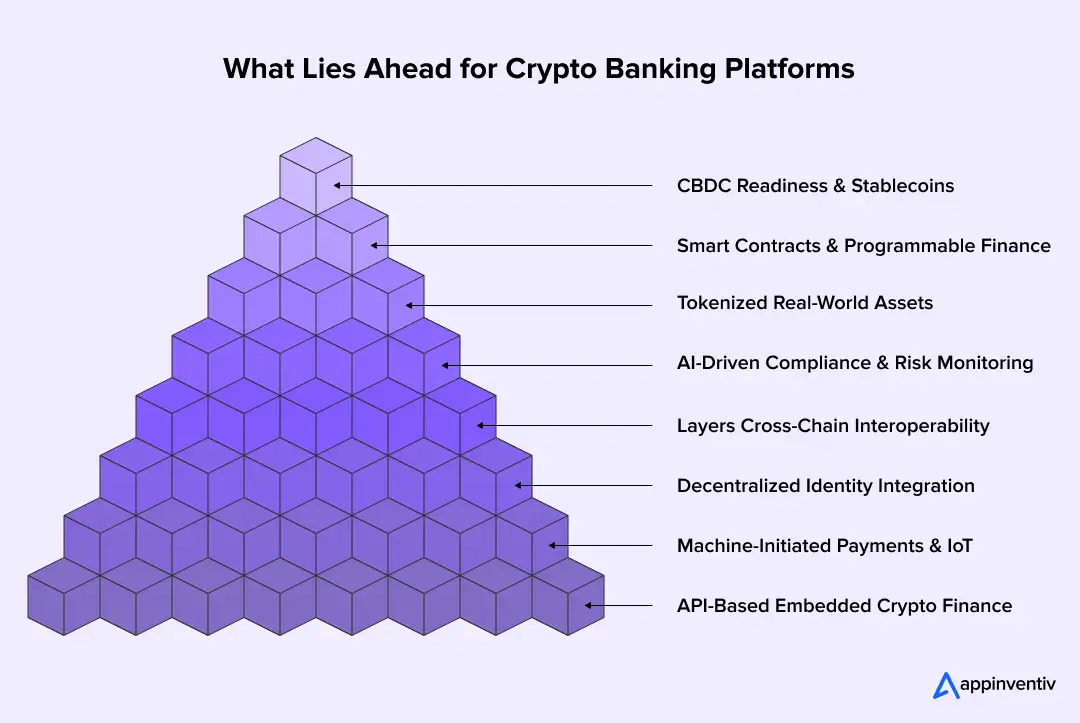
CBDC Readiness and Stablecoins
In the future, banking platforms will be able to support the use of stablecoins and central bank digital currencies within the same financial environment. The institutions engaged in the crypto banking infrastructure development are making ready wallet systems that will be able to facilitate government-issued digital currencies, regulated tokens, and cross-border digital settlements.
The automation trend in crypto banking is driven largely by programmable transactions. The IMF’s 2025 stablecoin paper notes that around 80% of stablecoin transactions are executed by automated systems and bots, which include arbitrage engines, smart-contract-based rebalancing, and automated trading infrastructure.
Smart Contracts and Programmable Finance
Blockchain-based automated processes will transform financial processes. Platforms built on custom crypto banking software development can include conditional payments via smart contracts, automated lending contracts, subscription billing, and transaction settlement with policies.
Tokenized Real-World Assets
Banks are considering tokens of assets like real estate, commodities and securities. Many crypto banking systems may ultimately be used to issue, hold and settle these representations of digital assets in regulated financial systems.
McKinsey reports that more than $120 billion in issued stablecoins has now grown to around $250 billion in just 18 months, and the firm notes that this rapid expansion shows tokenization is approaching an inflection point for financial services.
AI-Driven Compliance and Risk Monitoring
More and more transaction monitoring and identifying fraudulent activities will be facilitated with the help of AI in blockchain. Artificial intelligence models can scan wallet behavior, identify suspicious financial habits, and help compliance teams detect suspicious activity in decentralized networks.
Layers Cross-Chain Interoperability
In the future, crypto banks will be linked to various blockchain networks. Interoperability standards will enable the transfer of asset and payment functionality across chains, allowing users to operate through a single banking interface.
Decentralized Identity Integration
Blockchain-based identity models can ease the registration process and the verification of compliance. Decentralized digital identity systems would allow customers to verify their credentials without submitting documentation again.
Machine-Initiated Payments and IoT
Smart devices can possibly start making payments automatically. Autonomous cars, logistics sensors, and the industrial infrastructure might trigger crypto banking system-based transactions.
API-Based Embedded Crypto Finance
Contemporary systems are being constructed as modular infrastructure. APIs enable banks to expose crypto wallets, crypto payments, and crypto asset services, enabling fintech platforms and SaaS products to integrate crypto financial services into their apps.
We help you create systems that are built to grow and adapt without disruption

Start Your Crypto Banking Development Journey with Appinventiv
The financial sector is gradually shifting towards digital assets, stablecoins and blockchain-based settlement systems. As financial institutions start adopting cryptocurrencies, they need a secure infrastructure that combines regulatory oversight, digital asset custody, and immediate transaction processing.
Crypto banking products are thus becoming a strategic business expansion for contemporary financial services rather than a niche endeavor.
Appinventiv, as industry leaders in custom blockchain development services, assists in the process by creating safe and systematically scaled blockchain environments to help startups and business ventures investigate digital finance.
Our teams create full-stack platforms where blockchain networks, smart contracts, digital wallets, and regulatory frameworks are all combined into a single financial system. In addition to crypto banking software, we have experience in decentralized applications, token economies, and blockchain-based marketplaces.
This is demonstrated by a number of our blockchain projects. AVATUS is a social network that uses avatars and is developed on a secure blockchain layer with cloud computing, and supports interactions and social transactions through a native token economy where people can create and engage their digital identities.
In the case of Nova, we designed a blockchain-based learning architecture in which course certifications are granted via smart contracts, ensuring transparency and eliminating the possibility of fake certifications.
Through the Empire project, we demonstrated a decentralized hotel booking ecosystem that supports cryptocurrency payments through a dedicated digital token. The platform removes intermediary fees while improving transaction transparency and settlement efficiency.
For organizations planning to build a crypto-enabled banking platform or blockchain-based financial service, Appinventiv offers specialized banking software development services. From architecture design and secure platform implementation to long-term scalability, our team supports the complete development lifecycle.
Get in touch with our experts to discuss your crypto banking project idea.
FAQs
Q. How do crypto banks ensure regulatory compliance?
A. The crypto banks are subjected to strict financial and digital asset regulations. With the development of compliant crypto banking software, KYC, AML screening, and transaction monitoring are integrated directly into the platform by the institutions. Blockchain activity is logged in smart audit trails, and suspicious transactions and user identity verification are logged by regulatory reporting tools.
Crisis integration with licensed custodians, compliance APIs and jurisdiction-based regulatory frameworks is also useful in ensuring that crypto banks comply with financial authority requirements without compromising transparency and the security of their operations.
Q. What is the difference between crypto banking and traditional digital banking?
A. Conventional digital banking is based on centralized financial systems and handles fiat currencies using conventional payment networks. In its turn, crypto banking has been designed to accept blockchain-based assets, including cryptocurrencies and stablecoins. It needs blockchain nodes, smart contract connectivity and digital wallet infrastructure.
The digital banking model provides access to traditional financial services online; crypto banking platforms facilitate decentralized transactions, store digital assets, and process interbank payments using distributed ledger networks.
Q. Can banks integrate cryptocurrency wallets into their platforms?
A. Yes. Banking institutions can leverage the cryptocurrency wallet by incorporating it into their online platforms to facilitate the storage and transfers of assets and monitor transactions. These wallets will be linked with blockchain networks and will enable users to operate digital assets in banking. Security layers that are typically incorporated into integration include multi-signature authentication, encryption, and regulatory monitoring software to ensure operational security and compliance.
Q. How long does it take to develop a crypto banking platform?
A. The development of cryptocurrency banking software is based on the complexity of the systems, the compliance requirements, and the scale of infrastructure. The simplest crypto banking application, with a wallet and the ability to handle transactions, can be developed in four to six months.
More sophisticated systems that provide custody services, trading modules, regulatory monitoring, and multi-blockchain connectivity can take up to nine to twelve months to develop, as the architecture will need to support security testing, compliance tests, and stable blockchain integrations.
Q. Can traditional banks offer crypto services through custom software?
A. Yes. Conventional banks are able to launch cryptocurrency products by building bespoke financial applications that combine blockchain networks with the current banking framework. These platforms have the potential to embrace digital asset custody, walleting, and crypto-to-fiat transactions and be regulatory compliant.
Custodial development enables banks to bridge the linkage of cryptocurrency features to existing payment solutions, customer identity models, and internal risk management procedures.
Q. What APIs are required for crypto banking software development?
A. Here are some of the APIs needed for developing crypto banking software:
- Blockchain Node APIs: These APIs will be used to provide access to blockchain networks in order to verify transactions and access the ledger of transactions in crypto bank software development.
- Wallet Management APIs: Manage wallet, key management, digital asset transfers, and balance management.
- Payment Processing APIs: Facilitate crypto-to-fiat conversion, merchant transactions and settlement operations.
- Compliance and KYC APIs: Integrate identity verification, AML screening, and transaction monitoring services.
- Market Data APIs: Get real-time cryptocurrency market data and liquidity.
- Custody and Security APIs: Link safe storage systems of institutional digital asset custody.
Q. What is the cost of crypto banking software development?
A. The cost of crypto banking software development varies with platform scope, compliance layers, blockchain integrations, and security architecture. A basic platform with wallet management and transaction features typically ranges from $50,000 to $100,000.
A full enterprise-grade crypto banking system with custody infrastructure, regulatory modules, multi-chain support, and institutional security can range from $150,000 to $300,000 or more, depending on complexity and integrations.

- In just 2 mins you will get a response
- Your idea is 100% protected by our Non Disclosure Agreement.

FinTech Leaders’ Guide to Crypto Payment Gateway Development in the UAE
Key takeaways: The UAE has emerged as one of the most active crypto payment markets in the Middle East driven by clear regulations and strong government support. Building a compliant crypto payment gateway in the UAE requires careful alignment with regulatory bodies like VARA and the Central Bank. Integration with local banking rails, robust AML/KYC…

Step-by-Step Guide to Crypto Trading Bot Development in 2026
Key takeaways: Crypto trading bot development in 2026 functions as full-scale trading systems, not experimental scripts. They require the same engineering discipline as any financial platform. Execution quality drives results more than strategy logic. Latency control, order handling, and risk limits shape real-world performance. AI-based strategies work only when supported by reliable data flows, controlled…

Decentralized Exchange (DEX) Development: Features, Implementation Cost, and Enterprise ROI
Key Takeaways The development of a decentralized exchange will enable businesses to provide secure and user-controlled trading, improve transparency, and minimize the use of intermediaries. The cost of DEX development can vary depending on the platform's features, the chosen network, and regulatory requirements, and the approximate cost is about $50,000, with higher costs for customization,…









