





























Unlocking the Cost of Building a Community Platform Like Qatar Living: What to Expect


- The Strategic Playbook Behind Qatar Living and How You Can Apply It
- Understanding the Complete Cost to Build an Online Community Platform like Qatar Living
- Factors That Influence the Cost to Build an Online Community Platform Like Qatar Living
- Hidden Cost Drivers Businesses Often Miss in Community Platform Projects
- Optimize Your Budget: Proven Tips for Building Your Platform Efficiently
- Key Features Every Successful Community Platform Needs
- Advanced Features That Help Your Community Platform Stand Out
- How to Develop a Platform like Qatar Living: The Process
- How Community Platform Like Qatar Living Makes Money: Revenue Models Demystified
- Innovate Beyond Qatar Living: How to Create a Platform That Outshines
- Why Choose Appinventiv for Developing a Community Platform in Qatar
- FAQs

Key takeaways:
- Building a community platform is a business decision first and a technology project second.
- A strong MVP in Qatar typically starts around QAR 109,200–QAR 254,800, while full-scale platforms move into the QAR 2,184,000+ range based on scale and ambition.
- Success comes from solving daily user problems, not from copying features.
- Cost is driven more by architecture and scalability than visual design.
- MVP builds validate the market; enterprise platforms protect it.
- Hidden costs like moderation, infrastructure scaling, and maintenance shape long-term spend more than development alone.
The Middle East is no longer just investing in buildings and infrastructure. It is investing in digital communities. In Qatar, a connected population, mobile-first behavior, and government-led digitization are changing how people discover homes, jobs, services, and events. For leadership teams across industries, digital platforms have become growth channels, not side projects. This is why online community platform development is now being discussed in boardrooms, not just IT offices.
When people talk about community platforms in Qatar, one name comes up again and again: Qatar Living. It did not grow by accident. It grew because it became part of daily life. People return to it for housing, job leads, events, advice, and local news. That level of adoption made it more than a website. It made it infrastructure. And today, it dominates simply because it owns attention, trust, and repeat usage.
Beyond community platforms, businesses in Qatar are also investing in building a future-ready real estate platform in Qatar that aligns with Qatar’s National Vision 2030 digital transformation goals.
That success has sparked a wave of interest from founders and enterprises asking whether they should build an app like Qatar Living for their own segment. Real estate groups, media houses, local marketplaces, and lifestyle brands all see the opportunity. But the excitement usually stops at the same question every leadership team asks first. How much will it cost to build an online community platform like Qatar Living?
If you are planning to create an app like Qatar Living, the budget is not pocket change. A serious, scalable platform in Qatar typically starts around QAR 109,200 – QAR 254,800 ($30,000 – $70,000) for a strong MVP. A full-scale enterprise-grade platform with advanced search, monetization, moderation, multilingual support, and performance optimization often moves into the QAR 2,184,000+ ($600,000+) range. The exact number shifts based on what you build, how fast you want to launch, and how future-ready the platform needs to be.
This blog breaks down that investment in a way that actually helps decision-making. You will learn what drives the cost to build an online community platform like Qatar Living, where most platforms quietly overspend, and how teams control their budgets without cutting corners. We will also cover feature priorities, architecture choices, and what separates a basic portal from a sustainable business platform, so you can assess whether entering this market makes sense for your growth strategy.
Talk to our experts and get numbers you can plan your business around.

The Strategic Playbook Behind Qatar Living and How You Can Apply It
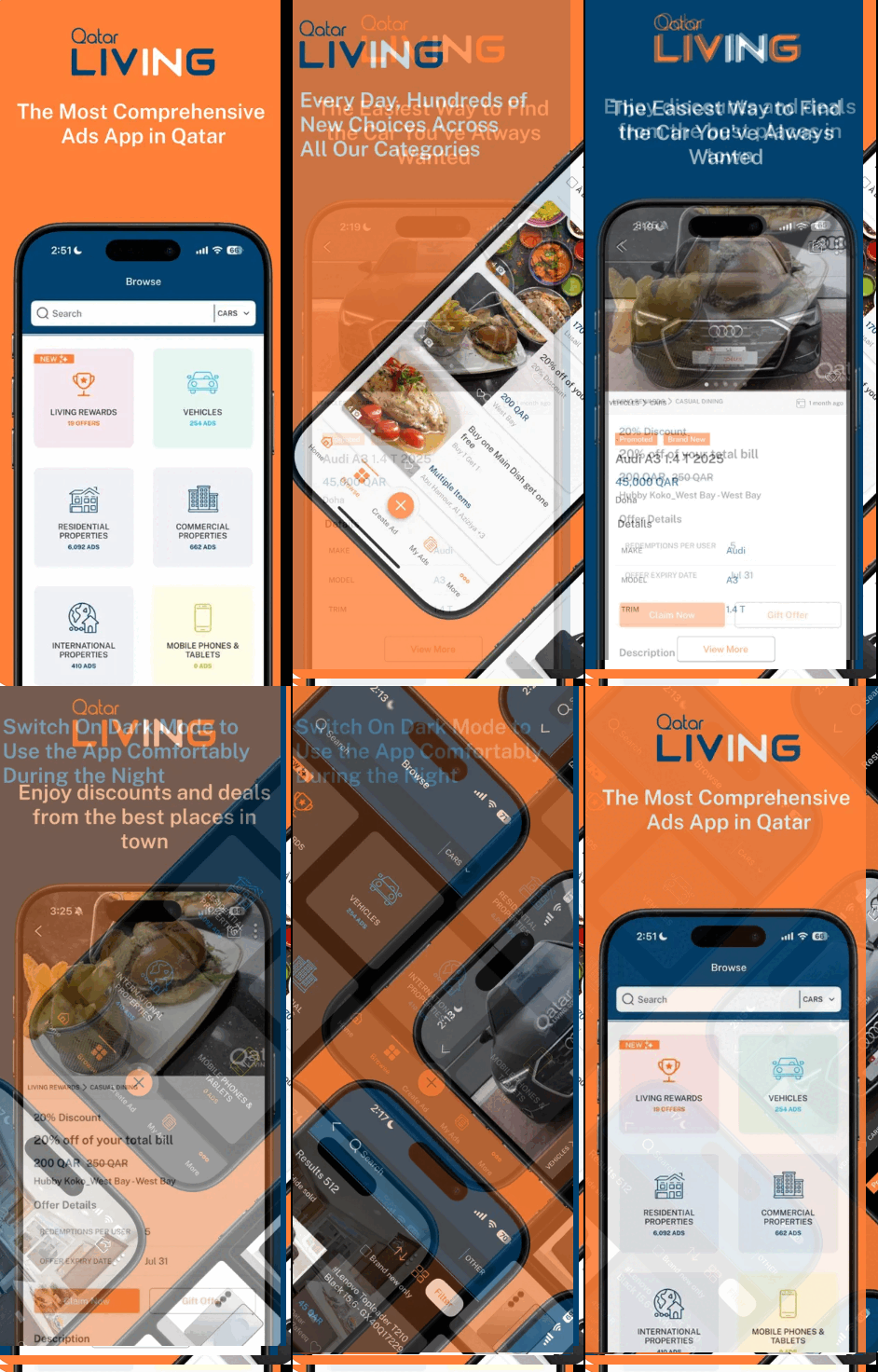
To understand the investment, one must first appreciate the value being created. Platforms like Qatar Living don’t succeed by accident. They stand out due to a potent combination of first-mover advantage, deep localization, and an incredibly comprehensive feature set that serves the real, day-to-day needs of a diverse expatriate and local population.
Key Success Factors:
- First-mover advantage – Established dominance in Qatar’s digital marketplace since 2005
- Deep localization – Tailored specifically for Qatar’s unique multicultural expatriate and local community needs
- Comprehensive ecosystem – One-stop digital platform covering housing, vehicles, jobs, services, and classifieds
- Community-driven approach – Built around real daily needs rather than a single feature
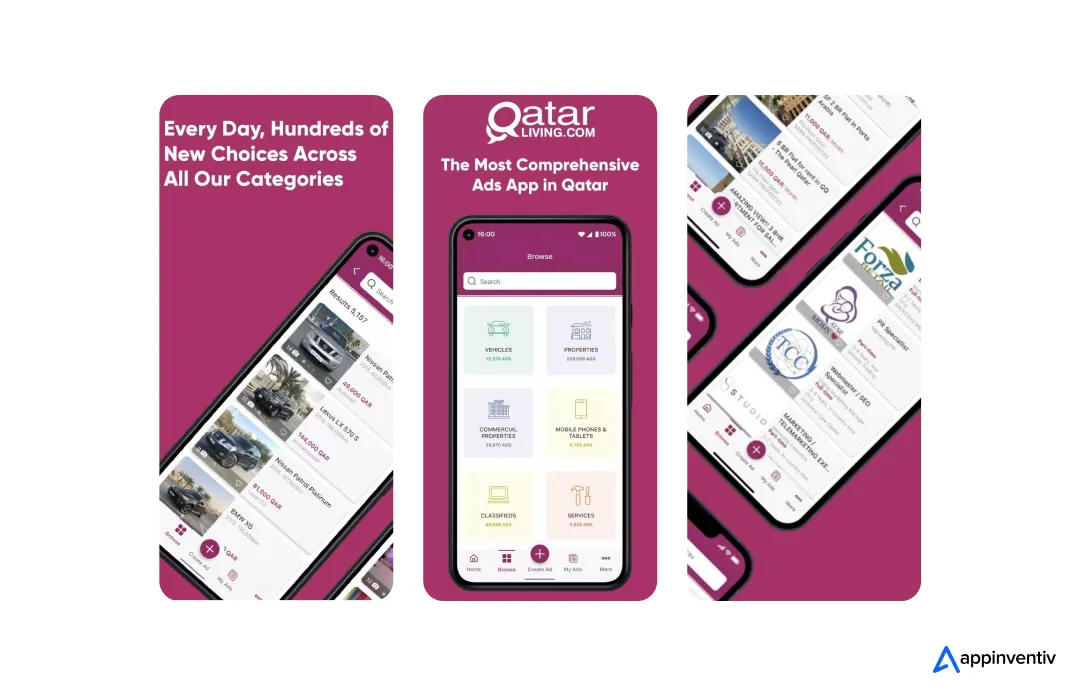
Their success comes from building a complete digital ecosystem rather than focusing on one standout feature. This approach created a huge user base, strong revenue from classifieds and ads, and real influence on Qatar’s digital economy. Since starting in 2005, Qatar Living grew from a basic forum into Qatar’s biggest digital platform by handling the everyday needs of people living there and visitors. With over 400k+ active users since October 2025, the platform works because it solves actual problems with a straightforward digital approach.
What this tells business leaders is simple. Community platforms win when they solve daily problems at scale, not when they chase trends. Qatar Living did not grow because of a single brilliant feature. It grew because it became useful every single day.
For any company looking to enter this market, the opportunity is not to copy screens, but to own a use case deeply. Whether it is real estate, employment, healthcare, or lifestyle services, the fastest path to traction is to narrow the audience first and dominate one category before expanding.
Businesses that design for real user behavior, prioritize trust, and build around repeat needs create platforms that grow through habit, not advertising spend. In a market like Qatar, where word-of-mouth and community influence are strong, relevance beats marketing every time.
Understanding the Complete Cost to Build an Online Community Platform like Qatar Living
The budget for a project of this magnitude is not a single figure but a spectrum, dictated by complexity, features, and strategic goals. Understanding the investment required to make an app like Qatar Living requires examining both complexity tiers and development stages to provide a complete price breakdown of community app development.
Investment Tiers by Platform Complexity
Minimum Viable Product (MVP): Build core features that solve specific user problems. Launch early to test market response. Collect user feedback to guide next steps. Keep costs low while proving your concept works.
- Investment Range: QAR 109,200 – QAR 254,800 ($30,000 – $70,000)
Mid-Complexity Platform: Add payment systems and messaging features. Include detailed user accounts and better navigation. Turn your basic platform into a money-making business. Strong user growth indicates market acceptance.
- Investment Range: Up to QAR 1,092,000 (Up to $300,000)
Enterprise-Grade Platform: Install AI recommendation engines and microservice architecture. Connect multiple external services and detailed reporting tools. Build systems that handle millions of users simultaneously. This represents top-tier online community platform development.
- Investment Range: QAR 2,184,000+ ($600,000+)
| Platform Type | Key Features | Investment Range (QAR) | Investment Range (USD) | Timeline | Strategic Advantage |
|---|---|---|---|---|---|
| Minimum Viable Product | Basic listings, user registration, search functionality, simple messaging | QAR 109,200 – QAR 254,800 | $30,000 – $70,000 | 3-4 months | Fast market entry, early user feedback |
| Mid-Complexity Platform | Payment gateway, advanced search filters, real-time notifications, mobile app, admin dashboard | Up to QAR 1,092,000 | Up to $300,000 | 6-8 months | Revenue generation, competitive positioning |
| Enterprise-Grade Platform | AI recommendations, multi-language support, advanced analytics, API integrations, auto-scaling infrastructure | QAR 2,184,000+ | $600,000+ | 12-18 months | Market dominance, future-proof technology |
Development Stage Breakdown (Cumulative Investment Approach)
When you’re planning to make an app like Qatar Living, understanding the development timeline helps you budget properly. Most projects start with research and planning, which typically runs between QAR 18,200 to QAR 36,400. During these early weeks, teams study the market, analyze what competitors are doing, and decide which features matter most. Think of this as your foundation work.
Once planning wraps up, design teams take over. The app design phase adds another QAR 27,300 to QAR 54,600 to your costs, bringing your total investment to somewhere between QAR 45,500 and QAR 91,000. This stage determines whether users will actually want to use your platform. Designers create wireframes, build mockups, and test different approaches until everything feels intuitive.
The development phase is where costs really climb. Building the actual platform – all the backend systems, databases, APIs, and user interface – costs between QAR 91,000 and QAR 163,800. Your running total now sits at QAR 136,500 to QAR 254,800. This is where your designs become functioning, considering your vision regarding online community platform development.
Testing happens throughout development but adds roughly 15-20% to overall costs. Teams hunt for bugs, verify everything works across different devices, and make sure security holds up before launch. Your final MVP investment lands between QAR 136,500 and QAR 254,800.
Also Read: Cost to Build a Classified App Like Dubizzle
This price breakdown of community app development shows exactly what you’re paying for at each step.
| Development Stage | Team Size | Individual Cost (QAR) | Individual Cost (USD) | Key Deliverables |
|---|---|---|---|---|
| Discovery & Planning | 2-3 specialists | QAR 18,200 – QAR 36,400 | $5,000 – $10,000 | Market analysis, technical specs, project roadmap |
| UI/UX Design | 2-4 designers | QAR 27,300 – QAR 54,600 | $7,500 – $15,000 | Wireframes, prototypes, design system |
| Backend & Frontend Development | 4-8 developers | QAR 91,000 – QAR 163,800 | $25,000 – $45,000 | Functional platform, database, APIs |
| Quality Assurance & Testing | 2-3 QA engineers | 15-20% of dev cost | 15-20% of dev cost | Bug-free platform, security validation |
Factors That Influence the Cost to Build an Online Community Platform Like Qatar Living
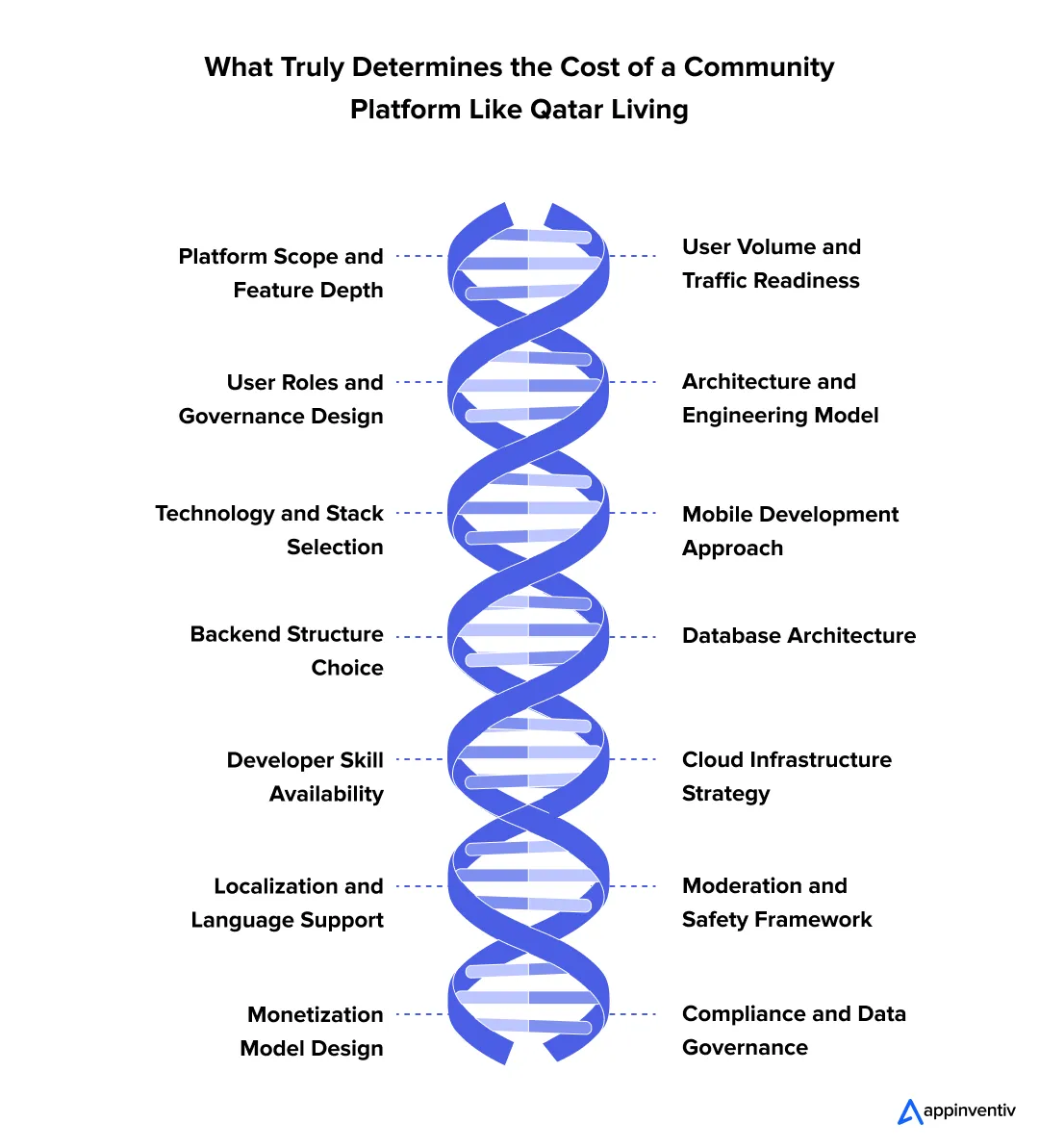
Before locking a budget, businesses need to understand one simple truth: platform cost is not driven by screens alone. It is shaped by architecture decisions, scaling needs, and how much responsibility the platform carries in daily user life. If you are planning community portal development for Qatar or the wider Middle East, these are the primary forces shaping your final spend.
Platform Scope and Feature Depth
A discovery portal with basic listings costs far less than a social platform that hosts conversations, jobs, rentals, and services in one place. As soon as you move into advanced search filters, user dashboards, admin controls, monetization modules, and moderation systems, cost rises. The more detailed and interconnected the features of an online community platform, the greater the build effort. Depth creates stickiness, but it also increases engineering complexity.
User Volume and Traffic Scaling
Building for five thousand users is very different from preparing for five hundred thousand. Platforms like Qatar Living are designed to handle search traffic spikes, multiple logins, and real-time updates without performance drops. That requires thoughtful backend planning, caching layers, and scalable databases. Businesses serious about growth must treat infrastructure as a core product decision, not an afterthought, especially when estimating factors affecting community platform development cost.
User Roles and Platform Governance
Community platforms operate in layers. Admins manage content. Moderators handle trust and safety. Advertisers track engagement. Users post and interact. Each role adds complexity to design, permissions, and workflows. The cost increases as governance becomes more structured, particularly for platforms that operate at scale or run paid listings and ads. This backend planning is where many projects underestimate the real effort involved.
Architecture and Engineering Approach
Not all platforms are built the same way. A monolithic system may launch faster but becomes costly to maintain as features grow. Microservices and modular architectures demand higher initial effort but support long-term scale. Strategic engineering choices during the online community platform development process directly affect future expansion cost, downtime risk, and flexibility. Leaders who plan for growth early usually save more later, even if the starting budget is higher.
Technology Selection
Your tech stack for online community platform development controls performance, data flow, and future compatibility. Cloud hosting, content delivery networks, search engines, analytics layers, and security tooling all shape your spend. Choosing mature technology reduces risk but carries licensing or operational cost. Going lean reduces expenses but demands stronger engineering skills. The balance between stability and scalability is one of the biggest pricing levers
| Component / Decision | Impact on MVP Cost (QAR / USD) | Impact on Enterprise Cost (QAR / USD) | Strategic Rationale |
|---|---|---|---|
| Mobile App Approach | React Native: Saves ~30–40% on initial build. QAR 109,200 – 218,400 ($30k – $60k) saved. | Native (Swift/Kotlin): Higher upfront cost, but better long-term performance and fewer OS update risks. Adds QAR 182,000+ ($50k+) to the budget. | For MVP: prioritize speed-to-market and cost-efficiency → React Native. For Enterprise: performance and flawless UX justify native investment. |
| Backend Architecture | Monolithic: Faster to develop, smaller team needed. Reduces backend dev time by ~50%. | Microservices: Requires senior developers + DevOps early. Increases backend costs by ~40–60%. | Start with a well-structured monolith (cheaper & faster). Build modularly to transition to microservices as platform scales. |
| Database Choice | Single DB (PostgreSQL): Simple setup, easy management. | Hybrid (PostgreSQL + MongoDB/Firebase): Complex setup, ~10–15% higher hosting costs. | MVP can survive on one database. Scaling requires specialized DBs (SQL for transactions, NoSQL for real-time features). |
| Developer Talent Pool | Node.js / React: Large global pool, competitive rates. | Niche Tech: Harder to hire, higher developer cost & hiring time. | MERN stack (Mongo, Express, React, Node) ensures long-term cost savings and hiring flexibility. |
| Cloud Hosting | Basic AWS Setup: A few EC2 instances, basic RDS/S3. QAR 1,100 – 3,600/month ($300 – $1,000). | Auto-scaling AWS: Multiple EC2s, load balancers, CDN, managed DBs. QAR 36,400+/month ($10,000+). | Start small, leverage elasticity. Pay-as-you-grow model scales infra costs with user growth. |
Localization and Language Support
Platforms serving Qatar must account for Arabic support, right-to-left design, and culturally aligned UX. This requires additional QA, UI adjustments, and content structuring. Deep localization is one of the reasons global templates fail in regional markets. Building for cultural alignment adds cost, but it also multiplies engagement and adoption in markets that care deeply about relevance.
Moderation and Safety Systems
Open communities require protection. As usage grows, so does the need for reporting tools, content filtering, and admin oversight. Automated moderation tools, AI support, and escalation workflows increase build time but protect the platform’s reputation. In social community platform development, trust is a feature, not a setting, and it is never free.
Monetization Design
Advertising engines, featured listings, subscription tiers, and data insights dashboards are not plug-and-play. Each monetization stream adds complexity to accounting, UI, and backend logic. Platforms that plan revenue from day one invest more early, but also build long-term sustainability. Companies chasing short-term savings often pay later when rework becomes unavoidable.
Compliance and Data Responsibility
Hosting user data includes legal exposure. Data protection, content liability, and operational transparency must be built into the platform. Compliance adds testing responsibility and security planning but protects the business from regulatory damage later. Ignoring this phase may reduce upfront cost to build an online community platform like Qatar Living but raises business risk significantly.
This analysis makes it clear: the primary factors affecting community platform development cost are deeply rooted in these early technology and architecture decisions.
Hidden Cost Drivers Businesses Often Miss in Community Platform Projects
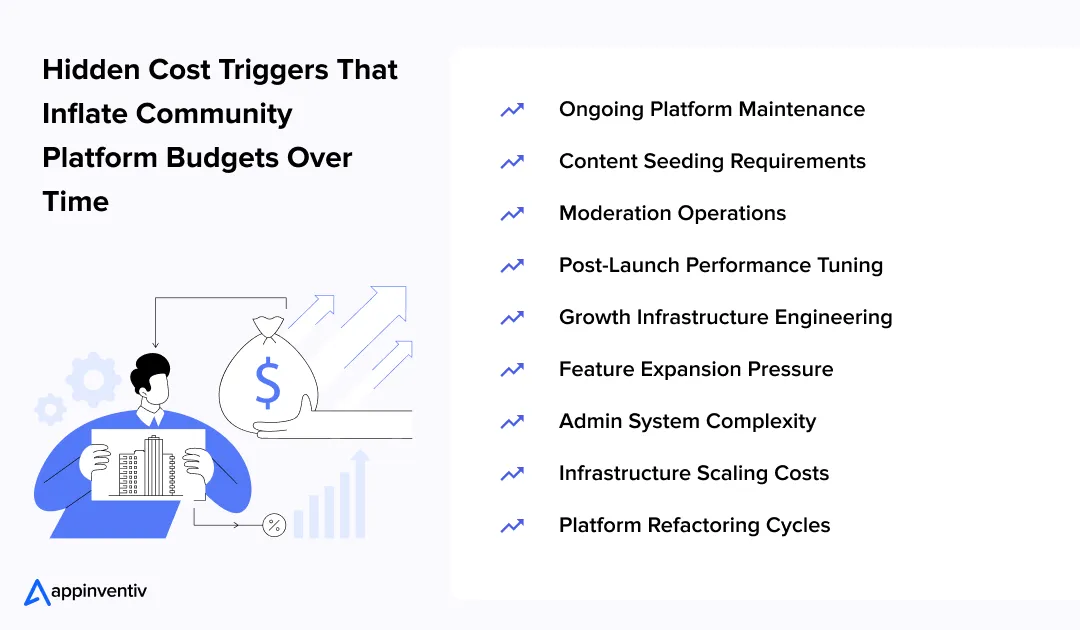
Some costs never show up in the original proposal. They appear later, after launch, when the platform begins handling real users at scale. Businesses focusing only on development quotes often overlook the day-to-day realities of running a community product. These hidden factors rarely make it into a pricing table, yet they quietly shape the total cost over time..
Continuous Maintenance and Updates
Platforms are not shipped and forgotten. Bugs, micro-improvements, and updates become routine. Every small fix consumes real engineering hours. Over time, maintenance becomes a recurring cost that rivals initial development if not planned upfront.
Content Seeding and Moderation Effort
Empty platforms feel abandoned. Many businesses underestimate the effort required to create relevance before communities self-sustain. Seeding content, managing discussions, and removing abuse takes human effort long after launch.
Performance Tuning After Launch
What works in testing can break under live traffic. Server crashes, slow search, or delayed listings create hidden optimization work. These costs rise sharply when growth outpaces infrastructure assumptions.
Marketing Infrastructure, Not Just Marketing Spend
Traffic alone does not create engagement. Referral systems, email workflows, notifications, and in-app nudges require product engineering. Growth without backend readiness burns money without retention.
Feature Creep Driven by User Behavior
Once people start using the platform, demands multiply. New filters, visibility controls, and payment features follow quickly. These are rarely part of original scopes, yet they become inevitable drivers of additional spend.
Internal Admin Complexity
Admin panels expand as operations grow. Reporting dashboards, moderation queues, and automation rules evolve with usage. The stronger the governance model, the higher the cost of system upkeep.
Infrastructure Elasticity
Hosting costs increase quietly as traffic grows. Storage, backups, data pipelines, and performance recovery systems all scale with volume, not with design.
Rebuilding for Growth
Shortcuts taken early eventually demand rebuilding. Quick launches limited by budget often need refactoring when traction arrives. That second build is always more expensive than getting it right early.
Optimize Your Budget: Proven Tips for Building Your Platform Efficiently
A large budget isn’t always a prerequisite for success. Strategic social community platform development can deliver a high-quality platform without breaking the bank. Smart cost optimization strategies enable entrepreneurs and businesses to build robust community platforms while maintaining financial efficiency and maximizing return on investment.
Core Cost Optimization Strategies:
The foundation of cost-effective community portal development lies in making strategic decisions during the planning and development phases. These proven strategies can reduce your overall investment by 40-60% while maintaining platform quality and functionality essential for competitive market entry.
Start with an MVP Approach
The single most effective strategy for optimizing the cost to build an online community platform like Qatar Living involves validating your core idea before investing in complex features. An MVP for social community platform development focuses on essential functionalities like user registration, basic listings, and simple messaging. This approach reduces initial investment by 60-70% while providing valuable user feedback to guide future development decisions.
Prioritize Features Meticulously
Use the MoSCoW method (Must have, Should have, Could have, Won’t have) to focus development resources on launch-critical features. For community portal development, “Must have” features typically include user profiles, content posting, and search functionality, while advanced features like AI recommendations fall into “Could have” categories for later phases.
Leverage Cross-Platform Development Technologies
Utilize React Native or Flutter to cut mobile development costs and time significantly. Cross-platform frameworks allow a single codebase to serve both iOS and Android users, reducing development time by 30-40% compared to native app development for each platform separately.
Must Read: Top 10 Cross Platform Development Frameworks
Strategic Partnership Approaches:
Consider exploring development partnerships within the GCC region or established Middle Eastern tech hubs that understand local market dynamics and regulatory requirements. Many Qatar-based businesses have found success working with regional development teams that offer competitive pricing while providing cultural alignment and proximity advantages for community portal development projects.
Additionally, consider hybrid development teams combining local project management with offshore development resources. This approach ensures clear communication and project oversight while maintaining cost efficiency. Fixed-price contracts with clearly defined milestones can further control costs and provide budget predictability for social community platform development projects.
These strategies for optimizing the cost to build an online community platform like Qatar Living enable successful platform creation while maintaining financial sustainability and competitive market positioning.
Key Features Every Successful Community Platform Needs
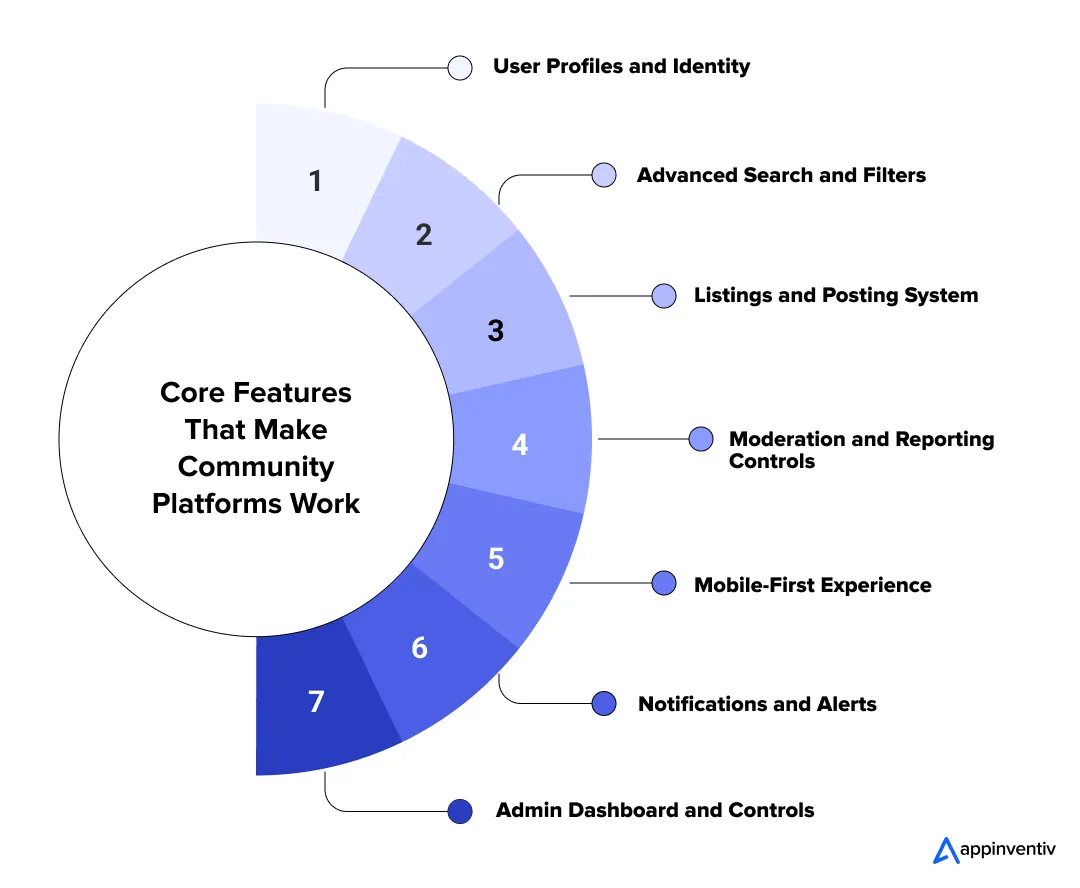
A community platform only works when people return without being forced to. That happens when the experience feels useful, familiar, and easy to trust. These are not “nice-to-have” features. These are the basics that decide whether your platform grows quietly or never takes off at all.
User Profiles and Identity
People want to be recognized, not remain anonymous forever. Profiles give users a reason to return and build reputation inside the platform.
Powerful Search and Filters
Communities fail when content is hard to find. Search needs to feel instant and accurate or users simply leave.
Listings and Posting System
Whether it is jobs, homes, services, or discussions, users expect posting to be quick and predictable.
Moderation and Reporting Tools
Trust keeps communities alive. Clear reporting, content flags, and basic admin controls are essential for stability.
Mobile-First Experience
Most users discover and return through their phone. If the experience is slow or confusing on mobile, growth stops.
Notifications and Alerts
People forget platforms easily. Subtle reminders through notifications encourage users to come back without feeling forced.
Admin Dashboard
Every platform needs control. Usage tracking, content approval, and basic analytics keep operations clean.
The stronger these fundamentals, the higher the chance your platform earns daily usage instead of casual visits.
Advanced Features That Help Your Community Platform Stand Out
Once your foundation is strong, growth comes from features that make your platform easier, faster, and harder to replace. These are the features that separate platforms that exist from platforms that dominate.
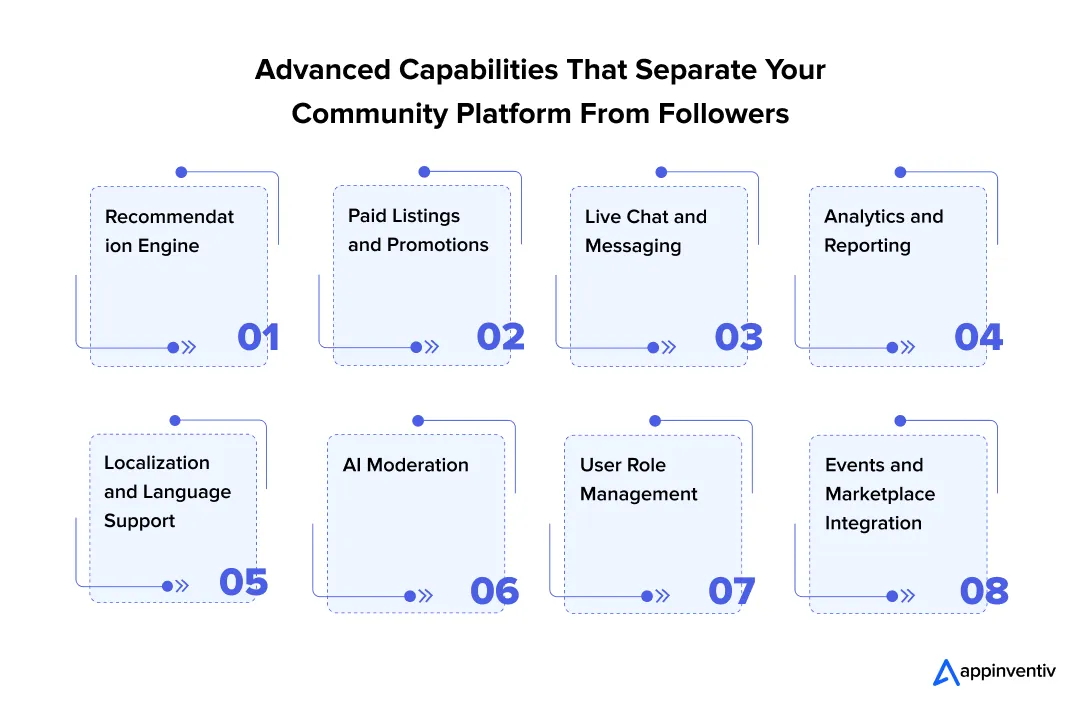
Smart Recommendation Engine
When content feels personalized, engagement rises. Suggested listings, jobs, or posts keep users browsing longer.
Paid Listings and Promotions
Revenue models must be built early. Highlighted ads, featured posts, and premium visibility unlock business income.
Live Chat and Direct Messaging
Communities grow through conversation. Real-time interaction creates retention that content alone cannot.
Advanced Analytics and Reporting
Data makes strategy possible. Activity trends, listing performance, and engagement insights guide smarter decisions.
Multilingual and Localization Support
A platform serving diverse users must speak their language both literally and culturally.
AI-Powered Moderation and Search
As scale increases, automation protects quality. Faster filtering and smarter search reduce manual workload.
User Role Management
Admins, contributors, advertisers, and moderators all need separate control levels as the platform evolves.
Event and Marketplace Integration
Communities become ecosystems when people can buy, book, and participate without leaving the platform.
How to Develop a Platform like Qatar Living: The Process
Building a large community platform is not a development project. It is a business transformation exercise. The most common reason platforms fail is not technology. It is poor execution discipline. The online community platform development process works when it connects strategy, engineering, design, and operations into one controlled delivery flow. Companies that treat it like an app build lose control of scope, budget, and performance within months.
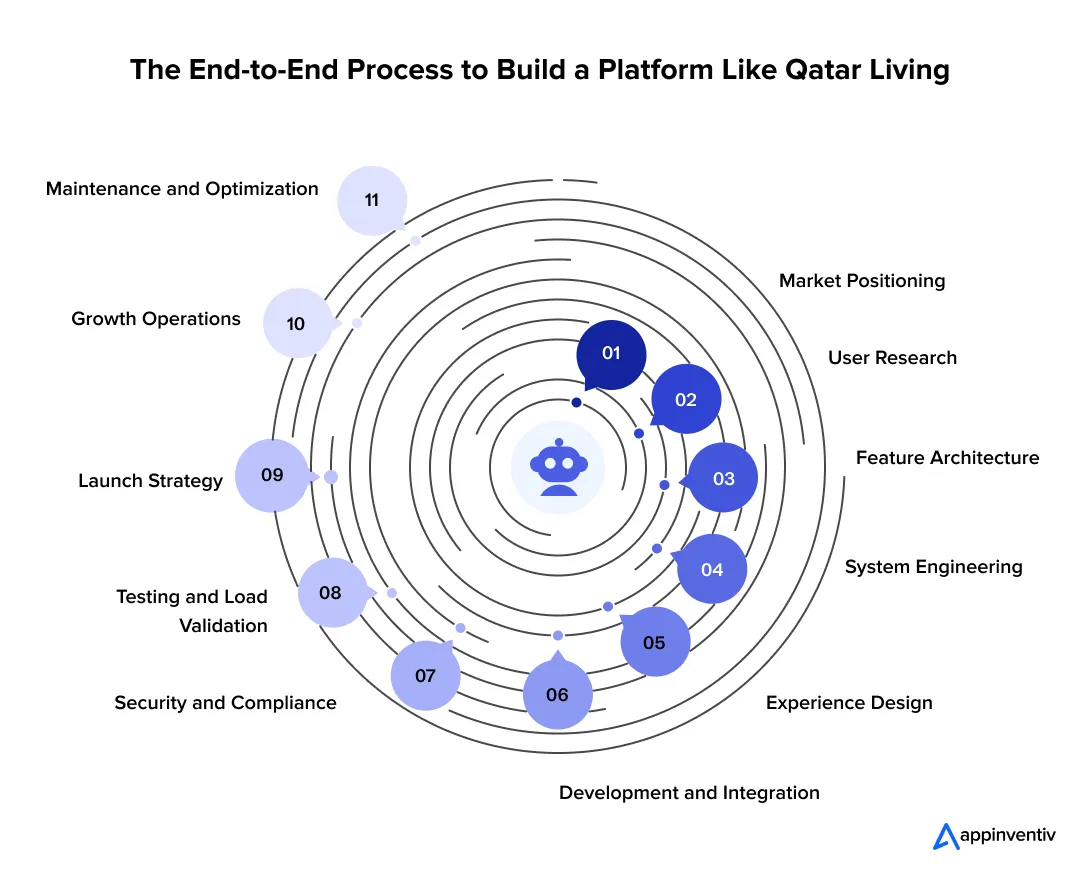
Step 1: Strategic Market Positioning and Business Alignment
This phase answers one question: why should users choose your platform over anything else already available? This includes market gap analysis, validation workshops, and competitive teardown studies. Leadership decides whether the platform is horizontal like Qatar Living or purpose-built for one domain. Revenue logic is also defined here to avoid building features that cannot be monetized later.
Step 2: User Research and Behavioral Intelligence
Here, teams move beyond demographics and study intent, friction, and usage frequency. Research includes interviews, surveys, and activity pattern analysis (how users search, scroll, save, and return). Real behavior maps define what screens matter and which features can be skipped. This avoids creating features nobody uses.
Step 3: Platform Planning and Feature Architecture
Once user reality is understood, the feature system is designed as an ecosystem, not as standalone screens. Business decides what goes into Phase 1 versus later upgrades. This keeps delivery practical without sacrificing long-term ambition. The product roadmap is frozen here to protect scope control.
Step 4: System Architecture and Engineering Blueprint
This is where cost control is won or lost. Database design, cloud infrastructure, traffic handling, and system separation models are locked. Platforms planning growth move toward modular engineering rather than tightly connected systems. This enables upgrades without platform shutdowns later.
Step 5: Experience Design and Usability Engineering
Design teams plan not only layout but behavior. User stress analysis is performed to understand confusion points. Button placement, form logic, filter priorities, and display layouts are structured around speed and clarity. Consistency beats creativity here. The goal is a platform people trust without thinking.
Step 6: Product Development and Integration
This is execution. Development proceeds in layers: core logic, user flows, database connections, external APIs, payment hooks, and analytics feeds. Teams enforce testing alongside development to prevent defects from piling up. Integration testing ensures the platform behaves as a single system, not fragmented modules. It is one of the crucial phases that impacts the overall cost to build an online community platform like Qatar Living.
Step 7: Security Framework and Compliance Controls
Authentication systems, encryption policy, back-office access rules, and session control models are enforced. Abuse prevention, system logging, and user protection mechanisms are stress-tested. This phase protects both users and business credibility.
[Also Read: How Should Enterprises Chart DT-driven Compliance Challenges]
Step 8: Performance Testing and Load Engineering
Traffic simulation is not optional. Database stress tests and failure scenarios reveal weaknesses before public usage. Engineering teams tune response times and memory usage under pressure. Platforms that skip this quietly collapse later.
Step 9: Launch Planning and Real-World Rollout
This phase does not start with press releases. Pilot users are invited. Feedback is logged. Fix cycles run in real time. Risk is minimized before exposure. Businesses that rush this phase often deal with reputation damage early.
Step 10: Growth Infrastructure and Operational Scaling
Moderation processes, ticket handling, customer support systems, and performance monitoring dashboards go live. Teams establish governance models. This ensures platform behavior remains healthy as users multiply.
Step 11: Maintenance, Stability, and Continuous Improvement
This is not a phase. This is a permanent operation. Systems require patching, performance tuning, and security reinforcement. Bugs are corrected. Hosting load is adjusted. Feature improvements are based on user behavior data, not guesswork. Sustainable platforms work because their owners never stop fixing small things before they become big failures.
And helped scale the national platform serving 2.6M users across 1,900+ services.

How Community Platform Like Qatar Living Makes Money: Revenue Models Demystified
A successful platform requires a diversified monetization strategy that generates sustainable revenue while providing value to users. When you create an app like Qatar Living, establishing multiple revenue streams from day one ensures long-term financial viability and platform growth in Qatar’s competitive digital marketplace.
Primary Revenue Streams & Pricing Models:
Community platforms make money when users want their posts to get noticed more. Most platforms get 60-70% of their revenue from featured listings and promotional boosts. In Qatar, people pay QAR 50-200 ($14-55) to make their listings stand out, creating steady monthly income.
Advanced Monetization Strategies:
- Tiered Business Subscriptions – Premium plans (QAR 500-2,000 monthly) offering unlimited listings, priority customer support, and advanced analytics dashboards
- Strategic Display Advertising – Programmatic ad placements generating QAR 2-8 per thousand impressions, particularly valuable given Qatar’s high purchasing power
- Transaction-Based Commissions – 2-5% fees on completed transactions, especially effective for high-value categories like real estate and vehicles
- Data-Driven Services – Market insights and analytics packages for businesses seeking consumer behavior data
Emerging Revenue Opportunities:
Modern online community platform development enables innovative monetization through API access licensing, white-label solutions for other markets, and premium verification services. Implementing escrow services for high-value transactions can generate additional commission revenue while building user trust.
There are always challenges in online community platform development, but a weak monetization strategy should not be one of them. Successful platforms typically achieve 25-35% profit margins within 18-24 months through diversified revenue approaches that scale with user growth and market penetration.
Innovate Beyond Qatar Living: How to Create a Platform That Outshines
Competing in a market already dominated by an incumbent like Qatar Living is not about feature parity. It is about business positioning. Enterprises that succeed in this space do not ask, “How do we match them?” They ask, “Where do we outperform them?” Building a community portal requires strategic clarity, not technical imitation. The objective is to enter with focus, not noise.
Use Technology to Remove Friction, Not Add Complexity
Technology should make life easier for users and simpler for operations. Faster search, smoother navigation, and reliable platform performance create trust faster than any marketing campaign. Businesses that invest in quality experience early reduce churn and support costs long-term. This is where online community platform development becomes a business advantage, not just an engineering exercise.
Enter the Market Through Focus, Not Scale
Trying to serve everyone usually results in serving no one well. Platforms that start with a defined audience build authority faster. Whether it is premium real estate, verified services, or job-specific communities, focus accelerates credibility. If you want to build an app like Qatar Living, the smarter move is to dominate one category before expanding horizontally.
Design Revenue Into the Experience From Day One
Revenue should never be treated as an add-on. Paid visibility, subscriptions, and premium access must feel native to the user journey. Teams that postpone monetization often rebuild later at higher cost. When you create an app like Qatar Living, revenue design should grow naturally alongside user adoption.
Build Experience That Creates Habits, Not Visits
Retention beats acquisition. Platforms grow when users return without reminders. Simple design, predictable flows, and relevant notifications shape daily behavior. The strongest communities are not the most complex. They are the most comfortable.
Use Innovation to Build Defensibility, Not Buzz
Innovation must reduce uncertainty and increase confidence. Smarter discovery, immersive listings, and security controls create real value. Voice access and multilingual support broaden reach, but only when they simplify experience. The long-term business benefits of online community portals come from trust and reliability, not novelty.
Our experts help you optimize spend and build community platforms that beat the competition.

Why Choose Appinventiv for Developing a Community Platform in Qatar
We hope this blog has helped you understand the overall cost to build an online community platform like Qatar Living. Now, when you choose a technology partner, you are not just hiring developers. You are trusting a team with your business model, your operations, and your long-term growth.
A community platform is not something that runs quietly in the background. It lives in front of users every day. It breaks under pressure if it is not engineered properly. That is why we approach every platform as a business system, not just a software build.
We spend time understanding how your platform will actually be used after launch, how people search, when they leave and why they come back. We build around real behavior, not assumptions. From the beginning, we design for traffic, content flow, and moderation needs so your platform does not struggle the moment real usage begins.
As a leading mobile app development company in Qatar, our experts focus on stability first, speed second, and features third because performance always matters more than appearance.
We also care about where your users are and how they think. Platforms in Qatar require more than technical execution. They demand cultural sensitivity, language planning, and reliability. We account for this early so alignment happens naturally, not as a patch later. Whether your audience is local, expatriate, or both, the experience is built to feel familiar and easy.
Most importantly, we do not leave after launch. Community platforms change fast. User behavior shifts. Traffic grows. Problems appear when you least expect them. We stay involved through iterations, improvements, and scaling support so you are never managing growth on your own. Our goal is simple: help you build something that works today and still works when the platform becomes bigger than you expected.
Ready to build Qatar’s next breakthrough community platform? Contact Appinventiv today and transform your vision into a market-leading reality.
FAQs
Q. How much does it cost to build a community platform like Qatar Living?
A. Building something like Qatar Living isn’t cheap, but it’s not impossible either. You’re looking at anywhere from QAR 109,000 to QAR 2.18 million, which is a huge range because it really depends on what you’re trying to build. If you just want the basics – people can post listings, search for stuff, maybe send messages – you might get away with QAR 109,000 to 327,000. But if you want all the bells and whistles – fancy mobile apps, payment systems, AI recommendations, the works – then you’re talking QAR 1.09 to 2.18 million, maybe more.
The cost to build an online community platform like Qatar Living depends on a bunch of things. How complicated do you want the design? How many features? Do you need it to connect with other systems? Are you building everything from scratch or can you modify something that already exists? The best thing to do is sit down with some developers and walk through exactly what you need. They’ll give you a proper quote instead of these rough estimates.
Q. Can AI and chatbots be integrated into community platforms?
A. Absolutely! AI and chatbots work wonderfully in community platforms and can really enhance the user experience. You can use them for instant customer support, helping new members navigate the platform, moderating content automatically, and even suggesting relevant discussions or connections based on user interests. Many platforms now use smart chatbots to handle common questions, filter spam, and provide 24/7 assistance when human moderators aren’t available. The technology has gotten pretty sophisticated – these tools can understand context and provide helpful responses that feel quite natural. It’s definitely worth considering if you want to improve engagement and reduce manual workload.
Q. How Web3 and blockchain could impact community platforms?
A. Web3 and blockchain are changing community platforms in interesting ways. You’re seeing features like token-based rewards where members earn cryptocurrency for valuable contributions, decentralized governance where the community votes on platform changes, and data ownership where users control their information. NFTs create exclusive memberships and digital collectibles within communities. Blockchain transparency helps build trust since everything gets recorded and verified. While it’s early days with technical challenges, many platforms experiment with these technologies to create engaging, user-owned community experiences that go beyond traditional models.
Q. What makes Appinventiv a trusted partner for community platform development in the Middle East?
A. Because building a community platform is not just about writing code. It is about making something stable, usable, and ready for growth from day one. Appinventiv’s strength lies in building platforms that are designed to scale, perform under load, and adapt as users grow.
We focus on fundamentals that matter long after launch – architecture planning, performance engineering, clean UX, and stability in real usage conditions. From the beginning, our teams design systems that can evolve, not just deploy.
What also sets Appinventiv apart is long-term involvement. Many development partners hand over the product and move on. We stay involved through improvements, scaling decisions, and technical refinements so your platform does not stall after release. Our role is not to just deliver software, but to support a business system that continues to perform as expectations grow.

- In just 2 mins you will get a response
- Your idea is 100% protected by our Non Disclosure Agreement.

How to Build a Forex Currency Trading App for Multi-Currency Trading in the UAE
Key Takeaways: In the UAE, regulation comes first. Your licensing choice will shape how the entire platform is built. A forex app here needs more than charts. It needs a solid trading engine, strong liquidity connections, and reliable risk controls. AED funding, USD settlement, Islamic swap-free accounts, and Arabic support are practical requirements, not optional…

A Guide on How to Choose the Right Mobile App Development Company in Iraq
Key Takeaways Define business goals, integrations, compliance needs, and success metrics before engaging a development partner. Prioritise teams experienced in Arabic/Kurdish localisation, RTL UX, and testing on low-spec Android devices common in Iraq. Evaluate architecture maturity, security standards (SOC2/ISO), and CI/CD practices rather than focusing only on development cost. Ensure the application is designed for…

How Much Does It Cost to Build a Calorie Counting App Like Cronometer in Australia
Key takeaways: Building a calorie counting app with Cronometer-level accuracy in Australia typically costs between AUD 70,000 and AUD 700,000+, depending on data depth, compliance posture, and analytics sophistication. Underestimating compliance, data licensing, and post-launch governance is the most common cause of budget overruns for Australian nutrition platforms. The hard cost driver is not screens.…









