























10+ Business Ideas to Launch in Saudi Arabia in 2026 and Beyond

 Share -



- 01Saudi Arabia’s Growing Business Landscape: Opportunities and Market Considerations
- 02Why Saudi Arabia is a Promising Market For New Businesses in 2026?
- 0310+ Profitable Business Ideas to Launch in Saudi Arabia in 2026 and Beyond
- 04Comparing the Top 10+ Business Ideas in Saudi Arabia
- 05How to Choose the Right Business Idea for the Saudi Market
- 06How to Start a Business in Saudi Arabia in 2026
- 07Estimated Cost of Setting Up a Business in Saudi Arabia
- 08How Appinventiv Can Help Turn Your Business Idea into Reality in Saudi Arabia
- 09FAQs

For investors and business owners assessing opportunities in Saudi Arabia, this guide covers high-potential sectors, capital requirements, revenue opportunities, and the factors that shape business viability.
From futuristic urban developments to technology-led public services, Saudi Arabia is creating new opportunities for businesses across the economy. Vision 2030 is driving this transition by expanding tourism, entertainment, healthcare, manufacturing, renewable energy, and digital infrastructure. If you are researching business ideas in Saudi Arabia, consider where these changes create practical demand, such as AI consulting, travel applications, healthcare platforms, and software for small and medium-sized enterprises.
Other areas to watch include cloud computing, data analytics, cybersecurity, and automation as part of the government’s digital transformation initiative. Arabic support, right-to-left interfaces, Saudi payment systems and adherence to relevant data protection regulations are among the features that businesses aiming at the local market might require. The commercial field is growing with these priorities.
Key takeaways:
- Saudi Arabia’s Vision 2030 is creating strong demand for tech-driven and service-based businesses.
- Promising opportunities include AI and software development, HealthTech, FinTech, tourism technology, renewable energy software, and digital learning platforms.
- Not every idea will work, so validate demand, competition, and licensing before investing.
- Software-based business ideas can generate revenue through subscriptions, licensing, transaction fees, implementation projects, and ongoing support services.
- Success depends on choosing a business that fits your skills, budget, and ability to scale.
Saudi Arabia’s Growing Business Landscape: Opportunities and Market Considerations
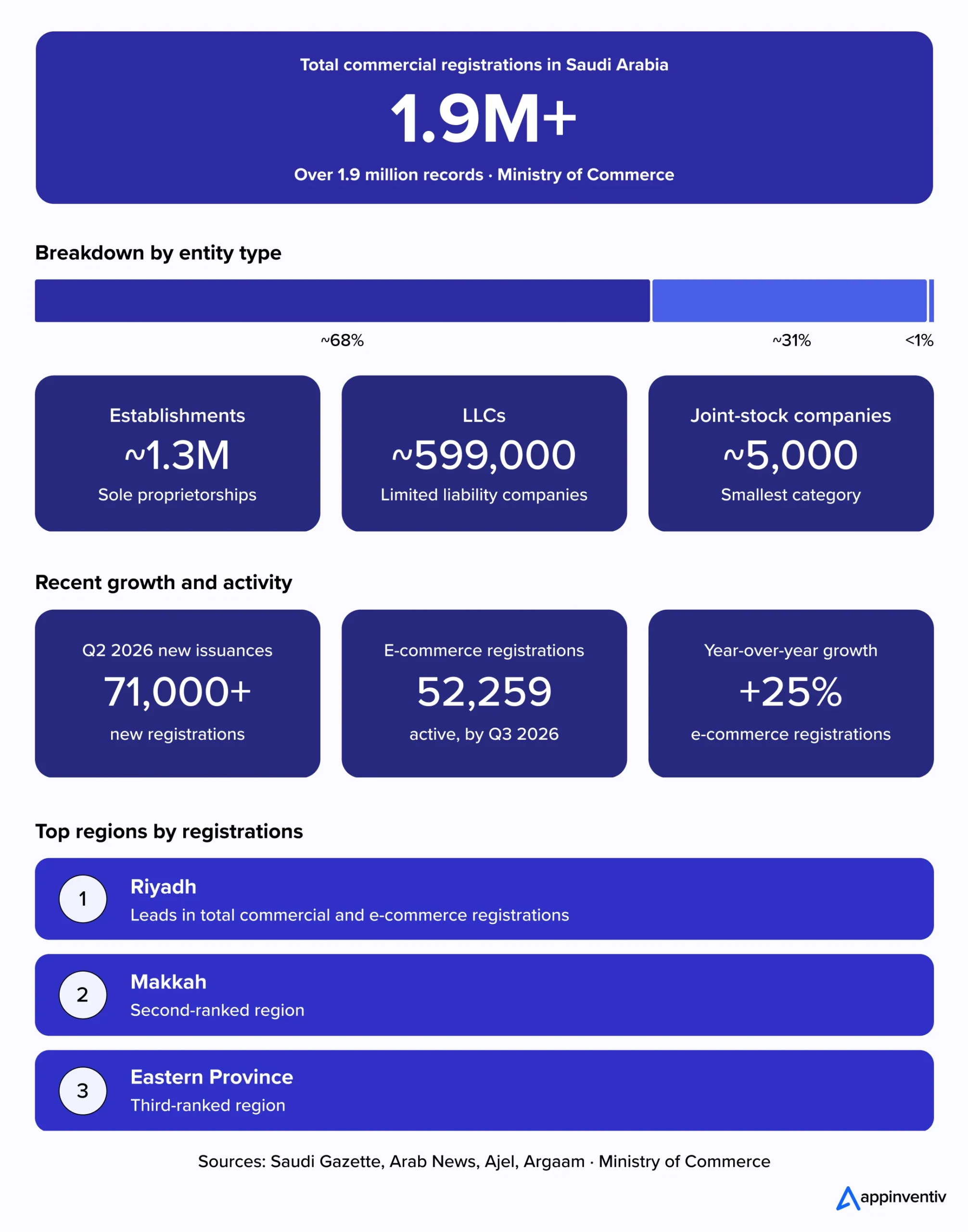
In Q2 2026, the Ministry of Commerce noted more than 1.91 million active commercial registrations and issued more than 71,000 new commercial registrations in the quarter. To get more detailed business registration information in the Kingdom, check out the illustration below:
Still, a growing economy does not make every idea commercially viable. Research your target audience, study competitors, check sector-specific licensing rules, and establish a realistic budget before committing capital.
In this blog, we will explore the top 10+ business ideas to start in the Kingdom in 2026 and beyond, compare their potential, discuss how to choose the right idea, and outline the steps to start a business along with estimated costs. Let’s dig deeper!
Identify customer demand, control operating costs, and work towards a measurable ROI through sound business planning.

Why Saudi Arabia is a Promising Market For New Businesses in 2026?
Saudi Arabia’s Vision 2030 agenda is opening up opportunities for technology, finance, healthcare, tourism and industrial services. The Kingdom has millions of commercial registrations which represent a growing customer base for businesses that meet the needs of these markets, creating profitable business opportunities in Saudi Arabia for companies of every size.
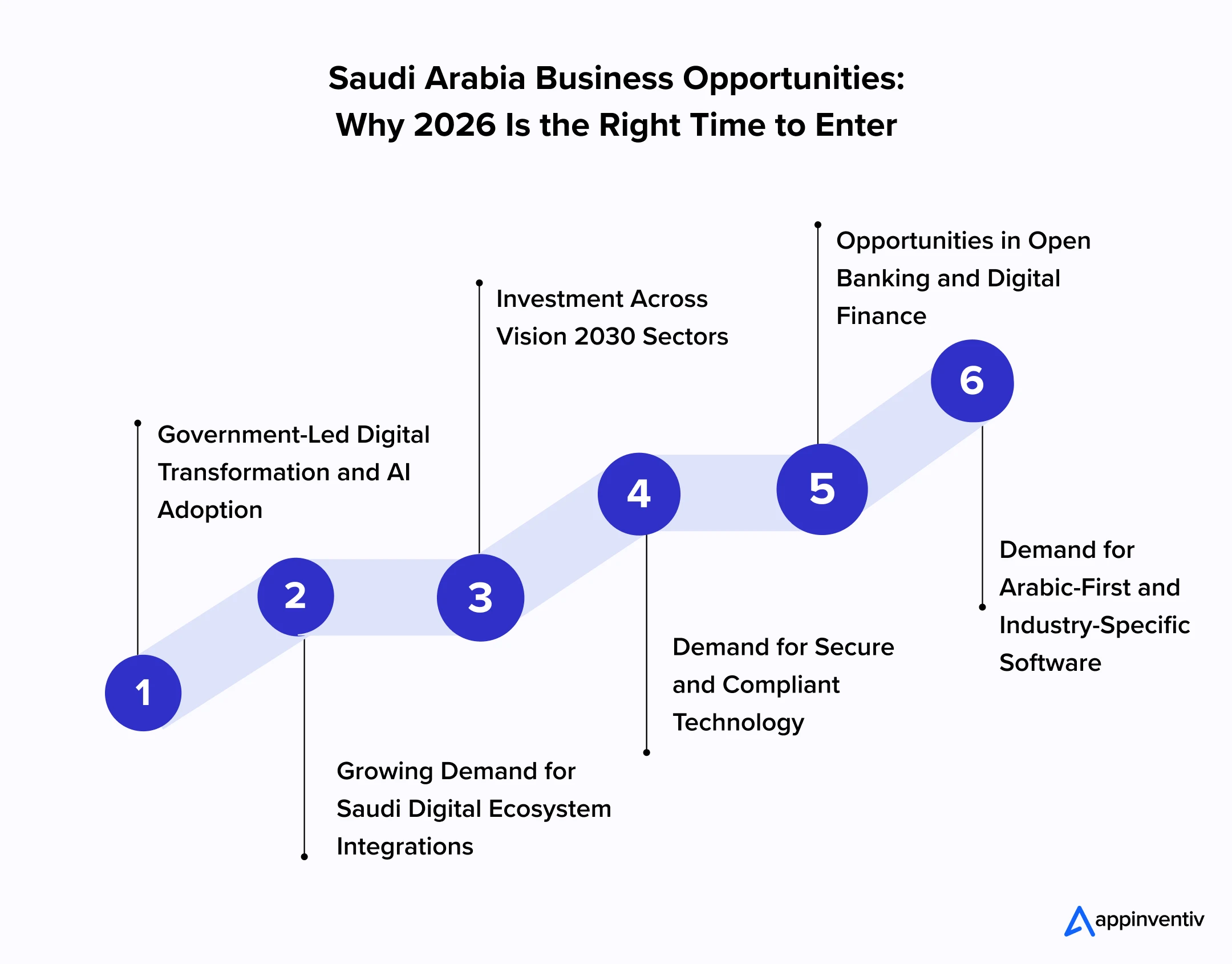
Government-Led Digital Transformation and AI Adoption
There is a surge in the use of AI-ready enterprise software, Arabic-first applications, and business automation, which is backed by the National Strategy for Data and AI and the 2026 Year of Artificial Intelligence initiative.
For founders seeking entrepreneurial opportunities in the region, document processing, predictive analytics and legacy modernization solutions can be created for companies to meet the requirements of relevant Digital Government Authority standards. Connecting with the best AI development company in Saudi Arabia can help entrepreneurs build compliant, scalable solutions aligned with local market needs.
Growing Demand for Saudi Digital Ecosystem Integrations
Businesses require systems that are connected with local services and meet Saudi requirements. The government APIs integration, along with ZATCA/FATOORA e-invoicing and Nafath authentication, opens new avenues for software providers. Integrating ERP, CRM, financial and customer systems can also cut manual workload and enhance reporting.
Investment Across Vision 2030 Sectors
There are unique technology requirements for each of the best industries to invest in Saudi Arabia, such as tourism, healthcare, logistics, finance and manufacturing. The companies can create travel platforms, healthcare management systems, fleet software, and industrial automation tools.
The Eastern Province presents unique opportunities for software solutions to factories, warehouses and industrial supply chains.
Demand for Secure and Compliant Technology
Organizations must comply with Saudi platform compliance regulations that account for data privacy, cybersecurity, and applicable hosting requirements. The Personal Data Protection Law (PDPL) and National Cybersecurity Authority controls create demand for secure cloud systems, identity management, data governance, and compliance services. Requirements vary by sector and type of data.
Opportunities in Open Banking and Digital Finance
The regulated financial environment in Saudi Arabia fosters opportunities for financial management platforms, payment technology, and authorized Open Banking integrations.
Businesses can create cash flow tracking tools, tools for managing expenses, and financial reporting tools. The solutions need to comply with the Saudi Central Bank’s conditions and ensure the security of customer data.
Demand for Arabic-First and Industry-Specific Software
Applications that are tailored towards the Arabic language, right-to-left navigation, the Saudi riyal currency, and local workflows will create applications more suitable for Saudi customers.
This involves Saudi PropTech/Ejar integrations, healthcare applications and niche industrial software. Solutions that address a known operational challenge can be competitive in terms of local relevance, ease of use and integration reliability.
10+ Profitable Business Ideas to Launch in Saudi Arabia in 2026 and Beyond
Each opportunity offers a different entry point based on investment capacity, market demand, and growth potential. Here are the best business ideas in Saudi Arabia 2026 offers to entrepreneurs, CIOs and investors, each with practical revenue models.
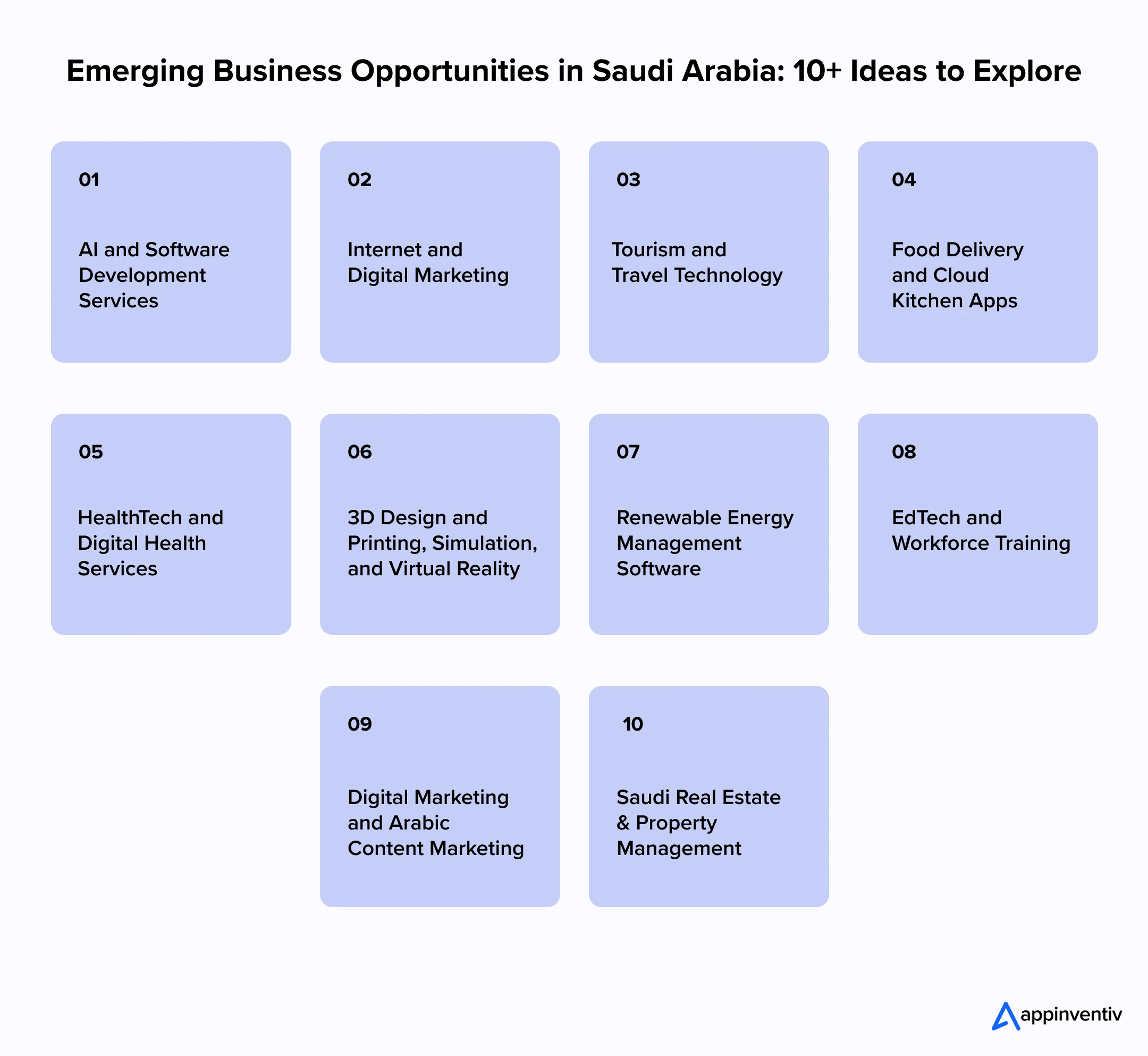
1. AI-Based Development Services
The Saudi Arabia 2026 AI Year presents an opportune moment to invest in AI-ready enterprise software. For organizations aiming to leverage data and intelligent systems in more ways, the National Strategy for Data and AI offers a policy framework. Tawakkalna and Nafath are examples of the breadth of digital services within the Kingdom’s government ecosystem.
CIOs can experiment with AI assistants and predictive analytics that are in Arabic, as well as Government/API architecture that enables the integration of approved services. Businesses can leverage enterprise software development, integration with AI, and legacy modernization for revenue generation.
2. Online Retail Platforms
While Saudi Arabia’s ecommerce market is already strong, it offers opportunities for companies to cater to niche audiences by offering more relevant shopping experiences and products. Platforms like Noon and Haraj embody the differences in online retail and classified marketplaces.
For those looking to start a business, there are opportunities to create niche websites for women’s fashion, perfumes, beauty, or home decor, with Arabic-English user interfaces, Mada payment systems, and local delivery.
3. Tourism Platform
The growth of tourism in Saudi Arabia is driving the demand for digital products and services that simplify the planning, booking, and management of travel and accommodation services. Nusuk and Almosafer are examples of apps that cater to pilgrimage and travel needs through digital platforms.
Entrepreneurs can create platforms in Arabic and English, along with a DMS platform that will enable them to link visitors with licensed tour operators. In the case of CIOs, the possibilities include integrating booking engines, payment systems, customer data, and real-time travel information. Revenue can be generated from enterprise software licensing, commissions and tourism operator partnerships.
4. Food Delivery and Cloud Kitchen Apps
Food delivery companies and restaurant owners can leverage the Saudi market to enhance order management systems, delivery coordination, and customer retention through technological advancements. Digital ordering has become a part of the local food service market, as seen on platforms like Jahez and HungerStation.
Specialized cloud kitchens, one of the small business ideas in Saudi Arabia worth considering, can be established, or software created to integrate kitchen operations, stock, delivery partners and orders. Also, businesses that are eligible for the ZATCA e-invoicing requirements can benefit from integration with their FATOORA system. Revenue can be generated from food sales, software subscriptions for restaurants and enterprise implementation projects.
5. HealthTech and Digital Health Services
For Saudi healthcare providers, technology that integrates patient services with clinical administration while safeguarding sensitive patient data is essential. The Sehhaty app highlights the part played by digital health services, and Nahdi highlights digital opportunities in the pharmacy and healthcare retail sector.
Before investing, it is important for founders to undertake an evaluation of PDPL obligations, hosting arrangements and applicable Ministry of Health and SFDA requirements. It can be in the form of software licenses, rollout and ongoing support contracts.
6. Logistics and Delivery Management Software
Saudi Arabia’s distribution networks and operations in the industry drive the need for more technology that can increase the visibility of shipments, improve fleet utilization, and support planning for deliveries. For on-demand delivery, apps like Mrsool are available, and for local delivery, apps like SPL Online work.
Entrepreneurs can create route optimization systems for logistics operators, create warehouse management software for warehouse operators, and create fleet tracking software for logistics operators. Revenue can come from monthly software subscriptions, per-vehicle or per-shipment charges, implementation fees, and premium analytics services.
7. Smart Energy Monitoring Software
Companies offering energy meters and equipment management software solutions for commercial buildings and industrial facilities are poised to benefit from Saudi Arabia’s energy transition, which is among the emerging business sectors in KSA.
Companies can create energy analytics systems, smart metering systems, and predictive maintenance systems that detect abnormal consumption patterns in advance and prevent them from causing an increase in operating expenses. Revenue can be easily generated from software subscriptions, installation projects and continuing monitoring services, depending on the technical approvals.
8. EdTech and Workforce Training
Saudi Arabia’s investment in digital capabilities opens the door to opportunities for education technology companies in the school, university, employer and individual learning markets. The digital learning platform Madrasati showcases the contribution of digital learning to the Kingdom’s education ecosystem.
Entrepreneurs can create Arabic-first learning apps, corporate training systems, and niche software development, cybersecurity, and AI skills courses. The revenue can be generated from institutional licensing, course subscriptions and corporate training contracts. Providers will confirm their licensing and accreditation needs relating to their products and services.
9. Arabic Content Marketing
Saudi businesses must have digital experiences that align with local search habits, Arabic language preferences and customer expectations across the Kingdom. Companies like Salla and Zid are examples of the local ecosystem of online merchants. Arabic SEO, e-commerce optimization, marketing automation and bilingual content services are services that entrepreneurs can provide.
CRM systems, analytics and campaign reporting capabilities can be enhanced in technology-driven businesses by connecting them all in a single application. Agency retainers, software subscription and implementation services are all sources of revenue, with demand driven by retail seasons and large local events.
10. Saudi Real Estate & Property Management
The Saudi property sector provides an opportunity for technology that allows for easier rental administration, property maintenance, and tenant communication. Ejar provides rental services; Sakani provides housing-related digital services. Entrepreneurs can create property management applications that monitor renting, maintenance requests, rent collection, and operating costs.
Saudi PropTech may also include authorized Ejar integrations and connections with accounting or facility management systems, depending on access requirements, for CTOs. Software subscription, property management fees and enterprise contracts are all revenue sources. Businesses should check what real estate and electronic rental contracts are required prior to operation.
11. FinTech and Open Banking Solutions
The financial technology ecosystem in Saudi Arabia presents opportunities for businesses to innovate in payments, cash-flow tools, and financial management platforms. The local examples of digital financial services are STC Bank and barq.
With the support of authorized financial providers, Open Banking applications are offering entrepreneurs the opportunity to link financial data and allow businesses to track cash flow, categorize spending, and enhance financial reporting.
The technical opportunity for CIOs is about secure API architecture, consent management and integration with existing financial systems. Revenue can be generated from subscription and enterprise licensing based on the requirements of the Saudi Central Bank and the applicable data protection requirements.
Our experts can help you explore industry-specific opportunities and shape your idea into a practical business plan.

Comparing the Top 10+ Business Ideas in Saudi Arabia
Each business opportunity comes with different market demands, set up costs, and operational requirements. This comparison highlights the typical complexity of each idea and the type of entrepreneur best positioned to pursue it. Use it as a starting point to shortlist opportunities that match your expertise, resources, and business goals.
| Business Idea | Demand Signal | Typical Complexity | Best Suited For |
|---|---|---|---|
| AI and Software Development Services | Very strong | Medium–High | Technology professionals, AI ventures, and software companies |
| Internet and Digital Marketing | Very strong | Medium | E-commerce entrepreneurs, online retailers, and digital businesses |
| Tourism and Travel Technology | Growing | Medium–High | Tourism operators, travel ventures, and hospitality businesses |
| Food Delivery and Cloud Kitchen Apps | Strong | Medium–High | Food entrepreneurs, restaurant operators, and software developers |
| HealthTech and Digital Health Services | Strong | High | Health-tech entrepreneurs, healthcare providers, and software companies |
| 3D Design and Printing, Simulation, and Virtual Reality | Growing | Medium–High | Design studios, engineering firms, and technology entrepreneurs |
| Renewable Energy Management Software | Growing | High | Energy specialists, industrial technology firms, and investors |
| EdTech and Workforce Training | Growing | Medium | Educators, trainers, and technology founders |
| Digital Marketing and Arabic Content Marketing | Strong | Low–Medium | Marketing agencies, Arabic content specialists, and freelancers |
| Saudi Real Estate and Property Management | Strong | Medium–High | Property professionals, PropTech business, and real estate companies |
| FinTech and Open Banking Solutions | Strong | High | FinTech founders and experienced technology teams |
How to Choose the Right Business Idea for the Saudi Market
Choosing from the many new business ideas in Saudi Arabia requires a clear understanding of local demand, available resources, and regulatory requirements. Evaluate these factors before investing:
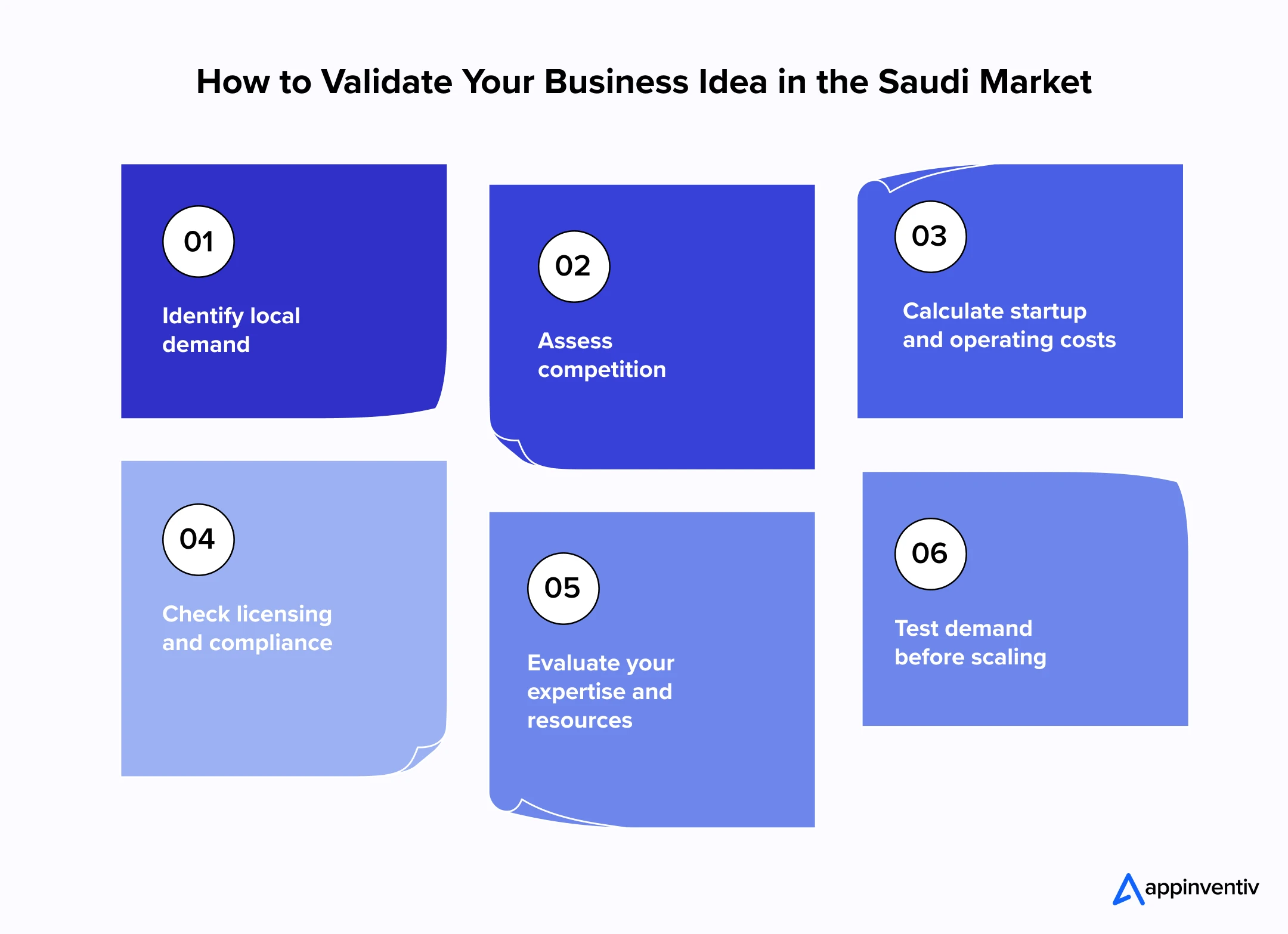
- Identify local demand: Research customer needs, buying habits, and gaps in existing services. Look for problems that businesses or consumers in Saudi Arabia still struggle to solve.
- Assess competition: Study established players and platforms like Noon, Salla, or Jahez, depending on your sector. Identify where your offering can stand apart through pricing, service, or a more focused customer experience.
- Calculate operating costs: Account for licensing, staffing, technology, marketing, premises, and ongoing expenses. Check whether the business can generate enough revenue to cover these costs.
- Check licensing and compliance: Review the relevant business registration, sector-specific approvals, ZATCA invoicing requirements, and data protection obligations before launching.
- Evaluate your expertise and resources: Choose a model that matches your skills, available capital, local partnerships, and ability to manage daily operations.
- Test demand before scaling: Interview potential customers, launch a small pilot, or validate interest through a minimum viable product. Use feedback to refine your offer before making larger investments.
Ultimately, the best business ideas in Saudi Arabia 2026 will be those that meet a genuine market need, fit your resources, and offer a realistic path to sustainable growth. Validate demand and estimate costs before committing significant capital.
How to Start a Business in Saudi Arabia in 2026
Entrepreneurs who wish to start a business and hire developers in Saudi Arabia must select the appropriate legal structure, submit registrations with the government and fulfill the tax and labour law regulations. The process will be different for Saudi investors, foreign investors, and depending on your business activity. The Saudi Business Center is a central hub for numerous business setup services.
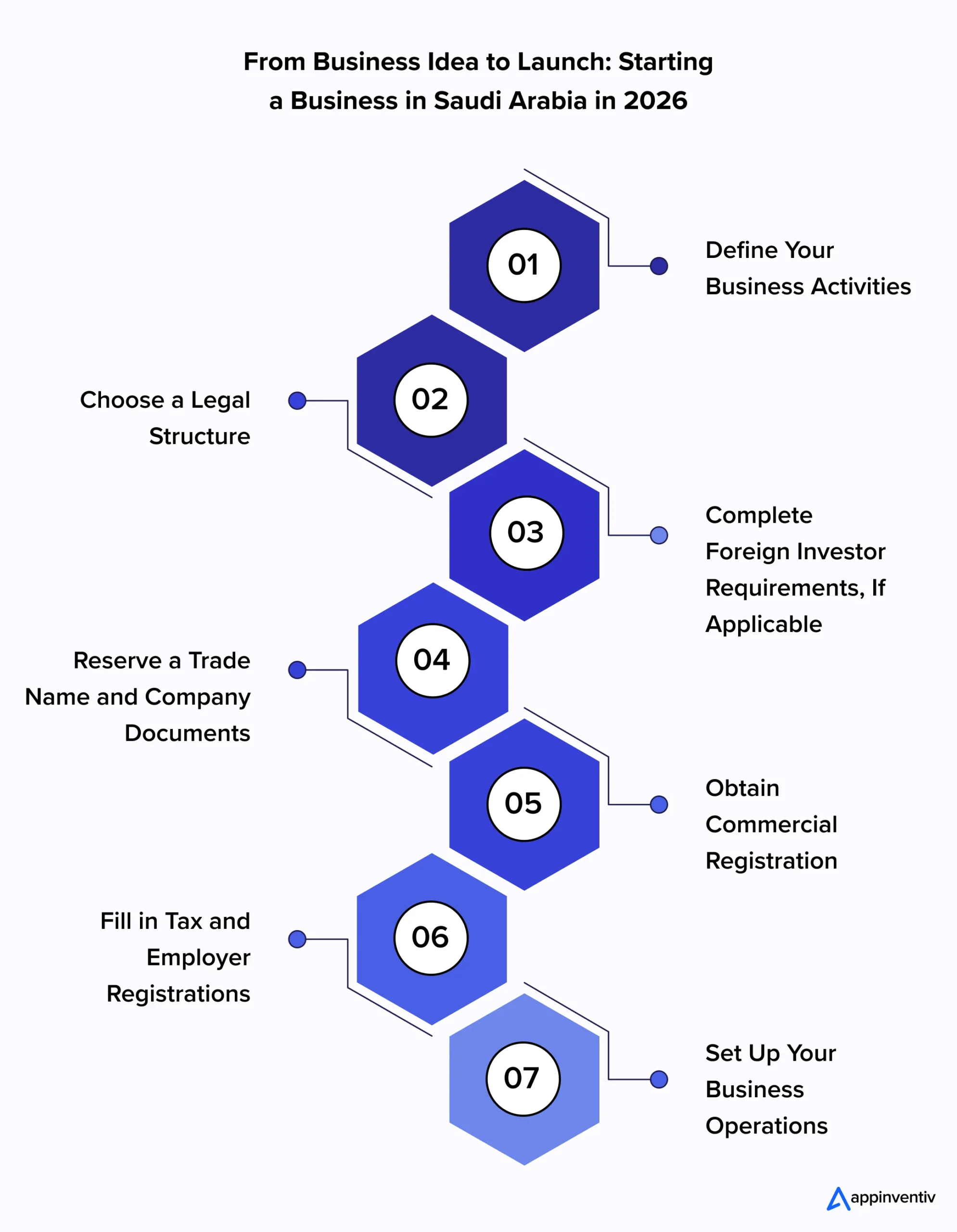
1. Define Your Business Activities
- Identify your business activity: Decide whether your venture will operate in commercial, industrial, professional, or service sectors.
- Check activity-specific requirements: Confirm whether your business needs additional licenses, permits, or approvals before registration.
2. Choose a Legal Structure
- Limited Liability Company (LLC): A common option for businesses seeking a separate legal entity and limited shareholder liability.
- Sole proprietorship: May suit eligible individuals running a business independently, subject to Saudi eligibility and activity rules.
- Other structures: Joint-stock companies and branches of foreign companies may suit ventures with different ownership, investment, or expansion needs.
3. Complete Foreign Investor Requirements, If Applicable
- Check MISA requirements: Foreign investors should get confirmation of the applicable investment or registration requirements from MISA before investing.
- Confirm ownership rules: Rules for foreign ownership and licensing will depend on the business and the relevant rules so check the rules for your business.
4. Reserve a Trade Name and Company Documents
- Register the company name: Present an appropriate name for the company to the appropriate Ministry of Commerce for approval.
- Draft the Articles of Association: Compile the company’s constitutional papers based on the legally-set structure and do the necessary authentication/approval of the papers.
5. Obtain Commercial Registration
- Get a Commercial Registration (CR): Register with the Saudi Business Center or the government service to obtain a Commercial Registration.
- Obtain additional permits: Get permits for additional sectors to ensure legal operations.
6. Fill in Tax and Employer Registrations
- Register with ZATCA: Make the necessary tax registrations with ZATCA if your business is under the requirements of VAT. Verify if ZATCA’s FATOORA e-invoicing rules are applicable to your operations.
- Complete labor registrations: If you hire employees, check the applicable requirements for the HRSD, GOSI, and labor management app like Qiwa.
- Set up payroll compliance: Meet applicable Wage Protection System requirements through the relevant platform, such as Mudad.
7. Set Up Your Business Operations
- Registering your Business Address: Make the necessary business address registration with Saudi Post (SPL).
- Open a company bank account: Register documents and go through the bank’s verification process.
- Review current obligations: Review the reporting, cyber, data protection, staffing and renewal requirements prior to launch.
Estimated Cost of Setting Up a Business in Saudi Arabia
The cost of starting a business in Saudi Arabia depends on its legal structure, ownership, activity, licensing needs, and operational scale. The following table provides indicative planning estimates for common setup expenses. Actual fees vary by business type and current government requirements.
| Cost component | Estimated cost (SAR) | What it covers |
|---|---|---|
| Trade name reservation | SAR 200–500 | Company name reservation and related administrative fees |
| Commercial Registration (CR) | SAR 500–1,600+ | Registration and applicable annual fees, depending on the entity and activity |
| Articles of Association and documentation | SAR 500–2,500 | Document preparation, authentication, and related services |
| Business address and National Address | SAR 500–3,000 per year | Address registration and potential office or business address services |
| Corporate bank account | SAR 0–1,000+ | Account setup and potential banking or service fees |
| Tax and employer registrations | SAR 0–2,000+ | Administrative support and setup services, excluding ongoing tax liabilities |
| Business licenses and permits | SAR 1,000–10,000+ | Activity-specific approvals and licensing fees |
| Estimated initial setup total | SAR 2,700–20,600+ | Indicative total before major operating expenses |
Note: These figures are preliminary budgeting estimates, not verified government fee quotations. They exclude potential MISA-related costs for foreign investors, minimum capital requirements where applicable, office rent, employee salaries, visas, insurance, and ongoing compliance costs. To get a preliminary idea on mobile app development cost in Saudi Arabia, you can connect with Appinventiv’s experts.
Speak with our experts to estimate initial expenses, assess your budget, and prepare for your business launch.

How Appinventiv Can Help Turn Your Business Idea into Reality in Saudi Arabia
Saudi Arabia’s evolving business environment offers opportunities across AI, software development, digital finance, healthcare, tourism, and other growing sectors. Turning an idea into a viable business requires a clear understanding of local demand, regulatory requirements, investment costs, and customer expectations. The right opportunity is one that has the ability to address a genuine problem and to fit the evolving market in the Kingdom.
Appinventiv drives Saudi Vision 2030 forward with SaaS solutions that help businesses adopt digital technologies, streamline operations, and explore new growth opportunities across the Kingdom.
Businesses leverage Appinventiv to transform their innovative ideas into digital products ready for the market by utilizing software development, AI engineering, and digital transformation expertise. Our mobile app development services in Saudi Arabia can assist entrepreneurs in creating their customer-facing apps, testing new business models, and preparing for the growth of their digital products.
We bring our experience from various Middle Eastern projects across brands and organizations like Adidas, IKEA, ALMP, Slice, Y.K. Almoayyed & Sons and Hukoomi, thus working on a variety of business requirements and industries.
From product planning to technology selection, development to integration, Appinventiv can guide you on your journey into the digital world. By having a strategy in place and the right technical partner, you can transform your business ideas into a digital solution that fits your vision and business needs and serves the Saudi market.
FAQs
Q. Which business opportunities align with Saudi Vision 2030?
A. Several business ideas in Saudi Arabia align with Vision 2030’s focus on digital transformation, tourism, healthcare, and economic diversification, including:
- AI-Based Development Services
- Online Retail Platforms
- Tourism Platform
- Food Delivery and Cloud Kitchen Apps
- HealthTech and Digital Health Services
- Logistics and Delivery Management Software
- Smart Energy Monitoring Software
- EdTech and Workforce Training
- Arabic Content Marketing
- Saudi Real Estate and Property Management
- FinTech and Open Banking Solutions
Q. Which industries need technology solutions in KSA?
A. Industries across Saudi Arabia need digital solutions to improve operations, customer experiences, and business performance, including:
- Information Technology and AI
- E-commerce and Retail
- Tourism and Hospitality
- Food and Restaurant Services
- Healthcare and Pharmaceuticals
- Logistics and Supply Chain
- Renewable Energy and Utilities
- Education and Workforce Training
- Real Estate and Property Management
- Banking and Financial Services
- Manufacturing and Industrial Operations
Q. What digital businesses can I start in Saudi Arabia?
A. You can launch an AI company in e-commerce, digital marketing, food delivery, travel booking, edtech, healthcare, property management or any other field. Other areas of interest are FinTech applications, Arabic content services and renewable energy management software. Research your local market, costs, licensing and competition before deciding on your business model.
Q. How can I turn a startup idea into a mobile app?
A. Start by validating your idea, identifying your target users, and defining the app’s core features. Create a minimum viable product (MVP) to test demand before expanding. A partner offering custom software development for startups in Saudi Arabia can help with UI/UX design, technology selection, development, testing, and deployment. Plan for Arabic localization, data protection, and relevant Saudi integrations from the outset.
Q. How much does it cost to build a startup app in Saudi Arabia?
A. The cost will vary based on the features, integrations, complexity of the app, and some compliance requirements. Simple applications are likely to be less expensive than more comprehensive platforms that include AI capabilities, payment processing, or enterprise integrations.
The earlier estimate of approximately SAR 2,700-20,600+ was for business setup and did not factor in high operational costs and some costs that are specific to the investors. App development is an additional cost, so ask for a project quote that is dependent on your needs.


Fast 2-minute response, fully NDA-protected.

10 Ways Artificial Intelligence is Transforming the Legal Services Industry
Christina Blacklaws, the former president of the Law Society, recently said in an interview, "I'd love to see firms embrace tech faster," capturing the palpable excitement around artificial intelligence in the legal industry. Today, legal firms are keeping pace with the latest AI trends to automate workflows, streamline research, and enhance client service. The adoption…

How Much Does it Cost to Build a Home Service App Like Urban Company?
The on-demand app industry has revolutionized consumer behavior, making access to essential services easier, faster, and more reliable than ever before. Whether it’s booking a professional cleaner, a plumber, or a beauty expert, apps like Urban Company have set new benchmarks for convenience and efficiency. This shift aligns with changing consumer expectations in a digital-first…

How Much Does it Cost to Build Your Own Metaverse Platform Like Decentraland?
Imagine being able to create your own digital oasis, build your own 3D game or application, or design a bustling marketplace for users to explore in a virtual environment of the metaverse. Welcome to the world of metaverse platforms like Decentraland, where possibilities are endless, and creativity knows no bounds. Decentraland allows users to play…