





























How to Build a Digital Wallet App Like X Money: Cost, Features, and Technology Stack

- How a Digital Wallet Like X Money Works
- Step-by-Step Process To Build A Digital Wallet App Like X Money
- Core Features Of X Money-Style Apps
- Advanced Features That Differentiate Wallet Apps Like X Money
- Technologies That Power Modern Digital Wallet Apps
- Compliance And Security Requirements For Digital Wallet Apps
- Cost To Build A Digital Wallet App Like X Money
- Revenue Models Behind Digital Wallet Platforms
- Key Challenges In Digital Wallet App Development And How To Overcome Them
- Future Trends In Digital Wallet And Super App Development
- Build a Digital Wallet App Like X Money With a Trusted FinTech App Development Company
- FAQs

- Building a wallet like X Money requires more than payment features. It needs identity verification, fraud monitoring, payment gateways, and a secure financial infrastructure.
- Development costs usually range between $40,000 and $400,000. The final cost depends on features, compliance requirements, payment integrations, and platform scale.
- Core technologies include mobile frameworks, backend microservices, financial ledgers, and cloud infrastructure to support real-time transactions and high user volumes.
- Revenue comes from multiple streams, including transaction fees, merchant payments, currency exchange margins, financial services, and premium wallet features.
Open a finance app on a phone today, and you will see the shift clearly. People send money, split bills, pay merchants, and manage balances in seconds. Cash moves less each year. Wallet apps handle more daily payments.
This shift has pushed many companies to build digital wallet apps like X Money. The idea is simple. Keep payments inside one platform where users already talk, shop, and follow creators. The platform known as X is preparing a payment system called X Money.
The goal is direct transfers between users, creator payouts, and everyday purchases inside the same app. One wallet links social activity to financial transactions.
The growth behind this model is measurable. Digital wallets are expected to account for about 54% of global e-commerce payments by 2026, according to the Worldpay Global Payments Report. Numbers like this explain why founders and product teams study the cost to build a digital wallet app like X Money. They want a payment product that sits inside a larger ecosystem of services.
Some teams plan to develop an app like X Money for peer payments. Others see value in creator payouts, online commerce, or social payments inside a single platform. A clear plan helps before development begins.
The next sections explain how a wallet like X Money works, what features it needs, the technology behind it, and the cost to develop a digital wallet app like X Money.
Digital wallets are expected to power 54% of global e-commerce payments by 2026. Build your own wallet platform before the market moves further.
How a Digital Wallet Like X Money Works
X Money is a digital wallet platform designed to enable peer-to-peer payments, creator payouts, and merchant transactions within the X ecosystem.
Open a payment app and send money to a friend. The action takes seconds. Behind that quick transfer, several systems verify identity, process payments, and update wallet balances. This structure guides teams that plan to create digital wallet apps like X Money.
A wallet platform connects users, banks, and payment networks. It verifies accounts, manages balances, and processes transactions in real time. The basic flow includes:
- User Account Creation
- Users install the app and register an account
- Identity checks verify the account owner
This step supports KYC and AML integration for digital wallets and prevents fraudulent activity.
- Payment Source Connection
- Users link debit cards or bank accounts
- Secure APIs connect the wallet with financial institutions
- Wallet Balance Management
- Funds enter the wallet through bank transfers or card payments
- Users track balances and transaction history
- Peer-to-Peer Payments
- Users select a contact or username
- The payment gateway processes the transfer instantly
- Merchant Payments
- Users pay businesses through QR codes or checkout links
- The system confirms the payment to both parties
Each stage requires strong protection measures. Payment data travels through encrypted channels and follows PCI DSS compliance for wallet apps, which protects card and transaction data.
This workflow forms the foundation for companies that want to build digital wallet apps like X Money.
Step-by-Step Process To Build A Digital Wallet App Like X Money
A wallet product rarely starts with a full platform. Most teams begin with a focused release and expand the system after launch. Companies that build digital wallet apps like X Money usually follow a structured development path that covers research, infrastructure design, security controls, and payment gateway integrations.
Each stage shapes the final product and affects the cost to develop a digital wallet app like X Money.
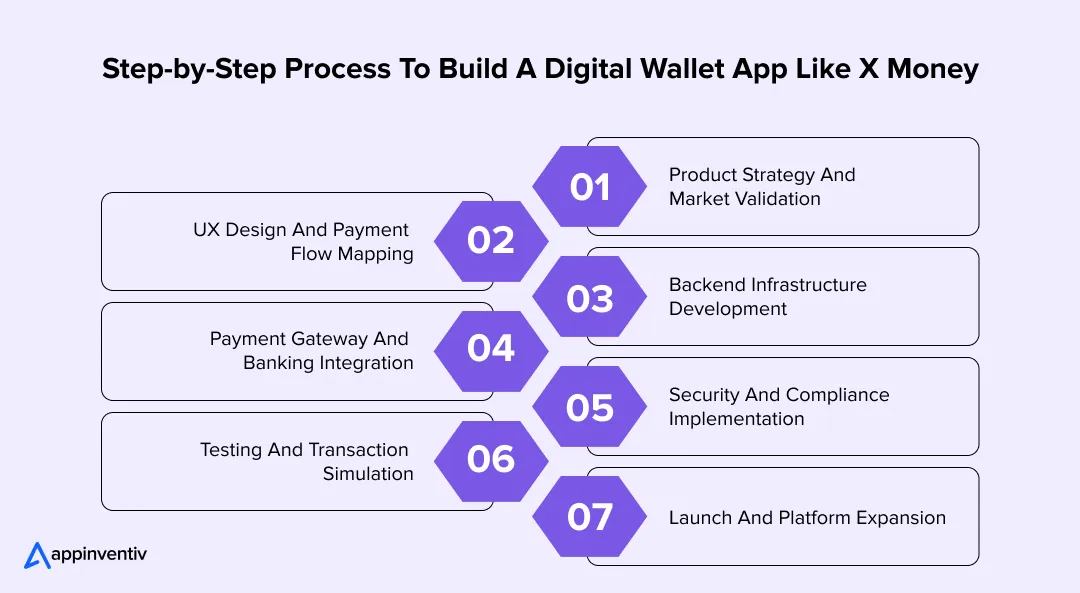
1. Product Strategy And Market Validation
Development begins with a clear product model. Teams define payment streams, user segments, and revenue models before writing code.
Key activities include:
- Studying the market overview of digital wallets and existing payment platforms
- Identifying target users such as consumers, merchants, or creators
- Defining the core wallet functions for the first release
- Planning revenue streams based on app monetization models for digital wallet apps
The goal at this stage is to determine whether the wallet will support peer payments, merchant payments, or both.
2. UX Design And Payment Flow Mapping
Wallet products rely on clear interaction design. Payment flows must feel simple even though the underlying system is complex.
Design teams focus on:
- User onboarding and identity verification screens
- Payment initiation interfaces
- Transaction confirmation flows
- Wallet balance and activity dashboards
Design prototypes help test the experience before engineering begins.
3. Backend Infrastructure Development
Backend services manage the financial logic of the wallet system. Engineers design services that handle identity verification, ledger updates, and payment processing.
Core components built during this stage include:
- User account management systems
- Wallet balance ledger services
- Transaction processing services
- API layers that connect mobile apps with backend systems
This stage forms the technical base for companies that develop digital wallet apps like X Money.
4. Payment Gateway And Banking Integration
Next comes integration with financial networks. These connections allow the wallet to process real payments.
Typical integrations include:
- Card payment processing services
- Bank account connection APIs
- Real time payment networks for instant transfers
- Merchant payment infrastructure for online checkout
These integrations enable the wallet to function as a financial transaction platform.
5. Security And Compliance Implementation
Payment systems require a strong security infrastructure. Engineers add encryption layers and monitoring systems that protect user funds.
Important systems include:
- Tokenization services that protect card data
- Transaction monitoring services that detect suspicious activity
- Identity verification systems that support KYC and AML software integration for digital wallets
- Data protection mechanisms required for PCI DSS compliance
Security architecture must undergo extensive validation before launch.
6. Testing And Transaction Simulation
Wallet platforms require strict testing procedures. Payment systems cannot tolerate transaction errors.
Quality assurance teams conduct:
- Transaction load testing under high user traffic
- Payment failure simulations and recovery testing
- Security vulnerability assessments
- Ledger reconciliation tests
These tests confirm that the wallet handles real financial activity without data inconsistencies.
7. Launch And Platform Expansion
The first release usually focuses on core payment functionality. Teams gather user data and expand features after launch.
Post-launch improvements may include:
- Merchant payment systems
- Creator payout services
- Spending analytics and budgeting tools
- International payment support
This development path helps companies create an app like X Money that evolves from a simple payment tool into a full financial platform.
Also Read: How to build an app like Exodus cryptocurrency wallet?
Core Features Of X Money-Style Apps
Open any large payment app, and the first screen looks simple. A balance, a send button and short list of recent transfers. The visible layer hides a complex system that verifies users, protects transactions, and records every money movement.
Teams that create digital wallet apps like X money must design features that work reliably at high transaction volumes. Each feature connects to payment networks, banking APIs, and fraud detection services.
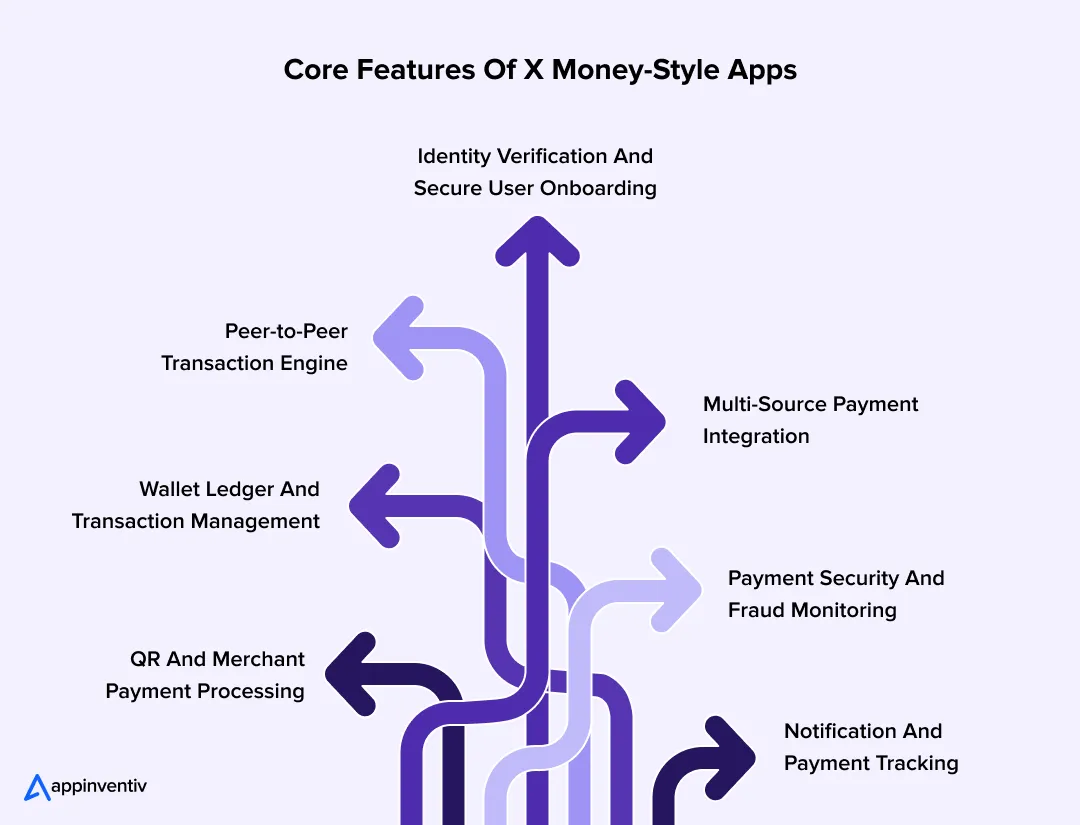
The following capabilities form the core features of X money-style apps.
1. Identity Verification And Secure User Onboarding
A wallet cannot operate without strict identity validation. Every new account must pass regulatory checks before any transaction begins.
Key components include:
- Document verification through ID upload and optical recognition
- Facial verification to match the user identity with the government ID
- Real-time sanction screening against financial watchlists
- Risk scoring during account creation
These steps support KYC and AML integration for digital wallets, helping prevent fraud and meeting financial regulations across many jurisdictions.
2. Multi-Source Payment Integration
Wallet apps connect to several funding sources. Users expect flexibility in how money enters and exits the wallet.
A production system supports:
- Debit and credit card linking through tokenized storage
- Bank account connections using fintech APIs
- Instant bank transfers through real-time payment rails
- Stored wallet balance for peer transfers
Payment credentials are never stored as raw card numbers. Secure tokens replace sensitive data and reduce exposure risk.
3. Peer-to-Peer Transaction Engine
Peer payments sit at the center of any wallet ecosystem. The transaction engine must process requests instantly and update account balances in real time.
A typical system includes:
- Contact discovery using phone numbers or usernames
- Real-time balance validation before payment approval
- Transaction queues that process high volumes without delay
- Event logs that record every transfer
This system becomes critical as platforms create digital wallet apps like X Money with social payments and creator payouts.
4. Wallet Ledger And Transaction Management
The ledger tracks every movement of funds. It acts as the financial record for the entire platform.
Important capabilities include:
- Double-entry ledger architecture for financial accuracy
- Immutable transaction logs
- Wallet balance reconciliation against payment networks
- Automated dispute tracking and refund processing
Large payment systems process millions of ledger updates daily. Database structure and data consistency matter greatly here.
5. Payment Security And Fraud Monitoring
Digital wallets attract fraud attempts, so the system must detect suspicious activity early.
Security infrastructure usually includes:
- Behavioral fraud detection based on user activity patterns
- Device fingerprinting that detects unusual login devices
- Transaction risk scoring before payment approval
- Velocity checks that block repeated rapid transfers
These systems operate alongside PCI DSS compliance for wallet apps, which protects card data and enforces strict payment security standards.
6. QR And Merchant Payment Processing
Wallets expand beyond peer transfers into retail payments. Merchant payments require integration with checkout systems and point-of-sale devices.
A merchant payment feature supports:
- QR code scanning for in-store payments
- Checkout API integration for online purchases
- Merchant dashboards for payment tracking
- Settlement systems that transfer funds to merchant accounts
This capability allows businesses to create an app like X Money that supports both consumer payments and online commerce.
7. Notification And Payment Tracking
Users expect immediate visibility for every financial action. The system must deliver alerts and detailed transaction records.
Typical capabilities include:
- Instant push notifications for completed payments
- Real-time transaction history updates
- Exportable payment statements
- Activity logs that support dispute resolution
These features create trust in the platform and encourage frequent wallet use. A wallet platform that includes these capabilities forms a strong technical base. Yet modern fintech platforms push further.
Social payments, creator monetization, and financial analytics expand the wallet beyond simple transfers. The next section explains the advanced features that differentiate wallet apps like X Money.
Advanced Features That Differentiate Wallet Apps Like X Money
Basic wallet functions handle payments and transfers. Advanced capabilities turn the product into a financial platform. Teams that build digital wallet apps like X Money focus on features that connect payments with social activity, commerce, and data intelligence.
These additions demand deeper system design. Each feature requires dedicated services, strong security controls, and scalable infrastructure.
1. Social Payments And Messaging Integration
Traditional wallets operate as standalone payment tools. Social platforms merge communication and payments into the same interface.
This feature supports:
- Sending money directly inside chat conversations
- Payment requests between contacts
- Group payment flows for shared expenses
- Transaction notes and message threads linked to transfers
The backend must synchronize messaging events with payment confirmations. Message services and transaction services exchange data through event queues to prevent delays.
2. Creator Monetization And Instant Payouts
Social platforms generate income for creators through tips, subscriptions, and content purchases. A wallet system must support these flows with low-latency payouts.
Core capabilities include:
- Creator wallet accounts linked to platform profiles
- Instant payout services that transfer funds to bank accounts
- Automated revenue splits between the platform and creators
- Payment dashboards showing earnings and withdrawal history
Teams planning to create an app like X Money often build dedicated payout infrastructure to support large creator networks.
3. AI Fraud Detection And Transaction Risk Scoring
Manual monitoring cannot manage high transaction volumes. Wallet platforms use machine learning app development models to detect suspicious behavior before funds move.
A typical system includes:
- Real-time transaction scoring based on user behavior
- Device fingerprint analysis that flags unfamiliar devices
- Pattern detection that identifies abnormal transfer activity
- Automated account restrictions during fraud investigation
These systems operate alongside PCI DSS compliance to enhance transaction protection.
3. Cryptocurrency And Digital Asset Support
Some wallet platforms expand beyond traditional currency transfers. Users can store and transfer digital assets inside the same app.
A crypto-enabled wallet may support:
- Cryptocurrency wallet addresses linked to user accounts
- Blockchain transaction processing through node APIs
- Real-time exchange rate calculation
- Conversion between fiat currency and digital assets
This capability attracts users who prefer decentralized payment options.
4. In-App Commerce And Merchant Ecosystems
Wallet platforms often evolve into full commerce networks. Payments connect with shopping, subscriptions, and digital services inside the same environment.
Key components include:
- Merchant onboarding systems for businesses
- Payment APIs that integrate with online stores
- Subscription billing for recurring purchases
- Merchant analytics dashboards for sales tracking
These features expand the platform beyond payments and strengthen monetization models for digital wallet apps.
5. Financial Insights And Spending Analytics
Advanced wallets help users track and understand their finances. Transaction data feeds analytics engines that categorize spending patterns.
This functionality often includes:
- Automated transaction categorization
- Monthly spending summaries
- Budget tracking tools
- Alerts for unusual account activity
Data services process large transaction datasets to generate these insights in real time.
Platforms that implement these capabilities move beyond simple payment tools. They become financial ecosystems built around communication, commerce, and user data.
Technologies That Power Modern Digital Wallet Apps
The wallet app’s visible interface looks simple. Balance, send button and transaction list. Underneath that interface sits a distributed system that processes payments, records financial data, and communicates with banking networks. Teams that work on X Money wallet app development must build technology layers that support high transaction volume and strict financial security.
A production wallet platform usually combines mobile frameworks, backend services, financial APIs, and cloud infrastructure. Each layer performs a specific function inside the payment system.
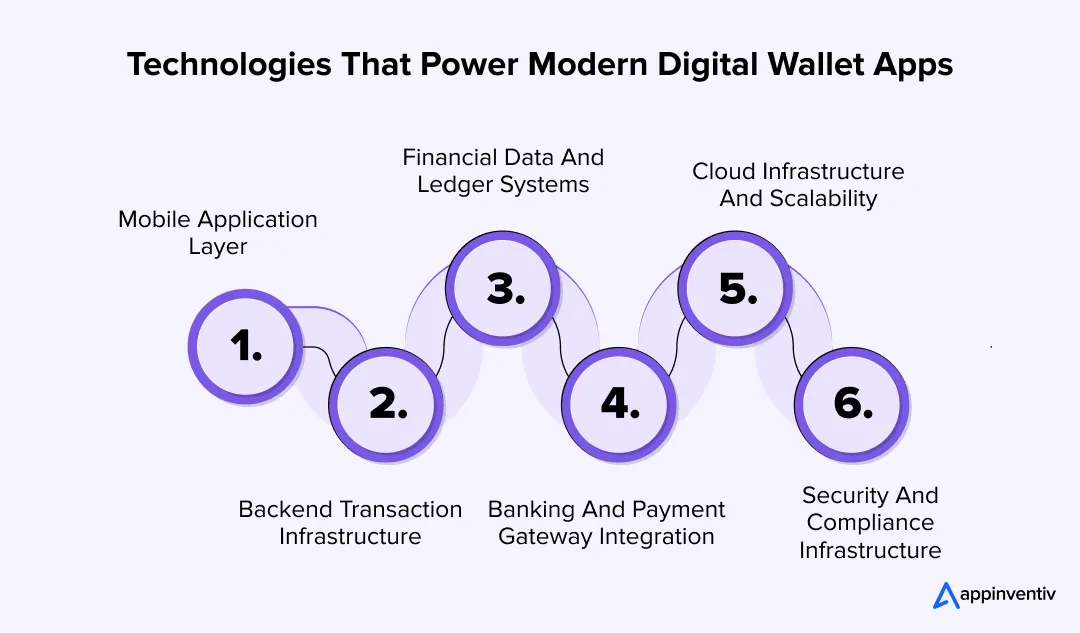
1. Mobile Application Layer
The mobile client handles user interaction and secure communication with backend services. Performance matters here since users expect instant payment confirmation.
Common mobile frameworks include:
- Flutter for cross-platform wallet development
- React Native for shared mobile code across iOS and Android
- Swift for native iOS applications
- Kotlin for Android wallet apps
These frameworks handle biometric login, QR code scanning, push notifications, and encrypted communication with backend services.
2. Backend Transaction Infrastructure
Backend manages wallet balances, validates transactions, and processes payments. It must handle thousands of concurrent requests without data inconsistency.
Popular backend technologies include:
- Node.js for real-time API services
- Java Spring Boot for financial transaction services
- Python for risk analysis and data processing
The backend often uses microservices architecture. Each service controls a single responsibility, such as payment processing, identity verification, or notification delivery.
Large wallet platforms must support real-time transaction processing. Many fintech systems integrate with payment rails such as ACH in the United States, SEPA in Europe, and Faster Payments in the United Kingdom. These networks allow wallets to move funds between financial institutions within seconds.
Enterprise wallet platforms also rely on AES-256 encryption and hardware security modules (HSMs) to protect payment credentials and cryptographic keys.
3. Financial Data And Ledger Systems
Every digital wallet requires a reliable financial ledger. The ledger records all wallet balances and transactions. Financial institutions use double-entry accounting systems to prevent discrepancies.
Core data components include:
- PostgreSQL for structured financial records
- MongoDB for user activity data
- Redis for caching and session management
The ledger service stores immutable transaction records and supports balance reconciliation across payment networks.
4. Banking And Payment Gateway Integration
A wallet cannot operate without connections to financial institutions. Payment gateways and banking APIs handle card payments, bank transfers, and settlement operations.
Common integrations include:
- Stripe for payment processing
- Plaid for bank account connections
- PayPal APIs for payment infrastructure
These integrations enable companies to develop a digital wallet apps like X Money that connect directly with global payment networks.
5. Cloud Infrastructure And Scalability
Wallet platforms process millions of requests daily. Cloud infrastructure provides computing power, storage, and network reliability.
Typical deployment environments include:
- Amazon Web Services for large-scale infrastructure
- Google Cloud Platform for data processing and analytics
- Microsoft Azure for enterprise cloud services
Cloud environments support auto scaling systems that increase computing capacity during high payment activity.
6. Security And Compliance Infrastructure
Security systems protect payment credentials and transaction data. Financial platforms must meet strict privacy standards.
Security components include:
- Tokenization services that replace raw card numbers
- Hardware security modules for encryption key management
- Real-time fraud monitoring systems
These layers support PCI DSS compliance and protect financial data during transactions.
A strong technology foundation allows companies to build a digital wallet app like X Money that processes payments quickly and safely. The next section explains the Digital Wallet App Architecture that connects these technologies into a unified payment platform.
The right architecture decides whether a wallet app scales or fails. Work with a team that builds secure fintech platforms from day one.
Compliance And Security Requirements For Digital Wallet Apps
Financial apps deal with sensitive data and real money. Every transfer must follow strict security rules. Teams that develop digital wallet apps like X Money spend great effort on regulatory controls before the product goes live.
Security and compliance systems protect payment data, verify user identity, and monitor suspicious activity. These systems also affect the cost of building a digital wallet app like X Money, as financial regulations require specialized infrastructure and audits.
Several frameworks guide wallet security and transaction monitoring.
1. PCI DSS Compliance For Wallet Apps
Payment card transactions follow strict privacy standards. The Payment Card Industry Data Security Standard defines how systems store and process card information.
Core security practices include:
- Encryption of payment data during transmission and storage
- Asset Tokenization that replaces card numbers with secure tokens
- Restricted access controls for payment databases
- Continuous security monitoring and vulnerability scans
Platforms that process card payments must pass regular compliance audits. These requirements form the foundation of PCI DSS compliance.
2. KYC And AML Integration For Digital Wallets
Wallet platforms must verify user identity before enabling financial transactions. Governments require financial platforms to prevent fraud and the movement of illegal funds.
Key identity verification measures include:
- Government ID verification during account registration
- Facial recognition software checks to confirm user identity
- Screening against global sanction lists
- Monitoring large or unusual transaction patterns
These processes form the base of KYC and AML integration for digital wallets. Identity verification services often connect with external compliance providers that maintain global risk databases.
3. Data Encryption And Secure Key Management
Payment systems must protect financial data during every transaction. Encryption systems prevent unauthorized access to sensitive information.
Security architecture typically includes:
- End-to-end encryption for payment data
- Hardware security modules that store encryption keys
- Secure communication protocols between application services
These controls prevent attackers from intercepting transaction data.
4. Fraud Detection And Transaction Monitoring
Digital wallets attract fraud attempts, including account takeover and payment scams. Real-time monitoring systems detect suspicious behavior before funds move.
Risk monitoring systems analyze:
- Rapid transaction patterns that indicate automated fraud
- Login attempts from unfamiliar devices
- Unusual payment destinations or transfer sizes
Machine learning models often support these systems by detecting abnormal user behavior.
5. Regulatory Licensing And Financial Oversight
Wallet operators must follow financial regulations in every region where the app operates. Some countries require payment service licenses before processing transactions.
Regulatory obligations may include:
- Registration as a payment service provider
- Reporting suspicious financial activity
- Maintaining transaction records for audit reviews
Compliance planning begins early when companies build a digital wallet app like X Money. Security architecture, identity verification, and regulatory controls all shape the technical design of the wallet system. These requirements also increase development complexity.
Regulators such as the Financial Action Task Force (FATF) and Financial Crimes Enforcement Network (FinCEN) require financial platforms to monitor transactions for suspicious activity. Digital wallet operators must implement automated compliance systems that flag unusual transaction patterns and maintain audit records for regulatory review.
Also Read: How to Develop a PCI-Compliant Fintech App?
Cost To Build A Digital Wallet App Like X Money
Many founders ask the same question before starting development. What is the cost to build a digital wallet app like X Money? The answer depends on system complexity, compliance requirements, and the number of payment features included in the first release.
A simple wallet with peer transfers and bank connections costs far less than a full financial platform with creator payouts, fraud monitoring, and merchant payments.
In most fintech projects, the cost to develop a digital wallet app like X Money falls between $40,000 and $400,000.
The range depends on several technical factors:
| Development Level | Estimated Cost | Key Capabilities | Typical Use Case |
|---|---|---|---|
| Basic MVP Wallet | $40,000 – $80,000 | User onboarding, identity verification, bank or card linking, peer-to-peer transfers, transaction history, basic notifications | Early product validation and market testing |
| Mid-Level Wallet Platform | $80,000 – $200,000 | Advanced identity verification, fraud monitoring, merchant payments, real-time transaction processing, scalable backend services | Stable payment platform with a growing user base |
| Enterprise Wallet Ecosystem | $200,000 – $400,000 | Creator payouts, multi-currency wallets, AI fraud detection, merchant ecosystems, and advanced analytics dashboards | Large fintech platforms handling millions of users |
The final cost to build a digital wallet app like X Money depends heavily on compliance scope and infrastructure complexity. Platforms that support cross-border payments, merchant networks, and large user bases require stronger backend infrastructure, fraud detection systems, and payment gateway integrations.
Enterprise fintech platforms often invest more in compliance and transaction monitoring than in the user interface.
Key Factors That Affect Development Cost
Several technical elements influence the development cost breakdown of X Money-like apps.
- Payment Infrastructure
- Real time payment rails
- Bank integration APIs
- Payment gateway connections
- Security And Compliance
- PCI DSS compliance
- KYC and AML integration for digital wallets
- Fraud monitoring systems
- Platform Architecture
- Microservice backend infrastructure
- High availability cloud environments
- Scalable transaction processing systems
- Product Complexity
- Creator payout features
- Merchant payment integrations
- AI-based risk detection systems
Each of these systems increases engineering effort and infrastructure cost.
Companies planning to create an app like X Money usually start with a focused MVP and expand features over time. This staged approach reduces early investment and enables teams to improve the platform based on real user feedback.
The next section explains the revenue models behind digital wallet platforms and how companies recover the cost of building a fintech payment system.
Also read: Understand the Cost to Build a digital payment wallet app
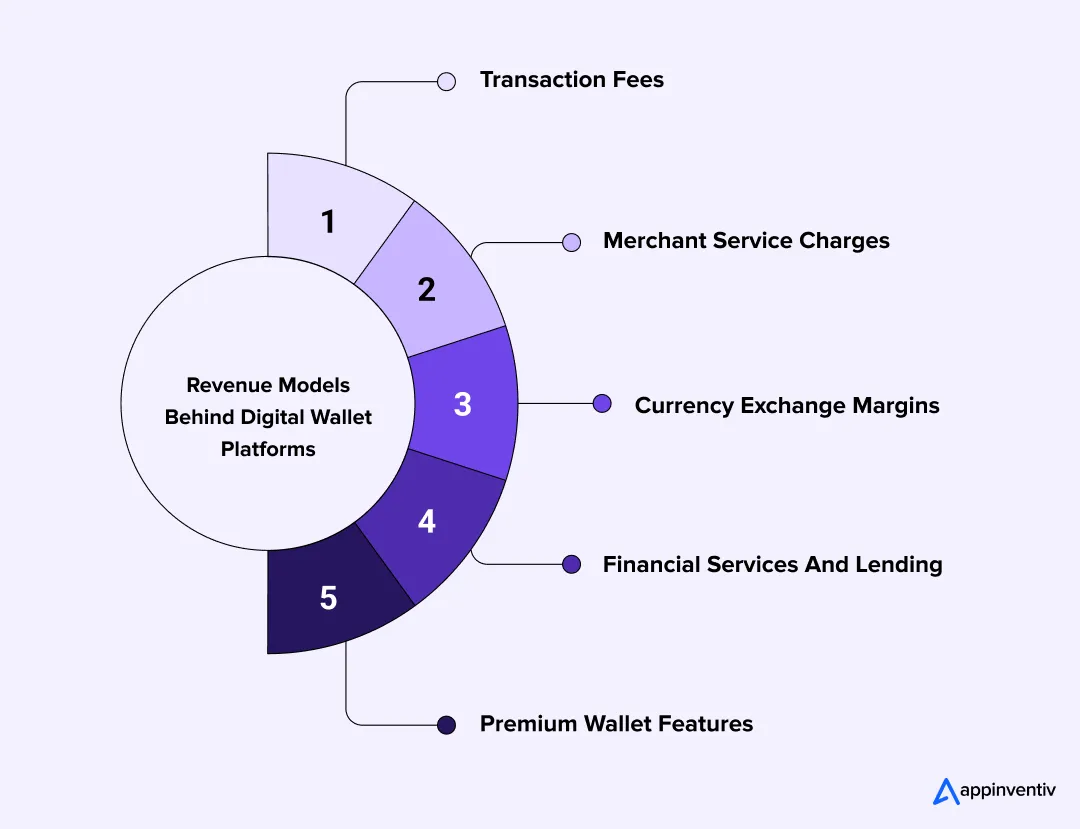
Revenue Models Behind Digital Wallet Platforms
Building a wallet platform requires a large investment, so companies design clear revenue streams early. Platforms building digital wallet apps like X Money rarely rely on a single income source. Most combine several financial services that generate steady transaction revenue.
These revenue streams form the foundation of monetization models for digital wallet apps.
1. Transaction Fees
Wallet platforms often charge small fees for money transfers or merchant payments. Even a small percentage can generate significant revenue with high transaction volume.
Common transaction charges include:
- Fees on peer-to-peer transfers above a free limit
- Merchant processing fees for accepting wallet payments
- Instant withdrawal fees when users move funds to bank accounts
Large payment platforms process millions of transactions daily. Small fees accumulate quickly.
2. Merchant Service Charges
Digital wallets act as payment gateways for businesses. Merchants pay a small percentage of every transaction processed through the wallet.
Typical merchant services include:
- Payment processing for online stores
- In-store QR code payments
- Subscription billing services
Merchant networks create stable long-term revenue for wallet providers.
3. Currency Exchange Margins
Wallet apps that support international transfers earn revenue through foreign exchange margins. The platform adds a small markup when converting between currencies.
This model appears often in global fintech apps that support cross-border payments.
Many wallets also display exchange rates inside the app before a transfer happens. The platform applies its own conversion rate during the transaction. For users, the process feels instant. For the platform, the margin between the market rate and the applied rate becomes a reliable revenue source, especially as international payments increase.
4. Financial Services And Lending
Some wallet platforms expand into financial services like credit or microloans. These services generate interest income and increase user engagement.
Examples include:
- Short-term credit lines for users
- Merchant financing services
- Buy now, pay later payment options
Financial services increase the lifetime value of wallet users.
5. Premium Wallet Features
Many platforms introduce subscription plans with additional features.
Premium offerings may include:
- Higher transaction limits
- Priority customer support
- advanced analytics for spending and budgeting
These features provide recurring revenue alongside transaction fees. A diversified revenue structure helps companies recover the cost to build a digital wallet app like X Money and sustain platform growth.
Also read: App Monetization Guide: 7 Strategies and Models Overview
Key Challenges In Digital Wallet App Development And How To Overcome Them
Building a wallet platform may seem straightforward on the user side. Engineering reality is much more complex. Payments involve financial institutions, strict regulations, and real-time transaction processing. Teams developing a digital wallet app like X Money face technical and regulatory barriers.
Addressing these challenges early reduces delays and protects the platform after launch.
1. Regulatory Compliance Complexity
Financial products are subject to strict regulatory oversight. Every transaction must follow identity verification rules and anti-money laundering standards. Different regions impose different licensing requirements.
Common compliance hurdles include:
- Identity verification during account creation
- Monitoring large or suspicious transactions
- Maintaining transaction records for audit reviews
These requirements demand KYC and AML integration for digital wallets, along with clear identity-verification workflows.
How To Overcome It
- Integrate identity verification services early in development
- Work with compliance specialists familiar with fintech regulations
- Design onboarding flows that collect and verify user information at registration
Early compliance planning prevents expensive system changes later.
2. Payment Security Risks
Wallet platforms are targeted by fraud attempts, including account takeover and unauthorized transfers. Payment data must remain protected during every transaction.
Security systems must meet PCI DSS compliance requirements for wallet apps, which govern how cardholder data is stored and transmitted across systems.
Security challenges often include:
- Protecting payment credentials
- Preventing unauthorized account access
- Detecting suspicious transfer patterns
How To Overcome It
- Use tokenization to replace stored card numbers
- Implement device fingerprinting and multi-factor authentication
- Deploy fraud monitoring systems that analyze transaction behavior
These controls reduce the risk of financial loss and account abuse.
3. Banking And Payment Network Integration
Wallet apps must connect with multiple financial networks. Bank APIs, card processors, and payment gateways all operate with different technical standards.
Integration challenges include:
- Inconsistent banking API documentation
- Settlement delays between financial networks
- Payment failures during transaction processing
These issues often slow development for companies trying to develop an app like X Money.
How To Overcome It
- Use established payment infrastructure providers
- Design retry logic for failed payment transactions
- Maintain clear logging systems that track every transaction stage
Reliable integration systems improve payment success rates.
4. Scalability And Transaction Volume
A wallet platform must handle large numbers of transactions without performance issues. As user numbers grow, database and server capacity must expand.
Scaling challenges often appear in:
- Ledger database performance
- Payment processing queues
- Notification delivery systems
These systems must process thousands of transactions per second as adoption increases.
How To Overcome It:
- Design a microservice architecture that separates critical services
- Use distributed databases for transaction storage
- Deploy cloud infrastructure with automatic scaling support
Strong infrastructure allows teams to build digital wallet apps like X Money that supports large user communities.
5. Building User Trust
Financial apps rely heavily on trust. Users hesitate to adopt a payment platform that lacks security or transparency.
Trust issues often appear when users cannot clearly track payments or resolve disputes.
How To Overcome It:
- Provide clear transaction records and payment confirmations
- Offer fast dispute resolution processes
- Maintain transparent security policies and privacy protections
Trust grows when users see consistent transaction reliability. These challenges shape the entire development process. Teams that address compliance, security, and infrastructure early create stronger fintech products. The final section summarizes what companies must consider before launching a wallet platform inspired by X Money.
Several global fintech platforms already demonstrate how digital wallets evolve into financial ecosystems. Applications such as PayPal, Cash App, Apple Pay, and WeChat Pay combine payments, commerce, and financial services inside one platform. These examples illustrate how companies building wallet platforms today are moving toward integrated financial ecosystems similar to the vision behind X Money.
Also Read: Top 12 FinTech Compliance Pitfalls & How to Avoid Them
Future Trends In Digital Wallet And Super App Development
Digital wallets have moved far beyond simple payment tools. Many platforms now combine financial services, commerce, and social activity in one app. Companies that build digital wallet apps like X Money are moving toward platforms that manage payments, subscriptions, creator earnings, and digital purchases in a single account.
Several trends are shaping the next phase of wallet platforms.
- Embedded Finance Expansion
- Payments appear inside social platforms, ride apps, and marketplaces
- Users complete purchases without leaving the platform
- Businesses collect transaction data and control the payment flow
This model drives strong interest in X Money wallet app development across digital platforms.
- AI-Driven Fraud Detection
- Machine learning systems analyze user activity patterns
- Fraud monitoring systems detect suspicious transactions faster
- Risk scoring models review each payment before approval
AI systems help maintain security as transaction volumes increase.
- Multi-Currency and Cross-Border Payments
- Wallet apps support international money transfers
- Platforms convert currencies instantly during transactions
- Users manage multiple currency balances in one wallet
These capabilities help global platforms create apps like X Money that support international users.
- Super App Ecosystems
- Payments integrate with messaging, shopping, and entertainment
- Users access several services from one account
- Wallet infrastructure becomes the financial layer of the platform
This model continues to shape the future of digital payments. Companies that develop digital wallet apps like X Money focus on platforms that integrate communication, commerce, and financial services within a single system.
Build a scalable wallet platform with secure payments, merchant features, and global transaction capabilities.
Build a Digital Wallet App Like X Money With a Trusted FinTech App Development Company
Building a wallet platform like X Money requires advanced fintech engineering. The platform must process secure financial transactions, integrate with payment networks, and comply with financial regulations. Working with an experienced fintech app development company helps businesses build payment infrastructure that scales as user adoption grows.
Appinventiv has delivered several fintech platforms that manage real financial operations. One example is the Slice real estate investment platform, which allows users to invest in fractional property and track returns through a digital interface. Another example is Mudra, a budget management app that helps users track spending and stay within their budget through automated alerts and expense insights.
If you plan to build a digital wallet app like X Money, working with an experienced fintech app development company can make the process far smoother. Appinventiv’s teams design wallet systems, payment infrastructure, and scalable fintech platforms that support real financial activity.
Connect with the Appinventiv team to discuss your idea and start building a secure digital wallet platform.
FAQs
Q. How Much Does It Cost To Build A Digital Wallet App Like X Money?
A. The cost to build a digital wallet app like X Money usually ranges between $40,000 and $400,000. The final amount depends on the platform’s features, payment integrations, and security systems.
A basic wallet MVP with peer transfers and account linking may cost $40,000 to $80,000. A larger fintech product with merchant payments, fraud monitoring, and global payment support can reach $200,000 to $400,000. Teams that develop digital wallet apps like X Money often start with a limited feature set and expand the platform after launch.
Q. How Long Does It Take To Build A Digital Wallet Platform?
A. A simple wallet platform usually takes 3 to 5 months to develop. This stage often includes user onboarding, bank account linking, and peer payments.
More advanced platforms require longer timelines. Products with strong payment infrastructure and compliance systems can take 6 to 12 months. Companies that create an app like X Money often release an MVP first and expand features gradually.
Q. What Is The Technology Stack For Fintech Wallet Apps?
A. The technology stack for fintech wallet apps includes mobile frameworks, backend services, databases, and payment integrations. Mobile apps often use Flutter, React Native, Swift, or Kotlin.
Backend services typically run on Node.js, Python, or Java. Financial records are stored in databases like PostgreSQL or MongoDB. Payment systems connect with APIs like Stripe or Plaid, and cloud platforms such as AWS support infrastructure scaling.
Q. How Does A Digital Wallet Like X Money Work?
A. A digital wallet connects users with banks and payment networks through a secure transaction system. Users register an account, complete identity checks, and link a bank account or payment card.
Once connected, the wallet allows users to send money, receive payments, and track balances. Payment gateways process transactions and update wallet records instantly. This system forms the foundation for companies that build digital wallet apps like X Money.
Q. How Can Companies Maintain PCI DSS Compliance For Wallet Apps?
A. Financial platforms must follow strict data security standards to protect payment information. PCI DSS compliance requires encryption of payment data and secure storage of card credentials.
Development teams must implement tokenization, restrict system access, and monitor payment networks for suspicious activity. Regular security audits help maintain compliance and protect user financial data.

- In just 2 mins you will get a response
- Your idea is 100% protected by our Non Disclosure Agreement.
How Much Does Accounting Practice Management Software Development Cost in Australia 2026?
Key takeaways: Custom accounting practice management software development in Australia for mid-to-large firms generally falls between AUD 70,000 and AUD 700,000. Adherence to the Privacy Act 1988 and ATO operational frameworks is a primary cost driver, not an add-on. A modular architecture and structured development approach ensure that the platform evolves with changing laws and…
Open Banking in Australia: A Practical Guide for Businesses
Key takeaways: Open banking-driven “Smart Data” initiatives are projected to contribute up to $10 billion annually to the Australian economy. Enterprises that follow a phased rollout covering readiness assessment, compliance alignment, API integration, cybersecurity, and scaling achieve faster deployment and lower operational risk. Constant CDR updates, accreditation complexity, and modernising legacy banking systems continue to…
Financial Wellness App Development: Process, Features and Costs
Key Takeaways Strategic ROI: Financial wellness apps are no longer "perks"; they are critical tools for reducing financial presenteeism and improving institutional retention. Technical Integrity: Successful deployment requires seamless integration with Human Capital Management (HCM) systems and secure Open Banking APIs. Compliance-First: Enterprise-grade solutions must prioritize SOC2, GDPR, and ISO 27001 standards to protect sensitive…









