


































Healthcare Asset Management: A Complete Guide to Applications, Benefits, and Costs

 Share -



- 01Understanding Asset Management in Healthcare
- 02Core Components of a Healthcare Asset Management System
- 03Practical Applications of Asset Management Across Hospital Operations
- 04Key Benefits of Asset Management in Healthcare
- 05Key Technologies Powering Healthcare Asset Management
- 06Key Features of a Custom HAM Software
- 07Healthcare Asset Management Challenges and How to Overcome Them
- 08How to Build a Healthcare Asset Management System That Works in Real Hospital Environments
- 09How Much Does a Healthcare Asset Management System Cost?
- 10Build a Connected Hospital Asset Ecosystem With Appinventiv
- 11FAQs

Key takeaways:
- Healthcare asset management gives hospitals real-time visibility into equipment location, condition, availability, and usage.
- A complete HAM system combines tracking, maintenance, inventory, compliance, analytics, and lifecycle management.
- RFID, BLE, RTLS, IoT, and AI help hospitals monitor assets and predict operational risks.
- Better asset data reduces unnecessary purchases, equipment downtime, losses, and time spent locating devices.
- Successful implementation requires accurate records, suitable tracking technology, secure integrations, and a focused pilot.
What happens when a nurse needs an infusion pump immediately, but nobody knows where the nearest available unit is?
The hospital may own enough pumps. Yet poor visibility can still delay care, consume clinical time, and push procurement teams to order equipment they do not need. This is not an isolated operational gap. A 2025 GE HealthCare reports that nurses spend an average of 21 minutes per shift searching for lost equipment. Across a large hospital workforce, those minutes quickly become thousands of hours diverted from patient care.
Asset management in healthcare closes this gap between equipment ownership and actual availability. It helps hospitals locate medical devices, monitor their condition, schedule maintenance, measure utilization, and plan replacements using reliable operational data.
However, effective healthcare asset management involves more than attaching tags to equipment. Hospitals need connected workflows covering medical devices, IT hardware, facilities, consumables, contracts, compliance records, and asset lifecycle decisions.
This guide explains how these systems work, their core components and technologies, practical use cases, implementation challenges, development costs, and the steps required to build a scalable solution.
Identify underused equipment, reduce avoidable purchases, and improve asset performance across every department.

Understanding Asset Management in Healthcare
Healthcare asset management is the coordinated process of tracking, maintaining, securing, and optimizing every resource a healthcare organization owns or leases. It covers each asset from planning and procurement through utilization, maintenance, replacement, and compliant disposal.
The objective is not simply to record where equipment is located. Hospitals must also know whether an asset is available, safe to use, properly maintained, and delivering enough value to justify its cost.
The scope extends far beyond medical equipment:
| Asset category | Common examples | What hospitals need to manage |
|---|---|---|
| Medical equipment | Infusion pumps, ventilators, MRI systems, patient monitors | Location, utilization, calibration, maintenance, and device history |
| IT assets | Servers, laptops, tablets, routers, and connected devices | Ownership, configuration, access, cybersecurity, and software updates |
| Facilities | Buildings, HVAC systems, generators, and electrical infrastructure | Condition, energy use, inspections, repairs, and lifecycle costs |
| Furniture and fixtures | Hospital beds, wheelchairs, cabinets, and examination tables | Availability, movement, sanitation, and replacement |
| Consumables | Gloves, syringes, IV supplies, and surgical kits | Stock levels, expiry dates, usage, and replenishment |
| Pharmaceuticals | Medicines, vaccines, and controlled substances | Storage conditions, expiry, custody, and disposal |
| Digital assets | Medical images, training content, licenses, and approved brand files | Access, version control, security, and distribution |
| Transportation | Ambulances, medical carts, and service vehicles | Location, availability, servicing, and operating condition |
Core Components of a Healthcare Asset Management System
A dependable system must follow an asset through every operational event. That includes procurement, assignment, movement, maintenance, downtime, transfer, and disposal. The following components keep that information accurate and useful across the hospital.
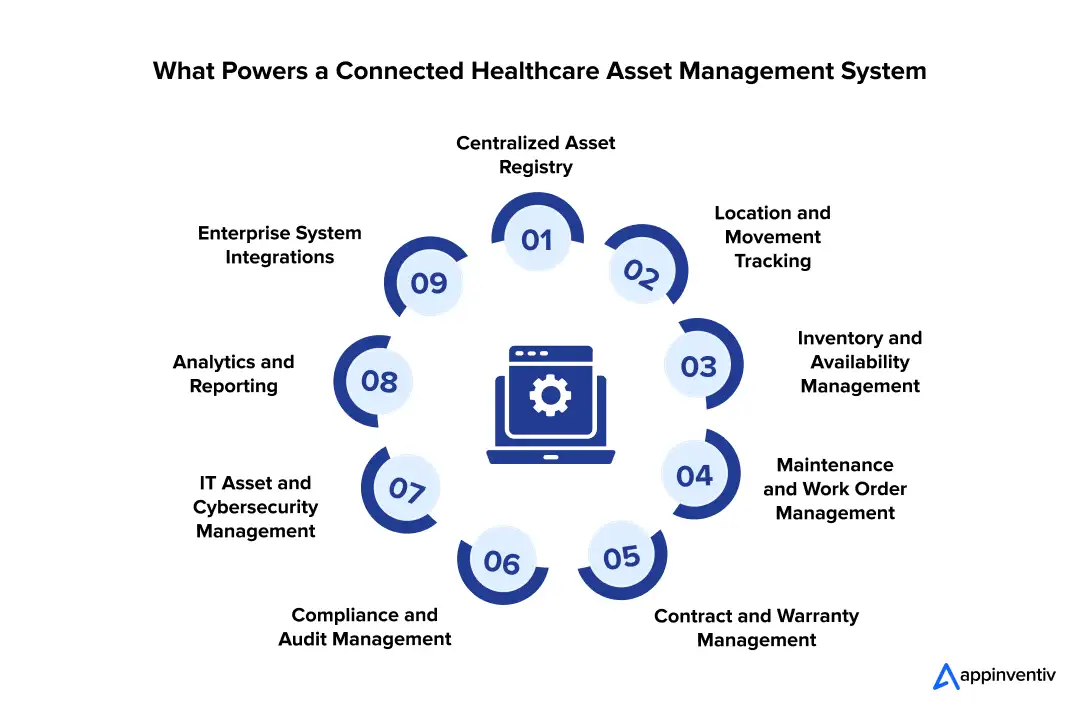
Centralized Asset Registry
The registry holds the complete record of every owned, leased, or rented asset. Typical fields include the serial number, department, custodian, purchase date, warranty, service history, condition, and present status.
Using one record prevents finance, procurement, clinical engineering, and operations from maintaining conflicting lists. It also establishes the data foundation needed for enterprise asset management for healthcare networks.
Location and Movement Tracking
Mobile equipment rarely stays in its assigned department. Infusion pumps, wheelchairs, monitors, and portable imaging devices may move several times during one shift.
RFID, BLE, Wi-Fi, GPS, barcodes, or QR codes can record these movements. Staff can check the current or last known location, while geo-fencing alerts flag equipment moved beyond approved areas.
Inventory and Availability Management
Location does not always confirm availability. Equipment may be in use, reserved, awaiting cleaning, or held for repair.
An inventory module separates these statuses and shows what teams can actually use. It can also monitor consumable quantities, batches, expiry dates, and reorder points to prevent shortages and excess stock.
Maintenance and Work Order Management
Maintenance teams need one place to receive requests, assign technicians, record repairs, and close work orders. The system should also schedule calibration, inspections, and preventive servicing based on time, usage, or equipment condition.
For medical device asset management, this history confirms whether a device remained within its prescribed service requirements. It also exposes repeated faults that may justify replacement.
Contract and Warranty Management
Service contracts, warranties, leases, and vendor agreements often sit in separate files. As a result, hospitals may pay for repairs already covered by a supplier or miss an important renewal date.
Linking each agreement to the relevant asset keeps its coverage visible. Automated reminders give teams enough time to renew, renegotiate, or end contracts before deadlines pass.
Compliance and Audit Management
Hospitals must prove that regulated equipment was inspected, calibrated, maintained, and disposed of correctly. Searching for that evidence during an audit wastes time and increases healthcare compliance risk.
The platform keeps certifications, service logs, access records, and disposal documents against each asset. A dated audit trail shows who changed a record, what changed, and when the action occurred.
IT Asset and Cybersecurity Management
Healthcare IT asset management covers much more than laptops and servers. It also includes tablets, network equipment, software licenses, IoT endpoints, and connected medical devices.
IT teams need visibility into ownership, configuration, software versions, patch status, and network access. Connecting these records with security and IT service platforms helps identify unapproved, unsupported, or vulnerable devices.
Also Read: Cybersecurity Risk Management – Strategy, Framework, Implementation Plan
Analytics and Reporting
Raw asset records have limited value until teams can use them to answer operational questions. Leaders need to analyze the healthcare data to know which remains idle, which devices fail repeatedly, and where maintenance spending continues to rise.
Dashboards can bring utilization, downtime, asset age, loss rates, and ownership costs into one view. These findings support better purchasing, redistribution, and replacement decisions.
Enterprise System Integrations
Asset information already exists across ERP, EHR, procurement, finance, CMMS, ITSM, facility, and identity platforms. Re-entering the same data creates duplication and inconsistency.
Secure integrations allow these systems to exchange approved information while retaining clear data ownership. The result is a connected healthcare asset management technology environment, not another isolated application.
Also Read: How ERP in Healthcare Enhances Efficiency & Patient Care
Practical Applications of Asset Management Across Hospital Operations
The most valuable use cases of asset management in Healthcare connect asset visibility with a specific clinical, operational, or financial decision. The platform should help teams act on information, not simply display equipment locations.
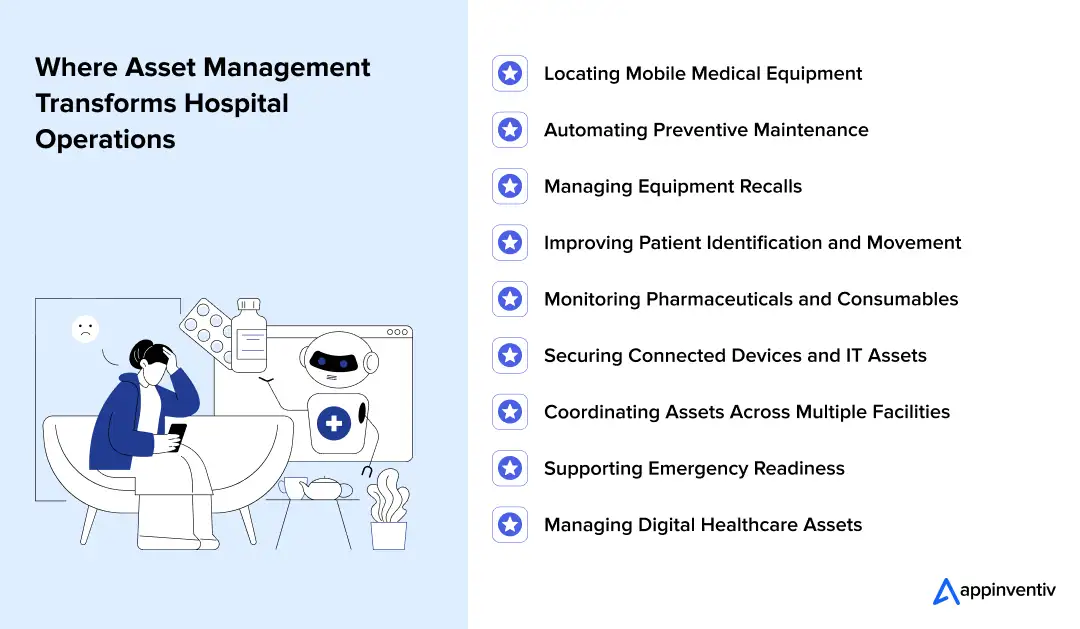
Locating Mobile Medical Equipment
Nurses can search for available infusion pumps, wheelchairs, monitors, or portable ultrasound systems from a central dashboard.
The system can distinguish equipment in use from units awaiting cleaning or maintenance. This prevents staff from travelling to another department for an asset that is not ready.
Automating Preventive Maintenance
Medical device asset management systems can trigger servicing according to operating hours, condition data, or manufacturer schedules.
Technicians receive work orders containing service history, fault details, and required procedures. Once work is complete, the system updates the equipment’s readiness and compliance status.
Managing Equipment Recalls
When a manufacturer recalls a device model or component, hospitals must identify every affected unit quickly.
Centralized records allow teams to locate impacted equipment by model, batch, serial number, or facility. The system can then remove those units from availability until inspection or replacement is complete.
Improving Patient Identification and Movement
Hospitals can connect patient wristbands with identity and location systems to support safer movement between departments.
For example, staff can verify a patient before a diagnostic procedure and confirm their arrival in the correct unit. The system may also alert care teams when a vulnerable patient enters an unauthorized area.
Patient tracking must remain separate from general equipment tracking permissions. Access controls and consent policies should protect sensitive identity and location data.
Monitoring Pharmaceuticals and Consumables
Hospitals can track medicine, vaccines, surgical supplies, and other consumables by quantity, batch, location, and expiry date.
Temperature sensors can monitor items requiring controlled storage. Automated alerts can flag stock shortages, environmental deviations, or approaching expiration dates before supplies become unusable.
Securing Connected Devices and IT Assets
Healthcare IT asset management gives technology teams a current inventory of laptops, tablets, servers, networking hardware, and connected medical devices.
Teams can monitor device ownership, software versions, patch status, network access, and security risks. Unsupported or unapproved devices can be identified before they create operational vulnerabilities.
Coordinating Assets Across Multiple Facilities
Enterprise healthcare networks may have equipment shortages at one location and underused capacity at another.
A centralized hospital asset management platform shows availability and utilization across the network. Leaders can transfer existing assets between facilities before approving new purchases or short-term rentals.
Supporting Emergency Readiness
Emergency teams need immediate access to crash carts, defibrillators, portable monitors, and other critical equipment.
Location data confirms where each asset is stored. Readiness data shows whether it has been inspected, charged, replenished, and cleared for clinical use.
Managing Digital Healthcare Assets
Healthcare organizations also manage medical images, training materials, approved patient content, design files, and software licenses.
A digital asset management healthcare approach controls how these files are stored, updated, accessed, and distributed. Version histories help teams prevent outdated or unapproved content from reaching employees, patients, or external channels.
Together, these applications turn asset data into faster clinical action, stronger oversight, and more informed resource allocation.
Key Benefits of Asset Management in Healthcare
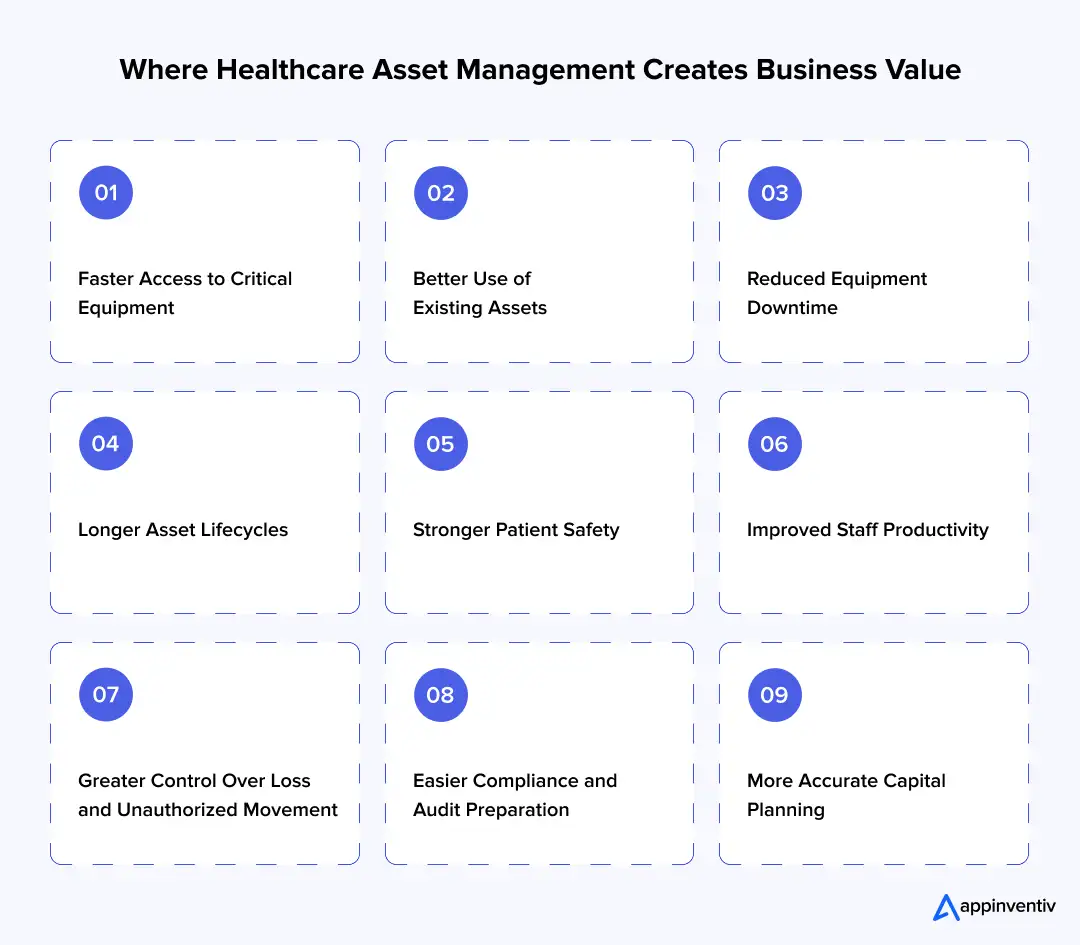
The benefits of asset management in healthcare appear wherever equipment availability affects care, cost, or staff time. Accurate records help hospitals use what they already own before purchasing more, while ensuring that clinical teams receive safe equipment when required.
Faster Access to Critical Equipment
Consider an infusion pump listed under one ward but left after use in another. The hospital owns the device, yet the nurse who needs it cannot access it without calling colleagues or searching nearby rooms.
Live location and status data shortens that search. Staff can identify the nearest available unit and confirm that it is ready for use before collecting it.
Better Use of Existing Assets
A shortage reported by one department may exist alongside unused stock elsewhere. Without network-wide visibility, procurement teams see the request but not the imbalance behind it.
Utilization data reveals equipment that remains idle or has accumulated in low-demand areas. Hospitals can redistribute those assets first and approve new spending only when the evidence supports it.
Reduced Equipment Downtime
A missed calibration date or unresolved fault can take a device out of service without warning. That loss may delay a procedure, increase pressure on backup equipment, or force the hospital to arrange a rental.
Scheduled work orders bring servicing forward before a minor issue becomes a breakdown. Technicians can also see previous faults and arrive with the right parts or repair information.
Longer Asset Lifecycles
Equipment lasts longer when servicing reflects how it is actually used. A heavily used monitor may need attention sooner than an identical unit stored as backup.
Condition, usage, and repair records allow maintenance teams to respond accordingly. The same evidence shows when continued repairs have become more expensive than a planned replacement.
Stronger Patient Safety
A device may be physically present but still require cleaning, charging, calibration, or inspection. Treating location as proof of readiness creates an avoidable clinical risk.
Hospital asset management can keep restricted equipment out of active inventory until the required action is complete. Recall notices can also identify every affected unit by model, batch, or serial number.
Improved Staff Productivity
Equipment searches interrupt more than the person looking for the asset. Calls move across wards, porters make unnecessary trips, and technicians lose maintenance time trying to locate scheduled devices.
A reliable search removes much of this disruption. Staff can find the equipment, check its status, and continue their work without involving several other teams.
Greater Control Over Loss and Unauthorized Movement
Portable equipment is easy to borrow and difficult to trace when handovers go unrecorded. Repeated uncertainty may also encourage departments to hold extra devices for future use.
Movement histories make those patterns visible. Hospitals can investigate missing assets earlier, challenge equipment hoarding, and receive alerts when valuable devices leave approved zones.
Easier Compliance and Audit Preparation
Inspection records, calibration certificates, service dates, and disposal documents must be available when auditors request them. Paper files and departmental spreadsheets make that task unnecessarily difficult.
A consolidated record keeps the evidence attached to the relevant asset. Teams can identify overdue actions before an audit and retrieve the required history without rebuilding it manually.
More Accurate Capital Planning
Age alone is a poor basis for replacing hospital equipment. An older device may remain reliable, while a newer one may suffer repeated faults and low utilization.
Asset management in healthcare gives decision-makers the broader financial picture. Repair frequency, downtime, depreciation, utilization, and remaining service life can all inform the next capital plan.
Key Technologies Powering Healthcare Asset Management
Choosing a tracking method starts with the asset, not the technology. A hospital bed, surgical instrument, vaccine refrigerator, and laptop each present different questions about location, condition, security, and cost. Most hospitals therefore need a combination of technologies.
RFID
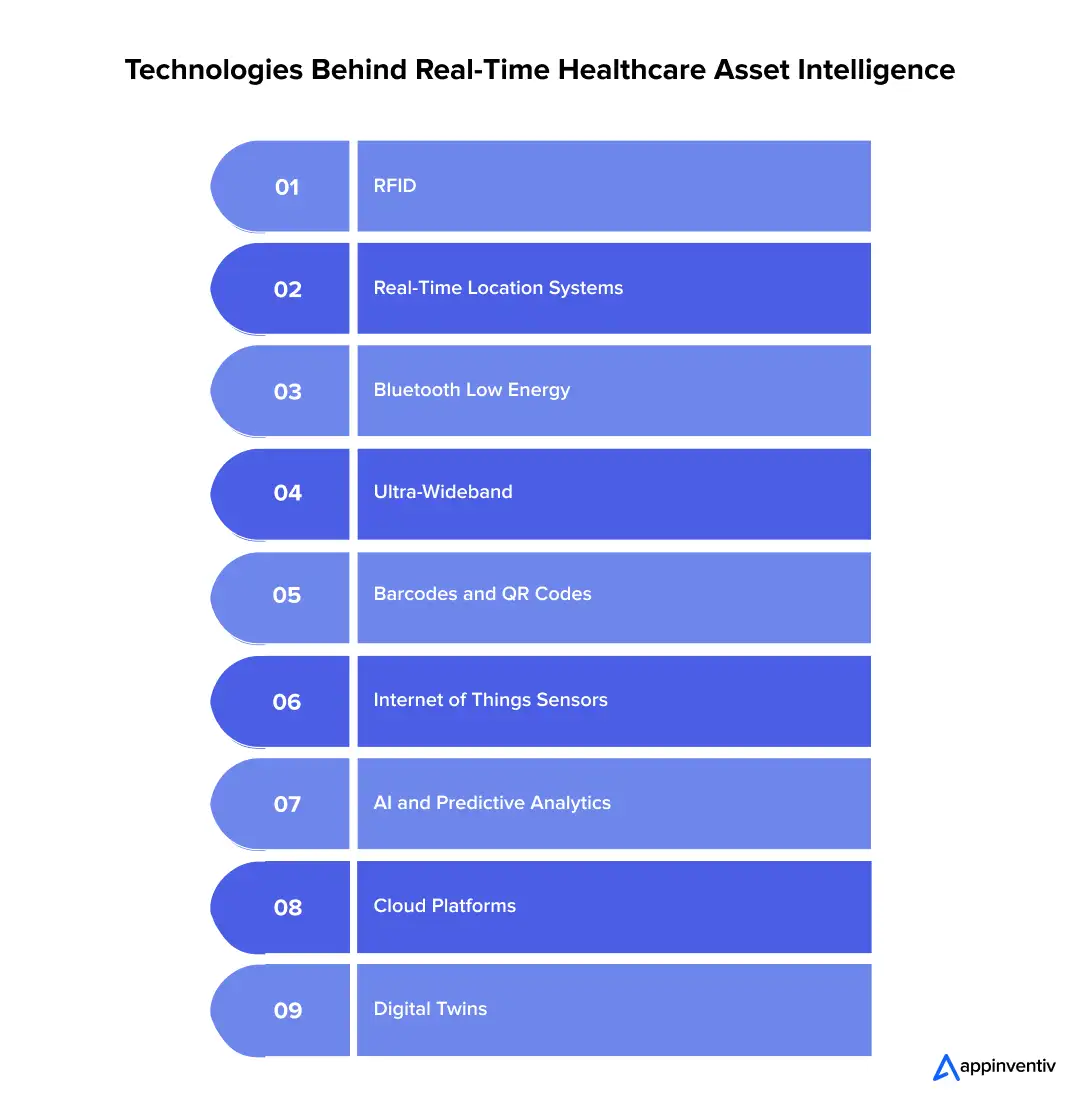
RFID identifies tagged items through radio signals. Readers can capture several tags without scanning each label individually, which makes the technology useful for inventory counts and controlled movement points.
Passive tags suit supplies, instruments, and lower-cost items because they do not contain batteries. Active tags transmit over longer distances and are better suited to valuable mobile equipment.
Real-Time Location Systems
RTLS shows where tagged equipment is located within a hospital or healthcare campus. It is commonly used for beds, infusion pumps, wheelchairs, monitors, and other assets shared between departments.
Its accuracy depends on the chosen tags, readers, network coverage, and building layout. Elevators, dense equipment rooms, walls, and signal interference must be tested before deployment.
Bluetooth Low Energy
BLE tags transmit small signals while consuming relatively little power. Compatible access points or dedicated gateways collect those signals and pass them to the tracking platform.
For hospitals with suitable wireless infrastructure, BLE can offer practical indoor coverage without an entirely separate reader network. Battery life and expected accuracy should still be tested in the intended clinical areas.
Ultra-Wideband
Ultra-wideband is appropriate when a floor-level or zone-level result is not precise enough. It can identify the room or immediate area containing a tagged device.
That precision requires more infrastructure and careful calibration. Hospitals should use UWB for equipment where faster recovery, safety, or high value supports the additional investment.
Barcodes and QR Codes
Barcodes and QR codes offer a straightforward way to identify assets and record events. Staff can scan them during assignment, transfer, inspection, repair, or return.
They cost less than continuous tracking technologies but depend on consistent staff action. A missed scan can leave the digital record out of step with the asset’s actual location.
Internet of Things Sensors
Some assets require condition monitoring as much as location tracking. Refrigerators, laboratories, pharmacies, and equipment rooms may need continuous oversight of temperature, humidity, vibration, or power.
IoT sensors on healthcare devices capture these readings and alert the responsible team when conditions move outside approved limits. Operating hours and vibration data can also help technicians plan maintenance around actual wear.
AI and Predictive Analytics
Hospitals may hold years of work orders, service notes, sensor readings, and utilization records. Reviewing that volume manually makes it difficult to spot early failure patterns or changing demand.
AI can identify equipment with unusual repair activity, forecast departmental requirements, and highlight assets that remain underused. This is how AI is changing asset management for healthcare businesses in practical terms.
The recommendation is only as dependable as the underlying data. Maintenance, clinical engineering, and procurement teams should review the output before acting on it.
Cloud Platforms
Cloud platforms allow several facilities to work from the same asset environment. Local teams can manage everyday activity while leadership reviews availability, utilization, and expenditure across the wider network.
This arrangement also supports remote access, shared reporting, and system integrations. Access controls and data-hosting requirements must still reflect the regulations governing each deployment.
Digital Twins
A digital twin represents a physical asset, department, or facility using connected operational data. It may combine location, condition, usage, maintenance history, and spatial information.
Hospitals can use the digital twin model to examine equipment movement, test layout changes, or assess how downtime would affect capacity. Without current data feeding it, however, the twin becomes little more than a visual model.
A sensible healthcare asset management technology stack does not apply premium tracking to every item. It reserves continuous, precise monitoring for assets where availability, safety, or financial exposure warrants it, while using simpler identification methods elsewhere.
Turn fragmented workflows, legacy systems, and infrastructure constraints into a scalable implementation roadmap.

Key Features of a Custom HAM Software
Modern health services asset management solutions offer a range of functionalities that drive operational efficiency, including:
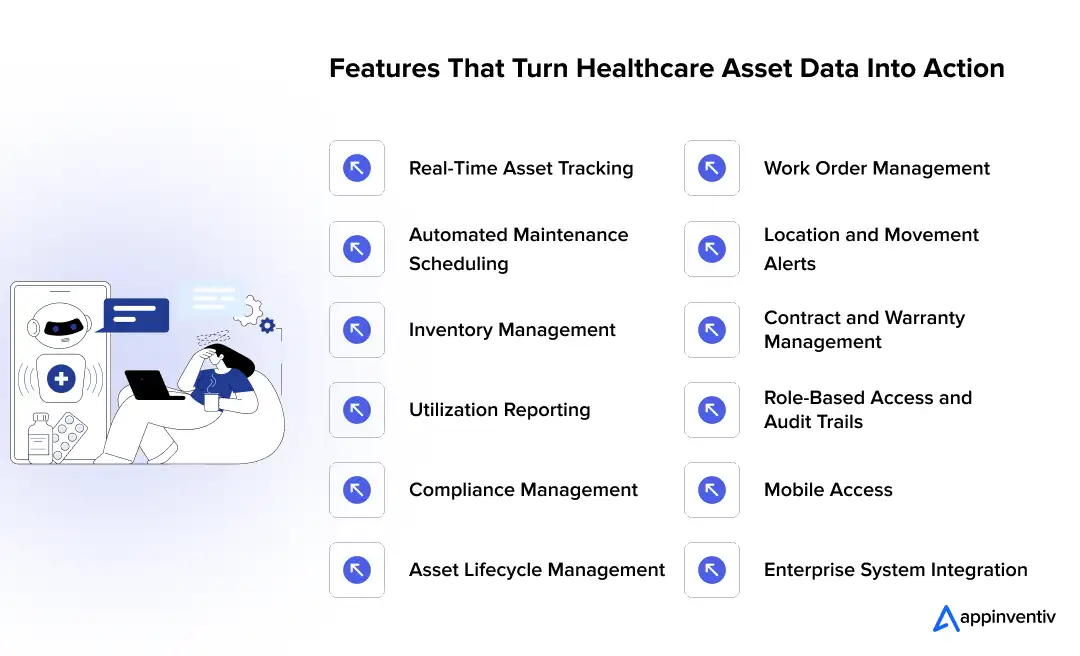
Real-Time Asset Tracking: Shows where equipment was last detected and whether it is available, assigned, or in use. Staff can find a pump or wheelchair without calling other wards.
Automated Maintenance Scheduling: Raises service tasks when calibration, inspection, or preventive maintenance becomes due. Schedules may follow dates, operating hours, or sensor readings.
Inventory Management: Keeps count of medical equipment, supplies, batches, and expiry dates. Procurement teams can spot a shortage early without ordering stock already held elsewhere.
Utilization Reporting: Reveals which devices are used regularly and which spend weeks in storage. These reports give leaders a firmer basis for purchases, rentals, and transfers.
Compliance Management: Keeps service logs, calibration certificates, sanitation records, and disposal documents with the asset. Teams can see what is overdue before audit preparation begins.
Asset Lifecycle Management: Follows equipment from purchase and deployment to repair, replacement, and disposal. The full history helps teams judge whether another repair is worthwhile.
Work Order Management: Gives technicians one queue for service requests, priorities, assignments, parts, and completed work. Urgent faults no longer sit beside routine maintenance in an email inbox.
Location and Movement Alerts: Flags high-value equipment when it leaves an approved ward, floor, or building. It can also identify assets that have remained in the wrong place for too long.
Contract and Warranty Management: Links warranties, leases, and service agreements to the equipment they cover. Teams can check coverage before paying for a repair or renewing a contract.
Role-Based Access and Audit Trails: Limits sensitive records and system actions to authorized users. Every important change carries a name and timestamp, making ownership easier to trace.
Mobile Access: Lets nurses and technicians scan a tag, report a fault, or update equipment status where the work happens. They do not need to remember the details and enter them later.
Enterprise System Integration: Passes approved information between the HAM platform and ERP, EHR, CMMS, procurement, finance, and ITSM systems. Asset management healthcare software then becomes part of hospital operations instead of another standalone database.
Healthcare Asset Management Challenges and How to Overcome Them
Implementation of asset management in healthcare sector often fails when hospitals treat it as a tagging project instead of an operational change. Accurate tracking depends on reliable records, suitable infrastructure, system integrations, and consistent staff participation.
The following challenges require attention before organization-wide deployment.
| Challenge | Operational impact | Practical solution |
|---|---|---|
| Incomplete asset records | Missing serial numbers, owners, and service histories weaken every report and alert. | Audit assets before migration. Standardize identifiers, categories, ownership rules, and mandatory data fields. |
| Legacy system integration | Separate finance, maintenance, procurement, and clinical systems create conflicting records. | Use APIs and an integration layer to connect ERP, EHR, CMMS, ITSM, and procurement platforms. Define which system owns each data field. |
| Poor location accuracy | Walls, equipment density, interference, and facility layouts can reduce tracking reliability. | Conduct site surveys and test tags in real hospital conditions. Use different technologies for room-level and zone-level tracking. |
| Staff resistance | Employees may avoid scanning assets if the process adds steps to urgent clinical workflows. | Involve clinical teams during design. Automate data capture where possible and keep manual actions short. |
| High implementation cost | Tracking every hospital item with the same technology can make deployment unnecessarily expensive. | Classify assets by value, mobility, and clinical risk. Use advanced tracking only where continuous visibility creates value. |
| Cybersecurity in healthcare and privacy risks | Connected equipment, location records, and patient identifiers can expose sensitive operational information. | Apply encryption, role-based access, network segmentation, device authentication, and complete audit logging. |
| Multi-facility inconsistency | Different naming rules and workflows make network-wide reporting unreliable. | Establish shared data standards while allowing limited configuration for facility-specific operations. |
| Excessive or poor-quality alerts | Repeated low-value notifications cause teams to ignore important warnings. | Set alerts according to urgency, asset type, and responsible role. Review thresholds using actual response data. |
| Weak maintenance coordination | Assets may appear available even when they require servicing, cleaning, or calibration. | Connect location status with maintenance and clinical-readiness workflows. Prevent unavailable equipment from appearing in active inventory. |
| Limited performance measurement | Hospitals cannot prove value when they lack baseline data on search time, downtime, and utilization. | Record pre-implementation metrics and compare them with results after each deployment phase. |
Healthcare digital asset management challenges introduce additional concerns around file duplication, access control, outdated content, and retention requirements. Hospitals should define versioning, approval, archival, and deletion rules before transferring digital resources.
For enterprise asset management for healthcare networks, governance becomes particularly important. Each facility needs clear responsibility for data quality, system adoption, equipment movement, and performance reporting.
Addressing these issues during discovery helps create a hospital asset management system that fits real workflows and remains dependable after deployment.
Build a tracking ecosystem around your assets, facility layout, accuracy needs, and existing infrastructure.

How to Build a Healthcare Asset Management System That Works in Real Hospital Environments
Healthcare asset management software development must begin with hospital workflows, not a predetermined technology stack. The system needs to reflect how equipment moves, who handles it, and which decisions depend on its data.
The following process helps healthcare organizations move from fragmented records to dependable asset visibility.
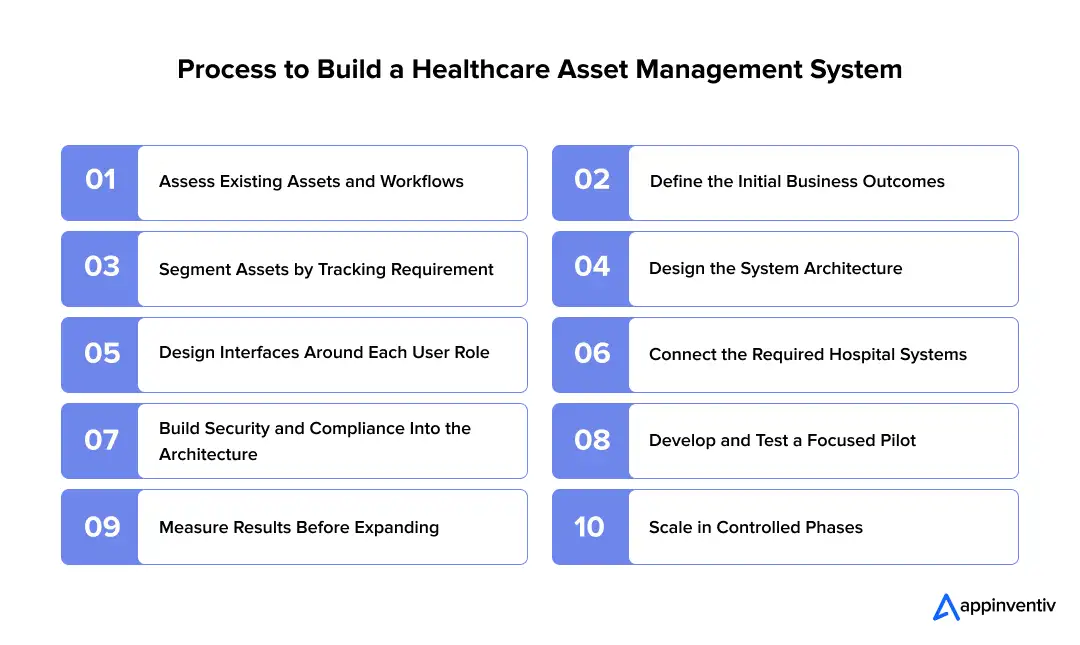
1. Assess Existing Assets and Workflows
Begin by documenting asset categories, ownership, movement patterns, maintenance processes, and existing data sources.
Teams should observe how clinicians locate equipment, how technicians receive repair requests, and how procurement approves replacements. This discovery phase reveals the gaps that software must address.
2. Define the Initial Business Outcomes
A platform should solve a specific operational problem during its first release. Common priorities include reducing equipment search time, preventing loss, improving maintenance compliance, or controlling rental costs.
Establish measurable baselines for each objective. These may include average retrieval time, equipment downtime, utilization, maintenance delays, or replacement spending.
3. Segment Assets by Tracking Requirement
Not every hospital asset requires continuous, room-level visibility. Hospitals should classify assets according to value, mobility, clinical importance, and security risk.
For example, mobile diagnostic equipment may require RTLS or BLE tags. Fixed furniture and lower-value items may only need QR codes. This tiered model prevents unnecessary infrastructure spending.
4. Design the System Architecture
The architecture should support asset records, location events, maintenance workflows, alerts, integrations, analytics, and user access.
Cloud infrastructure can provide centralized control across multiple facilities. Edge processing may also be necessary when location or sensor data must remain available during connectivity disruptions.
Teams that build healthcare asset management system solutions should also plan for increasing asset volumes, users, facilities, and sensor events.
Also Read: Hospital Management System Software Development – Benefits, Features, Process and Cost Estimations
5. Design Interfaces Around Each User Role
Nurses, technicians, procurement teams, IT administrators, and executives need different information.
Clinical staff may require a quick location search. Technicians need work orders and service histories. Leaders need utilization, cost, downtime, and replacement insights.
Role-specific dashboards reduce clutter and make the platform easier to adopt during busy hospital operations.
6. Connect the Required Hospital Systems
The platform may need integrations with:
- Enterprise resource planning systems
- Electronic health records
- Computerized maintenance management systems
- Procurement and inventory platforms
- IT service management tools
- Identity and access management systems
- Building and facility management platforms
- Vendor and warranty databases
Each integration should have a defined data owner. This prevents systems from overwriting one another with conflicting asset information.
7. Build Security and Compliance Into the Architecture
Security requirements should cover both connected equipment and the data collected about it.
Core controls include encryption, role-based permissions, device authentication, network segmentation, audit logs, and secure API access. Patient-related tracking requires additional privacy controls and limited access.
The platform should support the healthcare, cybersecurity, equipment, and data-retention requirements applicable to its deployment region.
8. Develop and Test a Focused Pilot
Start with one facility, department, or high-value asset group. A controlled pilot allows teams to test location accuracy, alert quality, integration reliability, and staff workflows.
Testing should occur during real shifts and across actual hospital spaces. Laboratories, elevators, thick walls, equipment rooms, and crowded clinical areas can affect tracking performance.
9. Measure Results Before Expanding
Compare pilot results with the baseline metrics established during discovery.
Hospitals should examine whether the system reduced search time, increased utilization, improved maintenance completion, or prevented unnecessary purchases. User feedback should also identify steps that remain confusing or time-consuming.
10. Scale in Controlled Phases
Once the pilot proves value, expand by asset category, department, or facility. Standardize core data and security rules while allowing necessary workflow differences.
Healthcare asset management software development should continue after deployment. Usage data, operational feedback, and new integrations will shape later releases and help the platform support changing hospital needs.
How Much Does a Healthcare Asset Management System Cost?
The healthcare asset management software cost can range from $40,000 for a focused pilot to $500,000 or more for an enterprise platform. The final investment depends on software’s complexity, tracking infrastructure, integrations, security, and the number of facilities involved.
These figures are indicative and should be refined through technical discovery.
| Solution scope | Estimated software development cost | Typical capabilities |
|---|---|---|
| Focused pilot | $40,000 to $80,000 | Asset registry, QR or barcode tracking, basic search, user roles, and reporting |
| Mid-scale platform | $80,000 to $200,000 | RFID or BLE integration, maintenance workflows, alerts, analytics, and multiple departments |
| Enterprise system | $200,000 to $500,000+ | Multi-facility management, RTLS, IoT data, predictive analytics, advanced security, and enterprise integrations |
These estimates primarily cover software design, development, integration, testing, and deployment. Tags, readers, gateways, sensors, network upgrades, and on-site installation may require a separate hardware budget.
Build a Connected Hospital Asset Ecosystem With Appinventiv
A hospital does not need another dashboard that only shows where equipment is. It needs a system that reflects how assets are requested, moved, cleaned, repaired, shared, and eventually replaced.
That is where our medical software development services become relevant. We work with hospital leaders, clinical teams, biomedical engineers, IT departments, and procurement teams to understand the gaps behind equipment delays and rising costs.
The scope may begin with one issue, such as locating infusion pumps or improving maintenance records. From there, we can build and connect the capabilities required for:
- RFID, BLE, RTLS, barcode, and IoT-based tracking
- Equipment availability and clinical readiness
- Maintenance schedules and technician work orders
- Utilization, downtime, and lifecycle reporting
- ERP, EHR, CMMS, ITSM, and procurement integrations
- Access controls, audit trails, and secure APIs
- Mobile access for clinical and maintenance teams
- Central oversight across departments and facilities
Our teams have delivered multiple healthcare products, including platforms that connect with various medical and wearable devices. This experience helps us account for the difficult parts of hospital asset management, including fragmented data, device integrations, security requirements, and clinical workflows that cannot pause during deployment.
We also avoid forcing every asset into the same tracking model. A portable monitor may require continuous location data, while a fixed examination table may only need a QR code and service history. This keeps the platform useful without making the implementation unnecessarily expensive.
Whether you want to modernize an existing platform or build healthcare asset management system capabilities from the ground up, we can take the engagement from workflow discovery and architecture through development, integration, testing, and phased rollout.
Get in touch with us to get started now!
FAQs
Q. How does asset management work in healthcare?
A. A healthcare organization creates a verified digital record for every asset and updates it throughout its lifecycle. The operating process includes:
- Identification: Tags, barcodes, or sensors connect each asset with its digital record.
- Monitoring: The system tracks location, availability, condition, and movement.
- Maintenance: Automated schedules initiate inspections, calibration, servicing, and repairs.
- Optimization: Utilization and cost data guide redistribution, procurement, and replacement.
Q. What are the core principles of asset management in a hospital setting?
A. Effective asset management requires more than accurate location tracking. A dependable hospital program rests on four principles:
- Visibility: Teams should know where an asset is and whether it is available.
- Accountability: Every asset should have a responsible department or custodian.
- Lifecycle control: Records should cover procurement, usage, maintenance, and disposal.
- Data-driven planning: Utilization and condition data should inform capital decisions.
Q. How is AI changing healthcare asset management?
A. AI analyzes asset, maintenance, sensor, and utilization data to identify patterns at scale. Its most practical applications include:
- Predictive maintenance: Identifying equipment that may require attention before failure.
- Demand forecasting: Estimating which departments will need specific assets.
- Utilization analysis: Finding equipment that remains idle or operates below capacity.
- Decision support: Prioritizing maintenance, redistribution, and replacement requirements.
Q. How does Healthcare Asset Management Improve Patient Identification?
A. Asset management does not identify patients independently. When connected with wristbands, identity platforms, and RTLS, it can support:
- Pre-procedure verification: Confirming the patient before equipment or treatment is assigned.
- Movement visibility: Recording transfers between approved care areas.
- Patient-equipment association: Linking specific devices with the correct patient.
- Location alerts: Flagging movement into restricted or incorrect areas.
Q. How do you calculate ROI for a healthcare asset-management system?
A. Hospitals calculate ROI by comparing measurable benefits with the platform’s complete ownership cost. The calculation should include:
- Financial benefits: Avoided purchases, rentals, replacements, and emergency repairs.
- Productivity gains: Staff hours recovered through faster equipment retrieval.
- Implementation costs: Software, hardware, integrations, installation, and training.
- Ongoing costs: Cloud infrastructure, support, maintenance, and tag replacement.
Q. Should a hospital buy an existing platform or develop a custom system?
A. The right choice for the platform for asset management in healthcare depends on workflow complexity, integration depth, deployment speed, and long-term ownership goals. Hospitals should evaluate:
- Existing platforms: Better suited to standard workflows and faster deployments.
- Custom systems: Better suited to specialized processes and complex integrations.
- Hybrid solutions: Suitable when an existing product requires controlled customization.
- Ownership costs: Include licensing, customization, support, and future expansion.
Q. What should hospitals assess before implementing asset management?
A. Hospitals should begin with a defined operational problem and a manageable pilot scope. The initial assessment should cover:
- Asset priorities: Equipment causing the highest delays, losses, or expenses.
- Data quality: Missing, duplicated, or outdated asset records.
- Infrastructure: Network coverage and required tracking accuracy.
- Integrations: ERP, EHR, maintenance, procurement, and identity systems.
- Success measures: Search time, utilization, downtime, loss, and maintenance completion.


Fast 2-minute response, fully NDA-protected.

Smart Ring App Development: BLE SDKs, Health APIs, and the Race for Connected Health
Key takeaways: The build path (a ring maker's API, a white-label ring or your own hardware) decides most of the budget. If last night's data is missing in the morning, people stop wearing the ring. One line of marketing copy can turn a wellness app into a medical device. Builds cost $50,000 to $500,000+, and…

Wearable Data Integration: Connecting Multiple Devices to a Unified Health Platform
Key takeaways: Device support should reflect the measurements your service needs, the people using it, and the decisions those readings inform. A unified health data platform must preserve source, timing, and measurement context while resolving duplicate records. Phone health platforms, manufacturer APIs, and direct device connections serve different integration needs. Clinical workflows require agreed review…

Sleep Tracker App Development: Features, Wearable Integration, AI, and Compliance
Key takeaways: Sleep tracking presents opportunities across consumer wellness, fitness, healthcare, employee wellness, senior care, and infant-care markets. Successful products combine actionable insights, wearable connectivity, user-friendly reports, privacy controls, and clearly differentiated experiences. HealthKit, Health Connect, and direct device APIs provide different data depths, costs, limitations, and maintenance requirements. AI supports sleep-stage estimation and personalization,…