






























Investing in the Future: Why Arabian Education App Development is Surging


- Arabian Education App Development Landscape in the Middle East
- Key Factors Driving the Surge in Arabian Education App Development
- Investment Hotspots Within Arabian Education App Development
- Core Requirements for Arabian Education App Development
- Key Features of Arabian Education App Development
- Arabian Education App Development Process
- Integration of Advanced Technologies in Arabian Education App Development
- Role of AI in Arabian Education App Development
- Compliance, Data Privacy, and Trust in Arabian Education Apps
- Key Challenges in Arabian Education App Development and How to Overcome Them
- How Appinventiv Approaches Education App Development in the Arabian Region
- FAQs

Key Takeaways:
- Education apps in the Arabian region are no longer stopgap solutions. They’re becoming part of how learning actually runs day to day.
- Schools, universities, and governments are choosing platforms that scale quietly and fit real teaching routines.
- The apps that succeed focus on stability, integration, and usability rather than packed feature lists.
- Most long-term growth is coming from K–12, higher education, and government-led education programs.
- Teams that understand local context, compliance, and gradual rollout earn trust and long-lasting adoption.
Across the Arabian region, the way education is delivered is quietly changing. Learning is no longer confined to classrooms, fixed hours, or printed textbooks. Students are learning on phones and tablets, teachers are managing classes digitally, and institutions are rethinking how education fits into everyday life. This practical shift is a key reason why Arabian education app development is surging today.
For a long time, many institutions have worked around the same limitations. Rigid systems, slow curriculum updates, and uneven access to quality education have created pressure points. These challenges in traditional education systems are no longer easy to ignore. As a result, Arabian education app development is increasingly seen as a long-term solution rather than a temporary add-on.
This change is especially visible in education app development in the Middle East, where digital learning is being built into national and institutional strategies. In the UAE, education app development efforts are moving past basic online lessons toward platforms that support teaching, assessment, and student progress in a more connected way. Growing investment in education technology in the Middle East reflects this shift, with many platforms designed to improve learning outcomes through better insights and adaptability, including the selective use of AI-powered education apps when they add real value.
In this guide, we look at what is driving this momentum, how different Arabian markets approach education technology, and what it takes to build education apps that genuinely work for the region.
Get clarity on feasibility, scalability, and compliance before committing time and budget.

Arabian Education App Development Landscape in the Middle East
Education apps across the Arabian region have evolved from quick digital band-aids into tools that institutions rely on every day. Schools, universities, and education authorities are now planning and building these systems with future growth in mind, not just as temporary supports. This shift is a big part of how Arabian education app development is taking shape and why it matters for long-term planning.
Across the region, demand is coming from diverse sources, including classroom support and student engagement, as well as national learning initiatives. That’s why education app development in the Middle East is moving beyond simple online lessons into connected platforms that fit into daily teaching routines and institutional goals.
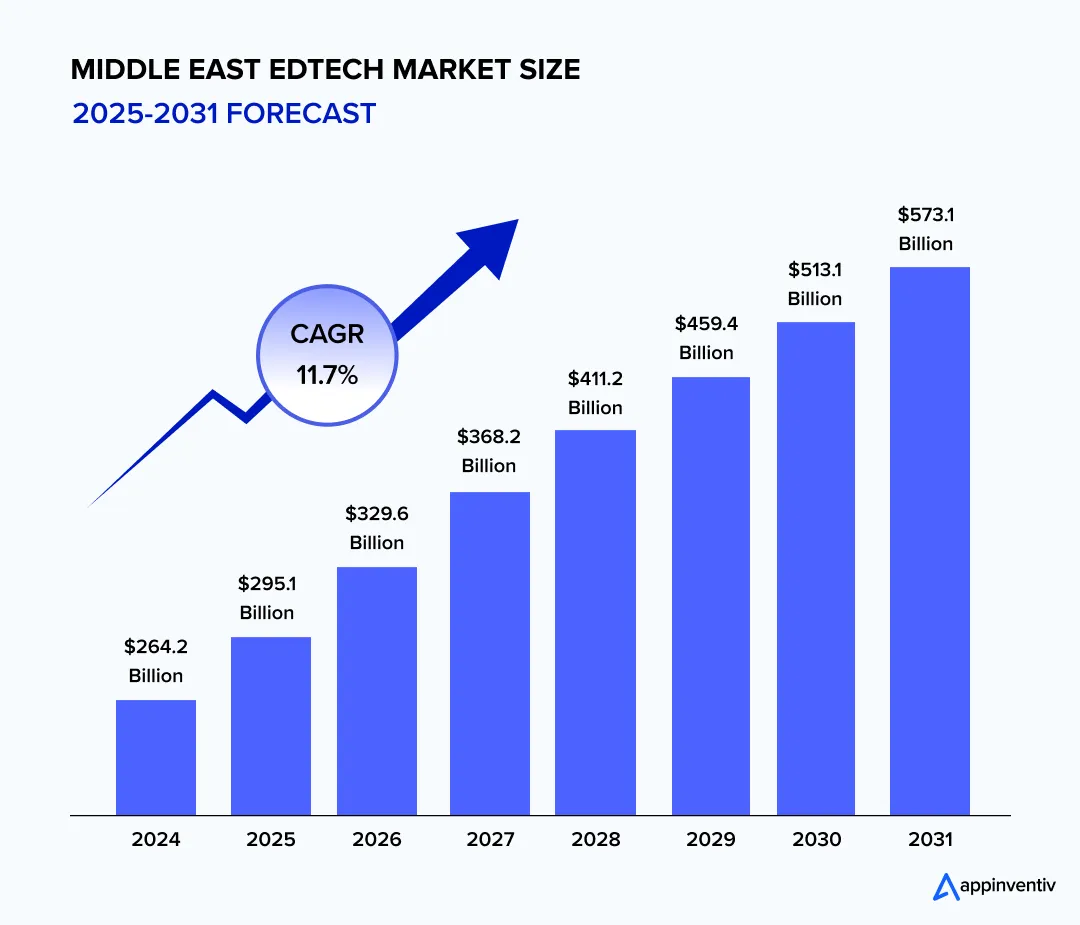
One strong signal of this momentum is the projected growth of the education technology market in the region. According to industry research, the Middle East EdTech market could grow from about USD 264 billion in 2024 to over USD 573 billion by 2031, highlighting ongoing investment and adoption in digital learning solutions.
How Adoption is Taking Shape:
- A clear focus on education app development in the UAE for everyday learning support, rather than temporary online classes
- Continued interest in eLearning app development in the UAE that delivers structured courses and assessments
- Rising use of education app development for schools to help teachers and parents stay connected to student progress
- Parallel growth in education app development for universities to streamline academic processes and resource sharing
More institutions are moving toward data-driven education platforms that bring teaching, tracking, and communication into one place. These platforms also work alongside Learning management systems (LMS), so educators don’t have to juggle multiple tools.
Overall, the landscape shows a clear shift toward maturity. Education apps in the Arabian region are being built to support long-term learning needs and institutional goals, not just quick digital fixes.
Key Factors Driving the Surge in Arabian Education App Development
The growth of education apps across the Arabian region is being shaped by what institutions are dealing with day to day. Class sizes are increasing, learning expectations are changing, and students are far more comfortable with digital tools than traditional systems. Education providers are not adopting apps for the sake of following a trend. They are doing it because existing models are no longer keeping pace.
1. Governments Pushing Education Beyond Traditional Classrooms
Governments across the region have played a visible role in driving this shift. Large-scale education apps for government education initiatives are now used to support teaching, assessments, and coordination at a national level.
These programs are built for reach and consistency, which has created steady demand for dependable education software development for institutions that can operate without frequent disruptions.
2. Schools and Universities Moving Past Stopgap Solutions
Many schools initially turned to digital tools out of necessity. Over time, that temporary use turned into long-term reliance. Today, education app development for schools focuses on everyday needs such as lesson delivery, student progress, and parent communication.
Universities are following a similar path through education app development, using apps to streamline coursework, learning materials, and academic processes. In both cases, apps are becoming part of how education functions, not something used occasionally.
3. Growing Preference for Platforms Designed Around Local Context
As adoption increases, institutions are becoming more selective about what they use. One-size-fits-all platforms often struggle with language support, curriculum alignment, or teaching styles.
This has pushed many organizations toward custom education app development, where platforms are shaped around how education actually works in the region. Over time, this approach is strengthening digital education platforms that Middle East institutions can depend on across different learner groups.
4. Demand for Systems That Can Grow Without Breaking
Another strong driver is the need for reliability at scale. Institutions want scalable education app solutions that continue to work as programs expand and user numbers grow. Easy integration with existing tools, including Learning management systems (LMS), is no longer optional. The focus has shifted toward building systems that can grow quietly in the background, without constant fixes or rework.
Together, these factors explain why education app development across the Arabian region is accelerating. The emphasis is no longer on experimenting with digital tools, but on building systems that support how education is actually delivered today.
Investment Hotspots Within Arabian Education App Development
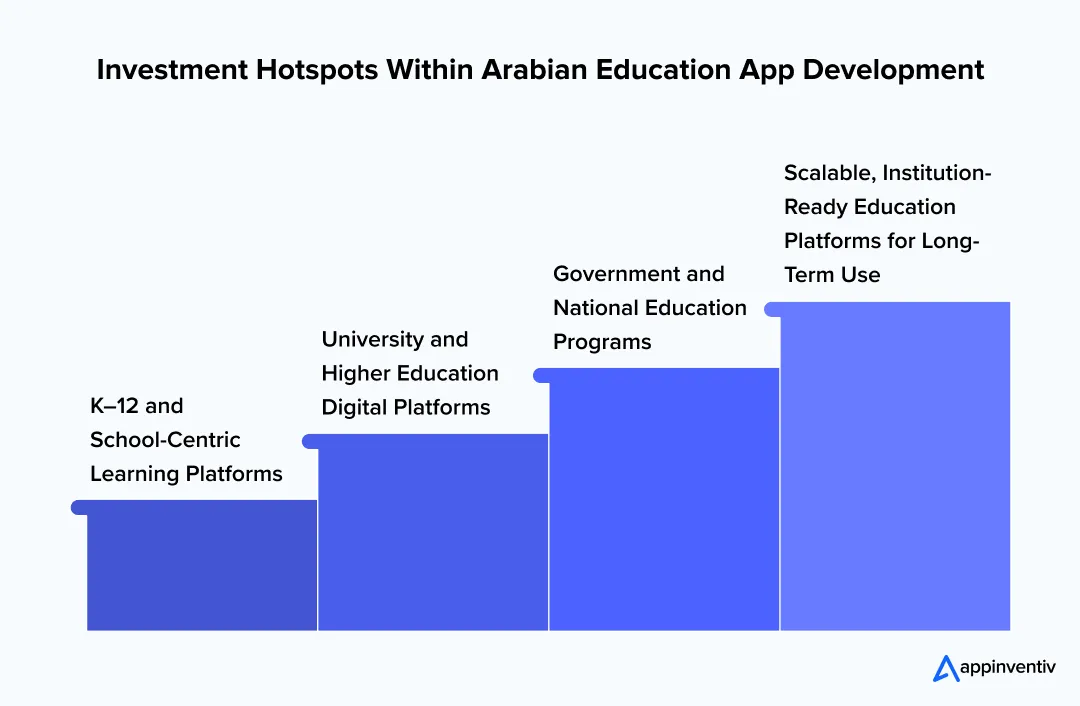
Investment across the region is not evenly distributed into education apps. Certain segments are attracting far more attention because they solve immediate problems for institutions and show clearer paths to long-term adoption. These areas are shaping where Arabian education app development efforts are being focused today.
At the center of this growth is demand from formal education systems that need dependable, scalable platforms rather than experimental tools. This is especially evident in investment in education technology in the Middle East, where funding is increasingly tied to outcomes, depth of use, and institutional alignment.
1. K–12 and School-Centric Learning Platforms
One of the strongest investment areas is education app development for schools. Schools are looking for apps that support daily teaching, track student progress, and improve communication with parents.
Investors are backing platforms that:
- Fit naturally into classroom routines
- Support blended learning without replacing teachers
- Scale across multiple schools or districts
These platforms are often adopted quickly because they address immediate operational needs.
2. University and Higher Education Platforms
Another active segment is education app development for universities, particularly platforms that manage coursework, digital content, and assessments. Universities across the region are modernizing how they deliver and manage learning, creating steady demand for institution-ready apps.
Key focus areas include:
- Centralized access to academic content
- Assessment and progress tracking
- Integration with existing campus systems
3. Government and National Education Programs
Large-scale education apps for government education initiatives continue to attract long-term investment. These platforms are designed to support national education goals and are typically rolled out over several years.
What makes this segment attractive is:
- Predictable scale and usage
- Long-term contracts and adoption cycles
- Strong alignment with public education priorities
4. Scalable Platforms Built for Long-Term Use
Across all segments, there is a growing preference for scalable education app solutions that can evolve without constant rebuilding. Investors are cautious about platforms that cannot grow beyond initial pilots.
Many of these platforms are now being positioned as data-driven education platforms, helping institutions make better decisions around learning outcomes and engagement. In some cases, AI in education apps is used selectively to support personalization or generate insights, but only where it clearly adds value.
Overall, investment patterns show a clear shift toward practicality. The strongest interest is in education apps that solve real problems for schools, universities, and governments, and can continue doing so as programs expand across the Arabian region.
Core Requirements for Arabian Education App Development
Building an education app for the Arabian region is less about adding more features and more about getting the fundamentals right. Institutions here expect platforms to work reliably in real classroom conditions, support diverse learners, and fit into existing education structures without friction. These expectations shape what a custom education app development needs to deliver.
At a baseline, apps must support everyday teaching and administration. But beyond that, they are expected to adapt to local learning styles, scale smoothly, and remain usable over long periods.
1. Designed Around Language, Culture, and Learning Habits
Education apps in this region need to feel familiar from day one. That means clear support for Arabic and bilingual learning environments, intuitive navigation, and layouts that work naturally for both students and educators.
Institutions increasingly favor platforms that:
- Support Arabic-first and bilingual content delivery
- Align with local curricula and teaching methods
- Feel intuitive for students, teachers, and parents
This focus has helped shape more mature digital education platforms that Middle East institutions can confidently adopt.
Also read: Master English-Arabic App Development for MENA Market …
2. Built to Work at Institutional Scale
Education apps are rarely used by small groups for long. Schools, universities, and public bodies all expect platforms to grow with them. That’s why scalable education app solutions are a core requirement, not an optional upgrade.
Scalability often means:
- Stable performance as user numbers increase
- Clean integration with existing systems
- Minimal disruption during updates or expansions
Many institutions also expect seamless compatibility with Learning management systems (LMS) they already rely on.
3. Clear Data Flow and Measurable Outcomes
Decision-makers want visibility into the progress of learning. This has increased demand for data-driven education platforms that offer clear reporting without overwhelming users.
Common expectations include:
- Simple progress tracking for students
- Actionable insights for educators and administrators
- Reliable data handling across multiple user roles
In some cases, platforms incorporate AI-based learning analytics to support these insights, but typically in a supporting role rather than as a central feature.
4. Reliability Over Complexity
Perhaps the most important requirement is dependability. Education apps are expected to work consistently during classes, assessments, and peak usage periods. Institutions are far more interested in experimental features than in platforms that perform well day in and day out.
Ultimately, successful education app development in Arabian markets comes down to practicality. Platforms that respect local context, scale quietly, and support real teaching workflows are the ones that see lasting adoption.
Translate these requirements into a secure, scalable platform designed for real classrooms and long-term use.

Key Features of Arabian Education App Development
Education apps built for the Arabian region are expected to do more than deliver content. They need to support everyday teaching, scale across institutions, and adapt to local learning environments. The most effective platforms focus on a clear set of features that directly support schools, universities, and education authorities.
At their core, these platforms are designed for Middle East institutions to rely on for daily operations, not just occasional use.
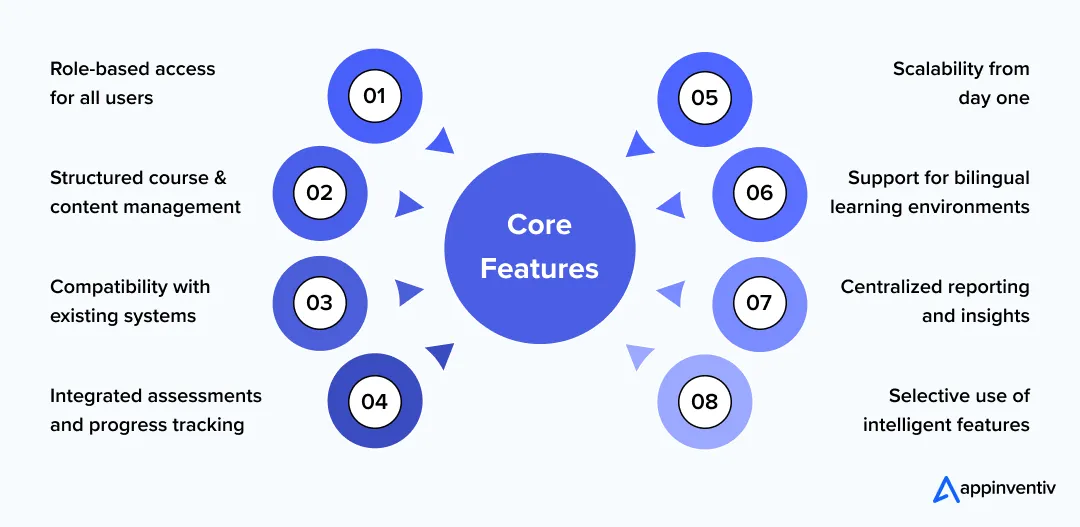
Core Features That Matter Most:
- Role-based access for all users: Clear separation of student, teacher, administrator, and parent access is essential, especially for education app development for schools and public institutions.
- Structured course and content management: Tools to create, organize, and update lessons, assessments, and resources across grades and programs. This is a foundation for both education app development for universities and institutional learning systems.
- Integrated assessments and progress tracking: Built-in quizzes, assignments, and reporting help institutions monitor outcomes without relying on external tools.
- Compatibility with existing systems: Seamless integration with Learning Management Systems (LMS) and other institutional software reduces friction during adoption and scaling.
- Support for bilingual learning environments: Arabic-first and bilingual interfaces ensure the app feels natural in local classrooms and across diverse learner groups.
- Scalability from day one: Designed as scalable education app solutions, platforms must handle growing user bases, multiple institutions, and regional expansion without performance issues.
- Centralized reporting and insights: Dashboards that provide visibility into usage, engagement, and performance support better decision-making across institutions. Many platforms evolve into data-driven education platforms as adoption grows.
- Selective use of intelligent features: Where appropriate, AI-powered education apps incorporate tools such as personalization and AI-based learning analytics to enhance learning insights without complicating the user experience.
Together, these features reflect what institutions in the Arabian region actually need. Platforms that prioritize practicality, stability, and local relevance are far more likely to achieve long-term adoption and sustained use.
Arabian Education App Development Process
Building for the Arabian education market is less about rushing to launch and more about getting the fundamentals right early. Schools, universities, and public bodies expect the product to fit real teaching routines, work reliably at scale, and stay compliant from day one. A step-by-step Arabian education app development process usually looks like this.
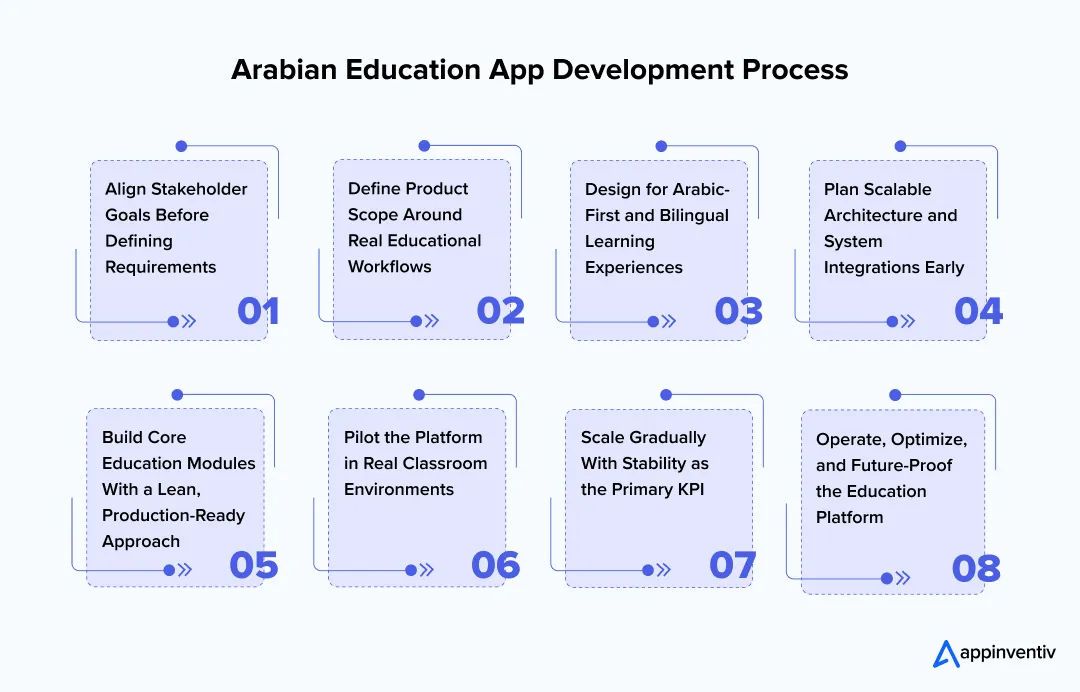
- Step 1: Align goals with stakeholders (before you write a single spec)
Map who the app serves and what success looks like across leadership, educators, IT teams, and operations. This is where you confirm whether you need a lightweight classroom tool or full education software development for institutions. - Step 2: Define the product scope around real workflows
Document daily teaching and admin flows, assessments, parent communication, and content needs. This step is where most challenges in traditional education systems show up in a usable form, and where custom education app development becomes a practical choice. - Step 3: Design for Arabic and bilingual learning
Build the UX for Arabic-first and bilingual environments, including RTL layouts, readable typography, and content structures that feel natural in classrooms. - Step 4: Choose a scalable architecture and integration plan
Most institutions already rely on Learning management systems (LMS) and other tools. Plan integrations early so the app fits into existing routines. This is also where you ensure scalable education app solutions can grow across campuses or regions without rework. - Step 5: Build the core modules first, not everything at once
Prioritize essentials like content delivery, assessments, roles and permissions, reporting, and communication. Keep the build lean but production-ready, especially for education app development for schools and education app development for universities, where daily usage is non-negotiable. - Step 6: Pilot in real classrooms and gather feedback
Run a controlled rollout with selected institutions, track adoption, and fix friction points. A pilot is where usability issues surface quickly, and where trust is either built or lost. - Step 7: Scale gradually with stability as the main KPI
Expand region by region or institution by institution. Stability during peak usage, assessments, and content updates matters more than shipping new features every week. - Step 8: Operate, improve, and keep the platform future-ready
Post-launch work is continuous: content updates, performance tuning, security reviews, and feature refinement. Over time, many platforms evolve into data-driven education platforms with selective use of AI-based learning analytics to improve visibility into learning outcomes.
This process keeps delivery grounded in how education actually works in the region, while setting the app up for long-term adoption rather than short-lived use.
Also Read: Top LMS Features to Boost Distance Learning Success
Integration of Advanced Technologies in Arabian Education App Development
Across the Arabian region, education apps are evolving in a very grounded way. Institutions are not chasing technology for the sake of innovation. They are asking simple questions first. Does this make learning easier? Does it help teachers do their job better? Does it keep systems running smoothly? Only when the answer is yes does a new technology find its place.
The best platforms are built around real learning environments and then quietly supported by the right tools.
How Technology Fits Into Everyday Learning:
- Practical student support through AI-driven chatbots: AI chatbots are mainly used to handle everyday queries. They help students find lessons, clarify instructions, or get reminders, without taking control away from teachers or making learning feel impersonal.
- Early insight through predictive analytics: By observing learning patterns over time, predictive analytics help educators notice when students start to lose engagement or struggle with certain topics. This makes it easier to step in early and offer support while it still matters.
- Making lessons easier to grasp with AR and VR: Augmented reality and virtual reality help students understand ideas that are difficult to explain through text alone. Visualizing processes or exploring virtual environments makes abstract concepts more tangible.
- Better coordination with IoT-enabled classrooms: In some institutions, IoT connects devices, attendance systems, and learning tools. This improves classroom coordination without asking teachers to change how they already work.
- Trust in credentials through blockchain and smart contracts: Blockchain technology is being explored as a way to secure certificates and academic records. Smart contracts help institutions issue and verify credentials with less paperwork and greater confidence. Early discussions around decentralised finance are also influencing how credential ownership is viewed.
- Security that works quietly in the background: Strong encryption techniques and cybersecurity practices protect student and institutional data without affecting usability. When security is built properly, it becomes invisible to users but essential for trust.
What stands out in the Arabian education ecosystem is balance. Technology is introduced carefully, with a clear purpose and limits. Platforms that use advanced tools to support learning rather than overwhelm it are the ones that gain trust and remain part of the education system over time.
Role of AI in Arabian Education App Development
Across the Arabian region, technology in education is being adopted with restraint and intent. Institutions are not chasing automation for headlines or replacing teachers with systems. Instead, they are introducing intelligent capabilities only where they make learning easier to manage and outcomes easier to understand. This is why AI-powered education apps in the region tend to feel supportive rather than intrusive.
For most schools and universities, these capabilities work quietly in the background. Educators stay in control, while technology helps reduce blind spots and manual effort. The emphasis is on usefulness in real classrooms, not experimentation.
Where Intelligent Capabilities Are Actually Helping
When used well, these features support day-to-day teaching without changing how educators work.
They are commonly applied to:
- Adjust learning content based on how students progress over time
- Highlight students who may need additional attention early on
- Recommend revision or practice material when gaps appear
These tools help teachers respond faster, without adding extra steps to their workload.
Using Learning Data Without Overcomplicating It
As platforms scale, institutions need a clearer view of what is happening across classes, grades, or campuses. This has increased reliance on data-driven education platforms that turn activity into insights educators can act on.
Through AI-based learning analytics, institutions are able to:
- Track engagement and performance across groups
- Spot patterns that affect learning outcomes
- Make informed changes to curriculum or delivery methods
The goal is clarity, not complexity. Insights are only valuable if educators can easily understand and use them.
A Measured View of What Comes Next
Adoption remains cautious across the region. New features are assessed on whether they are transparent, manageable, and easy to explain to teachers, parents, and administrators. This approach reflects how the future of education technology in Arab countries is being shaped, with trust and long-term reliability taking priority over rapid change.
In practice, intelligent capabilities are being used to strengthen existing education systems. By focusing on small, meaningful improvements, education apps in the Arabian region are evolving in ways institutions can confidently support over time.
Compliance, Data Privacy, and Trust in Arabian Education Apps
In the Arabian region, compliance is not a checkbox. It is often the deciding factor in whether an education app is approved, scaled, or rejected outright. Schools, universities, and government bodies handle sensitive student data every day, making trust a non-negotiable requirement.
Education platforms are expected to comply with regional regulations while remaining simple enough for teachers and learners to use without friction. This reality strongly shapes how education software development for institutions is planned and delivered.
Regulations That Commonly Shape Education Apps
Depending on the market, education apps are typically expected to align with a mix of national and international standards, including:
- Saudi Personal Data Protection Law (PDPL) for platforms operating in Saudi Arabia
- UAE Federal Decree-Law No. 45 of 2021 (PDPL) for student and institutional data protection
- NCA Essential Cybersecurity Controls (ECC) for systems supporting public-sector or large-scale programs
- Alignment with GDPR principles, especially for institutions working with international partners or curricula
For education apps for government education initiatives, these requirements are applied more strictly, with closer scrutiny on data access, hosting, and security controls.
Stability and Security Over Feature Depth
Institutions tend to favor platforms that work reliably during classes, exams, and peak usage periods. This is why many decision-makers prioritize scalable education app solutions that:
- Maintain performance as usage grows
- Integrate smoothly with existing systems
- Avoid frequent changes that disrupt learning workflows
A stable platform builds confidence faster than one packed with features but prone to disruption.
Trust as a Long-Term Advantage
Meeting compliance standards does more than reduce risk. It signals maturity. Education apps that demonstrate strong data protection, clear governance, and consistent performance are more likely to earn long-term adoption.
In the Arabian education ecosystem, trust is built quietly. Platforms that respect regulations, safeguard data, and support institutions without disruption become part of the system for years, not months.
Key Challenges in Arabian Education App Development and How to Overcome Them
Even with strong demand, building education apps for the Arabian region is rarely straightforward. Most challenges do not arise because the technology is complex, but because education systems move slowly and expect stability. Teams that understand these realities early are far more likely to see long-term adoption.
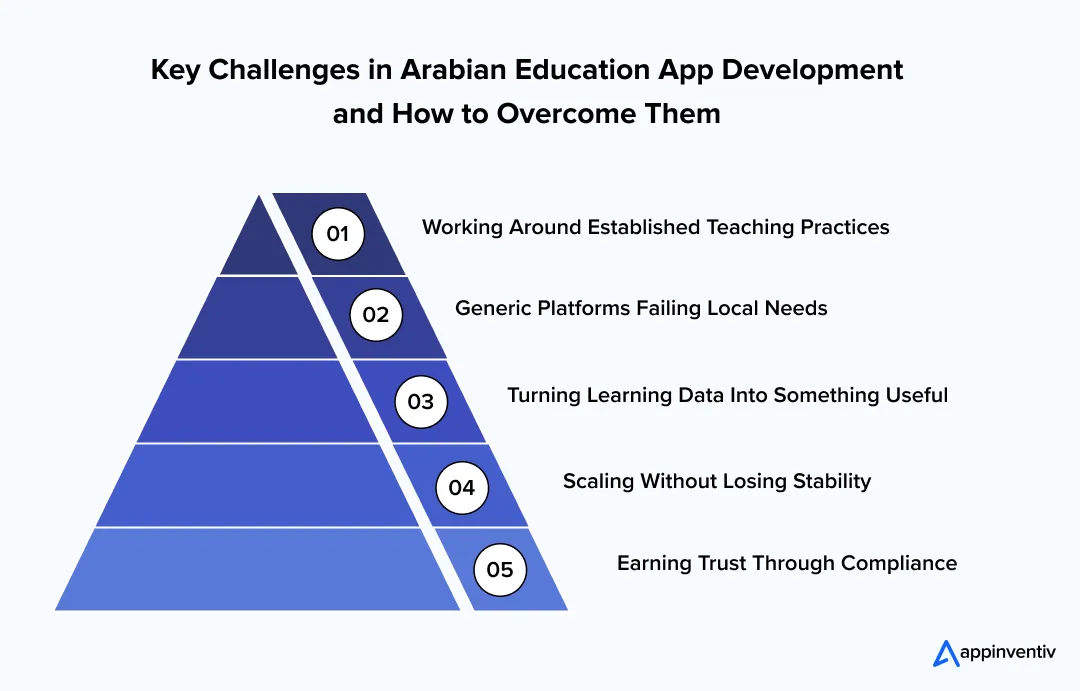
1. Working Around Established Teaching Practices
Many institutions operate on routines that have been in place for years. These challenges in traditional education systems often make it difficult to introduce new tools, even when there is a clear interest.
How to overcome it:
- Design platforms that fit existing teaching methods rather than replacing them
- Introduce changes gradually through pilots
- Focus on helping educators save time, not learn new processes
This approach is especially important in education app development for schools and higher education environments.
2. Generic Platforms Failing Local Needs
Off-the-shelf solutions often struggle with language support, curriculum structure, and institutional workflows. Over time, this leads to frustration and limited use.
How to overcome it:
- Invest in a custom education app development that reflects how education actually works locally
- Use flexible, modular features that adapt without constant rebuilding
- Plan for regional variation while keeping the platform simple
This is key to building reliable digital education platforms that Middle East institutions can depend on.
3. Scaling Without Losing Stability
As adoption grows, so do expectations. Platforms must perform reliably during classes, assessments, and peak usage periods.
How to overcome it:
- Prioritize scalable education app solutions from the start
- Test systems under real-world load conditions
- Ensure smooth integration with existing Learning Management Systems (LMS)
Consistency builds confidence faster than new features.
3. Turning Learning Data Into Something Useful
Institutions want insight into progress, but too much data can overwhelm educators.
How to overcome it:
- Keep reporting simple and role-specific
- Build data-driven education platforms that highlight what matters most
- Use AI-based learning analytics carefully, only where it improves clarity
The focus should be on actionable insight, not information overload.
4. Earning Trust Through Compliance
Strict data protection and security expectations can slow adoption if they are not addressed early.
How to overcome it:
- Treat compliance as a foundation, not a final step
- Be transparent about data handling and access.
- Design with long-term use in mind, especially for education apps for government education initiatives
In the Arabian education ecosystem, trust is earned through consistency. Platforms that respect local realities, scale quietly, and support educators day after day are the ones that succeed.
Address localization, compliance, and scalability challenges early with the right technical partner.

How Appinventiv Approaches Education App Development in the Arabian Region
Building an education app that people actually stick with takes more than technical skill. It starts with understanding how learning really happens. Appinventiv spends time with educators, administrators, and product owners to understand daily routines, pressure points, and long-term goals before any development begins. This approach helps avoid building tools that look good on paper but fall apart in real classrooms. As a software development company in Dubai, Appinventiv combines this local understanding with experience delivering products that scale reliably.
That mindset is clearly visible in the EdFundo project. Designed for children and teenagers in the UAE, the app focuses on teaching financial literacy through everyday activities such as saving, spending, and setting goals. Instead of turning money management into abstract lessons, EdFundo brings parents into the learning loop and connects education with real life. The result is a platform that feels relevant and engaging, not instructional or rigid.
Across education projects, Appinventiv keeps the same focus. The goal is to build platforms that fit naturally into existing learning environments, stay dependable as usage grows, and remain easy for institutions to manage.
If you’re planning an education app for the Arabian market and want a partner who values practical thinking and long-term outcomes, starting a conversation with Appinventiv can help turn that idea into something institutions genuinely trust and use. Let’s talk!
FAQs
Q. Why is education app development growing in the Middle East?
A. Education app development in the Middle East is growing because traditional systems are struggling to keep up with changing learning needs. Schools and universities need flexible ways to manage classes, assessments, and communication at scale. Mobile access, younger populations, and long-term education reform have made apps a practical choice rather than an experiment.
Q. What is driving EdTech growth in the UAE and GCC?
A. In the UAE and across the GCC, growth is being driven by education modernization and strong participation from both public and private institutions. Education app development initiatives in the UAE focus on blended learning and structured delivery, supported by steady investment in education technology. Middle East programs that aim to improve outcomes over time.
Q. How is digital education evolving in Arab countries?
A. Digital education in Arab countries is moving beyond basic online lessons. Institutions are adopting digital education platforms in the Middle East that bring teaching, assessments, reporting, and communication into one place. The goal is to support daily education workflows, not replace classrooms.
Q. Are education apps replacing traditional learning systems?
A. Education apps are not replacing traditional learning systems. They are extending them. Education apps for government education initiatives, schools, and universities are designed to support teachers, improve access to resources, and track progress more effectively while keeping in-person learning central.
Q. How is AI used in education apps in the Middle East?
A. In the Middle East, AI is used carefully and with clear limits. AI-powered education apps often rely on simple insights and AI-based learning analytics to help institutions understand progress and engagement, while teachers remain responsible for instruction and decisions.
Q. What features do modern education apps need?
A. Modern education apps need clear user roles, structured content management, assessments, and bilingual support. They should integrate smoothly with Learning management systems (LMS) and function as reliable, data-driven education platforms. Most importantly, institutions expect scalable education app solutions that grow quietly without disrupting learning.

- In just 2 mins you will get a response
- Your idea is 100% protected by our Non Disclosure Agreement.

How Much Does It Cost to Build a Calorie Counting App Like Cronometer in Australia
Key takeaways: Building a calorie counting app with Cronometer-level accuracy in Australia typically costs between AUD 70,000 and AUD 700,000+, depending on data depth, compliance posture, and analytics sophistication. Underestimating compliance, data licensing, and post-launch governance is the most common cause of budget overruns for Australian nutrition platforms. The hard cost driver is not screens.…

MVP to Market: Realistic Cost, Timelines & Tech Stack for MVP App Development in Australia
Key takeaways: MVP development costs in Australia typically land between AUD 50,000 and AUD 200,000+, driven by integration depth, security, and delivery shape. Time-to-market can vary from 8 to 20 weeks, influenced by integrations, compliance, and feature scope. Choosing the architecture and best tech stack for building mvp app early reduces rebuild risk when traction…

Step-by-Step Guide to Digital Tipping Platform Development for Australia: Features, Costs & ROI
Key takeaways: Digital tipping is now a system-level decision Once tips move through digital payments, they intersect with payroll, reporting, and workforce trust. Informal handling does not scale. Sector-specific design determines success Cafés, restaurants, hotels, delivery services, and franchises each require different allocation logic and operational controls to reflect how work is delivered. Cost reflects…