





























Robo-Advisor Platform Development – Costs, Benefits, and Process for FinTech Businesses

 Share -


- 01Step-by-Step Process to Build a Robo-Advisor Platform
- 02Build vs Buy vs Partner: What’s the Right Approach?
- 03Robo-Advisor Development Cost Breakdown
- 04Use Cases of Robo Advisor Software
- 05Core Features of a Robo-Advisor Platform
- 06Technology Stack Required for Robo-Advisor Platforms
- 07Regulatory & Compliance Requirements in Robo Advisory Platform
- 08Benefits of Robo Advisor Software for Institutions
- 09Challenges and How to Overcome in Robo-Advisor Development
- 10Future Trends in Robo-Advisory Platforms
- 11Why Appinventiv for Robo-Advisor & FinTech Development
- 12FAQs

Key takeaways:
- Robo advisor platform development is less about features and more about building scalable, compliant systems.
- Strong architecture, microservices, APIs, and cloud play a critical role in long-term performance and flexibility.
- The cost to build a robo-advisor platform typically ranges from $40,000 to $400,000, depending on complexity and the number of integrations.
- Data accuracy, compliance readiness, and system integration are the most common challenges in building a robo-advisor.
- Institutions that align product, compliance, and execution early tend to scale faster with fewer system limitations.
Think about a typical product discussion inside your team. At some point, the conversation shifts from features to something more practical. Can this platform actually handle scale? Will it stay compliant as we grow? And what happens when market activity spikes?
That’s usually where robo advisor platform development starts to feel less like a product decision and more like an infrastructure one, especially for institutions.
You’re not building a standalone investing app. You’re putting together a system that connects data feeds, risk logic, execution layers, and compliance workflows, all working in sync. If one piece slows down or fails, it doesn’t stay isolated. It shows up in portfolio decisions, reporting, and ultimately user trust.
This is why many firms are now moving toward robo-advisor software for institutions, where architecture is planned early. Teams lean on microservices to keep components independent, APIs to connect external systems, and cloud infrastructure to stay flexible when demand shifts.
The momentum behind this is clear. The global robo-advisory market is expected to grow at a CAGR of over 30% from 2026 onward, driven by rising digital adoption and demand for automated investing solutions.
In this blog, you’ll get a clear view of how these platforms are built, what they cost, and how institutions are approaching them today.
Build a scalable, compliant investment platform with expert-led robo advisor platform development.

Step-by-Step Process to Build a Robo-Advisor Platform
Before jumping into the build process, most teams reach a point where they need clarity. Should you build everything in-house, integrate with existing systems, or move faster with a partner?
If you’re working on robo advisor software for institutions, these decisions directly affect scalability, compliance readiness, and long-term cost control. Getting this right early often saves months of rework later.
When teams begin with robo advisor platform development, it rarely stays linear. You move forward, revisit decisions, and refine as systems begin to connect. The goal is to keep each layer stable so nothing breaks later.
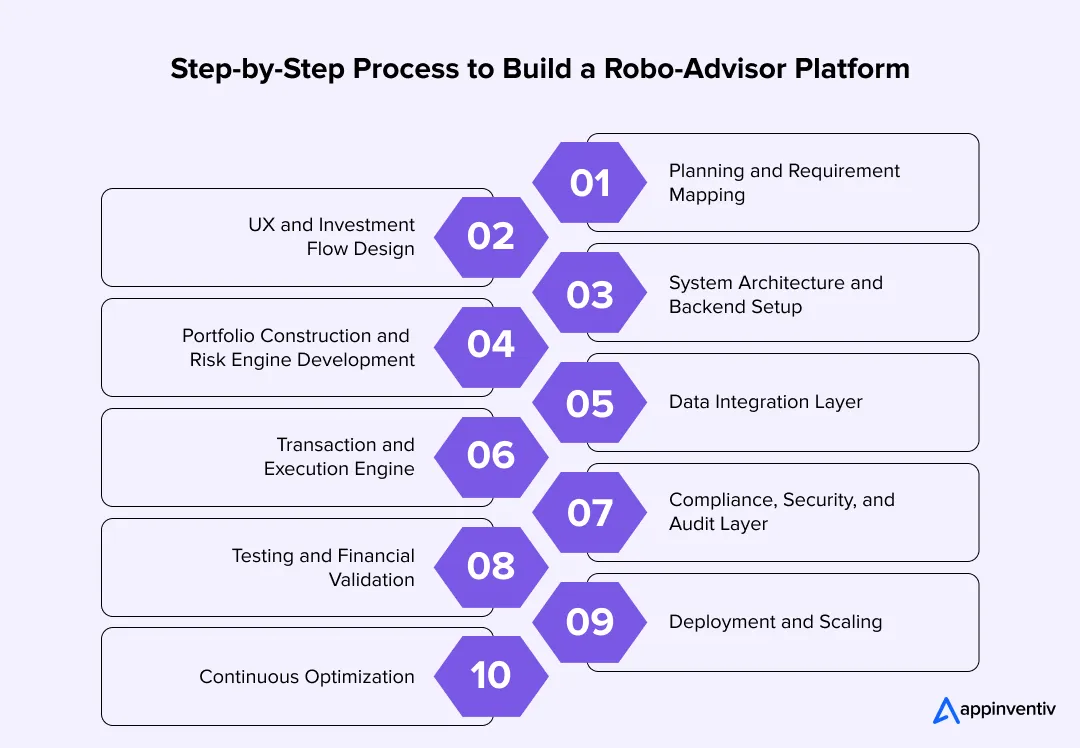
1. Planning and Requirement Mapping
This is where you step back and define what you’re actually building. You decide:
- Who are you building for
- What kind of portfolios will you offer
- How the business will make money
Alongside this, the scope of compliance, the regulatory scope, and the system integrations are defined early. These choices influence architecture, integrations, and even how flexible your platform can be later.
2. UX and Investment Flow Design
Before your team starts writing code, you shape how users interact with the product. The flow usually includes:
- Sign-up and identity checks
- A short risk questionnaire
- Goal selection
- Portfolio suggestion
Each step is designed to capture structured inputs that feed into the investment engine. The balance here is important. It needs to feel simple yet gather enough detail to produce reliable recommendations.
3. System Architecture and Backend Setup
This is where the system starts to take form. Most teams build with:
- Microservices architecture, so components scale independently
- Cloud infrastructure for flexibility and uptime
- Containers for consistent deployment
Core services are defined here, including user management, portfolio logic, transactions, and reporting. This is also where external APIs are integrated, and third-party integrations such as broker APIs and data providers are established.
4. Portfolio Construction and Risk Engine Development
This is the brain of the platform. You’re translating user inputs into investment decisions using:
- Portfolio allocation models
- Risk scoring tied to user behavior
- Rules around diversification and exposure
Some teams add machine learning later, but even a rule-based system needs to be consistent and easy to explain.
5. Data Integration Layer
At this point, everything depends on clean, reliable data. You’re pulling in:
- Market prices and indices
- User financial details
- Transaction data
APIs handle most of this, but you still need validation and caching in place. If data breaks here, the rest of the system feels it immediately.
6. Transaction and Execution Engine
This is where recommendations turn into actual trades. You connect:
- Order management systems
- Broker or trading APIs
- Portfolio tracking
Real-world issues show up here. Orders don’t always go through cleanly, and the system needs to handle that without confusing the user.
7. Compliance, Security, and Audit Layer
This runs in parallel, but it becomes more visible at this stage. You’re putting in place:
- Identity checks and AML workflows
- Data encryption
- Logs for every action taken
If you’re operating in regulated markets, every decision and transaction needs to be traceable.
8. Testing and Financial Validation
This is not just about fixing bugs. You check:
- Whether portfolios behave as expected
- If risk scores align with outputs
- How rebalancing performs over time
Backtesting is critical here. You run strategies against historical market data to see how they would have performed.
9. Deployment and Scaling
Once things feel stable, you move to production. Now the focus shifts to:
- Handling spikes in activity
- Monitoring system health
- Scaling infrastructure when needed
This is where performance issues tend to first appear.
10. Continuous Optimization
The work doesn’t stop after launch. Teams usually start refining:
- Portfolio logic
- Personalization features
- User experience
Over time, many platforms expand further by adding advanced investment features and personalization layers, connecting investing with other financial features inside the same product.
What most teams realize a bit late is that the algorithm alone doesn’t make the platform strong. It’s how well data, decisions, execution, and compliance fit together. When those pieces align, the system feels reliable. When they don’t, users notice quickly.
Build vs Buy vs Partner: What’s the Right Approach?
This is where most teams pause. Whether you’re building robo advisor software for institutions, choosing a white-label robo advisor platform, or integrating APIs, the decision shapes how flexible your system will be later.
For example, a white-label robo-advisor platform can help businesses launch quickly, but it often limits customization when scaling becomes important.
Comparison Overview:
| Approach | What It Means | Pros | Cons | Best Fit For |
|---|---|---|---|---|
| Build (In-house) | You develop the platform from the ground up with your own team | Full control, flexible product decisions, easier to scale over time, better use of embedded financial technologies | Takes longer, higher upfront investment | Teams are serious about owning their product and building a strong robo-advisor platform |
| Buy (White-label) | You use an existing product and customize it with your branding | Quick to launch, lower initial cost, less technical effort | Limited flexibility, depends on vendor updates, harder to stand out | Businesses that want to test robo-advisory systems for businesses without a heavy investment |
| Partner (BaaS /APIs) | You connect to third-party providers for core features like banking or trading | Faster setup, access to ready infrastructure, and easier compliance handling | Ongoing dependency, limited control over core features | Teams looking to move fast with third-party financial integrations |
Why “Build” Usually Makes More Sense Long-Term
In most fintech projects, especially at the institutional level, teams that start with white-label or third-party setups often revisit their decision later. What works for a quick launch doesn’t always support scale, deeper integrations, or evolving compliance needs.
This shows up consistently in practice. Based on Appinventiv’s experience across 3000+ digital products, nearly 60–70% of fintech teams that begin with white-label or partner-led models eventually shift toward building their own platforms as complexity grows.
The reason is fairly straightforward:
- You’re not waiting on vendors, which can reduce dependency delays by 30–40%
- Product decisions move faster because everything aligns with your business logic
- Integrations across banking and trading systems feel more seamless
- Long-term costs become more predictable, often lowering operational overhead by 20–30% over time
There’s more effort upfront, no doubt. But for teams building robo-advisor software for institutions, that control starts to pay off as soon as the platform begins to scale.
Robo-Advisor Development Cost Breakdown
This is usually where things start to feel more concrete. You’ve talked through features and architecture, but now the focus shifts to what it actually costs to build. When you start evaluating robo advisor platform development, the investment depends on how advanced your system needs to be. And if this sits within a broader product, the cost to build a fintech app as a whole can vary significantly depending on how tightly everything is connected.
In most cases, you’re looking at a range between $40,000 and $400,000. The lower end covers a fairly basic setup. The higher end comes in when you start adding deeper automation, stronger compliance, and multiple integrations.
The overall cost to build a robo-advisor platform ultimately depends on how much customization, scalability, and regulatory coverage your business needs from the start.
Estimated Cost Breakdown by Development Stage:
| Development Stage | What It Covers | Estimated Cost Range |
|---|---|---|
| Planning & Requirement Analysis | Figuring out what you’re building, who it’s for, and how it will make money | $5,000 – $20,000 |
| UX/UI Design & User Flow | Designing how users sign up, answer questions, and see their portfolios | $8,000 – $30,000 |
| Core Platform Development | Building the backend, user accounts, portfolio system, and transaction flow | $40,000 – $150,000 |
| Portfolio & Risk Engine Development | Setting up how portfolios are created, scored, and adjusted over time | $25,000 – $100,000 |
| API Integrations & Data Layer | Connecting market data, banking or trading systems, and handling data flow | $20,000 – $80,000 |
| Compliance & Security Setup | Putting in place identity checks, encryption, and required regulations | $15,000 – $60,000 |
| Testing & Financial Validation | Checking if everything works correctly, including portfolio behavior | $10,000 – $40,000 |
| Deployment & Infrastructure Setup | Moving the system live and making sure it can handle real users | $7,000 – $30,000 |
What Drives the Cost Up or Down:
- Level of automation- The more advanced the logic or AI in the system, the more time and effort it takes to build and test properly.
- Regulatory complexity- If you’re dealing with stricter rules or multiple regions, expect more work around compliance and approvals.
- Number of integrations- Every extra API or external system adds development time and ongoing maintenance.
- Customization level- Building everything from scratch costs more than using ready components or frameworks.
- Scalability needs- If you’re planning for high user volume early, infrastructure and setup costs go up accordingly.
For businesses focused on building robo-advisor software for institutions, costs often rise due to stricter compliance requirements, deeper integrations, and scalability demands.
Use Cases of Robo Advisor Software
If you look at how people deal with money today, most of them aren’t trying to “manage investments” in the traditional sense. They just want things to work without too much thinking. A few taps, a clear direction, and the system handles the rest. That’s exactly where the use cases of robo-advisor software start to make sense.
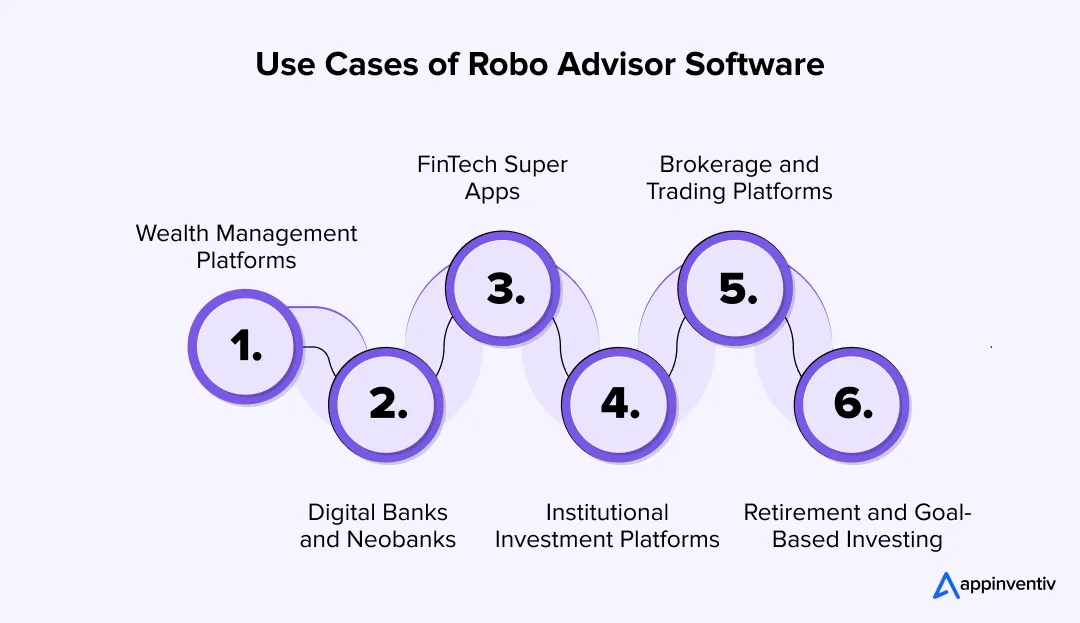
1. Wealth Management Platforms
Picture a user signing up, answering a few questions, and getting a ready portfolio within minutes. No calls, no back-and-forth. That’s what many wealth management platforms are doing now.
Behind the scenes, this is driven by robo-advisor platform development, where risk scoring, allocation, and rebalancing all run quietly in the background. For businesses, it means serving more users without scaling advisory teams at the same pace.
2. Digital Banks and Neobanks
You open a banking app to check your balance, and right there, you see an option to start investing. No extra login, no separate app.
That’s where a robo-advisor platform for banks fits in. It turns a basic banking app into something more complete. From the user’s side, it feels seamless. From a business perspective, it keeps users engaged within the same ecosystem.
3. FinTech Super Apps
Some apps are trying to do everything in one place: payments, lending, savings, and now investing. Instead of pushing users elsewhere, they’re building it in.
This is where robo-advisor app development comes into play. Companies already have active users, so adding investing becomes less about acquisition and more about expanding what users can do within the same product.
4. Institutional Investment Platforms
Now think about a much larger setup, thousands or even millions of users, stricter rules, and more complex portfolios. Things get heavier here.
That’s why many firms focus on building robo-advisory software for institutions. These platforms are designed to handle scale, compliance, and consistency without breaking under pressure.
5. Brokerage and Trading Platforms
Not every user wants to actively trade. Some just want their money to grow without watching charts all day.
Brokerages are picking up on this and offering automated portfolios alongside trading tools. Many are moving toward AI-powered robo-advisor platforms, where the system keeps adjusting based on market shifts and user behavior over time.
6. Retirement and Goal-Based Investing
Then there’s the long-term side of things. Someone sets a goal, say retirement or saving for education, and doesn’t want to keep tweaking things every month.
Robo-advisors handle that by keeping the portfolio aligned over time. It’s less about constant decisions and more about staying on track without effort.
Across all of these, one thing stays consistent. Investing stops feeling like a separate task. With robo-advisory technologies for business, it becomes part of the products people are already using. And once that happens, users tend to stick around longer without even thinking about it.
Whether you’re targeting banks, fintech apps, or institutions, design a solution that aligns with your users and growth goals.

Core Features of a Robo-Advisor Platform
At the core of any successful robo advisor platform development, these features ensure the system works reliably.
- User Onboarding & KYC: This is more than just creating an account. The system verifies identity, checks documents, and collects basic financial details. Most platforms rely on external KYC services here, and everything is stored securely for compliance.
- Risk Profiling Engine: Those short questionnaires are doing real work. The system converts answers into a risk score using weighted logic. That score serves as the basis for determining how aggressive or conservative a portfolio should be.
- Portfolio Construction Engine: Once the risk level is clear, the platform builds a portfolio. It decides how money is split among assets like ETFs or bonds, ensuring things stay balanced and diversified.
- Automated Rebalancing: Markets shift all the time, so portfolios don’t stay aligned on their own. The system continually checks and adjusts allocations when they drift too far from the original plan.
- Transaction & Execution Layer: When a portfolio is finalized, this layer places the actual trades. It connects to broker systems, tracks orders, and updates the portfolio in real time as transactions occur.
- Performance Tracking Dashboard: This is what users see day-to-day. Returns, growth, and asset distribution are calculated in the background and shown in a way that’s easy to follow.
- Compliance & Reporting Module: Every action is recorded. The platform keeps logs, generates reports, and makes sure everything stays within regulatory limits.
Individually, these features seem straightforward. But when they work together smoothly, that’s what makes the platform feel reliable to users.
Also Read: Building an Investment Platform: Key Strategies for Success
Technology Stack Required for Robo-Advisor Platforms
When teams actually get into building this, the stack doesn’t show up fully planned on day one. It takes shape as the product evolves, one layer at a time. On the surface, it looks like a simple app showing portfolios. Underneath, there’s a lot happening to keep everything accurate and in sync.
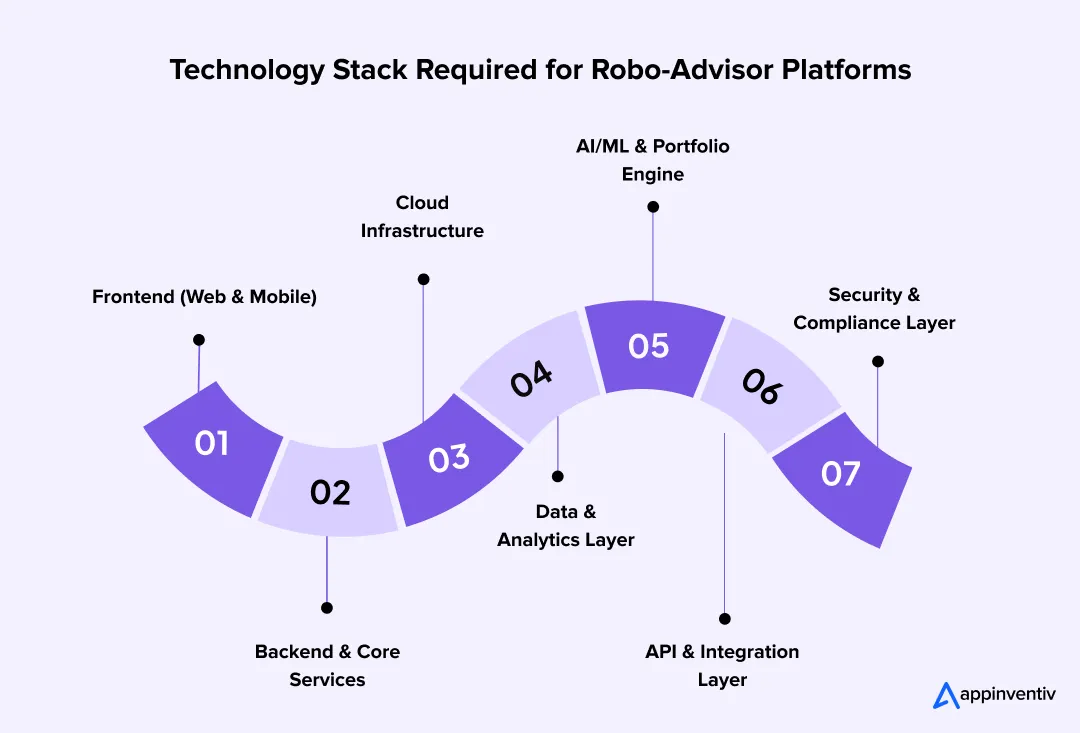
- Frontend (Web & Mobile): This is what users deal with daily. Screens showing returns, goals, and portfolio splits. Tools like React or Flutter are common, but the real work is making complex data feel easy to read. If the interface feels cluttered, users drop off quickly.
- Backend & Core Services: Most of the heavy lifting sits here. Built with Node.js, Python, or Java, this layer processes user data, implements portfolio logic, and handles transactions. Teams usually split this into smaller services so things like risk calculation or order execution can scale without slowing everything else down.
- Cloud Infrastructure: Everything runs on the cloud, typically AWS or Azure. Containers and orchestration tools like Docker and Kubernetes help keep deployments consistent. When markets move and traffic spikes, auto-scaling keeps the system from slowing down.
- Data & Analytics Layer: This component feeds the system with real-time data. Market prices, user inputs, and transaction logs all flow through here. Databases store it, while tools like Redis or Kafka help move and process data quickly, so nothing feels delayed.
- AI/ML & Portfolio Engine: At the center of robo advisor platform development, this is where decisions are made. Even if it starts simple, rule-based logic handles allocation and risk scoring. Over time, teams add smarter models to make adjustments based on behavior and market trends.
- API & Integration Layer: This is where things get connected. Market data providers, broker systems, KYC services, everything flows through APIs. Since you’re depending on external systems, retries, fallbacks, and monitoring become critical.
- Security & Compliance Layer: Security runs through every layer. Data is encrypted, access is tightly controlled, and every action is logged. It’s not something added later; it’s built in from the start to meet regulatory requirements.
When everything is set up well, users never notice any of this. The app just feels smooth and reliable. But if one part slows down or breaks, it shows up almost immediately. That’s why getting this stack right early on makes a big difference later.
Regulatory & Compliance Requirements in Robo Advisory Platform
This is the part that quietly determines whether your platform is reliable. You’re not just building features here, you’re dealing with real money, real users, and strict rules. In any setup involving financial advisory platforms, compliance and security are not optional layers; they run through everything.
- KYC & AML Workflows: Before a user can invest, their identity needs to be verified. Most platforms integrate third-party services for document checks, identity validation, and fraud detection. On top of that, AML systems keep monitoring transactions in the background to catch anything unusual.
- Data Security & Encryption: A lot of sensitive data flows through the system, so security must be tight from the start. Encryption tech is applied both during data transfer and storage. Access is controlled through secure tokens and permissions, ensuring only the right systems and users can access critical data.
- Regulatory Compliance (SEC, FINRA, etc.): Depending on where you operate, there are clear rules to follow. In markets like the U.S., regulators expect transparency in how portfolios are created and how user data is handled. Within regulated investment environments, this becomes even more important since multiple systems are connected.
- Audit Trails & Reporting: Every action gets recorded, from onboarding to trade execution. These logs are not just for internal tracking; they’re often required for audits and regulatory checks. If something goes wrong, this is where teams go to trace it back.
- Risk Disclosure & User Transparency: Users need to know what they’re stepping into. Clear risk levels, assumptions, and disclaimers are part of the experience. It’s not just about meeting rules; it helps build trust over time.
What most teams realize along the way is that compliance isn’t something you “add later.” It shapes how the system is designed from the beginning. When done right, it stays in the background. When ignored, it becomes a problem very quickly.
Benefits of Robo Advisor Software for Institutions
When teams move forward with robo advisor platform development, the value shows up pretty quickly. It’s not just about automation. It’s about building a system that can scale decisions, reduce friction, and stay consistent under pressure.
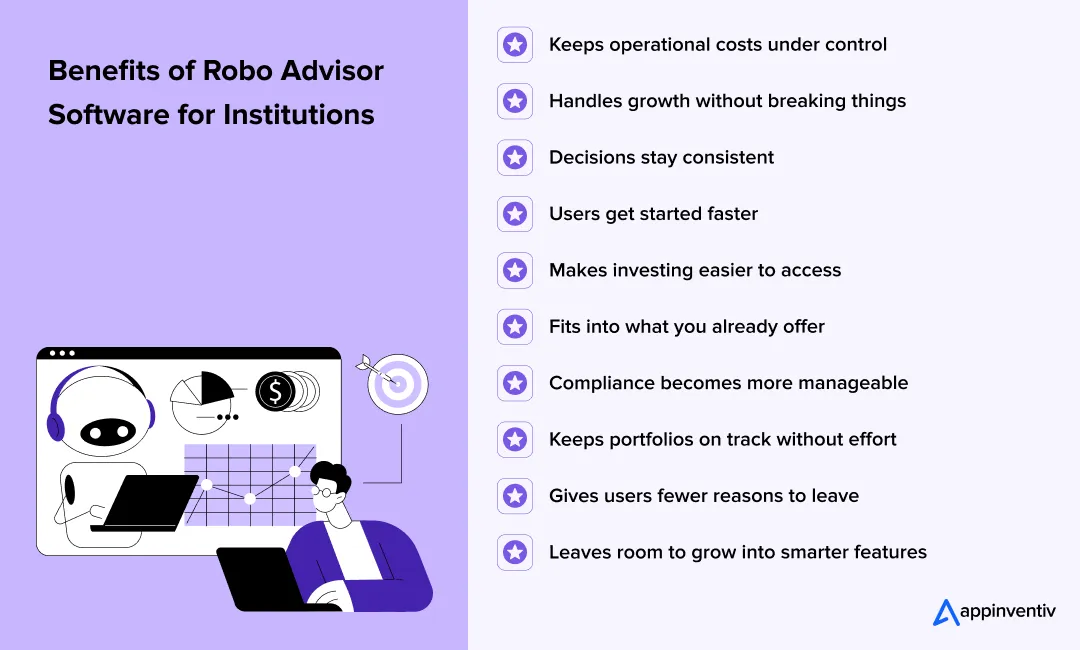
- Keeps operational costs under control: You’re not hiring more advisors every time user volume grows. The platform handles portfolio setup, rebalancing, and monitoring on its own, so your costs don’t scale at the same pace as your users.
- Handles growth without breaking things: Whether it’s a few hundred users or a sudden spike during market activity, the system keeps running the same way. You’re not constantly patching or rebuilding just to keep up.
- Decisions stay consistent: Everything runs on defined logic. That means users don’t get different outcomes based on who’s managing their account, which builds confidence over time.
- Users get started faster: Someone can sign up during a lunch break, answer a few questions, and have a portfolio ready before they’re done. That kind of speed makes a real difference in adoption.
- Makes investing easier to access: Not every user wants to speak to an advisor or understand every detail. This lowers that barrier and brings in people who would otherwise stay out.
- Fits into what you already offer: It doesn’t sit as a separate product. You can plug it into your banking app, trading platform, or fintech product, making investing feel like a natural extension.
- Compliance becomes more manageable: Every action is logged automatically. When audits or reporting come up, you’re not scrambling to piece things together later.
- Keeps portfolios on track without effort: Markets move, but the system keeps adjusting in the background. Users don’t have to step in every time something shifts.
- Gives users fewer reasons to leave: When things just work and don’t demand constant attention, people tend to stick around. It becomes part of their routine without feeling like work.
- Leaves room to grow into smarter features: Once the base is solid, you can start layering in AI, personalization, or predictive insights without redoing everything from scratch.
Challenges and How to Overcome in Robo-Advisor Development
This is usually where things get a bit unpredictable. On paper, the system looks clean. In reality, once users and real data come in, small issues start surfacing.
These challenges in building a robo-advisor don’t always surface during development; many of them only show up after real users and live market data interact with the system.
Some are technical, some are about trust, and some come from working within a larger embedded finance platform with multiple systems involved.
- Regulatory Complexity: Regulations are not something you deal with once and move on. They keep showing up at different stages, especially when your platform connects with banking or trading systems.
How to handle it: Bring compliance into the build early. Use reliable KYC/AML services and make sure every action, from onboarding to portfolio decisions, can be tracked clearly.
- Building Trust with Users: Not everyone is comfortable letting an algorithm handle their money. If the platform feels unclear, users hesitate.
How to handle it: Keep things straightforward. Show how portfolios are created, explain risk in simple terms, and avoid making the system feel like a black box.
- Data Accuracy and Reliability: The platform relies on constant data input. If something is off, even slightly, it can quickly affect decisions.
How to handle it: Use trusted data sources, add validation checks, and make sure there’s a backup if one feed fails.
- Algorithm Consistency: If results don’t feel stable, users notice. One inconsistent recommendation is enough to raise doubts.
How to handle it: Start with simple, rule-based logic. Make sure outputs are predictable and easy to explain before adding more complexity.
- Integration Challenges: Working with external APIs sounds simple until something stops responding. This is common in multi-system financial platforms, where your system depends on others.
How to handle it: Expect failures. Add retries, fallback flows, and monitoring so issues don’t directly affect users.
- Scalability Under Market Pressure: Everything works fine until markets get volatile. That’s when traffic spikes and systems are pushed harder than usual.
How to handle it: Use a cloud infrastructure that can scale automatically and keep an eye on performance in real time.
What most teams realize after launch is that these challenges don’t go away. They just show up in different forms as the platform grows. If the system is built with these in mind, things stay stable. If not, users start to feel the cracks pretty quickly.
Future Trends in Robo-Advisory Platforms
If you watch how these products are evolving, the shift is pretty clear. It’s not about adding more features. It’s about making investing feel like a natural part of the apps people already use.
- More Personal, Less Template-Based: Earlier, most portfolios looked similar. That’s changing. Platforms are starting to adjust based on how users behave, what they spend on, and what they’re trying to achieve over time.
- Investing Inside Everyday Apps: You won’t always need a separate app to invest. It’s slowly getting built into platforms people already use, which makes the whole experience feel more connected.
- Smarter Decisions with AI: Many platforms are shifting toward AI-powered robo-advisors that adapt to market behavior and user activity.
- Mix of Automation and Human Support: Fully automated works for many users, but not all. Some platforms are starting to add optional human guidance, especially when users need reassurance.
- Wider Investment Choices: It’s not just basic portfolios anymore. Users are gaining access to options such as ESG or thematic investments without needing a separate setup.
What stands out is how quietly this is happening. Investing is no longer being treated as a separate activity. It’s blending into the overall product experience, and that’s likely where it stays.
Leverage AI-powered robo-advisor platforms to deliver more personalized and adaptive investment experiences.

Why Appinventiv for Robo-Advisor & FinTech Development
When you start building something like a robo-advisor, it quickly becomes more than just a tech project. There are a lot of moving parts, product decisions, data handling, compliance, and how everything connects in the end. That’s where Appinventiv tends to fit in well. They don’t just jump into development; they work through the product side as well, combining fintech consulting with custom fintech app development services so you don’t end up fixing gaps later.
A simple example is the Mudra budget management app. It wasn’t built as just another expense tracker. The idea was to make it feel more natural to use. The app looks at how users spend and gives small, timely insights instead of making them dig through numbers. It feels less like managing finances and more like getting quick guidance when you need it.
If you’re planning to build robo-advisor software for institutions, this is usually the stage where having the right technical and product partners makes a measurable difference.
Talk to our FinTech experts and evaluate your platform approach before committing to development.
FAQs
Q. What is a robo-advisor and how does it work?
A. A robo-advisor is basically a system that helps you invest without needing to figure everything out yourself. You answer a few simple questions, and it builds a portfolio based on your goals and risk level.
From there, it keeps things on track automatically, adjusting investments and tracking performance in the background. That’s where robo-advisory platform services quietly handle the heavy lifting.
Q. How to build an AI-powered robo-advisor platform?
A. To build an AI-powered robo-advisor platform, you start with the basics: who it’s for and how it should invest. Then comes the setup: backend systems, data integrations, and trading connections.
The AI part comes into play when you want smarter decisions, such as adjusting portfolios based on behavior or market trends. At the same time, you need to stay aligned with Regulatory & Compliance requirements in robo advisory platform, since everything needs to be secure and traceable.
Q. What’s the difference between a robo-advisor and a traditional financial advisor?
A. A robo-advisor runs on automation. It’s quick, consistent, and built to handle large numbers of users, which is why companies focus on robo-advisor app development.
A traditional advisor, on the other hand, gives human guidance. That can be helpful in complex cases, but it’s usually slower and more expensive.
These days, many platforms combine both automation for everyday investing and human input when needed.
Q. What are the benefits of a robo-advisor platform?
A. If you think about scaling investment services, it can get complicated fast. That’s where the benefits of a robo-advisor platform become clear.
Most of the work runs automatically, from portfolio setup to rebalancing, so teams don’t have to handle everything manually. Decisions also stay consistent since they’re based on defined logic, not guesswork. It’s easier to scale, costs stay more controlled, and users tend to stick around because the experience feels simple and guided.
For businesses investing in robo-advisor platform development, it’s less about instant results and more about building something that becomes more efficient over time.
Q. Do robo-advisors make money?
A. Robo-advisors typically generate revenue through management fees, often calculated as a percentage (0.25% to 0.75%) of the assets under management (AUM). The fees are usually lower than those charged by traditional financial advisors, making robo-advisors an attractive and cost-effective option for investors.
Q. How long does it take to develop a robo-advisor app?
A. The time required for robo-advisor platform development can vary based on factors such as the desired features, complexity, and technology involved. On average, it typically takes anywhere from 6 to 12 months to create a fully functional and user-friendly robo-advisor fintech application.
Q. Should we build or buy a robo-advisory platform?
A. Buying a white-label robo-advisory platform accelerates time to market and reduces upfront costs. Building a custom AI-powered robo-advisor offers greater control over compliance logic, data ownership, and differentiation. Enterprises typically adopt a hybrid approach, starting with pre-built components and evolving toward a fully customized platform as scale and regulatory needs grow.
Q. How do robo advisors integrate with core banking systems?
A. Robo-advisors integrate with core banking systems through secure APIs and open banking frameworks. These connections enable account aggregation, fund transfers, transaction verification, and real-time balance updates. Middleware and integration layers handle data normalization, encryption, and reconciliation, ensuring seamless interoperability between AI-powered portfolio engines and existing banking infrastructure.
Q. What features are essential for an enterprise robo advisor MVP?
A. An enterprise robo-advisor platform requires AI-driven risk profiling, automated portfolio allocation, basic rebalancing, KYC and AML onboarding, secure user authentication, core banking integration, and compliance-ready audit logs. A web-based investor dashboard and reporting module are also essential for validating usability, regulatory alignment, and early-stage investor engagement before scaling.


Fast 2-minute response, fully NDA-protected.

Cost of Developing a Payment Gateway: A Complete Breakdown
Key takeaways: Custom gateway development requires $50,000 to $500,000 in upfront capital, and enterprise platforms cost more at scale. Core infrastructure, security compliance, and settlement logic consume far more budget than basic checkout screens. High transaction volumes require concurrency controls, failover systems, monitoring tools, and automated reconciliation engines. Platform ownership creates recurring costs for security…

How Much Does RegTech Software Development Cost in the UK in 2026?
Key takeaways: RegTech software development cost in the UK spans £40,000 to £400,000+, with regulatory scope and legacy integration depth driving the cost. High-performance systems deliver a 30% to 50% reduction in manual workloads, protecting enterprises from severe FCA penalties. Advanced AI features generally represent around 25–40% of the total project investment due to the…

Building Next-Generation Digital Payment Systems for Australia's NPP Economy
Key takeaways: Australia's NPP is approaching 1.82 billion real-time transactions annually; BECS decommissioning by 2030 creates a hard migration deadline that cannot be managed through incremental patches. The July 2026 Payday Super mandate makes real-time payment infrastructure a legal compliance requirement. Enterprises without NPP-capable payroll systems are already operating against a regulatory clock. NPP platform…