



























Top Machine Learning Trends the C-Suite Needs To Watch in 2026


- Where Enterprise Machine Learning Stands Going into 2026
- Top Machine Learning Trends For Businesses in 2026
- From Machine Learning Trends List to 2026 Machine Learning Action Plan
- Building the Foundations to Actually Execute on These Trends in Machine Learning
- How Appinventiv Helps Enterprises Turn Top Machine Learning Trends into Production-Ready Solutions
- FAQs

Key takeaways:
- C-suite focus shifts from “doing AI” to providing clear P&L, risk, and efficiency impact from machine learning in 2026.
- Nine ML trends matter most: agentic AI, multimodal, decision intelligence, governance, edge, MLOps, responsible AI, domain models, and AI security.
- Executives should treat ML as a portfolio: near-term run-the-business bets, change-the-business bets, and non-negotiable guardrails.
- Success depends on foundations: unified data, cross-functional AI product teams, and embedded governance, security, and compliance across the ML lifecycle.
Most leadership teams walk into board meetings knowing one question is coming. Not whether you are using AI. The real question is what it has delivered in terms of revenue, cost, and risk this year. That shift is why machine learning trends now sit at the center of executive agendas, not inside innovation labs.
Most enterprises entering 2026 fall into three categories:
- ML investments growing faster than measurable ROI
- Multiple pilots running without enterprise scaling plans
- Governance and security controls lagging behind AI expansion
If any of these patterns exist, your ML strategy is likely increasing risk and cost faster than value.
Your finance, supply chain, risk, and customer teams already rely on ML-driven decisions. At the same time, many enterprises are still running scattered pilots, sitting through vendor demos, and testing internal experiments. Plenty of movement. Very little clarity on AI and machine learning trends that truly matter.
As a C-level leader, you do not need another “AI is the future” story. You need to know which machine learning future trends in 2026 will shape competitive advantage, and which latest trends in machine learning can wait without slowing progress. Timing matters. Move too early and you inherit fragile platforms. Move too late, and competitors turn these trends into margin and market power.
Appinventiv has helped enterprises deploy 300+ AI and ML solutions across highly regulated and complex operational environments.
This guide breaks down machine learning trends through a business lens. You will see how each trend influences machine learning development strategies, along with revenue, cost, risk, talent, and operating models, and where to act on recent trends in machine learning so outcomes replace experiments.
Benchmark where you stand, close capability gaps, and prioritise 2026 ML bets with hard numbers.

Where Enterprise Machine Learning Stands Going into 2026
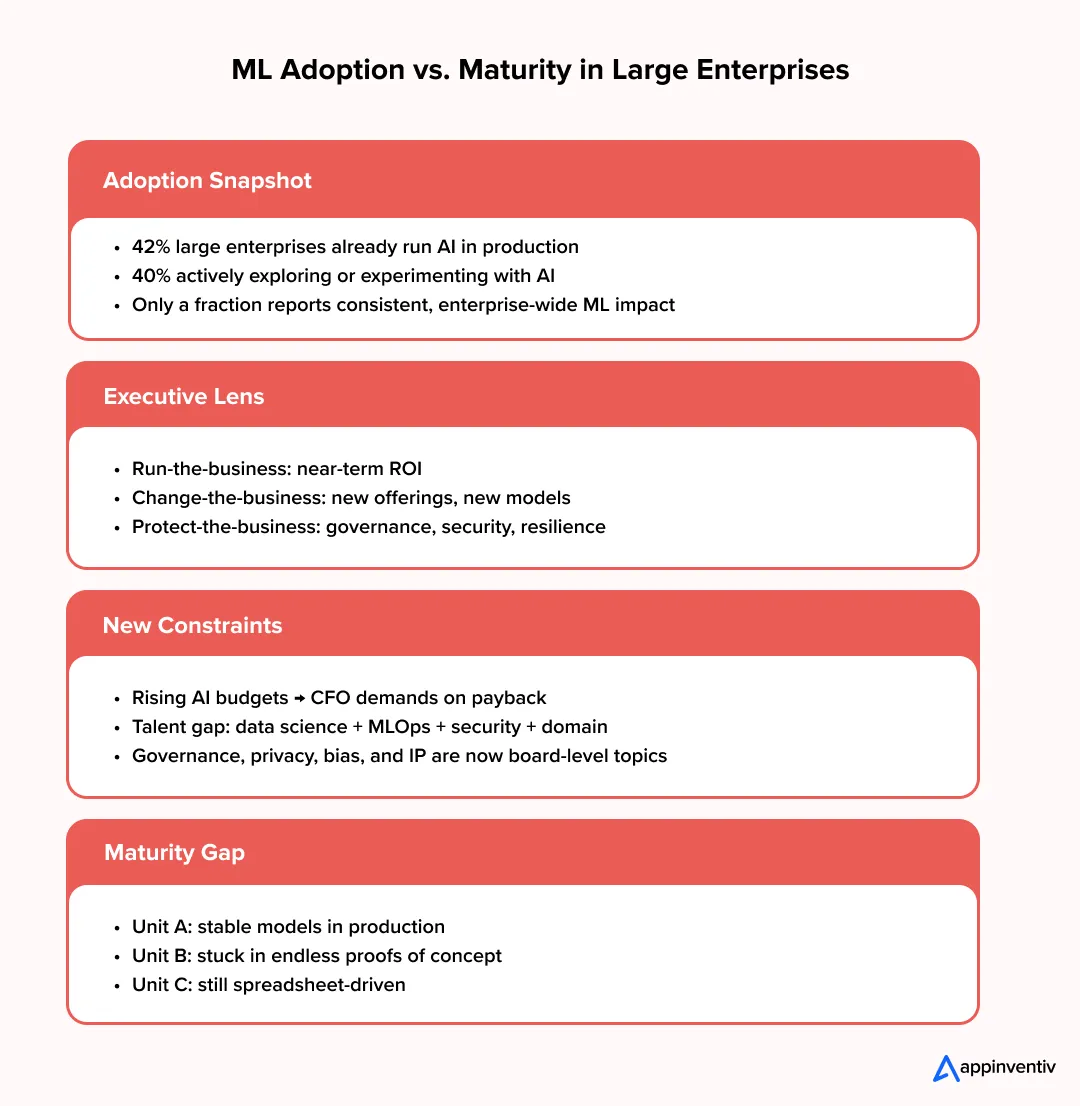
Many enterprises are no longer debating whether to use machine learning at all. Recent research shows roughly 42% of large organizations already run AI in production, and another 40% are still in active experimentation.
So the real question now is how deeply ML sits inside core decisions. And how confidently leadership can stand behind that investment in front of the board.
1. From Pilots to Production at Scale
Many enterprises moved fast with AI. Now that legacy ML models are aging, assumptions no longer align with live data, and ML technical debt is surfacing in core operations.
Machine learning still runs financial fraud checks, forecasts, routing, marketing journeys, and ecommerce personalization. But maturity remains uneven across the business.
- Some units run stable ML models in production with limited data lineage visibility
- Others remain stuck in proof-of-concepts
- Critical decisions fall back on spreadsheets when model drift raises doubts
As you move into 2026, this patchy picture becomes harder to justify. Boards expect a clear story on where machine learning truly powers the business, not isolated wins, and whether recent trends in machine learning are built on reliable foundations.
A focused ML audit identifies model drift, data lineage gaps, and hidden technical debt so AI and machine learning trends deliver trusted outcomes, not fragile experiments.
Must Read: Machine Learning in eCommerce: 10 Benefits & Use Cases
2. Budget, Talent, and Risk: The New Constraints
AI and ML spending has grown quickly in the last couple of years. CFOs now want sharper answers on payback, run costs, duplication, and ML procurement technology trends. Talent adds another constraint.
You may have data scientists, but you also need ML engineers, MLOps, security, and domain owners. Without that mix, models work in demos but falter in production.
Regulation and reputation risk are now part of every serious AI discussion. Privacy, AI bias, IP, and vendor risk sit on the same agenda as revenue and cost.
3. How The C-Suite Should Read Machine Learning Trends
You don’t need to track every new model release. You need a way to classify which of the latest trends in machine learning matter. A simple lens for analyzing trends in machine learning helps:
- Run-the-business trends: Improve existing processes and show near-term ROI.
- Change-the-business trends: Enable new products, services, or business models.
- Protect-the-business trends: Strengthen governance, security, and resilience as ML scales.
Use this lens as you review 2026 machine learning trends. You don’t have to bet on everything. You have to decide what will run, change, and protect your business. Now, let’s explore top machine learning trends and predictions.
Top Machine Learning Trends For Businesses in 2026
The stakes are rising fast. The global AI market stands at roughly $354 billion today and is projected to reach $1.64 trillion by the end of the decade, driving new machine learning trends.
Training advanced models is becoming more compute-intensive and expensive, impacting cloud costs and vendor pricing. That makes it critical to focus on top machine learning trends that can truly move P&L, risk, and operating models in 2026.
Below are the trends in machine learning worth a place on the C-suite agenda:
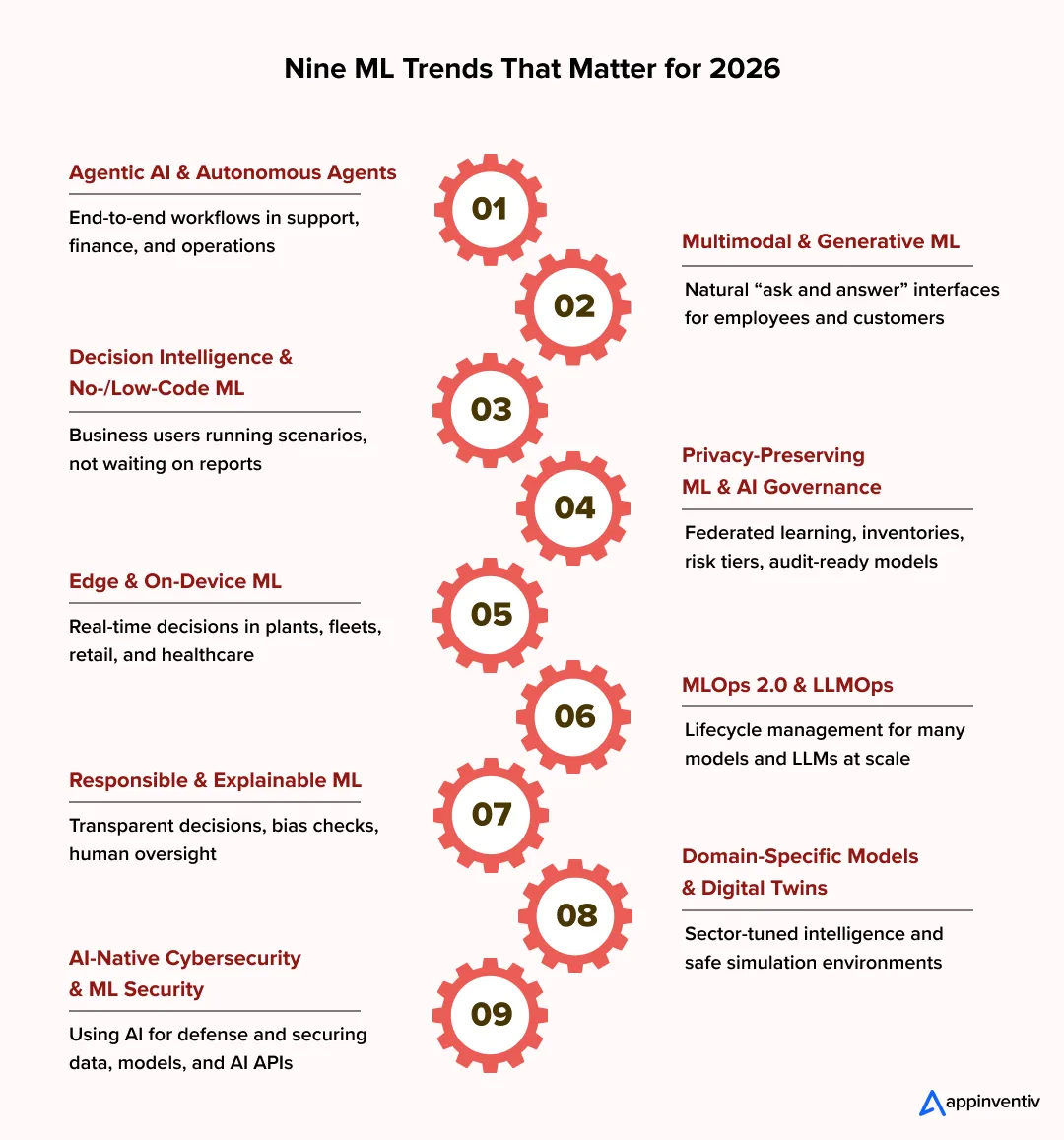
The competitive advantage in 2026 will not come from adopting these trends but from orchestrating them into a governed enterprise operating model.
Trend 1: Agentic AI and Autonomous ML Agents Reshaping Workflows
In 2026, agentic AI moves beyond copilots. Multi-Agent Systems (MAS) now talk to other agents through cross-API orchestration, solving tasks without human handoffs. You set the goal. Agents plan, call tools, and execute. This is redefining machine learning automation trends inside enterprise workflows.
Why it matters for enterprises:
- Entire workflows, not single tasks, get automated
- Cost per transaction drops
- Cycle times shrink across finance, support, and operations
Enterprise use cases:
- Support agents resolving tickets end-to-end
- Finance agents reconciling transactions and flagging anomalies
- IT agents orchestrating runbooks across systems
In 2026, the shift is clear. Agents no longer assist people. Agents coordinate with other agents to run work.
Trend 2: Multimodal and Generative ML as the Default Enterprise Experience
Multimodal ML now works across text, images, audio, video, and structured data. Generative ML turns that input into content, code, summaries, and insights. For enterprise teams, this replaces rigid forms with natural “ask and answer” interactions.
Two shifts matter most.
- Small Language Models (SLMs): Lean, domain-tuned models that are cheaper to run, easier to deploy on-premise or at the edge, and simpler to govern in regulated or latency-sensitive environments.
- Retrieval-Augmented Generation (RAG): Grounds generative AI in enterprise data. Models pull approved documents before responding, reducing hallucinations and aligning outputs with policies and contracts.
The result is faster knowledge work, better decision context, and standardized outputs across proposals, reports, and reviews.
In 2026, the priority is clear. Pilot one multimodal or generative ML assistant, define data access rules, logging, and human oversight, then scale where productivity gains are proven.
Also read: Multimodal AI – 10 Innovative Applications and Real-World Examples
Trend 3: Decision Intelligence & No-/Low-Code ML for Business Teams
Most enterprises still run critical decisions on spreadsheets and static reports. Decision intelligence changes that flow. It embeds machine learning into workflows and dashboards so business teams can test scenarios and trigger model-backed decisions without writing code.
No- and low-code ML algorithms for operations bring models closer to decision-makers. Data teams build core models, automated feature engineering pipelines, and guardrails. Business teams explore pricing, supply chain, and risk scenarios in minutes, rather than waiting weeks for analysis.
Where this creates impact:
- Revenue and pricing teams simulate margin and churn outcomes before changing commercial levers
- Supply chain leaders test capacity and supplier shifts with real-time service and risk trade-offs
- Machine learning marketing trends and recommendation systems shape acquisition and retention decisions through scenario modeling
- Risk and finance teams run portfolio stress tests and cash flow simulations
The result is fewer gut-driven calls, less shadow Excel, and auditable decision paths.
In 2026, the priority is clear. Deploy decision intelligence where recurring decisions carry high value. Pair no- and low-code ML with strong data lineage, model governance, and validation so faster decisions also remain controlled and reliable.
Trend 4: Privacy-Preserving ML, AI Governance, and Regulation-Ready Models
Enterprises want AI and machine learning trends that scale without exposing sensitive data. Privacy-preserving ML is now central to machine learning trends for C-Suite executives, especially in regulated industries.
Two technologies are changing the game:
- Federated Learning trains models where data lives, across banks, hospitals, or regional systems, without moving raw data
- Zero-Knowledge Proofs (ZKP) verify model outcomes or compliance conditions without revealing underlying data
Add differential privacy and anonymization, and you get machine learning models that learn from sensitive datasets without your teams ever seeing the raw records.
This is paired with AI governance and regulation-ready models. Clear model lineage. Traceable data flows. Audit-ready decision logs. Controls that prove how models behave, not just what they predict.
For enterprises, this reduces ML regulatory risk, unlocks restricted data value, and builds trust in recent trends in machine learning.
A focused ML audit identifies data lineage gaps, model drift, and governance blind spots, turning privacy-first machine learning trends into production-ready, board-defensible systems.
Trend 5: Edge and On-Device ML: Intelligence Closer to Customers and Operations
Edge and on-device ML push intelligence from central servers to sensors, gateways, mobile devices, and machines. Models run near the data source, reducing latency, cloud dependency, and exposure of sensitive data. This shift is becoming one of the most important trends in machine learning for real-time, regulated, and high-reliability environments.
For enterprises, milliseconds matter. In factory lines, fleets, energy grids, and medical devices, cloud round-trips can mean downtime, safety risks, or compliance gaps. Edge ML enables:
- Real-time decisions without constant connectivity
- Lower bandwidth and cloud processing costs
- Local data processing with stronger privacy controls
Enterprise use cases include predictive maintenance, logistics ML routing optimization, machine learning in retail analytics, in-store retail analytics, and on-device healthcare monitoring. Models score events locally, send only compressed insights, and reduce the load on central infrastructure.
The priority for 2026 is clear. Identify time-critical processes, classify where edge is essential, and pilot focused deployments. This is where the latest trends in machine learning translate into operational resilience, not experimentation.
Trend 6: MLOps 2.0 and LLMOps: Running ML as a Critical Production System
MLOps 2.0 is about running ML systems like core production services, not fragile experiments. It manages the full lifecycle of ML models, from data and training to deployment, monitoring, retraining, and retirement. LLMOps extends this to generative AI, tracking prompts, responses, latency, cost, safety, and business impact.
Most enterprises already have ML models, and GenAI pilots are live. The challenge is scale. Can you manage hundreds of models across teams and regions? Can you roll back a model without breaking operations? Without strong MLOps and LLMOps, model drift goes unnoticed, versions fragment, security gaps appear, and recovery takes too long.
What mature enterprise ML operations look like:
- Shared ML platforms with logging, alerts, and rollback
- Continuous monitoring for data drift and business KPIs
- LLM usage controls for cost, safety, and data exposure
For CXOs, this is resilience and risk management. In 2026, machine learning will be judged by reliability, not novelty. MLOps 2.0 and LLMOps make that possible.
Trend 7: Responsible, Explainable, and Human-Centric ML
Responsible ML is no longer just a compliance exercise. It is about building machine learning systems people can understand, question, and trust. As ML regulatory trends tighten, enterprises need responsible ML built on three pillars:
- Explainable ML logic that shows why a model made a decision
- Continuous checks for bias, model drift, and unintended impact
- Human oversight for high-stakes automated decisions
This matters as machine learning now drives credit, hiring, healthcare, security, and pricing. When teams or customers cannot understand decisions, trust breaks. Complaints rise. Models get overridden. AI and machine learning trends then become cost centers, not value drivers.
Explainable ML also creates audit readiness. You can trace decisions, prove data lineage, and respond when regulators ask how outcomes were reached.
What to prioritize in 2026:
- Identify high-impact ML decisions
- Define where humans must approve or override
- Deploy explainability and fairness monitoring on flagship models
This is how enterprises scale machine learning without losing trust.
Trend 8: Domain-Specific Foundation Models and Digital Twins
Generic models learn from broad public data. Domain-specific foundation models learn from your industry data, workflows, and regulatory context. Digital twins provide a virtual replica of assets or processes, allowing teams to test scenarios before touching real operations. Together, they push machine learning trends from generic intelligence to deep, business-specific capability.
In complex sectors, generic AI misses nuance. Domain models read contracts, sensor streams, and process logs. Digital twins simulate pricing shifts, supply disruptions, or production changes with lower risk. For C-Suite and machine learning adoption, this enables faster decisions, stronger capital allocation, and defensible intelligence built on proprietary data.
Where it shows impact
- Manufacturing and energy: plant twins and sensor-trained models
- Supply chain: network twins and contract-aware foundation models
- Financial services: vertical models for risk and regulatory analysis
- Healthcare and telecom: clinical and network twins for scenario testing
In 2026, start with one high-value, data-rich domain. A focused twin or domain model delivers machine learning future trends that competitors cannot easily copy.
Trend 9: AI-Native Cybersecurity and ML Security
AI now sits on both sides of the security battle. Defenders use ML for detection and response. Attackers use AI to automate and scale intrusion. At the same time, ML systems themselves have become targets. Data pipelines, models, prompts, and APIs expand the attack surface. This is where AI-native cybersecurity and Adversarial Machine Learning intersect.
For enterprises, a model failure is no longer a minor bug. It can trigger fraud losses, pricing errors, or regulatory exposure. Modern attacks now include:
- Model inversion attacks that reconstruct sensitive training data
- Data poisoning that corrupts training pipelines
- Automated probing of ML APIs and decision endpoints
Many security reviews still focus on front-end applications rather than on model behavior, training data integrity, or data lineage.
In 2026, you cannot scale AI and machine learning trends without securing ML itself. A focused security layer defends against model-drift exploitation, data poisoning, and adversarial manipulation, so machine learning trends deliver resilience, not new risk.
Let’s create production-grade ML solutions with our machine learning development services and teams experienced in complex integrations, governance, and enterprise-scale delivery.
From Machine Learning Trends List to 2026 Machine Learning Action Plan
Most leadership teams already have a slide listing top machine learning trends. The harder part is turning those trends in machine learning into initiatives that can be funded, integrated into core systems, and governed at enterprise scale.
In 2026, progress will depend less on chasing the latest trends in machine learning and more on building execution-ready portfolios.
A practical way forward is to treat ML as an operating portfolio, not a sequence of pilots. This approach helps leadership balance innovation, risk, and return across AI and machine learning trends.
Run The Business Now
These current trends in machine learning deliver near-term operational gains. Decision intelligence platforms, generative copilots, MLOps 2.0, and machine learning automation trends fit here.
Technically, this layer focuses on production-grade pipelines, feature stores, model registries, automated retraining, and continuous monitoring for model drift. The goal is simple: deploy ML technology trends that plug into existing workflows, use trusted data domains, and deliver measurable outcomes within one budget cycle.
Change The Business Next
These emerging trends in machine learning reshape how the enterprise operates and competes. Agentic AI, domain-specific foundation models, and digital twins sit in this tier. Execution here requires scalable ML infrastructure, vector databases, simulation environments, real-time inference APIs, and cross-domain data integration.
These machine learning future trends demand joint ownership between business, data, and engineering teams, because they touch customer experience, product design, and operating models.
Protect The Business Always
As adoption grows, ML regulatory trends and governance become non-negotiable. Privacy-preserving learning, explainable models, AI-native cybersecurity, and lineage tracking ensure AI and machine learning trends remain auditable and compliant. Technically, this means model inventories, bias testing pipelines, access controls on training data, and full data lineage across ingestion, training, and inference layers.
Once categorized, leadership can move from discussing recent trends in machine learning to making concrete decisions. Which ML technology trends drive immediate value? Where do larger bets create differentiation? What safeguards must exist before scaling further?
This is how Machine Learning Trends and Predictions become a 2026 execution plan, not another AI wish list.
Building the Foundations to Actually Execute on These Trends in Machine Learning
Chasing machine learning trends is not the hard part. Making them work inside real enterprise environments is. Most stalled AI programs do not fail on ambition. They fail on foundations. Data gaps, fragmented operating models, and weak governance quietly slow down even the latest trends in machine learning.
If your teams struggle to move trusted data at the right granularity and speed, every AI and machine learning trend feels harder than it should.
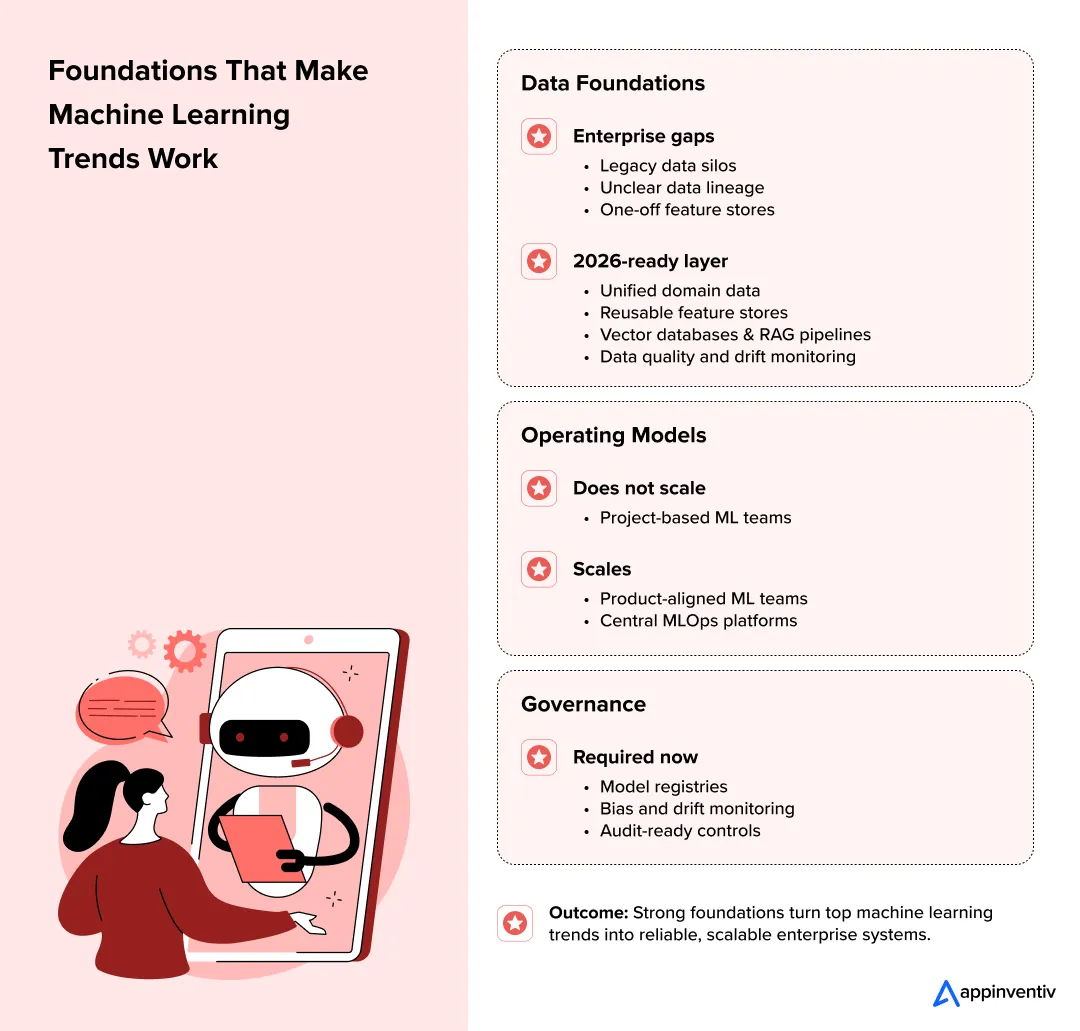
Most AI programs fail not because of model quality—but because data, governance, and operating models cannot support scale.
Data Readiness Comes First
Many enterprises still operate with fragmented data estates. Critical data lives across legacy cores, regional systems, spreadsheets, and vendor platforms. Definitions vary across business units. Data lineage is unclear. Feature stores are built for single projects instead of shared reuse. When source systems change, ML pipelines quietly break.
A 2026-ready data foundation does not mean rebuilding everything. It means creating a minimum viable ML data layer that supports modern trends in machine learning, including generative and agentic systems.
That requires:
- Unified domain data layers for customer, product, risk, and operations
- Feature stores designed for reuse across models
- Vector databases to index enterprise knowledge, documents, and embeddings
- RAG (Retrieval-Augmented Generation) pipelines to ground generative AI and machine learning trends in approved internal data
- Streaming and batch pipelines for real-time and historical ML workloads
- Automated data quality checks, continuous data drift monitoring, and data labeling pipelines
- End-to-end data lineage tracking from source systems to model outputs
Without these foundations, future machine learning trends like multimodal assistants, decision intelligence, and agentic AI remain stuck in controlled demos rather than production systems.
Operating Models Must Evolve
Trends in machine learning now cut across data science, engineering, security, and domain teams. Temporary project squads do not scale. High-performing enterprises use persistent product-aligned ML teams supported by a central platform group that owns tooling, MLOps, and standards. This is what turns experiments into production systems.
Governance Is No Longer Optional
As models touch pricing, risk, fraud, and customer journeys, boards expect accountability. That means model registries, version control, lineage tracking, bias testing, approval workflows, and continuous monitoring for model drift. ML regulatory trends are forcing audit readiness by design, not as an afterthought.
When these foundations are in place, top machine learning trends stop being risky bets. They become controlled, repeatable, and scalable capabilities. That is what separates organizations experimenting with trends in machine learning from enterprises operationalizing them at scale.
Align use cases, budgets, and risk limits into a single, board-ready machine learning action plan.

How Appinventiv Helps Enterprises Turn Top Machine Learning Trends into Production-Ready Solutions
Turning these trends into production systems needs more than good ideas. You need teams that understand both enterprise constraints and real-world ML engineering.
At Appinventiv, a leading machine learning development services company, we’ve delivered over 300 AI-powered solutions across 35+ industries. Behind that is a bench of 200+ data scientists and AI engineers who work with CXOs, not just IT teams.
We’ve trained and deployed 150+ custom AI models, completed 75+ enterprise AI integrations, and fine-tuned 50+ bespoke LLMs for specific domains and use cases. That means we are used to dealing with legacy systems, risk teams, security reviews, and board-level expectations.
Our role is simple: help you pick the right ML bets, design realistic roadmaps, and build secure, governed systems that your teams can actually run and scale. Not just proofs of concept, but production-grade capabilities aligned with your P&L and risk appetite.
By 2026, ML maturity gaps will increasingly separate market leaders from operational laggards. The difference will not be experimentation but execution speed and governance readiness.
For the C-suite, 2026 will reward focused, well-governed machine learning based on actionable trends, not scattered experiments. Pick the trends that serve your strategy.
Build the foundations. Bring the right partners to the table when speed or depth is critical. The winners will turn today’s ML noise into tomorrow’s operational advantage at a meaningful scale.
The winners will turn today’s ML technology trends noise into tomorrow’s operational advantage at a meaningful scale.
FAQs
Q. What are the current trends in machine learning?
A. Current trends in machine learning show the technology moving in a few clear directions. You see agentic AI that can take actions, not just give suggestions. Multimodal and generative ML is changing how people interact with systems using text, voice, images, and video. Decision intelligence tools put ML into the hands of business teams, not only data teams.
On the foundation side, MLOps 2.0 and LLMOps are making ML more reliable in production. Privacy-preserving ML, governance, and explainability are becoming standard in regulated industries. You also have edge ML, domain-specific foundation models, and AI-native cybersecurity, expanding what enterprises can safely automate and optimize.
Q. What are the top machine learning trends C-Suite executives need to watch in 2026?
A. For C-suite leaders, here are the key machine learning trends to watch in 2025 and 2026:
- Agentic AI and autonomous ML agents for end-to-end workflows in support, finance, and operations.
- Multimodal and generative assistants that change how employees and customers access information.
- Decision intelligence and no-/low-code ML that move critical decisions beyond spreadsheets.
- MLOps 2.0 and LLMOps to run all these models like stable production systems.
- Privacy-preserving and explainable ML, plus AI governance, to stay regulation-ready.
- Domain-specific foundation models and digital twins for high-value, complex domains.
- AI-native cybersecurity to both use AI for defense and secure the ML stack itself.
These trends directly affect revenue, cost, risk, and how your operating model will look in the next three to five years.
Q. How can Appinventiv help C-Suite executives leverage machine learning for business success?
A. Appinventiv works with leadership teams to move from “AI interest” to “AI outcomes,” by leveraging AI and machine learning trends. We start with your strategic priorities, then help you choose the right ML trends to back. That often begins with C-suite workshops, use case discovery, and a realistic 18–24 month roadmap. In practice, that means we can:
- Design and build decision intelligence, copilots, and agentic workflows.
- Put MLOps and governance in place so models are safe to scale.
- Integrate ML with your existing core systems, security controls, and regulatory requirements.
You get a partner that speaks both technology and boardroom language, and is measured on business impact, not just model accuracy.
Q. What are the most impactful ML trends for businesses?
A. “Impactful” depends on your strategy and industry, but some patterns are clear.
For near-term ROI, the most impactful trends are:
- Decision intelligence platforms that reshape pricing, planning, and risk decisions.
- Generative and multimodal assistants that save time in sales, service, and operations.
- MLOps 2.0 and LLMOps that reduce outages, rework, and technical drag.
For strategic differentiation, the big levers are:
- Agentic AI to redesign entire workflows, not just tasks.
- Domain-specific models and digital twins for complex, high-value operations.
For protecting the business, the critical trends are:
- Responsible and explainable ML for trust and compliance.
- AI-native cybersecurity and privacy-preserving ML as models touch more sensitive data.
The most effective businesses in 2026 will build a balanced portfolio across these three buckets: run the business better, change the business where it matters, and protect the business as ML scales.

- In just 2 mins you will get a response
- Your idea is 100% protected by our Non Disclosure Agreement.
10 Use Cases and Examples of How Machine Learning is Transforming the Logistics Industry
The widespread adoption of ML has resulted in the explosion of data from sensors, customer interactions, and digital platforms across different domains. More and more businesses are leveraging machine learning in logistics to improve their strategic decision-making expertise centered around tailoring customer experience, improving productivity, increasing engagement, and preventing fraud. According to the McKinsey Global…

Key takeaways: Machine learning in retail is reshaping the industry through smarter recommendations, dynamic pricing, and real-time personalization. AI & ML deliver measurable ROI, helping brands boost conversions by up to 40% and unlock multiple operational advantages. Successful ML implementation in retail requires high-quality data, scalable infrastructure, and continuous model optimization. With 10+ years of…

Machine Learning in Banking - Use Cases and Implementation Process
Key highlights: Discover how machine learning is revolutionizing banking operations, from fraud detection to personalized financial experiences. Explore real-world ML use cases transforming back-office efficiency, customer engagement, and regulatory compliance in global banks. Learn a step-by-step roadmap for implementing machine learning in banking with measurable ROI and business impact. Understand key regulatory, ethical, and change…