































Low-Code vs Custom App Development: Which Approach Is Best for Your Business in 2026?


- Low Code vs Custom App Development: A Strategic Comparison
- Pros and Cons of Low Code Development
- Custom App Development Advantages: What Sets It Apart from Low-Code
- How to Choose the Right App Development Approach in 2026
- Low Code Development Limitations: Why Businesses Turn to Custom App Development
- Low Code Vs Custom Development Cost Comparison
- Who Wins the Race: Custom Development or Low-Code?
- Accelerate Digital Growth with Appinventiv’s Development Expertise
- FAQs

Key takeaways:
- Low-code platforms offer speed and lower upfront costs, but often limit customization, scalability, and long-term flexibility as your business grows.
- Custom app development delivers full control over architecture, security, and integrations; ideal for complex, mission-critical, or highly regulated environments.
- Long-term costs for low-code can escalate due to licensing, vendor lock-in, and scaling fees, while custom solutions provide predictable ownership and cost stability.
- Choosing between low-code and custom development depends on your growth plans, technical resources, and need for innovation or integration.
- For lasting competitive advantage and seamless scaling, custom app development is the preferred path for enterprises with evolving needs.
A few years ago, low-code platforms were seen as experimental tools for side projects. Today, they are often the first option considered when a new app requirement emerges. The appeal is obvious. Teams can assemble working applications quickly, reduce dependency on core engineering resources, and move ideas into production with minimal friction. In discussions around low code vs. custom app development, efficiency usually shapes the initial preference.
Businesses today are pushed to deliver apps faster, yet adopting the wrong approach can slow them down over time. When deciding on a low code vs. custom app development, most companies opt to use low-code to speed up the delivery process.
However, speed is not necessarily associated with long-term value. Many companies that adopt low-code note that they experience issues with scalability and complex integrations, and that they have minimal flexibility as business requirements change. The issue of scalability with low-code apps is mentioned by almost half of enterprises, and issues with changing ready-made pieces are also widespread as projects become more business-reliant.
On the other hand, custom app development allows you to create an app to your business logic and workflow and to create every functionality around strategy rather than adjusting your strategy to the limitations of a platform. It gives you complete control over architecture, security, and integration with legacy systems, which often form the basis of core operations. The initial effort might require more time, but the results are more in line with the future development and competitive objectives.
The low-code and custom development market is on a booming trend. The low-code market worldwide is expected to exceed $101.68 billion in the coming years as enterprises are willing to deploy and reduce their development backlog more quickly. Meanwhile, the wider custom app development market remains well above $626.39 billion worldwide, as it is driven by the need for scalable, AI-powered, and enterprise-level systems.
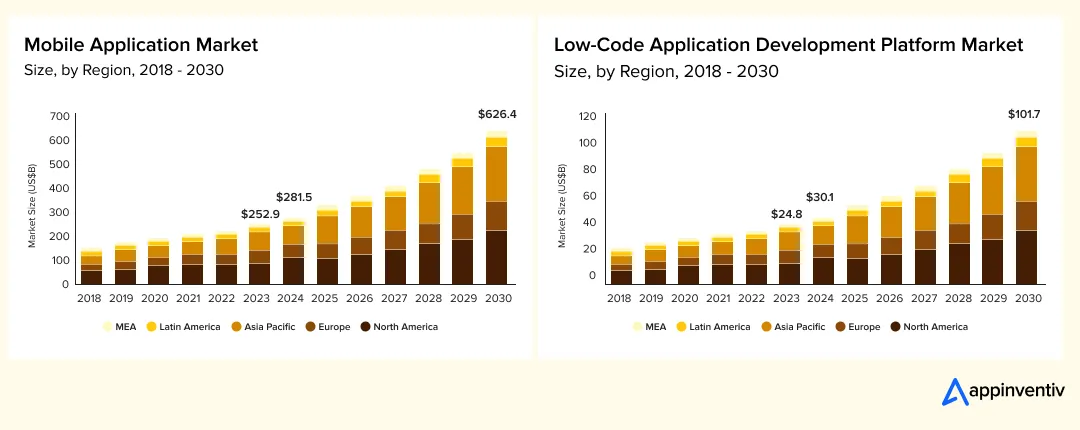
This two-fold advancement justifies the current dispute on low code vs custom app development. Low-code helps with agility, speed, and operational efficiency, particularly in internal tools. Nevertheless, custom app development is central to mission-critical systems, which must have architectural control, deep integration and long-term scalability. The actual choice lies between rolling out and achieving structural growth, or vice versa.
In brief, there is no option of speed or convenience between low-code and custom app development. It comes down to short- and long-term flexibility, particularly among businesses that anticipate their app to grow with them.
Make a strategic choice today that supports tomorrow’s scale

Low Code vs Custom App Development: A Strategic Comparison
The comparison between low code vs traditional development is not simply about speed. It relates to control, scalability, long-term cost, architectural flexibility and risk exposure. The low-code platform is based on the idea of using visual builders and pre-built components to speed up the delivery of an application. Conventional development is based on manually handwriting code and providing groups with complete autonomy in system design and behavior.
Low code is excellent when dealing with internal tools, prototyping, and simple workflows. Mission-critical systems, complex integrations, regulatory environments and products that are likely to change over a long period are usually developed in a traditional way.
Low Code vs Custom App Development Comparison
| Comparison Category | Low Code Development | Traditional Development |
|---|---|---|
| Development Speed | Faster initial build using visual tools and templates | Longer build time due to full coding process |
| Customization | Limited to platform capabilities and extensions | Fully customizable at every layer |
| Scalability | May face constraints as usage and complexity grow | Designed to scale based on architecture planning |
| Performance Optimization | Dependent on platform engine | Fine-tuned at code and infrastructure level |
| Security Control | Relies on vendor security framework | Security designed and implemented per business requirement |
| Integration Capability | Limited by available connectors and APIs | Deep integration with legacy and third-party systems |
| Ownership of Code | Vendor-controlled platform environment | Full ownership of source code |
| Vendor Lock-In | High risk if platform dependency increases | Minimal, since codebase is independent |
| Long-Term Cost | Lower upfront, rising licensing and scaling costs | Higher upfront, lower recurring platform dependency |
| Maintenance & Updates | Platform-managed updates, less control | Managed internally or by development partner |
| Regulatory Compliance | May require workarounds for complex compliance needs | Built directly around industry regulations |
| Technical Expertise Required | Lower initial technical barrier | Requires experienced development team |
| Innovation Flexibility | Limited to platform roadmap | No restrictions on future feature expansion |
In practice, organizations weigh immediate delivery needs against long-term architectural freedom. Low code prioritizes convenience and speed. Traditional development prioritizes structural depth, ownership, and durability. The right choice depends on how central the application is to business growth and competitive strategy.
Pros and Cons of Low Code Development
Low code development is currently a trend among companies aiming to develop applications faster, but with numerous benefits and trade-offs. These are essential to comprehend in the comparison of low code vs custom app development for your organization.
Pros
- Rapid Development – Visual builders, ready-made templates and drag-and-drop interfaces are much faster in development and useful in rapid prototyping or internal tools.
- Reduced Starting Costs – Less intensive development teams and expedited deployment can help reduce start-up costs.
- Simplify the Process – Non-technical team members can also be involved in app development, reducing dependence on specialized programmers.
- Quick Iterations – It allows businesses to adapt to new requirements very quickly since changes and updates can be made quickly without complex code.
- In-built Platform Functionalities – In-built integrations, APIs, and connectors make it easy to connect with other systems, dashboards, and data sources.
Cons
- Low Degree of Customization – There is a limitation in the customization of applications to the capabilities of the platforms, which may be an issue with complex or more unique business operations. This is one of the major reasons to compare low code and traditional development.
- Scalability Limitations – Low-code applications might not perform well as the number of users and features increases, or they may require expensive workarounds.
- Security Risks – The use of prebuilt templates and vendor-operated environments may have vulnerabilities if the security features are poorly configured.
- Lock-In to Vendors – It is difficult to leave a low-code platform because of proprietary components and dependencies.
- Long-Term Costs – Licensing fees, extra modules, and scaling restrictions may increase the cost of low-code solutions over time compared to custom development.
Also Read: Is Low-Code No-Code the Future of Application Development?
Custom App Development Advantages: What Sets It Apart from Low-Code
When evaluating low code vs custom app development, the distinction becomes clearer at scale. They are built to match business strategy, business depth and business long-term growth strategies as opposed to the predefined templates of platforms. The fundamental advantages that distinguish custom mobile app development are as follows.
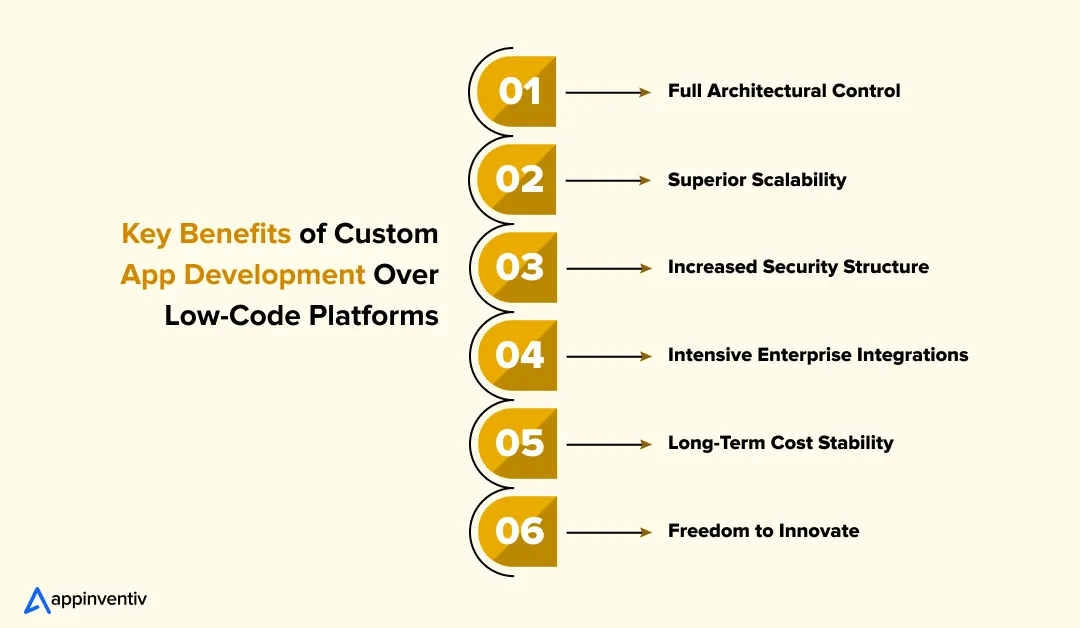
Full Architectural Control
Purpose-made applications are created with your unique workflows, information model, and performance requirements. Each layer (not just the user interface behavior) is made purposefully rather than adapted from a template. Such control minimizes structural constraints and eliminates technical compromises that tend to arise during system development.
Superior Scalability
Expansion creates complexity in user volume, data processing, integrations, and feature expansion. Bespoke systems are designed to be scalable and enable infrastructure modification, database optimization, and feature expansion that can be added and removed in a modular manner. This guarantees consistency in performance even when there is a steep rise in the operational requirements.
Increased Security Structure
One of the strongest custom app security advantages is the ability to embed protection measures directly into the application architecture. Companies are able to introduce multi-factor authentication models, encryption requirements, role-based access control, and regulatory protocols in accordance with regulatory requirements. Such an active design will minimize exposure to vulnerabilities that generalized platforms tend to have.
Intensive Enterprise Integrations
The contemporary business world exists on different systems, including integrations with ERP, CRM, analytics engines, and legacy databases. Custom development allows fine-tuning of these systems through custom-built APIs and data pipelines. This gets rid of workflow fragmentation and enhances cross-departmental visibility and effectiveness.
Long-Term Cost Stability
Even though the cost of custom development is higher up front, it eliminates reliance on licensing structures and platform usage levels. Given the scale of the application, businesses do not have to incur increases in subscription charges or costly add-ons. This brings greater financial predictability and operational control with time.
Freedom to Innovate
Custom applications are not subjected to a vendor roadmap. Integration of new technologies, automation layers, advanced analytics tools, and AI capabilities in business can be made without restrictions on the platform. This enables organizations to fast-track their adjustment to market changes and ensure they keep a competitive advantage, but keeps them within a structure that does not require any rework.
How to Choose the Right App Development Approach in 2026
The choice of the most appropriate direction between low code development and custom app development is a task that should be evaluated critically, considering your business requirements, business growth strategies, and technical capacity. The following is an elaborate step-by-step guide that will enable you to make an informed decision:
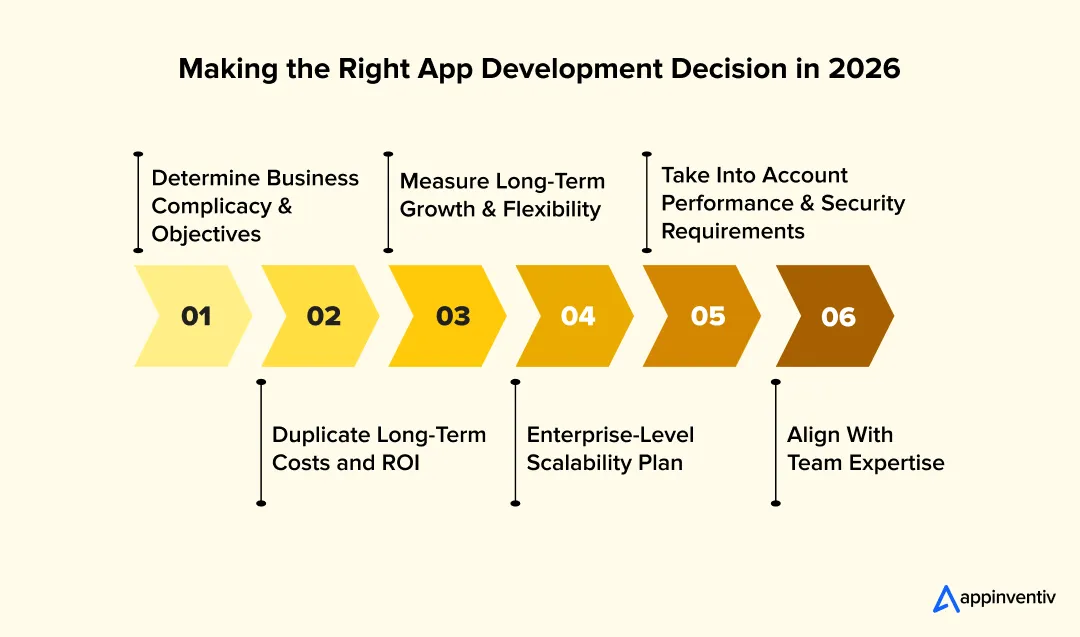
Determine Business Complicacy and Objectives
Start by examining the complexity of your workflows, the number of integrations needed, and any regulatory requirements. If your application must handle advanced operations, connect with multiple legacy systems, or comply with strict industry standards, custom app development for enterprises is the better choice.
For simpler, internal tools or prototypes where speed is a priority, low code development can deliver quick results without heavy upfront investment.
Measure Long-Term Growth and Flexibility
Take into account the way your application needs will be changed in the next 3-5 years. The scalability of low code vs custom systems differs significantly. Low-code platforms can fail when new product features or complex processes are added, necessitating workarounds or system upgrades.
Custom development enables your application to match the evolving business models, emerging technologies, or unforeseen business demands.
Take Into Account Performance and Security Requirements
Performance, reliability, and data security are paramount, particularly when an application is used by an enterprise. Low-code solutions are also based on vendor-managed environments, and you may not have control over optimization and security.
Custom development enables your staff to implement strict security measures, optimize for performance, and handle sensitive information as you deem necessary.
Duplicate Long-Term Costs and ROI
One should not just look at the speed at which it is developed at first. The upfront convenience of low-code solutions simply may not be as significant as the long-term ROI and profit-gaining opportunities from custom development.
Although low-code platforms require lower upfront costs, recurring fees, scale restrictions, and additional workarounds may increase costs in the long run. Bespoke applications can be more expensive to start with, but provide cost-effective sustainability throughout the life of the application.
Enterprise-Level Scalability Plan
Businesses that are geared towards growth have to plan how to expand in the future. Custom app scalability advantages give you the freedom to create applications with the ability to support a greater number of users, integrate with new systems, and add additional capabilities without any limitations set by the platform. This ensures your technology keeps up with your enterprise and doesn’t hold it back.
Align With Team Expertise
The decision is dependent on your internal capabilities and development resources. Low-code platforms do not require a lot of programming, so they can be used by smaller teams or when rapid prototyping is necessary.
Nevertheless, for organizations whose developers are well-versed, custom development offers full control over the codebase, enabling innovation, optimization, and long-term maintenance without relying on a third-party platform.
With a balanced consideration of these factors, in 2026, you can select a more suitable development approach that balances the urgent demand to deliver with the long-term strategic value of your application in delivering growth, security, and operational resilience.
Define the right approach with expert-led evaluation

Low Code Development Limitations: Why Businesses Turn to Custom App Development
Low-code platforms can accelerate initial delivery, but structural constraints often surface as applications mature. As integration, scalability, and governance demands increase, many businesses transition toward custom development for greater control and long-term stability.
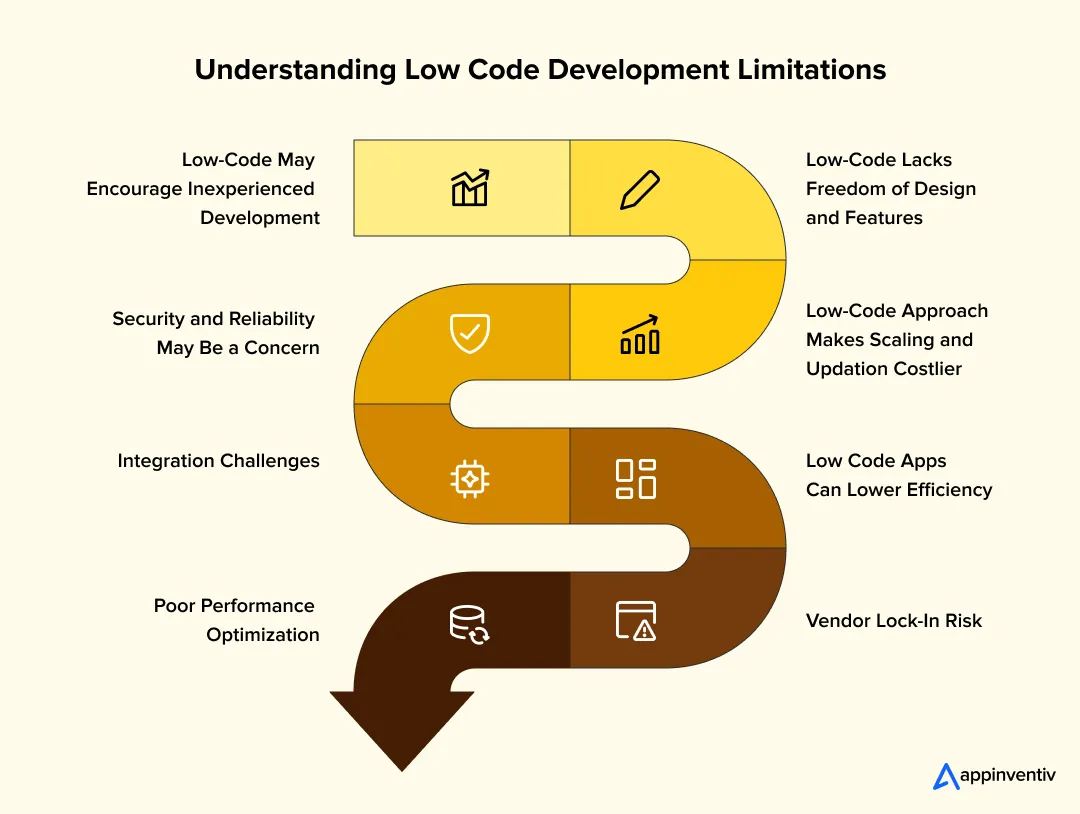
Low-Code May Encourage Inexperienced Development
Although not every low-code app developer lacks experience, it’s a route often preferred by individuals who may lack technical know-how or expertise.
Of course, a custom-code developer developing your business application from scratch may demand higher compensation compared to our low-code friend. But, this cost will bring with it the valuable experience and availability of a talented custom application development team closely looking after your business’s app development front.
Low-Code Lacks Freedom of Design and Features
As low-code applications are based on pre-developed templates or low-code platforms, there isn’t much scope for customization. If you have ever tried developing a low-code, template-based mobile app before, you may have an idea.
While these templates and platforms enable users to start off the app quickly, the final products often lack various features that may be essential for your business. Apart from that, even the most minor edits, including graphic and visual updates, may require an unusual amount of extra work. This makes low-cost applications a less preferred option by companies.
Low-Code Approach Makes Scaling and Updation Costlier
Unlike custom-code applications, low-code apps have fewer customization options, which we just mentioned. But is this the end of the problem there? A low-code application is often likely to pose challenges at the time of scaling or updating.
For instance, the template you used to build the application may stop supporting that particular range of products. Or, the latest template updates may not suit your purpose well. Additionally, a template-based application will put limits on your business’s creativity and productivity, keeping the app enclosed inside the same design and set of features.
Security and Reliability May Be a Concern
Security is a grave consideration in the low code vs custom app development decision. In 2025, 12,195 confirmed data breaches were reported worldwide, with the average price per breach at approximately $4.44 million, underscoring the vulnerability’s cost to contemporary businesses. (Source: IBM Cost of a Data Breach Report 2025). As the number of attacks and their sophistication increase, even simple security breaches may cause a lot of financial and reputational losses.
Low-code systems are potentially more risky because companies are using pre-written structures and abstraction layers that they have not fully developed. Examples of common security problems in recent 2025 reviews on no-code and low-code tools include inadequate authentication measures, insecure APIs, and inefficient data handling practices.
In comparison, the custom app development approach permits security architecture to be developed based on clear compliance, governance, and operational requirements.
Integration Challenges
Another drawback of using low-code platforms is their lack of integrability with other existing tools and apps that your business is currently using.
Most low-code platforms come with several limitations around what changes you can make to the output. Additionally, to make these changes, the developer will require the know-how of the platform in use.
This makes integration a challenge. Even if the integration of such a grade is possible and supported by a low-code platform, finding the way through may be difficult, as all platforms work differently. Speaking of custom-code development, it leaves enough room for seamless integration with your existing app.
Low Code Apps Can Lower Efficiency
Most low-code apps are built with several shortcomings, led by the lack of customization. This means that several useful features may be missing from the application. These factors can greatly contribute to lowering the overall efficiency of your team.
As your business app is not performing optimally, your employees may have to step in to guide your users through, make amendments or just manage the mess being created by the low-code counterpart.
Building a custom-code application in the first go will save you the hassle. Also, a custom-built application will be designed and developed based on your business’s specific requirements and your target audience. This can help your business establish a connection with its prospects.
Vendor Lock-In Risk
Low-code applications are usually created in proprietary ecosystems. Leaving one platform may be too complicated technologically and too expensive. The data structures, integrations and custom logic can not be easily moved to a different environment.
This reliance can restrict the strategy’s flexibility. Custom applications, on the other hand, give complete rights to source code and infrastructure choices.
Poor Performance Optimization
Low-code platforms run on shared infrastructure and uniform parameters of performance. Business applications are not able to fine-tune database queries, caching layers or backend logic on a fine basis.
As a result, applications handling high transaction volumes or complex processing may experience latency or resource constraints. Custom development enables precise optimization tailored to workload demands and performance benchmarks.
Low Code Vs Custom Development Cost Comparison
The analysis of costs must go beyond the initial cost of development. An actual comparison should take into consideration the development effort, the licensing plans, the scalability cost, maintenance and ownership in the long run. Although low-code saves initial engineering funds, custom development can provide greater financial control over a lifecycle of several years.
The initial mobile app development costs are also reduced by about 40% to 70% through low-code development relative to fully custom development. Small business applications typically range from $10,000 to $50,000, with medium-level projects ranging from $50,000 to $150,000, depending on integrations, automation levels, and platform subscription plans.
Custom mobile application development costs can rise upfront because it requires planning the architecture, doing backend engineering, designing the UI, testing, and implementing security. The average cost of a custom business-grade application ranges from $30,000 to $300,000 or more, depending on system complexity, integrations, compliance standards, and scalability. Nevertheless, market-designed solutions do not have recurring platform licensing charges.
Low Code vs Custom Development:
| Cost Category | Low-Code Development | Custom Development |
|---|---|---|
| Initial Development Cost | $10K–$150K | $30K–$300K+ |
| Upfront Investment Level | Lower due to visual development tools | Higher due to the full engineering process |
| Recurring Costs | $500–$5,000+ per month in licensing and user tiers | Hosting, maintenance, and support costs only |
| Scaling Costs | Increase as users, data volume, or features grow | Infrastructure-based and more predictable |
| Customization Expenses | Advanced features may require paid upgrades | Included within development scope |
| Migration Cost Risk | High due to platform dependency | Low due to source code ownership |
| 5-Year Cost Outlook | Can rise significantly with tier upgrades | More stable over the long-term lifecycle |
Financial Perspective
Low-code platforms can be cost-effective for internal tools, MVP development, or short-term deployments where speed is critical and long-term scaling is limited.
Custom development demands greater capital at the beginning but offers ownership, cost stability, and reduced dependency. For mission-critical systems expected to evolve and scale over several years, custom development often delivers stronger long-term financial efficiency despite the higher initial spend.
Request a comprehensive cost assessment before you build

Who Wins the Race: Custom Development or Low-Code?
Low-code systems are frequently deployed faster, so they are appropriate when a prototype is needed, internal tools are needed, or temporary operational requirements exist. They save on establishment and ease the development of simple applications. But as business processes become more complex and user demand increases, structural limitations begin to emerge.
Bespoke apps, developed to meet specific workflows and data needs, do not have the limitations of templates and allow a more in-depth alignment of the system at the initial stages. This becomes particularly evident in a security comparison of low code vs custom, where platform-level safeguards may not provide the same depth as purpose-built security architecture.
In the long term, custom development offers greater scalability, stronger security, and full ownership of the codebase. The performance can be optimized, advanced technologies may be incorporated, and the architecture can be adapted by the organizations without limitations from the vendors. Though the initial cost is increased, the flexibility and strategic control are usually achieved, leading to efficient operations and a better competitive position in the long run.
Accelerate Digital Growth with Appinventiv’s Development Expertise
Low-code platforms are never going away. Indeed, they will tend to become more powerful in departmental application, fast experimentation and process automation. They are useful in the case of internal dashboards, MVPs, and ad hoc operational aids.
They attract people with rapidity and availability. However, with the growing interconnectedness of digital ecosystems, data-driven demands, and the need for digital transformation partner, companies now structurally need to scale over the years ahead.
This is where custom development starts to lose its way. The type of enterprises that expect to grow, be subject to regulation or integrate across multiple platforms can hardly flourish within established templates. They require architectural engineering, explicit performance optimization, and ownership.
Across industries, the conversation has shifted from convenience to capability. High-growth and enterprise brands such as Americana ALMP, Adidas, Pizza Hut, Koda, Slice, AVATUS, and DiabeticU partnered with Appinventiv to engineer platforms built around operational complexity, compliance demands, and long-term scale.
As an established custom mobile app development company, Appinventiv delivers systems designed not only to launch efficiently, but to evolve reliably as business models expand.
Low-code will continue to enable rapid deployment for targeted use cases. Custom app, however, remains the foundation for platforms that demand performance control, integration depth, and strategic ownership.
If you are evaluating your next digital initiative, explore our portfolio and client testimonials to see how engineered solutions translate into measurable outcomes. Then get in touch with experts to build with clarity and purpose.
FAQs
Q. What is the difference between low code and custom app development?
A. Low code development enables companies to create applications in a short period, enjoying visual interfaces and ready-to-use components. It works best with basic internal tools, quick prototyping, or non-technical teams. Nevertheless, it might have a challenge in complex processes, integrations, or scalability.
Custom application development begins from the bottom up so as to facilitate certain business needs. It provides full architecture and performance as well as features. In the comparison of low code vs custom app development, the major difference is flexibility, ownership and long-term adaptability.
Q. How does custom development for enterprises impact business efficiency?
A. Custom app development for enterprises allows custom workflow, smooth integration with legacy systems, and automates the complicated processes. It aligns technology and business strategy, thereby simplifying the operations as well as enhancing productivity and scalability. The net effect is that it leads to the acceleration of the development process, better decision-making, a reduced number of manual errors and a quantifiable overall departmental efficiency.
Q. When should a business assess the shift from low-code to custom development?
A. A business should consider shifting from low code to custom app development when:
Increasing Complexity: Applications that demand advanced workflow or many system integrations.
Scalability Needs: When the growth plans require systems capable of supporting increased user loads or increased functionality.
Regulatory or Security Requirements: In cases where compliance or data sensitivity is greater than what low-code platforms can support.
Long-term Cost Factors: Low-code would prove to be less cost-effective in the long run due to recurring licensing fees and platform limitations.
Q. Which is more secure: low code or custom development?
A. Low-code applications are based on ready-to-use templates and environments that are managed by vendors, which may present vulnerabilities in case of a lack or incorrectly configured default security measures. Although this is convenient in terms of rapid deployment, it restricts the ability to control data handling, authentication and compliance measures.
However, custom-designed solutions enable organizations to adopt security measures that suit their purposes. The advantages of custom app development include complete control over authentication and access control, as well as encryption technology, which lowers the risk of breach and enables compliance with industry regulations.

- In just 2 mins you will get a response
- Your idea is 100% protected by our Non Disclosure Agreement.

How to Build a Forex Currency Trading App for Multi-Currency Trading in the UAE
Key Takeaways: In the UAE, regulation comes first. Your licensing choice will shape how the entire platform is built. A forex app here needs more than charts. It needs a solid trading engine, strong liquidity connections, and reliable risk controls. AED funding, USD settlement, Islamic swap-free accounts, and Arabic support are practical requirements, not optional…

A Guide on How to Choose the Right Mobile App Development Company in Iraq
Key Takeaways Define business goals, integrations, compliance needs, and success metrics before engaging a development partner. Prioritise teams experienced in Arabic/Kurdish localisation, RTL UX, and testing on low-spec Android devices common in Iraq. Evaluate architecture maturity, security standards (SOC2/ISO), and CI/CD practices rather than focusing only on development cost. Ensure the application is designed for…

How Much Does It Cost to Build a Calorie Counting App Like Cronometer in Australia
Key takeaways: Building a calorie counting app with Cronometer-level accuracy in Australia typically costs between AUD 70,000 and AUD 700,000+, depending on data depth, compliance posture, and analytics sophistication. Underestimating compliance, data licensing, and post-launch governance is the most common cause of budget overruns for Australian nutrition platforms. The hard cost driver is not screens.…









