


























How to Build an EdTech App for Australia: Framework, Features, Cost Structure, & Compliance


- The Policy Signals That Are Reshaping Education App Development in Australia
- How Different User Groups Shape the Australian EdTech Market
- Popular EdTech App Types That Actually Work in Australia
- Real World Examples of Australian Educational Apps
- EdTech App Framework: Architecture Decisions That Shape Cost and Compliance
- Key Features of an Australian eLearning App
- Compliance and Data Security Requirements for EdTech App Development in Australia
- How to Build an EdTech App in Australia
- How Much Does it Cost to Develop an Australian EdTech App?
- Common Challenges in EdTech App Development and How to Overcome Them
- Build a Scalable EdTech App with Appinventiv in Australia
- FAQs

Key takeaways:
- AI implementation in Australian EdTech gains ground when it is transparent, governed, and aligned with emerging regulatory expectations.
- Realistic EdTech app development costs range from AUD 70,000 to AUD 700,000, driven by compliance, scalability, and long-term support needs.
- Long-term success relies on modular development, continuous optimisation, and proactive compliance management rather than rushing to launch with feature-heavy prototypes.
In 2026, education app development in Australia is no longer a race for features; it is a race for institutional trust. As ASX-listed entities and government bodies tighten procurement gates, the ‘build fast’ mentality has been replaced by ‘secure by design.’
For Schools, universities, registered training organisations and technology leaders, the challenge isn’t just delivering a functional UI; it’s how to build EdTech systems that survive a rigorous ST4S audit while managing the long-term scalability needs and Australian regulatory expectations.
Because the difference between EdTech platforms that scale widely and those that stall early is rarely innovation alone. It is the combination of clear product validation, compliance-aware architecture decisions, and an understanding of how Australian organisations procure and govern technology.
This blog focuses on how to build an EdTech app in Australia. It explains which product models succeed, how architecture choices influence cost and compliance, what features matter and how to plan development with regulatory and long-term scalability in mind.
Design and deliver an EdTech platform aligned with Australian regulations, institutional needs, and long-term growth.

The Policy Signals That Are Reshaping Education App Development in Australia
EdTech platform decisions in Australia are increasingly shaped by regulation and procurement signals, not market hype. Recent government actions are already influencing how platforms are designed, reviewed, and approved for institutional use.
AI in Education Has Moved From Innovation to Oversight
The AU Government’s National AI Plan (Dec 2025) formally positioned education as a priority sector for AI adoption, with two explicit goals:
- Improving learner outcomes
- Reducing administrative and planning load on educators
What matters for builders is not the ambition, but the direction of control. AI use in education is now framed around accountability, explainability, and measurable benefit, not experimentation.
This direction was reinforced through the Australian Framework for Generative AI in Schools (endorsed June 2025), which sets expectations around clear boundaries on student data usage and transparency in how AI influences learning outcomes
Enterprise implication: Any EdTech platform incorporating AI must be architected with:
- Auditable decision paths
- Role-based AI access
- Explicit separation between assistive AI and autonomous decision-making
This immediately affects data models, logging, and governance layers.
Safety, Privacy, and Vendor Scrutiny Are Now Systemic
The establishment of the AI Safety Institute (2026) signals a longer-term regulatory posture. While not education-specific, its mandate to test and mitigate risks from emerging AI technologies will increasingly influence public sector procurement and institutional risk assessments.
Enterprise implication: EdTech vendors and platforms are now expected to demonstrate:
- Clear data residency controls
- Secure-by-design architecture
- Defined AI usage boundaries
Platforms that cannot pass structured security and privacy assessments face delayed or blocked adoption, regardless of feature sophistication.
How Different User Groups Shape the Australian EdTech Market
EdTech in Australia succeed when they are designed for the needs of the specific users, not just for the institutions or learners. The most user groups for EdTech applications are:
K–12 Public and Private Schools
Australian schools operate under strict data privacy, security, and accessibility requirements. Platforms must support:
- Secure student data handling, including minors’ data
- Parental visibility and consent workflows
- Alignment with state-level procurement and security reviews, such as Safer Technologies 4 Schools
Universities and Higher Education Providers
Higher education institutions prioritise:
- Scalability during peak academic periods
- Integration with Student Information Systems and identity platforms
- Reporting, accreditation support, and long-term data retention
Registered Training Organisations (RTOs)
For RTOs, EdTech platforms are compliance infrastructure and they must support:
- Assessment evidence storage
- Audit-ready reporting aligned with ASQA expectations
- Secure credential and certification management
Corporate Learning and Professional Certification Platforms
In enterprise environments, EdTech platforms are used for:
- Workforce onboarding and upskilling
- Compliance and safety training
- Certification tracking and reporting to regulators or industry bodies
This institutional focus is why Australian EdTech app development requires a fundamentally different approach than consumer learning apps.
Popular EdTech App Types That Actually Work in Australia
EdTech platforms scale in Australia when they align with policy-driven delivery models, not consumer learning patterns. Sustained adoption depends on how well an app type supports governance, repeatable outcomes, and operational control. The categories below reflect where long-term usage and investment are most consistent.
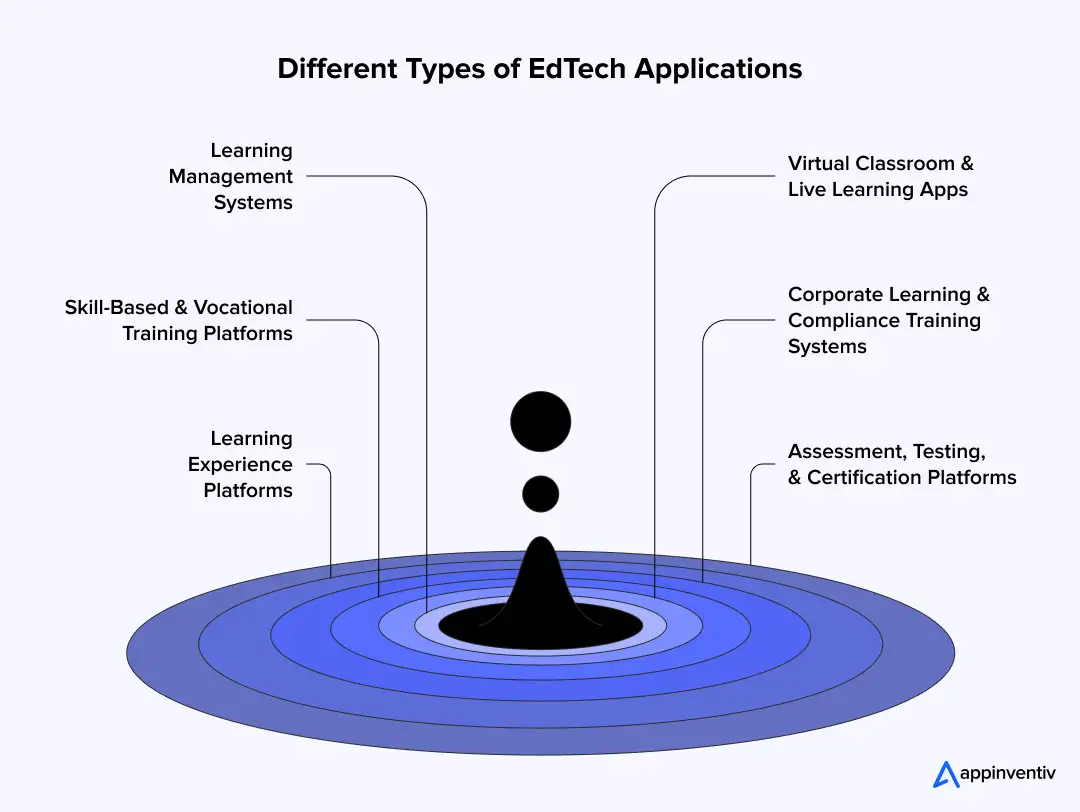
Learning Management Systems (LMS)
LMS platform development in Australia remain foundational for schools, universities, and RTOs. They work best when designed with:
- Role-based access control
- Deep reporting and AI analytics
- Procurement-led data structures
Also Read: Top LMS Features to Boost Distance Learning Success
Virtual Classroom and Live Learning Apps
Virtual classroom platforms support hybrid and remote learning models, with reliability and control determining institutional adoption. They must handle:
- High concurrent usage
- Moderation and session controls
- Reliable performance across regions
Skill-Based and Vocational Training Platforms
Vocational training platforms in Australia need to be designed around outcomes and verifiable skill progression. These platforms succeed when they focus on:
- Outcomes and assessment tracking
- Evidence collection for compliance
- Certification and credential workflows
Corporate Learning and Compliance Training Systems
Corporate learning platforms function as governance tools for workforce enablement and regulatory training, not just content delivery systems. These platforms prioritise:
- Governance and auditability
- Integration with HR and identity systems
- Subscription and access management
Assessment, Testing, and Certification Platforms
Assessment and certification platforms operate in highly regulated contexts, where security, traceability, and data integrity are non-negotiable. Assessment-centric platforms require:
- Strong security and integrity controls
- Traceable assessment records
- Long-term data retention
Learning Experience Platforms (LXP)
LXPs are increasingly used alongside or on top of LMS platforms, especially in universities, enterprises, and professional learning environments.
They focus on:
- Personalised learning pathways across multiple content sources
- Skill-based discovery rather than course-based progression
- Continuous upskilling rather than formal curriculum delivery
Real World Examples of Australian Educational Apps
These examples illustrate how different types of education apps succeed in Australia, based on who they are designed for and how they fit into institutional realities, rather than feature breadth.
Duolingo
Duolingo is widely used in Australia for individual and informal language learning, driven by strong engagement design and adaptive learning. Its success highlights the power of learner-centric experiences, but also the limitations of consumer-first platforms in the education sector.
Also Read: How Much Does Duolingo like App Development Cost?
ClassDojo
ClassDojo is commonly used in Australian primary schools to support parent–teacher communication and student engagement. The platform demonstrates how simplicity, security, and trust can drive adoption without functioning as a full learning management system.
Rapid Teachers
Rapid Teachers is designed to support classroom delivery and educator workflows within Australian school environments. Built by Appinventiv, the platform reflects a compliance-aware, teacher-first approach that prioritises operational clarity over feature complexity.

EdTech App Framework: Architecture Decisions That Shape Cost and Compliance
In Australia, architecture decisions are not neutral. They directly affect security reviews, accessibility requirements, procurement eligibility, and total cost of ownership. The frameworks below (grouped into two practical clusters) outlines the architectural layers that materially impact whether an EdTech app can operate sustainably in regulated environments.
Foundational Architecture Frameworks
These frameworks form the technical and structural backbone of an EdTech platform. If these are weak or misaligned, compliance and governance controls struggle to function effectively later.
Platform Strategy Framework
Defines how the platform is delivered across web, mobile, or hybrid environments, including native versus cross-platform decisions and offline access.
Early delivery choices directly affect accessibility effort, performance ceilings, and long-term cost.
Core System Architecture Framework
Establishes separation between learner, educator, and administrator experiences, along with backend services and system boundaries.
Poor architectural separation increases governance risk and makes audits harder to defend.
Integration and Interoperability Framework
Enables API-driven integration with LMS, SIS, identity systems, finance platforms, and reporting tools.
Platforms that cannot integrate cleanly are sidelined regardless of feature strength.
Scalability and Performance Planning Framework
These frameworks design the platform to handle predictable academic peaks and multi-institution growth.
Systems built for average usage fail during enrolments, exams, and certification periods.
Governance, Risk & Sustainability Frameworks
These frameworks determine whether an EdTech platform can survive institutional scrutiny, scale responsibly, and remain viable over time. In Australia, they often decide procurement outcomes more than features do.
Privacy-by-Design and Data Residency Framework
Embeds data minimisation, encryption, access logging, and retention controls into the architecture.
This ensures sensitive student data remains within Australian jurisdictions, protecting institutional trust and procurement approval.
Responsible AI Enablement Framework
Defines how AI features operate within clear governance boundaries, including transparency and human oversight.
Ungoverned AI introduces regulatory and institutional risk rather than value.
Security and Operational Resilience Framework
Covers identity management, threat prevention, monitoring, incident response, and continuity planning.
Security incidents erode confidence and stall expansion even when functionality remains intact.
Lifecycle Cost and Sustainability Framework
Ensures the platform remains economically viable over 5–10 years, including maintenance, compliance updates, and infrastructure scaling.
Low development cost for EdTech apps often hides high long-term operational risk.
Key Features of an Australian eLearning App
Building an EdTech app for Australia requires more than assembling common learning features. Each capability must support institutional delivery, regulatory expectations, and long-term operational control. The following sections outline features by who they serve and how they affect institutional accountability.
Learner-Focused Features
Learner-facing features define accessibility, continuity, and credibility of learning outcomes.
In Australia, these capabilities must operate within strict privacy, accessibility, and identity controls, particularly when minors or regulated cohorts are involved.
| Feature | Why It Matters in Australia |
|---|---|
| Secure user registration and login | Ensures controlled platform access and protects student identities, especially for underage learners |
| Identity verification and session management | Reduces impersonation risk and supports defensible audit trails |
| Course discovery and enrolment | Enables structured curriculum delivery across institutions and cohorts |
| Lesson and module navigation | Supports consistent learning progression and reduces learner drop-off |
| Quizzes, assignments, and exams | Forms the foundation of formal education and accredited training |
| Timed and controlled assessments | Preserves assessment integrity in regulated learning environments |
| Multimedia content delivery | Supports diverse learning formats without relying on external tools |
| Limited offline content access | Improves equity of access where connectivity is unreliable |
| Digital certificates and badges | Enables verifiable outcomes for vocational and professional learning |
| Transcripts and learning history | Supports long-term credential verification and learner mobility |
Educator and Administrator Features
Educator and administrator features determine whether an EdTech platform is operationally viable at scale. These capabilities help organisations maintain governance, meet audit requirements, and manage learning delivery without increasing administrative burden.
| Feature | Why It Matters in Australia |
|---|---|
| Course creation and structuring | Allows institutions to control curriculum design and updates |
| Content version control | Prevents data inconsistency during audits and curriculum changes |
| Student enrolment management | Supports cohort-based learning and institutional reporting |
| Attendance tracking | Mandatory for many schools, RTOs, and compliance-driven programs |
| Assessment creation and scheduling | Enables structured, defensible evaluation processes |
| Grading workflows | Maintains academic integrity and transparency |
| Assessment moderation controls | Supports regulated education and dispute resolution |
| Learner performance analytics | Provides evidence for intervention, reporting, and accreditation |
| Course completion reports | Supports funding claims and institutional accountability |
| Role-based access control (RBAC) | Limits access based on responsibility and reduces risk |
| User activity and audit logs | Enables traceability during investigations or compliance reviews |
Core Platform & Scale-Enabling Features
These are baseline requirements for platforms operating at institutional or enterprise level in Australia.
| Feature | Why It Matters in Australia |
|---|---|
| Gamification elements | Supports engagement when applied carefully within structured learning models |
| Discussion boards and moderated forums | Enables collaboration while maintaining safeguarding and oversight |
| Virtual classrooms and live sessions | Required for hybrid delivery across distributed learner cohorts |
| Subscription and pricing management | Enables sustainable institutional and enterprise delivery models |
| Payment gateway integration | Required for private, professional, and accredited training programs |
| API access for third-party systems | Essential for integration with SIS, HR, CRM, and identity platforms |
Advanced and Future-Ready Features
Advanced features support scale, productivity, and policy-aligned innovation rather than experimentation. These capabilities must align with architecture frameworks, evolving AI guidance, and long-term institutional sustainability.
| Feature | Why It Matters in Australia |
|---|---|
| AI-assisted content recommendations | Improves learning relevance while requiring transparent, governed decision logic |
| Learning insights and performance trends | Enables evidence-based interventions without increasing educator workload |
| Educator productivity tools (AI-assisted) | Reduces administrative effort while preserving professional oversight |
| AI usage controls and transparency | Aligns with responsible AI expectations in regulated education environments |
| Modular feature expansion | Allows platforms to evolve without triggering compliance or architectural rework |
Compliance and Data Security Requirements for EdTech App Development in Australia
In Australian EdTech app development, compliance influences architecture, delivery timelines, and total cost. Therefore, when building an educational platform, businesses must adhere to AU regulatory requirements from the start.
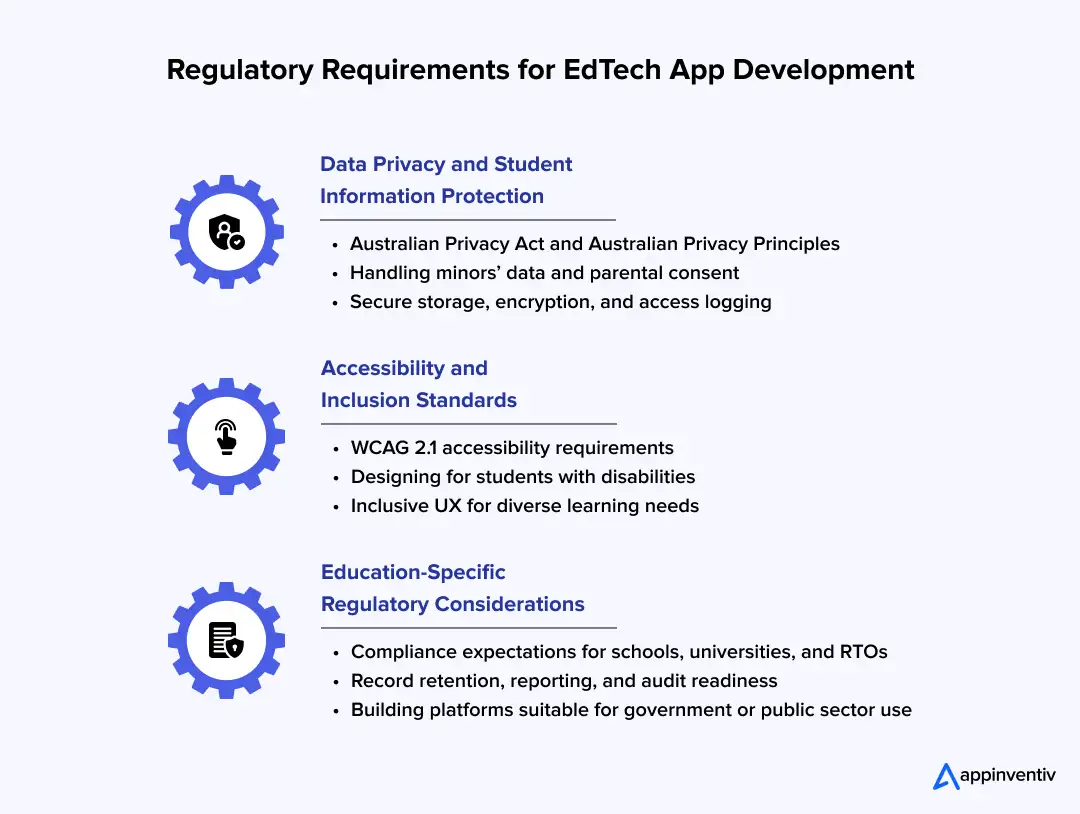
Data Privacy and Student Information Protection
Platforms must align with the Consumer Data Right (CDR), Australian Privacy Principles and Privacy Act Reforms. This is particularly sensitive when handling minors’ data. Institutions increasingly expect:
- Encryption of data at rest and in transit
- Detailed access logging
- Clear data retention and deletion policies
- Breach response readiness
National initiatives such as Safer Technologies 4 Schools have made privacy and security posture visible during procurement, not just during incidents.
Accessibility and Inclusion Standards
WCAG 2.1 compliance is mandatory for many institutions and increasingly expected across the sector.
Accessibility failures delay or block procurement. Retrofitting accessibility is expensive and often incomplete. Platforms that embed inclusive design from the outset reduce long-term risk and cost.
Education-Specific Regulatory Considerations
Australian education providers operate under audit and reporting obligations that extend beyond standard software compliance. Platforms must support:
- Long-term record retention
- Transparent reporting
- Evidence-based assessments
- Defensibility under review
For government or public-sector aligned use cases, these considerations become gating factors rather than enhancements.
How to Build an EdTech App in Australia
Building an EdTech app in Australia is not a linear product journey. It is a risk-managed delivery exercise shaped by compliance expectations, institutional procurement, and long-term operational accountability. Here is a step by step process of education app development in Australia
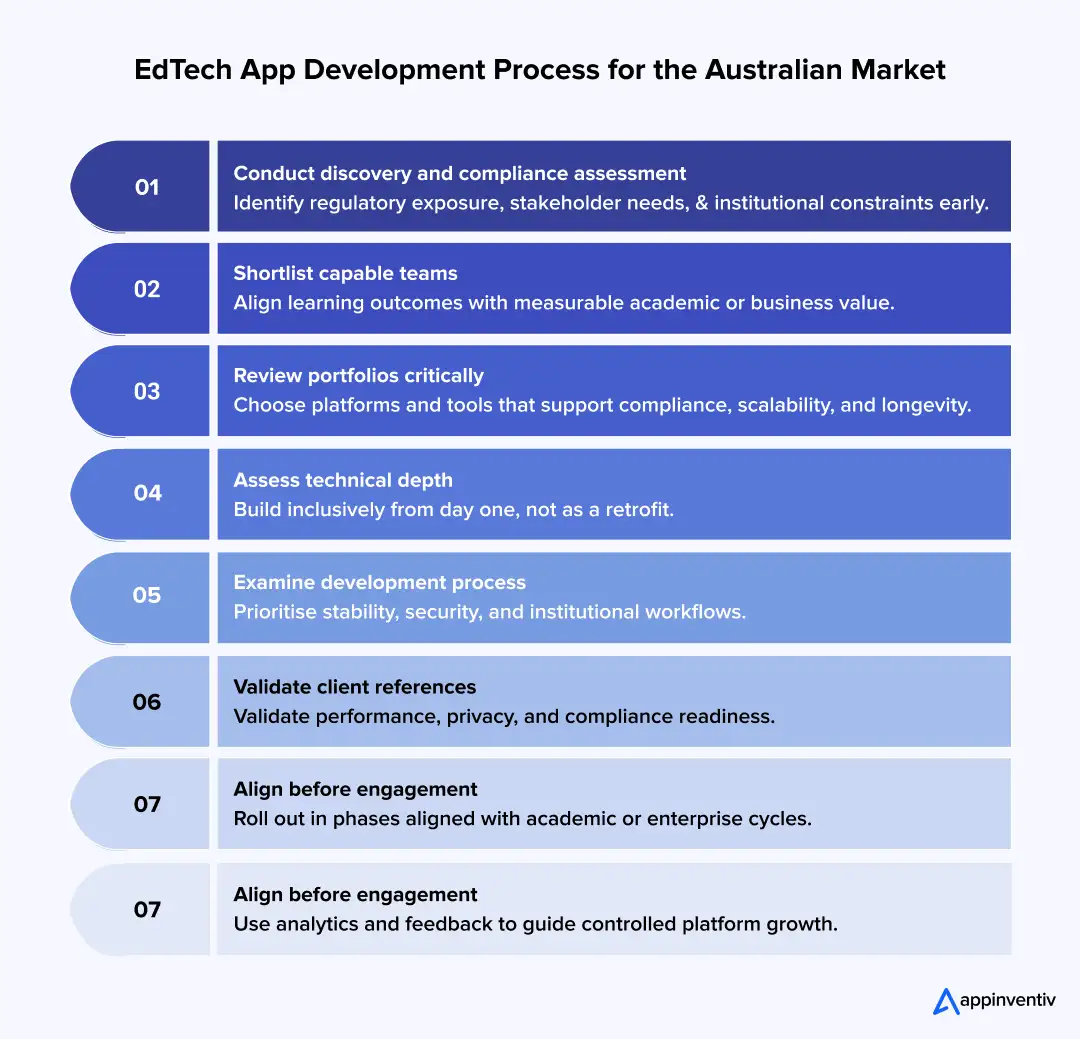
Conduct Discovery and Compliance Assessment
This phase determines whether the platform can exist in regulated education environments. It aligns institutional expectations, regulatory obligations, data sensitivity, and accessibility requirements before design decisions are locked.
Define the App Purpose
Australian institutions favour platforms with a clearly articulated purpose tied to measurable outcomes. Ambiguous scope creates friction across design, delivery, and procurement.
Defining what the platform will not do is as important as defining what it will. This prevents feature creep into regulated areas without proper controls.
Choose the Technology Stack
Technology selection in app development for Australian EdTech is a long-term commitment. Choices must support scalability, auditability, accessibility, and integration with institutional systems.
Stacks optimised only for rapid delivery often struggle when compliance evidence, reporting depth, or performance under peak academic load is required.
Design UI/UX with Accessibility-First Principles
Accessibility is not a validation step for EdTech app development. It is a design discipline. Embedding WCAG 2.1 principles early avoids costly remediation and prevents procurement delays later.
Institutions increasingly expect accessibility considerations to be visible in design rationale, not just test results.
Develop Core and Advanced Capabilities
This is the development stage where your ideas comes into life. At this stage, the development teams prioritise modularity and governance because core learning and compliance capabilities must remain stable as features evolve.
This approach allows platforms to adopt AI-assisted or engagement features without destabilising compliance posture.
Execute Testing and Security Validation
Testing in EdTech applications validates defensibility, not just functionality. Accessibility testing, security validation, and performance testing under peak conditions are critical before institutional rollout.
Platforms that underinvest here often fail during early institutional pilots.
Deploy with Governance Control
Deployment signals readiness. Secure environments, monitoring, documentation, and staff onboarding all contribute to institutional trust.
A technically sound platform can still lose momentum if deployment governance is weak.
Monitor, Optimise and Evolve Continuously
EdTech platforms in Australia operate in changing regulatory and policy environments. Continuous optimisation ensures alignment with evolving privacy, accessibility, and AI governance expectations.
Long-term success depends on disciplined iteration rather than feature acceleration.
Also Read: How to Build a Student Management System in Australia?
Build a secure, scalable learning platform that meets regulatory expectations and supports institutional adoption.

How Much Does it Cost to Develop an Australian EdTech App?
AI EdTech app development in Australia should be viewed as a lifecycle investment, not a one-time build cost. Thus, budgeting must account for compliance depth, institutional scale, and long-term operational support.
On average, the realistic cost to create teaching & learning apps typically falls between AUD 70,000 and AUD 700,000, depending on scope and risk profile. This cost range is primarily influenced by:
- Platform complexity and number of user roles
- Accessibility and compliance requirements
- Integration with institutional systems
- Security, data residency, and audit readiness
- Scalability and post-launch optimisation
Indicative timeline and cost to create teaching & learning apps by platform complexity
| Platform Scope | Typical Use Case | Estimated Cost (AUD) | Estimated Timeline |
|---|---|---|---|
| Entry-Level Platform | Small institutions, controlled pilots | 70,000–200,000 | 3–4 months |
| Mid-Scale Institutional Platform | Universities, RTOs | 200,000–400,000 | 5–7 months |
| Enterprise / Government-Ready Platform | Multi-tenant, regulated | 400,000–700,000 | 8–12 months |
Cost overruns in Australian EdTech projects most often occur when compliance, accessibility, or integration requirements are discovered after development has begun.
Common Challenges in EdTech App Development and How to Overcome Them
Australian EdTech platforms rarely fail due to lack of demand. They fail due to execution misalignment with institutional reality. The challenges below reflect recurring patterns across schools, higher education, vocational training, and enterprise learning environments.
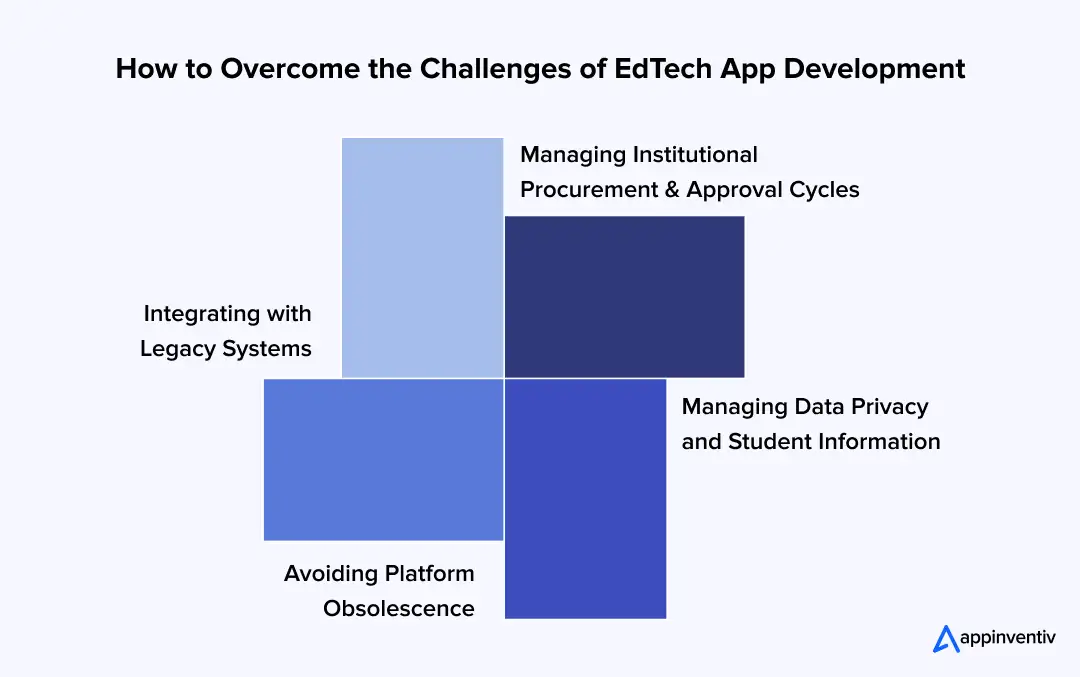
Managing Institutional Procurement and Approval Cycles
Challenge: Approval timelines are long, and requirements often surface late, creating uncertainty around launch and scale.
Solution: Build with procurement in mind from the start by preparing security, privacy, and accessibility evidence alongside development, not after it.
Managing Data Privacy and Student Information
Challenge: Student data, particularly for minors, carries high sensitivity, and unclear handling quickly becomes a blocker for adoption.
Solution: Apply privacy-by-design early by limiting data collection, enforcing access controls, encrypting sensitive records, and defining clear retention rules aligned with Australian expectations.
Avoiding Platform Obsolescence
Challenge: Platforms become rigid as policies, delivery models, and compliance needs evolve.
Solution: Design the system in modular layers so updates can be made without rewriting core compliance or reporting logic.
Integrating with Legacy Systems
Challenge: Existing SIS, HR, or identity platforms constrain modernisation efforts and slow rollout.
Solution: Use integration layers that sit alongside legacy systems, allowing gradual change rather than disruptive replacement.
Build a Scalable EdTech App with Appinventiv in Australia
Building an EdTech platform for Australia requires delivery experience in regulated, institution-led environments, not just technical capability. Appinventiv brings that experience through consistent execution across education, training, and enterprise learning systems.
To date, we have deployed 3000+ digital assets across Australia, supporting platforms that operate under real-world constraints such as accessibility compliance, data governance, and institutional scale. This delivery discipline is reflected in our 78% client retention rate, driven by long-term platform stability.
Our education and learning portfolio includes platforms such as Rapid Teachers, Gurushala, Nova, Bada Business, and Dr Reddy. This experience allows us to design and build fully custom EdTech platforms that align with Australian compliance expectations, institutional workflows, and long-term operational requirements.
Why Australian Organisations Work with Appinventiv
- 10+ years of APAC delivery experience in delivering mobile app development services in Australia for education platforms.
- Deep understanding of the Australian Privacy Act 1988, government initiatives, and accessibility requirements
- Capability to build custom EdTech systems from the ground up, not retrofit regulatory requirements later
For organisations building education platforms intended for long-term institutional use in Australia, execution experience matters more than experimentation.
Share your project vision with us.
FAQs
Q. How to monetize your EdTech app?
A. Some key monetisation models for education app development in Australia are:
- Institutional licensing – Sell platform access to schools, universities, RTOs, or enterprises on annual or multi-year contracts
- Per-user or seat-based pricing – Charge based on enrolled learners, educators, or active users
- Subscription tiers – Offer basic, advanced, and enterprise plans tied to features, reporting, or compliance depth
- Content or course marketplaces – Enable paid courses from accredited partners or educators
- Usage-based pricing – Charge based on assessments taken, credentials issued, or AI usage
- White-label or platform licensing – License the platform to institutions under their own brand
- Government or grant-funded deployments – Align with public sector programs and funded initiatives
Q. Why build an education app in Australia?
A. Australia’s education sector places strong emphasis on quality and outcomes, creating demand for robust digital learning platforms.
Growth is being driven by workforce reskilling, vocational training, professional certification, and hybrid learning models, rather than content-only apps. Platforms built to Australian standards often translate well to other regulated markets.
Q. How long does it take to build an education app?
A. An Australian EdTech app typically takes 3 to 12 months to build, depending on scope and regulatory requirements.
For instance, basic platforms can be delivered in shorter timelines, while institutional or government-ready systems require additional time for architecture design, accessibility validation, security testing, and integrations. Rushing early phases often leads to delays later.

- In just 2 mins you will get a response
- Your idea is 100% protected by our Non Disclosure Agreement.

How Much Does It Cost to Build a Learning Management System in Australia
Key takeaways: Enterprise LMS investment in Australia typically ranges from AUD 70,000 to AUD 700,000, driven primarily by architecture, integrations, and compliance scope. Privacy Act 1988, APP obligations, TEQSA, ASQA, and ASD Essential Eight significantly influence LMS design decisions. Cloud-native, API-first, and modular platforms reduce long-term total cost of ownership and also drive sustainable outcome.…

How Smart Campuses Are Redefining the Future of Education - Benefits, Use Cases, and Technologies
Digital transformation is roaring across industries, and the education sector is no exception. The integration of cutting-edge technologies like the Internet of Things (IoT), artificial intelligence (AI), machine learning (ML), cloud computing, virtual reality, etc. is increasingly making waves in the education sector. Amidst the hum of these technology trends, the emergence of smart campus…

How Much Does it Cost to Develop a Language Learning app like Babbel
According to a report, the global language learning market is expected to be $80 billion by 2028. The immense potential of the language learning app market serves as a bright opportunity for global entrepreneurs who want a piece of this pie. Babbel is one of the more popular language-learning apps in the market today. Building…