
























How AI Is Helping Retail Companies in Egypt Cut Costs and Improve Efficiency


- Egypt’s Retail Landscape: Why AI-driven Retail Transformation in Egypt Has Become a Strategic Imperative
- How Artificial Intelligence in the Retail Industry Drives Retail Cost Optimization
- AI Improving Retail Efficiency: Transforming Enterprise Retail Operations
- Boosting the Customer Experience Through AI Personalization
- The Technology Backbone: AI Innovations Powering Egypt’s Retail Transformation
- Measuring the Impact: ROI and Efficiency Metrics
- Challenges of Integrating AI in Retail and Their Solutions
- Future of AI in Egyptian Retail Industry
- Building an AI-Ready Retail Enterprise: Appinventiv’s Consulting Approach
- Frequently Asked Questions

- Egypt’s AI retail sector is growing rapidly under the National AI Strategy 2030 and national digital transformation targets.
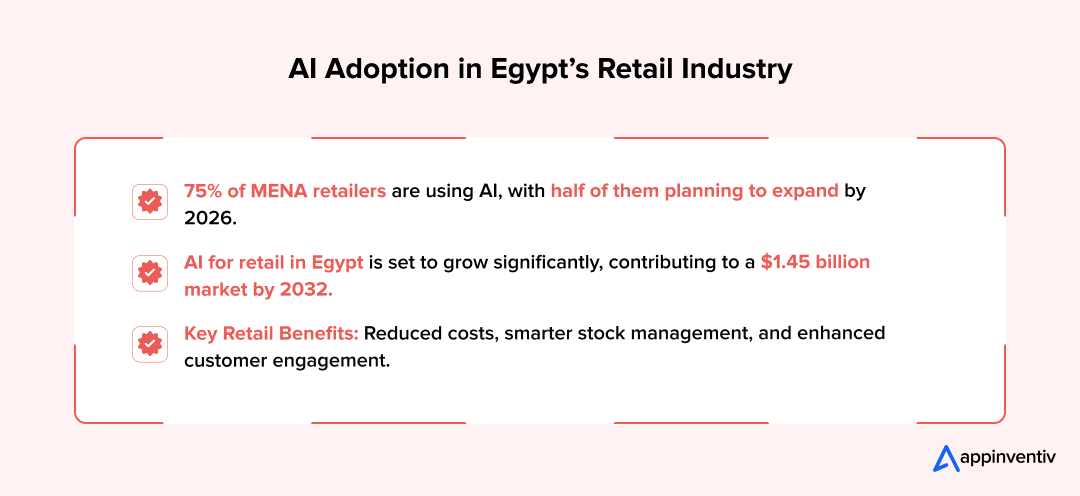
- More than 75% of local retailers already utilize AI, and Egypt has become a prime MENA hub for enterprise adoption.
- Jumia Egypt and Carrefour Egypt are the forerunners in adopting AI voice ordering, dynamic pricing, and checkout automation.
- AI enhances effectiveness by improving forecasting accuracy, price control, logistics optimization, and automated assistance.
- Egypt’s expanding ecosystem of AI start-ups and tech professionals is fueling enterprise readiness and local innovation.
Egypt’s retail industry is growing rapidly, but so are the challenges it faces. Inflation, volatile supply chains, and changing consumer tastes are pushing the limits of what enterprises can achieve. The actual challenge today isn’t growth — it’s maintaining profit while keeping operations running.
AI in retail in Egypt is slowly emerging as the go-to solution for most retailers today, helping them save on expenses and plan more intelligently. It assists big chains in predicting demand, monitoring stock, and minimizing wastage. What previously relied on checks or instincts is now controlled by data-driven predictions and computerized systems.
Region-wide, this phenomenon is taking hold very seriously. According to recent research forecasts, the AI market for the retail industry in the Middle East is set to reach almost $1.45 billion by 2032. Egypt is a significant contributor to that story, with an increasing number of businesses investigating how AI retail transformation in Egypt can bolster margins and decision-making.
For Egypt’s retail leaders, the question is no longer if they should adopt AI, but how soon. Early movers are already seeing the effects of AI improving retail efficiency, with faster turnaround times, better demand visibility, and measurable savings across their operations.
From supermarkets managing stock more precisely to online retailers refining customer journeys, results are becoming harder to ignore. In this blog, you’ll learn:
- How AI in retail in Egypt is reshaping cost management and decision-making
- Real examples of how enterprise retailers are harnessing AI effectively
- Key technologies driving this transformation
- The hurdles in adopting AI and how expert consulting makes it an easy ride
Let’s find out how Egypt’s retail businesses are making everyday data into smarter, more profitable decisions.
Join the enterprises in Egypt using AI to reduce costs and improve operations. Let’s build your intelligent retail future together.

Egypt’s Retail Landscape: Why AI-driven Retail Transformation in Egypt Has Become a Strategic Imperative
Egyptian retail is undergoing a low-profile but resolute revolution. The market is expanding, but the competition is more intense, and customers are much less forgiving.
Companies are realizing that outmoded systems no longer possess the speed or accuracy that today’s customers require. This push toward brighter, better retail models is where AI for the retail industry is starting to make its largest contribution.
Let’s explore what is driving this momentum and why AI in retail in Egypt has evolved from experimentation to imperative.
1. A Retail Market in Motion
Egypt’s retail companies are slowly transitioning from single-channel arrangements to omnichannel settings, where physical stores, mobile apps, and eCommerce platforms connect in real time.
The main drivers of modernization using AI for retail in Egypt are:
- Omnichannel expansion: Customers research, compare, and buy across various platforms, and they demand the same experience everywhere.
- Fintech-powered payments: Mobile payment wallets, QR payments, and BNPL options are now the norm, fueling digital transaction volumes.
- Supply-chain digitization: Smart solutions are allowing retailers to foresee demand and deliver parcels faster than before.
2. National Objectives-Driven Retail Automation
All of this digital change is not happening in a vacuum. It’s underpinned by government-driven programs that emphasize automation as a component of Egypt’s National AI Strategy 2030.
Retail automation in Egypt is being viewed as a way to make the sector more transparent, cost-effective, and customer-centric. Companies embracing AI-driven systems are already seeing the following benefits of AI in the Egyptian retail industry:
- Real-time visibility of inventory
- Automated restocking cycles
- Data-enabled logistics and delivery management
These initiatives reflect a nationwide mission to digitalize retailing with intelligent technologies and drive retail automation in Egypt.
3. AI Adoption and Market Readiness
The MENA region is witnessing booming AI growth, and Egypt is in the middle of it. The same research report estimates AI in retail in the Middle East reaching nearly $1.45 billion by 2032.
Several regional and global companies are already using artificial intelligence in retail industry to tackle underlying retail challenges:
- Carrefour Egypt uses predictive analytics to plan promotions and forecast demand.
- Jumia Egypt uses machine learning to provide product suggestions to consumers.
- Amazon Egypt (Souq.com) relies on AI-based demand forecasting to maximize inventory and improve fulfillment rates.
Fueling this momentum is Egypt’s growing community of AI startups, engineers, and data scientists. Their focus on local applications, which includes many AI use cases in the retail industry in Egypt — from computer vision-based shelf monitoring to support bots for automation — is building the foundation for horizontally scalable AI deployment in enterprise retail.
Why This Matters for Enterprises
To Egypt’s retail giants, AI has become a strategic decision as well as a technological improvement. Frustrated with dependence on human observation, those firms are shifting towards real-time intelligence to make planning, pricing, and customer management decisions.
Coupled with enabling policy environments, growing local capabilities, and a technology-embracing consumer base, Egypt’s retail market is ready to translate AI adoption into concrete business returns.
How Artificial Intelligence in the Retail Industry Drives Retail Cost Optimization
Retail margins have always been tight, and for Egyptian businesses, that margin is even tighter. Import expenses have been high, fuel prices unpredictable, and customers’ expectations have been rising. Efficiency became a cost of doing business rather than a goal of operations.
This is where AI in retail cost optimization is proving its true value — not as tomorrow’s technology but as a tangible business enabler.
AI systems are making it possible for retailers to spot money leaks – from overflowing shelves to unscheduled discounting. They are more accurate in their demand forecasting, more able to call the right price at the right time, and keep employees free to perform higher-value work rather than repetitive, menial tasks.
The following are the areas where AI in retail in Egypt is already driving tangible cost savings.
- Intelligent Demand Forecasting and Inventory Planning
Without AI in warehouse management, retailers can lose millions due to inaccuracy in their inventory. Having too much inventory locks up cash; having too little results in lost sales. AI reverses this equation by looking at several years’ worth of sales history, seasonal trends, and geographic differences.
It assists retailers in:
- Minimizing stockouts and overstocking due to anticipated fluctuations in demand
- Automatically adjusting procurement schedules
- Optimizing warehouse space usage
Outcome: Reduced pressure on working capital and fewer write-offs of unsold inventory.
Also Read: How Retail Predictive Analytics Transforms Demand Forecasting and Inventory Planning
- Dynamic Pricing for Profit Stability
Static pricing is not possible anymore in as volatile markets as Egypt’s. AI-driven pricing systems continually monitor demand, competition prices, and even macroeconomic trends.
They can suggest price updates in real time, keeping margins stable without becoming uncompetitive. Dynamic pricing retailers commonly experience:
- 15 to 20% improvement in margin stability
- Up to 50% quicker promotion planning cycles
- Fraud and Loss Prevention Through Computer Vision
Shrinkage is retail’s most intractable drain on profit. Computer vision in AI-powered retail systems now identifies suspicious behavior at self-checks, stockrooms, or delivery terminals.
These systems don’t just augment human judgment — they make it more acute. By analyzing patterns of movement or mismatched SKUs, they warn teams before losses escalate.
The payoff has been significant:
- Shrinkage cut by 25 to 40%
- Audit time reduced by 30% through automated manual audits
- Safer, more responsible store environments
- Streamlining Routine Operations
Retail businesses rely so much on repetitive processes — like those targeted by retail process automation using AI in Egypt for order scheduling, shift planning, and report consolidation. These back-office processes are now being performed by AI-based automation tools.
It doesn’t just save money; it speeds up response time between departments.
Small gains in efficiency at each level make huge savings over the course of a year for companies that run dozens of outlets.
Also Read: How Much Does It Cost to Build an App in Egypt?
AI Improving Retail Efficiency: Transforming Enterprise Retail Operations
Walk into any large retailer in Egypt today, and you’ll notice a quiet shift. Deliveries arrive faster, shelves get restocked before running empty, and reports reach management without the usual rush. The difference isn’t an extra workforce. It’s intelligence built into everyday systems.
AI now runs behind the scenes of retail operations, linking departments that once worked in isolation. The outcome is not only better coordination but measurable savings in time, fuel, and human effort.
- Supply and Logistics: From Guessing to Knowing
Egypt’s crowded delivery routes often struggle with traffic delays and cost fluctuations. Retailers using AI-based and IoT-enabled logistics tools now plan routes dynamically, cutting unnecessary travel and fuel use. In practice, this means:
- Potential delays are flagged before they cause disruption
- Dispatching decisions are based on data, not instinct
- Idle vehicle time falls, while delivery reliability improves
- Workforce Management That Balances the Load
Staff scheduling once depended on intuition and experience. Now, it’s powered by data. AI tracks footfall, sales volume, and even local event calendars to forecast staffing needs. For multi-store enterprises, that means fewer idle hours and better use of talent.
- Operations That Run on Their Own
Behind every retail outlet are dozens of repetitive tasks such as invoice matching, stock reconciliation, and reporting. AI automation tools now handle many of these quietly in the background. Finance and compliance teams receive clean reports instead of raw data dumps, saving hundreds of hours every month.
- The Bigger Picture
AI isn’t about replacing people. It’s about freeing them from low-value tasks so they can focus on growth, planning, and service. For Egypt’s retail enterprises, this is where real efficiency begins — not in cutting resources but in making every process work smarter and faster.
Boosting the Customer Experience Through AI Personalization
For retail businesses, loyalty is not created by discounts. It builds with timing, relevance, and acknowledgment. Retailers who get it before their customers ask for it are the ones who win.
That is what AI in retail in Egypt is enabling. From behavior to communication, AI is enabling big retailers with new modes to relate and convert.
1. Personalization That Feels Local
Generic promotions no longer resonate with Egyptian consumers. They anticipate offers aligned with their habits, budget, and even language. AI steps in by analyzing purchase history, web browsing behavior, and payment preferences to deliver the right offer at the right time.
Example:
Jumia Egypt collaborated with an AI development services company similar to Appinventiv, based in Cairo, to launch a voice-ordering function in Egyptian Arabic via Ziila. Users can now talk naturally to add items to the cart and check out. It made the website more accessible for non-English speakers and increased checkout rates.
This strategy shows that personalization in Egypt is more than algorithms. It’s about cultural accessibility and sensitivity.
2. Customer Support That Never Switches Off
Customer service used to rely on call centers and queues for response. AI chatbots and voice assistants currently process thousands of customer inquiries simultaneously while maintaining tone and accuracy. Customers are able to access product availability, order status, or refund information within seconds.
Real example:
Majid Al Futtaim operated Carrefour, which introduced AI-powered customer-support kiosks and chatbots in several MENA stores, including Egypt. The systems cut response times from hours to seconds and cut support expenses by as much as 25 percent.
For business retailers, this method demonstrates technology’s capability to sustain service quality without expanding team size.
3. Visual Search That Drives Conversions
Consumers nowadays like to display what they require rather than typing it. AI visual search technology currently allows users to upload an image and instantly view similar products on the internet.
Egyptian fashion and lifestyle retailers who employ this functionality have reported greater engagement rates and lower cart abandonment because customers are reaching the correct product quickly.
AI customer experience solutions in Egypt are assisting Egypt’s retail businesses in producing experiences that are real and pertinent to each consumer. These are not mere marketing add-ons. They are foundations for lasting loyalty and deeper brand connections.
The Technology Backbone: AI Innovations Powering Egypt’s Retail Transformation
Behind the AI retail transformation in Egypt are technologies working behind the scenes. AI for the retail industry has progressed far beyond recommendation engines. It now underpins every aspect of retail operations, including forecasting and pricing, and automation and fraud detection.
For enterprise retailers, it is essential to grasp these technologies in order to develop the appropriate composition of solutions that yield long-term value in artificial intelligence in the retail industry, not fleeting results.
- Machine Learning for Planning and Forecasting
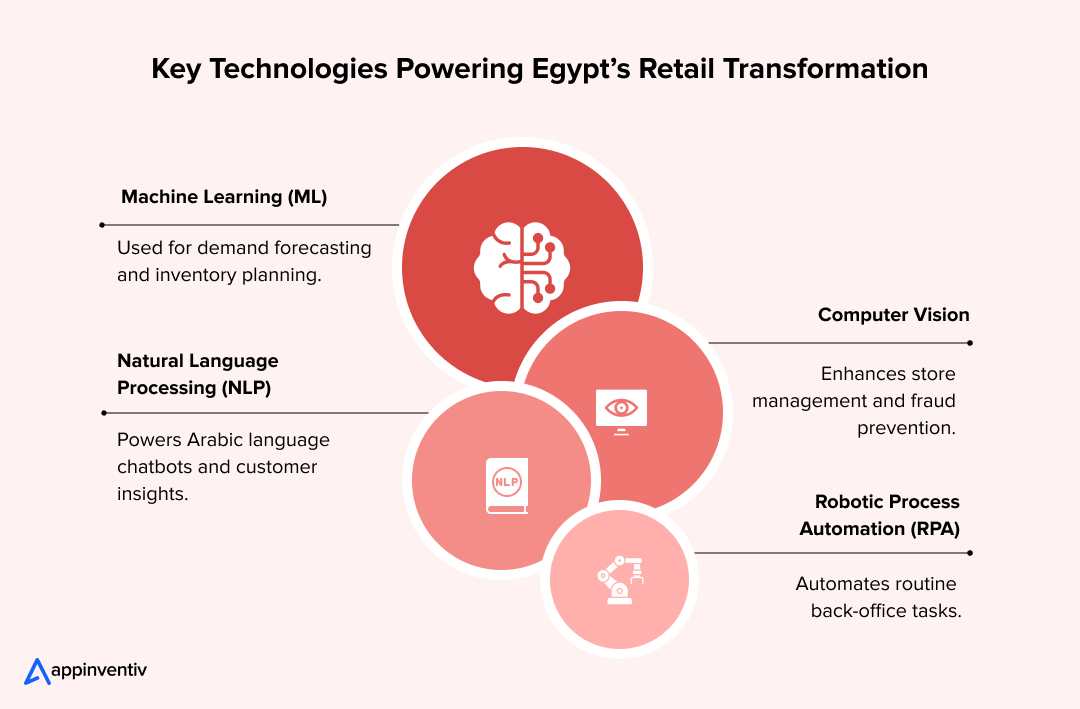
Machine learning algorithms assist retailers in making sense of big and dispersed data. They locate patterns in sales, weather, promotions, and even social trends to forecast demand accurately.
This translates into reduced stockouts, improved shelf planning, and intelligent procurement decisions. Egyptian retail chains employing ML for forecasting are already experiencing quicker turnaround times in restocking and higher margins during peak seasons.
- Computer Vision for Loss Prevention and Store Management
AI vision software inspects real-time camera footage to identify missing products or empty shelves, as well as suspicious behavior.
For convenience chains and large supermarkets, the technology saves both money and time. A few Egyptian retailers also test AI-powered queue management systems that notify personnel prior to queue build-up, which enhances both customer satisfaction and service velocity.
- Natural Language Processing for Support and Insights
NLP applications for businesses make it possible for chatbots, voice assistants, and sentiment-analysis software to comprehend and reply in natural human language.
In Egypt, this functionality is changing rapidly with Arabic dialect training. Businesses today utilize NLP systems to scan customer feedback and product reviews in both English and Arabic, enabling teams to find out what customers truly care about without manually sorting it.
- Robotic Process Automation for Routine Tasks
RPA, or robotic process automation,automates repetitive back-office activities like data entry, reconciliation, and invoice matching. It becomes self-reforming when integrated with AI. The system identifies what to do again and what not to do.
For large retail companies, retail process automation using AI in Egypt saves administrative expenses and eliminates human errors in finance, HR, and logistics functions.
- Generative AI for Retail Content and Merchandising
Generative AI is being heralded as a creative productivity tool for retail teams. It can produce brief product copy, design campaign imagery, or create localized content more quickly than existing processes.
Although still in the nascent stages of adoption across Egypt, marketing and merchandising departments are testing it to reduce creative turnaround time by almost half. Each of these technologies enables a particular piece of the retail value chain. Together, they form an interlocking system that learns, evolves, and improves continuously.
For Egyptian retailers in a price-sensitive environment, this technology stack of AI solutions for retail companies in Egypt is what makes data translate to quantifiable savings and better business decisions
Measuring the Impact: ROI and Efficiency Metrics
AI is no longer a test for Egypt’s retail businesses. It’s finally proving measurable impact in forecasting, pricing, logistics, and customer interaction.
A 2025 SAMENA Council report disclosed that more than 75 percent of regional retailers are now employing AI, and over half are set to increase investment by 2026. This indicates an evident transition from adoption to performance.
The most robust returns are being seen in four areas:
- Inventory management: Predictive applications eliminate waste and lost sales due to stockouts.
- Pricing strategies: AI models in real time help maintain margins during periods of price instability.
- Customer support: Voice assistants and chatbots lower response time and labor expense.
- Delivery operations: AI-based route optimization reduces delivery time and enhances fuel consumption.
Most Egyptian businesses start with targeted pilots in forecasting or customer service and grow as soon as the effect is demonstrated.
Jumia Egypt’s Arabic voice-ordering functionality and Carrefour’s AI-powered checkout systems are strong AI use cases in Egypt’s retail industry that demonstrate how local merchants are embracing AI as a long-term operational tool rather than a short-term experiment.
What comes next is not ROI posturing, but measuring it. Shoppers who invest in clean data platforms and performance dashboards have the best chance to witness the actual financial impact of AI throughout their value chain.
From AI-powered retail platforms to customer engagement systems, we help enterprises modernize operations with scalable, data-driven solutions.

Challenges of Integrating AI in Retail and Their Solutions
Even as AI uptake in Egypt’s retail market increases, most businesses continue to have impediments that hinder progress. The challenges of integrating AI in retail and their solutions are often not about the technology itself, but boil down to data readiness, legacy architecture, and change management.
Here are some of the most prevalent challenges and how top-performing retailers are overcoming them.
- Poor-Quality and Fragmented Data
Retailers tend to have information distributed across several systems — POS software, eCommerce platforms, and warehouse tools — that make it difficult for AI to provide credible insights.
Solution: Begin by developing a single data layer or warehouse that unifies all customer and inventory sources. Most enterprises are collaborating with regional AI consulting services for retail businesses in Egypt to develop integration pipelines that guarantee clean, standardized data before constructing AI models.
- Legacy IT Infrastructure
Ancient POS and ERP systems limit the ability to integrate with current AI tools and APIs.
Solution: Implement a hybrid modernization approach. Roll out AI modules as plug-ins to legacy systems rather than replacing all at once. This reduces costs and risk while enabling a phased transition to a cloud-based architecture.
- No Skilled AI Staff
AI expertise continues to be scarce in Egypt’s retail sector, particularly for mid-size businesses.
Solution: Businesses are filling this gap by partnering with local AI companies and universities. Training programs sponsored by the government and accelerators owned by private companies are also building up a robust AI workforce.
- Compliance and Data Privacy
Egyptian retailers gathering vast amounts of customers’ data have to comply with Egypt’s Personal Data Protection Law (PDPL) and adhere to international privacy guidelines.
Solution: Implement privacy-first AI systems with integrated encryption and consent management. Implement with the help of qualified retail IT services consultants to maintain compliance with PDPL prior to deploying AI tools department-wide.
- Resistance to Change
AI adoption is frequently met with internal resistance from teams concerned about job disruption or added complexity.
Solution: Begin small and visible, like automating forecasted inventory or deploying chatbots, and share the outcomes within. As soon as the teams get to see benefits, large-scale adoption is much simpler.
Egypt’s business retailers are discovering that the actual secret to effective integration of AI is not magnitude but consistency. The retailers who begin small, do data clean-up early, and have their people well-trained are the ones making incremental, measurable impact.
Future of AI in Egyptian Retail Industry
Egypt’s retail industry is entering a new phase in which AI in retail in Egypt is not just an optional add-on anymore—it’s increasingly becoming an actual economic growth driver.
As the government pushes forward with its National AI Strategy 2030, Egypt aims to position itself as a regional hub in AI for the retail industry, and retail happens to be one of the core sectors in this plan.
By 2030, the domestic Egyptian AI market will surpass $42.7 billion, driven by increasing demand from industry, government encouragement of innovation, and an increasing number of indigenous AI startups.
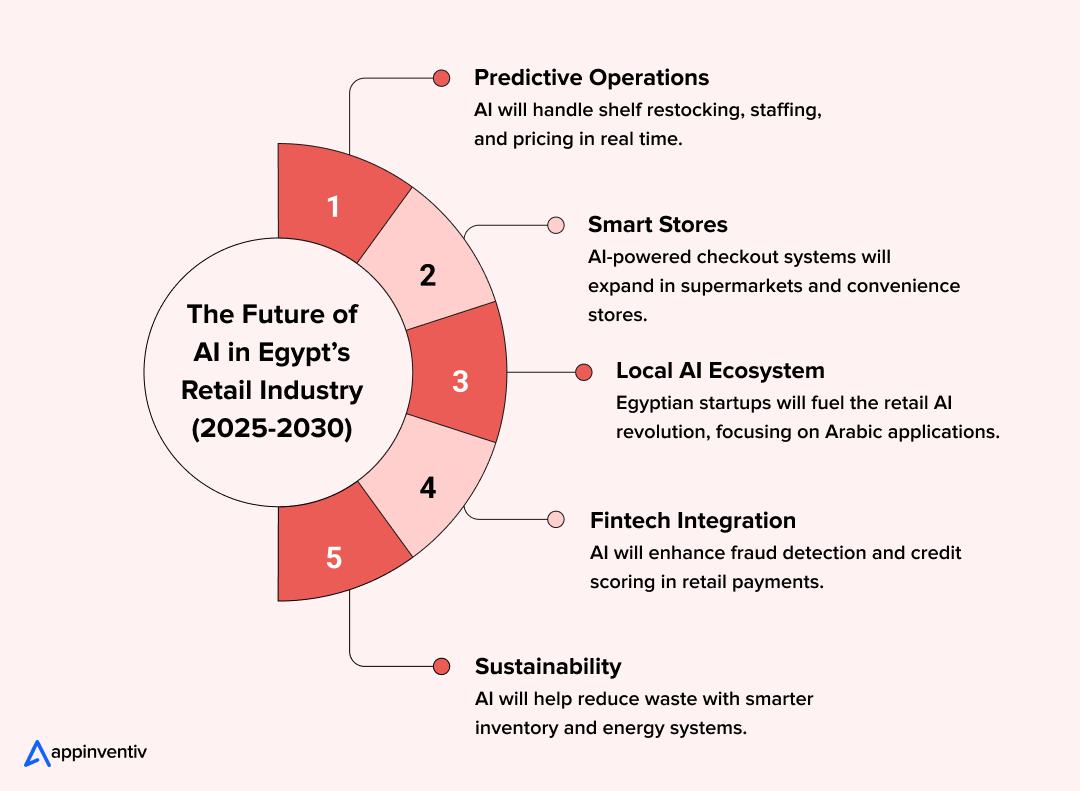
- Emergence of Predictive and Autonomous Retail Operations
In the future of AI in Egyptian retail industry, AI-driven forecasting, logistics, and dynamic pricing will become the norm for big-box retailers. Predictive analytics will begin handling mundane decisions—shelf restocking, staff scheduling, and price tweaking—with minimal human intervention. That will make retail operations leaner and more capable of reacting quickly to shifts in the market.
- Growth of Smart Stores and Checkout-Free Experiences
Following the trials conducted by Carrefour for AI-powered checkout systems in the MENA region, Egypt is set to observe similar ideas expand throughout supermarkets and convenience stores.
These smart stores will also feature augmented reality experiences for virtual product trials. Using intelligent cameras and sensors, shoppers will be able to make a purchase and pay without stopping at a checkout, minimizing waiting times and eliminating the need to hire additional staff.
- Expansion of Local AI Ecosystem
The Egyptian startup ecosystem is gaining ground quickly in terms of retail innovation. Domestic firms are now developing AI solutions for demand planning, customer intelligence, and supply chain. This translates into reduced costs for retailers as well as solutions that actually suit the Arabic language and local shopper habits.
Also Read: How AI Agents Are Transforming Retail Operations
- Fintech and E-Payment System Integration
With mobile payments now mainstream, AI is beginning to close the gap between retail and fintech. Retailers will also leverage customer data platforms to unify customer insights across channels. From detecting fraud to determining creditworthiness and forecasting payment behavior, these systems will allow retailers to customize their offers and make online shopping safer.
- Sustainability and Energy Efficiency
AI will also make retailers more sustainable. Intelligent refrigeration, forecasted maintenance, and energy management systems will be included in the ways big retail chains will cut waste and manage their environmental impact.
The next five years will be critical in shaping the major AI retail trends in Egypt and how deeply AI becomes woven into Egypt’s retail infrastructure. The businesses that approach AI not as a one-time initiative, but as a continuous way of operating—one that brings together data, automation, and local knowledge—will be the ones leading this shift.
Let’s design and deploy intelligent retail systems that simplify decision-making, improve forecasting, and boost profitability.

Building an AI-Ready Retail Enterprise: Appinventiv’s Consulting Approach
AI has turned retail into a predictive, data-driven industry, powering AI-driven retail transformation in Egypt. For C-level leaders, the benefits of AI in the Egyptian retail industry now show up in tighter inventory turns, lower storage costs, and stronger customer lifetime value—not just smoother front-end experiences.
At Appinventiv, a leading mobile app development company in Egypt, we partner with retailers and conglomerates to define AI roadmaps, modernize data infrastructure, and deliver AI-led transformation across enterprise retail operations.
Our teams focus on building AI solutions for retail companies in Egypt that are measurable, compliant, and ready for scale.
One example is our work with Y.K. Almoayyed & Sons, a large regional retail and distribution group. By modernizing their AWS-based archival and data management platform, we enabled a 32% reduction in storage costs, 2x faster data retrieval for global dealerships, and around 40% less IT intervention through policy-driven automation and self-service access.
Across the region, our three excellence centers, 20+ strategic partnerships, and 12 major government and compliance programs give us the scale and governance depth enterprises expect from an AI partner.
For enterprise retailers scaling omnichannel operations, retail platform development services play a critical role in connecting data, decision intelligence, and execution layers across stores, digital channels, and back-office systems.
For leaders evaluating AI in retail in Egypt, this is the standard that matters: AI initiatives built on solid data foundations, measurable efficiency gains, and controls that stand up in front of boards and regulators.
Frequently Asked Questions
Q. How is AI revolutionizing the retail industry of Egypt?
A. Egypt’s retailers are redesigning how they manage inventory, price products, and engage with customers. AI has evolved from a buzzword to an actionable technology that’s actually improving their businesses. From demand forecasting and dynamic pricing to chatbots and more intelligent logistics, old-fashioned manual processes are giving way.
Q. How AI helps retail businesses in Egypt?
A. AI performs the monotonous tasks, knows what customers need before they need to ask, and provides retailers more control over their stock. It reduces overstocking, accelerates order handling, and allows for support via voice and chat interfaces. The consequence? Reduced costs and more stable income.
Q. Which AI technologies are transforming enterprise retail operations in Egypt?
A. The technology behind these developments encompasses the following main areas:
- Machine Learning (ML): Applied to predict demand and identify trends in sales data.
- Computer Vision: Enables shelf watching, improving security, and fueling checkout-free stores.
- Natural Language Processing (NLP): Enables the development of Arabic-speaking chatbots and sentiment analysis of customers.
- Robotic Process Automation (RPA): Automates repetitive back-office work without human intervention.
- Generative AI: Generates marketing copy, product descriptions, and derives insights from consumer behavior.
Q. What are the ROI benefits of AI implementation in retail?
A. The return is apparent relatively soon. Retailers leveraging AI for customer interaction or logistics tend to achieve quicker inventory turn, reduced waste, and improved margins within a few short months.
Q. How can AI improve decision-making for retail enterprises in Egypt?
A. One of the largest changes is in how decisions are made. Rather than waiting for reports or responding once issues arise, retailers now operate with real-time data. They can see shifts in demand as they occur and react in real time. That level of agility was not previously possible.

- In just 2 mins you will get a response
- Your idea is 100% protected by our Non Disclosure Agreement.

How Much Does It Cost to Build a Conversational AI Chatbot in the UAE?
Key Takeaways AI chatbot development in the UAE typically costs AED 150,000–1,470,000 ($40K–$400K), based on complexity. Backend integration and compliance drive cost more than the chatbot interface itself. Arabic NLP, UAE hosting, and PDPL requirements increase budget and engineering effort. LLM + RAG enterprise chatbots sit at the higher end due to integration and infrastructure…

AI Inventory Management in Australia: Benefits, Use Cases, and Implementation Strategies
Key takeaways: Traditional ERP planning reacts to history; AI predicts demand shifts, reallocates stock dynamically, and prevents costly stockouts across distributed Australian networks. AI in inventory management in Australia typically reduces inventory levels 20–40% while maintaining service targets, unlocking significant working capital across multi-state operations. Enterprise implementations usually range from AUD 70,000 to AUD 700,000+,…
How to Hire RAG Architects for Enterprise AI
Key takeaways: Define your RAG architecture scope to avoid misaligned hiring decisions Identify end-to-end architectural ownership across retrieval, governance, and scaling Evaluate deep technical capabilities beyond prompt engineering and tools Validate governance and compliance readiness at the retrieval layer Test system-level thinking through real-world failure scenarios Choose the right hiring model based on scale, risk,…