



















How Generative AI Is Reshaping the Healthcare Industry: 10 Applications and Use Cases


- How Generative AI Is Transforming Healthcare Enterprises
- Top 10 Generative AI Applications in Healthcare
- Real World Use Cases of Generative AI in Healthcare
- Challenges of Generative AI in Healthcare and How to Solve Them
- Enterprise Deployment Framework for Generative AI in Healthcare
- Future of Generative AI in Healthcare
- Why Healthcare Enterprises Trust Appinventiv
- FAQs

Key Takeaways
- Gen AI is becoming a quiet helper in healthcare, easing daily workloads.
- The biggest wins of Gen AI show up in small moments like faster note-taking, clearer scans, and better patient support.
- AI works best when it fits into existing workflows, not when it forces new ones.
- Real hospitals are already seeing the impact, from Mayo Clinic to DeepMind.
- The challenges are real but fixable, as long as teams move steadily with the right guardrails.
Healthcare has always moved fast, but the pressure on modern enterprises is on a different scale. Clinicians are overloaded, operational teams are stretched and legacy systems slow everything down. In this environment, generative AI in healthcare is not just another upgrade. It is becoming the new foundation for how large healthcare organisations deliver care, run operations and make decisions. Recent generative AI in healthcare statistics also show that investments are rising steadily across regions.
According to a survey from Deloitte, 75 % of leading healthcare organisations are either experimenting with or trying to scale generative AI across their enterprise. This shows the steady rise in generative AI adoption in healthcare from concept to action. Signaling that this is no longer a fringe topic but an enterprise-priority. Taken together, these shifts underline the importance of Gen AI in healthcare for organisations that want to stay resilient and competitive in the coming decade.
For enterprises, the real impact comes from how generative AI for healthcare blends into existing systems. Data engineering, EHR integrations, cloud infrastructure and multi modal models work together to reduce documentation load, speed up diagnostics, support research teams, and personalize patient interactions. This is why healthcare generative AI is gaining momentum. It solves real problems that people inside the system feel every single day.
Let’s map out your GenAI journey.

How Generative AI Is Transforming Healthcare Enterprises
Across the healthcare landscape, organisations are adopting generative AI in healthcare not as a bold overhaul but as a set of practical upgrades that fit into existing workflows. Hospitals, payers, pharma teams and health-tech platforms are using it to ease daily pressure, personalize patient journeys, and speed up decisions.
What makes this shift work is the quiet integration happening behind the scenes. Practices like better data foundations, multi-modal models, and modernised infrastructure allow AI to blend into routine clinical, and operational tasks, and show what integrating generative AI in the healthcare industry looks like in practice.
Where generative AI creates real impact
- Fits into provider, payer, pharma, and health-tech systems without disrupting existing processes
- Multi-modal models read notes, analyze scans, interpret labs, and support diagnostics or trial planning
- CIO, CTO and CDO teams enable adoption through data lakes, cloud platforms, APIs in healthcare, and microservices
- Tangible improvements were seen in diagnostic speed, coding accuracy, clinical productivity, and patient adherence
- Adoption varies across regions: faster in the US and the EU, rapidly rising in India, and the Middle East
This growing comfort with healthcare generative AI is what’s pushing organisations from small pilots to meaningful enterprise-wide deployment. It also reflects how generative AI for healthcare is gradually becoming part of the operating fabric rather than a standalone experiment.
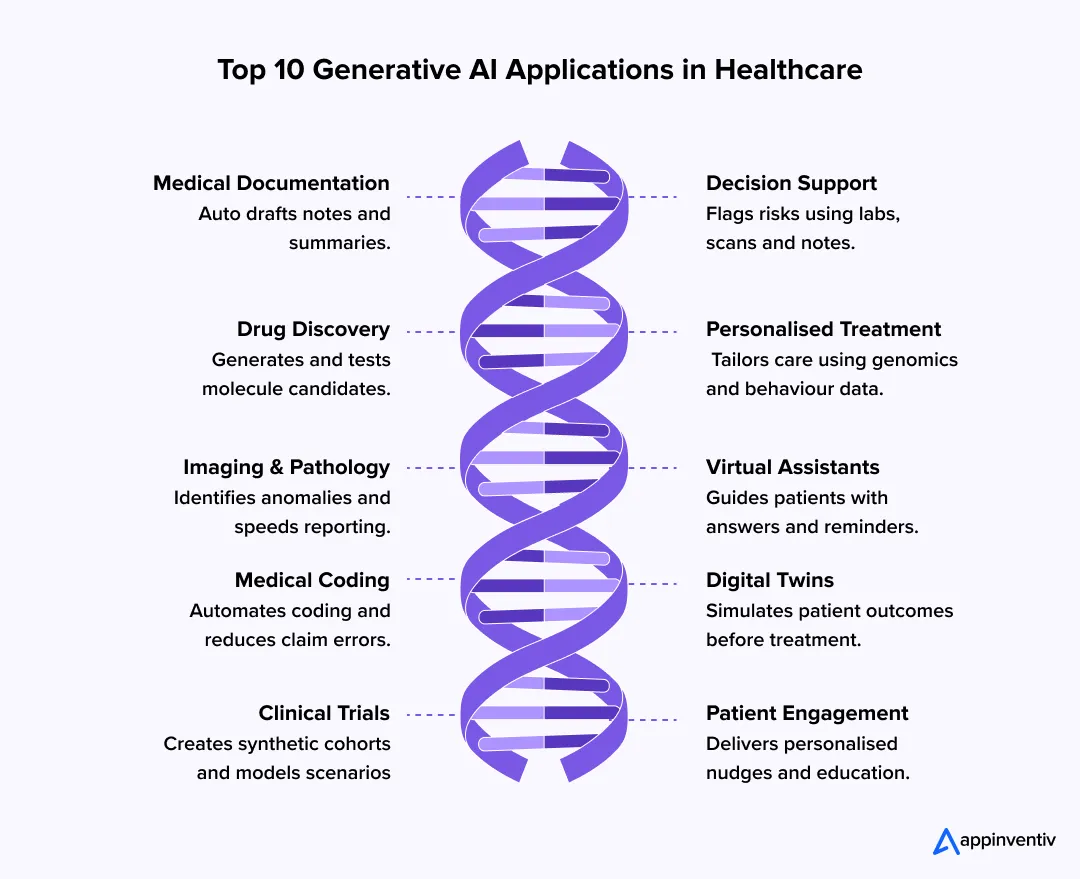
Top 10 Generative AI Applications in Healthcare
As more enterprises explore the applications of generative AI in healthcare, one thing becomes clear. The value does not come from a single model or a standalone tool. It comes from how these systems blend into real clinical, operational, and research workflows.
Whether it is reducing the time clinicians spend on paperwork or helping a pharma team screen molecules faster, each application solves a problem people inside the system feel every day. The practical use of generative AI in healthcare starts in these small, high-friction tasks.
In the next set of sections, we break down the top 10 generative AI use cases in healthcare that are already delivering measurable impact. Each one covers four things leaders care about most:
- How it works inside the workflow (process flow, and architecture)
- Where the enterprise value shows up (productivity, accuracy, speed, adherence)
- What risks need attention (data quality, hallucinations, compliance)
These applications and the benefits of generative AI in healthcare are reflecting where healthcare generative AI is making the strongest difference:
1. Automated Medical Documentation, and Summaries
Documentation has always been the invisible weight on a clinician’s day. Generative AI lightens that load by capturing conversations, pulling relevant history, and drafting notes that feel closer to a first edit than a rough outline.
How it works
- Captures audio or text from the consultation
- Pulls patient history from the EHR
- Generates a draft summary or note
- Clinician reviews. and signs off
Enterprise value
- Cuts documentation time
- Improves consistency in records
- Frees clinicians to focus on patients
Key metrics
- Time saved per note
- Reduction in after-hours charting
- Fewer transcription requests
Risks & mitigation
- Possible missing nuance
- Mitigate with clinician verification, and smart QA prompts
2. Clinical Decision Support, and Workflow Intelligence
Generative AI helps clinicians make decisions with more context. It doesn’t replace expertise; it simply gathers the pieces faster so the clinician has a clearer picture from the start.
How it works
- Reads notes, labs, and imaging
- Highlights patterns or risks
- Generates supportive insights
Enterprise value
- Faster decision cycles
- Better early-risk detection
- Higher workflow efficiency
Key Metrics
- Time to diagnosis
- Correctly flagged cases
- Reduction in manual data checks
Risks & mitigation
- Over-dependence
- Keep human review mandatory, show confidence scores
Also Read: Exploring the role of personalization in healthcare through technology
3. Drug Discovery, Compound Design, and Preclinical Acceleration
R&D teams lose months to early screening. Generative models give them a head start by suggesting structures the team might not have considered. This is one of the clearest demonstrations of Generative AI in medicine, where AI supports scientists in narrowing down viable candidates long before they reach the lab.
How it works
- Proposes molecular structures
- Runs virtual simulations
- Shortlists candidates for lab testing
Enterprise value
- Cuts early discovery time
- Reduces cost per candidate
- Expands the pool of viable molecules
Key Metrics
- Days saved in early screening
- Cost-per-candidate reduction
- Hit ratio in validation
Risks & mitigation
- Risk of model bias
- Mitigate with diverse chemical datasets
Also read: The Potential of AI in Drug Discovery and its Impact on Healthcare
4. Personalised Treatment Planning with Genomics, and Behaviour Data
Every patient responds differently. Generative AI in medicine helps tailor treatment plans by analysing genomics, habits, and medical history, giving clinicians more confidence in choosing the right path.
How it works
- Combines genomic, and clinical data
- Predicts treatment outcomes
- Suggests personalised pathways
Enterprise value
- Better treatment accuracy
- Higher adherence
- Reduced side-effect risk
Key Metrics
- Improved adherence rates
- Better outcome predictability
Risks & mitigation
- Incomplete datasets
- Fix through strong data quality checks
5. Diagnostic Image and Pathology Analysis
Radiology and pathology teams face enormous workloads. Generative and vision models help by reviewing scans, surfacing patterns and summarising findings.
How it works
- Ingests imaging
- Identifies anomalies
- Generates structured observations
Enterprise value
- Faster reporting
- Reduced backlog
- Lower missed-case risk
Key Metrics
- Turnaround time improvement
- Reduction in false negatives
Risks & mitigation
- Misinterpretation of edge cases
- Require radiologist confirmation
6. Virtual Health Assistants and Patient Guidance
Patients often feel lost between appointments. Generative AI assistants help answer questions, provide reminders and guide patients through their care journey.
How it works
- Conversational interface
- Context-aware responses
- Escalation to human staff
Enterprise value
- Better patient satisfaction
- Lower operational load
- 24/7 availability
Key Metrics
- Call deflection rate
- Engagement score
- Adherence improvement
Risks & mitigation
- Inaccurate
- Apply guardrails + human fallback
7. Medical Coding, Billing and Claims Automation
Billing is detail-heavy and repetitive. Generative AI reads documentation and proposes accurate codes, helping avoid slowdowns in reimbursement.
How it works
- Extracts key terms from notes
- Suggests medical codes
- Flags inconsistencies
Enterprise value
- Faster billing cycles
- Fewer denials
- Higher coding accuracy
Key Metrics
- Rejection rates
- Time to reimbursement
Risks & mitigation
- Incorrect
- Add audit checkpoints
8. Digital Twins for Patient Simulation and Outcome Prediction
A digital twin gives clinicians a safe digital space to test treatments and see how a patient might respond before making decisions.
How it works
- Aggregates clinical inputs
- Simulates outcomes
- Provides scenario comparisons
Enterprise value
- Better planning
- Fewer surprises in treatment
- Data-driven decision support
Key Metrics
- Prediction accuracy
- Correlation with real outcomes
Risks & mitigation
- Incomplete physiological modelling
- Continuous calibration
9. Clinical Trial Optimisation and Synthetic Cohort Creation
Generative AI helps researchers speed up trial planning by modelling scenarios and creating synthetic patient cohorts to test feasibility.
How it works
- Creates synthetic datasets
- Models trial outcomes
- Suggests protocol adjustments
Enterprise value
- Faster study setup
- Broader cohort representation
- Lower planning costs
Key Metrics
- Time to trial initiation
- Patient recruitment speed
Risks & mitigation
- Weak synthetic-data
- Hybrid validation with real data
10. Patient Engagement, Education and Behavioural Interventions
Generative AI helps in patient engagement by delivering personalised reminders, nudges and guidance, these small touches that keep patients consistent with their care plan.
How it works
- Reads patient history
- Generates tailored content
- Sends reminders and tracks response
Enterprise value
- Higher adherence
- Fewer readmissions
- Stronger patient trust
Key Metrics
- Engagement levels
- Medication adherence
Risks & mitigation
- Over-communication
- Use smart frequency control
Explore how we architect, develop and deploy GenAI for healthcare.
Real World Use Cases of Generative AI in Healthcare
Real adoption of generative AI in healthcare is no longer confined to innovation pilots. Some of the world’s most respected healthcare institutions are already using it to make daily work smoother, faster and more accurate. These examples show how AI creates value when it blends quietly into clinical and operational routines rather than replacing them.
Mayo Clinic: Automated Clinical Note Generation
Mayo Clinic has been quietly testing tools that help clinicians with one of the most draining parts of their job, which is writing notes after every encounter. Instead of staring at a blank screen at the end of a long shift, doctors now get a structured draft that captures the heart of the conversation. The technology isn’t perfect, and it isn’t meant to be. It simply gives clinicians a head start.
What’s interesting is the emotional response. Doctors say they feel less rushed during appointments because they aren’t mentally trying to “remember the note” while talking to patients. That change alone has made the trials worth continuing.
Novartis: Generative Models for Molecule Design
Novartis has been exploring AI in the early stages of drug discovery, where researchers spend endless hours sorting through chemical structures. AI now helps them generate and test possibilities that would have taken weeks to surface manually. It’s not replacing scientists — it’s widening the search space.
Researchers say it feels like brainstorming with a partner who never gets tired. They still decide what’s worth pursuing, but they get to those decisions faster and with more confidence.
Nvidia and Medtronic: Enhanced Surgical Intelligence
Nvidia and Medtronic are collaborating to bring real-time AI capabilities into procedural and surgical environments. Medtronic is integrating platforms such as NVIDIA Holoscan and NVIDIA IGX into its medical devices, enabling AI models to analyze endoscopy, laparoscopic and robotic-assisted procedure video streams as they happen. This allows systems like Medtronic’s GI Genius to process and highlight visual patterns in the moment, supporting physicians during fast moving procedures.
In early deployments, clinicians describe these AI tools as offering an added layer of awareness rather than replacing clinical judgment. The systems analyze procedural video continuously and surface details that might otherwise be missed in the pace of a case. They do not direct clinical decisions, but they help practitioners catch potential issues sooner and maintain focus throughout the procedure.
Google DeepMind: Retinal Disease Diagnosis
Google DeepMind, in partnership with Moorfields Eye Hospital, has developed an AI system that analyses retinal OCT scans to support early detection of serious eye diseases. The model reads complex retinal structures, compares patterns across thousands of scans and generates referral recommendations that align closely with specialist-level assessments. Research published by Moorfields and the NIHR Biomedical Research Centre confirms that the system can match expert performance across multiple retinal conditions and imaging devices.
The value highlighted in the published work is not faster workflow, but greater diagnostic consistency in settings where clinicians review many images each day. In busy ophthalmology clinics, subtle indicators can be difficult to spot across large volumes of scans. DeepMind’s research shows how AI can provide an added layer of assurance by flagging areas of concern and supporting specialists in making earlier, more confident decisions without replacing clinical judgment.
Cleveland Clinic: Virtual Assistants for Patient Support
Cleveland Clinic has introduced AI-powered virtual assistants to help patients with everyday questions about appointments, symptoms and visit preparation. Instead of waiting on hold, people can get quick answers about what to bring, how to get ready and when to follow up. It lightens the load on support teams, who can then focus on the situations that genuinely need a person on the other side.
The change is simple but noticeable. Fewer calls pile up, fewer details get missed and patients feel less confused while moving through their care. It makes the system feel a little easier to navigate, both for the people asking questions and the teams trying to support them.
Challenges of Generative AI in Healthcare and How to Solve Them
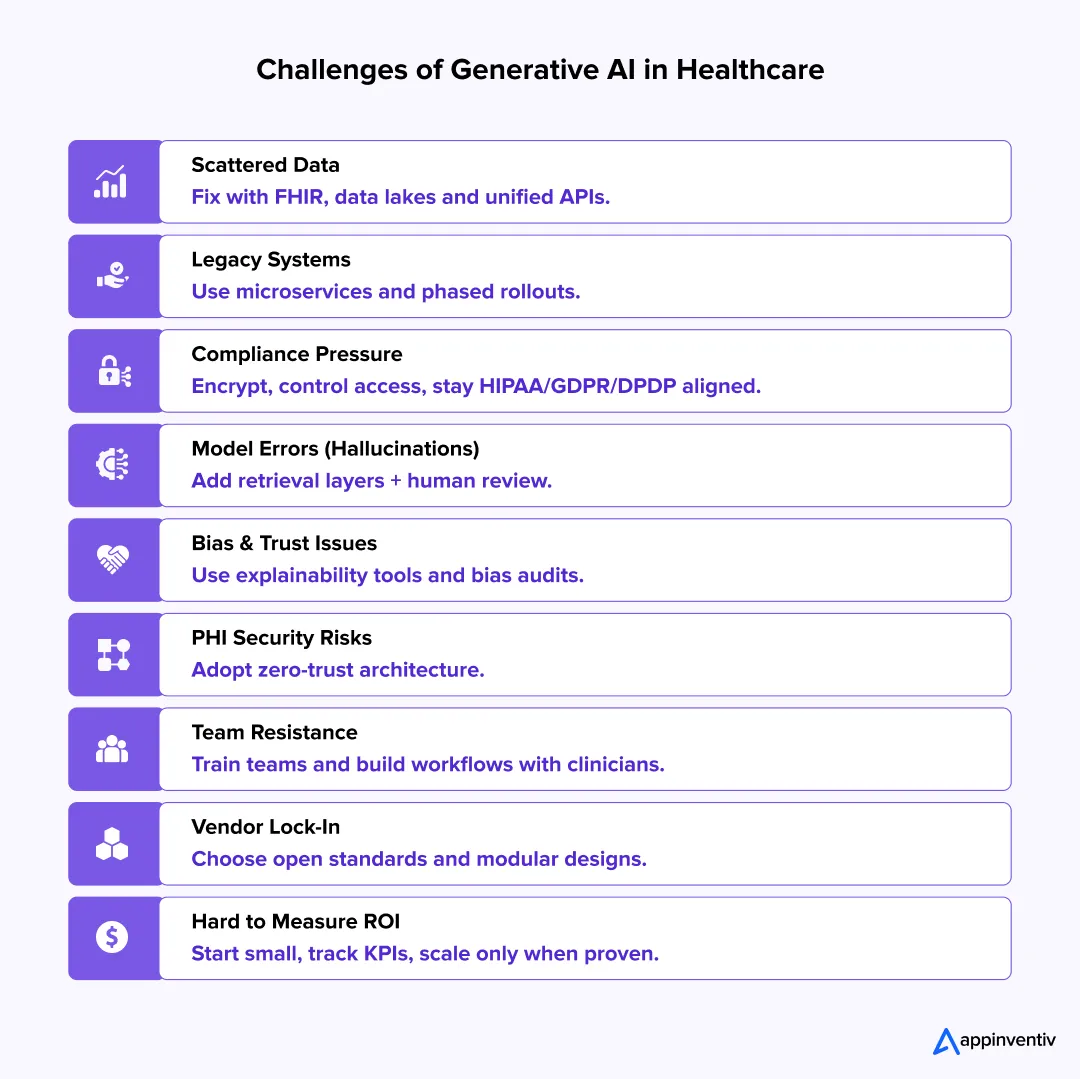
Anyone working inside a hospital or a healthcare enterprise knows this already — adopting generative AI isn’t a straight line. You fix one thing and three others show up behind it. Most teams are excited about the potential, but the moment the real work begins, the messy parts of healthcare start to show. Still, every challenge has a workable, realistic path forward. Here’s what organisations are dealing with, and how teams have been finding their way through it.
Data Fragmentation and Interoperability
If you ask any CIO what slows down AI projects, they’ll almost always point to the same issue: nothing in the system speaks the same language. Lab results live in one place, radiology images in another, and older notes feel like they were written for a different century. AI struggles not because it’s weak, but because the data beneath it is scattered.
How organisations solve it:
Many teams are slowly building cleaner foundations — moving towards FHIR, creating cloud-based data lakes and stitching everything together with unified APIs. It’s not glamorous work, but once the pipes are cleaned, every AI initiative suddenly gets easier.
Integration with Legacy Systems
Legacy systems are the quiet blockers. They’re stable, they’ve been around forever, and nobody wants to break them — but they don’t know how to work with modern AI tools either.
How organisations solve it:
Instead of forcing big-bang integrations for legacy application modernization, teams introduce small microservices around the edges, run things in sandboxes and roll out changes in stages. It lowers the risk and keeps clinicians from dealing with sudden, jarring changes mid-shift.
Regulatory and Compliance Burden
Healthcare doesn’t get the luxury of “move fast and break things.” Every new feature is measured against privacy, consent, auditability and regional regulations.
How organisations solve it:
Most leaders take a “privacy first” approach by encrypting everything, limit who can see what, keep tight audit logs and design the AI workflow in a way that keeps HIPAA, GDPR or DPDP concerns front and centre without slowing down innovation.
Also Read: How Explainable AI can Unlock Accountable and Ethical Development of Artificial Intelligence
Hallucinations and Clinical Risk
One of the most serious limitations of generative AI in healthcare is that models can sound confident even when they are wrong, and in clinical settings, such AI hallucinations are never acceptable.
How organisations solve it:
Teams pair models with retrieval layers so the AI pulls from verified clinical sources instead of guessing. And they keep humans firmly in the loop, especially in any step that touches diagnosis, medication or treatment planning.
Bias, Explainability and Clinical Acceptance
If a model can’t explain why it made a suggestion, clinicians tune out. If the AI feels biased toward a certain dataset, adoption slows to a crawl.
How organisations solve it:
Enterprises now offer explainability dashboards and carry out regular bias audits. They also involve clinical committees early, so decisions around fairness and risk are owned jointly — not pushed from IT to clinical teams without conversation.
Also Read: How to Reduce Bias in AI Models? Key Reasons to Understand and Mitigation Strategies to Follow
Security for PHI
The moment AI enters the environment, the attack surface widens. With PHI involved, there’s no room for “we’ll fix it later.”
How organisations solve it:
Most move toward zero-trust security, assume nothing is safe by default, verify every interaction and lock down access at every step. Combined with secure cloud foundations, this reduces the fear around introducing new AI tools.
Talent and Change Management
The biggest hurdle is often people, not technology. Clinicians already feel overloaded. Asking them to learn one more system, even one meant to help, can lead to quiet resistance.
How organisations solve it:
Successful organisations invest in internal AI training, create small Centers of Excellence and involve cross-functional teams so adoption feels collaborative. When clinicians help shape the workflow, they’re much more likely to support it.
Vendor Dependence
One fear that keeps coming up in boardrooms: “What if we get locked into one vendor and can’t adapt later?”
How organisations solve it:
Leaders now push for open standards, modular architecture and hybrid model strategies. This keeps AI flexible, prevents lock-in and gives organisations bargaining power as the market evolves.
ROI and Value Tracking
Executives want AI, but they also want proof, they are interested in real numbers, not excitement. And many early projects don’t track outcomes well.
How organisations solve it:
Most teams now begin with small, controlled pilots. They set clear KPIs upfront, track improvements in productivity or cost and only scale once the data shows genuine value. This avoids overcommitting and helps AI earn trust across the organisation.
Enterprise Deployment Framework for Generative AI in Healthcare
Deploying generative AI in healthcare isn’t a plug-and-play exercise. The organisations that succeed usually follow a simple, steady path — one that starts with data cleanup and ends with scalable, trustworthy adoption.
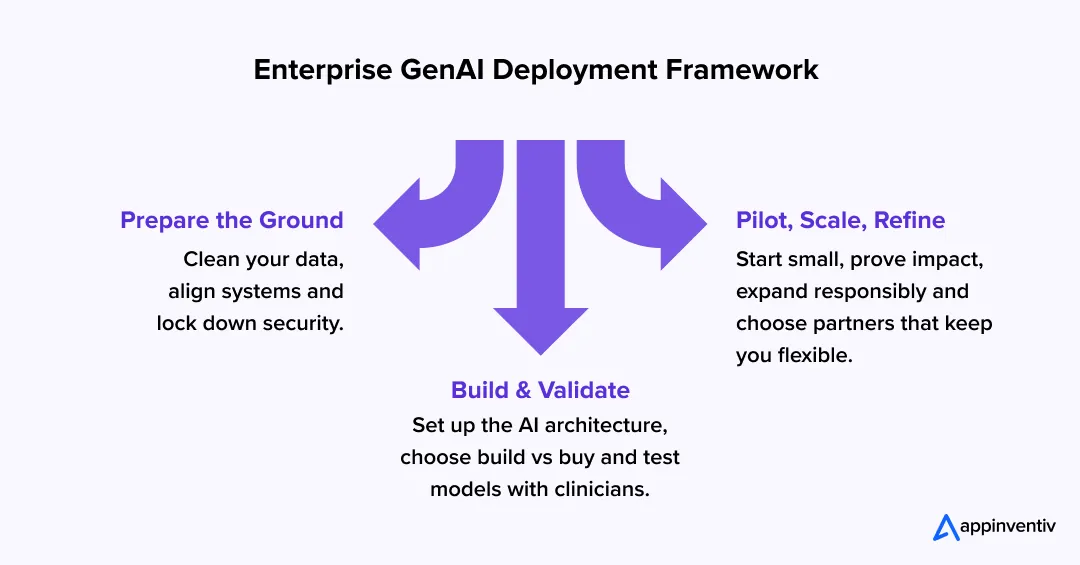
- Data Foundation Assessment: Every journey begins with understanding the state of your data. Most teams find gaps in quality, ownership and consistency that need fixing before AI can add real value.
- Architecture Blueprint: Once the data is mapped, enterprises design the backbone: a modern data lake, a secure model layer, orchestration tools and API gateways that let old and new systems work together without friction.
- Build vs Buy Models: Some models are worth building internally, especially when clinical context matters. Others are faster to buy or fine-tune. Most organisations end up with a balanced, hybrid mix.
- Security and Compliance: Before touching PHI, teams lock down encryption, access controls and audit trails. A privacy-first approach keeps AI aligned with HIPAA, GDPR, DPDP and regional rules.
- Model Validation: AI needs to prove itself. Shadow testing, bias checks, edge-case evaluation and clinical review help teams understand where the model shines and where it needs guardrails.
- Pilot to Production: Start small. Prove value in one workflow, refine the edges, then roll it out wider. This reduces disruption and builds confidence across teams.
- Scaling Strategy: Scaling is less about adding models and more about getting the organisation ready — governance, cost tracking, shared datasets and internal champions.
- Vendor and Partner Evaluation: Choose partners that offer flexibility, open standards and strong EHR integration. The right vendor should help you adapt as the AI landscape evolves.
Future of Generative AI in Healthcare
The next wave of generative AI in healthcare is going to feel less like incremental improvement and more like a quiet shift in how care is delivered. The generative AI in the healthcare future will be shaped by systems that do more than answer questions or draft summaries. They will help us understand what is coming, how to prepare and how to personalize care long before a crisis hits.
AI-Driven Epidemic Outbreak Prediction
One of the most promising generative AI in healthcare trends is epidemic and outbreak prediction. Instead of waiting for outbreaks to reveal themselves, generative models may soon simulate how infections move through different communities. Public health teams could test intervention plans, prepare resources and respond faster — all by running scenarios in advance rather than reacting in real time.
Expansion of Telemedicine
Telemedicine won’t just be video calls anymore. With AI in telemedicine, remote care platforms could interpret symptoms, suggest next steps and assist clinicians during virtual visits. This could make high-quality care more accessible in rural areas, smaller towns or places where specialists are scarce.
Enhanced Genomic Medicine
Generative models are getting better at analysing and even simulating genetic sequences. That means more precise, personalised treatment plans — therapies tailored not just to a condition, but to how one individual’s body is likely to respond. It’s a major step toward truly personalized medicine.
Advanced Mental Health Diagnostics
Mental health conditions often develop quietly. In the future, generative AI tools may help clinicians spot early signs by analysing speech patterns, facial micro-expressions or behavioural shifts over time. These tools won’t replace therapists, but they could flag concerns much earlier and support ongoing monitoring in a gentle, non-invasive way.
Real-Time Health Crisis Management
Imagine a system that picks up subtle signals — a spike in heart rate patterns, unusual ER visit trends, sudden medication lapses — and warns clinicians before a situation becomes serious. Future generative AI platforms could analyze live data streams and offer real-time guidance to clinicians and patients, giving them a chance to intervene early.
Decentralized Health Data Networks
As privacy standards rise, the future may lean toward decentralized data systems where patients control their own records. Generative AI could help analyze this distributed data securely, without moving it to a single location. With blockchain in healthcare, care teams could access the patient insights instantly while preserving patient privacy.
We’ll help you get there with confidence.
Why Healthcare Enterprises Trust Appinventiv
Healthcare leaders often know exactly where Generative AI in healthcare can make a difference — but getting from idea to a real, working solution inside a clinical environment is where things get complicated. That’s the gap Appinventiv fills. As a healthcare software development company, we work closely with hospitals, payers and health-tech teams to build AI solutions that don’t interrupt care, don’t overwhelm clinicians and don’t compromise compliance. Instead, we focus on tools that quietly strengthen workflows, reduce administrative pressure and make patient experiences smoother.
Our work with global healthcare organisations reflects that approach. With YouCOMM, we helped build a real-time patient–nurse communication system that improved response times inside hospital wards. With Soniphi, we developed a voice-analysis wellness app that showed how AI can deliver personalized insights without adding friction to a patient’s routine. These projects demonstrate the kind of thinking we bring as a generative AI development company — practical, secure and deeply grounded in real healthcare needs.
For healthcare enterprises exploring what AI can genuinely achieve, Appinventiv offers a path that’s structured, safe and built for long-term value. If you’re looking to take your next step with Generative AI in healthcare, contact our expert AI engineers and start your AI journey.
FAQs
Q. What is generative AI in healthcare?
Ā. Generative AI in healthcare refers to AI systems that can create useful outputs such as clinical notes, patient summaries, treatment suggestions, synthetic datasets or research insights. Instead of only analysing data, these models generate new, context-aware information that helps clinicians, researchers and care teams work faster and with more clarity.
Q. How has generative AI impacted the healthcare industry?
A. It has become a quiet support system behind the scenes. Hospitals and health-tech teams use it to reduce documentation work, speed up diagnostic steps, guide patients between visits and help researchers explore new drug candidates. The biggest impact is that it lightens everyday pressure on clinicians and makes workflows feel less chaotic.
Q. How is generative AI being used in healthcare?
A. It’s being used across clinical, operational and research tasks including drafting medical notes, analysing scans, personalising treatment plans, predicting outcomes, supporting virtual assistants, planning trials and generating synthetic health data. Most of its value shows up in small, repetitive tasks that slow teams down.
Q. What are three ways AI will change healthcare by 2030?
A. By 2030, AI is expected to feel far more woven into the day-to-day flow of healthcare. Instead of being a separate tool, it will quietly sit behind many decisions, helping clinicians, patients and operational teams move faster with more confidence. The biggest changes will come from how AI supports people, not replaces them.
Three key shifts include:
- Healthcare AI development services will make care more personalised through genomic insights and behaviour-based recommendations.
- It will reduce clinical workload by automating documentation, triage and admin-heavy tasks.
- It will strengthen preventive care through earlier risk detection and continuous monitoring.
Q. What are the modern trends of generative AI in healthcare?
A. The major trends include multi modal models that analyze scans and notes together, synthetic data for safer research, AI-assisted trial planning, virtual care assistants, early outbreak prediction and real-time decision support inside clinical workflows.
Q. How to enable generative AI technology in the healthcare industry?
A. It usually starts with strengthening data foundations — cleaning EHR data, connecting systems and moving to FHIR standards. From there, teams build secure cloud environments, run small pilots, validate models with clinicians and expand only when the workflow feels natural. Strong governance, human oversight and modular integration make adoption practical and safe.

- In just 2 mins you will get a response
- Your idea is 100% protected by our Non Disclosure Agreement.
How to Build Custom AI Agents: Process, Architecture, Tech Stack, and Cost
Key takeaways: Production AI agents need more than LLMs: RAG, IAM, tool controls, trajectory evaluation, observability, and human approval. Start with the workflow, not the model: define business outcomes, autonomy boundaries, system access, and measurable acceptance criteria first. Single-agent architectures should remain the default: add multiple agents only for specialization, security boundaries, or parallel execution.…
Healthcare Business Intelligence Platform: From MIS Reporting to AI-Driven Insight
Key takeaways: Declining margins and an 11.8% initial denial rate have made monthly MIS reporting economically untenable for US health systems. A healthcare intelligence platform differs from a healthcare analytics platform or classic BI stack in three ways: it is prospective, it ingests unstructured data, and it writes insight back into workflow. Vendor labels vary…
Healthcare AI voice agent development: steps, costs, and compliance
Key takeaways: Choose workflows by reversibility, not call volume. Scheduling, refills, and eligibility verification ship in Wave 1; nurse triage waits until last. Lock the latency budget before you choose a model. The turn-time target constrains hosting, retrieval, and orchestration more than any feature list does. Treat the stack as a pipeline, not a product.…